
Background
As some of my readers will know, I was from 1991 to 2008 a working barrister (sometimes in practice in England, sometimes employed by international law firms); I was also nominally a barrister, but neither practising nor employed, from 2008-2016. In 2016, I was disbarred by reason of a malicious Jew-Zionist complaint against me by a pro-Israel lobby group known as “UK Lawyers for Israel” (see the Notes at the foot of this blog post).
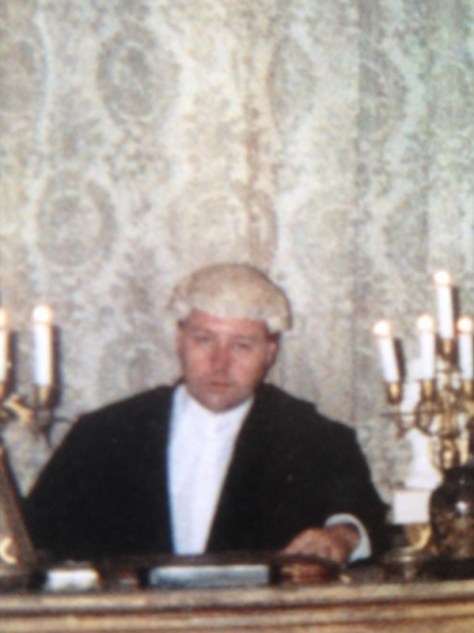
[photo: me as newly-minted pupil-barrister in or about 1992, aged however about 35]
As matters now stand, I have no personal interest in the Bar or the legal professions (the Bar, the solicitors’ profession etc); I do have a general socio-political interest, however, as well as a liking –perhaps excessive– for walking down Memory Lane (my natal chart has Saturn in Scorpio, for those with interest in such things).
I was impelled to write today having seen the Twitter output of someone calling himself “Abused Lawyer”:
https://twitter.com/AbusedLawyer
Thoughts
I start from the premise that a society of any complexity requires law, a legal system, legal rights and duties etc. By way of example, as long ago as the Babylonian Empire (c.600 BC), there existed laws dealing with the ongoing liability of builders to purchasers of houses (English law only caught up with this in, I think, the 1970s). At any rate, any complex society requires correspondingly-detailed laws.
Legal complexity is a sign of a complex society, just as the existence of “celebrity chefs” and “celebrity” sportsmen (etc) is a sign of a decadent society (as in the latter days of the Roman Empire: discuss).
Laws alone, however, are only the start. In order to have effect, laws need pillars of support: (equitable) enforcement, at the very least. Stalin’s Russia had laws on paper, but was very arbitrary and unjust in enforcement. English law has always said that “where there is a right, there is a remedy” and that that remedy will consist in, at root, enforcement of criminal law by a criminal penalty, or in civil law a civil ruling providing for compensation or a mandatory compulsion or prohibition.
There is a further point. In order to get from right to remedy, you need a mechanism with which to do that. In an ideal society, every citizen would be educated enough, have sufficient will or resolve (and the means necessary) to be his/her own lawyer. In reality, there is a need, in every society beyond the smallest and most primitive, for a group of lawyers, so that citizens can be advised, protected, fought for, defended, and also so that society functions with relative smoothness.
As societies progress, they go from having no lawyers, to having a few who are supposedly unpaid amateurs or monied gentlemen who receive only gifts (honorarii) from the grateful, then on to having lawyers who are paid freelancers (or, in some countries, salaried employees of the State).
The question arises as to how to remunerate lawyers. In England, there were at one time several kinds of lawyer: barristers, “attorneys”, “sergeants”, “notaries” etc. These categories were whittled down (for most purposes) to only two by the late 19th Century: barristers (in four “Inns of Court” in London) and solicitors. The barristers, when paid, were paid by the solicitors, who in turn were paid by their lay clients (the term “lay” coming, like much else, from the ecclesiastical vocabulary of the late Middle Ages).
The first State-paid legal aid scheme (criminal) in England dated from the 1890s and covered only the most serious offences (particularly murder, then a capital offence). After WW2, it became gradually clear that both justice and convenience required State funding for at least the more serious criminal offences dealt with at the Assizes and Quarter Sessions (from 1971, the Crown Courts). Civil legal aid dates from 1949 and expanded greatly until 2010, when it started to be drastically cut back, along with criminal legal aid.
When I started at the Bar in 1993 as a real working barrister and not a mere “first six” pupil (spectator and dogsbody), I did quite a lot of publicly-funded work: criminal “rubbish” (in the charming Bar term) in the magistrates’ courts and (far less commonly) the Crown Courts; Legal Aid-funded and also privately-funded civil work in the County Courts (housing, landlord and tenant, contract, various tortious disputes) and in the High Court: judicial reviews (mostly housing or immigration-related), which were via Legal Aid; also contractual problems, libels etc, which were privately-paid.
Even in 1993, criminal legal aid was not too generous (I was in the wrong sort of chambers to get lucrative frauds or other really serious criminal cases), though I still recall the unexpected pleasure at getting a £5,000 fee for 5 days at City of London Magistrates’ Court, an “old-style” committal in a cheque fraud case which later went to the Old Bailey for trial. A Nigerian solicitor and another Nigerian, a recently-Called barrister, cheated me out of that trial, but that’s another story….
I do recall that I did go to court from time to time for “Mentions”, a nuisance involving going somewhere, dressing up, then appearing for (usually) 5 minutes before a judge, all for £45, if memory serves (I was told about 10 years ago that the fee for that was still below £50, 15+ years later!).
On the other hand, I knew several people who, having gone to the Bar in 1988 or 1989 with relatively modest academic qualifications, had started to get lucrative and legally-aided criminal work by 1993. One was making around £100,000 p.a. by being led (i.e. by a Q.C.) in large-scale frauds. The average salary in the UK at the time would have been around £15,000 to £20,000, I suppose.
It is a question of where the line is drawn. The general public read of the few barristers making millions (some from legal aid) and are unaware of the fact that many barristers (solicitors too) make almost joke money, such as (in 2018) £20,000 a year, £30,000 a year etc. That applies especially to criminal barristers (and solicitors). The barrister has many expenses to pay, too, from Chambers fees and rent (which work out at as much as 20% of gross fees received) to parking, fuel etc (in the 2002-2008 period I myself travelled all over the UK, and also to mainland Europe and beyond by car, ferry and plane).
Lawyers must be paid, but how well? Unfortunately, this cannot be left to public sentiment. Just as, per Bill Clinton, “you can’t go too far on welfare” (because the public love to see the non-working poor screwed down on), it seems that the public have, understandably but ignorantly, no sympathy for lawyers! The newspapers make sure of it. On the other hand, read what “Abused Lawyer” has to say…
Further Thoughts
My first thoughts are that the governments since 2010 and perhaps before have had no real interest in the law as a major pillar of society. The court buildings themselves are often not much to look at. Many of the newer (post 1945) Crown Courts are in the “monstrous carbuncle” region, though there are a few modern courts that are better, such as Truro and Exeter, both of which I visited often when practising at the Bar out of Exeter in the years 2002-2007.
Some County Courts are appalling to look at: I once had to appear at Brighton County Court, which is or was like a public loo in almost every respect. Again, I was once only at Walsall County Court: I saw a magnificent 18thC building in the neoclassic style (pillared frontage etc) with the legend “Walsall County Court” on it. However, it turned out that that building had been sold and that the real County Court was now situated nearby in what had obviously been a shop, possibly a furniture emporium. Now, about 14 years later, I have just read that the original building is a Wetherspoon’s pub! Britain 2018…
If you visit courts in the United States, you often find that they embody “the majesty of the law”: pillars, atria, broad stone steps etc. Not all, but most. Even the modern courts make an effort to seem imposing. Not so in the UK! You might ask “so what?”, but image and impression are important. The same is true of the Bar. It is infuriating to see some barristers hugely overpaid, particularly at public expense, but at the same time law and society are diminished if the Bar is reduced to penury.
The question is not simple: the Bar has become overcrowded. Even now, we see that every other (or so it sometimes seems) black or brown young person wants to become a barrister (quite a few English people –so-called “whites”– too).
When I was at school and vaguely thinking about the idea (in 1973, the year in which I in fact dropped out of school!), the Bar had about 4,000-5,000 members (in practice in chambers), whereas now, in 2018, there are 16,000 (but the official definition now includes some —perhaps 3,000— employed barristers). In very broad terms, you could say that the number of practising barristers has tripled in 40 years. However, it seems that in 2017 and 2016, the number exceeded 30,000! Has there been a cull in the past year or so? I do not have the information with which I might answer my own question.
Looking at the situation from my present eyrie of objectivity, it seems to me clear that the Bar (and also the solicitor profession) as a career for many is going to disappear. Britain is getting poorer and the plan of the international conspiracy is to manage that. How? By importing millions of unwanted immigrants (who breed); by getting the masses used to the idea that Britain is getting poorer and/or “cannot afford” [fill in whatever: the Bar, the law, the police, the Welfare State, defence, decency…]. Also, by labelling the few non-sheep standing up against it all as “extremists”, “neo-Nazis”, “racists” etc.
The fees for the criminal Bar and the lower end of the civil Bar will only become more modest. Large numbers of often rubbish barristers will compete for the badly-paid cases going (and some more affluent young barristers, with family money supporting them, will willingly work for peanuts anyway). There is also the point that, when I was at the Inns of Court School of Law in 1987-88, you had to go there for a year in order to take, eventually, the (then) three days of the Bar Examination. Now, all sorts of poor places offer a “Bar Finals course” (now, I believe, called the Bar Vocational Course or BVC, or some even newer name). Thus the supply of (often poor) barristers has increased.
A final word on fees. Traditionally, barristers were not supposed to care about fees. They could not sue for their fees. These attitudes still exist, though in very modified form, today. At the same time, some solicitors take advantage. I suppose that my critics will call me biased etc, but I found that the non-paying solicitors were mostly the smaller, often Jewish or other “ethnic”, firms who, almost invariably, were also very lax on ethics (i.e. were crooks, in blunt language). I suppose that some will ask why I accepted instructions from such firms. Well, there are ways to get out of things, but the “cab rank” rule limits what you can say and do, and the joke “Code of Conduct” would make it impossible to say “no Jews, no blacks, no browns” (etc)…
Looking further ahead, the legal profession is likely to be hard-hit by AI (artificial intelligence).
Notes
Update, 1 December 2018
A tweet about a Crown Court trial by the author of a recent high-selling book on the broken justice system of the UK continues the theme:
As to why (criminal) barristers are now working for peanuts in many cases, see above blog post, and also:
- most criminal barristers cannot do anything else and are by no means always of much interest to those who might pay more, i.e. employers of whatever type;
- most criminal barristers are “me too” pseudo-liberals with the backbone of a jellyfish, as witness their lack of (public) support for me when a Jew-Zionist cabal (“UK Lawyers for Israel”) made malicious and politically-motivated complaint against me to the Bar Standards Board in 2014 (hearing 2016);
- following above theme, most barristers (not only criminal ones) are scared of the (absurd) BSB, the Bar Council, their instructing solicitors, their own shadows (etc);
- some have family money and/or are trustafarians.
Update, 13 December 2018
Another relevant contribution, from a barrister calling himself Cayman Taff…
Update, 16 December 2018
Solicitors: civil legal aid firm numbers reduced by well over 1,000 (from about 3,600 to 2,500), so a reduction of over a quarter. The BBC says “decimated”, but I have ceased to expect much literacy from BBC (or other msm journalistic) staff…
https://www.bbc.co.uk/news/uk-46357169
and I just noticed this tweet (see my mention of “Mentions” in the body of my blog post, above)…
 Ian Robert Millard