Tag Archives: Conservatives

Formation of a Social National Party in the UK

Background

For a number of years, I have watched the socio-political scene in the UK with increasing feelings of concern. The System parties have done terrible things (and omitted to do the right things) without any regard for the national interest, without compassion, without even logic:

  • disastrous foreign wars and other interventions, backing the United States and NATO and (in reality) Israeli interests and the plans for a “New World Order” [NWO];
  • financial madness caused by globalist economics and neoliberalism, not least the inability to tax effectively huge transnational enterprises;
  • gradual takeover by Zionists of strategic areas of society;
  • quite fast increase in the Muslim and other non-European populations of the UK;
  • inflicting appalling hardship and persecution upon the poorer section of the UK population (eg unemployed, disabled) via spending cuts, cruel bureaucratic systems, outsourcing;
  • allowing the NHS to decline steadily in all areas;
  • importation of many millions of immigrants even since 1997, with subsequent births to those immigrants, resulting overall in strain on NHS, roads, trains, housing; schools, prisons, social security, pensions;
  • policies on farming and landowning which do not prioritize wildlife and the environment  in general;
  • crises in care of the elderly;
  • decline in real educational levels covered up by meaningless “degrees” and award inflation;
  • inability to adequately and aesthetically house the population.

The above is not even a complete list of how the System parties have let down the British people.

System Parties

Conservatives

The Conservative Party has inflicted terrible damage on the UK via, inter alia, spending cuts and a coarsening of political converse generally. It might have suffered a huge defeat in 2015, but in the event was saved by the vagaries of the First Past the Post electoral system etc. It has now been saved, for the time being, by the implosion of the Labour Party.

Labour

The Labour Party becomes increasingly less relevant. Even mainstream commentators have woken up to it now. Labour introduced the hateful, dishonest and incompetent ATOS company to persecute the disabled. Labour was the party that decided to invade Iraq and Afghanistan. Labour is infiltrated, indeed pervaded, by the Jewish-Zionist lobby and its agents. True, so is the Conservative Party, but Labour claims to speak for what were once known as “the workers”. That, of course, is Labour’s problem: the bedrock of the “proletariat” has been replaced by the shifting sands of the (increasingly raceless and cultureless) “precariat”. So Labour seems to speak on behalf of metro-liberal “snowflakes”, “antifa” rentamob idiots, employees of the collapsing public sector; above all, perhaps, the “black and brown” ethnic minorities.

Example: in Stoke on Trent, Labour recently won the Stoke Central by-election by 2,500 votes. 62% of the electorate did not vote; of those that did, about 7,500 voted for Labour, 5,000 for both UKIP and Conservative. The constituency has 12% non-English voters (half of them Muslim). Virtually all voted Labour. In other words, the “ethnic” vote swung it for Labour. Educated guess: of the 7,500 Labour votes, virtually all were from ethnic minority (mainly Muslim) voters.

The SNP supremacy in Scotland has taken away about 50 MPs from Labour.

The redrawing of boundaries for 2020 will mean a House of Commons with 600 MPs. Labour is now polling at 25%, concentrated in a relatively few seats. Labour will have 100-200 MPs out of 600. It will be unable to form even a minority government.

Labour is gradually deflating to nothing.

Liberal Democrats

The 2015 debacle has killed the LibDems. The party may be getting “dustbin” or “protest” votes from disaffected Labour/Conservative voters, but its upsurge in 2010 will never be repeated. The Con Coalition mortally wounded the Liberal Democrats and they were lucky not be wiped out in 2015.

Non-System Parties

UKIP

UKIP was founded in 1993 and in the nearly 24 years since then has done well to get MEPs elected but has never come even very close to getting a Westminster MP, except for free-market crazy Douglas Carswell, who after all was already a Conservative MP and may well revert to being one.

UKIP failed badly at Stoke Central and Copeland and those failures reflected its lacklustre performance in local and Westminster by-elections since its peak in or around 2014.

Brexit has shot UKIP’s fox, both on the EU and on EU immigration. UKIP seems unwilling to engage on non-EU immigration and, in general, on race and culture; it seems afraid of being called “racist”. UKIP might have forged ahead had it gone social-nationalist in 2014, but it failed to do that and is now just a (sort of) Conservative joke party again.

UKIP has come to the end of the line except as a dustbin for some white English votes.

Other non-System Parties

There are none, really. Yes, there is “the solitary Green” at Westminster, who will be gone by 2020. The Greens are polling nationwide at 3% or below. As for the BNP, after its rise in 2008-2009, it has all but vanished. Its vote at Stoke Central was 124.

Political Vacuum

It is clear that there is a political vacuum in England. The Conservatives are riding high but only by default, Labour is imploding, UKIP is effectively dead as a party with actual MPs; LibDems may well have no MPs by 2020.

At the same time, real incomes are stagnating or declining in value, immigration continues at about half a million (perhaps 250,000 “net”), housing is inadequate and expensive, young people cannot have a decent life or future, the elderly are neglected, the unemployed and disabled persecuted.

There will never be a better or more auspicious time for social nationalism. However, only if there is a physical instrument, a political movement. I have blogged about the need for safe zones for social nationalism. However, there must also be a movement, part of which must be a political party.

Party

Party Funding

New parties always face financial difficulties. Dependence on donors is not easy yet hard to avoid. A basis of firm finance is essential. It may be that the only way for a small party to grow will be for its members to sacrifice a percentage of their income to the party. On that basis, a party of even 1,000 people can have an annual income of over £2 million (based on average net income of a very modest £20,000 and on a “tithe” of 10% of that).

Party Democracy

In an ideal world, a party should be (arguably) “democratic”, but experience shows that the enemy, particularly the Zionist enemy, is skilled at exploiting cracks and fissures to create factions which eventually destroy the party. It happened to the National Front in the 1970s, it happened (it seems) to the BNP in more recent times. It is happening to UKIP too, despite its doormatting where Israel is concerned, despite its wayward errors in respect of race and culture.

In view of the above, the party leader must have the final say.

Strategy

The way to go is for the new party to target first and foremost seats within the “safe zones” which will attract more and more people from across the UK. Thus the first thing is to create those safe zones.

Further Thoughts and Update (26 July 2018)

The only aspect of the above which requires rethinking is the role –and prospects– of the Labour Party. The bubble of the Conservative Party burst in the final weeks of the General Election 2017 campaign. Labour benefited. That I did not anticipate until the last week or two of the campaign. I see no great revival of Labour fortunes; rather a further deflation of Conservative fortunes. The likely result (in any general election in 2018 or 2019)? Hung Parliament and weak minority government, probably Labour.

As for the rest of my blog post, safe zones etc, all that still applies.

Update, 15 July 2023

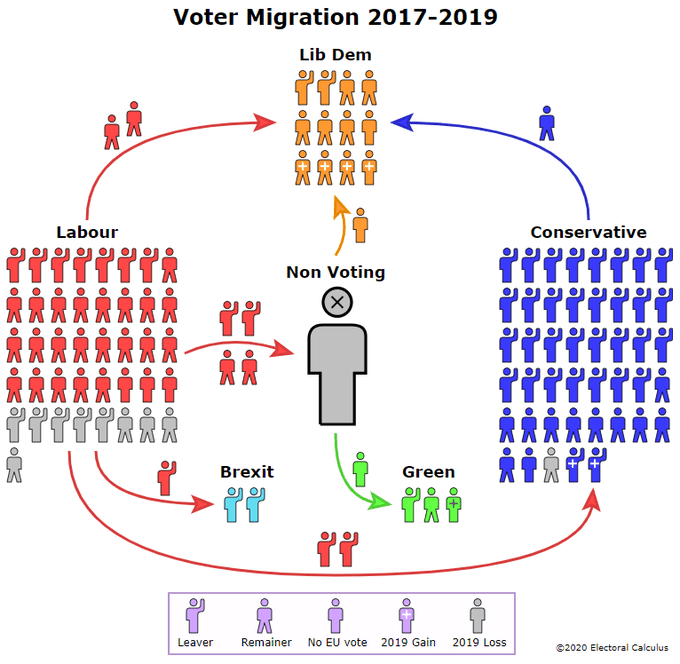
“Man proposes, God disposes“, as they say. The Jewish-lobby attack on Corbyn-Labour, combined with Nigel Farage shooting his own Brexit Party in the back, and the wall of lies put up by “Boris” Johnson, resulted in an unexpected and considerable Conservative Party win at the 2019 General Election.

There was another factor underpinning the Conservative Party win of 2019— the fact that so many Labour Party voters “voted with their feet”, a few defecting to vote Conservative, but most simply not voting:

The Conservative vote-share increased only marginally across the country (more in a few seats), but the Labour share fell by 8 points. Had the Jewish lobby not trashed Corbyn-Labour on a daily basis for several years, and had Nigel Farage really fought for Brexit Party, the 2019 result would have been very different.

As for social nationalism, still no credible party anywhere to be seen./

Copeland By-Election: Watershed?

Three weeks ago, I wrote a preliminary blog post about the upcoming Copeland by-election

https://ianrmillard.wordpress.com/2017/01/02/the-copeland-by-election-the-blog-before-the-blog/

in which I examined the history of the constituency. I also took a look at the factors influencing the present by-election. The time has now come to attempt a prediction with reference to wider political trends.

The Copeland constituency has been in existence on its current boundaries since 1983. The previous constituency, Whitehaven (created during the electoral reform of 1832), was rock-solid Labour (often over 60%) from 1935 until the boundaries were changed in 1983

https://en.wikipedia.org/wiki/Whitehaven_(UK_Parliament_constituency)

The Copeland constituency has continued Labour since its creation: the Labour vote reached its high-water mark in 1997, in the Tony Blair landslide. In that year, the Labour candidate achieved a vote of over 58%:

https://en.wikipedia.org/wiki/Copeland_(UK_Parliament_constituency)#Elections_in_the_1990s.

His successor, Jamie Reed, started off in 2005 with a Labour vote of 50.5%. However, the Labour vote share has steadily declined since then, most recently to 42% in 2015

https://en.wikipedia.org/wiki/Copeland_(UK_Parliament_constituency)#Elections_in_the_2010s

The Conservative vote has been more volatile, ranging in various elections from 29% to 43%. The Conservatives achieved nearly 36% in 2015, only one point down on their 2010 showing.

The UKIP vote in Copeland has mirrored in a modest way that of much of the country: 2.2% in 2005, 2.3% (beaten by the BNP, which got 3.4%) in 2010, jumping to 15.5% in 2015.

The Liberal Democrats have never done very well in Copeland, their vote share flickering around the 10% mark, not exceeding that in 2010 (one point down from their 2005 showing in fact), then crashing to 3.5% in the 2015 debacle.

In 2010, the Green Party stood for the first time since 1987 but received a vote of less than 1%. That improved to 3% in 2015.

There are several factors which do not bode well for Labour:

  • Jamie Reed may be seen as a “rat leaving the sinking ship”, having taken a potentially lucrative position with the company which operates the constituency’s largest employing entity (by far), the Sellafield nuclear plant. That may seep into perceptions of Labour MPs as a whole;
  • recent polling shows Labour nationally as having the support of only 25% of voters;
  • the same polling shows that Jeremy Corbyn is seen as a potential Prime Minister by only 16% of voters;
  • Copeland voted heavily for Leave in the EU Referendum;
  • Copeland is believed to be hostile to the mass immigration which Labour and its embattled leader seem unwilling to criticize, let alone promise to halt.

Labour has now selected as candidate a local councillor, Gillian Troughton, a former medical doctor and supporter of the nuclear industry, in which her husband works. That may help Labour’s campaign, as will her support for the NHS and the local hospital, but Labour’s problems locally stem from its general decline nationally and its generally pro-EU, pro-mass immigration positions.

Traditionally, the Conservative vote in Copeland comes from particular communities along the coast and inland and that vote seems to be rather solid. There is no reason to suppose that the Conservative vote will not hold up fairly well, bearing in mind Theresa May’s recent stance on Brexit and also the immigration question.

Recently-stagnating UKIP can probably expect a surge in its vote, though it seems that the party will probably not be able to do well enough to win, which would require its 2015 vote to increase by at least 50% and probably more. However, UKIP will probably be able to garner votes from disaffected 2010 and 2015 Labour voters.

Turnout is key. In 2015, the Labour vote was 16,750, the Conservatives received 14,186, but UKIP’s vote was only 6,148. It is quite likely that former Labour voters will not so much vote Conservative or even UKIP, but simply stay at home and refuse to support Labour. If turnout slumps, particularly among those former Labour voters, then the Conservatives might well pull ahead of Labour , especially if the UKIP vote increases .

Prediction

Conservatives to win Copeland, with UKIP second and Labour third.

Effect

Only once in 35 years and twice in 60 years has a by-election seat been lost by the official Opposition party. If that happens in Copeland (even leaving aside the result of the simultaneous by-election at Stoke-on-Trent Central), Labour will go into a tailspin.  If Labour is pushed into third place, that effect will be magnified immeasurably.

Corbyn has made it clear that he will not resign whatever happens. Failure at Copeland would lead either to a second attempt to depose Corbyn via leadership challenge or (more likely) to a mass exodus of anti-Corbyn careerists, Blairites, Brownites and Zionists following Jamie Reed and Tristram Hunt out of the House of Commons and possibly out of the Labour Party. If that exodus, in turn, leads to the loss of further Labour seats, then it is hard to see Labour recovering. Ever.

We may be seeing the death of one of the two major (i.e. long-established, sometimes governing) political parties, something that has not occurred since the collapse of the Liberal Party in the 1920s.

Update, 3 March 2019

Well, two years on, looking at the article and its predicted result, I can feel content that I did OK. The Conservative Party candidate, Trudy Harrison, did win, as I thought at the time she would, getting a 43.3% vote. Labour’s candidate, Gillian Troughton, came second on 37.3%. A major factor was the collapse in the UKIP vote, from 15.5% to 6.5%. The vast majority of those votes probably went to the Conservatives.

The Green Party got a 1.7% vote at the by-election, the two Independent candidates 2.6% and 0.4%; none stood at the 2017 General Election.

The contest was reprised only 4 months later, at that 2017 General Election. The “main” (LibLabCon) or System parties ran the same candidates with a similar result: the Con vote increased to 49.1%; the Lab vote however also increased considerably, to 45.1%. The LibDem vote slumped, from 7.2% at the by-election to 3.3% at the General Election. UKIP’s vote slumped too, from 6.5% to 2.5%.

Copeland is now a fairly tight Con-Lab marginal. It could go either way next time.

Update, 5 June 2020

Well, since the last update, there has been another general election, the General Election of December 2019. In that election, the sitting Conservative Party MP, Trudy Harrison, retained her seat, and increased her vote-share to 53.7% (from 49.1% in the 2017 General Election). The Labour Party vote fell back by over 5 points. The other two candidates (LibDem and Green) both scored under 5% of the total vote; both lost their deposits. https://en.wikipedia.org/wiki/Copeland_(UK_Parliament_constituency)#Elections_in_the_2010s

Notes

https://en.wikipedia.org/wiki/Copeland_(UK_Parliament_constituency)

https://en.wikipedia.org/wiki/Copeland_(UK_Parliament_constituency)#Elections_in_the_2010s

https://en.wikipedia.org/wiki/Trudy_Harrison