
Tag Archives: DHSS

Use and Abuse of the UK Welfare State

I am in favour of the Welfare State, in principle, but that just begs the question. Even the Iain Dunce Duncan Smiths and Esther McVeys of this world go that far, at least in public utterances. The devil really is in the detail here.

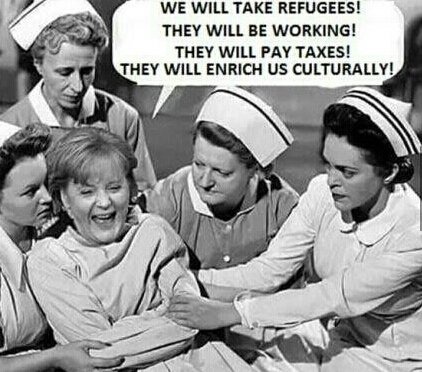
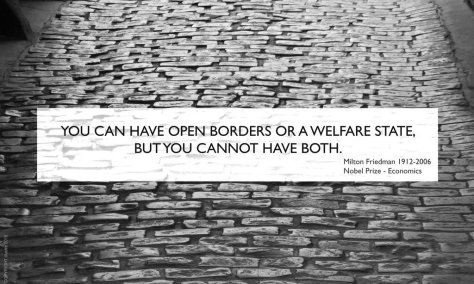
The famous economist, Milton Friedman, once said that you can have open borders, and you can have a welfare state, but you cannot have both. That it is even necessary to posit that shows how far the more socialist-minded people in the UK (and elsewhere in Northern Europe) have travelled from reality. Many “refugees welcome” dimwits actually believe that an almost endless number of “refugees” or others can enter the UK without affecting State benefits and services (as well as road and rail congestion etc). This seems to be based on the idea that the immigrants will work, pay taxes, in short become normal citizens or quasi-citizens. Angela Merkel thought the same, only to find that most “refugees” were

  • incapable of any but the most basic work (such as fruit-picking) because of their linguistic and/or educational levels;
  • unwilling, in many cases, to work, in a situation where the State provides free accommodation, free utilities, free transport for some, free food for some, as well as pocket money on quite a generous level.
CgFqWSRXEAICTlz

The UK does not provide social security (or, in our new Americanized speech, “welfare”) benefits on the generous scale offered by Germany or Scandinavia etc, but the fundamentals are similar.

A personal story: when I was much much younger, in my early twenties, I became acquainted, via a lady I then knew, with a friend of hers (more accurately a woman who had attached herself to her like a limpet). Now this other woman was not British in any sense except that she had married a New Zealander who had (presumably because taken there from the UK as a child) a British passport. The woman was in fact a Jewess from Moscow, who had somehow got to know the New Zealander while he was on a holiday trip to the Soviet Union. We need not examine motives and reasons, but that couple married and went to live in New Zealand. They had two children. After about four or five years, the woman left her husband, left New Zealand and flew to the UK.

When I met the woman in question, I believe that she had been in the UK for a couple of years. She washed-up in Downham, an obscure suburb in South-East London, where the local council provided her with a council flat. I have no exact idea of what other benefits she was granted, but they would have included child benefit and some form of income support. She never had to work, though at first she did a couple of evenings a week teaching Russian at some place or other which I forget (possibly Morley College in Westminster Bridge Road, or the City Literary Institute in Drury Lane, both of which adult education centres I myself frequented at the time).

Scroll on a few years. This “Russian” Jewish woman, with no real connection to the UK at all had been given a quite decent house with gardens in Grove Park, a better part of the same borough. She had been impelled to move, apparently, by a visit from her father, a nuclear scientist (which sounds impressive, but the Soviet Union had legions of them) who had told her that she would have a better flat were she to return to Moscow! Of course, there she would have had to work…anyway, I visited the new house once (out of duty rather than choice)  and so saw it, despite being not much liked by the woman. The woman had been diagnosed with a kidney complaint (though I never saw her looking unwell) and so no doubt managed to claim some form of incapacity or disability benefit; and had also acquired a car (almost certainly also funded by the State). In addition to all of that, the woman and her children also had all the usual UK benefits of free education and health. I do not think that she bothered to do much work after that, maybe a little part-time teaching or occasional low-level interpreting.

Now it might be said, perhaps especially by people more naturally drawn to socialism than capitalism, that she was entitled to these things because lawfully resident in the UK. Perhaps, but look at it from the wider point of view: she had never contributed anything to the UK, just taken. The small part-time jobs here and there can be discounted as having been de minimis. She leeched off the UK’s people since about 1979 and, the last I heard (a couple of years ago), that situation remained unchanged, probably to this day. In fact, she would now be “entitled” to a State pension and Pension Credit. Call it 40 years of being a millstone round the neck of the British Welfare State.

Now multiply the above by millions, the millions of often completely useless people from the backward hordes imported into the UK for decades. For example, it is reported that only 20% of the huge numbers of Somalis in the UK (how? why?) are employed at all.

I repeat, I do favour a decent Welfare State, but it can only exist if

a. the economy can support it;

b. it is not swamped.

The above two conditions really come down to the same thing now, or very nearly so.

For me, the answer to the work and income challenges of robotics, computerization, Internet shopping, AI etc is the Basic Income concept, but Basic Income, like the existing Welfare State, will decline and may fail unless it is restricted to those who are at the very least, genuine citizens.
ClVU6MSWgAAmfK6


Basic Income and the Welfare State– some ideas and reminiscences

Overview

At various times in history, there was either no social welfare system at all, or one which depended on spontaneous or systemized charity: individual alms-giving in the Christian, Muslim, Buddhist, Hindu and other traditions; more organized supply of food, shelter or money as in the ancient Roman dole, Renaissance attempts at poor relief and the cheerless “workhouses” of 19thC England (which in fact continued in places in some form or another until the Second World War and the emergence of the postwar Welfare State).

It is a matter for historical debate whether organized “welfare” in Europe started with the mediaeval Roman Catholic church or in the 19thC with Bismarck, who set up in Prussia and then in the unified Germany a system not unlike those which emerged later in other European countries (eg in the UK under Lloyd George) and further afield: for example, Uruguay had one of the most generous “welfare” (social security) systems in the world until it collapsed in the 1970s under the weight of its expense.

However, the Roman Catholic and other religious and other non-State providers of “welfare” rarely give out money. They supply, variously, food, shelter, often educational and medical help.

The more modern “welfare” systems, eg in the UK, were based on the idea of social insurance: during a working lifetime, you paid in; in periods of unemployment, disability, sickness, old age, you were paid out. In the UK, this has become largely notional. Some tax is still designated as “National Insurance” payment but of course is just an extra type of income tax, fed straight into central funds and not in any way ringfenced.

Some anecdotal evidence

Like many people of my age (b. 1956) in the UK, I had to request State assistance occasionally in the past. This is or was far more common than generally supposed. The writer J.K. Rowling, now supposedly worth £100 million, has described how only the more generous –compared to today– social security of the 1990s enabled her to sit in cafes (partly to keep warm) with her baby, and to write the stories that not much later became Harry Potter. More egregiously, the vampire of Britain’s social security system, Iain Duncan Smith, has admitted that he claimed social security after having left the Army (ignominiously, having only achieved the rank of lieutenant after six years). In fact, Smith, or as he prefers to be known, Duncan Smith (the Duncan not being part of his original surname), claimed social security under false pretences, making him a hypocrite as well as what Australians apparently call a “dole blodger” and (as seen in the scandal of his fake CV and Parliamentary expenses) a fraud.

Certainly, there are those who abuse the social security system. In the past, that was far more common, because the almost Stasi level of control and surveillance that now exists for claimants in Britain had not then been put into place. The system was itself less punitive, less quick to demand impossible levels of enthusiasm for what is now and vulgarly called “jobseeking”.

I knew one woman, a citizen of the Soviet Union, who, having run away from her husband in New Zealand, came to the UK and claimed social security (including disability benefits). How could this happen? Well, her ex-husband, though resident in New Zealand, had a British passport (was British citizen) and had the right to reside in the UK. That meant that his estranged wife could do likewise, even though she had no other connection with the UK and had never even landed there! In fact, that woman never had a job (beyond odd occasional part-time jobs teaching Russian conversation at evening classes). She was supplied with monies for being slightly disabled (kidneys), monies for not having a job, monies for having two children of school age. She was also supplied with free housing. I encountered that person in 1981. She was, I heard, still collecting from the “British taxpayer” in 1996 and is almost certainly still collecting (now State Pension too!) in 2017…All monies legally-obtained, without fraud of any kind.

Another case. A young man (in the mid-1990s), from a very affluent family, who, nonetheless, was “unemployed” and so received whatever unemployment benefit was called then, as well as Housing Benefit for the large flat he occupied in Marylebone, London. In fact, the flat was owned (under cloak of a private company) by the young man’s mother (who lived in Surrey), while the young man had his own freelance work as both a designer and a male model. In this case, there certainly was some kind of dishonesty, both on the part of the young man and his mother. I doubt that they could do the same today, but I last heard of them over 20 years ago, so do not know.

The above two examples seem to show abuse of a system, but here is another case from the 1990s; less obvious, less easy to judge: a single mother of a school-age child, she about 40-y-o, with no relevant educational qualifications. This lady had a small, indeed micro, informal business, making coffee and selling home-made sandwiches to the ladies having their hair done at a large London hairdressing salon. A “Trotter’s Traders” enterprise (“no income tax, no VAT” etc…). About £200 profit on a good week, but more usually less. Not enough to live on, even then, paying Central London rent. That lady was getting State benefits as a single mother; she was getting Housing Benefit too. Now it could be said that she was “defrauding” the State, but her earned income was not enough to live on without State help. Had she given up her private work, the State would have saved nothing, the economy generally would have suffered from her not earning and spending, she and her son would have suffered considerably.

Basic Income

For me, the answer to the above lies in Basic Income, a certain amount paid to every citizen (nb. not to everyone just off the boat, or those who have walked through the Channel Tunnel). The level at which it is set will be, inevitably, contentious. Some will end up with less than under the existing system of State benefits etc. However, it has the merit of certainty. Everyone knows that x-amount will be paid weekly or monthly; those over a certain (to be decided) income can have the Basic Income payment clawed back via the tax system. It may be that everyone should also get free local transport.

The benefits of Basic Income are several. Every citizen will have the basic wherewithal of life: food, shelter, transport etc, without being forced to jump through hoops, without being bullied or snooped upon. The State will save vast amounts on administration, salaries of penpushers, maintenance of useless and expensive buildings such as those called (another vulgarity) “jobcentres”. There will be little scope for fraud and deception, because everyone under a certain income will get the same amount. If society wants to provide the disabled, sick etc with more than the basic amount, then an assessment programme (decent, honest, not cruel, unlike the existing ones) can be put into place for that.

This is obviously the way to go.