
I cannot let the 20th of July pass by without a few words. On 20 July 1944, discontented officers tried to kill Adolf Hitler. Transposed (arguably pointlessly) to a British context, that would be equivalent to discontented British officers trying to kill Winston Churchill and the King (Hitler being both head of government and head of state). In fact, it is at least arguable that both the UK and mainland Europe would have been better had that happened (in 1940, when Germany offered honourable armistice between the Reich and the British Empire but was refused by Churchill and his circle). There would then have been no devastation throughout Europe, certainly in Western Europe, no carpet bombing of German and other cities (eg some French ones, largely destroyed by Allied bombing and shelling: Brest, Le Havre etc).
Above all, Stalinism might well have been destroyed or at least contained. Sovietism would not have been allowed to invade the East and Centre of Europe.
Do not imagine that there were no British senior officers who despised and hated Churchill. Lord Alanbrooke, Chief of the Imperial General Staff and (from 1944) Field Marshal makes his distaste for Churchill’s charlatanry clear in his diary. However, officers such as he were imbued with automatic-reflex loyalty to, not the head of government, but the King as head of state. They probably never thought of mutiny, still less assassination.
On the German side, most of the senior officers plotting against Hitler were content to do his bidding while the German forces were in the ascendant; when Germany started to fail, though, they thought in terms of surrendering on the Western Front, at the same time as holding on on the Eastern Front, thus saving Germany and much of the rest of Europe from what actually later happened, the savagery and barbarism of the Red Army engaged in wholesale murder, rape and looting, followed by the icy grip of Soviet socialism.
Those “disloyal” senior officers of the Wehrmacht (and some others, such as Canaris) were not motivated solely or even mainly by self-interest or their class-interest as aristocrats (not all were aristocrats; among the middle-class ones were Rommel and Canaris), but by a concern for what they conceived to be the ultimate focus of their loyalties– the future of the German state and German people, as well as, beyond that, European culture and civilization generally, threatened by Sovietism which, at that time, was Stalinism.
History is not black and white. National Socialism was a very fine movement overall, but not without flaw. The General Staff and other plotters likewise cannot simply be written off as “traitors” even though, from one point of view, they were. Their point of view, i.e. that Germany was losing the war on at least two fronts, was accurate to that extent. Where they went wrong was in assuming that the USA and UK (and their dependent entities, as well as hangers-on such as de Gaulle) would in fact conclude a separate peace, separate from the Soviet Union. That was pie-in-the-sky thinking. The Allies had already proclaimed, at Casablanca, that only “unconditional surrender” would be acceptable,
https://en.wikipedia.org/wiki/Casablanca_Conference
so the plotters would have had to throw themselves entirely on the mercies of the Western Allies and Stalin, were they to have eliminated Hitler. Even so, it is arguable that that might have been a better result for Germany and the rest of Europe than what actually transpired in 1945. However, that is to look with the benefit of what is now known. At the time, things must have looked very different, especially in Germany itself.
Hitler might have won out, even at the last moment, in terms of the conventional battlefield. The new jet fighters might have turned the tide, had they existed in sufficient numbers; new tanks were outclassing Soviet and Western models; above all, the East-West tension that blew up as soon as Germany was defeated in 1945 might have, in that final year, spelled the end of the alliance between the West and the Soviet Union and given Germany what is now called wriggle-room.
Having said all that, Germany would have been devastated to an even greater extent had it continued to fight after, at latest, the Summer of 1945. The Jewish scientists who created the atom bomb did so on the basis that it would be used against Germany, not, primarily, Japan. Had Germany started to defeat the Western Allies and Soviet forces on the ground and in the air in mid-1945, Berlin and other cities would have been attacked by atom bombs and destroyed; admittedly, in the case of Berlin, Hamburg etc, let alone Dresden, the difference might have been only academic:
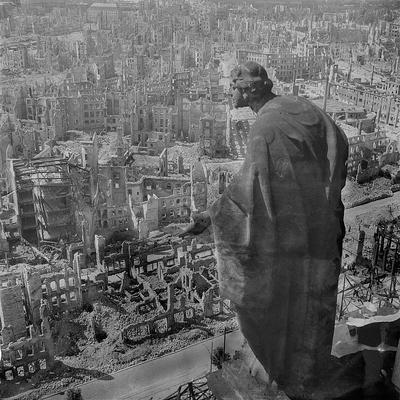
[Dresden after the UK/US bombing, 1945]
The key point is that Germany was not making atomic weapons and had no means with which to do so. It had been checkmated.
So there we have it. I cannot approve (and my approval is irrelevant either way) the actions of the backstabbers of 20 July 1944: Meine Ehre heisst Treue, but the plotters of that time were not all-“good” or all-“bad” in motive or action. As Wolfram von Eschenbach says in the introductory part of Parzival, “blame and praise alike befall when a dauntless man’s spirit is black and white mixed, like the magpie’s plumage”…
History has its own judgment. As Schiller observed, die Weltgeschichte ist das Weltgericht [“the history of the world is the judgment of the world”].
We honour the past but advance to the future.
 Ian Robert Millard