
Tag Archives: Brecon and Radnorshire

After Brecon and Radnorshire, What Now For Brexit Party and the Conservatives?

My original blog post (with updates to 2 August 2019) about the Brecon and Radnorshire by-election

https://ianrmillard.wordpress.com/2019/06/21/brecon-and-radnorshire-by-election-2019/

The result of the Brecon and Radnorshire by-election of 1 August 2019

  • LibDems 13,826 votes (43.5%)
  • Conservatives 12,401 (39%)
  • Brexit Party 3,331 (10.5%)
  • Labour Party 1,680 (5.3%)
  • Monster Raving Loony 334 (1%)
  • UKIP 242 (0.8%)

https://en.wikipedia.org/wiki/Brecon_and_Radnorshire_(UK_Parliament_constituency)#Elections_in_the_2010s

The LibDems won fairly decisively, but with a smaller majority than the betting might have been suggesting. I have posted several informative links below.

Why did the LibDems win, why did the Conservative Party not win?

For me, the most important aspect beyond the headline result is the fact that the Conservative ex-MP, Christopher Davies, would have won, perhaps even handsomely, were it not for the candidature of Brexit Party, which received 3,331 votes.

The LibDem majority over the Conservatives was only 1,425. In other words, had Brexit Party not been standing, the Conservatives would almost certainly have won, and probably by nearly 2,000 votes. The Brexit Party received a vote-share of only 10.5% (LibDems 43.5%, Conservatives 39%), but that was more than enough to sink the Conservative candidate.

The Labour vote has suffered a general decline in the constituency over the years (all-time high was 57.69% in 1964), but this was its lowest-ever vote-share (5.3%). I attribute that partly and perhaps mainly to tactical voting: Labour supporters voting against the Conservatives (mainly) in a situation where Labour had no real chance anyway (the Labour vote here has not exceeded 20% since 2001 (21.4%). However, the 5.3%, barely enough to retain the deposit, does tend to support my view that Labour is now the party of the blacks and browns, the public service workers and those mainly dependent on State benefits.

The Sky News Political Correspondent tweeted something interesting about the Labour vote in Brecon and Radnorshire, which had been in the 10%-18% range since 2005 and until this by-election’s collapse to 5.3%:

Brecon and Radnorshire is almost entirely white British in demographic terms (Powys, the county in which is situated the constituency, is said to be 99.3% white British). In white British areas, Labour increasingly has no chance. Labour scarcely speaks to or for white British people now. This has implications that go far beyond Brecon and Radnorshire.

The Conservatives and Brexit Party down the line

Brexit Party is one of two parties that emerged in 2019 despite having no real policies (the other being the pro-EU, pro-Remain, pro-Jewish lobby party, Change UK, which sputtered to a halt almost immediately and now scarcely exists).

There is no doubt that the early promise of Brexit Party has somewhat blunted since its great 2019 EU elections success. The recent Peterborough by-election was nearly won, but not quite, Brexit Party losing to Labour by a mere 683 votes. Now we have another, though less unexpected, disappointment. Nigel Farage and his large meetings held before both the EU elections and the Peterborough by-election built up a head of steam and a head of expectation, but so far that pressure has just tooted into the void, at least as far as Westminster is concerned.

The political landscape has just suffered an earthquake. Boris Johnson (aka, to me, “Boris-idiot”) is now, incredibly, Prime Minister (or Fool posing as “King for a Day”), having been put there by about 92,000 Conservative Party members (out of about 50 MILLION voters, in other words by about 1 out of every 500 or so eligible voters). He has “pledged” (for what little his pledges are worth) to leave the EU “deal or no deal” by 31 October 2019. If that seems about to happen, I am assuming that the anti-“no deal”/WTO MPs will block it and/or vote for a no-confidence motion. That might in turn cause Boris Johnson to trigger a general election.

Alternatively, the EU might offer Johnson a form of words that he can present to the Commons as a workable “deal” (in the now familiar vulgar terminology). The UK can then pretend to leave the EU but in reality stay in, or kick the can down the road by means of an extension, which Johnson himself seemed to find acceptable recently. The Commons might block the former, but probably not the latter.

An extension (as mooted) might last until 2021 or even 2022. In 2022, new electoral boundaries will be in place in the UK. MP numbers are set to be reduced from 650 to 600. Those changes will hit both Labour and the LibDems hard.

If the Conservatives can hang on until 2022, their chances of survival (as individual MPs and as a party of government) look better. In the meantime, Boris-idiot can go on posing as Prime Minister, and his Cabinet of Conservative Friends of Israel, enemies of the people, can (with the help of their Labour Friends of Israel accomplices) pass more repressive laws to destroy (real) “democracy” and (real) civil rights in the UK…

CZpdYWeW0AQXGc_

Bso85QHCEAA1yun

scan25

That, at least, could have been the scenario had the Conservatives a majority or at least a working majority (reduced by Brecon and Radnorshire to 1 MP vote) and so able to continue as a government. As it is, whatever happens on 31 October, it cannot be long now before Labour moves a no-confidence motion. If not in November, then surely in December or early next year.

Brexit Party has not yet proven that it can win Westminster seats, but it has proven that it can prevent the Conservative Party winning. In Peterborough, the successful Labour Party candidate got 10,484 votes (30.9%). The Brexit Party got 9,801 votes (28.9%). The Conservative got 7,243 votes (21.4%). While it may be that not all of those who voted Brexit Party would, in lieu of that, have voted Conservative, most would have done; hardly any would have voted Labour, in my opinion anyway. It is clear that, without Brexit Party, the Conservatives would have won Peterborough. The same is true in Brecon and Radnorshire.

Boris Johnson may have shot Brexit Party’s fox by going all-out (supposedly) for a “no deal”/WTO Brexit if the EU does not play ball, but he has not killed that fox, just wounded it. If the UK leaves on a “no deal”/WTO basis, then Brexit Party probably will deflate to nothing, though it may reinvent itself even then. However, it seems unlikely that the majority of MPs of all parties will not block such a departure. If that happens, then Boris Johnson, however much he tries to play the Leave “tribune of the people”, will be seen by Leavers as a waste of space, “all hat and no cattle”. In that scenario, the anger of the Leave-preferring voters will devolve upon both Remain MPs and Boris-idiot. Brexit Party will then, like Antaeus treading on his native earth, be revived and take on new strength.

What Boris Johnson and the Conservatives would like is for Brexit Party to just disappear, thus leaving the Conservatives to trample all over the hopelessly-split Labour Party and the LibDems. What is more likely is that the UK will not leave the EU on any real basis by the beginning of November. Brexit Party will thus put up 650 MPs and the Conservative Party will be slaughtered. Most hard-core Leavers will vote Brexit Party, most hard-core Remainers (especially in the South) will switch to the LibDems. For Boris Johnson and the Conservatives, a two-front war. Apart from Brexit issues, anyone who believes in the Welfare State, in decent public services, in animal welfare, will not vote Conservative. Anyone hostile to Jewish Zionism, likewise.

The Brexit Party may only get 10%-20%, so say 15%, nationwide, but that alone all but destroys any hope for a majority Conservative government. My own efforts at working it out using Electoral Calculus [see Notes, below] indicate Conservative Party as largest party in Commons, but without a majority and quite possibly worse off than now.

Much depends on the LibDem vote. At present, the opinion polls show intended LibDem vote somewhere in the 15%-25% range, with latest educated guess (via Ipsos/MORI) at 20%.

That might give a Conservative majority of as much as 74. However, even if that poll is accurate, it is unlikely that the Conservatives will actually maintain a lead of 10 points over Labour. If Labour were able to achieve 30% instead of 24%, which is well within the parameters of reasonable possibility, then the Conservative Party would be 20 MPs short of a majority, i.e. worse off than now.

There again, even if Labour were still on 24%, but if Brexit Party could reach to 15% at the expense of the Conservatives on 29%, the Conservatives would be no less than 57 MPs short of a majority.

On the other hand, If Brexit Party can get 20%, LibDems 20%, Labour 25% and Conservatives 30%, the Conservatives would be about 35 MPs short of a majority.

It is a game one can play for hours.

Conclusions

The LibDems are back in the game, if only by default. They have much of the Remain vote, they have a (notionally) fresh and energetic leader, they have the votes of those disliking the other two main System parties as well as those of persons wishing to vote tactically. They have at least the possibility of a 50-seat bloc (again) in the Commons.

Brexit Party is not looking good as a potential party of government but it is looking effective as a way of blocking Conservative Party ambitions. A general election resulting in 30% Con, 30% Lab, 20% LibDem, 15% Brexit Party and 5% Green comes out with Labour as largest party, but 46 MPs short of majority, the Conservatives not far behind and the LibDems with perhaps about 50 MPs. On that basis, the LibDems could, as in 2010, be once again the kingmakers. Plus ca change…

Notes

https://en.wikipedia.org/wiki/Brecon_and_Radnorshire_(UK_Parliament_constituency)#Elections_in_the_2010s

https://en.wikipedia.org/wiki/Powys

https://www.bbc.co.uk/news/uk-wales-politics-49200636

https://www.standard.co.uk/news/politics/voters-head-to-the-polls-for-brecon-and-radnorshire-byelection-live-a4202956.html

https://news.sky.com/story/liberal-democrats-win-brecon-and-radnorshire-by-election-as-johnson-suffers-first-defeat-as-pm-11775356

https://www.greekmythology.com/Myths/Gigantes/Antaeus/antaeus.html

https://www.electoralcalculus.co.uk/userpoll.html

Update, 4 August 2019

Worth reading:

https://www.theguardian.com/commentisfree/2019/aug/04/boris-johnson-armageddon-clock-what-is-it-counting-down-to

Andrew Rawnsley predicting the demise, quite soon, of both Boris-idiot and the Conservative government (and party):

“As he [Boris-idiot] points the country at the cliff edge and depresses the accelerator, does prime minister Johnson have any idea where this will end? It is a mistake to think that he does. No one knows what he is really up to, including himself. In one breath, he tells us that this is “do or die”; in another, he sets the odds on a no-deal Brexit at “a million to one”;

He [Boris-idiot] has to know that there is a strong possibility that it will mean an autumn general election. The least credible message from Number 10 is that it is not contemplating this outcome”;

Tory strategy for winning an election makes some very big and risky assumptions. One is that the gains harvested by the Conservatives at the expense of Labour among Leave-supporting voters will outweigh Tory losses in Remain-supporting constituencies. Nearly every top Lib Dem target is a Conservative seat, while Scottish Nationalists are hoping to scalp Tory MPs north of the border. The other perilous assumption is that Nigel Farage’s party will fade away or fold up. The leader of the Brexit party is enjoying being the object of renewed attention and displays no signs of wanting to retire again. He declares that he does not trust the prime minister and he has a bitter history of mutual loathing with Number 10’s chief strategist, Dominic Cummings.”

One lesson from the Brecon & Radnorshire by-election is that the Brexit party doesn’t have to do all that well – it polled barely a double-digit share on Thursday – to hurt the Tories. If the Conservatives could have added the Brexit party vote and that of Ukip to their tally, they would have held the seat with just over half the vote, rather than narrowly lose it to the Lib Dems. They’d hope to put a harder squeeze on the Brexit party in a general election, but couldn’t be absolutely confident. All the hazards of this strategy will be multiplied many times over if an election takes place after 31 October. In one scenario, we would still be in the EU, breaking the Tory leader’s “absolute commitment” to his party that Britain will be out “under any circumstances” and hugely boosting the Faragists.”

In the alternative scenario, Britain has tumbled out of the EU without an agreement. That is no longer a threat or a promise. The countdown has reached zero and no deal is a reality. Even in the less chilling versions of a crash-out Brexit – the ones that don’t involve supermarket shelves being stripped bare by panic-buying and children dying for lack of life-critical medicines – I wouldn’t want to be a prime minister trying to make a case for his re-election when the country has just suffered a big economic shock and the currency is collapsing.”

My suspicion is that the Armageddon Clock isn’t really there to count down the seconds to Brexit day. It is there to remind Boris Johnson how long he has left before it becomes too late to avoid his own doomsday.

Of course, I myself have made, in the above and previous blog posts, similar points to those now made by Andrew Rawnsley. He, however, has the inside contacts (and public profile) which I do not have. I, perforce, have to use simply my own knowledge and powers of reason (also, I am doing this unpaid, pro bono publico!)

I should say that there is little incentive for the Brexit Party to form a pact with the Conservatives unless the Conservatives in effect gift Brexit Party at least 50 winnable seats in return for Brexit Party standing down in the other 600. Such a pact might backfire for the Conservatives in that it would

  1. deprive the Conservatives of a number of seats which, even with Brexit Party standing, the Conservatives themselves might win; and
  2. create a bloc of up to 50 “fourth party” Westminster MPs for the first time, so
  3. making Brexit Party far more electorally credible in subsequent elections.

Meanwhile…

https://www.standard.co.uk/news/politics/tory-mps-beg-brexit-party-candidates-not-to-stand-in-their-constituencies-amid-fears-of-split-vote-a4205031.html

If Brexit Party candidates give up their candidature in seats where the Conservative candidates might lose if there is a Brexit Party candidate, then not only has the Brexit Party given up what might be good chances of winning in those seats, but it has restricted itself to standing only in seats where it has, arguably, little chance of winning.

In other words, a one-way electoral pact with the Conservatives almost wipes out Brexit Party’s reason for existing. It might confirm as MPs a few Conservative Eurosceptics, but no political earthquake is going to happen just because of that. The better strategy is to fight all 650 seats and see what happens. If it should be that 200+ Conservative MPs lose their seats, then good.

Update, 23 June 2020

My analysis was not too bad (as good that of Andrew Rawnsley, anyway), but nexpected events happened, as they often do: as we now know, duing the General Election campaign of December 2019, Nigel Farage, for whatever reason, decided to stand down all his Brexit Party candidates standing in Conservative-held seats. That killed Brexit Party stone dead and ensured a Conservative Party victory by default. 2017 Labour voters did not, most of them, vote Conservative, but some did, in some seats. A relative few defected to the LibDems or what was left of Brexit Party, but almost as many as all of those simply decided not to vote.
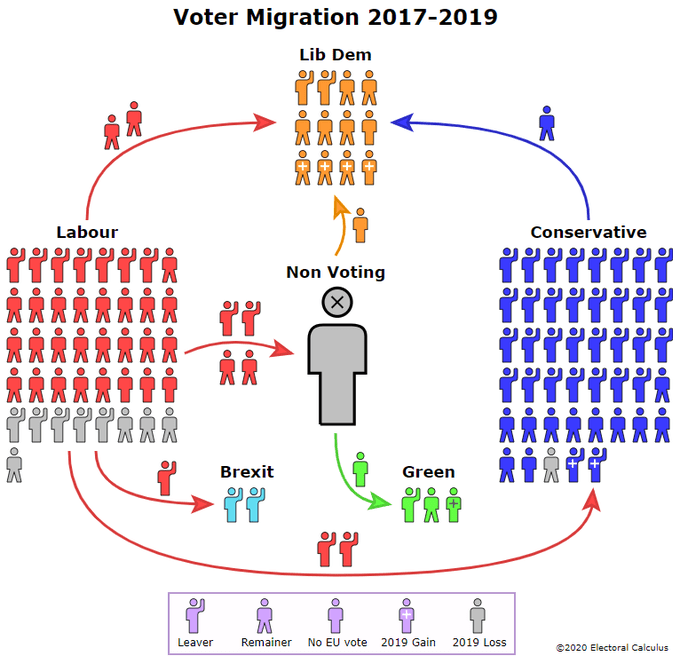
Result: a Conservative Party majority of about 80.

Could the LibDems Win A General Election in 2019-2020?

Background

Nearly eight years ago, when I still had a Twitter account (read “before the Jew-Zionists prevailed upon Twitter to expel me”), I tweeted that the LibDems were finished. At that time, around 2011, the height of the Con Coalition, the LibDem careerists were signing up to pretty much everything required of them by the misnamed “Conservatives”. In fact, even now in 2019, new tales come to light about how totally supine the LibDems in coalition were: recently, for example, it was revealed that the LibDems agreed to screw down harder on the sick and disabled in return for a 5p tax on plastic shopping bags.

The public were so disgusted by the LibDems 2010-2015 that the LibDem support and vote in the country hit almost rock-bottom in 2015. The 2010 general election had seen so-called “Cleggmania” and a popular vote of 23%, resulting in 57 House of Commons seats. In fact, that 23% was only 1 point above the level achieved in 2005 under the LibDems’ former (1999-2006) leader, Charles Kennedy; the LibDems in 2010 had 5 fewer seats than they had in 2005.

Naturally, the UK’s unfair First Past The Post [FPTP] political system left the LibDems with far fewer Commons seats than they “deserved” by reference to their popular vote. 23% of the 2010 popular vote “should” have given the LibDems about 150 MPs, not 57.

The 2010 hung Parliament result gave the LibDems their chance to demand proportional representation, instead of which their leadership (Nick Clegg, Danny Alexander and David Laws, mainly) accepted from the Conservative Party leader, David Cameron-Levita, the mere promise of a referendum on Alternative Vote [AV], a halfway house between FPTP voting and proportional representation [PR].

Gordon Brown, on behalf of Labour, the then Prime Minister, was willing to offer the LibDems immediate AV, via a new law to be passed by Labour and LibDem MPs, but the LibDems instead (and to my mind inexplicably) chose the Conservative offer of a mere referendum on AV over the Labour offer of immediate AV. When they did that, it was already clear that the LibDems (so called “Orange Book” LibDems, meaning pro-finance capitalist LibDems) much preferred to make common cause with the Conservatives.

This “Orange Book” “liberalism” underpinned what the LibDems did in coalition with the Conservatives from 2010 to 2015. The “Orange Book” itself took the LibDems far from the positions of the old Liberal Party and even from those of the LibDem party itself during the time when it was in the hands of Paddy Ashdown and Charles Kennedy.

The authors of the Orange Book favoured socio-political positions not far from those of leading members of the Conservative Party post-2000: effectively anti-Welfare State, pro-business, socially-judgmental, favouring so-called “choice” etc.

It is striking how many of the Orange Book authors have, in the years since its publication, been hit by scandal:

  • David Laws: found to have cheated on his Parliamentary expenses to the tune of about £40,000; many thought him fortunate not to have been prosecuted for fraud;
  • Chris Huhne: prosecuted and imprisoned for the very silly crime of perversion of the course of justice relating to a speeding offence [cf. Fiona Onasanya];
  • Mark Oaten, exposed as a coprophiliac and user of “rent boys”; since when Oaten has represented the International Fur Trade Federation, a largely Jewish body despised by animal-lovers worldwide. Oaten was also a supporter of fox-hunting.

“Only” three, but three out of only nine LibDems who wrote the Orange Book (Oaten admitted that in fact his research assistant had written his, Oaten’s, designated chapter, and that he, Oaten, had not even read that chapter, let alone the rest of the book). Of the other LibDems involved, Danny Alexander and Nick Clegg both lost their Commons seats in 2015 and 2017 respectively, gratefully then accepting lucrative directorships from transnational finance-capitalist companies.

The LibDem fortunes since the days of the Con Coalition

The LibDem popular vote crashed in 2015, sliding from its 2010 level of 23% to only 7.9%. MP numbers were slashed from 57 to 8.

In 2017, the LibDem popular vote slumped further, to 7.4%, though by the quirk of the FPTP voting system combined with the way boundaries are drawn, the LibDems actually managed to increase the number of LibDem MPs from 8 in 2015 to 12 in 2017.

The present situation

Nick Clegg took the Zuckerberg shilling (or should that be million?) and became an apologist for Facebook. He was replaced by Tim Farron, someone who was from an earlier, Nonconformist tradition within the LibDems and their ancestor-party, the Liberals. For example, “Farron was one of only two Liberal Democrat MPs to vote against the under-occupancy penalty (also known as the bedroom tax) in 2012.” [Wikipedia]. Farron was in the anti-Orange Book Beveridge Group [see Notes, below].

In 2017, Farron in turn was replaced by another Orange Book author, Vince Cable. Then, in 2019, Jo Swinson took the reins. She, though very much of the Orange Book persuasion, is more identified publicly with “socially liberal” than with “fiscally conservative” positions. Jo Swinson held the positions of PPS, and then Business Minister, during the Con Coalition period, but has managed to escape too great an identification with the social policies of the Coalition. Surprising, really, in that she

  • “Almost always voted for reducing housing benefit for social tenants deemed to have excess bedrooms (which Labour describe as the “bedroom tax”)”;
  • “Consistently voted against raising welfare benefits at least in line with prices”;
  • “Consistently voted against paying higher benefits over longer periods for those unable to work due to illness or disability”;
  • “Consistently voted for making local councils responsible for helping those in financial need afford their council tax and reducing the amount spent on such support”;
  • “Almost always voted for a reduction in spending on welfare benefits“;
  • “Almost always voted for reducing the rate of corporation tax

[see: https://www.theyworkforyou.com/mp/11971/jo_swinson/east_dunbartonshire/votes]

I have to say that I have always seen Jo Swinson as a ghastly bitch, who, like her husband (Duncan Hames, also a LibDem MP from, in his case only, 2010 to 2015) has been mainly a careerist type in politics; in Jo Swinson’s case, her brief period in provincial commerce before 2005 can only be seen as underwhelming, at best.

My view of Jo Swinson is, admittedly, mainly a personal impression based on what I have seen on TV etc. Her voting record on domestic UK issues must give pause, though, to those who see her as enlightened, socially compassionate etc.

Jo Swinson is a LibDem leader who does not frighten the Conservative horses. That could be key. In 2017, there were, if memory serves, 35 seats where the LibDems were in close 2nd place; there were many others where the LibDem was in close 3rd place. Most of those are Conservative-held seats. The implication is clear: if Brexit Party weakens an already-flagging Conservative vote, scores of (mainly) Conservative seats could fall, many to the LibDems. The Brexit Party is a major factor here.

Then we have the Remain vote. About 48% of the UK, famously, voted Remain. All three System parties were split in the 2016 Referendum, but the LibDems less so than the other two. As a party, the Conservative Party is now seen as basically Leave; the Labour Party is seen as sitting on the fence. That leaves the LibDems as the sole unalloyed Remain party. How that translates into votes and then into seats is another question. For one thing, people are likely to vote in any 2019/2020 general election on various issues, not only Brexit. However, Brexit is probably the one leading issue at time of writing.

The British electoral system is a bad joke. We know that a simple matter such as how the boundaries are drawn can alter everything:

c64bh5xw0aiwygy

In 2022, new boundaries will come into effect, along with the reduction of MP numbers to 600 (from the present 650). The Conservatives will be far less affected than Labour and the LibDems. It has been suggested that the LibDems will be all but wiped out by those changes. Perhaps, but any 2022 or later general election is still at least 2-3 years away. We are looking at the very strong likelihood of a general election within maybe only 2-3 months or so. The Conservatives would like to wait longer, but how can they, when they have a majority of one or none?

Boundaries and other factors make the popular vote indeterminative. In 2005, Labour’s popular vote was 35.2%, and the Conservative vote was not far behind (32.4%), yet Labour ended up with 355 MPs, while the Conservatives won only 198!

If the LibDems can gather to their banner the bulk of the votes of those for whom the number one issue is Brexit and for whom Remain is the only way to go, and then add those votes to the LibDem core support (which may be as low as 7%), then it is not impossible to conceive of the idea of the LibDems under Jo Swinson getting a vote at least as high as Charles Kennedy’s 22% or Nick Clegg’s 23%, and possibly even higher. As against that, many voters will not support the LibDems under any circumstances, either because the party is pro-EU Remain, or because it is seen as weak on immigration (but are the other two System parties any better?) or because most voters remember the LibDems as doormats for the Conservatives during 2010-2015.

In order to form the largest bloc in the House of Commons, the LibDems would have to get a popular vote in the region of 35% or 34%, both Lab and Con getting below 30%. Even then, the LibDems would be or might be at least 100 seats short of a majority.

As I have blogged previously, I do not think in terms of a LibDem surge, but more a concatenation of circumstances —LibDems as sole Remain party, weakening of Conservative vote because of Brexit Party, disenchantment with Labour— drawing votes away from the other parties and so to the LibDems. LibDems as largest Commons bloc? Unlikely but, now, not totally impossible.

Notes

https://en.wikipedia.org/wiki/2005_United_Kingdom_general_election

https://en.wikipedia.org/wiki/2010_United_Kingdom_general_election

https://en.wikipedia.org/wiki/Instant-runoff_voting

https://en.wikipedia.org/wiki/The_Orange_Book:_Reclaiming_Liberalism

https://en.wikipedia.org/wiki/Mark_Oaten#Scandal_and_resignation

https://wikispooks.com/wiki/Susan_Kramer

https://www.telegraph.co.uk/comment/telegraph-view/8508098/David-Laws-broke-the-rules-and-must-pay-a-price.html

https://en.wikipedia.org/wiki/David_Laws

https://en.wikipedia.org/wiki/Chris_Huhne#Expenses_claims

https://en.wikipedia.org/wiki/Chris_Huhne#Criminal_conviction

https://en.wikipedia.org/wiki/Tim_Farron

https://en.wikipedia.org/wiki/Beveridge_Group

https://en.wikipedia.org/wiki/Vince_Cable

https://en.wikipedia.org/wiki/Jo_Swinson

http://www.thetruthseeker.co.uk/?p=195941

Update, 13 September 2019

Well…

So there it is: Jo Swinson could never work with (be in coalition with? proffer “confidence and supply” to?) Jeremy Corbyn and Labour under Jeremy Corbyn.

It’s against her “principles” to support any criticism of Jews or Israel, it seems. Pity that her principles did not extend to refusing to work with evil part-Jew manipulators such as George Osborne and David Cameron-Levita. She and most of the LibDem MPs voted for all or most of the measures which for a decade have demonized, impoverished and actually killed sick, disabled and poor people in the UK via the “welfare” “reforms” of evil part-Jap Iain Dunce Duncan Smith and the Jew “lord” Freud (etc).

I was right about Jo Swinson. My instinct told me that she is an evil bitch. I was right.

https://twitter.com/misslucyp/status/1172941119287648256?s=20

Update, 17 September 2019

https://www.telegraph.co.uk/politics/2019/09/16/lib-dems-would-need-gargantuan-swing-hit-200-seat-target/?li_source=LI&li_medium=li-recommendation-widget

Some LibDems are actually saying that the LDs could get hundreds of MPs in the upcoming general election! Proof positive of their disconnection from reality. People are mostly going to vote LibDem (if at all) only as a way of hitting out at the more major parties. There is no “LibDem surge” as such, but (as I have repeatedly blogged) there is a desire on the part of many Remain partisans to vote against the Conservative Party (mainly).

We have been here before, as when pathetic David Steel urged his rank and file to “prepare for government” (in 1981): http://www.britishpoliticalspeech.org/speech-archive.htm?speech=42

I imagine that the LibDems will pick up some seats, maybe even 50, but what will prevent Jo Swinson getting 200 or becoming PM is that no-one really wants a LibDem government (well, about a tenth of the voters might…), but many more will vote LibDem negatively, to block other parties or to signal pro-EU Remain support.

Update, 8 October 2019

http://www.thetruthseeker.co.uk/?p=195941

Update, 24 October 2019

https://twitter.com/jameshirst91/status/1187268475477213185?s=20

Update, 27 October 2019

Well, my prediction that the LibDems want another “Con Coalition” becomes firmer daily; the Labour reaction is scalding (or should that be “scalded?):

https://twitter.com/TheMendozaWoman/status/1188389011917852674?s=20

https://twitter.com/MikeH_PR/status/1188347126352437248?s=20

https://www.telegraph.co.uk/politics/2019/10/27/bid-libdems-snp-december-9-election-rejected-stunt-tories-labour/

Update, 20 March 2020

Well, my analysis in the above article was right, but the basic facts changed in that Brexit Party candidates standing in Conservative Party-held seats were ordered by their duplicitous leader, Farage, to stand down. That order applied to all Conservative-held seats, even those held by the most committed pro-EU MPs!

That decision by Farage, which betrayed his own candidates and supporters, meant that dozens of pre-election Conservative Party MPs kept their seats when, had Brexit Party stood candidates, they would have lost them to the LibDems.

The LibDems were on track to win several dozen MPs until Brexit Party self-destructed.

Jo Swinson’s decision to push for a General Election, and Corbyn’s silly willingness to be shamed into going along with that, led directly to the victory of the Conservative Party at the 2019 General Election. It led directly to Boris Johnson, a part-Jew, part-Turk public entertainer, as Prime Minister. Disastrous.

My more recent pre-General Election blogging guessed the LibDem result almost exactly. I predicted that the LibDems would get fewer than 10 seats. They got 11. So nearly right, anyway.

As for Jo Swinson, her doormatting for the Jewish lobby paid off, in that she was made a fake “baroness” and elevated to the House of Lords once she lost her Commons seat.

Brecon and Radnorshire By-Election 2019

Recent events in Brecon and Radnorshire

A by-election is to be held in Brecon and Radnorshire constituency (formerly Brecon and Radnor, 1918-1997). Unusually, this by-election has been triggered by the conviction for (what amounts to) fraud relating to the Parliamentary expenses of the sitting MP. Christopher Davies, who had held the seat since 2015, pleaded guilty and was sentenced to 50 hours of community service and a fine of £1,500.

The relative leniency of the sentence may reflect the fact that the £700 wrongfully claimed by way of expenses by Davies could have been claimed legitimately (whether approved or not); the way in which he went about it (creating two false invoices amounting to the sum in question) made it unlawful. On a kind interpretation, Davies was stupid or incompetent more than (very) dishonest. Still not very good for him, I would have thought.

The position of the MP and the calling of the by-election

The events around this by-election raise interesting issues.

The news reports say that the seat “has been vacated”, but I have seen nothing about the Speaker declaring it so, a problem which previously arose during the Fiona Onasanya case, when that MP, despite having been sentenced for perversion of the course of justice, and despite a recall petition having been approved by more than the requisite 10% of eligible voters, still sat and voted as MP for Peterborough (including, crucially, in a significant Brexit debate and vote), also getting paid for months.

Davies may or may not, at time of writing, still be an MP. Even the more serious newspapers and the specialized websites (eg Politics Home) have not clarified the position. The Wikipedia entry for Davies says that his removal as MP was “automatic” once the results of the petition were known, but such is not the case. Wikipedia also says that “the seat was declared vacant on 21 June 2019” (today). Perhaps.

The Conservatives must “move a writ” to start the by-election process. In Britain’s unwritten or (more accurately) uncodified Constitution, this is supposed to happen within (usually) 3 months of the seat being declared vacant. After that, the by-election usually happens within 27 days (of the writ having been moved).

In other words, while in theory this by-election could happen by the end of July 2019, it might not happen until late October or, if the Conservatives really stretched the Constitutional proprieties to the limit, even later. Parliament rises for its Summer Recess on 25 July, so if the writ is not moved by then, the very earliest date on which the writ could be moved would be 3 September, after the Commons return, making the earliest by-election date one in late September.

If Davies is still nominally the MP, then he is entitled to his salary and expenses until such time as he is declared (by the Speaker) not the MP.

Christopher Davies, remarkably (bearing in mind that he pleaded guilty to the charges), seems to be breezy about the matter, and has invited his constituents to his local office, in the small Welsh town of Builth Wells, to view and enjoy the 9 landscape photographs which were the subject-matter of the expenses claims in question! I daresay that many of his constituents might wonder why Parliamentary expenses cover such purchases anyway (surely he or the local Conservative Association should have paid?).

Even more remarkably, Davies says that he intends to stand again! The local Conservatives, meanwhile, have not pronounced on whether Davies will be allowed to stand as a Conservative Party candidate! One can see their difficulty: if Davies stands as Conservative candidate, their chance of success is weakened, contaminated by his candidature, but if Davies stands as Independent Conservative or some such, he may draw off at least a few hundred, maybe even a thousand or more otherwise “Conservative” votes. None dare call it blackmail?

Still, one would have thought that simple ethical standards might have come into play, but in the contemporary Conservative Party, it seems not.

Another strange aspect: one would have thought that the two contenders for the Conservative Party leadership would have condemned Davies for his offences, or at least mumbled something neutral, but it seems that both have been “very supportive”.

The constituency

Before 1939, the constituency, under its Brecon and Radnor name, had as MPs persons from the Labour, Liberal, Conservative, Unionist, National and National Liberal parties (the latter three effectively Conservative coalition candidates).

Labour held the seat between 1939 and 1979. From 1979 to 2019, the Conservatives won 3 times, the Liberals/Liberal Democrats 3 times.

The post-WW2 Labour vote peaked in 1964 at just under 58%; its lowest was 10% in 2010. In general, the Labour vote has declined over the years, having not exceeded 20% of votes cast since the General Election of 2001.

The LibDem vote peaked in 2010 at 44.8% (1st placed), since when it declined to about 28% in 2015 and about 29% in 2017; however in both 2015 and 2017, the LibDems were placed 2nd.

In 2017, the Conservative candidate, Davies, achieved a vote of 48.6%, a post-WW2 record for Conservatives in the seat.

The only other (slightly) significant party contending over the years has been Plaid Cymru, which however has rarely retained its deposit in recent decades. Its typical vote share in recent years has been 2%-3%, though it reached 4.4% in 2015 (3.1% in 2017).

A few other parties have stood over the years. UKIP got 8.3% in 2015 (its best in the seat), but slumped to 1.4% in 2017.

The joker in the pack is Brexit Party.

Conclusion

There are some uncertain factors here: will Christopher Davies really stand again, and if so will it be as Conservative Party candidate or as some type of Independent? Will Brexit Party put up a strong candidate? Whatever happens, the Conservatives must be toast here. If Davies stands as Independent, and with Brexit Party now standing, then the Conservative vote will (probably though not necessarily) be even lower than if Davies brazenly stands again as Conservative. Davies does seem to be quite embedded locally, as a former livestock auctioneer, Royal Welsh Show ring commentator and manager of a veterinary practice.

The LibDems are currently strong favourites. The only thing that would or might upset the applecart would be the Brexit Party, now (announced today) entering the fray. Looking at 2015/2017, the LibDem core vote in the seat is below 30%. Even so, the LibDems must be in pole position here. It’s their election to lose.

Further factors

It is plainly in the Conservative interest to delay this by-election as long as possible. Their notional working Commons majority, even with DUP support, is now only four. If Brecon and Radnorshire goes LibDem or Brexit Party, that will reduce to three. Some Conservative MPs are ready to abandon support if Brexit no-deal looks likely. Boris Johnson may be a very short-lived Prime Minister.

Notes

https://en.wikipedia.org/wiki/Brecon_and_Radnorshire_(UK_Parliament_constituency)

https://en.wikipedia.org/wiki/2019_Brecon_and_Radnorshire_by-election

https://en.wikipedia.org/wiki/Tudor_Watkins,_Baron_Watkins

https://www.bbc.co.uk/news/uk-wales-politics-48720176

https://en.wikipedia.org/wiki/Chris_Davies_(Conservative_politician)

https://ianrmillard.wordpress.com/2018/12/21/deadhead-mps-an-occasional-series-the-fiona-onasanya-story/

https://www.politicshome.com/news/uk/political-parties/conservative-party/news/104734/convicted-tory-mp-chris-davies-booted

https://www.theguardian.com/politics/2019/jun/21/petition-to-recall-convicted-tory-mp-chris-davies-succeeds

https://www.parliament.uk/about/faqs/house-of-commons-faqs/business-faq-page/recess-dates/

Update, 24 June 2019

The Brecon and Radnorshire Conservatives have reselected Christopher Davies as their candidate.

Davies faces an uphill struggle. While his offence was only marginally dishonest, it was still dishonest. It also showed Davies as both lacking in judgment and as simply inept. Apart from that, there is the point that the Conservatives have rarely if ever been lower in public estimation. Also, this is a by-election and the Conservative Party is in government.

https://www.bbc.co.uk/news/uk-wales-politics-48736879

Update, 27 June 2019

The position has now been clarified. Davies is no longer the MP and the writ is expected to be moved today, Thursday 27 June, having failed two days ago. The by-election is now or soon will be set for 1 August 2019.

https://www.bbc.co.uk/news/uk-wales-politics-48764106

https://www.bbc.co.uk/news/uk-wales-politics-48777219

https://www.mirror.co.uk/news/politics/breaking-brecon-radnorshire-byelection-date-17264118

In a sense, I am surprised that the Conservatives did not play this more tactically, in view of their situation re. the numbers in the Commons, but there it is.

Now that Brexit Party is standing, the chance of the Conservatives actually winning (especially with a rather discredited candidate) has shrunk accordingly. If Brexit Party gets half of the 2017 Conservative vote, that would give them about 24%. The LibDems are unlikely to get less than the c.29% they got in 2017. Labour got over 17% in 2017.

If Labour does better than it did in 2017, and if Brexit Party does well too, and the LibDems do at least as well as they did in 2017, then all four serious contenders might well get vote shares in the 20%-35% range. If the Conservative vote were to collapse to, say, 10% or 15%, then the other three parties in serious contention might well end up getting about the same vote shares as each other.

This might turn out to be quite close among LibDems, Brexit Party, Labour, and maybe Conservatives too, with the likelihood of placings in that order.

Update, 29 June 2019

https://www.bbc.co.uk/news/uk-wales-politics-48798705

The Brexit Party has announced its candidate, a retired senior police detective. Ouch! (in view of the Conservative Party backing a convict!)

https://www.bbc.co.uk/news/uk-wales-politics-48810457

Meanwhile, minor Remain-friendly parties look like not contesting the seat, in order to give the LibDems a clear run. Green Party, Renew, Change UK (probably, if they even bother to make a statement, they are already so marginal), Plaid Cymru (maybe).

Renew has never contested this seat, though it scored about 4% in Newport West recently; Change UK is already a “dead parrot” party, marginal, negligible in support (below 1%); the Greens last contested this seat in 2015, scoring 3.1%; Plaid got 3.1% in the seat in 2017.

If Plaid get on board the non-contest train, the boost to the LibDems must be worth several points, maybe as much as 7%, though more realistically about 5%. Worth having, anyway.

https://www.express.co.uk/news/politics/1146794/brexit-news-brexit-party-brecon-and-radnorshire-by-election-renew-party-remain-coalition

Update, 3 July 2019

There are so far 4 candidates standing (LibDems, Conservatives, Brexit Party, Labour), with less than 48 hours until nominations close. Plaid Cymru has “indicated” that it will not be standing, in order to give the pro-Remain LibDems their best possible chance. The other pro-Remain parties, meaning Greens and Renew, are both not standing and for the same reason. Any late entries are likely to be vanity or joke candidates and will not at all change the outcome of the by-election.

The LibDems must be in an even stronger position to take the seat now that the smaller parties are not standing. In the last few elections, minor parties accounted for between 5% and 10% of the total vote.

Update, 4 July 2019

My eye was caught by the latest YouGov national opinion poll, as reported by Britain Elects.

If this poll is in any way accurate (and Ipsos Mori put out a very different result only a week ago, which shows how volatile UK politics is becoming), then Brexit Party would actually be the largest party in the Commons after a general election:

https://www.electoralcalculus.co.uk/userpoll.html

Brexit Party 196 seats (130 short of Commons majority), Labour 148, Conservative 169, LibDem 66. That would mean a Brexit Party government with, almost inevitably, Conservative support; possibly a coalition government. Large numbers of both Conservative and Labour MPs would be gone, including half of those recently vying for Conservative leadership.

Thinking about how that might apply to the Brecon and Radnorshire by-election, it may be that most of the 2017 Conservative votes in the seat will go to Brexit Party, but they might not. There is uncertainty. Personality often means more in rural constituencies than in urban and suburban ones. Much depends on whether voters regard the Conservative, Christopher Davies, as an “expenses cheat” and/or “fraudster” after his criminal conviction, or whether they will “forgive and forget” his sin/error because they (do they?) regard him otherwise as OK and his offence a technical one.

My view is obviously no more than an educated guess, but I should think that many locals will think that £700 is a ridiculous sum to pay out for 9 photographs anyway. Others will see the dishonesty aspect; yet others may think that the former MP should be given a second chance. Much depends on his personal vote, on his local popularity.

I find this by-election hard to call. However, it must be done. On present facts, I think that Labour has no chance, realistically. It is seen as the party of the blacks and browns now, for one thing. They are few in number in that part of the world, unless it has changed hugely since I was last there. Also, Remain voters will go LibDem here, not Labour, whereas committed Leave/Brexit voters will go Brexit Party or maybe Con.

I think that it is quite possible that at least half the 2017 Conservative vote will defect to Brexit Party. The LibDem vote will be solid now that the party is bouncing in the polls; also, in this seat, the LibDems are not seen as a wasted vote, Brecon and Radnorshire having had LibDem MPs from 1997 until 2015.

If the LibDems can build on the 29% they got in 2017, and I think that they will, then they are in with a very good chance. They might get a vote between 30% and 40%.

I doubt whether Labour will get more than 10% or so.

The Conservative vote may collapse, though I remain unconvinced that it will go much lower than 20%.

Brexit Party, if it can capture disaffected Conservative votes, might go as high as 30%. There is another point, which is whether people who prefer Conservative or Labour will vote tactically for Brexit Party. Hard to say. The LibDems must get at least 30% and may get 40%, so Brexit Party has to get around 40% to have a chance of winning.

Provisional Conclusion (with nearly 4 weeks left to run):

  1. LibDems
  2. Brexit Party
  3. Conservatives
  4. Labour

Update, 5 July 2019

With weeks left to run, the online betting market shows the LibDems as heavily odds-on (about 1/5), Labour (oddly, but the market is thin) on 2/1, Conservatives on 9/1, Brexit Party at 12/1. Political betting is a minefield. The favourites often go down. Labour on 2/1 looks like exceptionally poor value! Brexit Party, however, looks like fairly good value at 12/1. My own valuation of the odds would be nearer to: LibDems 1/2, Brexit Party 2/1, Conservatives 3/1, Labour 10/1, but we shall see.

In the meantime, msm commentary has started:

https://www.theguardian.com/politics/2019/jul/05/pro-emain-parties-strike-brecon-and-radnorshire-byelection-pact-to-fight-conservatives

11 July 2019

The confirmed final list of candidates shows the four expected parties (Con, Lab, LibDem, Brexit Party) and two late entrants, namely UKIP and Monster Raving Loony. The UKIP entry will obviously eat into Brexit Party’s chances; to what extent we shall see, though even 500 or 1,000 votes might be enough to sink Brexit Party in the by-election. Looks more like a spoiler than a serious candidature.

https://www.countytimes.co.uk/news/17756758.brecon-radnorshire-by-election-candidates-confirmed/

The Guardian interviews locals. One part stands out:

Given that 19% of the local electorate signed the recall petition, almost double the 10% threshold, a surprising number of locals of different party allegiances express sympathy for Davies’s plight. Yet there are some who are adamant that he should have stood down. One council worker tells me that, owing to her job, she’s in electoral purdah and can only speak off the record. “I signed the petition against Chris Davies because he tried to shaft a friend of mine who works in his office, by blaming the expenses mistake on her,” she says. As far as this council worker is concerned, Davies, whom she voted for in 2017, was given a second chance for cynical reasons. “Everyone knows that they didn’t want to put any promising new candidate in,” she says, “because they know they’re going to lose the seat.”

https://www.theguardian.com/politics/2019/jul/07/brecon-byelection-battle–remain-alliance-quiet-revolution

Meanwhile…

http://www.brecon-radnor.co.uk/article.cfm?id=110936&headline=Homebase%20store%20in%20Brecon%20to%20close&sectionIs=news&searchyear=2019

Update, 19 July 2019

Had a look at Oddschecker betting array. LibDems are hugely odds-on (1/9), Conservatives second at aroung 7/1, Brexit Party about 12/1, Labour 100/1. Not noted were UKIP and Monster Raving Loony. I expect that anyone wanting to throw away a few pounds could ask for and get 500/1 against either of those.

Betting is not always a sure indicator of a election or referendum result, but the LibDems have, as previously said, a lot going for them here: a fairly recent history of providing the local MP, the fact that the Conservative candidate is damaged goods, the fact that those who would have voted for the parties that have voluntarily withdrawn (Green, Plaid Cymru, Renew) will vote LibDem in a contest where Labour is anyway a wasted vote.

Update, 29 July 2019

https://www.thetimes.co.uk/article/convicted-tory-chris-davies-is-a-no-show-at-brecon-and-radnorshire-by-election-hustings-zlrn0p80l

https://www.bbc.co.uk/news/av/uk-wales-49090993/brecon-and-radnorshire-by-election-a-history

https://www.theguardian.com/politics/2019/jul/29/lib-dems-quiet-bollocks-to-brexit-brecon-and-radnorshire-byelection

Update, 31 July 2019

Well, “the moment of truth”, meaning that the by-election will be held tomorrow, Thursday 1 August 2019. This blog post has so far had, in about 5-6 weeks, 600+ views, far above the norm for my blog. Brecon and Radnorshire is having its 15 minutes of fame…

The BBC Wales take on it all:

https://www.bbc.co.uk/news/av/uk-wales-49170677/brecon-and-radnorshire-by-election-voters-highlight-issues

The LibDems are in pole position, hugely odds-on with the bookmakers (1/20 in some quarters), with the Conservatives in 2nd place (about 9/1) and (perhaps surprisingly) Brexit Party in 3rd position (as high as 50/1, which may be, at those odds, a value bet); Labour seems out of it at odds of 150-1.

A month ago, I was predicting, provisionally, LibDems to win, followed by Brexit Party, Conservatives, Labour, UKIP (a pure spoiler candidature, it seems) and the inevitable joke candidate, a Monster Raving Loony calling herself Lily the Pink (presumably after the comic song of 1968).

https://en.wikipedia.org/wiki/Lily_the_Pink_(song)

I see no reason to think that the LibDems will not win Brecon and Radnorshire. They have all the Remain votes and so many of the votes of the highly-subsidized local farmers, though no doubt some of the latter will remain loyal to the Conservative Party and its recently-convicted candidate. I do not know what sort of campaign Brexit Party put up in the constituency, but I should imagine that BP might still come second, notwithstanding the bookmakers. If it does not, Brexit Party’s balloon deflates a little more, but many will be looking at the result of the by-election to see whether the Conservative might have won were there no Brexit Party candidate. If the Brexit Party candidature alone meant that the Conservative could not win, alarm bells will sound at CCHQ.

Update, 1 August 2019

Polling day. The betting odds, for what they are worth are (best odds) LibDems 1/18 odds-on; Conservatives 7/1, Brexit Party 100/1, Labour 150/1. The bookmakers, at least, think that Brexit Party is heading for 3rd place. Perhaps.

It may well be that tactical voting is taking place, in particular that Labour supporters, recognizing that Labour has no chance here, are going with the LibDems in order to ensure defeat for the Conservatives (and Brexit Party).

The only significant changes in the betting are the Conservatives taking closer order (yesterday 8/1 or 9/1, today 6/1 or 7/1, and Brexit Party sliding from 50/1 to 100/1.

Looks as if the LibDems have probably nailed it and that the Government’s majority, even with DUP support, is now 1 MP vote.

https://www.theguardian.com/politics/2019/aug/01/the-view-from-brecon-and-radnorshire-voters-byelection

Update, 2 August 2019

The LibDems won fairly decisively, but with a smaller majority than the betting might have been suggesting. I have posted links here below.

For me, the most important aspect beyond the headline result is the fact that the Conservative ex-MP would have won, even handsomely, were it not for the candidature of Brexit Party, which received 3,331 votes.

The LibDem majority over the Conservatives was only 1,425. In other words, had Brexit Party not been standing, the Conservatives would almost certainly have won by nearly 2,000 votes. I shall be blogging separately later about the by-election and the implications of that Brexit Party aspect for the national political picture.

The Labour vote had suffered a general decline in the constituency over the years (all-time high was 57.69% in 1964), but this was its lowest-ever vote-share (5.3%). I attribute that partly and perhaps mainly to tactical voting: Labour supporters voting against the Conservatives (mainly) in a situation where Labour had no real chance anyway: the Labour vote here has not exceeded 20% since 2001 (21.4%).

https://en.wikipedia.org/wiki/Brecon_and_Radnorshire_(UK_Parliament_constituency)#Elections_in_the_2010s

https://www.bbc.co.uk/news/uk-wales-politics-49200636

https://www.standard.co.uk/news/politics/voters-head-to-the-polls-for-brecon-and-radnorshire-byelection-live-a4202956.html

https://news.sky.com/story/liberal-democrats-win-brecon-and-radnorshire-by-election-as-johnson-suffers-first-defeat-as-pm-11775356

The Monster Raving Loony Party got 1% (334 votes), the UKIP spoiler candidate (or was she just irredeemably stupid?) only 0.8% (242 votes).

There is not much sunshine for the Conservatives in this result. Still, ex-MP Christopher Davies can always return to auctioning cattle; and he has some lovely landscape photographs (the subject-matter of his criminal case) for his Builth Wells office. Something to think about as he endures his community service serf-labour…

“Always look on the bright side of Life”

Update, 13 May 2020

Prior to the 2019 General Election, Christopher Davies was selected to fight the Ynys Mon [Anglesey] seat [https://en.wikipedia.org/wiki/Ynys_M%C3%B4n_(UK_Parliament_constituency)#Elections_in_the_2010s] but stood down after criticism.

Ynys Mon, a constituency which (sub nom Anglesey) goes back to 1545, was won by the Conservative Party at the 2019 General Election, only the third time a Conservative Party MP had been elected there, and only the second Conservative MP (the first having been the multikulti supporter, Keith Best [MP 1979-1987], who was convicted, while MP, on charges of having made fraudulent share applications).

As to Brecon and Radnorshire, the Conservative Party won easily, with a vote-share of over 53%, at the General Election. Brexit Party had not stood (rather, withdrawn) a candidate after Nigel Farage stabbed his own supporters in the back.

https://en.wikipedia.org/wiki/Brecon_and_Radnorshire_(UK_Parliament_constituency)#Elections_in_the_2010s

The present MP for Brecon and Radnorshire is Fay Jones, a rather obscure and youngish woman (34/35 y-o) whose father was also once a Conservative Party MP (and is a prominent freemason in Wales).