Tag Archives: Stalin

What if Beria Had Succeeded Stalin?

Background

I recently re-read Special Tasks: The Memoirs of an Unwanted Witness– A Soviet Spymaster, the autobiography of General Pavel Sudoplatov, who was, inter alia, the brains behind such complex secret operations as the acquisition, in the 1940s, of atomic and nuclear technology from the USA and UK; he also oversaw such sanguinary plots as –and most notoriously– the assassination of Trotsky in Mexico in 1940.

I last read Sudoplatov’s book in 1994, the year of its first hardback publication. On first reading, I did not, perhaps, pay enough attention to the part of the book near the end, dealing with Beria and the Politburo in general after the death of Stalin in 1953.

It might be said that to examine the beliefs and intent of Beria is otiose now that 65 years have passed since his death by summary execution. Also, unsurprisingly, few tears have been shed for him since his death. He was in many ways monstrous: this article is of course limited in scope by reason of, inter alia, lack of space. Beria’s crimes of a political nature were on a vast scale. His more personal crimes were also many and included the regular abduction and rape of women and girls, including some young schoolgirls. Having said that, his swift “trial” (in secret and without defence representation) and the immediately-following execution was a purely political action ordered by those with political records in many ways as bad (Khrushchev, for one).

I start from the following premises:

  • that Western and/or Westernizing conspirators funded and oversaw the Bolshevik coup d’etat in October 1917 (old calendar);
  • that the same cabals set up the Soviet system in the 1920s as a quasi-religious movement (in style) which was atheist (in content);
  • that the quasi-religious character of Bolshevism slowly started to dissipate after the death of Lenin in January 1924, replaced at first by a pseudo-intellectual Marxism-Leninism (incorporating a personality-cult), then by a revival of “Holy Russia” and nationalistic propaganda (mixed with the foregoing) during the war of 1941-45. Finally, there came a late efflorescence of the Stalin personality cult mixed with pan-Slavism between 1945 and Stalin’s death in 1953;
  • that in the (significant number) 33 years from 1956 (the year of Khrushchev’s Secret Speech denouncing Stalinism as a personality cult etc) to 1989, Sovietism continued to decay ideologically, until it finally collapsed into a pile of dust.

Beria, ideologically

Beria was born in Merkheuli, near Sukhumi, which latter was a prosperous resort in late-Tsarist times. His family was not poor. It may be important that (in contradistinction to Russia), the Black Sea littoral was part of the Alexandrine Greek polity and, later, the Eastern Roman Empire. A more cosmopolitan milieu than that of Russia and one which existed for more than a thousand years prior to the first foundation of Kievan Rus.

That area, Abkhazia (geographically a part of Georgia, though historically distinct), was the location of the legendary Golden Fleece and is said to have been the birthplace of wine.

In the Soviet era, peasants were able to (in effect) own their own agricultural or horticultural plots of up to 0.5 hectare (about an acre or so). This was put into law in the mid-1930s. “Special districts” (particularly in Georgia) could have plots as large as 1 hectare (2.2 acres) officially and slightly more unofficially. By 1939, these small plots (only a few percent of the land area of the Soviet Union) produced at least 21% of all Soviet agricultural produce (and a far greater percentage of fruits etc). Some estimates from later times (the 1970s) put the real figure as high as 40%.

The “garden plots” or “household plots” had become important in Georgia/Abkhazia since the end of serfdom in 1865 (serfdom in some parts of the Russian Empire lasted for some years after the formal abolition of 1861).

Beria (b.1899) thus grew up in a milieu quite different from his later Russian and Ukrainian colleagues.

Beria was, as a youth, involved, when a student in Baku (again, a very “capitalist” and cosmopolitan city which, after a long history, had boomed pre-1914 by reason of the oil finds), with both the Bolsheviks and the Azeri anti-Bolshevik Musavat movement, which had Muslim, Turkic and general reformist roots and ideology.

It has been alleged against Beria that he had been involved with British Intelligence in Baku in or around 1919. Not impossible. Baku was of huge strategic importance during the First World War.

Likewise, at his drumhead trial in 1953, it was alleged that Beria favoured soft relations with National Socialist Germany or was even a “traitor” who helped Germany militarily and diplomatically (see the Wikipedia article, below).

Anthroposophy and other Germanic cultural connections

Beria was friendly toward the writer Konstantine Gamsakhurdia, who was educated partly at Berlin University (graduating in 1918) and spent the war years 1914-1918 in Germany and Switzerland as well as France. Gamsakhurdia may well have met Rudolf Steiner (d.1925) at that time, when Steiner was constructing the First Goetheanum (at Dornach, near Basel, Switzerland).

In the 1920s, Konstantine Gamsakhurdia was for 3-4 years a political prisoner in the Solovki concentration camp on the Solovetsky Islands. He would almost certainly not have survived the purges of the 1930s without Beria’s protection.

The son of Konstantine Gamsakhurdia, Zviad Gamsakhurdia, became President of Georgia in the first democratic elections following Soviet rule. He is generally considered to have been an Anthroposophist, and wrote, among other works, Goethe’s Weltanschauung from the Anthroposophic Point of View [pub. Tbilisi 1985].

Beria’s Preferred Policies

Beria was not an idealist, but a practitioner of Realpolitik, par excellence. This enabled him not only to implement Stalin’s repressions without conscience, but also to see the aspects of Soviet life that were not working.

Had Beria succeeded Stalin,

  • he would have brought back a large measure of private ownership, or at least operational ownership, into agriculture. That would have hugely improved Soviet agriculture, whereas Khrushchev’s Virgin Lands scheme was mainly an expensive and ecologically-negative failure;
  • because Beria was not an ideologue, he would have had no qualms in ending the Cold War early. He would have been, to cite Mrs Thatcher’s view of Gorbachev, someone “with whom the West could do business.” That might have meant no Vietnam War, no Soviet support for so-called “Liberation” movements in Africa, no Cuban Missile Crisis, no Berlin Wall;
  • while Beria would certainly have ruthlessly stamped down on domestic political opposition, he would not have repeated Stalin’s mistaken policy (implemented partly by Beria himself) of arresting millions of people for effectively no reason;
  • Beria would have (as Sudoplatov notes) allowed the non-Russian republics a greater degree of independence, thus creating an earlier and more feasible “Commonwealth of Independent States” [CIS], albeit that they would not be “states” but autonomous or semi-autonomous republics.
  • Beria would have concentrated the KGB (its later name) and GRU on useful intelligence gathering and not on playing spy games and fomenting pseudo-Marxist revolts in Africa, Latin America etc.

Conclusion

While it might stick in the craw of many to conclude that Beria would have made a far better ruler of Russia than uneducated Khrushchev with his half-baked huge projects and his bang-shoe-on-table style of diplomacy, the facts speak for themselves.

Notes

https://en.wikipedia.org/wiki/Sukhumi

https://en.wikipedia.org/wiki/Abkhazia

https://en.wikipedia.org/wiki/Household_plot#History

https://en.wikipedia.org/wiki/Musavat

https://en.wikipedia.org/wiki/Baku

https://en.wikipedia.org/wiki/Goetheanum

https://en.wikipedia.org/wiki/Anthroposophy

https://en.wikipedia.org/wiki/Rudolf_Steiner

https://en.wikipedia.org/wiki/Solovki_prison_camp

https://en.wikipedia.org/wiki/Solovetsky_Islands

https://en.wikipedia.org/wiki/Konstantine_Gamsakhurdia

https://en.wikipedia.org/wiki/Virgin_Lands_Campaign

https://en.wikipedia.org/wiki/Lavrentiy_Beria

Literary Note

A British scribbler, one Alex Marshall (formerly of The Guardian, now at time of writing apparently “Europe Culture Editor” for The New York Times) wrote a book called The Caucasus Under Soviet Rule, in which he wrote that “Personally propagating a bizarre Rudolph Steiner-inspired cult of anthroposophy, [Zviad] Gamsakhurdia…[etc]”.

Poorly written, for a start: “Anthroposophy” requires upper-case “A”, just like, say, “Roman Catholicism”. Marshall spells Rudolf Steiner, “Rudolph”, just as those who make fun of Hitler often write his name “Adolph” in petty denigration; also, “a bizarre” should be (if written at all) “the bizarre”.

Marshall’s words sound like a polemic against Anthroposophy, that movement which has achieved so much (though that fact is still not well-known to the masses in the Anglophone countries). To write off Anthroposophy as “a bizarre cult” is itself bizarre: think biodynamic agriculture, Waldorf [Rudolf Steiner] education etc.

I note that Marshall’s book, at least according to some reviewers, contains a number of other factual errors.

In fact, Shevardnadze, who overthrew Zviad Gamsakhurdia, was a ruthless “ex”-Soviet apparatchik who reintroduced large-scale repression into already-chaotic Georgian political life. He was the preferred candidate of the New World Order, completely under the “Western” thumb. I myself was slightly acquainted at one time (c.1995) with one of Shevardnadze’s advisers, who –like me– was on the Committee of the Central Asia and Transcaucasia Law Association [CATLA], a body active in the 1990s and which was supported by the British Government and large London-based law firms with interests in those regions.

http://poli.vub.ac.be/publi/ContBorders/eng/ch0201.htm

https://en.wikipedia.org/wiki/Eduard_Shevardnadze

https://en.wikipedia.org/wiki/Zviad_Gamsakhurdia

https://en.wikipedia.org/wiki/Anthroposophy

https://en.wikipedia.org/wiki/Rudolf_Steiner

Update, 24 November 2018

I have located my copy of the book Beria, by Sergio Beria (Lavrenty Beria’s son), so may add to this blog post when I have reread the book.
Leadership, Dictatorship and The Need For Effective Government

Dix5gSdWkAAinaz

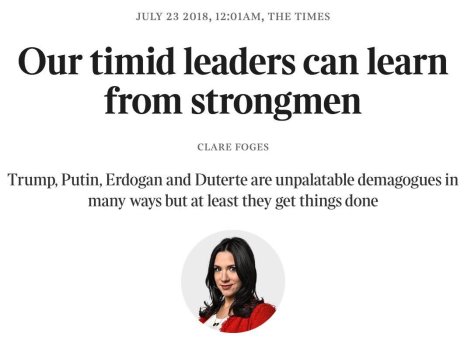
A woman journalist or opinion-writer of whom I had not previously heard, one Clare Foges, has suggested in an article in The Times that the leaders of the UK and Western Europe might learn from political “strongmen” (she cites an eclectic mixture: Trump, Erdogan, Putin, Duterte).

About the Writer

Having not previously heard of the writer, I did a quick Internet search. The surname suggests a Jewish origin, and someone of the same name posted this online in 2000:

https://www.ancestry.co.uk/boards/localities.ceeurope.austria.Prov.vienna/167.588/mb.ashx.

It seems that Clare Foges wrote speeches for David Cameron-Levita and others prior to the 2010 election and immediately after it. She has also written at least one book for small children.

Having now read a little about her, I should say that she seems to have some intelligence, though perhaps not enough, or not enough knowledge, for the matters she discusses in print. Her understanding of society and politics seems shallow. She gave an interview to the Evening Standard in 2015. In it, she proposes, inter alia, better pay (!) for MPs, who “give up well-paid careers” etc. Ha ha! She really should take a look at the collection of misfits, also-rans and chancers who comprise many (not all, admittedly) of the more recent MPs!

https://www.standard.co.uk/lifestyle/london-life/clare-foges-the-woman-who-put-words-in-david-camerons-mouth-10437029.html.

Indeed, in 2017 she herself wanted to become an MP, for the fairly safe Conservative seat of the Isle of Wight, but withdrew after having been shortlisted:

https://www.conservativehome.com/parliament/2017/05/exclusive-foges-joins-fox-in-withdrawing-from-isle-of-wight-selection.html.

In fact, the then-incumbent MP had hardly “given up a well-paid career”, having been a geography teacher in comprehensive schools for most of his life:

https://en.wikipedia.org/wiki/Andrew_Turner_(politician)#Early_life_and_career

and that MP (also an expenses freeloader…) then “stepped down” after having “become a laughing stock” by reason of his quasi-matrimonial situation:

https://www.telegraph.co.uk/news/politics/conservative/11334299/MP-battling-to-save-seat-in-toxic-Tory-rebellion-after-fiancee-moves-in-with-his-aide.html.

In short, my provisional view is that the writer of the article is, at 37 or 38, someone who for whatever reason has fallen between the cracks, who might have become something in the political realm, even perhaps an MP (and after all, her background as pr/”comms” “intern”, sometime children’s book writer, “Conservative” speechwriter, amateur poetess and (?) professional scribbler on politico-social issues is no worse than that of many “Conservative” or “Labour” MPs, and better than some) but has not.

The Issues Raised

What are we to make of this article suggesting that the UK needs leadership informed by “strongmen”? Duterte is the Philippines leader who has presided over a campaign of extra-judicial killing of drug gangsters etc. Erdogan is the political-Muslim Turkish dictator (by any other name) who is dismantling the legacy of Kemal Ataturk. Putin and Trump are too well-known to need any introduction even to those who take little interest in politics.

The main issue, surely, is that government must govern. It must be effective. Ideally, there will be checks and balances: law, due process, civil rights, property rights (within reason); however, in the end, a useless government has no right to exist.

Political leaders (including dictators) emerge for reasons. In broad brush terms, Putin emerged because Russia under Yeltsin had become a chaotic mess. Pensioners and other poor people were starving or dying from cold or lack of food, by the million. Public sector workers were being paid almost nothing. Jew carpetbaggers had flocked to Russia like a cloud of locusts (or vultures) and were stealing and cheating everything, pretty much. “Russian” Jew “oligarchs” ruled from “behind the throne” and had tricked their way into “ownership” of vast oilfields, diamond and gold mines, heavy industries. Putin began to claw back some of that. Pensioners who had been getting (USD) $5 a month under Yeltsin, now (2018) get $400. People are at least paid for work. Chechen and other gangsters have been stamped on and many killed or imprisoned. Russia has flourished compared to the 1990s.

Erdogan is someone for whom I myself have little sympathy, not least because I value the legacy of Kemal Ataturk. However, Erdogan has improved the lot of the poor, we read, while the economy has improved under his rule.

Trump likewise seems an egregious person generally, and even more egregious as a leader of a government and as a head of state. However, his rise (fuelled by his own huge fortune, of course) was not based on nothing. Many people in the USA are living in poverty. I read that 40% of Americans now require US governmental foodstamps! Many jobs (as, increasingly, in the UK and elsewhere) are “McJobs”, precarious and badly-paid. The drug epidemic is out of control. Illegal immigration had run wild since the 1980s. Whether Trump can deal with these problems and others,  with the “separation of powers” American system, is doubtful, but the dispossessed and marginalized, among others, voted for him to try.

The Missing Leaders

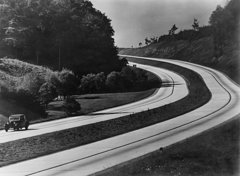
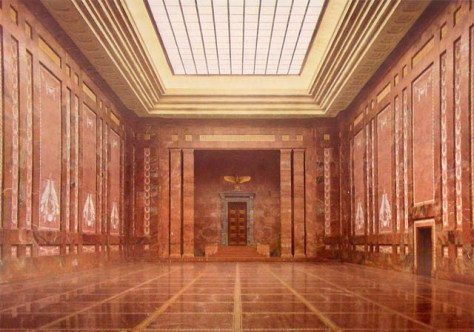
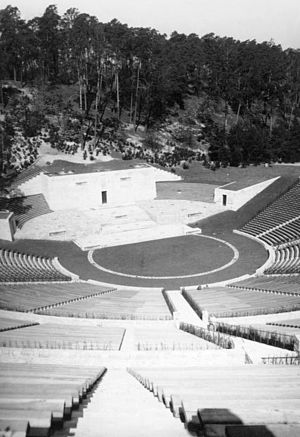
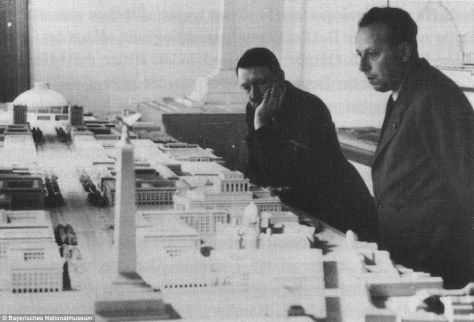
Clare Foges cited Trump, Putin etc, but not the controversial leaders of the 20th Century: Stalin, Hitler, Mussolini, Mao etc. They all took harsh measures but also did a huge amount that was positive. Hitler in particular saved Germany from degradation, removed Jew exploiters from the economy, the professions, the mass media; built autobahns (the first in the world); created air and airship travel routes; vastly improved animal welfare; planned new and better cities and national parks; put Germany to work and (for the first time) gave workers rights such as decent breaks at work, Baltic and other holidays in Germany, and also foreign holidays including cruises. Decent homes were built on a huge scale.

3396AD3500000578-3561575-Hitler_had_lived_in_Munich_just_before_World_War_I_and_remained_-a-1_1461778976380.jpg

an-automobile-on-the-sweeping-curves-everett

Chancellery2DietrichEckartBuhneVW3

Britain could do worse than follow Hitler’s lead, introducing some updated and English/British form of social nationalism.

Stalin was far harsher as a leader and as an individual than Hitler or Mussolini, though Mao might be considered far worse (but of course he was non-European). Stalin however (like Hitler) was put back domestically by war. Stalin did recreate the industrial sector, which was booming before the First World War but which Bolshevism all but wiped out as a thriving economic sector. Stalin’s major mistake (apart from his cruelties and brutalities etc) was to allow the agricultural sector to be ruined via Collectivization, the legacy of which is only now being very slowly erased.

Mussolini did a huge amount for Italy. His posturing on balconies etc is what people now think of when his name is mentioned, but he eliminated the Mafia (until the Americans caused its revival after 1943, releasing the imprisoned leaders and followers), started to get rid of the terrible urban slums (unfortunately more were created as a result of the Anglo-American invasion of 1943); Mussolini also created an advanced scientific and industrial sector, mainly in the North. Famously, he also greatly improved the railways, and “made the trains run on time” (both truth and metaphor). Now, the wartime propaganda of the Western Allies and Stalin is all that most people outside Italy know– Mussolini as clown. Ironic that a real clown (the leader of the Five Star Movement) is now a major political figure in Italy!

https://en.wikipedia.org/wiki/Beppe_Grillo.

Britain 2018

The UK has been pretty much left to rot since 2010. The Blair government, though repressive and in the pocket of the Jewish-Zionist lobby, tried to modernize infrastructure generally. New buildings were constructed: hospitals, libraries, schools. Credit where due.

The David Cameron-Levita-Schlumberger government of idiots was not only the most pro-Jewish/Zionist government Britain has ever had, (until Theresa May became Prime Minister), but also the least-effective of modern times (again, until that of Theresa May?). It not only failed to do anything new and decent, but also failed to maintain that which already existed, in every sector, from libraries and schools to the air force and navy.

The lesson surely is that government must be effective. If it is not, the State stands in peril. The people eventually demand action. They are beginning to demand it now.

The article by Clare Foges is, it seems to me, a sign of the times, or a straw in the wind. The political times in Britain are a changin’…

Notes

http://www.bbc.co.uk/programmes/profiles/3tMvnMp3DFW3z99Zvc7WC3T/clare-foges

https://www.standard.co.uk/lifestyle/london-life/clare-foges-the-woman-who-put-words-in-david-camerons-mouth-10437029.html

A critical article from the New Statesman:

https://www.newstatesman.com/politics/elections/2018/07/sorry-clare-foges-dictatorship-isn-t-just-character-flaw-it-s-crime

Another critique of her views:

https://www.property118.com/clare-foges-anti-landlord-the-times/comment-page-4/

She was desperate to become an MP but no-one wanted her:

https://www.telegraph.co.uk/women/womens-politics/11436355/Sir-Malcolm-Rifkind-resigns-Kensingtons-next-MP-might-be-this-woman.html

Another Clare Foges article. She seems to be very much of her time, meaning 2010-2015, as in this Cameroonesque piece of sort-of social Darwinism. I think that Clare Foges can be written off as a serious commentator.

https://www.thetimes.co.uk/article/put-feckless-patients-at-the-back-of-nhs-queue-5hnlqqstg

https://www.dailymail.co.uk/news/article-2267901/Clare-Foges-The-raven-haired-poet-ice-cream-seller-wrote-PMs-big-speech.html

Further thoughts, 6 December 2018

According to the Daily Mail, Clare Foges is “a devout Christian”. She may still be of part-Jewish ancestry (see above). My other query about the “devout Christian” bit is how does a “devout Christian” want to put IVF couples ahead of people needing NHS treatment for serious conditions just because they drink, smoke etc? Is that “Christian”? Even evil Iain Dunce Duncan Smith is said to be “devoutly Christian”…Yeah, right!

In the end, I suppose that it scarcely matters whether Clare Foges is this or that…and I just noticed that her Daily Mail bio was written by the egregious Andrew Pierce, so we can probably discount it…

Incredibly, she is appointed OBE!

https://www.huffingtonpost.co.uk/entry/labour-blocks-david-cameron-speechwriter-claire-foges-from-joining-party-to-oust-jeremy-corbyn_uk_58d90195e4b03787d35a3d08?guccounter=1&guce_referrer_us=aHR0cHM6Ly93d3cuZ29vZ2xlLmNvLnVrLw&guce_referrer_cs=Y57ohgKaElO9EWmxBHKC1w

Looking at her photos and her behaviour, I think that she is probably at least partly-Jewish.

Her Twitter comments (read the thread):

https://twitter.com/ClareFoges/status/985813260824989696

She has not tweeted since April 2018.

She writes in The Times, but also as freelance pr person…

http://www.finelinelondon.com/

She has certainly written columns in The Times [of London] several times, but is not on that newspaper’s list of its 29 “key” columnists. I have just taken a look on the Internet, and not seen anything online written by her as Times columnist in the past months (since August 2018), though her Linked-In profile avers that she is still a Times columnist. I did see a piece from November 2018 published in The Sun “newspaper”.

https://uk.linkedin.com/in/clare-foges-906a4676

Update, 9 November 2020

I have just seen that Clare Foges has been writing a column for The Times about once per week in recent months. I had not noticed, never now reading that newspaper (does anyone?I suppose some still do).

What’s in a Name?

Religious and occult literature is replete with learned disquisitions about the sacred power of the Name. We see that, in Genesis, the Bible itself starts with the words “In the beginning was the Word, and the Word was with God, and the Word was God.” In the New Testament, this theme is continued. Jesus Christ renamed some people who had “come over to him”, such as Peter. Others, later, renamed themselves, to mark their “ideological” or spiritual transformation, as when Saul became Paul after his experience on the road to Damascus.

In Rome, Octavius becomes the Emperor Augustus or Caesar Augustus eventually (the style Augustus Princeps was bestowed upon him by the Senate of Rome in 27 B.C., when he was 35).

In early mediaeval Spain, Rodrigo Díaz de Vivar is given the name El Cid (from the Arabic for “lord”, sidi) to crown his mission. Likewise, in the Christian monastic tradition, the postulant chooses or is given a new name, often one referencing a deceased saint. The same is true of religious leaders such as bishops, metropolitans, popes etc. Gandhi is called Mahatma Gandhi, same surname but elevated by the new forename.

In literature, we see that the hero who fights perceived evil, particularly if doing so covertly, takes a new name, a nom de guerre: the Scarlet Pimpernel was an early example, followed by many another, right up to the “superheroes” of the 20th and 21st centuries: Superman, Batman, Spiderman etc.

In the field of espionage too, we see that sometimes a secret agent who becomes a known character is given or takes a name: the White Rabbit, the Welshman etc. Mata Hari…

Politically, the same applies: the anarchist Bruno Traven (itself a pseudonym) was known in early 1920s Germany as der Ziegelbrenner (“the Brickburner”). Better known were the noms de guerre of the Bolshevik leadership: Lenin (V.I Ulyanov), from the river Lena; Stalin (I.V. –or JV– Djugashvili), from “steel”, Trotsky (L.D. Bronstein), a Russification or Polonization of the original Jewish (Yiddish/German-style) name. In fact, most Bolshevik leaders took on longlasting pseudonyms, in a macabre aping of those old religious orders: Scriabin became Molotov (from molot, “hammer”), though he was a rare real ethnic Russian. Most of the Bolsheviks who changed name did so partly to disguise their otherwise all-too-obvious Jewish identity. Having said that, the new names of the leaders also often spelled out the new strong self-image: “Steel”, “Hammer” etc. [Stalin and Molotov were among the few non-Jews].

Though German National Socialists were not generally given to changing name and in fact disapproved on principle, some did so temporarily, while on the run or on special missions. Hitler himself used the nom de guerre “Wolf”, Herr Wolf”, and “Herr Doktor Wolf” while evading State agents in Munich after the failure of the Beer Hall Putsch of 1923. Hitler himself did often say that it was fortuitous that his name was Hitler and not, as it perhaps might have been, Schicklgruber

[https://en.wikipedia.org/wiki/Adolf_Hitler#Ancestry].

“Heil Sch…!” you get my meaning. Names are important. Many a showbusiness personality has achieved fame and fortune only after changing name. Beyond even that, the use of “transformational vocabulary” can change, with the name, the sense, the sense of mission or purpose. Thus, the U.S. combined operation “Desert Shield” of 1990 became “Desert Storm” of 1991, as defence turned to attack.

The use of a particular name for a political party or group can energize it and make it stand out: En Marche!, le Front National, the Angry Brigade, Leave and so on.

An allied aspect is that of the Invocation, a word or form of words designed to link the material with the spiritual, to send up prayer or supplication, and to bring down power to the Earth. “Heil!” is an obvious example. “Heil Hitler!” which eventually (in just a few years) replaced the likes of “Good day” and “goodbye” in, at least official, Germany. Hitler’s speeches are often very well-written, erudite, informed, but the power of Hitler’s oratory was not founded on its content, but on something above and beyond content. Yet that still required words as a basis.

When we consider how to pull the UK and Europe out of the mess into which it is sliding, we must consider the sacred power of the Word and use it.

Notes

https://en.wikipedia.org/wiki/Trotsky_(surname)

Reports and Lies

We are accustomed to reading the most arrant nonsense about Adolf Hitler. According to this stream of black propaganda (which started as long ago as the 1920s), Hitler was savage, unforgiving, tyrannical, vituperative, uneducated, a down-and-out from the gutter, a house-painter, sexually perverse, an erotomaniac, impotent, excessively interested in women, a gay, mad, sometimes mad, occasionally mad, only interested in his own material benefit, a tax dodger, even harsh toward his beloved dog, Blondie!

In Hitler’s own lifetime, a pack of lies was spewed out by his enemies: Jewish elements and interests; the Communists and Socialists who, many of them, supported or condoned Stalinism; also journalists working, in effect, for those same groups. During the Second World War, both the Soviet Union and the Western Allies maintained huge ministries and agencies dedicated to “black propaganda”. After 1945 the baton was passed to the increasingly prevalent Jewish or Zionist lobby and its major offshoot, the “holocaust” industry, aided by historians who knew that their careers depended on not challenging the approved narrative.

The “Hitler was a house-painter” story seems to have come from a Jesuit priest who was taken to hear Hitler in Munich in or about 1920. He asked what Hitler was (at that time Hitler had few followers and was unknown outside the city); the answer came, “I think that he is a painter of houses” (no doubt a garbled version, heard somewhere, of Hitler’s pre-WW1 life as a struggling art student and painter). In the 1930s, Churchill took up that false version of Hitler’s life as a young man, no doubt calculating that English snobbery would be inherently biased against a political leader with a past involving painting houses or the like. Even today, one occasionally sees reference to Hitler “painting houses”.

The idea that Hitler was “mad” came from an anti-Hitler newspaper editor (probably the half-Jewish scribbler Konrad Heiden), who, in the 1930s, told the American correspondent and anti-Hitler propagandist William Shirer (who posed as an historian after 1945) that Hitler was a “Teppichfresser” (“carpet-chewer”), meaning prone to bouts of insanity when he would supposedly curl up in rage on the carpet and chew the edge of the same. A complete invention, which has coloured the popular view of Hitler ever since, though even the Jewish historians no longer make the exact allegation.

As to the stories and speculations about Hitler’s  sex life, I should imagine that every possibility has now been explored by journalists and historians eager to reduce Adolf Hitler to a sort of freak show. Needless to say, the most likely possibility (that Hitler was “normal” but unenthusiastic) is of little interest, being unlikely to sell books or newspapers.

A more recent allegation has been that Hitler was a drug addict. Again untrue, though there is at least a kernel of fact underpinning this one, in that Hitler’s doctor, Morell, was a medical innovator who did tend to experiment on his patients. Hitler demanded results; Morell tried to provide them:

https://en.wikipedia.org/wiki/Theodor_Morell#Substances_administered_to_Hitler

(actually, though many have quailed at Morell’s preparations, such as the ones that included “intestinal bacteria”, these were the basis for the now-popular “active” yoghurt health drinks for the stomach now found next to the milkshakes in every UK supermarket).

What about Hitler as a vengeful tyrant? This seems to rest mainly on his reaction to the 1944 plotters, who, in the midst of Germany’s fight for survival, saw fit to blow up Hitler and the German High Command at Rastenburg in East Prussia (now in Poland). Yes, they were executed, some cruelly, it seems, but would it have been much different in, say, England, had Churchill been blown up by “traitors” at Ditchley Park (in, perhaps, 1940), alongside his military and naval chiefs?

In reality, Hitler was not a vengeful type. Anton Drexler, the locksmith who founded the then DAP which Hitler joined in 1919, had a serious quarrel with Hitler in 1921. He wrote a letter accusing Hitler of “acting like a Jew, twisting every fact” (!), was removed as head of the party (replaced by Hitler) and was given a purely figurehead position until he resigned in 1924, after which he was elected to the Bavarian Parliament for another party, serving as elected member until 1928. Despite that, Drexler was readmitted to the NSDAP in 1933, honoured (though not given any political position) and died peacefully in 1942. One cannot imagine Stalin treating a similar case the same way!

Another example. The first reports about an attempted putsch in Munich in 1923 (the Beer Hall Putsch, also known as the Hitler-Ludendorff-Putsch), reached the ears of a police commander called Sigmund von Imhoff, who contacted the Reichswehr commander of the city and seized the telephone and telegraph exchange. He was probably the most important reason that the putsch failed (amid bloodshed, Hitler himself being injured as the main march was brought to a halt).

One can well imagine what Stalin, on attaining power, would have done with an officer such as von Imhoff, but under Hitler he was not punished. On the contrary, he was promoted to Police General in 1933 and, in WW2, seconded to the Luftwaffe with the rank of Major General (he died in Bavaria in 1967).

This article could be ten times or a hundred longer, so many lies about Hitler and the Reich have been told and continue to be told. However, the few examples above perhaps will give pause to those who imagine that they have been told the truth about those world-historic events of the 1920s, 1930s and 1940s.