Preamble
The Brexit argument in the UK has brought to the fore divisions and truths which, until recently, had been covered up by a “politically correct” or bien-pensant “consensus” in the (largely Jew-Zionist-controlled or strongly influenced) mass media and political milieux.
Anyone who imagines that “Brexit” is just about the UK’s membership of the EU is indulging in hobby-politics and joke-politics and/or exhibiting very poor political judgment. I have blogged about this on previous occasions, eg:
UKIP is the joke party and hobby-politics party of the UK, effectively a one-trick-pony, obsessed with the EU and EU immigration but not hitting hard on non-EU immigration and only peripherally touching on other issues. However, those voters who grasped at the UKIP straw up to 2015 were voting to a large extent not for Nigel Farage as Prime Minister, not for UKIP’s clown MEPs as UK ministers, not even simply to get Britain out of the increasingly sinister EU matrix, but as a protest and shout of anger against a whole host of issues, not all of which are connected directly to the UK membership of the EU.
What Is Democracy Anyway?
“Democracy” is one of those terms which is rather imprecise and commonly misused (another is “holocaust”, usually and deliberately misused and distorted by Jew-Zionists and others as “the Holocaust”, the definite article and the capital letter supposedly differentiating any misfortunes visited on Jews in the Second World War from similar misfortunes visited on non-Jews throughout history).
In ancient Greece (for example Athens, the home of the idea of “democracy”), we see that only the relative few had full political rights. In the 4thC BC, Attica had about 300,000 inhabitants (in the state as a whole, not just the “urbanized” polis of Athens itself). Out of that population, only about 100,000 were citizens. Out of that 100,000, only 30,000, being adult male citizens who had completed military service or similarly accepted service, were allowed to vote or to participate in political life. Women, slaves, freed slaves, children and metics (foreigners resident in Attica) were not allowed to vote etc. In other words, out of 300,000 inhabitants, only about 30,000, 10% of the whole, played a significant political role.
UK Democracy: the expansion of the electorate
In more modern times and in England/UK, we see that, though a kind of representative Parliament existed from the 13thC AD, the electorate (using the term broadly) widened over the centuries. At the time of the first great Reform Act (1832), the population of England and Wales (excluding Scotland) was about 12 million, out of which only 200,000 in counties and perhaps 20,000 more in boroughs had voting rights (see Notes, below), about 2% of the whole population (nb. population estimates of that era are not very accurate: some estimates say 400,000 in toto, so perhaps 4% of all inhabitants could vote), a far smaller percentage than in Periclean Athens! In France, the percentage with voting rights was even smaller, but was expanded hugely when universal suffrage was introduced in 1848.
The percentage expansion of the electorate in Scotland in the 1830s was far greater than applied in England and Wales. Some historians use the term “revolutionary”. I wonder whether that has perhaps had a lasting effect on Scottish socio-political attitudes down the line, even to the present day. Just a stray thought…
Further expansion of the electorate in the UK (as a whole, not just England and Wales) in the 19thC meant that, by 1912, there were 7.7 million voters, a figure that increased to 21.4 million following the Representation of the People Act 1918, which extended the franchise to most women of 30+ years, as well as to almost all men of 21+. Of course, the actual population had also increased very greatly, from 27 million in 1850 to 42 million in 1918.
In 1928, women 21-29 also gained the vote, increasing the number eligible to vote to about 27 million.
Changes in the Post-1945 era: where are we now?
UK voting qualifications have not changed substantially since 1928, except that, since 1948, university graduates have no longer had two potential votes, and the minimum voting age is now (and since 1970) 18.
There are now about 65 million inhabitants in the UK (some put the figure higher, by reason of undocumented, unregistered “illegals” etc).
Does “democracy” mean that all inhabitants of the state must be enfranchised?
The South African Example
We have seen that, in ancient Athens, only male citizens who had completed military service could vote. In “apartheid” South Africa, there was a fully-functioning democracy limited however to those of European (white) origin.
There had, prior to 1910, been non-racial forms of limited democracy in Cape Province, limited by reference to property etc. From 1910-1961, the vote was granted to all white men in South Africa, to mixed-race men in Cape Province, and to black men in Cape Province and Natal. Only white men could become Senators or MPs. White women were allowed the vote in 1930 and could serve as MPs or Senators. Blacks and “coloureds” (mixed-race) were barred from holding those offices. In 1960, the black franchise was terminated; the mixed-race franchise followed in 1968. Later, in 1984, an attempt was made to re-enfranchise the mixed-race population and to enfranchise, on a limited basis, the Indian population.
In 1992, a small majority of (white-only) voters endorsed, by referendum, the end of the apartheid system, after which South Africa adopted a different system, under which all person of 18+ years can vote or be elected. In practice, however, this led to what is effectively a one-party, typically-African state, shambolic and corrupt. The African National Congress (ANC) operates what is effectively an elected dictatorship. In the most recent election (2014), its vote declined, but it still holds 249 out of 400 seats (on 62% of the popular vote).
Under this “new” (post-1994) “democracy”, the white population of the country is under siege from both crime (racially-based) and/or (connected) “political” attack, such as the robbery, rape and murder of whites, particularly in the rural areas. Neither are the (mainly black) poor of South Africa helped by the “elected dictatorship”. Indeed, in some respects they are worse off than they were under apartheid. The “infamous” pass laws may have restricted the blacks, but also restricted crime, which has become epidemic.
The USA
The USA is supposedly a “democracy”, but in practice any Presidential candidate has to be a multi-millionaire or billionaire, or have the support of such, simply to be seen as a credible candidate, or to be able to buy TV ads (this is about the same thing, in practice). If elected, he will find that to do anything effective requires that he be not opposed by either the Congress or the Supreme Court. This rarely happens. In most cases, the separation of powers prevents anything effective, let alone radical, being implemented.
The UK
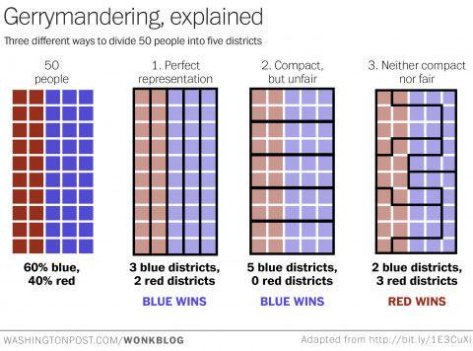
In the UK, there is “democracy” (we think). Almost everyone can vote, almost everyone can be a candidate. Yet there are impediments: the powerful Jewish-Zionist lobby (special-interest group), the entrenched First Past The Post (FPTP) voting system, the need for finance, and the way in which boundaries are deliberately sliced up to provide a semblance of “fairness”, but in fact to favour 2-party or sometimes 3-party “stability” over real reflection of popular opinion. There is also the fact that “main party” (System) candidates are usually carefully selected to exclude anyone with even mild social-national views. The “choice” is then put before the electorate (together with the minor candidates who almost invariably have no chance at all).
Another important aspect is that, since the Tony Blair government passed its restrictive laws, political parties have to be registered, can be fined (eg for refusing membership to certain types of person, or certain racial or national groups), and can even be “de-registered”, thus barring them from standing candidates in elections. Democracy?
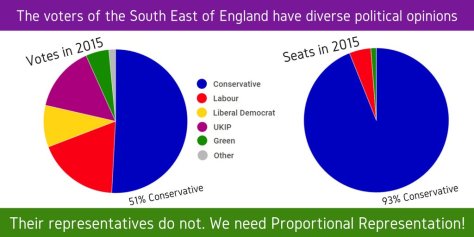
Here is an example from the General Election of 2015.
Brexit
The Brexit vote has exposed the sham or part-sham of British democracy. David Cameron-Levita thought that the 2016 Referendum would be easy to “manage”. He had, after all, “managed” two previous referenda: the Scottish Independence referendum and the AV-voting referendum. Third time, he miscalculated. The people, on the FPTP basis, voted about 52% to 48% for Leave. This was a shock to the System. Immediately, the Remain leaders started to demand “No Brexit”, and for a second Referendum, which would (once the voters had been exposed to enough fear propaganda) come to a different result, and/or for Parliament (most MPs being “Remain”) to just ignore the 2016 Referendum result which (they said) had been procured by fraud, lies, or post-KGB Russian trickery…
The fact is that, leaving aside the “sheeple”, the hard core of anti-Brexit Remain consists of
- the affluent/wealthy metropolitan self-styled “elite”;
- the big business people;
- the Jews (most of them);
- those who have done well financially in the 2010-2019 period;
- the brainwashed under-30s, mostly from not-poor backgrounds, who imagine that not being in the EU somehow prevents them from getting (for most of them, non-existent) jobs in the EU, or that they will even not be allowed to travel after Brexit!
- Those shallow little nobodies (again, mostly young or would-be young urban-dwellers) who think that it is old, unfashionable and “gammon” (white Northern European British) to support Leave or indeed to have any pride in England’s history, race and culture;
- Almost all of those working in the msm.
These groups have become ever more severe and open in their hatred of Leave supporters. There are now open calls for the rights of, in particular, voters over the age of, perhaps, 60, to be restricted, for older people to be disenfranchised, especially if white, (real) British, or “racist” (i.e. people who see their land and culture being swamped and destroyed).
Here, for example, we see an almost archetypal Remain whiner, the broadcaster Jeremy Vine, 53, who is paid over £700,000 a year by the BBC and maybe as much as £100,000 p.a. from elsewhere (despite having been awarded only a mediocre 2:2 in English at university and then been –in my opinion– a markedly mediocre Press/radio/TV journalist).
Here’s another idiotic statement by Vine, though on an unrelated topic:
https://www.devonlive.com/news/devon-news/carol-vorderman-defends-devon-girl-2429731
We see from examples around the world, eg South Africa, or Zimbabwe (etc) that one-man one-vote “democracy” can lead to elected dictatorship. In the UK, it has become increasingly clear that the Parliamentary democracy in place does not reflect the views of the bulk of the population, and certainly not the bulk of the white real British population, those with whose future I concern myself.
Leave may “only” have won the EU Referendum by 52%-48%, but there are nuances here: the assassination of pro-Remain MP Jo Cox, only a week before the referendum certainly had an effect, and is thought to have changed the outcome by as much as 10 points (at the time of her death, Leave was 10 points ahead of Remain in some polls); particularly as much was made of supposed secondary culpability of Leave propaganda for the attack. The referendum outcome might easily have been 60% or even 65% for Leave.
There is also the point that most “blacks and browns” and other ethnic minority voters (eg Jews) voted Remain if they voted at all. Most Scots voted Remain too (no doubt because they have a faux-nationalist SNP as a comfort blanket). Take away those Remain blocs and it might be that about 60% of white English and Welsh voters voted Leave, which might have been 70% without the Jo Cox matter.
Alternatives to Parliament Deciding Everything
I favour the Rudolf Steiner concept of the “Threefold Social Order”. As I paraphrase it, and in the contemporary UK context,
- it means that an elected Parliament decides matters properly within the political sphere or “sphere of rights”;
- it means that Parliament (and government) does not run the economy or economic enterprises (though it can regulate it and them); likewise, economic forces and personalities cannot rule the political sphere and/or “sphere of rights”;
- it means that the State (or economic forces) cannot rule over the proper ambit of the sphere of spirit, culture, religion, medicine, education.
This obviously moves on from the conventional “Parliament rules supreme” idea, developed in the UK since the time of Cromwell.
We can see that Parliament in the UK is no longer fit for purpose. Those currently elected have only a limited mandate. Greater freedom and a more efficient as well as a more just society depend on proper integration of the three basic spheres: political, economic, spiritual/cultural.
There is no necessity for everyone to vote. Voting should be for citizens who are resident and who are of suitable age (I favour 21 years, at minimum). Foreigners, offspring of foreigners, persons who are mainly of non-European origin etc should not be allowed a vote.
Brexit and the future
People voted for Brexit for many reasons and fundamentally out of a lack of satisfaction with the existing way of life in the UK. That urge for something better may be the basis for social-national reform or even revolution. The British people will no more allow themselves to be treated as helots.
Notes
https://en.wikipedia.org/wiki/Athenian_democracy
https://en.wikipedia.org/wiki/Parliament_of_the_United_Kingdom
https://en.wikipedia.org/wiki/Reform_Act_1832
https://en.wikipedia.org/wiki/Representation_of_the_People_Act_1918
https://en.wikipedia.org/wiki/1929_United_Kingdom_general_election
https://en.wikipedia.org/wiki/University_constituency#United_Kingdom
https://en.wikipedia.org/wiki/Politics_of_South_Africa
https://en.wikipedia.org/wiki/Parliament_of_South_Africa
https://en.wikipedia.org/wiki/26th_South_African_Parliament
https://www.electoralcommission.org.uk/i-am-a/party-or-campaigner/guidance-for-political-parties
http://www.brugesgroup.com/blog/the-british-road-to-dirty-war-analysis-by-david-betz-mlr-smith-1
Update, 25 March 2021
Well, it seems that I spoke too soon in saying that the British people will no longer allow themselves to be treated like helots! The “panicdemic”, weaponized for the purpose, has (or the moment at least) put both the British people and “democracy” back in the box. Still, “the night is young”, I suppose. “Tomorrow is another day”…
 Ian Robert Millard