

Tag Archives: Winter of Discontent

Diary Blog, 5 October 2024, including a few thoughts about the reality of the 1970s (as distinct from the usual “fake history”)

Morning music

Saturday quiz
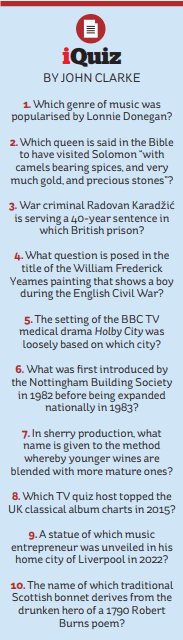
Well, this week my 6/10 trumped political journalist John Rentoul, who scored 4/10. I did not know the answers to questions 3, 5, 6, and 8.

Tweets seen

https://irvingbooks.com/product-category/books/

Accurate… I spent 9 months in East Africa. It’s very hard to pinpoint exactly why it’s such a mess.

They have an infantile mentality and absolutely no commercial sense.

I once went about 10 miles down the road, in the middle of nowhere on the way to Lusaka, the capital of Zambia, and every 50 meters there was someone selling watermelon. I said to the driver, “Everyone is selling exactly the same product. Why don’t they try making watermelon juice or something different to stand out?” He replied, “But why would we do that? We like melon!”

That attitude was everywhere. In fact, I would sometimes meet Westerners who would say, “Isn’t it amazing how they’ve kept this piece of junk car going for 30 years?” And I’d reply, “It’s more amazing that we have automated car factories with robots.” They literally only focus on the immediate need. “Car not go today, car fixed with string and tape.

The only two factors preventing Britain and other European countries from retaking direct control of Africa, of all of Africa, are 1. socio-political will and 2. the fact that the (((globalists))) find it more convenient to exploit Africa’s resources via corrupt tiny “elites” in each fake African “state” (and to hell with the environment, the forests, the wildlife, and the African people themselves).

The fact is that European rule would benefit all, not least the ordinary Africans.

Incidentally, it would be a great deal easier than many imagine for Europe to reconquer Africa militarily. Only the two factors already noted make it at all hard.

Illiterate travel

I have just read this, https://www.standard.co.uk/lifestyle/travel/sarajevo-guide-balkans-bosnia-and-herzegovina-b1176081.html, a travel piece in what I still call the Evening Standard, and written by well-known columnist Suzanne Moore. Not hugely interesting anyway, but then absurdly badly-written. An essay by a 10-year-old, at best. Or is the sub-editing to blame? Maybe someone pushed a few of the wrong buttons. Extraordinary. Read it and see.

I have read other pieces by Suzanne Moore which were written properly, so maybe it was the fault of the Standard.

More tweets

Pretty accurate summing-up of “Starmer-ism”, in my opinion, “Blairism without the good bits“, though I do not recall many good bits then either, speaking personally.

As far as assisted dying is concerned, I see it as a generally well-meaning attempt to be kind, which however, put into policy and law, is the start of a slide to, eventually, somewhere down the line, killing people for convenience or money.

HS2 was a vanity project that never should have been approved. As far as I know, though, the other rail projects are or were useful.

She seems to have difficulty identifying the “J” problem…

Again, look at the “usual suspects”…

The “fake history” of the 1970s

That’s because you, “Steve Zodiac”, are apparently telling your grandchildren a load of old hooey…

I have blogged in the past about how very many people (including, weirdly, many who were at least in their teens then, and so actually of an age to remember) say, and even perhaps believe, that the 1970s in the UK were some kind of dark age in which the electricity was off most of the time, in which bodies were left unburied by reason of industrial action, in which trains and buses rarely ran, in which rubbish piled up in the towns and cities, in which there was a “three day week” when offices and factories were closed for four days each week, and in which life was generally miserable (for example, food was terrible, they say).

The above-noted fabled dystopia was, we are told, the result of overreaching trade union power and Labour misgovernment.

Where to start?

First of all, the party in power for the first 4 years of the 1970s was the Conservative Party: https://en.wikipedia.org/wiki/1970_United_Kingdom_general_election, and of course Mrs Thatcher won again for the Conservatives in 1979: https://en.wikipedia.org/wiki/1979_United_Kingdom_general_election.

In other words, out of the 10 years, Labour was in power for about 6 years. Labour government was in place from the early 1960s until mid-1970, then from early 1974 until mid-1979.

https://en.wikipedia.org/wiki/February_1974_United_Kingdom_general_election; https://en.wikipedia.org/wiki/October_1974_United_Kingdom_general_election.

One interesting fact is that, in the 1966 General Election, the “two main parties” (Lab/Con) got exactly 98% of Commons seats on just under 90% of the popular vote: https://en.wikipedia.org/wiki/1966_United_Kingdom_general_election#Results.

Compare to 2024: 81.8% of seats based on 57.4% of the popular vote.

In 1966, the winning party (Labour) got 48% of the popular vote, the losing Conservatives 41.9%.

In 2024, Labour got 33.7%, and the losing Conservatives only 23.7%.

The electoral system has become not just unfair but also illogical and ridiculous. It no longer reflects reality.

Reverting to the general situation in the 1970s, the much-talked-about “Three Day Week” only affected, directly, commercial operations (which were banned from using electricity on the other four days). The Three Day Week only lasted for two months. Out of 10 years (120 months).

I saw the Three Day Week firsthand. I was working, aged just 18, as supposed assistant manager in a very small commercial intelligence outfit based in the Strand (London). The office only had 5 people including me, though we did have a network of mostly ad-hoc agents all over the southern and eastern parts of England (anywhere south or southwest of The Wash). Much of the work was in Surrey, Sussex, Kent, Hampshire, Berkshire, Hertfordshire, Essex. The agents were often retired Army officers who, on being contacted, would —eagerly— say something such as “right-oh, old boy. I’ll fire up the Rover and get onto it.”

I must do a blog post sometime about it.

There were, in the early 1970s, strikes by coal miners etc, resulting in a few brief power cuts (“outages”, as the Americans say), but they lasted for a few hours a day, for a few days. Out of 10 years, again.

In the “Winter of Discontent” (1978-79), there were, for a few weeks, situations in some towns and cities whereby rubbish piled up, yes; that much of the “fable” is true, but only for a brief time. As for the “bodies left unburied“, that only applied in Liverpool and Manchester and only for 14 days: https://en.wikipedia.org/wiki/Winter_of_Discontent#Gravediggers’_strike.

In fact, though the 1970s had its problems political, social, economic, Britain still had possibilities. The population was still almost entirely white Northern European, new ideas and projects were around or developing (the Milton Keynes conurbation, the Open University, new express trains, cross-Channel hovercraft etc), and the absurd and damaging house-price madness, though it had started, was still in its early stages.

Britain still had a functioning Army, Navy, Air Force (etc), and a police force that mainly did its expected job and was not usually the sort of poundshop Stasi we now see, snooping on or “monitoring” the expression of views and opinions.

Incidentally, the food was OK back then on the whole. Slightly less cosmopolitan, yes, but in the South of England at least, foreign foods such as hummus, taramasalata, olives, Indian, Chinese, etc were ubiquitous. In fact, some food was better and more available back then.

What I find worrying is not only that people who were not there, or were small children, are convinced that England in 1970-1979 was a dark and gloomy place; more that people who were there seem to have substituted, for what actually happened, a kind of folk-tale.

As for Jewish-lobby puppet Robert Largan, who was parachuted into the constituency of High Peak (Derbyshire) and served as MP from GE 2019 to GE 2024, he was only born in 1987.

If people cannot recall accurately the 1970s, how much less accurate must be the “memories”, often publicized, of the 1930s and 1940s.

More tweets

Late music

Diary Blog, 9 January 2022, including a few more thoughts about Labour Party chances, and about Islington North

On this day a year ago

Jewish National Fund UK chair: ‘Jews have no future in England

In an interview with the Jerusalem Post earlier this month, Jewish National Fund UK chair Samuel Hayek warned British Jews may “feel more comfortable” after the defeat of Jeremy Corbyn but “the underlying issues have not gone away”.

In addition to suggesting British Jews should consider emigration, he said: “Let’s assume that Corbyn would have become prime minister. We all know our lives would have changed without recognition. We cannot even understand it fully.”

“Is it easy to sell their businesses?” he asked. “Could they do it quickly? Where would they go? To South Africa, the United States, Canada – hopefully, Israel.”

[Jewish News/Jerusalem Post] https://www.jpost.com/diaspora/antisemitism/jews-do-not-have-a-future-in-england-687711

Comment unnecessary…

Tweets seen

A Jew like Giles Coren can suggest that someone (Mira bar-Hillel, a Jewish, but anti-Zionist, journalist) who is both named, and known to Coren, be killed by Jew Zionists, but will the police take any interest? No, of course not; yet if you, as an English person, say “boo” not even to a Jew but about him (or her, or it), the skies will fall in as the police —or even, maybe, their “anti-terror command”— play at being a poundland KGB.

Labour Party

Interesting, and typical of many tweets seen this morning. Looks as if Keir Starmer’s Jewish-lobby “Labour” Party (Rachel Reeves, like Starmer and all his Shadow Cabinet, being a fervent member of Labour Friends of Israel) is not convincing many. I concede that Twitter is very unrepresentative, but offline I have not met an openly Labour supporter or voter for about 7 years.

That is one reason why I took a very early look, a few days ago, at the Erdington by-election. That looks very much like it is going to be a straight Labour-Conservative fight, in a situation where both main System parties have lost public confidence. The question is, which party is hated and/or despised the most?

In recent by-elections, the Conservative Party has done badly, losing two hitherto safe Con seats, but to the LibDems as relatively uncontroversial third party, not to Labour. Both Chesham and Amersham, and North Shropshire, were considered safe Con seats. Birmingham Erdington has been a safe Labour seat since the 1930s (with a near-upset in 1983).

The Conservative Party vote-share fell hugely in the two by-elections mentioned; it also fell at the 2021 Batley and Spen by-election (won narrowly by Labour), and that at Old Sidcup and Bexley (won easily by the Conservatives).

However, in all those by-elections except Old Bexley, the Labour vote also fell, and by a considerable amount. The Labour percentage vote-shares were: Batley and Spen 35.3%; Old Bexley and Sidcup 30.9%; North Shropshire 9.7%; Chesham and Amersham 1.6%.

Another, earlier, 2021 by-election, was that held at Hartlepool, in March 2021. There, in a seat always Labour since its establishment in 1974 (and usually also in the predecessor constituency), and where Labour candidates almost always scored over 50% (Peter Mandelson 60.7% in 1997), Labour’s losing (to Conservatives) 2021 by-election vote-share was only 28.7%.

None of Labour’s 2021 by-election results can be plausibly laid at the door of the departed Jeremy Corbyn.

Out of those 5 by-elections, only one success (Batley and Spen) and only one increase in vote-share (Old Bexley and Sidcup). To me, the results show that Labour is being seen as not only unpopular but as actually irrelevant. As I have noted before, the Keir Starmer “pitch” to the public is, more or less, “we support what the Government is doing, on the whole, but it should be doing it better, and while down on one knee and wearing a facemask“. Not very inspiring.

The odds must be that the Birmingham Erdington by-election will go Labour’s way, but I am unsure about that. Until the past few weeks, I should have said that the Cons were only a couple of points behind Lab in the constituency. Now? Hard to say. This may be a battle between two blocs of apathy…

Afternoon music

Islington North: more Labour Party news

A high-profile Labour woman who lost her seat ‘thanks to Jeremy Corbyn‘ should be the candidate to end his Commons career, it was suggested last night.

Party insiders say that one of several female MPs who lost in the disastrous 2019 election would be Labour’s best choice to stand against the former leader in his North London stronghold, Islington North.

Mr Corbyn is currently barred from standing as the Labour candidate in the next General Election because of a bitter antisemitism row with Sir Keir Starmer.” [Mail on Sunday]

https://www.dailymail.co.uk/news/article-10382919/Labour-woman-lines-Jeremy-Corbyn-London-stronghold-Islington-North.html

I think that one can guess what (((type))) of individual thought up that bitter and vindictive “pound of flesh” idea…

Mary Creagh was one of the most active and fervent pro-Israel drones in the Commons; Ruth Smeeth, half-Jewish and descended on one side from East London gangsters, was exposed by Wikileaks as listed as a “to be strictly protected” secret informant by the U.S. Embassy in London. In effect, an agent or spy, to put it one way. It is not known (by me) whether she was paid for that. Before becoming an MP, she was also employed by the Israeli propaganda operation known as BICOM.

Both women were or are members of Labour Friends of Israel. Both were found well-paid jobs heading non-governmental orgs after the electors of their constituencies disposed of them.

As to what might well happen if one of those two is selected by the Jewish-lobby “Labour” Party now headed by Keir Starmer to contest Islington North, that might be interesting.

Islington North is a very solid Labour stronghold. The last election there won by the Conservative Party was in 1935. No Labour Party candidate since 1931 has recorded a vote-share below 40%.

Corbyn has been MP for Islington North since 1983, and his peak vote-share of 73% (in 2017) exceeded even that which he achieved in 1997 (69.3%) and that of the winning Labour candidate in 1945 (67.4%). In 2019, his vote was at 64.3%. Only when he was first elected in 1983 did his vote-share dip below 50% (40.4%), and that was because the Social Democratic Party stood, and garnered a vote of 22.4% (Con 25.3%).

How much of that solid Labour voting is for Labour label, and how much for Corbyn? We have seen many past examples of former Labour MPs standing as independent or small-party candidates, only to be swept away. No doubt Starmer and “Labour Friends of Israel” hope that that will happen in this case. I doubt it.

This situation is, as far as I know, unprecedented. Former Labour ministers have stood against Labour in the past (notably in the SDP days), and with mixed but generally poor results. Never, however, has a former Labour Party leader stood for election in a constituency, against an official Labour Party candidate.

Corbyn is extremely well-known, to say the least, both in the country generally (since 2015) and in the constituency (since 1983; 38 years…).

I should think that, in such unique circumstances, Corbyn would have every chance if he stood as Independent, or Independent Labour. I doubt that, with his background, he would start a new party.

The Conservative Party vote-share in the constituency peaked at 66.07% in 1931; since then, there has been an uneven but gradual decline overall. In the 1980s and 1990s, mostly in the 20%-30% range, and lower since then: the elections 1997-2019 show 12.9%, 10.8%, 11.9%, 14.2%, 17.2%, 12.5%, and finally 10.2%.

See the direction of travel below:

https://en.wikipedia.org/wiki/Islington_North_(UK_Parliament_constituency)#Election_results

There is every chance that the Conservative vote will slip below 10% —maybe even below 5%— next time. That means that the contest will be between Corbyn (if he stands) and whoever Labour selects to oppose him. Corbyn may well be the front-runner.

As to the LibDems, their vote peaked at 29.9% in 2005, and in the last few elections has been in the 10%-20% range (15.6% in 2019). It may be that they could mount something of a challenge in a 4-horse race. If Con votes joined with LibDem votes, on 2019 figures, that might add up to 25% or so, but it seems unlikely even then, that they could do better than a second place.

A situation to watch.

Mary Creagh

I just saw a comment by one of Mary Creagh’s former Wakefield constituents:

Mary Creagh was our mp, unfortunately. She is the most arrogant, self-important, waste of space. She literally did nothihng for the Wakefield area. Her attitude is appalling, she just could not be bothered with the area. Goodness knows why people voted for her. Islington is welcome to her. Strange isn’t it that she is still blaming someone else for her loss. She lost because she asserted remain when our area had voted leave and still the penny has not dropped for her. Her sense of entltlement is staggering. Watch out Islington!

Mary Creagh had her eyes on things far more important to her than the poor people of Wakefield, namely the interests of Israel and the Jewish lobby, followed by the pro-EU Remain campaign. Her own career and money too, of course…

Seeing TV reportage of Mary Creagh crying in anger and frustration, after the voters of Wakefield binned her, was stellar.

Addendum: saw this comment about Islington Labour voters: “Young professionals who have never lived through a Labour government. Could they cope through another Winter of Discontent with constant strikes, sitting my candlelight with no heating and rubbish piled up in the street?

The “”Winter of Discontent” myth has become as ingrained as the old “holo (you know what)” farrago! I was in the UK (aged 22) during the said winter. There were strikes in some parts of the economy, yes, for a few weeks in some cases. Few people had their electricity supply interrupted; same with heating. As for rubbish piling up, yes, but only in some areas, and for a few weeks. The whole thing was short in duration and limited in effect(s). It was not the Siege of Leningrad. See https://en.wikipedia.org/wiki/Winter_of_Discontent.

The “Winter of Discontent” has become one of those things that many think is so, but is only partly so, a bit like the aforesaid “holo” stuff and various other situations (eg that the UK only had basic foodstuffs until about 20 years ago, or that there were large numbers of blacks living in the UK in the 1960s or even 1950s.

You often see people moaning also about how terrible the whole of the 1970s were, with light and heat cut off because of strikes, and similar “facts”. In fact, the “three day week” and the power cuts affected mainly businesses, lasted weeks not months (in late 1973) and few domestic users were even affected. A few, for short periods. Yet you see people, even those who were there at the time spinning nonsense in newspaper comments sections, or on Twitter, about how they spent much of the 1970s without heat, light, or even food!

It does make me wonder about the fallibility of human memory.

Tweets seen

“Doctor”? Hardy ha ha…The law should be clarified as to who is entitled to use the designation and who should not (e.g. someone whose doctorate is merely a Ph.D. based on a study of a strike in a match factory in 1888…).

Rod Liddle strikes me (though I have never met him) as a remarkably unpleasant person, with some of whose views (not re. the “panicdemic”, obviously) I agree, from time to time. Why anyone should think his views on medicine in any way authoritative, I have no idea; Liddle’s mature-student degree was in Social Psychology: see https://en.wikipedia.org/wiki/Rod_Liddle.

Late afternoon music

Late tweets

Sometimes, non-violent resistance can work, if the regime opposed is not completely brutal and/or deranged; and if the time is right. It worked in the Baltic republics, the DDR and other Soviet satellites in the late 1980s and early 1990s, and indeed in the Russian core of the Soviet Union in the same period, but it would never have worked in, say, 1970s Cambodia.

Late music

What a voice that woman had! Unique.