Background
I recently re-read Special Tasks: The Memoirs of an Unwanted Witness– A Soviet Spymaster, the autobiography of General Pavel Sudoplatov, who was, inter alia, the brains behind such complex secret operations as the acquisition, in the 1940s, of atomic and nuclear technology from the USA and UK; he also oversaw such sanguinary plots as –and most notoriously– the assassination of Trotsky in Mexico in 1940.
I last read Sudoplatov’s book in 1994, the year of its first hardback publication. On first reading, I did not, perhaps, pay enough attention to the part of the book near the end, dealing with Beria and the Politburo in general after the death of Stalin in 1953.
It might be said that to examine the beliefs and intent of Beria is otiose now that 65 years have passed since his death by summary execution. Also, unsurprisingly, few tears have been shed for him since his death. He was in many ways monstrous: this article is of course limited in scope by reason of, inter alia, lack of space. Beria’s crimes of a political nature were on a vast scale. His more personal crimes were also many and included the regular abduction and rape of women and girls, including some young schoolgirls. Having said that, his swift “trial” (in secret and without defence representation) and the immediately-following execution was a purely political action ordered by those with political records in many ways as bad (Khrushchev, for one).
I start from the following premises:
- that Western and/or Westernizing conspirators funded and oversaw the Bolshevik coup d’etat in October 1917 (old calendar);
- that the same cabals set up the Soviet system in the 1920s as a quasi-religious movement (in style) which was atheist (in content);
- that the quasi-religious character of Bolshevism slowly started to dissipate after the death of Lenin in January 1924, replaced at first by a pseudo-intellectual Marxism-Leninism (incorporating a personality-cult), then by a revival of “Holy Russia” and nationalistic propaganda (mixed with the foregoing) during the war of 1941-45. Finally, there came a late efflorescence of the Stalin personality cult mixed with pan-Slavism between 1945 and Stalin’s death in 1953;
- that in the (significant number) 33 years from 1956 (the year of Khrushchev’s Secret Speech denouncing Stalinism as a personality cult etc) to 1989, Sovietism continued to decay ideologically, until it finally collapsed into a pile of dust.
Beria, ideologically
Beria was born in Merkheuli, near Sukhumi, which latter was a prosperous resort in late-Tsarist times. His family was not poor. It may be important that (in contradistinction to Russia), the Black Sea littoral was part of the Alexandrine Greek polity and, later, the Eastern Roman Empire. A more cosmopolitan milieu than that of Russia and one which existed for more than a thousand years prior to the first foundation of Kievan Rus.
That area, Abkhazia (geographically a part of Georgia, though historically distinct), was the location of the legendary Golden Fleece and is said to have been the birthplace of wine.
In the Soviet era, peasants were able to (in effect) own their own agricultural or horticultural plots of up to 0.5 hectare (about an acre or so). This was put into law in the mid-1930s. “Special districts” (particularly in Georgia) could have plots as large as 1 hectare (2.2 acres) officially and slightly more unofficially. By 1939, these small plots (only a few percent of the land area of the Soviet Union) produced at least 21% of all Soviet agricultural produce (and a far greater percentage of fruits etc). Some estimates from later times (the 1970s) put the real figure as high as 40%.
The “garden plots” or “household plots” had become important in Georgia/Abkhazia since the end of serfdom in 1865 (serfdom in some parts of the Russian Empire lasted for some years after the formal abolition of 1861).
Beria (b.1899) thus grew up in a milieu quite different from his later Russian and Ukrainian colleagues.
Beria was, as a youth, involved, when a student in Baku (again, a very “capitalist” and cosmopolitan city which, after a long history, had boomed pre-1914 by reason of the oil finds), with both the Bolsheviks and the Azeri anti-Bolshevik Musavat movement, which had Muslim, Turkic and general reformist roots and ideology.
It has been alleged against Beria that he had been involved with British Intelligence in Baku in or around 1919. Not impossible. Baku was of huge strategic importance during the First World War.
Likewise, at his drumhead trial in 1953, it was alleged that Beria favoured soft relations with National Socialist Germany or was even a “traitor” who helped Germany militarily and diplomatically (see the Wikipedia article, below).
Anthroposophy and other Germanic cultural connections
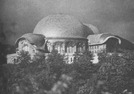
Beria was friendly toward the writer Konstantine Gamsakhurdia, who was educated partly at Berlin University (graduating in 1918) and spent the war years 1914-1918 in Germany and Switzerland as well as France. Gamsakhurdia may well have met Rudolf Steiner (d.1925) at that time, when Steiner was constructing the First Goetheanum (at Dornach, near Basel, Switzerland).
In the 1920s, Konstantine Gamsakhurdia was for 3-4 years a political prisoner in the Solovki concentration camp on the Solovetsky Islands. He would almost certainly not have survived the purges of the 1930s without Beria’s protection.
The son of Konstantine Gamsakhurdia, Zviad Gamsakhurdia, became President of Georgia in the first democratic elections following Soviet rule. He is generally considered to have been an Anthroposophist, and wrote, among other works, Goethe’s Weltanschauung from the Anthroposophic Point of View [pub. Tbilisi 1985].
Beria’s Preferred Policies
Beria was not an idealist, but a practitioner of Realpolitik, par excellence. This enabled him not only to implement Stalin’s repressions without conscience, but also to see the aspects of Soviet life that were not working.
Had Beria succeeded Stalin,
- he would have brought back a large measure of private ownership, or at least operational ownership, into agriculture. That would have hugely improved Soviet agriculture, whereas Khrushchev’s Virgin Lands scheme was mainly an expensive and ecologically-negative failure;
- because Beria was not an ideologue, he would have had no qualms in ending the Cold War early. He would have been, to cite Mrs Thatcher’s view of Gorbachev, someone “with whom the West could do business.” That might have meant no Vietnam War, no Soviet support for so-called “Liberation” movements in Africa, no Cuban Missile Crisis, no Berlin Wall;
- while Beria would certainly have ruthlessly stamped down on domestic political opposition, he would not have repeated Stalin’s mistaken policy (implemented partly by Beria himself) of arresting millions of people for effectively no reason;
- Beria would have (as Sudoplatov notes) allowed the non-Russian republics a greater degree of independence, thus creating an earlier and more feasible “Commonwealth of Independent States” [CIS], albeit that they would not be “states” but autonomous or semi-autonomous republics.
- Beria would have concentrated the KGB (its later name) and GRU on useful intelligence gathering and not on playing spy games and fomenting pseudo-Marxist revolts in Africa, Latin America etc.
Conclusion
While it might stick in the craw of many to conclude that Beria would have made a far better ruler of Russia than uneducated Khrushchev with his half-baked huge projects and his bang-shoe-on-table style of diplomacy, the facts speak for themselves.
Notes
https://en.wikipedia.org/wiki/Sukhumi
https://en.wikipedia.org/wiki/Abkhazia
https://en.wikipedia.org/wiki/Household_plot#History
https://en.wikipedia.org/wiki/Musavat
https://en.wikipedia.org/wiki/Baku
https://en.wikipedia.org/wiki/Goetheanum
https://en.wikipedia.org/wiki/Anthroposophy
https://en.wikipedia.org/wiki/Rudolf_Steiner
https://en.wikipedia.org/wiki/Solovki_prison_camp
https://en.wikipedia.org/wiki/Solovetsky_Islands
https://en.wikipedia.org/wiki/Konstantine_Gamsakhurdia
https://en.wikipedia.org/wiki/Virgin_Lands_Campaign
https://en.wikipedia.org/wiki/Lavrentiy_Beria
Literary Note
A British scribbler, one Alex Marshall (formerly of The Guardian, now at time of writing apparently “Europe Culture Editor” for The New York Times) wrote a book called The Caucasus Under Soviet Rule, in which he wrote that “Personally propagating a bizarre Rudolph Steiner-inspired cult of anthroposophy, [Zviad] Gamsakhurdia…[etc]”.
Poorly written, for a start: “Anthroposophy” requires upper-case “A”, just like, say, “Roman Catholicism”. Marshall spells Rudolf Steiner, “Rudolph”, just as those who make fun of Hitler often write his name “Adolph” in petty denigration; also, “a bizarre” should be (if written at all) “the bizarre”.
Marshall’s words sound like a polemic against Anthroposophy, that movement which has achieved so much (though that fact is still not well-known to the masses in the Anglophone countries). To write off Anthroposophy as “a bizarre cult” is itself bizarre: think biodynamic agriculture, Waldorf [Rudolf Steiner] education etc.
I note that Marshall’s book, at least according to some reviewers, contains a number of other factual errors.
In fact, Shevardnadze, who overthrew Zviad Gamsakhurdia, was a ruthless “ex”-Soviet apparatchik who reintroduced large-scale repression into already-chaotic Georgian political life. He was the preferred candidate of the New World Order, completely under the “Western” thumb. I myself was slightly acquainted at one time (c.1995) with one of Shevardnadze’s advisers, who –like me– was on the Committee of the Central Asia and Transcaucasia Law Association [CATLA], a body active in the 1990s and which was supported by the British Government and large London-based law firms with interests in those regions.
http://poli.vub.ac.be/publi/ContBorders/eng/ch0201.htm
https://en.wikipedia.org/wiki/Eduard_Shevardnadze
https://en.wikipedia.org/wiki/Zviad_Gamsakhurdia
https://en.wikipedia.org/wiki/Anthroposophy
https://en.wikipedia.org/wiki/Rudolf_Steiner
Update, 24 November 2018
I have located my copy of the book Beria, by Sergio Beria (Lavrenty Beria’s son), so may add to this blog post when I have reread the book.
 Ian Robert Millard