I have been a voice crying in the wilderness, but I sense now that the people will soon be ready to listen, in the UK and across Europe.
Born in the English county of Berkshire and brought up both there and in Sydney, Australia, I have had a varied and sometimes challenging life. I could not list all the jobs I have done, from the most basic labouring and menial work through to advising international enterprises and appearing as a barrister in the courts of England, including the High Court.
I have lived and/or worked in numerous countries, including the USA (where I qualified as attorney at the Bar of the State of New York), France, Russia, Kazakhstan, Egypt (and other parts of the Middle East), Turkey and the Caribbean.
Many reading this will be aware that in October 2016 I was disbarred (in England), after a Jewish Zionist pressure group made official complaint about me (in 2014) to the Bar Standards Board. The complaint related to 7 tweets (out of, at the time, about 155,000) which I tweeted from my Twitter account (@ianrmillard). I shall write about the Kafkaesque process which led eventually to my disbarment in more detail on the blog, though only to clear the air and to lay out the full facts omitted from the accounts given by the Daily Mail, Daily Express, Independent, Huffington Post, Metro etc.
My aim in blogging is to comment on current events and trends; also, even more important, to put forward ideas and policies for a new or better society.
I disparage the terms "left" or "left wing", "right", "far right" etc. These are outdated and, in an era in which politics is becoming more nuanced in the UK, Europe and elsewhere, misleading. The same applies to terms such as "Nazi", "neo-Nazi" etc. Speaking for myself, while there was much that was valuable and good in the work of Adolf Hitler and the NSDAP and in German "volkisch" politics generally, there is no need to defend everything that every National Socialist did from 1933-1945. The National Socialists were fighting the horrifying Stalinist version of socialism and, also, the debt-oriented finance-capitalism of the "West". That fight was both necessary and honourable. The fight now moves to the needs of the 21st Century.
For me, the template for the new society is contained, in outline, in the Threefold Social Order first explained after the First World War by that great genius Rudolf Steiner.
I urge all British people to join the struggle for national freedom. There are dark forces, often posing as "good", which must be vanquished.
“I went to school on the train endless strikes waiting on cold platforms for hours. Then returned home to a house with power cuts no heating hot food it was a nightmare for at least 10 years“— who can guess on what the lady I quote was, in a semi-literate fashion, commenting? The Second World War? Surely not: that only lasted for 6 years. The Siege of Leningrad? No, that lasted for a shorter period yet— 2 years, 4 months. What, then? In fact the lady in question was commenting, in the online Daily Mail, on the UK railways and, in the wider sense, on the UK generally in the 1970s.
Well, it certainly sounds like it was awful. The problem with that, though, is that it is in fact not true. The trains in England (where I lived; Wales and Scotland were similar) were not subject to “endless” strikes (though there were certainly far more than is now the case) and the station platforms were no colder than they are now. What about “power cuts”, “no heating [or] hot food”?
The Reality
The “Three Day Week” only lasted for 3 months (January-March 1974) and only commercial users of electricity were cut off or required to cease using electrical power. Most domestic users were unaffected. Newspaper printing, supermarkets and hospitals were also exempt. In other words, if the lady quoted at top is not simply making up her story of hardship (or failing to remember accurately), the reasons must lie elsewhere. Maybe her parents failed to pay their electricity bill! Only joking…In fact, two years before that, there had been announced (on 16 February 1972) a rolling programme of area outages (including domestic users) but peace broke out 2-3 days later (midday on 19 February 1972) so, again, few domestic users were affected, though a minority had seen limited outages earlier, in early February.
There was, also, the “Winter of Discontent”, which occurred in the winter of 1978-79, but in fact (in its acute phase) was only effective in January and early February 1979. In reality, we are talking about weeks rather than months. Neither domestic nor commercial users of electricity lost power; gas and coal users were likewise unaffected.
So there we have it: the lady commenting on these matters at top seems to be a victim of selective amnesia when she regards a decade of her childhood as having been an awful ten years without rail travel, heating, lighting etc. The “decade” in question turns out to have been affected for about 2-4 months out of 120…
In fact, the amnesiac lady is not alone. Time and again we read about how the UK spent much of the 1970s in the dark, in the cold, without public transport, without food, rubbish uncollected and dead bodies unburied. It’s nonsense, but many really believe it, even those who were there, which is worrying…I should add that I myself was there, having been born in 1956; by the way, those “dead bodies unburied” did exist briefly (for a few days) in the winter of 1978-79, but only in two or three small areas of Liverpool and Manchester. Less noxious rubbish did pile up, but not for very long and not everywhere.
This fake history, that the 1970s were a decade of “socialist” chaos and dislocation, is quite entrenched now. This canard has wings! The various “Conservative” newspapers in the UK repeat it as an article of faith.
Other Fake Memories
No, I am not going to blog, here anyway, about the “holocaust” scammers and delusionals. I want to focus on a few other things. One persistent idea (which I have even seen said and written by journalists and TV talking heads older than me) is that Britain had no decent food until about 20 years ago! It’s just nonsense! Another is that life was harder for people in the 1960s, 1970s, 1980s than it now is. More nonsense. In, say, the 1970s, people mostly had secure jobs, which paid enough to live on; there were no such things as foodbanks; social security was far better overall, the disabled and unemployed were not bullied by DWP jobsworths; the mass immigration which is making the UK (especially parts of England) into a human zoo had not really begun to snowball; workers had fixed hours, which included decent lunch breaks of 1 hour (often interpreted generously); there was no such thing (for most employees) as being on call after hours, in the evenings or on weekends and holidays. In addition, it was far easier (for anyone qualified) to access higher education.
Conclusion
There is a wave of unreality around. I have a –perhaps idiosyncratic– theory that the various kinds of lies or lying fake “facts” that people are often now expected to believe (“holocaust” fakery, the idea that races and peoples are all somehow “equal”, the idea that National Socialism was “evil” etc) have affected the general sense of truth in society, so that many cannot detect lies, and indeed often lie to themselves as well as others about recent history and even about their own experiences.
I have just now watched a BBC TV show, Putin’s Russia with David Dimbleby. In the programme, Dimbleby goes around Moscow interviewing a variety of people and asking their opinion of V.V. Putin. He started off by interviewing a lady who has had, I think, 10 children, thus ensuring her a medal, significant State financial benefits and a title which is different from but in essence the same as the old Stalin-era one, Mother Heroine of the Soviet Union. Fairly predictable opening gambit.
Dimbleby interviewed a number of dissidents: Yevgenia Albats, a fairly obvious Jewess and anti-Putin journalist; then another woman, who was arrested for 5 minutes, then released without charge, for going to the Duma (Parliament) with a satirical cardboard cutout of a pro-Putin politician accused informally of sexual offences. Hardly Stalinist repression: the same could happen in the UK. Finally, he interviewed an anti-Putin think-tank personage, who says that, while there probably was government interference in the recent Russian Presidential election, Putin would have won anyway. The dissident political figurehead Navalny was mentioned by Dimbleby. Navalny’s poll ratings have usually been well below 20% and his electoral showing as Presidential candidate was about 1%.
On the pro-Putin side, Dimbleby interviewed a smoothly duplicitous Russian Orthodox prelate who would not have been out of place in the Roman Catholic Curia c.1600. It should come as no surprise that the Russian Orthodox Church supports the Russian state. After all, the slogan of late-Tsarist official Pobedonostsev was Orthodoxy, Autocracy, Nationality [Православие, самодержавие, народность]. The Russian Orthodox Church Church (that is, the small part not repressed during the Jewish-dominated years of the Revolution, Civil War, 1920s New Economic Policy and 1930s Stalinism) supported Stalin –or pretended to– during the 1940s, though ignorant peasant Khrushchev again repressed the Church during the late 1950s, the “Thaw”, a period otherwise thought of as “liberal”.
Dimbleby also visited a class of children being taught weapons handling and maintenance, mixed with some patriotism and religion, an ironic twist on non-urban America. Dimbleby went on to talk with others: one ultra-nationalist whose interview was short and not-so-sweet; a group of young people, all Putin supporters. However, his most telling interview was with an Englishman working for RT, who was comfortable with his job and role.
It was pretty irritating to see Dimbleby, mouthpiece of the BBC, which is itself a mouthpiece for the UK Government and (like the UK government) riddled with Jew-Zionists, criticize lack of journalistic and individual liberty in Russia. He himself was party to the planned ambush of (arguably, naive) Nick Griffin on BBC TV Question Time, which (again, arguably) finished off the BNP, until then on a roll. Dimbleby was scathing about what happens in Russia to those who say the “wrong” things. Perhaps he missed the several recent criminal trials in the UK of anti-Zionist dissidents such as Jez Turner of The London Forum (sentenced to 1 year’s imprisonment for making a speech partly about Jews), or Alison Chabloz, convicted of singing satirical songs about the “holocaust” scam and the Jewish fraudsters who make money out of it. Ironically, Alison Chabloz is in court in London tomorrow, for sentence. The last two people named have also had their Youtube channels taken down. Alison Chabloz has also (like me) been expelled from Twitter. “Long live freedom”…
Anyone who was in Russia or the Russophone area in the 1990s (I was: a week in Moscow in 1993, a year in Almaty, Kazakhstan, in 1996-97) knows that, at that time, Russia was a wreck of a state, looted by (mainly) Jews. People starved by the million, especially the elderly. Yeltsin was a corrupt puppet. Putin may not be the perfect philosopher-king, and he does have both personal and ideological flaws, but his rule was and still is necessary.
Postscript
Dimbleby also criticized the lack of an independent judiciary in Russia. I was unable to compare that to the English system, in particular to the Alison Chabloz case, in which the defendant, a satirical singer-songwriter persecuted by the Jewish-Zionist lobby, was in court for –in effect– singing songs, because the matter was still before the court. Now that she has been sentenced, I can mention the fact that, at first, she was before the Chief Magistrate for London, one Emma Arbuthnot. The latter is married to a Conservative Party MP who, like 80% of such, is a member of Conservative Friends of Israel; the couple have been on all-expenses-paid trips to Israel. Alison Chabloz, via her lawyers, objected to Mrs Arbuthnot presiding, and she recused herself (stepped down from the case). Arguably better than Russia, but not much.
It has been proven that to take away the familiar and known from an individual is to disorientate that person. It is a well-practised method of breaking down a prisoner for interrogation, for example (sensory deprivation etc). A less harsh form, usually, is recruit training in armies and similar organizations. However, the same is true in societies generally. When the familiar is taken away, society suffers something akin to a nervous breakdown. The singer Morrissey has commented recently that England now is little more than a memory.
In the UK, we have seen how society was already struggling with the importation of millions of immigrants even before 1997, when the Tony Blair Zionist government (ZOG puppet government) took power. It is now a matter of record that a deliberate decision was taken by the Tony Blair government to import further millions of immigrants, mostly non-Europeans, in order to destroy Britain as it has been and to a limited extent still is; to destroy the racial and cultural roots and foundations of our country. White genocide.
That policy, spearheaded by two corrupt Jews, Phil Woolas and Barbara Roche (both now removed from Parliament), has been successful. Britain is now, at least in part, an ethno-social dustbin. The millions imported have been breeding, prolifically. Recent reports and studies estimate that the UK will become majority non-white by 2050. If one takes England alone, the date can probably be reduced to around 2040. Already, some English cities are English in name and history only or are getting that way: London is already majority non-white (native-born population: 44%), Birmingham and Manchester are rapidly following (57% and 66%), while smaller cities such as Leicester and Bradford are already, like London, mainly non-white.
The above ethno-cultural changes have destabilized the national mental landscape. The change has been accompanied by a propaganda campaign stealthily making use of “soaps” and TV advertizing. The mixed-race family is presented as the norm. Even Midsomer Murders, the archetypal Middle England comedy-drama detective series, was forced, after criticism, to put blacks and browns into the cast lists. This is (as with TV ads) not really reflective of reality but the creation of a new “reality”. Social engineering.
The wrenching apart of the accepted “mental landscape” does not end with the racial-cultural question. It is far wider. It includes the gratuitous renaming of commercial and trade union organizations. Thus the old trade unions, with their easy to understand names and functions, have become amorphous huge conglomerations with names that mean little, such as “Unison”, “Unite” etc, and have abandoned their members’ interests to pursue a politically-correct agenda involving “anti-racism”, “anti-sexism”, promotion of mass immigration etc.
In the same way that the trade unions have been corrupted, so commercial enterprises have been renamed and somehow displaced. Norwich Union insurance becomes “Aviva”, and so on.
The result of this dislocation of the mental landscape on the large scale has been the rupturing of the connection between the people as a whole and the mainstream political parties. The Conservative Party, which once had a membership in the millions, now numbers only a few tens of thousands and is still sliding. Labour, which was going the same way, has recovered under Corbyn to about 450,000, but its popular vote has not recovered. The Liberal Democrats are a very small party in terms of both members and votes. UKIP too has fallen back, in its case to almost nothing, but the fact that it briefly mushroomed into a threat to the older parties indicates that the voters are no longer anchored to System parties. However, a non-System party credible enough to come to the fore has not yet emerged.
Another symptom of the mental-landscape dislocation is seen in the notionally “nationalist” direct-action operations carried out by the “lone wolf” dissidents. The highest profile case is probably that of Thomas Mair, who killed Jo Cox MP a few years ago. In his case, the sheer dislocation suffered by society seems to have triggered a determination to make a point through forceful action.
More significantly, the lack of secure anchorings in society may lead to a volatile political milieu in which a social-national party could be formed, become popular and then move to attain power within a relatively few years.
I had occasion to visit a small NHS facility recently. It was a lovely, quiet unit, with only about a dozen or so patients, those patients living, prior to discharge, in several large “bays” and a few individual rooms. The unit was surrounded by flower gardens with small flowering trees and a few classical statues. Beyond that (out of sight) was a very small town (little more than a village) and the countryside of Southern England. If you have to go to a hospital, you could do worse. So why am I blogging about this?
While waiting to go in to see the patient in question, I perused the literature rack by the nursing station. One leaflet caught my eye. I have it before me as I write. Under the NHS logo and the name of the NHS foundation trust running the unit at the strategic level, the title:
PREVENT
[the words contained within a shield device; with two hands –dark blue and light blue (the old KGB colour..ironic) and perhaps (?) representing white and non-white– clasped]. The leaflet was then sub-headed:
Preventing vulnerable people from being drawn into terrorism
Inside the leaflet:
What is Prevent? Prevent is part of the government’s counter terrorism strategy; aiming to prevent people of all ages from being radicalised and drawn into terrorism.
The leaflet continues:
What kind of extremism does Prevent aim to deal with? It aims to deal with all forms of extremism; for example far right extremism, animal rights extremism and religious extremism.
So we see that “terrorism” has already been conflated with or replaced by “extremism”, an even less easily-defined idea. Moreover, we see that Islamist terrorism, the only kind actually posing even a slight threat to public order in the UK, is not mentioned by name (no doubt that would be called “Islamophobic”…) and only coyly implied, sub nom “religious extremism”. No doubt the Jewish Zionist fanatics, who go in their hundreds to be trained by the Israelis in Israel, are not considered “extremists”, “terrorists” etc. No, they just go to an alien society to be trained in the use of weapons and in the techniques of killing with bare hands (oh, and of course, how to “bring down” British MPs thought not to be pro-Israel or pro-Jew…).
Who are these “extremists” in pole position in the Prevent leaflet? Ah, yes, the “far right” (also left undefined, presumably social nationalists, those who hate mass immigration and the trashing of the UK by certain groups and types) as well as those who hate the cruelties inflicted on the animal kingdom by some humans and by human society; but let us now return to the leaflet:
What are some of the possible signs of radicalisation?
you may notice changes in the person’s behaviour or mood;
the person’s appearance may change and they may spend excess [sic] time on the internet;
the person may start to express extreme political or radical views;
the person may become withdrawn or have a change in their circle of friends.
So now we have travelled from “terrorism” and even “extremism” to people who have or may have merely “radical” points of view about, say, the disastrous effect that mass immigration has had on the UK, or about the exploitation and cultural contamination carried out by Jew-Zionists, or even about animal welfare.
The leaflet then asks what the reader might do should he or she actually suspect that another person has changed lifestyle or perhaps have acquired “radical” views:
NOTICE: Be aware of an individual’s vulnerability to radicalisation, any change in behaviour or ideology. An ideology is a set of beliefs an individual may have. [this section of the leaflet also contains the iconic alien-looking “all-seeing eye” motif…]
CHECK: If possible and appropriate check out any concerns with the individual…your line manager and the [NHS] safeguarding team. [this section of the leaflet contains a motif of a magnifying glass with a little humanoid figure inside the lens…]
SHARE: You need to share your concerns with the [NHS] safeguarding team. They can advise you on any relevant partner agencies who will need to be contacted. [note “will need to be contacted” not “may need”…presumably police, MI5 etc].
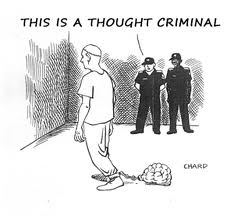
The leaflet then goes on to list telephone numbers and internet contact details, before ending with these dystopian remarks, which would not have been out of place in an early 1970s BBC Play For Today, or perhaps George Orwell’s Nineteen Eighty-Four:
What happens to my referral? [“my referral”, note, not “my denunciation”, “my informing”, my accusation” etc…]. Prevent referrals are shared with the MASH (multi-agency safeguarding hub) or [name of city] SPA (single point of access) depending on where the individual lives. Referrals are then screened for acceptance in to the channel process.
What is channel?
Channel is a multi-agency process whereby professionals and partner agencies can share resources and expertise. The aim of channel is to work with the individual to reduce risk. If your referral is accepted into the channel process you may also be asked to attend the channel meetings to share relevant information as part of effective multi-agency working.
I have sometimes been accused of being, inter alia, a “grammar Nazi”, and am, of course, (also) appalled by the poor English displayed in the leaflet. I have no idea by whom the leaflet was written. Perhaps the Home Office and MI5 are now less likely to recruit graduates from Oxford or Cambridge, or perhaps the near-illiteracy shown is just a function of the UK’s sliding educational standards. The main impression given, though, is that of a police state operation which would be recognizable to an official of Stalin’s Russia or any similar society. The saving grace is probably that it is not (though I am guessing) very efficient.
Indeed, shorn of the millennial “nudge”-government, fake “sharing caring” and armchair psychology nonsense, the leaflet could be seen simply as a method of recruiting agents…
Finally, think about where this leaflet was found– not in a prison, a government office, nor even in a university library, but in a normal NHS clinical environment in the heart of the South of England…
Italy has just held its 18th national election since the present republic was established in 1948. The results have appalled the EU/ZOG/NWO System but have given hope to many both inside and outside Italy.
The Results
The coalition headed by Lega [“The League”, formerly The Northern League], anti-EU, anti-Euro currency, anti-mass immigration, got 37% of the popular vote and (under Italy’s partly-proportional, partly-First Past The Post electoral system) 265 seats in the Chamber of Deputies). 265 seats out of 630. Lega got a plurality (125) of the coalition’s seats, most of the rest being taken by Silvio Berlusconi’s Forza Italia.
The Five Star Movement, with less direct but not dissimilar policies (anti-EU, Eurosceptic, broadly anti-mass immigration etc), got 227 seats on a popular vote of just under 33%.
Most of the rest of the 630 seats (122) were taken by the “Centre-Left Coalition”, and most of those seats (112) were taken by the Partito Democratico [“Democratic Party”], i.e. System social-democrats.
Thus we see that the insurgent parties, with an anti-EU, anti-mass immigration outlook, have 492 seats out of 630. Similar results were recorded in the Senate. In terms of popular vote, the winners got about 70% of votes cast. By any standards, a landslide, albeit for a general outlook rather than for one party or one coalition of parties.
The Italian President, unwilling to approve an anti-Euro politician as Finance Minister, now appoints someone who is not even a politician to be Prime Minister until fresh elections are called next year! The person “appointed” is a former IMF economist, i.e. another NWO/ZOG EU drone.
The reaction of the leader of the Five Star Movement:
“Why don’t we just say that in this country it’s pointless that we vote, as the ratings agencies, financial lobbies decide the governments?”…
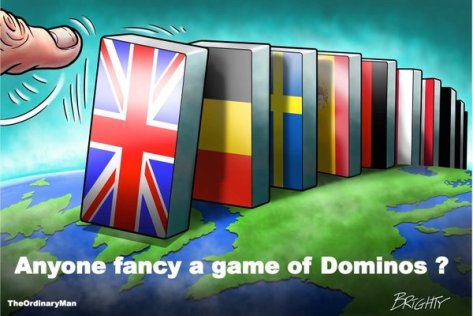
Italy is the fourth-biggest state in the EU, both in terms of population and economy. The EU would fall to pieces without it, especially if the UK really leaves, at present still an open question.
Here we see, again, the conspiratorial basis and mechanism of the EU, below all the “human rights” stuff, below all the financial subsidy sleight-of-hand. Wrong vote? Hold another one and another, until the “right” result is obtained. Wrong views? “Holocaust” “denial” laws backed up by the “European Arrest Warrant” system will correct that outburst of free expression…
Relevance to the UK
In the UK, we see that the clear though not huge majority to leave the EU is being undermined heavily now. The army of self-congratulatory “Remain” whiners on Twitter etc are backed by secret monies on a vast scale, by UK civil servants unwilling to do their jobs, by System MPs burrowing away to make Brexit effective in name only. The Italian situation reflects the same EU ZOG/NWO conspiracy at core; the same has happened in the past in Portugal, Ireland, Austria etc. If the “wrong” people get elected, measures are taken to get rid of them one way or another, from scandals “appearing” suddenly, to elections rigged, even to “car crash” deaths. Look at Catalonia. Another example.
Conclusion
Social-national political parties must exist (none do in the UK at present; there is no credible and effective one at least), but ordinary political activity may not be enough on its own.
I was recently “suspended” (in reality, probably expelled) from Twitter. The “usual suspects” (Jew-Zionist provocateurs) were to blame, but that is another story (and the guilty will be suitably punished in due course, no doubt). This event has led me to reassess whether Twitter is even useful for someone from a political-influence standpoint.
At first, it seems to be a non-question: of course Twitter spreads influence. After all, most MPs have a Twitter account, along with Donald Trump and Vladimir Putin. However, those Twitter accounts (and the myriad showbusiness ones with millions of Twitter “followers”) are only followed and (sometimes) read because the people running the accounts are of note in the “real world” outside Twitter.
I acquired my Twitter account in 2010 but only started to tweet regularly in 2011 or 2012. My follower count increased steadily from zero to, at peak, just under 3,000, falling back at time of “suspension” to about 2,800. What struck me in the last months was that my follower count had plateaued, oscillating between 2,700 and 2,800. I began to suspect that my total of followers was being artificially limited. Others, with far more followers, have started to tweet, as did I until my expulsion, along the same lines. Anne Marie Waters for one.
Another Twitter tactic has been stealth censorship, sub nom “shadowbanning”, both of tweets and replies. I found (by accident) time and again, that Twitter had not notified me of replies, often supportive ones. The Jew-Zionist fix is well and truly in, and not only on Twitter; Facebook is said to be worse. When the UK Government (ZOG) talks about working with Internet platforms to reduce “extremism”, this is what they mean– censorship and banning.
One consequence of spending time tweeting is that you are not doing something offline or elsewhere online. Thus we see much tweeting, Facebook posting etc by social-nationalists, the “Alt-Right” and others, but less and less real political activity. That does affect System parties too, but less so, because they already have organizations, MPs, MEPs etc.
My conclusion from all this is that, while tweeting etc is useful in terms of raising consciousness and bridging gulfs, it cannot be a substitute for real-world political, social and military action.
Update, 4 March 2019
Twitter is censoring many others now, especially people with any real political influence. Tommy Robinson got bumped off the site. Many others have suffered the same fate. A recent example:
As well as censoring our content over the past few weeks, Twitter have now deleted all the people we were following, which in turn means we have lost a ton of followers
Please RT and follow if you’re still right behind us – we have no idea why Twitter is doing this pic.twitter.com/opwxMMr6fX
I write in a condition of profound dissatisfaction with the situation on the broadly nationalist wing of British, European and world politics. Yesterday, someone whom I have only met twice but who has made a favourable impression on me, Jez Turner [Jeremy Bedford-Turner] of the London Forum, was found guilty of incitement to racial hatred under the Public Order Act 1986 after a Crown Court trial, being then sentenced to 12 months imprisonment, meaning that he will be incarcerated for nearly 6 months, all for making a harmless speech about Jews.
Also yesterday, the latest hearing in the Alison Chabloz case took place, legal argument prior to the judgment, which is expected on 25 May. Most reading this will know that Alison Chabloz is being prosecuted, in effect, for singing songs.
As with the Turner case, that of Alison Chabloz has been promoted by the malicious Jew-Zionist group calling itself the “Campaign Against Anti-Semitism” or “CAA”, which organization has previously (and unsuccessfully) tried to have others, including me (and David Icke, and Al Jazeera TV etc…) prosecuted:
The outcome of the Alison Chabloz trial is of huge importance not only for the future of free speech in terms of socio-political expression, but also in terms of artistic expression. A “guilty” verdict (from the single magistrate) would chill lampooning, making fun of politicians and events and, frankly, would cause the UK to become something pretty close to a police state.
Nick Griffin’s Booklet
I have no particular animus against Nick Griffin (whom I have never met). He did well, alongside Andrew Brons, to get the BNP into the position where it could get two MEPs (Griffin and Brons) elected in 2009, but in my view he underestimated the sheer dishonesty (and determination) of those who opposed him and the BNP. He also seems to have thought that soft-pedalling on the “holocaust” revisionism would mean that the Jew-Zionist element would lay off a little. That was naive, as was assuming that he was invited onto BBC Question Time just like many another guest, when the object of the exercise was to ambush him and trash him and, via him, the BNP. Having said that, Griffin was one of the outstanding people in a party not over-endowed with the well-educated and reasonably credible.
I mention Griffin here because I was sent, yesterday, a pdf version of a booklet by him:
I found the contents disturbing and challenging. I agreed readily with some of them, indeed the majority; with others, particularly the attack on Jez Turner, I disagreed, though I concede that I am in no special position in terms of inside knowledge.
Griffin’s main arguments against many of the “alt-Right” personalities and entities struck a chord with me. I have from the start been suspicious of any and all “nationalists” who are pro-Israel, loudly “anti-Nazi” (though Griffin himself is guilty of a certain amount of that latter) or who somehow find a way of squaring the circle and reconciling being a “white nationalist” with support for Israel. This pathology is particularly seen in the USA, where it is not seen as odd to be a “nationalist”, a pro-Israel blockhead (“holocaust” belief and all…) and a kind of anti-government “rebel” all in one, mixed in with a bit of Bible study and membership of the National Rifle Association.
Griffin correctly points out the Zionist/System infiltration into nationalism in Europe too: Front National, Geert Wilders etc. In the UK, we have seen the so-called “nationalism” of UKIP and smaller offshoots, of which the one now promoted most widely is the “For Britain” party, headed by an Irish lesbian ex-secretary called Anne Marie Waters. To paraphrase-quote a general in the film Lawrence of Arabia, For Britain is a sideshow of a sideshow, a one-trick pony “party” which has no prospect of mass appeal or electoral success.
Many see the promotion of so-called “kosher nationalists” as a way of diverting the nationalist torrent. My problem with that analysis is that, so far at least, there is no nationalist torrent (in the UK). That may change, but at present the single great fact of British nationalism or, as I prefer, social nationalism, is that its support in the wider population is minimal. Again, that may change: in 1928, the NSDAP received only 2.6% of the national vote in Germany, lower than it had managed several years before; however, by 1932 that vote had become 33% and in 1933 (by which time Hitler was already Chancellor) 44%. In the UK, there have been governments –with working majorities in the House of Commons– which have been elected on less than 30% of the popular vote.
The Alt-Right
I have had no personal contact with the “Alt-Right”, unless there is included my February 2017 talk to the London Forum (which was on YouTube until that organization caved in to Jewish-Zionist pressure and removed the London Forum YouTube channel in its entirety…”long live freedom”…). I find myself in sympathy with much of what Nick Griffin says in his booklet about odd young men with odd lifestyles, swinging (if such be the bon mot) between braindead “libertarianism” and a (sort-of) white nationalism mixed with pro-Israel sympathies. These people set off alarm bells for me. I find it telling that such people are all in favour of “free speech” until it comes to those such as Jez Turner and Alison Chabloz (and me) who are hated by the Jewish Zionists. We are, at best, ignored, even when on trial or in other peril. Big alarm bells…
The Answer
The answer, for me, is straightforward in principle but complex and difficult to put into effect:
A political organization must exist. Voters cannot vote for a party that does not exist. It may be that such a party faces insuperable obstacles in a rigged system, but it must exist. At present, no such party exists;
The social national population must cluster in one or more “safe zone” areas of the UK. I have blogged fairly extensively about this on WordPress.
The present situation is intolerable: Jew-Zionists and “anti-fascists” (often the same) try to shut down even the limited free speech that exists now in the UK. Meanwhile, the major cities are going black-brown, with births to those populations outpacing those to the white northern Europeans. A new way forward must be found.
I have no idea who “Secret Barrister” (apparently a criminal specialist) is; in fact I block him (or her) on Twitter simply because he (or she) seems to be friendly with some Jew-Zionists and others who have proven themselves to be hostile to me. It will be recalled by some that, though I ceased Bar practice in 2008, I was nonetheless disbarred in 2016 (!), after a malicious complaint by a pack of Jews calling themselves “UK Lawyers for Israel”. The main facts can be found here:
I should add that I have not read the Secret Barrister book.
My Bar pupillage (on-job training year, in my case mostly in 1992), was largely criminal (the rest being mostly civil and public law). Prior to that, I had done –and was only able to do– unpaid “pro bono” work, such as helping an eccentric small publisher to win a libel perpetrated on him by Alexander Solzhenitsyn, the famous Russian author having claimed via innuendo that the plaintiff –now “claimant”– had acted as an agent for the Soviet K.G.B. We won £10,000 and costs; if anyone is interested, the case was Flegon v. Solzhenitsyn and was reported on the front pages of the more serious newspapers.
I did no ordinary criminal cases after the mid-1990s and –as mentioned– ceased Bar practice entirely in 2008, and so have no direct knowledge of the damage done to the justice system in England and Wales by reason of post-2010 “austerity” (that being the subject matter of the Secret Barrister book), but my observations more generally may be of interest.
When I was at the “Bar School” (the Inns of Court School of Law in Gray’s Inn, at the time the only place where the academic part of Bar training, culminating in the Bar Finals Exam, could be undertaken), the legal scene in London was vibrant. The pre-recession late 1980s saw major newspapers ( Times and Independent especially) carrying dozens of display ads weekly for lawyers of all types and levels of seniority. In the private salaried realm, pay for employed lawyers went from perhaps £25,000 for very junior to £100,000 and even £200,000. I knew a Bar student who needed to get a salaried job on Call to the Bar. The Crown Prosecution Service, founded only in 1986, offered him £26,000 a year as starting salary, quite good by the standards of many non-legal employees at the time. I have no specific knowledge about the salary which his equivalent might be offered today, but I doubt that it is much more, despite inflation in the succeeding 30 years.
As to those I knew who went on into private Bar practice, I followed their progress from afar, mostly from the USA. One got into criminal chambers doing fairly heavy criminal (including white collar) crime: fraud, armed robbery, serious violence. The frauds paid especially well and my friend was, by the early 1990s, making well over £100,000 a year as junior Counsel often led by a “silk” (QC). This was, to me, a stunning amount paid to a young man in his mid twenties from a no more than average academic background (a comprehensive school in the North of England, then a law degree from a provincial university) to be making, but in his milieu it was just accepted as the norm. I mention all that because it was at that time that the newspapers started to report on the amounts some barristers were making from legal aid fees. Indeed, it was about then, or not very many years later, that a handful of barristers paid via legal aid were starting to break through the million-pounds-a-year barrier.
As to others I knew, they were doing well too: an appearance in the Mags (magistrates’ court) might only pay a couple of hundred pounds, but that has to be set against the fact that many “ordinary people” were paid that much, or less, for a week of work, as opposed to what might well be, in terms of time in court (leaving aside preparation, waiting, travel) only half an hour or less in some small magistrates’ cases. I joined the throng in 1993 and, though scarcely in the stellar league (much at the Bar depends on the quality of the chambers you are in; chambers supply almost all of your work), made a reasonable living, anyway. I do recall one brief I had, an “old-style” committal for trial in a modestly-large multi-handed (7 or 8 defendants) cheque fraud case, at City of London Mags. It went on for a few days and I remember even now that my fee for that was £5,000, which for me at the time was a windfall very gratefully received (it could not happen now and of course I recall it mainly because of its rarity. I did not get the expected £20,000-£40,000 Old Bailey trial, because the Nigerian solicitor gave “my” trial to a recently-Called young Nigerian woman barrister who just happened to be a daughter of his friend…but that’s another story).
Scroll on a decade or so to the years before the Conservative Party victory of 2010. I had made my last appearance in court in late 2007 and since my return to the practising Bar in 2002 had done only privately-paid civil work, no criminal (except for the odd regulatory violation committed by large companies); in fact, before mid-2002, I had also spent years overseas in various parts of the world, from the Caribbean to Kazakhstan. During that time, legally-aided Bar fees in England had generally not kept pace with inflation. For example, back in about 1993 I had appeared on a Mention at a Crown Court, this being more or less what it sounds like: the matter (an upcoming trial) is listed for Mention, the judge examines any issues arising and makes any directions necessary, then it finishes, about 5 minutes or ten minutes after it started. A silly thing and it paid £46. I heard some time ago that, 25 years later, the fee is still less than £50! It is said that the same is true of many fees for both criminal and family work that is legally-aided.
Apparently, somewhere around 258 courts have actually closed in the past 8 years. This means that parties often have to trek quite far to their cases. Some people are poor, cannot afford fares and may not have a car. Unjust in itself.
It was in the fake “austerity” atmosphere after 2010 (which in fact started before 2010, under the equally “ZOG” Gordon Brown government) that the Jew-Zionist “Conservative” MP Jonathan Djanogly commented, as Parliamentary Under-Secretary (a junior government post for an MP), that the UK justice system was “the most generous in the world” [https://en.wikipedia.org/wiki/Jonathan_Djanoglyhttps://en.wikipedia.org/wiki/Jonathan_Djanogly]. This laid the ground for the Ministry of Justice becoming a prime target for “austerity” cuts. Djanogly himself left government in 2012 and his political career seems to have stalled, probably permanently.
I want to be clear. I have little sympathy for the Bar, meaning barristers, as such (and less for solicitors). I think that those who made good and often very good livings out of legally-aided work (criminal, family and other) were lucky when compared to many people in the UK who work at hard, boring, maybe dirty jobs, often for a pittance. Many at the Bar still are fortunate. Having said that, any decent public service or arm needs to be properly funded, whether it be the Army, Navy, Air Force, SIS, NHS or Ministry of Justice. There are arguments to be had about some aspects of MoJ funding, as about priorities too, but as the book in question seems to be saying (from reviews seen), the justice system (and that includes prisons, probation, forensic science etc, as well as courts and legal services) is now under very serious strain.
July 2018
Since I wrote the above, The Guardian amended its article and, inter alia, cured its spelling error.
From 2005 through to 2008, I worked as a practising barrister in England, but spent about half my time in Brittany, commuting on a twice or thrice-monthly basis by sea and air. I did not keep in close touch with UK political affairs. I used my TV in France only for DVDs and videos and had no Sky service. The brief triumph of BNP candidates Nick Griffin and Andrew Brons in the European elections was heard by me via BBC World Service and Radio 4 (which can usually be picked up on or near the coast).
In mid-2009, having given up Bar practice in early 2008, I returned to the UK. I started to take great interest in British political life. One aspect surprised me particularly: the rise to –brief– prominence of persons whose connection to politics was slight. Not so much “commentators” (their usual self-styling) as pseudo-commentators and pseudo-“activists”. One of these was a young woman called Alexandra Swann (on Twitter, @alexandralswann, not to be confused with @alexandraswann, an American blogger). She was (for her “15 minutes of fame”) a UKIP spokesperson:
and the msm started to take an interest in her. For a few months she seemed to be on TV constantly, pontificating (albeit risibly) on social welfare, employment, all sorts of things. UKIP gave her 10 minutes in which to speak at its 2012 Conference:
The Guardian –of all outlets!– gave Alexandra Swann op-ed space, calling her “the new face of UKIP”. She was also called, by others,”the future face of UK politics”!
In fact, she described herself as “libertarian” and had been an office-holder at one time in “Conservative Future”, the more or less defunct Con youth wing (the Scottish section even had to cancel its conference, when only 6 people applied for tickets!). Like so many youthful “libertarians” (she was 23 years old in 2012), she had a wealthy father to help her out should she be unable to stand on her own two feet in the approved Ayn Rand manner. Indeed, she was, at the time, still a student, working on a politics-oriented PhD at Sussex.
In fact, it was around that time that UKIP started to split internally between the members who were basically pseudo-nationalist Conservatives (fiscal Conservatives who were anti-mass immigration) and the more social-national UKIPpers who might (and did, briefly) appeal to voters in the Labour heartlands of the North.
She was so politically-unaware that she thought that UKIP should ditch its anti-immigration stance and become a party of Ayn Rand “libertarians” (liberty for the wealthy and austerity/repression for the poor, as I see it). She was not alone in holding such attitudes: some who held elected positions were not far from her in this; one could mention Daniel Hannan MEP, Douglas Carswell MP etc as “fiscally conservative, socially-liberal”. Those far more seasoned (not to say educated and intelligent) figures likewise at least pretended to think that a “small-state” national conservatism could be popular. Needless to say, the idea is anathema to me.
Since that time, Alexandra Swann has retreated into private life and (her tweets have recounted) has even had a job or two, as well as becoming, presumably on a small scale (via family money? I do not know, but how else?), a buy-to-let parasite or “residential real estate investor” if you prefer. I should add that the lady blocks me on Twitter, though I have never tweeted to her. She must have disagreed with a tweet of mine which was critical of her smug “entitled” attitudes…
What I am writing about here is not this one now-obscure person, Alexandra Swann, as such (she was, in the end, too silly and inconsistent a figure to be taken seriously even in Britain’s decadent political/msm milieu), but as a symptom of a time when the mainstream media promoted almost anyone, especially those thought to be travelling along the “welfare reform”, “austerity” line. A pretty face and youth helped but were not essential. There were others after 2010 who were trying to become media talking heads and/or political stars. Some even became MPs.
There was Louise Mensch, who caught the wave early. David Cameron-Levita-Schlumberger placed her on the “A” List, as a result of which she was briefly an MP, though she resigned for “personal reasons” later, by which time various stories about her behaviour had surfaced, not least the fact that (as she admitted), “hard drugs” had “messed with” her brain…
Louise Mensch could be seen on TV constantly in 2010-2011, supporting the evil policies of the “Conservative” government of Cameron-Levita (and not only on Sky News, but Newsnight, at the time still a programme of some weight).
Since her resignation as MP, Louise Mensch has tried and failed at various commercial social media and Internet activities and was for a few years a columnist for the Sun “newspaper”, until she “left” in 2017. I always wondered why Murdoch paid her (assuming that it was a paid job). It seemed bizarre that a woman who constantly gets basic facts wrong could be a columnist even for the Sun. She still tweets, though: prolifically and sometimes –though unwittingly– funnily. She blocks me on Twitter…
I should add that Louise Mensch has been gunning for me for years on Twitter and elsehow. She loved it when the Jew Zionists managed to get me disbarred in 2016 (I suppose that she thought that I was still in practice and that I would suffer as a consequence) and (together with or parallel to the same Zionists) tweeted directly to me that she was going to get me chucked out of the New York Bar too. She is married to a wealthy Jew. Her desire to extract the “pound of flesh” from me was patent!
For the record, the New York Bar does not police its members’ opinions on politics (there’s this thing called the U.S. Constitution…) and I never heard anything more about the complaint by Louise Mensch against me (if it was ever made) or that supposedly made by some London Jews (eg one Goldberg QC, who threatened me with the same in the newspapers). In fact, I have never practised in New York anyway, and whether I belong to the NY Bar is a matter of supreme unconcern to me.
There were many others around 2010 (in fact from 2009) and in the succeeding years who were to be seen on Sky News and BBC News newspaper reviews, on Question Time and BBC Daily Politics. Some found niche positions in small publications or online, but most have almost faded from view. One is the egregious Caroline Criado-Perez. Like several others of the type now under discussion, she seems to have come from a rather wealthy background, so it scarcely matters to her from an everyday point of view that she dropped out of university in the first year. Her Wikipedia entry –pretty obviously mainly drafted by her– mentions her “working in digital marketing for several years”…well, it may be true…(ha).
It seems that some silly and malicious people emailed or tweeted to Caroline Criado-Perez in a threatening way (three were even convicted), allowing her to claim a kind of pseudo-martyr status for a while. I personally have no objection at all to women of note (no pun intended) being depicted on paper money, but to agitate for that (which had already been done anyway) hardly counts as a career…
Caroline Criado-Perez had an OBE bestowed upon her by David Cameron-Levita for her “activism” in getting Jane Austen on a banknote (though Elizabeth Fry had been on banknotes for years). She has now agitated for a statue of a Suffragist in Parliament Square. She still seems to regard herself as a kind of full-time or other “activist” though her Wikipedia entry says that in 2013 she was “in process of completing” a Master’s degree in Gender Studies. Roll over, Einstein! I have no idea whether she will now get a CBE for having asked that a statue be erected; maybe not.
I have never tweeted to Caroline Criado-Perez, but she must have seen me criticize her on Twitter or, more likely, not take her seriously on Twitter, because she too blocks me…I have only seen her a couple of times on TV and she seems quite pleasant in her interview manner, but “pleasant” alone just does not cut it in these times. She is a one-trick pony who is just not at all interesting.
What strikes me about the three women above is how adept, at least initially, they were at self-promotion. Also, how, in the end, self-promotion is not enough. 2010 and 2012 were different to 2018. Times are becoming serious. Yes, you could get on TV shows if you were a pretty girl willing to address (however shallowly) important issues; yes, you could maybe become an MP if you had the right help and image; yes, you could get an OBE for something like demanding that a certain type of person be put on a banknote. However, that’s where it finishes. The pretence of gravity is not the same, ultimately, as gravity. If you are shallow, or ignorant, or a one-trick pony, the more serious times will not carry you along but will dump you as irrelevant.
My intention in writing the above was not to criticize those mentioned but to characterize a time, a time that is pretty much gone now. The new time demands serious people with the ability to think and act seriously. This is no longer the time of the dilettante.
Later Note
“[Louise] Mensch is diagnosed with attention deficit hyperactivity disorder, which made her realise she was “self medicating” with wine for stress….[103] She has also commented, on BBC Question Time during a debate on calls to decriminalise hard drugs, about taking hard drugs in her 20s; she subsequently told the press: “It is something that I regret incredibly, that, in my youth, I messed with my brain. I said ‘we all do stupid things when we are young’. It’s had long-term mental health effects on me.”
[Wikipedia]
Update, 25 January 2020
Nearly two years have passed since I wrote the above. The times have indeed become serious, but I have been astonished to note that System politics has founds niches for dilettantes almost as absurd as the three mentioned in the article. The Prime Minister is now Boris-idiot, dilettante sans pareil, and his top adviser is Dominic Cummings, another dilettante, who has asked that “weirdos and misfits” apply to “reform” the Civil Service. 35,000 have, we are told, applied. The UK is now going down so fast that it is dizzying.
Labour? Same: Jess Phillips for one, tipped (incredibly) as leader at some point (I doubt it, not if Labour is going to survive).
Update, 17 March 2023
None of the three women mentioned has come back into prominence, except that Louise Mensch has continued to tweet complete rubbish (including anti-Russia propaganda); she has been dumped by her now ex-husband, a wealthy American Jew; she still, it seems, lives in New York. As far as I can see, her tweets about me from years ago have all been deleted, and I myself was expelled from Twitter in 2018 after a long campaign by a pack of Jews.
I am in favour of the Welfare State, in principle, but that just begs the question. Even the Iain Dunce Duncan Smiths and Esther McVeys of this world go that far, at least in public utterances. The devil really is in the detail here.
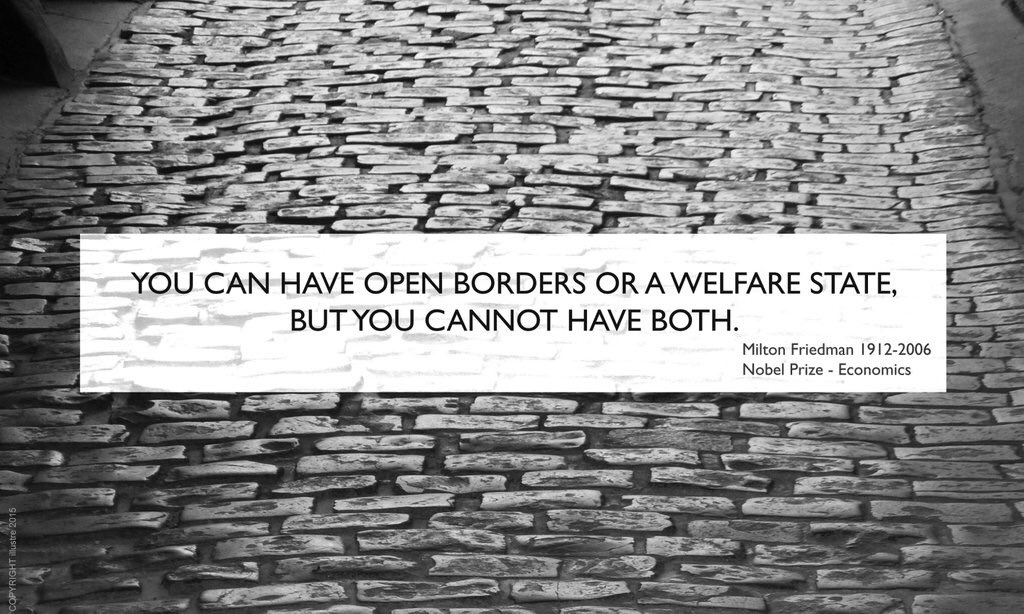
The famous economist, Milton Friedman, once said that you can have open borders, and you can have a welfare state, but you cannot have both. That it is even necessary to posit that shows how far the more socialist-minded people in the UK (and elsewhere in Northern Europe) have travelled from reality. Many “refugees welcome” dimwits actually believe that an almost endless number of “refugees” or others can enter the UK without affecting State benefits and services (as well as road and rail congestion etc). This seems to be based on the idea that the immigrants will work, pay taxes, in short become normal citizens or quasi-citizens. Angela Merkel thought the same, only to find that most “refugees” were
incapable of any but the most basic work (such as fruit-picking) because of their linguistic and/or educational levels;
unwilling, in many cases, to work, in a situation where the State provides free accommodation, free utilities, free transport for some, free food for some, as well as pocket money on quite a generous level.
The UK does not provide social security (or, in our new Americanized speech, “welfare”) benefits on the generous scale offered by Germany or Scandinavia etc, but the fundamentals are similar.
A personal story: when I was much much younger, in my early twenties, I became acquainted, via a lady I then knew, with a friend of hers (more accurately a woman who had attached herself to her like a limpet). Now this other woman was not British in any sense except that she had married a New Zealander who had (presumably because taken there from the UK as a child) a British passport. The woman was in fact a Jewess from Moscow, who had somehow got to know the New Zealander while he was on a holiday trip to the Soviet Union. We need not examine motives and reasons, but that couple married and went to live in New Zealand. They had two children. After about four or five years, the woman left her husband, left New Zealand and flew to the UK.
When I met the woman in question, I believe that she had been in the UK for a couple of years. She washed-up in Downham, an obscure suburb in South-East London, where the local council provided her with a council flat. I have no exact idea of what other benefits she was granted, but they would have included child benefit and some form of income support. She never had to work, though at first she did a couple of evenings a week teaching Russian at some place or other which I forget (possibly Morley College in Westminster Bridge Road, or the City Literary Institute in Drury Lane, both of which adult education centres I myself frequented at the time).
Scroll on a few years. This “Russian” Jewish woman, with no real connection to the UK at all had been given a quite decent house with gardens in Grove Park, a better part of the same borough. She had been impelled to move, apparently, by a visit from her father, a nuclear scientist (which sounds impressive, but the Soviet Union had legions of them) who had told her that she would have a better flat were she to return to Moscow! Of course, there she would have had to work…anyway, I visited the new house once (out of duty rather than choice) and so saw it, despite being not much liked by the woman. The woman had been diagnosed with a kidney complaint (though I never saw her looking unwell) and so no doubt managed to claim some form of incapacity or disability benefit; and had also acquired a car (almost certainly also funded by the State). In addition to all of that, the woman and her children also had all the usual UK benefits of free education and health. I do not think that she bothered to do much work after that, maybe a little part-time teaching or occasional low-level interpreting.
Now it might be said, perhaps especially by people more naturally drawn to socialism than capitalism, that she was entitled to these things because lawfully resident in the UK. Perhaps, but look at it from the wider point of view: she had never contributed anything to the UK, just taken. The small part-time jobs here and there can be discounted as having been de minimis. She leeched off the UK’s people since about 1979 and, the last I heard (a couple of years ago), that situation remained unchanged, probably to this day. In fact, she would now be “entitled” to a State pension and Pension Credit. Call it 40 years of being a millstone round the neck of the British Welfare State.
Now multiply the above by millions, the millions of often completely useless people from the backward hordes imported into the UK for decades. For example, it is reported that only 20% of the huge numbers of Somalis in the UK (how? why?) are employed at all.
I repeat, I do favour a decent Welfare State, but it can only exist if
a. the economy can support it;
b. it is not swamped.
The above two conditions really come down to the same thing now, or very nearly so.
For me, the answer to the work and income challenges of robotics, computerization, Internet shopping, AI etc is the Basic Income concept, but Basic Income, like the existing Welfare State, will decline and may fail unless it is restricted to those who are at the very least, genuine citizens.


 Ian Robert Millard