Category Archives: society

Free Speech: Individuality and Collectivity

Rudolf Steiner often spoke of the ever-increasing individualism in our age (that period which he named the “Fifth Post-Atlantean Age”, which started around 1400 AD and is due to run until about 3500 AD). This is an inevitable continuing process and will bring many benefits if people are guided by conscience. However, if people are not guided by individual conscience, the forces of the individual will tear apart society.

Against the forces of individualism stands “society”, which encompasses law, unwritten “laws” of convention and expectation and also the powers of the State (which holds itself out as the concrete expression of the people as a whole).

Society is, of course, a good thing. In proper measure, it makes possible and supports such aspects of life as law, public order, organized help for the sick, disabled, elderly, poor etc. It is a structure which supports the family, too. It also provides, via the State,  the structure for defence against outside forces (hostile states, natural calamities etc). However, if taken too far, society and/or the State becomes oppression, involving the repression of individual liberty in various ways (most obviously, perhaps, suppression of free speech or other freedom of expression).

Society restricts freedom of speech. It is hard to imagine a society beyond the most primitive or germinal in which complete freedom of speech exists (eg spoken or written threats against the person). On the other hand, when society (the State, or perhaps a religious or political cult) prevents individual expression, reasonable restriction becomes unreasonable repression. One thinks, perhaps, of the more extreme socialist states of the 20th Century, such as the Soviet Union under Lenin and Stalin, China under Mao Tse-Tung, Albania under Enver Hoxha, Cuba under Fidel Castro. The same was true of anti-socialist tyrannies such as Nicaragua under Somoza.

Particular emergency conditions may lead to a temporary tightening of what is regarded as acceptable free speech. In the Second World War, the various combatants restricted free speech considerably. In the UK, those who spoke out against the war or government policy faced both prosecution (State) and persecution (society generally). Even the USA, with its famous Constitutional safeguards, clamped down on freedom of expression.

As in other fields of life, we can see that the tension between the demands of the individual qua individual and those of the collective results in what amounts to a compromise. It is a question of either where society (in practice, usually the State, but possibly a smaller community such as a town or even a family) decides where the line is drawn, or where the individual draws the line, based on conscience or preference and regardless of where the State and/or society has drawn it.

Most people, most of the time, obey the dictates of the collective. Were that not so, law could not exist except as a facade with nothing behind it (cf. Stalin’s Russia etc); neither could the State or its power, in the end. On the other hand, the individual must always obey conscience and it therefore becomes vital to distinguish between individual conscience and individual wilfulness or egoism. No outside force can decide what is conscience and what is wilfulness or egoism. The individual, the individual human soul, is the only judge or arbiter here. Where the individual and the collective collide, the results can range from martyrdom of the individual to reform or even revolution affecting the collective.

Where do I myself, as both individual and citizen (i.e. part of the collective) draw the line? For me, freedom of expression about social, political and historical matters should be absolute. Other forms of expression (eg threats, libels, fraudulent misrepresentations) can be (and commonly are) restricted to a greater or lesser extent.

It follows from the above that I prefer the approach taken in the United States to that of most EU states (including the UK). Restrictions on freedom of expression are often imposed for or from outwardly “good” motives, but rapidly become a slippery slope with evil results. The road to Hell is paved with good intentions.

Notes

  1.  http://www.cps.gov.uk/legal/a_to_c/communications_sent_via_social_media/
  2. https://en.wikipedia.org/wiki/English_defamation_law
  3. https://en.wikipedia.org/wiki/First_Amendment_to_the_United_States_Constitution

Reports and Lies

We are accustomed to reading the most arrant nonsense about Adolf Hitler. According to this stream of black propaganda (which started as long ago as the 1920s), Hitler was savage, unforgiving, tyrannical, vituperative, uneducated, a down-and-out from the gutter, a house-painter, sexually perverse, an erotomaniac, impotent, excessively interested in women, a gay, mad, sometimes mad, occasionally mad, only interested in his own material benefit, a tax dodger, even harsh toward his beloved dog, Blondie!

In Hitler’s own lifetime, a pack of lies was spewed out by his enemies: Jewish elements and interests; the Communists and Socialists who, many of them, supported or condoned Stalinism; also journalists working, in effect, for those same groups. During the Second World War, both the Soviet Union and the Western Allies maintained huge ministries and agencies dedicated to “black propaganda”. After 1945 the baton was passed to the increasingly prevalent Jewish or Zionist lobby and its major offshoot, the “holocaust” industry, aided by historians who knew that their careers depended on not challenging the approved narrative.

The “Hitler was a house-painter” story seems to have come from a Jesuit priest who was taken to hear Hitler in Munich in or about 1920. He asked what Hitler was (at that time Hitler had few followers and was unknown outside the city); the answer came, “I think that he is a painter of houses” (no doubt a garbled version, heard somewhere, of Hitler’s pre-WW1 life as a struggling art student and painter). In the 1930s, Churchill took up that false version of Hitler’s life as a young man, no doubt calculating that English snobbery would be inherently biased against a political leader with a past involving painting houses or the like. Even today, one occasionally sees reference to Hitler “painting houses”.

The idea that Hitler was “mad” came from an anti-Hitler newspaper editor (probably the half-Jewish scribbler Konrad Heiden), who, in the 1930s, told the American correspondent and anti-Hitler propagandist William Shirer (who posed as an historian after 1945) that Hitler was a “Teppichfresser” (“carpet-chewer”), meaning prone to bouts of insanity when he would supposedly curl up in rage on the carpet and chew the edge of the same. A complete invention, which has coloured the popular view of Hitler ever since, though even the Jewish historians no longer make the exact allegation.

As to the stories and speculations about Hitler’s  sex life, I should imagine that every possibility has now been explored by journalists and historians eager to reduce Adolf Hitler to a sort of freak show. Needless to say, the most likely possibility (that Hitler was “normal” but unenthusiastic) is of little interest, being unlikely to sell books or newspapers.

A more recent allegation has been that Hitler was a drug addict. Again untrue, though there is at least a kernel of fact underpinning this one, in that Hitler’s doctor, Morell, was a medical innovator who did tend to experiment on his patients. Hitler demanded results; Morell tried to provide them:

https://en.wikipedia.org/wiki/Theodor_Morell#Substances_administered_to_Hitler

(actually, though many have quailed at Morell’s preparations, such as the ones that included “intestinal bacteria”, these were the basis for the now-popular “active” yoghurt health drinks for the stomach now found next to the milkshakes in every UK supermarket).

What about Hitler as a vengeful tyrant? This seems to rest mainly on his reaction to the 1944 plotters, who, in the midst of Germany’s fight for survival, saw fit to blow up Hitler and the German High Command at Rastenburg in East Prussia (now in Poland). Yes, they were executed, some cruelly, it seems, but would it have been much different in, say, England, had Churchill been blown up by “traitors” at Ditchley Park (in, perhaps, 1940), alongside his military and naval chiefs?

In reality, Hitler was not a vengeful type. Anton Drexler, the locksmith who founded the then DAP which Hitler joined in 1919, had a serious quarrel with Hitler in 1921. He wrote a letter accusing Hitler of “acting like a Jew, twisting every fact” (!), was removed as head of the party (replaced by Hitler) and was given a purely figurehead position until he resigned in 1924, after which he was elected to the Bavarian Parliament for another party, serving as elected member until 1928. Despite that, Drexler was readmitted to the NSDAP in 1933, honoured (though not given any political position) and died peacefully in 1942. One cannot imagine Stalin treating a similar case the same way!

Another example. The first reports about an attempted putsch in Munich in 1923 (the Beer Hall Putsch, also known as the Hitler-Ludendorff-Putsch), reached the ears of a police commander called Sigmund von Imhoff, who contacted the Reichswehr commander of the city and seized the telephone and telegraph exchange. He was probably the most important reason that the putsch failed (amid bloodshed, Hitler himself being injured as the main march was brought to a halt).

One can well imagine what Stalin, on attaining power, would have done with an officer such as von Imhoff, but under Hitler he was not punished. On the contrary, he was promoted to Police General in 1933 and, in WW2, seconded to the Luftwaffe with the rank of Major General (he died in Bavaria in 1967).

This article could be ten times or a hundred longer, so many lies about Hitler and the Reich have been told and continue to be told. However, the few examples above perhaps will give pause to those who imagine that they have been told the truth about those world-historic events of the 1920s, 1930s and 1940s.

Tipping Points in Politics and Life

We have all heard of the theatrical cliche of the actor who achieves “overnight success”, having in fact worked hard against all the odds for years. The same is often true of writers, painters and other artists. Not forgetting scientists. It was Edison who, on the failure of his (supposedly) 2,000th lightbulb experiment, is said to have said: “I have not failed. I have just discovered the 2,000th way not to invent the incandescent lightbulb.” At a later time, he of course succeeded. Many things follow the pattern: a long period of non-movement, then sudden success (or sudden failure of something, often after long stagnation).

One can call this a tipping-point, or characterize it by some other metaphor. The aircraft which suddenly fails by reason of metal fatigue, the ship which finally turns over after ice has built up on its external structure in Arctic waters, the huge empire which “suddenly” staggers and falls. On the other hand, there is that actor with his “overnight” success, that composer whose works suddenly find favour, the small political group which “suddenly” rises to prominence and power.

The Bolsheviks were a small group of societal rejects mostly living in internal or external exile, or in prison. Many were not even Russian. Jews predominated in their higher councils (despite forming only 10% of the entire membership), but there were also Georgians and others. In fact, the Bolshevik Party only had 8,400 members in 1905 and, though that increased to 46,100 by 1907, by 1910 the numbers had slipped back to about 5,000. Few would then have imagined either that the mighty Russian Empire would collapse or that the tiny faction of Bolsheviks could seize control of what was left. We know the rest: a failing war and an impoverished population, an initial attempt by others at “moderate” revolution and then a coup d’etat by one small group in one corner of a vast empire.

The lesson: a small and marginalized group, disciplined ideologically and practically, can both seize power and institute an entirely new form of society, once that tipping point or crisis point has been reached.

In post-WW1 Bavaria, Adolf Hitler became the 7th member of the German Workers’ Party [DAP], which may also have had an unknown number (estimates vary from mere dozens to as many as 15,000) of loose supporters in the beerhalls of 1919 Munich.

By 1923, this tiny and marginalized group was able to attempt the Beer Hall Putsch [aka Hitler-Ludendorff-Putsch], but it is important to note that, despite the support of Ludendorff and a few other notables, the actual number of putschists involved was small: the main march headed by Hitler was only 2,000-strong (immediately after the putsch failed, 3,000 students from the university also marched in support and to lay wreaths). Indeed, even had the putsch succeeded, Hitler would only have taken power in one city of one region within the German state as a whole.

The membership of the NSDAP grew steadily, reaching 108,000 by 1928. Electorally, however, the NSDAP was doing worse in 1928 (receiving only 2.6% of the national vote) than it had done in 1924, no doubt a reflection of the growing prosperity in the intervening years (i.e. since the infamous hyperinflation finished in 1924). Despite that poor showing, once the Great Depression started to affect Germany after 1929, the NSDAP was able to gain the trust of ever-more voters: the vote in 1932 was 37% and then 33% (in the two elections of that year), growing to 44% in 1933. Adolf Hitler then took full power, having been appointed Chancellor in 1932.

A different example: UKIP grew from a few people in a pub in 1991 to a peak in the 2012-2015 period, but has not the ideological discipline or revolutionary intent to “seize power” even by electoral means. It missed its chance and will probably not get any further. Still, its growth, in the UK context, is interesting. Its founder, Alan Sked, was a former Liberal candidate who stood as “Anti-Federalist” candidate for the seat of Bath in 1992 (i.e. after UKIP had been formed), receiving 117 votes [0.2%].

UKIP had virtually no members until the late 1990s, though by 2015 the membership had grown to nearly 50,000 (now 30,000). As for its vote share, that grew to nearly 13% by 2015, but the UK’s unfair “First Past The Post” [FPTP] electoral system meant no gains.

FPTP voting itself illustrates the “tipping point” idea, as happened in Scotland: the SNP had fairly good support for decades, but few MPs until the tipping point was reached. Now it has 50% support, but almost 100% of Westminster seats. Why was the tipping point reached? Cultural identity rising, living standards falling, entrenched Labour failing. The point was reached–and the Labour vote collapsed.

UKIP has the same problem. So long as it has only 10% or even 15% of votes, it cannot get more than one or two MPs. Were it to get to 25% support, the situation would tip and UKIP would have perhaps 100 MPs. Except that that will probably not happen…

In fact, the Bath constituency mentioned above is instructive: Alan Sked got only 117 votes (0.2%) in 1992; in 2015 the UKIP candidate received nearly 3,000 votes (over 6%), but was still only 5th (Sked came in 6th in 1992)

https://en.wikipedia.org/wiki/Bath_(UK_Parliament_constituency)#Elections_in_the_2010s

The difference between UKIP’s situation and that of the Bolsheviks or NSDAP is that UKIP has no really firm ideological or organizational structure. Even if society came to a political tipping point, UKIP might well be unable to take advantage of that.

A new and properly-run social nationalist party could take most of the votes of UKIP as well as those which formerly went to the BNP and others. That however, could only ever be a foundation for electoral success. That success itself would depend on the rising star of the new party meeting the fading star of the old parties. It is a question of timing and of Fate. The tipping point for the whole society would be key.

Simplicity or Excess?

The spectrum stretching from simplicity through moderation to excess is perennial. Even today, people use Sparta, Athens and Corinth (or, sometimes, Babylon) to illustrate the different lifestyles and societies pertaining to each. In the past, societies have had to enact sumptuary laws in times of economic prosperity, in order to restrain the outward show of wealth by the rich or by those with wealth but who were not also of high social rank.

It is not necessary to go back to ancient Sparta to find societies where a drab uniformity or conformity has been enforced. The socialist societies of the 20th century were cases in point: China, from 1949 to –roughly– 1989, with its hundreds of millions dressed superficially identically in Mao suits (though in fact small differences such as the materials used or the tailoring still indicated rank or status), was the template. Other examples were Albania, Cambodia under the Khmer Rouge etc. To a lesser extent, the Soviet Union and its satellites. Those societies have passed into history now.

The opposite idea, the society of excess or of conspicuous consumption, is the dominant mode at present. Indeed, some of the “worst” (least aesthetic?) expressions of excess are to be seen in precisely those countries so long repressed into austere uniformity, such as China, where it is now not uncommon to see people who are able to spend hundreds of thousands of pounds on a single car and millions of pounds on a house or apartment.

The wealth generated by globalized capitalism, by computerization, automation, robotics etc has resulted in a global class of “owners” whose everyday excess is in stark contrast to the lives of the vast majority: private jets and helicopters, massive motor “yachts” the size of ocean liners, multiple houses and estates, very expensive cars etc. The wealthiest resident of London is said to be a Ukrainian Jew worth somewhere around £15 BILLION. Fifteen thousand million pounds. When one considers what a sum of even one million pounds means to the average British citizen, that sort of figure is put into perspective.

On a lower but still opulent level are the “celebrity” TV faces etc, often better known than the ultra-rich. Occasionally, their financial level is spotlighted by a news report, as when the Sky News person Kay Burley was reported to have spent a few hundred pounds on a bottle of wine in a restaurant.

Somewhere in the middle, between severity and excess, we have a society where moderation does not become austerity and where comfort does not slide into decadence. Where that is, is not always easy to say. What might be regarded as great comfort to many would seem like pinched poverty to, say, a Donald Trump, to a “Russian” Jew oligarch or, a fortiori, to the King of Saudi Arabia or the Sultan of Qatar.

In the societies of Scandinavia, it has long been thought socially-unacceptable to flaunt wealth; the same could be said of Switzerland. The same was so in the Roman Republic before it became the Roman Empire notorious for decadent excess.

It is necessary, of course, to distinguish between wealth and the outward show of wealth. However, both should, ideally, be moderated, in the interests of social cohesion and, indeed, social functioning.

Basic Income will moderate poverty; caps on income, capital and landowning will moderate both excessive wealth and the flaunting show of wealth. The society of the future will not be one of a few wealthy people and a large number of poor people; neither can it be one of enforced uniformity. It must be a society in which everyone has enough and some have more than enough but without thereby being or seeming vulgar.

The Veneer of Social Order

Living in a country such as the UK, basic social order has been taken for granted for centuries. Even during the economic and political upheavals of the 1920s and 1930s, or during the Second World War, disorder was only briefly and occasionally present. The 1950s and 1960s brought the odd street battle (not always political), but real life continued. The same was true of the 1970s and 1980s, where the occasional skirmish between political opponents or industrial disputants and/or the police was something that people for the most part watched on television, in between a variety show and Match of The Day. The relatively few riotous disorders in a few black neighbourhoods in London and elsewhere did not directly affect many citizens.

In those past decades, there were certainties: pretty much everywhere had a police station (even a village would have a “police house” with one or two constables). Every village had a sub-post office, every town had at least one main post office. Emergency calls for ambulances were quickly answered and took people to Accident and Emergency departments and hospitals which were usually efficient, with quiet wards and plenty of staff. Courts were places of seriousness and, in larger towns, some grandeur. Social security offices were there to help the poor, unemployed, disabled and destitute.

Now look. The UK’s social fabric has worn very very thin. Police are concentrated in large police stations and headquarters and are rarely seen on the streets. I myself happened to need to report something recently (in a small town in Southern England) and went to the large police station only to find that it shut daily at 1800 hrs and was staffed (as far as could be seen) by one woman aged (it appeared) in her sixties, certainly late fifties, in a uniform bearing the rank “Station Support Officer”, i.e. not even a policewoman. Admittedly, another and very pleasant woman, with a charming yet efficient telephone manner, called later to take details, but she was based in some other part of the county.

Many will recall the petrol disputes and consequent shortages which happened a few times in the Tony Blair years. I myself saw, in 2000, scenes verging on the anarchic, simply because the petrol stations were running out of fuel.

Again, take the health service, with its crowding, its noisy hospitals, its bureaucracy, its ever-lengthening response times and waiting lists. Or look at the courts (those not closed down, of which there have been literally hundreds in England and Wales). Instead of imposing and beautiful buildings imparting a sense of “the majesty of the law”, we find that many courts are housed in ugly utilitarian edifices. In addition, many citizens are now priced out of justice by high fees.

Then we have the governmental functions that interface with members of the public on a vast scale: the almost inhuman DWP created or coarsened by Iain Dunce Duncan Smith, the Jew “Lord” Freud etc., the HMRC and its (even more shambolic) administration. To call these organizations “not fit for purpose” is to be kind.

We have examined the now-skeletal police service; the same is true of the armed services, such as the British Army. What would happen if there were a truly big challenge to public and social order? Could the State cope? I think not.

For the above reasons and several others, I favour the creation of a mini-ethnostate in one or more parts of the UK, possibly starting in the South West of England. I have written about the idea in several of my blog posts on this site as well as on my own website:

http://ianrmillard.com/social-national-communities

If the social order breaks down in the UK, the “safe zone” that I propose will be a redoubt, an area where public and social order can be maintained, together with culture, civilization, a decent life. From this defended region can come the call to the rest of the UK to re-establish society and State.

Should We Prepare for Social Collapse?

We read of those, especially in North America, who are termed “preppers”, people preparing for various forms of disaster (nuclear war, an asteroid hitting the Earth, inability of the State to maintain civil order) leading to social collapse, either with rampaging and desperate hordes of displaced people everywhere or with a mere few “survivors” from whatever calamity has struck. We in Europe tend to laugh at these American excesses (as they seem to us), but perhaps we should be less amused and more cautious.

Naturally, there is a huge difference in geographical and demographic norms. The wide open spaces of much of the USA and Canada contrast starkly with Europe, particularly the UK, with its centuries-old man-altered landscapes, densely-populated cities and towns, lack of true wilderness (except in the North-West of Scotland).

The population density of the USA, overall, is 92 persons per square mile; that of the UK nearly 700. Naturally, that is a misleadingly simplistic picture. The most densely-populated American state, New Jersey (where I myself once lived) has a population density of over 1,200 ppsm, whereas, while the UK West Midlands region has a density of over 3,000 ppsm and Manchester over 2,000, Devon has only 172, Cornwall 154 and the Scottish Highlands and Islands only 11. On the other hand, there is the point that “crowded” (in parts) New Jersey, the 4th-smallest American state, is about the same size as Wales. The more sparsely-populated areas of the USA are often a very long way from major cities or even modest towns.

It is clear that, for the UK prepper, less is more and that the congested urban and suburban areas are to be avoided as a base. However, the distinction should be made between the hardcore prepper, who intends to live by hunting, fishing and his wits, i.e. as a “survivalist” and the person who aspires to the creation of a new society after any collapse of the existing one. The latter is therefore, almost ipso facto, a conserver of civilization and culture.

I have already blogged about the idea of forming and developing a “safe zone” or base area for UK social nationalists. I have suggested that, in terms of region, the Devon/Cornwall peninsula might be the most suitable. Naturally, when social nationalists have relocated to that zone, their lives will not consist, in the absence of immediate war or social collapse, of hunter-gatherer or subsistence farmer activities. They will do normal jobs, run businesses, smallholdings, farms and estates and in general live (in most cases) as they do in those other parts of the UK where they live at present.

I suggest the following ideas. This is not supposed to be a comprehensive list, but only a basis for one:

  • Food Security

Keep a stock of food to last for a year or even two. The Mormons have been doing this for a long time, certainly for many decades. There is no need to re-invent the wheel when we can learn from others who know how to do things. Here is one explanation of how the food storage system works with the Mormons:

https://mormonwoman.org/2009/08/28/ask-a-mormon-woman-why-do-mormons-store-food/

The Mormon system seems to work on the idea of having a buffer for months rather than years, but with modern canning, packing and freezing techniques it should be possible to give the people in the safe zone at least a one-year supply of food from store.

Naturally, in a rural area, agricultural and horticultural produce will be available. Members of the social-national community will no doubt own estates, farms, smallholdings. In addition, those occupying smaller residences can be encouraged to cultivate part of their gardens, grow produce on a small scale under glass etc.

An important aspect of food security is the existence of a seed bank. Individuals and families can keep their own, but the community as a whole should also maintain one.

No doubt people will be able, in hard times, to forage and to find wild food and to fish.

  • Energy Security

It is to be expected that, in the first instance, the houses and other buildings in the safe zone will be on mains electricity. This supply is vulnerable in the event of war, natural disaster or social collapse in the wider society.

The first necessity is to build up the supply, within the zone, of solar electricity generation and solar heating. There are buy-back schemes etc whereby the householder can even sell his excess power to the National Grid, so long as it exists. At any rate, the community within the safe zone should do everything it can to utilize this renewable supply.

Geothermal heating of homes and other buildings is possible now, if the capital is there to utilize it.

It may be possible for individual residences in the countryside to have small wind turbines too, which can both supply those homes with electricity and also put any surplus back into the National Grid or a local grid.

A further option for some farms and estates would be hydropower from rivers and smaller streams of water.

As an emergency fallback, there should be a range of off-grid options for heating homes: woodburning stoves, ordinary open fires and, for electricity generation, emergency generators run from oil or other petroleum products.

It would be useful, too, if members of the community were to stockpile emergency lighting: candles (even tealights), hurricane lamps etc, battery-operated or camping gas-operated lights, wind-up lamps and torches.

  • Water Security

Water supply is easier, being regional and local rather than national. Indeed, many houses and farms in rural England have their own supply from springs. However, a contingency plan must be drafted and worked out.

  • Communications

The Internet was designed, originally, as a means by which communications might continue even after nuclear war. Presumably, that system will continue in some form even during social collapse. If so, it might be of huge importance beyond the confines of the safe zone, in the struggle to rebuild the wider society.

The community ought to maintain a radio transmitter.

  • Conclusion

An article such as this cannot cover all aspects of how a decent society might survive when the wider society around it is in a state of disorder and even collapse. I have not touched upon questions of social order, for example. However, these few proposals may start running a current of thought. The proposed safe zone will have to operate on the basis that an externally-triggered emergency will probably occur before very long.

Update, 21 July 2019

I saw this on Twitter. Obviously drafted with American conditions in mind rather than European/UK ones, but not bad overall.

https://twitter.com/SoCarbonNeutral/status/1151751859125669889

The Labour Vote and the Effects of Insecurity and Mass Psychology in UK Politics Today

At present, across the advanced world, there is starting a political ferment. In the UK, attention has been focussed on the EU Referendum, Brexit, mass immigration and the economy. The backdrop for all that has been the decline of popular support for System parties in general and the Labour Party in particular.

There have been two contrasting by-elections recently: Richmond Park; Sleaford and North Hykeham. One, a very pro-Remain constituency which has only ever had Liberal Democrat or (one, Zac Goldsmith) Conservative MPs; in the other, Leave captured 62% of the Referendum vote in a constituency which has never had anything other than Conservative MPs. In both of these by-elections, the Labour vote bombed.

I have blogged about the results of both by-elections: Richmond Park

https://ianrmillard.wordpress.com/2016/12/02/thoughts-on-the-richmond-park-by-election/;

Sleaford and North Hykeham

https://ianrmillard.wordpress.com/2016/12/09/the-sleaford-by-election-post-poll-view/.

We hear various reasons put forward as to why the UK Labour Party is not gaining or regaining the support of the people. Some blame Corbyn and his ideology and connections; others make the valid point that Labour support was sliding even before Corbyn became leader. Labour did poorly in both 2010 and 2015 General Elections.

I should like to put forward the following idea: that Labour is sliding in public esteem and support for a more basic reason than ideology or even perceived competence. Labour is sliding because the people generally have no faith in its power or even willingness to protect them.

A primary function of the State, which predates even the State itself as we now know it, is the ability and willingness to protect the people from external danger. This primary function was, over time, added to. The State was expected not only to defend against other states and rampaging bands, but also to keep order within its own borders, to promote justice and fairness; also, eventually and in general, to keep the people fed and housed, their children educated, the national culture protected and promoted. These incidents of State functioning are now basic, even in those states which operate on a more or less laissez-faire ur-ideology.

The protective functions of the State are also transferred to or expected to be carried out by the ruling political parties, both those actually in government and those which aspire to government.

Apply the above to the Liberal Democrat Party. For decades, it had built up a respectable support base. It proclaimed all sorts of virtuous policies, said it would protect people in every way, acquired 62 MPs by 2005, yet was all but wiped out in the 2015 General Election after having engaged for 5 years in the “Con Coalition”. Why? It was because people expected the LibDems to protect their interests against the more savage manifestations of Conservative government: spending cuts, callousness toward the poor, unemployed, disabled etc. The LibDems (despite protests) did not, overall, do that. Their punishment was condign: to be reduced to a rump of 8 MPs (now 9, by reason of the special circumstances of the Richmond Park by-election), with effectively no hope of recovery.

Now we look at Labour.

Welfare State

The Labour reaction to the attack on the Welfare State which an earlier Labour Party had done so much to support was to join in the “me-too” mass media and Conservative Party onslaughts on the disabled, on the unemployed, on all those dependent on State assistance (except the Royal Family, the subsidized farmers and the increasing swamp-floods of immigrants). Time after time, Labour MPs, especially those who had been ministers or who were shadow ministers, supported the most callous “reforms” to the social security system. Many Labour MPs either supported the Conservatives in the Commons (even more so after the 2015 General Election) or failed to oppose measures such as the Bedroom Tax. Indeed, it was Alastair Darling, James Purnell, Stephen Timms etc (all Labour ministers) who brought in the dreaded, hated and incompetent ATOS organization in the first place.

Conclusion: Labour failed, both in Government and in Opposition, to protect those most dependent on the Welfare State. Reaction? Those people deserted Labour in droves, either going to (at first) BNP, then (later) UKIP, or dropping out of voting altogether. They will not vote Labour now, despite Corbyn’s support for them, because they have no faith in his (in effect) being elected as PM and because most Labour MPs are still a rabble of pro-neoliberal, anti-Welfare State me-too-ers and fakes.

Pay and Living Standards

In government, Labour under Tony Blair and Gordon Brown advanced the interests of the wealthy or affluent above those of the rest of the population, in the hope of general improvement of the economy. A pathetic version of trickle-down theory. Income and capital inequality soared. Gordon Brown’s Working Tax Credits and other tax credits ameliorated this to some degree, though at the cost of taxes and taxpayers subsidizing, in effect, low-paying businesses–and on a huge scale. Welfare for Business. Mad.

Pay has continued to decline or stagnate for most people, but Labour has no answer for that problem and is judged on its record. There is no sense that Labour stands with the poor working people (or middling people who are becoming poor).b-cisxdiqaa7qj_-jpg-large
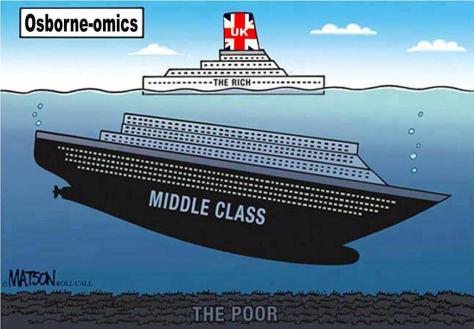
Another factor in this is the continuing rise in rents as against pay. When the cost of rent in the private sector is added in, pay has slumped almost as much as has the Labour vote.

Result? Voters have no confidence either that Labour pay policy works or even that Labour is somehow “on their side”. This belief in the uselessness or untruthfulness of Labour has led many either to prefer Conservative policy on the economy as well as (if, arguably, bizarrely) on pay, or to cease bothering to vote at all.

The proletariat scarcely exists now in the UK and has been replaced by a more volatile “precariat”, without loyalty to the former certainties of class, background, region, or even race and culture.

Mass Immigration

Here Labour has no cards to play.  It deliberately imported millions of immigrants, (mainly non-European, i.e. non-white) under Tony Blair and then Gordon Brown, not only to provide big business with cheap labour and more consumers but also to destroy British (especially English) race and culture [see Tom Bower, Broken Vows: Tony Blair — The Tragedy of Power]. Whistleblowers exposed this treason far too late and, it has to be said, the swamping has continued under the misnamed “Conservatives”, right up to today.

Those behind the Labour Government’s immigrant-importation were and are traitors and include, among many others, these two then ministers:

https://en.wikipedia.org/wiki/Barbara_Roche

https://en.wikipedia.org/wiki/Phil_Woolas

The Jewish Zionist Barbara Roche was particularly culpable. The voters of her once-safe Labour constituency realized (years before Tom Bower’s book came out) that she hated English (and all European) race and culture– they voted her out in 2005 and she has never returned to Parliament, despite lobbying hard for either another Labour candidacy or a peerage. She had inherited a 20,000+ Labour majority in 1992. Straw in the wind?

Labour MPs are still lobbying for more immigration! Even those, such as Yvette Cooper, now belatedly paying lip-service to “having a discussion” about it (as the hordes break down the gates!) are “refugees welcome” dimwits and promoters. Most Labour MPs are not even interested in talking about mass immigration, let alone actually doing anything about it. Corbyn and his absurd or joke “front bench” will never even talk about the swamping of England, except to support it. Angela Rayner and the freeloading moneygrasper Diane Abbott are two names that come to mind.

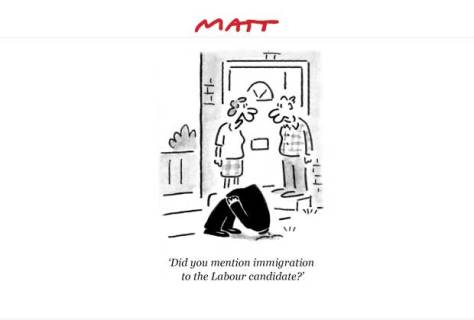
The cartoonists have hit upon Labour’s immigration madness many times, yet all Labour MPs say is that the people need to have the “benefits” of immigration “explained” to them. Patronizing and wrongheaded.
161214-matt-web_3139193a

ctgqcfywiaa6yvr

The result of Labour’s immigration non-policy and its attacks (both now and in government) on English and British race and culture? Millions of former Labour voters voting for UKIP, for the Conservatives (who at least pay lip-service to slowing the rate of immigration despite doing nothing much in a practical way) or not bothering to vote at all.

Conclusion

On the big issues for most voters, meaning living standards and social protection generally and immigration (bearing on race, culture, identity, NHS, schools transport, crime etc), Labour is not only NOT protecting the British people, but is still actively against most of what is in the popular interest.

The “instant karma” of all that is that the people withdraw their support and withdraw their votes. Richmond Park and Sleaford were just the start, in fact not even that: Scotland is already a Labour Party-free zone, pretty much (Labour is only 4th in the polls there now, on a pathetic 15%).

One has to wonder what sort of people would now vote Labour. Some ethnic minorities, some public sector workers, some traditionally-minded (older? maybe not: older people have seen the devastation caused by mass immigration over decades) Northern voters. Not much of a mass-support base.

On the basis of the latest polls showing 25% support, Labour would have about 180 seats (out of 650) on present boundaries and only 140 (out of 600) on the proposed new ones.

Labour is on the way out. It has betrayed the trust of the people and deserves to be obliterated. The people rightly feel that they are not protected by Labour.

A new social national party must arise, to protect the people and to create and preserve a new form of State in England and Wales.

cqsbrinweaalitk

The Society of Measure

In the mid-20th century, especially in the 1960s, it was commonplace to see articles or features about the supposed coming “age of leisure” which would be facilitated by machines and advanced industrial techniques. Now (since the 1980s), those predictions are often laughed at, as society (eg in the UK) finds itself enmeshed in the “long hours culture”, the workaholic culture, the low pay economy. Was this inevitable?

The fact is, that the predictions of the past about a future “society of leisure” left out one crucial fact in particular: that the benefits of industrial efficiency and the emerging developments in computing, robotics etc would be taken by the owners of capital, by shareholders and others.

Since the 1970s, real pay (whether absolute or per hour) of most employees has stagnated and indeed even declined across the advanced Western world generally. At the same time, the profit accruing to capital and the remuneration of the upper strata of executives, higher managers and their professional counterparts has rocketed.

The above was true to some extent even in the Soviet Union, except that there, the developments in technology and efficiency were not spread equally across all industrial sectors and the benefits were used mainly for State power and prestige: military and naval upbuilding, space programmes and other large-scale projects such as the BAM railway.

The result (focussing on the West and particularly the UK) is that people have to work ever-longer hours for ever-lessening real pay. If public services, amenities and State benefits are taken into account, the contrast between the optimistic promises and predictions of the 1960s and 1970s on the one hand and the realities of 2016 on the other is even more stark.

There is another factor to be taken into consideration: there are three “work/leisure” faces:

  • work as unwelcome and/or repetitive drudgery, with little free time;
  • leisure as mere absence of work, for whatever reason;
  • creative work, balanced with stimulating leisure or free time

Adolf Hitler was referring, by implication, to the above alternative lifestyles when he noted “the Aryan ideal of creative work“, to be contrasted with (as he saw it) uncreative Jewish profit-making, as well as equally-uncreative paid drudgery [see Adolf Hitler, Mein Kampf 2:7]. In explaining, for example, the symbolism of the red-white-black NSDAP banner, Hitler wrote:

And indeed a symbol it proved to be. Not only because it incorporated those revered colours expressive of our homage to the glorious past and which once brought so much honour to the German nation, but this symbol was also an eloquent expression of the will behind the movement. We National Socialists regarded our flag as being the embodiment of our party programme. The red expressed the social thought underlying the movement. White the national thought. And the swastika signified the mission allotted to us — the struggle for the victory of Aryan mankind and at the same time the triumph of the ideal of creative work which is in itself and always will be anti-Semitic.

In our contemporary society, we see the temporary victory of uncreative work/leisure modes: on the one hand, soul-less profiteering (whether by manipulations on stock and bond markets or by buy-to-let parasitism etc); on the other hand, everyday work becoming less and less interesting for most people. Soul-less economic serfdom. Creativity and a decent work/life balance become the province of the artist, the maverick off-grid person, the creative writer. Most people are excluded.

At the same time, those without paid work and who are under pensionable age cannot even enjoy the one major benefit of being unemployed: leisure! They are harried and chased around by Department of Work and Pensions drones. In other words, in place of actual paid work, there is a ghastly and ghostly simulacrum of work consisting of the tick-box applying for (often non-existent) job vacancies or the attending of pointless “courses”, in return for which the unemployed claimant is paid a shadow version of a very low real salary: State benefits.

It is estimated that, between now and 2030 or so, developments in robotics alone will mean that 20%-30% of UK jobs will disappear, including some presently “professional” ones (eg in the medical and legal fields). The numbers of unemployed, under-employed and poorly-paid will increase. The “precariat” will include ever-more people.

The solution to all of the above is not a “society of leisure” but a “society of measure”:

  • strict limits on hours worked by employees, perhaps 30 hours per week;
  • strict enforcement of break-times within the working day;
  • strict demarcation between work-time and free-time (leisure time);
  • strict limitations or barring of employees being “on call” when at home;
  • payment to all citizens of “Basic Income”
  • more equitable distribution of the fruits of the economy.

Such a society will have time for those important things which have traditionally been part of “leisure time”: home, family, culture, rest, sleep, entertainment, sport. This must be the way to go and will cure many of the ills of the present society.

Text reference link:

http://www.angelfire.com/folk/bigbaldbob88/MeinKampf.pdf

The UK Housing Crisis

The housing crisis in the UK is perhaps the most pressing problem the UK, certainly England has, apart from mass immigration. The two are connected, of course. It is idle to imagine that the housing crisis can be solved without stopping mass immigration, yet the System political parties all maintain that the two problems (or facts) are unconnected. In any TV discussion on housing, mass immigration is the elephant in the room, rarely if ever mentioned by the participants. This is remarkable.

The latest statistics [https://www.migrationwatchuk.org/statistics-net-migration-statistics] for immigration show that (official, “legal”) “net immigration” into the UK was 327,000 in a single year (about 700,000 came in, some left, some British people also emigrated). Even if two or three immigrants live in one house, that means that somewhere around 100,000-200,000 houses or flats would be required to house these incomers. In one year. Another 100,000-200,000 houses next year…and so on. In fact, the situation is worse than that, because the immigrants (certainly the non-Europeans) have a far higher birth rate than the British. In parts of London and elsewhere, there are already far more births to immigrant mothers than to British ones.

About 150,000 new houses are being built each year in the UK now, but the House of Lords has said that the UK “needs” (largely because of immigration and births to immigrant mothers) 300,000 more houses each year:

http://www.telegraph.co.uk/business/2016/07/14/england-needs-to-build-50pc-more-homes-than-governments-target-s/, while even more conservative estimates say 250,000.

In other words, there is a shortfall each year of at least 100,000 dwellings, yet the System political parties will not address the main reason why British people either cannot get a house (whether to buy or rent, as prices and rents spiral) or pay through the nose to do so. The Labour Party is particularly culpable, because it both promotes mass immigration and yet cries about the “housing crisis”! No wonder its former voters are deserting it in droves.

British people are divided by the crisis: a minority are living as rentier parasites and/or are profiting (on paper) via inflated property values. The majority are paying huge amounts in mortgage payments or excessive rents, simply so as to have a roof overhead. This cannot continue.

The solution to the housing crisis in, particularly, England, is to

  • stop mass immigration;
  • repatriate as many immigrants (and offspring) as possible;
  • prioritize British people for all forms of housing;
  • build decent State housing for rental;
  • change planning rules in large parts of Victorian and interwar London;
  • found beautiful new garden cities and towns without destroying the countryside;
  • decentralize the UK, to prevent the South and South East being ruined.


Robotics Might Save the Railways

The rail system in the UK is a mess. Start from basics: rail travel, when it started (in England, in the world) in the 19th century, was a fast expanding private enterprise system of competing lines. These lines (companies) solidified into an efficient cartel by the time of the First World War. During the war itself, the railways were under State control (and until 1921). The Railways Act 1923 put the de facto private cartel on a statutory basis, with four large railway companies running virtually all passenger and freight services. Profitability waned with the coming of cars and road freight so that, by the time of nationalization in 1948, losses threatened. This became reality in 1955, when British Rail recorded its first operating loss.

The “modernization” plans adopted from 1955 culminated in the Beeching Report of 1963 and the subsequent and consequent closures of lines, services and stations. More than a third of passenger services were closed down. The closures of railway stations were even more dramatic: out of 7,000 stations, more than 4,000 were shut.

The 1990s privatization was carried out in a manner so poorly-conceived that only free-market ideologues who knew little of the realities of how to run a railroad could ever have decided upon it. I do not propose to delve into the detail here (and I myself am no expert anyway), except to say that there seems to be a good case for re-nationalization, possibly on a low-compensation or even an expropriation basis.

What of the future? We see that, all over the world, even in the UK, that driverless train transport, indeed driverless transport generally, is becoming common. Many British people will have travelled on limited forms of automated transport such as the Docklands Light Railway or the monorail at Gatwick Airport which connects the main terminal with another. It would be possible to run many more light rail and ultralight rail services on new branch lines, connecting with existing mainline stations and lines. Indeed, computerized and robotized ultralight narrow-gauge trains could run from towns, villages and suburbs not presently connected to rail, such lines terminating at an existing railway station. A whole huge new web of public transport could come into operation in this manner, eventually becoming more dense even than the railway system that existed before the 1960s. At the extremities, such lines could be narrow-gauge and the trains very small, perhaps single carriage. The expense, though considerable, would be worthwhile, knitting together a country which has become dislocated.

Road transport will be the dominant mode for the foreseeable future, but if an enhanced branch line network can take even 10% of passenger journeys off the roads, the cost of the new system will perhaps have been justified on that basis alone.