Tag Archives: DWP

Deadhead MPs, An Occasional Series: The Justin Tomlinson Story

Background

Here, in my occasional series about those I am pleased to call “deadhead MPs”, I now feature Justin Tomlinson MP [Con, North Swindon]. Tomlinson is unique —so far— in terms of this series, in that he has actually achieved junior ministerial rank (appointed junior minister at the DWP). [*Note: I have previously written about Kate Osamor MP, but until she resigned she was only in the Shadow Cabinet and has never been in government].

As on previous occasions in this series, this MP’s academic and work background do not inspire confidence. His family origins seem obscure. Having been born in Blackburn, Lancs, in 1976, he attended a comprehensive school in Kidderminster, Worcs, before reading History and Politics at Oxford Brookes University (the former Oxford Poly).

Arguably bizarrely, Tomlinson’s only known employed position was as manager of a small nightclub known as Eros, in Swindon: see Notes, below (the photographs show scenes every bit as ghastly as expected, a strange mish-mash of provincial, cheesy, decadent and humdrum. Forget Cabaret, think The Office).

It must remain a mystery as to why Tomlinson, a son of either Lancashire or Worcestershire, and then a student in Oxfordshire, relocated yet further South to Wiltshire. Was the Swindon job (as manager of “Eros”) the only one he could get?

We are asked to believe that Tomlinson also “ran a small marketing business” called TB Marketing Solutions Ltd at the same time (c.2000-c.2010). It must have been “small” indeed. The Companies House accounts summary shows the company’s net worth in 2011 at only £66,000. It seems to have had, at any one time, only one director other than Tomlinson, as well as a company secretary, and to have operated from a privately-owned or rented flat in Swindon. It was dissolved in or shortly after 2011. Still, something to add to the CV, I suppose…

Tomlinson may be short on background but he is certainly not lacking self-confidence, having when a student placed a bet on himself to become Prime Minister!

Chris Kelly and Justin Tomlinson stand to collect £500,000 from William Hill should either become prime minister before 2038. Tomlinson placed two £50 bets at 10,000/1 when the pair were at university. Both are already Conservative MPs.” [BBC, in 2012]

Chris Kelly stood down as MP in 2015 (returning to his family’s Midlands truck-rental business), which is a pity in that he might have made a good “deadhead MP” for this series, were I able to find anything even slightly interesting to say about him.

Back to Tomlinson. He was a local councillor for several years prior to being selected then elected as MP for North Swindon, one of the two constituencies in the town.

Some highlights from Tomlinson’s Parliamentary career

  • “In May 2015, it was reported by The Huffington Post that his appointment as Minister for Disabled People was controversial as he had previously voted against protecting the benefits of disabled children and those undergoing cancer treatment.” [Wikipedia];
  • Tomlinson faced calls for his resignation in October 2015 after it was reported that he had leaked information from the Public Accounts committee regarding regulation of short term high cost credit “payday lenders” to Wonga.com back in 2013. Tomlinson accepted he had broken the rules and apologised, stating that his “strongly-held belief that action needed to be taken on payday lenders” had caused his “judgement to be clouded”.[13] Tomlinson arranged £30,000 of sponsorship for Swindon Supermarine F.C., a local football team by the same payday lender wonga.com. The football club’s chairman, Jez Webb, has made donations of £30,218 to both Tomlinson’s and local Conservative Party funds since 2014. Webb stated that he donated in a personal capacity and that the very similar amounts “were coincidental.”[14] Tomlinson was subsequently accused of trying to remove references to previous links to Wonga from his website, including the arrangement of a sponsorship deal with Swindon Supermarine F.C. in 2011.” [Wikipedia];
  • Tomlinson, 42, employs his personal partner, Katie Bennett, 28, as his office manager, on a salary of £50,000 p.a.; Tomlinson was married from 2012-2016 to another lady but is now divorced;
  • Tomlinson leaked a draft of a public accounts committee report on the credit industry to someone he knew who worked for payday lender, Wonga. And when that person emailed four suggested amendments back, Tomlinson had forwarded them virtually word for word on to the Committee as if they were his own.” [The Guardian];
  • In November 2018, Tomlinson again sparked controversy, this time by suggesting that families facing penury under the Universal Credit scheme initiated by the Conservative governments of 2010-2018 should “take in a lodger.”

“Tomlinson was apparently unaware that [even discounting the fact that few such families have spare rooms], both private and other (e.g. local council and housing association) leases prohibit any form of sub-letting.” [Evening Standard].

North Swindon

Considered to be a “bellwether” constituency, North Swindon has, since its creation in 1997, always followed the national trend. Tomlinson was elected for North Swindon in 2010, receiving a 44.6% vote share (Lab 30.5%). In 2015, the Conservative vote share was 50.3% (Lab 27.8%) and in 2017, 53.6 (Lab 38.4%). In other words, Labour are creeping back but were still well behind in 2017.

Tomlinson has consistently voted for Leave/Brexit, which may help him hang on.

Tomlinson’s vote in numbers was just under 30,000 in 2017, and his majority about 8,000. If, as a recent opinion poll claimed, half those who voted Conservative in 2017 are not going to vote Con in any 2019 General Election, that would reduce Tomlinson’s likely vote to about 15,000 and render the election of another candidate, probably the Labour one, likely. Labour got over 21,000 votes in 2017.

Conclusion

Well, there he is, voters of North Swindon— your deadhead MP. If you want to kick him out, the only lawful way is to vote for Labour or, if it stands, Brexit Party, next time.

Notes

https://en.wikipedia.org/wiki/North_Swindon_(UK_Parliament_constituency)

https://en.wikipedia.org/wiki/Justin_Tomlinson

https://www.gov.uk/government/people/justin-tomlinson

https://en.wikipedia.org/wiki/Chris_Kelly_(British_politician)

http://www.justintomlinson.com/about/biography

https://www.swindonadvertiser.co.uk/news/16320207.rewind-pictures-from-cairos-and-eros/

https://www.swindonadvertiser.co.uk/news/16320207.rewind-pictures-from-cairos-and-eros/#gallery9

https://companycheck.co.uk/company/04739303/TB-MARKETING-SOLUTIONS-LIMITED/companies-house-data

https://publications.parliament.uk/pa/cm/cmregmem/120514/tomlinson_justin.htm

https://www.bbc.co.uk/news/magazine-18769451

https://www.mirror.co.uk/news/politics/dwp-tory-apologises-parliament-making-14224350

https://www.theguardian.com/politics/2016/sep/15/justin-tomlinson-shows-sorry-seems-to-be-the-easiest-word

https://www.thesun.co.uk/news/1434753/mp-justin-tomlinson-announces-love-for-25-year-old-aide-after-divorcing-wife/

Below, Justin Tomlinson’s one-time milieu, Eros nightclub, Swindon, in 2002:

Update, 7 May 2019

Below, Tomlinson making himself look stupid and nasty again…

https://www.mirror.co.uk/news/politics/dwp-leaves-claimants-waiting-9-15010363

Update, 30 May 2020

In the end, Tomlinson held on at North Swindon rather easily. Nigel Farage stabbed his Brexit Party and its candidates (and supporters) in the back; Brexit Party candidates in Conservative Party-held seats (even where the sitting MP was a Remain partisan) were all stood down so that the Conservative Party could win the General Election of late 2019. Tomlinson thus faced no danger that much of his vote would defect to Brexit Party.

Not that the absence of Brexit Party materially altered the result. Labour’s vote slid substantially, and Tomlinson was re-elected by a majority double that which he had achieved in 2017, both in absolute and percentage terms (majority in 2017 was 8,335; in 2019, 16,171).

His vote share in 2019 was 59.1% (2017: 53.6%); pretty convincing by any standards.

https://en.wikipedia.org/wiki/North_Swindon_(UK_Parliament_constituency)#Elections_in_the_2010s

Tomlinson continues as Minister of State (i.e. junior minister) at the DWP, the post he has held since April 2019.

Update, 9 August 2022

Tomlinson was sacked as junior minister in a Government reshuffle of September 2021.

In February 2022 Tomlinson was accused of bullying and sending inappropriate “unprofessional” and “belittling” messages to employees at Conservative Campaign Headquarters.[32]

[Wikipedia].

Tomlinson must have blagged plenty of money since 2010 in terms of pay, expenses, and “consultancy fees” from Wonga etc. He may need those monies. On present opinion polling, the bellwether seat of Swindon North may jettison him at the next general election.

Update, 5 July 2024

As expected, Tomlinson was binned at GE 2024. Time for him (and girlfriend/wife?) to get employment of a more useful type.

https://en.wikipedia.org/wiki/Swindon_North_(UK_Parliament_constituency)#Elections_in_the_2020s
The Urgent Necessity for Basic Income (or its equivalent)

Preamble

I have blogged previously about the need for Basic Income (see Notes, below).

One important point is that the nexus connecting work and pay is loosening in the more developed countries. Already, computers, automation and modern business streamlining have led to the situation whereby, apart from actual unemployment, there is huge underemployment. In the UK, we see, in big picture terms, that the poorer half of the workforce is still being paid less in real terms (the latest statistics suggest about 7% less) than was paid in 2007 for equivalent work.

Now, there is a headlong rush into greater automation and, crucially, to Artificial Intelligence [AI].

Working Tax Credits as Government Subsidy to Poor-Paying Employers

Even before the financial upheaval of 2007-2008, it is clear that the “market”, as “hidden hand” mechanism, delivering adequate pay for required work, was not working properly or as old-thinking economic theory suggested that it should. Employers were unwilling or in some cases unable to offer pay high enough for employees to subsist on, let alone live decently on.

The answer of the Blair-Brown governments was to offer employees “working tax credits”, i.e. a form of “welfare”/”social security” for those in employment, the purpose of which was (and at time of writing still is) to top-up inadequate pay to a determined level. A more limited measure, Family Credit, claimable only by families, was in operation from 1986-1999.

The most obvious drawback of Working Tax Credit [WTC], i.e. that it in effect subsidizes poor and poor-paying employers out of general taxation, was either not foreseen by self-styled financial genius Gordon Brown, or was ignored by him and/or Tony Blair. Adding insult to injury was and is the fact that some of the worst-paying employing companies are also those most adept at avoiding tax liability: transnational enterprises such as Amazon in particular.

In other words, an employee is forced (by circumstances) to work for pay which is not enough for that employee to live on, even at a very basic level. That pay is then topped-up to a minimum subsistence level by Working Tax Credit, which is paid for not directly by the exploitative employer but by government, and so by general taxation. Low-paid employees pay little or no income tax now, but still pay so-called National Insurance, which is today just another or extra income tax in all but name. Put simply, the low-paid worker is paying out for his or her own Working Tax Credit, at least to some extent.

The poor-paying employer has no incentive to pay decently, because the government will stump up enough to keep the employee in place.

Real-terms pay now, for very many people, is inferior to what was paid in the 1980s and 1970s. Conditions of employment are also worse in reality (though that aspect is not part of this blog post).

At present, 5 million people in the UK receive WTC, while another 2 million are entitled to receive it but, for whatever reason, do not apply for it.

Other Government Top-Ups to Pay

In addition to basic Working Tax Credit, people in low-paying jobs and who have children can get extra money via WTC , as can disabled workers.

Persons who are disabled or unwell (including employed persons) can receive Disability Living Allowance, which is not means-tested.

Persons who have children are also entitled to Child Benefit, regardless of capital or income (up to £50,000-£60,000, tapering).

Persons of the age(s) specified can receive State Pension regardless of whether they work or not; moreover, whether or not they have ever worked.

Limited Elements of Basic Income Already Embedded in the Existing System

  • State Pension, paid whatever the individual’s capital or income, and whether or not the individual is working (employed or self-employed) or not and (if you include Pension Guarantee Credit), payable regardless of how much the pensioner has paid in via National Insurance;
  • Child Benefit, paid regardless of income (under £50,000 p.a.);
  • Disability Living Allowance (and its successor, “Personal Independence Payment” or PIP), paid regardless of capital or income to qualifying persons (and this is not the place in which to examine why politicians and Department of Work and Pensions [DWP] civil servants often choose vulgar names for State benefits and programmes: cf. “Jobseeker’s Allowance” etc).

Advantages of Basic Income

  • Simplicity. A Basic Income would mean that most of the existing DWP structure could be dispensed with: the vast edifice of “Jobcentres” (office buildings), filled with DWP staff engaged in adminstration, and the snooping upon, monitoring, “assessing” of claimants etc. The absurdity of it is that many claimants are only getting about £75 a week anyway. The present Kafka-esque set-up really should be and can be junked. Probably 90% of the present 85,000 DWP employees can be made redundant. The financial savings from that, decommissioning of buildings, running costs etc would be in the tens of billions annually; the untold billions paid by the State to useless and dishonest private contractors, such as ATOS and Capita, would also be saved;
  • Security of Citizens. It has been shown in overseas pilot studies (eg recently in Finland) that having a Basic Income, even if small, gives people a sense of security only available until now to those with an inherited private income. Yes, some people will decide to loaf all day, maybe even drink all day, but others will do paid work, start small businesses, improve their cultural level, volunteer locally or far away etc. The idle and/or useless are like that under the present system anyway and are costing the State money even now, both directly and indirectly (eg via the costs of policing, NHS, prisons etc);

Doubts Often Expressed about Basic Income

  • “People will not want to work if they get money for nothing”: well, most wealthy inheritors of capital, most of those living off trust incomes etc do seem to want to work in some way, or to set up businesses, or at least to write, paint, or other similar activity. Don’t disparage writing or other artistic activity. After all, Harry Potter, which snowballed into a huge industry employing, altogether, many thousands and even tens of thousands, came out of the mind of one lady, a single mother on State benefits; J.K. Rowling herself has said that, under the punitive present benefits regime, she would have been messed around so much that it would have been impossible for her to sit in cafes with her baby writing Harry Potter. True, some people will simply loaf. They do that under the present system. Don’t think that there are no costs to the State and society now (even if actual benefits are cut off): police costs, court and legal costs, NHS costs, too;
  • “The cost to the taxpayer”: the cost of Basic Income would be little more than the present “welfare” (social security) system, once you take into account the huge savings on DWP and HMRC bureaucracy, savings by not using useless/dishonest outsourcing organizations, the economic benefit of people spending more, stimulating the economy, setting up new small businesses;
  • “People getting Basic Income money that they do not even need”: firstly, what people “need” is, beyond the basic level, something subjective. Apart from that, there is no problem with clawing back monies paid to those above a certain income. All that need happen is that a maximum level of income (all income) for recipients be set. All persons above that income level to be taxed or super-taxed to the same level as Basic Income received. The level might be a total (including Basic Income) of £30,000, assuming Basic Income of perhaps £15,000 per year. In that case, the person would be taxed the £15,000, leaving £15,000. Yes, there would be apparent unfairness at lower income levels, whereby it might be questioned why work, when you could simply receive the (in the example given) £15,000 and not work. However, even then the recipient does gain, via extra security in case of job loss or illness; alternatively, the threshold could be set higher, say at £50,000 p.a.

Variations on the Basic Income Theme

Instead of money alone, Basic Income could include benefits paid to certain persons, such as free housing for persons receiving less than a certain income. The danger here is in the complexity and cost, as under the existing system, as well as monies wasted going to landlords charging excessive rents. It may be that the way forward is to add to the existing (in the UK) more or less “free” (at point of use) health service, free education at primary and secondary level etc. Examples:

  • free public transport, whether local or regional;
  • free car insurance;
  • free domestic utilities;
  • free NHS or similar;
  • free education.

Basic Income as Necessity

It is clear that, in the UK, relatively few people at present are purely living off what they can earn by work or by investments and/or trust income. 7 million are eligible for Working Tax Credits, millions more are children, retired people, disabled and not working, unemployed etc. For many, working for pay does not cover the basic necessities of life, let alone provide a decent human existence. The State already recognizes these facts.

The explosion in artificial intelligence and robotics will turn the screw. For example, there are at present 356,300 taxi drivers and private hire drivers in the UK. The technology already exists to replace them. It is unlikely that more than a small percentage will still be doing such work in, say, 2030. That’s just one group affected. Groups as diverse as farmers, lawyers, surgeons, pilots, security guards will all be made, as groups, largely redundant.

Basic Income is not just the right thing, but the necessary thing.

Notes

https://www.mirror.co.uk/money/what-happened-finland-scrapped-benefits-13950300

https://en.wikipedia.org/wiki/Working_Tax_Credit

https://en.wikipedia.org/wiki/Child_benefit#United_Kingdom

https://en.wikipedia.org/wiki/Department_for_Work_and_Pensions

https://ianrmillard.wordpress.com/2018/07/27/what-do-people-need/

https://ianrmillard.wordpress.com/2018/10/27/the-revolution-of-the-robots-and-ai-means-that-basic-income-is-inevitable/

https://ianrmillard.wordpress.com/2017/12/03/the-general-shape-of-a-future-society/

https://ianrmillard.wordpress.com/2017/11/16/basic-income-and-the-welfare-state-some-ideas-and-reminiscences/

https://ianrmillard.wordpress.com/2017/03/29/aspects-of-the-new-society/

https://ianrmillard.wordpress.com/2017/09/16/priorities-in-state-funding/

https://www.gov.uk/government/statistics/taxi-and-private-hire-vehicles-statistics-england-2017

https://www.plymouthherald.co.uk/news/plymouth-news/universal-credit-basic-income-california-2563380

https://basicincome.org/news/2016/09/netherlands-debate-about-unconditional-basic-income-in-parliament/

Update, 11 March 2019

People generally are now waking up to both the desirability and the practical possibility of Basic Income:

https://www.theguardian.com/politics/2019/mar/11/scrap-tax-free-personal-allowance-and-pay-everyone-48-a-week

https://www.dailymail.co.uk/news/article-6886461/Unemployed-people-happier-income-scheme-no-likely-job-experiment-reveals.html

Update, 8 September 2019

The necessity for Basic Income is spreading, but not yet to enough people. Many still think that it is “expensive” (probably the same people who believe that the answer to a recession is to “cut spending”…). There is, however, dissent…

https://twitter.com/DerorCurrency/status/1170523619023147009?s=20

Update, 4 November 2019

When Almost Everyone Says to a Government in Office, “Just GO!”

Background

Today I happened to see the Daily Mirror report (link below, at foot of post) about a 9-year-old girl who telephoned a charity begging for help, even offering to work, in order to save her family. This was not in some ragged part of the former Soviet Union, not in Latin America, not (to be rhetorical) in the Britain of the workhouse and Ebenezer Scrooge, but that of Britain in 2018.

The Conservative Party seems to be relying on effluxion of time to disguise what it (and to a lesser extent, Blair-Brown Labour) has done in the past 20 years and especially since 2010 when the Con Coalition took power. However, the fact is that millions of people have been degraded, insulted, even killed or forced to suicide by the hugely expensive and ill-conceived “welfare” “reforms” of Iain Dunce Duncan Smith. He and those guilty with him, have not as yet faced popular justice. Perhaps some form of justice will in the end catch up with him, and Esther McVey and Danny Alexander, and David Gauke, and the Jew “lord” Freud etc.

Then we have Brexit, which I (for social national revolutionary reasons) favour. The present government has proven itself incompetent in respect of that, too.

Armed forces: scarcely functioning, thousands of experienced officers and other ranks made redundant, so that, now that few want to join what was the TA (now, The Reserves), the government is forced to open Army recruitment widely to those from Commonwealth countries who may never even have visited the UK.

NHS: plainly in managed decline.

Immigration: scarcely slowing.

Housing: far too expensive and, in the private rented sector, the hunting ground of buy-to-let parasites.

A future for the young: where is it?

Wherever one looks, the present government has failed miserably, along with its predecessors of the past 8 years. Labour looks scarcely better, true, and has even decided to keep the pathetic Universal Credit scheme if elected, but in a general election, an incompetent government is still at a disadvantage vis a vis an incompetent Opposition.

Labour is no longer unelectable

It was said for years that “Labour is unelectable” under Corbyn, a strange statement in view of the fact that Brown and Miliband also both failed to make it electable. The idea seems to be that Labour has to appeal to the middle of the road floating voters to be electable, and that Corbyn does not appeal to that voter. I do not think that the misnamed “Conservatives” can rely on that. Many of the Corbyn-Labour policies do have Middle England appeal: strict rail regulation or even renationalization, strict controls on utility company bills, making large transnational enterprises pay decent tax. These and other policies speak to those forgotten Middle England voters. Labour has not quite thrown the poor under a bus, but its focus is certainly now on winning over the vital marginal seats. It has recently supported Phillip Hammond’s tax plans on the basis that Labour plans to hit the wealthiest 5% (in income terms) and not, say, the most affluent 10%, 20% or 50%.

The Conservatives have demonized the poor, especially but not only the non-working poor. The Con Party is now more than ever the party only of the wealthy few, the buy to let parasites, the Jews too (95% of whom have deserted Labour since Corbyn took over), the wealthy London foreign cosmopolitans of various types etc.

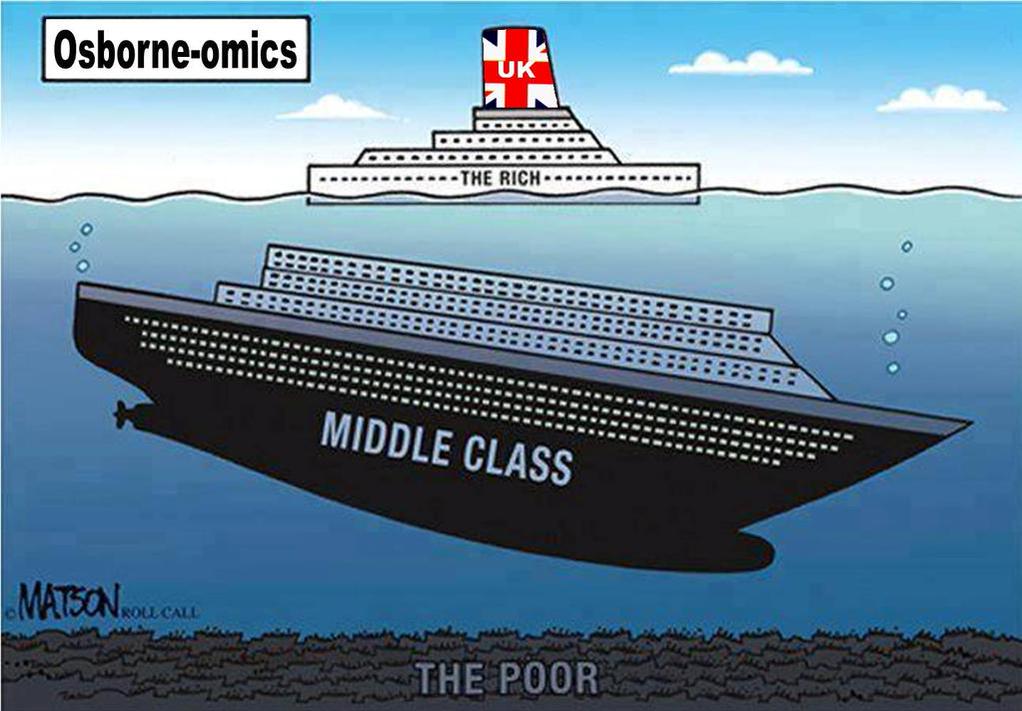
As to the traditional Conservative Party Middle England vote, that is ebbing away. The reasons are clear: the “middle classes”, at least at the lower end, are sinking, and the Government is letting them drown. A cartoon from a few years ago made the point.

b-cisxdiqaa7qj_-jpg-large

On the above facts, it is more than likely that the Conservatives will not be the largest party after the next General Election. The Conservative vote shrinks with every passing month. There is a sense that, as with the 1990s Conservatives, the present Theresa May government has outstayed its welcome so that almost everyone is saying “GO!”.

The poorest 10% will mostly vote Labour anyway. The wealthiest 5% (and probably 15%) will mostly vote Conservative whatever. The bulk of workers in the middle are the battlefield, and one which Labour looks increasingly likely to win.

https://www.mirror.co.uk/news/uk-news/universal-credit-girl-forced-beg-13546259

https://www.huffingtonpost.co.uk/entry/universal-credit-people-are-being-pitchforked-into-poverty_uk_5bdc7c7ae4b01ffb1d01f672?utm_hp_ref=uk-homepage&ncid=fcbklnkukhpmg00000001&guccounter=1&guce_referrer_us=aHR0cHM6Ly90LmNvLzM0dkk5OE05aTM&guce_referrer_cs=ffONymDD0om9x8VezJud7A

https://www.mirror.co.uk/news/uk-news/iain-duncan-smith-claimed-breakfast-1810086

Use and Abuse of the UK Welfare State

I am in favour of the Welfare State, in principle, but that just begs the question. Even the Iain Dunce Duncan Smiths and Esther McVeys of this world go that far, at least in public utterances. The devil really is in the detail here.

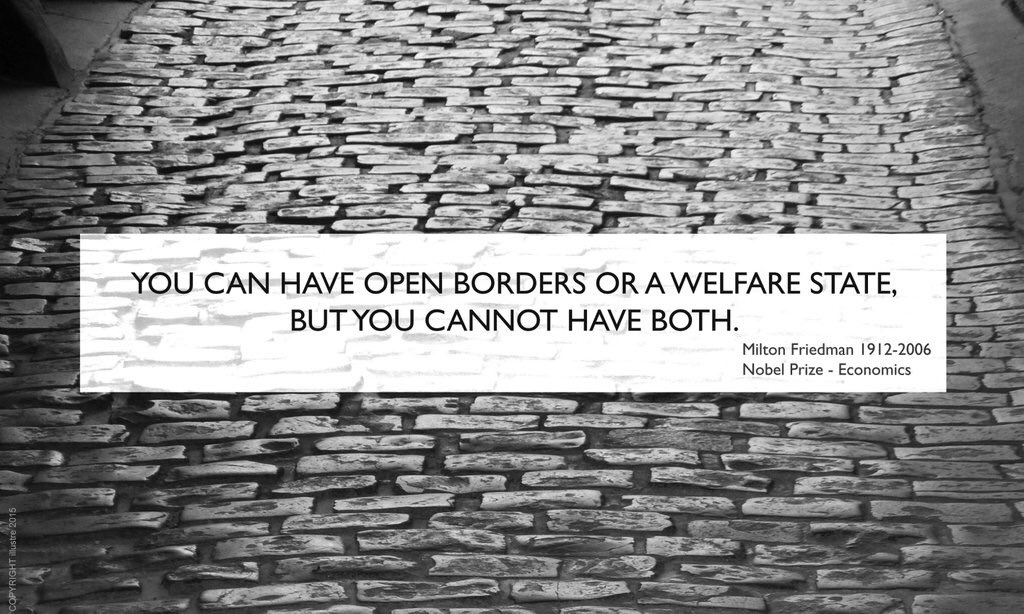
The famous economist, Milton Friedman, once said that you can have open borders, and you can have a welfare state, but you cannot have both. That it is even necessary to posit that shows how far the more socialist-minded people in the UK (and elsewhere in Northern Europe) have travelled from reality. Many “refugees welcome” dimwits actually believe that an almost endless number of “refugees” or others can enter the UK without affecting State benefits and services (as well as road and rail congestion etc). This seems to be based on the idea that the immigrants will work, pay taxes, in short become normal citizens or quasi-citizens. Angela Merkel thought the same, only to find that most “refugees” were

  • incapable of any but the most basic work (such as fruit-picking) because of their linguistic and/or educational levels;
  • unwilling, in many cases, to work, in a situation where the State provides free accommodation, free utilities, free transport for some, free food for some, as well as pocket money on quite a generous level.

CgFqWSRXEAICTlz

The UK does not provide social security (or, in our new Americanized speech, “welfare”) benefits on the generous scale offered by Germany or Scandinavia etc, but the fundamentals are similar.

A personal story: when I was much much younger, in my early twenties, I became acquainted, via a lady I then knew, with a friend of hers (more accurately a woman who had attached herself to her like a limpet). Now this other woman was not British in any sense except that she had married a New Zealander who had (presumably because taken there from the UK as a child) a British passport. The woman was in fact a Jewess from Moscow, who had somehow got to know the New Zealander while he was on a holiday trip to the Soviet Union. We need not examine motives and reasons, but that couple married and went to live in New Zealand. They had two children. After about four or five years, the woman left her husband, left New Zealand and flew to the UK.

When I met the woman in question, I believe that she had been in the UK for a couple of years. She washed-up in Downham, an obscure suburb in South-East London, where the local council provided her with a council flat. I have no exact idea of what other benefits she was granted, but they would have included child benefit and some form of income support. She never had to work, though at first she did a couple of evenings a week teaching Russian at some place or other which I forget (possibly Morley College in Westminster Bridge Road, or the City Literary Institute in Drury Lane, both of which adult education centres I myself frequented at the time).

Scroll on a few years. This “Russian” Jewish woman, with no real connection to the UK at all had been given a quite decent house with gardens in Grove Park, a better part of the same borough. She had been impelled to move, apparently, by a visit from her father, a nuclear scientist (which sounds impressive, but the Soviet Union had legions of them) who had told her that she would have a better flat were she to return to Moscow! Of course, there she would have had to work…anyway, I visited the new house once (out of duty rather than choice)  and so saw it, despite being not much liked by the woman. The woman had been diagnosed with a kidney complaint (though I never saw her looking unwell) and so no doubt managed to claim some form of incapacity or disability benefit; and had also acquired a car (almost certainly also funded by the State). In addition to all of that, the woman and her children also had all the usual UK benefits of free education and health. I do not think that she bothered to do much work after that, maybe a little part-time teaching or occasional low-level interpreting.

Now it might be said, perhaps especially by people more naturally drawn to socialism than capitalism, that she was entitled to these things because lawfully resident in the UK. Perhaps, but look at it from the wider point of view: she had never contributed anything to the UK, just taken. The small part-time jobs here and there can be discounted as having been de minimis. She leeched off the UK’s people since about 1979 and, the last I heard (a couple of years ago), that situation remained unchanged, probably to this day. In fact, she would now be “entitled” to a State pension and Pension Credit. Call it 40 years of being a millstone round the neck of the British Welfare State.

Now multiply the above by millions, the millions of often completely useless people from the backward hordes imported into the UK for decades. For example, it is reported that only 20% of the huge numbers of Somalis in the UK (how? why?) are employed at all.

I repeat, I do favour a decent Welfare State, but it can only exist if

a. the economy can support it;

b. it is not swamped.

The above two conditions really come down to the same thing now, or very nearly so.

For me, the answer to the work and income challenges of robotics, computerization, Internet shopping, AI etc is the Basic Income concept, but Basic Income, like the existing Welfare State, will decline and may fail unless it is restricted to those who are at the very least, genuine citizens.

ClVU6MSWgAAmfK6


Basic Income and the Welfare State– some ideas and reminiscences

Overview

At various times in history, there was either no social welfare system at all, or one which depended on spontaneous or systemized charity: individual alms-giving in the Christian, Muslim, Buddhist, Hindu and other traditions; more organized supply of food, shelter or money as in the ancient Roman dole, Renaissance attempts at poor relief and the cheerless “workhouses” of 19thC England (which in fact continued in places in some form or another until the Second World War and the emergence of the postwar Welfare State).

It is a matter for historical debate whether organized “welfare” in Europe started with the mediaeval Roman Catholic church or in the 19thC with Bismarck, who set up in Prussia and then in the unified Germany a system not unlike those which emerged later in other European countries (eg in the UK under Lloyd George) and further afield: for example, Uruguay had one of the most generous “welfare” (social security) systems in the world until it collapsed in the 1970s under the weight of its expense.

However, the Roman Catholic and other religious and other non-State providers of “welfare” rarely give out money. They supply, variously, food, shelter, often educational and medical help.

The more modern “welfare” systems, eg in the UK, were based on the idea of social insurance: during a working lifetime, you paid in; in periods of unemployment, disability, sickness, old age, you were paid out. In the UK, this has become largely notional. Some tax is still designated as “National Insurance” payment but of course is just an extra type of income tax, fed straight into central funds and not in any way ringfenced.

Some anecdotal evidence

Like many people of my age (b. 1956) in the UK, I had to request State assistance occasionally in the past. This is or was far more common than generally supposed. The writer J.K. Rowling, now supposedly worth £100 million, has described how only the more generous –compared to today– social security of the 1990s enabled her to sit in cafes (partly to keep warm) with her baby, and to write the stories that not much later became Harry Potter. More egregiously, the vampire of Britain’s social security system, Iain Duncan Smith, has admitted that he claimed social security after having left the Army (ignominiously, having only achieved the rank of lieutenant after six years). In fact, Smith, or as he prefers to be known, Duncan Smith (the Duncan not being part of his original surname), claimed social security under false pretences, making him a hypocrite as well as what Australians apparently call a “dole blodger” and (as seen in the scandal of his fake CV and Parliamentary expenses) a fraud.

Certainly, there are those who abuse the social security system. In the past, that was far more common, because the almost Stasi level of control and surveillance that now exists for claimants in Britain had not then been put into place. The system was itself less punitive, less quick to demand impossible levels of enthusiasm for what is now and vulgarly called “jobseeking”.

I knew one woman, a citizen of the Soviet Union, who, having run away from her husband in New Zealand, came to the UK and claimed social security (including disability benefits). How could this happen? Well, her ex-husband, though resident in New Zealand, had a British passport (was British citizen) and had the right to reside in the UK. That meant that his estranged wife could do likewise, even though she had no other connection with the UK and had never even landed there! In fact, that woman never had a job (beyond odd occasional part-time jobs teaching Russian conversation at evening classes). She was supplied with monies for being slightly disabled (kidneys), monies for not having a job, monies for having two children of school age. She was also supplied with free housing. I encountered that person in 1981. She was, I heard, still collecting from the “British taxpayer” in 1996 and is almost certainly still collecting (now State Pension too!) in 2017…All monies legally-obtained, without fraud of any kind.

Another case. A young man (in the mid-1990s), from a very affluent family, who, nonetheless, was “unemployed” and so received whatever unemployment benefit was called then, as well as Housing Benefit for the large flat he occupied in Marylebone, London. In fact, the flat was owned (under cloak of a private company) by the young man’s mother (who lived in Surrey), while the young man had his own freelance work as both a designer and a male model. In this case, there certainly was some kind of dishonesty, both on the part of the young man and his mother. I doubt that they could do the same today, but I last heard of them over 20 years ago, so do not know.

The above two examples seem to show abuse of a system, but here is another case from the 1990s; less obvious, less easy to judge: a single mother of a school-age child, she about 40-y-o, with no relevant educational qualifications. This lady had a small, indeed micro, informal business, making coffee and selling home-made sandwiches to the ladies having their hair done at a large London hairdressing salon. A “Trotter’s Traders” enterprise (“no income tax, no VAT” etc…). About £200 profit on a good week, but more usually less. Not enough to live on, even then, paying Central London rent. That lady was getting State benefits as a single mother; she was getting Housing Benefit too. Now it could be said that she was “defrauding” the State, but her earned income was not enough to live on without State help. Had she given up her private work, the State would have saved nothing, the economy generally would have suffered from her not earning and spending, she and her son would have suffered considerably.

Basic Income

For me, the answer to the above lies in Basic Income, a certain amount paid to every citizen (nb. not to everyone just off the boat, or those who have walked through the Channel Tunnel). The level at which it is set will be, inevitably, contentious. Some will end up with less than under the existing system of State benefits etc. However, it has the merit of certainty. Everyone knows that x-amount will be paid weekly or monthly; those over a certain (to be decided) income can have the Basic Income payment clawed back via the tax system. It may be that everyone should also get free local transport.

The benefits of Basic Income are several. Every citizen will have the basic wherewithal of life: food, shelter, transport etc, without being forced to jump through hoops, without being bullied or snooped upon. The State will save vast amounts on administration, salaries of penpushers, maintenance of useless and expensive buildings such as those called (another vulgarity) “jobcentres”. There will be little scope for fraud and deception, because everyone under a certain income will get the same amount. If society wants to provide the disabled, sick etc with more than the basic amount, then an assessment programme (decent, honest, not cruel, unlike the existing ones) can be put into place for that.

This is obviously the way to go.

THE CASE FOR BASIC INCOME

Jesus Christ said that the poor are always with us (part of society). Whether that be accepted or not in absolute terms, the fact remains that, in practice, there is always the necessity to deal with “the submerged tenth”. In Soviet Russia, the solution was make-work jobs and, if that failed, part of the GULAG system. In finance-capitalist “Western” societies, there is the illusion of “aspiration” and “opportunity”: people need not be without (sufficient) income if they work. This theory or ideology leaves aside those who cannot work, whether because sick, disabled, or unable to find remunerative or sufficiently remunerative employment.

Robotics and computerization are advancing. Some studies say that a third of present jobs in countries such as the UK will disappear by about 2030 (some say “only” 25%). It may well be that other jobs will not appear to take up the slack. Millions may be left unemployed. At present, lack of income means that unemployed people (as well as the sick and disabled) have to jump through hoops in a degrading and largely pointless bureaucratic exercise in order to receive often very modest State-provided benefit payments. The system is not only expensive because of those payments, but because of the huge bureaucratic machinery that is built in to the process. There is a better way. Basic Income.

The Basic Income idea is that all citizens receive a regular payment, regardless of circumstances. In short, the payment is unconditional, meaning not withheld if the recipient does not have a job, look for a job, can do a job. Basic Income replaces all (or, in some versions, some) existing social welfare payments.

Basic Income is being trialled in some areas of Europe: in parts of Switzerland, Finland, the Netherlands. In Alaska, all permanent residents receive a small Basic Income payment annually (at present, about $2,500), monies routed from oil revenues.

Basic Income could be tweaked, so that persons on incomes above a certain level have an equivalent amount taken via the tax system; another idea would be to give a higher-tier Basic Income to the disabled (though that would mean some form of assessment and judgment). Alternatively, Basic Income could be paid only to those without income or capital, topping up income to a certain or decided level. That is, in fact, more or less what happens now in the UK, but without the present system’s bureaucracy, unpleasantness, snooping, harassing etc (made far worse since the Iain Duncan Smith regime of 2010-present).

It is objected that Basic Income would mean that people would just be unwilling to work. Is that so? First of all it might depend on the level of Basic Income. Economic realities would probably limit Basic Income to no more than about £15,000 p.a. It might be as little as £10,000 (either per person or per household). Many will, at that level, find plenty of incentive to work if they can. Also, it is rarely heard that people should not receive inheritances or trust incomes because they might be made lazy thereby. Lottery winners in the UK usually start businesses, carry on working for pay or do charity work.

In fact, in the UK, there are already payments somewhat analogous to Basic Income. State Pensions are already paid to all persons over a decided age, with extra “State Pension Guarantee Credit” money paid to those whose income and capital is below a certain level. Child Benefit was formerly paid to all persons who have children (regardless of income) and still is paid, though now there is an income cutoff point (at a fairly high level).

The cost of Basic Income is lessened by the removal of large numbers of pointless jobs in the (UK) Department of Work and Pensions etc and by the elimination of the need for large numbers of “Jobcentres” and other buildings and their upkeep. Housing Benefit will not exist, so greedy buy-to-let parasites will not be subsidized by taxpayers via taxation revenues). That alone will save billions of pounds.

A person receiving Basic Income who wishes to work will be able to look for work honestly (rather than in order to tick a Jobcentre box) and with confidence, and in the meantime will have money for transport, clothing, food. The disabled will not have to undergo degrading tests in order to receive at least the “basic level” of Basic Income (medical report from GP should be sufficient anyway). The more fortunate, who have income or capital, will (if receiving Basic Income), will be able to spend more (thus stimulating the economy) and/or start their own businesses.

In short, it will become clear in time that Basic Income is the way forward in the UK.