
Ha ha!
News from the “broken society”
I suspect that the judge, in the case reported below, had some sympathy for the defendant. So do I. There is far too much anti-social behaviour around, and the police are usually not very useful. I think that the lady in question was quite right, in the circumstances.
https://www.mirror.co.uk/news/uk-news/mum-mowed-down-teens-threatened-21291400
News from Labour
The newspapers in a flurry because Rebecca Long-Bailey seems to be in the lead, ahead of ex-DPP Keir Starmer. As already blogged, I have little time for any of the candidates, but the two I most want binned and humiliated are Jess Phillips and Lisa Nandy. Overall, Rebecca Long-Bailey is probably the best from a policy point of view at least, but in a terribly poor field.
Voter migration 2017-2019
That is an interesting graphic. From it can be seen Labour’s haemorrhage of support quite clearly.
The Conservatives stood firm, gaining few new voters but still more than they lost; more Brexit Leavers migrating Lab to Con than Brexit Remainers migrating Con to LibDem.
The 4-point upswing in the LibDem popular vote is seen to be entirely Remainer dissidents from both Lab and Con, together with some 2017-non-voting Remainers.
While Labour did lose former (2017) voters, i.e. Leave supporters, to both Conservative Party and Brexit Party, and almost as many Remain supporters to the LibDems, almost as many former Labour voters as all of those defectors simply did not vote at all in 2019. What is especially interesting is that those former Labour voters who did not vote at all in 2019 were split about 50-50 between Remain and Leave.
What that means, to me, is that a very great number of people who used to vote Labour found it unsuitable in 2019 not because it was pro or anti the EU, but for other reasons. We are talking about somewhere in the region of a million people who voted Labour in 2017 but who did not vote at all in 2019. About 2.7 million fewer people voted Labour in 2019 as compared to 2017. Almost half of of those did not vote at all in 2019. So at least a million, maybe nearly 1,250,000.
What do these dynamics mean for the short or medium term? One problem is that we do not know all of the facts. Some former Labour voters defected to the Con Party or Brexit Party because those voters supported Brexit, but others obviously could not support Con Party or Brexit Party for other reasons. They at least could perhaps be called “social national” voters without a home. 500,000-600,000 people.
Brexit, even if probably in a messed-up, disorganized way, is going ahead. Remain is a dead duck politically. Brexit will not be a factor in the next general election, except in residual ways. That means that, inter alia, the LibDems are toast.
About a third of the new 2019 LibDem voters were Remainers who were previously Con, Lab or non-voting. Now that Brexit is set to leave the political agenda, at least as an In/Out question, those voters will ebb away. At the same time, the concentrations of LibDem support in a small number of constituencies are diffusing, but the LibDems have no real national narrative to tell, while the paucity of MPs (11 at present) means that the pool of potential leaders is a mere puddle. Finally, the proposed boundary changes and reduction of MP numbers from 650 to 600 will kill off at least half a dozen LibDem seats anyway. Result— misery and probable annihilation.
I admit that I have been predicting LibDem annihilation for 9+ years, but in my defence I can only plead that I underestimated the stupidity of the electorate or some of it. I also underestimated the effect of the UK’s effectively rigged political system. Where else but to the LibDems could the voters go if unwilling to vote Con or Lab? Only to UKIP or Brexit Party. Controlled opposition. I do think, now, that the fateful hour is approaching for LibDemmery. Their vague “centrism” and “let’s all be nice in society” messaging rang very hollow after the terrible things done by the Con Coalition, in which now-binned Jo Swinson was a junior minister.
The Con Coalition killed the LibDems, or rather mortally-wounded them. The LibDems are slowly dying from the effects of 2010-2015.
The frontrunner for next LibDem leader is Ed Davey, who was a Cabinet minister in the Con Coalition. Not really likely to revive the LibDems, though a more substantial figure than Jo Swinson (whose recent elevation to the Lords, after having been chucked out by the voters of her Commons constituency, has probably irritated voters generally even more). Looking at the other LibDem MPs, one sees the problem in finding even a halfway-suitable leader!
https://en.wikipedia.org/wiki/Liberal_Democrats_(UK)#Current_MPs
Another point to remember is that the turnout in 2019 was about 67%. Nearly 33% of eligible voters (in round figures, about 16 million people) did not vote. There are yet others who are eligible but who are not registered. Could there be a political position that would attract the allegiance of that 16M-strong or maybe 20M-strong bloc?
Interesting to see that the Greens, though basically a joke-party, managed to attract Brexit-unaligned voters who had not voted in 2017. Seems to me that, in part, that was a protest vote against the lack of choice.
Labour is hopeless at present, with no decent leader in sight and policies which are partly-popular but also partly deeply unpopular (eg mass immigration laxity). Its traditional base is ebbing away and its new foundations in the black and South Asian “communities” are not so solid.
Labour seems not to want to turn to the truths that everyone else, pretty much, sees: such as that mass immigration has destroyed decent pay, benefits, and has crowded schools, NHS, prisons etc. Labour wants to say that “unions are the answer” when they were not even the answer 30 years ago!
What about the Conservatives? Their new seats are not theirs by tradition or custom. The roots are very shallow. They are a government by default, who won the recent General Election by default. Labour might have had a chance were it not for the Jew-dominated hate barrage put up over 4 years and intensified during the campaign. However, that was only part of the story. The other part was Labour as it actually is. Diane Abbott as proposed Home Secretary? A West Indian woman who scarcely knows what day it is, who cannot put the right shoe on the right foot, who cannot add up…it just goes on! Oh, and who has made plain her hatred for the British people again and again.
Labour just did not look like a credible government. Even compared to Boris-idiot’s “Conservatives”. It did not hit hard enough against the Israel lobby that was behind the anti-Labour msm barrage either. Since the campaign and election, one of the sinister “Campaign Against Antisemitism” bastards, one Joe Glasman, even posted a triumphalist clip (he looked drugged or drunken) on Twitter (it is deleted now, I read) in which he admitted that the Jews beat Labour through msm links, “spies and intel” and a relentless focus on negative attacks on Corbyn especially. Indeed, he revelled in “his” victory.
The Conservative victory was won without having had to oppose a credible opponent (made still less credible by the Jewish-lobby publicity campaign and by its own flaws). Another factor was the weaponization of Brexit. 52% wanted Brexit in 2016 and even if the mismanagement etc had reduced that to perhaps 45% or 50% by December 2019, that 45%-50% was still more than the Conservative voting intention of earlier in the year, that stood in the 35%-40% range. It was that Brexit factor that augmented the Conservative lead.
2022/2024? Completely open. If a social national party exists by then, it might gain huge support. True, the political system is rigged via FPTP voting, carefully-drawn constituency boundaries etc, not to mention the msm, but if such a party has elections as a stratagem, not an end, such a party might still triumph eventually via other roads to glory…
An enemy of the truly European future
The Coudenhove-Kalergi idea again. How anyone could believe that a white Northern European population is less creative and has fewer evolutionary possibilities than, say, the populations of Nigeria, Congo, Brazil etc is hard to understand except in terms of multikulti brainwashing. Judge the trees by their fruits.
It would also be good if scientists who tweet could use “too” and not “to” when they mean “too”…
Ah, mystery solved. Our “scientist” is a former lifeguard and waiter, who later worked in IT and is now a lecturer at a couple of former polytechnics:
http://scienceontheedge.com/about/
*for those unaware of Coudenhove-Kalergi:
https://www.westernspring.co.uk/the-coudenhove-kalergi-plan-the-genocide-of-the-peoples-of-europe/
https://en.wikipedia.org/wiki/Richard_von_Coudenhove-Kalergi
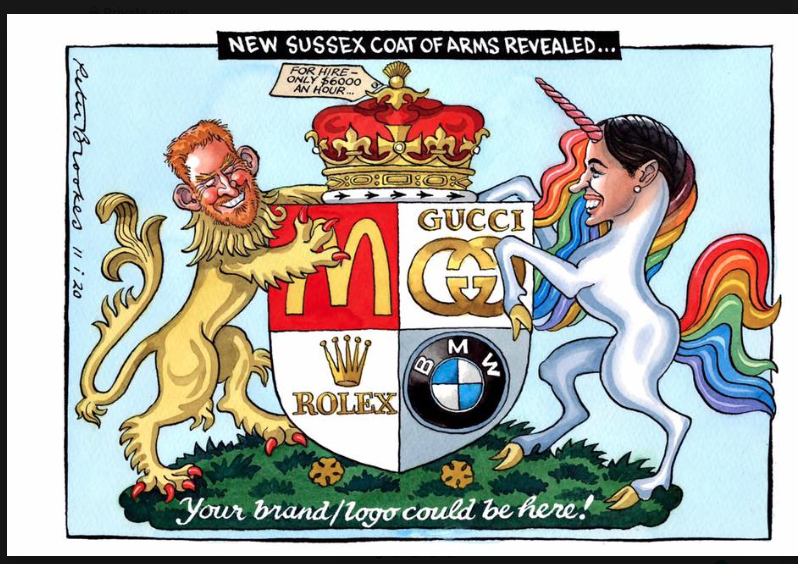
Harry and the Royal Mulatta
A tweet or two.
That last tweet hits the nail on the head. “He who would be first must be the servant of all”. The Queen understands that, at least in principle, but the younger royals feel only the entitlement, not the obligation. Some were always like that, of course. Princess Margaret. Prince Andrew. Edward Fag-End (as the Anglo-Saxons might have named him). Now we have this pair of msm “celebrities”.
An older sort of monarchy would have loaded their camels with gold (if they were lucky) and then banished them forever to a far kingdom. I suppose that, in a sense, that is what was done with Edward VIII and Wallis Simpson after 1936.
This marriage has tarnished the whole concept of British Royalty in a way never done before, certainly not so openly.
Update, 8 February 2021
Looking at the above blog post a year on in time, I think that it has held up well. Even the fact that the idea to reduce MP numbers from 650 to 600 in time for the next General Election has been binned changes little. The LibDems are still a dead duck, in my view.
 Ian Robert Millard