
Tag Archives: Universal Basic Income

Diary Blog, 20 March 2020

Constitutional Coup?

The new emergency legislation being put forward has a life of, at present, 2 years, until 2022, despite the assertion by Boris-idiot that the Coronavirus crisis might last only for 3 months more, i.e. until June 2020. Already, local elections have been deferred for a year. It may be that NWO/ZOG dictatorship is planned, not only in the UK, but across Europe. I would not rule out civil or social war by 2022.

#StopHoarding

Twitter is doing what it does best, namely allowing people to tweet well-meaning and totally ineffective pleas. In this case, under hashtag #StopHoarding, to those who imagine that they need 500 loo rolls and a mountain of pasta and bottled water.

As I have blogged on previous days, there is (possibly reasonable) bulk-buying and there is (wholly unreasonable) panic-buying. Yesterday, at 1900 hrs, I visited the little village shop about 2 miles from me, and which I have noted in previous posts. It shuts at 1930. I bought almost the last loaf of bread, a bunch of bananas, some locally-produced asparagus and a few lottery tickets.

I wanted to see whether Waitrose in the nearest town was offering much, and mistakenly thought that it closed at 2100 on Thursday. Turned out that it closes at 2000 on Thursdays, so I arrived with only 10 minutes to get anything I wanted. That being so, I was unable to see whether shoppers had stripped the shelves bare again. I did notice that there was not a single egg left, not even the more expensive ones from rare breed chickens, with sky-blue shells. I myself bought only (again) almost the last loaf of bread and a reduced-price (99p reduced from £2-75) North African vegetable and cous-cous salad thing (which turned out to be quite tasty).

I think that this panic-buying can be halted by supermarkets only allowing one item or pack of anything per shopper. Inconvenient, yes, and some would then go to half a dozen places to evade the rule, but most would not and it would restore equilibrium.

Free speech

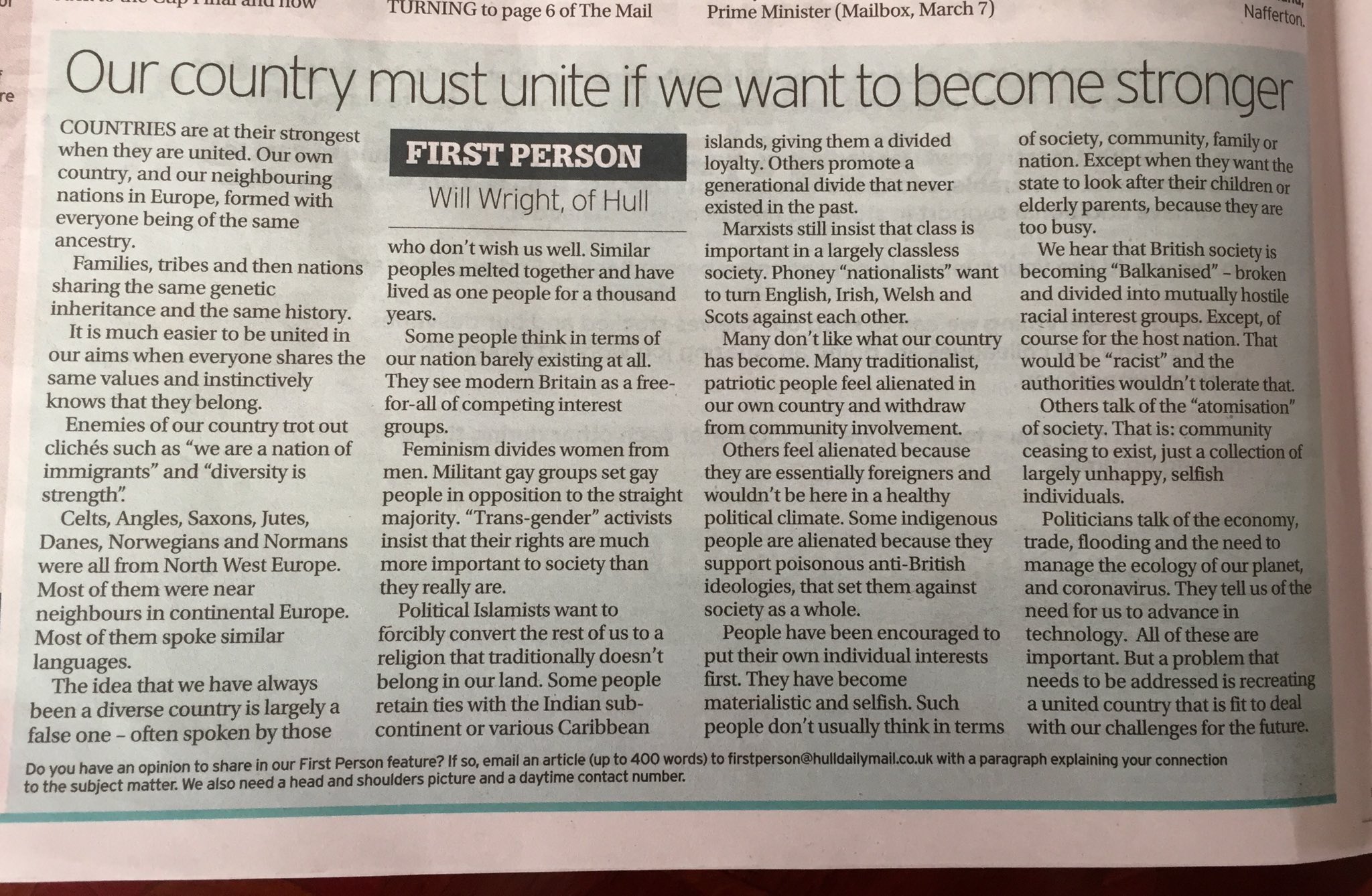
Well done, @HullLive [http://hull-live.co.uk], and well done “Will Wright of Hull”, whoever you are. The truth is rarely seen in the newspapers in the UK.
Image

Socialism, National Socialism, “National Communism” and Social Nationalism

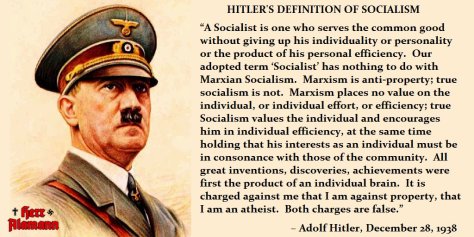
“Socialism” has almost as many meanings as “democracy”. We still see people with pedestrian understanding writing or tweeting about how “socialism” is and can only be something akin to the Marxist-Leninist setup of the period before the great change(s) since 1989. Those people say that German “National Socialism” was not “real” socialism. Yet German National Socialism gave the German people a great deal more in every way, both economic and cultural, than did either Weimar Republic social democracy or post-1945 Soviet-style DDR (East German) socialism.
C6zkTIvU8AEqebq

Of course, socialism in the Soviet Union had various faces at various times, from Civil War times (1918-21) when militarization of the workforce was the norm (“War Communism”) to the New Economic Policy of the 1920s under which a controlled form of capitalism and private enterprise was permitted, to the harsh centralized system of Stalin in the 1930s and 1940s, a less severe version in the 1950s to 1980s, and then the fall of the various forms of socialism, all over the world, from 1989.

Hitler took a broad view of the term “socialism”, regarding it as meaning, broadly, “the common weal”. He was not hidebound by artificial or arbitrary “definitions” of what socialism means. For him, what mattered were results. So long as the German people were well-fed, housed, educated, organized etc, he was content.

For me, policy matters, as do results. Artificial theory matters less. I was, at one time, in the mid-1970s, accused of not being so much a National Socialist as a “National Communist”, in other words accused of over-valuing the role of the State. I demur. However, the State does have its rightful place (as seen in the Threefold Social Order concept: https://en.wikipedia.org/wiki/Social_threefolding).

We in the UK have seen in the past decade what happens when the role of the State is cast aside or into the background. Now, with the Coronavirus crisis, we see that the State, in its weakened condition, is unable to properly fulfil its role of guardian of the people (“…for the welfare of the people is the highest law“— Cicero).

What is now required is what might be called “social nationalism”, not old-style State socialism but a system whereby the State, in its proper place, protects and serves the people and, as part of that, regulates but does not actually run economic enterprises and markets. “Nationalism”? All that that means is that the political organization is rooted in our basically “Aryan” European culture, history and way of life.

Basic Income

Yes…

My previous blog articles on the subject:

https://ianrmillard.wordpress.com/2019/02/07/the-urgent-necessity-for-basic-income-or-its-equivalent/

https://ianrmillard.wordpress.com/2018/10/27/the-revolution-of-the-robots-and-ai-means-that-basic-income-is-inevitable/

https://ianrmillard.wordpress.com/2017/11/16/basic-income-and-the-welfare-state-some-ideas-and-reminiscences/

https://ianrmillard.wordpress.com/2016/11/25/a-few-words-more-about-basic-income/

https://ianrmillard.wordpress.com/2016/11/14/the-case-for-basic-income/

How long before it becomes necessary to start shooting looters?

https://www.mirror.co.uk/news/uk-news/coronavirus-thieves-force-foodbank-shut-21725631

Public sentiment

Government “recalls” retired NHS staff

So little Matt Hancock, clearly out of his depth, has been told to “recall” retired doctors and nurses. My thoughts:

  • the Government has no power to order such recall, only to request it;
  • retired NHS staff are almost all over 60, many over 70, and so are far more likely to fall victim to Coronavirus and to be seriously affected if they do contract it;
  • the above is obviously far more likely to happen in the often not very hygienic conditions of a UK NHS hospital.

Guardian view

https://www.theguardian.com/world/2020/mar/20/as-fearful-britain-shuts-down-coronavirus-has-transformed-everything

Worth reading, certainly, but of course the Jew scribbler never once mentions the racial divisions or aspects.

Stuttgart view

A snapshot of Stuttgart life under Coronavirus, from “antifa” cheerleader Mike Stuchbery, who was all but run out of the UK on a rail in 2018.

Stuchbery, “writer”, “journalist”, “historian” (all self-descriptions) and one-time schoolteacher, apparently does not know the difference between “less” and “fewer”.

A midnight ramble through Casablanca and beyond

[above: La Marseillaise trumps Der Wacht am Rhein in Casablanca]

The Urgent Necessity for Basic Income (or its equivalent)

Preamble

I have blogged previously about the need for Basic Income (see Notes, below).

One important point is that the nexus connecting work and pay is loosening in the more developed countries. Already, computers, automation and modern business streamlining have led to the situation whereby, apart from actual unemployment, there is huge underemployment. In the UK, we see, in big picture terms, that the poorer half of the workforce is still being paid less in real terms (the latest statistics suggest about 7% less) than was paid in 2007 for equivalent work.

Now, there is a headlong rush into greater automation and, crucially, to Artificial Intelligence [AI].

Working Tax Credits as Government Subsidy to Poor-Paying Employers

Even before the financial upheaval of 2007-2008, it is clear that the “market”, as “hidden hand” mechanism, delivering adequate pay for required work, was not working properly or as old-thinking economic theory suggested that it should. Employers were unwilling or in some cases unable to offer pay high enough for employees to subsist on, let alone live decently on.

The answer of the Blair-Brown governments was to offer employees “working tax credits”, i.e. a form of “welfare”/”social security” for those in employment, the purpose of which was (and at time of writing still is) to top-up inadequate pay to a determined level. A more limited measure, Family Credit, claimable only by families, was in operation from 1986-1999.

The most obvious drawback of Working Tax Credit [WTC], i.e. that it in effect subsidizes poor and poor-paying employers out of general taxation, was either not foreseen by self-styled financial genius Gordon Brown, or was ignored by him and/or Tony Blair. Adding insult to injury was and is the fact that some of the worst-paying employing companies are also those most adept at avoiding tax liability: transnational enterprises such as Amazon in particular.

In other words, an employee is forced (by circumstances) to work for pay which is not enough for that employee to live on, even at a very basic level. That pay is then topped-up to a minimum subsistence level by Working Tax Credit, which is paid for not directly by the exploitative employer but by government, and so by general taxation. Low-paid employees pay little or no income tax now, but still pay so-called National Insurance, which is today just another or extra income tax in all but name. Put simply, the low-paid worker is paying out for his or her own Working Tax Credit, at least to some extent.

The poor-paying employer has no incentive to pay decently, because the government will stump up enough to keep the employee in place.

Real-terms pay now, for very many people, is inferior to what was paid in the 1980s and 1970s. Conditions of employment are also worse in reality (though that aspect is not part of this blog post).

At present, 5 million people in the UK receive WTC, while another 2 million are entitled to receive it but, for whatever reason, do not apply for it.

Other Government Top-Ups to Pay

In addition to basic Working Tax Credit, people in low-paying jobs and who have children can get extra money via WTC , as can disabled workers.

Persons who are disabled or unwell (including employed persons) can receive Disability Living Allowance, which is not means-tested.

Persons who have children are also entitled to Child Benefit, regardless of capital or income (up to £50,000-£60,000, tapering).

Persons of the age(s) specified can receive State Pension regardless of whether they work or not; moreover, whether or not they have ever worked.

Limited Elements of Basic Income Already Embedded in the Existing System

  • State Pension, paid whatever the individual’s capital or income, and whether or not the individual is working (employed or self-employed) or not and (if you include Pension Guarantee Credit), payable regardless of how much the pensioner has paid in via National Insurance;
  • Child Benefit, paid regardless of income (under £50,000 p.a.);
  • Disability Living Allowance (and its successor, “Personal Independence Payment” or PIP), paid regardless of capital or income to qualifying persons (and this is not the place in which to examine why politicians and Department of Work and Pensions [DWP] civil servants often choose vulgar names for State benefits and programmes: cf. “Jobseeker’s Allowance” etc).

Advantages of Basic Income

  • Simplicity. A Basic Income would mean that most of the existing DWP structure could be dispensed with: the vast edifice of “Jobcentres” (office buildings), filled with DWP staff engaged in adminstration, and the snooping upon, monitoring, “assessing” of claimants etc. The absurdity of it is that many claimants are only getting about £75 a week anyway. The present Kafka-esque set-up really should be and can be junked. Probably 90% of the present 85,000 DWP employees can be made redundant. The financial savings from that, decommissioning of buildings, running costs etc would be in the tens of billions annually; the untold billions paid by the State to useless and dishonest private contractors, such as ATOS and Capita, would also be saved;
  • Security of Citizens. It has been shown in overseas pilot studies (eg recently in Finland) that having a Basic Income, even if small, gives people a sense of security only available until now to those with an inherited private income. Yes, some people will decide to loaf all day, maybe even drink all day, but others will do paid work, start small businesses, improve their cultural level, volunteer locally or far away etc. The idle and/or useless are like that under the present system anyway and are costing the State money even now, both directly and indirectly (eg via the costs of policing, NHS, prisons etc);

Doubts Often Expressed about Basic Income

  • “People will not want to work if they get money for nothing”: well, most wealthy inheritors of capital, most of those living off trust incomes etc do seem to want to work in some way, or to set up businesses, or at least to write, paint, or other similar activity. Don’t disparage writing or other artistic activity. After all, Harry Potter, which snowballed into a huge industry employing, altogether, many thousands and even tens of thousands, came out of the mind of one lady, a single mother on State benefits; J.K. Rowling herself has said that, under the punitive present benefits regime, she would have been messed around so much that it would have been impossible for her to sit in cafes with her baby writing Harry Potter. True, some people will simply loaf. They do that under the present system. Don’t think that there are no costs to the State and society now (even if actual benefits are cut off): police costs, court and legal costs, NHS costs, too;
  • “The cost to the taxpayer”: the cost of Basic Income would be little more than the present “welfare” (social security) system, once you take into account the huge savings on DWP and HMRC bureaucracy, savings by not using useless/dishonest outsourcing organizations, the economic benefit of people spending more, stimulating the economy, setting up new small businesses;
  • “People getting Basic Income money that they do not even need”: firstly, what people “need” is, beyond the basic level, something subjective. Apart from that, there is no problem with clawing back monies paid to those above a certain income. All that need happen is that a maximum level of income (all income) for recipients be set. All persons above that income level to be taxed or super-taxed to the same level as Basic Income received. The level might be a total (including Basic Income) of £30,000, assuming Basic Income of perhaps £15,000 per year. In that case, the person would be taxed the £15,000, leaving £15,000. Yes, there would be apparent unfairness at lower income levels, whereby it might be questioned why work, when you could simply receive the (in the example given) £15,000 and not work. However, even then the recipient does gain, via extra security in case of job loss or illness; alternatively, the threshold could be set higher, say at £50,000 p.a.

Variations on the Basic Income Theme

Instead of money alone, Basic Income could include benefits paid to certain persons, such as free housing for persons receiving less than a certain income. The danger here is in the complexity and cost, as under the existing system, as well as monies wasted going to landlords charging excessive rents. It may be that the way forward is to add to the existing (in the UK) more or less “free” (at point of use) health service, free education at primary and secondary level etc. Examples:

  • free public transport, whether local or regional;
  • free car insurance;
  • free domestic utilities;
  • free NHS or similar;
  • free education.

Basic Income as Necessity

It is clear that, in the UK, relatively few people at present are purely living off what they can earn by work or by investments and/or trust income. 7 million are eligible for Working Tax Credits, millions more are children, retired people, disabled and not working, unemployed etc. For many, working for pay does not cover the basic necessities of life, let alone provide a decent human existence. The State already recognizes these facts.

The explosion in artificial intelligence and robotics will turn the screw. For example, there are at present 356,300 taxi drivers and private hire drivers in the UK. The technology already exists to replace them. It is unlikely that more than a small percentage will still be doing such work in, say, 2030. That’s just one group affected. Groups as diverse as farmers, lawyers, surgeons, pilots, security guards will all be made, as groups, largely redundant.

Basic Income is not just the right thing, but the necessary thing.

Notes

https://www.mirror.co.uk/money/what-happened-finland-scrapped-benefits-13950300

https://en.wikipedia.org/wiki/Working_Tax_Credit

https://en.wikipedia.org/wiki/Child_benefit#United_Kingdom

https://en.wikipedia.org/wiki/Department_for_Work_and_Pensions

https://ianrmillard.wordpress.com/2018/07/27/what-do-people-need/

https://ianrmillard.wordpress.com/2018/10/27/the-revolution-of-the-robots-and-ai-means-that-basic-income-is-inevitable/

https://ianrmillard.wordpress.com/2017/12/03/the-general-shape-of-a-future-society/

https://ianrmillard.wordpress.com/2017/11/16/basic-income-and-the-welfare-state-some-ideas-and-reminiscences/

https://ianrmillard.wordpress.com/2017/03/29/aspects-of-the-new-society/

https://ianrmillard.wordpress.com/2017/09/16/priorities-in-state-funding/

https://www.gov.uk/government/statistics/taxi-and-private-hire-vehicles-statistics-england-2017

https://www.plymouthherald.co.uk/news/plymouth-news/universal-credit-basic-income-california-2563380

https://basicincome.org/news/2016/09/netherlands-debate-about-unconditional-basic-income-in-parliament/

Update, 11 March 2019

People generally are now waking up to both the desirability and the practical possibility of Basic Income:

https://www.theguardian.com/politics/2019/mar/11/scrap-tax-free-personal-allowance-and-pay-everyone-48-a-week

https://www.dailymail.co.uk/news/article-6886461/Unemployed-people-happier-income-scheme-no-likely-job-experiment-reveals.html

Update, 8 September 2019

The necessity for Basic Income is spreading, but not yet to enough people. Many still think that it is “expensive” (probably the same people who believe that the answer to a recession is to “cut spending”…). There is, however, dissent…

https://twitter.com/DerorCurrency/status/1170523619023147009?s=20

Update, 4 November 2019