Category Archives: Defence

What if Beria Had Succeeded Stalin?

Background

I recently re-read Special Tasks: The Memoirs of an Unwanted Witness– A Soviet Spymaster, the autobiography of General Pavel Sudoplatov, who was, inter alia, the brains behind such complex secret operations as the acquisition, in the 1940s, of atomic and nuclear technology from the USA and UK; he also oversaw such sanguinary plots as –and most notoriously– the assassination of Trotsky in Mexico in 1940.

I last read Sudoplatov’s book in 1994, the year of its first hardback publication. On first reading, I did not, perhaps, pay enough attention to the part of the book near the end, dealing with Beria and the Politburo in general after the death of Stalin in 1953.

It might be said that to examine the beliefs and intent of Beria is otiose now that 65 years have passed since his death by summary execution. Also, unsurprisingly, few tears have been shed for him since his death. He was in many ways monstrous: this article is of course limited in scope by reason of, inter alia, lack of space. Beria’s crimes of a political nature were on a vast scale. His more personal crimes were also many and included the regular abduction and rape of women and girls, including some young schoolgirls. Having said that, his swift “trial” (in secret and without defence representation) and the immediately-following execution was a purely political action ordered by those with political records in many ways as bad (Khrushchev, for one).

I start from the following premises:

  • that Western and/or Westernizing conspirators funded and oversaw the Bolshevik coup d’etat in October 1917 (old calendar);
  • that the same cabals set up the Soviet system in the 1920s as a quasi-religious movement (in style) which was atheist (in content);
  • that the quasi-religious character of Bolshevism slowly started to dissipate after the death of Lenin in January 1924, replaced at first by a pseudo-intellectual Marxism-Leninism (incorporating a personality-cult), then by a revival of “Holy Russia” and nationalistic propaganda (mixed with the foregoing) during the war of 1941-45. Finally, there came a late efflorescence of the Stalin personality cult mixed with pan-Slavism between 1945 and Stalin’s death in 1953;
  • that in the (significant number) 33 years from 1956 (the year of Khrushchev’s Secret Speech denouncing Stalinism as a personality cult etc) to 1989, Sovietism continued to decay ideologically, until it finally collapsed into a pile of dust.

Beria, ideologically

Beria was born in Merkheuli, near Sukhumi, which latter was a prosperous resort in late-Tsarist times. His family was not poor. It may be important that (in contradistinction to Russia), the Black Sea littoral was part of the Alexandrine Greek polity and, later, the Eastern Roman Empire. A more cosmopolitan milieu than that of Russia and one which existed for more than a thousand years prior to the first foundation of Kievan Rus.

That area, Abkhazia (geographically a part of Georgia, though historically distinct), was the location of the legendary Golden Fleece and is said to have been the birthplace of wine.

In the Soviet era, peasants were able to (in effect) own their own agricultural or horticultural plots of up to 0.5 hectare (about an acre or so). This was put into law in the mid-1930s. “Special districts” (particularly in Georgia) could have plots as large as 1 hectare (2.2 acres) officially and slightly more unofficially. By 1939, these small plots (only a few percent of the land area of the Soviet Union) produced at least 21% of all Soviet agricultural produce (and a far greater percentage of fruits etc). Some estimates from later times (the 1970s) put the real figure as high as 40%.

The “garden plots” or “household plots” had become important in Georgia/Abkhazia since the end of serfdom in 1865 (serfdom in some parts of the Russian Empire lasted for some years after the formal abolition of 1861).

Beria (b.1899) thus grew up in a milieu quite different from his later Russian and Ukrainian colleagues.

Beria was, as a youth, involved, when a student in Baku (again, a very “capitalist” and cosmopolitan city which, after a long history, had boomed pre-1914 by reason of the oil finds), with both the Bolsheviks and the Azeri anti-Bolshevik Musavat movement, which had Muslim, Turkic and general reformist roots and ideology.

It has been alleged against Beria that he had been involved with British Intelligence in Baku in or around 1919. Not impossible. Baku was of huge strategic importance during the First World War.

Likewise, at his drumhead trial in 1953, it was alleged that Beria favoured soft relations with National Socialist Germany or was even a “traitor” who helped Germany militarily and diplomatically (see the Wikipedia article, below).

Anthroposophy and other Germanic cultural connections

Beria was friendly toward the writer Konstantine Gamsakhurdia, who was educated partly at Berlin University (graduating in 1918) and spent the war years 1914-1918 in Germany and Switzerland as well as France. Gamsakhurdia may well have met Rudolf Steiner (d.1925) at that time, when Steiner was constructing the First Goetheanum (at Dornach, near Basel, Switzerland).

In the 1920s, Konstantine Gamsakhurdia was for 3-4 years a political prisoner in the Solovki concentration camp on the Solovetsky Islands. He would almost certainly not have survived the purges of the 1930s without Beria’s protection.

The son of Konstantine Gamsakhurdia, Zviad Gamsakhurdia, became President of Georgia in the first democratic elections following Soviet rule. He is generally considered to have been an Anthroposophist, and wrote, among other works, Goethe’s Weltanschauung from the Anthroposophic Point of View [pub. Tbilisi 1985].

Beria’s Preferred Policies

Beria was not an idealist, but a practitioner of Realpolitik, par excellence. This enabled him not only to implement Stalin’s repressions without conscience, but also to see the aspects of Soviet life that were not working.

Had Beria succeeded Stalin,

  • he would have brought back a large measure of private ownership, or at least operational ownership, into agriculture. That would have hugely improved Soviet agriculture, whereas Khrushchev’s Virgin Lands scheme was mainly an expensive and ecologically-negative failure;
  • because Beria was not an ideologue, he would have had no qualms in ending the Cold War early. He would have been, to cite Mrs Thatcher’s view of Gorbachev, someone “with whom the West could do business.” That might have meant no Vietnam War, no Soviet support for so-called “Liberation” movements in Africa, no Cuban Missile Crisis, no Berlin Wall;
  • while Beria would certainly have ruthlessly stamped down on domestic political opposition, he would not have repeated Stalin’s mistaken policy (implemented partly by Beria himself) of arresting millions of people for effectively no reason;
  • Beria would have (as Sudoplatov notes) allowed the non-Russian republics a greater degree of independence, thus creating an earlier and more feasible “Commonwealth of Independent States” [CIS], albeit that they would not be “states” but autonomous or semi-autonomous republics.
  • Beria would have concentrated the KGB (its later name) and GRU on useful intelligence gathering and not on playing spy games and fomenting pseudo-Marxist revolts in Africa, Latin America etc.

Conclusion

While it might stick in the craw of many to conclude that Beria would have made a far better ruler of Russia than uneducated Khrushchev with his half-baked huge projects and his bang-shoe-on-table style of diplomacy, the facts speak for themselves.

Notes

https://en.wikipedia.org/wiki/Sukhumi

https://en.wikipedia.org/wiki/Abkhazia

https://en.wikipedia.org/wiki/Household_plot#History

https://en.wikipedia.org/wiki/Musavat

https://en.wikipedia.org/wiki/Baku

https://en.wikipedia.org/wiki/Goetheanum

https://en.wikipedia.org/wiki/Anthroposophy

https://en.wikipedia.org/wiki/Rudolf_Steiner

https://en.wikipedia.org/wiki/Solovki_prison_camp

https://en.wikipedia.org/wiki/Solovetsky_Islands

https://en.wikipedia.org/wiki/Konstantine_Gamsakhurdia

https://en.wikipedia.org/wiki/Virgin_Lands_Campaign

https://en.wikipedia.org/wiki/Lavrentiy_Beria

Literary Note

A British scribbler, one Alex Marshall (formerly of The Guardian, now at time of writing apparently “Europe Culture Editor” for The New York Times) wrote a book called The Caucasus Under Soviet Rule, in which he wrote that “Personally propagating a bizarre Rudolph Steiner-inspired cult of anthroposophy, [Zviad] Gamsakhurdia…[etc]”.

Poorly written, for a start: “Anthroposophy” requires upper-case “A”, just like, say, “Roman Catholicism”. Marshall spells Rudolf Steiner, “Rudolph”, just as those who make fun of Hitler often write his name “Adolph” in petty denigration; also, “a bizarre” should be (if written at all) “the bizarre”.

Marshall’s words sound like a polemic against Anthroposophy, that movement which has achieved so much (though that fact is still not well-known to the masses in the Anglophone countries). To write off Anthroposophy as “a bizarre cult” is itself bizarre: think biodynamic agriculture, Waldorf [Rudolf Steiner] education etc.

I note that Marshall’s book, at least according to some reviewers, contains a number of other factual errors.

In fact, Shevardnadze, who overthrew Zviad Gamsakhurdia, was a ruthless “ex”-Soviet apparatchik who reintroduced large-scale repression into already-chaotic Georgian political life. He was the preferred candidate of the New World Order, completely under the “Western” thumb. I myself was slightly acquainted at one time (c.1995) with one of Shevardnadze’s advisers, who –like me– was on the Committee of the Central Asia and Transcaucasia Law Association [CATLA], a body active in the 1990s and which was supported by the British Government and large London-based law firms with interests in those regions.

http://poli.vub.ac.be/publi/ContBorders/eng/ch0201.htm

https://en.wikipedia.org/wiki/Eduard_Shevardnadze

https://en.wikipedia.org/wiki/Zviad_Gamsakhurdia

https://en.wikipedia.org/wiki/Anthroposophy

https://en.wikipedia.org/wiki/Rudolf_Steiner

Update, 24 November 2018

I have located my copy of the book Beria, by Sergio Beria (Lavrenty Beria’s son), so may add to this blog post when I have reread the book.
The Imperial Vacuum in the Middle East and Near East, and Its Consequences

Initial Thoughts

I have been reading about what appears to have been the appalling and unusually cruel murder of a dissident Saudi journalist, supposedly cut up while still alive by some kind of Saudi Arabian “security” team in the Consulate of Saudi Arabia in Istanbul.

This news item made me once again muse on the unsatisfactory position in the “Levant”, the Middle East and also what was once called the Near East.

The region is not one that I know well personally. I have been to Qatar twice on short visits, once in 2001 (when Doha was a rather pleasant and rather sleepy place) and again in 2008 (by which time it had become a horrible, dystopian and skyscraping sprawl). I spent less than a week in the Luxor Hilton in 1994, and another three months in Egypt in 1998 (Aswan, the Red Sea, Alexandria and the oasis of Siwa). I have also spent about 4 months in Turkey and Turkish North Cyprus.

The Gulf

What many younger people fail to realize is just how recent (in present form) are the phenomena we know as Saudi Arabia, Dubai, Qatar etc. Take Abu Dhabi: when I was at school in England, aged 14, in 1970, there were a couple of rather unpleasant boys whose father was chief of police in Abu Dhabi, which was at the time a dusty desert enclave just beginning to profit from its huge hydrocarbon wealth. The British still supplied the senior military, police and other officials in Abu Dhabi at that time. Abu Dhabi, which had been known (right up to the Second World War) only for its pearls and for the slave trade, first struck oil in 1958 (or rather BP, as concession-holder, did). That first strike was followed by others, in 1959, 1962 and 1965.

The growth of Abu Dhabi in terms of population can be judged by the following progression: in 1960, the entire resident population of the city itself was 25,000. That grew to 50,000 by 1965 (though falling back to 46,400 by 1969). By 1995, the population was 398,695, and by 2014 was apparently 1,205,963, an increase of 31% even on the previous year! The latest estimate for the (entire) Abu Dhabi population (2018) is nearly 3 million! Abu Dhabi city (which contains about two-thirds of the entire population) was planned in 1967 for 40,000 inhabitants, which was changed in the 1970s (i.e. less than a decade later!) to a projection of 600,000. The present (2018) population of the city is said to number about 2 million. About 90% of the population of the emirate is foreign.

Qatar, likewise, is a very recent phenomenon in its recent form. Oil was discovered only in 1940, after which successive oil and gas finds in later decades transformed the small enclave once populated by a few thousand fishermen and pearl divers. The population of the entire sultanate in 1970 was 108,000, whereas in 2018 it is between 2.5 million and 3 million. As with Abu Dhabi and other Gulf Arab “states”, something like 90% of the population is foreign and that 90% does almost all of the work (from banking to street-sweeping), and has few rights.

I was once told, around 1977, by a construction person who spent his time in the Gulf, that he was engaged on constructing a new airport (I forget exactly where) there. He told me that the growth in the region (even then) had been phenomenal. I asked him where he thought that the Gulf Arabs would be by some date in the future (probably 2000, but I have in fact forgotten which year I specified) and he answered, cynically, “back riding their camels”! Well, he was wrong (if 2000 was the year), but I wonder whether he will be so wrong when looked back at from, say, 2050 or even 2030.

The Gulf “states” or statelets have no resilience: 90% of their population consists of expats, many of whom are from poor parts of Asia. The 1990 Iraqi invasion of Kuwait showed that, for all their expensive Western military toys, the Gulf rulers and their forces are men of straw.

Some Gulf states are running out of hydrocarbons, others have understood that the demand for oil may have peaked with the development of other energy sources, and so have begun to diversify economically. However, in the end, the future for these socially-backward societies with their “ready-to-wear” (bought) Western toys and expertise may be not so good.

The Main Part of the Middle East

We have seen that, from the time of open proclamation of the New World Order [NWO] immediately after 1989, the NWO has destabilized the Middle East and North Africa. Israel is of course pivotal. The destabilization has, overall, helped Israel. Its major opponents militarily (Syria, Iraq) have been cast into chaos, Iran has been embroiled in conflict in Iraq, Yemen and Syria, Egypt has been further suborned and placed under NWO-controlled dictatorship, while even Libya (peripheral, but wealthy and always anti-Israel) has been broken up internally. There are now no regional armies able to pose an immediate threat to Israel, the “Zionist entity”.

Turkey

Turkey was, for much of the past century, a relatively static and relatively neutral player on the geopolitical stage. That was the genius of Ataturk, to make Turkey militarily-strong without (usually, much) using that power externally. Now, Turkey risks being drawn into the sphere of destabilization.

The Big Picture

The combined region of the Middle East and Near East has always been the stage for empires, among them the Alexandrine Greeks, the Romans, the Byzantine Romans, the Ottomans, the British; the French too (from Napoleon’s day until 1945). There were attempts by others to exercise imperial power: the Russians under both Tsarism and Sovietism; also, briefly, Iran under the Shah in the 1960s and 1970s. Now, beyond the strictly regional squabbling players, there are attempts at larger-scale control: Russia, the USA (i.e. the NWO), as well as, on a more limited level of power than the first two (and also than under the Shah), Iran again.

It is clear that the only solution to the problems of the regions, particularly of the core Middle East, likely to last long, will be the imposition of a supervening imperium which can subordinate all existing states to its control. That means that the Arab states and Israel would be ruled by this quasi-imperial power. It is equally clear that such an imperium does not exist. The Americans have huge destructive resources, but lack the imperial will and desire which would enable them to succeed the British, the Ottomans, Byzantium, Rome etc. That is also true of the Russians, who also can be described as largely “defensive” (wishing to defend their Southern flank as much as anything). The Iranians have not the power to make a substantial difference in this arena.

The conclusion is, to me, obvious: the future of the region is not another imperial or quasi-imperial chapter, but large-scale destruction only.


https://en.wikipedia.org/wiki/Abu_Dhabi

http://worldpopulationreview.com/world-cities/abu-dhabi-population/

https://en.wikipedia.org/wiki/Qatar

https://en.wikipedia.org/wiki/Demographics_of_Qatar


Europe Will Soon Be In Chaos– We Can Create A New Civilization From That

First Postulate: Collapse

Many reading this may ask how Europe is going to be in chaos soon. After all, for all its problems, Europe is still one of the best places in the world to live, which is precisely why so many non-Europeans are invading the continent as immigrants of various sorts, so how could it soon be in chaos?

One factor is that very migration-invasion, though it alone, on the scale so far seen, is not quite enough to tip Europe as a whole into chaos. Likewise, the “invasion by birth” to the non-Europeans presently resident in Europe, though it is starting to have a very negative effect on societies across Europe, is a slow and gradual degradation of the racial stock and society, and not something that has an immediate determinative effect.

Another factor is that of social or societal breakdown, the result of alcohol and drug abuse, crime and the loosening bonds of traditional or institutional morality. Again, this does not have an immediate effect on the large scale, but weakens the society gradually. Thus we see, for example, that the wish of individuals to (in the American phrase) “pursue happiness”, or to not be “offended” (even when offence is actually and actively sought in a kind of masochistic game) now often trumps the needs of the society as a whole.

Marriage as an institution (eg in the UK) has been weakened by various “reforms” over the past few decades: the equivalence given to “civil partnership”; the creation of the “gay marriage” which now has exactly the same rights (in the UK) as actual, real or traditional marriage; the financial impossibility for most (heterosexual) married couples to decide that the mother of children should actually look after those children full-time.

Again, freedom of expression on social, political, historical and religious topics, a key pillar of the modern “Western” (racially and culturally European) tradition, is being weakened. Speaking in very general terms, Jews (certainly Zionist Jews) want to prevent free speech where it examines the “holocaust” fakery etc, or where it criticizes the (increasing) Jewish stranglehold over the mass media, publishing, System politics, the financial sector, the legal professions. The Muslims, though less active in repressing free speech than the Jews, wish to prevent criticism of Islam. A multitude of “doormats” in Parliament, the police, central and local government work away trying to repress free speech in the ostensible interest of a “community cohesion” which now scarcely exists.

All of the above are factors to be taken into account, alongside financial and/or economic collapse (which even the mainstream media are now reporting on as a serious short-to medium term likelihood). However, the primary key factor in any general collapse of society in Europe in the near future is likely to be a major war. We have seen an acceleration of rhetoric against Russia by the System political parties and msm in recent years. Any major war in Europe will be between NATO (in reality the New World Order conspiracy or NWO) and Russia.

Russia has been for several years improving its armed forces and still has huge numbers of personnel which it can place in the field. It is no longer weak. Many commentators note the economic weakness of Russia, but that did not stop Stalin from conquering half of Europe. As to who would “want” a war (the other argument often heard), who “wanted” a war in 1914, a war which started or at least was triggered because an Austrian archduke was shot by a semi-literate anarchist youth in one of the least civilized parts of Europe?  For that matter, despite the build-up of tension in the 1930s, war was by no means “inevitable” in 1939. It could have happened in 1938, in 1936, or even in 1934. The worthless “guarantees” extended to Poland by Britain and France primed the gunpowder, but it was the decision by, fundamentally, the British Government (ruled largely by Jews and freemasons) that lit the fuse. War did not have to happen between the German Reich and Britain in 1939. It did happen, though, nicht wahr?

We have become used to the idea that nuclear weapons will never be used, certainly not in Europe. A major conflict in Europe, once triggered, will see everything being used in the end, even if the start of that conflict is conventional. Every UK and US staff college modelling exercise that tried to think about what another major war would be like ended up with the use of conventional forces at first, followed by “tactical” and finally “strategic” nuclear weapons.

What Could Europe Look Like After a Major War?

That depends on how long any conflict lasts, on whether indeed nuclear weapons are used (and on what scale), and on how the war goes. The Chinese position would be crucial, both in terms of the war and in terms of whatever follows the war. Would China wait until NATO –meaning mainly the USA– is devastated, and until Russia too is devastated, and then pick up the pieces? In those circumstances, China could end up ruling most of the present-day Russian Federation as well as states such as Kazakhstan (where I myself spent a year in 1996-97).

In any event, war on any but a small scale would leave Europe’s major cities either destroyed or in a state of chaotic anarchy. The economic dislocation would lead to mass rioting, civil war(s), huge criminality. Then what? Europe is not Haiti, not black Africa. Chaos in Europe is only the harbinger of a new order.

Second Postulate: A New Order Based on European Race and Culture

At time of writing, the non-European racial/ethnic elements in Europe are said to comprise about 3% to 5% of the entire population of the continent (including European Russia). However, this percentage is rapidly increasing via both migration-invasion and invasion-by-birth. There is time to save Europe, but not unlimited time.

In a situation where the formerly-existing power-structures have collapsed and where there is chaos, more or less, a radical and “extreme” solution will find favour. A social-national movement could take power in the various parts of Europe, because the power-structures opposing us will have been weakened or even destroyed. Likewise, the stranglehold of the Jewish-Zionist element over msm, corrupt System politics etc, finance and the rest will be as good as ended. In short, we can do this!

Europe after a major conflict will be without direct help (and direct interference) from a possibly-largely-destroyed United States. It will have to find its own way back and its own way forward. Racial-cultural communities, safe zones, citizens’ militias etc… and from all that, a new order and a new Europe!

There Should Have Been An Honourable Peace in 1939 or 1940

The Background

September the 9th, 2018. 79 years and 8 days since the famous German attack on the Polish radio station at then Gleiwitz; 79 years and 6 days since Britain (and so the entire British Empire) and France declared war on Germany; about 78 and a bit years since the German defeat of France, since the British retreat from Dunkirk; 78 years since the air Battle of Britain.

What weakens the usual System-history narrative about the history of those times is the a priori assumption or, if you like, a Grundnorm [basic underlying concept or belief, often unquestioned or deliberately made impossible to question], that the declaration of war by Britain and France was unquestionably both “the right thing to do” and unavoidable.

The typical, conventional System view, as displayed above, is of course grounded on an even deeper-held belief or Grundnorm, that is that the German government of Adolf Hitler and the NSDAP was so evil that it had to be destroyed. That view (at the time and really until the 1970s at least –talking about British attitudes–) was based on the opinion that Germany was again trying, for the second or third time in memory, and as a continental power, to take over mainland Europe. More recently, the more Jewish-influenced attitude has held sway, because of the Jewish control or veto over the worlds of publishing, academia, politics, msm etc in the West: that Germany had to be confronted and defeated because of its policy re. Jews.

The whole “Germany had to be defeated because of the ‘holocaust'” nonsense is of quite recent date. Not often (i.e. never) mentioned to the brainwashed masses or to their equally brainwashed offspring in British schools, is the fact that not one of the world leaders or the most important military leaders (e.g. Churchill) made any mention of “extermination programmes” or “gas chambers” in their spoken remarks or post-war written memoirs. The Jewish-Zionist element has taken control of the historical narrative and completely twisted it. That is why “they” hate any historical revisionism. They present a weight of mutually-quoting fakery as if it were a weight of evidence. In any case, even the Zionist propagandists do not claim any German “extermination plan” or programme for the Jews  until 1941.

Returning to war and peace in 1939-40, we see that the big picture shows a world far more than today split between European empires. The British Empire ruled between a quarter and a third of the world. Most of the rest (leaving aside the Soviet Union, the USA and China) was ruled by other Europeans: empires of the French, Spanish, Italian, Dutch, Belgians. The depredations of the early imperial days had begun to give way to the idea of stewardship. The native peoples were beginning to be looked after, the wildlife the same. All that (which became so positive in the 1950s) was ruined by the Second World War and its aftermath. Decolonization, globalist finance-capitalism etc have been disastrous for the peoples and environment of Africa, South America, Asia.

In Europe too, we see how disastrous was the decision to go to war in 1939. Immense destruction, huge loss of life (some estimates say 80 million), cruelties, hardship etc. Also massive economic dislocation.

We often hear half-baked nonsense about how “the war” stimulated inventions and technological progress. Most of this is either not true or is at best half-true. In both Europe and USA, huge strides were being made in the 1930s. What the war did was to change priorities: planes built for speed rather than comfort, housing built on a utilitarian rather than an aesthetic basis etc.

In the UK, much nonsense is talked about the Welfare State in this regard. In fact, social housing (which had existed in limited forms for centuries) was being created on quite a large scale in the UK of the 1930s, particularly in and around London. As for the NHS etc, that was already being prepared in studies etc, though the war may have concentrated minds and so on.

The Phoney War

The Phoney War, also called the Bore War and (in Germany) Sitzkrieg, lasted from September 1939 to April 1940. At that point, few people, even in the armed services of either side (meaning UK/Germany) had been killed. Any bitterness or venom (mainly on the British side and stirred up by relentless propaganda) was small compared to what existed later. There could, after Dunkirk, have been an honourable peace, an armistice. Germany could then have turned its full attention to destroying Stalin’s regime the following year. The Russian people would eventually have come to a concordat with the German Reich. Only the Jewish commissars etc would ultimately have lost out.

Conclusion

Britain lost out hugely by going along with Churchill’s ridiculous adventurism. Terrible loss and turmoil during the years of war, 10 years of “austerity” after the war ended. The perceived “need” (in fact a conspiracy) to import blacks and browns in the 1950s and thereafter in order to make up for those killed and injured in that wholly unnecessary war. Slow poisoning of the folk.

Britain and France declared war on Germany, ostensibly, to protect the independence of Poland. It never happened. Poland was split between the German Reich and the Soviet Union at first, later taken entirely by the Reich, then later still taken entirely by the Soviet Union. Instead of one or two weeks of war, Poland was strafed by 6 years of it. Only since 1989 has Poland regained anything like full political sovereignty. When I myself visited Poland on several occasions in the late 1980s, one still met older Poles who might mention those worthless guarantees of 1939.

Had an honourable peace been found in 1939 or 1940, the British Empire would have wound down more gradually, as would the other European empires. There would not have been so much war and misery across the world, the American cultural death-impulse would not have been so powerful and destructive; also, the environment would not have suffered anything like as badly. Above all, Europe would be fully European and have a fully-European future.

The Latest Turn of the Screw

Today, a collection of System MPs in a Select Committee of the House of Commons decided that the Internet in the UK is too free, despite the increasing censorship seen (I myself having fairly recently been expelled from Twitter). They want new laws to force the platforms such as Twitter, Facebook etc to somehow prevent “fake news” and the “wrong” kind of opinions being seen or heard. They are animated by the election of Donald Trump and by the Leave vote in the EU Referendum which occurred in the UK. Oh, and they want to stop “interference by foreign countries” in UK politics…

I can see why one Californian film mogul referred to a similar delegation of British MPs that he met (about 20 or so years ago) as “yawningly dull Little Englanders”. These MPs seem to think that they can pass laws in their little Parliament of fools which will control the Internet. In reality, the USA will not pass such laws, most of them anyway, because of a thing called the US Constitution. The EU might, in its little Parliaments or in its completely undemocratic Brussels version, or by Commission decree, pass such laws, but I doubt it.

As for “foreign interference”, they mean Russia, mainly, but not a word is said about the pervading and continuing Israeli interference in UK politics. Only one documentary (on Channel 4, about 8 years ago) examined the Jewish Israel lobby in the UK. Al Jazeera TV did another recently, only for paid Israel drones in Westminster to laugh it off.

We do not have a “fake news problem” (unless is meant by that the msm). We have another problem, which might be called a “Zionists in the woodwork” problem.

The System MPs would love the Internet to be (even more) muzzled. They love it when honest people cannot put forward social-national views. They are mostly now enemies of the British people.

Notes

Leadership, Dictatorship and The Need For Effective Government

Dix5gSdWkAAinaz

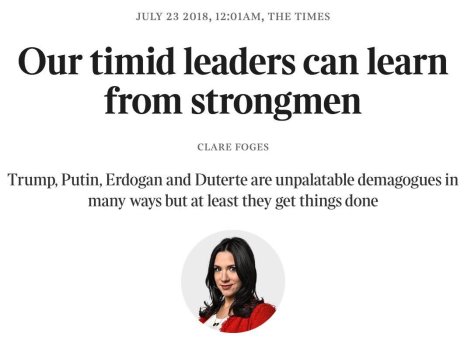
A woman journalist or opinion-writer of whom I had not previously heard, one Clare Foges, has suggested in an article in The Times that the leaders of the UK and Western Europe might learn from political “strongmen” (she cites an eclectic mixture: Trump, Erdogan, Putin, Duterte).

About the Writer

Having not previously heard of the writer, I did a quick Internet search. The surname suggests a Jewish origin, and someone of the same name posted this online in 2000:

https://www.ancestry.co.uk/boards/localities.ceeurope.austria.Prov.vienna/167.588/mb.ashx.

It seems that Clare Foges wrote speeches for David Cameron-Levita and others prior to the 2010 election and immediately after it. She has also written at least one book for small children.

Having now read a little about her, I should say that she seems to have some intelligence, though perhaps not enough, or not enough knowledge, for the matters she discusses in print. Her understanding of society and politics seems shallow. She gave an interview to the Evening Standard in 2015. In it, she proposes, inter alia, better pay (!) for MPs, who “give up well-paid careers” etc. Ha ha! She really should take a look at the collection of misfits, also-rans and chancers who comprise many (not all, admittedly) of the more recent MPs!

https://www.standard.co.uk/lifestyle/london-life/clare-foges-the-woman-who-put-words-in-david-camerons-mouth-10437029.html.

Indeed, in 2017 she herself wanted to become an MP, for the fairly safe Conservative seat of the Isle of Wight, but withdrew after having been shortlisted:

https://www.conservativehome.com/parliament/2017/05/exclusive-foges-joins-fox-in-withdrawing-from-isle-of-wight-selection.html.

In fact, the then-incumbent MP had hardly “given up a well-paid career”, having been a geography teacher in comprehensive schools for most of his life:

https://en.wikipedia.org/wiki/Andrew_Turner_(politician)#Early_life_and_career

and that MP (also an expenses freeloader…) then “stepped down” after having “become a laughing stock” by reason of his quasi-matrimonial situation:

https://www.telegraph.co.uk/news/politics/conservative/11334299/MP-battling-to-save-seat-in-toxic-Tory-rebellion-after-fiancee-moves-in-with-his-aide.html.

In short, my provisional view is that the writer of the article is, at 37 or 38, someone who for whatever reason has fallen between the cracks, who might have become something in the political realm, even perhaps an MP (and after all, her background as pr/”comms” “intern”, sometime children’s book writer, “Conservative” speechwriter, amateur poetess and (?) professional scribbler on politico-social issues is no worse than that of many “Conservative” or “Labour” MPs, and better than some) but has not.

The Issues Raised

What are we to make of this article suggesting that the UK needs leadership informed by “strongmen”? Duterte is the Philippines leader who has presided over a campaign of extra-judicial killing of drug gangsters etc. Erdogan is the political-Muslim Turkish dictator (by any other name) who is dismantling the legacy of Kemal Ataturk. Putin and Trump are too well-known to need any introduction even to those who take little interest in politics.

The main issue, surely, is that government must govern. It must be effective. Ideally, there will be checks and balances: law, due process, civil rights, property rights (within reason); however, in the end, a useless government has no right to exist.

Political leaders (including dictators) emerge for reasons. In broad brush terms, Putin emerged because Russia under Yeltsin had become a chaotic mess. Pensioners and other poor people were starving or dying from cold or lack of food, by the million. Public sector workers were being paid almost nothing. Jew carpetbaggers had flocked to Russia like a cloud of locusts (or vultures) and were stealing and cheating everything, pretty much. “Russian” Jew “oligarchs” ruled from “behind the throne” and had tricked their way into “ownership” of vast oilfields, diamond and gold mines, heavy industries. Putin began to claw back some of that. Pensioners who had been getting (USD) $5 a month under Yeltsin, now (2018) get $400. People are at least paid for work. Chechen and other gangsters have been stamped on and many killed or imprisoned. Russia has flourished compared to the 1990s.

Erdogan is someone for whom I myself have little sympathy, not least because I value the legacy of Kemal Ataturk. However, Erdogan has improved the lot of the poor, we read, while the economy has improved under his rule.

Trump likewise seems an egregious person generally, and even more egregious as a leader of a government and as a head of state. However, his rise (fuelled by his own huge fortune, of course) was not based on nothing. Many people in the USA are living in poverty. I read that 40% of Americans now require US governmental foodstamps! Many jobs (as, increasingly, in the UK and elsewhere) are “McJobs”, precarious and badly-paid. The drug epidemic is out of control. Illegal immigration had run wild since the 1980s. Whether Trump can deal with these problems and others,  with the “separation of powers” American system, is doubtful, but the dispossessed and marginalized, among others, voted for him to try.

The Missing Leaders

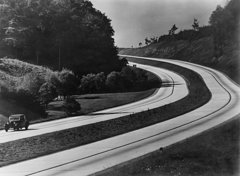
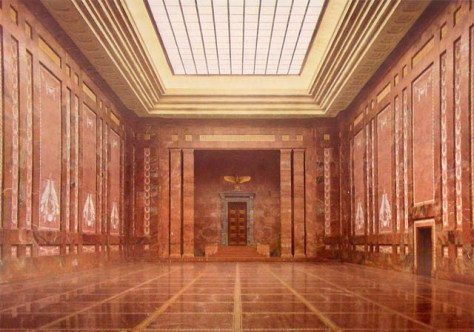
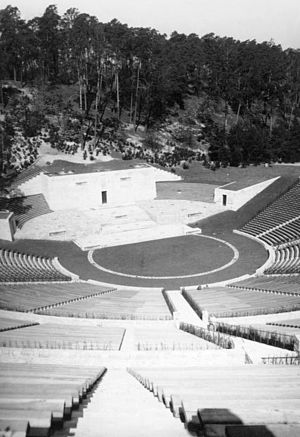
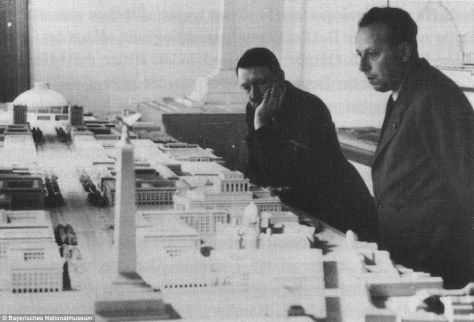
Clare Foges cited Trump, Putin etc, but not the controversial leaders of the 20th Century: Stalin, Hitler, Mussolini, Mao etc. They all took harsh measures but also did a huge amount that was positive. Hitler in particular saved Germany from degradation, removed Jew exploiters from the economy, the professions, the mass media; built autobahns (the first in the world); created air and airship travel routes; vastly improved animal welfare; planned new and better cities and national parks; put Germany to work and (for the first time) gave workers rights such as decent breaks at work, Baltic and other holidays in Germany, and also foreign holidays including cruises. Decent homes were built on a huge scale.

3396AD3500000578-3561575-Hitler_had_lived_in_Munich_just_before_World_War_I_and_remained_-a-1_1461778976380.jpg

an-automobile-on-the-sweeping-curves-everett

Chancellery2DietrichEckartBuhneVW3

Britain could do worse than follow Hitler’s lead, introducing some updated and English/British form of social nationalism.

Stalin was far harsher as a leader and as an individual than Hitler or Mussolini, though Mao might be considered far worse (but of course he was non-European). Stalin however (like Hitler) was put back domestically by war. Stalin did recreate the industrial sector, which was booming before the First World War but which Bolshevism all but wiped out as a thriving economic sector. Stalin’s major mistake (apart from his cruelties and brutalities etc) was to allow the agricultural sector to be ruined via Collectivization, the legacy of which is only now being very slowly erased.

Mussolini did a huge amount for Italy. His posturing on balconies etc is what people now think of when his name is mentioned, but he eliminated the Mafia (until the Americans caused its revival after 1943, releasing the imprisoned leaders and followers), started to get rid of the terrible urban slums (unfortunately more were created as a result of the Anglo-American invasion of 1943); Mussolini also created an advanced scientific and industrial sector, mainly in the North. Famously, he also greatly improved the railways, and “made the trains run on time” (both truth and metaphor). Now, the wartime propaganda of the Western Allies and Stalin is all that most people outside Italy know– Mussolini as clown. Ironic that a real clown (the leader of the Five Star Movement) is now a major political figure in Italy!

https://en.wikipedia.org/wiki/Beppe_Grillo.

Britain 2018

The UK has been pretty much left to rot since 2010. The Blair government, though repressive and in the pocket of the Jewish-Zionist lobby, tried to modernize infrastructure generally. New buildings were constructed: hospitals, libraries, schools. Credit where due.

The David Cameron-Levita-Schlumberger government of idiots was not only the most pro-Jewish/Zionist government Britain has ever had, (until Theresa May became Prime Minister), but also the least-effective of modern times (again, until that of Theresa May?). It not only failed to do anything new and decent, but also failed to maintain that which already existed, in every sector, from libraries and schools to the air force and navy.

The lesson surely is that government must be effective. If it is not, the State stands in peril. The people eventually demand action. They are beginning to demand it now.

The article by Clare Foges is, it seems to me, a sign of the times, or a straw in the wind. The political times in Britain are a changin’…

Notes

http://www.bbc.co.uk/programmes/profiles/3tMvnMp3DFW3z99Zvc7WC3T/clare-foges

https://www.standard.co.uk/lifestyle/london-life/clare-foges-the-woman-who-put-words-in-david-camerons-mouth-10437029.html

A critical article from the New Statesman:

https://www.newstatesman.com/politics/elections/2018/07/sorry-clare-foges-dictatorship-isn-t-just-character-flaw-it-s-crime

Another critique of her views:

https://www.property118.com/clare-foges-anti-landlord-the-times/comment-page-4/

She was desperate to become an MP but no-one wanted her:

https://www.telegraph.co.uk/women/womens-politics/11436355/Sir-Malcolm-Rifkind-resigns-Kensingtons-next-MP-might-be-this-woman.html

Another Clare Foges article. She seems to be very much of her time, meaning 2010-2015, as in this Cameroonesque piece of sort-of social Darwinism. I think that Clare Foges can be written off as a serious commentator.

https://www.thetimes.co.uk/article/put-feckless-patients-at-the-back-of-nhs-queue-5hnlqqstg

https://www.dailymail.co.uk/news/article-2267901/Clare-Foges-The-raven-haired-poet-ice-cream-seller-wrote-PMs-big-speech.html

Further thoughts, 6 December 2018

According to the Daily Mail, Clare Foges is “a devout Christian”. She may still be of part-Jewish ancestry (see above). My other query about the “devout Christian” bit is how does a “devout Christian” want to put IVF couples ahead of people needing NHS treatment for serious conditions just because they drink, smoke etc? Is that “Christian”? Even evil Iain Dunce Duncan Smith is said to be “devoutly Christian”…Yeah, right!

In the end, I suppose that it scarcely matters whether Clare Foges is this or that…and I just noticed that her Daily Mail bio was written by the egregious Andrew Pierce, so we can probably discount it…

Incredibly, she is appointed OBE!

https://www.huffingtonpost.co.uk/entry/labour-blocks-david-cameron-speechwriter-claire-foges-from-joining-party-to-oust-jeremy-corbyn_uk_58d90195e4b03787d35a3d08?guccounter=1&guce_referrer_us=aHR0cHM6Ly93d3cuZ29vZ2xlLmNvLnVrLw&guce_referrer_cs=Y57ohgKaElO9EWmxBHKC1w

Looking at her photos and her behaviour, I think that she is probably at least partly-Jewish.

Her Twitter comments (read the thread):

https://twitter.com/ClareFoges/status/985813260824989696

She has not tweeted since April 2018.

She writes in The Times, but also as freelance pr person…

http://www.finelinelondon.com/

She has certainly written columns in The Times [of London] several times, but is not on that newspaper’s list of its 29 “key” columnists. I have just taken a look on the Internet, and not seen anything online written by her as Times columnist in the past months (since August 2018), though her Linked-In profile avers that she is still a Times columnist. I did see a piece from November 2018 published in The Sun “newspaper”.

https://uk.linkedin.com/in/clare-foges-906a4676

Update, 9 November 2020

I have just seen that Clare Foges has been writing a column for The Times about once per week in recent months. I had not noticed, never now reading that newspaper (does anyone?I suppose some still do).

How Can There Be International Large-Scale Politico-Social Change by 2022?

I have been re-reading Involuntary Journey to Siberia, by Andrei Amalrik [https://en.wikipedia.org/wiki/Andrei_Amalrik], a Soviet dissident better known for his short book Will the Soviet Union Survive Until 1984? (both works were published illegally outside the Soviet Union in 1970, a fact which resulted in a 5-year sentence of hard labour and then internal exile in Kolyma).

Leaving aside the fact that the slowly increasing repression of free speech and free political activity in the UK of 2018 is mirroring (albeit in slightly milder form) that of the Soviet Union of 1970, it occurred to me –not for the first time– how hard it is to predict, accurately, sudden or large-scale socio-political and socio-economic change.

When I read Will the Soviet Union Survive Until 1984?, which was in or about 1980 (the year Amalrik himself died, a result of his own careless driving in Spain), I thought that the thesis was possible but would take far longer, probably 20 years longer. I thought that there would be a gradual collapse. I was wrong; so was Amalrik, but only by 5 years –in reality– or by 7 years (formally). Sovietism and all other forms of old-style socialism across the world died in 1989 in real terms, though in official terms the Soviet Union coughed to a halt only in 1991. This was perhaps appropriate: the Soviet Union was established formally only in 1922, though everyone thinks of it in terms of its having been established de facto in 1917.

It should now be added that all the “experts”, “Sovietologists”, “Kremlinologists”, Foreign Office bods, SIS bods, journalistic scribblers etc (all the ones I ever heard of, anyway) laughed at Amalrik and his book. The “East-West” Cold War set-up seemed set in stone. The Soviet Union was a granite monolith. They had been brought up in it or on it, most of them, most having been born in the 1930s and 1940s: nothing would happen suddenly. They were wrong. A combination of factors brought about not only the swift collapse of Soviet power, as well as the Soviet “empire” worldwide and particularly in Europe, but also that of all forms of ordinary old-style socialism, from the CPSU through to the pre-Kinnock/Blair UK Labour Party.

Lenin thought that the revolution in Russia was upon him in 1905; he discounted the real upheaval in 1917 and very nearly missed the boat. Hitler also thought that his time had come in 1923; when it did arrive, in 1932-33, he was uncertain at times about it.

I happen to believe now that we are in a current of (about, approximately) 33-year history. 1923, 1956, 1989, 2022. If I am right, the year 2022 will bring about another huge change in economics, politics, society, the world order generally. Think of how, say, China has changed since 1989. Russia too. Even the UK has changed hugely since 1989. The finance-capitalist “reforms” under Mrs. Thatcher had not started to affect most people outside the formerly industrialized North of England, South Wales etc. The mercantilism and commercialization that has happened since 1989 has changed the UK profoundly, in most respects in a not-good way, though there have been positive changes as well.

In brief, and without pretending to be comprehensive, one can say that, in the UK since 1989, the professions have largely become businesses, that the State has, at least in part, abandoned many who need help, that the UK (especially England) has largely become a non-white society, that the Jew-Zionist influence over mass media, politics and other areas of life has become pervasive and destructive, that there has been a general coarsening of thought, of cultural life, of behaviour.

UK politics has, since 1989, gone through the changes outlined above with the following results

  • Labour has had a quarter of a century of what amounts to control by New World Order/Zionist Occupation Government NWO/ZOG types: Kinnock, Blair, Brown, before collapsing under Ed Miliband; its MPs are still mostly of that type and Jeremy Corbyn is finding it hard to completely defeat the Jew-Zionist/Israel-First lobby within his own party. The Old Labour members and MPs still exist, but only just. Few now have ever done industrial work; many have never done non-political work at all, unless one includes management consultancy, public relations, “comms”, “organizing” what remains of trade unions, pseudo-academia etc.
  • The Conservative Party is now almost devoid of real members. The average age of members is somewhere around 70 if not 75. The membership figures are now kept secret, but it seems that a party which once had 4 MILLION members (in the 1950s) now has about 20,000. A Potemkin village with no-one living there. A mirage.
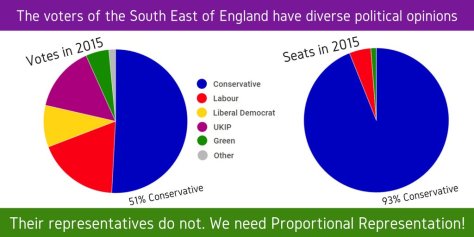
  • Other parties are even worse off. The LibDems have surely had their day except as a tactical vote for discontented voters trapped in “safe seats” occupied by parties they do not like. The graphics explain it.C3l1gk9XAAMHAwF

C64bh5XW0AIWYgy.jpg

  • UKIP was the populist answer to the gulf between governed and governing. However, the totally unjust voting system defeated it (in any case, UKIP had few answers to Britain’s real problems, was pro-ZOG/NWO, and by the time it deflated after 2014, even had non-white candidates! Some called it “kosher nationalism”). UKIP’s 2015 result said it all: 3.8 MILLION votes, 1 MP (former Conservative Douglas Carswell, an entryist, in my view).
  • Real British nationalism of a more social national type has hit rock bottom. The BNP failed in 2010 and collapsed in 2015. There are now only a handful of parties of general “nationalist” type, all of which are jokes, only one of which (Britain First) has more than 500 members.
  • The people are divided into a minority of wealthy and/or affluent who have doubled or tripled their capital over even the past decade, and the rest, many of whom are paying through the nose for poor rented places in which to live, who make rubbish money from jobs which (like their rented homes) are without security; their votes mean almost nothing, their views mean less, and they are just disposable labour units in an unfair society.

It Could Happen

An opinion poll has just been published saying that 24% of UK voters would vote for an “extremist” “far right”, “anti-Islam” and anti-mass immigration party. 38% want a real Brexit and would vote for any new party promising it (credibly, presumably). Leaving the tendentious wording aside, there we have it! The prize is right in front of us!

It could happen that

  • Brexit either happens on WTO terms, or fails to happen, causing massive discontent;
  • Russia and NATO get into actual conflict in Eastern Europe;
  • Corbyn becomes Prime Minister but with no majority; or
  • Some Conservative Party idiot-MP becomes a weak PM; and
  • The people are pushed beyond endurance on real pay, rents etc.
  • Mass immigration is not stopped or even increases.
  • Zionist exploiters are exposed even more than they have been.

In those circumstances, a credible and very radical social national party can take power and start to clear away the rubbish. 2022 and thereafter. Then we can see across Europe removal of the migration-invaders, removal of finance-capitalist parasites, a better society in Europe (inc. UK) with decent work, pay, Basic Income, animal welfare etc.

The prize is before us! 

One Man’s “Extremism” is Another Man’s Struggle for Liberty and Justice

I had occasion to visit a small NHS facility recently. It was a lovely, quiet unit, with only about a dozen or so patients, those patients living, prior to discharge, in several large “bays” and a few individual rooms. The unit was surrounded by flower gardens with small flowering trees and a few classical statues. Beyond that (out of sight) was a very small town (little more than a village) and the countryside of Southern England. If you have to go to a hospital, you could do worse. So why am I blogging about this?

While waiting to go in to see the patient in question, I perused the literature rack by the nursing station. One leaflet caught my eye. I have it before me as I write. Under the NHS logo and the name of the NHS foundation trust running the unit at the strategic level, the title:

PREVENT

[the words contained within a shield device; with two hands –dark blue and light blue (the old KGB colour..ironic) and perhaps (?) representing white and non-white– clasped]. The leaflet was then sub-headed:

Preventing vulnerable people from being drawn into terrorism

Inside the leaflet:

What is Prevent? Prevent is part of the government’s counter terrorism strategy; aiming to prevent people of all ages from being radicalised and drawn into terrorism.

The leaflet continues:

What kind of extremism does Prevent aim to deal with? It aims to deal with all forms of extremism; for example far right extremism, animal rights extremism and religious extremism.

So we see that “terrorism” has already been conflated with or replaced by “extremism”, an even less easily-defined idea. Moreover, we see that Islamist terrorism, the only kind actually posing even a slight threat to public order in the UK, is not mentioned by name (no doubt that would be called “Islamophobic”…) and only coyly implied, sub nom “religious extremism”. No doubt the Jewish Zionist fanatics, who go in their hundreds to be trained by the Israelis in Israel, are not considered “extremists”, “terrorists” etc. No, they just go to an alien society to be trained in the use of weapons and in the techniques of killing with bare hands (oh, and of course, how to “bring down” British MPs thought not to be pro-Israel or pro-Jew…).

Who are these “extremists” in pole position in the Prevent leaflet? Ah, yes, the “far right” (also left undefined, presumably social nationalists, those who hate mass immigration and the trashing of the UK by certain groups and types) as well as those who hate the cruelties inflicted on the animal kingdom by some humans and by human society; but let us now return to the leaflet:

What are some of the possible signs of radicalisation?

  • you may notice changes in the person’s behaviour or mood;
  • the person’s appearance may change and they may spend excess [sic] time on the internet;
  • the person may start to express extreme political or radical views;
  • the person may become withdrawn or have a change in their circle of friends.

So now we have travelled from “terrorism” and even “extremism” to people who have or may have merely “radical” points of view about, say, the disastrous effect that mass immigration has had on the UK, or about the exploitation and cultural contamination carried out by Jew-Zionists, or even about animal welfare.

The leaflet then asks what the reader might do should he or she actually suspect that another person has changed lifestyle or perhaps have acquired “radical” views:

  • NOTICE: Be aware of an individual’s vulnerability to radicalisation, any change in behaviour or ideology. An ideology is a set of beliefs an individual may have. [this section of the leaflet also contains the iconic alien-looking “all-seeing eye” motif…]
  • CHECK: If possible and appropriate check out any concerns with the individual…your line manager and the [NHS] safeguarding team. [this section of the leaflet contains a motif of a magnifying glass with a little humanoid figure inside the lens…]
  • SHARE: You need to share your concerns with the [NHS] safeguarding team. They can advise you on any relevant partner agencies who will need to be contacted. [note “will need to be contacted” not “may need”…presumably police, MI5 etc].

The leaflet then goes on to list telephone numbers and internet contact details, before ending with these dystopian remarks, which would not have been out of place in an early 1970s BBC Play For Today, or perhaps George Orwell’s Nineteen Eighty-Four:

What happens to my referral? [“my referral”, note, not “my denunciation”, “my informing”, my accusation” etc…]. Prevent referrals are shared with the MASH (multi-agency safeguarding hub) or [name of city] SPA (single point of access) depending on where the individual lives. Referrals are then screened for acceptance in to the channel process.

What is channel?

Channel is a multi-agency process whereby professionals and partner agencies can share resources and expertise. The aim of channel is to work with the individual to reduce risk. If your referral is accepted into the channel process you may also be asked to attend the channel meetings to share relevant information as part of effective multi-agency working.

I have sometimes been accused of being, inter alia, a “grammar Nazi”, and am, of course, (also) appalled by the poor English displayed in the leaflet. I have no idea by whom the leaflet was written. Perhaps the Home Office and MI5 are now less likely to recruit graduates from Oxford or Cambridge, or perhaps the near-illiteracy shown is just a function of the UK’s sliding educational standards. The main impression given, though, is that of a police state operation which would be recognizable to an official of Stalin’s Russia or any similar society. The saving grace is probably that it is not (though I am guessing) very efficient.

Indeed, shorn of the millennial “nudge”-government, fake “sharing caring” and armchair psychology nonsense, the leaflet could be seen simply as a method of recruiting agents…

Finally, think about where this leaflet was found– not in a prison, a government office, nor even in a university library, but in a normal NHS clinical environment in the heart of the South of England…

Notes:

https://en.wikipedia.org/wiki/Nineteen_Eighty-Four

Addendum, 25 January 2019

https://www.grimsbytelegraph.co.uk/news/grimsby-news/humberside-police-transgender-twitter-thinking-2466084

Addendum, 4 February 2019

http://www.salisburyreview.com/articles/going-to-prison-for-having-the-wrong-thoughts/

scan25

Update, 2 September 2019

So there we are: once the chistka starts, it takes on a life of its own…

Seismic Shifts in the World

There are now huge changes happening in the world power structure. Russia is on a roll, strategically, at the same time as its underpinning economy is struggling.

2016 has been a successful year for Russia in the military-diplomatic realm. Its support for the Assad government of Syria has proven decisive. The rebel forces have been all but vanquished and Russia sits for now unchallenged in Syria and, thus, in the most strategic part of the Middle East and the Eastern Mediterranean.

It scarcely matters that, on paper, Russia’s economy is not prospering. Stalin built up the Soviet Union to be a world power while the Russian and other peoples under his rule suffered under socio-economic conditions that make today’s Russia look like a land of plenty in a fairy tale.

At the same time, Donald Trump’s victory in the United States is a victory for Russia and (I hope) for peace between Russia and the USA. If Russia helped to procure Trump’s election via “active measures”, then so much the better. It makes a change from the Israel lobby pulling all the strings and, even if Trump is (as he may be) entirely unsuited for the role of head of government or head of state, at least Israel-controlled warmonger Hillary Clinton was prevented from exercizing power and fomenting more war.

In the Far East, traditionally one of Russia’s weakest areas, influence is felt in the latest sayings of the president of the Philippines. American influence is waning fast  in a region where Chinese power is waxing.

As for Europe, the rise of populism and, to a lesser extent, social nationalism, plays to Russia’s strengths: tradition, white European culture and history, shared values, shared hopes for a better future (and against globalism, multiracialism, China, Zionism, Islamism, Americanism).

In France, Marine le Pen has every chance of becoming President in 2017. In Austria, the Freedom Party narrowly missed in its Presidential bid but is well ahead of all rivals and looks like winning the general election of 2018 (in theory also may be but unlikely to be in 2017). Even in Germany, the more nationalistic forces are increasing in influence.

All of the above leads to a situation in 2017-2018 in which the broadly social-nationalist agenda can be carried forward.

NATO IS OBSOLETE

Long before he won the U.S. Presidential election, Donald Trump described NATO as “obsolete”. That exactly describes it. After the end of the Second World War, NATO was established in order to confront the Soviet Union and its allies in the Warsaw Pact. The United States stood with Western European allies. An attack on any of those states of Western and Northern Europe would result, via Article 5 of the NATO treaty, in a response, including possible nuclear response, from all NATO members including, crucially, the USA.

Half a century after NATO was founded, socialism died. The Soviet Union imploded. At that point, a genuinely new relationship might have been established between Russia and the United States and its dependent allies. As it was, Russia was invaded by a horde of carpetbagging business chancers (often Jewish) and similarly-staffed US and UK (mainly) corporate entities. The West took the chance to loot, batten upon and spy the bejesus out of Russia.

The result, a quarter-century on, is that Russia, having to some extent regained its self-respect and strength, now confronts the West, including NATO. Meanwhile, NATO has expanded far from its Atlantic roots and interferes far and wide. Its membership has expanded to include states such as Poland and Lithuania. At the same time, NATO (USA) has established bases and stationed missiles on the ground of some of the former Warsaw Pact and now NATO members.

It is important to understand what this means: if any NATO member is attacked, all other NATO states are obliged to retaliate to defend that member. What that now means is that a small conflict between Poland and Russia or even between, say, Lithuania and Russia, could and probably would draw in the USA and UK, leading to a major war, which war might, in all probability, go nuclear.

The absurdity and the danger is clear. A border skirmish or a misunderstanding might trigger a short but devastating war, the ultimate consequences of which are incalculable. The worst-hit country might be the UK, which still hosts numerous U.S. bases.

Russia is not the Soviet Union. The Soviet Union was an aggressive and (despite “Socialism in one country”) expansionist entity, founded on a premise of world Marxist-Leninist revolution; its military doctrine favoured attack. Russia now is completely different, has no wish to take over the world and has no ideology beyond that of patriotic nationalism. It is not the same threat as was the Soviet Union.

The conclusion is obvious: NATO must disband. In the meantime, the USA should either leave NATO or demand removal (or at least the softening) of Article 5 of the NATO treaty.