According to BBC Radio 4 News yesterday, one person died in the preceding 24 hours in the UK “within 28 days of a positive Covid test”. That one person may have died of anything, even in a car crash. One person out of about 65 MILLION inhabitants of the UK.
Despite the effective disappearance of “Covid-19” as a cause of death, despite the obviously inflated statistics over the past 16 months, the Government of Clowns is still not only keeping to its propaganda line about the “necessity” for having shut down much of the UK for most of the past 16 months, but is also still insisting on its ludicrous “rules”, regulations, laws (possibly invalid) etc, and is now even saying that the facemask nonsense may continue throughout the summer, or beyond!
BBC World Service
I have written before about the sad state of BBC World Service, which has largely become a “Black Lives Matter” service (when not a “holocaust” story service). I have now just heard (again…about the fourth time in the past year) on the World Service about the anti-black riot in Tulsa, Oklahoma in 1921. A black “pastor” of some kind tells the BBC interviewer that “it is still not illegal to lynch a black man in the USA“!
Incredibly (?), that nonsense was not challenged, not even slightly, not even politely, by the BBC idiot, who sounded almost reverential. In fact, the black “religious” went on to explain that what he meant was that to lynch a black man is not a Federal crime! It is a State crime (murder) in all 50 states of the USA, and might result in a sentence of death, or life imprisonment, but that is apparently not enough!
What I did not enjoy was the fact that every single ad in the ad breaks contained either only blacks, or blacks and mixed-race persons (with the odd white person here and there). There were no ads containing only English (white) people. This is not “reflecting reality” but an attempt to create a new “reality”, that in fact is not reality in a country where 80% of the population is still white, and where the actual more or less black (Afro-Caribbean) population is only about 4% (officially at least) so far.
An allied (though minor) propaganda effort is the constant use in the msm of the word “actor” for a female thespian, when the correct word would be “actress“. In other countries (except the USA and a few others), this would be considered ridiculous. Certainly in Russia. What I do not understand is why the harmless descriptive word “actress” has become unacceptable (in the msm, though the general population has not been convinced). Just one more attack on the roots of society, I suppose…
Millions of Hongkongers face the choice of moving to the U.K. or staying in a city gripped by China. We spoke to eight locals about their decisions and here’s what they said https://t.co/ndE3erUrUqpic.twitter.com/xcJUZCSZ89
— The Bolshevik Beekeeper🐝 (@bolshevik_bee) May 29, 2021
I doubt whether Galloway will win the Batley and Spen by-election, but he might save his deposit. If he does that well, or better, then the Labour candidate will probably have lost, probably to the Conservative Party candidate.
Alison Chabloz
Latest information, as yet unconfirmed, is that the Crown have applied to the Court for an adjournment of Alison’s appeal to Crown Court against conviction and sentence. It appears that the reason given is an overrun on the trial on which Counsel instructed for the Crown in Alison’s case is presently engaged.
From information sent to me (unconfirmed) it seems that Alison has not objected to the adjournment application. On that basis, it seems likely that the appeal dates (3-4 June 2021) will be vacated, and the matter taken out of the list.
I do not know when (or even if) Alison’s appeal will be heard now. Assuming that she does not abandon the appeal, and assuming also that the Crown does not abandon its response to that appeal, I should imagine that the appeal would be heard quite some time in the future (perhaps September), in view of the fact that Alison has finished the custodial part of her sentence (unless recalled to prison for some reason), and in view of the present backlog in the Crown Court.
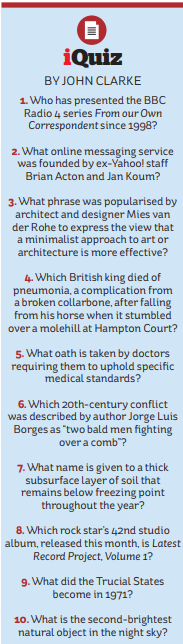
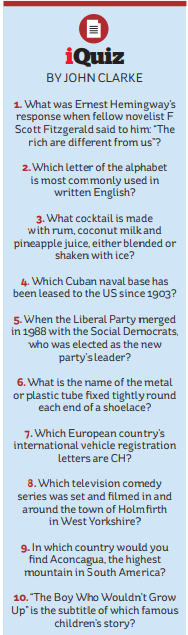
Well, this week I again beat John Rentoul. He scored 6/10, I scored 7/10. The questions to which I did not know the answers were questions 1, 8, and 10.
Tweets seen
EXCLUSIVE 🚨
Campaigners and carers are demanding the government publish its long-awaited review into “barbaric” benefits rules forcing terminally ill people to attend work assessments
Sounds like another #WMD dodgy dossier to me, but will the MSM & social media giants now apologise to Donald Trump and all the people they've smeared, shadow banned and deplatformed for saying this when it was a 'conspiracy theory'?#Chinahttps://t.co/PeQWyea3F2
Lyrical piece from Hitchens on losing touch with our bucolic past, breaking “the long cycle of the centuries in which the dead, the living and the unborn joined hands under the oak trees of our countryside in a pact to protect and pass on what matters.” #OakAppleDayhttps://t.co/FrSpF477Nz
@adamgarriereal. You have misunderstood the issue. Aldous Huxley pointed out in Brave New World that a society in which the people numb their minds is far more easily governed. In fact, they come to love their servitude. https://t.co/R2FC2r0Q4A
1/2 @pocx100 It is an abuse of freedom to use personal insult instead of facts and reason. I have always quoted experts in support of my arguments. Johnson and Hancock are not doctors or virologists either, yet you do not complain about that. https://t.co/6ZxoWqvIPO
Perhaps @scepticsligo we ALL saw no reason why opposition to strangling the country also required opposition to the vaccination. I certainly see no logical connection between the two positions. You may reasonably hold both or neither, or just one of them. https://t.co/E6FBSr9BB5
The Cummins drama was about: 1) Making us believe that a harder faster lockdown would have made a difference (despite being against WHO advice) 2) Preparing us for future harder lockdowns – and soon 3) Paving the way for Gove to replace BoJo so we get tougher lockdowns – and soon
— Dr Zoe Harcombe, PhD (@zoeharcombe) May 27, 2021
“The entire government has been complicit in the lie that lockdowns were an objective scientific necessity, rather than a subjective political decision”. https://t.co/To9eAqcONL
Cummings is the type of guy who thinks if only the Americans had dropped more Napalm and orange agent in Vietnam they would have won the war. He’s a lunatic.
As to Vietnam, the war could only have been won by the South (with American help) had there been a massive ground invasion of the North, with the attendant risk of superpower non-proxy conflict. There were Soviet fighter pilots actually on service in North Vietnam (I met one myself in 1996).
Whether that sort of ground invasion of North Vietnam would have succeeded long-term is of course doubtful (cf. Afghanistan and Iraq in the post-1989 era). In the end, war is a method of achieving political goals (in most cases). Peace is usually achieved via political consensus or victory.
Prof Neil Ferguson says on R4 that his claim that a week’s delay on lockdown cost 20,000 lives is “unarguable”. On the contrary, other academics have shown in detail how his figure was cooked up using now-debunked assumptions. https://t.co/9t7c6dT9J0
Why isn’t @BBCNewsnight being transparent about how many people working there are pro apartheid regime? I resent paying for this supremacist club https://t.co/mvYW8svJGf
This is pretty bad news for Labour, though unsurprising if you think, like me, that Labour now has no reason to exist except as a rather niche party, one for blacks, browns, and some of those who work in the public sector.
I am not yet ready to blog about Batley and Spen, the by-election for which is set down for 1 July 2021. If Labour loses, at it did at Hartlepool recently, Starmer is probably a “dead man walking”, politically.
At the moment, I incline to the view that Batley will be an uphill struggle for Labour, bearing in mind that George Galloway (under aegis of “Workers’ Party”), and the Yorkshire Party, are both standing. Galloway is rather a busted flush, but still has his supporters. The Yorkshire Party seems to have support as well. Those two together will probably get about 5%, which might make the difference between Labour holding on or not.
The Labour vote there has been declining since the rigged by-election of 2016 (in which Labour was not opposed by the other System parties).
The “right royal” circus
"Has Prince Harry ever had a thought and not made it public? Are there feelings or emotions he has experienced but kept to himself?" By @jowilliams293https://t.co/24pAXMblXf
— The Spectator World (@TheSpectator) May 29, 2021
I find this all hilarious. Harry is now effectively a critic of the whole “right royal” circus, yet he himself is of course a major recipient and beneficiary of it. After all, take away the “royal prince” thing, and what is Harry? A youngish man (37 this September) who only became an Army officer because he was “helped”: https://en.wikipedia.org/wiki/Prince_Harry,_Duke_of_Sussex#Education, and who would have had no chance of high rank based on merit (he held the rank of Captain at the end of his active service).
Indeed, without his birth privilege, Harry would probably have drifted into some line such as car salesman, Hooray Henry estate agency, or similar.
I doubt that Netflix etc would take any interest in him at all were he not supposedly “royal”…
Actually, thinking about Harry’s “help” in passing exams at Eton (he ended up with two “A” levels, a “B” in Art, and a “D” in Geography), I am reminded of a story I heard a long time ago (about 1981) about a similar “royal” educational straggler.
The young lady in question was a relative of the Queen who struggled academically. She needed intensive personal tuition in languages in order to gain entrance to an Oxford college. This was in the late 1970s, as I understand it. The college in question had bent over backwards to accommodate the Palace, but insisted on the young lady having the special private tuition if they were going to offer her a place.
In the end, she was accepted by that Oxford college, after having been worked on for weeks, perhaps months, by an elderly White Russian resident in London. All under cloak of secrecy, but of course there are no secrets, as such, just levels of secrecy.
More tweets
The first step towards restoring the National Trust
‘There is a feeling among the French I speak to that the country is nearing a tipping point and that voters, alone in the booth, might decide that with no dignified politicians left, they might as well give Le Pen a go.’
“President Macron has just welcomed to the Elysée two YouTubers called Carlito and McFly, both of whom dressed down for the occasion with one appearing to have a tea cosy on his head. The pair are all the rage among that section of society who get their kicks on YouTube, although despite their adolescent antics Carlito and McFly are actually a couple of middle-class men in their mid-thirties.
What followed was excruciating, what one conservative commentator described as ’36 minutes of soft barbarism… [which] erodes the verticality of power and deconstructs the state’. All of which begs the question: what was Macron thinking in inviting Carlito and McFly into his palace?
To win the youth vote, perhaps? A poll last month suggested that the 25 to 34-year-old demographic is more inclined to vote for Marine Le Pen in next year’s presidential election than for Macron. But they would not have been won over by what they saw, a president ill-at-ease in his suit and tie, a fixed grin on his face as he exchanged wooden banter with two lowbrow clowns.
There is a feeling among the French I speak to that the country is nearing a tipping point and that voters, alone in the booth, might decide that with no dignified politicians left, they might as well give Le Pen a go.” [The Spectator]
Sorry about bad language here, but this is the future if we don't act now to keep e-scooters illegal, as they should be. Write to your MP NOW via https://t.co/NvqnYvAbQphttps://t.co/YoUeflAEvE
This, I think, is what PH meant when he said that the measures will never be lifted. Not that ‘lockdown’ in itself will never be lifted, but that the regimentation of daily life and state interference will not go away.
Indeed, the State has been increasing its scope of power for quite a while now under various pretexts. The example I always point to is the introduction or ‘counter-terrorism’ laws, which I find sinister.
As in the example of Alison Chabloz. People should stop and think what kind of tyranny imprisons people for singing satirical songs, or for posting a few cartoons about Jews or others.
He really doesn’t get it. This is extraordinarily common with sixties types. They still believe all judges are male and went to public schools, that the Church believes in moral laws and that the Tories are conservative. For example. https://t.co/6zpSxk74Qk
The System and its msm handmaidens may not have thought through what might happen down the line if the British people are denied any peaceful political expression. Even the Soviet tyranny was toppled in the end, even the Albanian tyranny was toppled in the end, even the Romanian tyranny was toppled in the end. Our Ceaucescus may look different, but they too exist.
“Who overcomes By force, hath overcome but half his foe.” [Milton, Paradise Lost].
— VIXC News – @VIXC_News (@VIXC_News) May 30, 2021
Demographic disaster
[2019 statistics]
Europe! Reflect on the disaster that is unfolding in front of your very eyes! Even those 2019 figures are well out of date; and those statistics do not include births to non-European mothers themselves born in Europe (esp. applies to UK).
Look at Switzerland! Austria! Germany! Sweden! This is a combination of madness, an ethno-cultural death wish (fostered by the “occupied” msm), and a transnational conspiracy.
What is that supposed to mean @michaelrosenyes? That you have encountered information that does not fit your presumptions? I sympathise, but there it is. Johnson is not even slightly conservative, in politics or culture. He’s far closer to you than to me. Sorry. https://t.co/O2dWwnzZpD
1/2 @michaelrosenyes Munira Mirza, Johnson’s close associate since his days as Mayor, and now head of his policy unit, has, er, links with the Revolutionary Communist Party… https://t.co/H2NZqAczIj
Yes, Munira Mirza, head of Johnson’s policy unit, is quite some way to my left. So is Claire Fox, ennobled by Johnson. But none so blind as those who do not wish to see. https://t.co/aQQ1A3veNn
I am talking about the fact that a 50-year cultural revolution, of which @michaelrosenyes has been part, has put the left in power in the cultural, educational, legal, official and moral institutions of a previously conservative country. Not new.I’ve been saying it for 20+ years. https://t.co/jZgla7tFOM
I myself never use the outdated “Left”/”Right” terminology unless qualified or in jest, but Hitchens’ basic view is correct. The only thing he has left out is the ubiquitous and malign Jewish influence on our society and its culture.
Israel systematically terrorises Palestinian children. It is the only state on Earth to regularly prosecute children through a military court system, with many forced to sign confession statements in a language they cannot read or speak. https://t.co/8hmM4WCZhr
Dear 77 Brigade social media warriors, may your nearest & dearest die of untreated cancers and you live long enough to bury them all. Because the #GreatReset lockdown is a far from victimless crime, & you – not even paid as much as journalists – are the lowest of collaborators. pic.twitter.com/vqt9DuFUE8
“The Brigade uses social media such as Twitter and Facebook as well as psyop techniques to influence populations and behaviour. David Miller, a professor of political sociology at the University of Bristol who studies British government propaganda and public relations, said that it is “involved in manipulation of the media including using fake online profiles“.[25][26][27]
“In September 2019, Middle East Eye reported that Gordon MacMillan, a Twitter executive with editorial control over the Middle East and North Africa, is also a reservist officer in the 77th Brigade. Both Twitter and the British Army denied that they have a relationship or agreement. Miller said it was hypocritical of Twitter to close accounts alleged to be connected with non-Western governments while having links to the British Army.[28][29]
“On 22 April 2020, during the UK government’s daily coronavirus briefing, General Nick Carter confirmed that 77th Brigade are working with the Home Office Rapid Response Unit “helping to quash rumours from misinformation, but also to counter disinformation”.[30][31][32]“
“On 7 May 2020, The Economist interviewed Carter on the role of 77th Brigade in fighting coronavirus disinformation.[33] The Defence Cultural Specialist Unit was used to monitor the internet for content on COVID-19 and to look for evidence of disinformation related to COVID-19 vaccines.[34]” [Wikipedia]
Heaven alone knows @daveheller10. But it really is time that media organisations stopped reporting positive test results as ‘cases’ and failing to distinguish between deaths from and deaths with. https://t.co/ulYKJhCiDd
Subversive parody of govt propaganda observed at Oxford Station. The continued fervour of some fir wearing face-coverings in the open air is remarkable . pic.twitter.com/GqbasJpuST
You have been warned. Do not let Parliament legalise these stupid devices. Write now to your MP . How e-scooters are driving a crime wave https://t.co/HT7EsG6SDA via @MailOnline
Where I live there are few of these machines, not very many blacks or browns, and few even of white “chavscums”, so the potential for misuse is limited, perhaps. I cannot get very worked up about them, nuisance though they are. If one were to impede my quite heavy car, I think I know who would emerge the victor.
Alison Chabloz
Latest news is that (whether by malicious interference by the Jew-Zionists, or because of bureaucratic ineptitude), Alison Chabloz is not going to be released early. It seems that she will now be released having served half her headline 18-week sentence, but minus the 4 days and part-days that she served in 2020 prior to her successful appeal.
The firm expectation now is that Alison will be released from prison on Friday 28 May 2021 (i.e. the day after tomorrow).
Alison’s appeal against conviction and sentence will be heard on 3-4 June 2021 in the Crown Court, probably at Southwark.
The bigger picture is the totally chaotic mess now presided over by the part-Jew political chancer, “Boris” Johnson.
It amused me to see the msm tying itself in knots over the question of whether “Boris” is fit to be PM. Are there still those who believe that he is? After over two years?
..and those “erudite cretins” purport to have the ability and even right to rule over this country…
“… UK government failed public on Covid response, says #DominicCummings Boris Johnson’s former aide says ministers ‘fell disastrously short’ of standards public had right to expect pic.twitter.com/4sOZhCnysB
— The Daily Outsider (@DailyOutsider) May 27, 2021
What a circus! Little Matt Hancock posing as a Cabinet minister, part-Jew chancer “Boris” posing as Prime Minister, and Dominic Cummings as “top adviser” (sole attempt at being other than a glorified office bod was being in charge of a “babyflot” airline in Russia, 25 years ago, and which folded after a single flight).
Meanwhile, there is no effective official Opposition at all.
Afternoon music
More tweets
The NHS plans to 'scrape' the medical histories of patients, including sensitive stuff on mental and sexual health, criminal records and abuse, into a database to be shared with third parties. You have less than a month to opt out, if you want to .https://t.co/rFigDgArxU.
@meirionj Surely the explanation is in plain sight. Our political class, in all parties, is made up of inexperienced, ignorant chancers prone to panic, and advised by driven megalomaniacs who even modern spin techniques cannot make acceptable to the public. https://t.co/HbqYQokHR3
Indeed @kynohy . I think that amost every country praised at the start of the Covid crisis for its decisive severity has later suffered a renewed widespread incidence of the disease. Countries which did not panic are ignored or misrepresented. https://t.co/BMRlO3aJ05
Much of what Cummings said based on the presumption(shared by media & pro-lockdown left) that lockdowns cut deaths. They don't: 'Rapid border closures, full lockdowns, and wide-spread testing were not associated with COVID-19 mortality per million people'. https://t.co/Vma0fo82Ty
“Cases” (positive tests) are increasing, but 90%+ are asymptomatic. Hospitalizations and deaths “within 28 days of test” are decreasing, fast. Despite that, those given power over the past year of panic are desperate to keep the public fear going. Put those people back in their box. Then boot the box into the sea.
Incredible. Simply incredible. What kind of pull does this person, or his family (?) have? Or does he just know where “bodies are buried”? The Bar really is a complete dustbin now. It has no integrity left.
I was actually disbarred, simply for posting on Twitter five tweets about society; three or four of them mentioned Jews. Draw your own conclusions…
Late tweets seen
The propaganda myth of 'peaceful' marijuana is exposed as tripe night after night on British streets : https://t.co/uJ3Tar99sk
Absolutely superb from Max Hastings who gets to the malignant core of Boris Johnson and his crew of lightweights perfectly. Essential reading. pic.twitter.com/njnUUezGWQ
Boris-idiot is a gravity-defier, in both senses. Entirely unfit for any public office, yet there he sits, doing whatever he likes, whatever is expedient, whatever the Jewish lobby and/or his donors, and the ludicrously-misnamed SAGE committee (aka DUMB— “Department Under Matt and Boris”), want or “advise” him to do.
What if you don’t like “Boris” and his government? Well, then, this being a “democracy”, you can wait a few years and then vote for an ostensibly different party, which however will really be rather similar, except for some of the personnel.
The vested interests in keeping corona going are now massive. Politicians, big pharma, manufacturers of plastic crap; painters of stupid circles on shop floors etc etc etc. Bear that in mind next time you hear about some scary sounding new variant
— Isabel Oakeshott (@IsabelOakeshott) May 21, 2021
I had one of those typical “lockdown”/”virus” experiences the other day.
I usually get fuel for car from an automatic pump quite a few miles away, so that I need not comply with the facemask nonsense, but I happened to be running low on fuel, so went to a nearer place, in fact the only nearer place.
Having put some fuel in the car, I went to the shop/kiosk to pay. I even donned a disposable facemask in order not to have to explain myself. Not enough! Having entered the shop, and as I was standing a few feet behind another customer, the cashier called to me and indicated that I should make a clockwise circuit of the island of shelves selling various goods, in order not to stand behind the customer already paying.
I noticed that little yellow circles with arrows had been applied to the floor. I had not noticed them on previous visits, and no-one had required me to make that little circuit, perhaps because I have usually been the only person waiting to pay in the shop.
Anyway, I made the circuit required, only to end up about…3 feet to the side of the customer paying! Apparently that was OK…
I recount this admittedly trivial experience as an example of how much of the population has thrown away all common sense since the virus “panicdemic” started in early 2020.
— Isabel Oakeshott (@IsabelOakeshott) May 21, 2021
I will avoid the NHS App at all costs. Happy to prove I've had the jab, but I'm not signing up for Chinese style surveillance "for my own good," thanks
— Isabel Oakeshott (@IsabelOakeshott) May 21, 2021
Isabel Oakeshott sells her civil rights cheaply! Why should she have to prove that she has been vaccinated, when firstly the virus is only fatal to one out of every 1,000 of the population and when, secondly, the vaccines are no guarantee of protection anyway?
NHS App is a hackers paradise full of sensitive personal data that it has no right to demand. Deeply intrusive, I will not use it. Nor should anyone who values the privacy of their data. https://t.co/DqVEv1cYhR
What will it take to awaken the British people to the fact that “the virus” is nothing more than a reason, an excuse, and a facilitator, for a socio-political agenda?
My latest conversation with Mike Graham. If the BBC won't fulfil its legal obligation to be impartial, and it won't , it should be replaced with a new National Broadcaster. Right now, we don't have a National Broadcaster. We have an Islington Broadcaster. https://t.co/YDKp5cUsEt
And it worked, whereas waiting for crime to happen and then rushing to the scene does not work. So why not return to the proven method @lesscrime? https://t.co/66cq8TMOPe
When I was on Twitter, a large number of journalists and other “media folk”, as well as MPs, blocked me; with most of them I had had no direct contact. They simply did not want to even have to see, even inadvertently, any views that challenged their crippled world-view. Most of course, are dependent on the Jewish Zionist element for their large salaries and other monies. They are basically well-padded serfs.
Labour continues to bump along almost at the bottom of major-party credibility. As I have blogged often previously, Labour’s problem was not Corbyn, as such; neither is it Jewish-lobby puppet Starmer, as such. It stems more from Labour’s disappearing traditional base, and from Labour’s now almost invisible identity.
The opinion poll above does not show Conservative Party popularity so much as Labour Party unpopularity, of course. The point is, for what does Labour stand? Anything? As many have said, half-joking, it seems to be something akin to “workhouses are good, but we say let’s run them efficiently, and more fairly”. I do not think that that will attract many voters.
Of course, there are still pockets of die-hard Labour right-or-wrong support around. The sort of old-style Northern English tribalism that can be seen on TV in the Daily Mirror journalist Kevin Maguire (who in fact lives in some comfort in London).
That kind of ping-pong, cuckoo clock Con-Lab-Con-Lab politics is so out of date now. Especially when the policies of the supposed political rivals are almost identical.
In July, there will be held the Batley and Spen by-election. Labour is putting up the sister of the assassinated MP, Jo Cox, which MP has been all but canonized by the msm since her death in 2016.
I shall blog about the by-election when all runners and riders are in the frame, but what occurs to me at this stage is how desperate Labour must be to select as candidate someone purely because her sister was assassinated. Labour obviously hopes for some kind of sympathy vote, or “solidarity” vote. I doubt that it will work, but we shall have to see. Labour really has no other card to play.
Reality v. semblance
Nobody should be disciplined for stating a biological fact.
“Nearly a third of all prosecutions brought under Covid-19 laws in the first year of the pandemic were incorrectly charged, a review has found…Police forces around the UK were handed powers by the government last March to enforce the ‘stay at home’ message and break up large gatherings of people…Officers were also empowered to prosecute people for breaking lockdown, not wearing masks on public transport, throwing house parties, and meeting in the street in groups.
However a Crown Prosecution Service (CPS) review of court cases which had been concluded by March 31 this year found that 549 out of 1,821 had been incorrectly charged…Every one of the 270 prosecutions brought under the Coronavirus Act 2020 – which granted powers to direct infectious people into quarantine – had either been abandoned or convictions overturned.
The review also found that the wrong offences contained in a myriad of versions of the Health Protection regulations had been deployed by police officers.
The problems with the use of coronavirus offences were first identified last April, just days into the pandemic, when journalists noticed that a woman had been wrongly prosecuted and convicted under the Coronavirus Act in Newcastle.
The review found the Health Protection regulations had also been misapplied by police, using out-of-date rules and making mistakes such as deploying an offence specific to Wales for a London prosecution.
The review found that 1,272 of the 1,551 Health Protection regulation cases had been correctly charged, with some prosecutions abandoned due to insufficient evidence.
More than 1,000 Covid-19 cases have been brought to courts through the Single Justice Procedure, which allows a magistrate to deal with the case administratively instead of at an open court hearing.
Those cases are not reviewed at court by a prosecutor, and are instead processed by police forces.” [Evening Standard].
So once again the police failed to know, understand, and properly apply laws and regulations and, in this case, conflating these with (supposed) “rules”, and with cretinous “advice” given out by politicians and their ridiculous advisers.
I heard, on the radio, a weasel from the Israeli Defence Force [IDF] saying how moral and ethical the Israelis are, because before they drop bombs or attack with missiles a residential apartment building, the Jews drop a lesser bomb on it as a “warning”, and sometimes drop leaflets etc in a “get out now” threat. For the Jew, that apparently made it OK…No thought that most of the residents of such a building were uninvolved civilians: families, children, companion animals etc. The Israeli Jews mix brutality and hypocrisy in a most unpleasant way.
BBC World Service
Heard a couple of other reports. The first was a laughably-poor one about repatriation of historical artefacts and so on. The BBC presenter, a black man from London (but from a family background in what is now Zambia) admitted that, prior to the programme, he had never heard of the Elgin Marbles! https://en.wikipedia.org/wiki/Elgin_Marbles
[the Elgin Marbles, British Museum, London]
Incidentally, the presentation of the Marbles at the British Museum looks more aesthetically-pleasing than when I was last there nearly 30 years ago. Maybe my memory is at fault, though.
On the same BBC World Service show, another African made the point that the wealth of what is now Zambia, the mineral wealth mainly, was “plundered” by the British, without which “plunder” the “Zambians” (i.e. the Africans then living there and their descendants) would have been able to develop a better, more prosperous (etc) society. Ha ha! What nonsense! For one thing, the Africans had no idea of how to mine, refine, or use the product of all that. They did not have any idea that there was anything useful under the ground on which they walked.
The other BBC World Service feature was about a cafe in Innsbruck called Cafe Schindler, once owned by Jews who were bought out (at an undervalue, supposedly) in 1938, after the plebiscite and Anschluss that joined Austria to Germany . They decamped to London.
The granddaughter of the 1930s owner (which owner established or bought the cafe in 1922) has researched her family history extensively. She discovered that her father, who was a fraudulent Jew businessman, and who had said that he had been beaten up in Innsbruck in 1938 by “Nazis”, had in reality been living in London by then (aged 12). In other words, he had told “porkies”…not very kosher!
Apparently, the woman’s father found that a fake “holocaust” connection was a good excuse (in both London and Austria) against allegations of business fraud in the 1960s and 1970s, though he was eventually imprisoned in England. His daughter claimed that one of the reasons why her father never paid his business creditors was because he spent all his money or much of it on lawyers, trying to get “restitution” for value allegedly taken by (yes, you guessed it) “the Nazis”.
Apparently, in the 1960s or 1970s, her father also demanded (and received) non-existent arrears of “rent” for the seven years from 1938 to 1945 from the National Socialist, Franz Hofer [https://en.wikipedia.org/wiki/Franz_Hofer], who had bought the Cafe Schindler in 1938, and who had turned it into a favourite place for the Innsbruck National Socialists. The “rent” was paid to the Jew by Hofer (who may have been unwell and who died in 1975) “unofficially”, in cash. A form of blackmail, really.
The cafe still exists, under a similar name.
An interesting feature, that made me laugh, was that the presenter seemed to take some of the assertions made as truthful, despite having been made by a Jewish business cheat whose own daughter admits he was a fraudster and serial liar. In fact, I found the daughter’s account rather naive in places, as when she said that her family had to sell in 1938 in order to avoid “being shipped off to Poland“. Well, Germany only invaded Poland in 1939, so…
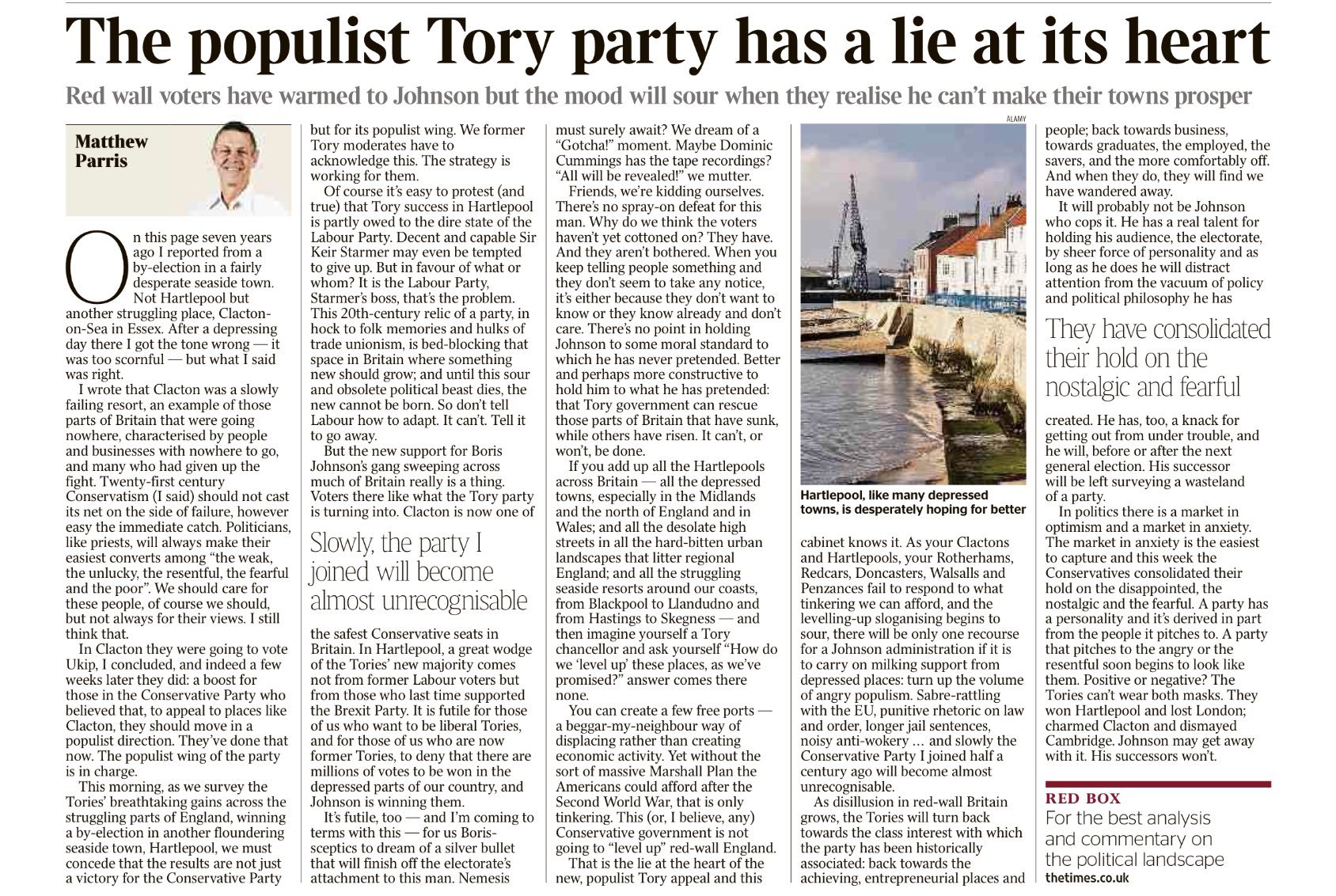
I am ideologically far from Matthew Parris, but I notice that many of the points in his article have been made by me in my blogging of past days, months, and years. My conclusions are not exactly the same, however…
Both Conservative and Labour parties are now incompetent fakes.
Tweets seen
Another souvenir for those who claim no affinity between Nazis and Communists . Nazi Wehrmacht officer Guderian and Stalinist Red Army officer Krivoshein jointly celebrate the crushing of Poland at a victory parade in Brest-Litovsk in 1939. https://t.co/AWY7jBf7yX
Rather poor from a well-known journalist. Guderian [https://en.wikipedia.org/wiki/Heinz_Guderian] was a German officer who was not, however, a member of the NSDAP (National Socialist party). In fact, most German officers were not NSDAP members, though about a third of junior officers were, by 1945.
Hitchens, despite making equivalence between the Reich and the Soviet Union, always seems to me to have more genuine animus against the German Reich, possibly (I speculate) because of his own part-Jewish background [see https://ianrobertmillard.org/2019/05/19/peter-hitchens-and-his-views/].
This must be a first. At almost any time in the near or historical past, a “British” Prime Minister who had handed down against him a County Court money judgment would probably have been forced to resign. It would certainly have been a huge embarrassment. Now? So unworried is the part-Jew chancer now posing as Prime Minister that he has just ignored it for six months!
As I have blogged previously, Boris-idiot has weaponized his own incompetence and sleaze. Almost nothing that he does, or fails to do, counts against him, because the public simply do not expect correct or even ordinarily decent behaviour from “Boris”.
I've just signed. Please do the same and pass it on: Impose Financial and Military Sanctions on Israel for War Crimes – Sign the Petition! https://t.co/jjZstw9aqg via @UKChange
1/2 @spy_historian If anyone in London had wanted to avoid war, they would have done everything they could to disabuse Poland of its fantasy that Britain and France would come to its aid when it was attacked by Germany. https://t.co/m91v8gaFhm
This (the fact that the UK gave Poland in 1939 a “guarantee” that it did not honour and indeed was unable from the start to honour) still resonated when I was last in Poland in 1989.
2/2 @spy_historian Halifax and Chamberlain no doubt imagined that the war would be a repeat of 1914, static fronts held by the mighty French, plus a blockade crippling the German economy. By the time Stalin torpedoed that, it was too late to pull out. https://t.co/m91v8gaFhm
1/2 @spy_historian . This is clearly your opinion, but anyone who wanted to avoid war would not have made the Polish guarantee. The Polish guarantee made war inevitable *unless* Poland made a side-deal with Berlin, something London plainly did not desire. https://t.co/m91v8gaFhm
3/3 Britain had no previous alliance with Poland. Britain was not, historically, unsympathetic to the German position on Danzig. Britain knew it could not in fact aid Poland if war came (and did not do so). So why the Guarantee? @spy_historianhttps://t.co/9YwSgxCACR
My answer to the rhetorical question posed by Hitchens is that the Jews (primarily in the sense of “international Jewry” or “the Zionists’ leaders”) wanted war, to destroy Hitler and National Socialism. In Britain, in its ruling circles, there was a “War Party” fronted by Churchill, paid for secretly by the Jews, and that “War Party” included leading civil servants such as Vansittart [https://en.wikipedia.org/wiki/Robert_Vansittart,_1st_Baron_Vansittart] and leading System politicians, such as not only Churchill but also Duff Cooper and others [https://en.wikipedia.org/wiki/Duff_Cooper].
The defendant attacked a Jew lawyer who was himself, not long before the attack, quite violent (and had to be restrained). The defendant then, having been ejected from the pub where both parties had been drinking (incidentally, one in which I myself have had a drink once or twice, though about 30 years ago) returned and attacked the alleged victim, so could not, in law, have pleaded self-defence.
The alleged victim apparently suffered considerable injury.
I can see why the defendant was charged with “s.18” GBH (Grievous Bodily Harm with intent) rather than the lesser “s.20” GBH, the defendant having returned to the alleged victim (accompanied by his, the defendant’s, sons). There was, plainly, an intent both to attack the alleged victim and also to inflict serious harm upon him.
Where I find the matter unjust is in the sentence.
A nine-year sentence! Almost ludicrously harsh on the facts (at least as presented in the newspaper), and in this case the defendant has been sentenced to serve 2/3 of that, meaning 6 years.
I hope that the defendant will appeal this seemingly harsh sentence.
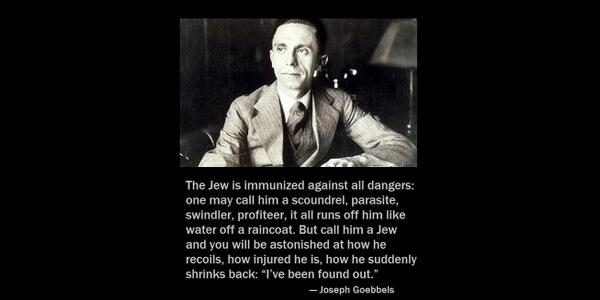
Another point that interested me was that the alleged victim says that the defendant “goaded” him “into revealing [the alleged victim’s] ethnicity“, i.e. that he is a Jew. So he wanted to keep it secret or unremarked upon to some extent? I seem to recall that Dr. Goebbels once commented on what he implied was a typical attitude:
Well, I usually do better than John Rentoul (almost always, in fact), and this week was no exception: John Rentoul scored 6/10, but I beat him easily with 9/10. The question to which I did not know the answer was question 6 (though I looked up the answer and realized that I did, sort-of, or in the back of my mind, know it, so I nearly scored, for the first time in these Saturday quizzes, 10/10. Damn). Still, 9/10 it is, this week.
Labour now represents mainly the ethnic minorities (except Jews, wealthy Indians and Chinese), the public service workers (esp. NHS), and the so-called “woke”. So where should it be based? Brixton? Spitalfields?
Exclusive | Boris Johnson has remortgaged his £1.2 million south London townhouse and is preparing to rent it out as his money troubles reportedly deepen
The house could rent for between £3,300 and £4,000 a month, according to property experts https://t.co/K5uurK0AJS
— The Times and The Sunday Times (@thetimes) May 8, 2021
I wonder whether that clown is receiving (but unable to touch at present) monies deposited offshore for him, or has any promise of such monies? I should not be surprised.
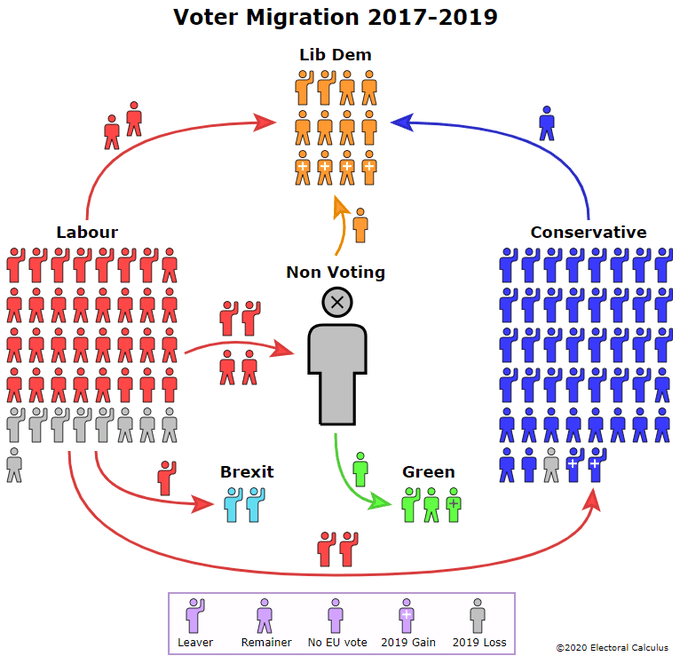
Back circa the late 2000s, @JohnRentoul used to talk of the "Sweden daydream", whereby left-wing policymakers would reflexively cite Scandinavian countries as an example to follow. The "progressive alliance daydream" may have taken its place. https://t.co/r6JCY3jYmv
— Tom Doran (gypsum.fantastic on Threads) 🇺🇦 🇬🇧 (@portraitinflesh) May 8, 2021
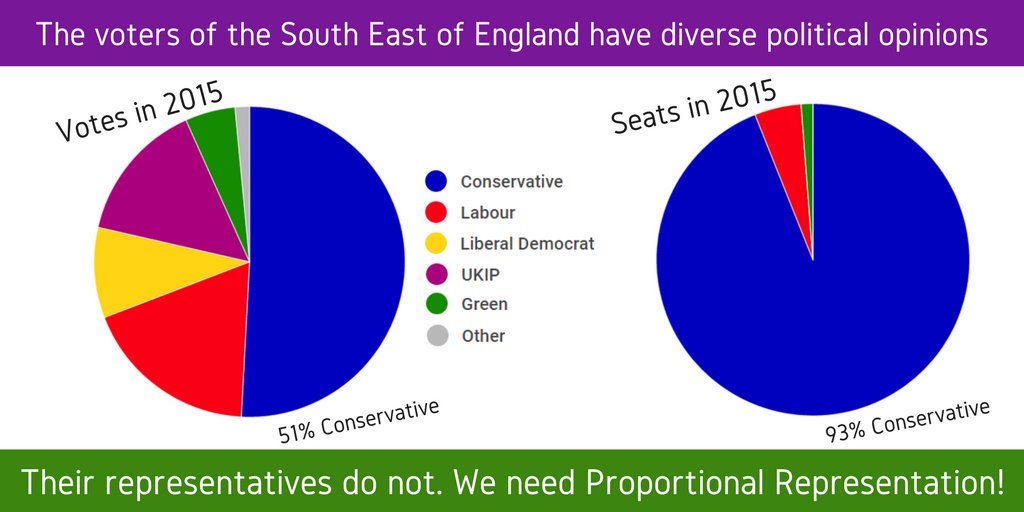
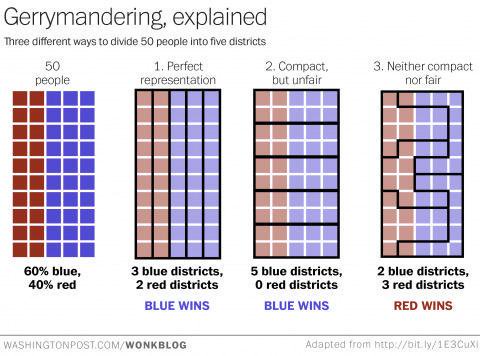
Well, the UK electoral system is manifestly unjust, of course. The following example from the General Election of 2015 makes the point:
Boundaries can be (and are) drawn to achieve a desired result:
The reality is that people are pushing back against both main System parties. In areas usually Conservative-voting, against the Conservative Party; in areas traditionally Labour, against the Labour Party. The people are frustrated.
The voters (and the many millions of non-voters) want something different, yet are presented with a System-controlled fake binary choice (plus a LibDem “dustbin” option, and here and there a few “controlled opposition” crank options), neither of which two main options they really want, or even respect.
Alrhough it's made the headlines, the collapse of #Starmer#Labour as a result of its betrayal of the white working class is only a fraction of the impact of the complete failure of the left to confront global capitalism's #GreatReset – the biggest wealth & power grab in History. pic.twitter.com/KpfjeJq7f9
Exactly. I have been blogging in that vein and, before that, tweeting (until a Jew pack managed to have my Twitter account closed down in 2018), for years.
In the UK, the self-describing “Left” and/or pseudo-socialists put out 95% of their effort into “deplatforming” those they have decided to hate (especially people like me, those with real ideas), rather than trying to present an alternative to global finance-capitalism, the New World Order (NWO), and Zionist Occupation Government(s) (ZOG).
In fact, the self-describing “Left” has no alternative to present, unless you count as an alternative world-view some farrago of “antiracism”, “antisexism”, compliance with Jew-Zionism (sometimes, absurdly, mixed with anti-Israel-ism), “holocaust” fables, anti-“Nazi” rhetoric, and a vague belief in the goodness or efficacy of washed-up societies such as Cuba or Venezuela.
The self-describing “Left” has not really understood yet that history left them behind in 1989 (some of them don’t even understand that history started to leave them behind in 1956).
Here we are, one year away from the next great pivotal year in the 33-year cycle, 2022, with the international conspiracy/consensus moving towards its “Great Reset”, and people in the UK are still talking or tweeting about “the Tories” and “Labour”, as if they really mean something fundamental. Those people do not understand that the System parties in the UK are like Soviet chocolate boxes— the chocolates differing in shape but with identical fillings.
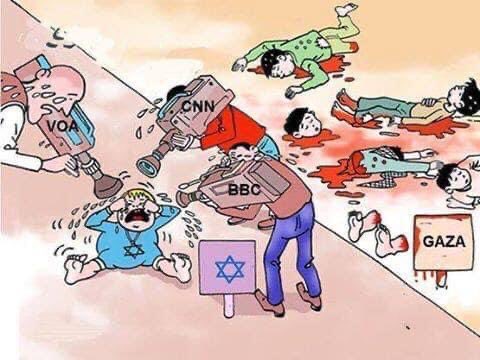
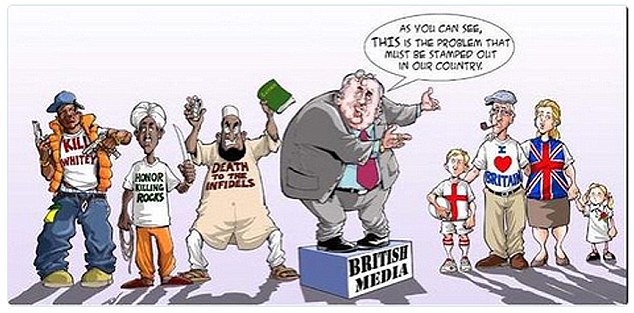
As for “Leftism” (I myself have never designated politics as “Left” or “Right”), the following cartoon says it all:
The Dutch experience, is the more more normal you make cycling, the safer it becames, and no need for a helmet.https://t.co/6rswGOxkvA
The British people —what’s left of them— do not want or welcome evidence, they just want to be told that they are safe in all circumstances. All measures are accepted if that is the justification.
You have seen it in the last year or more of “panicdemic” measures. People are told that ludicrous facemask muzzles save them from the dreaded virus (which has —supposedly— killed about 1 in 1,000 UK people, but really far far fewer), and people want to believe that. Those who do not (and fail to wear them as mandated) are fined, and so deterred from not wearing facemasks. cf. “holocaust” “denial” laws in some countries.
The same or similar applies, mutatis mutandis, to the vaccine promotion etc.
The days are long gone when the Soviet Union might have invaded the UK; Russia today has no wish to do so, and no ideology to underpin that kind of strategy. If Russia ever were to invade, though, the British of today would roll up like a map…
An undercover investigation can disclose that Prince Michael of Kent is alleged to be secretly selling his privileged access to Vladimir Putin’s Russian regime to business clients seeking favours from the Kremlin #Royalsforhirehttps://t.co/hXYNUeQQif
Especially now that Labour has become a basically minority-ethnic party; at least, that is very much the direction of travel. Which means that most of the white British, especially white English, have just switched off from Labour. They might or might not vote Conservative, but Labour is very much yesterday’s news.
Labour insiders are fearing disaster in elections on Teesside, with some predicting a reverse clean sweep of losses across the board, according to sources on Skwawkbox's old home territory #HartlepoolByElectionpic.twitter.com/tqxuzPltjC
The last time a Conservative was elected in Hartlepool Cliff Richard was No.1 with "Living Doll", Ben-Hur was in the cinema, Winston Churchill was alive, England had not yet won a World Cup & Tony Blair was 6. Ignore the hot takes playing it down. If it happens, it's a big deal
Again, nothing much to be added to that, except that that very slender Conservative Party win (another by-election, in 1959) was on different constituency boundaries.
That Jessica Simor (((person))) seems to have little political nous; was a candidate for the always-doomed “Change UK” short-lived party, and gives me the impression of someone who seems to think that she takes the moral high ground. The air in Hampstead seems to have that effect on some of its residents. Oh, no, wait…https://order-order.com/people/jessica-simor/.
I enjoyed especially her tweet about how others have “unbelievable silver spoons stuck in their mouths“, which is often true in the UK (as elsewhere) but comes awkwardly from a woman who attended St. Paul’s Girls’ School and St. Catherine’s College, Oxford, followed by both City University and Kings’ College London!
Seems that some members of the Bar can, e.g. swear prolifically at people on Twitter without (Bar) censure, yet I —who only tweeted fivecompletely true and accurate tweets on political and social issues— had to be disbarred to placate the Jewish lobby: see https://ianrobertmillard.org/2017/07/09/the-slide-of-the-english-bar-and-uk-society-continues-and-accelerates/. Oh, and the great “human rights” barristers at, inter alia, Matrix Chambers (which Jessica Simor co-founded in 2000), said and tweeted not a word in defence of my rights to socio-political expression.
I was also surprised that the Simor woman, in one tweet in that Guido Fawkes report above, renders “I could make neither head nor tail of it” as “I couldn’t make head or tale of it.” That’s no more than semi-literate.
Other tweets seen
▪️1 UK Covid death in the past 24 hours (deaths for any reason within 28 days of a positive test). ▪️450 UK cancer deaths in the past 24 hours (on average). ▪️450 UK heart / circulatory disease deaths in the past 24 hours (on average).
Yes. My mother-in-law (aged 99) was recently in hospital for a fracture. After 2 weeks under the hit or miss care of the NHS, she was routinely tested for “Covid-19”. Positive. She had no symptoms. Obviously picked up the virus in the hospital. Was discharged a week or so later. Had she then died from any cause, even in a car accident, she would have become another “died within 28 days of a positive test” statistic. The whole thing is a ludicrous misapplication of statistics and propaganda.
Ha ha! How could this unthinking young Labourite miss the 4 years of Jewish-lobby bile against Corbyn? Every day, and on every msm platform! I am not even a Labour supporter (or member, or voter), and it was unmissable! Plots, conspiracies, legal cases…Labour Friends of Israel MPs and the rest.
Conservative Party first with 51.9%; Labour second with…28.7%. That’s the headline, of course.
Interesting to note that the eligible electorate is over 70,000. Of those, only 29,933 turned out to vote, and only 8,589 voted Labour. About 12% of the entire eligible electorate.
The demise of the LibDems was confirmed (again): 7th place, with only 1.2% of the vote (349 votes). The worst-ever LibDem result in the constituency, by far. The LibDems got 4.1% last time, in 2019; in 2017, only 1.8%, and in the 2015 meltdown, 1.9% (2010, 17.1%, but in 2005 they got 30.4% and 2nd place, and in 2004, which was another by-election, 34.2% and another 2nd place, that time only 6 and a half points behind the winning Labour candidate).
The 3rd, 4th and 5th places at Hartlepool were taken by an Independent, Sam (Samantha) Lee, a local businesswoman and former local journalist (note: local…), who achieved a creditable nearly 10% of the vote, then “Heritage” and “Reform UK” parties, effectively UKIP/Brexit Party offshoots. 1.6% and 1.2% respectively. Green Party took 6th place, also with 1.2% of the vote.
The Northern Independence Party, which I thought would get around 5%, in fact attracted only 235 votes (0.8%, 10th placed) and looks washed-up already. I had thought that their concept might prove attractive to many “up North”. Seems not. Not so far, at least. Rather unimpressive also that they are so disorganized that they failed to register in time with the Electoral Commission, so their candidate, Thelma Walker, a former Labour MP, had to stand as Independent. They might have done better under their real banner.
The remaining eight candidates were either Independents or crank-party candidates, and only one got more than 0.5% of the vote.
What does this result mean, in the wider sense? Firstly, that Jewish-lobby puppet Keir Starmer is too colourless to make any impression at all. Part-Jew chancer and fraud “Boris” may be corrupt, incompetent, and unfit to be an MP, let alone PM, but he has (carefully-cultivated) presence, a fact recognized by the huge Munich-style effigy of him that appeared at the by-election count. https://en.wikipedia.org/wiki/Carnival_in_Germany,_Switzerland_and_Austria#Alemannic_Fastnacht
Reminiscent of Berlusconi in Italy a number of years ago, or of some banana republic.
As I have blogged before, Keir Starmer has nothing to offer the people, and nothing to say except “I was the Director of Public Prosecutions!”. Nothing to offer. Nothing at all. As some wag commented on Twitter a while ago, were the “Conservatives” to open workhouses in the manner of the Dickensian age, Starmer-Labour would be there to agree with the policy, but say that it should be run more efficiently and slightly more fairly…
Then we recall Starmer on his knees, with dim deputy Angela Rayner, not so long ago, professing fealty to the “Black Lives Matter” nonsense. That must have played well in Hartlepool, which has a proud, if poor, English/British history…
The problem Labour has, though, is not Starmer but its own identity and role. As I have blogged before, the System parties were all products of the 19th and early-20th centuries (taking the LibDems to be an extension of the old and once-governing Liberal Party).
Somewhere like Hartlepool may look superficially similar to what it did in 2010, 1997, 1980s, even 1960s, but the social changes in the UK have been huge. No large nationalized industries. Few manufacturing industries at all. A growing atomization of the individual in society. Lessening “community”. Growing socio-political volatility. Insecurity. The Internet. In places such as Hartlepool, a considerable drug problem to add to the traditional drink problem.
The old parties have no answers, and not even any questions, about all of that. What Hartlepool and many other places want, perhaps without knowing it, is social nationalism. A new socio-national community to replace the old forms of community that are now all but gone.
Look at that by-election: not one social-national candidate, not even from the joke “parties” such as For Britain or Britain First. The voters wanted rid of Labour. If you like, “Problem— get rid of fake Labour; Method— vote fake Conservative, or stay at home and watch fake reality-TV shows”. Apathy and abstention was enough to sink Labour, as in 2019.
Tweets
Wow Labour in the UK actually appears to be useless. Didn’t follow the by-election, but that is an astounding defeat in Hartlepool.
— Zitong is practicing piano (@RenZitong) May 7, 2021
Short and sweet (and true).
Go woke, go broke.
This is bigger than Hartlepool.
Labour lost seats all over… 🔵Tories: Derby, Dudley, Thurrock, Sunderland, Redditch, Nuneaton and Bedworth, Northumberland
🟠Lib Dems: Essex, Sunderland
🟢Greens: Stockport, Northumberland, South Tyneside
— Fr Calvin Robinson (@calvinrobinson) May 7, 2021
Labour's vote has declined in Hartlepool in every election bar 2017 since 1997.
It's a microcosm of the crisis facing the party in England more broadly, and can't simply be put down to Brexit, Corbyn or Starmer.
She’s right (for once). Where (I apprehend) she is wrong is in impliedly saying that Labour did better in 2017 because of Corbyn. Partly-true maybe, but had UKIP not taken 11.5% of the vote in 2017, Labour, though still in front, would have won by only about 5 points.
However Peter Mandelson spins it, facts are stubborn things.
Labour won 53% of the vote in 2017 in Hartlepool – a majority of all the votes.
It was not always thus. I have never been a Labour member, supporter, or even voter, but many Labour MPs up until the 1980s were decent British ex-workers, others were at least reasonable intellectuals of sorts. I might not have agreed with all they said or did, but they had integrity, most of them. Now look! Since, say, 1989, freeloaders, careerists, expenses cheats, fakes. Jess Phillips, Ruth Smeeth (now binned), Patricia Hewitt (gone), Mandelson, the whole pack of Blair/Jew lobby MPs. Many are still around, unfortunately.
Look at Williams, the Hartlepool candidate that Labour put up: a medic who preferred to “get ahead” as an MP; formerly failed in another constituency; wanted to become a Police and Crime Commissioner too. Rather “dodgy” generally; pro-EU, pro-Jewish Lobby. Never trust a doctor who becomes a politician. A good rule of thumb, by the way.
“During the by-election campaign, Williams apologised for a tweet he posted in 2011: “Do you have a favourite Tory MILF? Mind-blowing dinner table conversation”.[38] He was defended by Starmer, while Labour peer and former shadow Attorney General Shami Chakrabarticalled for him to be replaced “immediately”.[39] Williams’ campaign featured a pledge to return hospital services to the town, but was accused of hypocrisy after it emerged that he was a co-author of a clinical commissioning group report which recommended the closure of those services in 2013.” [Wikipedia]
A social-national party, were one allowed to exist at all in what is a society of increasing socio-political repression, might not be “voted in” —because the (((System))) would probably make sure of that— but would be a way of gathering support for an attempt to seize power by any other means.
More tweets seen today
"Former Labour leader Jeremy Corbyn has responded to the Hartlepool result and early local election defeats for the party"
The man who had an open goal before him but put the ball into the stands has an opinion.
A pretty silly tweet. Corbyn, whatever his faults, was at least as “electable” as Starmer, but that is, well, not very…and the tweeter ignores the 4 years of Jewish propaganda carried on against Corbyn, on a daily basis, and on every single msm platform (and many online too).
Every single one of those MPs is either a Jew or a Jewish-lobby puppet. Expenses freeloader and anti-Corbyn plotter Tom Watson has not only been given the very well-paid sinecure previously occupied by Michael Dugher (another puppet of “the lobby”, now head of a betting organization) but is even getting paid non-political TV appearances. As people say, “ker-ching”…
Hartlepool isn’t deprivation. It’s Little Englander, high home ownership, I’m alright jack, small minded, xenophobic boomer town. British MAGA. Amirite?
Two stupid tweets for the price of one. They would probably like that Nigerian bigmouth, Femi Oluwole [https://en.wikipedia.org/wiki/Femi_Oluwole], still posing as a political activist while living in his affluent parents’ attic, to be Labour leader! Don’t laugh too quickly! Of course, by then Labour will be about as popular as the LibDems are now…
Maybe, but probably not. Had Corbyn done that, the Corbyn candidate would have got about half, maybe more, of the Labour vote at Hartlepool, but even taking that as maybe 25%+ (half of 50%+ as in the past), that would still be a close contest if the Conservatives were not also challenged by (as in the past) a Brexit Party or similar; which would probably still result in a Con victory…
System politicians rarely start new parties, mainly because few succeed. One of the few that might have done was Enoch Powell. He just might have gathered enough support from Conservative voters and others (eg National Front voters) to get a bloc of MPs. He decided, though, to reprise Parnell [https://en.wikipedia.org/wiki/Charles_Stewart_Parnell], who controlled a bloc of pro-Home Rule (Irish Independence or autonomy) MPs in the 19thC; Powell thought to do that, on a smaller scale, with Ulster Unionists. Never got anywhere. He was too tied up in traditional thinking. https://en.wikipedia.org/wiki/Enoch_Powell.
If that was indeed Powell’s strategy, it was based on faulty thinking (surprising, in someone of Powell’s intellect): Parnell controlled around 90 MPs in the late 19thC; Powell could never have hoped for that with the Ulster Unionists.
In fact, that 2015 poster was one of the better Labour attempts. I suppose that the very silly tweeter hates the “control immigration” bit…but the migration-invasion and encouragement thereof was one of the aspects of Corbynism that appalled many voters…
Afternoon music
BBC PM
Listening to PM for the first time in quite a while, heard an interview with Ben Houcher, the Teesside Mayor. Not very impressive in terms of content, but full of confidence, and his electoral result speaks for itself.
Then came an interview with three Labour activists. Not very interesting, though I agreed with their point that “Boris” is “an act” (as they put it), “supported by a sycophantic mass media“. Also true. None openly called for Starmer to go. They really should…
The most interesting thing heard was from the presenter, Evan Davis, in the Ben Houcher interview, who expressed the idea that politics in the UK is “going beyond Left and Right“. Well, I have been saying that for years, decades even. Always the Cassandra, usually right but rarely listened to…
— Jane Johnson 〓〓💙🇲🇦 (@JaneJohnsonBakr) May 7, 2021
Typical (?) UK Labour supporter of 2021: “ Historical novelist, THE SEA GATE out now. UK publisher of GRRM, Hobb, Lawrence, Feist; ex-Tolkien publisher; gardener. Married to a Berber chef. #CFC#Chelsea...Location Cornwall/Morocco”…[https://www.janejohnsonbooks.com/].
Not that she is entirely wrong about the influence of the mass media, but she completely fails to see that the Conservative Party won Hartlepool not because the eligible voters were supporters of the Conservative Party and/or finance-capitalism (egged on by the msm) and voted accordingly, but because out of 70,000+ eligible voters, only about 8,500 went out to vote Labour.
Why? Because Labour is useless. It is now once more completely in the pocket of the Jew/Zionist/Israel lobby, and its MPs are mostly worthless chancers, expenses blodgers, and/or careerists; many of them (especially but certainly not exclusively the blacks) are also as thick as two short planks. Also, Labour scarcely opposes the Government at all, but supports it, or cavils at unimportant details (Keir Starmer was, after all, best known as a prosecution lawyer who became DPP).
The Conservative Party did not win Hartlepool— Labour lost it.
Incidentally, that lady “@JaneJohnsonBakr” is a director of HarperCollins publishers: https://www.janejohnsonbooks.com/about/. Whatever her ideological leanings, I think that it can probably be surmised that she does not have the financial struggles common to most of the voters of Hartlepool, and it sounds as though she is far from them in terms of outlook, as well.
I do not think it unfair to say that there we have Labour’s problem in a nutshell. It can get the (apparent) support of a presumably rather affluent lady who, with her Moroccan husband, splits her time between her houses in Cornwall and Morocco, but it cannot get the support of over 60,000 of the 70,000 struggling English voters of somewhere like Hartlepool…
Here’s another of the lady’s tweets, expressly contemptuous of the British people:
The 'Great British Public' – happy to turn a blind eye to fascism, corruption, theft, murder, ineptitude and dishonesty.
— Jane Johnson 〓〓💙🇲🇦 (@JaneJohnsonBakr) May 7, 2021
I wonder whether she supported Tony Blair’s government?…
Not that she is wrong about “Boris”, of course; and the people are easily fooled, that’s true.
She seems to think it wonderful that Liverpool now has a “black” woman as Mayor! These people…! You really could not make it up…
Late tweets
The lady featured above is still tweeting…
Jesus. I've never much been a fan of democracy. People should have to pass a civics and critical thinking test before being give a vote.
— Jane Johnson 〓〓💙🇲🇦 (@JaneJohnsonBakr) May 7, 2021
She should stop bleating about being “progressive” and just come out 100% for “enlightened” dictatorship…though I see her point about “Fred” (supposedly) from Hartlepool (supposedly)…Is he a joker?
Wide-ranging podcast discussion with two outstanding #traditional#Catholic talk show hosts. Subjects covered include #Transhumanism, #Zionism, the death of the liberal West and positive ideas for the way forward. Listen in and thanks for sharing.https://t.co/1gVr4gd4AS
‘British politics, I've found, is entirely tribal and wholly hostile to reason. In fact, it is angered by reason, and closes its mind to such reason with a self-righteous certainty.’
Mainstream media are predicting a Conservative Party victory, while continuing to pretend that a contest between two very similar System parties (and a few cranks and no-chances) is “democracy”, though it seems that, thanks to FPTP voting, the main binary choices will capture about 90%, maybe 95%, of all votes cast.
Turnout will probably be quite low.
I was just looking at a couple of tweets about the contest:
I keep seeing Labour talking about Tory sleaze on here and saying in Hartlepool we should vote Labour! Have they forgotten our last MP Mike Hill was a sex pest ? You couldn't make this shit up pic.twitter.com/AGRiAe6cpm
That refers to the outgoing (going, gone…) MP, Mike Hill, who denies sex pest allegations but who decided to stand down as MP because of them. Hm…Still, he can always return to work at the local library…or do a bit of useless trade union droning…[https://en.wikipedia.org/wiki/Mike_Hill_(British_politician)].
I’m on a Labour page and these are the reason why they think people will be voting Tory tomorrow: ‘They are mindless brainless morons.’ ‘More stupid than monkeys.’ ‘Parroting what Murdoch tells them to think.’ ‘Selfish.’ ‘Idiots or just blind.’ ‘Racists.’
People may be surprised that I repost the tweet of a Jew-Zionist scribbler, but “there is no religion higher than truth”, as they say.
The fact is that communities such as Hartlepool are clutching at straws. That does not mean that they are totally stupid. True, the misnamed “Conservatives” are not worthy, and they have been in power, nationally, for 11 years now, but the voters of Hartlepool have had Labour MPs for nearly 50 years, and feel exploited. They can only bin Labour by voting Conservative (or at least staying at home and not voting).
In some countries at some times, failed political parties (members of) face imprisonment and even execution. In the UK, we are kinder. Those parties simply face political death. It happened to the once-all-powerful Liberal Party (though a ghostly shadow still exists, the LibDems), it is now happening to both Labour and Conservative parties. Labour first to go, it seems.
That one, above, the well-known Jewish actress, used to block me on Twitter, I think (my Twitter account was closed down by a Jew-Zionist claque-barrage of complaints in 2018) and even tweet against me occasionally. Correct here, though. Look at that tweet by one Grace Blakely:
Where does one start? Perhaps by expressing “surprise” (no, not really, not these days) that a young woman [https://en.wikipedia.org/wiki/Grace_Blakeley] from a privileged background, privately-educated in Hampshire, and with (for what it is worth these days) a “First” from Oxford, prefers the philosophical-psychological term “ressentiment” to the straightforward standard English “resentment”…I suppose that she picked that up while doing her PPE back-of-postcard degree at St. Peter’s, Oxford. https://en.wikipedia.org/wiki/Ressentiment
Secondly, by examining the claim that those with a “degree” (even if a “McDegree” from a “McUniversity”, are “the educated“. That is so Blair-1997…pretty outdated as a expression of reality.
Sadly, the “degree” from a “university” is no guarantee of real education, now that nearly half of all persons over 17 go to a “university”. Going to Oxford is no guarantee either, as both Grace Blakely and, for another example, Louise Mensch (if anyone remembers that stupid creature) bear witness.
As a matter of fact, both of the above are also examples of the pointlessness or near-pointlessness of Twitter. Grace Blakely has, apparently, 132,000 Twitter “followers”, while the lunatic Mensch has (looking at her Twitter account for the first time in a couple of years) 281,000! One Direction pop group has 31.5 million!
Grace Blakely is apparently appointed as a Visiting Fellow at the Open University! This country is so screwed, it really is…
More tweets seen
There are fears in the party that the deployment of Navy gunboats to Jersey was being whipped up to influence the critical Hartlepool by-election https://t.co/b0T4JgI9qg
So what is left of the Royal Navy is being used to show the flag in a fishing dispute with a close ally of this country (Brexit notwithstanding), but 200+ migrant-invaders are being “rescued” and then escorted across the Channel by the same navy and/or the ludicrous Border Force, every day. Mad…
Were I maliciously-inclined, I suppose that I should encourage pedestrians to push off the riders whenever seen. However, where I live there are few “e-scooters” (in fact, I believe that I have only seen one), so on this occasion I shall say “none of my business”.
The revolution devours its own children…
This time, involving the tiny and unpleasant “Resisting Hate” “antifascist” troll-org, led by the well-fed Roanna Carleton-Taylor of (near) Chesterfield, Derbyshire.
Seems that either Roanna Carleton-Taylor or an associate (she uses several Twitter accounts anyway) posted something involving a banana to a black, which apparently is considered “racist”, though I cannot see why. I myself eat the occasional yellow fruit, after all.
Anyway, there ensued a several-days-long Twitter storm in a teacup, which dragged in “Dr” Louise Raw (prolific pro-“antifa” tweeter) and at least one mentally-disturbed Jewish Zionist woman from North London.
“Dr” Raw has not tweeted for the past week, I now notice.
I concede that I have not followed the nonsense, and am merely amused at the supposed “anti-racists” of different types all tearing chunks out of each other.
The denouement? Roanna “antifashwitch”, the former “@Witchofpeace” on Twitter (she tweeted once about how she kills spiders when putting a curse on someone! Odd…I thought that that brought down bad luck upon the killer…), has changed her account to “@oilpaintwitch” and has posted this:
Can you “resign” from an “organization” that is just you yourself, with a few other idiots? Oh, well, there it is.
Well, I do not pretend to have followed the progress of this silly (and typical) Twitter-spat between groups of Twitter trolls whose greatest achievement (in their own little minds) is when someone of whom they disapprove is “deplatformed” by being expelled from Twitter or Facebook. In fact, I seem to remember that (((Roanna))) and (((some))) associates tweeted happily about my wrongful disbarment in 2016: for the disbarment, see https://ianrobertmillard.org/2017/07/09/the-slide-of-the-english-bar-and-uk-society-continues-and-accelerates/.
As I have blogged previously, I have never seen any of these sorts of “antifascist” and/or Jewish Zionist trolls offer any policies or ideas about how to improve society (except by advocating the “removal” of those they deem “Nazi”, “fascist”, “racist” etc). It’s all negative and all, at root, based around their own hate (they, unwittingly ironically, always claim to oppose “hate”, of course…). cf. “Hope Against Hate” etc.
I have to admit that I am rather curious as to what happened to the £12,000 that Roanna, Mike Stuchbery (the pro-“antifa” tweeter, would-be “journalist”, would-be “historian” and general grifter), and a Pakistani solicitor extracted, via GoFundMe, from 700 well-meaning (?) mugs, on the premise that Stuchbery was going to sue “Tommy Robinson” (Stephen Yaxley-Lennon). Never happened. As far as I know, the only action taken was a very poorly-drafted letter from the Pakistani, which may or may not have been delivered to “Robinson”.
Apparently, one of the minor candidates for London Mayor has been associating with some alleged fraudsters: https://www.mirror.co.uk/news/should-someone-who-wants-london-24047689. Strangely enough, though, I saw nothing in the msm about the fairly recent video put out by “Conservative” candidate Shaun Bailey, which featured a woman best described as a “Balkan fraud”, and who was convicted of both fraud and forgery at Southwark Crown Court in 2013. Come to that, Bailey himself was, arguably, lucky not to face more than a police investigation when his non-profit quasi-charity had to be wound up some years ago. Oddly enough, all the monies had disappeared, and large amounts had apparently been spent on hotels and restaurants for…Shaun Bailey.
Fortunately for West Indian-origined Bailey, the voters in today’s election will have voted by the time I post this; in any case, Bailey has little chance of beating Sadiq Khan in the contest.
I wonder why the Conservative Party picked Bailey? I remember seeing him on one of the Andrew Neil politics shows on the BBC, years ago. Unimpressive. A West Indian with a big mouth and not much of interest to say. I suppose that, London now being a mainly non-white city, the Con Party decided that it needed a non-white candidate. Well, that fell flat (it seems).
Late music
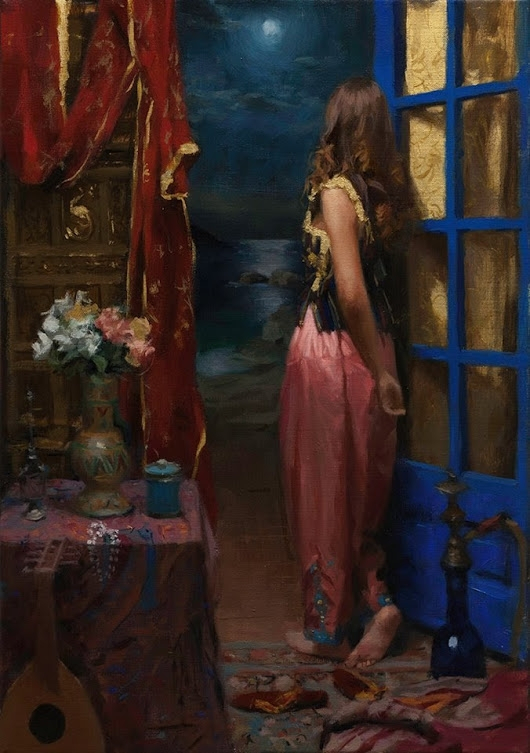
[painting by Vicente Romero]
Update, 25 October 2024
Well, 3-4 years of water under the bridge. Shaun Bailey is now a member of the ever-less-credible House of Lords! Baron Bailey of Paddington, no less. As good as “Burlington Bertie— from Bow”.
Bailey therefore gets a double bite: H o L expenses (nearly £400 a day, taxfree, for the days when the Lords are in session, most of the year, and (I admit that I was unaware that that was allowed) a salary as a member of the London Assembly. Not bad for someone whose only career jobs have been to have founded a fake charity that folded after 6 years with debts, much of the money having gone to Bailey himself; someone who was a token black SpAd for David Cameron-Levita for 2-3 years, then a multiple failure at various elections. Britain, 2024…
As for the “Balkan fraud”, Jasna Badzak, she is finished and may even be dead; I do not know.
Jill Mortimer won the 6 May 2021 by-election convincingly for the Conservative Party— 51.9% of the vote. The Labour candidate, NHS doctor Paul Williams, garnered only 28.7% and was forced to resume work as a medical doctor. Jill Mortimer’s time as MP was, however, quite brief; at the General Election of 2024, she lost her seat and got only 21.9% of the vote, placed 3rd after Labour (46.2%) and Reform UK (24.5%).
The likely date of early release is now some day uncertain next week. “They” are trying to get their full pound of flesh, it seems.
Latest news about persecuted singer-songwriter Alison Chabloz is that, according to usually-reliable sources, her early release on electronic tag has been further delayed by wrangling over the terms of her release; in other words, it may be that the Jew-Zionist lobby, operating as always behind the scenes, is trying to have her gagged, i.e. there may be conditions around use of or posting on the Internet. Such conditions, if imposed, might last until the end of the 18 weeks starting on 31 March 2021, the day of her sentencing; if so, she may be unable to post until early August 2021.
Books sent should be *new, *paperback and preferably (though not necessarily) sent via online vendors [important update: Bronzefield Prison now does not accept Amazon deliveries but will accept books from elsewhere]
Looks as though the technology first publicly seen in the 1965 film, Thunderball, has finally come of age and is finally of use in practical operations:
Gotta say, whilst I don't share all of the conclusions he comes to, this mini-documentary by Owen Jones is the most interesting and informative piece I've yet seen on the Hartlepool by-election. Far better than anything put out by the BBC/Sky/ITN etc. https://t.co/biQGOT1IRd
— Mathew Hulbert 🔶️ 🏳️🌈 (@MathewHulbert) May 5, 2021
Worth watching (pity about the horrible ending soundtrack, though).
The few, in (eg) Hartlepool, who are still Labour loyalists, point at achievements of the past, such as those of the Attlee government of 1945 (NHS, mainly…), but that is like saying that Lloyd George brought in the Old Age Pension, so vote Liberal, or LibDems in today’s terms. Absurd. Doesn’t work…
It is ridiculous for people in Hartlepool to vote “Conservative”, but it is equally silly to vote “Labour”, which supports mass immigration, and in that and other respects is now almost identical in real policy terms to the equally-misnamed “Conservatives”, and now led by a man who is married to a Jewish woman lawyer, whose children are being brought up as Jewish, and who is a puppet of the Jewish Zionist lobby.
Does Keir Starmer have anything to say to the people of Hartlepool? No. Neither, of course, does the part-Jew chancer and political bad joke, Boris Johnson. However, the voters of Hartlepool have no other realistic choice. The electoral system is itself a fraudulent bad joke. The result is that those voters want a change, but cannot get a change except to make a gesture at least, by binning Labour, which has won Hartlepool since 1974 when the present constituency was created.
The opinion polls show the Conservative Party well ahead of Labour in the Hartlepool race. The result may be tighter than some expect, but it seems likely that Labour will lose to the Conservative Party.
It is unlikely that Reform UK (effectively Brexit Party without the name, the support, or even the leader— traitorous Farage has decamped for the money) will get many votes. Thus the Conservative Party vote will be little impacted.
As for Labour, I predict a poor showing. There are many in Hartlepool, no doubt, who will not vote Conservative under any circumstances. Many former Labour voters, as in the 2019 General Election, will probably vote with their feet, and stay at home to watch the televised sport and pseudo-“celebrity” nonsense so beloved of the contemporary British masses. If so, the Labour Party is toast at Hartlepool.
A Conservative Party “victory by default” at Hartlepool is more than likely, and the same effect will be seen, in the near future, across much of England, in the absence of a real social-national party.
Tweets seen
Digbeth's railway viaduct was built 150 years ago but has never seen a single train.
So I'm determined to make use of the space by transforming it into a green walkway providing a much needed green lung for the city – similar to the NY Highline.
Another new solo show. How Brits should vote on Thursday. A nurse exposes New York's real covid scandal. I rip apart the BBC's 'black Cheddar man' hoax. And find a piece of environmental good news thanks to unfashionable but inventiveness of white men. https://t.co/gxpwbgzxsk

























 Ian Robert Millard