Tag Archives: Conservative Party

UK System Parties Struggle For Relevance

Overview

The next UK general election must be held by mid-2022 at latest. Pundits have suggested every time between Autumn 2018 and that date. I myself incline to the view that the next general election will be in late 2018 or Spring 2019, but I have no great faith either way.

What interest me are the prospects for social nationalism and I assess them, at present, as close to zero, assuming a general election in 2018 or 2019. Why? Primarily because there is not only no credible social national party, but in effect no social national party at all.

UKIP

What is left of UKIP is being pushed as a fake “alternative” by those who have no interest in actually having a social national government in the UK: conservative “nationalists”; “alt-right” “social media” weirdos (who never criticize Israel or the Jewish Zionist lobby, or put forward any policies for a better society) such as “Prison Planet” Watson and “Sargon of Akkad” Benjamin; as well as various others who actually wish to prevent a social national movement developing.

Does UKIP have any chance of resurgence if, for instance, Brexit turns out to be a fraud (as seems likely)? If what is meant by “resurgence” is an increase, perhaps even a doubling or tripling, of its vote percentage, yes; if what is meant is a breakthrough and the election of a bloc of UKIP MPs, no.

At present, after 25 years of activity, UKIP has no Westminster MPs (out of 650), 2 members of the London Assembly (out of 25), and 4 members of the Welsh Assembly (out of 60), as well as 17 MEPs (out of 73 in the British contingent). The last will of course disappear next year even on a nominal Brexit. In 2015, UKIP managed a Westminster vote of 12.6%, which fell back to 1.8% in 2017. In order to get back to the 2015 position, UKIP would have to increase its vote 7-fold (and even then probably be unable to get even one single MP elected).

UKIP has been a winner for the System: it took votes and attention away from the BNP prior to 2010 and has taken the wind out of the sails of social nationalism by, to mix metaphors, diverting the waters of popular discontent angry at mass immigration, the EU, globalism etc. All that popular discontent was diverted into a “safe” channel– not “anti-Semitic” and, in fact, not really even anti-immigration. UKIP after 2010 fielded numbers of ethnic minority candidates. At one point, the favoured candidate to take over the party leadership was one Steven Woolfe MEP, of both Jewish and “African-American” descent. Woolfe had become an MEP in 2014 (UKIP’s peak year) after having come third (with only 13% of the vote) in the North West, which result points to the essentially shallow support that UKIP had even at its peak.

As to the small parties trying to swim in nationalist waters, none has any weight or credibility.

For Britain

“For Britain”, the narcissism vehicle of Irish lesbian ex-secretary Anne Marie Waters, is an anti-Islam one-trick-pony and one, er, woman band, pretty much. Not only has it few members (at an educated guess a hundred or so), but its popular support is effectively non-existent: leader Ms. Waters managed a derisory 1.2% (266 votes) at the Lewisham by-election of 2018, coming 7th in the poll. “For Britain” actually expelled a local election candidate because of alleged links to both National Action and Generation Identity. To make matters worse, that information had come from the partly-Zionist-funded “Hope Not Hate” “antifa” snoop-group. The conclusion is obvious: from every point of view, “For Britain” is a waste of space.

Britain First

Britain First is the most important broadly supposedly nationalist party and is said to have perhaps 1,000 members. It is not, to my mind, credibly social-national, being pro-Israel and expressing support for Jews in the UK. Its leaders are not known for intelligence or cultural depth. Its actions, such as invasion of mosques, throwing bacon at mosques etc are little removed from a Monty Python level of tactics and activity. It has done abysmally in all elections contested to date and in fact has (since 2017) been deregistered as a political party. Another waste of space from an electoral point of view.

Others

All other “nationalist” parties and groups (English Democrats, the rumps of the British National Party and National Front etc) are tiny and not worthy of consideration. One possible exception is Generation Identity, but that is not a political party. Other small but non-nationalist parties and groups are of no importance.

System Parties

It is clear that the next general election will be fought among the long-established System parties. Even UKIP will play only a walk-on role: its likely vote of 1% or 2% is unlikely to make an electoral impression in any but the few most marginal seats.

Conservative Party

The Conservative Party can now be characterized as “donkeys led by donkeys”, with not a lion in sight, unless is included the moth-eaten toy lion called Boris Johnson. The Conservative Party’s best electoral argument is that it is not the Labour Party.

Britain teeters on the brink of social breakdown. The “Conservative” governments since 2010 have slashed spending on police, the legal and justice systems, social security, housing etc. In the past, “law and order” was the Conservative Party’s trump card. Now all that is left is a barrage of empty words.

Who now votes Conservative as a natural thing? The few percent of very wealthy individuals? The –maybe– 25% of the population who are relatively affluent? Buy-to-let parasites? I get a sense that formerly loyal groups —pensioners, ex-military, Brexit supporters, anti-immigration small-c conservatives, suburban homeowners— are deserting the Conservative Party in droves. They may not vote Labour or even LibDem, but are not going to make much effort to vote Conservative. If the Conservatives are only going to get their core 25%-30% vote out, they are in trouble.

Labour

Labour is damaged by being seen (and all the more under Corbyn) as the party of mass immigration, though that is not entirely fair: the Conservatives first triggered the post-1945 immigration trickle that became a flood much later; the Conservatives have presided over enormous volumes of immigration, most obviously since 2010 (despite  –again– empty words against the invasion). In fact, the Labour Party that deliberately imported millions of non-white immigrants was that of Tony Blair, not that of Jeremy Corbyn.

Labour’s strength is that its present policies, such as rail nationalization, utilities regulation, building social housing etc, resonate with a population that has seen living standards fall for a decade.

Labour may lose 30 seats in the 2022 boundary changes, but 2022 seems a long way off at present…

Liberal Democrats

The LibDems were mortally wounded by joining with the Conservatives in the 2010-2015 Con Coalition. At present, their only strength is that some voters in the South of England will vote LibDem rather than Conservative, when they would not vote Labour.

The LibDems presently have 12 MPs, but the boundary changes set for 2022 will cost them as many as 8 seats. The LibDems have been there before, but not for many decades and that was in a political milieu where the typical election in a constituency would be a three-way split; now five or six parties, plus minor and joke candidates, contend. If the LibDems lose 8 seats, that will be close to the end. It was noticeable that their recent Conference was attended almost exclusively by the over-60s and indeed over-70s.

Conclusion

If a general election is held in 2018 or 2019, the likely result is a hung Parliament, probably with Labour as the largest party. If a social national party can be founded within the next two years, it has every chance of attaining power within a decade.

Notes: 

https://en.wikipedia.org/wiki/Steven_Woolfe

https://en.wikipedia.org/wiki/For_Britain

Update, 23 January 2025

Well, having now read the above for the first time in 7 years, I see that my thoughts were almost all correct, yet my ultimate view on what would be the result of a 2019 General Election was not correct. “Events, dear boy”…

I could not have predicted that snake-oil salesman Farage would set up Brexit Party, and at first lead it to the cusp of victory, before stabbing his own candidates in the back, thus gifting the fake Conservative Party under poundland Churchill, “Boris” Johnson, an unmerited electoral bonanza.

Why I Hope That Labour Splits

The major System newspapers in the UK are now talking about two connected possible events. The first is that the Labour Party might split into two parties. The second is that new “centre” parties are about to emerge. I hope that such rumours are true. Why?

If Labour splits, Corbyn and the anti-Zionists will keep the name, organization and most funding sources of present Labour. The breakaway MPs, who might even be in the majority but will probably, in reality, number only in the dozens rather than the hundreds (Labour presently has 258 MPs), will have slender resources. Most rank and file members and supporters joined because of Corbyn and will almost all stay with him and “official” Labour.

The Zionists and pro-Zionists and doormats in Labour (the usual suspects: Liz Kendall, Chuka Umunna, John Woodcock –already resigned–, Ruth Smeeth –exposed as an agent of American Intelligence and of Israel–, Luciana Berger etc) will be lucky to retain their seats. Most if not all will lose. Thus we shall be rid of at least many of the most vocal Zionist trumpets at Westminster.

As for the new “parties” speculated about, they have little chance, for several reasons. One is likely to be funded by some (I presume) Jew called Franks, who apparently has £50 million with which to play. He is said to regard himself as another Macron (and sees that as a recommendation!). These parties have no chance, because of FPTP voting, English (Welsh/Scottish) voter caution, but most of all because (though I deprecate “left-centre-right” labelling), people who are not desperate rarely look for an alternative; those who are desperate seek radical and revolutionary solutions. These “centre” parties are strategically misplaced.

If a new and truly radical social-national party emerges, though, that will have a chance…

When the misnamed “Conservative” Party is weak and led by idiots (as now), when Labour is in a similar position and split into two, when both System parties are further weakened by new parties in contention, we can strike.

https://www.theguardian.com/politics/2018/aug/20/prospect-new-uk-party-grows-westminster-political-cracks-brexit

The Latest Turn of the Screw

Today, a collection of System MPs in a Select Committee of the House of Commons decided that the Internet in the UK is too free, despite the increasing censorship seen (I myself having fairly recently been expelled from Twitter). They want new laws to force the platforms such as Twitter, Facebook etc to somehow prevent “fake news” and the “wrong” kind of opinions being seen or heard. They are animated by the election of Donald Trump and by the Leave vote in the EU Referendum which occurred in the UK. Oh, and they want to stop “interference by foreign countries” in UK politics…

I can see why one Californian film mogul referred to a similar delegation of British MPs that he met (about 20 or so years ago) as “yawningly dull Little Englanders”. These MPs seem to think that they can pass laws in their little Parliament of fools which will control the Internet. In reality, the USA will not pass such laws, most of them anyway, because of a thing called the US Constitution. The EU might, in its little Parliaments or in its completely undemocratic Brussels version, or by Commission decree, pass such laws, but I doubt it.

As for “foreign interference”, they mean Russia, mainly, but not a word is said about the pervading and continuing Israeli interference in UK politics. Only one documentary (on Channel 4, about 8 years ago) examined the Jewish Israel lobby in the UK. Al Jazeera TV did another recently, only for paid Israel drones in Westminster to laugh it off.

We do not have a “fake news problem” (unless is meant by that the msm). We have another problem, which might be called a “Zionists in the woodwork” problem.

The System MPs would love the Internet to be (even more) muzzled. They love it when honest people cannot put forward social-national views. They are mostly now enemies of the British people.

Notes

Leadership, Dictatorship and The Need For Effective Government

Dix5gSdWkAAinaz

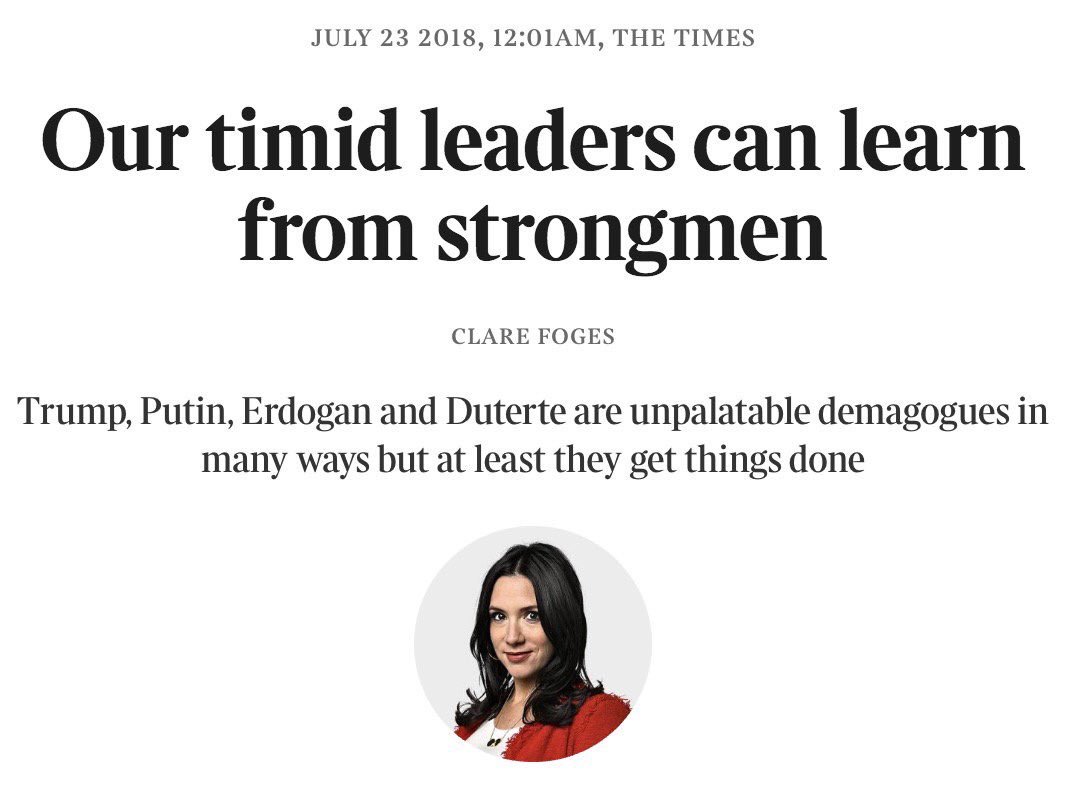
A woman journalist or opinion-writer of whom I had not previously heard, one Clare Foges, has suggested in an article in The Times that the leaders of the UK and Western Europe might learn from political “strongmen” (she cites an eclectic mixture: Trump, Erdogan, Putin, Duterte).

About the Writer

Having not previously heard of the writer, I did a quick Internet search. The surname suggests a Jewish origin, and someone of the same name posted this online in 2000:

https://www.ancestry.co.uk/boards/localities.ceeurope.austria.Prov.vienna/167.588/mb.ashx.

It seems that Clare Foges wrote speeches for David Cameron-Levita and others prior to the 2010 election and immediately after it. She has also written at least one book for small children.

Having now read a little about her, I should say that she seems to have some intelligence, though perhaps not enough, or not enough knowledge, for the matters she discusses in print. Her understanding of society and politics seems shallow. She gave an interview to the Evening Standard in 2015. In it, she proposes, inter alia, better pay (!) for MPs, who “give up well-paid careers” etc. Ha ha! She really should take a look at the collection of misfits, also-rans and chancers who comprise many (not all, admittedly) of the more recent MPs!

https://www.standard.co.uk/lifestyle/london-life/clare-foges-the-woman-who-put-words-in-david-camerons-mouth-10437029.html.

Indeed, in 2017 she herself wanted to become an MP, for the fairly safe Conservative seat of the Isle of Wight, but withdrew after having been shortlisted:

https://www.conservativehome.com/parliament/2017/05/exclusive-foges-joins-fox-in-withdrawing-from-isle-of-wight-selection.html.

In fact, the then-incumbent MP had hardly “given up a well-paid career”, having been a geography teacher in comprehensive schools for most of his life:

https://en.wikipedia.org/wiki/Andrew_Turner_(politician)#Early_life_and_career

and that MP (also an expenses freeloader…) then “stepped down” after having “become a laughing stock” by reason of his quasi-matrimonial situation:

https://www.telegraph.co.uk/news/politics/conservative/11334299/MP-battling-to-save-seat-in-toxic-Tory-rebellion-after-fiancee-moves-in-with-his-aide.html.

In short, my provisional view is that the writer of the article is, at 37 or 38, someone who for whatever reason has fallen between the cracks, who might have become something in the political realm, even perhaps an MP (and after all, her background as pr/”comms” “intern”, sometime children’s book writer, “Conservative” speechwriter, amateur poetess and (?) professional scribbler on politico-social issues is no worse than that of many “Conservative” or “Labour” MPs, and better than some) but has not.

The Issues Raised

What are we to make of this article suggesting that the UK needs leadership informed by “strongmen”? Duterte is the Philippines leader who has presided over a campaign of extra-judicial killing of drug gangsters etc. Erdogan is the political-Muslim Turkish dictator (by any other name) who is dismantling the legacy of Kemal Ataturk. Putin and Trump are too well-known to need any introduction even to those who take little interest in politics.

The main issue, surely, is that government must govern. It must be effective. Ideally, there will be checks and balances: law, due process, civil rights, property rights (within reason); however, in the end, a useless government has no right to exist.

Political leaders (including dictators) emerge for reasons. In broad brush terms, Putin emerged because Russia under Yeltsin had become a chaotic mess. Pensioners and other poor people were starving or dying from cold or lack of food, by the million. Public sector workers were being paid almost nothing. Jew carpetbaggers had flocked to Russia like a cloud of locusts (or vultures) and were stealing and cheating everything, pretty much. “Russian” Jew “oligarchs” ruled from “behind the throne” and had tricked their way into “ownership” of vast oilfields, diamond and gold mines, heavy industries. Putin began to claw back some of that. Pensioners who had been getting (USD) $5 a month under Yeltsin, now (2018) get $400. People are at least paid for work. Chechen and other gangsters have been stamped on and many killed or imprisoned. Russia has flourished compared to the 1990s.

Erdogan is someone for whom I myself have little sympathy, not least because I value the legacy of Kemal Ataturk. However, Erdogan has improved the lot of the poor, we read, while the economy has improved under his rule.

Trump likewise seems an egregious person generally, and even more egregious as a leader of a government and as a head of state. However, his rise (fuelled by his own huge fortune, of course) was not based on nothing. Many people in the USA are living in poverty. I read that 40% of Americans now require US governmental foodstamps! Many jobs (as, increasingly, in the UK and elsewhere) are “McJobs”, precarious and badly-paid. The drug epidemic is out of control. Illegal immigration had run wild since the 1980s. Whether Trump can deal with these problems and others,  with the “separation of powers” American system, is doubtful, but the dispossessed and marginalized, among others, voted for him to try.

The Missing Leaders

Clare Foges cited Trump, Putin etc, but not the controversial leaders of the 20th Century: Stalin, Hitler, Mussolini, Mao etc. They all took harsh measures but also did a huge amount that was positive. Hitler in particular saved Germany from degradation, removed Jew exploiters from the economy, the professions, the mass media; built autobahns (the first in the world); created air and airship travel routes; vastly improved animal welfare; planned new and better cities and national parks; put Germany to work and (for the first time) gave workers rights such as decent breaks at work, Baltic and other holidays in Germany, and also foreign holidays including cruises. Decent homes were built on a huge scale.

3396AD3500000578-3561575-Hitler_had_lived_in_Munich_just_before_World_War_I_and_remained_-a-1_1461778976380.jpg

an-automobile-on-the-sweeping-curves-everett

Chancellery2DietrichEckartBuhneVW3

Britain could do worse than follow Hitler’s lead, introducing some updated and English/British form of social nationalism.

Stalin was far harsher as a leader and as an individual than Hitler or Mussolini, though Mao might be considered far worse (but of course he was non-European). Stalin however (like Hitler) was put back domestically by war. Stalin did recreate the industrial sector, which was booming before the First World War but which Bolshevism all but wiped out as a thriving economic sector. Stalin’s major mistake (apart from his cruelties and brutalities etc) was to allow the agricultural sector to be ruined via Collectivization, the legacy of which is only now being very slowly erased.

Mussolini did a huge amount for Italy. His posturing on balconies etc is what people now think of when his name is mentioned, but he eliminated the Mafia (until the Americans caused its revival after 1943, releasing the imprisoned leaders and followers), started to get rid of the terrible urban slums (unfortunately more were created as a result of the Anglo-American invasion of 1943); Mussolini also created an advanced scientific and industrial sector, mainly in the North. Famously, he also greatly improved the railways, and “made the trains run on time” (both truth and metaphor). Now, the wartime propaganda of the Western Allies and Stalin is all that most people outside Italy know– Mussolini as clown. Ironic that a real clown (the leader of the Five Star Movement) is now a major political figure in Italy!

https://en.wikipedia.org/wiki/Beppe_Grillo.

Britain 2018

The UK has been pretty much left to rot since 2010. The Blair government, though repressive and in the pocket of the Jewish-Zionist lobby, tried to modernize infrastructure generally. New buildings were constructed: hospitals, libraries, schools. Credit where due.

The David Cameron-Levita-Schlumberger government of idiots was not only the most pro-Jewish/Zionist government Britain has ever had, (until Theresa May became Prime Minister), but also the least-effective of modern times (again, until that of Theresa May?). It not only failed to do anything new and decent, but also failed to maintain that which already existed, in every sector, from libraries and schools to the air force and navy.

The lesson surely is that government must be effective. If it is not, the State stands in peril. The people eventually demand action. They are beginning to demand it now.

The article by Clare Foges is, it seems to me, a sign of the times, or a straw in the wind. The political times in Britain are a changin’…

Notes

http://www.bbc.co.uk/programmes/profiles/3tMvnMp3DFW3z99Zvc7WC3T/clare-foges

https://www.standard.co.uk/lifestyle/london-life/clare-foges-the-woman-who-put-words-in-david-camerons-mouth-10437029.html

A critical article from the New Statesman:

https://www.newstatesman.com/politics/elections/2018/07/sorry-clare-foges-dictatorship-isn-t-just-character-flaw-it-s-crime

Another critique of her views:

https://www.property118.com/clare-foges-anti-landlord-the-times/comment-page-4/

She was desperate to become an MP but no-one wanted her:

https://www.telegraph.co.uk/women/womens-politics/11436355/Sir-Malcolm-Rifkind-resigns-Kensingtons-next-MP-might-be-this-woman.html

Another Clare Foges article. She seems to be very much of her time, meaning 2010-2015, as in this Cameroonesque piece of sort-of social Darwinism. I think that Clare Foges can be written off as a serious commentator.

https://www.thetimes.co.uk/article/put-feckless-patients-at-the-back-of-nhs-queue-5hnlqqstg

https://www.dailymail.co.uk/news/article-2267901/Clare-Foges-The-raven-haired-poet-ice-cream-seller-wrote-PMs-big-speech.html

Further thoughts, 6 December 2018

According to the Daily Mail, Clare Foges is “a devout Christian”. She may still be of part-Jewish ancestry (see above). My other query about the “devout Christian” bit is how does a “devout Christian” want to put IVF couples ahead of people needing NHS treatment for serious conditions just because they drink, smoke etc? Is that “Christian”? Even evil Iain Dunce Duncan Smith is said to be “devoutly Christian”…Yeah, right!

In the end, I suppose that it scarcely matters whether Clare Foges is this or that…and I just noticed that her Daily Mail bio was written by the egregious Andrew Pierce, so we can probably discount it…

Incredibly, she is appointed OBE!

https://www.huffingtonpost.co.uk/entry/labour-blocks-david-cameron-speechwriter-claire-foges-from-joining-party-to-oust-jeremy-corbyn_uk_58d90195e4b03787d35a3d08?guccounter=1&guce_referrer_us=aHR0cHM6Ly93d3cuZ29vZ2xlLmNvLnVrLw&guce_referrer_cs=Y57ohgKaElO9EWmxBHKC1w

Looking at her photos and her behaviour, I think that she is probably at least partly-Jewish.

Her Twitter comments (read the thread):

https://twitter.com/ClareFoges/status/985813260824989696

She has not tweeted since April 2018.

She writes in The Times, but also as freelance pr person…

http://www.finelinelondon.com/

She has certainly written columns in The Times [of London] several times, but is not on that newspaper’s list of its 29 “key” columnists. I have just taken a look on the Internet, and not seen anything online written by her as Times columnist in the past months (since August 2018), though her Linked-In profile avers that she is still a Times columnist. I did see a piece from November 2018 published in The Sun “newspaper”.

https://uk.linkedin.com/in/clare-foges-906a4676

Update, 9 November 2020

I have just seen that Clare Foges has been writing a column for The Times about once per week in recent months. I had not noticed, never now reading that newspaper (does anyone?I suppose some still do).

Which Way Politically After Brexit?

It seems to be a virtual certainty that, during 2019, “Brexit” will –at least in name– take place. What that means is still uncertain. It has just been revealed that Theresa May and others have been secretly working to undermine the substance of Brexit and to make it appear as if Britain has left the EU while in reality tying it ever closer.

As soon as the EU Referendum was held, when the result favoured Leave, I assumed that the ZOG/NWO cabals would attempt to subvert it. The Referendum was planned as a public relations exercise, cleverly channelled so that “the people” would rubberstamp the UK’s continuing EU membership. David Cameron (aka David Cameron-Levita) miscalculated. As punishment, he was booted out under the figleaf of resignation, and is now an obscure fringe figure in British politics.

The Theresa May government has little legitimacy. Theresa May inherited her mantle as PM, and then lost credibility during and after the 2017 General Election. She now clings to power by juggling the House of Commons votes of her own rebellious MPs and those of the Democratic Unionist Party (which latter have been, in effect, bought).

Fate now takes a hand. As with Cameron-Levita, Theresa May has few of the attributes necessary to be a Prime Minister. She has made a mess of both the Brexit negotiations and her own plot to “leave” the EU while really staying in it. As a result, she has become something close to a laughing stock with the public.

It is possible that the UK will leave, or as Remainers always say, “crash out” of the EU on the basis of World Trade Organization [WTO] rules. It is possible, though unlikely, that the UK will “leave” the EU (but in effect stay) under the “Chequers” plan of Theresa May. It is possible, though very unlikely, that not even a nominal Brexit will happen.

I do not here want to examine the possible economic consequences in detail, but to look at the political future in the short to medium term.

There has already been a backlash from the public in the 9 days since the Chequers plan was announced. In the old phrase, you can fool some of the people some of the time but you cannot fool all of the people all of the time. Was that Mark Twain? According to my brief Internet query, no. Abraham Lincoln.

The opinion polls are already starting to move against Theresa May and the Conservatives vis a vis Labour. Labour has pulled a couple of points ahead for the first time in months. The revelation (which only burst upon the public prints yesterday) that Theresa May has been presiding over a secret plot to nullify Brexit will sink her and her party, in my opinion. So far, the Conservatives have been able to rely on the Corbyn Factor (which includes the Diane Abbott Factor etc) to put many voters off voting Labour. Now? Those people might or might not vote Labour, but many will not vote Conservative. They might abstain, they might vote Labour, they might even vote UKIP, which has experienced a rare poll boost in the past week or so.

UKIP is washed up, as I have been tweeting and blogging since 2014. However, it will still stand a small number of candidates in any general election held in 2018 or 2019 and those candidates will take the edge off the Conservative vote. The same is true of any candidate who is anti-EU.

The present weak Conservative government can surely only decline in popularity from here. As I have recently (and previously) blogged, the voters at present are mainly voting against parties rather than for them. A voter may abstain from voting Conservative or make a protest vote rather than voting Labour (or LibDem, bearing in mind that the LibDems are pro-EU).

The electoral mechanics in the UK are such that the result of any general election mirrors the “glorious uncertainty” of the racecourse. However, the present likelihood is that no party will have an overall majority, or that either Labour or Conservative will have a very small majority. That would be not dissimilar to the present situation, where in 2017 the Conservatives won 317 seats; however, a formal majority would require a party to win 326 seats but in fact (because Sinn Fein’s 7 MPs do not attend and so do not vote) 320 for a bare practical majority. Theresa May is 3 MPs short; hence the DUP arrangement.

My present feeling is that, while Labour will never be able to get a working majority in any election in the next couple of years, it could end up as (probably marginally) the largest party and so be able to form a weak minority government of some kind. This would be the best outcome for social nationalism, so long as a credible social national movement can emerge.

On the above premises, a half-cocked Brexit might lead to continuing mass immigration (including non-white immigration), economic slowdown, general malaise and administrative chaos. People will be dissatisfied, and disgusted by the System. On those premises, a real social national movement could gather strength enough to challenge the System by 2022.

Society, Politics and the Mental Landscape

It has been proven that to take away the familiar and known from an individual is to disorientate that person. It is a well-practised method of breaking down a prisoner for interrogation, for example (sensory deprivation etc). A less harsh form, usually, is recruit training in armies and similar organizations. However, the same is true in societies generally. When the familiar is taken away, society suffers something akin to a nervous breakdown. The singer Morrissey has commented recently that England now is little more than a memory.

In the UK, we have seen how society was already struggling with the importation of millions of immigrants even before 1997, when the Tony Blair Zionist government (ZOG puppet government) took power. It is now a matter of record that a deliberate decision was taken by the Tony Blair government to import further millions of immigrants, mostly non-Europeans, in order to destroy Britain as it has been and to a limited extent still is; to destroy the racial and cultural roots and foundations of our country. White genocide.

That policy, spearheaded by two corrupt Jews, Phil Woolas and Barbara Roche (both now removed from Parliament), has been successful. Britain is now, at least in part, an ethno-social dustbin. The millions imported have been breeding, prolifically. Recent reports and studies estimate that the UK will become majority non-white by 2050. If one takes England alone, the date can probably be reduced to around 2040. Already, some English cities are English in name and history only or are getting that way: London is already majority non-white (native-born population: 44%), Birmingham and Manchester are rapidly following (57% and 66%), while smaller cities such as Leicester and Bradford are already, like London, mainly non-white.

The above ethno-cultural changes have destabilized the national mental landscape. The change has been accompanied by a propaganda campaign stealthily making use of “soaps” and TV advertizing. The mixed-race family is presented as the norm. Even Midsomer Murders, the archetypal Middle England comedy-drama detective series, was forced, after criticism, to put blacks and browns into the cast lists. This is (as with TV ads) not really reflective of reality but the creation of a new “reality”. Social engineering.

The wrenching apart of the accepted “mental landscape” does not end with the racial-cultural question. It is far wider. It includes the gratuitous renaming of commercial and trade union organizations. Thus the old trade unions, with their easy to understand names and functions, have become amorphous huge conglomerations with names that mean little, such as “Unison”, “Unite” etc, and have abandoned their members’ interests to pursue a politically-correct agenda involving “anti-racism”, “anti-sexism”, promotion of mass immigration etc.

In the same way that the trade unions have been corrupted, so commercial enterprises have been renamed and somehow displaced. Norwich Union insurance becomes “Aviva”, and so on.

The result of this dislocation of the mental landscape on the large scale has been the rupturing of the connection between the people as a whole and the mainstream political parties. The Conservative Party, which once had a membership in the millions, now numbers only a few tens of thousands and is still sliding. Labour, which was going the same way, has recovered under Corbyn to about 450,000, but its popular vote has not recovered. The Liberal Democrats are a very small party in terms of both members and votes. UKIP too has fallen back, in its case to almost nothing, but the fact that it briefly mushroomed into a threat to the older parties indicates that the voters are no longer anchored to System parties. However, a non-System party credible enough to come to the fore has not yet emerged.

Another symptom of the mental-landscape dislocation is seen in the notionally “nationalist” direct-action operations carried out by the “lone wolf” dissidents. The highest profile case is probably that of Thomas Mair, who killed Jo Cox MP a few years ago. In his case, the sheer dislocation suffered by society seems to have triggered a determination to make a point through forceful action.

More significantly, the lack of secure anchorings in society may lead to a volatile political milieu in which a social-national party could be formed, become popular and then move to attain power within a relatively few years.

The Train is Hitting the Buffers

The UK train is hitting the buffers. The train crash has been slow, long in coming, but it is now starting to happen.

Decades of decadence, mass immigration, political corruption, Zionist takeover of the legal system, cultural sickness in all mass media (fostered by Zionist infiltration at all levels) etc now result in manifestations that are becoming apparent even to the voting public.

The public has little idea, even now, of the causes, but it sees the effects: National Health Service creaking, beginning to fall to pieces; the housing market effectively closed to most of those who wish to buy a house or even an apartment; sky-high rents paid to speculative parasites by employees and others; congested roads and trains; cities full of those of alien race and culture; schools which brainwash children with “multiculti” propaganda and “holocaust” lies.

Those few (including me) who saw this coming as long ago as in the 1970s (in my case) or even 1960s, were and still are marginalized by a mass media system which is thoroughly corrupted. The same is true of the political system and, increasingly, of the professions, where to speak up at all invites expulsion: see

https://ianrmillard.wordpress.com/2017/07/09/the-slide-of-the-english-bar-and-uk-society-continues-and-accelerates/

The Zionists are behind much of this and are now trying to shut down free speech and comment across social media– as happened long ago in the mass media.

https://ianrmillard.wordpress.com/2017/07/13when-i-was-a-victim-of-a-malicious-zionist-complaint/

The question that now has to be asked is what, in the next 4-5 years, will be the political result of the slow but accelerating collapse of British society in all areas?

It is clear that specifically English (leaving aside Scotland, Wales and Northern Ireland) voters are now, in a semi-rigged “First Past The Post” electoral system, voting against parties rather than for them. There is little enthusiasm for any of the System parties, let alone the more or less washed-up UKIP, Liberal Democrats and Greens, but there is determination to block parties by voting tactically for the party most likely to achieve that in any given seat.

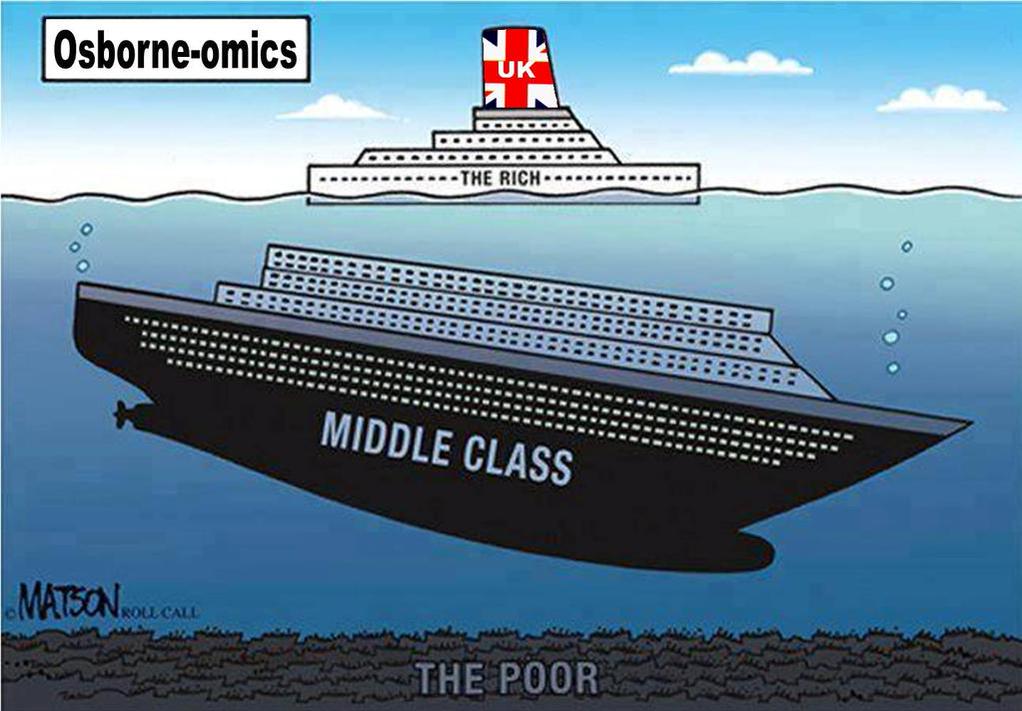
Beyond the wish to block unwanted parties and candidates, there is a general and growing dissatisfaction. Above all, the “Middle Classes” are joining the “workers” and the marginalized at the bottom.

b-cisxdiqaa7qj_-jpg-large

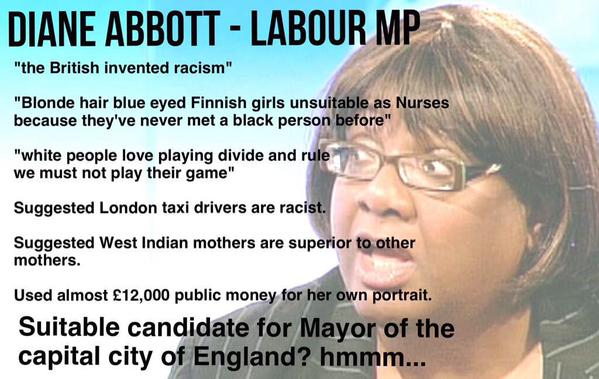
That can only help Labour, despite the misgivings many feel about its MPs and leaders (the obvious example being Diane Abbott). The success of the Corbyn faction and its vanguard, Momentum, may unsettle some voters, but may give rise in others to the feeling that at least Labour is fairly solid ideologically, not a chaotic mess. That is bound to play to Labour’s advantage electorally. Contrast with the Conservatives. This cartoon portrayed the way in which Theresa May achieved office by default:

CnLGOc5XYAALLJdThe next general election will probably favour Labour, though probably not enough for it to win a majority in the House of Commons. After that, one can foresee continuing mass immigration, continuing slide in public services, continuing disparity in wealth. That will be the moment when a social-national party can strike. First of all, one must exist, however.

Formation of a Social National Party in the UK

Background

For a number of years, I have watched the socio-political scene in the UK with increasing feelings of concern. The System parties have done terrible things (and omitted to do the right things) without any regard for the national interest, without compassion, without even logic:

  • disastrous foreign wars and other interventions, backing the United States and NATO and (in reality) Israeli interests and the plans for a “New World Order” [NWO];
  • financial madness caused by globalist economics and neoliberalism, not least the inability to tax effectively huge transnational enterprises;
  • gradual takeover by Zionists of strategic areas of society;
  • quite fast increase in the Muslim and other non-European populations of the UK;
  • inflicting appalling hardship and persecution upon the poorer section of the UK population (eg unemployed, disabled) via spending cuts, cruel bureaucratic systems, outsourcing;
  • allowing the NHS to decline steadily in all areas;
  • importation of many millions of immigrants even since 1997, with subsequent births to those immigrants, resulting overall in strain on NHS, roads, trains, housing; schools, prisons, social security, pensions;
  • policies on farming and landowning which do not prioritize wildlife and the environment  in general;
  • crises in care of the elderly;
  • decline in real educational levels covered up by meaningless “degrees” and award inflation;
  • inability to adequately and aesthetically house the population.

The above is not even a complete list of how the System parties have let down the British people.

System Parties

Conservatives

The Conservative Party has inflicted terrible damage on the UK via, inter alia, spending cuts and a coarsening of political converse generally. It might have suffered a huge defeat in 2015, but in the event was saved by the vagaries of the First Past the Post electoral system etc. It has now been saved, for the time being, by the implosion of the Labour Party.

Labour

The Labour Party becomes increasingly less relevant. Even mainstream commentators have woken up to it now. Labour introduced the hateful, dishonest and incompetent ATOS company to persecute the disabled. Labour was the party that decided to invade Iraq and Afghanistan. Labour is infiltrated, indeed pervaded, by the Jewish-Zionist lobby and its agents. True, so is the Conservative Party, but Labour claims to speak for what were once known as “the workers”. That, of course, is Labour’s problem: the bedrock of the “proletariat” has been replaced by the shifting sands of the (increasingly raceless and cultureless) “precariat”. So Labour seems to speak on behalf of metro-liberal “snowflakes”, “antifa” rentamob idiots, employees of the collapsing public sector; above all, perhaps, the “black and brown” ethnic minorities.

Example: in Stoke on Trent, Labour recently won the Stoke Central by-election by 2,500 votes. 62% of the electorate did not vote; of those that did, about 7,500 voted for Labour, 5,000 for both UKIP and Conservative. The constituency has 12% non-English voters (half of them Muslim). Virtually all voted Labour. In other words, the “ethnic” vote swung it for Labour. Educated guess: of the 7,500 Labour votes, virtually all were from ethnic minority (mainly Muslim) voters.

The SNP supremacy in Scotland has taken away about 50 MPs from Labour.

The redrawing of boundaries for 2020 will mean a House of Commons with 600 MPs. Labour is now polling at 25%, concentrated in a relatively few seats. Labour will have 100-200 MPs out of 600. It will be unable to form even a minority government.

Labour is gradually deflating to nothing.

Liberal Democrats

The 2015 debacle has killed the LibDems. The party may be getting “dustbin” or “protest” votes from disaffected Labour/Conservative voters, but its upsurge in 2010 will never be repeated. The Con Coalition mortally wounded the Liberal Democrats and they were lucky not be wiped out in 2015.

Non-System Parties

UKIP

UKIP was founded in 1993 and in the nearly 24 years since then has done well to get MEPs elected but has never come even very close to getting a Westminster MP, except for free-market crazy Douglas Carswell, who after all was already a Conservative MP and may well revert to being one.

UKIP failed badly at Stoke Central and Copeland and those failures reflected its lacklustre performance in local and Westminster by-elections since its peak in or around 2014.

Brexit has shot UKIP’s fox, both on the EU and on EU immigration. UKIP seems unwilling to engage on non-EU immigration and, in general, on race and culture; it seems afraid of being called “racist”. UKIP might have forged ahead had it gone social-nationalist in 2014, but it failed to do that and is now just a (sort of) Conservative joke party again.

UKIP has come to the end of the line except as a dustbin for some white English votes.

Other non-System Parties

There are none, really. Yes, there is “the solitary Green” at Westminster, who will be gone by 2020. The Greens are polling nationwide at 3% or below. As for the BNP, after its rise in 2008-2009, it has all but vanished. Its vote at Stoke Central was 124.

Political Vacuum

It is clear that there is a political vacuum in England. The Conservatives are riding high but only by default, Labour is imploding, UKIP is effectively dead as a party with actual MPs; LibDems may well have no MPs by 2020.

At the same time, real incomes are stagnating or declining in value, immigration continues at about half a million (perhaps 250,000 “net”), housing is inadequate and expensive, young people cannot have a decent life or future, the elderly are neglected, the unemployed and disabled persecuted.

There will never be a better or more auspicious time for social nationalism. However, only if there is a physical instrument, a political movement. I have blogged about the need for safe zones for social nationalism. However, there must also be a movement, part of which must be a political party.

Party

Party Funding

New parties always face financial difficulties. Dependence on donors is not easy yet hard to avoid. A basis of firm finance is essential. It may be that the only way for a small party to grow will be for its members to sacrifice a percentage of their income to the party. On that basis, a party of even 1,000 people can have an annual income of over £2 million (based on average net income of a very modest £20,000 and on a “tithe” of 10% of that).

Party Democracy

In an ideal world, a party should be (arguably) “democratic”, but experience shows that the enemy, particularly the Zionist enemy, is skilled at exploiting cracks and fissures to create factions which eventually destroy the party. It happened to the National Front in the 1970s, it happened (it seems) to the BNP in more recent times. It is happening to UKIP too, despite its doormatting where Israel is concerned, despite its wayward errors in respect of race and culture.

In view of the above, the party leader must have the final say.

Strategy

The way to go is for the new party to target first and foremost seats within the “safe zones” which will attract more and more people from across the UK. Thus the first thing is to create those safe zones.

Further Thoughts and Update (26 July 2018)

The only aspect of the above which requires rethinking is the role –and prospects– of the Labour Party. The bubble of the Conservative Party burst in the final weeks of the General Election 2017 campaign. Labour benefited. That I did not anticipate until the last week or two of the campaign. I see no great revival of Labour fortunes; rather a further deflation of Conservative fortunes. The likely result (in any general election in 2018 or 2019)? Hung Parliament and weak minority government, probably Labour.

As for the rest of my blog post, safe zones etc, all that still applies.

Update, 15 July 2023

“Man proposes, God disposes“, as they say. The Jewish-lobby attack on Corbyn-Labour, combined with Nigel Farage shooting his own Brexit Party in the back, and the wall of lies put up by “Boris” Johnson, resulted in an unexpected and considerable Conservative Party win at the 2019 General Election.

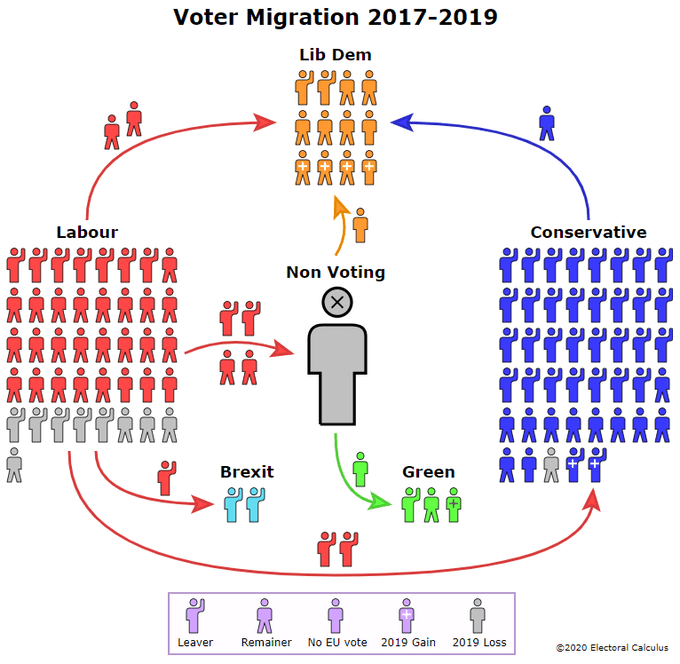
There was another factor underpinning the Conservative Party win of 2019— the fact that so many Labour Party voters “voted with their feet”, a few defecting to vote Conservative, but most simply not voting:

The Conservative vote-share increased only marginally across the country (more in a few seats), but the Labour share fell by 8 points. Had the Jewish lobby not trashed Corbyn-Labour on a daily basis for several years, and had Nigel Farage really fought for Brexit Party, the 2019 result would have been very different.

As for social nationalism, still no credible party anywhere to be seen./

Stoke Central and Copeland: the aftermath for Labour and UKIP

The by-elections in Stoke Central and Copeland have been held. The public relations people for Labour (UKIP seems to have no public relations section) are still trying to spin positives out of the Stoke result and even the Copeland defeat. The time has come to look to the future based on what can be taken from these by-elections.

The Result in Stoke Central

https://en.wikipedia.org/wiki/Stoke-on-Trent_Central_(UK_Parliament_constituency)#Elections_in_the_2010s

The Result in Copeland

https://en.wikipedia.org/wiki/Copeland_(UK_Parliament_constituency)#Elections_in_the_2010s

First Thoughts

I blogged before the poll that, if UKIP failed to win Stoke Central, that that would surely be the end or at least beginning of the end for it as a serious contender. I have also blogged and tweeted for 18 months my view that UKIP peaked in 2014. I have no reason to change those views now.

As a candidate, Paul Nuttall was fairly poor, not resilient, not intelligent, not really passionate enough politically. The UKIP organization or administration of the campaign also seemed poor. Overall, as in the past, UKIP seemed to be afraid to really set the campaign alight. The law being what it now is, UKIP could hardly have copied the successful 1960s Smethwick Conservative by-election candidate whose posters said “if you want a n****r for a neighbour, vote Labour”, but UKIP seemed to want to bypass the race/culture question entirely. There was no bite to the UKIP campaign.

The Labour candidate at Stoke Central, Gareth Snell, might fairly be described as “a poorly-educated and spotty Twitter troll, living mainly if not entirely off his allowances and expenses as a local council leader, who seems never to have had a non-political job (except a trade union one of some kind)”. In some respects he was a worse candidate than Paul Nuttall.

One has to bear in mind the heavily-industrial, heavily-Labour-voting history of Stoke-on-Trent. Labour has always had a built-in advantage there. The Conservative candidate, Jack Brereton, though looking like a schoolboy, did well to come a close third to Labour and UKIP, though in fact the Conservative vote increased by only a modest 1.8 points over the 2015 result.

Apathy or hostile apathy was the real winner in Stoke Central. 62% of the electorate did not vote. No party energized them to come out to vote for it.

As to Copeland, the main point that leaps out, apart from the obvious Labour car crash, is the poor performance of UKIP.

Future View

UKIP

UKIP surely must be finished now. It started in 1993 and in the nearly 24 years since then has failed to win a single Westminster seat, save for that of former Conservative MP Douglas Carswell, who is really just a Brexit Conservative and “free market” globalist.

UKIP would have been in a far better position had it won even a couple of seats at the 2015 General Election, but, in the irritating phrase, “we are where we are”. Theresa May’s Brexit policy has “shot UKIP’s fox” on the EU.

That leaves immigration, race and culture. UKIP now seems to have many spokesmen who are not of European race, so UKIP is not even offering the UK a white persona, a white country, if you like.

The conclusion is clear: UKIP is pointless, hopeless and must go.

Labour

Labour has been declining for years. Corbyn is both symptom and cause. The disappearance of the industrial proletariat has swept away the bedrock underneath Labour, replacing it by the sand of the “precariat”. Labour imported millions of immigrants, who are now breeding. The social landscape becomes volatile. The political landscape too.

The elimination of “socialism” from Labour led to focus-group rudderlessness, surely personified by Tony Blair, who has no principles, no real ideology, just careerism, self-seeking and politically-correct non-thinking. Labour became a party made in Blair’s image. It has no real ideology any more, not even social-democracy.

By 2020, the House of Commons will consist of 600 MPs, reduced from the current 650. Labour is currently at about 25% in the opinion polls and it is likely that, in 2020, Labour will have between 100 and 200 MPs in the House. Labour cannot now form even a coalition or minority government. It will slowly crumble.

The Future Beyond 2020

A new social nationalist party must be formed. It must be ideologically clear, administratively disciplined, capable of gaining trust and credibility. When a crisis comes, that small party may be able to seize control, as has happened before in history.

Update, 23 April 2019

I am updating because there has been much water under the bridge in the past 2 years and 2 months. Labour did fail to become the largest party in the Commons at the 2017 General Election, held a few months after the above was written. However, the Conservatives lost ground. Labour has trailed in the opinion polls since I wrote the above blog post, but just recently has managed to come back, not really on its own merit but because the Conservatives under Theresa May have had a complete car crash in several respects, especially Brexit. Labour has been sitting on the fence, not exactly a “cunning plan” but effective enough…

Update, 20 November 2020

The world turns…the 2019 General Election finished off the “15 minutes of fame” political career of Gareth Snell. He lost out to the Conservative Party candidate: https://en.wikipedia.org/wiki/Gareth_Snell; https://en.wikipedia.org/wiki/Stoke-on-Trent_Central_(UK_Parliament_constituency)#Elections_in_the_2010s.

As for the planned reduction of MP numbers to 600 (from 650), that will not now occur.

Update, 6 December 2020

I just noticed that my prediction of Labour MP-strength in the House of Commons (100-200 by 2020) was right: the Labour Party now has 200 MPs (201, if presently-suspended Jeremy Corbyn is included).

At date of writing, and despite the appalling incompetence of the Boris Johnson government, Labour under Jewish lobby puppet Keir Starmer is still trailing a few points behind the Conservative Party.

Update, 26 January 2026

The Copeland constituency no longer exists.

As for Stoke Central, Gareth Snell managed to regain it at the 2024 General Election with 42.4% of the vote: https://en.wikipedia.org/wiki/Stoke-on-Trent_Central#Elections_in_the_2020s.

The Reform candidate came second, with 24.2%. The Conservative vote slumped to 17.6%.

It is not unlikely that Reform will triumph next time, looking at the present opinion polling nationwide.

Incidentally, Snell is now married to half-Jewish former MP Ruth Smeeth, the Labour Friends of Israel member and alleged agent for both Israel and USA, who now sits in the degraded House of Lords as “Baroness Anderson”, having been “ennobled” by Conservative Friends of Israel former PM, “Boris”-idiot. What price “democracy”?

Stoke-on-Trent Central By-Election

Last week, I wrote a preview of the upcoming (23 February 2017) Stoke-on-Trent Central by-election, one of two taking place on that day

https://ianrmillard.wordpress.com/2017/01/18/stoke-on-trent-central-preview/.

Now that the main candidates are declared, I am ready to expand on that and to predict the result as best one can a month before polling.

The Stoke Central constituency has existed since 1950 and the Labour Party has won every election since then. Until Tristram Hunt appeared in 2010, the Labour vote varied between 48% and 68%. Hunt’s votes have been 38.8% (2010) and 39.3% (2015). Stoke Central has moved from being a Labour safe seat to one which can be regarded as marginal:

https://en.wikipedia.org/wiki/Stoke-on-Trent_Central_(UK_Parliament_constituency)#Elections

The Labour vote in 2015 was about 12,000, that of both UKIP and Conservatives about 7,000. The Liberal Democrats, until 2015 the second party, crashed to fifth place (behind an Independent) with 1,296 votes. In fact, the LibDem vote in 2010 was 7,000, the same as the UKIP vote in 2015, perhaps a sign that the “protest vote” bloc at Stoke Central is around 7,000 or so. Arguende. The LibDem candidate for the by-election is Zulfiqar Ali, a consultant cardiologist, who lost his deposit (vote share 4.2%) in the 2015 General Election.

Tristram Hunt, the outgoing-going-gone Labour Party MP, was never very popular in his own constituency, though London TV studios loved him. He made no bones about despising the leader of his own party, tried and failed to formulate policy of his own and was surprisingly bad (for someone of his background and education) at arguing his points when (as so often) being interviewed.

Hunt stepped down as MP in order to take a job as Director of the Victoria and Albert Museum. MP pay is about £74,000 (plus generous expenses); the V&A Director presently gets a package worth £230,000. Hunt may be getting more. No wonder that he said that “the V&A offer was too good to refuse.” So much for political conviction, vocation and, indeed, loyalty (whether to party or constituents). Stoke Central is well rid of him.

The Labour candidate in the by-election is Gareth Snell, a still fairly young former leader of the Borough Council of Newcastle-under-Lyme (3-4 miles from Stoke-on-Trent). His selection indicates that Labour are going to play on local roots and try to pretend that God is in His Heaven and Jeremy Corbyn far away, Corbyn being (arguably?) an electoral liability (seen as a credible future Prime Minister by only 16% in a recent poll).

The Conservatives have not been even the second party at Stoke Central since 2001. This by-election is one which will be decided between Labour and UKIP. The recent Theresa May Brexit speech may well have shot UKIP’s fox overall, but at Stoke Central no-one is expecting a Conservative win or even a Conservative second. The Conservative candidate is Jack Brereton, 25, who was elected at age 19 to Stoke-on-Trent City Council.

Since the 2001 General Election, the second and third-placed candidates at Stoke-on-Trent Central have received very similar numbers of votes (behind victorious Labour).

UKIP, joker in the pack. Paul Nuttall, a Northerner who was recently elected leader of UKIP, is the candidate. He must have a chance despite his partly-“libertarian” views (of which Labour is making the most, of course, claiming that Nuttall believes in NHS privatization). UKIP has a steep climb in the by-election, but it is possible. This is a by-election. The result will not affect who governs the UK. People can protest with their votes. Labour is now seen as the pro-mass immigration party and the pro-EU party. Stoke Central voted nearly 70% for Leave in the EU Referendum.

If turnout is low, if the 2015 Labour vote halves to about 6,000, if the 2015 UKIP vote mostly holds up at 7,000 or not much less, then UKIP can win. If.

It is not credible to imagine a win for the Conservatives or LibDems and they will vie for most votes not going to Labour or UKIP, but this is very much a Labour/UKIP contest. If enough people (eg 2015 Conservative voters) vote tactically for UKIP, UKIP has a good chance. On the other hand, many 2015 LibDem or Green voters may also vote tactically for Labour.

In 2015, an Independent got over 2,000 votes. Will those votes go to UKIP, now that that candidate has not renewed his candidature? Open question.

Unemployment is high, immigration is high and having had Labour MPs for 66 years has not prevented either in recent times. There is strong cultural resistance in the seat to the Conservative Party. UKIP is the insurgent here.

Prediction

The bookmakers still have Labour as odds-on to win the by-election and it would be tempting to call it as a Labour-UKIP-Conservative 1-2-3, but I am going to be bold and say that Paul Nuttall and UKIP can crack this. The seat must be one of the best chances UKIP has had or will have: anti-EU, pro-Leave, anti-mass immigration, disenchanted with the System parties and very much a “left-behind” area. Also, Tristram Hunt abandoning the seat for a quarter-of-a-million-pound job must sit badly in an area which is one of the poorest in England. In addition, Nuttall has the cachet, such as it is, of being his party’s leader.

In sum, I see the 1234 as: 1.UKIP; 2.Labour; 3.Conservative; 4.LibDem.

Effect

If the result is as I have predicted, it will push even more anti-Corbyn Labour MPs to jump ship and it will weaken Labour even further in the North (it being of little importance now in Scotland or most of the South of England). If Labour hangs on to win, then everything depends on the majority obtained but it might well be just a slower car crash.

Update, 30 May 2019

I blogged twice more about that Stoke on Trent by-election:

https://ianrmillard.wordpress.com/2017/02/21/stoke-central-by-election-final-word-before-polling/

and

https://ianrmillard.wordpress.com/2017/02/24/stoke-central-and-copeland-the-aftermath-for-labour-and-ukip/