Category Archives: environment

Aspects of the New Society

Political and economic organization

The basic template will be taken from the guidance given by the great mind of Rudolf Steiner, in his Threefold Social Order, sometimes called the Threefold Social Organism or simply Social Threefolding: https://en.wikipedia.org/wiki/Social_threefolding.

In other words, the key is finding the right relationship between the functioning of the economy (fundamentally private rather than State-run) and the rights of citizens. That does not mean that a few strategic economic areas or enterprises, or those of direct impact on the population (eg some utility companies, some railways etc) can never be State-owned or at least heavily State-regulated.

Population

An advanced society cannot be built on a backward population. The UK and other European societies of the future can only exist and advance if at least fundamentally European. The mass immigration from outside Europe has been disastrous and has greatly set back (especially Western and Central) Europe and, therefore, the world. However, we are where we are. We cannot say “10% of our population is non-European and so we cannot create a better society”. It has to be admitted that at some level, the non-European population within the general population might be so numerous that society can only decline or collapse. Tipping-points exist. The UK may not be very far from that tipping-point now. Certainly the major cities are close to it. For the purposes of this blog post, though, we must just keep in mind that there is an iron necessity for a (fundamentally) European population.

Education

According to the principles of the Threefold Social Order, education is within the spiritual-cultural sphere. It should be run neither by the State nor for private profit. That is not to say that it should not be regulated or unable to accept private monies via fees etc. It should not be taxed but accepted as having charitable or at least non-profit status.

It might be objected that, in the UK, private education tends to perpetuate social differences. There is some truth in that, but not much. The major drivers of inequality (apart from race and culture) are those of family capital and income. The education of children is rather a red herring in terms of the equality-inequality debate. There is also the point that parents (and children themselves) have the right to choose. The fact that choice may be rationed by available money does not destroy that right, but challenges both the State and society as a whole to make the means available to support educational choice.

The whole concept of the university “degree” should be looked at. This is a mediaeval concept which has probably outlived its usefulness. Bachelor, Master, Doctor, these have more in common with the Europe of Nostradamus than the Europe of 2017. In the UK, the true value of a university degree has been lowered (indeed rendered in some cases valueless) by award inflation and the mere fact that half the population now has some kind of degree.

Methods and conditions of work

The citizen must be protected from exploitation. That is a primary duty of the State. That means that maximum hours must be laid down. There might be flexibility within that, for example by laying down a weekly maximum of hours (say, 40 hours, but it might be 35 or even 30) but permitting the employer/employee to agree how those hours should be fulfilled within the working week: 5 x 8, or 4 x 10, even 3 x 13.33, or a work-week split into different hours on different days.

There is an argument to keep at least one day, traditionally of course Sunday, relatively free from work and commercial activities. There must be a rhythm to the week and a fallow day promotes that. Obviously, there are exceptions which would have to exist.

Basic Income

Robotics, computerization, automation are developments, the advantages of which are going mainly to a few within society. At the same time, they are destroying, for many, work as a way of getting even a basic living (in the UK, this was recognized years ago and led to the introduction of Working Tax Credits etc). The nexus between work and pay is dissolving.

The answer is the introduction of a measure of “basic income” not in any way dependent upon or conditional upon work done, availability for work etc. In that way, most of the expensive bureaucracy around social security or “welfare” can be eliminated: large buildings in every town, huge numbers of low-grade staff doing repetitive work processing applications, snooping  on and monitoring claimants etc. Whether a basic system should have tested aspects added for disability etc is a matter for debate. As to the amount of money given, again a matter for discussion. Perhaps £10,000 or £15,000 per person per year on present values.

In the UK, Basic State Pension is a form of Basic Income which already exists. Child Benefit is another form of Basic Income. Neither are conditional upon the income or capital earned or held by the recipient.

Contrary to what many still believe, basic income has the potential to free “entrepreneurship”, volunteering and ordinary “work more to get more” within the working-age population.

Transport

Here we are hostages to technology. It may be that driverless cars will soon exist in large numbers. It may be that lighter-than-air craft will be brought into service on a scale hitherto unknown. We do not know for sure. As matters stand, it seems clear that new initiatives are required in the field of railways (including driverless, light, ultralight and miniature), as well as wide canals for passenger and freight transport. There are trains in tubes being developed in the USA which may travel at 800 mph. All one can do is keep open to the future of transport while suggesting suitable policy for now.

Religion or spiritual belief

Religion should be (and is, in more advanced parts of the world) a question of individual choice. It is not for the State, or a dominant theocracy, to lay down what a citizen should believe or adhere to. However, that does not mean that the State cannot regulate or ban certain practices of religious groups. Thus toleration of religion as such need not import toleration of backward practices such as genital mutilation.

Conclusion

These few paragraphs are not meant to be a comprehensive manifesto but a springboard for ideas.
A Wildlife Grid for the UK

A few years ago, I began to tweet occasionally about the necessity for a wildlife grid, that is, connected strips or plots of uncultivated land to allow birds and animals to travel and live safely. Around the same time as I started to tweet on the subject, I read that one or two charities had started pilot schemes. It has been heartening to see in recent weeks that this activity has apparently been stepped up.

We are now used to the concepts of nature reserves, national parks etc. The wildlife grid complements these. Not that nature is expunged elsewhere: there are landowners and farmers who are not completely hostile to wildlife. However, modern farming (except organic or biodynamic) is often to a great degree inimical to the environment: pesticides, herbicides, intensive use of land, grubbing up of hedgerows. The wildlife grid mitigates the damage by allowing nature respite and allowing animals to travel between areas suitable for them and through areas otherwise unsuitable.

There is another part of the UK which can help wildlife, if properly used. There are a million or more acres of land in the UK used as private gardens. Some people in modest houses concrete or tarmac their “front gardens”, destroy hedges (replacing them with walls or fencing), uproot trees, lay what is left entirely to lawn. All harmful. Others however are now learning to plant hedging, plant bushes and trees, keep a part of the garden or gardens wild, select bee-friendly plants etc and to avoid use of harmful pesticides and herbicides. Even the (often derided) “water feature” can be very helpful to wildlife. Also, there are ways of helping various creatures (birds, hedgehogs, bees) via the installation of suitable places for them to live or feed in. The wildlife grid not only complements all of that but comprises that, in part.

The aim need not be a wildlife grid owned or run by the State or even by large charities. The grid will consist of all sorts of variously-held land: national parks, nature reserves, private farmland and parkland, wildflower strips alongside roads, private gardens, woodland, unused land. What matters is what is done with the land, rather than who owns it. In any case, when it comes to small areas or narrow strips, no one large organization could monitor and control all of that.

It might be asked then whether this is not all self-functioning. Up to a point, but what would be useful even so would be a secretariat to map the UK in terms of a wildlife grid, to identify areas of the country where gaps exist and, assuming existence of a suitable trust with capital and income, to buy land to fill in such gaps, planting trees, creating whole forests. Also, such a body  would be able to explain the concept to interested landowners, as well as being able to conduct public relations education and so on.

The wildlife grid will be part of a future programme to place wildlife at the centre of urban, suburban and rural policy in the UK.

The UK Housing Crisis

The housing crisis in the UK is perhaps the most pressing problem the UK, certainly England has, apart from mass immigration. The two are connected, of course. It is idle to imagine that the housing crisis can be solved without stopping mass immigration, yet the System political parties all maintain that the two problems (or facts) are unconnected. In any TV discussion on housing, mass immigration is the elephant in the room, rarely if ever mentioned by the participants. This is remarkable.

The latest statistics [https://www.migrationwatchuk.org/statistics-net-migration-statistics] for immigration show that (official, “legal”) “net immigration” into the UK was 327,000 in a single year (about 700,000 came in, some left, some British people also emigrated). Even if two or three immigrants live in one house, that means that somewhere around 100,000-200,000 houses or flats would be required to house these incomers. In one year. Another 100,000-200,000 houses next year…and so on. In fact, the situation is worse than that, because the immigrants (certainly the non-Europeans) have a far higher birth rate than the British. In parts of London and elsewhere, there are already far more births to immigrant mothers than to British ones.

About 150,000 new houses are being built each year in the UK now, but the House of Lords has said that the UK “needs” (largely because of immigration and births to immigrant mothers) 300,000 more houses each year:

http://www.telegraph.co.uk/business/2016/07/14/england-needs-to-build-50pc-more-homes-than-governments-target-s/, while even more conservative estimates say 250,000.

In other words, there is a shortfall each year of at least 100,000 dwellings, yet the System political parties will not address the main reason why British people either cannot get a house (whether to buy or rent, as prices and rents spiral) or pay through the nose to do so. The Labour Party is particularly culpable, because it both promotes mass immigration and yet cries about the “housing crisis”! No wonder its former voters are deserting it in droves.

British people are divided by the crisis: a minority are living as rentier parasites and/or are profiting (on paper) via inflated property values. The majority are paying huge amounts in mortgage payments or excessive rents, simply so as to have a roof overhead. This cannot continue.

The solution to the housing crisis in, particularly, England, is to

  • stop mass immigration;
  • repatriate as many immigrants (and offspring) as possible;
  • prioritize British people for all forms of housing;
  • build decent State housing for rental;
  • change planning rules in large parts of Victorian and interwar London;
  • found beautiful new garden cities and towns without destroying the countryside;
  • decentralize the UK, to prevent the South and South East being ruined.


Robotics Might Save the Railways

The rail system in the UK is a mess. Start from basics: rail travel, when it started (in England, in the world) in the 19th century, was a fast expanding private enterprise system of competing lines. These lines (companies) solidified into an efficient cartel by the time of the First World War. During the war itself, the railways were under State control (and until 1921). The Railways Act 1923 put the de facto private cartel on a statutory basis, with four large railway companies running virtually all passenger and freight services. Profitability waned with the coming of cars and road freight so that, by the time of nationalization in 1948, losses threatened. This became reality in 1955, when British Rail recorded its first operating loss.

The “modernization” plans adopted from 1955 culminated in the Beeching Report of 1963 and the subsequent and consequent closures of lines, services and stations. More than a third of passenger services were closed down. The closures of railway stations were even more dramatic: out of 7,000 stations, more than 4,000 were shut.

The 1990s privatization was carried out in a manner so poorly-conceived that only free-market ideologues who knew little of the realities of how to run a railroad could ever have decided upon it. I do not propose to delve into the detail here (and I myself am no expert anyway), except to say that there seems to be a good case for re-nationalization, possibly on a low-compensation or even an expropriation basis.

What of the future? We see that, all over the world, even in the UK, that driverless train transport, indeed driverless transport generally, is becoming common. Many British people will have travelled on limited forms of automated transport such as the Docklands Light Railway or the monorail at Gatwick Airport which connects the main terminal with another. It would be possible to run many more light rail and ultralight rail services on new branch lines, connecting with existing mainline stations and lines. Indeed, computerized and robotized ultralight narrow-gauge trains could run from towns, villages and suburbs not presently connected to rail, such lines terminating at an existing railway station. A whole huge new web of public transport could come into operation in this manner, eventually becoming more dense even than the railway system that existed before the 1960s. At the extremities, such lines could be narrow-gauge and the trains very small, perhaps single carriage. The expense, though considerable, would be worthwhile, knitting together a country which has become dislocated.

Road transport will be the dominant mode for the foreseeable future, but if an enhanced branch line network can take even 10% of passenger journeys off the roads, the cost of the new system will perhaps have been justified on that basis alone.

The Organization of Community

When new social-national communities emerge, as they will in the coming years, the question is posed as to their organization.

It is important to note that, in the UK, a social-national community will not, in general, be anything akin to a commune, paramilitary encampment or religious settlement such as a monastery or convent. It will be a community which interpenetrates the existing or pre-existing ordinary village, suburb, town or city. The template can best be explained in relation to what might happen when social nationalism arrives in a large village or small town.

Scene

A social nationalist with capital buys a country house or estate, somewhere near a small English or Welsh town. He or she needs workers or retainers to help with the house, grounds, park, perhaps farmland too. Those people are sourced from the wider social-national community in the UK. At the same time, these people gradually infiltrate the local community, not in any sinister way, but by doing the things that they would have done wherever they lived: sending their children to local schools, joining local non-political groups (am-dram, allotments, churches, residents’, neighbourhood watch etc).

Other social nationalists arrive, buying houses locally, renting property, getting jobs or living off pensions or even State benefits. Some buy or rent farms, cafes, pubs, shops. Some start to work in the local offices of larger enterprises, in the local Jobcentre (if any), or in the local council offices. Others are able to work from home, thanks to the Internet.

Nothing alarming or noisy happens. There are no marches, demonstrations, or other disruptions. People get on with normal life. Underneath the surface, however, there is purposeful movement, a current beginning to flow. There are meetings, discussions, social events; nothing too large or noisy. In time, the social nationalists number in the hundreds and are a significant proportion of the local population, with more gravitating to the area every week. The time has then come for overt political action.

A by-election for a council ward is held. Few of the original local inhabitants even bother to vote. A social nationalist is elected, either under Party banner, as “Resident”, or “Independent”; even perhaps under System party aegis.

The local council is taken over before very long. Social nationalists are then in the driving-seat locally. The area and the wider region becomes a magnet for social-national people from across the UK as it becomes known as a place where censorship and hostile opposition is unknown or swiftly checkmated. The local librarian is a social nationalist, the Mayor, the schoolteachers, the council officials, the friendly innkeeper and his wife, the sub-post office people.

The election for Westminster is held and the social nationalist candidate is elected, perhaps under social nationalist party banner. By this time, the national press, radio and TV is trying to spread lies about the people in the movement, but can do nothing against a solid phalanx of believers, living, working and acting in a situation where the Zionists and others can do nothing substantial to harm or impede them. Locally, social nationalists run an Internet radio station, even local transmitted radio, as well as the local free newspaper. It is not long before the movement spreads throughout the whole region. People of like mind are fleeing London, Manchester, Birmingham etc so that they can live in such a region. A mini-ethnostate has been created.

The story does not end there, but on a wider stage.

Social Nationalism and Green Politics

There has always been a strong connection between the current now known as social nationalism and what is now called the “green” movement.

The famous author Henry Williamson [https://en.wikipedia.org/wiki/Henry_Williamson#Politics], who lived in North Devon and wrote the story Tarka the Otter, was a member of the British Union of Fascists, visited Germany during the 1930s and was, by any other name, a National Socialist.

It is well known that Walther Darre [https://en.wikipedia.org/wiki/Richard_Walther_Darr%C3%A9] was “green” and that he represented a definite current within German National Socialism.

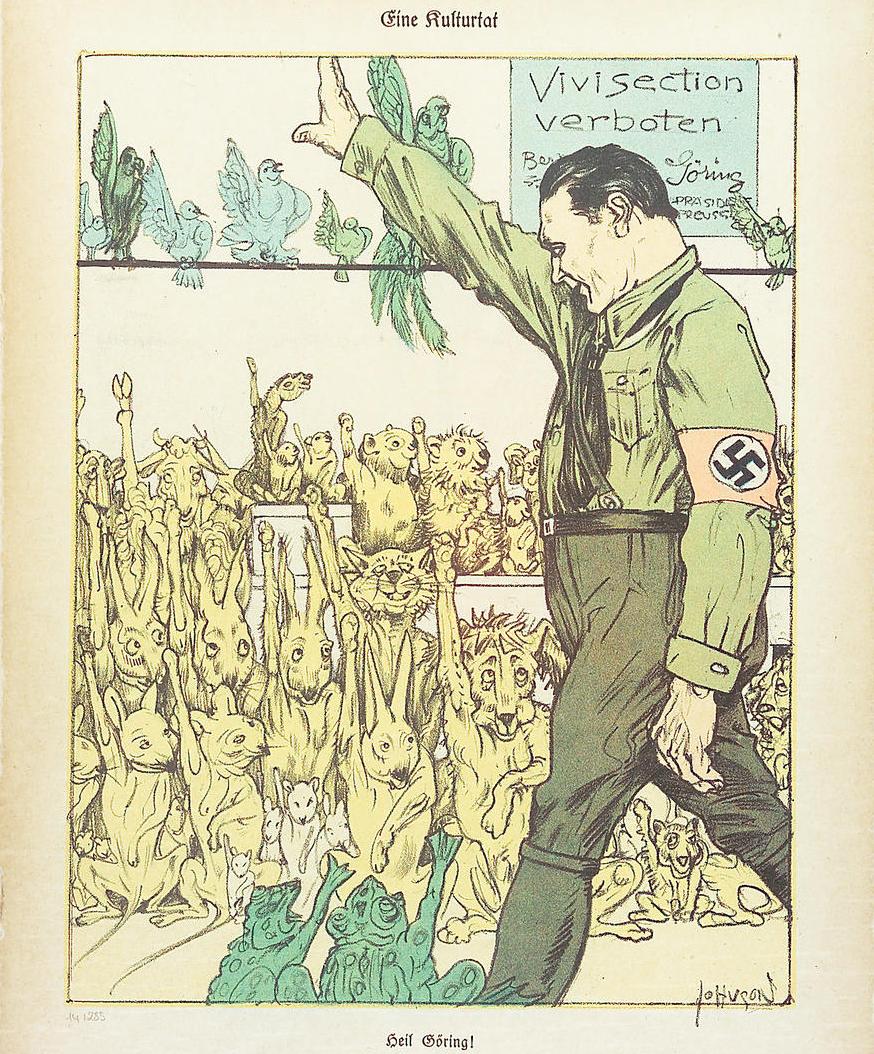
The only state, to date, to have banned cruel experiments on animals outright was National Socialist Germany. The anti-vivisection law was the first law or one of the first few laws passed by Hitler’s government. Cartoons showed Goering (another National Socialist and leading conservationist) and animals saluting, with captions such as “Heil Goering!”, “Even the animals vote for the Fuhrer!” and “Vivisection verboten!”goeringanimals

A leading, though at the same time once-obscure thinker, who espoused both National Socialism and animal welfare (etc), was Savitri Devi [https://en.wikipedia.org/wiki/Savitri_Devi], whose work is now again coming to attention. Her ideas and books even have websites devoted to them: https://www.savitridevi.org/last_man_french.html and https://www.savitridevi.org/.

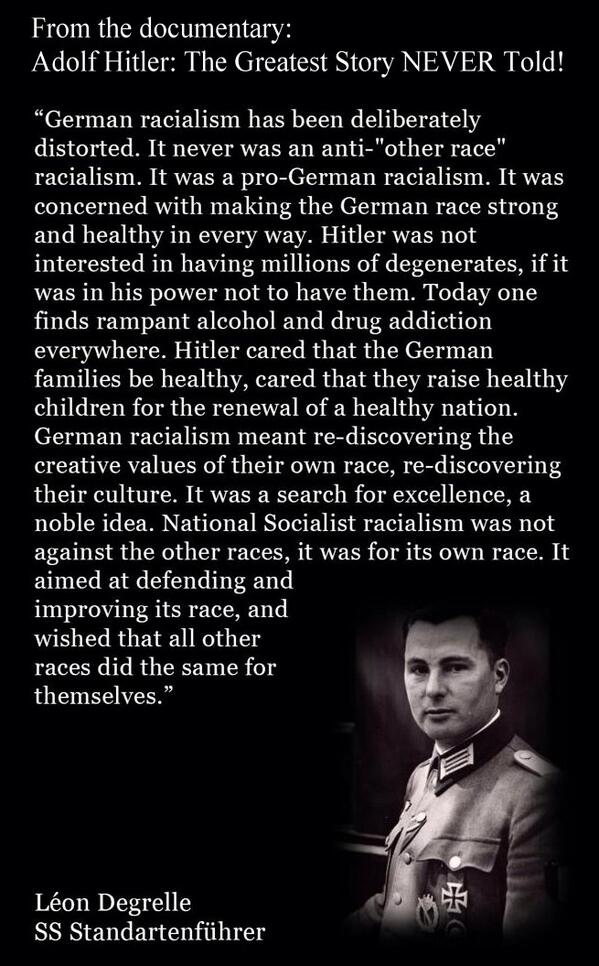
The connection is not surprising. What is now termed social nationalism is organic, built on the natural order and having respect for the creatures of the land, water and air as well as (contrary to Zionist propaganda) the relatively backward racial groups and peoples of our Earth. The hero Leon Degrelle [https://en.wikipedia.org/wiki/L%C3%A9on_Degrelle] put the latter point very well after the Second World War:becwoaeccaazenq

It is striking to see that there is very often an overlap, for example on Twitter, between those who are protective of animals and those who are strongly social-nationalist. Brigitte Bardot is a name which comes to mind: https://en.wikipedia.org/wiki/Brigitte_Bardot.

The new society in Europe will be nationalist; it will also be for Europe’s European future (though anti-EU); it will be green and it will be socially-just.

Notes:

https://www.kn-online.de/Nachrichten/Hamburg/Voelkische-Siedler-Die-Bio-Nazis-von-nebenan

Update, 28 June 2020

https://www.theguardian.com/world/2020/jun/28/german-far-right-infiltrates-green-groups-with-call-to-protect-the-land?CMP=share_btn_tw

Update, 26 May 2021

Note: https://en.wikipedia.org/wiki/Gerard_Wallop,_9th_Earl_of_Portsmouth#Organic_movement; https://en.wikipedia.org/wiki/Gerard_Wallop,_9th_Earl_of_Portsmouth

Fortress-Centres of Culture and Science

In the Dark Ages, the flame of civilization and culture was kept burning in fortified centres: walled cities, monasteries etc. It may be that the time has come to think in terms of “back-up” for the knowledge and human expertise that we take for granted today.

What does that mean in practical terms? There can be little doubt that, were a breakdown of law and order to occur (whether as a result of war or natural calamity), the British cities would probably become chaotically lawless in a short space of time, especially if fuel, food, water or utilities were unavailable.

It seems to me that those inclined to social-nationalism should think in terms of relocating to areas some distance from major cities, to small towns and villages where like-minded people can become either the majority or a strong minority. Such clusters of people can take over the local councils, local businesses and farms, as well as doing the usual run of employed work which they might do in the cities where they, perhaps, now live.

The idea has the following merits:

a. Political (electoral or other) bases can be created, with voting weight;

b. The clustering effect would enable concerted action;

c. In the event of catastrophes in the wider world, these centres would become the places looked to by the wider masses for leadership.

Clausewitz said that, in order to extend power, one must first have a secure base. It is that that social-nationalism lacks at present in the UK. The above proposal aims to address that lack.