Category Archives: Reminiscences and Musings

Thoughts about Bitcoin

First Remarks

I am not an economist; neither am I, at least in terms of occupation and/or formal training, an historian. I say that from the outset simply because it may be objected that, especially in terms of economics, I have no intellectual locus standi, despite the fact that most predictions made by economists turn out to be inaccurate. Also, “two economists, three opinions”…

Bitcoin

So, Bitcoin. Bitcoin was invented in 2008, possibly in Japan, by someone (or a group) whose provenance and even real name or names remain unknown:

https://en.wikipedia.org/wiki/Bitcoin

What is Money, in any case?

Money is an almost metaphysical thing. Different societies have used seashells, precious metals etc as money, the key characteristic being the relative rarity of the commodity used. In China (in the 7th Century under the Tang dynasty), paper currency was invented, and later more widely introduced in the 11th Century (Song Dynasty), where it was encountered by Marco Polo and others, who introduced the idea to Europe.

https://en.wikipedia.org/wiki/Banknote

Paper currency was, at first and for a long time, backed or notionally backed by precious metals, notably gold. Paper money only became generally acceptable in Europe a thousand years after its invention in China. The natural scepticism of the people was overcome both by its convenience and by its credibility, that credibility not only bolstered by its supposed convertability into gold or silver but also by the draconian penalties visited upon those who counterfeited the notes.

These factors underpin all money, credibility or popular belief in its value being the core.

Speculative Bubbles

One could go wider and say that credibility and belief underpin all valuation of assets, whether money assets, real property or other property in which the population is impelled to invest. Time and again there have been speculative bubbles: in currencies, in shares, in housing, in undeveloped land, in metals and even in such things as tulip bulbs (17thC Holland).

A good history of these bubbles and other mass events of the sort was penned in 1841 after the South Sea Bubble and was reprinted after the Wall Street Crash of 1929: Extraordinary Popular Delusions and the Madness of Crowds (and reprinted since, eg in the early 1980s)..

https://en.wikipedia.org/wiki/Extraordinary_Popular_Delusions_and_the_Madness_of_Crowds

Since that book came out, since its 1930s reprinting, other bubbles have come and gone. Among the more noteworthy was the “Silver Bears” bubble of the 1970s

https://en.wikipedia.org/wiki/Silver_Thursday

and also many and various real property bubbles across the world.

Bitcoin Goes Viral

At first, back in 2008, Bitcoin was valueless, worth nothing at all. It was just electrical impulses on a machine, effectively. It was still of small value three years later:

“The price of bitcoins has gone through various cycles of appreciation and depreciation referred to by some as bubbles and busts.[129][130] In 2011, the value of one bitcoin rapidly rose from about US$0.30 to US$32 before returning to US$2.[131] In the latter half of 2012 and during the 2012–13 Cypriot financial crisis, the bitcoin price began to rise,[132]reaching a high of US$266 on 10 April 2013, before crashing to around US$50.[133] On 29 November 2013, the cost of one bitcoin rose to a peak of US$1,242.[134] In 2014, the price fell sharply, and as of April remained depressed at little more than half 2013 prices. As of August 2014 it was under US$600.” [Wikipedia]

Wikipedia continues:

“Ponzi scheme and pyramid scheme concerns

Various journalists,[79][144] economists,[145][146] and the central bank of Estonia[147] have voiced concerns that bitcoin is a Ponzi scheme. In 2013, Eric Posner, a law professor at the University of Chicago, stated that “a real Ponzi scheme takes fraud; bitcoin, by contrast, seems more like a collective delusion.”[148] A 2014 report by the World Bank concluded that bitcoin was not a ‘deliberate’ Ponzi scheme, but that it did thus far meet the “standard definition of a speculative bubble”.[149]:7 The Swiss Federal Council[150]:21 examined the concerns that bitcoin might be a pyramid scheme; it concluded that “Since in the case of bitcoin the typical promises of profits are lacking, it cannot be assumed that bitcoin is a pyramid scheme.” In July 2017, billionaire Howard Marks referred to bitcoin as a pyramid scheme.[151]

On 12 September 2017, Jamie Dimon, CEO of JP Morgan Chase, called bitcoin a “fraud” and said he would fire anyone in his firm caught trading it. Zero Hedge claimed that the same day Dimon made his statement, JP Morgan also purchased a large amount of bitcoins for its clients.[152]

Speculative bubble dispute

Bitcoin has been labelled a speculative bubble by many including former Fed Chairman Alan Greenspan[153] and economist John Quiggin.[154] Nobel Memorial Prize laureate Robert Shiller said that bitcoin “exhibited many of the characteristics of a speculative bubble”.[155] Journalist Matthew Boesler in 2013 rejected the speculative bubble label and saw bitcoin’s quick rise in price as nothing more than normal economic forces at work.[156] Timothy B. Lee, in a 2013 piece for The Washington Post pointed out that the observed cycles of appreciation and depreciation don’t correspond to the definition of speculative bubble.[131] On 14 March 2014, the American business magnate Warren Buffett said, “Stay away from it. It’s a mirage, basically.”[157]

Two lead software developers of bitcoin, Gavin Andresen[158] and Mike Hearn,[159] have warned that bubbles may occur. David Andolfatto, a vice president at the Federal Reserve Bank of St. Louis, stated, “Is bitcoin a bubble? Yes, if bubble is defined as a liquidity premium.” According to Andolfatto, the price of bitcoin “consists purely of a bubble,” but he concedes that many assets “have bubble component to their price”.[53]:21 Speculation in bitcoin has been compared to the tulip mania of seventeenth-century Holland. Comparisons have been made by the vice-president of the European Central Bank, Vítor Constâncio, by JPMorgan Chase chief Jamie Dimon,[160] by hedge fund manager Ken Griffin of Citadel,[161] and by former president of the Dutch Central Bank, Nout Wellink.[162] In 2013, Wellink remarked, “This is worse than the tulip mania […] At least then you got a tulip [at the end], now you get nothing.”[163] On 13 September 2017, Jamie Dimon compared bitcoin to a bubble, saying it was only useful for drug dealers and countries like North Korea.[164] On 22 September 2017, a hedge fund named Blockswater subsequently accused JP Morgan of market manipulation and filed a market abuse complaint with Financial Supervisory Authority (Sweden).[165]

The Guardian, CNBC, Forbes and Evening Standard compared bitcoin to bubbles such as the South Sea Bubble, the Wall Street Crash, the sub-prime mortgage crisis and the Dot-com bubble.” [Wikipedia]

Current Situation

Bitcoin started to reach escape velocity in late 2016, going from hundreds of U.S. dollars to thousands. At time of writing (December 2017), a single Bitcoin is valued at over $14,000 [USD], or £10,500 [Pounds Sterling]. People who “invested” less than £100 several years ago have seen their stock suddenly rise to be “worth” as much as £100,000. Those who have risked more (in some cases a million pounds or more) now find themselves in theory able to buy small or even medium-size nation-states lock, stock and barrel.

What Do We Know About Bitcoin?

  • Bitcoin’s origins are obscure, to the extent that journalists and others have researched, investigated and written about the names of possible founders and organizers without having come to a definite conclusion;
  • Bitcoin is almost useless as a popular currency: its explosion in “value” has made it unusable for any transaction not involving, at the least, tens of thousands of pounds;
  • Bitcoin, though supposedly limited in overall amount or number, has seen security breaches which, at the push of a button (putting it simply), have at least briefly increased the supply of Bitcoin.

Conclusion

Bitcoin is a classic speculative bubble or, alternatively and perhaps even better put, pyramid scheme. The people who got in early and stayed in are sitting on mirage-fortunes; those who have “invested” more recently will probably lose everything they put in. At the moment of writing, Bitcoin is probably nearing its peak. When it starts to fall rapidly, the panic will probably wipe it out entirely.

The surely inevitable collapse of Bitcoin will take down more than just Bitcoin itself. It may affect the stability of the economy more generally. Beyond that, if (as Bitcoin proponents and/or “investors” say–and their anger at any criticism is perhaps born of subconscious desperation), Bitcoin is as “credible” as any “ordinary” currency (and that is Bitcoin’s strongest point), then the upcoming crash of Bitcoin could take with it much public confidence in the value of the world’s major currencies too. Our major currencies are no longer backed by gold or silver and have only the value we put upon them. We exchange stones for bread. Our currencies are themselves castles in the air and “such things as dreams are made on”.

We recall the hyperinflation of early 1920s Germany, and I myself saw, on several visits to 1980s Poland, how the slide of the zloty affected that country politically and socially. The fate of Bitcoin is not just about Bitcoin.

Update, 23 November 2018

https://www.independent.co.uk/life-style/gadgets-and-tech/news/bitcoin-price-crash-cryptocurrency-mining-bankrupt-china-bitmain-giga-watt-a8646821.html

Update, 18 February 2019

The course of Bitcoin trading in 2017 is examined (below)

https://www.coindesk.com/900-20000-bitcoins-historic-2017-price-run-revisited

At the time of writing of my own 2017 blog article, a single Bitcoin was “worth”, i.e, valued at, about £10,500 pounds sterling. At time of writing today, 1 Bitcoin is worth just over £2,853 pounds sterling, somewhat above a quarter of the former figure, and only about a sixth of the 2017 peak.

Update, 19 November 2020

I update my post purely because, in the uncertain conditions of 2020, I see that the article is receiving more hits. Sign of the times?

I have nothing to add to the article itself, but as of today, Bitcoin is trading at just under £13,398 (pound sterling) and at USD $17,730.

Update, 26 November 2020

Update, 20 February 2021

Radio 4 Today interviewed an expert in cryptocurrencies, who himself has made tens of millions of pounds from them. He expects a crash. I expected one three years ago. Never happened, though the value did plummet before recovering and climbing further.

As of today, 20th February 2021, 1 Bitcoin is valued at not far short of £40,000!

I notice that Alison Chabloz accepts Bitcoin donations; I hope that she got some before the price rocketed, and still has them. If so, she may have a windfall. https://alisonchabloz.com/how-to-donate/

Update, 8 September 2021

Today, Bitcoin recovered from USD $44,000 to USD $46,000 after having fallen from USD $52,500. An indication of the underlying volatility.

All the same, I am wondering whether, so far from being somehow “anti” the international money system, Bitcoin might not in reality be controlled by it…

Certainly, the genesis of Bitcoin has the feeling of “legend” (in either sense) about it (supposedly created by a Japanese whose identity has never been confirmed. Perhaps…).

Update, 14 December 2021

Update, 14 June 2022

14 June 2022 saw Bitcoin at around USD $22,000.

Update, 20 July 2022

https://www.bbc.co.uk/news/business-62246367

Update, 18 July 2024

Well, I have to admit that my 2017 prediction of a Bitcoin collapse was, though accurate-seeming in 2019 (when the price dropped to a mere sixth of its 2017 peak) wrong in terms of its later rise.

Incredibly, as of today, the price of 1 Bitcoin is £49,700 (Pound Sterling) or USD $64,627!

There is now renewed fevered speculation about the trajectory Bitcoin might take: https://cointelegraph.com/news/analysts-forecast-200k-bitcoin-price-after-btc-s-bullish-momentum-returns.

I can only suppose that the surge in “value” (rather, in price) of Bitcoin reflects the world situation, the instability of the world economy, and therefore the instability of world traditional currencies.

Gold is also at a record high at present.

All the same, if there were a major war, a world war (a fortiori, a nuclear war), and assuming that any human society and economy were to survive, Bitcoin would probably disappear in a flash (literally), as the Internet is destroyed, taking Bitcoin with it.

Human paper currencies would also disappear, at least for a while, in that scenario, but gold would still hold at least some value, presumably. At least you can hold a lump of gold in your hand, or put it in your rucksack…

Update, 7 October 2024

https://www.theguardian.com/business/2024/nov/06/dollar-soars-as-markets-bet-that-trump-has-won-us-election

Bitcoin leapt to USD $75,000 yesterday. £58,000 in pounds sterling.

Update, 21 November 2024

An illustration of the madness:

https://www.dailymail.co.uk/news/article-14109325/Bitcoin-binbag-landfill-Wales-500m.html

Update, 18 November 2025

According to newspapers, Bitcoin is “crashing” [https://www.dailymail.co.uk/money/mailplus/article-15298981/Inside-Bitcoin-apocalypse-Prices-crash-buy-sell-warning.html], but that is only so in relative terms; as of time and date of writing, one Bitcoin is still “worth” or valued at marginally down from £70,000, well up on the price at this time last year.

Update, 6 February 2026

https://www.theguardian.com/technology/2026/feb/05/bitcoin-cryptocurrency-slump

As of today, 1 Bitcoin is valued at just below £48,000 (USD $55,000).
People are Worth More than Their Opinions

Someone, possibly Auden, remarked once that “people are worth more than their opinions” (in relation to the Comintern/NKVD agents of the 1930s active in the British universities). There is something in that. On Twitter, for example, I have noticed that people bitterly divided politically will often still support, separately, such causes as animal welfare or environmental improvement. Wider than that, I am willing to see that some of those who attack my views (and, often, me personally) are, in some cases –and like me– interested in the welfare of the more downtrodden parts of the population. Sadly, most of those who attack me –and this particularly applies to the Jewish Zionists– are unwilling to see the slightest good in me or my views. I can only assume that to do so would weaken their assertion that anything connected with social nationalism (and, a fortiori, National Socialism) is irredeemably evil and without any good in it at all.

Adolf Hitler was of different mind. He accepted into the ranks of the NSDAP and SA, even into the SS, many who had been his enemies. People, in other words, who wanted a better society but who at first did not accept that National Socialism would create one.

In the Soviet Union, from 1917 onward, many who fought Bolshevism or were at least opposed to it were later shot, imprisoned or exiled as so-called “former people”, others however were allowed to stay as free as anyone could be under Sovietism. Some even became members of the CPSU and/or the officer corps of the Red Army, at least until the purges of the late 1930s. Beria’s own past was full of ambiguities. During the 1941-1945 war, the vast majority of Russians fought and struggled together (whatever one may think of that).

In the UK at present, I can see that many want positive social change and that many (sometimes the same people) want to preserve the better aspects of the existing society. These people belong to Labour (especially the Corbyn wing), the Green Party, the LibDems, UKIP, even the Conservative Party. I trust that, when a real social national movement comes into existence, these people or many of them will feel able to join with me in the rebirth of this country.

The War on Freedom of Expression in the UK, USA and EU States

Introduction

Recent events have sharpened my already-keen interest in freedom of expression. On Twitter, the premier socio-political short-comment website, those regarded in the USA as “alt-right” have had their “blue ticks” removed, signalling that they are not very approved of by whomever decides policy at Twitter. In the UK, several people are currently about to be put on trial for saying or singing things of which the Jewish Zionists disapprove. Also in the UK, David Icke has just (17 November 2017) had his event at the Old Trafford facility owned by Manchester United (itself owned by a clan of American Jew-Zionists) cancelled. In the EU, the already considerable online censorship in Germany, France, Scandinavia has been intensified and new EU rules control online platforms as never before (and behind such restrictions, once again, “them”…).

Many reading this will be aware that, by reason of the activities of a pack of Jew-Zionists, I was disbarred in 2016. I have blogged about that and may do so again. Even before those events, I was prevented, I think in 2011 or 2012, from posting book reviews on Amazon (UK and US) because one (at first only one) obsessed Jew complained to the Jewish Chronicle about me. Other Jews joined in, the original one trolling anyone who liked my reviews (enough liked them to propel me to the top 40 reviewers), leaving stupid and unpleasant comments, many both defamatory and untrue). Once the Jewish Chronicle and other Jew-Zionist organizations piled in, Amazon caved in…

In fact, this censorship, largely exercized by the Jewish-Zionist element, predates the Internet era. I recall trying to advertize a small organization in The Spectator, around 1978. I was advised that I had to supply a precis of its political view. I did that, only to be told that my advertisement would not be printed. Same at that bastion of well-heeled and hypocritical Home Counties free-speech-ism, Private Eye. This at a time when these publications carried both “Conservative” and “socialist”, even Communist adverts!

The Internet opened up a window of freedom of expression, but “they” are rapidly moving to close it. Free speech is being shut down.

USA

The free speech provisions of the US Constitution are as outdated and superseded as those governing arms in private hands and other matters. At present, with certain exceptions, the State (meaning government) will not (there are exceptions) criminalize something said by an individual in the street, on a placard, in print, but that does not prevent that individual losing his job (if an employer dislikes what he has said or written, or where the employer has been pressured by external forces, such as the Jewish Lobby, with its campaigns of boycott etc).  The US Constitution, in other words, cannot save the individual from losing his job, home, family, if his employer decides to penalize him because of his “free expression”.

Likewise, the writer who writes that which is disliked by the Jewish lobby will not be arrested in the USA, but may find that he cannot get books published by mainstream publishing houses. The academic who tries to expand the boundaries may find that tenure is denied, or employment terminated.

Now, in the Internet age of social media, we find that the major platforms for freedom of expression are not properly public, but private organizations, private enterprises, which can decide on almost any basis to prohibit any named individual from posting. Amazon, ebay (which e.g. allows Soviet but not German Third Reich memorabilia), Facebook, Twitter. These organizations are either owned or largely owned or strongly influenced (and staffed) by Jewish Zionists.

I spoke in February 2017 at the London Forum about, inter alia, the “privatization of public space” in this regard. Now, the “alt-right” personality Richard Spencer has echoed me from the United States, talking about how the fora of the past were public, but the (online) “fora” of the present age private, thus able to exclude those whose views are not approved by the owners of the websites (or the commercial advertizers thereon).

UK and EU

The above “privatization of the forum” (or fora) applies not only in the USA, but in the UK and other EU states. The EU has already (in most states) criminalized “holocaust” “denial” (examination and/or revision of that historical narrative). It has also forged ahead (under Jewish-Zionist control or influence) with plans to penalize Twitter, Facebook etc if the “wrong” symbols, cartoons, views are hosted.

In the UK, several people are now facing trial at the instigation of Jewish-Zionists: Alison Chabloz, Jez Turner, others. Whatever happens to them will be of significance for freedom of expression.

We now hear that Twitter is planning further purges, this month (November 2017), and on or about 22 December. Those changes may well mean the end of Twitter as a useful place online on which to exchange ideas. We shall see. I myself am half-expecting to be removed.

In the end, the consolation must be to remember that no revolution or takeover of any state has ever happened via social media, though online propaganda has helped one or two offline campaigns to achieve success. Boots on the ground are what count.

Update, 23 December 2018

I was expelled from Twitter in mid-2018. No reason given (beyond weasel words), no appeal, no clarification. Many others have gone the same way. The only consolation has been the realization of how totally pointless and self-defeating tweeting is!

Update, 13 January 2021

Since my last update, over 2 years ago, the war on freedom of expresson has intensified. See my later blog posts.

Basic Income and the Welfare State– some ideas and reminiscences

Overview

At various times in history, there was either no social welfare system at all, or one which depended on spontaneous or systemized charity: individual alms-giving in the Christian, Muslim, Buddhist, Hindu and other traditions; more organized supply of food, shelter or money as in the ancient Roman dole, Renaissance attempts at poor relief and the cheerless “workhouses” of 19thC England (which in fact continued in places in some form or another until the Second World War and the emergence of the postwar Welfare State).

It is a matter for historical debate whether organized “welfare” in Europe started with the mediaeval Roman Catholic church or in the 19thC with Bismarck, who set up in Prussia and then in the unified Germany a system not unlike those which emerged later in other European countries (eg in the UK under Lloyd George) and further afield: for example, Uruguay had one of the most generous “welfare” (social security) systems in the world until it collapsed in the 1970s under the weight of its expense.

However, the Roman Catholic and other religious and other non-State providers of “welfare” rarely give out money. They supply, variously, food, shelter, often educational and medical help.

The more modern “welfare” systems, eg in the UK, were based on the idea of social insurance: during a working lifetime, you paid in; in periods of unemployment, disability, sickness, old age, you were paid out. In the UK, this has become largely notional. Some tax is still designated as “National Insurance” payment but of course is just an extra type of income tax, fed straight into central funds and not in any way ringfenced.

Some anecdotal evidence

Like many people of my age (b. 1956) in the UK, I had to request State assistance occasionally in the past. This is or was far more common than generally supposed. The writer J.K. Rowling, now supposedly worth £100 million, has described how only the more generous –compared to today– social security of the 1990s enabled her to sit in cafes (partly to keep warm) with her baby, and to write the stories that not much later became Harry Potter. More egregiously, the vampire of Britain’s social security system, Iain Duncan Smith, has admitted that he claimed social security after having left the Army (ignominiously, having only achieved the rank of lieutenant after six years). In fact, Smith, or as he prefers to be known, Duncan Smith (the Duncan not being part of his original surname), claimed social security under false pretences, making him a hypocrite as well as what Australians apparently call a “dole blodger” and (as seen in the scandal of his fake CV and Parliamentary expenses) a fraud.

Certainly, there are those who abuse the social security system. In the past, that was far more common, because the almost Stasi level of control and surveillance that now exists for claimants in Britain had not then been put into place. The system was itself less punitive, less quick to demand impossible levels of enthusiasm for what is now and vulgarly called “jobseeking”.

I knew one woman, a citizen of the Soviet Union, who, having run away from her husband in New Zealand, came to the UK and claimed social security (including disability benefits). How could this happen? Well, her ex-husband, though resident in New Zealand, had a British passport (was British citizen) and had the right to reside in the UK. That meant that his estranged wife could do likewise, even though she had no other connection with the UK and had never even landed there! In fact, that woman never had a job (beyond odd occasional part-time jobs teaching Russian conversation at evening classes). She was supplied with monies for being slightly disabled (kidneys), monies for not having a job, monies for having two children of school age. She was also supplied with free housing. I encountered that person in 1981. She was, I heard, still collecting from the “British taxpayer” in 1996 and is almost certainly still collecting (now State Pension too!) in 2017…All monies legally-obtained, without fraud of any kind.

Another case. A young man (in the mid-1990s), from a very affluent family, who, nonetheless, was “unemployed” and so received whatever unemployment benefit was called then, as well as Housing Benefit for the large flat he occupied in Marylebone, London. In fact, the flat was owned (under cloak of a private company) by the young man’s mother (who lived in Surrey), while the young man had his own freelance work as both a designer and a male model. In this case, there certainly was some kind of dishonesty, both on the part of the young man and his mother. I doubt that they could do the same today, but I last heard of them over 20 years ago, so do not know.

The above two examples seem to show abuse of a system, but here is another case from the 1990s; less obvious, less easy to judge: a single mother of a school-age child, she about 40-y-o, with no relevant educational qualifications. This lady had a small, indeed micro, informal business, making coffee and selling home-made sandwiches to the ladies having their hair done at a large London hairdressing salon. A “Trotter’s Traders” enterprise (“no income tax, no VAT” etc…). About £200 profit on a good week, but more usually less. Not enough to live on, even then, paying Central London rent. That lady was getting State benefits as a single mother; she was getting Housing Benefit too. Now it could be said that she was “defrauding” the State, but her earned income was not enough to live on without State help. Had she given up her private work, the State would have saved nothing, the economy generally would have suffered from her not earning and spending, she and her son would have suffered considerably.

Basic Income

For me, the answer to the above lies in Basic Income, a certain amount paid to every citizen (nb. not to everyone just off the boat, or those who have walked through the Channel Tunnel). The level at which it is set will be, inevitably, contentious. Some will end up with less than under the existing system of State benefits etc. However, it has the merit of certainty. Everyone knows that x-amount will be paid weekly or monthly; those over a certain (to be decided) income can have the Basic Income payment clawed back via the tax system. It may be that everyone should also get free local transport.

The benefits of Basic Income are several. Every citizen will have the basic wherewithal of life: food, shelter, transport etc, without being forced to jump through hoops, without being bullied or snooped upon. The State will save vast amounts on administration, salaries of penpushers, maintenance of useless and expensive buildings such as those called (another vulgarity) “jobcentres”. There will be little scope for fraud and deception, because everyone under a certain income will get the same amount. If society wants to provide the disabled, sick etc with more than the basic amount, then an assessment programme (decent, honest, not cruel, unlike the existing ones) can be put into place for that.

This is obviously the way to go.

The Right Attitude to Race and Culture

Race and culture are among the hottest topics of the moment. From the migration-invasion of Europe to the American wave of the alt-right, to the elections in European states, there is a ferment which will not calm. As social-nationalists, standing first and foremost on the racial-cultural front line, we must be clear where we stand in terms of attitude.

It disturbs me when I see unpleasant and too-general remarks made even about the basest of race-types. We must never forget that, as Adolf Hitler himself said in another context, “there is the individual, but beyond the individual is the race.” The individual comes out of a race; he is made by it, formed by it, is in most cases brought up and educated by it and by the nation which is part of the race. However, the individual can transcend the race-group (equally, can descend from it). German National Socialism itself recognized this reality when it granted a relatively small number of persons, who were not Aryan, the status of “honorary Aryan” or Ehrenarier: https://en.wikipedia.org/wiki/Honorary_Aryan

We today, even those of us who are social-national in political orientation, are yet not  National Socialists in the same sense as those who fought for European humanity in the 1920s, 1930s and 1940s. We today have our own path forward. At the same time, to put it in Biblical language, we “honour our father and our mother” and that means that we honour National Socialism as the ground from which we sprang.

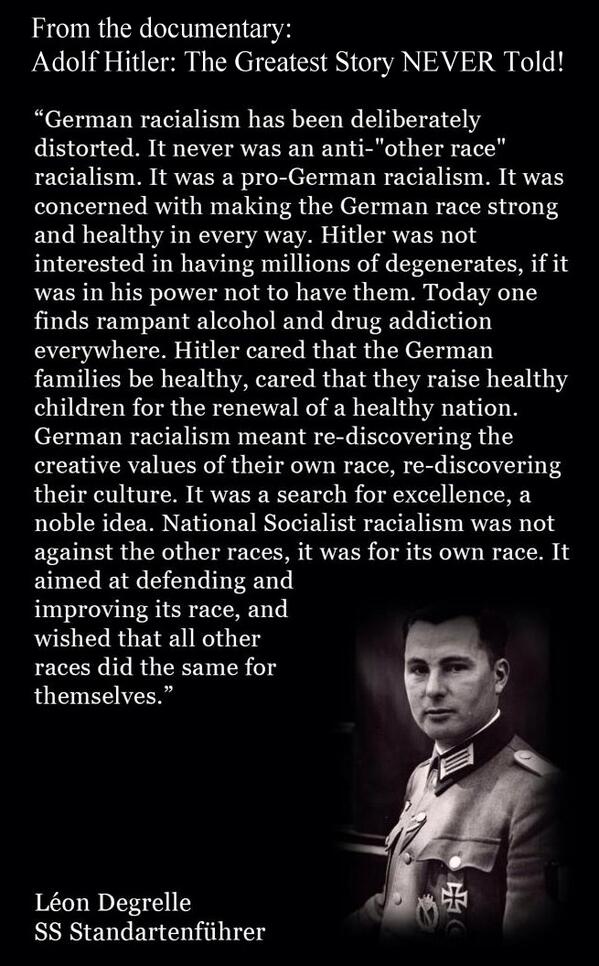
Leon Degrelle, the political leader, front-line fighter and thinker, had this to say on the subject after National Socialism in its original phase had passed into history:

becwoaeccaazenq

There is no need for social nationalists to utter insults at blacks, Jews or members of other groups, except where that is justified and/or where it makes a political or social point. I do not want to concentrate on the American socio-political situation. I am not American, have not lived or worked there for many years and am focussed on Europe and Russia. However, we have to recognize that American society is very different from our European society. American society has had a relatively recent history of slavery, of genocide (the American Indians, aka Native Americans), of a civil war in which 3% of the population died, of the resistance to the social consequences of that war in the South, that resistance being, in part, the Ku Klux Klan, and so on.

American politics has become far more bitter, far more polarized, particularly in language, than is generally the case in Europe. There is also the point that there is a far wider spectrum of education and culture in the USA than pertains in most parts of Europe, or even Russia.

For me, it is natural to regard the non-European races as distinct and as having their own paths to the future, while equally recognizing the necessity (for all races) for the leading role of European humanity. For some Americans, this is perhaps less obvious and those other races seen as purely enemy contingents.

Social nationalists must take every opportunity to refute the lie (often though not always made by Jewish Zionists) that we base our political philosophy on “hate”. We ourselves know that that is not so, but often the public is bamboozled by the Jewish Zionists into believing the lie. For example, we wish not to be ruled or owned or influenced by the Jewish Zionist element, but that is, if you like, “defensive” in nature.

Our attitude to race and culture is one of recognition of evolution and involution. Our European race is generally still evolving, as is the “Russian”, “Slavonic” or “Slavic” race which (important point) will not come into its plenitude for another 1,500 years. Other races in this world are stagnant or are degenerating. The prime motive force behind social nationalism is to evolve the race and nation to higher levels and to destroy any threats to that evolution. This is a positive, not a negative, political world-view.

In the future, European and Euro-Slavic humanity will have powers of soul, of mind, which today would be regarded as magical. This is the point to which we as a people have been striving.

When we see the sacred Swastika, we must understand it to be a symbol of evolution, of our evolution.

TorchSwastika

Stray Thoughts about Transport in the UK

A couple of weeks ago, I went to a country house in a heavily wooded part of Southern England. Even using a map, I nearly failed to find the way. A modern version of Parzival –in Wolfram von Eschenbach’s great work–, who gets lost in the trackless forests around the Castle of the Grail. The “B”-road was left behind as I took a quite narrow lane at an acute angle. A few miles further on and an easily-missed small sign almost at ground-level told me to turn off onto a lane so narrow that it was more like a track, tarmacked long ago (probably in the 1960s) and never repaired. Uneven, with large potholes. The forest pressed in on all sides. A stag with magnificent antlers ran across  and into the dense wood as the car approached at a slow 5-10 mph. Squirrels were there aplenty, as were many birds. After what seemed miles, the destination was suddenly in front of me.

That experience made me wonder what roads would be like in a future of automated cars, buses, passenger drones controlled by computers, lighter than air craft akin to Zeppelins, automated trains etc.

One could imagine a future where the roads are scarcely used and so not funded, or perhaps only the motorways or major highways funded. A network of automated rail, light rail, branch lines, narrow gauge, ultralight trains, Thames river services etc. Commuters (if they still exist) travelling easily by those means, such as airships docking on top of high towers or buildings, ultralight trains going to almost every street or road. Conventional roads might become a thing of the past, especially if commuting and travelling regularly by car become uncommon.

It is not necessary to travel far back in time (say, 1800) to find a Britain in which roads were in most cases almost unusable most of the time. It may happen again. Society moves on. Until the Beeching cuts of the 1960s (and the others in the 1950s and even prior to that), there were many railway lines in existence which, today, are all but forgotten.

The alternative vision is that roads will still be necessary even if vehicles become computer-controlled. We wait to see. In the meantime, we speculate.

Update, 31 July 2019

Elegiac song about the Beeching cuts of the 1960s…

“Thank You For Your Service!…Have A Nice Day!”

One of the many minor but telling irritations of the present day is the extent to which American phrases and linguistic usage has infiltrated everyday English English. I say that despite having lived and worked in the United States (work sourced both in the USA and elsewhere) alongside American people. In fact, I am (despite the best efforts of parts of the Jewish Zionist lobby, including the crazed scribbler Louise Mensch) still a member of the New York Bar, at least on paper (I never practised there).

It was back in the early 1990s when I first heard someone (a West Indian woman) use the term “train station” to designate what everyone I knew until then had called a “railway station” or sometimes “rail station”. When I questioned the term, she replied that she had never heard such places called anything but “train stations”. My theory was that that was the influence of latter-day American films, particularly those shown on Sky. Maybe. Since then, “train station” has become ubiquitous, even on the BBC.

One might say, “what does it matter?” whether railway stations are called “railway stations” or “train stations”. However, language does matter. Whole treatises have been written on the power of transformative vocabulary. The American military machine and its political masters used to be expert at that (far more so than the British). “Operation Desert Shield” conveyed a message; “Operation Desert Storm” a different one, a changed one. Sometimes it became awkward if pushed too far, as in the phrases used in the Vietnam War: “bodycount”, “free fire zone”, “friendly fire” and many others became notorious; some are still in use today.

Such manipulative use of language is common elsewhere. The linked worlds of special operations and espionage have given us “plausible deniability” etc, and that is before we even look at the sleazy swamp of the political milieu. I do not want to go off-track too far and lose my point in the morass of “hard Brexit”, “soft Brexit”, “helping people back to work” (indeed the ghastly “world of work” itself) etc.

Words create a mental landscape, they shape a society as surely as the architecture of our cities and, to be rather topical, public statuary.

It matters whether the influx of millions of non-Europeans into Europe and other European-inhabited lands is described as a “desperate” “movement” of “refugees” or as a “flood” of “migrant-invaders”, indeed as a “migration-invasion” (my favourite) or simply as an “invasion”.

It matters if “social security” (in the British use of the term), meaning a “safety net” or system available to those who need it (and, importantly, into which most if not all of those using it have paid, one way or another) is then changed to “welfare”, a term which gives the impression of money or food thrown at (probably undeserving and probably useless) eaters, who are, again, “probably” taking money from “the taxpayer” (not even “the State”).

It matters if “free speech” is in many cases re-designated as “hate speech” and/or “hate crime”.

So we return to “thank you for your service”…one of the least meaningful phrases around. An American affectation, which seems to say, “this person served in ‘the military’ in some capacity and so we regard him –or her– as heroic.” It of course bears little relationship to reality. Most service personnel, even in a war, are not anywhere near the “front-line” or active fighting areas. Indeed, many American service personnel never even leave the shores of the USA. In Britain, that idea crept in during the Falklands campaign, when anyone who had been to the Falklands in uniform became, ipso facto, a “Falklands hero”, courtesy of the Sun “newspaper”.

No-one disputes that a modern military system requires large numbers of accountants, lawyers, dentists, administrative people, pension experts etc, as well as cooks, drivers and the more obviously martial occupations of fighter pilot, tank commander, infantry soldier and commando. They all “do their bit”, in the English phrase of yesteryear. However, it seems strained to say “thank you for your service” to people who spent their entire service researching legal cases in Washington D.C., or fixing the plumbing on an Air Force base in Texas.

One notices that some scribblers who are very adherent to the Atlanticist or “New World Order” viewpoint are among the worst offenders (people such as Louise Mensch). In fact, it could be said that “thank you for your service” goes beyond affectation and constitutes an attempt to further Americanize the mentality of the British.

So it is that I plead for people to avoid the use of “thank you for your service”, even when addressing those who should be in that sense respected.

How the Bar of England and Wales Became a Dustbin

I recognize, in writing about the Bar and having been myself disbarred for political reasons last year, that I shall probably be accused of some species of sour grapes. Not so. My disbarment in late 2016 at the instigation of a pack of Jewish Zionists had no practical effect on me beyond a couple of days of newspaper and Twitter nonsense. I ceased practice at the English Bar in 2008 and last appeared in court (Central London County Court, a three-day construction case) in December 2007. The views I am about to express were mine, in essence, then too.

What is “the Bar”, what is its purpose or role and what prompts me to call it “a dustbin”?

There is no point in going into long history or explanation. It is enough to say that the English Bar grew organically out of British history and society intimately connected with the struggle for free speech against the tyrannical tendency inherent in monarchical rule. I suppose that, today, a figure such as John Hampden is less well known by, e.g. schoolchildren than, say, Nelson Mandela, just as the founder of modern nursing, Florence Nightingale, has been eclipsed by the minor figure of Mary Seacole (who set up a tea-room in the Crimean War). “They established brainwashing and called it education.”

At any rate, it can be said that the institution of the Bar, meaning the independent Bar, the Bar independent of the State, grew at least partly out of that struggle for the rights of the individual as against the power of the State. Free speech was part of it, as were the rights of property (set against the mediaeval feudal system of royal and baronial –etc– patronage).

It is this very independence of the Bar which has now largely been destroyed, though remnants remain. The Bar has become entangled with the State. Civil and criminal legal aid, in many ways very useful for society and individual persons (criminal defendants, and those making or defending a civil claim), yet has had the effect of making the Bar dependent on State patronage. The proliferation of quangos requiring chairpersons and/or legal advisers has made many barristers further dependent, financially, on the State, in effect at least. Finally, the adoption of a Zionist-drafted and/or influenced “Code of Conduct”, increasingly draconian in its enforcement and enforced by an increasingly-active regulatory body (the Bar Standards Board) has made many at the Bar afraid of their own shadows.

When I was a student of law, I graduated (aged 30) in 1987. At that time, there was only one place to take the then “Bar Finals course” (a one-year course for most students)– the Inns of Court School of Law, located in Gray’s Inn. That was inconvenient for those whose usual residence was far from London, but it had the merit that barristers emerged from the same institution and often acquainted to some extent with each other. Though there were over a thousand students, many were foreign citizens almost all of whom would return to practise law in their home countries (many eventually to lead those countries politically, or even to found states, as did Gandhi and Jinnah).

During the 1990s, the Bar Finals course, sub nom Bar Vocational Course, was changed to be less academic, more practical. There were benefits to that in terms of the confidence of young barristers, but the drawback was that, bluntly, it became easier to become a barrister.

The Inns of Court School lost its monopoly under the influence of globalism and ensuing legislation, the Bar being regarded as just another “business” offering “legal services” to “consumers”. Soon a multitude of “service providers” (universities, former polytechnics etc) offered “Bar” courses. That remains the case today. A barrister now is simply someone who has acquired two pieces of paper: a “degree” of some sort and a certificate that the requisite Bar course has been completed (and few fail these days…).

The only thing preventing untold thousands more practising at the Bar is the pupillage bottleneck, but many are now allowed to “complete pupillage” in places like government departments, so it is perfectly possible to have substandard barristers (practising in court and advising people) who have a degree from a place which is little more than a degree mill, a Bar qualification which is given to almost all who take the course and a pupillage as an office bod in, say, a provincial government department building.

There has always been a space and vacancy problem at the Bar, both for practising barristers and pupil-barristers: until recent years, barristers were often squashed into inadequate rooms in the Inns, four or more to a room in some chambers. That is less acute now because chambers are able to exist, even in London, outside the Inns. However, that too has led to problems. Sets of barristers were established outside the Inns of Court. Some were good, others less good. One example in the 1990s called itself “Brick Lane Chambers” and was composed largely of Bangladeshis and others unable to work elsewhere. It was given a subsidy by the notorious  Tower Hamlets Council, based on numbers of “legal service providers” available, the idea being to increase “legal service provision” in an area supposedly without much.

I knew a barrister (still in practice today) whose name was fraudulently added to the “Brick Lane Chambers” list in order for those chambers to get extra money from the local council. She was not alone. She complained and her name was taken off the list, but no action was taken by the local council or the Bar itself in respect of a deliberate and egregious fraud. At that time, the Bar had already embarked on its “let’s not annoy the ethnic minorities” journey.

As a Bar student, I proposed (but not officially) a different idea, which would have safeguarded the Bar’s integrity: to found a fifth Inn of Court. That, however, would have involved huge cost, for one thing. It also would have required the clearance of a large site in Central London. Instead, sets of poor barristers started above laundromats and in shopfront premises (others moved from the Inns into far better circumstances).

Now we come to the regulation of the Bar. The Code of Conduct, once a slim volume, perfectly workable and focussed on trust and integrity, became a thick sheaf of papers packed with the politically-correct shibboleths of the day. It has, in its application, destroyed the independence of mind of the Bar. I refer the reader to my own experience:

https://ianrmillard.wordpress.com/2017/07/09/the-slide-of-the-english-bar-and-uk-society-continues-and-accelerates/

As to recruits to the Bar, many now are brainwashed into a politically-correct mindset and (bearing in mind the pressure on pupillages and tenancies) few are willing to do anything but condemn those who (like me) are thought to have controversial views. They fail to see that their doormatting to the Jewish-Zionist element will not help most of them much. When I was at school in the 1970s, there were about 5,000 practising barristers; when I was Called to the Bar (1991) there were about 10,000 or so, I believe. Now that figure is something like 18,000! Meanwhile, criminal and other legal aid has been slashed and “solicitor-advocates” appear in court too. The result has been that the prestige of the Bar has plummeted. I do not regret that I no longer practise.

For the public, for society, the result of the Bar’s fall has been that the service available is more limited, poorer and that the independent voice of an independent barrister is muted. Just as, in the journalistic milieu, “journalists” of today (particularly online) are often twenty-somethings with no real training or education, their heads full of politically-correct nonsense, the Bar is now full of “barristers” who are really just barristers on paper, men of straw (women too), without real substance. The “journalists” thus cravenly welcome censorship and the “barristers” are unwilling to be seen as even listening to contrary views, let alone standing up for freedom of expression.

The New UK Crown Prosecution Service Guidelines on “Hate Crime”: Thoughts and Suggestions

Background

Yesterday, Alison Saunders, the Director of Public Prosecutions, announced updated and expanded “guidelines” on how the Crown Prosecution Service will deal with so-called “hate crime”. These new guidelines have been heavily criticized as, in effect, creating new and tyrannical law, despite the fact that the guidelines are neither primary nor secondary legislation.

In this blog post, I examine only those aspects of relevance to socio-political tweeting etc, meaning in practice those with a racial or religious element.

Part of the concern around the guidelines revolves around Alison Saunders herself. Many regard her as a sinister though incompetent figure, a “graduate” (member) of the pervasive and infiltrative organization (some say “cult”) called Common Purpose. In 2013, when Alison Saunders was CPS chief for the London area, a Freedom of Information request was made as to her connection with Common Purpose. At first, the reply was affirmative, but that was then altered to negative:

https://www.whatdotheyknow.com/request/alison_saundersgraduate_of_commohttps://www.whatdotheyknow.com/request/alison_saundersgraduate_of_commo

The answer is relevant to the new CPS guidelines because the motto of Common Purpose is “Leading Beyond Authority”. In other words, the citizens of the UK cannot rely any more on law or decent public administration, because organizations such as the CPS, full of “CP” “graduates”, will, it is suspected, manipulate the regulations etc in order to achieve a desired (by them) result.

Definition of “Hate Crime”

It is vital to note that there is no statutory (or accepted Common Law) definition of “hate crime”:

“A hate crime law is a law intended to deter bias-motivated violence. Hate crime laws are distinct from laws against hate speech: hate crime laws enhance the penalties associated with conduct which is already criminal under other laws.” [Wikipedia]

Wikipedia continues: “For England, Wales, and Scotland, the Crime and Disorder Act 1998 makes hateful behaviour towards a victim based on the victim’s membership (or presumed membership) in a racial group or a religious group an aggravation in sentencing for specified crimes.”

In other words, there must first be a crime as designated by law and only then can that alleged crime (if one of those “specified”, i.e. assault, criminal damage, offences under the Public Order Act 1986, and offences under the Protection from Harassment Act 1997) be treated by the police and CPS as a “hate crime.” The new guidelines reflect that existing position:

“The police and the CPS have agreed the following definition for identifying and flagging hate crimes:

“Any criminal offence which is perceived by the victim or any other person, to be motivated by hostility or prejudice, based on a person’s disability or perceived disability; race or perceived race; or religion or perceived religion; or sexual orientation or perceived sexual orientation or a person who is transgender or perceived to be transgender.”

“There is no legal definition of hostility so we use the everyday understanding of the word which includes ill-will, spite, contempt, prejudice, unfriendliness, antagonism, resentment and dislike.”

It will be noted that there must first be a criminal offence. If there is not, then it matters not at all how “unfriendly”, “prejudiced” etc is the alleged perpetrator.

Further, sections 145 and 146 of the Criminal Justice Act 2003 require a court to consider whether any crime which is not specified by the Crime and Disorder Act 1998 is “racially or religiously aggravated.”

Incredibly, while the police and/or CPS will “flag” a case as a “hate crime”, “it is not CPS policy to remove a flag in the absence of sufficient evidence to support a sentence uplift. This in part reflects the commitment to treat hate crime seriously and to support the victim’s perception and also to encourage community confidence in reporting all such offending.”

So a crime which is “flagged” at first as a “hate crime” but for which flagging there is eventually no evidence, will still be treated, in Court, as a “hate crime”, resulting (on conviction) in a far more severe sentence. How can this be regarded as in any way just?

The guidelines now continue:

“If the case passes the evidential stage and it is a case of racial or religious hate crime, or it is motivated by discrimination against the victim’s ethnic or national origin, or religion or belief, it is more likely that a prosecution is required in the public interest.”

This is a hardening of the position taken in the earlier CPS guidance and may mean an increase in the number of prosecutions. However, there is still a requirement for a substantive crime to have been committed and there is still a requirement for sufficient evidence to support prosecution. New crimes have not been created, but the danger is that zealous CPS and –especially– police persons will get the bit between their teeth and start to ignore the basics in their quest to hunt the witches. Anyone who has read the outpourings of the UK police forces online recently will not be reassured as to their objectivity in this respect. There is an unthinking “me-too” political correctness abroad, one which seems impervious to logic, argument, reason or plain commonsense.

Other Aspects Relevant to a Charge

The CPS legal guidance for its staff can be found here:

http://www.cps.gov.uk/legal/p_to_r/racist_and_religious_crime/

The full details can be found via the above link but one key element is that there must be one or more identifiable “victims” of the “crime”. In other words, if there is no identifiable victim, then the matter falls in respect of the “hostility” required under the relevant statutes.

How the CPS regards freedom of expression

“In deciding upon the public interest of charging these offences it is essential that prosecutors keep in mind that in a free, democratic and tolerant society people are able to robustly exchange views, even when these may cause offence. However, the rights of the individual to freedom of expression must be balanced against the duty of the state to act proportionately in the interests of public safety, to prevent disorder and crime, and to protect the rights of others.”

Other Thoughts

It is noteworthy that the body of the new guidance neither mentions nor lists the Communications Act 2003, s.127 as among the statutes utilized in the prosecution of “hate crime”. However, under the provisions of the Criminal Justice Act 2003, ss.145 and 146 (see hereinabove), anyone sentenced for having posted a “grossly offensive” tweet (etc) under the 2003 Act can receive a sentence uplift if the offending tweeting (etc) had a “hate crime” element (the maximum sentence being 6 months’ imprisonment, though the usual sentence is non-custodial).

One cannot analyze these matters without noting that the Zionist special-interest lobby is likely to try to pursue its political ends by abusing the new guidelines. Readers are referred to my own experience of January 2017:

https://ianrmillard.wordpress.com/2017/07/13/when-i-was-a-victim-of-a-malicious-zionist-complaint/

Advice for Social Nationalists

I advise a defensive approach. Malicious persons, notably Zionists, try to make provocations by saying offensive things online, eg on Twitter, then (if the interlocutor replies in similar vein), reporting to Twitter, Facebook etc and even to the police. I have found that the easiest way to deal with such nuisances (in the short or medium term) is to block them (on Twitter), which tends to avoid conversations and disputes. It also means that it is much harder for the Zionists to report a tweeter to Twitter. I myself have seen, in the past few years, several Zionists lamenting that “he blocks us, so we cannot [make false accusations].” Yes, it means that the individual tweeter cannot answer back to the lying allegations the Zionists often make, but the solution is simple: just do not care what they may write about you! I don’t…

In other words, just try to avoid having any conversations with malicious Zionists or other nuisances online. Make it hard or impossible for them to make false or malicious reports to Twitter (etc) or the police.

In respect of tweets not specifically addressed to anyone, it is more difficult for those wishing to destroy freedom of expression to report them to Twitter or (a fortiori) to the police, so long as there is no evidence of direct incitement within the meaning of the relevant (1988) Act.

In extreme cases, just protect your tweets. You can also pre-block any obvious Zionists on Twitter (and most of them are indeed very obvious…).

The ultimate and longer-term protection for social nationalists lies in future relocation to “safe zones”, as I suggest on my website: http://ianrmillard.com/social-national-communities, which will then limit the powers of the wider State.

In essence, the new social media guidelines are indeed another nail in the coffin of free speech in the UK, but are unlikely to stop socio-political comment online– which is why the conspiracy –and behind Alison Saunders stand Theresa May, Amber Rudd, secret groups, the whole #NWO and #ZOG farrago– is trying to get the big online platforms signed up to repression.

In the end, the net result of this latest silliness is likely to be a tsunami of pointless and/or malicious complaints to the police.

Update, 29 April 2019

Since I wrote the above blog post, Alison Chabloz has been convicted under Communications Act 2003, s.127, and is appealing (at time of writing, to the Divisional Court). However, the “guidelines” which are the subject of the article above do not seem to have had much practical effect in terms of changing prosecution or sentencing policy.

Update, 21 November 2019

https://www.telegraph.co.uk/news/2019/11/20/right-offended-does-not-exist-judge-says-court-hears-police/

Update, 17 January 2021

Much water under the bridge in relation to the Alison Chabloz case(s). To find out more, please use the search function on this blog.

In relation to repression of free speech generally, and as I predicted in the main article above, the ZOG strategy has been, not so much a tightening of laws criminalizing individual free speech, but a campaign of getting the major plaforms of social media to police free speech without any law having to be passed.

Thus we see that Twitter, Facebook, Google etc are simply expelling socio-political dissidents, and so removing both their inherent citizen-rights to free expression and (in the case of the prominent few) their online incomes. We have seen such as Tommy Robinson, Katie Hopkins, David Icke, David Duke etc removed or largely removed from online platforms, the same also happening to less prominent people.

Update, 11 January 2025

Update, 4 April 2026

Like so many before and after her, Alison Saunders has been rewarded for failure, and is apparently now a partner at a top City of London firm of solicitors, Linklaters, so probably on £500,000+ p.a.: https://en.wikipedia.org/wiki/Alison_Saunders#Controversy; https://en.wikipedia.org/wiki/Alison_Saunders#Later_career.

At least she never got the peerage which a better performance in office would probably have guaranteed.

Fame is Often Fleeting

[preliminary note: this is a personal rather than a political or social blog post, though it does touch on both of those aspects of life]

It is hardly original to say that fame often tends to be fleeting, but indulge me. I was thinking about this matter recently in the context of hearing about a number of persons and their life-trajectories. In particular, in the past 6-7 years I have observed the meteoric rise of a Jewish Zionist lawyer (solicitor) to fame; he rose to public prominence (after years of provincial obscurity and a slide into near-madness) on the basis of one type of notorious case, only to slowly deflate ever since. That person’s fate, still unfolding (or should that be “unravelling”?) gave rise to other, connected, thoughts.

I was on holiday in Hammamet, Tunisia [https://en.wikipedia.org/wiki/Hammamet] in 1994 when my then girlfriend and I met with a young Englishman and his girlfriend. They were both struggling or at least very junior young journalists, twenty-somethings. The young man explained that they had been in a not very pleasant hotel and so had upgraded to the one in which I was staying, the Phoenicia, one of the best in the resort, all marble and staff wearing white uniforms topped by a fez.

The young journalist said that his name was Jasper Gerard (the girlfriend’s name I forget). We had lunch and the odd drink in the succeeding days and they were in the grounds of the hotel when they noticed someone nearly get killed when his parascending canopy collapsed at altitude. Yes, that was me (I pulled too hard on one side to descend) and apparently Gerard cried out “isn’t that Ian?!” as I appeared to be about to fall, mortally wounded, to the beach. However, I survived with nothing worse than a minor story to tell.

I kept in touch with Jasper. I invited him, not long after, to dinner at Lincoln’s Inn (of which I was then a member). He attended not with the Tunisia holiday girlfriend but with a pleasant, very quiet young lady who (judging by more recent Press photos) was probably his later wife. A week or two later, in the English way, he invited me to dinner at his club, a members-only but non-traditional place in Mayfair called Green Street. The sort of place full of young or youngish people who were probably pop stars whom I would probably not have recognized even by name. At dinner, the next table was occupied by a lady and her two guests. She was, Gerard whispered, the journalist Marie Colvin, already noted but who became rather famous later on, after she lost an eye and took to wearing a dashing eye-patch. She was killed in Homs, Syria, in 2012, making Gerard’s dinner comment to the effect that connections had helped her into her job seem in retrospect even more envious than it did at the time.

After that, I did not see Jasper Gerard for nearly three years, during which time he had become the head of the Diary column in The Times. After I finished a year working in Kazakhstan, I called him and suggested a drink. He suggested lunch at El Vino, not the original wine bar but the branch at the foot of Ludgate Hill. He failed to turn up and when I called to ask whether a problem had arisen, did not even apologize but got some underling to say that “something had come up”. That was discourteous, but personal loyalty is important to me, so I agreed to a second lunch date. This time, Gerard did turn up, but the pleasant, rather hesitant young man had become a blase, vain fellow obviously very much spoiled by his career uplift and hugely full of himself. He scarcely bothered to talk, obviously found me not famous enough to waste even the lunch break on, then did not offer to pay, or even to pay half the bill, but waited until I did before saying “do you mind if I take the cash and pay, so that I can claim it back”! With such a brazen attitude, it is not surprising that the bastard later tried to be elected as an MP!

I did not meet with Jasper Gerard after that, though I noticed that he was later to be found in the Sunday Times as chief interviewer. He lasted for some years before being removed. He then became restaurant critic in The Observer for a year or two, until 2008. He was even mentioned (once) in celebrity chef Gordon Ramsay’s memoirs.

Gerard fell into obscurity after that, though he came second in the Maidstone and The Weald constituency in the 2015 General Election, standing as a LibDem (well, after all, the LibDems are now the last resort of the scoundrel!).

The last I heard of Jasper Gerard, in 2016, he had become the Head of Press for the LibDems. Whether he still is, I have no idea.; and his last tweet to the public was in 2015…

The above is just one reminiscence about, mainly, one person. I suppose that the moral of my brief story is that some people really cannot handle fame or even minor celebrity, and that obscurity often beckons.

Update, 29 December 2020

I saw that there were recently a few hits on this rather obscure blog post, so am updating it.

The Maidstone and the Weald election results: https://en.wikipedia.org/wiki/Maidstone_and_The_Weald_(UK_Parliament_constituency)#Elections_in_the_2010s.

Jasper Gerard’s 2015 vote share of 24.1%, though far below that of the 36% attained by the LibDem in 2010, was still better than that garnered by the LibDems of 2017 and 2019 (16.4% in both cases). Gerard was the last LibDem to get a second place at Maidstone and the Weald; Labour has come second since 2015: 22.1% in 2017, 18.3% in 2019.

As for Gerard himself, it turns out that his full surname is Gerard-Sharp, and that his sister is also a journalist, with a Twitter account: [https://twitter.com/LisaGerardSharp] and a personal website [https://www.lisagerardsharp.com/].

“In the soup for playing down the Lord Rennard scandal (‘It’s hardly Jimmy Savile’) Liberal Democrat candidate Jasper Gerard stands accused of playing down his poshness. Colleagues at Durham University remember him as Jasper Gerard-Sharp. Once he secured the post of head of the university’s Lib Dem society he morphed into plain Jasper Sharp. But by the time he arrived at The Times as a trainee journalist, he reverted to Jasper Gerard. Keep up at the back!” [Daily Mail, in 2013] https://www.dailymail.co.uk/debate/article-2285672/Is-boastful-Vince-Cable-ready-new-challenge.html

Professionally, and politically, Jasper Gerard —or Gerard-Sharp— now seems to have vanished without trace. He may have retired early; he would now be 53, must have been extremely well-paid when he was Chief Interviewer for the Sunday Times, and there may well be some family money, despite his grammar school secondary education.

Update, 18 March 2021

I noticed that there were several hits on this old article today.

I recall seeing an interview in the Sunday Times, in 2003, written by then-Chief Interviewer Jasper Gerard. It was with, and the article about, the wife of Kevin Maxwell, the part-Jew son of MOSSAD chief European agent, millionaire Jew fraudster and later food-for-fish, “Robert Maxwell”. At the time, the Maxwells were trying to sell their expansive country house on the Thames, somewhere near Wallingford.

That is a nice part of the world, one I knew well as a child and teenager in the early/mid 1960s and in the 1970s. I remember, reading the interview, thinking “there is a horrible brash Jewish or part-Jew family living in luxury on the banks of the Thames near Wallingford, and I am scraping a modest living from the law…“. The fact that Kevin Maxwell was living off the proceeds of crime, such as the frauds perpetrated by his despicable father, made the feeling all the stronger.

Well, the wheel of life has certainly turned for Ghislaine Maxwell, “Captain Bob’s” daughter, currently resident in a 9 foot by six foot cell in a US Federal prison.

Hey! I have an idea! Jasper Gerard should go interview the declining Ghislaine before she gets bumped like Epstein, or does herself in. He could write a good (well, adequate…) article about the contrast between her present circumstances and those days long ago with her brother and family by the sweet Thames…If, that is, anyone would now publish him.

Notes

https://ianrobertmillard.org/2019/08/11/the-jew-epstein-and-prince-andrew-the-british-royal-family-has-another-scandal-maybe-its-time-to-just-get-rid-of-them/

https://www.pressgazette.co.uk/grey-cardigan-so-where-has-jasper-gerard-gone

https://www.thetimes.co.uk/article/living-maxwell-house-mtz0crcfv7q

Update, 18 May 2026

Having noticed that the blog post has had a few recent hits, I thought to add a little update.

I discovered, quite a while ago, a few years ago in fact, that Gerard had become the manager or CEO of an offshore gambling outfit based on the island of Alderney. That may or may not be the same one a local resident told me about in 2002, when I made a couple of visits to the island on legal business, and had enquired as to the crowd (about 20) of Chinese girls we drove past; all, apparently, employees of that online casino.

According to Companies House, Gerard was born in February 1968, and so is now 58.

I imagine that the kind of work he now does (assuming he is still there) must be lucrative, but in terms of public profile he is now utterly obscure.