Tag Archives: Labour

Manchester Gorton By-Election

Introduction

Manchester Gorton, one of the most solidly Labour constituencies in the UK, was represented 1955-1967 by Konni Zilliacus, an interesting character who was acquainted with many of the most significant political figures of the 20th Century (his widow, whom I met a few times, carried on in the local Labour Party of Maida Vale, London until her death in 1999).

https://en.wikipedia.org/wiki/Konni_Zilliacus

The recent death of Gerald Kaufman MP (a famously anti-Zionist Jew, MP for the seat since 1983 and for a neighbouring seat from 1970-1983) has triggered a by-election, though the date (probably 4 May 2017) is yet to be confirmed. It follows that there is still time for candidates to be nominated (e.g. the Conservative Party has not yet selected its candidate).

At present, the candidate list includes those of Labour, Green Party, Liberal Democrat and, standing as Independent, George Galloway. UKIP may or may not stand. Previous elections in the seat have attracted a host of minor candidates: Trade Unionist and Socialist Coalition [TUSC], Pirate, Christian, Workers’ Revolutionary Party [WRP], Resolutionist Party, Socialist Labour; and going back further, Revolutionary Communist, Red Front, Natural Law, BNP (only in 1983), National Front (only in 1979) etc.

Manchester Gorton is a Labour seat, has always been Labour, right back beyond the creation of the seat in 1918 and further back to when it was called South-East Lancashire, Gorton Division: Labour won in 1906 and in 1910 (twice). This is rock-solid Labour Party territory and considered to rank as the 9th-most-Labour seat in the UK

http://www.electoralcalculus.co.uk/orderedseats.html.

The Labour vote in Manchester Gorton has only once (since 1918 anyway) fallen below 50% [1967 by-election: just below 46%] and peaked in 1945 at over 69%, though Gerald Kaufman almost equalled that in 2015, with just over 67%.

https://en.wikipedia.org/wiki/Manchester_Gorton_(UK_Parliament_constituency)#Elections_in_the_2010s.

Analysis

There is no prospect of Labour losing in Manchester Gorton. It is a question of how many voters turn out and of the margin of Labour’s inevitable win. Turnout, at one time over 70% and even over 80%, has fallen back in recent years [2015: nearly 58%]. The other points of interest will revolve around the votes garnered by UKIP (if standing), the Liberal Democrats and George Galloway.

29% of the voters of Manchester Gorton are ethnic Pakistanis. The most recent ICM polling has made clear that the Conservative Party is preferred to Labour by every standard demographic except non-whites. The Labour shortlist contained 5 candidates, all Pakistani Muslims.

The Conservative Party always came second in Manchester Gorton until 1997, since which year it has always come third and always third to the Liberal Democrats, until 2015, when the general LibDem slaughter led to their 2010 vote share of 33% collapsing to 4%, which put the LibDems only fifth (after UKIP). Since 1997, the Conservative Party vote has always been around 10%, compared to 20%+ in the 1980s and 30%+ in 1970s. In the 1967 by-election, the Conservative candidate was Winston Churchill, grandson of the former Prime Minister. Winston junior nearly won that by-election, getting 44.51% as against Labour’s 45.89%.

Interestingly enough, the 2015 Liberal Democrat rout did not help the Conservative candidate: third place and 9.7% as against 11% in 2010. Second place went to the Green Party , which got 9.8%, its previous best having been 3.1% (in 2001).

The 2015 UKIP vote was 8.2% (2010, 2.7%). Likely 2017 vote would be around 5%.

George Galloway has attacked the all-Asian Labour shortlist. This may indicate that he is hoping to attract to his banner English (i.e. white) former Labour voters who were willing to vote for Kaufman but will not vote for a Pakistani Muslim as their MP. A proposition which may be flawed. Abstention is more likely, in my opinion.

Conclusion

There is nothing much to disturb the inevitable Labour victory here.

  • The Pakistani Muslim demographic will turn out in large numbers for the Labour candidate and that alone will ensure a Labour win.
  • The Conservatives may see a small increase, no more, in vote share.
  • The same is true of the Liberal Democrats. This is an area hard hit by the spending cuts of the Con Coalition, which was propped up by 2010-2015 LibDem MPs’ votes. On the other hand, there is the “dustbin” or “catch-all” factor.
  • George Galloway will probably only get a few per cent of the vote (hard to see who would vote for him either from white or non-white communities, despite his new role as TV face on RT).
  • The Greens will have achieved a victory if they save their deposit.
  • If UKIP stand, they will be lucky to save their deposit.

In the end, turnout may be very low. The white former Labour voters may well vote with their feet and stay home and Labour will probably see both its vote numbers and vote percentage fall to some extent, but Labour has in its favour the fact that almost a third of the voters are Pakistani Muslims and that there are other non-white groups in the constituency.

Likely result:

1.Labour;

2.Liberal Democrats;

3.Conservatives;

4.Green;

5.UKIP (if standing).

Postscript, written in early 2018

In the event, a General Election was called and the by-election was cancelled. Almost all candidates standing in the constituency at the General Election were the same as had been candidates in the cancelled by-election.

https://en.wikipedia.org/wiki/Manchester_Gorton_(UK_Parliament_constituency)#Elections_in_the_2010s

Formation of a Social National Party in the UK

Background

For a number of years, I have watched the socio-political scene in the UK with increasing feelings of concern. The System parties have done terrible things (and omitted to do the right things) without any regard for the national interest, without compassion, without even logic:

  • disastrous foreign wars and other interventions, backing the United States and NATO and (in reality) Israeli interests and the plans for a “New World Order” [NWO];
  • financial madness caused by globalist economics and neoliberalism, not least the inability to tax effectively huge transnational enterprises;
  • gradual takeover by Zionists of strategic areas of society;
  • quite fast increase in the Muslim and other non-European populations of the UK;
  • inflicting appalling hardship and persecution upon the poorer section of the UK population (eg unemployed, disabled) via spending cuts, cruel bureaucratic systems, outsourcing;
  • allowing the NHS to decline steadily in all areas;
  • importation of many millions of immigrants even since 1997, with subsequent births to those immigrants, resulting overall in strain on NHS, roads, trains, housing; schools, prisons, social security, pensions;
  • policies on farming and landowning which do not prioritize wildlife and the environment  in general;
  • crises in care of the elderly;
  • decline in real educational levels covered up by meaningless “degrees” and award inflation;
  • inability to adequately and aesthetically house the population.

The above is not even a complete list of how the System parties have let down the British people.

System Parties

Conservatives

The Conservative Party has inflicted terrible damage on the UK via, inter alia, spending cuts and a coarsening of political converse generally. It might have suffered a huge defeat in 2015, but in the event was saved by the vagaries of the First Past the Post electoral system etc. It has now been saved, for the time being, by the implosion of the Labour Party.

Labour

The Labour Party becomes increasingly less relevant. Even mainstream commentators have woken up to it now. Labour introduced the hateful, dishonest and incompetent ATOS company to persecute the disabled. Labour was the party that decided to invade Iraq and Afghanistan. Labour is infiltrated, indeed pervaded, by the Jewish-Zionist lobby and its agents. True, so is the Conservative Party, but Labour claims to speak for what were once known as “the workers”. That, of course, is Labour’s problem: the bedrock of the “proletariat” has been replaced by the shifting sands of the (increasingly raceless and cultureless) “precariat”. So Labour seems to speak on behalf of metro-liberal “snowflakes”, “antifa” rentamob idiots, employees of the collapsing public sector; above all, perhaps, the “black and brown” ethnic minorities.

Example: in Stoke on Trent, Labour recently won the Stoke Central by-election by 2,500 votes. 62% of the electorate did not vote; of those that did, about 7,500 voted for Labour, 5,000 for both UKIP and Conservative. The constituency has 12% non-English voters (half of them Muslim). Virtually all voted Labour. In other words, the “ethnic” vote swung it for Labour. Educated guess: of the 7,500 Labour votes, virtually all were from ethnic minority (mainly Muslim) voters.

The SNP supremacy in Scotland has taken away about 50 MPs from Labour.

The redrawing of boundaries for 2020 will mean a House of Commons with 600 MPs. Labour is now polling at 25%, concentrated in a relatively few seats. Labour will have 100-200 MPs out of 600. It will be unable to form even a minority government.

Labour is gradually deflating to nothing.

Liberal Democrats

The 2015 debacle has killed the LibDems. The party may be getting “dustbin” or “protest” votes from disaffected Labour/Conservative voters, but its upsurge in 2010 will never be repeated. The Con Coalition mortally wounded the Liberal Democrats and they were lucky not be wiped out in 2015.

Non-System Parties

UKIP

UKIP was founded in 1993 and in the nearly 24 years since then has done well to get MEPs elected but has never come even very close to getting a Westminster MP, except for free-market crazy Douglas Carswell, who after all was already a Conservative MP and may well revert to being one.

UKIP failed badly at Stoke Central and Copeland and those failures reflected its lacklustre performance in local and Westminster by-elections since its peak in or around 2014.

Brexit has shot UKIP’s fox, both on the EU and on EU immigration. UKIP seems unwilling to engage on non-EU immigration and, in general, on race and culture; it seems afraid of being called “racist”. UKIP might have forged ahead had it gone social-nationalist in 2014, but it failed to do that and is now just a (sort of) Conservative joke party again.

UKIP has come to the end of the line except as a dustbin for some white English votes.

Other non-System Parties

There are none, really. Yes, there is “the solitary Green” at Westminster, who will be gone by 2020. The Greens are polling nationwide at 3% or below. As for the BNP, after its rise in 2008-2009, it has all but vanished. Its vote at Stoke Central was 124.

Political Vacuum

It is clear that there is a political vacuum in England. The Conservatives are riding high but only by default, Labour is imploding, UKIP is effectively dead as a party with actual MPs; LibDems may well have no MPs by 2020.

At the same time, real incomes are stagnating or declining in value, immigration continues at about half a million (perhaps 250,000 “net”), housing is inadequate and expensive, young people cannot have a decent life or future, the elderly are neglected, the unemployed and disabled persecuted.

There will never be a better or more auspicious time for social nationalism. However, only if there is a physical instrument, a political movement. I have blogged about the need for safe zones for social nationalism. However, there must also be a movement, part of which must be a political party.

Party

Party Funding

New parties always face financial difficulties. Dependence on donors is not easy yet hard to avoid. A basis of firm finance is essential. It may be that the only way for a small party to grow will be for its members to sacrifice a percentage of their income to the party. On that basis, a party of even 1,000 people can have an annual income of over £2 million (based on average net income of a very modest £20,000 and on a “tithe” of 10% of that).

Party Democracy

In an ideal world, a party should be (arguably) “democratic”, but experience shows that the enemy, particularly the Zionist enemy, is skilled at exploiting cracks and fissures to create factions which eventually destroy the party. It happened to the National Front in the 1970s, it happened (it seems) to the BNP in more recent times. It is happening to UKIP too, despite its doormatting where Israel is concerned, despite its wayward errors in respect of race and culture.

In view of the above, the party leader must have the final say.

Strategy

The way to go is for the new party to target first and foremost seats within the “safe zones” which will attract more and more people from across the UK. Thus the first thing is to create those safe zones.

Further Thoughts and Update (26 July 2018)

The only aspect of the above which requires rethinking is the role –and prospects– of the Labour Party. The bubble of the Conservative Party burst in the final weeks of the General Election 2017 campaign. Labour benefited. That I did not anticipate until the last week or two of the campaign. I see no great revival of Labour fortunes; rather a further deflation of Conservative fortunes. The likely result (in any general election in 2018 or 2019)? Hung Parliament and weak minority government, probably Labour.

As for the rest of my blog post, safe zones etc, all that still applies.

Update, 15 July 2023

“Man proposes, God disposes“, as they say. The Jewish-lobby attack on Corbyn-Labour, combined with Nigel Farage shooting his own Brexit Party in the back, and the wall of lies put up by “Boris” Johnson, resulted in an unexpected and considerable Conservative Party win at the 2019 General Election.

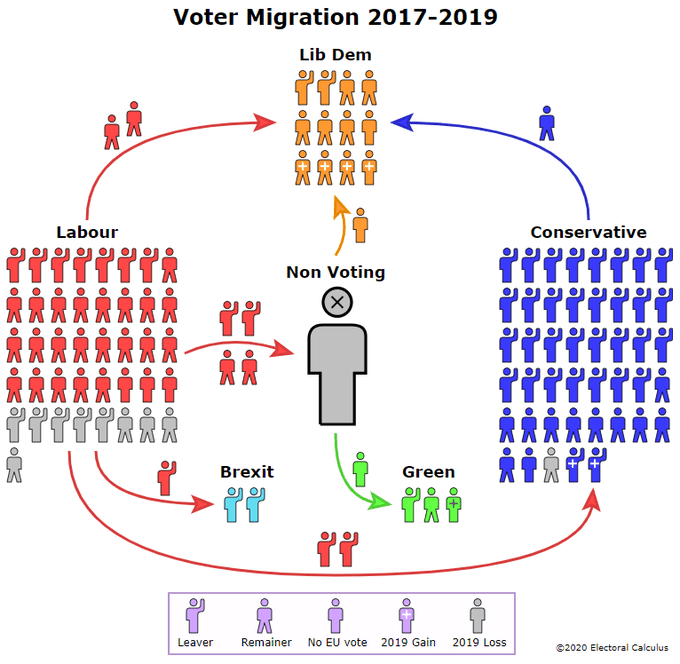
There was another factor underpinning the Conservative Party win of 2019— the fact that so many Labour Party voters “voted with their feet”, a few defecting to vote Conservative, but most simply not voting:

The Conservative vote-share increased only marginally across the country (more in a few seats), but the Labour share fell by 8 points. Had the Jewish lobby not trashed Corbyn-Labour on a daily basis for several years, and had Nigel Farage really fought for Brexit Party, the 2019 result would have been very different.

As for social nationalism, still no credible party anywhere to be seen./

Stoke Central By-Election: Final Word before Polling

I have blogged twice previously about the upcoming Stoke Central by-election:

https://ianrmillard.wordpress.com/2017/01/18/stoke-on-trent-central-preview/

and

https://ianrmillard.wordpress.com/2017/01/26/stoke-on-trent-central-by-election/

in which I predicted a very close race. In the latter post I suggested that UKIP and Paul Nuttall could finally crack it and defeat Labour in a former Labour heartland. That post was written on 26 January, since which date Paul Nuttall and UKIP have run one of the least impressive campaigns seen for a long time. Labour is now  (21 February) 8/13 odds-on favourite, with UKIP out at 9/4, having been at one point 10/11 favourite.

The latest polling seems to suggest, however, that UKIP and Labour are neck-and-neck in the affections of the voters:

http://www.stokesentinel.co.uk/survey-predicts-tight-result-in-stoke-on-trent-central-by-election/story-30149927-detail/story.html

As the Stoke Sentinel report says, turnout will therefore be key. UKIP voters tend to be older, tend to vote, tend to be more motivated politically than Labour voters now are. Those factors favour UKIP strongly. Against that, the NHS is a major issue, which favours Labour (especially because Nuttall seems to have flirted with market forces in the NHS, albeit some years ago). Immigration, race, and culture is probably a combined major issue under the surface, something which is often obscured in polling by reason of the pervasive political correctness.

All weather forecasts are showing that Polling Day, Thursday 23 February 2017, will be a cold, wet and windy day across the country, featuring “Storm Doris”. That will depress voting numbers in Stoke Central, which is already one of the least-voting constituencies in the UK (in 2015, the turnout was 49%).

On the face of it, Paul Nuttall seems a poor candidate and UKIP a bit of a joke. However, it was revealed during the campaign that the Labour candidate, Gareth Snell, is a spotty and rather unpleasant Twitter troll, who posted, only a few years ago, some juvenile-level insults about women. He also grievously insulted EU Referendum Leave voters, in one of the most Brexit-friendly parts of  the UK.

In addition, Gareth Snell seems not to have had a job outside local Labour and connected union politics, living off his council allowances and expenses.

http://www.dailymail.co.uk/news/article-4219874/Labour-s-election-candidate-caught-sexist-rant.html

One has to ask whether Stoke Central voters want to be represented by such an unpleasant person. We shall see.

Prediction

It may be foolish to predict anything now that the race seems so close, but I am still inclined to think that UKIP might crack it despite everything that has happened. In the end, if Labour wins, Stoke Central gets another and particularly useless Labour MP, whereas if UKIP wins, Stoke Central really is on the map.

The main indicators still look good for UKIP:

  • turnout
  • voter motivation
  • voter age profile

as against which Labour has on its side

  • traditional Labour voting pattern
  • Muslim voters [6%+].

Conclusion

This looks bad for Labour. Either Labour loses to UKIP or Labour scrapes a pathetic fingertips win. If the former, Labour will go into a tailspin and its MPs will be lining up to find new jobs after 2020; if Labour “only just” wins, then Labour’s decline continues anyway.

As for UKIP, only a win will do. A win keeps the UKIP train clattering along its rusty rails. If UKIP loses here, then that is derailment or the end of the line, whichever metaphor might be preferred.

Update, 14 July 2025

Well, in the end, Gareth Snell won the by-election for Labour with 37.1% of the vote. UKIP’s Paul Nuttall got 24.7%, and the Con Party candidate, Jack Brereton (who was later elected MP for another seat, Stoke on Trent South, 2017-2024), got 24.3%.

Snell was re-elected at the 2017 General Election, but was unseated at the 2019 General Election by the Conservative candidate, Jo Gideon, who however stood down before the 2024 General Election (she was then 71: https://en.wikipedia.org/wiki/Jo_Gideon). Snell was then returned as MP at the 2024 General Election.

Paul Nuttall eventually resigned from UKIP, which became more or less dormant after that, or co-incident with that. Nuttall thereafter faded from political life until (surprisingly) he made a comeback, having been appointed Deputy Chairman of Reform UK in early July 2025. He therefore is (again, surprisingly), not necessarily washed-up, politically. He is still only 48. https://en.wikipedia.org/wiki/Paul_Nuttall#UKIP_Leadership.

So there it is. At time of writing, Snell is still the MP, though it is an open question as to what will happen at the next general election. Reform UK may clinch it.

Arguably oddly, in May 2025 Snell married Ruth Smeeth, now also “Baroness Anderson” and a Labour peer (as well as Israeli agent and former informant for the U.S. Embassy in London). https://en.wikipedia.org/wiki/Ruth_Smeeth.

The Sliding Labour Party– What Next?

Some months ago I blogged about what I saw as the emerging political vacuum in England and Wales. My overall view now is the same but more so.

The 2015 General Election would have broken the mould of British politics had it been carried out under conditions other than the absurd First Past The Post system, more suited to the UK of the 1920s than that of the early 21st Century. The distribution of votes in Southern England illustrates this well enough, where the Conservative Party got about half the votes but won about 95% of the Westminster seats (a similar ration to that of the SNP in Scotland).

The UKIP insurgents famously won nearly 4 million votes UK-wide (mostly in England), some 12% of the vote, yet won no seat except that of Douglas Carswell, who is really a Conservative and was previously elected as one.

It can be asserted as simple fact that, in almost any given English seat, most of the voters do not get the MP or party that they want and for which they voted. Moreover, even the typical 30%-50% received by the winning candidate often reflects more the candidates that most voters did not want: voters vote tactically in the absence of a true choice being available.

FPTP has distorted British politics, giving the incumbent party in any given seat a great advantage and –far more– giving the main System parties as a whole a like electoral advantage and an anchor against sliding into ruination. All the same, when the forces become unstoppable, that slide does happen. It happened to the Liberal Party during and after the 1920s (replaced by Labour) and it happened to Scottish Labour after 2010. This illustrates it well:

https://en.wikipedia.org/wiki/Scottish_National_Party#UK_General_Elections

Founded in 1934, the SNP often scored less than 1% of the vote in Scotland and had to wait until 1970 to get a single MP elected. Even in 2010, the SNP only got 19.9% of the Scottish vote and 6 MPs (out of 59). Then the tipping-point was reached and in 2015, its vote swelled to 50% and suddenly the SNP had (a typically-disproportionate FPTP result) 56 MPs (out of 59). Labour in Scotland was ruined and now (2017) is only the third party in the polls there (after the Conservatives!) and has only about 15% voter support.

Moving to Labour overall, we see that this is a party that has been living “off its hump” for a long time. It even managed to jettison almost every remnant of “socialism” in its policies and yet win elections under Tony Blair (via appealing to otherwise Conservative or Liberal Democrat voters in the South and Midlands). Labour, in effect, “sold its patrimony for a mess of pottage”. When one asks oneself “what does Labour stand for?”, nothing coherent comes to mind: a confusion of old history, trade unions, strike banners, post-1945 nationalization, 1960s-1970s managerial technocracy, that old humbug Michael Foot in his donkey jacket at the Cenotaph, then, from the mid-1990s, the mirage of Blairism (New World Order pro-Americanism meets the Israel Lobby meets managerial “socialism” meets Common Purpose careerism).

It is often said that Labour is now split into Corbynists and Blairites. Another fault line (closely following the first) might be said to be the pro-Israel lobby bloc and the generally anti-Zionist bloc (though most in both still feel the need to pay lip-service to the “holocaust” narrative and its faked history, non-existent “gas chambers”, the now-derided “six million” etc).

In fact, Labour is now not even two parties but three:

  • the remnant of the old trade union-oriented Labour Party, based around traditional and unthinkingly Labour communities, mostly in the North;
  • the Blairite-Brownite pro-Israel bloc, consisting largely of MPs and their staffs, together with careerists in other parts of the country. These are those who want “to win elections” by promising pie in the sky: socialism to socialists, aspiration to the voters of the suburbs, “diversity” to the ethnic minorities and the rainbow loonies, profits and low taxes to the Jewish Zionist potential donors;
  • the Corbyn  camp, which relates to a partly-imaginary Labour history from the 1930s through to the 1980s: “no pasaran!” Communist (and some syndicalist) propaganda from the Spanish Civil War; an airbrushed “anti-Nazi” and “anti-fascist” Second World War narrative; the conflicts of the 1970s such as that in Chile or those in parts of Central America; the Miners’ Strike of the 1980s (seen mainly through a London lens though). This is largely a bloc based around London, around the half-mad pseudo-socialist local council enclaves that became notorious in the 1980s: Islington, Camden, Haringey, Lambeth. It is the dominant bloc now and is supported by at least half of the ordinary Labour Party members and supporters.

Naturally, there is overlap here and there within that tripartite split. However, what has fallen away is not only consensus among the Labour members and activists, but more, the voters. Most Labour voters now are in that first group and are only voting Labour out of traditional allegiance. When you look at, say, Stoke Central, where the by-election is about to take place, you see that voting Labour, not in 1945 but in 1997, 2001, 2005, 2010, 2015 has not given the people anything. Unemployment high, immigration high, large numbers of ethnic minority voters (Labour’s most reliable pawns now); little hope. Why would people in Stoke Central vote Labour? The answer seems to be that they see little choice (those that will actually vote, being probably a minority of those eligible).

In Stoke Central, the only alternative to Labour is UKIP, which is not the sort of social-national party likely to rise to power. In fact, UKIP is not social-nationalist at all, though some of its supporters are. The fact that UKIP is even being entertained (and may yet win the Stoke Central seat) is mainly a sign of Labour’s decline and not UKIP’s strength.

The industrial proletariat has gone, almost entirely. The trade unions are just a feeble bureaucratic, rainbow-coalition, “anti-racist”, Common Purpose-contaminated joke. The people who are suffering under fake “austerity” (the effect of #NWO/#ZOG globalism) and who belong to the burgeoning “precariat” (unemployed, underemployed, disabled, 50+, zero-hours-exploited, minimum-wage-exploited) are not now Labour voters but non-voters, sometime UKIP voters, potential social-nationalist voters. The Labour MPs are now mainly careerists, pro-Israel drones and “what’s-in-it-for-me?” bastards. Stoke Central MP Tristram Hunt abandoned his seat and constituents because, as he said, “the offer [from the Victoria and Albert Museum] was too good to refuse.” £250,000 a year. That was his price.

When a social nationalist movement of the new type emerges, as it must, it will start to scoop up the poor, or poor and angry and frustrated, masses. Labour will then disappear. Already it seems likely that Labour will only get between 100-200 seats in the 2020 Parliament, whether numbers are reduced from 650 to 600 or not. Labour policies– pro mass immigration, “welcoming” “refugees” (not of course to the MPs’ homes and neighbourhoods but to those of the former Labour voters), pro the EU octopus etc, simply have no appeal to those left behind by a conspiratorial globalism and multiculturalism.

As yet, a suitable party does not exist. When it does exist, Labour, already weakened, will fall to dust.

Update, 24 August 2025

Well, scroll on 8.5 years and here we are. The 2017 Stoke Central by-election was won by Labour (from UKIP and Con), and the seat retained by Labour at the 2017 General Election, but lost to the Conservatives in 2019, only for Labour to win the seat back in 2024: https://en.wikipedia.org/wiki/Stoke-on-Trent_Central_(UK_Parliament_constituency)#Elections_in_the_2020s.

In the bigger picture, of course, the Cons under Boris-idiot won in 2017, and won bigger in 2019, only to lose to Starmer-Labour in 2024, since which time Reform UK has arisen to prominence and, indeed, dominance. We now await events.

Stoke-on-Trent Central By-Election

Last week, I wrote a preview of the upcoming (23 February 2017) Stoke-on-Trent Central by-election, one of two taking place on that day

https://ianrmillard.wordpress.com/2017/01/18/stoke-on-trent-central-preview/.

Now that the main candidates are declared, I am ready to expand on that and to predict the result as best one can a month before polling.

The Stoke Central constituency has existed since 1950 and the Labour Party has won every election since then. Until Tristram Hunt appeared in 2010, the Labour vote varied between 48% and 68%. Hunt’s votes have been 38.8% (2010) and 39.3% (2015). Stoke Central has moved from being a Labour safe seat to one which can be regarded as marginal:

https://en.wikipedia.org/wiki/Stoke-on-Trent_Central_(UK_Parliament_constituency)#Elections

The Labour vote in 2015 was about 12,000, that of both UKIP and Conservatives about 7,000. The Liberal Democrats, until 2015 the second party, crashed to fifth place (behind an Independent) with 1,296 votes. In fact, the LibDem vote in 2010 was 7,000, the same as the UKIP vote in 2015, perhaps a sign that the “protest vote” bloc at Stoke Central is around 7,000 or so. Arguende. The LibDem candidate for the by-election is Zulfiqar Ali, a consultant cardiologist, who lost his deposit (vote share 4.2%) in the 2015 General Election.

Tristram Hunt, the outgoing-going-gone Labour Party MP, was never very popular in his own constituency, though London TV studios loved him. He made no bones about despising the leader of his own party, tried and failed to formulate policy of his own and was surprisingly bad (for someone of his background and education) at arguing his points when (as so often) being interviewed.

Hunt stepped down as MP in order to take a job as Director of the Victoria and Albert Museum. MP pay is about £74,000 (plus generous expenses); the V&A Director presently gets a package worth £230,000. Hunt may be getting more. No wonder that he said that “the V&A offer was too good to refuse.” So much for political conviction, vocation and, indeed, loyalty (whether to party or constituents). Stoke Central is well rid of him.

The Labour candidate in the by-election is Gareth Snell, a still fairly young former leader of the Borough Council of Newcastle-under-Lyme (3-4 miles from Stoke-on-Trent). His selection indicates that Labour are going to play on local roots and try to pretend that God is in His Heaven and Jeremy Corbyn far away, Corbyn being (arguably?) an electoral liability (seen as a credible future Prime Minister by only 16% in a recent poll).

The Conservatives have not been even the second party at Stoke Central since 2001. This by-election is one which will be decided between Labour and UKIP. The recent Theresa May Brexit speech may well have shot UKIP’s fox overall, but at Stoke Central no-one is expecting a Conservative win or even a Conservative second. The Conservative candidate is Jack Brereton, 25, who was elected at age 19 to Stoke-on-Trent City Council.

Since the 2001 General Election, the second and third-placed candidates at Stoke-on-Trent Central have received very similar numbers of votes (behind victorious Labour).

UKIP, joker in the pack. Paul Nuttall, a Northerner who was recently elected leader of UKIP, is the candidate. He must have a chance despite his partly-“libertarian” views (of which Labour is making the most, of course, claiming that Nuttall believes in NHS privatization). UKIP has a steep climb in the by-election, but it is possible. This is a by-election. The result will not affect who governs the UK. People can protest with their votes. Labour is now seen as the pro-mass immigration party and the pro-EU party. Stoke Central voted nearly 70% for Leave in the EU Referendum.

If turnout is low, if the 2015 Labour vote halves to about 6,000, if the 2015 UKIP vote mostly holds up at 7,000 or not much less, then UKIP can win. If.

It is not credible to imagine a win for the Conservatives or LibDems and they will vie for most votes not going to Labour or UKIP, but this is very much a Labour/UKIP contest. If enough people (eg 2015 Conservative voters) vote tactically for UKIP, UKIP has a good chance. On the other hand, many 2015 LibDem or Green voters may also vote tactically for Labour.

In 2015, an Independent got over 2,000 votes. Will those votes go to UKIP, now that that candidate has not renewed his candidature? Open question.

Unemployment is high, immigration is high and having had Labour MPs for 66 years has not prevented either in recent times. There is strong cultural resistance in the seat to the Conservative Party. UKIP is the insurgent here.

Prediction

The bookmakers still have Labour as odds-on to win the by-election and it would be tempting to call it as a Labour-UKIP-Conservative 1-2-3, but I am going to be bold and say that Paul Nuttall and UKIP can crack this. The seat must be one of the best chances UKIP has had or will have: anti-EU, pro-Leave, anti-mass immigration, disenchanted with the System parties and very much a “left-behind” area. Also, Tristram Hunt abandoning the seat for a quarter-of-a-million-pound job must sit badly in an area which is one of the poorest in England. In addition, Nuttall has the cachet, such as it is, of being his party’s leader.

In sum, I see the 1234 as: 1.UKIP; 2.Labour; 3.Conservative; 4.LibDem.

Effect

If the result is as I have predicted, it will push even more anti-Corbyn Labour MPs to jump ship and it will weaken Labour even further in the North (it being of little importance now in Scotland or most of the South of England). If Labour hangs on to win, then everything depends on the majority obtained but it might well be just a slower car crash.

Update, 30 May 2019

I blogged twice more about that Stoke on Trent by-election:

https://ianrmillard.wordpress.com/2017/02/21/stoke-central-by-election-final-word-before-polling/

and

https://ianrmillard.wordpress.com/2017/02/24/stoke-central-and-copeland-the-aftermath-for-labour-and-ukip/