
Tag Archives: Liberal Democrats

EU Elections 2019 in Review: the LibDems

The Liberal Democrats had a good election. Everyone says so. From having 1 MEP to now having 16 MEPs. 3,367,284 votes. A vote-share of 19.58% (second only to Brexit Party, which scored 30.22%).

In London the LibDems came 1st, with a 27.2% share. London was the only EU constituency of England and Wales where Brexit Party did not top the poll (it came 3rd, behind the LibDems and Labour).

The only constituencies where the LibDems failed to get at least one MEP were Wales and North East England.

It seems clear that the LibDem surge and vote was, more than the vote for any other party in these elections, purely an outcome of the Remain/Leave binary. The LibDems are the party of Remain, Remain at all costs, Remain no matter what.

Not that the LibDem vote in these elections was solely a Remain vote, a Remain vote and nothing else, but 90% probably was. The two major System parties were both ambiguous in terms of statements, policies and, especially, their MPs. Brexit Party and UKIP were of course both unambiguously Leave. The Greens and the new joke party, Change UK, were also Remain. The LibDems got about 70% more votes than the Greens, who came 4th overall.

At an educated guess, the Remain votes that went Green rather than LibDem were from people who remember the way in which the LibDems (arguably the least honest party in the UK) enabled the dreadful and cruel policies of the Conservatives, of David Cameron-Levita-Schlumberger and his 2010-2015 “Con Coalition”, while still spouting the language of “social justice”. Nick Clegg, Danny Alexander etc. Remember them?

The above being so, the support that the LibDems received in the EU elections will almost certainly not follow them into the Westminster arena. A good test will be the result of the Peterborough by-election scheduled for 6 June 2019. In 2010, the LibDem vote in Peterborough peaked at just under 20% (3rd place), which was a few points up on previous general elections. The LibDem vote fell back to 3.8% in 2015, then fell back again to only 3.3% in 2017 (as it did in most constituencies, though the LibDem MP cadre actually increased from 8 to 12 thanks to the UK’s mad electoral system).

Now, in Peterborough, the LibDems, with the same candidate they stood in 2017, look like losing, possibly badly, at the by-election. Their odds re. winning are at time of writing 25/1, joint 3rd place with the Conservatives (Labour 4/1, Brexit Party 1/5  odds-on favourite).

Brexit is not the only issue in a Westminster election. Yes, the LibDems are still the go-to “dustbin” vote out of the System parties, and there may be many (especially in the Southern parts of the UK) who will vote LibDem as a tactical measure in the next general election, but in the most heavily Conservative-voting areas that will not much dent massive Con majorities, whereas in more marginal areas it will (with Brexit Party) help to sink the Conservatives, but only in a few areas will the ultimate beneficiaries be the LibDems themselves.

In any case, by 2022, boundary changes and the reduction of MP numbers to 600 will have culled almost all LibDem MPs.

I have considered the LibDems to be effectively dead since the days of the Con Coalition. The EU elections will have cheered them, but their fires will soon be but glowing embers.

Update, 31 May 2019

If that poll were to be given effect in a general election, the result would be about (depending on various factors): Brexit Party 188 MPs (and largest party in Commons), Labour 186 MPs, LibDems 114 MPs, Conservatives 83. Hung Parliament (Brexit Party 138 short of majority). Popular vote does not exactly equal number of MPs.

https://www.electoralcalculus.co.uk/userpoll.html

Also, if that general election were held in or after 2022, remove about 10 from LibDems and about 30 from Labour; and maybe 5-10 from Conservatives.

I still cannot see that the LibDems will be able to replicate 2010 Cleggmania even if it seems that many are able to forgive and forget the “Con Coalition” of 2010-2015 (I cannot. I will not). I still see the LibDem vote next time as amounting to no more than about 10% and the LibDems as coming away with fewer than 20 MPs. I concede that I may be wrong on this if hard-core Remain voters continue to flock to LibDems and away from Conservatives (as they did in the EU Elections 2019). Everything is uncertain in that no-one knows who will be Conservative leader, how long he (or she) will last as PM (not long, I think) and whether he or she will be basically Remain or Leave.

Update, 1 June 2019

The betting on the Peterborough by-election, scheduled for 6 June, five days from now, continues to shift. At present, the LibDems, who were at 70/1 and in 4th place just a week ago, are now, as of 1 June, on 12/1 and in firm 3rd place (Conservatives 25/1 and in 4th place, and already looking well-beaten). Brexit Party 1/5, Labour 4/1. It still seems unlikely that the LibDems can win:

https://ianrmillard.wordpress.com/2019/05/09/notes-from-the-peterborough-by-election/

but it is just possible if and only if pro-Remain and/or anti-Brexit Party voters abandon both the Conservative candidate and Labour, and go LibDem. Tactical voting to block the Brexit Party candidate.

If the LibDems can pull off the coup of getting their candidate elected at Peterborough (in the 2017 General Election, her vote share was only 3.3%), it will rank, arguably, above the other LibDem and Liberal Party revivals in the post-1945 era, such as the 2010 “Cleggmania” and the 1961 Orpington by-election

https://en.wikipedia.org/wiki/1962_Orpington_by-election

In that event, the Brexit Party juggernaut would be halted in its tracks, quite possibly.

Update, 1 March 2022

In fact, at that Peterborough by-election of 2019, Labour managed to pull off an unexpected victory, scoring 30.91% as against Brexit Party’s 28.89%. The LibDems came in 4th, with 12.26%: https://en.wikipedia.org/wiki/2019_Peterborough_by-election.

I blogged about the by-election result: https://ianrobertmillard.org/2019/06/07/peterborough-by-election-post-poll-analysis-and-thoughts/; https://ianrobertmillard.org/2019/06/08/a-few-peterborough-afterthoughts-about-the-libdems/.

Since then, much water under the bridge. There was a General Election only 6 months later. At that election, the Labour MP, Lisa Forbes, lost her seat, being replaced by a Conservative Party MP who had not been the by-election candidate. Brexit Party nationwide was betrayed by its own leader, Farage; Mike Green stood again for Brexit Party but received a poor vote-share of 4.4%. As for the LibDems, a mere 4.9% (same candidate).
The UK Local Elections Have Been Held: My View

Introduction

The 2019 local elections are at an end and the results collated and endlessly analyzed in the msm. I had predicted a seat loss for the Conservatives of well beyond 1,000 seats, somewhere between there and 1,500. In that, my prediction was correct. Where I went wrong was in thinking that Labour would do well.

What I got right was the disgust and despair voters generally now feel in respect of the Conservative Party. What I got wrong, mainly, was in assuming that voters in the North and Midlands would vote Labour to spite the Conservatives, even if only as a choice between evils and not much supporting Labour as such.

The facts

The system of voting for local councillors etc in the UK is as antiquated and convoluted as one might resignedly expect: not all councils are elected in the same year, and some councils only elect a third of their councillors in any one election. Absurd.

The actual result of the election nationwide, where 8,798 seats (between a third and a half of all the 20,712 local government seats in the UK) were being contested was:

  • Con 3,562 (loss of 1,334) seats;
  • Lab 2,023 (loss of 82) seats;
  • LibDems 1,350 (gain of 703) seats;
  • Others 1,310 (mostly Independents). The Greens did well and now have 265 councillors (a gain of 194). UKIP did badly, and now have only 31 councillors (a loss of 145).

Analysis

The two major System parties are now widely despised. More than that, the political/electoral system is now despised; people have little or no trust in it or in those who are making their living from it. Those facts are reflected not only in the votes cast, but in those not cast. Turnout varies depending on the type of body being elected, but seems overall to have been only about 30%, if that. In addition, unprecedentedly huge numbers of ballot papers were spoiled, some being endorsed with the words “Brexit” or “Brexit Party” or a drawn Swastika. Unsurprising, when one considers that, in many local council seats, there was no real choice.

In many areas of Southern England, the Conservatives were not opposed by even System party opponents from Labour or the LibDems. That explains the way in which disgusted voters voted for anyone not tainted by System connections: Independents (despite most being completely unknown to most of those who voted for them; complete wild cards); Residents’ Association candidates, Greens. How though to explain the relative success of the LibDems (a System party)? How to explain the collapse of UKIP (a non-System party)? In fact, there is no difficulty in understanding those apparent anomalies.

The LibDems were obviously voted for by voters who liked the LibDems’ focus on local affairs, those who are Remain supporters voting for the LibDems as an anti-Brexit protest vote, and by those former Conservative voters who wanted to punish the Conservatives generally, but who were unwilling to vote for Labour, Greens or for complete wild cards. For those people, I suspect mainly in the South of England, the LibDems were an acceptable compromise “dustbin” vote.

The Greens were probably mostly voted for as a pure protest vote, as well as an environmentally-oriented protest vote.

UKIP lost out badly and now, out of a possible nearly 21,000 councillors, has only 31. I think that one can see why that has happened. I have been tweeting/blogging for years that UKIP peaked in 2014. Since then, UKIP has been sliding. The good, but not good enough, 2015 General Election result led to a precipitous plunge in UKIP’s fortunes. Its new leader, Batten, has slowed the plunge, but not stopped it.

UKIP had insufficient troops and funds to fight these local elections hard. It did not contest the vast majority of seats anyway. Apart from that, it is clear that the connection with the “alt-Right” wastes of space (“Sargon of Akkad” Benjamin, “Prison Planet” Watson, “Count Dankula” Meechan) has damaged UKIP badly. Benjamin’s spat with ghastly “Labour” (Labour label) MP Jess Phillips was probably a huge turn-off for many voters. This is the end of the road for UKIP, even re. the EU elections (if any are held in the UK), because defections to Brexit Party have already left UKIP with only 3 MEPs, and BP is running at 30% or more in the opinion polls, while UKIP is now down to about 3%.

Conclusion

These were elections in which voters clutched at straws, weakly trying to damage the main parties of the System. In most seats, there was no non-System candidate standing. The aftermath has been that Con and Lab are now trying to cobble together a faked-up “deal” (“Brexit In Name Only”) so that both parties can avoid having to hold EU elections at all on the 23rd of this month..

We are coming to the end of even the pretence of representative democracy in the UK. Any means will soon be entirely justified in replacing the present corrupt, decadent and totally incompetent system with a better one. The present political system is just not working.

Notes

https://www.itv.com/news/2019-05-03/why-tories-and-labour-should-be-petrified-by-local-elections/

https://en.wikipedia.org/wiki/2019_United_Kingdom_local_elections

http://www.heritageanddestiny.com/early-ukip-gains-as-voters-turn-against-main-parties/

Update and afterthoughts, 4 May 2019

There were almost no candidates ostensibly “nationalist”, still less social-national. A few did well where they stood, here and there. The standouts were Karen King and Julian Leppert, both of whom were For Britain Movement candidates..

Julian Leppert was elected for the “For Britain” party in Waltham Abbey, Paternoster ward, in Epping Forest, Essex. The one-time BNP councillor received 40.7% of the vote, 321 votes; the Con in second place got 227. Turnout was only 23%. About 808 votes were cast in toto.

Karen King, in Hartlepool, de Bruce ward, won with an even more striking 49.5% vote. “The turnout for the elections was 27.18% with 19,284 verified votes from an electorate of 70,943” [Northern Echo]. That of course relates to all Hartlepool and not simply the ward picked out, where Karen King/For Britain Movement got 694 votes, Labour 527, Con 180.

Hartlepool Borough Council councillors now consist of 13 Labour, 8 Independent Union, 5 Independent, 3 Conservatives, 1 UKIP, 1 Veterans’ and People’s Party, 1 For Britain Movement and 1 Socialist Labour Party. Such fragmentation is interesting. The old “three party” or “two party” System stitch-up is just not working any more.

Of course, readers of this blog will know that I have little time for “For Britain Movement”, and 2 councillors is a very small contingent out of the nearly 21,000 in the UK, but looking at those results in isolation, one can only congratulate the candidates.

I shall blog separately about the prospects for the main System parties.

The Newport West By-Election

On 4 April 2019, a by-election will be held at Newport West, the former seat of Labour MP Paul Flynn, who died recently.

Paul Flynn was generally well-regarded, except by the Jew-Zionists, who deplored his principled opposition to Israel and to, in 2013, (the then) H.M. Ambassador to Israel appointed despite being a Jew and admitted Zionist (and so perhaps having dual or conflicted loyalties: see Notes, below). Flynn retweeted my tweets once or twice, I think, when I still had a Twitter account, but also criticized me once. Well, de mortuis nihil nisi bonum, so we’ll say no more of that.

Newport West

The constituency was created in 1983. It was won that year by the Conservatives, who received 38% of votes cast (Labour 36.6%, Liberal Party 24.2%, and Plaid Cymru 1.2%). That result turned out to be anomalous, in that Paul Flynn won for Labour in 1987 and held the seat until his recent death.

This is a Lab-Con marginal. The Liberal Democrats peaked in 2005 at 17.9% (third place), plateaued at a similar figure in 2010, slumped to 3.9% in 2015 (fifth place) and collapsed further (to 2.2%, again fifth-placed) in 2017.

Plaid Cymru is irrelevant here, peaking at 7.2% in 2001 but usually found at or near the bottom of the poll at under 2% (and sometimes under 1%).

UKIP peaked here in 2015 at 15.2% (third) and again achieved a third place in 2017, but on a miserable 2.5%.

Other candidates have stood occasionally over the years (Green, Referendum Party, BNP and Independents), but are not even marginally significant (BNP 3% in 2010, beating UKIP).

As to the only significant contenders, Labour and Conservative, Labour’s vote peaked in 1997 at 60.5%; its lowest ebb (apart from 1983) was in 2015 (41.2%). So much for the “personal vote”. After Corbyn replaced Miliband as Labour Leader, Labour’s vote increased, in 2017, to 52.3%.

The Conservative Party vote stood lowest in 1997 (24.4%) and highest in 1987 (40.1%). Its 2017 vote, at 39.3%, was the Con best since 1987, though the Con vote has held up above 30% (perhaps surprisingly so) since 2010.

Opinion

There are several reasons to think that the Labour vote will sink back: a new and untested candidate, the death of a fairly popular longstanding MP, Labour’s perceived pro-mass-immigration stance. Also, the fact that Labour is sending out mixed messages about Brexit in a constituency which voted Leave more heavily than the UK average (nearly 54%). The “Corbyn factor” seems, so far, to have been a positive rather than a negative.

If I were putting money on this, I should probably still back Labour to win, though the Conservative candidate may do well and might just do it. As to the others, they can probably all easily be written off. The interesting side-bet will be how high or low UKIP scores. My guess? Under 5%, anyway (if UKIP stands at all; if not, the Con candidate will be boosted, probably).

Notes

The 2016 EU Referendum results were not directly voted for or collated by constituency, and in Wales the vote was arranged by reference to local authority boundaries, in this case designated as “Newport”, not “Newport West”. I have taken the Leave vote relating to Newport West as standing at or about 54%, but other estimates have it as about 56%.

https://en.wikipedia.org/wiki/Results_of_the_2016_United_Kingdom_European_Union_membership_referendum#List_of_constituency_results

https://en.wikipedia.org/wiki/Newport_West_(UK_Parliament_constituency)

https://www.politicshome.com/news/uk/political-parties/labour-party/analysis/102182/analysis-brexit-set-dominate-newport-west

https://www.southwalesargus.co.uk/news/17465965.newport-west-by-election-to-be-held-on-april-4-following-death-of-paul-flynn/

https://en.wikipedia.org/wiki/Paul_Flynn_(politician)

Afterthought, 1 March 2019

Candidates have not yet declared. It is unknown whether any candidates of a broadly “nationalist” character will stand. UKIP is a possible but not inevitable contender. What would be significant would be anyone standing for the “Independent Group” of MPs. That group is not yet registered as a party (and may never be); until it is, it cannot put up candidates under “Independent Group”, but only as “Independent”. Having said that, if a candidate were to be endorsed on TV etc by the rebel MPs as the candidate, in effect, of the Group, then that would have an effect. It would split the Labour vote and almost certainly let in the Conservative candidate, though it is just on the fringe of possibility that, in a 3-way split of main candidates, the (in effect) IG candidate might just win. Hard to see it happening but not totally impossible.

My guess is that the “Independent Group” will not put up a quasi-IG candidate, because

  • voters would not know what his/her policy views might be (except pro-EU Remain, which is the minority view in Newport West);
  • there would be little time in which to select a candidate and, because of the disorganized way in which IG has been established (step up, Chuka Umunna…), there are no selection procedures in place;
  • any IG candidate (in all but name) would be likely to go down in flames, so this is a battle that the IG MPs will probably sidestep.

Update, 4 March 2019

The candidature listing is still open. So far, 6 candidates have declared: Conservative, Labour, Plaid Cymru, Green, and two wild cards, “Renew” and “Abolish the Welsh Assembly”. The obvious non-declarers, so far, are the LibDems, UKIP and anyone adherent to the “Independent Group”. However, as stated, there is still time in which to declare.

https://www.bbc.co.uk/news/uk-wales-politics-47414610

Update, 6 March 2019

Update, 9 March 2019

The candidate list is now complete:

  • Labour – Ruth Jones
  • Conservatives – Matthew Evans
  • UKIP – Neil Hamilton
  • Plaid Cymru – Jonathan Clark
  • Welsh Liberal Democrats – Ryan Jones
  • Green Party – Amelia Womack
  • Abolish the Welsh Assembly Party – Richard Suchorzewski
  • Renew – June Davies
  • SDP – Ian McLean
  • The For Britain Movement – Hugh Nicklin
  • Democrats and Veterans Party – Phillip Taylor

I see no reason to alter my view of the contest as expressed in the blog.

Update, 30 March 2019

I was just considering to what extent, if any, the meltdown of the House of Commons over and around Brexit will affect this by-election. The obvious protest vote would be for UKIP, which as noted above only scored 2.5% in 2017, though it managed 15.2% at its 2015 peak. Both were 3rd places. To win, UKIP has to beat both main System parties. On paper, that is near-impossible, but we are in interesting times.

Update, 2 April 2019

Update, 5 April 2019

The result was that Labour won with nearly 40% of the vote, but less than 38% of those eligible could be bothered to vote. Labour’s candidate was thus endorsed by only about 15% of those eligible.

The Conservatives came a fairly but not very close second. UKIP came third (again). “For Britain Movement” got less than 1% and came right at the bottom of the list of 11 candidates.

https://en.wikipedia.org/wiki/Newport_West_(UK_Parliament_constituency)#Elections_in_the_2010s

What Can Be Done To Create A Social-National Movement in the UK?

I was just reading a few appreciations of Paddy Ashdown, the one-time LibDem leader, who recently died. I tend to adhere to the saying de mortuis nihil nisi bonum, but when it comes to political people, kindness must sometimes give way to clarity.

In fact, I rather liked Paddy Ashdown, at least in parts (not that I ever actually met him). I certainly feel more respect for him than I ever could feel for the idiots who preceded and followed him (Thorpe, Steel, Kennedy, Campbell, Clegg etc, though I do have time for Jo Grimond, whose interesting and erudite memoirs I reviewed on Amazon years ago; Grimond was by far the best of the Liberal/LibDem leaders, to my mind).

I feel that Ashdown was a great deal more honest than most System politicians, for one thing. Also, he was an idealist, and someone willing to put a mission above his (and his family’s) comfort: not many men in their mid-thirties would leave a comfortable and perhaps promising SIS/FCO career to get involved in the hurly-burly of UK politics, particularly for something as marginal as the then Liberal Party (at the time it had only 13 Commons seats, despite having garnered nearly 20% of the popular vote in both of the two 1974 General Elections). Ashdown gave up a pleasant diplomatic/intelligence near-sinecure based in Switzerland to take ordinary jobs in the Yeovil (Somerset) area while pursuing his political mission. When his employer folded, nearly a decade later, Ashdown applied unsuccessfully for 150 jobs. When elected MP for Yeovil in 1983, he had been unemployed for 2 years and was doing unpaid volunteer work as part of a programme for the long-term unemployed.

Not that I agreed with much of Ashdown’s policy-set: Ashdown was a politician for an England which was disappearing even in the 1970s. He seems to have been sanguine about mass immigration, for one thing. I doubt that he was ever anti-Zionist in any sense (certainly not my sense). Ashdown was no intellectual and not (to my mind) a policy person. Neither was Ashdown intellectually honest in a way that might match what I still perceive to be his personal integrity (leaving aside the “Paddy Pantsdown” episode). Certainly, amid the pathetic rabble called the LibDems, Ashdown could hardly fail to be seen as a star, just as the young Bill Clinton, with his Georgetown, Oxford and Yale academic background, could not fail to shine in the intellectual backwater that is Arkansas.

Yes, much can be laughed at in Ashdown, not least his absurd sense of his own importance and weight, as when he was or tried to be (using my own parody-title for him) “the Lord High Panjandrum of the Balkans and Afghanistan”, but without at least some elevated sense of self-worth, Ashdown would never have tried to be a political leader in the first place, I suppose.

So why am I talking about Ashdown, when this blog piece is supposed to be about the creation of a social-national movement?

What caught my attention about Ashdown as politician was that he only got elected as MP in 1983, after about 8-9 years of trying; also, once he was an MP, it only took him 5 years to become the leader of his party (admittedly tiny in terms of MP numbers).

One of the precepts of the American “self-help” guru Anthony Robbins is that “most people overestimate what they can accomplish in a year and underestimate what they can achieve in ten years.” That is very true. Examples are all around in history.

Famously, Hitler joined the NSDAP as “Member no.7” in 1919. A year later, it was still of little importance even in its home city, Munich. By 1923 Hitler had attempted the Beer Hall Putsch, which went down in shambolic ignominy; by 1928, 9 years after its foundation, the NSDAP could still only raise a national vote of 2.6%. However, Hitler had built a party and beyond that, a whole volkisch movement. It only needed the right conditions in which to flourish. The Depression provided that, together with the widespread feeling against the Jewish exploitation of the German people: by 1930, the NSDAP had a vote of 18%, by 1932 of 33%, and by 1933 of nearly 44%.

Lenin’s serious revolutionary political activity could be said to have begun with the establishment of Iskra [The Spark] in 1900. Though by 1910, Lenin was still politically marginal, he was considered to be one of the leaders of the Marxist tendency, at least. However, both Bolsheviki and Mensheviki together numbered only 8,400 by 1910 (perhaps 75% of whom were under 30 years of age). Once again, though, the important point is that a party, albeit split, existed and, once the disastrous Russian participation in the European war of 1914 onward had destroyed the strength of the Tsarist government and society, that party could take over the existing uprising in 1917 and perform a coup d’etat later the same year.

Other examples? How about “Solidarity” in Poland? Founded by a small number of workers in Gdansk (former Danzig) in 1980, by 1989 it was the governing party in Poland.

UKIP was formed in 1993 and had become an organized though marginal party by 2003. UKIP never did break through. It peaked in 2014 and deflated from 2015. What stopped UKIP from taking power was not only the UK’s totally unfair First Past the Post electoral system (though that did not help). What stopped UKIP was, first, that it was and (to the extent that it still exists) is not a revolutionary, nor even radical, party/movement; also, there has been no truly “triggering” event comparable to the First World War, the Great Depression etc in the UK of the late 20th/early 21st centuries.

Even if the future for the UK and Europe is a kind of multifaceted civil war, a political party or movement must exist. It is the sine qua non. In a year, it would achieve nothing, but in ten years it could achieve everything.

Notes

https://en.wikipedia.org/wiki/Paddy_Ashdown

https://en.wikipedia.org/wiki/Jo_Grimond

https://en.wikipedia.org/wiki/De_mortuis_nil_nisi_bonum

https://www.theguardian.com/politics/2016/sep/16/paddy-ashdown-i-turned-to-my-wife-and-said-its-not-our-country-any-more

https://en.wikipedia.org/wiki/Beer_Hall_Putsch

https://en.wikipedia.org/wiki/Nazi_Party#German_Reichstag

https://www.amazon.co.uk/Jo-Grimond-Memoirs/dp/B0015L8O0G

https://en.wikipedia.org/wiki/Vladimir_Lenin

https://en.wikipedia.org/wiki/Solidarity_(Polish_trade_union)

https://en.wikipedia.org/wiki/Vladimir_Lenin#Revolutionary_activity

Further Thoughts, 28 December 2018

As to practical steps, I have blogged before about these:

  • Focus on one, two, or a very few areas of the UK at first;
  • Establishment of safe zone(s) which can develop into a germinal ethnostate;
  • “Tithing” as a way of building up operational funds.

The Train is Hitting the Buffers

The UK train is hitting the buffers. The train crash has been slow, long in coming, but it is now starting to happen.

Decades of decadence, mass immigration, political corruption, Zionist takeover of the legal system, cultural sickness in all mass media (fostered by Zionist infiltration at all levels) etc now result in manifestations that are becoming apparent even to the voting public.

The public has little idea, even now, of the causes, but it sees the effects: National Health Service creaking, beginning to fall to pieces; the housing market effectively closed to most of those who wish to buy a house or even an apartment; sky-high rents paid to speculative parasites by employees and others; congested roads and trains; cities full of those of alien race and culture; schools which brainwash children with “multiculti” propaganda and “holocaust” lies.

Those few (including me) who saw this coming as long ago as in the 1970s (in my case) or even 1960s, were and still are marginalized by a mass media system which is thoroughly corrupted. The same is true of the political system and, increasingly, of the professions, where to speak up at all invites expulsion: see

https://ianrmillard.wordpress.com/2017/07/09/the-slide-of-the-english-bar-and-uk-society-continues-and-accelerates/

The Zionists are behind much of this and are now trying to shut down free speech and comment across social media– as happened long ago in the mass media.

https://ianrmillard.wordpress.com/2017/07/13when-i-was-a-victim-of-a-malicious-zionist-complaint/

The question that now has to be asked is what, in the next 4-5 years, will be the political result of the slow but accelerating collapse of British society in all areas?

It is clear that specifically English (leaving aside Scotland, Wales and Northern Ireland) voters are now, in a semi-rigged “First Past The Post” electoral system, voting against parties rather than for them. There is little enthusiasm for any of the System parties, let alone the more or less washed-up UKIP, Liberal Democrats and Greens, but there is determination to block parties by voting tactically for the party most likely to achieve that in any given seat.

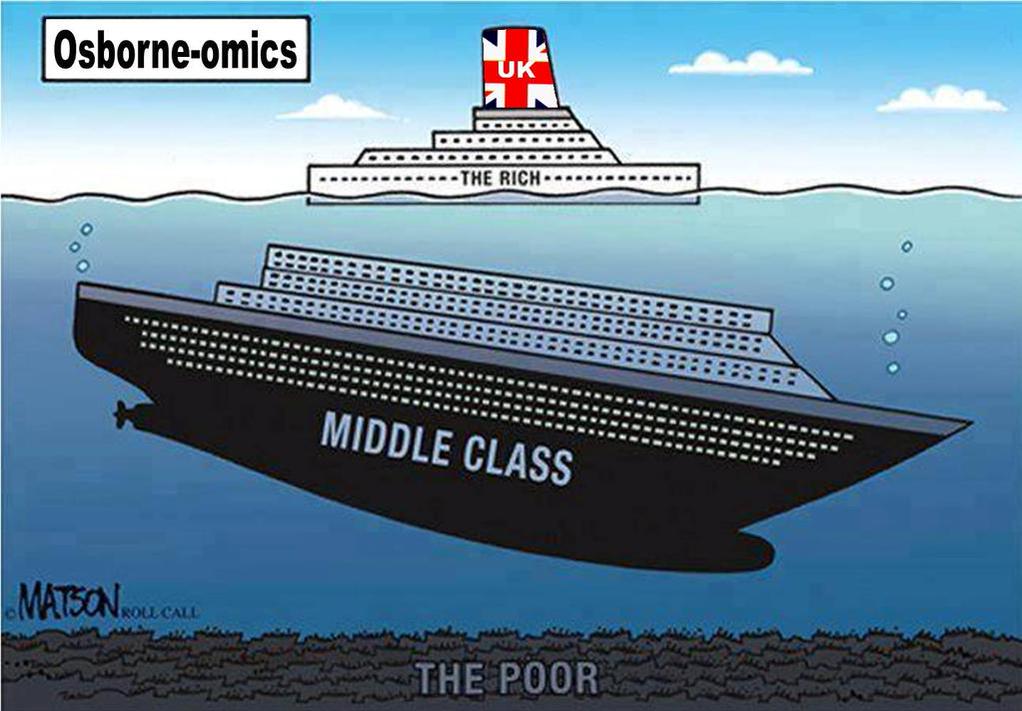
Beyond the wish to block unwanted parties and candidates, there is a general and growing dissatisfaction. Above all, the “Middle Classes” are joining the “workers” and the marginalized at the bottom.

b-cisxdiqaa7qj_-jpg-large

That can only help Labour, despite the misgivings many feel about its MPs and leaders (the obvious example being Diane Abbott). The success of the Corbyn faction and its vanguard, Momentum, may unsettle some voters, but may give rise in others to the feeling that at least Labour is fairly solid ideologically, not a chaotic mess. That is bound to play to Labour’s advantage electorally. Contrast with the Conservatives. This cartoon portrayed the way in which Theresa May achieved office by default:

CnLGOc5XYAALLJdThe next general election will probably favour Labour, though probably not enough for it to win a majority in the House of Commons. After that, one can foresee continuing mass immigration, continuing slide in public services, continuing disparity in wealth. That will be the moment when a social-national party can strike. First of all, one must exist, however.
Fame is Often Fleeting

[preliminary note: this is a personal rather than a political or social blog post, though it does touch on both of those aspects of life]

It is hardly original to say that fame often tends to be fleeting, but indulge me. I was thinking about this matter recently in the context of hearing about a number of persons and their life-trajectories. In particular, in the past 6-7 years I have observed the meteoric rise of a Jewish Zionist lawyer (solicitor) to fame; he rose to public prominence (after years of provincial obscurity and a slide into near-madness) on the basis of one type of notorious case, only to slowly deflate ever since. That person’s fate, still unfolding (or should that be “unravelling”?) gave rise to other, connected, thoughts.

I was on holiday in Hammamet, Tunisia [https://en.wikipedia.org/wiki/Hammamet] in 1994 when my then girlfriend and I met with a young Englishman and his girlfriend. They were both struggling or at least very junior young journalists, twenty-somethings. The young man explained that they had been in a not very pleasant hotel and so had upgraded to the one in which I was staying, the Phoenicia, one of the best in the resort, all marble and staff wearing white uniforms topped by a fez.

The young journalist said that his name was Jasper Gerard (the girlfriend’s name I forget). We had lunch and the odd drink in the succeeding days and they were in the grounds of the hotel when they noticed someone nearly get killed when his parascending canopy collapsed at altitude. Yes, that was me (I pulled too hard on one side to descend) and apparently Gerard cried out “isn’t that Ian?!” as I appeared to be about to fall, mortally wounded, to the beach. However, I survived with nothing worse than a minor story to tell.

I kept in touch with Jasper. I invited him, not long after, to dinner at Lincoln’s Inn (of which I was then a member). He attended not with the Tunisia holiday girlfriend but with a pleasant, very quiet young lady who (judging by more recent Press photos) was probably his later wife. A week or two later, in the English way, he invited me to dinner at his club, a members-only but non-traditional place in Mayfair called Green Street. The sort of place full of young or youngish people who were probably pop stars whom I would probably not have recognized even by name. At dinner, the next table was occupied by a lady and her two guests. She was, Gerard whispered, the journalist Marie Colvin, already noted but who became rather famous later on, after she lost an eye and took to wearing a dashing eye-patch. She was killed in Homs, Syria, in 2012, making Gerard’s dinner comment to the effect that connections had helped her into her job seem in retrospect even more envious than it did at the time.

After that, I did not see Jasper Gerard for nearly three years, during which time he had become the head of the Diary column in The Times. After I finished a year working in Kazakhstan, I called him and suggested a drink. He suggested lunch at El Vino, not the original wine bar but the branch at the foot of Ludgate Hill. He failed to turn up and when I called to ask whether a problem had arisen, did not even apologize but got some underling to say that “something had come up”. That was discourteous, but personal loyalty is important to me, so I agreed to a second lunch date. This time, Gerard did turn up, but the pleasant, rather hesitant young man had become a blase, vain fellow obviously very much spoiled by his career uplift and hugely full of himself. He scarcely bothered to talk, obviously found me not famous enough to waste even the lunch break on, then did not offer to pay, or even to pay half the bill, but waited until I did before saying “do you mind if I take the cash and pay, so that I can claim it back”! With such a brazen attitude, it is not surprising that the bastard later tried to be elected as an MP!

I did not meet with Jasper Gerard after that, though I noticed that he was later to be found in the Sunday Times as chief interviewer. He lasted for some years before being removed. He then became restaurant critic in The Observer for a year or two, until 2008. He was even mentioned (once) in celebrity chef Gordon Ramsay’s memoirs.

Gerard fell into obscurity after that, though he came second in the Maidstone and The Weald constituency in the 2015 General Election, standing as a LibDem (well, after all, the LibDems are now the last resort of the scoundrel!).

The last I heard of Jasper Gerard, in 2016, he had become the Head of Press for the LibDems. Whether he still is, I have no idea.; and his last tweet to the public was in 2015…

The above is just one reminiscence about, mainly, one person. I suppose that the moral of my brief story is that some people really cannot handle fame or even minor celebrity, and that obscurity often beckons.


Update, 29 December 2020

I saw that there were recently a few hits on this rather obscure blog post, so am updating it.

The Maidstone and the Weald election results: https://en.wikipedia.org/wiki/Maidstone_and_The_Weald_(UK_Parliament_constituency)#Elections_in_the_2010s.

Jasper Gerard’s 2015 vote share of 24.1%, though far below that of the 36% attained by the LibDem in 2010, was still better than that garnered by the LibDems of 2017 and 2019 (16.4% in both cases). Gerard was the last LibDem to get a second place at Maidstone and the Weald; Labour has come second since 2015: 22.1% in 2017, 18.3% in 2019.

As for Gerard himself, it turns out that his full surname is Gerard-Sharp, and that his sister is also a journalist, with a Twitter account: [https://twitter.com/LisaGerardSharp] and a personal website [https://www.lisagerardsharp.com/].

In the soup for playing down the Lord Rennard scandal (‘It’s hardly Jimmy Savile’) Liberal Democrat candidate Jasper Gerard stands accused of playing down his poshness. Colleagues at Durham University remember him as Jasper Gerard-Sharp. Once he secured the post of head of the university’s Lib Dem society he morphed into plain Jasper Sharp. But by the time he arrived at The Times as a trainee journalist, he reverted to Jasper Gerard. Keep up at the back!” [Daily Mail, in 2013] https://www.dailymail.co.uk/debate/article-2285672/Is-boastful-Vince-Cable-ready-new-challenge.html

Professionally, and politically, Jasper Gerard —or Gerard-Sharp— now seems to have vanished without trace. He may have retired early; he would now be 53, must have been extremely well-paid when he was Chief Interviewer for the Sunday Times, and there may well be some family money, despite his grammar school secondary education.

Update, 18 March 2021

I noticed that there were several hits on this old article today.

I recall seeing an interview in the Sunday Times, in 2003, written by then-Chief Interviewer Jasper Gerard. It was with, and the article about, the wife of Kevin Maxwell, the part-Jew son of MOSSAD chief European agent, millionaire Jew fraudster and later food-for-fish, “Robert Maxwell”. At the time, the Maxwells were trying to sell their expansive country house on the Thames, somewhere near Wallingford.

That is a nice part of the world, one I knew well as a child and teenager in the early/mid 1960s and in the 1970s. I remember, reading the interview, thinking “there is a horrible brash Jewish or part-Jew family living in luxury on the banks of the Thames near Wallingford, and I am scraping a modest living from the law…“. The fact that Kevin Maxwell was living off the proceeds of crime, such as the frauds perpetrated by his despicable father, made the feeling all the stronger.

Well, the wheel of life has certainly turned for Ghislaine Maxwell, “Captain Bob’s” daughter, currently resident in a 9 foot by six foot cell in a US Federal prison.

Hey! I have an idea! Jasper Gerard should go interview the declining Ghislaine before she gets bumped like Epstein, or does herself in. He could write a good (well, adequate…) article about the contrast between her present circumstances and those days long ago with her brother and family by the sweet Thames…If, that is, anyone would now publish him.

Notes

https://ianrobertmillard.org/2019/08/11/the-jew-epstein-and-prince-andrew-the-british-royal-family-has-another-scandal-maybe-its-time-to-just-get-rid-of-them/

https://www.thetimes.co.uk/article/living-maxwell-house-mtz0crcfv7q