Translates to about 437 Reform UK MPs, 57 LibDems, 46 SNP, 38 Lab, 27 Con, 19 Green, 5 Plaid (etc).
If not an outlier, or anomalous set of results, this is stunning.
The headline result for Reform would be, in the British context, near-revolutionary, and would cause an almost-immediate Constitutional crisis, in that Reform has no peers at all in the Lords.
An influx of hundreds of Reform MPs of very varied views, on that scale, would lead to hard-to-predict events over the succeeding 5 years.
Labour (38 MPs) below LibDems (57 MPs) for the first time (formerly, of course, sub nom Liberal Party) since the 1920s. Hard to believe.
Conservatives with only 27 MPs, but that would be not quite as bad as other recent polls, which have predicted as few as 7 Con MPs. Reform was on 32% in this poll; another recent poll had them on 36%.
Greens with 19 MPs! The “watermelon party”, of course, green outside, but light red inside…
Of course, Labour is being pulled apart by centrifugal forces. The Pakistani/Muslim/Islamist element is defecting to Galloway’s “Workers’ Party”, to Islamist independent factions, to Corbyn’s anti-Israel “Your Party” etc. The craven pro-Israel, pro-Jewish lobby stance of Starmer-stein’s Labour Friends of Israel government has alienated many of the very voters on which Labour is now mainly dependent: Muslims, non-whites generally, would-be “progressives” etc.
Interesting times in British politics.
Anyone who backed him the second time round after Truss and the spies should be shot. That includes Rudd etc. I said to father of children and best friend – who both lost their seats because of Tom – dear lord please don’t back him again. One did, the other was more sensible and…
[“Anyone who backed him the second time round after Truss and the spies should be shot. That includes Rudd etc. I said to father of children and best friend – who both lost their seats because of Tom – dear lord please don’t back him again. One did, the other was more sensible and entirely where I was on candidates despite being on very different wings of the party. When Tugendhat came to Poole to “help” during the election campaign I made my views known – we could not afford to lose a single vote and having probably the most notorious backed-Truss-for-a-job “helping” was a disaster. We lost by a handful. He partied as colleagues cleared their desks in tears, only interested in canvassing support for a run not a moment of grief for his party. Just disgusting. Ruthless bugger. One of so many reasons I’m glad to be free of this sort of nonsense. There is so little honour left in the Tories and TT is one of the absolute worst. Ugh.“]
Though of course the lady tweeter there would never make the point, Tom Tugendhat, the MP and former chocolate soldier, is a quarter-Jew whose family origins, some of them, are in Bielsko-Biala, Silesia (Poland, but once, pre-1918, part of Austrian Silesia under the name Bielitz ).
Incidentally, and as blogged previously, I know the Bielsko-Biala area slightly, having visited twice in the late 1980s, and having spent a total of about 4 weeks there.
Of course, the Conservatives having now fallen well below 20% in the opinion polls, the infighting about who should replace Nigerian chancer Kemi Carpetbagger as Con Party leader does rather look like bald men and women fighting over a comb, especially as 1. some predictions suggest that the number of Conservative Party MPs post-2028/2029 might fall as low as 7; and 2. all of those currently hoping to replace Kemi Badenoch are predicted to lose their Commons seats anyway (as is Kemi Badenoch herself).
Jewish-lobby puppet Michael Gove, a former scribbler and former MP expenses cheat and fraud, as well as a drunk and cocaine-abuser now Editor of The Spectator, weighs in to demand that notorious Israeli Jew football hooligans, Maccabi Tel Aviv, be allowed to have a “rumble in the jungle” in the West Midlands. Nein danke.
Only 12 Home Office staff are working on the “one in, one out” returns deal —The Times, tonight
It is a gimmick that will never work. But what this shows, yet again, is Labour is not taking our border security seriously
Starmer-stein never has explained how his “one in, one out” idea reduces immigration and the numbers here. Of course it cannot. At best (if it ever worked anyway) it would keep the huge numbers (of illegals; “legal” migrants would still flood in) static. Why am I even bothering to discuss this ridiculous scheme? It is just a scam for public relations purposes…
Remarkable – Starmer, Davey, Badenoch and Farage all unequivocally condemn West Mids Police over Maccabi Tel Aviv decision. pic.twitter.com/egFIHPeZN1
Not so remarkable when you consider the pervasive Jewish/pro-Israel influence over System politics in the UK.
Russian troops liberated eight communities in the Kharkov and Dnepropetrovsk Regions and the DPR over the week, including two settlements in the past 24 hours in the special military operation in Ukraine, Russia’s Defense Ministry reported:https://t.co/tXl5CMUrOrpic.twitter.com/WMN3hRy4MW
Justice without boundaries becomes chaos, but law without mercy becomes cruelty. ⚖️ The system must protect the innocent not shield those who harm them. 🕊️🇬🇧
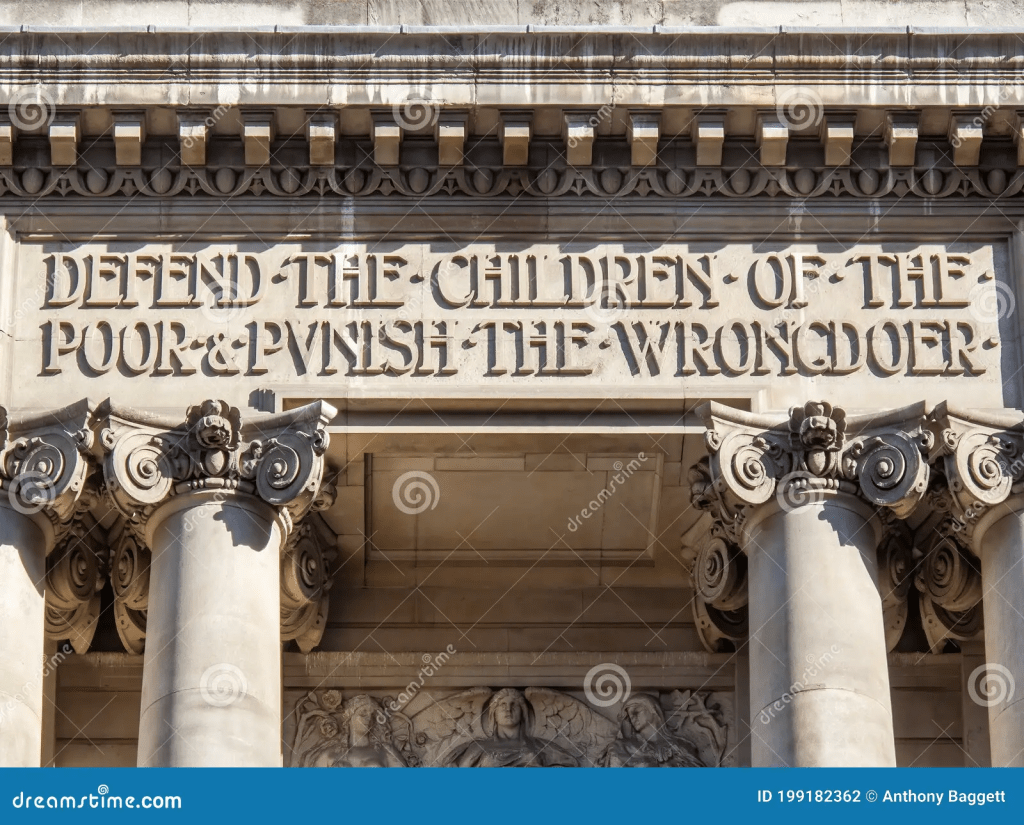
“Defend the children of the poor, and punish the wrongdoer” [Biblical phrase — adapted from Psalm 72:4— inscribed above the main entrance of “the Bailey” —Central Criminal Court, London, aka “Old Bailey”]
That Egyptian, after some punishment, should be given a choice— back to Egypt, or up against a wall. In fact, maybe just put him up against a wall anyway.
What is it all of a sudden with Egyptians? They are fleeing the country due to alleged oppression and we are sold holidays there because its safe , make it make sense.
— Somewhere in the south🏴🇬🇧✝️ (@Emmaloucol19) October 17, 2025
Egypt is still OK for a holiday, so long as you are in a good hotel. Admittedly, I have not been there for about 27 years. As a country, Egypt welcomes tourists, but not political dissidents, potential terrorists, or spies.
The persecution continues. The Motability scheme isn’t some luxury add-on or “extra help”: it’s simply a different way of receiving the disability benefits that people are already legally entitled to. It’s not a perk that means a free Beamer FFS. #TakingThePIPpic.twitter.com/jTdHIMdEKj
The Starmer-stein Labour Friends of Israel misgovernment. Rachel Reeves’ spending cuts take away monies from various groups of mainly English/British people in order to have money to waste on migrant-invaders, Ukrainians, and Jews (in the UK and in Israel).
Rachel Reeves is evil, as well as being a moneygrubber and an expenses cheat.
As already mentioned, it is hard to see who will be left able and willing to vote Labour. Even “the blacks and browns” are largely charging for the exit. The Muslims certainly are, despite attempts to placate them.
Hard to see many pensioners, or those approaching pensionable age─ say anyone over 55, voting Labour, despite Reeves and Starmer keeping (so far) the State Pension Triple Lock.
The previously very supportive under-30 group of potential voters also seem to be turning their collective face against Labour, and going Green or LibDem; some are now turning to Reform UK as well..
Looked at like that, the at-first surprising (?) recent polling suggesting only 15% of voters intend to vote Labour makes sense.
Late tweets seen
Following reports of destruction by Israeli soldiers of the Sheikh Ejleen sewage plant in #Gaza – financed with German taxpayer money – Germany's Federal Development Ministry (BMZ) responds for the first time.
The Kiev regime must know that, at the end of the day, Russian forces have 6,000+ nuclear weapons. Russia may not want to use any in Ukraine, but the fact remains that, should the orders be given, Kiev and other major centres of population and industry could be reduced, entirely, to rubble and radioactive ash in a matter of, at most, half an hour.
…because Russian forces are slowly but steadily advancing along the entire active front.
Late thought
Just saw the film Oppenheimer, about the atom-bomb scientist. Pretty good, but too long by about half an hour and that last 30 mins or so of typically-American stuff about postwar legal arguments, and Congressional hearings, could have been cut out without loss.
One part of the film struck me, though the specific facts were not new to me, I having read books about the Manhattan Project and the atom bomb spies etc.
The film reminded me that the scientists at Los Alamos in the early 1940s were concerned that the first atom bomb might start a chain reaction which would be unstoppable and cause, inter alia, the atmosphere of the Earth to ignite. Despite that possibility still existing at time of detonation of the first full test, they decided to go ahead. Why? Well, almost all of the important scientists were Jews, and for them the defeat of the “antisemitic” German Reich was more important than the possibility that all life on Earth might be destroyed.
Lesson? For “them”, it really is always “all about them”…
Late talking point
Starmer-stein, for whom real British people always come second, third, fourth, or last…
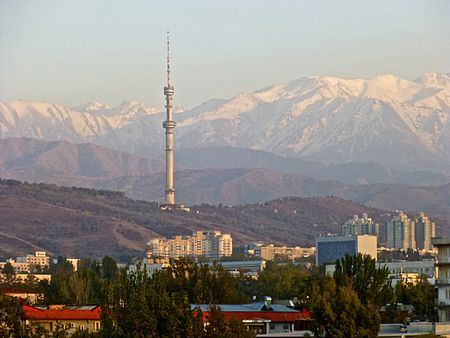
In 1997, I moved back to London after having spent an interesting year in Almaty, Kazakhstan. Almaty was, even then, a quite large city, was at the time the capital of Kazakhstan, and boasted green spaces, tree-lined streets, pavement cafes, pretty girls in short skirts (or furs, depending on the season), a city as hot as 40C in high Summer, sub-zero and snowy in Winter.
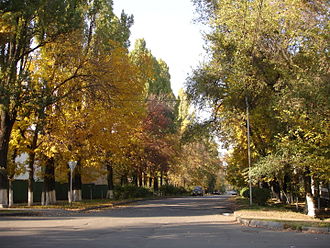
[immediately above, Pushkin Street, not very far from where I lived at one time]
[above, Almaty in Winter]
On returning to London after 12 months, in late September 1997, I found that it was easier to be “offered” another overseas position than to actually get one. In the world of the headhunters, words are cheap. I found myself rapidly running out of funds in a London where the weather became wet and then cold and wet; in fact, my very first day back in London, it became necessary to visit Knightsbridge to buy a raincoat (unnecessary in Almaty, where it rains heavily for only a few days in the year). I went on holiday to Minorca and then, after a number of fruitless meetings re. possible contracts (everywhere Russophone from Moscow to Moldova to Baku and back to Almaty) sat down to decide where to winter, in the hope that a new contract might be offered in the upcoming new year; it was by now already early December.
It had to be somewhere both reasonably warm and reasonably (if not very) cheap. I considered the Canaries, Asmara (Eritrea) and a few other locations, before settling on Egypt, partly because I had been there before (only briefly though, a short break at the Luxor Hilton a few years before), partly because I knew that it could be cheap if one did not stay at a luxury-grade hotel, partly because it would be pleasantly warm even in December. There had also just been a terrible massacre at the Temple of Hatshepsut in the Valley of the Kings (across the river from Luxor), which led me to consider that there might be cheap flights and hotel rooms on offer.
What spoiled the flight part of the plan was that after the news media reported the massacre, the package tour and cheap flights people immediately cancelled all flights to Egypt. However, I had already decided by then to go, my resolve hardened by a pointless breakfast meeting at 0730 (!) with a couple of American “emerging markets” hucksters at the Mount Royal Hotel near Marble Arch, after which I got an overpriced taxi back to Little Venice in the pouring rain and chill.
Olympic and Egyptair were still flying, so I bought a ticket to Aswan via Athens and Cairo.
Egypt
Cutting through the detail of my first weeks in Egypt, I stayed in subtropical Aswan (it’s 1 degree North of the Tropic of Cancer) for 2 weeks before spending a couple of dull weeks at an almost deserted, beautiful and undeveloped beach (living in a large tent) near the then almost uninhabited and tiny settlement of Marsa Alam on the Red Sea. Served by one bus every day or two, it was hard to get to and harder to escape from… (now, over 20 years later, that almost derelict area is very different, has luxury hotels and even its own international airport!). From there I went, not without difficulty, to Alexandria, a journey of at least 12 hours by both what in Tunisia is called voiture de louage (a 6-seat car shared by 5 customers and driver) and long-distance bus via Port Safaga, al-Quseir and Hurghada.
I had already selected a small 3-star hotel on the Corniche in Alexandria, thanks to my Lonely Planet guidebook. Walking distance from Ramla, the central place in Alex. However, unknown to Lonely Planet, the buses no longer terminated at Ramla for reasons of traffic control, so I ended up pulling my heavy (thankfully, wheeled) suitcases (inc. portable typewriter) miles along the Corniche (seafront).
After a day or so, I decided to stay in the supposedly good semi-gated beach suburb of Mamoura Beach, at the Eastern extremity of Alex. If possible, I would then rent a flat there via a local agency.
As anyone who has spent more than a brief holiday in Egypt will tell you, organization is not to be expected, chaos is the norm…
At the railway station, which was not busy, I got a local train. It terminated at Abu Qir, which was the place where, in the bay of which, Nelson defeated a French fleet at the Battle of the Nile in 1798 (the westernmost mouth of the Nile itself is now a few miles to the East of that bay).
I had bought a ticket to Mamoura. The train would then continue only for two or three stops until it finished its journey. The seats were polished wooden benches and the train’s journey passed at a snail’s pace. Eventually the train reached Mamoura. I disembarked. It was still mid-morning.
I was not entirely expecting the typically Egyptian scene outside the small station. Crowded streets, traffic, donkey-carts carrying aysh (flat and usually very tasty Egyptian bread), schoolchildren in uniform (this was the first day of Ramadan, so they had probably been sent home early). I had been expecting a quieter sort of place.
What I did not understand at the time was that I had got off at the wrong stop. I had assumed that the nearest station to Mamoura Beach would be Mamoura, whereas in fact the latter was a suburb to the East of Mamoura Beach. I should have disembarked at Montazah.
I had a map, but not a good one. I walked through a couple of crowded residential streets going North, in the direction of the sea. I came upon an Islamic cemetery, the wall of which had a gap on the other side. A small boy was climbing through it. I assumed (wrongly, again…) that he must have been going to the beach, so I followed. When I arrived on the other side, the boy had gone and I found myself in a large open area with some buildings in the middle distance. I saw some soldiers doing road repair on an unused roadway. Their sergeant, when approached, directed me (thanks to my Arabic phrasebook) to where there was the hotel (the only one) on Mamoura Beach, and where I had thought that I might stay. He helpfully wrote the name of that hotel (as I thought) on a scrap of paper, in case I needed to ask anyone else.
I carried on but was surprised to see that the beach, cut off by barbed wire, appeared to be mined. The skull and crossbones motif and a warning in Arabic and English made that plain. As for what I thought was some kind of disused military camp, it appeared now to be, well, an in-use military base. Oh dear…
I walked on and found myself next to a large ground-to-air missile battery, with 4 missiles in place, pointing upward at about 45 degrees.
Realizing that I had to get out, I moved across cut grass towards a distant wall, only to find that a small pack of what seemed to be wild dogs, sunning themselves near the wall, had noticed me. I slowly moved away, tracked parallel to my course by one of those dogs. This was not a military base as known in the UK, USA or even (where I had been in 1977) Rhodesia.
It was at that moment that an officer spotted me and sent over a young sergeant to me to see who was this European wearing chinos, climbing boots and a tweed-style jacket. After I had dropped the half-brick I was carrying (in case the dog attacked), the sergeant escorted me to the officer. A short conversation later (in which I tried to thank them for their help and to walk out of what I could now see was the nearby guarded exit from the base), ended with me taken a few steps to a nearby low building, which turned out to be the Officers’ Mess. Half a dozen curious officers came out, one with a wooden chair, which was placed in front of me. I was gestured to sit. The officers were not unfriendly (several shook hands with me), but just very curious. It felt like being treated as were the shot-down fliers of the First World War. The only thing missing was the bottle of champagne.
Minutes later, a car rolled up, which turned out to contain a major and a captain, who turned out to be the security officer (major) and intelligence officer (captain) of the base. The major searched me, including my boots (while still on my feet), then I was placed in the car and driven away. Thus began a boring but not uneventful day.
The major and captain (the latter more pleasant and I thought probably from a more cultured background, though that was just an impression) questioned me over some Arab coffee (which I like). The captain spoke English, the major none or almost none. There was no rough stuff, no violence or obvious threat. However, they went over my reasons for being in Egypt, in Alex, in Abu Qir and, most of all, on their base.
It turned out that the address in Arabic scrawled by the sergeant I had encountered was not the Mamoura Beach Hotel but a special Soviet-style hotel for officers only, just by the base. Why did I have this in my pocket? Why did I have a Swiss Army knife? Why did I have a map, a small torch, a phrase-book? And so on. One officer casually remarked that, the year before, they had caught an agent of MOSSAD. I have no idea whether that was true, or if so what happened to him, and I decided not to ask, or to appear too interested in what happened to spies in Egypt. I just evinced what I hoped sounded like polite slight interest.
Several times, I asked for the British Consul. The responses were almost amusing, but it was hard to see the joke: “the Consul? Oh, no, the Consul is only for the most serious cases. You don’t want to be treated as a serious case, do you?” or “the Consul will be busy. We just need to ask a few questions more.” When I said that I needed access to the Consul because I was under arrest, the answer was “No, no! You are not under arrest. You are very welcome in Egypt!” (“Ah, so I am free to leave?” “Once we have asked a few more questions…”).
After a couple of hours of such light diversions, including my asking about whether the base had been once a British one, which was me trying to lighten the atmosphere as well as genuine curiosity (they said no), I was informed that I would be leaving, but only because some civilian colleagues needed to speak to me. This was not good news. The Mukhabarat (security police, secret police) is a ubiquitous and feared organization in Egypt. I had entertained a slight hope that the Army might just release me as innocent tourist with a warning not to stray in future. Vain hope.
I was escorted out of the office into a larger reception-style office crowded with ordinary Egyptian soldiers, many of whom were plainly there to catch a glimpse of me, though none said anything. There was also a very sinister body, a civilian, in a light brown leather jacket, with dark glasses and heavy stubble, who absurdly —in that situation— pretended not to have noticed that a foreigner was in the reception area. One of “them”, of course.
I was taken by car out of the base in a car driven by the young sergeant, my fellow passengers the captain and the major. Alexandria is about 20 miles long but only a mile or so deep. It runs along the coast. We were driving now from the edge of the city, past vegetable allotments and near the sea towards central Alex. It was not long before we were in one of the suburbs of Alex not far from the centre of the city (as I thought; I did not then know the city, of course). I thought that we were possibly in the Chatby neighbourhood. The car stopped by a quite high wall. A door was there. We were admitted. On the other side, there seemed to be a fine looking white house, like a small palace, amid luxuriant gardens. There was a little white painted waiting building by the entrance. We waited. The captain left. I lightened the atmosphere by asking the young conscript how come he was a sergeant at such a young age. He blushed as the major asked what I had said! When the sergeant translated it, the major laughed.
A civilian with a long scar down his cheek came to take me into the house. The soldiers left, the major shaking my hand. In a way, that seemed ominous.
Inside, the house was all marble, white and gold. I was shown into a glitz-palatial room, with white and gold chairs around a long low coffee table. It was the very image of the rooms in which Saddam Hussein used to receive his visitors.
Already gathered there were my new interrogators, several Mukhabarat officers. The only one who said nothing was Scarface, presumably there to provide the muscle in case the dangerous spy tried to escape or to kill those present with his bare hands.
A boy came in to take orders for coffee. Displaying all the confidence of my dozen words of phrase-book Arabic, I requested “aqwa mazboot, min fadlak” (loosely meaning Arab coffee with a little sugar please) and one of the Mukhabarat people jumped on it: “oh, so you speak Arabic?!” “I have a phrasebook, that’s all”. “But you ask for coffee with a good Egyptian accent…” and so I nearly became the first man hanged (well, not really, but halfway there) because I owned a good phrasebook. Thanks, Berlitz!
I tried the ask-for-British-Consul thing again, with the by-now-expected response: “The Consul will be busy…You are not under arrest…You are welcome in Egypt…We just have to ask a few questions” etc.
Then the polite but persistent questioning resumed: why was I in Egypt? Why was I on the military base? “What do you think of Israel?”; “I have always opposed Zionism”; “Oh, why would you answer thus to an Egyptian intelligence officer?” Smiles all round, mine by far the most nervous.
Another strange question: “what do you think of Princess Diana?” [who, as mentioned above, had died about 3 months previously]; “I have no particular view of her”; “Really?” [incredulously]…”all Egyptian people love Princess Diana”. Now it was my turn to respond “really?”. “Yes…I myself met Princess Diana here in Alexandria.” I supposed that that was plausible, Mohammed Fayed (father of her lover, Dodi Fayed) having originated in Alex.
Yet another strange question: “why do British government not clear the mines that they put on the beaches of Egypt?”, this a reference to the thousands, maybe millions, of landmines placed under the sands of Egypt (beaches and inland) by the British, Germans and Italians during the Second World War. There are even some on Red Sea beaches. The barbed wire with the warning symbol and English/Arabic “Beware Mines” is everywhere in some regions. I could only nod sympathetically and indicate that I had no influence or power over the British Government or its actions… All in all, this was a very odd little tea party or, rather, Arab coffee party.
In the end, after a couple of hours, it was decided that I had to return to my hotel on the Corniche to get my passport (I carried around only a photocopy). Scarface, a younger officer and a driver accompanied me.
The expressions on the faces of the staff at the hotel were telling: they were petrified. They knew at once who my “guests” were. The officers examined my baggage, my passport etc. They were most interested in the typewriter, my snorkelling equipment (especially the very large “professional”-size fins) and my sole reading matter: Barbarossa, by Alan Clark.
I was surprised that we did not return to the villa, but went to another, possibly more central neighbourhood (not knowing the city, I was trying to see clues to where we were). The driver was a professional, the only one I ever encountered in Egypt who did not use the horn incessantly. It was now drizzling as darkness fell, and as we drove slowly down a street of tall pre-WW2 houses, rather reminiscent of Paris (Alex having been effectively under joint Anglo-French control in the decades up to the late 1940s), the streetlights showed a steel barrier ahead, guarded by a phalanx of uniformed security police with submachineguns, the rain glistening on their short capes, again reminiscent of old Paris. They were ready for trouble, wearing not caps but steel helmets. As our car approached at a snail’s pace, the driver signalled twice using his headlights. The barriers were parted for us.
The car stopped. I was asked to disembark. The air was fresh and cool, as it often is at night in the Alexandrian winter. I was not restrained in any way. After all, to where would I run (even if I were not shot in the back)?
We were outside what had obviously been the townhouse of some wealthy merchant of the late 19thC. Depressingly, the windows were all barred. At first, I thought that I was going to be actually imprisoned in that place.
Above the door, the coat of arms of the Mukhabarat, incorporating the Egyptian all-seeing eye and a hawk or eagle (I think hawk: Horus was “the Hawk of Light” in ancient Egypt; that eye was his eye, “the Eye of Horus”). Also, the words, in Arabic and English, “State Security Headquarters, Alexandria”.
I was led in. At one time in the mists of history (well, pre-1945 anyway) the entrance hall must have been quite grand. A very high ceiling, a wide curved staircase leading up to the next floor, a crystal chandelier, a generally white and gold ambience. An entrance hall for a Hollywood film, perhaps one starring Fred Astaire and Ginger Rogers. Or some version of Anna Karenina. The effect was spoiled, however, by the general lack of maintenance and cleanliness, the long sofa with its dirty fabric badly torn, and the battered old wooden table, at which sat a scruffy middleaged fellow in a warm jacket, his revolver casually in front of him on the table, together with a clipboard and a landline telephone.
Once I was left there, this individual struck up a conversation as I sat on the sofa that the Mukhabarat might have taken from a skip, so old and used was it. There was no-one else around. Kafka-esque. The “receptionist” told me that I was waiting to see the general in charge of all state security in Alexandria. He would then order my release. I had little confidence in that, having been given the run-around all day and knowing that Egyptians can have an odd sense of humour (and a certain streak of sadism, somehow, too). Still, I had no choice but to wait.
At one point, around 1900 hrs, some people arrived and ascended the staircase. The night shift? Or do secret police personnel find the night more congenial for their work? One fellow, dressed in what looked like an expensive suit, was obviously important, because the scruffy receptionist actually got off his rear to greet him. The new arrival looked rather comical to my mind, in that he seemed almost as broad as he was tall, like the British advertising cartoon seen on posters and TV in my childhood, “Mr. Cube”, who was the face of Tate & Lyle sugar. There was something slightly sinister about this man, though. He stopped part-way up the grand staircase and turned round to look at me briefly. His gaze was or seemed quizzical.
I was later escorted by the scruffy fellow upstairs and through quite bright, well-appointed corridors to a small but comfortable office occupied by, as the reader may have guessed, “Mr. Cube” and a colleague, the largest person I ever saw in Egypt. They were friendly enough, and Mr. Cube (aka General Cube, who introduced himself only as the head of state security in Alexandria) explained that before I could be released, he would have to be satisfied that I was not a spy. So we ran through all the same stuff all over again. Mr. Cube was not unfriendly and had some Turkish or Arab coffee brought in, the best I have ever had, served in exquisite tiny china cups. Very welcome after a foodless day (I had not even had breakfast).
At the end of our talk, Mr. Cube did a strange thing (but one I later read about in relation to both the Soviet and British intelligence services). He just looked at me, straight in the eye, and his friendly demeanour turned into something so chilling and indeed evil that it has stayed with me to this day. His gaze seemed to be penetrating deep into my consciousness. The word which came to mind later was “pitiless”. This was a man who might be capable of anything and quite probably had tortured and killed people. Then Cube turned off the terror as easily as he had turned it on, and pronounced that he thought that I was not a spy, but that he had to get clearance from Cairo before releasing me. He busied out of the office and his large assistant clapped me on the back in a friendly way (which felt like the blow from a large bear must feel).
Half an hour later and Cube was himself driving me back to my hotel in his own (very modest) little car (I think that it was a Fiat). It was almost midnight, about 2300 hours. He wished me a pleasant stay in Egypt (in fact I did stay, for another 2 months) and I entered the hotel again. Again the faces of the staff said it all. They obviously had not expected to see me again. The waiter even raised his arms in the air and quietly cheered, as if a goal had been scored.
Well, I did many other things in Egypt but that’s enough for now. If anyone ever asks me about my longest trip to Egypt and what happened, I just say that I was “not” arrested…
Alexandria, San Stefano (now redeveloped)
Early morning sea view from the Corniche at Alexandria
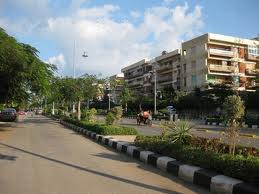
above: the main residential road in Mamoura Beach, Alexandria, where I rented a flat a few days after the events described above; I lived there for a month
above: Mamoura Beach. When I was there it was off-season, January, but quite warm in daytime, though cool and often wet at night.
above: Old Montazah Station, near both the Montazah Palace and Mamoura Beach where I lived for a month.
The short 1946 film below shows mainly the grounds of the Montazah Palace in Alex, not far from where I lived for a while; it also shows the Corniche.
Alexandria was much better under European rule and/or influence!
[above: scenes from pre-Nasser Egypt: Cairo, Alexandria and elsewhere]
[below: old Alexandria]
[below: amateur film from, at a guess, a few years ago. It shows some places I occasionally frequented, such as the Brazilian Coffee Stores in central Alex, mentioned in Lawrence Durrell’s books known as The Alexandria Quartet: https://en.wikipedia.org/wiki/The_Alexandria_Quartet]
[below, a critical look at Alexandria as it is now]
Below, another view of Alex as it is now:
Another (less impliedly critical) film, below:
above: scenes of Alex, the one immediately shown above being the Montazah Gardens, surrounding the Montazah Palace. Easy walking distance from my one-time temporary refuge at nearby Mamoura Beach. I was there a couple of times. An oasis of tranquility.
below: amateur video from the city
A few further thoughts…
When I was first in Alex (as every foreigner calls it before long), my impression was of a kind of Miami Beach, or as such a place might be after large-scale devastation and/or long-term neglect. Ironically, one seafront part of Alex is actually called Miami! Maybe that’s where the more famous one got its name, but [see Note, below] apparently not.
Despite the acreage of decaying concrete there, despite the nuisance of a goodly part of the population, despite the traffic (and noise thereof), despite despite despite, there is something compelling about Alexandria, at least to me. The sea is a large part of that. The sea at Alex is so beautiful that not even the decaying concrete and the often-ghastly people can ruin it. I was there in winter, and it may be that winter, or perhaps slightly earlier or later, is the best time there. In any case, the 5+ million population swells even more in summer, and Alex must be unbearable then. When I was there, in 1998, the settled population was “only” 3.5 million, so has grown by about 50% in just 20 or so years! Before the Second World War, the population was below 1 million.
There is, or was, something indefinably romantic about Alexandria, despite everything (concrete near-ruins, street nuisances, general chaos, tasteless redevelopment —the most egregious example since I was there being the huge excrescence now at San Stefano). I am not sure that I have any wish to return to Alex, but I cannot say that I never shall.






 Ian Robert Millard