
Well, not me personally! In fact, the title refers rather to those who have tried to attack me over recent years.
Beyond those who seem to be obsessed with me personally (see below), I have noticed over the past 7-8 years on Twitter (my own account was closed down in 2018) that the platform does seem to attract many people who are mentally not normal in various ways. Indeed, many of those seem to take pride in their flawed mentalities and either proudly proclaim themselves to be this, that or the other, or frequently describe their conditions, medication, battles with the DWP or NHS etc.
I tend to look mostly at the more political side of Twitter, and there one does find a lot of mental instability and worse, and that particularly applies to those supporting Zionism, as well as “antifa” idiots. Most who attack me have mental problems (admitted by the individuals themselves).
When I had a Twitter account, one particular little bumboy even incited his relatively few followers to pour petrol over me and immolate me. I could not be bothered to report it to the police (or Twitter) at the time, though Twitter did suspend the pathetic degenerate’s account for a week. I daresay that he will get what’s coming to him in the end, one way or another. He will probably die of AIDS or something before any punishment comes to him from elsewhere. In the meantime, the same unpleasant little blot on humanity still tweets about me and how “evil” I supposedly am, though he does so only occasionally now. He thinks that he is anonymous and hidden, perhaps. He recently tweeted that he is “absolutely fine” about Nigel Farage being attacked with battery acid. Are the police interested? Probably not, since he has not posted rude pictures of one of the tame thick princelings and/or the Royal Mulatta, and has not tweeted anything “anti-Semitic”. One law for all? Hardy ha ha.
Dr. Tim G. Stevens
There again, we see, here below, another nuisance troll who spends time on Twitter: Dr. Tim G. Stevens, NHS consultant psychiatrist from Essex (via South Africa and Newcastle). He tends to tweet in the Jewish and Zionist interest, despite not being Jewish (certainly not full-Jew). He is in favour of mass immigration in the UK and was anti-apartheid as a Trotskyist student in his native South Africa. All the same, it seems that he has no desire to return to build the wonderful new “rainbow nation” South Africa, ruled as it is by an increasingly violent and corrupt African majority rule “democracy”. He is obviously capable enough of seeing the folly in that, but look at this absurd and recent tweet!
Proof positive of mental disorder!
At first, Dr. Tim seemed to regard me as a person simply espousing an ideology with which he disagreed, but over time he has become virulently hostile, as can be seen in his tweets here below.
Dr. Tim’s own mental health seems to have deteriorated between 2016 and 2018, looking at a selection of his many tweets about me. Just my honest opinion, of course. He starts off by being quite thoughtful in 2016, but by 2018 is all-out offensive and stupid.
Looking back at 2016, I wonder whether Dr. Tim started to understand that, in the 1930s, it was the norm for at least the leading or influential National Socialists to be highly educated, intelligent etc. The same is in fact true in 2019 of many social national people, but the Jew-Zionists, the “antifa” idiots etc usually want to portray them as “knuckledraggers”. Perhaps it is this cognitive dissonance that has sent Dr. Tim off the rails, apparently. He has recently been tweeting about how he has clinical depression and is on medication for it.
Even in 2016, Dr. Tim seemed obsessed by me and a couple of other tweeters:
In 2016, I am not (yet?) a “knuckledragger”, but by 2017 Dr. Tim thinks that I am a “sad sack“. Ironic, in view of his own (though only recently publicly-admitted) depressive condition…
In fact, and in case anyone is curious, I myself have never been diagnosed with any mental illness or condition…
An odd thing, though, for a psychiatrist to tweet about someone. Not very professional. I am aware that he has also made very unprofessional comments about others in recent years. Examples: Jo Stowell, photographer, formerly of Bristol, for one; also about Alison Chabloz, the persecuted satirist, singer and songwriter.
Dr. Tim attempts a little cod-diagnosis by tweet. Pathetic. Is this the sort of diagnostic skill he uses on his Chelmsford patients?
Obsessed Dr. Tim replies to someone on Twitter who defended me:
Dr. Tim’s journey downward, from 2016 to 2018…
2016:
2017: Ironic. Self-described depressive case (and actually on medication) “Dr. Tim” describes me (never diagnosed with any mental problem or illness) as a “sad sack”.
It does seem rather unprofessional, though, for an NHS consultant psychiatrist to describe anyone as a “sad sack“. It seems to indicate an odd attitude to his own psychiatric patients, particularly those suffering (like Dr. Tim himself) from depression.
Dr. Tim is also a hypocrite:
Others supported me in 2017, at which time I was still on Twitter:
2018:
Dr. Tim is perhaps angry because my instinct told me that he might be partly-Jewish and I tweeted about it once, several years ago. An educated guess based on his general look (not conclusive by any means), his attitude (he not infrequently tweeting about how others envy his professional status and supposed “success”, for example), his constant tweeting about “anti-Semitism” etc, and his being accepted openly as “one of us” by outright Jew-Zionist trolls on Twitter.
In the past, Dr. Tim claimed that one of his grandfathers was an SS officer who died at Stalingrad. At other times, he seems to have tweeted that the same officer was in the Wehrmacht and not the SS. Either way, he tweeted that he was ashamed of that officer, who (assuming any of it is true) seems to have perished defending Europe from Stalinism.
Now it seems that Dr. Tim believes himself to be part-Jew; he has been tweeting about it:
Dr . Tim tweets further (in answer to tweeters who have been arguing with him over his enthusiastic support for controversial electro-shock “therapy”):
and Dr Tim admits that he often cannot think logically or coherently by reason of his mental condition:
and another person with mental illness “issues” replies.
“@cdaargh”
https://twitter.com/cdaargh/status/1017900289582600192
Tweeter “@cdaargh”, above, formerly known as “Christine of Aargh”, is someone with mental problems, and who supplements her prescribed medication with self-medication (whisky). She is not known for her diplomacy, as evidenced by this amusingly crazed (though understandable) tweet to the then Prime Minister, David Cameron-Levita, in 2015:
https://twitter.com/cdaargh/status/643091968424288256
[Update, 14 October 2025: now that “cdaargh” has locked her Twitter/X account and stopped tweeting (since 2022), her amusingly-crazed tweets cannot be read, but I cannot fail to commemorate one of her best ones, in which she described the then Prime Minister, David Cameron-Levita as, and so replied to one of his official tweets, “you pus-faced shitlizard wankgoblin“. Legendary…].
She does not mince her words generally:
https://twitter.com/cdaargh/status/506882678277570560
https://twitter.com/cdaargh/status/506158192385335296
She has been obsessed with me for several years. Examples of her tweets:
https://twitter.com/cdaargh/status/760851570456010752
https://twitter.com/cdaargh/status/764149046822969350
https://twitter.com/cdaargh/status/762811505834352640
“@cdaargh”, a Jewess, used to troll anyone on Twitter who chatted with me (about anything):
https://twitter.com/cdaargh/status/640186495698137088
@cdaargh” linked up with a minor Jewish academic called Ben Gidley, “@bengidley”, who was was secretly using the Twitter name “@inthesoupagain” to troll people (Twitter suspended the account permanently in the end, after which “Soup” —Gidley— started an identical account called “@antinazisunited”, now also apparently suspended, though tweets earlier than May 2019 are still extant). He also seems to run Twitter account “@bobfrombrockley” and other accounts, a fact which has often made me wonder whether he ever gets any work done at Birkbeck or Goldsmiths colleges (University of London)! Another one obsessed with me (and “anti-Semitism”, of course).
https://twitter.com/cdaargh/status/793827438958555136
“Christine” loved it that I was disbarred, and she was too stupid to see that it did not harm me in the slightest (because I had ceased practice 8 years before). I wonder whether “Christine” herself has ever had a job, let alone a profession? I doubt it.
https://twitter.com/cdaargh/status/794650967736258561
[Update, 7 February 2026: another of her tweets also deserves immortality: some tweeter asked people what would be their favourite Olympic sport. Her reply? “Catapulting politicians onto a wall lined with spikes“! Again, legendary craziness…]
Quite a number of decent tweeters stood with me against these crazies:
https://twitter.com/cdaargh/status/793825120976384000
“Christine/@cdaargh” admitted that half the tweeters she hit with demands to block me then blocked her instead!
https://twitter.com/cdaargh/status/726211780972793856
https://twitter.com/cdaargh/status/725489838057787392
https://twitter.com/cdaargh/status/692486806097498113
Well, “@cdaargh” only tweets occasionally now. Looks as though she is back down the rabbithole or somewhere. I could show hundreds of other tweets from her in similar vein, but there it is… Her latest tweets at time of writing of this article:
https://twitter.com/cdaargh/status/1139582916432994304
Bye! See you at the tea-party sometime!

A few more tweets from “Christine”:
https://twitter.com/cdaargh/status/1143214575057342464
https://twitter.com/cdaargh/status/1143223983665553408
Andrew Roberjot aka “@frankiescar” / “flying”
A Zionist Jew who seems to spend a great deal of time on Twitter is tweeter “@frankiescar”, aka Andrew Roberjot, a kind of legal groupie (though apparently unqualified), who is so odd that he actually turned up to gloat when I was before the Bar Disciplinary Tribunal in 2016. While he is not (as far as I know) actually clinically mentally-disordered, he is an obsessed Zionist who, like Dr. Tim, has an elastic relationship with the truth. Here, below, they discuss my ability as a barrister, and my life at the Bar in the 1980s (in fact, I was still a —belated— student then, and, having spent years in the USA, was Called to the Bar only in 1991):
Roberjot “diagnoses” me! Ah, well, why not? Stevens is little better, and he is apparently a qualified psychiatrist (though I have never heard of one behaving as he does). Note that NHS “consultant psychiatrist” and depressive case Dr Tim “likes” Roberjot’s “diagnosis”…
I wonder whether I should make formal complaint against Stevens to the GMC? His behaviour seems very unprofessional, to say the least. I shall have to think about it. I usually prefer to not bother with the like. On the other hand, “Mark Lewis Lawyer” laughed when people said that they would complain against him. Well, he’s not laughing now…
Note that “@frankiescar” (Jewish Zionist knowall —or know-nothing— Roberjot) agrees with some other crazy Zionist that I was “a prospective Tory candidate” in years past. Not only have I never been a prospective candidate for any party, but have never even belonged to the Conservative Party (or to any System party)! Complete fabrication. Well, after all, what else can you expect from (((them)))?
Mike Stuchbery
Yet another one who has mental “issues” is Mike Stuchbery, who has tweeted against me in the past, gloating at my disbarment etc if I recall aright, though there were so many unthinking deadheads and “antifa” idiots like Stuchbery doing that (especially in late 2016, soon after my disbarment) that by now I have forgotten almost all.
Stuchbery poses as both “journalist” and “historian”. In fact, he was briefly a (later discredited and sacked) supply teacher in a comprehensive school, who now is always asking his Twitter followers for money):
Not all of Stuchbery’s readers on Twitter are sympathetic…
Stuchbery is better known for having quite recently organized people to go to Tommy Robinson’s family’s home, while also organizing the filming of the incursion. What Stuchbery did not anticipate was that Tommy Robinson would turn up later at his, Stuchbery’s, house! Collapse of stout party! In fact, meltdown…

Stuchbery’s modus operandi is to sit in the rear and co-ordinate information about any broadly “nationalist” activists, from UKIP and Brexit Party through Tommy Robinson and on to social nationalism. He does not expect to be directly involved in the violence he can be said to have incited (he himself claims that his actions fall short of incitement), but he supports it with weasel words, and he certainly does not expect to be called to account for his actions (see photograph above!) . The Tommy Robinson episode may have taught him a lesson, i.e. “what goes around comes around”. I wonder.
Louise Mensch
Then again, we have others, affected by mental problems, drugs, whatever: Louise Mensch, for example. The one-time “chick-lit” scribbler as Louise Bagshawe) and pro-Zionist, who is married to a New York Jew and now lives in Manhattan), was briefly the “Conservative” Party MP for Corby (under her married name, Mensch, not her, er, “maiden” name of Bagshawe):
https://en.wikipedia.org/wiki/Corby_(UK_Parliament_constituency)#Elections_in_the_2010s
https://en.wikipedia.org/wiki/Louise_Mensch
https://www.newstatesman.com/politics/2012/11/louise-mensch-corby-was-nothing-more-stepping-stone
Before she scribbled “chick-lit” books and became an MP, Louise Mensch worked for EMI, at which time she was a heavy drug abuser. She has admitted being left with “long term mental problems” by reason of her drug abuse.
Apparently, she was also a very promiscuous rock music groupie too, at one time, a fact that the 2010 Conservative Party campaign at Corby failed to mention:
https://www.buzzfeed.com/jimwaterson/louise-mensch-university-heavy-metal
https://forums.digitalspy.com/discussion/1910179/louise-mensch-super-groupie
Oxford University has, of course, always been famous for bikes (though mainly of the 2-wheeled type).

[above, Louise Mensch, smoking drugs]
Hard to believe that the Conservative Party made a ghastly and ignorant bitch like that an MP, even if it lasted in the end no more than about 15 months. Oh, well, maybe not, looking at some other MPs…
Louise Mensch has of course admitted being “left with long-term mental problems” because of her drug abuse, and is now notorious for making up claims about supposed Russian involvement in American and UK elections, claims that have recently been exploded by independent research. Even Nick Clegg, for Facebook, has now agreed with that.
Mensch personifies the absurdity of Twitter: with 289,000 “followers” (whether bought or real; perhaps genuine), she no doubt thinks herself very influential, but her real political or other influence is effectively zero.
https://twitter.com/BarbaraMcK42/status/903381817754923008
Louise Mensch was almost manically or hysterically happy when I was disbarred in England, and actually tweeted directly to me to say that she was going to make similar complaint against me to the Bar of the State of New York. She thus managed to display simultaneously not only her lack of any class, but also her ignorance about the New York Bar and its rules, and about US Federal law (including the US Constitution).
Louise Mensch. What a stupid demented cow! When she realized that she had no leg to stand on (little matters such as the U.S. Constitutional free speech provisions, the fact that she was never my client, the fact that I have in fact never practised in New York despite being qualified and Admitted there… etc), she deleted the tweet. In fact, she seems to have deleted all her tweets about me.
https://twitter.com/ElToroSolo/status/634925040400736256
https://twitter.com/perspolicy/status/1033382602307198976
Another point: anyone who thinks that attendance at Oxford University guarantees a good level of knowledge should take a look at types such as Louise Mensch…Like so much of Britain, Oxford University has been living off its hump for a very long time.
Mark Lewis
Abusive Jew-Zionist solicitor Mark Lewis, whose mind has been damaged either by his multiple sclerosis condition or the drugs used to control or ameliorate it, admitted when on trial before the Solicitors’ Disciplinary Tribunal that at times he had no idea what he was doing, saying, or tweeting! After having being found guilty, he fled to Israel with his carer/”partner”.

Rather than go through all the details of Lewis’s crazed behaviour, I refer the reader to my previous studies about him, which can be found on my blog pages via the search function. Incidentally, he has never even threatened to sue me for any of what I have written about him…
“Slatfascists”
Then we have the persistent Twitter troll (he’s also on GAB and other platforms) known, inter alia, as “‘@slatfascists” or “Dave”. Another one with mental problems — this becomes almost tiresome, but this article is being written to show the strong link between “antifa” (and also some Zionists) trolling and snooping, and mental disorder.
“Slatfascists” is often in contact on Twitter with other “antifa” idiots and also Zionists such as “Mark Lewis Lawyer”. Supposedly Mancunian (like Lewis), his main interest other than trolling/snooping is playing some stupid online game in which the “space cadets” pretend to be commanders of spaceships! Beam me up! Once, “slatfascists” did not take his medication and had a Twitter meltdown. Out of misplaced compassion, I deleted my Twitter comments about the episode. As the Bible says, “do not give that which is holy to the dogs, lest they turn and rend you” (as he indeed did…). Below, “slatfascists” interacts with another disturbed person, who describes himself as a “proud Aspie” (Asperger’s Syndrome person)
[Update, 16 October 2021: “Slatfascists” has closed down his Twitter account, possibly because his identity was allegedly revealed recently. Good riddance; and I hope permanent riddance. Because the “Slatfascists” Twitter account has gone up the chimney, none of his malicious and unpleasant tweets can now be seen]
[Update, 17 October 2021: as predicted likely yesterday, “Slatfascists” is back on Twitter already. A weak-minded little troll with nothing to say].
[Update, January 2022: “@slatfascists” has changed its Twitter name to “@DaveAFAF”]
Update, 27 April 2020
Well, Ben Gidley is, sadly, still around, but his main troll accounts on Twitter have been killed off: @inthesoupagain went up the chimney; @antinazisunited is permanently frozen though the tweets are mostly extant. @BobFromBrockley is still on Twitter, but revealed now as simply a pro-Israel account with some pathetic “non pasaran!” 1930s Popular Front stuff added (the Labour Party supporters on Twitter saw through “BobFromBrockley” long ago).
“Christine” or “@cdaargh” seems to have gone down the rabbithole or (very likely, I think) permanently up the chimney. Her last tweet was in early December 2019, i.e. over 4 months ago.
https://twitter.com/cdaargh/status/1206686493596684294?s=20
Good riddance.

Update, 12 August 2020
Seems that unprofessional NHS psychiatrist “Dr. Tim” (Tim G. Stevens, of Epping Forest/Chelmsford) cannot stop himself from commenting on me via Twitter. Having said that I am a “sad sack” (despite the fact that he is the one with a diagnosed mental problem, and is on medication for it), he now uses that other term of medical art, “batshit“, about me and others, while chatting on Twitter with a few Jews and yet another nut, a Balkan woman who is a convicted fraudster and embezzler and who claims to be a medical doctor as well as an MBA and various other things. She was convicted in 2013: https://www.dailymail.co.uk/news/article-2448851/Ex-press-secretary-fleeced-UKIP-MEP-went-spending-spree-disapproving-policies.html
Were I not so lazy, I should probably see what the General Medical Council (GMC) has to say about Dr. Tim, but I cannot be bothered at present. After all, what goes around comes around, eventually.
Update, 14 August 2020
Update, 5 December 2020
The tweeter above is not Jewish, certainly not full, but has been a consistent ally of the Jewish lobby in the UK, especially but not exclusively on Twitter. I believe that she has tweeted against me a few times in the past but her main focus has been to defeat the Corbyn wing of the Labour Party.
Synchronicity. I was recently rereading the memoirs of Hans Eysenck [https://en.wikipedia.org/wiki/Hans_Eysenck] who was based for a long time at the Maudsley Hospital (near Denmark Hill, South London).
People with mental problems, and who are not Jewish, often either attach themselves to Jews, Zionism, and Israel, or develop psychoses if they visit Israel. Israeli psychiatrists even have a special label they attach to such manifestations, i.e. “Jerusalem Syndrome”: https://en.wikipedia.org/wiki/Jerusalem_syndrome
What a nice person…Still, “it’s not her fault…she’s mentally ill“…I suppose…(or maybe she’s just not very nice…).
Update, 2 January 2021
Good grief! Another one!
Kamm, half-Jewish, is a hypocrite who pretends to be pro-free speech, but consistently, in my view, manifests the reverse when —important point— the interests of Jews, the Jewish lobby, or Israel are involved. He made sure that he got quoted by the msm Press after I got disbarred in 2016, saying that he was “a near-absolutist on free speech” (but still commended my disbarment at the instigation of a pack of Jews!) See: https://ianrobertmillard.org/2017/07/09/the-slide-of-the-english-bar-and-uk-society-continues-and-accelerates/.
Kamm has also said that persecuted singer-songwriter Alison Chabloz should not have been prosecuted in 2018 for having posted songs satirizing a few of the many hundreds of proven “holocaust” fakes and frauds. Superficially, a pro-free speech position, but not when you understand that what he wants (and proposed) is for major online and offline platforms to quietly ban Alison Chabloz (and others) from saying (or singing) anything! A prize half-Jew hypocrite.
He has now monetized his own mental condition!
Below, Kamm continues to lie…
Liar.
Update, 1 February 2021
and I saw this today:
Ironic…if I am not mistaken, that “antifascist” tweeter, “@jdpoc” (who in the past has tweeted against me) was quite recently tweeting something online about his own mental “issues”…
Update, 17 February 2021
“Aargh aargh AAARGH!@cdaarghgone girl. that is to say, I’ve left twitter for good. I hope. For the sake of my mental health. Good luck, and fight fascism.“
Looks as though @cdaargh has finally taken her pills and her bottle of whisky back down the rabbit-hole.
In other news, it seems that “Dr. Dim” (see above) has had to apologise to persecuted satirical singer Alison Chabloz, and delete one or more tweets about her, after the NHS trust that employs him took up the matter of his online abusiveness. Talk about eating crow! The GMC should take up the matter.
Update, 21 June 2021
Well, “Dr. Dim” continues to tweet occasionally about Alison Chabloz and others, though I have not seen much about me since Dr Dim was forced, quite a while ago, by his NHS employers, to delete a tweet mentioning me, satirical singer Alison Chabloz, and Jo Stowell (photographer, formerly of Bristol). He lied about all three of us supposedly having threatened him and his family. The bastard even gratefully accepted tweets in commiseration from a number of mugs who follow his Twitter account.
Alison Chabloz got an official apology from “Dr Dim” (Dr. Tim G. Stevens), via his NHS trust, but so far neither he nor his Trust has apologized directly to me. Well, I am not a Jew, so do not harp on about “apologies” all the time.What goes around comes around, in the end…
In the meantime, “Dr. Dim” continues to transgress the NHS code of practice for psychiatrists by publicly posting “diagnoses” of people who are not his patients, and whom he has never even met. Below, George Galloway [https://en.wikipedia.org/wiki/George_Galloway], a candidate in the 1 July 2021 by-election at Batley and Spen, gets the Dr. Dim treatment:
I think I know who is “not well“…
Update, 16 October 2021: As noted now in the body of the text, “Slatfascists” has closed down his Twitter account, possibly because his identity was allegedly revealed recently, though I have no idea whether the identity “revealed” by a couple of tweeters was the correct one.
Good riddance; and I hope permanent riddance. Unfortunately, because the “Slatfascists” Twitter account has “gone up the chimney”, none of his malicious and unpleasant tweets can now be seen.
Memory lasts longer than tweets…
[note: as updated in the body of the text, “Slatfascists” weakly decided to crawl back to Twitter only a day after having “left”, and continues to troll, pointlessly, as before, now sub nom “@DaveAFAF”]
Update, 27 December 2021
No need to comment, methinks (Stevens is also now suffering from, he has previously tweeted, possibly-terminal cancer).
I see, looking at the above blog post for the first time in a couple of months, that some of the others have also reduced their Twitter trolling as a result of various events.
“The Balkan woman” (Balkan fraud) has not tweeted for about a month, and little before that over the past year, as a result (presumably) of the alleged murder of her son a year or so ago.
“@Frankiescar” (Andrew Roberjot), the “legal people” groupie, troll and Zionist pest, who actually turned up to gloat when I was disbarred by a Bar Disciplinary Tribunal in late 2016), has disengaged, at least in public, from the “CAA” fake charity. He rarely if ever mentions me now; I even see the odd tweet from him with which I can agree! Mirabile dictu!
In fact, Roberjot/@frankiescar has, like so many who attack me, suffered a serious “medical episode” (necessitating a heart operation). #TenGreenBottles…
More about that “Dr. Julia Grace Patterson”, who selflessly (in her own opinion) gave up her medical career in order to spout rubbish, sell facemasks and start a supposedly pro-NHS pressure group…
https://twitter.com/Philosophi__Cal/status/1475255941406892038?s=20
She is now supported by Communist hypocrite and SAGE bureaucrat, Professor Susan Michie (who wants an almost endless “lockdown”, endless restrictions on personal liberty etc):
The Michie woman was even once banned from the UK Communist Party conference for being too extreme! Now she advises the Boris-idiot government of fools.
The fact is that the man at the bar of the local pub knows almost as much about “Covid” as some GPs, and as much as some non-practising “doctors” who run pressure groups and sell things such as cloth facemasks.
It would be interesting to know exactly what (if any) post-qualification medical career that young Patterson woman has had. I suspect not much of one.
Unfortunately, people tend to take “doctor”-somebody as someone who actually knows something in some depth. Often not so (and that is without even looking at the “doctors” of various non-medical subjects who (despite not being medical doctors, academics, or people in religious orders), insist on calling themselves “doctor” this or that on Twitter. I have blogged in the past about political bad jokes such as “Doctor” Louise Raw. Just one of many.
Anyway, back to the (other) lunatics who have (more often) attacked me online.
“Christine of Aargh” (@cdaargh) seems to have gone up the chimney or into a mental hospital, and has not tweeted publicly for well over a year: https://twitter.com/search?q=cdaargh&src=typed_query&f=live.
“Slatfascists” and some others (eg some crazed and apparently incontinent old woman to whom he talks online) only occasionally mention me now, probably because they realize that every time I or my blog are mentioned, my readership increases.
Mike Stuchbery occasionally mentions me, but not so often as at one time; he too probably wants to starve my blog of the “oxygen of publicity”, and has apparently taken up running, with almost (?) manic fervour. As far as I know, his proposed legal action against fake nationalist “Tommy Robinson” has still not come to court, a couple of years on from when he and Roanna Carleton-Taylor (“@oilpaintwitch”) collected nearly £12,000 via GoFundMe for that purpose.
In fact the said Roanna, “Witch of Peace” as was, has had the ludicrously-misnamed “anti-fascist” “organization” (a handful of lunatics), “Resisting Hate” she ran booted off Twitter. Poetic justice…
I have heard little from crazed non-Jewish Zionist idiot Louise Mensch, though I saw in some newspaper that her wealthy Jewish-American husband has managed to get rid of her by divorce. In political terms, she is, if possible, even more of a nullity than she has been for the past 9 years. No-one takes her even semi-seriously now.
As for serial troll Ben Gidley, the minor Jew academic, a few people better-known to the public than me (eg Peter Hitchens) have exposed on Twitter his, Gidley’s, fake Twitter personas, Hitchens perhaps having seen my blog, or former Twitter exposure of that horrible little pest.
A number of crazy or just unpleasant persons who have attacked or insulted me on Twitter have died, and/or suffered other hits, since I posted the main article. As for the rest, such as Kamm, they are still around, but rarely if ever mention me now.
Happy New Year!
Update, 2 December 2022
A few updated facts about those mentioned in the original post.
“@TimGStevens”. “Dr. Dim” has not mentioned me on Twitter since his health deteriorated and he was hospitalized suffering from both delerium and some kind of cancer, though after a long break, he now again tweets occasionally, about one tweet every week or so.
Maybe he learned his lesson after committing a number of unprofessional acts, including having falsely accused singer Alison Chabloz, a lady photographer from Bristol, and me of (all) having threatened his family. He was too lacking in class to apologise directly, but Alison Chabloz received a formal apology, nominally on the bastard’s behalf, sent by the NHS trust for which he works or worked.
Why is an unprofessional loony like that even employed by the NHS and/or Chelmsford and Essex (C&E) Trust? “Answer came there none“.
“@cdaargh” seems not to have tweeted since late 2020, and her Twitter account is locked.
The “Balkan fraud” mentioned on the blog has tweeted only a few times since July 2022. I feel restricted in what I can write about her, because the trial of a couple of defendants accused of having stabbed her son to death over two years ago is still upcoming, set down for some date in 2023.
I probably could write more about her without falling foul of “contempt of court” (she will not, I apprehend, be a major witness anyway) but prefer to leave it until after that trial concludes (assuming that it proceeds). I may have a few more interesting things to say about her then.
In the meantime, said woman has been in hospital for several months, and has tweeted that the nurses and doctors in that hospital have deliberately stabbed her with needles, causing her to go into a coma for 8 weeks. Latterly, she also blames the Metropolitan Police for sending her into a coma (because of “stress”), and says that the police are “harassing” her and her family (what family?).
I expect that I would be criticized for being too suspicious, were I to say that I suspect the genesis of a spurious medical negligence claim and (and/or) another type of money claim (which I shall not specify today).
At her trial in 2013 [https://www.dailymail.co.uk/news/article-2448851/Ex-press-secretary-fleeced-UKIP-MEP-went-spending-spree-disapproving-policies.html] the judge sentencing her was very critical of her:
“Judge Michael Gledhill QC told Badzak that she would have been jailed for a year had she not been the sole carer for her 15-year-old son, who is studying his GCSEs.
Instead, he suspended her 12-month month prison sentence for two years to ‘avoid wrecking her son’s life’.
Sentencing, Judge Gledhill told her: ‘In November 2011 you were taken on by Gerard Batten on a three-month contract and you were to be paid by the European Parliament.
‘You knew there would be a delay in payments and you were not to be paid until January. In fact, the European Parliament paid people earlier than expected in December.
‘You doctored your online bank statement with your NatWest account by removing the £2,500 payment so someone looking at the statement would think it had not been paid.
‘That was flagrant dishonesty.
‘In due course Mr Batten was good enough to give you another three-month contract and you threw that back in his face by continuing the lie.
‘By the end of the period he realised you were not working together as satisfactorily as he had hoped when he decided not to issue another three-month contract.
‘What did you do? You then took him to an employment tribunal and lost those proceedings.
‘You reported him to the police for fraud, who investigated and took no further action. You issued high court proceedings against him as well.
You did that to deflect attention from your own dishonesty by mounting a wholesale attack on his character.
‘He said he felt he was on trial and that was your doing.
‘I am going to suspend the sentence only because of your son. He is perfectly innocent of any wrongdoing and I’m not going to wreck his life by sending his mother to prison.‘”
[Daily Mail]
“Despite having an MBA qualification, she claimed she was ‘absolutely useless’ with money and ‘never knew what was in her bank account.’
Arlette Piercy, defending Badzak, told the court that she suffered from significant health problems including depression, which had been exacerbated as a result of the proceedings.
Badzak, of Kilburn, northwest London, denied forgery and fraud but was convicted by a jury.“
[Daily Mail]
The half-dozen “readers’ comments” are amusing.
Said woman often mentions her MBA, as well as her supposed medical qualifications from (I believe) former Yugoslavia. It may be true, though one has to ask why someone with such qualifications was working as a poorly-paid secretary on a 3-month contract. I believe that, for the past many years (about 9 or 10 years), the woman has been living off State benefits of various kinds.
A 2019 Twitter spat with UK-based minor academic Marko Attila Hoare (who, ironically, himself tweeted against me in past years):
Ha ha!
Andrew Roberjot aka “@frankiescar”. Since the days when the once-described “drunken bankrupt former businessman” constantly trolled my Twitter account, and even turned up at my Bar Disciplinary Tribunal to gloat (((as “they” would))) [for details of that case, see https://ianrobertmillard.org/2017/07/09/the-slide-of-the-english-bar-and-uk-society-continues-and-accelerates/], “@frankiescar” has, like so many others of his type, suffered serious health problems, and even had surgery. He seems to have distanced himself (at least in public) from the worst Jew-Zionist cabal on Twitter, and has not mentioned me for a long time (that in fact has applied to most of “them” in the past 6-9 months).
“@DaveAFAF” aka “slatfascists”. This one has apparently recently been expelled from Twitter. He saw it coming, somehow. His Twitter account does not even say “account suspended” but just “this account doesn’t exist“. In a way, it is incredible that the unpleasant mentally-afflicted bastard was not expelled years ago. All he did (apart from pretending to be an “Elite Dangerous” “space cadet”) was troll people and/or tweet insults about better people than himself. No ideas about society, not even any intelligent political or social commmentary. Typical “antifa” idiot.
“@DaveAFAF” (deceased, though sadly not literally, yet), tweeted, prior to his departure, that he intended to appeal. I presume that he was messaged by Twitter in advance. Anyway, for now it is “good riddance” time…

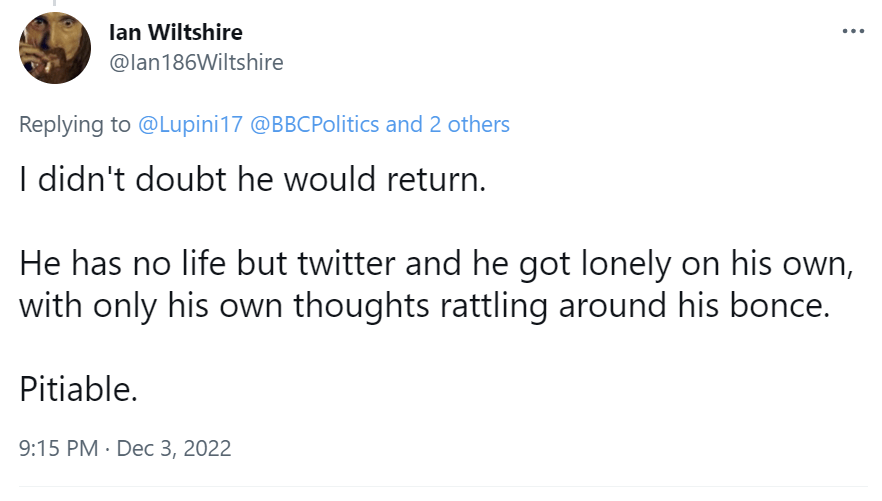
[Update, 3 December 2022: unfortunately, it seems that the troll “@DaveAFAF” has been allowed back on Twitter, at least for the time being, and so far confined to retweeting tweets of others]
That’s all, folks! (for now).
The Elon Musk risorgimento at Twitter is like a breath of fresh air, though I suspect that the Jews are working day and night to destabilize the new order or to influence Elon Musk.
Update, 4 December 2022
Well, “@DaveAFAF” now spins his temporary expulsion as if he himself deleted his Twitter account:
Recent tweets re “@DaveAFAF”:
Update, 7 April 2023
Well, prolific tweeter and political oddity (though not obviously mentally-disordered) Marko Attila Hoare has, for the first time in a few years (I think) tweeted about me:
Apart from the fact that the “clique” did not exist (the tweeters mentioned were just individuals, not closely or organizationally connected with each other), and apart from the fact that none of those mentioned could be described as “vicious“, I do not recall that any of those people “harassed” anyone. Rather the contrary.
I myself have never heard of Damian Read. As for the others, I recall the others from Twitter. A few of them tweeted to me occasionally while I still had a Twitter account (a pack of Jews had me expelled in 2018, and I have not bothered to get myself reinstated).
The only one of that list I have met in person was persecuted satirist and singer-songwriter Alison Chabloz, and that encounter was a 5-minute chat at the now-defunct London Forum, at which I gave a legal talk in 2017.
In theory, I could sue Marko Attila Hoare in libel and, now being very impecunious, would have little to lose, but I do not play games of that sort, luckily for Hoare, who might find such an action expensive even if I lost. Well, I have now a year, minus a few days, in which to decide on that, but I doubt that I shall bother in the end.
Update, 20 May 2023
A few updates, in fact.
I have some interesting thoughts, and information, about Jasna Badzak, but will wait until the trial of those accused of killing her son ends, which will not be for months (it has not even started so far).
Then we have “Dr. Dim” (Tim G. Stevens). He, it seems, is actually addressing the Royal College of Psychiatrists, no less, at their conference in Liverpool in July; on “professional practice” etc.
I never did get that apology from him or his employers in Essex, after he made a completely untrue and, indeed, crazed allegation that singer Alison Chabloz and photographer Jo Stowell (and me) were either threatening to attack, or actually planning to attack, his family!
In relation to that outright and loony lie, Alison Chabloz made official complaint and eventually received apology from “Dim’s” employing NHS trust (he was too lacking in courage and class to do it himself), I was given a half-apology by the NHS trust concerned, was told that the matter was being investigated, but in the end (as I expected), it died on the vine. The third person libelled did not want the bother of making a complaint.
Stevens had to delete his lying tweets, though.
In between then and now, Stevens has actually been hospitalized suffering from serious delusions, but now seems to be ready to pontificate to his fellow-psychiatrists, though he tweets only occasionally now.
As with so much in modern Britain, you could hardly make up such nonsensical behaviour as displayed by Stevens.
Looks as if at least one other person (unnamed, for now) who used to tweet unpleasantly about me is having to face the fact that his days are numbered by reason of a medical condition. #TenGreenBottles…
Update, 25 October 2023
No comment (necessary).
Tweeting to “Dr. Dim” Stevens…
Small (Twitter/X) world…
Update, 27 October 2023
Jew-Zionist loonie.
…and here’s another:
Update, 5 December 2023
Well, it took that one (above) another 5 or 6 weeks actually to shuffle off (Twitter/X) but “they” do tend to cling on like limpets (or should that be “leeches”?)…
https://twitter.com/AngryLevantine/status/1732058353734386167
“I have decided to leave Twitter. This is not a decision I made on a whim, or out of vindictiveness. This is something that took hours of careful deliberation amongst myself. I am doing this for my own benefit.
I am doing this because my depression, my anxiety, and my extreme bouts of anger are doing damage to the fight against antisemitism and other causes I care about, and to friendships (if online friendships can even be called that) I valued. I don’t like that my personal issues have become a source of drama and division. I want to be an asset. Not a liability. That is why I am exiting. If I do return here, it will be when I’m in a healthier state of mind. I will leave this up for a day or so before deactivating.”
but a mere hour later—
As if anyone wants to read that loonie’s outpourings.
Update, 7 February 2024
Well, the “Balkan Fraud”, Jasna Badzak, is still occasionally tweeting. As I suspected a year ago, she was thinking of making both a medical negligence claim (based on her bizarre allegation that NHS staff deliberately and repeatedly stabbed her or injected her with something while she was in hospital), or a Criminal Injuries Compensation Authority claim based around the fact of her son’s murder by a gang of blacks a few years ago. I think that she also has it, or had it, in mind to sue the police, but that is a guess on my part. She has now tweeted this:
“…did not pay me anything“…That is her beef. She wants money, always, and preferably other people’s…
Looks like the criminal injuries people turned down her claim, if one was made. I can guess why.
I appeared as Counsel in very few Criminal Injuries Compensation Authority matters, but recall that one reason for not paying an award, or reducing one actually made, is because the applicant is of “bad character” (which includes but is not limited to criminal convictions).
“Jasna Badzak, 42, fed Gerard Batten a “pack of lies” about how her wages from the European Parliament had not been paid and she was too poor to travel to work, a court heard.
In fact she had doctored her online bank statement to make it appear as if the £2,500 payment had not been received.
Taken in by her story, the MEP loaned her the apparently outstanding wages, together with a separate £500, believing she would repay him after receiving the cash from the European Parliament.
Records show that in the meantime Badzak enjoyed spending sprees in Gucci and Harrods, Southwark Crown Court was told.
She only offered to reimburse Mr Batten after police began an investigation, and has yet to repay a penny to the MEP.
Badzak, who fled war-torn Yugoslavia 20 years ago and whose relatives died in Nazi concentration camps, said her relationship with the politician deteriorated after she was asked to work on a policy document entitled “Dismantling Multiculturalism” in February 2011.
“[the judge at the Crown Court said that] ‘You doctored your online bank statement with your NatWest account by removing the £2,500 payment so someone looking at the statement would think it had not been paid. That was flagrant dishonesty.
In due course Mr Batten was good enough to give you another three-month contract and you threw that back in his face by continuing the lie.’
When Mr Batten decided not to issue another three-month contract after that, Badzak took him to an employment tribunal and lost, the court heard.
She also reported him to the police for fraud, but detectives investigated and took no further action.
Judge Gledhill added: ‘You issued high court proceedings against him as well. You did that to deflect attention from your own dishonesty by mounting a wholesale attack on his character. He said he felt he was on trial and that was your doing.
I am going to suspend the sentence only because of your son. He is perfectly innocent of any wrongdoing and I’m not going to wreck his life by sending his mother to prison’…“
[Daily Telegraph]
Badzak’s conviction dates from October 2013.
As to whether she really has qualifications (from Yugoslavia) as a medical doctor, and whether she really has an MBA from somewhere else, God knows. If so, why was she working for a modest sum as a temporary office-bod? She seems to have been living for at least a decade on various UK state benefits. We shall probably never know.
She used to tweet very disparagingly about me, that I was “just a fool” etc. Very silly.
#TenGreenBottles…
Update, 10 February 2024
[originally posted on Twitter/X in 2023, but retweeted by political academic Matt Goodwin today]
If there were a “pro-Israel” or “Jew-Zionist” category, it would probably be nearer to 90%.
Update, 16 February 2024
Update, 10 April 2024
Well, the Balkan Fraud (Jasna Badzak) has now set up a GoFundMe appeal, and numerous mugs have donated already. She seeks £40,000, ostensibly in order to get medical treatment and generally to “get well” so that she can track down those who appear to have escaped trial for the murder of her son (I believe that three others have been convicted at trial, which trial or trials received enormous publicity in the Sun, Daily Mail etc). https://www.bbc.co.uk/news/articles/c03xe0j0xwro.
Strange GoFundMe appeal. After all, her medical treatment is free in the UK; you do not have to pay for it. Also, how will giving Badzak money help catch those responsible for her son’s murder?
It looks to me like a kind of scam, frankly. Still, there it is, genuine or not. I think certainly not.
Among the mugs who have already donated, I notice well-known newspaper and online scribblers Carole Cadwalladr, Peter Jukes and (assuming it is the political journalist and broadcaster) Michael Crick.
So far, she has raised over £2,000 for herself.
Update, 29 April 2024
Previously-featured Zionist loonie @AngryLevantine continues:
“History is not on the right side of History“…
Update, 5 May 2024
Balkan fraud Jasna Badzak continues to try to scam money out of kind-hearted but unthinking members of the public, having so far failed to get a criminal injuries compensation award (re. the murder of her son a few years ago), and also having, it seems, failed to sue either the NHS or Metropolitan Police for supposedly having “injected her with needles for 5 days” and thus having (allegedly) sent her into a coma and (later) paralysed her.
She claims to be unable to lift a glass or wipe away tears, yet tweets several times daily, asking for money for her GoFundMe appeal. Dozens of —in my opinion— mugs have actually now donated a total of nearly £3,000, in only two months or so.
Somewhere between a lunatic and a horrible snake, in my opinion.
Update, 6 May 2024
I noticed a while ago a fanatical and violent Jew-Zionist, “@leekern13”, on Twitter/X. He has in the past expressed incitement to violence, i.e. to the effect that “antisemites” “should be hurt” etc. That same Jew has now emigrated from his “native” London to Tel Aviv, from where he tweets to the effect that the (UK) Press and TV, and Twitter/X users, “are Hamas”.
[Tweet in question later deleted]
Distasteful and, like so very many other of the most fanatical Jew-Zionists (as shown above in this blog post), mentally afflicted.
Incidentally, this is what the Jew says about Britain, where he was presumably born, brought up, educated (probably free of charge, thanks to those British “antisemitic” taxpayers), and where he was given his career opportunities:
“I’m leaving Britain and moving to Israel.
Even if it wasn’t for the antisemitism I’d be leaving Britain is a dying society I’ll be fine in Israel It’s the most dynamic, creative and positive place I’ve ever been – even though surrounded by Islamic fundamentalist psychopaths who daily try to destroy it .
You can forget the power of positivity and optimism. It’s become taboo in England.
That’s one thing I’ll never understand or make peace with. Britain is a shit hole – but if you try to express positivity, pride and optimism in the idea of salvaging something good about ourselves and improving things – you’ll be shamed and beaten down by smug, elitist morons who have a stranglehold over our culture – a culture that they have made desperately dull and oppressive.
Britain is a place that hates individuals who stick their head above the parapet, hates self-belief, hates pride, and it hates success.
Our enemies have contributed to this grim culture of floundering confusion and self-loathing. Useful idiots do the donkey work. And our leadership seem to lack entirely any connection with the grandeur or grand ideas that drive not just a society forward – but a civilisation.“
[Lee Kern]
Like so many of his type, he hates the UK, hates Europe, hates the Arabs and other Muslims (needless to say); basically hates anything not Jewish.
When Israel is destroyed, what is the betting that —if he survives— he will come crawling back to this country that he hates?
Indeed, his recent tweets sometimes seem to be posted from Tel Aviv, and sometimes from the UK (presumably from the North London/South Hertfordshire “Borshch Belt”).
Does he even know what country he is in, or has he “emigrated” to Israel while really still spending much of his time in the UK that he obviously despises (or purports to despise)? (cf. “Mark Lewis Lawyer”).
A complete loonie, like so many others.
Update, 7 May 2024
This one has been tweeting, mainly though not entirely in the “antifascist”/Jewish-lobby interest, for years. Turns out that he is yet another one with what he himself describes as “very severe mental health issues“.
Someone should do a Ph.D. thesis on the links between mental problems, “antifascist” tendencies, and Jew-Zionism. Might be groundbreaking.
Update, 8 May 2024
Another:
Is comment even necessary?
Update, 30 May 2024
Another one:
Myerson, an obsessed Jew-Zionist who tweets up to 100x a day on occasion, is a member of both “UK Lawyers for Israel” and “Campaign Against Antisemitism”, is a barrister based mainly in Leeds, and a Recorder (p/t judge) who has recently been rebuked by the Judicial Conduct Investigations Office for his toxic social media presence.
Update, 10 July 2024
https://en.wikipedia.org/wiki/Charlotte_Nichols#Personal_life
“Nichols grew up in a mostly secular Catholic family with some Irish heritage. At the age of 22, Nichols started attending weekly services at the Manchester Reform Synagogue; after attending the services, she claimed to have felt more peace than she ever had growing up.[31] She converted to Judaism in 2014 and celebrated her bat mitzvah on her 27th birthday.[32]
Since converting to Judaism, Nichols has faced ongoing abuse for her beliefs, including anti-Semitism from a Conservative Party council candidate for the 2021 Warrington Borough Council election. The candidate sent a message via Twitter to Nichols saying “Keep the Aryan race going”.[33]
In 2021, it was reported that Nichols has post-traumatic stress disorder, having been forced to cut a parliamentary visit to Gibraltar short following a “mental health episode“.[34]
In 2022, Nichols opened up about her struggles with abusive messages and threats of violence she has faced, after a BBC investigation found that she was in the top 5 backbench MPs for receiving abusive and toxic tweets on Twitter.[35][36]
In a 2021 interview, Nichols stated that she identifies as bisexual.[37]
In October 2019, Nichols tweeted that a group of S.S. Lazio fans who had been filmed making Nazi salutes in Glasgow should “get their heads kicked in”. Nichols defended her comments in December that year: “These were people doing Nazi salutes on the streets of Britain… As a Jewish person whose grandfather fought in World War Two, ultimately sometimes I believe that fascism has to be physically confronted”.[28][29]
An article published in The Daily Telegraph in 2019 reported that Nichols had described members of the Green Party as “bourgeois scab fucks” and told one Twitter user, “Hope you lose your virginity”.[30]“
[Wikipedia]
A Labour MP…what does that say about not only the Labour Party but the whole political system?
Update, 11 July 2024:
Update, 7 October 2024:
…AND… yet another one turns up…
Another non-Jewish pro-Jewish and pro-Israel loonie.
Update, 28 October 2024
That last loonie has been chucked off Twitter/X for violent abuse, so his crazed tweet is now unavailable, sadly.
Above photo shows yet another “antifascist” loonie, one Christopher Eccleston, apparently a well-known actor: https://en.wikipedia.org/wiki/Christopher_Eccleston.
I had never heard of him but, now having read the Wikipedia entry, realize that I have seen him in both Inspector Morse and Poirot.
Apparently, “In his autobiography, Eccleston described chronic anorexia, body dysmorphia and depression, and said that he had considered suicide. Speaking about his poor mental health, he wrote that he was “a lifelong body hater”.[74] He was hospitalised in 2016 with severe clinical depression.[75]” [Wikipedia].
Update, 11 November 2024
Deleted Twitter. if you know me, massive.— Mike Stuchbery (@mikestuchbery.bsky.social) 6 November 2024 at 20:09
Pitiable fake “historian” Mike Stuchbery has apparently departed “permanently” from Twitter/X and has migrated to “Blue Sky”, where he can post “antifascist” messages unchallenged by anyone social-national, or knowledgeable about modern history; he can now continue to “report” anyone whose opinions he dislikes (Twitter just ignored him in recent years).
Sad and half-crazed Stuchbery, now living off the generous German social welfare system (generous enough for him to have, he says, “spent a few weeks in northern Italy” a while ago) has recently moved into a new apartment (presumably in Stuttgart) with a new girlfriend. He is still trying to beg money from mugs online, though.
As for “DaveAFAF”, once known as “Slatfascists”, the Mancunian loony “antifascist”…
“Dave. Anti-Fascist As Feck. 𝕏 @DaveAFAF
David. Not using this cesspool now that the owner has ruined it. Find me where skies are blue – same username.“
[“DaveAFAF” posting on Blue Sky].
So that idiot has also gone from Twitter/X. I read (true or not) that the police are now interested in some of his activities.
What about Jasna Badzak, the Balkan Fraud? Well, she has not tweeted since May 2024, and her attempted GoFundMe scam has not raised the £40,000 she wanted, but only £3,542, with the last mug-donation £25, some months ago. All other donations ceased nearly 6 months ago.
I have no idea whether Jasna Badzak has “shuffled off” in general, or just online, but quite likely the former.
“Dr. Dim” Stevens has not tweeted since May 2024, and only twice since February 2024.
A few others have “gone up the chimney” since they started to post and plot against me. #TenGreenBottles…
Update, 28 November 2024
Mentally-weird “grifter” and self-proclaimed “historian” and “journalist”, Mike Stuchbery (a stand-in temp schoolteacher a decade ago, sacked from that job after a short while, and “economically-inactive” since then) continues to try to grift from his new online platform on Bluesky, but is now once again, for the (?) 20th or 30th time, making himself out to be more than the straw man he is:
Stuchbery threatening Elon Musk. As the Germans might say, unglaublich! I am sure that Musk must be quaking in his boots, as straw man Stuchbery threatens to, er, “make a noise“… Quite funny, really. Keep taking the tablets…
A reminder about how Stuchbery often makes empty threats:
(in fact, loonie Stuchbery did know about me, having tweeted many times about me; he’s a joke).
Update, 11 February 2025
Just saw this loonie tweeter again:
Even uses their horrible insult-language. Total loonie.
Update, 18 February 2025
Online pseudo-political “grifter” “Supertanskiii” is, apparently, a SAD (Seasonal Affective Disorder”) sufferer, as well.
Update, 21 February 2025
Looks as if Matt Goodwin is finally catching up with me…
“People on the Woke Left are the most likely to say they’ve suffered from mental health problems and to say they feel sad, lonely, stressed and depressed”
[Matt Goodwin]
Update, 15 March 2025
Jasna Badzak, the “Balkan Fraud”, no longer tweets. She has not tweeted for 10 months. She may even have “snuffed it”, in the vernacular. Either way, another one of my enemies and horribly obsessed trolls gone, it seems. #TenGreenBottles
Paging “Dr. Dim” (Tim) Stevens of Essex (see this blog post, ante); he (himself a mental case, as he publicly admitted online) is a fervent advocate of electro-convulsive “therapy”…
“Dr. Dim”, possibly partly-Jewish (it was never established for sure) was one of the cabal of pro-Israel and pro-Jewish lobby Twitter trolls who often mentioned me and usually insulted me on Twitter and elsewhere. He even made up completely contrived, completely non-existent “threats” allegedly made by me, Alison Chabloz, and another, and apparently reported me (and others) to the police (who, however, realized that the supposed threats were false; the police never even contacted me, though Stevens was not arrested as he should have been (his NHS employers did apologize on his behalf, though).
I do not know whether “Dr. Dim” Stevens is still around, or whether, as he feared, he developed early dementia and/or died of cancer. Still, he’s gone from Twitter/X, having not tweeted for over 9 months. Good riddance. #TenGreenBottles.
Update, 21 June 2025
He is still supporting Israel, even its Gaza quasi-genocide.
Update, 2 October 2025
…and the one below saw fit to tweet, after either my 2016 disbarment or my free speech trial in 2023, in a hostile manner; I think his tweets said that I should have been given a far harsher sentence in 2024 (sentencing hearing). Apparently a retired cop of some kind, he purports to be an expert on policing etc:
[“Folks today I chilled & I drove for 2/3hrs for one of my best friends memorial; en-route I thought a lot privately; my heart is heavy we will never talk again he stood by me for 50yrs when I was broken & after when I repaired myself I’ve no real family & he attended my police passing out parade & cheered me on; some others I lived with in Children’s home at the same time as I joined the police sadly were in YOI & prison I had to work & try hard not to take that route & I didn’t I done why some do as I grew up with so many broken children; I’ll be honest I feel a little lost; I came home & looked to see what was happening in the world & all I saw on here was Anger Hatred & Bitterness I Fucking Hate what this platform has become & some of the accounts I so often see posting their constant angry shite; The only positive? Over 15yrs I’ve been on here I’ve interacted with many some of the most kindest caring of people & on my low days yes even Norm has some many of you have posted the nicest posts many made me feel humble; in fact it’s the main reason I’ve stayed on this platform; some of you will know over recent years I had had enough & was going to close my account & just piss off but I was always talked out of it by you Herbert’s;
Some of vilest of people on this platform often post their Bile Anger Hatred & Bitterness to attract huge numbers of clicks to earn from what’s called ‘Monitorisation’ many of those are Faceless Fuckers who hide behind a Pseudonym often hide behind a picture of a monkey or other photo but rarely not of them & they don’t care who they attack & hurt it’s all about how much money they can earn the damage they cause & leave behind? They really just don’t care; Those of you who have been kind are kind & you interact politely & you are of the best of us; those who I have described above Fuck you as it your types that have reduced this platform from the once pleasant place it was & they often now take TwitterX into the sewers!
Fuck you as it your types that have reduced this platform from the once pleasant place it was & they often now take TwitterX into the sewers! I hope tomorrow I wake in a better mood than I’m currently in cos I’ve really had my belly full of some of the shite on here! To all the decent people on TwitterX I wish you a good week ahead & God Bless You“]
Loonie.
Tweets about kindness etc, after having thrown the first stone at me, someone he had never met or, I imagine, ever heard of (until the msm reported on me).
Hypocrite. Or idiot.
Loonie.
Wikipedia has an entry for that one:
[“Police Review described Brennan as probably being the best known face and voice in British policing and said that “Protect the Protectors” was the primary reason the government of the day reversed its policy on issuing police officers with a side-handled baton which had been originally refused.[citation needed]
Some members of the Police Federation, the Association of Chief Police Officers (ACPO) and the Home Office were critical of Brennan’s outspoken positions.[citation needed] One Police Federation member[who?] was quoted as saying that Brennan “gives outrageous soundbites and simplistic solutions to complex issues. I don’t think he represents the views of many officers.”[2]
In 2013, The Independent offered critical coverage questioning whether Brennan is a convenient “rent-a-mouth” for the media pointing out his propensity to comment on a wide array of matters unrelated to policing, ranging from asylum-seekers to prison gyms. The newspaper also suggested that some in the police force viewed Brennan as “an unelected, unrepresentative, hardline reactionary.”[2]]
[Wikipedia]
Actually, I do not disagree with all of his tweets that I have seen, but his shameless kow-towing to the Jew/Israel lobby after either my free speech trial or my (wrongful/unlawful) disbarment of 2016 makes him ridiculous, in my view.
Update, 27 October 2025
Another one…(or two)
Update, 19 December 2025
Another one…
I happened to notice this piece from 2019 by one Lee “Budgie” Barnett, in which the individual relates how he had a “breakdown” about a decade ago from now:
That individual is or was a Jew who seemed, judging from his cautious tweets, somehow to know something of my political history going back, it appeared, to the 1970s.
Looking at his Twitter account (years ago), I noticed that he seemed to live not far from my own one-time home at Little Venice, London; either that neighbourhood, or nearby St. John’s Wood. During the years 2014-2020, he tweeted about me occasionally, talking to various other Jew-Zionists.
I notice also that the individual’s tweets and other online activity stopped about three years ago, so it looks as though he will not be chatting to other Jews about me in future.

 Ian Robert Millard