3,000 people paid £2.50 to hear Nigel Farage speak. How many System politicians can get 3,000 to hear them speak? In fact, few would even get an audience of 300. Maybe 30, but only if entry were gratis. In fact, many of those listening to Farage had also paid a voluntary £25 donation to Brexit Party (read the report).
The size of the rally was not quite as impressive as those of Mosley in the 1930s, but you can’t have everything!
On 16 July 1939, Mosley addressed 30,000 at Earl’s Court in West London.
Returning to our contemporary political reality, here are the latest opinion poll readings:
Note the variation between the YouGov and ComRes polls. There is usually variation, but not such wide variation. The YouGov poll is the more recent, relying on polling done in the past 3 days (19-21 May). It shows Brexit Party at 37%. The Conservatives have slumped to a miserable 5th place, on merely 7%! This is incredible! As for Labour, it has been overtaken by the LibDems.
Obviously, EU elections are not the same as Westminster ones, but I think that we are seeing more here than the sort of EU election surge that we have seen before with both UKIP and to a lesser extent and long ago (in 1989) the Green Party.
Anecdotal evidence is always suspect, but then so are “statistics”. I concede that I meet few people these days, but everyone that I do meet, or encounter, or hear, is voting Brexit Party in the EU election.
I am inclined to believe that, with only a day to go, Brexit Party is still, even now when it is polling around 37%, being underestimated. I should not be surprised were Brexit Party to top 40% on Thursday.
It is clear that the most fixated Remainers are gravitating to the LibDems, with most of the rest voting Labour. The new party, Change UK, has sunk like a stone and I shall be surprised if it gets a vote of 5% (as polling indicates). Its “rallies” have all been tiny meetings, with audience numbers often in single figures. Even its main London meeting audience (disregarding journalists) only numbered about 40.
MSM scribblers and the Twitterati wastes of space are now discussing as to whether the EU elections constitute a kind of referendum on UK EU membership. How can it be, when the Labour, Conservative and even Green parties are internally split?
It is clear to me that the EU election in the UK will be dominated by Brexit Party candidates. What is really significant is that Brexit Party doing really well will give it a launching pad for Westminster.
The important poll will be the Peterborough by-election on 6 June. If Brexit Party can win that, it will be on its way.
People are angry about what has happened in and to this country over decades, since 1989 particularly. Finally they have realized that the guilty parties are literally that, the political parties (and their own apathy, but let’s not look in the mirror…). The Conservatives, having destroyed so much over the past decade, are the primary target for the wrath of the people, including that of many who until recently were themselves voting Conservative.
Brexit and its betrayal has finally crystallized the feelings of disappointment and treachery.
The Conservatives are facing a perfect storm in the EU elections:
the pathetic Prime Minister, Theresa May;
the mediocre or poor level of most other leading Conservative MPs;
Brexit, fake Brexit, and betrayal of the popular decision in the 2016 Referendum;
the rise of Brexit Party to near 40% in vote-share and perhaps, on the day, beyond;
the defection of Conservative pro-EU/Remain voters to the LibDems
The real crisis for the Conservative Party will come after the EU elections. The Peterborough by-election was noted above. The Conservative Party is rated by the bookmakers as no better than a 20/1 shot for that by-election. Incredible when one considers that from 2005-2017, Peterborough had a Conservative MP who was beaten in 2017 by only 607 votes (1.3%). Even when Peterborough had Labour MPs in the 1990s, 1980s etc, the Conservatives were always closely second-placed.
Then there is the Conservative Party membership, officially 124,000 but most of those are people in the sixties, seventies, eighties or even nineties. The active membership may be no more than a few thousand. This is important for several reasons: lack of canvassers etc, lack of subscriptions, but also the fact that, once Theresa May goes, if MPs cannot elect a new Conservative leader outright, the top 2 in the MPs ballots will go for general membership vote. Who will the aged Conservative membership pick? Will their chosen leader be in any way acceptable to the British public as a whole? That seems doubtful.
What an odd system, when a Prime Minister can resign and then be replaced by some new leader, chosen by about 150 Conservative MPs or —at most— by maybe 60,000 aged Conservative Party members, and who then becomes Prime Minister automatically, with no obligation to call a general election until 2022!
People in the UK are outgrowing both the present political/electoral system and the existing System parties.
Using Electoral Calculus [ https://www.electoralcalculus.co.uk/userpoll.html ], that Panelbase poll indicates that a general election held now would produce the following result: Brexit Party bloc of 19 seats. Labour majority of 44 seats. Conservative loss of 132 seats, including those of Amber Rudd, Nicky Morgan, Justine Greening, Stephen Crabb, Boris Johnson, Grant Shapps etc. Happy time! (except for the Labour majority, but the Cons have to be stamped on now; should have happened long ago)
Update, 23 May 2019
Election day, 1800 hrs. I happened to see an interesting Twitter thread analysis from a journalist. From a couple of days ago. Read the whole thread.
THREAD: On the rise of the Brexit Party and what it means for Brexit and British politics.
That’s it, there are no more Brexit Party rallies planned before polling day. I’ve been to half a dozen of them across the country, from the very first week to the end.
It will be be seen above that the videos of Mosley’s massive 1939 rally in London are now “not available” because YouTube (aka, for many, “JewTube”) has closed the account. This is part of a huge censorship campaign now spreading across the Internet. (((They))) are behind it. It is a covert censorship, banning and barring operation to close down free speech in the UK and across the Western world. It affects, inter alia, YouTube, Twitter, Facebook, Amazon; many others too.
In view of the duty to fight the evil noted, I have posted, below, other links.
A comet has appeared in the UK’s political skies. Its name is Brexit Party. It is running at about 30% in the opinion polls re. the EU elections to be held on 23 May 2019, while in respect of Westminster elections, it is on about 15%. The EU elections may not be of much importance except as a popularity contest, but for a new party without any policies at all (except to get out from under the EU) to be at 15% indicates a groundswell of public disquiet which may have huge consequences one way or another in domestic UK politics.
[note: even as I write, the polling figures above are out of date! One very recent poll now has Brexit Party at 34% for the EU elections and 20% re Westminster voting intention, with Conservatives only on 19% for Westminster and 13% for the EU elections; has the Conservative vote ever been that low? I think not; even in the Blair-Labour landslide of 1997, the Conservatives polled in the actual election at 30.7%].
It now looks as though some of my early blogging was prescient indeed, if I myself may say so. “Give that man a cee-gar”!
Exclusive Telegraph poll: for the first time Brexit Party is in second place in general election polling – BP on 20%, Tories on 19% – on course to win 49MPS – Tories lose over 130 seats including Johnson and Rudd – Labour in minority governmenthttps://t.co/YGVFr3Y6bL
The Brexit Party gets more popular by the day, with 34% now intending to back them in the European elections – more than the Labour and Conservative Parties COMBINED. The 17.4m have been betrayed by our political class for years, and now we're going to MAKE them listen!
There are signs of panic in the main System parties:
“A ComRes poll for the Sunday Telegraph showed that if a Westminster general election were called, Labour would reap the largest share of the vote with 27%; the Brexit party would garner 20% ahead of the Conservatives on 19%. The Liberal Democrats would win 14%, followed by ChangeUK (7%) and the Greens (5%) with Ukip trailing on 2%.” [The Guardian]
I come from a certain direction: I recall the limited but real popularity of the National Front [NF] in the mid-1970s, and saw at first hand how outside forces made use of internal dissensions in order to destroy the NF as an effective party and movement. I believe (though without having any direct or personal knowledge) that similar events may have happened to explode the British National Party [BNP].
The National Front and BNP were both broadly social-nationalist, whereas UKIP is broadly nationalist but lacking the para-socialist element ideologically. Brexit Party has taken on UKIP’s “nationalist” or “patriotic” mantle despite having no published policies at all beyond leaving the EU.
It is easy to speculate about why the course of events happens, harder to pin down the exact or even approximate facts. Many casually blame, or designate as important, the operations of Zionists, Israel, MI5, SIS, MOSSAD, unnamed State agencies, freemasons, occult spiritual groups etc.
Every party or movement has internal tensions. As a John le Carre character remarked, “Jesus Christ only had 12 agents, and one of those was a double” [meaning “double-agent”].
The art of influencing events from the shadows is not to be identified or identifiable as a moving force.
Coming back to Brexit Party, there are known facts. The extraordinary political showman (as some would have it, “snake-oil salesman”), Nigel Farage, was leader of UKIP for decades. He in fact was in UKIP almost at the start, and is often termed one of the founders, though he was not the actual founder, who was an academic called Allan Sked.
“Sked is a member of the British-American Project, which exists to promote Britain’s political ties to the U.S.” [Wikipedia].
“During the administration of President Bill Clinton in the US, the Australian journalist John Pilger attacked the BAP as an example of “Atlanticist freemasonry.” He asserted in November 1998 that “many members are journalists, the essential foot soldiers in any network devoted to power and propaganda.” [Wikipedia].
Here is one msm drone who belongs to that British-American Project:
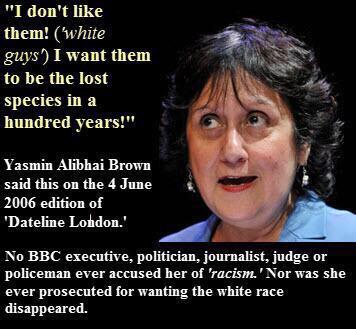
Yes, that’s right. Yasmin-Alibhai-Brown, the supposedly “radical”, “anti-imperialist” “journalist” (in fact, totally unqualified and inexperienced in true journalism, just a ranting loudmouth).
Another member of the very same organization is BBC journalist James Naughtie, most of whose views are, at least superficially, totally different from those of Yasmin Alibhai-Brown…
The British-American Project contains a large number of UK-based (and other) journalists (and others), of supposedly diverse views. I wonder if their views and motives are as “diverse” as they seem to be at first blush.
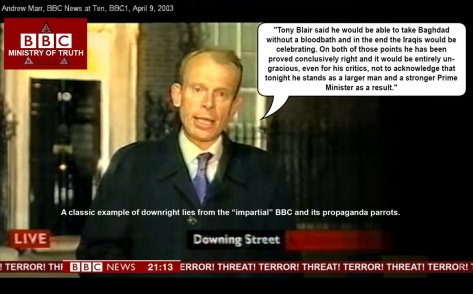
Only today, on the Andrew Marr Show [BBC 1 TV], Marr tried to trash Nigel Farage and Brexit Party, but Farage was able to crush Marr easily in the end.
System drones like Marr do not seem to understand that populist movements such as UKIP (a few years ago) or Brexit Party (now) are the last chance for the System to listen to the British people and so avert an explosion of justified political hatred which will, otherwise, roll over them like a tank over a cockroach.
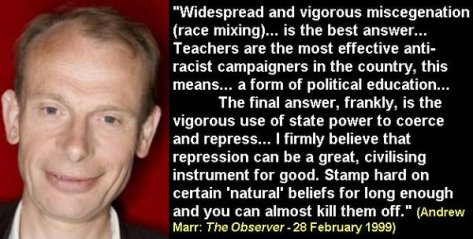
Marr’s own (rarely admitted) views:
A typical pro-NWO, pro-ZOG, pro-EUmsm drone, paid until recently a million pounds a year by the BBC out of your “licence fee” (enforced tax) monies (apparently somewhat less now, after public uproar about the absurd salaries paid by the BBC to key propagandists).
Was the secret aim of UKIP to draw off nationalist sentiment from parties such as the BNP, i.e. to neutralize effective political opposition to NWO [New World Order] and ZOG [Zionist Occupation Government] in the UK by containing it, controlling it, monitoring it? Or was UKIP just a typically English amateur effort which mushroomed into something bigger. Or both of those?
Already, in looking at UKIP, we see the difficulty of unravelling the skein of motives: secret forces, public faces, ambitions, ideals, various personalities etc.
As recently as last year, Alan Sked said that “I founded UKIP. It’s a national joke now and should disappear.” [The Guardian]. Is that just sour grapes from a founder left behind? Is there anything else there? Had UKIP “done its job”, and so could be binned?
Until 2010, the BNP did better in all or almost all elections than did UKIP. It is hard to recall that, now that the UKIP star has risen and fallen and now that the BNP is just a tiny handful of back-room zealots. In its heyday, the BNP was more successful by far than UKIP. The BNP even had two MEPs (Nick Griffin and Andrew Brons).
Brexit Party is UKIP, but a UKIP which, like a snake, has shed its “skin” of various unwanted people, unwanted history etc and, unlike the snake, miraculously become far far more powerful, far more slick, far more able to capitalize on its “unique selling point”, the sheer hatred which many many people now feel for UK society as it now is (and also for the EU dictatorship).
Farage is the star of Brexit Party, as he was when in UKIP. Look at the clip below. Farage enters a hall packed with supporters. It echoes in a minor key the entrance of Adolf Hitler into the hall at the end of the 1935 Leni Riefenstahl film Triumph of the Will.
The Brexit party turned up in Newport, south Wales last night. A true Labour heartland. Usually. https://t.co/NoBovPxNCv
Farage can draw large crowds, as in this recent rally at Peterborough, where 2,000 supporters are said to have paid£10 each just to hear Farage speak. Few other politicians in the UK could get 200 (or even 20, in many cases) to turn up to hear them, even for free!
Peterborough rally for the Brexit Party. When was the last time British politics saw something like this?? Astonishing. They’re doing three rallies a week! pic.twitter.com/YVUlQnhTdw
Farage is the key to this. No Farage in UKIP means, effectively, no UKIP. Were there no Farage in Brexit Party, that party would also rapidly cease to exist.
Despite his public profile, Farage is to some degree an enigma. A metals trader, he was in employment as recently as 2003 and possibly even after that. He was elected as an MEP in 1999. He seems to have been a “Eurosceptic” (anti-EU) for a long time, voting Green Party in 1989: the Green Party was, at that time, Eurosceptic and not pro-mass-immigration. One wonders whether, had it not become a kind of middle class virtue-signallers’ party, Green Party might have had greater political success.
Farage created UKIP (not founded perhaps, but created) in his own image: anti-EU, free marketist (softened for tactical purposes), English more than British, not social-national, not “racist” (racialist), despite Farage making a few innocuous comments that only echoed what most white British people believe or feel. Brexit Party may or may not follow those lines, but we cannot say for sure, because Brexit Party, almost uniquely, has published literally no policies at all, save for Brexit itself.
I say “almost uniquely” because the surely-doomed Change UK, which can be taken to be the opposite pole to Brexit Party, also has no published policies (beyond staying in the EU). This is in fact consonant with earlier blogs and, until I was expelled from Twitter, tweets, i.e. that people in the UK, at least in England and Wales, are now voting against rather than for parties; voting tactically to block parties they dislike, rather than supporting the party they like. I have blogged before about this and how it is an outcome of the ludicrous UK electoral system.
I take Farage to be sincerely anti-EU, anti-socialist, possibly anti-immigration, but not to have any sophisticated socio-political or economic ideas. I have said before that Farage does not understand politics well, a surprising statement in view of his stellar public political performance. What I meant is that he has not developed any ideology, as such; neither has he a political programme; also, he has not much developed a party machine (with UKIP; we shall see what happens with Brexit Party).
I take Farage at face value, more or less; the same with his mass following. As to others, I am looking and seeing a strong Jewish element. Brexit Party already has a “Brexit Party Friends of Israel” group. There are other indications; the Brexit Party Treasurer is indirectly connected by marriage to the Rothschilds:
Brexit Party not only has Jewish influence but is open in general to persons of other and various ethnicities. Many candidates are not really British, certainly not of British origin.
Good afternoon Mr. Umunna. I am a candidate for the Brexit party. I am partly of Pakistani origin. There are many candidates of mixed ethnicity in our terrific party. You have the wrong end of the stick. May we pls meet to discuss your prejudices? Anytime that suits you. Pls say https://t.co/W6IdKODVMQ
Despite its paucity of policy and its multi-ethnic candidate list, many of those who support Brexit Party and also many of those who oppose it seem to think that it is somehow “nationalist”. It may be, but only in the very broadest sense.
In respect of candidates, one aspect I find very odd is that, out of about 60 or so Brexit Party EU election candidates, Brexit Party has no less than 3 who are former members of the (1978-1997) Revolutionary Communist Party. Remarkable from a tiny party which had so few members. If I were to suggest State involvement here, it would be without any real evidence, but it does give me pause all the same.
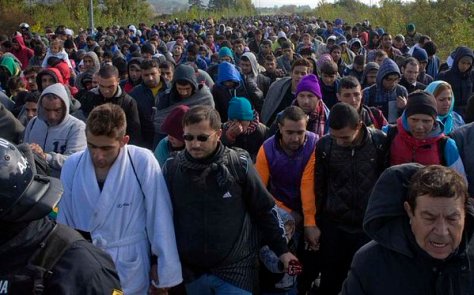
The Great Replacement, otherwise known as “migration-invasion” of Europe, is no mere “conspiracy theory”. United Nations and EU documents have laid out the conspiratorial globalist plan time and again. Only recently, EU and other political heads met in Marrakesh, Morocco, to pledge to assist African and Asian invasion of Europe, to replace European populations with alien black and brown populations.
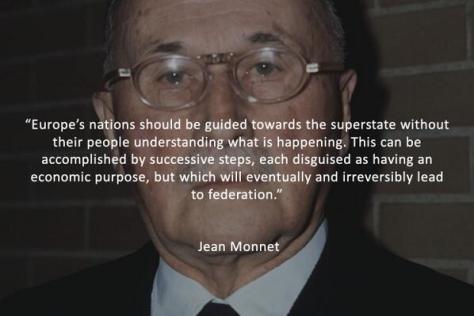
This anti-white, anti-European campaign was built into the EU right from the start and conflated with the idea of a European “superstate”:
Jean Monnet was one of the principal freemasonic architects of the EU:
“Jean Omer Marie Gabriel Monnet (French: [ʒɑ̃ mɔnɛ]; 9 November 1888 – 16 March 1979) was a Frenchpolitical economist and diplomat.[1] An influential supporter of European unity, he is considered as one of the founding fathers of the European Union. Jean Monnet has been called “The Father of Europe” by those who see his innovative and pioneering efforts in the 1950s as the key to establishing the European Coal and Steel Community, the predecessor of today’s European Union.[2] Never elected to public office, Monnet worked behind the scenes of American and European governments as a well-connected pragmatic internationalist.” [Wikipedia]
“He was the first to be bestowed Honorary Citizen of Europe by the European Council of the European Union, for extraordinary work to promote European cooperation on 2 April 1976. Following this he became the first person alive to be pictured on a German stamp who was not also a German head of state.” [Wikipedia]
“In his book Praktischer Idealismus (Practical Idealism), written in 1925, he describes the future of Jews in Europe and of European racial composition with the following words:
The man of the future will be of mixed race. Today’s races and classes will gradually disappear owing to the vanishing of space, time, and prejudice. The Eurasian-Negroidrace of the future, similar in its appearance to the Ancient Egyptians, will replace the diversity of peoples with a diversity of individuals. […]
Instead of destroying European Jewry, Europe, against its own will, refined and educated this people into a future leader-nation through this artificial selection process.”
“Nazis considered the Pan-European Union to be under the control of Freemasonry.[27] In 1938, a Nazi propaganda book Die Freimaurerei: Weltanschauung, Organisation und Politik was released in German.[28] It revealed Coudenhove-Kalergi’s membership of Freemasonry, the organization suppressed by Nazis.” [Wikipedia]
“Hitler did not share the ideas of his Austrian compatriot. He argued in his 1928 Secret Book that they are unfit for the future defense of Europe against America. As America fills its North American lebensraum, “the natural activist urge that is peculiar to young nations will turn outward.” But then “a pacifist-democratic Pan-European hodgepodge state” would not be able to oppose the United States, as it is “according to the conception of that commonplace bastard, Coudenhove-Kalergi…”” [Wikipedia]
There are secret occult forces behind the founding and expansion of both USA and EU. They are not exclusively Jewish or Zionist, but there is a strong link, as there is to Freemasonry, and also to other groupings not publicly named. Forces of Evil.
Look at the tweet below, from the World Economic Forum at Davos, and retweeted by a pro-EU public relations drone, and which purports to show a wonderful “economic plan” to create a “trade route” (corridor) from Malta and the Mediterranean to Scandinavia. What is the real purpose here? To create a funnel from Africa to Northern Europe, through which migrant-invaders will be funnelled through the heart of Europe to destroy it racially and culturally.
The EU was never meant to be just a mutual-benefit trade bloc. It was always meant to be a monolithic superstate in which the white European populations could be mixed, eventually, with blacks and browns. Of course, that was never conveyed to the peoples of Europe, only to the self-appointed “elite”. In fact, some naive people supported the EU (and still do) because they imagined that it was European in race and culture and not only in geography. Thus we see the deliberate conflation by Remain drones, in the msm or on social media, of “EU” and “Europe“, as in “if Brexit happens, we shall be leaving Europe“, rather than “…leaving the EU.” The UK is part of Europe and always will be; it need not be part of the already-dictatorial EU superstate, which is deliberately importing the culturally inferior by the million.
How is it possible, though, for bothEU and Brexit Party to be heavily influenced by the same forces (ZOG, NWO etc)? Think of a bet whereby you could, in a two-horse race, win whichever horse puts its nose in front. Likewise, in the UK there are or were two or three main parties. The fix was/is into all of those parties. It does not matter (or did not, until Corbyn took over Labour) which party wins, because ZOG/NWO is embedded in all three “main parties” (things are changing now, though).
Brexit Party may have been partly set up with secret aims in mind, but these plans do not always go as planned. Brexit Party has mushroomed, almost exploded, in a way which was perhaps unforeseen even by Farage himself. These things happen in history. The events of the Russian Revolution spiralled out of control, or to use a different metaphor, spread like a wildfire from its modest beginnings in one city in the corner of a huge empire.
Why are voters flocking to Brexit Party? It cannot be because of Brexit Party’s policies, because it has none, or at least only one. I identify these factors:
the wish to have the Referendum of 2016 properly respected and complied with; but beyond that
the wish to hit out at the System parties and especially the mis-named “Conservative” Party, which under the influence of Jewish Zionism and globalism has trashed the UK (especially England and Wales) to the point where nothing works properly, where most people have neither security nor freedom, where the population is only about half really British now, and where standards in all areas are dropping like a stone (NHS, transport, education, real pay, State welfare benefits, animal welfare, environment etc). There is also the repression on thought and socio-political expression. “Free speech” scarcely exists now in the UK.
The wish to lash out is very strong now. The people can see that Brexit Party has the popular support to make it a credible vote at both EU and (so far) Westminster elections. People know (whether intellectually or instinctively) that a vote for Brexit Party is one that hits the Conservatives hard, much harder than voting, say, Labour. In any case, Labour itself is not supported by most people (not so much for policy reasons as because white English people especially do not like what they see around Corbyn: the blacks and browns, the semi-literate Angela Rayner types who would be in Cabinet, the creaking 1970s comic-book “Marxism” etc).
A vote for Brexit Party hits the Conservative Party hard not only in areas where Labour is strong but in areas where the Conservatives have prevailed for decades. As I blogged previously, if (as polls suggest) the Conservatives lose 60% or even 50% of their votes, they will lose 50-200 seats, to Labour, to Brexit Party itself, and, here and there, to the Liberal Democrats. That means (as I also blogged previously and to which the msm is now catching up) that
Brexit Party may actually win some —possibly 50, even 100— seats at Westminster;
The Conservative Party, which has outlived its usefulness, will fade and go the way of the Liberal Party after the First World War; and
Labour will (as I have predicted for 2 years) probably be largest party in the Commons, but will be unable to do whatever it wants, because it will be a minority government (almost certainly). People may well prefer that to a majority Labour government.
It can probably be said that, in Westminster constituencies where Labour is not now the first or second party in elections, even former Labour voters would be better to vote Brexit Party than to vote Labour, because in “Conservative” Westminster constituencies, a vote for Labour is going to be a wasted vote, whereas a vote for Brexit Party will quite possibly help to unseat the Conservative MP in question.
Speaking now from a social-national viewpoint, why do I welcome Brexit Party?
That is a simple question to answer. No matter what forces may be behind Brexit Party, no matter what forces influence it, its importance to me lies in its ability to smash the “three main parties” scam-system in the UK. A weak government, esp. Labour, would open the way to real social nationalism in a way never seen before.
The unreality of the “Remain” crowd can be gauged by the tweet below. Like so many of the twitterati, this fellow over-values Twitter. He actually thinks that he is achieving something by having a few hundred or a few thousand other Remain whiners in his echo-chamber retweet or “like” his pointless tweet. Result? Nothing, but he feels warm and justified. In fact, he is a public relations man whose Twitter output is largely a one-sided and pro-EU song of praise. I predict that 24 May 2019 will not be a pleasant day for him!
Looks as if Boris Idiot and Amber Rudd might both lose their seats at the next General Election. Conservative MPs will not be voting for either of them to be leader if there is every chance that they might lose their seats…Happy day!
Curtice: "The [Conservative] party faces the prospect of nothing less than a mass defection that could leave it with by far its worst ever result in a UK-wide ballot"https://t.co/PW0KpRPHiv#EP2019#brexit
Someone called Casper Hughes, writing in The Independent [see below], says that Brexit Party will have no effect on Westminster elections. That statement, I think, is probably wrong. For the following reasons:
first of all, like most unthinking scribblers and talking heads of the present time, he has not managed to free himself from the idea that there is a spectrum going from “far left” through “hard left”, “soft left”, “centre-left”, “centrist”, then to “centre-right”, “rightwing”, “hard right” and finally the —demonized— “far right”;
Casper Hughes labels, simplistically, a huge group as “rightwing voters”. It’s a meaningless phrase; it shows lack of real understanding;
politics is more nuanced now. People from all parts of the outdated “right”/”left” spectrum can, for example, be allied on animal rights, environment, economic outcomes (and even policies: rail and utility renationalization for example). It was Jack London who said “I am a socialist, but a white man first”;
it is a mistake to imagine that Brexit Party support is all about Brexit. The System betrayal of the EU Referendum result is one example of how the System has, in vulgar terms, shat on the white British people over and over, especially in the past 30 years or so. The Brexit Party is a chance (like the 2016 EU Referendum itself) to kick the System “parties” (which form, to a large extent, one party with 2-3 faces).
people are currently (since at least 2015) voting against, not for. The article does to some extent acknowledge that. That means that people are voting not for Brexit Party and its sole policy, but to stamp on Con and Lab (and LibDem) as well as voting —yes— for Brexit, i.e. to leave the EU properly, without strings;
people generally now realize that a conspiracy is stealing Brexit, against the “democracy” we are supposed to have in the UK; they want to fight against that; the traditional voters for the “main parties” are not as dominant as they were. In 1950, 97% voted LibLabCon. Now? Maybe 50%;
also, many traditional voters feel betrayed: Labour betrayed its core vote by turning into the Blair finance-capitalist, mass immigration, “ignore-Pakistani-child-rapists” “New Labour” or fake-Labour party. The Conservatives betrayed their core vote by continuing with mass immigration, by increasing taxes to an extent not seen under Blair —or even Callaghan in the 1970s—, by destroying much of the mental landscape that made England England, by conspiring to dishonour the 2016 Referendum result, and in other ways;
the article says in terms that the present situation is a re-run of UKIP in 2014-2015. It is not. People saw that UKIP was cheated in 2015 (1 in 8 people voted UKIP in 2015 and were cheated by a rigged electoral system) and are angry at that, but even more angry at the corruption, freeloading and dishonesty of the main 2 parties, as well as at their incompetence and arrogance;
the article supposes that the so-called “right-wing” voters will “coalesce” around the misnamed “Conservatives” as a “stop Corbyn” tactic. Don’t count on it. After 3 years of Jewish propaganda contra Corbyn, Labour is riding higher than ever; and many former Con voters actually like many Corbyn-Labour policies;
the article says that Brexit Party is unlikely to win many if any Westminster seats. Let’s see. The SNP was founded in 1934, and did not get many MPs until 2015, before which it often had 0, 1, 2 or a few MPs most of the time (81 years!); then it reached that FPTP tipping point and had 59. Brexit Party may or may not get to the tipping point, but the idea is no longer ludicrous, if it opposes, say, Labour under Corbyn and Conservative Party under whoever (possibly Boris-Idiot);
the very fact that Boris Johnson is spoken of as possibly Prime Minister is proof enough that the System is sick and the Conservative Party terminally so;
the article seems to imagine that if Brexit Party gets only the same vote as UKIP in 2015, then its effect is meaningless. No, because even if Brexit Party gets the 12% UKIP got in 2015, and if the others stack up as Lab 35%, Con 35%, LibDem 10%, that leaves the Conservatives, though largest party, 32 seats off a majority: https://www.electoralcalculus.co.uk/userpoll.html (only a couple of points more for Labour and Labour are largest party, though 18 off a majority);
the article’s conclusion is predicated on traditional tribal Conservative loyalty, but that is breaking down fast and very many older voters are dying. A recent poll said that less than half of 2017 Conservative voters intend (at present…) to vote Con next time. That would cull anything up to 200 Conservative MPs if it were to become reality;
the EU elections will be a guide, the Peterborough by-election even more important.
I noticed that the article ends on an uncertain note.
If actual voting reflected that, the Conservatives would lose about 172 seats and be left with about 145; Labour would be the largest party in the Commons, with 297 MPs (up 35), and Brexit Party would have a bloc of 105 MPs. LibDems might have 18. That would mean Corbyn as Prime Minister of a minority (or coalition) government, 29 seats short of a Commons majority.
Brexit Party is now holding two rallies daily! Not pathetic little meetings like those of Change UK (a Change UK meeting yesterday had 9 people on the podium and 5 —yes, 5— people in the audience!) Here is the Thursday May 16 2019 Brexit Party meeting in Willenhall, West Midlands, a town with a population of about 29,000; the meeting had about 1,000 attending, obviously mostly locals:
and here (same day!), another Brexit Party meeting in the same region, in Wolverhampton, this time with 1,200 attending! So at least 2,200 people had turned out to support Brexit Party in the same region and on the same day! This seems unstoppable, whatever some msm twitterati and chatterati are saying!
Nigel Farage about to go on stage in Wolverhampton. Hall managers tell me around 1200 are here. Every seat is taken. Supporters are having to stand around the walls. pic.twitter.com/xZshL2LgNW
— Christopher Hope📝 (@christopherhope) May 16, 2019
Meanwhile, at a Change UK “rally” (8 members of the public and 2 reporters? Or was it 5 members of the public and 5 reporters?…)
Now we’ve seen the enthusiasm of the people for Chuka and Soubry’s great party I assume we’ll be seeing less of them on #marr, #bbcqt and #BBCR4today… but I won’t hold my breath pic.twitter.com/TlZ9uVgCAT
Here we are. Election day. Every indication shows Brexit Party powering ahead, leaving Con, Lab, LibDems, let alone Greens and Chukup, in its wake and floundering. I saw an interesting Twitter thread analysis about it all (see below):
THREAD: On the rise of the Brexit Party and what it means for Brexit and British politics.
That’s it, there are no more Brexit Party rallies planned before polling day. I’ve been to half a dozen of them across the country, from the very first week to the end.
The Peston show on ITV got a psephologist to work out what would happen in the (unlikely but possible) contingency that the next general election saw the same voting as the recent EU elections. The result? Brexit Party 441 seats, Conservatives 1 seat!
Well, much water under the bridge! Brexit Party was polling around 12% when Farage decided to pull 317 Brexit Party candidates only 4 weeks before the election. That was followed by another 38. That, in return for a worthless promise from Boris Johnson, a man of no credibility, no integrity, a useless beneficiary of the UK’s sick political system.
Farage‘s ridiculous decision (taken unilaterally and without consultation with the candidates themselves, who had all paid to be considered as candidates) collapsed Brexit Party overnight. Farage killed his party as surely as if he had shot it in the neck.
Now, at time of writing, Brexit Party is in the polls at around 4% and, with 3 weeks to go, is not a serious contender in the General Election. Brexit Party might have won a number of seats while depriving the Conservatives (mainly) of a number of others, but now will be lucky to win even in those constituencies where it had a chance (e.g. Hartlepool).
Why did Farage destroy his own party? I am not the conspiracy theorist some imagine but I do speculate whether this is some kind of Russian operation.
Russia, we are told, wants the UK out of the EU (and, in Putin’s wildest dreams, NATO). Taking that as correct, it may be that Russian strategists were (are?) hoping for “hard Brexit” or “no deal Brexit” (real Brexit), because it weakens the EU (as part of the New World Order or “NWO”) and because a real Brexit might both cause economic/political discontent in the UK down the line and also stimulate Scottish nationalism, with the possibility that Scotland might break off from the UK, and then possibly (probably) decommission the nuclear missile submarine bases there. A break-up of the UK would be a stunning coup for the Russian state in terms of Atlantic geopolitics.
Still speculating, if an immediate “hard Brexit” seemed likely to be blocked by Parliament’s Remain majority in the event of another hung Parliament, then Russian strategists might have decided to strengthen Conservative Party chances by taking out Brexit Party.
Brexit Party is a dictatorship of one man, Farage. To take Brexit Party out of the General Election, Farage alone had to make that decision. He did. So the question is why did Farage take that decision? To my mind, there is no logical reason based on ordinary politics why Farage should take the word of a proven and continual liar such as Boris Johnson. On the other hand, if Farage is or has become an agent under control, then it makes perfect sense.
How do we know that Farage has not been promised (or even paid already) a large sum (£20M is good, £50M is even better) offshore? It makes sense in baldly venal terms but it also makes sense for Farage politically, if Farage has become convinced that a Boris prime ministership with a large majority would result, in a year or two, in a “hard” or even “no deal” Brexit. That way, Farage gets a secret fortune and the political result he has wanted to see since the early 1990s.
True, Farage is wealthy anyway (is supposed to be), but so what? As to whether the Russians would pay really large sums for such purposes…well, the wife of an “oligarch” paid the Conservative Party £160,000 just to have a tennis game with Boris Johnson and David Cameron-Levita. On that basis, £50M to change the whole course of British policy and strategy seems cheap at the price.
There is no direct evidence that Farage is an agent of the Russian state, but he has been shown to have close links with some leading “oligarchs” etc. The Russia of Putin is not the Soviet Union. It operates partly via the uber-wealthy who are beholden to Putin; the Soviet Union operated in this sense in a different way, bureaucratically, via the KGB and its predecessor agencies (NKVD etc), GRU and, pre-WW2, the Comintern.
As we have seen (google, or see my earlier blogs), Boris Johnson, like Farage, is or has been close to some Russian or Russian-Jew “oligarchs”. Then there is the role of Dominic Cummings, Johnson’s “adviser” (who however has been reported as having actually overruled Johnson on some occasions!). I blogged about Cummings a few months ago: https://ianrmillard.wordpress.com/2019/08/10/les-eminences-grises-of-dystopia/
There have been those who have implied that Cummings is a kind of Russian agent. My previous assumption was that he might have been an agent of SIS (British agent rather than salaried officer, perhaps, but who knows?) for a while (when he was in Russia for about 3 years after having graduated from university) but again that was just my speculative thought. Still, one would not necessarily preclude the other, especially over time.
I have no evidence that Farage has been paid a huge bribe by Russia; I have no evidence that Cummings has, either. Still, I do wonder. “Thoughts are duty free”, even in the EU…
There is, of course, also the fact that the British Intelligence assessment of some connected matters is not going to be released until after the General Election. It has been held up by Johnson and Cummings. Why?
A recent ComRes poll indicated that only about half of those who voted Conservative in the General Election of 2017 are intending to vote that way in the next general election, which might come any time between Summer 2019 and early June 2022. I have been thinking and blogging etc for a year or so that 2019 might be the year. Mainstream commentators have recently been gravitating to the same view.
The Brexit chaos has highlighted the incompetence of the Theresa May and other Conservative Party governments stretching back to 2010: roads, rail, social security/”welfare”, the migration-invasion (mass immigration), crime etc.
As I have more than once blogged and (before I was banned in our “free” country, tweeted), the choice for many may be between a Labour Party government which may well prove to be incompetent, and a Conservative Party government which has already, time and again, proven its incompetence.
Labour, Conservative, UKIP, Brexit Party
Labour is now slightly ahead of the Conservatives in the opinion polls, probably because
UKIP, though effectively washed-up as an electoral force, has managed, under its latest leader, Batten, to halt its downward slide;
Brexit Party now exists and is taking votes mainly from the Conservatives;
also, Theresa May is now finally seen almost universally as the disaster she is.
No-one expects UKIP to win seats in any general election this year; after all, 1 in 8 voters voted UKIP in 2015, but the rigged/unfair UK electoral system deprived it of its merited success. On strict PR voting, UKIP’s 12.6% popular vote would have given UKIP about 80 MPs. Indeed, had many not seen a vote for UKIP as a wasted vote, that number could have been doubled or even trebled. In Mrs. May’s now-famous screech, “nothing has changed!” as far as that is concerned.
UKIP will probably get a few percentage points of the vote in English and Welsh constituencies, maybe even 5%, but that will not win any seats. What it will do, though, is deprive the Conservatives (mainly) of those votes (nearly 600,000 in 2017). Many constituency seats are won and lost by less than a thousand votes.
Now we have Brexit Party, which I had thought would fight only the EU elections, but which, it seems (see Nigel Farage’s comments in Notes, below), now intends to fight the next UK general election.
My initial skepticism about Brexit Party has been proven wrong, at least in the opinion polls. Brexit Party is now running at anything up to 30% re. the EU elections, and, in initial polling, 14% in respect of Westminster elections. That latter polling may already have been superseded by events, but even 14%, at a general election, is huge, inasmuch as it means that Brexit Party and UKIP in aggregate may take away from (mainly) the Conservatives as much as 20% of the votes in any given English or Welsh constituency. In an average constituency with average GE turnout that works out at about 8,000 votes!
As usual, most of the Twitterati get it wrong. Look at the tweets below by one Tom Clarke, who seems to be a fairly typical Remain and anti-nationalist tweeter. He says, probably correctly, that 27% is not enough to “take power” but fails to see the side-effects in terms of depriving others of power…He also bleats about “mandate”. What about the 52% who voted Leave in 2016?
And there’s the problem for the Brexit Party in a nutshell. Set up for something that won’t happen, for which there has consistently been no appetite and no desire to compromise on anything. That is why they’ll never get above 30-odd %
In fact, Twitter is a poor guide to elections and popular votes. The twitterati voted Remain in 2016 (losing side), thought that Trump had no chance of becoming US President (wrong again), and are (or often seem to be) almost all pro-immigration, virtue-signalling idiots etc…
Core votes
The Labour core vote, though no more than 25% of eligible voters, is solid because it is composed of those unlikely to be enticed by other parties presently around, and particularly by the Conservative Party: almost all “blacks and browns” (and other ethnic minorities, except for Jews); almost all of the poorly-paid, unemployed, and disabled. Others, while not “core vote”, add up to possibly another 10% of the eligible electorate: those 18-24 (only 4% favour Conservative), voters under 35 (only 16% favour Conservative). Increasing numbers of persons in their 30s, 40s and older are victims of buy-to-let parasites and bully landlords, or are not getting much personal or social benefit from their work. Labour’s policies speak to them. The Conservatives have nothing to say to such people except “pay up or get out! And don’t complain about repairs!” and “poor pay? Get a different job!”
When one thinks “who today would vote Conservative?” the answer, in broad brush terms must be
the wealthy
the affluent
buy to let parasites
those who own their homes outright and are financially stable
those elderly who are stick-in-the-mud creatures of frozen voting habits
That is the 25% or so core vote, to which must be added
those who hate Labour or Corbyn enough to vote Conservative simply in order to keep Labour and/or a Labour candidate out.
Here is an important point: the Labour core vote may be and probably is growing; the Conservative core vote is shrinking.
The Brexit Party and UKIP strike both at the Conservative core vote and the potentially-Conservative non-core vote.
Would Boris Johnson make a difference?
Doubtful. I concede that I am as anti-Boris as almost anyone could be, but my antipathy is matched by many voters: Boris is apparently the choice for Con leader (and so, unless there is a general election, Prime Minister by default) of about 70% of Conservative Party members (if one can believe sources such as the Daily Express), but even if correct, that is 70% of (at most) 120,000 Con Party members, i.e. 84,000 voters out of at least 40 million (in 2017, about 32 million voted).
In polls of the wider public, Boris Johnson is only a few percentage points ahead of other possible Con leaders.
Conclusion
Since 2017, I have thought that the most likely result of the next UK general election is Labour to win most seats, but not enough to have an overall majority. Now, for the first time, I am questioning that and wondering whether a strong general election campaign by both Brexit Party and UKIP might weaken the Conservative vote to the point where, nationally, the Conservatives might get as little as 30% (could it drop even to 25%?) as compared to 42.4% in 2017 and 36.9% in 2015.
I am of course no psephologist, but using online tools etc, it seems not unlikely that, if the Conservative vote falls to 30% and Labour is five points ahead, Labour might end up with about 300 seats and the Conservatives about 250. Others, about 100. No overall majority.
If, though, the Con vote were 25% and the Lab vote five points ahead, the Conservatives would end up with perhaps 225 or fewer seats, while Labour might get about 320. Yet again no overall majority for Corbyn, but closer.
However, we are uncharted territory, and in the “glorious uncertainly” of the British electoral system, it is not impossible that, in dozens and perhaps hundreds of constituencies, the Conservatives might come in second rather than first, their vote sapped by voters voting for UKIP, Brexit Party and others.
The ComRes poll cited at the start of this article said that only just over half of 2017 Con voters were planning to vote Con next time. In 2017, about 13,600,000 or so voted Con. If that is reduced to about 7 million, then the Conservative Party is toast.
In that event, the parliamentary Conservative Party would be reduced to a half, even a quarter of its present strength, and Labour under Jeremy Corbyn might actually be elected with a considerable majority. After that, anything might happen.
In my concluding sentences, above, I explored what might happen if Brexit Party (and/or UKIP, but Brexit Party is plainly taking off in a way that UKIP now is not) were to take away a large number of votes from the Conservatives. I examined what would happen if, nationally, the Conservatives went from 35%-45% down to 30% or 25% (or even lower).
Nigel Farage has made comments indicating that Brexit Party might make inroads into the Labour vote too, especially in the North where Labour was once monolithic in its supremacy in most constituencies.
The polling percentages and national vote percentages can only take you so far. In 2017, Theresa May led the Conservatives to inconclusive victory-defeat and 317 MPs, despite getting 42.4% of the national vote, a level not achieved by any political leader since Mrs Thatcher in 1983. In 2015, David Cameron-Levita’s Conservatives only got 36.9% of the national vote, yet 330 MPs. Only in an electoral system as Alice in Wonderland as that of the UK could that make any sense.
In other words, predictions are tricky when it comes to exact or even inexact numbers.
However, in my view, Brexit Party (and what is left of UKIP support) will hit the Conservatives harder than Labour. Indeed, some voters in seats where Labour never wins may vote tactically to unseat Conservatives, even if the result is that a LibDem or other may get in as a result. One can easily imagine seats fought until now as effectively a two-way split which may now be fought as a three-way or even four-way split.
If Brexit Party can go up from its 14% polling (Westminster voting intention; in EU elections the figure may be as high as 30%) to 25%+, that raises the serious possibility of Brexit Party MPs being elected. If about half the 2017 Conservative voters are not going to vote Conservative (as ComRes reports), are they going to abstain or vote elsewhere? The fact that they bothered to vote before seems to suggest that they will vote again. That means that even in the handful of seats where the Conservatives won in 2017 with over 60% of the vote, the Conservative share of the vote might go from 60% or so to 40%. (the safest Conservative seat is North East Hampshire: 65.5% in 2017).
In the circumstances above, defending a 60% vote share and ending up with perhaps 40%, the Conservatives would still win in most cases, but that would not be the case in more typical constituencies, where the Conservative MP won in 2017 with 50%, 40% or an even lower percentage of the votes cast. A Con MP who got 40% in 2017 might end up getting 30% or even 20% next time.
If Brexit Party can maintain momentum, it (with UKIP’s effect added) will cripple the Conservatives, who will lose swathes of seats. For example, in Uxbridge and South Ruislip, Boris Johnson received about 50% of the vote in 2017. Most of the rest (40%) went to Labour. Were half or even a quarter of the Conservative votes to be cast elsewhere, Labour would win (even if the votes “cast elsewhere” were not cast for Labour). In that example, Boris would end up with less than 40% and (if Labour’s 2017 40% vote were to hold up), the Labour candidate would win. That could be replicated in hundreds of seats, in theory. Most would fall to Labour, a few might go to or revert to LibDem, but it is also possible that some would fall to the Brexit Party. At present, unreal though it feels, it is not totally impossible to foresee Nigel Farage’s Frankenstein coming to life (energized by the Brexit hullabaloo itself) and actually ending up as a bloc of anywhere between a few MPs and as many as 50.
Times columnist Iain Martin tweeted on 27 April 2019 that “Disintegrating Tories need a leader who can get the Brexit Party to shut up shop.” It is clear to him, quite evidently, that Brexit Party, even if only as a “super-protest”, has the ability to smash the Conservative Party forever by reducing a typical Conservative vote in a marginal or even hitherto “safe” constituency by anything up to 8,000 votes…
The corollary is —almost— equally true: if Brexit Party (and UKIP) either did not exist or were not popular, the Conservatives would be well ahead of Labour for the next general election.
27 April 2019
Interesting analysis from 2017: had Labour won 7 more seats (requiring only 2,227 votes!), Corbyn might now be Prime Minister!
and here is John Rentoul, writing in The Independent, saying outright part of what I have been saying (I think that he is the first msm commentator of importance to have done so), that is that the Conservative Party is a dead duck (he says “smoking ruin”!) and likely to run only third after Labour and Brexit Party at the next UK general election:
If that polling is right, the combined Brexit Party and UKIP vote at the possible/probable 2019 General Election is now running above 20%. Today 21%, tomorrow 25%, even 30%? Anything above 10% (as in 2015—UKIP got over 12% that year) is pretty bad for the Conservatives; anything above 20% will kill them stone dead. They would lose not even 100, but 200 MPs.
Update, 1 May 2019
With only 1 day to go before the UK local elections, I saw this tweet:
This is incredible! I am not a “supporter” of Farage or “Brexit Party”, but this is the sort of reception that few get! Reminiscent of the Fuhrer (though without the depth or substance, of course). Brexit Party is on a roll! Only three weeks to go before the moment of truth (EU elections).
The Brexit party turned up in Newport, south Wales last night. A true Labour heartland. Usually. https://t.co/NoBovPxNCv
We are beginning to hear news of a UKIP revival, in which the party appears to have lost some of its older, more conservative and ex-Conservative (Party) stalwarts, but gained younger members who are more social-national in inclination. The Guardian has published reports on this:
I have tweeted (before that platform saw fit to expel me) and blogged in the past about UKIP, in particular how UKIP peaked in 2014 and has since then been declining. As the Guardian noted, the nadir came with the pathetic joke leadership of Henry Bolton, but the seeds of failure were always there, embedded in UKIP’s “conservative nationalism”, when what UKIP required was to get rid of nuisances and entryists such as Douglas Carswell and go all out for social nationalism.
The 2015 General election finished UKIP as an electoral force. The absurdly unfair FPTP voting system was to blame: UKIP got nearly 4 million votes (12.6% of votes cast), yet finished with only 1 MP, “libertarian” political idiot Douglas Carswell, who had been a Conservative MP for the same seat for years. By way of contrast, the Green Party received somewhat over 1 million votes and also finished with 1 MP. More absurd yet, Plaid Cymru, Sinn Fein and the DUP all got only around 180,000 votes (0.6% of all votes) and got 3, 4 and 8 MPs respectively! Indeed, the SDLP got 0.3% of votes and finished with 3 MPs, while the UUP got 0.4% and finished with 2 MPs! So the SDLP got three times the number of MPs as UKIP, despite UKIP having been voted for by THIRTY-EIGHT times the number of voters!
The British voting system, and in general political system, is completely unfair, unjust, rigged and broken.
Having said the above, we are where we are. The System parties will not give up their unfair privileges, and that leaves UKIP, in colloquial language, totally screwed.
The 2017 General Election found UKIP floundering under yet another joke leader, Northern lecturer Paul Nuttall; in fact Nuttall, armed with his “university” Certificate of Education degree, only lectured for 2 years (aged 28-30), apparently the only non-political work he has ever done in his life: https://en.wikipedia.org/wiki/Paul_Nuttall#Teaching_career
The 2017 General Election left UKIP on its knees: fewer than 600,000 votes (a twentieth of the number of UKIP votes in 2015), no MPs (the egregious Carswell having gone to make money in business, and his seat having reverted to Conservative). Again the electoral unfairness: the SNP got about 977,000 votes (in, admittedly, its more limited pool of seats) and ended up with 35 MPs. The Green Party polled again lower than UKIP but retained its 1 MP.
Various “alt-Right” (aka “alt-lite”) personalities have joined UKIP recently, including “Prison Planet” Watson, “Sargon of Akkad” Benjamin and “Count Dankula” Mark Meechan. I do not see any of these as social national in orientation. I instinctively distrust them all, and not one of those bothered to post a single tweet supporting me in my persecution by the Jew-Zionists; neither has any one of them posted anything in support of Alison Chabloz nor (as far as I know) those persecuted overseas by the Jewish lobby and/or ZOG, eg Ursula Haverbeck in Germany. They are wastes of space, as are other similar tweeters, bloggers and vloggers.
So what now for UKIP? We hear that Batten has formed a close alliance with the activist who uses the nom de guerre “Tommy Robinson”. The msm and the pervasive Jewish press and general lobby is concerned. Why? Tommy Robinson has always bent over backward to gain the favour of the Zionists, as has UKIP. Despite the new supposedly “far right” (i.e. social national) UKIP stance, an active member has apparently been expelled for tweeting or posting something adjudged “anti-Semitic”. UKIP is still running scared of the Jews, it seems: Farage also always kow-towed, and Douglas Carswell was actually a member of Conservative Friends of Israel (as well as being an expenses-blodger and a complete waste of space).
Until you face the Jewish-Zionist problem squarely and honestly, you cannot pretend to be a political solution for the UK or anywhere in Europe.
Naturally, Europe is facing a two-pronged invasion by Muslims and others, meaning actual migration (whether by speedboats across the Channel or by “legal” means) but also (and equally-important) “invasion by births” or “invasion by breeding”. UKIP is alive, at least more or less, to those dangers. It however is not alive to the fact that European culture and civilization is being eaten away by the Zionist element and/or by those (in Parliament, mass media, decadent cultural strata) under the sway of the Zionists.
We read that the UKIP membership has increased recently by 50%, thus giving UKIP maybe 30,000 members (it reached about 50,000 at peak). Electorally, however, and despite UKIP’s opinion poll support having recently surged from about 4% to around 7%, that is nowhere near enough to get MPs elected, bearing in mind UKIP’s evenly-spread support in England and Wales.
The reason that young and often social-nationalist young persons are joining UKIP is surely because UKIP is the only game in town on the nationalist side. It may only have received 600,000 votes in 2017, but that compares with 5,000 votes for the BNP (the only other broadly nationalist party to contest the 2017 General Election, leaving aside the Scottish and Welsh faux-nationalist SNP and Plaid Cymru). Where else can young activists go? The stupid “Britain First” is no longer a registered party and has imploded; “For Britain”, the anti-Islam one-trick-pony led by an Irish lesbian ex-secretary, is tiny, a joke in every way and destined to get nowhere; Generation Identity is of more interest but is not a political party as such.
The positives? At least the UKIP umbrella is keeping alive a corps of broadly nationalist persons and attracting others. UKIP itself will not get anywhere electorally or otherwise, but might yet prove to be a useful reservoir of support for any properly-led and organized party which might yet emerge.
In fact, UKIP came third, exactly where it was in the previous two general election contests at Newport West, and while its 8.6% of votes looks good vis-a-vis 2017 (2.5%), UKIP got 15.2% in 2015:
This was just a by-election protest vote and a pretty muted one.
Update, April 15 2019
There has emerged to minor prominence the Brexit Party, a vehicle for Nigel Farage. Despite having no policies beyond the UK leaving (really leaving) the EU, Brexit Party is already running at anywhere up to 15% in opinion polling for the EU elections of 23 May 2019.
It is reported that up to 56% of those who voted Leave in the 2016 EU Referendum will vote either Brexit Party or UKIP in any General Election held this year. It is unclear whether Brexit Party would contest a general election, but if not, its votes would presumably go to UKIP. So about 50% of about 52% = about 26% of votes. That might not be enough to win any seats (certainly not, if split two ways), but it would cripple the Conservatives.
Update, 15 August 2022
Well, we know what happened next: Brexit Party reared up like a pantomime horse, looked like it might really amount to something, and got ready to contest the 2019 General Election. In the meantime, it contested the 2019 European Parliament elections, winning 29 seats and so becoming the largest single party in the European Parliament.
Nigel Farage, the “controlled opposition” snake-oil salesman, might have parlayed that success into Brexit Party getting a real bloc of seats at the 2019 General Election. Instead, fearful of Corbyn-Labour, or bought off, he stabbed his own party in the back, withdrew most of its candidates, and so gifted Boris-idiot an 80-seat Commons majority.
Some political leaders are destined for victory, and are of world-historic importance. Others, like Farage, even though they may have a range of talents (in Farage’s case, public speaking ability and a way of connecting with at least some of the public— English people over 50, mainly) just never make the right decisive moves.
The scale of Farage’s treachery was epic:
“On 11 November [2019], Farage then said his party would not stand in any of the 317 seats won by the Conservatives at the last election.“
[Wikipedia].
Farage thus all but ensured that Johnson and the Conservative Party would get a majority in the Commons; the slide of the Labour Party magnified that. Result? An 80-seat “Conservative” majority and, arguably, the worst government for a century or more.
Farage’s 2019 treachery broke Brexit Party, which failed to win any seats, though a few of its remaining candidates did well, in a few cases getting around 30% of the vote.
As for UKIP itself, its one-time membership numbers of 50,000+ had declined, by late 2020, to 3000-4,000, and now (August 2022) may be in the low hundreds rather than low thousands.
I have interrupted the drafting of a far more significant blog post to comment on matters arising from and matters around the resignation of Nigel Farage from UKIP, announced today.
Nigel Farage and UKIP
It is perhaps the conventional wisdom to regard Nigel Farage as a hugely–skilled politician who made UKIP into a major force in British politics. My own view is rather different.
I see Farage as an articulate, fairly intelligent fellow, not very ideological beyond an ingrained free-marketism. Certainly not a great or even wide-ranging thinker. Farage was leader of UKIP (founded 1993) from 1997 to 2016. On the one hand, Farage mobilized and organized UKIP sufficiently to gain, at peak, 24 MEPs and 2 Conservative MP defectors. On the other hand, in 25 years of operation and 19 years under Farage, UKIP never came close to having a new UKIP MP elected anywhere (mainly the fault of the British FPTP electoral system, so be it).
UKIP (as I tweeted and blogged for years) peaked in 2014. Since then it has been on the downward slope. Farage saw that and jumped ship, first giving up the leadership, then getting new and presumably lucrative work as radio talk host on LBC and as a general talking head.
Now Farage has resigned from UKIP because he says that it is becoming a single-issue party obsessed by Islam or Islamism. He also thinks that the new UKIP leader is obsessed with the idea of linking up with “Tommy Robinson” and his large band of followers. Farage’s view is mired in irony though: if there has ever been a one-issue party (or maybe two connected issues) it is UKIP, with its emphases on exit from the EU and mass immigration.
Farage’s own view seems to be that he prefers immigration (so long as notionally “high-skilled”) from India than from EU states. Despite the influx to the UK of low-wage Lithuanians and others, and also Roma Gypsy thieves and freeloaders, that is just mad, or at best very wrongheaded. After all, “race is the root, culture is the flower”.
UKIP’s Electoral Chances
As I have blogged several times, I assess UKIP’s electoral chances as close to zero. At electoral peak in 2014, UKIP might have had several MPs elected, had there been a General Election that year. As it was, the 2015 General Election saw UKIP miss the bus. Its (in round figures) nearly 4M votes (12.6% of the overall vote) were insufficient to win any individual seat, because spread evenly among English and Welsh constituencies.
Any linkage with Tommy Robinson might revivify UKIP to some extent, but in my view not enough to do well electorally. Most of Robinson’s supporters vote UKIP anyway, in all likelihood.
Down The Line
It is possible that, if Brexit either does not happen or happens in a patently false way, then UKIP might do better, but it is not the party for any radical or revolutionary new start for the UK. “Robinson’s” noisy beerswillers will contribute little to UKIP, which I think will still pretty much disappear by 2022 at latest.
Further thoughts, 8 December 2018
UKIP was a major reason why the BNP (which until 2010 often did better than UKIP in elections) failed to take off in the 2005-2010 period. The BNP, though somewhat crude, was a genuine social-national party, not (as was or is UKIP) a partly-fake conservative-nationalist party. The attitude of, eg, the BBC, made that clear. UKIP members were and still are welcome on the Daily Politics show (or whatever it is now called), Question Time etc. The BNP was only allowed on to be trashed or when law and regulation prescribed, mainly during election run-up times.
There were positive aspects to UKIP when it was a live party:
UKIP raised the profile of nationalism in the UK;
UKIP raised the subject of mass immigration into the UK and the EU, and because UKIP had a platform on msm TV, radio and Press, was able to awake some slumbering people to it and the consequential dangers of it;
UKIP may have been the catalyst for the EU Referendum. Even if Brexit is defeated or denied (overtly or not) the national debate has once more awakened many not only to the EU’s faults, but to migration-invasion etc.
Notes
UKIP membership, at one time around 40,000, now stands officially at 23,000 and is believed to be in very steep decline.
In the past, by which I mean as far back as you want to go, but particularly the 1920s, 1930s etc, the primary method of opposing a political movement or tendency was to do so directly. Political battles on the streets, electoral contests involving propaganda and shows of strength etc; books might be written, too. One thinks perhaps of Trotsky’s book Terrorism and Communism, largely apolemic against the social-democrat Karl Kautsky. That was then. Today, while elements of the former methods still exist, new ones have come to the fore. One of these, applied particularly to (deployed against) the nationalist wing of politics, is the fake party, fake movement, fake tendency (call it what you will).
Fake Movements: example
It may be that the modern “fake movement” tactic had its genesis in the repressions of the Russian Empire in the period before the First World War. The Tsarist secret police, the Okhrana, established agents as “dissident” voices, attracting to those agents genuine dissidents. Thus society had “safety valves” and could blow off steam safely, with no danger of serious damage to the overall society or the government’s hold on the people.
There were many examples. The famous Father Gapon became one such, though it seems that, like his even more famous predecessor, Judas Iscariot, he started off as an “honest dissident” or believer in social justice. Likewise, the assassin of Stolypin was another “double agent” or double player, being both a revolutionary and an agent of the Okhrana.
Fake Movements Today: UKIP and how it was used to beat down the BNP; the Alt-Right fakery now joins with UKIP to prevent the rise of any new and real social-national party…
It is of the essence of a “fake” movement that it starts off or seems to start off as a genuine manifestation of socio-political frustration. UKIP was like that. It started life as the Anti-Federalist League, the brainchild of a lecturer at the London School of Economics, Alan Sked, whose first attempt at electioneering led to a 0.2% vote (117 votes) at Bath in 1992. UKIP itself was created in 1993. At that stage, UKIP’s membership could be fitted into one or two taxis.
By 1997, UKIP was able to field 194 candidates, yet still only achieved 0.3% of the national vote, perhaps equivalent to 1% in each seat actually contested, the same result as had been achieved in the 1994 European elections. In those 1997 contests, the Referendum Party funded by Franco-Jewish financier James Goldsmith was its main rival (beating UKIP in 163 out of 165 seats). The BNP was another rival, on the more radical, social-national side. However, the votes of all three combined would have amounted to only a few percent in any given seat.
It is at this point that an early joiner, Nigel Farage, emerges as leader. Alan Sked left UKIP, fulminating about “racism” and Farage’s meetings with BNP members etc. Farage had been the only UKIP candidate to have saved his deposit in 1997 (getting 5% at Bath, Sked’s old test-bed). Goldsmith died; most of the Referendum Party joined UKIP. “Major donors” emerged too.
In the 1999 European elections, UKIP received 6.5% of the vote; not very impressive, but enough (under the proportional voting system in use) to win 3 seats in the EU Parliament. From that time on, UKIP slowly gathered strength. In the 2001 general election, it still only had 1.5% of the national vote, but 6 of its candidates retained their deposits.
On a personal note, I missed much of UKIP’s rise. I was living out of the UK for much of 1990-1993 (mostly in the USA), again in 1996-97 (in Kazakhstan) and after I left Kazakhstan again spent much time overseas (many places, from North Cyprus to the Caribbean, the USA, the Med, the Canaries and Egypt, among others). In any case, I was not much interested in UK politics at the time. I had lunch with a girl in a pub at Romsey in Hampshire in the Spring of 2000. She told me that most of her time was spent “working on behalf of something called UKIP. Have you heard of it?” Answer no. When it was explained to me, I have to admit that I thought, secretly, that something like that had no chance. I suppose that I was both right and wrong at once.
Now, at the time when UKIP was gaining strength, after 1999, the BNP under its new leader, Nick Griffin, was also gaining strength and –in Westminster elections– doing better overall than UKIP at first. In 2001, it got over 10% of the vote in 3 constituencies (16% in one). It is important to note here that the BNP was a genuine party, proven as such by the hatred it engendered in the “enemy” camp(s): Jewish Zionists, “antifascists” (many of whom are also Jews, though some are naive non-Jews), and the System (a wide term but certainly including existing MPs, the BBC, the journalistic swamp etc).
The anti-BNP forces were trying constantly to repeat their success in destroying the National Front in the 1970s. It lived on after the 70s, but as a shell. Internal factionalism was aided and abetted by skilled enemies. Akin to cracking marble in Carrara.
Whatever may be said of Nick Griffin (and I am neutral on the subject, though certainly more sympathetic than hostile), it cannot be denied that he gave the BNP its only chance of becoming a semi-mainstream party in the manner of the Front National in France. A strategic thinker, he managed to bring the BNP to the brink of success by 2009.
Within UKIP itself, there were social-national elements as well as what I would call conservative nationalists and others who were really Conservative Party types who, being anti-mass immigration, anti-EU etc, had defected. Two of the last sort later became UKIP’s 2 MPs, both initially elected as Conservatives: Mark Reckless, Douglas Carswell. Their kind of pseudo-“libertarian” “Conservatism” was exactly the wrong position for UKIP to take and positioned UKIP somewhere near but beyond the Conservative Party, when, to really break through, it needed to go social-national.
When the BNP imploded after the disastrous post-Question Time 2010 General Election, UKIP was able to get the votes of most of those who had previously voted BNP, if only fuelled by frustration or desperation, or “better half a loaf than none”.
UKIP beat all other UK parties at the 2014 European elections, getting 27 MEPs. OFCOM then awarded UKIP “major party” status, enabling it to get huge amounts of airtime (and people still talk about Britain’s “free” mainstream media…).
UKIP however, was unable to beat its way through the British fair-seeming (but in fact as good as rigged) “First Past the Post” electoral system at the General Election of 2015. 12.6% of national vote (nearly 4 million votes), but only 1 seat (Carswell’s, at Clacton, Essex). Meanwhile, the BNP vote had collapsed even from its 2010 level (1.9%, 563,743 votes) to effectively zero (1,667 votes).
I myself had already tweeted and blogged from 2014 that UKIP had peaked. I paid virtually no attention to the BNP, which by that time was already yesterday’s news. The 2017 election brought UKIP 1.9%, whereas the BNP bumped along with statistical zero (despite having tripled its individual votes to 4,642).
Douglas Carswell, the “libertarian” Conservative faux-nationalist resigned before UKIP’s 2017 failure to take up lucrative “work” in the City of London. His work with UKIP was done, let us put it that way. As for Farage, he reinvented himself as a touring talking head, while keeping his hand in as a “nationalist” by referring to his concerns about the “US Jewish lobby” (strangely, he failed to mention the Jew lobby in the UK or France…).
Today, in 2018, with neither main System party commanding firm support, we see the System, the Zionists in particular, “concerned” about the “resurgence” of the “far right” (i.e. worried that the British people might awaken and turn to a real alternative).
So what happens? The System “operation” revs up a little: the “Alt-Right” talking heads –who rarely if ever criticize the Jewish Zionist lobby– are now flocking to join UKIP! Milo Yan-whatever-he-is-opolous, “Prison Planet” Watson, “Sargon of Akkad”, “Count Dankula” etc…all the faux-“nationalist” fakes and fuckups are going to UKIP, have in fact gone to UKIP, have all suddenly joined as members of UKIP.
Conclusion
Naturally, all this could be co-incidence, but it is very odd that the events that I have chronicled seem to have happened at just the “right” time:
UKIP rising at the same time as the BNP which was, at that time, a rapidly-growing potential threat to the System;
Nick Griffin ambushed on BBC TV Question Time;
BNP marginalized in msm while UKIP was promoted as a “threat” to LibLabCon;
UKIP given endless msm airtime so long as it was “non-racist” (it now has quite a few non-whites as prominent members and is pro-Israel etc…);
Conservative Party MPs defecting to UKIP and so (in the absence of any elected UKIP MPs) bound to take leading roles in UKIP and steer it into capitalist, “libertarian” backwaters;
as the people look ready to follow any new credible social-national party (were one to emerge a little further down the line), suddenly dead-and-nailed-to-its-perch UKIP gets a boost from those fake “Alt-Right” figures…;
Former msm “radical” talking heads such as Paul Mason turn up shouting about the UKIP/Alt-Right convergence as if the SA were marching down Whitehall.
It is just all too convenient.
Still, God moves in mysterious ways. Maybe the System, in its cleverness, will score an “own goal”. After all, that’s what the Okhrana did in pre-revolutionary St. Petersburg…




 Ian Robert Millard