Tag Archives: NSDAP

Reports and Lies

We are accustomed to reading the most arrant nonsense about Adolf Hitler. According to this stream of black propaganda (which started as long ago as the 1920s), Hitler was savage, unforgiving, tyrannical, vituperative, uneducated, a down-and-out from the gutter, a house-painter, sexually perverse, an erotomaniac, impotent, excessively interested in women, a gay, mad, sometimes mad, occasionally mad, only interested in his own material benefit, a tax dodger, even harsh toward his beloved dog, Blondie!

In Hitler’s own lifetime, a pack of lies was spewed out by his enemies: Jewish elements and interests; the Communists and Socialists who, many of them, supported or condoned Stalinism; also journalists working, in effect, for those same groups. During the Second World War, both the Soviet Union and the Western Allies maintained huge ministries and agencies dedicated to “black propaganda”. After 1945 the baton was passed to the increasingly prevalent Jewish or Zionist lobby and its major offshoot, the “holocaust” industry, aided by historians who knew that their careers depended on not challenging the approved narrative.

The “Hitler was a house-painter” story seems to have come from a Jesuit priest who was taken to hear Hitler in Munich in or about 1920. He asked what Hitler was (at that time Hitler had few followers and was unknown outside the city); the answer came, “I think that he is a painter of houses” (no doubt a garbled version, heard somewhere, of Hitler’s pre-WW1 life as a struggling art student and painter). In the 1930s, Churchill took up that false version of Hitler’s life as a young man, no doubt calculating that English snobbery would be inherently biased against a political leader with a past involving painting houses or the like. Even today, one occasionally sees reference to Hitler “painting houses”.

The idea that Hitler was “mad” came from an anti-Hitler newspaper editor (probably the half-Jewish scribbler Konrad Heiden), who, in the 1930s, told the American correspondent and anti-Hitler propagandist William Shirer (who posed as an historian after 1945) that Hitler was a “Teppichfresser” (“carpet-chewer”), meaning prone to bouts of insanity when he would supposedly curl up in rage on the carpet and chew the edge of the same. A complete invention, which has coloured the popular view of Hitler ever since, though even the Jewish historians no longer make the exact allegation.

As to the stories and speculations about Hitler’s  sex life, I should imagine that every possibility has now been explored by journalists and historians eager to reduce Adolf Hitler to a sort of freak show. Needless to say, the most likely possibility (that Hitler was “normal” but unenthusiastic) is of little interest, being unlikely to sell books or newspapers.

A more recent allegation has been that Hitler was a drug addict. Again untrue, though there is at least a kernel of fact underpinning this one, in that Hitler’s doctor, Morell, was a medical innovator who did tend to experiment on his patients. Hitler demanded results; Morell tried to provide them:

https://en.wikipedia.org/wiki/Theodor_Morell#Substances_administered_to_Hitler

(actually, though many have quailed at Morell’s preparations, such as the ones that included “intestinal bacteria”, these were the basis for the now-popular “active” yoghurt health drinks for the stomach now found next to the milkshakes in every UK supermarket).

What about Hitler as a vengeful tyrant? This seems to rest mainly on his reaction to the 1944 plotters, who, in the midst of Germany’s fight for survival, saw fit to blow up Hitler and the German High Command at Rastenburg in East Prussia (now in Poland). Yes, they were executed, some cruelly, it seems, but would it have been much different in, say, England, had Churchill been blown up by “traitors” at Ditchley Park (in, perhaps, 1940), alongside his military and naval chiefs?

In reality, Hitler was not a vengeful type. Anton Drexler, the locksmith who founded the then DAP which Hitler joined in 1919, had a serious quarrel with Hitler in 1921. He wrote a letter accusing Hitler of “acting like a Jew, twisting every fact” (!), was removed as head of the party (replaced by Hitler) and was given a purely figurehead position until he resigned in 1924, after which he was elected to the Bavarian Parliament for another party, serving as elected member until 1928. Despite that, Drexler was readmitted to the NSDAP in 1933, honoured (though not given any political position) and died peacefully in 1942. One cannot imagine Stalin treating a similar case the same way!

Another example. The first reports about an attempted putsch in Munich in 1923 (the Beer Hall Putsch, also known as the Hitler-Ludendorff-Putsch), reached the ears of a police commander called Sigmund von Imhoff, who contacted the Reichswehr commander of the city and seized the telephone and telegraph exchange. He was probably the most important reason that the putsch failed (amid bloodshed, Hitler himself being injured as the main march was brought to a halt).

One can well imagine what Stalin, on attaining power, would have done with an officer such as von Imhoff, but under Hitler he was not punished. On the contrary, he was promoted to Police General in 1933 and, in WW2, seconded to the Luftwaffe with the rank of Major General (he died in Bavaria in 1967).

This article could be ten times or a hundred longer, so many lies about Hitler and the Reich have been told and continue to be told. However, the few examples above perhaps will give pause to those who imagine that they have been told the truth about those world-historic events of the 1920s, 1930s and 1940s.

Tipping Points in Politics and Life

We have all heard of the theatrical cliche of the actor who achieves “overnight success”, having in fact worked hard against all the odds for years. The same is often true of writers, painters and other artists. Not forgetting scientists. It was Edison who, on the failure of his (supposedly) 2,000th lightbulb experiment, is said to have said: “I have not failed. I have just discovered the 2,000th way not to invent the incandescent lightbulb.” At a later time, he of course succeeded. Many things follow the pattern: a long period of non-movement, then sudden success (or sudden failure of something, often after long stagnation).

One can call this a tipping-point, or characterize it by some other metaphor. The aircraft which suddenly fails by reason of metal fatigue, the ship which finally turns over after ice has built up on its external structure in Arctic waters, the huge empire which “suddenly” staggers and falls. On the other hand, there is that actor with his “overnight” success, that composer whose works suddenly find favour, the small political group which “suddenly” rises to prominence and power.

The Bolsheviks were a small group of societal rejects mostly living in internal or external exile, or in prison. Many were not even Russian. Jews predominated in their higher councils (despite forming only 10% of the entire membership), but there were also Georgians and others. In fact, the Bolshevik Party only had 8,400 members in 1905 and, though that increased to 46,100 by 1907, by 1910 the numbers had slipped back to about 5,000. Few would then have imagined either that the mighty Russian Empire would collapse or that the tiny faction of Bolsheviks could seize control of what was left. We know the rest: a failing war and an impoverished population, an initial attempt by others at “moderate” revolution and then a coup d’etat by one small group in one corner of a vast empire.

The lesson: a small and marginalized group, disciplined ideologically and practically, can both seize power and institute an entirely new form of society, once that tipping point or crisis point has been reached.

In post-WW1 Bavaria, Adolf Hitler became the 7th member of the German Workers’ Party [DAP], which may also have had an unknown number (estimates vary from mere dozens to as many as 15,000) of loose supporters in the beerhalls of 1919 Munich.

By 1923, this tiny and marginalized group was able to attempt the Beer Hall Putsch [aka Hitler-Ludendorff-Putsch], but it is important to note that, despite the support of Ludendorff and a few other notables, the actual number of putschists involved was small: the main march headed by Hitler was only 2,000-strong (immediately after the putsch failed, 3,000 students from the university also marched in support and to lay wreaths). Indeed, even had the putsch succeeded, Hitler would only have taken power in one city of one region within the German state as a whole.

The membership of the NSDAP grew steadily, reaching 108,000 by 1928. Electorally, however, the NSDAP was doing worse in 1928 (receiving only 2.6% of the national vote) than it had done in 1924, no doubt a reflection of the growing prosperity in the intervening years (i.e. since the infamous hyperinflation finished in 1924). Despite that poor showing, once the Great Depression started to affect Germany after 1929, the NSDAP was able to gain the trust of ever-more voters: the vote in 1932 was 37% and then 33% (in the two elections of that year), growing to 44% in 1933. Adolf Hitler then took full power, having been appointed Chancellor in 1932.

A different example: UKIP grew from a few people in a pub in 1991 to a peak in the 2012-2015 period, but has not the ideological discipline or revolutionary intent to “seize power” even by electoral means. It missed its chance and will probably not get any further. Still, its growth, in the UK context, is interesting. Its founder, Alan Sked, was a former Liberal candidate who stood as “Anti-Federalist” candidate for the seat of Bath in 1992 (i.e. after UKIP had been formed), receiving 117 votes [0.2%].

UKIP had virtually no members until the late 1990s, though by 2015 the membership had grown to nearly 50,000 (now 30,000). As for its vote share, that grew to nearly 13% by 2015, but the UK’s unfair “First Past The Post” [FPTP] electoral system meant no gains.

FPTP voting itself illustrates the “tipping point” idea, as happened in Scotland: the SNP had fairly good support for decades, but few MPs until the tipping point was reached. Now it has 50% support, but almost 100% of Westminster seats. Why was the tipping point reached? Cultural identity rising, living standards falling, entrenched Labour failing. The point was reached–and the Labour vote collapsed.

UKIP has the same problem. So long as it has only 10% or even 15% of votes, it cannot get more than one or two MPs. Were it to get to 25% support, the situation would tip and UKIP would have perhaps 100 MPs. Except that that will probably not happen…

In fact, the Bath constituency mentioned above is instructive: Alan Sked got only 117 votes (0.2%) in 1992; in 2015 the UKIP candidate received nearly 3,000 votes (over 6%), but was still only 5th (Sked came in 6th in 1992)

https://en.wikipedia.org/wiki/Bath_(UK_Parliament_constituency)#Elections_in_the_2010s

The difference between UKIP’s situation and that of the Bolsheviks or NSDAP is that UKIP has no really firm ideological or organizational structure. Even if society came to a political tipping point, UKIP might well be unable to take advantage of that.

A new and properly-run social nationalist party could take most of the votes of UKIP as well as those which formerly went to the BNP and others. That however, could only ever be a foundation for electoral success. That success itself would depend on the rising star of the new party meeting the fading star of the old parties. It is a question of timing and of Fate. The tipping point for the whole society would be key.

Social Nationalism and Green Politics

There has always been a strong connection between the current now known as social nationalism and what is now called the “green” movement.

The famous author Henry Williamson [https://en.wikipedia.org/wiki/Henry_Williamson#Politics], who lived in North Devon and wrote the story Tarka the Otter, was a member of the British Union of Fascists, visited Germany during the 1930s and was, by any other name, a National Socialist.

It is well known that Walther Darre [https://en.wikipedia.org/wiki/Richard_Walther_Darr%C3%A9] was “green” and that he represented a definite current within German National Socialism.

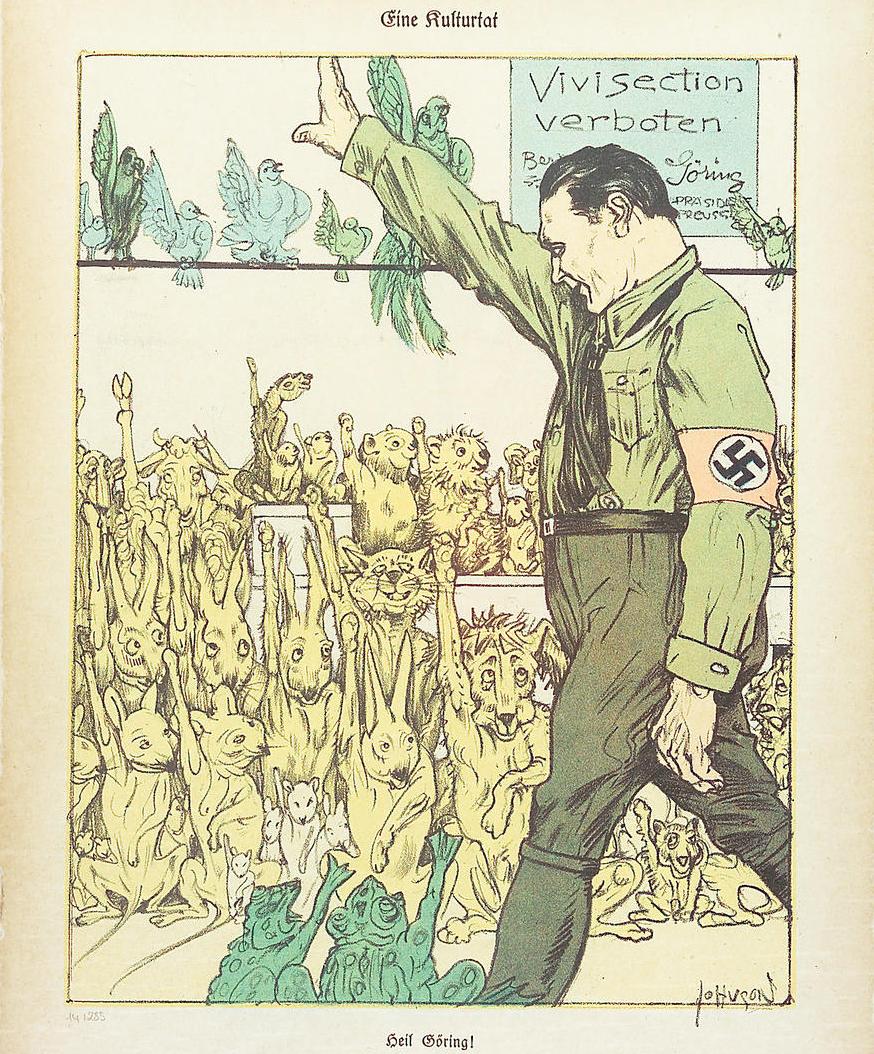
The only state, to date, to have banned cruel experiments on animals outright was National Socialist Germany. The anti-vivisection law was the first law or one of the first few laws passed by Hitler’s government. Cartoons showed Goering (another National Socialist and leading conservationist) and animals saluting, with captions such as “Heil Goering!”, “Even the animals vote for the Fuhrer!” and “Vivisection verboten!”goeringanimals

A leading, though at the same time once-obscure thinker, who espoused both National Socialism and animal welfare (etc), was Savitri Devi [https://en.wikipedia.org/wiki/Savitri_Devi], whose work is now again coming to attention. Her ideas and books even have websites devoted to them: https://www.savitridevi.org/last_man_french.html and https://www.savitridevi.org/.

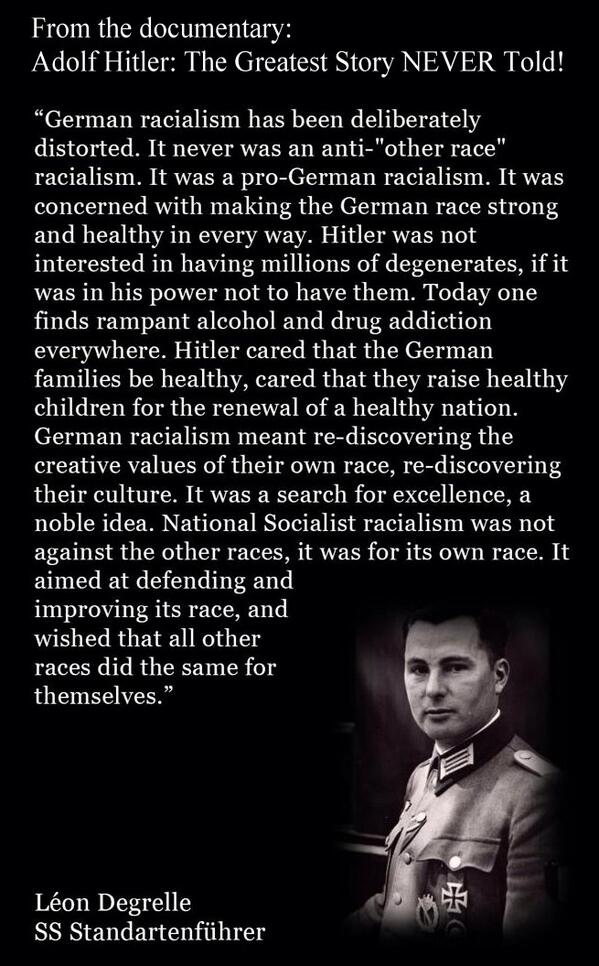
The connection is not surprising. What is now termed social nationalism is organic, built on the natural order and having respect for the creatures of the land, water and air as well as (contrary to Zionist propaganda) the relatively backward racial groups and peoples of our Earth. The hero Leon Degrelle [https://en.wikipedia.org/wiki/L%C3%A9on_Degrelle] put the latter point very well after the Second World War:becwoaeccaazenq

It is striking to see that there is very often an overlap, for example on Twitter, between those who are protective of animals and those who are strongly social-nationalist. Brigitte Bardot is a name which comes to mind: https://en.wikipedia.org/wiki/Brigitte_Bardot.

The new society in Europe will be nationalist; it will also be for Europe’s European future (though anti-EU); it will be green and it will be socially-just.

Notes:

https://www.kn-online.de/Nachrichten/Hamburg/Voelkische-Siedler-Die-Bio-Nazis-von-nebenan

Update, 28 June 2020

https://www.theguardian.com/world/2020/jun/28/german-far-right-infiltrates-green-groups-with-call-to-protect-the-land?CMP=share_btn_tw

Update, 26 May 2021

Note: https://en.wikipedia.org/wiki/Gerard_Wallop,_9th_Earl_of_Portsmouth#Organic_movement; https://en.wikipedia.org/wiki/Gerard_Wallop,_9th_Earl_of_Portsmouth