Tag Archives: political parties

Diary Blog, 14 August 2022

Afternoon music

On this day a year ago

An extract from the blog of exactly a year ago:

The System needs at least two “major parties” (even if their combined membership is only about 600,000, i.e. 1% of the UK population) because it preserves the facade of a binary choice, the facade of supposed “democracy” etc. So fake Labour has to exist, just as fake Conservative Party has to exist, in order to fool the mass of the people into thinking that they have a real choice. They do not have any such choice.

Also:

Labour, like the “Conservatives”, has to exist and pretend to put forward a bunch of policies, when really both parties have been stripped of real policy, real difference, and even real politicians (look at the pathetic deadheads now crowding the Commons and Lords alike). You want to see what “ZOG” looks like? Just look at “British” political parties and MPs today.

Nothing has changed.

“Covid” “vaccine” uselessness

https://www.dailymail.co.uk/health/article-11108521/Covid-19-weve-jabbed-poleaxed-virus.html.

Cashing-in pensions

https://www.mirror.co.uk/news/uk-news/mum-quits-nhs-pension-pay-27734990.

Leaving aside the immediate issue reported on (fuel inflation), it should not be possible to “cash in” a private pension below X-age. If I am not mistaken, the right to cash-in was brought in, or made much easier, when the part-Jew, George Osborne, was Chancellor of the Exchequer.

A private pension is to help someone of pensionable age, clearly. It is not just a long-term investment of some kind. It is against public policy in the broad sense to allow pensions to be simply cashed-in.

In fact, it is contra public policy in practical terms as well, quite apart from the ethical aspect, or impact on the individual, because someone who cashes-in a private pension but then later, at or above pensionable age, becomes poor enough to require State “Pension Credit Guarantee”, will have his or her State Pension augmented by Pension Credit so that he or she receives a minimum of £185 per week (as well as other benefits, such as Housing Benefit etc if applicable).

In other words, not only the individual but also the State itself will, in that instance, lose out financially.

“The world is not without kind people”

https://www.dailyrecord.co.uk/entertainment/celebrity/mrs-hinch-home-rent-free-27735161.

The world is not without kind people“, says a Russian proverb. One sees that constantly, despite also seeing contrary news.

Look at the story about “Mrs. Hinch”. She has given away a £600,000 house simply because she wants to help a family, and “does not need” the capital proceeds of any sale.

Remarkable. I have no idea whether her husband is wealthy; she herself is said to be “worth” about £1.5M (presumably discounting the donated house).

It was not clear to me, on skimming the report, whether the house donated has actually been transferred, or just given to live in rent-free for as long as permitted. Either way, very generous.

If only the very wealthy of our society, those possessing tens, hundreds, or thousands of millions, were as kind-hearted.

More tweets seen

[in an ideal world…]

London. Zoo. Monkeyworld.

Full-term abortion“. Murder of babies born, or being born, or about to be born, and perfectly capable of living a full human life in most cases. Straight murder. Legalized.

Will any of those Australian MPs be held to account in an appropriate way?

“Racism” against white Europeans is now considered OK; but any perceived mere criticism of Jews, or non-whites, is not only not approved of by the System, but may even be criminalized by biased law and enforcement.

“They” worm their way in everywhere, if not stopped.

Educated guess: of those 19,000 or more migrant-invaders, not one will actually be —in any way— someone who benefits the British people, but let us be kind, and assume that 1% benefit the UK (somehow). What about the other 99%? Guessing (but I think reasonably) further: of every 100 migrant-invaders, at least 10, maybe 20, will turn out to be criminal and/or terroristic; the remaining 79 or more will just be completely useless millstones round our collective neck.

I was not too pleased about Neil Oliver when he did Coast, especially his —not always well-informed– occasional anti-“Nazi” historical (or ahistorical) comments, but he has certainly redeemed himself in the past couple of years.

Not that I agree with everything he now says, but no matter. He is in general on the right track. I may be an “idealist”, as some have called me, but I do have pragmatic aspects as well.

Ask “Robert Maxwell” or Jeffrey Epstein. Oh, no— you can’t, because they snuffed it under mysterious circumstances. Ask Ghislaine “Maxwell”, then. Oh, no— you can’t, because she is in prison for much of the rest of her horrible life, and afraid of being murdered (as was, she thinks, her father) by Israeli Intelligence killers.

Liz Truss and Priti Patel, and Keir Starmer (etc) should be wary of being puppets of Israel and the Jew lobby. It’s one rouble to get in, but two roubles to get out…

Temperature variations

Incredible how varied the UK can be in terms of temperature. Where I live (Hampshire coast) the temperature at 0900 hrs this morning was 22C, in London at same time it was 33C, but in Edinburgh only 16C.

More tweets seen

Eddie Izzard is as much a woman as a pantomime horse is Red Rum.

Late tweets seen

I do not usually approve of rowdy behaviour, but if a few frustrated Brits in Greece were to give the idiot a kicking, I have to admit that I would not be upset about it.

Incapable of creating a civilization, incapable of maintaining one even when provided to them, and most of them incapable even of simply living decently as unwanted “guests” in the civilization created by white Europeans.

Late music

[https://en.wikipedia.org/wiki/Douglas_Lilburn]
[New Zealand, South Island]

Tactical Voting, the Only Way Around the First-Past-The-Post Electoral System (but it may be pointless anyway)

The UK has, famously or infamously, a First Past The Post [FPTP] electoral system. Winner takes all. There was some logic supporting such a system in, say, the 1950s, when over 90% of the electorate of the UK voted Conservative, Labour or Liberal, and in fact almost entirely for the first two. In the 1950 General Election, nearly 97% of those who voted voted for the “three main parties”. At that time, the FPTP system provided stability and a certainty of result in most general elections. Indeed, most UK adults were actually members of those parties. Even as late as 1983, 65% of UK adults belonged to a political party, mostly the “big three” and in fact mostly the “big two”. That contrasts with somewhere between 0.5% and 1.5% now, in 2019.

The figures are not entirely what they seem, of course: millions were inducted into the Labour Party by default, via their trade union membership (itself then compulsory in many industries and occupations); the Conservative Party was also packed by people who joined at least partly because they wanted to belong to Conservative clubs, i.e. social clubs (with bars). Labour also had social clubs: as it might be, the Toytown Working Man’s Club or Labour Club. Millions also belonged to the Young Conservatives (a mainly social organization and, unofficially, dating forum).

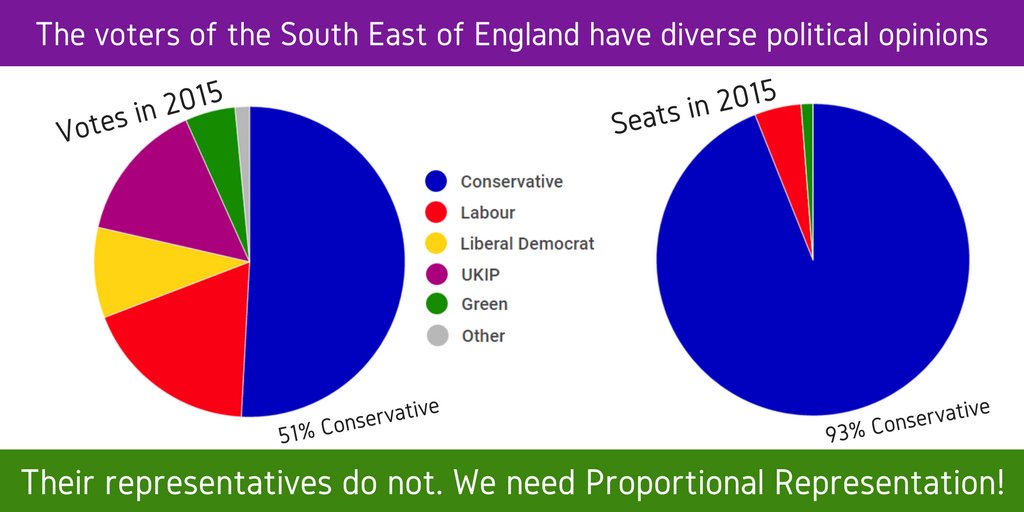
The above reflected the relative homogeneity of the UK population at the time. That homogeneity and cohesion has been shattered by social and demographic changes. We see now that FPTP voting does not reflect even the votes cast, let alone wider opinion. The chart below, for example, shows the votes cast in the South East of England, vis a vis Westminster seats won, in the 2015 General Election. Even that chart does not tell the full story, leaving out the views of those who had to compromise because there was no party which reflected their true views standing in the particular constituency: they therefore voted for the nearest party to them, ideologically, or just refused to vote (33.6% of those eligible to vote did not vote! I wonder what kind of party might capture that more-than-a-third of eligible voters?)

C3l1gk9XAAMHAwF

Also, we see that the way in which constituencies are sliced-up is a fairly arbitrary one:

c64bh5xw0aiwygy

The Boundary Commissions for the four UK countries delineate the constituency boundaries in such a way as to preserve a notional “balance”, a completely outdated one, based on that 1950s paradigm. So we see that some constituencies are “safe” Conservative or Labour and that a few are or were in the past Liberal Democrat/Liberal . A minority of seats are designed to be “marginal”, whether Con-Lab, Con-LibDem, LibDem-Lab.

The result of the above system is that, at time of writing, 80% of voters do not think that any party speaks for their views or for them.

To put it another way, there is a battle between anger and apathy.

Obviously, there should be a more responsive electoral system, based on one of the proportional voting systems already in use in many countries. However, FPTP is still the voting system in use in the UK for Westminster elections. That being so, tactical voting is the only way in which the ordinary voter can influence the result.

Take a fairly random example, Chesterfield, the constituency of Tony Benn for many years. Chesterfield, first contested in the 1880s, has been regarded as a safe Labour seat for most of that time. The Conservatives won it only once, in 1931, when the Liberals, who had won the seat several times previously, declined to stand. The Liberal Democrats won in 2001 and 2005, after the retirement of Tony Benn. Labour won again in 2010, 2015 and 2017.

The point here is that Labour has in most Chesterfield elections won, when it has won, because the anti-Labour vote was split, usually between Liberal Democrat and Conservative, in the past between Liberal and Conservative, and once only (2015) among LibDem, Conservative and UKIP (which attained a strong 3rd place).

Tactical voting could, at times, in fact quite often, have prevented Labour from winning Chesterfield. The same is true in many Lab or Con seats across the country.

The sting in the tail is that, yes, the voter can vote tactically, but all that does, usually, is to replace one System dummy with another, and one label with another. In a situation where 80% of voters think that no System party represents them or speaks for them, that is cold comfort.

duf13vmw0aejrdm

Notes

https://en.wikipedia.org/wiki/Chesterfield_(UK_Parliament_constituency)#Election_results

https://en.wikipedia.org/wiki/List_of_political_parties_in_the_United_Kingdom

https://en.wikipedia.org/wiki/1950_United_Kingdom_general_election


The Way Forward for Social Nationalism in the UK

The talent of the strategist is to identify the decisive point and to concentrate everything on it, removing forces from secondary fronts and ignoring lesser objectives.”

Those words of Clausewitz are often taken to encapsulate the essence of strategy. How are they applied to the socio-political question in the UK (England, primarily) from the social-national point of view?

“The Decisive Point”

The “decisive point” or objective, ultimately, is the formation of a British ethnostate as an autonomous part of a Eurasian ethnostate based on the Northern European and Russian peoples. However, within the UK itself and before that, the objective must first be drawn less widely, as political power within the UK’s own borders.

The Gaining of Political Power in the UK

The sine qua non of gaining the sort of political power required is the existence of a political party. More than that, a party which is uncompromizing in its wish to entirely reform both State and society.

History is replete with examples of states which have seemed not even just powerful but actually eternal, yet which have collapsed. Ancient Rome, though perhaps not a “state” in our modern sense, is perhaps the one most embedded in the Western consciousness. More recently, the Soviet Union and its satellite states. In between those two examples (but among many others) we might cite the pre-1914 European “settlement” based on the empires and kingdoms which collapsed during and after the First World War: Germany, Austria-Hungary, Russia, the Ottoman Empire.

The main point to understand is that, in situations of crisis on the large scale, it is not the political party with the most money, erudition, developed policy or even membership that comes out on top, but the party with the most will or determination. That means the most disciplined party under the leadership of the most determined leader.

It is better to have a party consisting of only 1,000 which is tightly-disciplined and self-disciplined than one of 100,000 which is a floundering mass of contradictions. When a national crisis occurs, such as 1917-1921 in Russia or 1929-1933 in Germany (to take two obvious examples), the people instinctively turn to the party perceived to be strongest, not strongest in numbers, money, intellectuality or number of members, but strongest in the will, the will to power.

The Party

A party requires leadership, members, ideology, policy and money. Everything comes from the leadership and the membership, in symbiosis. In practical terms, this means that policy is open to free discussion, up to the point where a decision is made as to what is party policy as such. Also, it has to be understood that a party requires money as a tank or armoured car requires fuel. To have endless fundraising drives, hunts for wealthy donors etc demeans and dispirits the membership. Having a “tithing” system renders such other methods unnecessary. The members sacrifice an agreed amount of their post-tax income, such as 10%. The party organizes itself and its message to the general population using that money.

As a rule of thumb in contemporary Britain, it might be said that, on average, each member will provide something like £2,000 per year to the party. A party of even 1,000 members will therefore have an annual income of £2 million, enough to buy not only propaganda and administration but real property as a base. By way of comparison, the Conservative Party in 2017 has an income of about £3.5 million.

Elections

It must be understood that elections are only one way to power, but they are indispensable in England, for historical-cultural reasons. A party which cannot win elections loses credibility rapidly once that party is large. In the initial phase, no-one expects the party to win Westminster or even local council seats, but after that, it has to win and so grow, or deflate as the BNP did and as UKIP is doing now. The problem small parties have under the English electoral system is that a Westminster seat can be won only with, at a minimum, about 30% (and usually 40% or more) of votes. The insurgent party is in danger of spreading itself too thinly, in every way. UKIP’s history illustrates the point: in 2015, about 12% of votes cast (nearly 4 million), but only the one MP with which they, in effect, started. The answer is to concentrate the vote. That is done by concentrating the members and supporters of the party geographically.

Safe Zones

I have blogged previously about the creation of safe zones and especially one primary safe zone (possibly in the South West of England). If the members and supporters of the party gradually relocate into that zone or zones, many things become easier, from protection of buildings, meetings, exhibitions etc to the election of councillors and MPs. I have also blogged about the magnetic attraction such a safe zone might exercise over people in the UK as a whole.

The Decisive Time

The “decisive time” cannot be predicted. In Russia, Lenin (at the time in foreign exile) thought that the 1905 uprising was “the revolution”. He was wrong. He also thought that the first (February, old-style) 1917 uprising was not “the” revolution. He was wrong again. It was.

https://en.wikipedia.org/wiki/February_Revolution

Lenin had to hurry back to Russia (arriving belatedly in April 1917, old-style) not only to try to take control (he failed in that and had to foment his own coup d’etat in October 1917) but to avoid being sidelined and so becoming an almost irrelevant footnote to history.

In Germany after 1929, Hitler likewise was not in control of events. In the end, economic near-collapse and political turmoil gave him the chance to win enough votes (33% in 1932) to form a coalition government which led on to full power in 1933, after the NSDAP achieved a higher –though still minority– popular vote (44%).

In other words, both Lenin and Hitler were the pawns of Fate while striving to be the masters of events. They had something in common though: highly-disciplined and ideologically-motivated parties behind them.

Practical Matters

At the age of 60, the last thing which is convenient for me is to form a political party. I have no need of such an activity as a hobby or absorbing interest. I am coming to the idea out of duty, out of a realization that something has to be done and out of an understanding that something can be done, if Fate concurs. I am not willing to compromize on overall ideology or on the way things are organized within such a party. I shall only establish a political party (which may become a movement) if it can be done on a serious basis. However, there is a need for a party to speak for the British people and there is a widening political vacuum in which such a party can thrive and grow.

Update 15 April 2019

In the two years since I wrote the above blog post, my view has not changed, that is

  • a political party and movement is needed;
  • there is at present no such party;
  • such a party can only be established if done on a serious basis;
  • I myself still do not have the means with which to found such a party; but
  • a political party and movement is —still— needed…

Update, 8 March 2023

All factors mentioned in the previous update remain the same.