
Tag Archives: voting

Diary Blog, 24 February 2025

Morning music

News from the migration invasion

https://www.dailymail.co.uk/news/article-14416593/Irish-migrant-powder-keg-Far-right-militias-rise-asylum-seekers-violence-machete-attacks-drug-brawls-Dublin.html

Ireland has exploded into a wave of violence as anti-migrant anger is at an all time high – after the number of people applying to come into the country rocketed by nearly 300 per cent five years.

Once sleepy towns are now homes to hundreds of asylum seekers while tent cities have been set up along Dublin’s Grand Canal. 

And with far-right sentiment at fever pitch the country is on a knife edge – with even Ireland’s left-wing politicians admitting that the influx of migrants was driving a spike in homelessness.

The government has previously spoken favourably about migration. Jamie Drummond, Co-Founder and Executive Director of NGO ONE and a friend of U2 star Bono, told the International Development Committee in 2015 that young immigrants were needed to help with Ireland’s ‘senile’ aging population.

“Just as this country and this continent will be at its most senile demographically speaking, Africa will be the world’s youth and the supply of the world’s energy, creativity and dynamism.”

[Daily Mail]

The final comment, apparently by a friend of grasping hypocrite “Bono” shows that he (Daily Mail says “she“, for some reason) has little of use to contribute: anyone who imagines that Africa can give white Europe “energy, creativity and dynamism” is either deluded or working to an agenda.

Very sad that Ireland has become so contaminated. I saw it in the 1970s, and again in the mid-1980s. From what I have seen on TV and newspapers, it has become busier and, in recent decades, more affluent in parts than when I was there but also, now, far less pleasant by reason of the migration invasion.

At least the Irish, unlike most of the English, are not going down without a fight.

Tweets seen

You can see that process happening in the UK. In fact, it has been a factor for decades, but the huge migration-invasion since, arguably, 1989, is now completely destroying the “democratic rights” of the (real) British people.

Somewhere around 15%-20% of the UK population is now non-white; in England, the proportion is far higher, around 25%, and in the major cities such as London even higher, somewhere around 30% if not more. Some cities in the Midlands and North are already majority non-white.

Even in the UK as a whole, the average non-white presence in primary schools is now somewhere around 40%. As shown, that means that in cities such as London, the primary schools are already about 50% or more non-white.

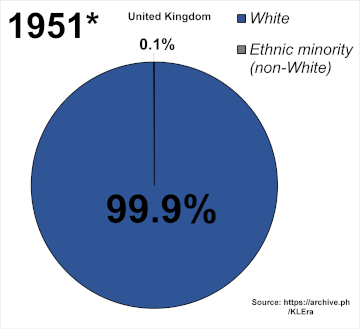
[In 1951, there were effectively no non-whites in the UK; the few that did exist were in the major ports, including London (graphic from Wikipedia)]

Incidentally, you can see from that graphic what a lie are those TV dramas (eg, Grantchester) which show even small villages in the 1940s or 1950s with racially-mixed populations.

People of my age [b.1956] know the truth, but younger people, especially children, are being brainwashed via the TV, cinema, streaming services, and at school, to believe what amounts to a lying narrative.

By 2050, at latest, the UK population will be majority non-white. Yes, some non-whites will not support later waves of immigration; however, most will, and do.

If Britain does not have, by 2030 or so, a genuinely social-national government, or at very least a Reform UK-type conservative semi-nationalist one, you can forget the “Parliamentary road”.

Talking point

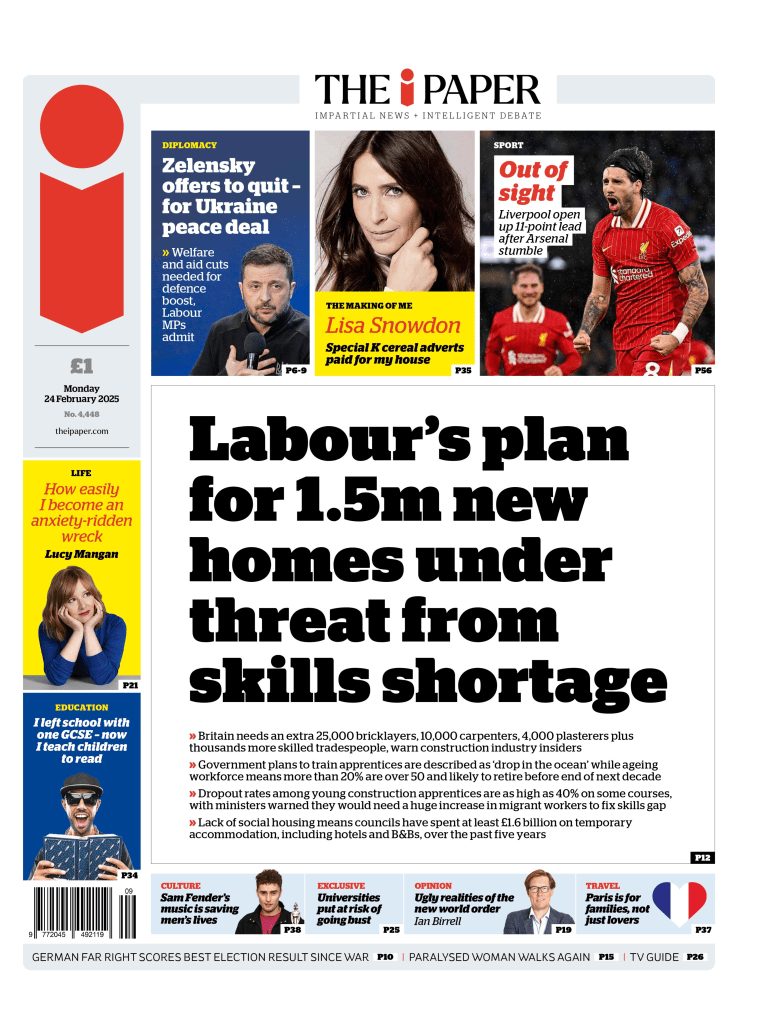
Fake Labour has no “plan”, except to allow profiteering bodge-housebuilders to make money destroying what is left of our countryside by building hutches for migrant-invaders and their offspring.

Now, the msm has awoken to what dissidents were saying on Twitter/X 6 months or more ago— there is no sufficient workforce to build said hutches.

You see the agenda, though, in that “i paper” bullet-point list: the UK “needs” more migrants to (supposedly) build more houses because…Britain has so many migrants (who are breeding). Brilliant…

More tweets

Nick Robinson is, of course, half-Jewish, his maternal grandparents having emigrated from Germany after the advent of Hitler: https://en.wikipedia.org/wiki/Nick_Robinson_(journalist).

Sounds hopeful.

Migration invasion…

I wrote at some length about this on the blog yesterday.

“Mark Lewis Lawyer”— latest

[“Episode 4 is published. The one in which Eddy Cantor refuses my offer of a nominal settlement after Mark Lewis of Patron Law tells him he can’t lose any money. Cantor will now lose his home. https://open.substack.com/pub/perincuriam2/p/post-4-mr-cantors-refusal-of-a-nominal]

Mark Lewis, the notorious Jew-Zionist solicitor, is both dishonest and professionally negligent.

Incidentally, that photo of Lewis is about 13-15 years old. He can now scarcely walk, inter alia, by reason of a chronic medical condition.

See also:

James Wilson was the victorious claimant in the recent libel action Wilson v. Mendelsohn, Newbon (deceased) and Cantor.

Late tweets

True, but we have seen this before, and not so long ago— in 2019, with Farage’s previous vehicle, Brexit Party, whose members he let down, shamelessly.

Still, I agree with Goodwin that there is now building up a head of steam which might yet blow up British politics forever.

Ukraine’s army suffering huge losses in Kursk Region.

The Sumy Region is now becoming a theater of military operations, a source in Russian defense circles told TASS: https://vk.cc/cIT9MP.”

https://en.wikipedia.org/wiki/Sumy

Late music

Tactical Voting, the Only Way Around the First-Past-The-Post Electoral System (but it may be pointless anyway)

The UK has, famously or infamously, a First Past The Post [FPTP] electoral system. Winner takes all. There was some logic supporting such a system in, say, the 1950s, when over 90% of the electorate of the UK voted Conservative, Labour or Liberal, and in fact almost entirely for the first two. In the 1950 General Election, nearly 97% of those who voted voted for the “three main parties”. At that time, the FPTP system provided stability and a certainty of result in most general elections. Indeed, most UK adults were actually members of those parties. Even as late as 1983, 65% of UK adults belonged to a political party, mostly the “big three” and in fact mostly the “big two”. That contrasts with somewhere between 0.5% and 1.5% now, in 2019.

The figures are not entirely what they seem, of course: millions were inducted into the Labour Party by default, via their trade union membership (itself then compulsory in many industries and occupations); the Conservative Party was also packed by people who joined at least partly because they wanted to belong to Conservative clubs, i.e. social clubs (with bars). Labour also had social clubs: as it might be, the Toytown Working Man’s Club or Labour Club. Millions also belonged to the Young Conservatives (a mainly social organization and, unofficially, dating forum).

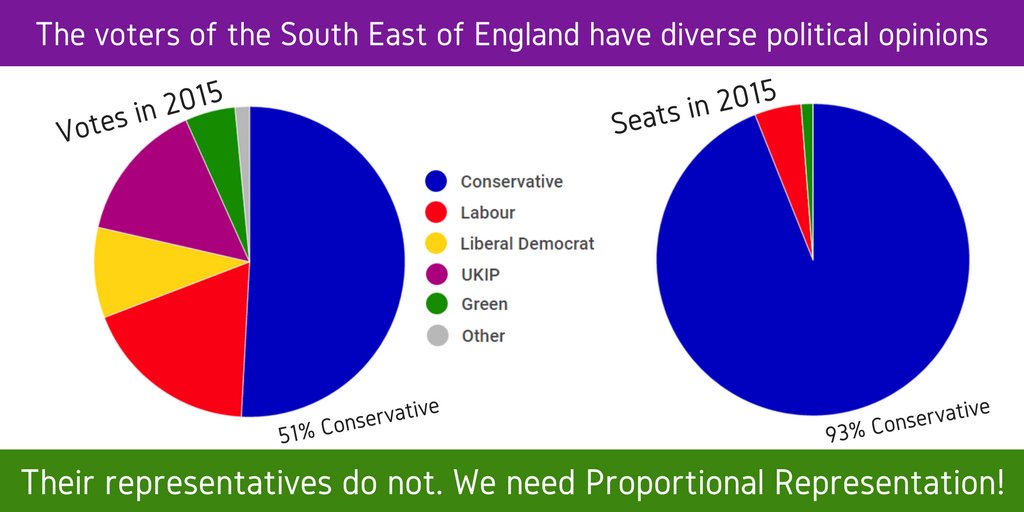
The above reflected the relative homogeneity of the UK population at the time. That homogeneity and cohesion has been shattered by social and demographic changes. We see now that FPTP voting does not reflect even the votes cast, let alone wider opinion. The chart below, for example, shows the votes cast in the South East of England, vis a vis Westminster seats won, in the 2015 General Election. Even that chart does not tell the full story, leaving out the views of those who had to compromise because there was no party which reflected their true views standing in the particular constituency: they therefore voted for the nearest party to them, ideologically, or just refused to vote (33.6% of those eligible to vote did not vote! I wonder what kind of party might capture that more-than-a-third of eligible voters?)

C3l1gk9XAAMHAwF

Also, we see that the way in which constituencies are sliced-up is a fairly arbitrary one:

c64bh5xw0aiwygy

The Boundary Commissions for the four UK countries delineate the constituency boundaries in such a way as to preserve a notional “balance”, a completely outdated one, based on that 1950s paradigm. So we see that some constituencies are “safe” Conservative or Labour and that a few are or were in the past Liberal Democrat/Liberal . A minority of seats are designed to be “marginal”, whether Con-Lab, Con-LibDem, LibDem-Lab.

The result of the above system is that, at time of writing, 80% of voters do not think that any party speaks for their views or for them.

To put it another way, there is a battle between anger and apathy.

Obviously, there should be a more responsive electoral system, based on one of the proportional voting systems already in use in many countries. However, FPTP is still the voting system in use in the UK for Westminster elections. That being so, tactical voting is the only way in which the ordinary voter can influence the result.

Take a fairly random example, Chesterfield, the constituency of Tony Benn for many years. Chesterfield, first contested in the 1880s, has been regarded as a safe Labour seat for most of that time. The Conservatives won it only once, in 1931, when the Liberals, who had won the seat several times previously, declined to stand. The Liberal Democrats won in 2001 and 2005, after the retirement of Tony Benn. Labour won again in 2010, 2015 and 2017.

The point here is that Labour has in most Chesterfield elections won, when it has won, because the anti-Labour vote was split, usually between Liberal Democrat and Conservative, in the past between Liberal and Conservative, and once only (2015) among LibDem, Conservative and UKIP (which attained a strong 3rd place).

Tactical voting could, at times, in fact quite often, have prevented Labour from winning Chesterfield. The same is true in many Lab or Con seats across the country.

The sting in the tail is that, yes, the voter can vote tactically, but all that does, usually, is to replace one System dummy with another, and one label with another. In a situation where 80% of voters think that no System party represents them or speaks for them, that is cold comfort.

duf13vmw0aejrdm

Notes

https://en.wikipedia.org/wiki/Chesterfield_(UK_Parliament_constituency)#Election_results

https://en.wikipedia.org/wiki/List_of_political_parties_in_the_United_Kingdom

https://en.wikipedia.org/wiki/1950_United_Kingdom_general_election