Category Archives: ethnostate

Use and Abuse of the UK Welfare State

I am in favour of the Welfare State, in principle, but that just begs the question. Even the Iain Dunce Duncan Smiths and Esther McVeys of this world go that far, at least in public utterances. The devil really is in the detail here.

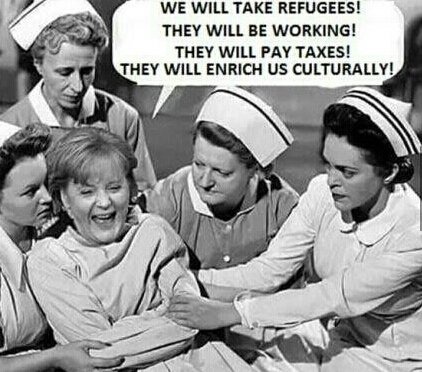
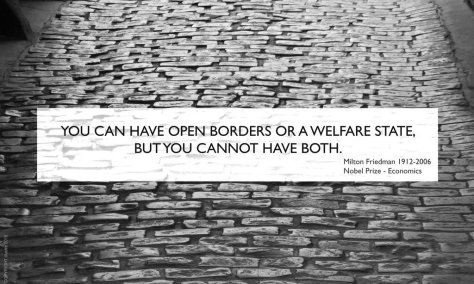
The famous economist, Milton Friedman, once said that you can have open borders, and you can have a welfare state, but you cannot have both. That it is even necessary to posit that shows how far the more socialist-minded people in the UK (and elsewhere in Northern Europe) have travelled from reality. Many “refugees welcome” dimwits actually believe that an almost endless number of “refugees” or others can enter the UK without affecting State benefits and services (as well as road and rail congestion etc). This seems to be based on the idea that the immigrants will work, pay taxes, in short become normal citizens or quasi-citizens. Angela Merkel thought the same, only to find that most “refugees” were

  • incapable of any but the most basic work (such as fruit-picking) because of their linguistic and/or educational levels;
  • unwilling, in many cases, to work, in a situation where the State provides free accommodation, free utilities, free transport for some, free food for some, as well as pocket money on quite a generous level.

CgFqWSRXEAICTlz

The UK does not provide social security (or, in our new Americanized speech, “welfare”) benefits on the generous scale offered by Germany or Scandinavia etc, but the fundamentals are similar.

A personal story: when I was much much younger, in my early twenties, I became acquainted, via a lady I then knew, with a friend of hers (more accurately a woman who had attached herself to her like a limpet). Now this other woman was not British in any sense except that she had married a New Zealander who had (presumably because taken there from the UK as a child) a British passport. The woman was in fact a Jewess from Moscow, who had somehow got to know the New Zealander while he was on a holiday trip to the Soviet Union. We need not examine motives and reasons, but that couple married and went to live in New Zealand. They had two children. After about four or five years, the woman left her husband, left New Zealand and flew to the UK.

When I met the woman in question, I believe that she had been in the UK for a couple of years. She washed-up in Downham, an obscure suburb in South-East London, where the local council provided her with a council flat. I have no exact idea of what other benefits she was granted, but they would have included child benefit and some form of income support. She never had to work, though at first she did a couple of evenings a week teaching Russian at some place or other which I forget (possibly Morley College in Westminster Bridge Road, or the City Literary Institute in Drury Lane, both of which adult education centres I myself frequented at the time).

Scroll on a few years. This “Russian” Jewish woman, with no real connection to the UK at all had been given a quite decent house with gardens in Grove Park, a better part of the same borough. She had been impelled to move, apparently, by a visit from her father, a nuclear scientist (which sounds impressive, but the Soviet Union had legions of them) who had told her that she would have a better flat were she to return to Moscow! Of course, there she would have had to work…anyway, I visited the new house once (out of duty rather than choice)  and so saw it, despite being not much liked by the woman. The woman had been diagnosed with a kidney complaint (though I never saw her looking unwell) and so no doubt managed to claim some form of incapacity or disability benefit; and had also acquired a car (almost certainly also funded by the State). In addition to all of that, the woman and her children also had all the usual UK benefits of free education and health. I do not think that she bothered to do much work after that, maybe a little part-time teaching or occasional low-level interpreting.

Now it might be said, perhaps especially by people more naturally drawn to socialism than capitalism, that she was entitled to these things because lawfully resident in the UK. Perhaps, but look at it from the wider point of view: she had never contributed anything to the UK, just taken. The small part-time jobs here and there can be discounted as having been de minimis. She leeched off the UK’s people since about 1979 and, the last I heard (a couple of years ago), that situation remained unchanged, probably to this day. In fact, she would now be “entitled” to a State pension and Pension Credit. Call it 40 years of being a millstone round the neck of the British Welfare State.

Now multiply the above by millions, the millions of often completely useless people from the backward hordes imported into the UK for decades. For example, it is reported that only 20% of the huge numbers of Somalis in the UK (how? why?) are employed at all.

I repeat, I do favour a decent Welfare State, but it can only exist if

a. the economy can support it;

b. it is not swamped.

The above two conditions really come down to the same thing now, or very nearly so.

For me, the answer to the work and income challenges of robotics, computerization, Internet shopping, AI etc is the Basic Income concept, but Basic Income, like the existing Welfare State, will decline and may fail unless it is restricted to those who are at the very least, genuine citizens.

ClVU6MSWgAAmfK6


When Britain Becomes A Police State

Repression of Opinion in the UK

Had I written an article with such a title in 1978 or 1988, or even 1998, the reader might have been justified in laughing. However, since (to specify a year) 1989, when –or soon after which– President Bush snr proclaimed openly the American/ZOG (Zionist Occupation Government) New World Order, and especially since Tony Blair’s ascendancy in 1997, the British state and society has slid ever faster down the slope towards what amounts to a muffled totalitarianism.

The Blair government introduced a number of repressive statutes, including the Regulation of Investigatory Powers Act 2000 (extending snooping powers)

https://en.wikipedia.org/wiki/Regulation_of_Investigatory_Powers_Act_2000

the Political Parties, Elections and Referendums Act 2000 (controlling political parties in various ways)

https://en.wikipedia.org/wiki/Political_Parties,_Elections_and_Referendums_Act_2000

and the Communications Act 2003, which has provisions (s.127 etc) under which tweets, emails, Facebook posts etc can be criminalized as, inter alia, “grossly offensive”. It is this Act which is currently being used against the satirical singer-songwriter Alison Chabloz.

The Blair government was not persuaded that it should introduce a “holocaust” “denial” law in the UK (or could easily pass one through Commons and Lords), but the Jewish Zionist organizations and lobbyists are currently using existing laws such as s.127 of the Communications Act 2003 to introduce one by the back door, in co-ordination with the misnamed “international definition” of “anti-Semitism”.

I have previously written about my experience of being interviewed by the police for tweeting socio-political tweets

https://ianrmillard.wordpress.com/2017/07/13/when-i-was-a-victim-of-a-malicious-zionist-complaint/

and have also written about how the Jewish Zionist lobby (and the Theresa May/Amber Rudd government of clowns in the pocket of that lobby) is abusing the ever-tighter “regulation” of professions (another Blair/Brown era feature) to suppress freedom of expression, as when I was disbarred in 2016:

https://ianrmillard.wordpress.com/2017/07/09/the-slide-of-the-english-bar-and-uk-society-continues-and-accelerates/

Now the suppression or repression of opinion becomes both harsher and stealthier. The large platforms for opinion have been persuaded to remove dissenting voices. Youtube, in the past week, has removed numerous popular and broadly “nationalist” channels, including that of the London Forum, which had 7,000 subscribers and had had 500,000+ views. Singer-songwriter Alison Chabloz has had her youtube channel removed from many countries, including the UK. Others have suffered similarly. Facebook and even Twitter are also caving in.

What to Do

There are no “digital rights” to speak of that go beyond simple contract law. If a quasi-monopoly such as ebay, Facebook, Twitter, Amazon wants to expel a user or prevent his opinions being seen, that can be done at will (and is being done, now). Several years ago, at the behest of the Jewish lobby, I was prevented from posting further book reviews on Amazon (UK and US sites, by the way…so much for American “freedom”!): on the UK site, a third of my reviews were removed, quite arbitrarily (many were non-political) and I was barred from posting, despite having been a “top 50” reviewer. I have one Jew (it was only one, at first) to thank for that, he having involved the Jewish Chronicle, which then wrote against me, nagging at Amazon UK; on the Amazon USA site, all my reviews were removed without warning (one can guess why: a Jew-Zionist working for Amazon USA…).

The same is true of Facebook and Twitter: if they decide to remove someone, however popular, that person has no right of appeal (certainly no legal right, in any court).

So what to do as this ZOG repression intensifies… I have written previously on this blog about how I believe that the main chance for social nationalism is to concentrate its people and forces in one area of the UK (I have suggested the South West of England). I firmly believe that. It is a way to cluster, to defend and to infiltrate the social and political key points. To some extent, it removes the need for social media. In any case, social media can only assist a political movement, not create one, nor sustain it to victory. We need boots on the ground.

The Train is Hitting the Buffers

The UK train is hitting the buffers. The train crash has been slow, long in coming, but it is now starting to happen.

Decades of decadence, mass immigration, political corruption, Zionist takeover of the legal system, cultural sickness in all mass media (fostered by Zionist infiltration at all levels) etc now result in manifestations that are becoming apparent even to the voting public.

The public has little idea, even now, of the causes, but it sees the effects: National Health Service creaking, beginning to fall to pieces; the housing market effectively closed to most of those who wish to buy a house or even an apartment; sky-high rents paid to speculative parasites by employees and others; congested roads and trains; cities full of those of alien race and culture; schools which brainwash children with “multiculti” propaganda and “holocaust” lies.

Those few (including me) who saw this coming as long ago as in the 1970s (in my case) or even 1960s, were and still are marginalized by a mass media system which is thoroughly corrupted. The same is true of the political system and, increasingly, of the professions, where to speak up at all invites expulsion: see

https://ianrmillard.wordpress.com/2017/07/09/the-slide-of-the-english-bar-and-uk-society-continues-and-accelerates/

The Zionists are behind much of this and are now trying to shut down free speech and comment across social media– as happened long ago in the mass media.

https://ianrmillard.wordpress.com/2017/07/13when-i-was-a-victim-of-a-malicious-zionist-complaint/

The question that now has to be asked is what, in the next 4-5 years, will be the political result of the slow but accelerating collapse of British society in all areas?

It is clear that specifically English (leaving aside Scotland, Wales and Northern Ireland) voters are now, in a semi-rigged “First Past The Post” electoral system, voting against parties rather than for them. There is little enthusiasm for any of the System parties, let alone the more or less washed-up UKIP, Liberal Democrats and Greens, but there is determination to block parties by voting tactically for the party most likely to achieve that in any given seat.

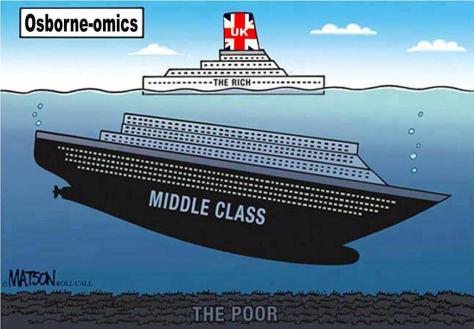
Beyond the wish to block unwanted parties and candidates, there is a general and growing dissatisfaction. Above all, the “Middle Classes” are joining the “workers” and the marginalized at the bottom.

b-cisxdiqaa7qj_-jpg-large

That can only help Labour, despite the misgivings many feel about its MPs and leaders (the obvious example being Diane Abbott). The success of the Corbyn faction and its vanguard, Momentum, may unsettle some voters, but may give rise in others to the feeling that at least Labour is fairly solid ideologically, not a chaotic mess. That is bound to play to Labour’s advantage electorally. Contrast with the Conservatives. This cartoon portrayed the way in which Theresa May achieved office by default:

CnLGOc5XYAALLJdThe next general election will probably favour Labour, though probably not enough for it to win a majority in the House of Commons. After that, one can foresee continuing mass immigration, continuing slide in public services, continuing disparity in wealth. That will be the moment when a social-national party can strike. First of all, one must exist, however.

Taking the Whole Package

This evening, I watched a show called something like “The Real Marigold Hotel”, in which four elderly once-“celebrities” went to a country (in this case, Cuba) in order to see what facilities might be available for retired people. As such, as a “documentary”, it was very superficial and lacking depth, though entertaining. What interested me was the society in general.

The Cuba –actually just Havana– shown (and I have never been there, though I am quite well acquainted with its history of the past century and, in the manner of Sarah Palin, have glimpsed it from the air and from the sea) was in fact largely the stereotype: old American cars in pastel pink and blue, decrepit but charming colonial mansions, palm trees etc.

The old people went to cultural classes and talked to Cubans in parks. It struck me anew that any society is a package: Cuba has some culture (both European and its own mixture incorporating the Caribbean and African, as well as that of the USA.

The Havana shown was one where the parks were (on the face of it) safe to visit, the people well-educated (one or two Cubans carefully making the point that their good education had been free, as were the classes available to the elderly).

Most people know that the Cuban healthcare system is also very good, both in relative and absolute terms. On the other hand, and as the TV programme noted, the Internet is tightly controlled, requires a card (no doubt traceable..) and is mostly only available in “wi-fi” areas such as certain parks; not so many have home Internet connection.

It is perhaps pointless to reiterate what most of us know in terms of the Cuban police state (which –in all the documentary films I have ever seen– is so pervasive that it is invisible: you never see the hand of the State in plain sight, though it is there all right).

So there you have the Cuban package: low crime rate (supposedly), no obvious disorder, at least some rather polite, cultured citizens, good education and healthcare etc (one Cuban did say that it was better before the supportive Soviet Union collapsed), as well as a certain charm.

As against that, a socialist state which controls the news and Internet tightly, imprisons dissidents for years (not to mention the large number who, in the late 1950s and 1960s, were just shot); a socialized economy which (leaving aside the effect of American embargo) was and largely is hopelessly inefficient at providing consumer goods. Travel restrictions, too.

Let us take a different case. The German Reich in the 1930s was intolerant of dissidents too, though it was far more tolerant than was the Soviet Union under Stalin or, indeed, Cuba under Fidel.

The National Socialist state imprisoned some dissidents or placed them in concentration camps such as Dachau (though few now know that many served short sentences, such as 3 months, there, and were not there indefinitely). Others were encouraged or more or less forced out of the country. There was a generally militarized ethos. How could a state both German and quasi-socialist be anything else?

In the Reich, there was state interference in culture (though, again, far less than, say, in the Soviet Union). Consumer production was given a lower priority than rearmament (“Guns Before Butter”), though large projects for the benefit of the people were also pushed into the foreground: the Autobahnen; the VW “people’s car”; the 1936 Olympics; a huge programme of educational and cultural events; the Kraft durch Freude [“Strength through Joy”] programme of Canary Islands cruises and Baltic beach holidays for the people (at a time when, in the UK, most people who had a holiday at all were corralled into poky Blackpool guest houses…); better nutrition for young people, too.

The National Socialist Reich was hugely beneficial for most Germans, certainly compared to what existed in the Weimar period. The Reich solved the inflation problem, the unemployment problem, the decadence problem and, yes, what it termed “the Jewish question”.

In the UK at the same time, there was greater ostensible “freedom”: elections every 5 years, the freedom to eat daily at the Ritz or at the Savoy Grill (if one had the funds..), no obvious book censorship (though, behind the scenes, there was much, not least via the Jewish element, even then). There was official theatre and cinema censorship (via the Lord Chamberlain’s office) and there was also, of course, grinding poverty (especially outside the South East), and a very repressive justice and prison system; not to mention the pervasive class system and its inequities.

No state, no political system is “perfect”. All have flaws, and all (most, at least) have benefits (though what might be the benefits of living in, say, North Korea or the Congo might be disputed). The aim can only be to do the best with what is available at the material time. We take everything as a package, as a whole.

The General Shape of a Future Society

We should be aiming at a society which contains the good from the present (and, therefore, past) while being oriented toward the future. Humanity is a work in progress. Society is a work in progress.

The basic template for a future society, even in the short-term, can be found in the Threefold Social Order concept:

https://en.wikipedia.org/wiki/Social_threefolding

This is not some castle in the air. Many of the concepts within the overall concept of the Threefold Social Order are already part of UK society to a greater or lesser extent: religious freedom, freedom of thought, equal treatment under the law, the separation of the economic, political/legal and spiritual spheres or realms. Even since, say, 1989 (when old-style socialism died), there has come about a greater acceptance that, for example, the State should not monopolize education, that the State should not directly run business enterprises etc. There have been retrograde aspects too, though: increasing actual slavery, a huge increase in quasi-slavery or economic serfdom (including “welfare-to work” schemes, as well as diminution of employee rights and workplace conditions), the “National Curriculum” in State-run schools etc.

Necessary Changes and Structure

First of all, the migration invasion must be halted and a plan developed to remove as many non-Europeans as possible from the UK and Europe. There can be no decent future for UK citizens unless at least most are of British/European origin and culture. As Milton Friedman said, also, “You can have open borders or you can have a welfare state, but you cannot have both.” The Labour Corbynists have not all, by any means, awoken to this truth.

Special-interest groups, notably the Jewish Zionists, must not be allowed disproportionate influence or power. That applies to politics (eg Westminster seats), the Press and other mainstream media, professions, the ownership of business enterprises.

All citizens should receive a “Basic Income”. Robotics and computerization are advancing to the point where perhaps a third of the jobs in the UK might go. The choice will either be Basic Income or Iain Dunce Duncan Smith-style DWP snooping, bullying and serfdom, i.e. forced “make work” projects run by carpetbagging companies, validating payment of what is now often called “welfare” (social security).

The State will not run business enterprises, in general. However, it may be that the security of the State and of society requires the State to run or at least tightly to regulate some enterprises: railways, water supply, electricity supply. Having said that, technology may lessen those cases, as in individual electrical power generation via solar, wind, hydro.

Private business should not run what are, properly, State functions: prisons, the armed forces, social security provision overall.

There must be freedom of expression on political, social, historical matters.

The State can organize or fund some things without actually owning or, on ground level, running them: a UK-wide wildlife grid (possibly composed of land owned largely by non-State owners) is one example.

There is a necessity for improvement in several everyday areas: housing must be built or rebuilt to give everyone a decent home and garden space. No-one should own several and certainly not dozens or hundreds of dwelling-homes. There must be a minimum per-person amount of space within every new house or flat, a higher level than usually found at present.

Local transport should be free of charge.

Higher education should regain its credibility: standards must be improved. Grants can be given to the best students, but others may have to do without and perhaps not go to university. The corollary is that a university degree should not be necessary for most, perhaps all, occupations. Other means of selection can be worked out.

There should be huge expansion of branch rail lines using light, ultralight, narrow-gauge etc trains, mostly operated by robots.

A grid of new wide canals should be dug, for leisure, environmental and business use (freight and passengers).

The airship or Zeppelin can now come into its own as a UK-wide passenger-carrying form of transport. The tops of some high office buildings in cities such as London can become passenger hubs (while commuting exists as a lifestyle).

A New Society Needs New People

The aim must be to create a new people for the future. People create society; society creates people. It is symbiotic. This can be a “virtuous circle”: a highly-educated, highly-cultured people, which in turn will result in society being improved over time and so again. This is something worth struggling and fighting for.

People are Worth More than Their Opinions

Someone, possibly Auden, remarked once that “people are worth more than their opinions” (in relation to the Comintern/NKVD agents of the 1930s active in the British universities). There is something in that. On Twitter, for example, I have noticed that people bitterly divided politically will often still support, separately, such causes as animal welfare or environmental improvement. Wider than that, I am willing to see that some of those who attack my views (and, often, me personally) are, in some cases –and like me– interested in the welfare of the more downtrodden parts of the population. Sadly, most of those who attack me –and this particularly applies to the Jewish Zionists– are unwilling to see the slightest good in me or my views. I can only assume that to do so would weaken their assertion that anything connected with social nationalism (and, a fortiori, National Socialism) is irredeemably evil and without any good in it at all.

Adolf Hitler was of different mind. He accepted into the ranks of the NSDAP and SA, even into the SS, many who had been his enemies. People, in other words, who wanted a better society but who at first did not accept that National Socialism would create one.

In the Soviet Union, from 1917 onward, many who fought Bolshevism or were at least opposed to it were later shot, imprisoned or exiled as so-called “former people”, others however were allowed to stay as free as anyone could be under Sovietism. Some even became members of the CPSU and/or the officer corps of the Red Army, at least until the purges of the late 1930s. Beria’s own past was full of ambiguities. During the 1941-1945 war, the vast majority of Russians fought and struggled together (whatever one may think of that).

In the UK at present, I can see that many want positive social change and that many (sometimes the same people) want to preserve the better aspects of the existing society. These people belong to Labour (especially the Corbyn wing), the Green Party, the LibDems, UKIP, even the Conservative Party. I trust that, when a real social national movement comes into existence, these people or many of them will feel able to join with me in the rebirth of this country.

Why Should People Relocate to the Safe Zone of the Germinal Ethnostate?

I have blogged previously about people of social national views relocating to “safe zones” or to a (germinal) ethnostate possibly to be centred on the South West of England (Cornwall and Devon, as well as Somerset and Dorset):

https://ianrmillard.wordpress.com/category/safe-zones/

https://ianrmillard.wordpress.com/category/white-flight/

https://ianrmillard.wordpress.com/category/prepping/

In various blog posts, I have covered issues of practical relevance such as how such a safe zone or germinal ethnostate might be started, how it might be maintained (even if the rest of the UK and Europe faces disaster or social collapse) and how the safe zone might have real political influence even within the present society. Now I should like to address what the advantages are for an individual, couple or family relocating in the next few years.

It can be taken as read that most people willing to relocate to a “safe zone” will be discontented in some way, or in various ways, with their existing lives, lifestyles or with at least some aspects of the existing society. It is not hard to imagine that many living in Britain’s decaying urban sprawls will find the idea of relocating to, say, Cornwall attractive. What, however, are the other benefits?

For one thing, the relocated people will be living in a milieu where many of their neighbours, employees, employers, co-workers are of similar viewpoint, at least in broad outline. Secondly, there is the fact that the South West of the UK is still an area where most of the existing inhabitants are English or British or at least European in ethnic origin and in culture. Thirdly, a social national community, even if at first loose or spread out, provides a support structure and defensive barrier for those under attack from the existing UK State or from the Zionist infestation. Fourthly, for those with children, there will be the chance to have their offspring educated in free schools etc set up by the community. This last is not a matter of “indoctrination” as such, but rather of protecting the children from the negative and decadent influences now so pervasive in the wider society.

In my view, there can be created a zone within the UK which will over time exercize a magnetic attraction.

Update, 21 July 2019

Saw this from USA. Not bad, though obviously drafted with American conditions in mind.

https://twitter.com/SoCarbonNeutral/status/1151751859125669889

Update, 29 September 2019

https://www.kn-online.de/Nachrichten/Hamburg/Voelkische-Siedler-Die-Bio-Nazis-von-nebenan

Post-Collapse Survival; Preservation of Civilization and Culture

Recent months have seen devastation from hurricanes. The Caribbean area has been the worst-hit. Most of those islands are now, with help from major states as well as from charities and individuals, bouncing back. Puerto Rico is still suffering from the effects, partly because it is the largest of the worst-affected islands, partly because the US Federal Government response has been sluggish.

In Europe, it is unlikely that we shall suffer in any major way from hurricanes, but there is a quite-high chance that our societies will suffer from the dislocations caused by war and/or socio-economic collapse. Many will say that this cannot happen or would not affect at least the more civilized parts of Europe. Are they sure? It is still just within living memory that parts of Europe were devastated twice by the very major conflicts of 1914-18 and 1939-1945. Apart from those wars, there have been others: the war between the Bolsheviks and others from 1918-1922 (Russia, Ukraine, Poland, East Prussia); the Spanish Civil War (1936-1939); the Balkan War(s) of the 1990s. That is not even taking into account smaller armed conflicts such as the Hungarian Uprising and subsequent Soviet invasion (1956) or disruptions of an economic or other nature. The recent and continuing “migration-invasion” of Europe by non-Europeans comes to mind.

An individual or small group within a society, not holding political power, cannot do much to steer such events; neither can an individual or small group easily defend itself either directly or in terms of subsistence. However, there are possibilities, if prepared for in advance. In Puerto Rico, while most of the population suffered (at time of writing many continue to suffer) from shortages of water, food, from lack of electricity, vehicle fuel and medical help, others have been able to weather the storm, both literally and metaphorically, far better.

In Puerto Rico and elsewhere, those who survived without suffering more than they had to were those whose homes were solid, who had stocks of food, fuel and medical supplies and who were as far as possible “off-grid”. Twitter carried innumerable stories of despair and triumph, such as the farmer who powers his farm using solar power from his own solar array. For him, the fact that the electricity distribution network was not working (for weeks) was not directly relevant.

In the UK and across Northern Europe, the same applies. I have blogged previously about how people on farms, country estates and elsewhere might be able, not only to survive social collapse, but also to help to preserve culture and civilization during what could be an extended period without central control, help, law, order. As during WW2 rationing, those best off might be people living in rural areas, especially those already “prepped”:

  • electrical power and hot water from solar panels, heat exchanges, small wind turbines, small hydropower plants; there are also ways of producing limited amounts of electricity via pedal-powered and hand-operated wind-up systems; temporary back-up might involve small petrol or diesel generators.
  • water purification systems; solar stills; temporary back-up via stocks of bottled water: bottled water lasts, at a minimum, 2 years and in many cases is still drinkable without treatment after 4 –or more– years and even after that can still be used after simple treatment such as addition of drops of potassium permanganate or by running it through a filter and purification system, or by boiling it as required. In fact, most rural farms and estates have access to springwater supplies etc.
  • food home-grown or produced. This of course depends on having land on which to grow it and will be much easier if the preppers already do it on their own estates and farms (or the land around ordinary houses). How much land is required is not fixed and depends on the required diet, the land type and quality etc, but can be as little as half an acre per person and quite likely even a smaller area– https://www.smallfootprintfamily.com/how-much-land-is-needed-to-be-self-sufficient . In addition, there will be food backup via stocks of tinned food, dried foods and, for those whose diet encompasses them, foods from fishing and shooting: fish, shellfish, venison etc. A further source would be from permaculture sources: nut-bearing trees, wild berries and so on.
  • Internet. This may be interrupted or even cease to exist for a time, though it is likely that service will continue in some form or be rebuilt eventually; a major resource in terms of useful techniques, as well as in holding together spread-out communities and the rebuilding –if necessary– of the wider society. Also, a way of offering or asking for help.
  • medical help: as on expeditions etc, you can never have too many doctors or nurses. A further advantage to having doctors on board before disaster strikes the general society is that doctors can order supplies of drugs unavailable without prescription and, should they so decide, stockpile them. While few individuals will be able to afford their own operating theatre, a social-national community might be able to fund doctors to set up one before it is required.
  • transport: vehicle fuel can be stored, but may not last very long. Electric cars and other vehicles are still novel; when they are available, anyone with an electrical supply and a charger will be able to charge them and so continue to have the use of cars, trucks, tractors etc.

I have left out the question of arms. As the law now is in the UK, most people are not permitted arms beyond shotguns and in some cases rifles. Obviously, farmers and landowners will usually have such weapons. In a situation of collapse, arms will probably become available. In any event, any larger or more complex weapons (eg mortars, tanks) require persons with the requisite military training. In short, it is unnecessary for the germinal ethnostate to have arms beyond those customarily available to all rural communities in the UK (other European countries are far less strict).

We in the germinal ethnostate will be in a good position not only to survive but to found a new society if we prepare in the right way and in good time.

Notes

https://www.smallfootprintfamily.com/

https://www.theorganicprepper.com/

http://prepared-housewives.com/about-me/preppers/

https://sustainablefoodtrust.org/articles/making-compost-at-blaencamel-farm/


The Right Attitude to Race and Culture

Race and culture are among the hottest topics of the moment. From the migration-invasion of Europe to the American wave of the alt-right, to the elections in European states, there is a ferment which will not calm. As social-nationalists, standing first and foremost on the racial-cultural front line, we must be clear where we stand in terms of attitude.

It disturbs me when I see unpleasant and too-general remarks made even about the basest of race-types. We must never forget that, as Adolf Hitler himself said in another context, “there is the individual, but beyond the individual is the race.” The individual comes out of a race; he is made by it, formed by it, is in most cases brought up and educated by it and by the nation which is part of the race. However, the individual can transcend the race-group (equally, can descend from it). German National Socialism itself recognized this reality when it granted a relatively small number of persons, who were not Aryan, the status of “honorary Aryan” or Ehrenarierhttps://en.wikipedia.org/wiki/Honorary_Aryan

We today, even those of us who are social-national in political orientation, are yet not  National Socialists in the same sense as those who fought for European humanity in the 1920s, 1930s and 1940s. We today have our own path forward. At the same time, to put it in Biblical language, we “honour our father and our mother” and that means that we honour National Socialism as the ground from which we sprang.

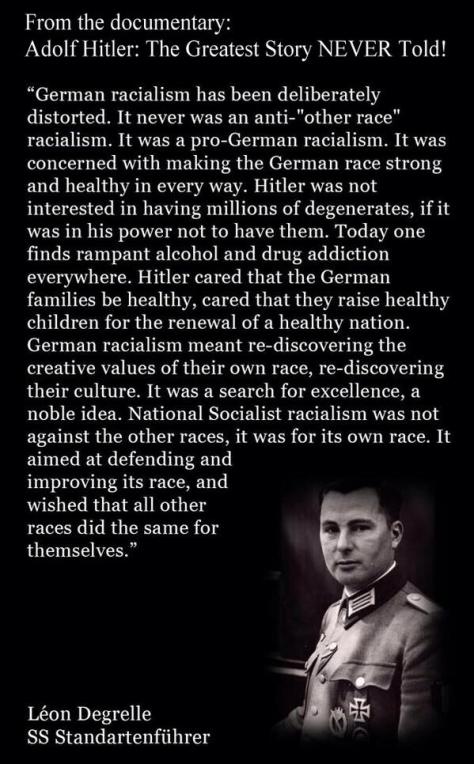
Leon Degrelle, the political leader, front-line fighter and thinker, had this to say on the subject after National Socialism in its original phase had passed into history:

becwoaeccaazenq

There is no need for social nationalists to utter insults at blacks, Jews or members of other groups, except where that is justified and/or where it makes a political or social point. I do not want to concentrate on the American socio-political situation. I am not American, have not lived or worked there for many years and am focussed on Europe and Russia. However, we have to recognize that American society is very different from our European society. American society has had a relatively recent history of slavery, of genocide (the American Indians, aka Native Americans), of a civil war in which 3% of the population died, of the resistance to the social consequences of that war in the South, that resistance being, in part, the Ku Klux Klan, and so on.

American politics has become far more bitter, far more polarized, particularly in language, than is generally the case in Europe. There is also the point that there is a far wider spectrum of education and culture in the USA than pertains in most parts of Europe, or even Russia.

For me, it is natural to regard the non-European races as distinct and as having their own paths to the future, while equally recognizing the necessity (for all races) for the leading role of European humanity. For some Americans, this is perhaps less obvious and those other races seen as purely enemy contingents.

Social nationalists must take every opportunity to refute the lie (often though not always made by Jewish Zionists) that we base our political philosophy on “hate”. We ourselves know that that is not so, but often the public is bamboozled by the Jewish Zionists into believing the lie. For example, we wish not to be ruled or owned or influenced by the Jewish Zionist element, but that is, if you like, “defensive” in nature.

Our attitude to race and culture is one of recognition of evolution and involution. Our European race is generally still evolving, as is the “Russian”, “Slavonic” or “Slavic” race which (important point) will not come into its plenitude for another 1,500 years. Other races in this world are stagnant or are degenerating. The prime motive force behind social nationalism is to evolve the race and nation to higher levels and to destroy any threats to that evolution. This is a positive, not a negative, political world-view.

In the future, European and Euro-Slavic humanity will have powers of soul, of mind, which today would be regarded as magical. This is the point to which we as a people have been striving.

When we see the sacred Swastika, we must understand it to be a symbol of evolution, of our evolution.

TorchSwastika

Priorities in State Funding

Preliminaries

We have, in the UK, been subjected to a so-called “austerity” spending regime for about 7 years now, the burden (in reality) of which has fallen on the poorer citizens, if only because there is an almost irreducible minimum which anyone requires in order to survive in a basic civilized way in our society. It matters not that a statistician may say that the wealthiest have seen their incomes fall more than the poorest, because if a rich man has a discretionary income of, say, a half-million a year (and many have 10x that) and if that is reduced by, say, 20%, he still has hundreds of thousands of pounds beyond what is necessary even on an opulent level of expenditure. The poor man on a net income of, say, £10,000, suffers directly (meaning in terms of food, shelter, transport) if his income is reduced by only 10% or even 1%. The figures for income do not in any case take account of the huge rise in the capital of the UK’s wealthier citizens in the past decade or two.

It can probably be agreed generally that the State has and must have spending priorities, even in less “austere” times. While money is not the fixed or finite amount kept (as the simpler people seem to believe) in a large chest at the Treasury or in the Bank of England, there is, over time, a limit to State expenditure no matter what system of government exists.

The above being so, we should examine what should be the spending priorities of the proposed ethnostate. We already know the priorities of the present “Conservative” government: a reduced social security “welfare” roll, tax breaks for the wealthier citizens, expenditure on Trident submarines, HS2 high-speed train line etc.

The Expenditure Priorities of the Ethnostate

Firstly, the proper defence of the realm. That means defence services under British control (unlike Trident). In the absence of multilateral disarmament, that has to include nuclear weapons, though there are cheaper alternatives to Trident. A Navy which has the capacity to guard the British coasts (rather than those of supposed allies halfway around the world). An Army of suitable size for defence but not one to be used in support of American or Israeli geopolitical aims. The same for the Air Force. Defence in the wider sense too: internal security, meaning a police force which has as its aim the preservation of public peaceful order, rather than enforcement of some decadent pseudo-liberal agenda; also, security agencies focussed on protecting the public.

Secondly, a healthy population (that that population should be fundamentally white European is a given). The health of the population requires clean air and water first. That requires State regulation and supervision. After that, healthy food: State support in various ways for organic and biodynamic agriculture and horticulture; discouragement of unhealthy foodstuffs (eg via taxes, imposts etc). Then there is the question of encouraging the population to take moderate exercise: State funding of, not Olympic athletes and other careerists, but facilities for the generality of the population, meaning health clubs, sport clubs, swimming pools, properly-policed and well-kept parks (for walking exercise as well as general public amenity); National and regional parks, for the same reason. Information services to the public, ranging from general health education through to suitably-healthy food recipes etc.

Thirdly, funding for a health service. The overriding necessity for a healthy population, as well as the impulse to compassion, indicates the necessity for a free-at-point-of-use health service akin to the N.H.S. This blog post is concerned with spending, so here is not the right place to address the great changes that should take place in the N.H.S., both attitudinally and otherwise. Suffice to say that the health service must be properly funded, so that where the preventive health measures are insufficient, medication and surgery are available.

Fourthly, education. Education should be a matter for personal or family choice in terms of curriculum, type of educational philosophy or particular school or university, but the State should only subsidize what is useful for the State as instrument of the people, the nation, the race. Thus private/independent schools must be allowed to exist and (subject only to the welfare of the pupils) free from “national curriculum” and the like, but the State need not subsidize them beyond allowing them tax-free status, which they already enjoy. Likewise, students must be allowed to attend university freely in terms of choice of institution and course taken, but the State can choose which students, which courses, which institutions to subsidize. For example, it may be that the State gives the top 10% of students (however assessed) full tuition and maintenance grants, others less generous provision, still others nothing at all. These others would have to find loans or other funding. Another example: the State might decide to give financial subsidy to certain courses and not others: perhaps to Engineering and Chemistry rather than to American Literature or Gender Studies.

Fifthly, transport. It should not be the business –and certainly not a priority– of the State to fund luxury travel for the few. Concorde was an error, albeit that it was a tremendous technical achievement: State subsidy so that a relatively small number of extremely wealthy persons could save time crossing the Atlantic to New York or Barbados. Subsidy in development, in manufacture and in terms of ticket pricing. Wrongheaded all the way through. HS2 is a less-egregious but similar error. Transport must be improved in the UK, not by “high-speed” rail, but by a web of more ordinary or standard rail lines. These can be supplemented by a further network of branch lines, probably light rail and ultralight or narrow-gauge rail. Technology is moving to the point where these can be unmanned trains, especially on branch lines where safety is not a major issue.

There should be dug a network of very wide canals for freight transport. These will also have environmental benefits and might also be used for passenger transportation.

The possibilities of lighter-than-air travel (Zeppelins) have not been fully explored. This form of transport might have great use for commuter and other passenger transportation. Government may need to help.

Bus travel should be maintained, at least at a basic level, throughout the country. It knits together rural and urban areas and may need subsidy.

There is an argument for local or even regional travel to be free up to a certain radius. Modern technology in terms of ID cards, pay cards etc makes this administratively possible.

Sixthly, though its place in the list might be disputed, Basic Income. The level at which this can be paid depends on the overall economy, but it is now becoming clear that, with advances in robotics and computerization, the nexus between work and pay is loosening. Citizens, whether old, sick, disabled, unemployed or otherwise, all need a basic amount of money in order to exist. A “floor”. The regressive “welfare” “reforms” of recent years are absurd and unreal as well as being unjust. It is time for the State dismantle the huge (and hugely expensive) DWP bureaucracy and to keep only that which pays out money (as well as a core of investigators to deter real large-scale fraud).

The above list should enable the State to promote a healthy, sheltered, fed, clothed and protected population capable of advancing toward a higher level in terms of evolution.