Category Archives: ethnostate

Should We Prepare for Social Collapse?

We read of those, especially in North America, who are termed “preppers”, people preparing for various forms of disaster (nuclear war, an asteroid hitting the Earth, inability of the State to maintain civil order) leading to social collapse, either with rampaging and desperate hordes of displaced people everywhere or with a mere few “survivors” from whatever calamity has struck. We in Europe tend to laugh at these American excesses (as they seem to us), but perhaps we should be less amused and more cautious.

Naturally, there is a huge difference in geographical and demographic norms. The wide open spaces of much of the USA and Canada contrast starkly with Europe, particularly the UK, with its centuries-old man-altered landscapes, densely-populated cities and towns, lack of true wilderness (except in the North-West of Scotland).

The population density of the USA, overall, is 92 persons per square mile; that of the UK nearly 700. Naturally, that is a misleadingly simplistic picture. The most densely-populated American state, New Jersey (where I myself once lived) has a population density of over 1,200 ppsm, whereas, while the UK West Midlands region has a density of over 3,000 ppsm and Manchester over 2,000, Devon has only 172, Cornwall 154 and the Scottish Highlands and Islands only 11. On the other hand, there is the point that “crowded” (in parts) New Jersey, the 4th-smallest American state, is about the same size as Wales. The more sparsely-populated areas of the USA are often a very long way from major cities or even modest towns.

It is clear that, for the UK prepper, less is more and that the congested urban and suburban areas are to be avoided as a base. However, the distinction should be made between the hardcore prepper, who intends to live by hunting, fishing and his wits, i.e. as a “survivalist” and the person who aspires to the creation of a new society after any collapse of the existing one. The latter is therefore, almost ipso facto, a conserver of civilization and culture.

I have already blogged about the idea of forming and developing a “safe zone” or base area for UK social nationalists. I have suggested that, in terms of region, the Devon/Cornwall peninsula might be the most suitable. Naturally, when social nationalists have relocated to that zone, their lives will not consist, in the absence of immediate war or social collapse, of hunter-gatherer or subsistence farmer activities. They will do normal jobs, run businesses, smallholdings, farms and estates and in general live (in most cases) as they do in those other parts of the UK where they live at present.

I suggest the following ideas. This is not supposed to be a comprehensive list, but only a basis for one:

  • Food Security

Keep a stock of food to last for a year or even two. The Mormons have been doing this for a long time, certainly for many decades. There is no need to re-invent the wheel when we can learn from others who know how to do things. Here is one explanation of how the food storage system works with the Mormons:

https://mormonwoman.org/2009/08/28/ask-a-mormon-woman-why-do-mormons-store-food/

The Mormon system seems to work on the idea of having a buffer for months rather than years, but with modern canning, packing and freezing techniques it should be possible to give the people in the safe zone at least a one-year supply of food from store.

Naturally, in a rural area, agricultural and horticultural produce will be available. Members of the social-national community will no doubt own estates, farms, smallholdings. In addition, those occupying smaller residences can be encouraged to cultivate part of their gardens, grow produce on a small scale under glass etc.

An important aspect of food security is the existence of a seed bank. Individuals and families can keep their own, but the community as a whole should also maintain one.

No doubt people will be able, in hard times, to forage and to find wild food and to fish.

  • Energy Security

It is to be expected that, in the first instance, the houses and other buildings in the safe zone will be on mains electricity. This supply is vulnerable in the event of war, natural disaster or social collapse in the wider society.

The first necessity is to build up the supply, within the zone, of solar electricity generation and solar heating. There are buy-back schemes etc whereby the householder can even sell his excess power to the National Grid, so long as it exists. At any rate, the community within the safe zone should do everything it can to utilize this renewable supply.

Geothermal heating of homes and other buildings is possible now, if the capital is there to utilize it.

It may be possible for individual residences in the countryside to have small wind turbines too, which can both supply those homes with electricity and also put any surplus back into the National Grid or a local grid.

A further option for some farms and estates would be hydropower from rivers and smaller streams of water.

As an emergency fallback, there should be a range of off-grid options for heating homes: woodburning stoves, ordinary open fires and, for electricity generation, emergency generators run from oil or other petroleum products.

It would be useful, too, if members of the community were to stockpile emergency lighting: candles (even tealights), hurricane lamps etc, battery-operated or camping gas-operated lights, wind-up lamps and torches.

  • Water Security

Water supply is easier, being regional and local rather than national. Indeed, many houses and farms in rural England have their own supply from springs. However, a contingency plan must be drafted and worked out.

  • Communications

The Internet was designed, originally, as a means by which communications might continue even after nuclear war. Presumably, that system will continue in some form even during social collapse. If so, it might be of huge importance beyond the confines of the safe zone, in the struggle to rebuild the wider society.

The community ought to maintain a radio transmitter.

  • Conclusion

An article such as this cannot cover all aspects of how a decent society might survive when the wider society around it is in a state of disorder and even collapse. I have not touched upon questions of social order, for example. However, these few proposals may start running a current of thought. The proposed safe zone will have to operate on the basis that an externally-triggered emergency will probably occur before very long.

Update, 21 July 2019

I saw this on Twitter. Obviously drafted with American conditions in mind rather than European/UK ones, but not bad overall.

https://twitter.com/SoCarbonNeutral/status/1151751859125669889

The Society of Measure

In the mid-20th century, especially in the 1960s, it was commonplace to see articles or features about the supposed coming “age of leisure” which would be facilitated by machines and advanced industrial techniques. Now (since the 1980s), those predictions are often laughed at, as society (eg in the UK) finds itself enmeshed in the “long hours culture”, the workaholic culture, the low pay economy. Was this inevitable?

The fact is, that the predictions of the past about a future “society of leisure” left out one crucial fact in particular: that the benefits of industrial efficiency and the emerging developments in computing, robotics etc would be taken by the owners of capital, by shareholders and others.

Since the 1970s, real pay (whether absolute or per hour) of most employees has stagnated and indeed even declined across the advanced Western world generally. At the same time, the profit accruing to capital and the remuneration of the upper strata of executives, higher managers and their professional counterparts has rocketed.

The above was true to some extent even in the Soviet Union, except that there, the developments in technology and efficiency were not spread equally across all industrial sectors and the benefits were used mainly for State power and prestige: military and naval upbuilding, space programmes and other large-scale projects such as the BAM railway.

The result (focussing on the West and particularly the UK) is that people have to work ever-longer hours for ever-lessening real pay. If public services, amenities and State benefits are taken into account, the contrast between the optimistic promises and predictions of the 1960s and 1970s on the one hand and the realities of 2016 on the other is even more stark.

There is another factor to be taken into consideration: there are three “work/leisure” faces:

  • work as unwelcome and/or repetitive drudgery, with little free time;
  • leisure as mere absence of work, for whatever reason;
  • creative work, balanced with stimulating leisure or free time

Adolf Hitler was referring, by implication, to the above alternative lifestyles when he noted “the Aryan ideal of creative work“, to be contrasted with (as he saw it) uncreative Jewish profit-making, as well as equally-uncreative paid drudgery [see Adolf Hitler, Mein Kampf 2:7]. In explaining, for example, the symbolism of the red-white-black NSDAP banner, Hitler wrote:

And indeed a symbol it proved to be. Not only because it incorporated those revered colours expressive of our homage to the glorious past and which once brought so much honour to the German nation, but this symbol was also an eloquent expression of the will behind the movement. We National Socialists regarded our flag as being the embodiment of our party programme. The red expressed the social thought underlying the movement. White the national thought. And the swastika signified the mission allotted to us — the struggle for the victory of Aryan mankind and at the same time the triumph of the ideal of creative work which is in itself and always will be anti-Semitic.

In our contemporary society, we see the temporary victory of uncreative work/leisure modes: on the one hand, soul-less profiteering (whether by manipulations on stock and bond markets or by buy-to-let parasitism etc); on the other hand, everyday work becoming less and less interesting for most people. Soul-less economic serfdom. Creativity and a decent work/life balance become the province of the artist, the maverick off-grid person, the creative writer. Most people are excluded.

At the same time, those without paid work and who are under pensionable age cannot even enjoy the one major benefit of being unemployed: leisure! They are harried and chased around by Department of Work and Pensions drones. In other words, in place of actual paid work, there is a ghastly and ghostly simulacrum of work consisting of the tick-box applying for (often non-existent) job vacancies or the attending of pointless “courses”, in return for which the unemployed claimant is paid a shadow version of a very low real salary: State benefits.

It is estimated that, between now and 2030 or so, developments in robotics alone will mean that 20%-30% of UK jobs will disappear, including some presently “professional” ones (eg in the medical and legal fields). The numbers of unemployed, under-employed and poorly-paid will increase. The “precariat” will include ever-more people.

The solution to all of the above is not a “society of leisure” but a “society of measure”:

  • strict limits on hours worked by employees, perhaps 30 hours per week;
  • strict enforcement of break-times within the working day;
  • strict demarcation between work-time and free-time (leisure time);
  • strict limitations or barring of employees being “on call” when at home;
  • payment to all citizens of “Basic Income”
  • more equitable distribution of the fruits of the economy.

Such a society will have time for those important things which have traditionally been part of “leisure time”: home, family, culture, rest, sleep, entertainment, sport. This must be the way to go and will cure many of the ills of the present society.

Text reference link:

http://www.angelfire.com/folk/bigbaldbob88/MeinKampf.pdf

Problems of Finance in Social Nationalist Politics

System political parties in the UK have sources of finance which are well known: wealthy donors, membership dues, fundraising drives, donations from big business or trade unions, as well as “Short money”, i.e. State monies given to parties depending on the number of MPs they have in the House of Commons. Smaller political parties, without many or any MPs, have to rely on trying to get large and smaller donations as well as collecting money from their members via subscriptions, collections and/or sale of items such as newspapers, magazines or, in some cases, memorabilia etc. There is another way.

When I lived in the United States in the early 1990s, I discovered that not only did many suburbs or little townships have countless churches (the names of which were unknown to me, usually), but that most of these churches were replete with cash. I was told that that was because they insisted, often, on the practice of “tithing”, i.e. the members had to give a proportion (usually 10%) of their income (post-tax income, usually) to the church to which they belonged. As a result, these churches had full-time staff, real property, vehicles etc. They were also able to help out members of the church fallen on hard times and had no difficulty raising the funds to print books. Some even owned radio and TV stations!

Returning to UK politics, were a social-national party or movement to operate the same system, the funds would be available for both pure political activity and wider work. A party might have as few as 100 full members, the income of which, after tax, might be only about £20,000 each (approx. UK average), but even that tiny party would, on the premises, have an annual income of £200,000. Small by the standards of the System parties or even UKIP, but still significant. A party with 1,000 members might have an annual income of £2 million. Now you’re talking…Such an income would enable a party to do more than conventional political activity. It could, for example, buy houses and flats wherein some of its members could live. The rents would thus go to the party, not to some buy-to-let parasite. This would also assist morale and esprit de corps.

Another way in which such income can help a political organization is in allowing it to operate a commercial arm and so not only make operational surpluses (“profits”), but also provide employment to members who need jobs.

As in many marriages, difficulties and dissent in political parties often arise out of money troubles. The tithing system is a way of avoiding that. A well-funded party is a credible party in a way that a shoestring organization can never be. An air of serious purpose pervades such a body.

It might be objected that it will be hard to persuade people to give up their (in many cases) hard-earned money. If so, their commitment must be questioned. There are enough “hobby politics” organizations around already. Most will never amount to anything. If someone wants to belong to something as a hobby, then fine, go do it..elsewhere. If, on the other hand, someone wants to belong to a serious movement, with a serious world-view, a serious plan and a serious chance of accomplishing something, then the need for tithing must be apparent and will be accepted by those most able to carry out the objectives set.


The Organization of Community

When new social-national communities emerge, as they will in the coming years, the question is posed as to their organization.

It is important to note that, in the UK, a social-national community will not, in general, be anything akin to a commune, paramilitary encampment or religious settlement such as a monastery or convent. It will be a community which interpenetrates the existing or pre-existing ordinary village, suburb, town or city. The template can best be explained in relation to what might happen when social nationalism arrives in a large village or small town.

Scene

A social nationalist with capital buys a country house or estate, somewhere near a small English or Welsh town. He or she needs workers or retainers to help with the house, grounds, park, perhaps farmland too. Those people are sourced from the wider social-national community in the UK. At the same time, these people gradually infiltrate the local community, not in any sinister way, but by doing the things that they would have done wherever they lived: sending their children to local schools, joining local non-political groups (am-dram, allotments, churches, residents’, neighbourhood watch etc).

Other social nationalists arrive, buying houses locally, renting property, getting jobs or living off pensions or even State benefits. Some buy or rent farms, cafes, pubs, shops. Some start to work in the local offices of larger enterprises, in the local Jobcentre (if any), or in the local council offices. Others are able to work from home, thanks to the Internet.

Nothing alarming or noisy happens. There are no marches, demonstrations, or other disruptions. People get on with normal life. Underneath the surface, however, there is purposeful movement, a current beginning to flow. There are meetings, discussions, social events; nothing too large or noisy. In time, the social nationalists number in the hundreds and are a significant proportion of the local population, with more gravitating to the area every week. The time has then come for overt political action.

A by-election for a council ward is held. Few of the original local inhabitants even bother to vote. A social nationalist is elected, either under Party banner, as “Resident”, or “Independent”; even perhaps under System party aegis.

The local council is taken over before very long. Social nationalists are then in the driving-seat locally. The area and the wider region becomes a magnet for social-national people from across the UK as it becomes known as a place where censorship and hostile opposition is unknown or swiftly checkmated. The local librarian is a social nationalist, the Mayor, the schoolteachers, the council officials, the friendly innkeeper and his wife, the sub-post office people.

The election for Westminster is held and the social nationalist candidate is elected, perhaps under social nationalist party banner. By this time, the national press, radio and TV is trying to spread lies about the people in the movement, but can do nothing against a solid phalanx of believers, living, working and acting in a situation where the Zionists and others can do nothing substantial to harm or impede them. Locally, social nationalists run an Internet radio station, even local transmitted radio, as well as the local free newspaper. It is not long before the movement spreads throughout the whole region. People of like mind are fleeing London, Manchester, Birmingham etc so that they can live in such a region. A mini-ethnostate has been created.

The story does not end there, but on a wider stage.

Social Nationalism and Green Politics

There has always been a strong connection between the current now known as social nationalism and what is now called the “green” movement.

The famous author Henry Williamson [https://en.wikipedia.org/wiki/Henry_Williamson#Politics], who lived in North Devon and wrote the story Tarka the Otter, was a member of the British Union of Fascists, visited Germany during the 1930s and was, by any other name, a National Socialist.

It is well known that Walther Darre [https://en.wikipedia.org/wiki/Richard_Walther_Darr%C3%A9] was “green” and that he represented a definite current within German National Socialism.

The only state, to date, to have banned cruel experiments on animals outright was National Socialist Germany. The anti-vivisection law was the first law or one of the first few laws passed by Hitler’s government. Cartoons showed Goering (another National Socialist and leading conservationist) and animals saluting, with captions such as “Heil Goering!”, “Even the animals vote for the Fuhrer!” and “Vivisection verboten!”goeringanimals

A leading, though at the same time once-obscure thinker, who espoused both National Socialism and animal welfare (etc), was Savitri Devi [https://en.wikipedia.org/wiki/Savitri_Devi], whose work is now again coming to attention. Her ideas and books even have websites devoted to them: https://www.savitridevi.org/last_man_french.html and https://www.savitridevi.org/.

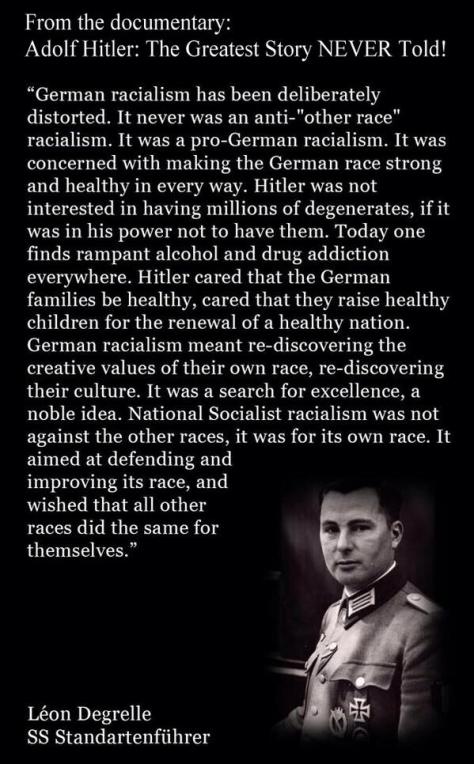
The connection is not surprising. What is now termed social nationalism is organic, built on the natural order and having respect for the creatures of the land, water and air as well as (contrary to Zionist propaganda) the relatively backward racial groups and peoples of our Earth. The hero Leon Degrelle [https://en.wikipedia.org/wiki/L%C3%A9on_Degrelle] put the latter point very well after the Second World War:becwoaeccaazenq

It is striking to see that there is very often an overlap, for example on Twitter, between those who are protective of animals and those who are strongly social-nationalist. Brigitte Bardot is a name which comes to mind: https://en.wikipedia.org/wiki/Brigitte_Bardot.

The new society in Europe will be nationalist; it will also be for Europe’s European future (though anti-EU); it will be green and it will be socially-just.

Notes:

https://www.kn-online.de/Nachrichten/Hamburg/Voelkische-Siedler-Die-Bio-Nazis-von-nebenan

Update, 28 June 2020

https://www.theguardian.com/world/2020/jun/28/german-far-right-infiltrates-green-groups-with-call-to-protect-the-land?CMP=share_btn_tw

Update, 26 May 2021

Note: https://en.wikipedia.org/wiki/Gerard_Wallop,_9th_Earl_of_Portsmouth#Organic_movement; https://en.wikipedia.org/wiki/Gerard_Wallop,_9th_Earl_of_Portsmouth

NEW COMMUNITIES IN ENGLAND AND WALES FOR SOCIAL NATIONALISTS

The large cities of England are becoming no-go zones for social nationalism. Repressive anti-free-speech laws, politically-indoctrinated police and, above all, the increasing hordes of non-Europeans make cities such as London, Birmingham, Manchester (let alone such as Bradford or Leicester) unwelcoming. In London, the Jews have even established their own police force (under the cover of a help-the-police Neighbourhood Watch scheme). This body, apparently known as the “Shomrim”, has marked “police” cars, uniformed “officers” and, it is said, operates from real police stations in Barnet and elsewhere. In the Muslim areas of the large cities, it would be a brave individual who would undertake any political activities of a social-nationalist or anti-immigration nature, even if as mild as, say, supporting UKIP.

Electorally, social-nationalists are isolated and, especially since the implosion of the BNP, almost certain to receive fewer than 5% of votes, even in local council elections. UKIP is scarcely social-nationalist, garnered 3.8 million votes, yet failed to win a single new MP in 2015.

Socially, English and Welsh people (I leave Scotland aside) find that their children, if in State schools, are in a milieu which is not British and are subjected to brainwashing propaganda dressed up as education, while they themselves live in a “multicultural” mess which can only get worse.

There is already “white flight” from the large cities of England to the smaller cities and towns and to the rural areas generally.
Let us build on this existing trend.

What I propose is that social nationalists cluster in one or two or a few areas, where we can order society the way we want, educate children the way we want, have electoral weight and other political influence.

Those who have capital can buy houses, businesses, farms, estates. Those without capital and dependent on paid work, pensions, or State benefits can relocate to circumstances similar to those in which they currently live. An organised movement will be able to assist with contacts, jobs and business links etc. An internet radio station can be established without State interference. Even a “normal” (albeit regulated and censored by OFCOM) local radio can be set up and a local newspaper established.

Once there is a credible social national party, it can take over the local council(s) without much difficulty and in time depose whoever is the System party MP to elect a real social-national MP (or MPs).

A thriving base for social nationalism will exist, spreading influence nationwide, attracting even more like-minded people. If two or more such bases are established, the same applies, but concentration is key.

I have had several places or regions suggested as the most suitable. There may be a number of suitable parts of England or Wales; I personally favour the South West, an area which I know, where I have lived and which has always been sympathetic to British and/or English national sentiment.

I welcome all useful or constructive contact and comment on how to start this ball rolling.

Update, 28 October 2019

https://twitter.com/douglasmercer33/status/1187908562426613760?s=20

THE CASE FOR BASIC INCOME

Jesus Christ said that the poor are always with us (part of society). Whether that be accepted or not in absolute terms, the fact remains that, in practice, there is always the necessity to deal with “the submerged tenth”. In Soviet Russia, the solution was make-work jobs and, if that failed, part of the GULAG system. In finance-capitalist “Western” societies, there is the illusion of “aspiration” and “opportunity”: people need not be without (sufficient) income if they work. This theory or ideology leaves aside those who cannot work, whether because sick, disabled, or unable to find remunerative or sufficiently remunerative employment.

Robotics and computerization are advancing. Some studies say that a third of present jobs in countries such as the UK will disappear by about 2030 (some say “only” 25%). It may well be that other jobs will not appear to take up the slack. Millions may be left unemployed. At present, lack of income means that unemployed people (as well as the sick and disabled) have to jump through hoops in a degrading and largely pointless bureaucratic exercise in order to receive often very modest State-provided benefit payments. The system is not only expensive because of those payments, but because of the huge bureaucratic machinery that is built in to the process. There is a better way. Basic Income.

The Basic Income idea is that all citizens receive a regular payment, regardless of circumstances. In short, the payment is unconditional, meaning not withheld if the recipient does not have a job, look for a job, can do a job. Basic Income replaces all (or, in some versions, some) existing social welfare payments.

Basic Income is being trialled in some areas of Europe: in parts of Switzerland, Finland, the Netherlands. In Alaska, all permanent residents receive a small Basic Income payment annually (at present, about $2,500), monies routed from oil revenues.

Basic Income could be tweaked, so that persons on incomes above a certain level have an equivalent amount taken via the tax system; another idea would be to give a higher-tier Basic Income to the disabled (though that would mean some form of assessment and judgment). Alternatively, Basic Income could be paid only to those without income or capital, topping up income to a certain or decided level. That is, in fact, more or less what happens now in the UK, but without the present system’s bureaucracy, unpleasantness, snooping, harassing etc (made far worse since the Iain Duncan Smith regime of 2010-present).

It is objected that Basic Income would mean that people would just be unwilling to work. Is that so? First of all it might depend on the level of Basic Income. Economic realities would probably limit Basic Income to no more than about £15,000 p.a. It might be as little as £10,000 (either per person or per household). Many will, at that level, find plenty of incentive to work if they can. Also, it is rarely heard that people should not receive inheritances or trust incomes because they might be made lazy thereby. Lottery winners in the UK usually start businesses, carry on working for pay or do charity work.

In fact, in the UK, there are already payments somewhat analogous to Basic Income. State Pensions are already paid to all persons over a decided age, with extra “State Pension Guarantee Credit” money paid to those whose income and capital is below a certain level. Child Benefit was formerly paid to all persons who have children (regardless of income) and still is paid, though now there is an income cutoff point (at a fairly high level).

The cost of Basic Income is lessened by the removal of large numbers of pointless jobs in the (UK) Department of Work and Pensions etc and by the elimination of the need for large numbers of “Jobcentres” and other buildings and their upkeep. Housing Benefit will not exist, so greedy buy-to-let parasites will not be subsidized by taxpayers via taxation revenues). That alone will save billions of pounds.

A person receiving Basic Income who wishes to work will be able to look for work honestly (rather than in order to tick a Jobcentre box) and with confidence, and in the meantime will have money for transport, clothing, food. The disabled will not have to undergo degrading tests in order to receive at least the “basic level” of Basic Income (medical report from GP should be sufficient anyway). The more fortunate, who have income or capital, will (if receiving Basic Income), will be able to spend more (thus stimulating the economy) and/or start their own businesses.

In short, it will become clear in time that Basic Income is the way forward in the UK.

A Floor or a Ceiling?

The Front National in France, other broadly social-national parties of the European mainland and (in England and Wales) UKIP are not “ceilings” (end results) but “floors” (starting points). Their function is to disrupt the political status quo and to awaken as far as they can the voting populations of the various European states. Naturally, that is not how they themselves see their role.

The case of UKIP is telling. UKIP came into a political milieu in Britain where (in the 1990s) there were only “three main parties” and a high majority of those who voted voted for them. Below the surface, though, there was growing but unfocussed discontent and alienation. Turnout in general elections, which peaked at 83.9% in 1950, fell (on the wider franchise after 1966) to a low of 59.4% by 2001, though it recovered slightly to 66.1% by 2015. An equally-telling fact is that the proportion of voters who voted and who voted for one of those “three main parties” fell steadily and is still falling. In broad terms, a third of eligible voters did not vote at the 2015 General Election; of those who did vote, about 75% voted for LibLabCon (UK-wide results), with another 12.6% voting for UKIP.

UKIP peaked in 2014, failed to break through in 2015 and is now declining fast in every way. Its 2016 by-election results have been poor, its donors are going and its membership falling. I addressed the UK political vacuum in an earlier blog post. However, UKIP has succeeded in a more major way than did the BNP and not only because UKIP scored 21 MEPs as against the BNP’s 2.

UKIP created an atmosphere across the country in which social nationalism might start to thrive, despite the fact that UKIP, as a party, is not really social-national.

UKIP, despite being now more or less washed-up, is a floor. On that floor a movement can be built. The Front National in France is not at all in decline (au contraire) but is also a basis for a movement, rather than the movement itself. The FN is, however, likely to become or coalesce with such a movement, whereas UKIP will just fade away even if it can score a few election victories in the 2016-2020 period. The importance of both parties, however, is that they have changed the atmosphere. Social nationalism is now not a fringe ideology. It stands ready, once the right vehicles arrive, to take command across Europe. In Britain (specifically England and Wales), there is a crying need for such a social national movement and I believe that it will emerge, will arise and will, eventually, seize power.

NATO Must Not Attack Russia

President Bush snr. proclaimed the “New World Order” [NWO] openly in 1990. The Soviet Union was not dissolved until the following year, but had in fact died in 1989, 33 years (significantly) after Khrushchev’s “Secret Speech” of 1956, which denounced Stalinism and introduced the “Thaw”.

The ruling circles of the West (variously called the Wise Men of the West, the Judaeo-Masonic conspiracy, the NWO-Zionist consensus etc) were behind the fall of the Russian Empire in February 1917 and the Bolshevik takeover in October 1917. That is not to say that they were able to control events completely. They wanted the Jew, Trotsky (L.D. Bronstein) to take over eventually from the part-Jew, Lenin (V.I. Ulyanov), but reckoned without an even more ruthless evil character, the Georgian, Stalin (J.V. Djugashvili).

Stalin’s seizure of power in the mid-1920s was not ideal from the point of view of the Western conspirators. It stabilized or froze the political situation and the decline in social and family life in Russia and its dependent territories. The Soviet regime became even more conservative during the course of the 1941-45 conflict with the German Reich. Russian Orthodox religion was allowed (under controlled conditions), national patriotism held sway. Marxism was embalmed alongside Lenin’s “waxwork”.The original plan of the Western circles had been that Marxism-Leninism would take over all of Eastern and Central Europe, as far as the Rhine. What stopped that was

  1. in Russia, Stalin’s “Socialism in One Country” policy; and
  2. in Germany, the rise of National Socialism under Adolf Hitler.

The end of the Second World War saw Europe split between East and West. Central Europe was squeezed out. Germany was divided into East and West. Berlin was symbolically divided into East and West. This was deliberate.

In time, the Sovietized “East” (including those Eastern parts of Central Europe), moved to a position which was not far from various forms of social democracy under a socialist-communist mantle. This did not suit the Western “consensus”, which therefore decided to collapse the post-1945 “international settlement”. The Soviet Union, whose citizens were more affluent than they had ever been, fell gradually into social decadence and corruption until the state was ready to have as its anointed leader a man who would sit complacently at its head and watch it implode: Gorbachev.

When George Bush senior proclaimed the New World Order, he was giving voice to the latest global plan of the ruling Western circles: to rule over a globalized world economy. Politics would be merely the instrument by which finance-capitalism would triumph, sweeping away regional, national and local economies, customs, religions and social cohesion. Only money, that is, concentrations of capital, would count.

The plan worked for several years. Socialism in all forms had died in 1989 and Russia was swept along with the finance-capitalist tide, even though the majority of Russians were poorer in most ways than they had been under late-Sovietism. When a rump of pro-Soviet parliamentarians and officers (supported by most Russians, probably) tried to take back power in 1993, the corrupt and drunken Yeltsin ordered massive and bloody assaults on the Duma and other installations. Bush snr. called that an affirmation of “democracy”.

Below the surface, Russians were tiring of their diminished country being a playground for gangsters and exploitative Jewish “oligarchs”, a place in which American companies and other carpetbaggers (again, often Jewish) could strut about, a place where Moscow schoolgirls dreamed of being, not artists, doctors, scientists or mothers, but hard-currency prostitutes. Ten years after the proclamation of the New World Order, the Russian economy having collapsed, a new President of Russia, Putin, started to rebuild Russian pride and self-confidence. At the same time, the New World Order suffered its second and equally massive blow when Islamist fanatics flew planes into the World Trade Center in New York City. That attack (whether “helped along” one way or another or not), was a sign of Islamist strength gathering worldwide.

Another decade passed. The Western circles made a huge mistake in invading Iraq and Afghanistan. Further errors were made in Libya and Syria, instigated by Israel, whose lobby of Jewish Zionists and pro-Israeli non-Jews has a stranglehold in Washington. Israel wanted to destroy or degrade the armies of all potentially harmful states, but its gain was the West’s loss.

The Western circles then decided to arm even Islamist anti-Assad forces in Syria. At the same time, the government of Ukraine, corrupt and weakened by years of Zionist infiltration, was deposed and replaced by a complete “ZOG” [“Zionist Occupation Government”]. Eastern Ukraine, in part, broke away. The NWO (mainly though not exclusively American in terms of its military reach and leadership elements) is attempting to foment war in Crimea, Eastern Ukraine, as well as in Poland, the Baltic States and in Syria.

Hillary Clinton wanted and vowed to “confront Russia in Syria”. She was a corrupt puppet of the NWO and Israel. Donald Trump’s defeat of her was divinely ordained, no matter that the man himself is unfit to be a head of state or government. The danger now is that the NWO will try to hedge him about with NWO satraps. There is still a huge danger that the NWO, via NATO, will push Russia into a war which would devastate Europe, as well as wide areas of both Russia and the USA.

All those who wish for the West to come to peaceful concord with Russia must stand up now against what amounts to a conspiracy to cause a Third World War.

Fortress-Centres of Culture and Science

In the Dark Ages, the flame of civilization and culture was kept burning in fortified centres: walled cities, monasteries etc. It may be that the time has come to think in terms of “back-up” for the knowledge and human expertise that we take for granted today.

What does that mean in practical terms? There can be little doubt that, were a breakdown of law and order to occur (whether as a result of war or natural calamity), the British cities would probably become chaotically lawless in a short space of time, especially if fuel, food, water or utilities were unavailable.

It seems to me that those inclined to social-nationalism should think in terms of relocating to areas some distance from major cities, to small towns and villages where like-minded people can become either the majority or a strong minority. Such clusters of people can take over the local councils, local businesses and farms, as well as doing the usual run of employed work which they might do in the cities where they, perhaps, now live.

The idea has the following merits:

a. Political (electoral or other) bases can be created, with voting weight;

b. The clustering effect would enable concerted action;

c. In the event of catastrophes in the wider world, these centres would become the places looked to by the wider masses for leadership.

Clausewitz said that, in order to extend power, one must first have a secure base. It is that that social-nationalism lacks at present in the UK. The above proposal aims to address that lack.