
A comet has appeared in the UK’s political skies. Its name is Brexit Party. It is running at about 30% in the opinion polls re. the EU elections to be held on 23 May 2019, while in respect of Westminster elections, it is on about 15%. The EU elections may not be of much importance except as a popularity contest, but for a new party without any policies at all (except to get out from under the EU) to be at 15% indicates a groundswell of public disquiet which may have huge consequences one way or another in domestic UK politics.
[note: even as I write, the polling figures above are out of date! One very recent poll now has Brexit Party at 34% for the EU elections and 20% re Westminster voting intention, with Conservatives only on 19% for Westminster and 13% for the EU elections; has the Conservative vote ever been that low? I think not; even in the Blair-Labour landslide of 1997, the Conservatives polled in the actual election at 30.7%].
It now looks as though some of my early blogging was prescient indeed, if I myself may say so. “Give that man a cee-gar”!
https://twitter.com/Fair4all3/status/1127361421258436610
There are signs of panic in the main System parties:
“A ComRes poll for the Sunday Telegraph showed that if a Westminster general election were called, Labour would reap the largest share of the vote with 27%; the Brexit party would garner 20% ahead of the Conservatives on 19%. The Liberal Democrats would win 14%, followed by ChangeUK (7%) and the Greens (5%) with Ukip trailing on 2%.” [The Guardian]
I come from a certain direction: I recall the limited but real popularity of the National Front [NF] in the mid-1970s, and saw at first hand how outside forces made use of internal dissensions in order to destroy the NF as an effective party and movement. I believe (though without having any direct or personal knowledge) that similar events may have happened to explode the British National Party [BNP].
The National Front and BNP were both broadly social-nationalist, whereas UKIP is broadly nationalist but lacking the para-socialist element ideologically. Brexit Party has taken on UKIP’s “nationalist” or “patriotic” mantle despite having no published policies at all beyond leaving the EU.
It is easy to speculate about why the course of events happens, harder to pin down the exact or even approximate facts. Many casually blame, or designate as important, the operations of Zionists, Israel, MI5, SIS, MOSSAD, unnamed State agencies, freemasons, occult spiritual groups etc.
Every party or movement has internal tensions. As a John le Carre character remarked, “Jesus Christ only had 12 agents, and one of those was a double” [meaning “double-agent”].
The art of influencing events from the shadows is not to be identified or identifiable as a moving force.
Coming back to Brexit Party, there are known facts. The extraordinary political showman (as some would have it, “snake-oil salesman”), Nigel Farage, was leader of UKIP for decades. He in fact was in UKIP almost at the start, and is often termed one of the founders, though he was not the actual founder, who was an academic called Allan Sked.
“Sked is a member of the British-American Project, which exists to promote Britain’s political ties to the U.S.” [Wikipedia].
“During the administration of President Bill Clinton in the US, the Australian journalist John Pilger attacked the BAP as an example of “Atlanticist freemasonry.” He asserted in November 1998 that “many members are journalists, the essential foot soldiers in any network devoted to power and propaganda.” [Wikipedia].
Here is one msm drone who belongs to that British-American Project:
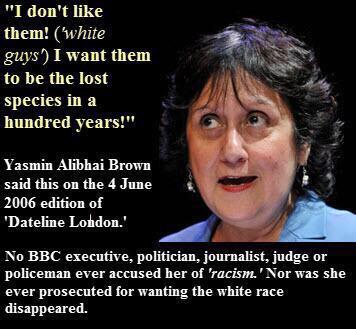
Yes, that’s right. Yasmin-Alibhai-Brown, the supposedly “radical”, “anti-imperialist” “journalist” (in fact, totally unqualified and inexperienced in true journalism, just a ranting loudmouth).
Another member of the very same organization is BBC journalist James Naughtie, most of whose views are, at least superficially, totally different from those of Yasmin Alibhai-Brown…
The British-American Project contains a large number of UK-based (and other) journalists (and others), of supposedly diverse views. I wonder if their views and motives are as “diverse” as they seem to be at first blush.
Only today, on the Andrew Marr Show [BBC 1 TV], Marr tried to trash Nigel Farage and Brexit Party, but Farage was able to crush Marr easily in the end.
System drones like Marr do not seem to understand that populist movements such as UKIP (a few years ago) or Brexit Party (now) are the last chance for the System to listen to the British people and so avert an explosion of justified political hatred which will, otherwise, roll over them like a tank over a cockroach.
Marr’s own (rarely admitted) views:
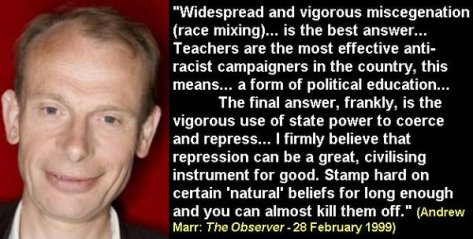
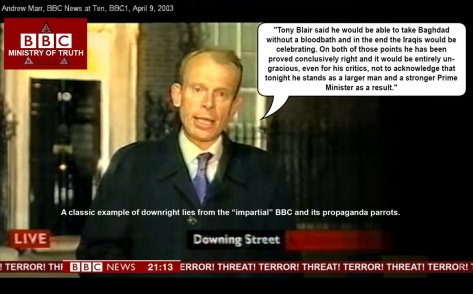
A typical pro-NWO, pro-ZOG, pro-EU msm drone, paid until recently a million pounds a year by the BBC out of your “licence fee” (enforced tax) monies (apparently somewhat less now, after public uproar about the absurd salaries paid by the BBC to key propagandists).
Was the secret aim of UKIP to draw off nationalist sentiment from parties such as the BNP, i.e. to neutralize effective political opposition to NWO [New World Order] and ZOG [Zionist Occupation Government] in the UK by containing it, controlling it, monitoring it? Or was UKIP just a typically English amateur effort which mushroomed into something bigger. Or both of those?
“Sked has since been a vocal critic of the “ racist” direction in which Farage has taken UKIP. He told the Guardian in 2014: “The party I founded has become a Frankenstein’s monster.”
Already, in looking at UKIP, we see the difficulty of unravelling the skein of motives: secret forces, public faces, ambitions, ideals, various personalities etc.
As recently as last year, Alan Sked said that “I founded UKIP. It’s a national joke now and should disappear.” [The Guardian]. Is that just sour grapes from a founder left behind? Is there anything else there? Had UKIP “done its job”, and so could be binned?
Until 2010, the BNP did better in all or almost all elections than did UKIP. It is hard to recall that, now that the UKIP star has risen and fallen and now that the BNP is just a tiny handful of back-room zealots. In its heyday, the BNP was more successful by far than UKIP. The BNP even had two MEPs (Nick Griffin and Andrew Brons).
Brexit Party is UKIP, but a UKIP which, like a snake, has shed its “skin” of various unwanted people, unwanted history etc and, unlike the snake, miraculously become far far more powerful, far more slick, far more able to capitalize on its “unique selling point”, the sheer hatred which many many people now feel for UK society as it now is (and also for the EU dictatorship).
Farage is the star of Brexit Party, as he was when in UKIP. Look at the clip below. Farage enters a hall packed with supporters. It echoes in a minor key the entrance of Adolf Hitler into the hall at the end of the 1935 Leni Riefenstahl film Triumph of the Will.
Farage can draw large crowds, as in this recent rally at Peterborough, where 2,000 supporters are said to have paid £10 each just to hear Farage speak. Few other politicians in the UK could get 200 (or even 20, in many cases) to turn up to hear them, even for free!
Farage is the key to this. No Farage in UKIP means, effectively, no UKIP. Were there no Farage in Brexit Party, that party would also rapidly cease to exist.
Despite his public profile, Farage is to some degree an enigma. A metals trader, he was in employment as recently as 2003 and possibly even after that. He was elected as an MEP in 1999. He seems to have been a “Eurosceptic” (anti-EU) for a long time, voting Green Party in 1989: the Green Party was, at that time, Eurosceptic and not pro-mass-immigration. One wonders whether, had it not become a kind of middle class virtue-signallers’ party, Green Party might have had greater political success.
Farage created UKIP (not founded perhaps, but created) in his own image: anti-EU, free marketist (softened for tactical purposes), English more than British, not social-national, not “racist” (racialist), despite Farage making a few innocuous comments that only echoed what most white British people believe or feel. Brexit Party may or may not follow those lines, but we cannot say for sure, because Brexit Party, almost uniquely, has published literally no policies at all, save for Brexit itself.
I say “almost uniquely” because the surely-doomed Change UK, which can be taken to be the opposite pole to Brexit Party, also has no published policies (beyond staying in the EU). This is in fact consonant with earlier blogs and, until I was expelled from Twitter, tweets, i.e. that people in the UK, at least in England and Wales, are now voting against rather than for parties; voting tactically to block parties they dislike, rather than supporting the party they like. I have blogged before about this and how it is an outcome of the ludicrous UK electoral system.
I take Farage to be sincerely anti-EU, anti-socialist, possibly anti-immigration, but not to have any sophisticated socio-political or economic ideas. I have said before that Farage does not understand politics well, a surprising statement in view of his stellar public political performance. What I meant is that he has not developed any ideology, as such; neither has he a political programme; also, he has not much developed a party machine (with UKIP; we shall see what happens with Brexit Party).
I take Farage at face value, more or less; the same with his mass following. As to others, I am looking and seeing a strong Jewish element. Brexit Party already has a “Brexit Party Friends of Israel” group. There are other indications; the Brexit Party Treasurer is indirectly connected by marriage to the Rothschilds:
Brexit Party not only has Jewish influence but is open in general to persons of other and various ethnicities. Many candidates are not really British, certainly not of British origin.
Despite its paucity of policy and its multi-ethnic candidate list, many of those who support Brexit Party and also many of those who oppose it seem to think that it is somehow “nationalist”. It may be, but only in the very broadest sense.
In respect of candidates, one aspect I find very odd is that, out of about 60 or so Brexit Party EU election candidates, Brexit Party has no less than 3 who are former members of the (1978-1997) Revolutionary Communist Party. Remarkable from a tiny party which had so few members. If I were to suggest State involvement here, it would be without any real evidence, but it does give me pause all the same.
The Great Replacement, otherwise known as “migration-invasion” of Europe, is no mere “conspiracy theory”. United Nations and EU documents have laid out the conspiratorial globalist plan time and again. Only recently, EU and other political heads met in Marrakesh, Morocco, to pledge to assist African and Asian invasion of Europe, to replace European populations with alien black and brown populations.
This anti-white, anti-European campaign was built into the EU right from the start and conflated with the idea of a European “superstate”:
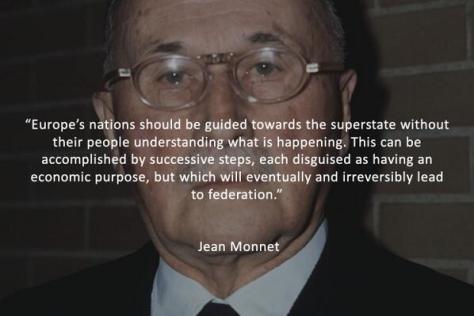
Jean Monnet was one of the principal freemasonic architects of the EU:
“Jean Omer Marie Gabriel Monnet (French: [ʒɑ̃ mɔnɛ]; 9 November 1888 – 16 March 1979) was a French political economist and diplomat.[1] An influential supporter of European unity, he is considered as one of the founding fathers of the European Union. Jean Monnet has been called “The Father of Europe” by those who see his innovative and pioneering efforts in the 1950s as the key to establishing the European Coal and Steel Community, the predecessor of today’s European Union.[2] Never elected to public office, Monnet worked behind the scenes of American and European governments as a well-connected pragmatic internationalist.” [Wikipedia]
“He was the first to be bestowed Honorary Citizen of Europe by the European Council of the European Union, for extraordinary work to promote European cooperation on 2 April 1976. Following this he became the first person alive to be pictured on a German stamp who was not also a German head of state.” [Wikipedia]
https://en.wikipedia.org/wiki/Jean_Monnet
Another one was Coudenhove-Kalergi:
“In his book Praktischer Idealismus (Practical Idealism), written in 1925, he describes the future of Jews in Europe and of European racial composition with the following words:
The man of the future will be of mixed race. Today’s races and classes will gradually disappear owing to the vanishing of space, time, and prejudice. The Eurasian-Negroid race of the future, similar in its appearance to the Ancient Egyptians, will replace the diversity of peoples with a diversity of individuals. […]
Instead of destroying European Jewry, Europe, against its own will, refined and educated this people into a future leader-nation through this artificial selection process.”
https://en.wikipedia.org/wiki/Richard_von_Coudenhove-Kalergi
“Nazis considered the Pan-European Union to be under the control of Freemasonry.[27] In 1938, a Nazi propaganda book Die Freimaurerei: Weltanschauung, Organisation und Politik was released in German.[28] It revealed Coudenhove-Kalergi’s membership of Freemasonry, the organization suppressed by Nazis.” [Wikipedia]
“Hitler did not share the ideas of his Austrian compatriot. He argued in his 1928 Secret Book that they are unfit for the future defense of Europe against America. As America fills its North American lebensraum, “the natural activist urge that is peculiar to young nations will turn outward.” But then “a pacifist-democratic Pan-European hodgepodge state” would not be able to oppose the United States, as it is “according to the conception of that commonplace bastard, Coudenhove-Kalergi…”” [Wikipedia]
https://en.wikipedia.org/wiki/Richard_von_Coudenhove-Kalergi
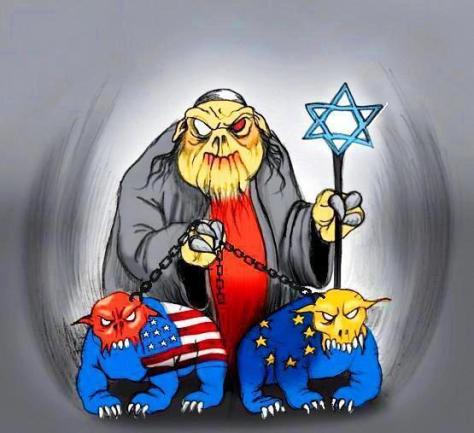
There are secret occult forces behind the founding and expansion of both USA and EU. They are not exclusively Jewish or Zionist, but there is a strong link, as there is to Freemasonry, and also to other groupings not publicly named. Forces of Evil.
and see:
http://www.westernspring.co.uk/the-coudenhove-kalergi-plan-the-genocide-of-the-peoples-of-europe/
Look at the tweet below, from the World Economic Forum at Davos, and retweeted by a pro-EU public relations drone, and which purports to show a wonderful “economic plan” to create a “trade route” (corridor) from Malta and the Mediterranean to Scandinavia. What is the real purpose here? To create a funnel from Africa to Northern Europe, through which migrant-invaders will be funnelled through the heart of Europe to destroy it racially and culturally.
https://twitter.com/JamesMelville/status/1127141453161955328
The EU was never meant to be just a mutual-benefit trade bloc. It was always meant to be a monolithic superstate in which the white European populations could be mixed, eventually, with blacks and browns. Of course, that was never conveyed to the peoples of Europe, only to the self-appointed “elite”. In fact, some naive people supported the EU (and still do) because they imagined that it was European in race and culture and not only in geography. Thus we see the deliberate conflation by Remain drones, in the msm or on social media, of “EU” and “Europe“, as in “if Brexit happens, we shall be leaving Europe“, rather than “…leaving the EU.” The UK is part of Europe and always will be; it need not be part of the already-dictatorial EU superstate, which is deliberately importing the culturally inferior by the million.
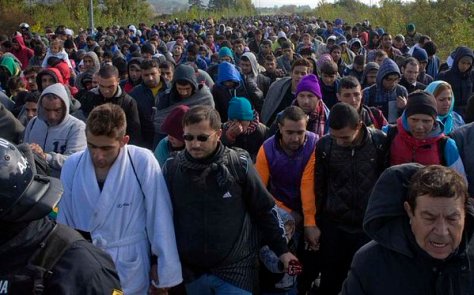
How is it possible, though, for both EU and Brexit Party to be heavily influenced by the same forces (ZOG, NWO etc)? Think of a bet whereby you could, in a two-horse race, win whichever horse puts its nose in front. Likewise, in the UK there are or were two or three main parties. The fix was/is into all of those parties. It does not matter (or did not, until Corbyn took over Labour) which party wins, because ZOG/NWO is embedded in all three “main parties” (things are changing now, though).
Brexit Party may have been partly set up with secret aims in mind, but these plans do not always go as planned. Brexit Party has mushroomed, almost exploded, in a way which was perhaps unforeseen even by Farage himself. These things happen in history. The events of the Russian Revolution spiralled out of control, or to use a different metaphor, spread like a wildfire from its modest beginnings in one city in the corner of a huge empire.
Why are voters flocking to Brexit Party? It cannot be because of Brexit Party’s policies, because it has none, or at least only one. I identify these factors:
- the wish to have the Referendum of 2016 properly respected and complied with; but beyond that
- the wish to hit out at the System parties and especially the mis-named “Conservative” Party, which under the influence of Jewish Zionism and globalism has trashed the UK (especially England and Wales) to the point where nothing works properly, where most people have neither security nor freedom, where the population is only about half really British now, and where standards in all areas are dropping like a stone (NHS, transport, education, real pay, State welfare benefits, animal welfare, environment etc). There is also the repression on thought and socio-political expression. “Free speech” scarcely exists now in the UK.
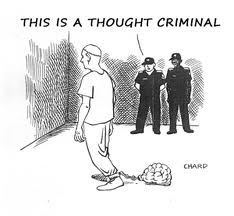
The wish to lash out is very strong now. The people can see that Brexit Party has the popular support to make it a credible vote at both EU and (so far) Westminster elections. People know (whether intellectually or instinctively) that a vote for Brexit Party is one that hits the Conservatives hard, much harder than voting, say, Labour. In any case, Labour itself is not supported by most people (not so much for policy reasons as because white English people especially do not like what they see around Corbyn: the blacks and browns, the semi-literate Angela Rayner types who would be in Cabinet, the creaking 1970s comic-book “Marxism” etc).
A vote for Brexit Party hits the Conservative Party hard not only in areas where Labour is strong but in areas where the Conservatives have prevailed for decades. As I blogged previously, if (as polls suggest) the Conservatives lose 60% or even 50% of their votes, they will lose 50-200 seats, to Labour, to Brexit Party itself, and, here and there, to the Liberal Democrats. That means (as I also blogged previously and to which the msm is now catching up) that
- Brexit Party may actually win some —possibly 50, even 100— seats at Westminster;
- The Conservative Party, which has outlived its usefulness, will fade and go the way of the Liberal Party after the First World War; and
- Labour will (as I have predicted for 2 years) probably be largest party in the Commons, but will be unable to do whatever it wants, because it will be a minority government (almost certainly). People may well prefer that to a majority Labour government.
It can probably be said that, in Westminster constituencies where Labour is not now the first or second party in elections, even former Labour voters would be better to vote Brexit Party than to vote Labour, because in “Conservative” Westminster constituencies, a vote for Labour is going to be a wasted vote, whereas a vote for Brexit Party will quite possibly help to unseat the Conservative MP in question.
Speaking now from a social-national viewpoint, why do I welcome Brexit Party?
That is a simple question to answer. No matter what forces may be behind Brexit Party, no matter what forces influence it, its importance to me lies in its ability to smash the “three main parties” scam-system in the UK. A weak government, esp. Labour, would open the way to real social nationalism in a way never seen before.

Notes
https://en.wikipedia.org/wiki/Claire_Fox
https://en.wikipedia.org/wiki/Nigel_Farage
https://www.ft.com/content/9f89051e-730f-11e9-bf5c-6eeb837566c5
https://en.wikipedia.org/wiki/National_Front_(UK)
https://en.wikipedia.org/wiki/Alan_Sked
https://en.wikipedia.org/wiki/Jean_Monnet
http://www.dutchanarchy.com/coudenhove-kalergi-plan-genocide-white-peoples-europe/
http://www.westernspring.co.uk/the-coudenhove-kalergi-plan-the-genocide-of-the-peoples-of-europe/
The unreality of the “Remain” crowd can be gauged by the tweet below. Like so many of the twitterati, this fellow over-values Twitter. He actually thinks that he is achieving something by having a few hundred or a few thousand other Remain whiners in his echo-chamber retweet or “like” his pointless tweet. Result? Nothing, but he feels warm and justified. In fact, he is a public relations man whose Twitter output is largely a one-sided and pro-EU song of praise. I predict that 24 May 2019 will not be a pleasant day for him!
https://twitter.com/JamesMelville/status/1126988777304526848

Afterthought
Looks as if Boris Idiot and Amber Rudd might both lose their seats at the next General Election. Conservative MPs will not be voting for either of them to be leader if there is every chance that they might lose their seats…Happy day!
Update, 17 May 2019
Update, 18 May 2019
Someone called Casper Hughes, writing in The Independent [see below], says that Brexit Party will have no effect on Westminster elections. That statement, I think, is probably wrong. For the following reasons:
- first of all, like most unthinking scribblers and talking heads of the present time, he has not managed to free himself from the idea that there is a spectrum going from “far left” through “hard left”, “soft left”, “centre-left”, “centrist”, then to “centre-right”, “rightwing”, “hard right” and finally the —demonized— “far right”;
- Casper Hughes labels, simplistically, a huge group as “rightwing voters”. It’s a meaningless phrase; it shows lack of real understanding;
- politics is more nuanced now. People from all parts of the outdated “right”/”left” spectrum can, for example, be allied on animal rights, environment, economic outcomes (and even policies: rail and utility renationalization for example). It was Jack London who said “I am a socialist, but a white man first”;
- it is a mistake to imagine that Brexit Party support is all about Brexit. The System betrayal of the EU Referendum result is one example of how the System has, in vulgar terms, shat on the white British people over and over, especially in the past 30 years or so. The Brexit Party is a chance (like the 2016 EU Referendum itself) to kick the System “parties” (which form, to a large extent, one party with 2-3 faces).
- people are currently (since at least 2015) voting against, not for. The article does to some extent acknowledge that. That means that people are voting not for Brexit Party and its sole policy, but to stamp on Con and Lab (and LibDem) as well as voting —yes— for Brexit, i.e. to leave the EU properly, without strings;
- people generally now realize that a conspiracy is stealing Brexit, against the “democracy” we are supposed to have in the UK; they want to fight against that; the traditional voters for the “main parties” are not as dominant as they were. In 1950, 97% voted LibLabCon. Now? Maybe 50%;
- also, many traditional voters feel betrayed: Labour betrayed its core vote by turning into the Blair finance-capitalist, mass immigration, “ignore-Pakistani-child-rapists” “New Labour” or fake-Labour party. The Conservatives betrayed their core vote by continuing with mass immigration, by increasing taxes to an extent not seen under Blair —or even Callaghan in the 1970s—, by destroying much of the mental landscape that made England England, by conspiring to dishonour the 2016 Referendum result, and in other ways;
- the article says in terms that the present situation is a re-run of UKIP in 2014-2015. It is not. People saw that UKIP was cheated in 2015 (1 in 8 people voted UKIP in 2015 and were cheated by a rigged electoral system) and are angry at that, but even more angry at the corruption, freeloading and dishonesty of the main 2 parties, as well as at their incompetence and arrogance;
- the article supposes that the so-called “right-wing” voters will “coalesce” around the misnamed “Conservatives” as a “stop Corbyn” tactic. Don’t count on it. After 3 years of Jewish propaganda contra Corbyn, Labour is riding higher than ever; and many former Con voters actually like many Corbyn-Labour policies;
- the article says that Brexit Party is unlikely to win many if any Westminster seats. Let’s see. The SNP was founded in 1934, and did not get many MPs until 2015, before which it often had 0, 1, 2 or a few MPs most of the time (81 years!); then it reached that FPTP tipping point and had 59. Brexit Party may or may not get to the tipping point, but the idea is no longer ludicrous, if it opposes, say, Labour under Corbyn and Conservative Party under whoever (possibly Boris-Idiot);
- the very fact that Boris Johnson is spoken of as possibly Prime Minister is proof enough that the System is sick and the Conservative Party terminally so;
- the article seems to imagine that if Brexit Party gets only the same vote as UKIP in 2015, then its effect is meaningless. No, because even if Brexit Party gets the 12% UKIP got in 2015, and if the others stack up as Lab 35%, Con 35%, LibDem 10%, that leaves the Conservatives, though largest party, 32 seats off a majority: https://www.electoralcalculus.co.uk/userpoll.html (only a couple of points more for Labour and Labour are largest party, though 18 off a majority);
- the article’s conclusion is predicated on traditional tribal Conservative loyalty, but that is breaking down fast and very many older voters are dying. A recent poll said that less than half of 2017 Conservative voters intend (at present…) to vote Con next time. That would cull anything up to 200 Conservative MPs if it were to become reality;
- the EU elections will be a guide, the Peterborough by-election even more important.
I noticed that the article ends on an uncertain note.
https://twitter.com/casperhughes2/status/1129386694476795905
Update, 19 May 2019
Brexit Party now on 24% for the next general election (Con 22%, Lab 29%).
If actual voting reflected that, the Conservatives would lose about 172 seats and be left with about 145; Labour would be the largest party in the Commons, with 297 MPs (up 35), and Brexit Party would have a bloc of 105 MPs. LibDems might have 18. That would mean Corbyn as Prime Minister of a minority (or coalition) government, 29 seats short of a Commons majority.
https://www.electoralcalculus.co.uk/userpoll.html
Brexit Party is now holding two rallies daily! Not pathetic little meetings like those of Change UK (a Change UK meeting yesterday had 9 people on the podium and 5 —yes, 5— people in the audience!) Here is the Thursday May 16 2019 Brexit Party meeting in Willenhall, West Midlands, a town with a population of about 29,000; the meeting had about 1,000 attending, obviously mostly locals:
and here (same day!), another Brexit Party meeting in the same region, in Wolverhampton, this time with 1,200 attending! So at least 2,200 people had turned out to support Brexit Party in the same region and on the same day! This seems unstoppable, whatever some msm twitterati and chatterati are saying!
Meanwhile, at a Change UK “rally” (8 members of the public and 2 reporters? Or was it 5 members of the public and 5 reporters?…)
Update, 23 May 2019
Here we are. Election day. Every indication shows Brexit Party powering ahead, leaving Con, Lab, LibDems, let alone Greens and Chukup, in its wake and floundering. I saw an interesting Twitter thread analysis about it all (see below):
Update, 27 May 2019
Update, 30 May 2019
The Peston show on ITV got a psephologist to work out what would happen in the (unlikely but possible) contingency that the next general election saw the same voting as the recent EU elections. The result? Brexit Party 441 seats, Conservatives 1 seat!
Update, 20 November 2019
Well, much water under the bridge! Brexit Party was polling around 12% when Farage decided to pull 317 Brexit Party candidates only 4 weeks before the election. That was followed by another 38. That, in return for a worthless promise from Boris Johnson, a man of no credibility, no integrity, a useless beneficiary of the UK’s sick political system.
Farage‘s ridiculous decision (taken unilaterally and without consultation with the candidates themselves, who had all paid to be considered as candidates) collapsed Brexit Party overnight. Farage killed his party as surely as if he had shot it in the neck.
Now, at time of writing, Brexit Party is in the polls at around 4% and, with 3 weeks to go, is not a serious contender in the General Election. Brexit Party might have won a number of seats while depriving the Conservatives (mainly) of a number of others, but now will be lucky to win even in those constituencies where it had a chance (e.g. Hartlepool).
Why did Farage destroy his own party? I am not the conspiracy theorist some imagine but I do speculate whether this is some kind of Russian operation.
Russia, we are told, wants the UK out of the EU (and, in Putin’s wildest dreams, NATO). Taking that as correct, it may be that Russian strategists were (are?) hoping for “hard Brexit” or “no deal Brexit” (real Brexit), because it weakens the EU (as part of the New World Order or “NWO”) and because a real Brexit might both cause economic/political discontent in the UK down the line and also stimulate Scottish nationalism, with the possibility that Scotland might break off from the UK, and then possibly (probably) decommission the nuclear missile submarine bases there. A break-up of the UK would be a stunning coup for the Russian state in terms of Atlantic geopolitics.
Still speculating, if an immediate “hard Brexit” seemed likely to be blocked by Parliament’s Remain majority in the event of another hung Parliament, then Russian strategists might have decided to strengthen Conservative Party chances by taking out Brexit Party.
Brexit Party is a dictatorship of one man, Farage. To take Brexit Party out of the General Election, Farage alone had to make that decision. He did. So the question is why did Farage take that decision? To my mind, there is no logical reason based on ordinary politics why Farage should take the word of a proven and continual liar such as Boris Johnson. On the other hand, if Farage is or has become an agent under control, then it makes perfect sense.
How do we know that Farage has not been promised (or even paid already) a large sum (£20M is good, £50M is even better) offshore? It makes sense in baldly venal terms but it also makes sense for Farage politically, if Farage has become convinced that a Boris prime ministership with a large majority would result, in a year or two, in a “hard” or even “no deal” Brexit. That way, Farage gets a secret fortune and the political result he has wanted to see since the early 1990s.
True, Farage is wealthy anyway (is supposed to be), but so what? As to whether the Russians would pay really large sums for such purposes…well, the wife of an “oligarch” paid the Conservative Party £160,000 just to have a tennis game with Boris Johnson and David Cameron-Levita. On that basis, £50M to change the whole course of British policy and strategy seems cheap at the price.
There is no direct evidence that Farage is an agent of the Russian state, but he has been shown to have close links with some leading “oligarchs” etc. The Russia of Putin is not the Soviet Union. It operates partly via the uber-wealthy who are beholden to Putin; the Soviet Union operated in this sense in a different way, bureaucratically, via the KGB and its predecessor agencies (NKVD etc), GRU and, pre-WW2, the Comintern.
As we have seen (google, or see my earlier blogs), Boris Johnson, like Farage, is or has been close to some Russian or Russian-Jew “oligarchs”. Then there is the role of Dominic Cummings, Johnson’s “adviser” (who however has been reported as having actually overruled Johnson on some occasions!). I blogged about Cummings a few months ago: https://ianrmillard.wordpress.com/2019/08/10/les-eminences-grises-of-dystopia/
There have been those who have implied that Cummings is a kind of Russian agent. My previous assumption was that he might have been an agent of SIS (British agent rather than salaried officer, perhaps, but who knows?) for a while (when he was in Russia for about 3 years after having graduated from university) but again that was just my speculative thought. Still, one would not necessarily preclude the other, especially over time.
I have no evidence that Farage has been paid a huge bribe by Russia; I have no evidence that Cummings has, either. Still, I do wonder. “Thoughts are duty free”, even in the EU…
There is, of course, also the fact that the British Intelligence assessment of some connected matters is not going to be released until after the General Election. It has been held up by Johnson and Cummings. Why?
https://www.theguardian.com/politics/2019/oct/31/boris-johnson-accused-report-russia-dominic-grieve
https://www.bbc.co.uk/news/uk-politics-48874147
https://www.politics.co.uk/news/2016/07/19/boris-johnson-once-outed-mi6-spy-for-a-laugh
https://www.theneweuropean.co.uk/top-stories/dominic-cummings-links-to-russia-1-6355329








 Ian Robert Millard