Category Archives: white flight

Post-Collapse Survival; Preservation of Civilization and Culture

Recent months have seen devastation from hurricanes. The Caribbean area has been the worst-hit. Most of those islands are now, with help from major states as well as from charities and individuals, bouncing back. Puerto Rico is still suffering from the effects, partly because it is the largest of the worst-affected islands, partly because the US Federal Government response has been sluggish.

In Europe, it is unlikely that we shall suffer in any major way from hurricanes, but there is a quite-high chance that our societies will suffer from the dislocations caused by war and/or socio-economic collapse. Many will say that this cannot happen or would not affect at least the more civilized parts of Europe. Are they sure? It is still just within living memory that parts of Europe were devastated twice by the very major conflicts of 1914-18 and 1939-1945. Apart from those wars, there have been others: the war between the Bolsheviks and others from 1918-1922 (Russia, Ukraine, Poland, East Prussia); the Spanish Civil War (1936-1939); the Balkan War(s) of the 1990s. That is not even taking into account smaller armed conflicts such as the Hungarian Uprising and subsequent Soviet invasion (1956) or disruptions of an economic or other nature. The recent and continuing “migration-invasion” of Europe by non-Europeans comes to mind.

An individual or small group within a society, not holding political power, cannot do much to steer such events; neither can an individual or small group easily defend itself either directly or in terms of subsistence. However, there are possibilities, if prepared for in advance. In Puerto Rico, while most of the population suffered (at time of writing many continue to suffer) from shortages of water, food, from lack of electricity, vehicle fuel and medical help, others have been able to weather the storm, both literally and metaphorically, far better.

In Puerto Rico and elsewhere, those who survived without suffering more than they had to were those whose homes were solid, who had stocks of food, fuel and medical supplies and who were as far as possible “off-grid”. Twitter carried innumerable stories of despair and triumph, such as the farmer who powers his farm using solar power from his own solar array. For him, the fact that the electricity distribution network was not working (for weeks) was not directly relevant.

In the UK and across Northern Europe, the same applies. I have blogged previously about how people on farms, country estates and elsewhere might be able, not only to survive social collapse, but also to help to preserve culture and civilization during what could be an extended period without central control, help, law, order. As during WW2 rationing, those best off might be people living in rural areas, especially those already “prepped”:

  • electrical power and hot water from solar panels, heat exchanges, small wind turbines, small hydropower plants; there are also ways of producing limited amounts of electricity via pedal-powered and hand-operated wind-up systems; temporary back-up might involve small petrol or diesel generators.
  • water purification systems; solar stills; temporary back-up via stocks of bottled water: bottled water lasts, at a minimum, 2 years and in many cases is still drinkable without treatment after 4 –or more– years and even after that can still be used after simple treatment such as addition of drops of potassium permanganate or by running it through a filter and purification system, or by boiling it as required. In fact, most rural farms and estates have access to springwater supplies etc.
  • food home-grown or produced. This of course depends on having land on which to grow it and will be much easier if the preppers already do it on their own estates and farms (or the land around ordinary houses). How much land is required is not fixed and depends on the required diet, the land type and quality etc, but can be as little as half an acre per person and quite likely even a smaller area– https://www.smallfootprintfamily.com/how-much-land-is-needed-to-be-self-sufficient . In addition, there will be food backup via stocks of tinned food, dried foods and, for those whose diet encompasses them, foods from fishing and shooting: fish, shellfish, venison etc. A further source would be from permaculture sources: nut-bearing trees, wild berries and so on.
  • Internet. This may be interrupted or even cease to exist for a time, though it is likely that service will continue in some form or be rebuilt eventually; a major resource in terms of useful techniques, as well as in holding together spread-out communities and the rebuilding –if necessary– of the wider society. Also, a way of offering or asking for help.
  • medical help: as on expeditions etc, you can never have too many doctors or nurses. A further advantage to having doctors on board before disaster strikes the general society is that doctors can order supplies of drugs unavailable without prescription and, should they so decide, stockpile them. While few individuals will be able to afford their own operating theatre, a social-national community might be able to fund doctors to set up one before it is required.
  • transport: vehicle fuel can be stored, but may not last very long. Electric cars and other vehicles are still novel; when they are available, anyone with an electrical supply and a charger will be able to charge them and so continue to have the use of cars, trucks, tractors etc.

I have left out the question of arms. As the law now is in the UK, most people are not permitted arms beyond shotguns and in some cases rifles. Obviously, farmers and landowners will usually have such weapons. In a situation of collapse, arms will probably become available. In any event, any larger or more complex weapons (eg mortars, tanks) require persons with the requisite military training. In short, it is unnecessary for the germinal ethnostate to have arms beyond those customarily available to all rural communities in the UK (other European countries are far less strict).

We in the germinal ethnostate will be in a good position not only to survive but to found a new society if we prepare in the right way and in good time.

Notes

https://www.smallfootprintfamily.com/

https://www.theorganicprepper.com/

http://prepared-housewives.com/about-me/preppers/

https://sustainablefoodtrust.org/articles/making-compost-at-blaencamel-farm/


The Right Attitude to Race and Culture

Race and culture are among the hottest topics of the moment. From the migration-invasion of Europe to the American wave of the alt-right, to the elections in European states, there is a ferment which will not calm. As social-nationalists, standing first and foremost on the racial-cultural front line, we must be clear where we stand in terms of attitude.

It disturbs me when I see unpleasant and too-general remarks made even about the basest of race-types. We must never forget that, as Adolf Hitler himself said in another context, “there is the individual, but beyond the individual is the race.” The individual comes out of a race; he is made by it, formed by it, is in most cases brought up and educated by it and by the nation which is part of the race. However, the individual can transcend the race-group (equally, can descend from it). German National Socialism itself recognized this reality when it granted a relatively small number of persons, who were not Aryan, the status of “honorary Aryan” or Ehrenarierhttps://en.wikipedia.org/wiki/Honorary_Aryan

We today, even those of us who are social-national in political orientation, are yet not  National Socialists in the same sense as those who fought for European humanity in the 1920s, 1930s and 1940s. We today have our own path forward. At the same time, to put it in Biblical language, we “honour our father and our mother” and that means that we honour National Socialism as the ground from which we sprang.

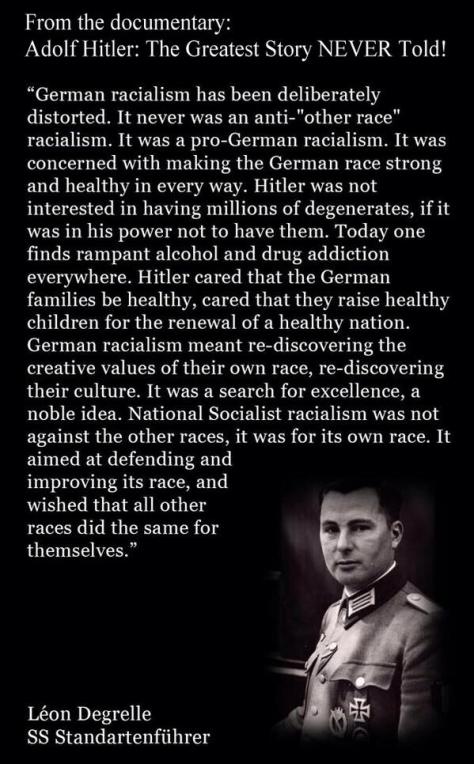
Leon Degrelle, the political leader, front-line fighter and thinker, had this to say on the subject after National Socialism in its original phase had passed into history:

becwoaeccaazenq

There is no need for social nationalists to utter insults at blacks, Jews or members of other groups, except where that is justified and/or where it makes a political or social point. I do not want to concentrate on the American socio-political situation. I am not American, have not lived or worked there for many years and am focussed on Europe and Russia. However, we have to recognize that American society is very different from our European society. American society has had a relatively recent history of slavery, of genocide (the American Indians, aka Native Americans), of a civil war in which 3% of the population died, of the resistance to the social consequences of that war in the South, that resistance being, in part, the Ku Klux Klan, and so on.

American politics has become far more bitter, far more polarized, particularly in language, than is generally the case in Europe. There is also the point that there is a far wider spectrum of education and culture in the USA than pertains in most parts of Europe, or even Russia.

For me, it is natural to regard the non-European races as distinct and as having their own paths to the future, while equally recognizing the necessity (for all races) for the leading role of European humanity. For some Americans, this is perhaps less obvious and those other races seen as purely enemy contingents.

Social nationalists must take every opportunity to refute the lie (often though not always made by Jewish Zionists) that we base our political philosophy on “hate”. We ourselves know that that is not so, but often the public is bamboozled by the Jewish Zionists into believing the lie. For example, we wish not to be ruled or owned or influenced by the Jewish Zionist element, but that is, if you like, “defensive” in nature.

Our attitude to race and culture is one of recognition of evolution and involution. Our European race is generally still evolving, as is the “Russian”, “Slavonic” or “Slavic” race which (important point) will not come into its plenitude for another 1,500 years. Other races in this world are stagnant or are degenerating. The prime motive force behind social nationalism is to evolve the race and nation to higher levels and to destroy any threats to that evolution. This is a positive, not a negative, political world-view.

In the future, European and Euro-Slavic humanity will have powers of soul, of mind, which today would be regarded as magical. This is the point to which we as a people have been striving.

When we see the sacred Swastika, we must understand it to be a symbol of evolution, of our evolution.

TorchSwastika

The Way Forward for Social Nationalism in the UK

The talent of the strategist is to identify the decisive point and to concentrate everything on it, removing forces from secondary fronts and ignoring lesser objectives.”

Those words of Clausewitz are often taken to encapsulate the essence of strategy. How are they applied to the socio-political question in the UK (England, primarily) from the social-national point of view?

“The Decisive Point”

The “decisive point” or objective, ultimately, is the formation of a British ethnostate as an autonomous part of a Eurasian ethnostate based on the Northern European and Russian peoples. However, within the UK itself and before that, the objective must first be drawn less widely, as political power within the UK’s own borders.

The Gaining of Political Power in the UK

The sine qua non of gaining the sort of political power required is the existence of a political party. More than that, a party which is uncompromizing in its wish to entirely reform both State and society.

History is replete with examples of states which have seemed not even just powerful but actually eternal, yet which have collapsed. Ancient Rome, though perhaps not a “state” in our modern sense, is perhaps the one most embedded in the Western consciousness. More recently, the Soviet Union and its satellite states. In between those two examples (but among many others) we might cite the pre-1914 European “settlement” based on the empires and kingdoms which collapsed during and after the First World War: Germany, Austria-Hungary, Russia, the Ottoman Empire.

The main point to understand is that, in situations of crisis on the large scale, it is not the political party with the most money, erudition, developed policy or even membership that comes out on top, but the party with the most will or determination. That means the most disciplined party under the leadership of the most determined leader.

It is better to have a party consisting of only 1,000 which is tightly-disciplined and self-disciplined than one of 100,000 which is a floundering mass of contradictions. When a national crisis occurs, such as 1917-1921 in Russia or 1929-1933 in Germany (to take two obvious examples), the people instinctively turn to the party perceived to be strongest, not strongest in numbers, money, intellectuality or number of members, but strongest in the will, the will to power.

The Party

A party requires leadership, members, ideology, policy and money. Everything comes from the leadership and the membership, in symbiosis. In practical terms, this means that policy is open to free discussion, up to the point where a decision is made as to what is party policy as such. Also, it has to be understood that a party requires money as a tank or armoured car requires fuel. To have endless fundraising drives, hunts for wealthy donors etc demeans and dispirits the membership. Having a “tithing” system renders such other methods unnecessary. The members sacrifice an agreed amount of their post-tax income, such as 10%. The party organizes itself and its message to the general population using that money.

As a rule of thumb in contemporary Britain, it might be said that, on average, each member will provide something like £2,000 per year to the party. A party of even 1,000 members will therefore have an annual income of £2 million, enough to buy not only propaganda and administration but real property as a base. By way of comparison, the Conservative Party in 2017 has an income of about £3.5 million.

Elections

It must be understood that elections are only one way to power, but they are indispensable in England, for historical-cultural reasons. A party which cannot win elections loses credibility rapidly once that party is large. In the initial phase, no-one expects the party to win Westminster or even local council seats, but after that, it has to win and so grow, or deflate as the BNP did and as UKIP is doing now. The problem small parties have under the English electoral system is that a Westminster seat can be won only with, at a minimum, about 30% (and usually 40% or more) of votes. The insurgent party is in danger of spreading itself too thinly, in every way. UKIP’s history illustrates the point: in 2015, about 12% of votes cast (nearly 4 million), but only the one MP with which they, in effect, started. The answer is to concentrate the vote. That is done by concentrating the members and supporters of the party geographically.

Safe Zones

I have blogged previously about the creation of safe zones and especially one primary safe zone (possibly in the South West of England). If the members and supporters of the party gradually relocate into that zone or zones, many things become easier, from protection of buildings, meetings, exhibitions etc to the election of councillors and MPs. I have also blogged about the magnetic attraction such a safe zone might exercise over people in the UK as a whole.

The Decisive Time

The “decisive time” cannot be predicted. In Russia, Lenin (at the time in foreign exile) thought that the 1905 uprising was “the revolution”. He was wrong. He also thought that the first (February, old-style) 1917 uprising was not “the” revolution. He was wrong again. It was.

https://en.wikipedia.org/wiki/February_Revolution

Lenin had to hurry back to Russia (arriving belatedly in April 1917, old-style) not only to try to take control (he failed in that and had to foment his own coup d’etat in October 1917) but to avoid being sidelined and so becoming an almost irrelevant footnote to history.

In Germany after 1929, Hitler likewise was not in control of events. In the end, economic near-collapse and political turmoil gave him the chance to win enough votes (33% in 1932) to form a coalition government which led on to full power in 1933, after the NSDAP achieved a higher –though still minority– popular vote (44%).

In other words, both Lenin and Hitler were the pawns of Fate while striving to be the masters of events. They had something in common though: highly-disciplined and ideologically-motivated parties behind them.

Practical Matters

At the age of 60, the last thing which is convenient for me is to form a political party. I have no need of such an activity as a hobby or absorbing interest. I am coming to the idea out of duty, out of a realization that something has to be done and out of an understanding that something can be done, if Fate concurs. I am not willing to compromize on overall ideology or on the way things are organized within such a party. I shall only establish a political party (which may become a movement) if it can be done on a serious basis. However, there is a need for a party to speak for the British people and there is a widening political vacuum in which such a party can thrive and grow.

Update 15 April 2019

In the two years since I wrote the above blog post, my view has not changed, that is

  • a political party and movement is needed;
  • there is at present no such party;
  • such a party can only be established if done on a serious basis;
  • I myself still do not have the means with which to found such a party; but
  • a political party and movement is —still— needed…

Update, 8 March 2023

All factors mentioned in the previous update remain the same.

Formation of a Social National Party in the UK

Background

For a number of years, I have watched the socio-political scene in the UK with increasing feelings of concern. The System parties have done terrible things (and omitted to do the right things) without any regard for the national interest, without compassion, without even logic:

  • disastrous foreign wars and other interventions, backing the United States and NATO and (in reality) Israeli interests and the plans for a “New World Order” [NWO];
  • financial madness caused by globalist economics and neoliberalism, not least the inability to tax effectively huge transnational enterprises;
  • gradual takeover by Zionists of strategic areas of society;
  • quite fast increase in the Muslim and other non-European populations of the UK;
  • inflicting appalling hardship and persecution upon the poorer section of the UK population (eg unemployed, disabled) via spending cuts, cruel bureaucratic systems, outsourcing;
  • allowing the NHS to decline steadily in all areas;
  • importation of many millions of immigrants even since 1997, with subsequent births to those immigrants, resulting overall in strain on NHS, roads, trains, housing; schools, prisons, social security, pensions;
  • policies on farming and landowning which do not prioritize wildlife and the environment  in general;
  • crises in care of the elderly;
  • decline in real educational levels covered up by meaningless “degrees” and award inflation;
  • inability to adequately and aesthetically house the population.

The above is not even a complete list of how the System parties have let down the British people.

System Parties

Conservatives

The Conservative Party has inflicted terrible damage on the UK via, inter alia, spending cuts and a coarsening of political converse generally. It might have suffered a huge defeat in 2015, but in the event was saved by the vagaries of the First Past the Post electoral system etc. It has now been saved, for the time being, by the implosion of the Labour Party.

Labour

The Labour Party becomes increasingly less relevant. Even mainstream commentators have woken up to it now. Labour introduced the hateful, dishonest and incompetent ATOS company to persecute the disabled. Labour was the party that decided to invade Iraq and Afghanistan. Labour is infiltrated, indeed pervaded, by the Jewish-Zionist lobby and its agents. True, so is the Conservative Party, but Labour claims to speak for what were once known as “the workers”. That, of course, is Labour’s problem: the bedrock of the “proletariat” has been replaced by the shifting sands of the (increasingly raceless and cultureless) “precariat”. So Labour seems to speak on behalf of metro-liberal “snowflakes”, “antifa” rentamob idiots, employees of the collapsing public sector; above all, perhaps, the “black and brown” ethnic minorities.

Example: in Stoke on Trent, Labour recently won the Stoke Central by-election by 2,500 votes. 62% of the electorate did not vote; of those that did, about 7,500 voted for Labour, 5,000 for both UKIP and Conservative. The constituency has 12% non-English voters (half of them Muslim). Virtually all voted Labour. In other words, the “ethnic” vote swung it for Labour. Educated guess: of the 7,500 Labour votes, virtually all were from ethnic minority (mainly Muslim) voters.

The SNP supremacy in Scotland has taken away about 50 MPs from Labour.

The redrawing of boundaries for 2020 will mean a House of Commons with 600 MPs. Labour is now polling at 25%, concentrated in a relatively few seats. Labour will have 100-200 MPs out of 600. It will be unable to form even a minority government.

Labour is gradually deflating to nothing.

Liberal Democrats

The 2015 debacle has killed the LibDems. The party may be getting “dustbin” or “protest” votes from disaffected Labour/Conservative voters, but its upsurge in 2010 will never be repeated. The Con Coalition mortally wounded the Liberal Democrats and they were lucky not be wiped out in 2015.

Non-System Parties

UKIP

UKIP was founded in 1993 and in the nearly 24 years since then has done well to get MEPs elected but has never come even very close to getting a Westminster MP, except for free-market crazy Douglas Carswell, who after all was already a Conservative MP and may well revert to being one.

UKIP failed badly at Stoke Central and Copeland and those failures reflected its lacklustre performance in local and Westminster by-elections since its peak in or around 2014.

Brexit has shot UKIP’s fox, both on the EU and on EU immigration. UKIP seems unwilling to engage on non-EU immigration and, in general, on race and culture; it seems afraid of being called “racist”. UKIP might have forged ahead had it gone social-nationalist in 2014, but it failed to do that and is now just a (sort of) Conservative joke party again.

UKIP has come to the end of the line except as a dustbin for some white English votes.

Other non-System Parties

There are none, really. Yes, there is “the solitary Green” at Westminster, who will be gone by 2020. The Greens are polling nationwide at 3% or below. As for the BNP, after its rise in 2008-2009, it has all but vanished. Its vote at Stoke Central was 124.

Political Vacuum

It is clear that there is a political vacuum in England. The Conservatives are riding high but only by default, Labour is imploding, UKIP is effectively dead as a party with actual MPs; LibDems may well have no MPs by 2020.

At the same time, real incomes are stagnating or declining in value, immigration continues at about half a million (perhaps 250,000 “net”), housing is inadequate and expensive, young people cannot have a decent life or future, the elderly are neglected, the unemployed and disabled persecuted.

There will never be a better or more auspicious time for social nationalism. However, only if there is a physical instrument, a political movement. I have blogged about the need for safe zones for social nationalism. However, there must also be a movement, part of which must be a political party.

Party

Party Funding

New parties always face financial difficulties. Dependence on donors is not easy yet hard to avoid. A basis of firm finance is essential. It may be that the only way for a small party to grow will be for its members to sacrifice a percentage of their income to the party. On that basis, a party of even 1,000 people can have an annual income of over £2 million (based on average net income of a very modest £20,000 and on a “tithe” of 10% of that).

Party Democracy

In an ideal world, a party should be (arguably) “democratic”, but experience shows that the enemy, particularly the Zionist enemy, is skilled at exploiting cracks and fissures to create factions which eventually destroy the party. It happened to the National Front in the 1970s, it happened (it seems) to the BNP in more recent times. It is happening to UKIP too, despite its doormatting where Israel is concerned, despite its wayward errors in respect of race and culture.

In view of the above, the party leader must have the final say.

Strategy

The way to go is for the new party to target first and foremost seats within the “safe zones” which will attract more and more people from across the UK. Thus the first thing is to create those safe zones.

Further Thoughts and Update (26 July 2018)

The only aspect of the above which requires rethinking is the role –and prospects– of the Labour Party. The bubble of the Conservative Party burst in the final weeks of the General Election 2017 campaign. Labour benefited. That I did not anticipate until the last week or two of the campaign. I see no great revival of Labour fortunes; rather a further deflation of Conservative fortunes. The likely result (in any general election in 2018 or 2019)? Hung Parliament and weak minority government, probably Labour.

As for the rest of my blog post, safe zones etc, all that still applies.

Update, 15 July 2023

“Man proposes, God disposes“, as they say. The Jewish-lobby attack on Corbyn-Labour, combined with Nigel Farage shooting his own Brexit Party in the back, and the wall of lies put up by “Boris” Johnson, resulted in an unexpected and considerable Conservative Party win at the 2019 General Election.

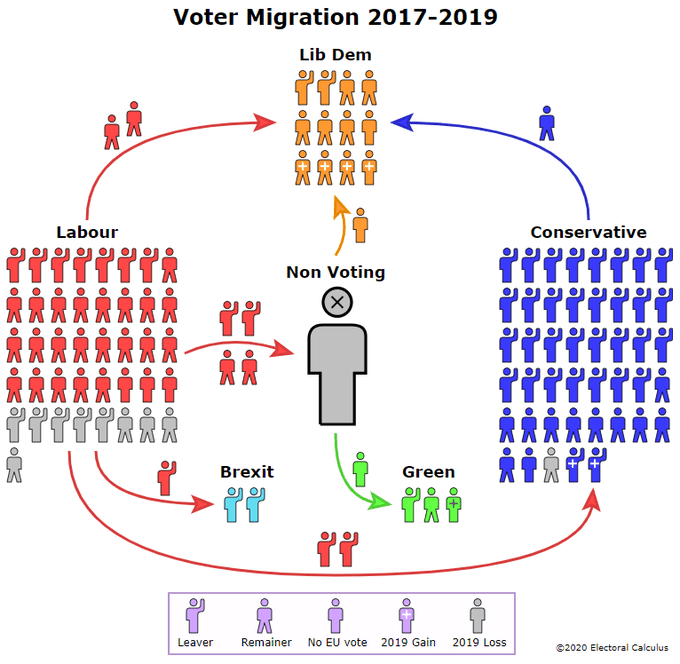
There was another factor underpinning the Conservative Party win of 2019— the fact that so many Labour Party voters “voted with their feet”, a few defecting to vote Conservative, but most simply not voting:

The Conservative vote-share increased only marginally across the country (more in a few seats), but the Labour share fell by 8 points. Had the Jewish lobby not trashed Corbyn-Labour on a daily basis for several years, and had Nigel Farage really fought for Brexit Party, the 2019 result would have been very different.

As for social nationalism, still no credible party anywhere to be seen./

From Secure Base to National Power

I have blogged about my plan for a “safe zone” in a region such as the South West of England, where forces of social nationalism, of culture and of civilization can be concentrated when, at the same time, much of the UK, particularly the urban wasteland, becomes gradually a horrible dystopia.

In the safe zone, it will be possible over time (perhaps only a few years) to take over local and county councils and, in respect of Westminster constituencies, to depose sitting MPs, once enough social nationalists are resident in the zone. Our people will be found in every official chamber and office, every business, in the three emergency services, in the common-rooms of schools and universities, on the farms and in the telephone company.

The question arises, does the safe zone only mutate and develop into a mini-ethnostate or does it expand beyond its (notional) borders? Does it move from local, county and regional power to national contention? If it does, how does this happen?

A major point to note here is that, at the same time as the safe zone is developing, there will be the formation of a social nationalist party or movement, to which people from all over the UK can belong. “Outstations” will exist even in areas not likely to be friendly to national renewal, such as London, Birmingham and the other urban sprawls which have majority non-European populations. Once this political party has even a handful of MPs from the safe zone, it can expand its influence wider. Also, the safe zone will exercize a magnetic attraction to those living outside it.

There may be a social collapse in the UK, following either war or social breakdown. More likely will be a gradual slide into a less civilized, less cultured way of life, where things such as electricity supply, social care, NHS, trains etc still exist, but operate, steadily, less well than before. In those circumstances, it will be possible for the political party to contrast the safe zone with the degenerate part of the UK and to make political capital out of that contrast.

Only in the case of a complete breakdown of the powers of the UK state would it be necessary to think in terms of paramilitary activity. In any event, there would be already-existing military units willing to save the State and society by alliance with the safe zone ethnostate.

The party or political movement will have to build its strength and await the right time, both electorally and otherwise. The way the UK is going, it cannot be very long before a revolutionary situation of some kind develops, i.e. before the British people are tired of being lied to and ready to cast off the System parties which have no solutions. Then the party can strike in both electoral and other ways.

The Veneer of Social Order

Living in a country such as the UK, basic social order has been taken for granted for centuries. Even during the economic and political upheavals of the 1920s and 1930s, or during the Second World War, disorder was only briefly and occasionally present. The 1950s and 1960s brought the odd street battle (not always political), but real life continued. The same was true of the 1970s and 1980s, where the occasional skirmish between political opponents or industrial disputants and/or the police was something that people for the most part watched on television, in between a variety show and Match of The Day. The relatively few riotous disorders in a few black neighbourhoods in London and elsewhere did not directly affect many citizens.

In those past decades, there were certainties: pretty much everywhere had a police station (even a village would have a “police house” with one or two constables). Every village had a sub-post office, every town had at least one main post office. Emergency calls for ambulances were quickly answered and took people to Accident and Emergency departments and hospitals which were usually efficient, with quiet wards and plenty of staff. Courts were places of seriousness and, in larger towns, some grandeur. Social security offices were there to help the poor, unemployed, disabled and destitute.

Now look. The UK’s social fabric has worn very very thin. Police are concentrated in large police stations and headquarters and are rarely seen on the streets. I myself happened to need to report something recently (in a small town in Southern England) and went to the large police station only to find that it shut daily at 1800 hrs and was staffed (as far as could be seen) by one woman aged (it appeared) in her sixties, certainly late fifties, in a uniform bearing the rank “Station Support Officer”, i.e. not even a policewoman. Admittedly, another and very pleasant woman, with a charming yet efficient telephone manner, called later to take details, but she was based in some other part of the county.

Many will recall the petrol disputes and consequent shortages which happened a few times in the Tony Blair years. I myself saw, in 2000, scenes verging on the anarchic, simply because the petrol stations were running out of fuel.

Again, take the health service, with its crowding, its noisy hospitals, its bureaucracy, its ever-lengthening response times and waiting lists. Or look at the courts (those not closed down, of which there have been literally hundreds in England and Wales). Instead of imposing and beautiful buildings imparting a sense of “the majesty of the law”, we find that many courts are housed in ugly utilitarian edifices. In addition, many citizens are now priced out of justice by high fees.

Then we have the governmental functions that interface with members of the public on a vast scale: the almost inhuman DWP created or coarsened by Iain Dunce Duncan Smith, the Jew “Lord” Freud etc., the HMRC and its (even more shambolic) administration. To call these organizations “not fit for purpose” is to be kind.

We have examined the now-skeletal police service; the same is true of the armed services, such as the British Army. What would happen if there were a truly big challenge to public and social order? Could the State cope? I think not.

For the above reasons and several others, I favour the creation of a mini-ethnostate in one or more parts of the UK, possibly starting in the South West of England. I have written about the idea in several of my blog posts on this site as well as on my own website:

http://ianrmillard.com/social-national-communities

If the social order breaks down in the UK, the “safe zone” that I propose will be a redoubt, an area where public and social order can be maintained, together with culture, civilization, a decent life. From this defended region can come the call to the rest of the UK to re-establish society and State.

Should We Prepare for Social Collapse?

We read of those, especially in North America, who are termed “preppers”, people preparing for various forms of disaster (nuclear war, an asteroid hitting the Earth, inability of the State to maintain civil order) leading to social collapse, either with rampaging and desperate hordes of displaced people everywhere or with a mere few “survivors” from whatever calamity has struck. We in Europe tend to laugh at these American excesses (as they seem to us), but perhaps we should be less amused and more cautious.

Naturally, there is a huge difference in geographical and demographic norms. The wide open spaces of much of the USA and Canada contrast starkly with Europe, particularly the UK, with its centuries-old man-altered landscapes, densely-populated cities and towns, lack of true wilderness (except in the North-West of Scotland).

The population density of the USA, overall, is 92 persons per square mile; that of the UK nearly 700. Naturally, that is a misleadingly simplistic picture. The most densely-populated American state, New Jersey (where I myself once lived) has a population density of over 1,200 ppsm, whereas, while the UK West Midlands region has a density of over 3,000 ppsm and Manchester over 2,000, Devon has only 172, Cornwall 154 and the Scottish Highlands and Islands only 11. On the other hand, there is the point that “crowded” (in parts) New Jersey, the 4th-smallest American state, is about the same size as Wales. The more sparsely-populated areas of the USA are often a very long way from major cities or even modest towns.

It is clear that, for the UK prepper, less is more and that the congested urban and suburban areas are to be avoided as a base. However, the distinction should be made between the hardcore prepper, who intends to live by hunting, fishing and his wits, i.e. as a “survivalist” and the person who aspires to the creation of a new society after any collapse of the existing one. The latter is therefore, almost ipso facto, a conserver of civilization and culture.

I have already blogged about the idea of forming and developing a “safe zone” or base area for UK social nationalists. I have suggested that, in terms of region, the Devon/Cornwall peninsula might be the most suitable. Naturally, when social nationalists have relocated to that zone, their lives will not consist, in the absence of immediate war or social collapse, of hunter-gatherer or subsistence farmer activities. They will do normal jobs, run businesses, smallholdings, farms and estates and in general live (in most cases) as they do in those other parts of the UK where they live at present.

I suggest the following ideas. This is not supposed to be a comprehensive list, but only a basis for one:

  • Food Security

Keep a stock of food to last for a year or even two. The Mormons have been doing this for a long time, certainly for many decades. There is no need to re-invent the wheel when we can learn from others who know how to do things. Here is one explanation of how the food storage system works with the Mormons:

https://mormonwoman.org/2009/08/28/ask-a-mormon-woman-why-do-mormons-store-food/

The Mormon system seems to work on the idea of having a buffer for months rather than years, but with modern canning, packing and freezing techniques it should be possible to give the people in the safe zone at least a one-year supply of food from store.

Naturally, in a rural area, agricultural and horticultural produce will be available. Members of the social-national community will no doubt own estates, farms, smallholdings. In addition, those occupying smaller residences can be encouraged to cultivate part of their gardens, grow produce on a small scale under glass etc.

An important aspect of food security is the existence of a seed bank. Individuals and families can keep their own, but the community as a whole should also maintain one.

No doubt people will be able, in hard times, to forage and to find wild food and to fish.

  • Energy Security

It is to be expected that, in the first instance, the houses and other buildings in the safe zone will be on mains electricity. This supply is vulnerable in the event of war, natural disaster or social collapse in the wider society.

The first necessity is to build up the supply, within the zone, of solar electricity generation and solar heating. There are buy-back schemes etc whereby the householder can even sell his excess power to the National Grid, so long as it exists. At any rate, the community within the safe zone should do everything it can to utilize this renewable supply.

Geothermal heating of homes and other buildings is possible now, if the capital is there to utilize it.

It may be possible for individual residences in the countryside to have small wind turbines too, which can both supply those homes with electricity and also put any surplus back into the National Grid or a local grid.

A further option for some farms and estates would be hydropower from rivers and smaller streams of water.

As an emergency fallback, there should be a range of off-grid options for heating homes: woodburning stoves, ordinary open fires and, for electricity generation, emergency generators run from oil or other petroleum products.

It would be useful, too, if members of the community were to stockpile emergency lighting: candles (even tealights), hurricane lamps etc, battery-operated or camping gas-operated lights, wind-up lamps and torches.

  • Water Security

Water supply is easier, being regional and local rather than national. Indeed, many houses and farms in rural England have their own supply from springs. However, a contingency plan must be drafted and worked out.

  • Communications

The Internet was designed, originally, as a means by which communications might continue even after nuclear war. Presumably, that system will continue in some form even during social collapse. If so, it might be of huge importance beyond the confines of the safe zone, in the struggle to rebuild the wider society.

The community ought to maintain a radio transmitter.

  • Conclusion

An article such as this cannot cover all aspects of how a decent society might survive when the wider society around it is in a state of disorder and even collapse. I have not touched upon questions of social order, for example. However, these few proposals may start running a current of thought. The proposed safe zone will have to operate on the basis that an externally-triggered emergency will probably occur before very long.

Update, 21 July 2019

I saw this on Twitter. Obviously drafted with American conditions in mind rather than European/UK ones, but not bad overall.

https://twitter.com/SoCarbonNeutral/status/1151751859125669889

The Organization of Community

When new social-national communities emerge, as they will in the coming years, the question is posed as to their organization.

It is important to note that, in the UK, a social-national community will not, in general, be anything akin to a commune, paramilitary encampment or religious settlement such as a monastery or convent. It will be a community which interpenetrates the existing or pre-existing ordinary village, suburb, town or city. The template can best be explained in relation to what might happen when social nationalism arrives in a large village or small town.

Scene

A social nationalist with capital buys a country house or estate, somewhere near a small English or Welsh town. He or she needs workers or retainers to help with the house, grounds, park, perhaps farmland too. Those people are sourced from the wider social-national community in the UK. At the same time, these people gradually infiltrate the local community, not in any sinister way, but by doing the things that they would have done wherever they lived: sending their children to local schools, joining local non-political groups (am-dram, allotments, churches, residents’, neighbourhood watch etc).

Other social nationalists arrive, buying houses locally, renting property, getting jobs or living off pensions or even State benefits. Some buy or rent farms, cafes, pubs, shops. Some start to work in the local offices of larger enterprises, in the local Jobcentre (if any), or in the local council offices. Others are able to work from home, thanks to the Internet.

Nothing alarming or noisy happens. There are no marches, demonstrations, or other disruptions. People get on with normal life. Underneath the surface, however, there is purposeful movement, a current beginning to flow. There are meetings, discussions, social events; nothing too large or noisy. In time, the social nationalists number in the hundreds and are a significant proportion of the local population, with more gravitating to the area every week. The time has then come for overt political action.

A by-election for a council ward is held. Few of the original local inhabitants even bother to vote. A social nationalist is elected, either under Party banner, as “Resident”, or “Independent”; even perhaps under System party aegis.

The local council is taken over before very long. Social nationalists are then in the driving-seat locally. The area and the wider region becomes a magnet for social-national people from across the UK as it becomes known as a place where censorship and hostile opposition is unknown or swiftly checkmated. The local librarian is a social nationalist, the Mayor, the schoolteachers, the council officials, the friendly innkeeper and his wife, the sub-post office people.

The election for Westminster is held and the social nationalist candidate is elected, perhaps under social nationalist party banner. By this time, the national press, radio and TV is trying to spread lies about the people in the movement, but can do nothing against a solid phalanx of believers, living, working and acting in a situation where the Zionists and others can do nothing substantial to harm or impede them. Locally, social nationalists run an Internet radio station, even local transmitted radio, as well as the local free newspaper. It is not long before the movement spreads throughout the whole region. People of like mind are fleeing London, Manchester, Birmingham etc so that they can live in such a region. A mini-ethnostate has been created.

The story does not end there, but on a wider stage.

NEW COMMUNITIES IN ENGLAND AND WALES FOR SOCIAL NATIONALISTS

The large cities of England are becoming no-go zones for social nationalism. Repressive anti-free-speech laws, politically-indoctrinated police and, above all, the increasing hordes of non-Europeans make cities such as London, Birmingham, Manchester (let alone such as Bradford or Leicester) unwelcoming. In London, the Jews have even established their own police force (under the cover of a help-the-police Neighbourhood Watch scheme). This body, apparently known as the “Shomrim”, has marked “police” cars, uniformed “officers” and, it is said, operates from real police stations in Barnet and elsewhere. In the Muslim areas of the large cities, it would be a brave individual who would undertake any political activities of a social-nationalist or anti-immigration nature, even if as mild as, say, supporting UKIP.

Electorally, social-nationalists are isolated and, especially since the implosion of the BNP, almost certain to receive fewer than 5% of votes, even in local council elections. UKIP is scarcely social-nationalist, garnered 3.8 million votes, yet failed to win a single new MP in 2015.

Socially, English and Welsh people (I leave Scotland aside) find that their children, if in State schools, are in a milieu which is not British and are subjected to brainwashing propaganda dressed up as education, while they themselves live in a “multicultural” mess which can only get worse.

There is already “white flight” from the large cities of England to the smaller cities and towns and to the rural areas generally.
Let us build on this existing trend.

What I propose is that social nationalists cluster in one or two or a few areas, where we can order society the way we want, educate children the way we want, have electoral weight and other political influence.

Those who have capital can buy houses, businesses, farms, estates. Those without capital and dependent on paid work, pensions, or State benefits can relocate to circumstances similar to those in which they currently live. An organised movement will be able to assist with contacts, jobs and business links etc. An internet radio station can be established without State interference. Even a “normal” (albeit regulated and censored by OFCOM) local radio can be set up and a local newspaper established.

Once there is a credible social national party, it can take over the local council(s) without much difficulty and in time depose whoever is the System party MP to elect a real social-national MP (or MPs).

A thriving base for social nationalism will exist, spreading influence nationwide, attracting even more like-minded people. If two or more such bases are established, the same applies, but concentration is key.

I have had several places or regions suggested as the most suitable. There may be a number of suitable parts of England or Wales; I personally favour the South West, an area which I know, where I have lived and which has always been sympathetic to British and/or English national sentiment.

I welcome all useful or constructive contact and comment on how to start this ball rolling.

Update, 28 October 2019

https://twitter.com/douglasmercer33/status/1187908562426613760?s=20

Fortress-Centres of Culture and Science

In the Dark Ages, the flame of civilization and culture was kept burning in fortified centres: walled cities, monasteries etc. It may be that the time has come to think in terms of “back-up” for the knowledge and human expertise that we take for granted today.

What does that mean in practical terms? There can be little doubt that, were a breakdown of law and order to occur (whether as a result of war or natural calamity), the British cities would probably become chaotically lawless in a short space of time, especially if fuel, food, water or utilities were unavailable.

It seems to me that those inclined to social-nationalism should think in terms of relocating to areas some distance from major cities, to small towns and villages where like-minded people can become either the majority or a strong minority. Such clusters of people can take over the local councils, local businesses and farms, as well as doing the usual run of employed work which they might do in the cities where they, perhaps, now live.

The idea has the following merits:

a. Political (electoral or other) bases can be created, with voting weight;

b. The clustering effect would enable concerted action;

c. In the event of catastrophes in the wider world, these centres would become the places looked to by the wider masses for leadership.

Clausewitz said that, in order to extend power, one must first have a secure base. It is that that social-nationalism lacks at present in the UK. The above proposal aims to address that lack.