Category Archives: Brexit

Thoughts about Bitcoin

First Remarks

I am not an economist; neither am I, at least in terms of occupation and/or formal training, an historian. I say that from the outset simply because it may be objected that, especially in terms of economics, I have no intellectual locus standi, despite the fact that most predictions made by economists turn out to be inaccurate. Also, “two economists, three opinions”…

Bitcoin

So, Bitcoin. Bitcoin was invented in 2008, possibly in Japan, by someone (or a group) whose provenance and even real name or names remain unknown:

https://en.wikipedia.org/wiki/Bitcoin

What is Money, in any case?

Money is an almost metaphysical thing. Different societies have used seashells, precious metals etc as money, the key characteristic being the relative rarity of the commodity used. In China (in the 7th Century under the Tang dynasty), paper currency was invented, and later more widely introduced in the 11th Century (Song Dynasty), where it was encountered by Marco Polo and others, who introduced the idea to Europe.

https://en.wikipedia.org/wiki/Banknote

Paper currency was, at first and for a long time, backed or notionally backed by precious metals, notably gold. Paper money only became generally acceptable in Europe a thousand years after its invention in China. The natural scepticism of the people was overcome both by its convenience and by its credibility, that credibility not only bolstered by its supposed convertability into gold or silver but also by the draconian penalties visited upon those who counterfeited the notes.

These factors underpin all money, credibility or popular belief in its value being the core.

Speculative Bubbles

One could go wider and say that credibility and belief underpin all valuation of assets, whether money assets, real property or other property in which the population is impelled to invest. Time and again there have been speculative bubbles: in currencies, in shares, in housing, in undeveloped land, in metals and even in such things as tulip bulbs (17thC Holland).

A good history of these bubbles and other mass events of the sort was penned in 1841 after the South Sea Bubble and was reprinted after the Wall Street Crash of 1929: Extraordinary Popular Delusions and the Madness of Crowds (and reprinted since, eg in the early 1980s)..

https://en.wikipedia.org/wiki/Extraordinary_Popular_Delusions_and_the_Madness_of_Crowds

Since that book came out, since its 1930s reprinting, other bubbles have come and gone. Among the more noteworthy was the “Silver Bears” bubble of the 1970s

https://en.wikipedia.org/wiki/Silver_Thursday

and also many and various real property bubbles across the world.

Bitcoin Goes Viral

At first, back in 2008, Bitcoin was valueless, worth nothing at all. It was just electrical impulses on a machine, effectively. It was still of small value three years later:

“The price of bitcoins has gone through various cycles of appreciation and depreciation referred to by some as bubbles and busts.[129][130] In 2011, the value of one bitcoin rapidly rose from about US$0.30 to US$32 before returning to US$2.[131] In the latter half of 2012 and during the 2012–13 Cypriot financial crisis, the bitcoin price began to rise,[132]reaching a high of US$266 on 10 April 2013, before crashing to around US$50.[133] On 29 November 2013, the cost of one bitcoin rose to a peak of US$1,242.[134] In 2014, the price fell sharply, and as of April remained depressed at little more than half 2013 prices. As of August 2014 it was under US$600.” [Wikipedia]

Wikipedia continues:

“Ponzi scheme and pyramid scheme concerns

Various journalists,[79][144] economists,[145][146] and the central bank of Estonia[147] have voiced concerns that bitcoin is a Ponzi scheme. In 2013, Eric Posner, a law professor at the University of Chicago, stated that “a real Ponzi scheme takes fraud; bitcoin, by contrast, seems more like a collective delusion.”[148] A 2014 report by the World Bank concluded that bitcoin was not a ‘deliberate’ Ponzi scheme, but that it did thus far meet the “standard definition of a speculative bubble”.[149]:7 The Swiss Federal Council[150]:21 examined the concerns that bitcoin might be a pyramid scheme; it concluded that “Since in the case of bitcoin the typical promises of profits are lacking, it cannot be assumed that bitcoin is a pyramid scheme.” In July 2017, billionaire Howard Marks referred to bitcoin as a pyramid scheme.[151]

On 12 September 2017, Jamie Dimon, CEO of JP Morgan Chase, called bitcoin a “fraud” and said he would fire anyone in his firm caught trading it. Zero Hedge claimed that the same day Dimon made his statement, JP Morgan also purchased a large amount of bitcoins for its clients.[152]

Speculative bubble dispute

Bitcoin has been labelled a speculative bubble by many including former Fed Chairman Alan Greenspan[153] and economist John Quiggin.[154] Nobel Memorial Prize laureate Robert Shiller said that bitcoin “exhibited many of the characteristics of a speculative bubble”.[155] Journalist Matthew Boesler in 2013 rejected the speculative bubble label and saw bitcoin’s quick rise in price as nothing more than normal economic forces at work.[156] Timothy B. Lee, in a 2013 piece for The Washington Post pointed out that the observed cycles of appreciation and depreciation don’t correspond to the definition of speculative bubble.[131] On 14 March 2014, the American business magnate Warren Buffett said, “Stay away from it. It’s a mirage, basically.”[157]

Two lead software developers of bitcoin, Gavin Andresen[158] and Mike Hearn,[159] have warned that bubbles may occur. David Andolfatto, a vice president at the Federal Reserve Bank of St. Louis, stated, “Is bitcoin a bubble? Yes, if bubble is defined as a liquidity premium.” According to Andolfatto, the price of bitcoin “consists purely of a bubble,” but he concedes that many assets “have bubble component to their price”.[53]:21 Speculation in bitcoin has been compared to the tulip mania of seventeenth-century Holland. Comparisons have been made by the vice-president of the European Central Bank, Vítor Constâncio, by JPMorgan Chase chief Jamie Dimon,[160] by hedge fund manager Ken Griffin of Citadel,[161] and by former president of the Dutch Central Bank, Nout Wellink.[162] In 2013, Wellink remarked, “This is worse than the tulip mania […] At least then you got a tulip [at the end], now you get nothing.”[163] On 13 September 2017, Jamie Dimon compared bitcoin to a bubble, saying it was only useful for drug dealers and countries like North Korea.[164] On 22 September 2017, a hedge fund named Blockswater subsequently accused JP Morgan of market manipulation and filed a market abuse complaint with Financial Supervisory Authority (Sweden).[165]

The Guardian, CNBC, Forbes and Evening Standard compared bitcoin to bubbles such as the South Sea Bubble, the Wall Street Crash, the sub-prime mortgage crisis and the Dot-com bubble.” [Wikipedia]

Current Situation

Bitcoin started to reach escape velocity in late 2016, going from hundreds of U.S. dollars to thousands. At time of writing (December 2017), a single Bitcoin is valued at over $14,000 [USD], or £10,500 [Pounds Sterling]. People who “invested” less than £100 several years ago have seen their stock suddenly rise to be “worth” as much as £100,000. Those who have risked more (in some cases a million pounds or more) now find themselves in theory able to buy small or even medium-size nation-states lock, stock and barrel.

What Do We Know About Bitcoin?

  • Bitcoin’s origins are obscure, to the extent that journalists and others have researched, investigated and written about the names of possible founders and organizers without having come to a definite conclusion;
  • Bitcoin is almost useless as a popular currency: its explosion in “value” has made it unusable for any transaction not involving, at the least, tens of thousands of pounds;
  • Bitcoin, though supposedly limited in overall amount or number, has seen security breaches which, at the push of a button (putting it simply), have at least briefly increased the supply of Bitcoin.

Conclusion

Bitcoin is a classic speculative bubble or, alternatively and perhaps even better put, pyramid scheme. The people who got in early and stayed in are sitting on mirage-fortunes; those who have “invested” more recently will probably lose everything they put in. At the moment of writing, Bitcoin is probably nearing its peak. When it starts to fall rapidly, the panic will probably wipe it out entirely.

The surely inevitable collapse of Bitcoin will take down more than just Bitcoin itself. It may affect the stability of the economy more generally. Beyond that, if (as Bitcoin proponents and/or “investors” say–and their anger at any criticism is perhaps born of subconscious desperation), Bitcoin is as “credible” as any “ordinary” currency (and that is Bitcoin’s strongest point), then the upcoming crash of Bitcoin could take with it much public confidence in the value of the world’s major currencies too. Our major currencies are no longer backed by gold or silver and have only the value we put upon them. We exchange stones for bread. Our currencies are themselves castles in the air and “such things as dreams are made on”.

We recall the hyperinflation of early 1920s Germany, and I myself saw, on several visits to 1980s Poland, how the slide of the zloty affected that country politically and socially. The fate of Bitcoin is not just about Bitcoin.

Update, 23 November 2018

https://www.independent.co.uk/life-style/gadgets-and-tech/news/bitcoin-price-crash-cryptocurrency-mining-bankrupt-china-bitmain-giga-watt-a8646821.html

Update, 18 February 2019

The course of Bitcoin trading in 2017 is examined (below)

https://www.coindesk.com/900-20000-bitcoins-historic-2017-price-run-revisited

At the time of writing of my own 2017 blog article, a single Bitcoin was “worth”, i.e, valued at, about £10,500 pounds sterling. At time of writing today, 1 Bitcoin is worth just over £2,853 pounds sterling, somewhat above a quarter of the former figure, and only about a sixth of the 2017 peak.

Update, 19 November 2020

I update my post purely because, in the uncertain conditions of 2020, I see that the article is receiving more hits. Sign of the times?

I have nothing to add to the article itself, but as of today, Bitcoin is trading at just under £13,398 (pound sterling) and at USD $17,730.

Update, 26 November 2020

Update, 20 February 2021

Radio 4 Today interviewed an expert in cryptocurrencies, who himself has made tens of millions of pounds from them. He expects a crash. I expected one three years ago. Never happened, though the value did plummet before recovering and climbing further.

As of today, 20th February 2021, 1 Bitcoin is valued at not far short of £40,000!

I notice that Alison Chabloz accepts Bitcoin donations; I hope that she got some before the price rocketed, and still has them. If so, she may have a windfall. https://alisonchabloz.com/how-to-donate/

Update, 8 September 2021

Today, Bitcoin recovered from USD $44,000 to USD $46,000 after having fallen from USD $52,500. An indication of the underlying volatility.

All the same, I am wondering whether, so far from being somehow “anti” the international money system, Bitcoin might not in reality be controlled by it…

Certainly, the genesis of Bitcoin has the feeling of “legend” (in either sense) about it (supposedly created by a Japanese whose identity has never been confirmed. Perhaps…).

Update, 14 December 2021

Update, 14 June 2022

14 June 2022 saw Bitcoin at around USD $22,000.

Update, 20 July 2022

https://www.bbc.co.uk/news/business-62246367

Update, 18 July 2024

Well, I have to admit that my 2017 prediction of a Bitcoin collapse was, though accurate-seeming in 2019 (when the price dropped to a mere sixth of its 2017 peak) wrong in terms of its later rise.

Incredibly, as of today, the price of 1 Bitcoin is £49,700 (Pound Sterling) or USD $64,627!

There is now renewed fevered speculation about the trajectory Bitcoin might take: https://cointelegraph.com/news/analysts-forecast-200k-bitcoin-price-after-btc-s-bullish-momentum-returns.

I can only suppose that the surge in “value” (rather, in price) of Bitcoin reflects the world situation, the instability of the world economy, and therefore the instability of world traditional currencies.

Gold is also at a record high at present.

All the same, if there were a major war, a world war (a fortiori, a nuclear war), and assuming that any human society and economy were to survive, Bitcoin would probably disappear in a flash (literally), as the Internet is destroyed, taking Bitcoin with it.

Human paper currencies would also disappear, at least for a while, in that scenario, but gold would still hold at least some value, presumably. At least you can hold a lump of gold in your hand, or put it in your rucksack…

Update, 7 October 2024

https://www.theguardian.com/business/2024/nov/06/dollar-soars-as-markets-bet-that-trump-has-won-us-election

Bitcoin leapt to USD $75,000 yesterday. £58,000 in pounds sterling.

Update, 21 November 2024

An illustration of the madness:

https://www.dailymail.co.uk/news/article-14109325/Bitcoin-binbag-landfill-Wales-500m.html

Update, 18 November 2025

According to newspapers, Bitcoin is “crashing” [https://www.dailymail.co.uk/money/mailplus/article-15298981/Inside-Bitcoin-apocalypse-Prices-crash-buy-sell-warning.html], but that is only so in relative terms; as of time and date of writing, one Bitcoin is still “worth” or valued at marginally down from £70,000, well up on the price at this time last year.

Football Lads’ Alliance March

A couple of days ago, a huge march took place through Central London. It was organized by an entity called the Football Lads’ Alliance [FLA], of which I had not previously heard. The march was supposedly “against extremism”. One presumes that, by “extremism” was meant “Islamist extremism” and I have no quarrel with a march against that (though the march will achieve nothing), but I wonder how many of those marching will understand that, for Israel doormats such as Amber Rudd, measures against Islamist terrorism are actually designed to catch (also) those who oppose Jewish-Zionist supremacism in the UK and elsewhere and who are fighting for Britain, for real Europe and for the survival and future of Western civilization?

We have been here before, with the English Defence League [EDL], another fake “patriotic” body which, strangely or perhaps not so strangely, saw no need to oppose Israel and Zionism, and in fact expressed support for both.

It will be recalled that, in 1905, the proletarian protesters of St. Petersburg were led by Father Gapon, who was also an agent of the Okhrana (Russian secret police).

So there it was, this 40,000-strong (some reports said 75,000) march, expressing opposition to ill-defined “extremism” and professing support for the System, indeed demanding stronger measures against “extremism”. What is really behind such a manifestation? Was the march (and the pop-up “FLA” itself) something which was set up by “the authorities” as a safety-valve to allow some discontented English people (and almost all seem to have been white men, not all young) a way of “protesting” without actually changing anything? Perhaps it started as something real and is just being controlled.

The Press reported that some FLA marchers were saying things such as “Muslims, gays, we don’t care– if they are with us. It’s all based around football.” When the level of political awareness is on such a primitive level of utter meaninglessness, it is unsurprising that these people are easily led. It was no surprise to see that Tommy Robinson, late of the EDL, was there and at times “mobbed” by fans.

The marchers may have been unhappy at the state of Britain, but were unwilling to do anything much active, still less violent, on the march, not even to the EDL-extent of throwing a few bottles. The police reported no arrests.

The chances are that the majority of the marchers would be, if under proper discipline and if led by those with an ideology –of any sort, almost, though social-nationalist would be best– an effective street army. As it is, all that the FLA seems to be is a loud claque, the object of which is to support the increasing repression of the existing order, the System, rather than to topple it.

The newspapers did not pay much attention to the FLA march and, as far as I know, it went unreported on television. There may be several reasons for that. It was peaceful, so there was no “if it bleeds, it leads” imperative. There again, with such an ill-defined purpose as “opposing extremism”, there is nothing ideological to invite analysis.

So there it is: no ideology, no real purpose, no political aim as an organization. This is a waste of time, but, more importantly, a wasted opportunity.

The Self-described “Left”, “Liberals” and “Democratic Socialists”: The Fall of the Pretensions

Those who follow me on Twitter, WordPress etc will know that I never use the now-outdated terms “Right”, “Left”, “far-Right” etc. Politics is more nuanced now. There are not two monolithic ideological blocs facing each other. However, others do still use such terms, for what they are worth. Those who self-describe as “left”, as well as some “liberals” and “socialists”, have been celebrating the rigged election (rigged via propaganda and hullabaloo) of a French presidential election candidate, Macron, who should be their worst nightmare.

In Macron, we see someone who believes in the virtually untrammelled movement of money across the world. He describes French culture as non-existent, he wants to destroy most of the rights of French citizens in respect of employment, State benefits and in respect of their culture. You would think that such a person would be anathema to the so-called “left”, yet most of the latter in France supported and voted for him rather than voting for Marine le Pen, not even abstaining. Their counterparts in England applaud Macron, because he opposed Marine le Pen.

As in other political matters, the role of the Jewish Zionist element is key.

In the UK, the upcoming General Election is likely to be a “landslide by default”, with the misnamed “Conservatives” sweeping all before them as their main rivals (UKIP, Labour) implode (the LibDems being unlikely to figure except as peripheral players). Again, the self-described “left” has nothing effective to say. Its supporters prefer to laugh at the demise of UKIP (and in general the failure of non-Conservative nationalist parties) rather than offer the British people anything by way of effective opposition to the Conservative regime under Theresa May.

The Labour Party is now widely expected to achieve no more than 150 or so seats, a prediction I made a year ago. Some predict as few as 125. Labour is declining from what it was until 2010, with a self-view and image as a national or UK-wide party, to that of an English and Welsh party focussed around and supported by, mainly, some ethnic minorities and public sector workers.

The self-described “left” favours many things which most British people do not: mass immigration, open borders, globalized movement of people, of money, of employment. These are also favoured by the Conservative Party and the LibDems.

The people have been left out. They are the victims not only of the rootless cosmopolitan finance-capitalists but of those who have claimed until now to speak for the people: the “left”/”socialist”/”liberal” political parties and the trade unions tied in with the “socialist” or “social democratic” political parties. The whole journalistic milieu, pretty much, can be added to the mix, as can a good deal of the “media” world generally, including entertainers etc.

The “Left”, “liberals”, non-national “socialists” etc are now not speaking for the people of Britain (or any part of Europe). Their pretensions are exploded. They can only applaud the anointing of a completely-manufactured fake and puppet, such as Macron, just as they applaud the finance-capitalist EU (and imagine that it will somehow protect “rights”, despite “holocaust” “denial” laws, arbitrary cross-border arrest etc), just as they applaud mass immigration and just as they want open borders so that the detritus of the failing post-1945 international order can flood across Europe, destroying everything in its path.

The fall of the pretensions means that, soon enough, nothing will stand in the way of pan-European (but anti-EU) social nationalism. It will speak for the people and it will be heard.

Update, 20 July 2019

I was right about the direction of travel, though wrong about Labour’s likely performance at the 2017 General Election.

Update, 5 July 2021

The 2019 General Election confirmed the essential accuracy of my analysis. Labour has lost most of the English people; it even seems to have lost some of the Muslims, now that it is under Jewish-lobby control again.

As for Macron, he is very much on the back foot with the French people.

John Woodcock, Barrow and Furness and the General Election 2017

It has been announced that John Woodcock will be allowed to stand for the seat of Barrow and Furness. He has therefore survived a serious threat of deselection, having said publicly that no-one should vote Labour in the General Election (presumably excluding from his exhortation those voting for him).

John Woodcock

Woodcock, now 38, is one of those MPs who has never had a non-political job, unless is counted a brief spell as a trainee journalist on The Scotsman. Personal details are “a little vague”, but he was born in Sheffield and attended the University of Edinburgh. After his time at The Scotsman, Woodcock was an aide to John Hutton, the MP for Barrow and Furness from 1992-2010 and now in the House of Lords. He was also (2009-2010) a Special Adviser (SpAd) for the then Prime Minister, Gordon Brown. He was elected as Labour (strictly speaking, Labour and Co-operative) MP for Barrow and Furness in 2010.

https://en.wikipedia.org/wiki/John_Woodcock_(politician)

As MP, Woodcock has been associated mostly with the Israel lobby and was even Chair of (Parliamentary) Labour Friends of Israel from 2011-2013. He prefers to talk more about his self-serving support for Trident (the submarines for which are built in Barrow-in-Furness, the main population centre in the constituency).

Woodcock’s entries in the House of Commons Register of Members’ Interests show donations from the governments or agencies of Israel, China and Kurdistan:

https://www.theyworkforyou.com/regmem/?p=24837

Woodcock is one of the most anti-Corbyn Labour MPs and was until 2015 the Chair of Progress, the Blairite group. He has repeatedly called for the removal (as Labour leader) of Jeremy Corbyn and has been associated with the most anti-Corbyn of the Labour plotters, including Liz Kendall (who stood against Corbyn in the second Labour leadership election, receiving 4.5% of the vote and coming last out of the four contenders). Woodcock has denied that he had some kind of affair with Liz Kendall, though rumours persist. At present he is involved with fellow-depressive Isabel Hardman of the ultra-Conservative Spectator magazine.

Woodcock’s depressive illness is said to have been triggered by what his own political website describes as “a nasty fall from his attic ladder”, a Fawlty-esque vision, arguably: falling off an attic ladder hardly compares with, say, the WW2 Arctic Convoys, the Normandy Landings, the Siege of Leningrad or the Battle for Berlin. He is, it seems, separated from his wife, mother of his children.

Woodcock is intolerant not only of dissent generally but of views in conflict with his own, especially where Jews and Israeli interests are concerned. I declare an interest here: the fake “revolutionary” scribbler Owen Jones tweeted to Woodcock in 2015 that he should block me. Woodcock complied immediately!

https://twitter.com/OwenJones84/status/633675878342492160

[Update, 13 June 2024: looks as though Owen Jones has belatedly expunged the said tweet].

So there we have Labour’s 2017 General Election candidate for Barrow and Furness: a not very popular, pro-Israel, pro-China Blairite, whose marriage collapsed because of his behaviour and who is currently involved with another depressive case, which lady is an ultra-Conservative scribbler. Not very appealing.

Barrow and Furness: political analysis

It is possible to think of Barrow and Furness as being now a marginal Lab-Con constituency despite the fact that, since Labour’s win in 1945, the Conservatives have only won twice (1983, 1987). The Labour majority that Woodcock inherited was 5,208. Woodcock’s tenure as MP reduced that in 2015 to 795 on a similar turnout. The 2010 Labour vote share was 48.1% (Con 36.3%); the 2015 Labour vote share was 42.3% (Con 40.5%).

The Liberal Democrat vote share of 10% in 2010 was slashed to 2.7% in 2015. It is hard to see that increasing much, bearing in mind that the Barrow and Furness area voted Leave in the EU Referendum:

http://www.bbc.co.uk/news/uk-politics-eu-referendum-36598819

Woodcock is strongly Remain and that again pits him against most Barrow voters.

The UKIP vote in 2010 was a fairly miserable 1.9%, but was elevated in 2015 to 11.7%, enough to achieve a third place. However, it is unlikely that that relative success can be repeated. The majority of 2015 UKIP voters will probably defect to the Conservatives, especially now that they scent blood vis a vis removing Woodcock.

Other parties are not very significant. The BNP and Greens both stood in 2010, both losing their deposits. The Greens also stood in 2015, more than doubling their vote (but only to 2.5%).

Conclusion and Prediction

Labour will struggle to hold the seat. Woodcock is not considered to be a very good constituency MP and will be, so to speak, handicapped by his mental issues and by the fact that many Labour voters may prefer to stay at home rather than vote for him.

Woodcock (and so, Labour) has the advantage of being pro-Trident in a pro-Trident constituency, but (barring the Greens) that is a given for candidates in Barrow and Furness.

The 2015 Conservative vote increased by about 4 points over that of 2010. Earlier votes were far below this level: 1997 27%, 2001 30%, 2005 31%. The direction of travel has been upward for 20 years. If the Conservatives can add the votes of UKIP defectors to those of their own loyalists, they can win if enough formerly Labour voters either vote Conservative or stay at home. The Conservative candidate is the same as in 2015, which may help their cause.

Overall, the Conservatives have a good chance of scoring their first win at Barrow and Furness since 1987.

Update (15 July 2018)

I am updating the above for two or three reasons, not least because, of all my blog posts, this one has –to my surprise– been the most read (by nearly 1,000 people, to date).

In the 14 months since I wrote the original post above, Woodcock retained his seat at Barrow and Furness at the 2017 General Election, though only scraping home by 209 votes. John Hutton, Woodcock’s predecessor (and one-time employer) had enjoyed majorities of as high as 14,497 (in 1997) and had left Woodcock a majority of 6,037 (in 2005). Woodcock’s first (2010) majority was 5,208, which reduced to 795 in 2015 and to 209 in 2017.

In 2017, the Labour vote was 22,592 and the Conservative vote was 22,383. I think that I can claim that my original analysis was accurate despite Labour having pipped Conservative to the post. The Labour vote increased from 42.3% in 2015 to 47.5% in 2017 (but the Conservative vote also increased, from 40.5% to 47%). UKIP’s vote decreased from 5,070 votes (11.7%) to a mere 962 votes (2%) in 2017. The LibDem vote stayed exactly the same in percentage terms (2.7%). The only minor candidate in 2017 was a Green (whose vote share fell from 2.5% in 2015 to 0.8% in 2017).

Meanwhile, Woodcock has been investigated by Labour and the police over multiple claims of sexual harassment. It was reported in April 2018 that he was “planning to resign the Labour whip”, not (of course…) because of the sex allegations, but because of continuing concerns about Jeremy Corbyn! However, he obviously calculated that that would be the end of his already-stalled “high-flying” and “high profile” System political career. Were Woodcock to stand at Barrow as Independent or Independent Labour or Pro-Israel Labour, I imagine that he would be lucky to get 100 votes. He needs Labour hugely more than Labour needs him. In fact, Woodcock is a millstone round Labour’s neck. The voting figures make that clear. After the latest scandal, Woodcock is surely unelectable.

On 30 April 2018, Woodcock was suspended from the Labour Party pending conclusion of the inquiry into his behaviour. In late June 2018, Woodcock refused to appear before a Labour Party tribunal to explain or defend himself. His political future now appears to be non-existent. He will probably face deselection (at last); if not, it is unlikely that the voters of Barrow and Furness will elect him again. No doubt some Jewish and/or Zionist organization will arrange a well-paid sinecure for him whatever happens. The same has been done for other (and at least equally useless) disgraced MPs. Woodcock has done work for Israeli organizations previously.

Woodcock continues to tweet prolifically, as if he were still looking forward to a big political future, but tweets from Labour supporters and members are mostly very critical.

Notes:

https://en.wikipedia.org/wiki/Barrow_and_Furness_(UK_Parliament_constituency)#Elections_in_the_2010s

https://order-order.com/people/john-woodcock/

http://www.dailymail.co.uk/news/article-5675423/Arch-Corbyn-critic-John-Woodcock-suspended-Labour-party.html

Further Update (18 July 2018):

John Woodcock has resigned from the Labour Party as of today’s date (18 July 2018), though he makes no mention of resigning the seat which the Labour label alone gave to him. Typical…As an Independent, his vote at Barrow would be a couple of hundred at best and he would have no chance, yet this useless pro-Israel parasite and freeloader is going to hang on until the next general election in order to maximize his pay, expenses and pension benefits. Labour and Barrow are well rid of him.

ds3 

Further update (25 January 2019)

Parasitic freeloader Woodcock is still tweeting, trying to present himself as the sort-of “Labour” MP for Barrow and Furness, despite having left Labour. I had assumed that he would be given a well-paid sinecure by the Zionists, as has happened to others (eg Michael Dugher), but it may be that he intends to try to fight the seat as a wild card Independent, on the basis that the vote is split between Labour and Conservative and that he might just squeeze in through the middle. Doomed, in my view, though…

In the meantime, he is getting pay, “expenses” and, no doubt, more money from elsewhere (he’s had quite a bit from Israel in the past). Also, the longer he spends as MP, the more money he will get when finally removed (gratuity, pension etc).

Note:

https://www.ft.com/content/1082473a-3979-11e7-ac89-b01cc67cfeec

Update, 1 May 2019

Woodcock continues to tweet, nominally, as MP, though he must know that his time is very nearly up (this year, if there is a general election, which seems more likely than not). In the meantime, he tweets against Labour (which he joined —or should that be “infiltrated”?…Let’s say “joined”, a more pleasant and less loaded word…— as a student twenty-odd years ago; he tweets for Israel and the Jewish Zionist interest etc. After all, he might find that useful when he needs a job…which might be rather soon.

Update, 8 May 2019

I missed this, Woodcock’s latest misadventure…

https://www.bbc.co.uk/news/uk-england-cumbria-47775073

Update, 8 October 2019

Woodcock continues to attack Corbyn and the Labour Party, despite (or because of) the likely proximity of a general election in which Woodcock himself, if he stands, will be bumped out of Parliament. I wonder whether he was in Tel Aviv recently…My only question is what sort of lucrative sinecure the Jews will find for Woodcock after the electors of Barrow and Furness kick him out. Public relations/”comms”, as in the case of other ex-Labourites such as John McTernan? Head of some commercial or trade org, as with Michael Dugher? “They” sometimes pay their servants well. Personally, I should be unable to endure the dishonour, but that’s me…

Update, 28 October 2019

Woodcock is still going through the motions of being an MP, even questioning party leaders on their intentions. I wonder why he bothers. Do the Israelis tell him what to ask? Whatever the truth, his time is nearly up…

ds5

Update, 5 November 2019

Well, there it is. As I have blogged, “they” have arranged a suitable position for the sex-pest depressive, a position in which he will be able to doormat for Israel and the Jew-Zionist lobby— and be well-paid for it…

Update, 27 April 2020

Woodcock did not stand as Independent or whatever (Supporter of Israel?) in 2019, having been appointed by Boris Johnson as (presumably well-paid) “Special Envoy” on “Far Right” “Extremism” only a week before the 2019 General Election. The Jew/Israel lobby in action once again.

At that election, the Conservative Party candidate, one Simon Fell, won with a vote-share of 51.9%.

https://www.simonfell.org/about-simon

https://en.wikipedia.org/wiki/Simon_Fell_(politician)

There seems to be relatively little hard information about Fell, who also contested Barrow and Furness in 2015 and in 2017. Provisional assessment: a dogged stayer.

The Labour Party vote dropped sharply, whether poisoned by Woodcock or by the Jewish lobby msm campaign against Corbyn. Both, I suppose; connected. The Labour vote-share was 39.3%. That gave Fell and the Conservative Party a majority of 5,789.

The Greens, LibDems and Brexit Party also stood candidates in 2019, all of whom lost their deposits: https://en.wikipedia.org/wiki/Barrow_and_Furness_(UK_Parliament_constituency)#Elections_in_the_2010s

As for Woodcock himself, he has not been in the news recently. Presumably, he is snooping away in his new position. He does tweet, though, still plugging away for the Jewish lobby…


Update, 6 August 2020

It was announced recently that Woodcock would join 37 others (most equally unmeritorious) as a fake “lord” in the House of Lords, elevated by Boris-idiot. “For services to the Jewish lobby”? Peculiar expenses fraudster and doormat for Israel, Ian Austin, is another one of the 38. So Woodcock now has not only his paid sinecure, snooping on British nationalists, but also over £300 a day taxfree any time that the House is sitting and he manages to crawl through the door. Woodcock has reached peak parasite.

Update, 20 June 2023

Woodcock is now “Lord Walney”, and his tweets (including all the tweets above-exhibited from years ago) are now tweeted not by “John Woodcock” but by “Lord Walney”.

Stoke-on-Trent Central: Preview

I shall blog in more detail about the upcoming by-election at Stoke-on-Trent Central when the runners and riders are fixed. This is merely an advance viewing of the contest based on the background.

Tristram Hunt, the Labour Party MP, was never very popular in his own constituency, though London TV studios loved him. He made no bones about despising the leader of his own party, tried and failed to formulate policy of his own and was surprisingly bad (for someone of his background and education) at arguing his points when (as so often) being interviewed on TV.

Hunt stepped down as MP in order to take a job as Director of the Victoria and Albert Museum. MP pay is £74,000 (plus generous expenses); the V&A Director presently gets a package worth £230,000. Hunt may be getting more. No wonder he said that “the V&A offer was too good to refuse.” So much for political conviction, vocation and, indeed, loyalty (whether to party or constituents). Stoke Central is well rid of him.

The Stoke Central constituency has existed since 1950 and the Labour Party has won every election since then. Until Hunt appeared in 2010, the Labour vote varied between 48% and 68%. Hunt’s votes have been 38.8% (2010) and 39.3% (2015). Stoke Central has moved from being a Labour safe seat to one which can be regarded as marginal:

https://en.wikipedia.org/wiki/Stoke-on-Trent_Central_(UK_Parliament_constituency)#Elections

The Labour vote in 2015 was about 12,000, that of both UKIP and Conservatives about 7,000. The LibDems, until 2015 the second party, crashed to fifth place (behind an Independent) with 1,296 votes. In fact, the LibDem vote in 2010 was 7,000, the same as the UKIP 2015 vote, perhaps a sign that the “protest vote” bloc at Stoke Central is around 7,000 or so. Arguende.

The Conservatives have not even been the second party at Stoke Central since 2001. This by-election is one which will be decided between Labour and UKIP. The recent Theresa May Brexit speech may well have shot UKIP’s fox overall, but at Stoke Central no-one is expecting a Conservative win or even a Conservative second.

Can UKIP win? The answer, even at this stage, must be a qualified “yes”. Much will depend on its candidate and that of Labour. If Paul Nuttall, a Northerner, stands, he must have a chance despite his partly-“libertarian” views. UKIP has a steep climb but it is possible. This is a by-election. The result will not affect who governs. People can protest with their votes. Labour is now seen as the pro-mass immigration party, the pro-EU party (to an extent). Stoke Central voted about 65% for Leave in the EU Referendum.

If turnout is low, if the 2015 Labour vote halves to about 6,000, if the 2015 UKIP vote mostly holds up at 7,000 or not much less, then UKIP can win. If.

It is not credible to imagine a win for the Conservatives or LibDems and they will vie for most votes not going to Labour or UKIP, but this is a Labour/UKIP contest. If enough people vote tactically for UKIP, UKIP has a good chance. On the other hand, 2015 LibDem or Green voters may also vote tactically for Labour.

Unemployment is high, immigration is high and having had Labour MPs for 66 years has not prevented either.

Labour must still be odds-on to win Stoke Central at this point, but UKIP has a serious chance.

Update, 27 November 2020

Looking at this post nearly 4 years on, I have to say that my prediction was accurate. The Labour Party won convincingly at the 2017 by-election, with 37.1% of votes cast. UKIP came in second with 24.7%, narrowly ahead of the Conservative Party on 24.3%. LibDems 4th-placed, with 9.8% of the vote.

The less-serious candidates all captured less than 2% of the vote; indeed, all except the Green Party got less than 1%: two Independent candidates, BNP, Christian People’s Alliance and the Monster Raving Loony (who actually beat the BNP, CPA and one of the Independents). https://en.wikipedia.org/wiki/Stoke-on-Trent_Central_(UK_Parliament_constituency)#Elections_in_the_2010s.

The Conservative Party candidate, Jack Brereton, did not stand again at Stoke Central but was adopted by the Conservatives at Stoke South, where he was elected at the 2017 General Election and re-elected in 2019.

The 2017 General Election saw the Labour Party MP, Gareth Snell, a seemingly rather unpleasant individual, re-elected with a greatly-increased vote-share (51.5%). However, the 2019 General Election saw Snell lose to Jo Gideon of the Conservative Party in a close result (45.4% to 43.3%).

As for the one-time MP, Tristram Hunt, he is at time of writing still Director of the V&A, still getting that hugely-generous salary and expenses, and has, no doubt, long ago forgotten the people of “his” once-Labour constituency at Stoke-on-Trent…

https://en.wikipedia.org/wiki/Tristram_Hunt

Social Nationalism and Green Politics

There has always been a strong connection between the current now known as social nationalism and what is now called the “green” movement.

The famous author Henry Williamson [https://en.wikipedia.org/wiki/Henry_Williamson#Politics], who lived in North Devon and wrote the story Tarka the Otter, was a member of the British Union of Fascists, visited Germany during the 1930s and was, by any other name, a National Socialist.

It is well known that Walther Darre [https://en.wikipedia.org/wiki/Richard_Walther_Darr%C3%A9] was “green” and that he represented a definite current within German National Socialism.

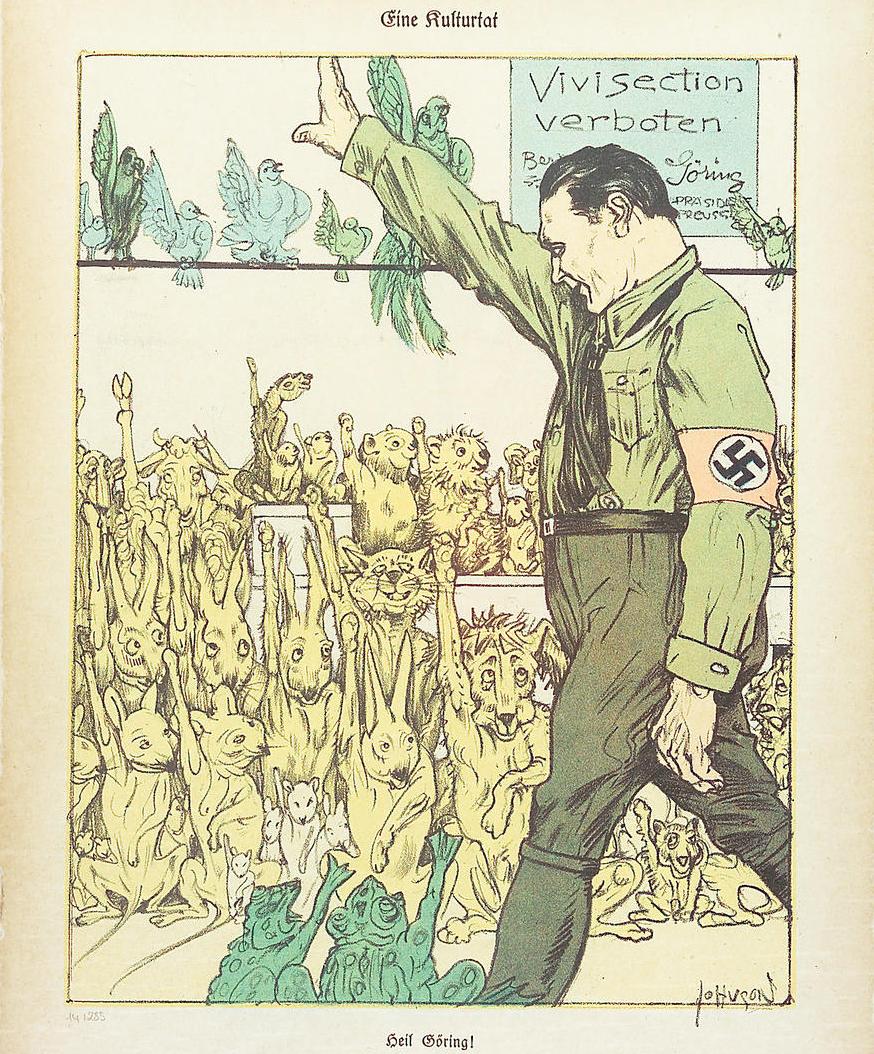
The only state, to date, to have banned cruel experiments on animals outright was National Socialist Germany. The anti-vivisection law was the first law or one of the first few laws passed by Hitler’s government. Cartoons showed Goering (another National Socialist and leading conservationist) and animals saluting, with captions such as “Heil Goering!”, “Even the animals vote for the Fuhrer!” and “Vivisection verboten!”goeringanimals

A leading, though at the same time once-obscure thinker, who espoused both National Socialism and animal welfare (etc), was Savitri Devi [https://en.wikipedia.org/wiki/Savitri_Devi], whose work is now again coming to attention. Her ideas and books even have websites devoted to them: https://www.savitridevi.org/last_man_french.html and https://www.savitridevi.org/.

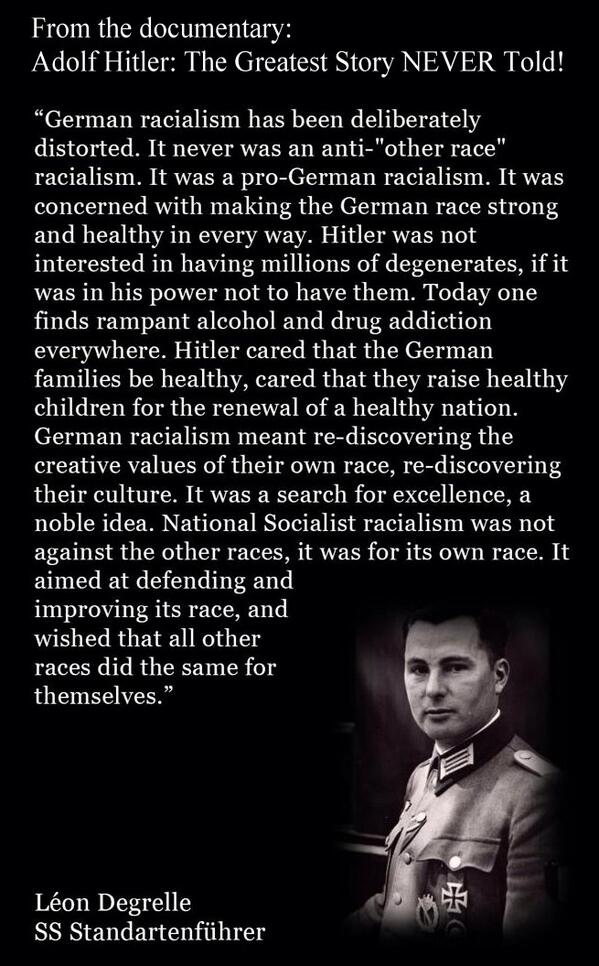
The connection is not surprising. What is now termed social nationalism is organic, built on the natural order and having respect for the creatures of the land, water and air as well as (contrary to Zionist propaganda) the relatively backward racial groups and peoples of our Earth. The hero Leon Degrelle [https://en.wikipedia.org/wiki/L%C3%A9on_Degrelle] put the latter point very well after the Second World War:becwoaeccaazenq

It is striking to see that there is very often an overlap, for example on Twitter, between those who are protective of animals and those who are strongly social-nationalist. Brigitte Bardot is a name which comes to mind: https://en.wikipedia.org/wiki/Brigitte_Bardot.

The new society in Europe will be nationalist; it will also be for Europe’s European future (though anti-EU); it will be green and it will be socially-just.

Notes:

https://www.kn-online.de/Nachrichten/Hamburg/Voelkische-Siedler-Die-Bio-Nazis-von-nebenan

Update, 28 June 2020

https://www.theguardian.com/world/2020/jun/28/german-far-right-infiltrates-green-groups-with-call-to-protect-the-land?CMP=share_btn_tw

Update, 26 May 2021

Note: https://en.wikipedia.org/wiki/Gerard_Wallop,_9th_Earl_of_Portsmouth#Organic_movement; https://en.wikipedia.org/wiki/Gerard_Wallop,_9th_Earl_of_Portsmouth

A Floor or a Ceiling?

The Front National in France, other broadly social-national parties of the European mainland and (in England and Wales) UKIP are not “ceilings” (end results) but “floors” (starting points). Their function is to disrupt the political status quo and to awaken as far as they can the voting populations of the various European states. Naturally, that is not how they themselves see their role.

The case of UKIP is telling. UKIP came into a political milieu in Britain where (in the 1990s) there were only “three main parties” and a high majority of those who voted voted for them. Below the surface, though, there was growing but unfocussed discontent and alienation. Turnout in general elections, which peaked at 83.9% in 1950, fell (on the wider franchise after 1966) to a low of 59.4% by 2001, though it recovered slightly to 66.1% by 2015. An equally-telling fact is that the proportion of voters who voted and who voted for one of those “three main parties” fell steadily and is still falling. In broad terms, a third of eligible voters did not vote at the 2015 General Election; of those who did vote, about 75% voted for LibLabCon (UK-wide results), with another 12.6% voting for UKIP.

UKIP peaked in 2014, failed to break through in 2015 and is now declining fast in every way. Its 2016 by-election results have been poor, its donors are going and its membership falling. I addressed the UK political vacuum in an earlier blog post. However, UKIP has succeeded in a more major way than did the BNP and not only because UKIP scored 21 MEPs as against the BNP’s 2.

UKIP created an atmosphere across the country in which social nationalism might start to thrive, despite the fact that UKIP, as a party, is not really social-national.

UKIP, despite being now more or less washed-up, is a floor. On that floor a movement can be built. The Front National in France is not at all in decline (au contraire) but is also a basis for a movement, rather than the movement itself. The FN is, however, likely to become or coalesce with such a movement, whereas UKIP will just fade away even if it can score a few election victories in the 2016-2020 period. The importance of both parties, however, is that they have changed the atmosphere. Social nationalism is now not a fringe ideology. It stands ready, once the right vehicles arrive, to take command across Europe. In Britain (specifically England and Wales), there is a crying need for such a social national movement and I believe that it will emerge, will arise and will, eventually, seize power.

A New Civilization For Eurasia

From the defeat of the German Reich in 1945, which destroyed, at least temporarily, the idea of Central Europe (and so split Europe between East and West, symbolically in Berlin itself), an international order comprising such organizations as the IMF, World Bank, United Nations Organization etc has been the skeleton of the “West”.

The “East”, meaning the Marxist-Leninist world of the Soviet Union, China and their offshoots, fell to pieces after 1989. The present necessity for both Europe/Eurasia and the world in general, is for, not the faked-up and largely Zionist-controlled “New World Order” made public by the first President Bush in 1990, but a REAL New Order which will be a synthesis of the best of the former and existing ideologies (National Socialism, “private enterprise” capitalism, socialism/communism), together with and held together by an acceptance of the general principles of Rudolf Steiner’s Threefold Social Order (cf. the works of Valentin Tomberg et al).

This will be a social order which reconciles the superficially conflicting demands of social cohesion (collectivity) and individual human rights (individuality). Spiritually, the new social matrix will accept the right of every individual to his or her own spiritual path, while protecting the right of society as a whole not to be placed under the tyranny of any particular religion.

Geographically, the new social order will be based in, though not limited to, Northern Europe and Russia/Siberia. Ethnically, the new civilization will be based on, but not limited to, those of White Northern European racial background. The important factor will be culture and not race; however, race must, for many centuries, play its important part as foundation for the new society.

I call upon all those interested in the future of Europe and the world to come together in this enterprise.