Race and culture are among the hottest topics of the moment. From the migration-invasion of Europe to the American wave of the alt-right, to the elections in European states, there is a ferment which will not calm. As social-nationalists, standing first and foremost on the racial-cultural front line, we must be clear where we stand in terms of attitude.
It disturbs me when I see unpleasant and too-general remarks made even about the basest of race-types. We must never forget that, as Adolf Hitler himself said in another context, “there is the individual, but beyond the individual is the race.” The individual comes out of a race; he is made by it, formed by it, is in most cases brought up and educated by it and by the nation which is part of the race. However, the individual can transcend the race-group (equally, can descend from it). German National Socialism itself recognized this reality when it granted a relatively small number of persons, who were not Aryan, the status of “honorary Aryan” or Ehrenarier: https://en.wikipedia.org/wiki/Honorary_Aryan
We today, even those of us who are social-national in political orientation, are yet not National Socialists in the same sense as those who fought for European humanity in the 1920s, 1930s and 1940s. We today have our own path forward. At the same time, to put it in Biblical language, we “honour our father and our mother” and that means that we honour National Socialism as the ground from which we sprang.
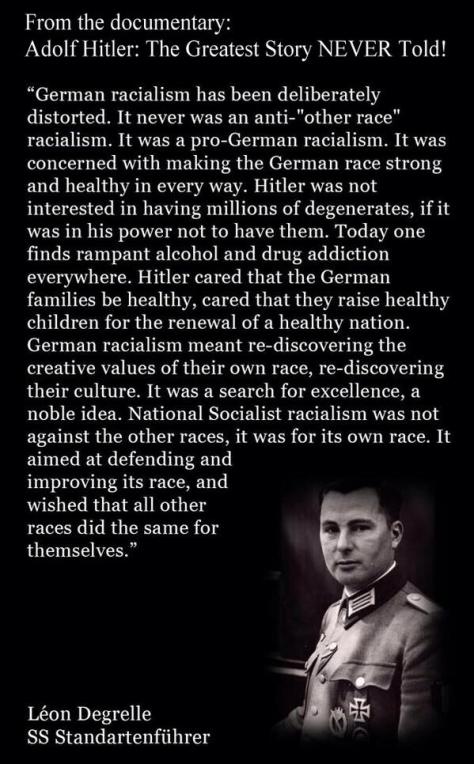
Leon Degrelle, the political leader, front-line fighter and thinker, had this to say on the subject after National Socialism in its original phase had passed into history:
There is no need for social nationalists to utter insults at blacks, Jews or members of other groups, except where that is justified and/or where it makes a political or social point. I do not want to concentrate on the American socio-political situation. I am not American, have not lived or worked there for many years and am focussed on Europe and Russia. However, we have to recognize that American society is very different from our European society. American society has had a relatively recent history of slavery, of genocide (the American Indians, aka Native Americans), of a civil war in which 3% of the population died, of the resistance to the social consequences of that war in the South, that resistance being, in part, the Ku Klux Klan, and so on.
American politics has become far more bitter, far more polarized, particularly in language, than is generally the case in Europe. There is also the point that there is a far wider spectrum of education and culture in the USA than pertains in most parts of Europe, or even Russia.
For me, it is natural to regard the non-European races as distinct and as having their own paths to the future, while equally recognizing the necessity (for all races) for the leading role of European humanity. For some Americans, this is perhaps less obvious and those other races seen as purely enemy contingents.
Social nationalists must take every opportunity to refute the lie (often though not always made by Jewish Zionists) that we base our political philosophy on “hate”. We ourselves know that that is not so, but often the public is bamboozled by the Jewish Zionists into believing the lie. For example, we wish not to be ruled or owned or influenced by the Jewish Zionist element, but that is, if you like, “defensive” in nature.
Our attitude to race and culture is one of recognition of evolution and involution. Our European race is generally still evolving, as is the “Russian”, “Slavonic” or “Slavic” race which (important point) will not come into its plenitude for another 1,500 years. Other races in this world are stagnant or are degenerating. The prime motive force behind social nationalism is to evolve the race and nation to higher levels and to destroy any threats to that evolution. This is a positive, not a negative, political world-view.
In the future, European and Euro-Slavic humanity will have powers of soul, of mind, which today would be regarded as magical. This is the point to which we as a people have been striving.
When we see the sacred Swastika, we must understand it to be a symbol of evolution, of our evolution.
A couple of weeks ago, I went to a country house in a heavily wooded part of Southern England. Even using a map, I nearly failed to find the way. A modern version of Parzival –in Wolfram von Eschenbach’s great work–, who gets lost in the trackless forests around the Castle of the Grail. The “B”-road was left behind as I took a quite narrow lane at an acute angle. A few miles further on and an easily-missed small sign almost at ground-level told me to turn off onto a lane so narrow that it was more like a track, tarmacked long ago (probably in the 1960s) and never repaired. Uneven, with large potholes. The forest pressed in on all sides. A stag with magnificent antlers ran across and into the dense wood as the car approached at a slow 5-10 mph. Squirrels were there aplenty, as were many birds. After what seemed miles, the destination was suddenly in front of me.
That experience made me wonder what roads would be like in a future of automated cars, buses, passenger drones controlled by computers, lighter than air craft akin to Zeppelins, automated trains etc.
One could imagine a future where the roads are scarcely used and so not funded, or perhaps only the motorways or major highways funded. A network of automated rail, light rail, branch lines, narrow gauge, ultralight trains, Thames river services etc. Commuters (if they still exist) travelling easily by those means, such as airships docking on top of high towers or buildings, ultralight trains going to almost every street or road. Conventional roads might become a thing of the past, especially if commuting and travelling regularly by car become uncommon.
It is not necessary to travel far back in time (say, 1800) to find a Britain in which roads were in most cases almost unusable most of the time. It may happen again. Society moves on. Until the Beeching cuts of the 1960s (and the others in the 1950s and even prior to that), there were many railway lines in existence which, today, are all but forgotten.
The alternative vision is that roads will still be necessary even if vehicles become computer-controlled. We wait to see. In the meantime, we speculate.
Update, 31 July 2019
Elegiac song about the Beeching cuts of the 1960s…
It was, I think, that great genius Rudolf Steiner who first made the point that work in ancient times (meaning here the 4th Post-Atlantean Age which finished in the early 15th Century AD) was a matter, fundamentally, of slavery, or, to put it another way, of bond. The typical worker was a slave or serf, who worked because he or she was forced to work. There was no pay as such, but some form of food, shelter and clothing was provided. Any monetary reward was in the form of discretionary gratuity, not a matter of right. The worker belonged to the owner or master.
Not everyone was a slave, obviously. Apart from the slave-owning classes, there were those who were free citizens or subjects, who worked in various fields and were paid for doing so, but these were a minority.
Over the centuries and particularly since the Renaissance, in our 5th Post-Atlantean Age, the typical form of labour is that of paid work. The worker works and, in return, (i.e. transactionally) is paid money. This did not suddenly change in 1415 (supposedly the notional year of change from 4th to 5th Post-Atlantean Age), but was gradual and in some respects even today is not complete. For example, it was until very recently common in the UK for farm workers to be paid small wages, but to receive free accomodation, tied to the job. The “tied cottage”. Likewise, there have been retrograde movements alongside the general movement forward. The various Communist-inspired societies of the 20th Century were in that sense backward, but found that people would not work or work effectively as slaves. Thus, in the Soviet Union, “War Communism” did not last long and was replaced by the New Economic Policy in the 1920s. Stalinism tried to turn the clock back by collectivizing most agriculture and by having millions literally slaving in the so-called “GULAG Archipelago” of labour camps, but at the same time had to pay most workers at least some form of salary. In the Soviet joke, “we pretend to work and they pretend to pay us.” In some parts of the world (some Caribbean islands etc, parts of Russia too) the slave or serf of the 19th Century was only forced to work for the master’s benefit for part of the week, the rest of the time being free to farm or forage for himself.
In Russia, as in the United States, the problem with slavery, serfdom and similar forms of servitude, was their economic inefficiency and social demerit. In North America, which had had, from its beginnings in British colonial rule, slavery applicable only to blacks, there was, nonetheless, a lesser form of “slavery” or “serfdom” known as “indentured servitude”, which applied to white people (usually English): https://www.encyclopediavirginia.org/Indentured_Servants_in_Colonial_Virginia. This form of forced labour lasted until the end of the 18th Century but had largely died out by the time the USA declared itself independent of Britain. At one time, over half of the white population of Virginia (where the system was probably at its most common), was forced labour. Indentured servitude was finally outlawed by the 13th Amendment to the U.S. Constitution; it continued elsewhere (notably in the Caribbean) until the mid-19th Century.
Even in the late 20th Century, there were attempts here and there to introduce forced labour as an economic model for the whole of a society. The Khmer Rouge “Year Zero” society in “Kampuchea” (Cambodia); North Korea (in part); rebel-held parts of South America. The generality of the world, however, had, by 1989, moved on. Russia and China moved to a typically “Western” pay-for-labour system. Europe had been evolving such a system for many hundreds of years.
The 6th Post-Atlantean Age will bring in, as a general way of life, the system of “work as free gift”. This seems Utopian today, of course. The Greeks and Romans (even their greatest thinkers) could hardly if at all conceive of a society without slavery; neither, it seems, could some of the landowners in the Americas or the Caribbean as late as the early 19th Century. Thomas Jefferson himself struggled with the practicalities of a society without slaves: https://en.wikipedia.org/wiki/Thomas_Jefferson#Slavery.
Now, when we speak of the 6th Post-Atlantean Age, that will not start until about 3500 AD, long in the future. However, just as paid work existed even in Roman times (even in the Roman Republic, some 1500 years before the start of the 5th Post-Atlantean Age), work as free gift can exist in places even today. When people volunteer for work in charity shops, on environmental projects etc, we see small flashes of that future world.
Consciousness is vital: to volunteer for a charity is something of the future; however, to be forced to work in a charity or elsewhere, in order not to have State benefits cut off, as in the policies implemented by Iain Duncan Smith and the Jew “Lord” Freud, is something from the previous Age and can properly be described as evil (being, in the “theological” sense, in error).
“Man cannot live by bread alone”. Profound words which, however, leave out the necessary addendum, “Man needs bread in order to live on Earth”. In the earlier Age, “bread” (i.e. the means of earthly subsistence) was supplied (in principle) by the owner of the work force. In the present Age, “bread” is bought by the work force for money and in return for work. In the future Age, work will be given freely. In return, the society will give freely to supply the necessities of life. Karl Marx had an intimation of this in his famous axiom, “from each according to his ability, to each according to his need”: https://simple.wikipedia.org/wiki/From_each_according_to_his_ability,_to_each_according_to_his_need.
We in the more advanced countries stand in 2017 at a point where computers, robotics, indeed the organization of society generally, lead to a situation where many forms of human labour may very soon not be at all required and will be taken over by inorganic or hybrid machines. What then happens to the huge numbers of people displaced from the labour market? The conventional answer, the “Iain Dunce Duncan Smith” answer is that such people (possibly half the population of the UK by 2050 or even 2030) will be forced to “seek [non-existent] work” or be more or less starved and made homeless.
Not only is the conventional approach unjust, but it will inevitably lead to social and political upheaval on a scale not seen for decades, if ever (at least in the UK). There has to be a social mechanism by which people are supported economically whether they have paid work or not. Here we have, at present, “tax credits” and other forms of social security or “welfare” benefits, including the “unconditional” or “non-judgmental” forms such as Child Benefit and State Pension.
Basic Income must come and eventually will come. It will enable people to exist, at least on –indeed– a basic level without needing to sell their labour in order to survive. Not all will offer work somewhere where it is needed, as a “free gift”. Some, however, will. It is a question, in the individual as in society at large, of the evolution of consciousness. The key point is that Basic Income is a societal and an economic necessity.
Update, 11 March 2019
People generally are now beginning to wake up to both the desirability and the practical possibility of Basic Income:
I recognize, in writing about the Bar and having been myself disbarred for political reasons last year, that I shall probably be accused of some species of sour grapes. Not so. My disbarment in late 2016 at the instigation of a pack of Jewish Zionists had no practical effect on me beyond a couple of days of newspaper and Twitter nonsense. I ceased practice at the English Bar in 2008 and last appeared in court (Central London County Court, a three-day construction case) in December 2007. The views I am about to express were mine, in essence, then too.
What is “the Bar”, what is its purpose or role and what prompts me to call it “a dustbin”?
There is no point in going into long history or explanation. It is enough to say that the English Bar grew organically out of British history and society intimately connected with the struggle for free speech against the tyrannical tendency inherent in monarchical rule. I suppose that, today, a figure such as John Hampden is less well known by, e.g. schoolchildren than, say, Nelson Mandela, just as the founder of modern nursing, Florence Nightingale, has been eclipsed by the minor figure of Mary Seacole (who set up a tea-room in the Crimean War). “They established brainwashing and called it education.”
At any rate, it can be said that the institution of the Bar, meaning the independent Bar, the Bar independent of the State, grew at least partly out of that struggle for the rights of the individual as against the power of the State. Free speech was part of it, as were the rights of property (set against the mediaeval feudal system of royal and baronial –etc– patronage).
It is this very independence of the Bar which has now largely been destroyed, though remnants remain. The Bar has become entangled with the State. Civil and criminal legal aid, in many ways very useful for society and individual persons (criminal defendants, and those making or defending a civil claim), yet has had the effect of making the Bar dependent on State patronage. The proliferation of quangos requiring chairpersons and/or legal advisers has made many barristers further dependent, financially, on the State, in effect at least. Finally, the adoption of a Zionist-drafted and/or influenced “Code of Conduct”, increasingly draconian in its enforcement and enforced by an increasingly-active regulatory body (the Bar Standards Board) has made many at the Bar afraid of their own shadows.
When I was a student of law, I graduated (aged 30) in 1987. At that time, there was only one place to take the then “Bar Finals course” (a one-year course for most students)– the Inns of Court School of Law, located in Gray’s Inn. That was inconvenient for those whose usual residence was far from London, but it had the merit that barristers emerged from the same institution and often acquainted to some extent with each other. Though there were over a thousand students, many were foreign citizens almost all of whom would return to practise law in their home countries (many eventually to lead those countries politically, or even to found states, as did Gandhi and Jinnah).
During the 1990s, the Bar Finals course, sub nom Bar Vocational Course, was changed to be less academic, more practical. There were benefits to that in terms of the confidence of young barristers, but the drawback was that, bluntly, it became easier to become a barrister.
The Inns of Court School lost its monopoly under the influence of globalism and ensuing legislation, the Bar being regarded as just another “business” offering “legal services” to “consumers”. Soon a multitude of “service providers” (universities, former polytechnics etc) offered “Bar” courses. That remains the case today. A barrister now is simply someone who has acquired two pieces of paper: a “degree” of some sort and a certificate that the requisite Bar course has been completed (and few fail these days…).
The only thing preventing untold thousands more practising at the Bar is the pupillage bottleneck, but many are now allowed to “complete pupillage” in places like government departments, so it is perfectly possible to have substandard barristers (practising in court and advising people) who have a degree from a place which is little more than a degree mill, a Bar qualification which is given to almost all who take the course and a pupillage as an office bod in, say, a provincial government department building.
There has always been a space and vacancy problem at the Bar, both for practising barristers and pupil-barristers: until recent years, barristers were often squashed into inadequate rooms in the Inns, four or more to a room in some chambers. That is less acute now because chambers are able to exist, even in London, outside the Inns. However, that too has led to problems. Sets of barristers were established outside the Inns of Court. Some were good, others less good. One example in the 1990s called itself “Brick Lane Chambers” and was composed largely of Bangladeshis and others unable to work elsewhere. It was given a subsidy by the notorious Tower Hamlets Council, based on numbers of “legal service providers” available, the idea being to increase “legal service provision” in an area supposedly without much.
I knew a barrister (still in practice today) whose name was fraudulently added to the “Brick Lane Chambers” list in order for those chambers to get extra money from the local council. She was not alone. She complained and her name was taken off the list, but no action was taken by the local council or the Bar itself in respect of a deliberate and egregious fraud. At that time, the Bar had already embarked on its “let’s not annoy the ethnic minorities” journey.
As a Bar student, I proposed (but not officially) a different idea, which would have safeguarded the Bar’s integrity: to found a fifth Inn of Court. That, however, would have involved huge cost, for one thing. It also would have required the clearance of a large site in Central London. Instead, sets of poor barristers started above laundromats and in shopfront premises (others moved from the Inns into far better circumstances).
Now we come to the regulation of the Bar. The Code of Conduct, once a slim volume, perfectly workable and focussed on trust and integrity, became a thick sheaf of papers packed with the politically-correct shibboleths of the day. It has, in its application, destroyed the independence of mind of the Bar. I refer the reader to my own experience:
As to recruits to the Bar, many now are brainwashed into a politically-correct mindset and (bearing in mind the pressure on pupillages and tenancies) few are willing to do anything but condemn those who (like me) are thought to have controversial views. They fail to see that their doormatting to the Jewish-Zionist element will not help most of them much. When I was at school in the 1970s, there were about 5,000 practising barristers; when I was Called to the Bar (1991) there were about 10,000 or so, I believe. Now that figure is something like 18,000! Meanwhile, criminal and other legal aid has been slashed and “solicitor-advocates” appear in court too. The result has been that the prestige of the Bar has plummeted. I do not regret that I no longer practise.
For the public, for society, the result of the Bar’s fall has been that the service available is more limited, poorer and that the independent voice of an independent barrister is muted. Just as, in the journalistic milieu, “journalists” of today (particularly online) are often twenty-somethings with no real training or education, their heads full of politically-correct nonsense, the Bar is now full of “barristers” who are really just barristers on paper, men of straw (women too), without real substance. The “journalists” thus cravenly welcome censorship and the “barristers” are unwilling to be seen as even listening to contrary views, let alone standing up for freedom of expression.
A few months ago, someone won about £100 million on one of the lotteries. I have no idea who that was, or whether his (or her) use of the monies won will go beyond the usual and indeed banal new house, new car, holiday in the sun scenario, but that massive win led me to thoughts beyond the determination to buy more tickets myself.
For example, £100M would buy somewhere around 10% of the land area of the Isle of Wight (along with country houses, farmhouses etc). Alternatively, a fairly large part of Scotland could be bought (multi-thousand-acre Highlands or Islands estates now selling for, in some cases anyway, only a few million pounds).
The above thoughts led me in turn to consider how the UK countryside could be changed for the better under a different kind of state. A ban on hunting, certainly; a ban on commercial shooting too. Along with those, there would probably have to be a reordering of rural land ownership. There would be, to start, a cap on the acreage any one individual, company, trust or family could own. This is not the place to get exact about figures, but the maximum land acreage held would obviously have to differ in different parts of the UK: a thousand acres in the Scottish Highlands is not to be equated with the same amount in Surrey.
The subject of farming subsidies has to be addressed. The present situation which (in essence) rewards landowners simply for holding (owning) land is unjust, achieves little and is a waste of public monies. It transfers monies from people in general to those who, in most cases, are already wealthier. It also has poor ecological or environmental results.
George Monbiot, the writer and environmental activist, has raised the issue of the present system of subsidizing hill farmers to own land (on which they usually produce sheep). Withdrawal of subsidy would mean that most such small and relatively poor farmers would go out of business. However, that unfortunate fact should not be the determining factor. The hillsides can be allowed to revert to forest, either by simply leaving the hills to rewild, or in a more controlled way, by selective planting of trees and other plants. This would have several benefits, including upstream flood control.
There may be some scope for limited subsidy on the basis of farmers setting aside areas for nature (this was once part of the UK farming subsidy scheme). There should also be a wildlife grid consisting of strips and blocks of (in many cases) privately-held and maintained wild or rewilded land, organized however by a state commission. The idea of the wildlife grid would be to allow animals and birds to travel easily across the country, free from interference. The grid would interface with areas already given considerable protection, such as the existing national parks.
There may be the opportunity to experiment with less-usual forms of land-holding, such as collectives of “New Age” or other persons, to be given leases by the State (as freeholder) for various terms of years. The average age of a British farmer is now 59. There must be ways found to rejuvenate the personnel in agriculture.
There would be the possibility, under a different governmental philosophy from that now dominant, to encourage production of fruit and vegetables and to discourage the production of meat, particularly under harsh industrialized conditions.
There could be State encouragement of very small scale horticultural production, e.g. by giving tax relief for people giving over part of their house gardens to the growing of fruits and vegetables. It is estimated that, in the UK, agricultural land amounts to some 42 million acres; however, private gardens and small parks amount to about 10 million. In past wartime situations, part of that acreage has been intensively cultivated: https://en.wikipedia.org/wiki/Victory_garden
The Soviet Union in the 1970s permitted private plots of up to (in some Soviet republics and toward the end of the Soviet period) about 5 acres, though the usual limit laid down in 1935 was around an acre (2+ acres in “special districts”, particularly in countries like Georgia): https://en.wikipedia.org/wiki/Household_plot. In the 1970s, the private plots were about 2% of all utilized agricultural land, but produced 40% of the produce of the Soviet Union. Instructive.
Another area where there could and should be huge improvement in the UK is the production of nuts, particularly those suited to the prevailing climatic conditions: chestnuts, walnuts, hazelnuts. In fact, those upland areas no longer farmed for sheep by subsidized small farmers would be ideal for such trees on the large scale. In Kyrgyzstan, there are natural walnut forests. Why not in the UK too?
So we see the possible future take shape: a UK with greater forest cover, with greater wild or rewilded acreage, with many private householders cultivating part of their gardens, perhaps using small greenhouses too. In the rural areas, traditional farming being supplemented by new collectives of cultivators. A wildlife grid to make the natural world safer and more prolific. More small-scale hydropower and solar-power schemes. More vegetable, fruit and nut production, not so much emphasis on meat and dairy produce. Greater linkage via the Internet.
It is clear that, in the countryside as in other areas of national life, change must come.
Yesterday, Alison Saunders, the Director of Public Prosecutions, announced updated and expanded “guidelines” on how the Crown Prosecution Service will deal with so-called “hate crime”. These new guidelines have been heavily criticized as, in effect, creating new and tyrannical law, despite the fact that the guidelines are neither primary nor secondary legislation.
In this blog post, I examine only those aspects of relevance to socio-political tweeting etc, meaning in practice those with a racial or religious element.
Part of the concern around the guidelines revolves around Alison Saunders herself. Many regard her as a sinister though incompetent figure, a “graduate” (member) of the pervasive and infiltrative organization (some say “cult”) called Common Purpose. In 2013, when Alison Saunders was CPS chief for the London area, a Freedom of Information request was made as to her connection with Common Purpose. At first, the reply was affirmative, but that was then alteredto negative:
The answer is relevant to the new CPS guidelines because the motto of Common Purpose is “Leading Beyond Authority”. In other words, the citizens of the UK cannot rely any more on law or decent public administration, because organizations such as the CPS, full of “CP” “graduates”, will, it is suspected, manipulate the regulations etc in order to achieve a desired (by them) result.
Definition of “Hate Crime”
It is vital to note that there is no statutory (or accepted Common Law) definition of “hate crime”:
“A hate crime law is a law intended to deter bias-motivated violence. Hate crime laws are distinct from laws against hate speech: hate crime laws enhance the penalties associated with conduct which is already criminal under other laws.” [Wikipedia]
Wikipedia continues: “For England, Wales, and Scotland, the Crime and Disorder Act 1998 makes hateful behaviour towards a victim based on the victim’s membership (or presumed membership) in a racial group or a religious group an aggravation in sentencing for specified crimes.”
In other words, there must first be a crime as designated by law and only then can that alleged crime (if one of those “specified”, i.e. assault, criminal damage, offences under the Public Order Act 1986, and offences under the Protection from Harassment Act 1997) be treated by the police and CPS as a “hate crime.” The new guidelines reflect that existing position:
“The police and the CPS have agreed the following definition for identifying and flagging hate crimes:
“Any criminal offence which is perceived by the victim or any other person, to be motivated by hostility or prejudice, based on a person’s disability or perceived disability; race or perceived race; or religion or perceived religion; or sexual orientation or perceived sexual orientation or a person who is transgender or perceived to be transgender.”
“There is no legal definition of hostility so we use the everyday understanding of the word which includes ill-will, spite, contempt, prejudice, unfriendliness, antagonism, resentment and dislike.”
It will be noted that there must first be a criminal offence. If there is not, then it matters not at all how “unfriendly”, “prejudiced” etc is the alleged perpetrator.
Further, sections 145 and 146 of the Criminal Justice Act 2003 require a court to consider whether any crime which is not specified by the Crime and Disorder Act 1998 is “racially or religiously aggravated.”
Incredibly, while the police and/or CPS will “flag” a case as a “hate crime”, “it is not CPS policy to remove a flag in the absence of sufficient evidence to support a sentence uplift. This in part reflects the commitment to treat hate crime seriously and to support the victim’s perception and also to encourage community confidence in reporting all such offending.”
So a crime which is “flagged” at first as a “hate crime” but for which flagging there is eventually no evidence, will still be treated, in Court, as a “hate crime”, resulting (on conviction) in a far more severe sentence. How can this be regarded as in any way just?
The guidelines now continue:
“If the case passes the evidential stage and it is a case of racial or religious hate crime, or it is motivated by discrimination against the victim’s ethnic or national origin, or religion or belief, it is more likely that a prosecution is required in the public interest.”
This is a hardening of the position taken in the earlier CPS guidance and may mean an increase in the number of prosecutions. However, there is still a requirement for a substantive crime to have been committed and there is still a requirement for sufficient evidence to support prosecution. New crimes have not been created, but the danger is that zealous CPS and –especially– police persons will get the bit between their teeth and start to ignore the basics in their quest to hunt the witches. Anyone who has read the outpourings of the UK police forces online recently will not be reassured as to their objectivity in this respect. There is an unthinking “me-too” political correctness abroad, one which seems impervious to logic, argument, reason or plain commonsense.
Other Aspects Relevant to a Charge
The CPS legal guidance for its staff can be found here:
The full details can be found via the above link but one key element is that there must be one or more identifiable “victims” of the “crime”. In other words, if there is no identifiable victim, then the matter falls in respect of the “hostility” required under the relevant statutes.
How the CPS regards freedom of expression
“In deciding upon the public interest of charging these offences it is essential that prosecutors keep in mind that in a free, democratic and tolerant society people are able to robustly exchange views, even when these may cause offence. However, the rights of the individual to freedom of expression must be balanced against the duty of the state to act proportionately in the interests of public safety, to prevent disorder and crime, and to protect the rights of others.”
Other Thoughts
It is noteworthy that the body of the new guidance neither mentions nor lists the Communications Act 2003, s.127 as among the statutes utilized in the prosecution of “hate crime”. However, under the provisions of the Criminal Justice Act 2003, ss.145 and 146 (see hereinabove), anyone sentenced for having posted a “grossly offensive” tweet (etc) under the 2003 Act can receive a sentence uplift if the offending tweeting (etc) had a “hate crime” element (the maximum sentence being 6 months’ imprisonment, though the usual sentence is non-custodial).
One cannot analyze these matters without noting that the Zionist special-interest lobby is likely to try to pursue its political ends by abusing the new guidelines. Readers are referred to my own experience of January 2017:
I advise a defensive approach. Malicious persons, notably Zionists, try to make provocations by saying offensive things online, eg on Twitter, then (if the interlocutor replies in similar vein), reporting to Twitter, Facebook etc and even to the police. I have found that the easiest way to deal with such nuisances (in the short or medium term) is to block them (on Twitter), which tends to avoid conversations and disputes. It also means that it is much harder for the Zionists to report a tweeter to Twitter. I myself have seen, in the past few years, several Zionists lamenting that “he blocks us, so we cannot [make false accusations].” Yes, it means that the individual tweeter cannot answer back to the lying allegations the Zionists often make, but the solution is simple: just do not care what they may write about you! I don’t…
In other words, just try to avoid having any conversations with malicious Zionists or other nuisances online. Make it hard or impossible for them to make false or malicious reports to Twitter (etc) or the police.
In respect of tweets not specifically addressed to anyone, it is more difficult for those wishing to destroy freedom of expression to report them to Twitter or (a fortiori) to the police, so long as there is no evidence of direct incitement within the meaning of the relevant (1988) Act.
In extreme cases, just protect your tweets. You can also pre-block any obvious Zionists on Twitter (and most of them are indeed very obvious…).
The ultimate and longer-term protection for social nationalists lies in future relocation to “safe zones”, as I suggest on my website: http://ianrmillard.com/social-national-communities, which will then limit the powers of the wider State.
In essence, the new social media guidelines are indeed another nail in the coffin of free speech in the UK, but are unlikely to stop socio-political comment online– which is why the conspiracy –and behind Alison Saunders stand Theresa May, Amber Rudd, secret groups, the whole #NWO and #ZOG farrago– is trying to get the big online platforms signed up to repression.
In the end, the net result of this latest silliness is likely to be a tsunami of pointless and/or malicious complaints to the police.
Update, 29 April 2019
Since I wrote the above blog post, Alison Chabloz has been convicted under Communications Act 2003, s.127, and is appealing (at time of writing, to the Divisional Court). However, the “guidelines” which are the subject of the article above do not seem to have had much practical effect in terms of changing prosecution or sentencing policy.
Much water under the bridge in relation to the Alison Chabloz case(s). To find out more, please use the search function on this blog.
In relation to repression of free speech generally, and as I predicted in the main article above, the ZOG strategy has been, not so much a tightening of laws criminalizing individual free speech, but a campaign of getting the major plaforms of social media to police free speech without any law having to be passed.
Thus we see that Twitter, Facebook, Google etc are simply expelling socio-political dissidents, and so removing both their inherent citizen-rights to free expression and (in the case of the prominent few) their online incomes. We have seen such as Tommy Robinson, Katie Hopkins, David Icke, David Duke etc removed or largely removed from online platforms, the same also happening to less prominent people.
[preliminary note: this is a personal rather than a political or social blog post, though it does touch on both of those aspects of life]
It is hardly original to say that fame often tends to be fleeting, but indulge me. I was thinking about this matter recently in the context of hearing about a number of persons and their life-trajectories. In particular, in the past 6-7 years I have observed the meteoric rise of a Jewish Zionist lawyer (solicitor) to fame; he rose to public prominence (after years of provincial obscurity and a slide into near-madness) on the basis of one type of notorious case, only to slowly deflate ever since. That person’s fate, still unfolding (or should that be “unravelling”?) gave rise to other, connected, thoughts.
I was on holiday in Hammamet, Tunisia [https://en.wikipedia.org/wiki/Hammamet] in 1994 when my then girlfriend and I met with a young Englishman and his girlfriend. They were both struggling or at least very junior young journalists, twenty-somethings. The young man explained that they had been in a not very pleasant hotel and so had upgraded to the one in which I was staying, the Phoenicia, one of the best in the resort, all marble and staff wearing white uniforms topped by a fez.
The young journalist said that his name was Jasper Gerard (the girlfriend’s name I forget). We had lunch and the odd drink in the succeeding days and they were in the grounds of the hotel when they noticed someone nearly get killed when his parascending canopy collapsed at altitude. Yes, that was me (I pulled too hard on one side to descend) and apparently Gerard cried out “isn’t that Ian?!” as I appeared to be about to fall, mortally wounded, to the beach. However, I survived with nothing worse than a minor story to tell.
I kept in touch with Jasper. I invited him, not long after, to dinner at Lincoln’s Inn (of which I was then a member). He attended not with the Tunisia holiday girlfriend but with a pleasant, very quiet young lady who (judging by more recent Press photos) was probably his later wife. A week or two later, in the English way, he invited me to dinner at his club, a members-only but non-traditional place in Mayfair called Green Street. The sort of place full of young or youngish people who were probably pop stars whom I would probably not have recognized even by name. At dinner, the next table was occupied by a lady and her two guests. She was, Gerard whispered, the journalist Marie Colvin, already noted but who became rather famous later on, after she lost an eye and took to wearing a dashing eye-patch. She was killed in Homs, Syria, in 2012, making Gerard’s dinner comment to the effect that connections had helped her into her job seem in retrospect even more envious than it did at the time.
After that, I did not see Jasper Gerard for nearly three years, during which time he had become the head of the Diary column in The Times. After I finished a year working in Kazakhstan, I called him and suggested a drink. He suggested lunch at El Vino, not the original wine bar but the branch at the foot of Ludgate Hill. He failed to turn up and when I called to ask whether a problem had arisen, did not even apologize but got some underling to say that “something had come up”. That was discourteous, but personal loyalty is important to me, so I agreed to a second lunch date. This time, Gerard did turn up, but the pleasant, rather hesitant young man had become a blase, vain fellow obviously very much spoiled by his career uplift and hugely full of himself. He scarcely bothered to talk, obviously found me not famous enough to waste even the lunch break on, then did not offer to pay, or even to pay half the bill, but waited until I did before saying “do you mind if I take the cash and pay, so that I can claim it back”! With such a brazen attitude, it is not surprising that the bastard later tried to be elected as an MP!
I did not meet with Jasper Gerard after that, though I noticed that he was later to be found in the Sunday Times as chief interviewer. He lasted for some years before being removed. He then became restaurant critic in The Observer for a year or two, until 2008. He was even mentioned (once) in celebrity chef Gordon Ramsay’s memoirs.
Gerard fell into obscurity after that, though he came second in the Maidstone and The Weald constituency in the 2015 General Election, standing as a LibDem (well, after all, the LibDems are now the last resort of the scoundrel!).
The last I heard of Jasper Gerard, in 2016, he had become the Head of Press for the LibDems. Whether he still is, I have no idea.; and his last tweet to the public was in 2015…
The above is just one reminiscence about, mainly, one person. I suppose that the moral of my brief story is that some people really cannot handle fame or even minor celebrity, and that obscurity often beckons.
Update, 29 December 2020
I saw that there were recently a few hits on this rather obscure blog post, so am updating it.
Jasper Gerard’s 2015 vote share of 24.1%, though far below that of the 36% attained by the LibDem in 2010, was still better than that garnered by the LibDems of 2017 and 2019 (16.4% in both cases). Gerard was the last LibDem to get a second place at Maidstone and the Weald; Labour has come second since 2015: 22.1% in 2017, 18.3% in 2019.
“In the soup for playing down the Lord Rennard scandal (‘It’s hardly Jimmy Savile’) Liberal Democrat candidate Jasper Gerard stands accused of playing down his poshness. Colleagues at Durham University remember him as Jasper Gerard-Sharp. Once he secured the post of head of the university’s Lib Dem society he morphed into plain Jasper Sharp. But by the time he arrived at The Times as a trainee journalist, he reverted to Jasper Gerard. Keep up at the back!” [Daily Mail, in 2013] https://www.dailymail.co.uk/debate/article-2285672/Is-boastful-Vince-Cable-ready-new-challenge.html
Professionally, and politically, Jasper Gerard —or Gerard-Sharp— now seems to have vanished without trace. He may have retired early; he would now be 53, must have been extremely well-paid when he was Chief Interviewer for the Sunday Times, and there may well be some family money, despite his grammar school secondary education.
Update, 18 March 2021
I noticed that there were several hits on this old article today.
I recall seeing an interview in the Sunday Times, in 2003, written by then-Chief Interviewer Jasper Gerard. It was with, and the article about, the wife of Kevin Maxwell, the part-Jew son of MOSSAD chief European agent, millionaire Jew fraudster and later food-for-fish, “Robert Maxwell”. At the time, the Maxwells were trying to sell their expansive country house on the Thames, somewhere near Wallingford.
That is a nice part of the world, one I knew well as a child and teenager in the early/mid 1960s and in the 1970s. I remember, reading the interview, thinking “there is a horrible brash Jewish or part-Jew family living in luxury on the banks of the Thames near Wallingford, and I am scraping a modest living from the law…“. The fact that Kevin Maxwell was living off the proceeds of crime, such as the frauds perpetrated by his despicable father, made the feeling all the stronger.
Well, the wheel of life has certainly turned for Ghislaine Maxwell, “Captain Bob’s” daughter, currently resident in a 9 foot by six foot cell in a US Federal prison.
Hey! I have an idea! Jasper Gerard should go interview the declining Ghislaine before she gets bumped like Epstein, or does herself in. He could write a good (well, adequate…) article about the contrast between her present circumstances and those days long ago with her brother and family by the sweet Thames…If, that is, anyone would now publish him.
No doubt there will be many who might say that I am unqualified to write about academia. My post-graduate qualifications, after all, are or were of a basically vocational nature (the Bar of England and Wales; the Bar of the State of New York). Further, I have never taught any subject at any level. However, it really is time that “time is called” on the dummy intellectuality being passed off as scholarship in the tertiary educational sector.
I do not intend to give specific examples, glaring though many are, of what I have called “dummy intellectuality” in academia. Anyone interested can find it easily for himself, by looking at the list of publications by university faculty members, or at their social media outpourings. I am of course confining my comment mainly to what are often termed the softer areas of study, such as sociology, literature and linguistics, “migration” (yes, this too is now an academic “discipline”!) and the like.
In the past, in the 19th century and most of the 20th, non-scientific academic works could usually be understood perfectly well by the ordinary educated person. That is no longer the case. A whole farrago of nonsense has been imported into academic life, involving narrow jargon, ever-narrower fields of study, cliques of “experts” in the foregoing and careers built on these insubstantial foundations.
I suppose that the pseudo-intellectual egg from which the above-noted chick was hatched was probably the area of the study of Marx, Lenin and Engels, firstly in the Soviet Union, then in the socialist world more generally, which then seeped out into the universities and other tertiary institutions of the Western world. Marxism was itself once called a result of “Jewish Talmudic theorizing and argument” and in the dummy intellectuality now rife in the universities of the UK and elsewhere, there is certainly a powerful Jewish element.
Read any papers by academics in fields such as sociology, “gender studies”, “migration studies” etc and you will see that the language employed is so specialized that it amounts to an exclusionary jargon.
One of the effects of the narrowing of language into jargon is that only those indoctrinated into the jargon can discuss the subjects concerned; others are not to be included in the discussion because they are not “educated” (in the narrow sense) enough to do so. Only the “specialists” (the Jewish or sometimes non-Jewish “experts”) can say anything, it is thought. This way of thinking has also contaminated areas such as economics, which are thought of as “harder” or more scientific than, say, sociology.
Thus it is that, before the financial crash usually dated as 2007-2008, the “experts” were mostly sure that such a crash would not happen. Afterwards, the “experts” split into at least two camps (pro”austerity” being the main one in the UK). These “experts” made predictions, got jobs paying hundreds of thousands of pounds in the Bank of England, the City of London financial district, in the BBC and elsewhere. The fact that most of them got their predictions wrong most of the time (and still do) means little, because they cannot be challenged by non-experts on their own terms. The average critic does not even have a common language with the average “expert”. The fact that some kind of Mystic Meg or the spin of a coin is as accurate as the “experts” is thought irrelevant.
Likewise, it is hard to challenge the idea, put forward (in nuanced form, so be it) by a few well-known academics and then trumpeted (in simplistic forms) by a horde of “me-too” politically-correct imbeciles and one-world plotters, that the Romans were non-European or even sometimes “blacks”. Who are you, ordinary educated citizen, to challenge “the experts”? Yes, all Roman art, currency, literature, shows a European (Aryan) heritage, but what of that? That has no weight, because Professor Somebody of SuchAndSuch University has suggested that a few non-Europeans served (perhaps) as legionaries for short periods in Britain. From that tentative suggestion by an academic, not only do the “me-too” politically-correct hordes draw sweeping and wrong conclusions as to Roman Britain, but (even more wrongly) go further, to say that modern British people have African or other non-European ancestry. This despite the scientific evidence that does exist:
Returning to our main theme, it is clear that academia must be reclaimed from the “experts” in that narrow sense, from those who are only talking to each other and (((of course))) making a good living doing so.
Whole subjects may have to be either done away with or subjected to a purge. True academics must be able to exist again (they still do, in fact, alongside the jargonists) and thus be able to inform the non-academic population properly as to both their own subjects and public policy. Clarity is king.
I suppose that few British people have ever seen the collapse of public order. The United Kingdom has at least been fortunate in that regard. The tumultuous events of the past century have left largely intact the Victorian legacy of “law and order” bequeathed by the 19th Century.
Britain has endured two world wars (1914-1918 and 1939-1945), other and smaller wars overseas, a General Strike (1926), other periods of industrial strife (1930s, 1970s), acts of terrorism, periods of political violence (1930s, 1970s) and even a limited and slow-burn civil war in pockets (Northern Ireland, particularly 1970s to late 1990s), yet overall order (and the rule of law) has persisted. Even in Northern Ireland that has been so, though a barrister friend of mine visited a “Diplock court”–https://en.wikipedia.org/wiki/Diplock_courts— in the 1980s and told me of how surrealistic it was to see a criminal trial with all the panoply of the English law (bewigged and gowned barristers, a “red judge” in his wig and robes etc) but without a jury and, instead of court security or police officers, several soldiers carrying submachineguns and on guard.
This is of course in stark contrast to the experience of other Europeans. Russia of course is, as always, sui generis, with its 20thC revolutions (1917), civil war (1918-1922), political purges (1917-1948), invasion and vast wartime destruction (1941-1945), as well as the collapse of the Soviet system in the 1980s and early 1990s and the waves of gangsterism and Jewish-Zionist oligarchy that followed from 1991 onward until a degree of stability was attained under the Putin regime.
The older generation of mainland Europeans were almost all affected, at least at second-hand, by disorders: the Second World War swept across the continent leaving few countries untouched (and even some of those–Finland, Spain, Eire– had seen their own wars, civil wars etc). In fact, the only European countries of any size unaffected directly (though certainly indirectly) by the Second World War or civil upheavals were Sweden and Switzerland. Even Portugal, neutral during 1939-1945, later had a military coup and revolution (in the 1970s).
France, for example, was in the 20th Century invaded twice, had several all-France republics established, as well as the Vichy Government of 1940-1944; it also had considerable political and industrial conflict, huge destruction from air, land and sea (in 1940, from German attack, but more seriously from the Anglo-American invasion, bombing, shelling etc of 1941-1944). France also had the underground war of the OAS in the early 1960s, which very nearly brought down de Gaulle and the Fifth Republic.
Again, Poland has seen, from 1914 through to the 1980s, invasions, purges, wars, civil disorder, very great changes in the Western and Eastern borders of the country itself, near-starvation at times, economic collapse several times, destruction of much of its infrastructure, ruination of its currency.
The effects upon civic life and rule of law of all these events has been greater on mainland Europe than has been the case in the UK. On mainland Europe, the ways of life of the various countries has had to be re-established, sometimes several times over, usually with very significant changes. In the UK, the way of life has evolved quite slowly and –even as a result of WW2– without dramatic alteration overnight.
Why then, do I see civil disorder as a serious possibility in the UK?
First of all, Britain has taken in a vast horde of mainly non-European immigrants, most of whom have no racial, cultural or religious connection with anything that British history has produced. Even those non-Europeans born in the UK do not feel the same connection with the country that is felt by the real British (including those with other white Northern European ancestry and who were born here).
Secondly, the reaction of the Caribbeans and other non-Europeans to serious difficulty is to engage in street protest which can become riotous, as has happened several times even in the past decade.
Thirdly, the indigenous British have lost at least some of the resilience which sustained public order in previous times. By way of personal anecdote, I recall the “petrol crisis” of 2000, when I had not long returned from overseas: https://en.wikipedia.org/wiki/Fuel_protests_in_the_United_Kingdom. Having little choice but to travel across country, I saw at one motorway filling station scenes not far from the chaotic. This left a deep impression on me. Speaking personally, I have little faith in the ability of the System to maintain order, should a more serious or prolonged crisis hit the nation, if “nation” it still is.
I do not see the British now as a unified people, because of both cultural and directly racial/religious factors. A large and growing minority are really not British at all and have only tenuous connection with and loyalty to the State.
A fourth aspect is that the arms of the State are not now well-staffed. Police, Army etc. Could they handle large-scale disruption? I wonder.
It may be that the UK will have to undergo some of the vicissitudes endured in the past century by many of the mainland European peoples before a new system is established.
Six months and a day ago, I attended Grays Police Station, Essex, for an interview with the police. I trudged through the snow and slush of estuarial Essex after a long rail journey involving several changes of train. A police fortress set in a snowbound urbanized wasteland. Crossing the rail line in the snow reminded me of visits to socialist Poland in the 1980s. Not pleasant.
[above, Grays Police Station, Grays, Essex]
A week or so before my supposedly voluntary but in fact involuntary trip to Essex, I had been surprised to receive a telephone call from a detective-sergeant of the Essex Police, who informed me that the “Campaign Against Anti-Semitism” [CAA] had made formal complaint against me.
Now the CAA, as some readers will know, is a small but well-funded Jewish Zionist organization, sufficiently in funds to be able to employ a number of full-time staff. It was founded around the time of Israel’s 2014 Gaza slaughter, in order to defend the interests of Israel and of Jews generally. Some of its members also belong to “UK Lawyers for Israel”, a similar group and the one which complained against me to the Bar Standards Board in 2014, as a result of which I was disbarred in late 2016 (though I had not practised for 9 years!). The signatory on that complaint had been one Jonathan Goldberg QC, a Jew who was once the preferred Counsel of the notorious Kray gangsters. Goldberg also appeared pro bono (without fee) for the CAA in its private prosecution against the satirical musician, Alison Chabloz (which prosecution was later taken over by the Crown Prosecution Service [CPS] and the original charges dropped, though new ones were substituted and the matter adjourned until, at the earliest, late December 2017).
The head of the CAA, one Gideon Falter, had, prior to founding the CAA, made a complaint against a Foreign Office man, Rowan Laxton, who was accused of having shouted out (while on a gym treadmill, watching a TV report of yet another Israeli atrocity), “Fucking Jews! Fucking Jews!” (yes, that is enough to get you arrested in contemporary London…). Laxton’s case ended not with his first-instance conviction before a (dozy? biased?) magistrate, but with his acquittal on an appeal by way of rehearing in the Crown Court.
The “Director of Investigations and Enforcement” (sinister title…) at the CAA is one Stephen Silverman, who lives in Essex and who was exposed in open court (possibly inadvertent admission by the CAA’s own advocate) in December 2016 as having been the Internet troll @bedlamjones on Twitter and a user (abuser?) called “Robbersdog” on another discussion site, Disqus. This person abused anyone thought to be anti-Zionist, particularly women. His posts were notorious for their gloating sadism. He particularly enjoyed looking forward to people being arrested, questioned, charged, tried, imprisoned for “anti-Semitic” comments. He was in fact part of a whole group of Jew-Zionists on Twitter and elsewhere, all following the same line of attack (Twitter has now removed several for similar abuse). Despite that, Silverman remains in post at the CAA, an organization apparently supported now by a number of politicians, all under the thumb of the Israel lobby.
Back now to my visit to the area some call “the arsehole of England” (it must be true: it is represented in Parliament by freeloading chancer and former receptionist Jackie Doyle-Price!). It had been arranged with the detective in charge that I would appear at Grays Police Station on 12 January at a specified time. I arranged to have a solicitor who, in the event, failed to turn up. Given the “choice” of returning within a few days or a week at most (and the expense and inconvenience therefore being doubled) or interviewing without legal advice (I last practised at the Bar in 2007-2008 and, apart from corporate “crime” on behalf of companies such as South West Water and Balfour Beatty, had not engaged in criminal law since about 1994), I decided that I had no choice but to continue to interview.
The several detectives who dealt with me were polite, even reasonably friendly; certainly professional in their approach. I was never arrested during the whole proceeding and was told that I could leave at any time. I was then cautioned and interviewed for three hours about some 60 pages of tweets, hundreds in all. Slowly, each tweet was put to me. Many were stories from newspapers, cartoons etc. I mostly no-commented, but did make some pertinent points and the odd joke.
What struck me first was the sheer injustice of all of this. The Jews complaining about me had done so at no cost to themselves and yet had wasted the time and money of both me and the police. The police should have told them, at the least, to go whistle, instead of taking the complaint seriously. I was in fact told by the police that they were dealing with another half-dozen CAA complaints of similar nature. So much for “the police are starved of resources”!
The next point that struck me, as we trawled through many tweets alleged (but not proven) to have been tweeted by me, was how brainwashed the police were in respect of the “holocaust” mythus. They referred to one cartoon (“Alice in Holohoax Land”) and asked how anyone could make a joke of people (Jews) made into soap and lampshades! They obviously had no idea at all that those WW2 “black propaganda” stories had not only been totally debunked but also accepted by the Zionists themselves as untrue! They also, needless to say, had no idea that those “holohoax” tales were in fact of WW1 origin, recycled (so to speak) for WW2 use. I did not bother to argue with them. Perhaps they will read this blog post.
Another funny moment was when the detective in charge objected to tweets poking fun at “Saint” Bob Geldof. It turned out that he took Geldof’s charitable image at face value. I thought that detectives were trained to recognize the dodgy. Apparently not.
I was able to read into the record of interview (taped) a letter I had sent prior to interview, detailing the abuse of the criminal justice system being engaged in by the CAA and by Silverman in particular, as exposed during the Chabloz case and otherwise. I asked that this letter be sent to the CPS, were the complaint against me to go further.
Anyway, after a dehydrating 3 hours (I was given one cup of water) in a hot little room, I was taken outside to the custody desk and booked out. I had never been under arrest and was not given police bail, but just released without anything more. The detective murmured something about “postal disposal” to the custody officer (I never was sent any letter of closure, though) and I was released back into the cold streets of Grays, now being blanketed by more snow.
I do not (much) blame the police involved. They were obviously under pressure from higher ranking police (probably either Zionists or, more likely, freemasons). Political pressure from higher-up, too, in a situation where the governing party under Theresa May and Amber Rudd is really just “ZOG” [Zionist Occupation Government].
Needless to add, I was never prosecuted.
So that is my account of an experience provided for me by the abusive CAA organization. It is time for the CPS to rein back the apparent latitude given to Jewish-Zionist organizations making malicious and politically-motivated complaints against private citizens (I do not belong to any political party or group).
As to my final word, I should say only that “what goes around comes around”…
Update, 10 February 2019
Since the above was written, the CAA has been (I think is still being) investigated by the police and the Charity Commission. It has suffered significant legal defeats, and Stephen Silverman, the sinister troll-stalker of women, is himself now under further police investigation.[see below]
More recent developments: well, I was eventually put on trial after the “CAA” pressured the Crown (or Clown) Prosecution Service to cobble together a misconceived prosecution-persecution of me.
What happened then is detailed in the blog posts below:
The upshot of all that was that I was made subject to a 9-month “community order” and required to pay costs etc amounting to £734. The costs were partly (about 1/3) crowdfunded, the rest paid off in monthly instalments (all now paid).
As for the “community order”, with 15 “rehabilitation days”, the “days” turned out to be short or shortish meetings lasting between 20 minutes and a couple of hours and, after half a dozen of them (one every few weeks, I was told that, by reason of other and larger events (unrelated to my own case), the “rehabilitation days” requirement was, in my case, deemed to have been fulfilled.
All finished.
The little screeching “CAA” Jew-Zionist pack were so shocked that I was not either imprisoned or given a suspended custodial sentence (and the blog closed down) that it took them a couple of weeks (during which they were not inactive behind the scenes) to comment on my —as they wrongly termed it on their website— “absurdly lenient” sentence (which exactly followed the written recommendation of the Probation Service).
They must be fuming even more, now that the sentence turns out to have been even less harsh than when passed. They (no doubt) continue to plot and scheme.
Meanwhile, the blog continues to be published on a daily or near-daily basis.




 Ian Robert Millard