
Afternoon music
Migration-invasion news
“A 14-year-old boy has been knifed to death after a Syrian refugee randomly stabbed passersby in the Austrian city of Villach today, leaving four others injured.”
[Daily Mail]
Get rid of them. Get rid of them out of Austria. Get rid of them out of the UK. Get rid of them out of Europe.
Tweets seen
“In 1943, amid the devastating final years of World War II, the Berlin Zoo was heavily bombed, leaving much of the zoo in ruins and many of its animals in grave danger. Among the survivors was a Shoe-billed stork, an unusual and majestic bird recognized for its unique, shoe-shaped bill and stately demeanor. With the zoo’s facilities destroyed, the stork found an unlikely refuge in a nurse’s bathroom, a small but safe haven where it was cared for during the chaos of war. The nurse’s bathroom became a sanctuary for the bird, symbolizing the compassion and determination of those who worked to protect the zoo’s animals despite the dire circumstances. The stork’s survival depended on the care it received in this improvised setting, where it was fed and tended to with limited resources. This poignant scene of a wild, exotic bird in a domestic, human space emphasized the extraordinary lengths people went to preserve life during a time when destruction seemed all-encompassing. The survival of the Shoe-billed stork and its temporary shelter in the nurse’s bathroom became a powerful symbol of resilience and hope amidst the horrors of war. While much of the zoo was destroyed and many animals were lost, stories like this highlight the small acts of care and humanity that endured even in the darkest hours. The stork’s journey is a testament to the enduring bond between humans and animals and serves as a reminder of the fragments of hope that can emerge even in times of overwhelming devastation.“
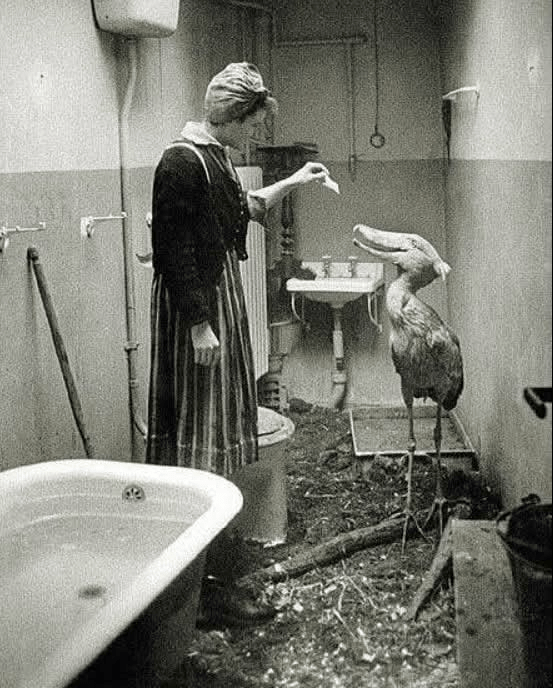
Thus proving, yet again, that “Boris”-idiot never does his homework…(and always talks rubbish)…
Stray thought
Though I cannot claim huge numbers of readers on any one day, or most days, the blog does have hits from almost all of the states and territories of the world, even places such as Antarctica, Greenland, Burkina Faso etc.
Today, so far, UK, USA (those two by far the bulk of hits), but also Canada, Kazakhstan, Russia, and New Zealand.
Are they all supporters? Probably not. Enemies also snoop on the blog, but no matter— “one human soul is a big audience“.
More tweets seen
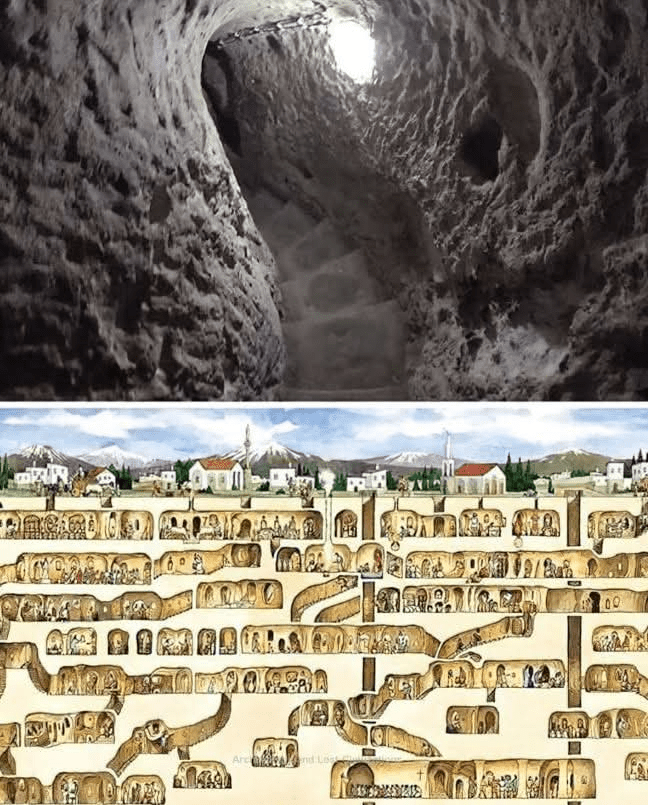
“The subterranean city of Derinkuyu, located in Cappadocia region of Türkiye, an extraordinary historical site with the capacity to house an estimated 20,000 to 60,000 people, including their livestock and supplies. Its discovery occurred unexpectedly in 1963 when a homeowner accidentally broke through a wall in his basement, unveiling an ancient and intricate underground structure hidden for centuries. Derinkuyu is an impressive multi-level complex, descending over 200 feet below the surface and consisting of at least 18 levels, though only a portion of it has been fully excavated. The city features an array of functional spaces, including living quarters, kitchens, storage areas, wine and oil presses, stables, and even chapels and schools. Ventilation shafts and a sophisticated water system ensured the city’s inhabitants could survive underground for extended periods. Defensive mechanisms, such as heavy stone doors that could be rolled into place, protected the city from invaders. Historians and archaeologists believe Derinkuyu was initially constructed by the Phrygians or Hittites in the early centuries BCE, though it was later expanded and used by various groups, including early Christians, as a refuge from persecution or attacks. Its design reflects the ingenuity and resilience of the civilizations that relied on such cities for survival during times of conflict or environmental challenges. The discovery of Derinkuyu has spurred interest in Cappadocia’s extensive network of underground cities, many of which remain unexplored. These ancient marvels continue to captivate researchers and visitors alike, shedding light on the innovative ways humans adapted to their environment and safeguarded their communities.“
“Recruits to the castle-convents scattered across Teutonic territory primarily hailed from Germanic regions such as Franconia, Thuringia, the Rhine, and other German territories. These knights, often aristocrats but also comprising lower-ranking members, were stationed in commanderies housing anywhere from 10 to 80 individuals. Similar to other military orders, recruits pledged monastic vows of poverty, chastity, and obedience. Joining offered prospects of spiritual rewards, adventure, career advancement, and even basic amenities like regular meals and shelter. While German settlers were permitted entry, they typically served as priests or half-brethren. Each castle-convent also accommodated local crossbowmen, as well as non-combatants like servants and craftsmen. Although officially international, the order predominantly drew recruits from German lands. Membership numbers varied, influenced by battles and territorial shifts. For instance, Prussia counted 700 members in 1379 AD, 400 in 1450 AD, 160 in 1513 AD, and 55 in 1525 AD. The total knightly roster likely never exceeded around 1,300. The order’s revenue stemmed from wartime spoils, captured territories, trade, land rents, and donations in cash, goods, or land. Some brethren paid an entry fee, while taxes on local populations were imposed in Teutonic territories by the 15th century AD. As recruitment challenges grew, the order increasingly relied on mercenaries, necessitating financial support. Commanderies not only offered training, residences, and retirement options but also extended aid to local communities through hospices, hospitals, schools, and cemeteries. Additionally, the order constructed churches, providing ongoing maintenance and fostering artistic endeavors for embellishment.“
I once knew a German lady from East Prussia, one of whose several historically-distinguished ancestors was a Grand Master of the Teutonic Knights in the Middle Ages.
“The Lion Man – An Ice Age Masterpiece : The Lion Man is a masterpiece. Sculpted with great originality, virtuosity and technical skill from mammoth ivory, this 40,000 year-old image is 31cm tall. It has the head of a cave lion with a partly human body. He stands upright, perhaps on tiptoes, legs apart and arms to the sides of a slender, cat-like body with strong shoulders like the hips and thighs of a lion. His gaze, like his stance, is powerful and directed at the viewer. The details of his face show he is attentive, he is watching and he is listening. He is powerful, mysterious and from a world beyond ordinary nature. He is the oldest known representation of a being that does not exist in physical form but symbolises ideas about the supernatural.
Found in a cave in what is now southern Germany in 1939, the Lion Man makes sense as part of a story that might now be called a myth. The wear on his body caused by handling suggests that he was passed around and rubbed as part of a narrative or ritual that would explain his appearance and meaning. It is impossible to know what that story was about or whether he was deity, an avatar to the spirit world, part of a creation story or a human whose experiences on a journey through the cosmos to communicate with spirits caused this transformation. Obviously, the story involved humans and animals. Lion Man is made from a mammoth tusk, the largest animal in the environment of that time and depicts the fiercest predator, a lion, now extinct, that was about 30 centimetres taller than a modern African lion and had no mane. Distinct from other animals through their use of tools and fire, humans were nonetheless dependent on some animals for food while needing to protect themselves from predators. Perhaps this hybrid helped people to come to terms with their place in nature on a deeper, religious level or in some way to transcend or reshape it.
Archaeological discoveries in other caves in this region include small sculptures as shown in the British Museum’s 2013 exhibition Ice Age art: arrival of the modern mind. They were found in caves with large quantities of stone tools and animal bones that indicate people lived in the shelter of the daylight areas of these sites for repeated periods of time.
Stadel Cave, where the Lion Man was found, is different. It faces north and does not get the sun. It is cold and the density of debris accumulated by human activities is much less than at other sites. This was not a good place to live. Lion Man was found in a dark inner chamber, carefully put away in the darkness with only a few perforated arctic fox teeth and a cache of reindeer antlers nearby. These characteristics suggest that Stadel Cave was only used occasionally as a place where people would come together around a fire to share a particular understanding of the world articulated through beliefs, symbolised in sculpture and acted out in rituals.
Lion Man is the oldest known evidence for religious beliefs and Stadel Cave suggests that believing and belonging have a deep history crucial to human societies and originating long before writing. In 2017, UNESCO acknowledged Stadel Cave and other Swabian localities as World Heritage Sites of importance to all humanity and now Ulm Museum has loaned this important sculpture to the British Museum for the exhibition.”
“The candidate for Chancellor of Germany Alice Weidel has called for the restoration of relations and economic ties with Russia The election program of Alternative for Germany includes points about the need to lift sanctions on Russia to allow free trade. Additionally, according to members of the AfD, it is necessary to repair the Nord Stream pipeline, which supplied Russian gas to Europe. “We want to end the sanctions policy, which primarily harms our country,” Weidel said. She reminded that just two years ago, Germany was buying cheap natural gas from Russia through Nord Stream, but now the country has “the highest energy prices in the world.”
The AfD is not fully social-national but is still clearly the best choice for German voters at present. Deutschland erwache!
I thought, when he was not nominated (plainly at his own request) for a fake peerage that Johnson, aka “Boris”-idiot, had it in mind to stand for leader again.
Were Johnson to get some sympathetic Con MP to stand down in his favour, Johnson might well win a safe-seat by-election.
Why would any MP do that? In return for a promise of getting a peerage later. That would not require Johnson to be Prime Minister, because the Leader of the Opposition also has peerage-nomination rights.
Johnson would then have to wait (probably) until November 2025 before at least 15% of Con MPs send in letters of no-confidence in “Carpetbagger Kemi” Badenoch. That means 18 MPs, as matters stand. That would happen. Con MPs know that Kemi Badenoch is a total turn-off for most voters, sure to lose the next general election and, thus, a number of seats.
Then, all Johnson would need would be a small number of MPs (in the 2024 leadership election, the number was 10 MPs) to nominate him as a candidate (quite likely possible).
Opinion polls of 2024 Con-voting people show that Johnson is far more popular (despite his evident unfitness to hold office, despite his total incompetence) than Kemi Badenoch.
I may even place a bet on “Boris” to be next Con Party leader. The odds, though, are not too generous, below 5/1. Maybe I shall lose my money elsewhere…
https://www.betfair.com/exchange/plus/politics/market/1.235470805.
As Matt Goodwin says, though, Johnson was disastrous as PM (and, before that, as Foreign Secretary), and at present the Con Party is hovering around or below 20% in the opinion polls.
Quelle surprise…Stella Creasy cannot spell “supersedes“. Ignorant woman.
“Nearly every other day I learn that someone I know in Wiltshire, in Westminster or in my wider Conservatiive network has left the party – and about half the time they join Reform too. Today two have jumped. Give it time, say Tory diehards but even under new leadership the Conservative Party simply isn’t healing or recovering. Its decline is continuing. I am not finding Reform membership easy but don’t regret my move nor leaving a party that is now so divided and adrift. It’s sad to watch.“
“I don’t know one lifetime Tory that still supports them personally, i wont ever vote for them again. They’re bad coalition where no meaningful policy happens, migration we had since Cameron was mostly low skill we are paying 70 yr high tax to subside that migration . Waste is massive, they were funding most of the things they said they didn’t support. to be honest Tim looking at the state of this country I’m wondering did they do anything in 14 years, everything in England is broken, GPS, dentists, NHS, councils, police, judiciary, child services, mental health services, prisons, social care, we have gone backward and it’s frightening to watch.“
Semi-literate, but surely accurate.
It has been forecast in the past and not quite happened, but I truly feel that the once-great Conservative Party is now finally going the same way as the old 19thC/20thC Liberal Party. Terminal decline.
The Con vote in (?) 2029 (and assuming that a nuclear war has not happened by then anyway) may be as low as 15%.
That could see the Con Party reduced to 20 MPs (if Con 15%, Lab 25%, Reform 30%, LibDems 15%, Greens 10%): see https://www.electoralcalculus.co.uk/userpoll.html.
It would also mean Reform UK getting 330 Commons seats, an overall majority, and thus being able to form the next Government of the UK. If that then ended badly, social nationalism could finally arise. God mote it be.
Late news and tweets
https://www.bbc.co.uk/news/articles/cx2pddvwgg8o
“Lord Walney has called for more action to protect the public from “the menace of extreme protestors”, after his role as the government’s independent adviser on political violence was scrapped.“
[BBC]
Ha ha. Good news.
Translation: “useless sex pest, depressive case, and puppet of the Israel lobby “Lord” Walney (aka John Woodcock) has been sacked.”
The bastard is also an egregious moneygrubber, taking money from lobby groups and oil, gas, and armaments interests. Evil little bastard.
See also:
Other Israel-lobby puppets and useless types, including notorious ex-MP “Lord” Ian Austin, and notably cultureless and useless ex-MP and one-time Culture Secretary Ed Vaizey (now “Lord” Vaizey), have been tweeting in support of said bastard. Many others feel differently, though.
(((Because)))…
I nearly missed Woodcock/Walney’s sacking. That would have been a pity. I now feel quite cheered-up (after the pathos of having watched the film of Doctor Zhivago).
Late thought
Earlier today, I caught literally the last 30-60 seconds of an interview (I think on Sky News) with, I also think, a junior Labour minister whose name I did not get. What a typically smug, pleased-with-himself bastard! A System political drone with, in the short piece I saw, nothing to say beyond the sort of bland propaganda soundbites all too common over the past 25 years.
No wonder the British people are turning off from System parties and politicians. Reform UK is but the next step on the road, not the ultimate destination. Anger and frustration is growing.
Late music

 Ian Robert Millard