Tag Archives: Labour Party

John Woodcock, Barrow and Furness and the General Election 2017

It has been announced that John Woodcock will be allowed to stand for the seat of Barrow and Furness. He has therefore survived a serious threat of deselection, having said publicly that no-one should vote Labour in the General Election (presumably excluding from his exhortation those voting for him).

John Woodcock

Woodcock, now 38, is one of those MPs who has never had a non-political job, unless is counted a brief spell as a trainee journalist on The Scotsman. Personal details are “a little vague”, but he was born in Sheffield and attended the University of Edinburgh. After his time at The Scotsman, Woodcock was an aide to John Hutton, the MP for Barrow and Furness from 1992-2010 and now in the House of Lords. He was also (2009-2010) a Special Adviser (SpAd) for the then Prime Minister, Gordon Brown. He was elected as Labour (strictly speaking, Labour and Co-operative) MP for Barrow and Furness in 2010.

https://en.wikipedia.org/wiki/John_Woodcock_(politician)

As MP, Woodcock has been associated mostly with the Israel lobby and was even Chair of (Parliamentary) Labour Friends of Israel from 2011-2013. He prefers to talk more about his self-serving support for Trident (the submarines for which are built in Barrow-in-Furness, the main population centre in the constituency).

Woodcock’s entries in the House of Commons Register of Members’ Interests show donations from the governments or agencies of Israel, China and Kurdistan:

https://www.theyworkforyou.com/regmem/?p=24837

Woodcock is one of the most anti-Corbyn Labour MPs and was until 2015 the Chair of Progress, the Blairite group. He has repeatedly called for the removal (as Labour leader) of Jeremy Corbyn and has been associated with the most anti-Corbyn of the Labour plotters, including Liz Kendall (who stood against Corbyn in the second Labour leadership election, receiving 4.5% of the vote and coming last out of the four contenders). Woodcock has denied that he had some kind of affair with Liz Kendall, though rumours persist. At present he is involved with fellow-depressive Isabel Hardman of the ultra-Conservative Spectator magazine.

Woodcock’s depressive illness is said to have been triggered by what his own political website describes as “a nasty fall from his attic ladder”, a Fawlty-esque vision, arguably: falling off an attic ladder hardly compares with, say, the WW2 Arctic Convoys, the Normandy Landings, the Siege of Leningrad or the Battle for Berlin. He is, it seems, separated from his wife, mother of his children.

Woodcock is intolerant not only of dissent generally but of views in conflict with his own, especially where Jews and Israeli interests are concerned. I declare an interest here: the fake “revolutionary” scribbler Owen Jones tweeted to Woodcock in 2015 that he should block me. Woodcock complied immediately!

https://twitter.com/OwenJones84/status/633675878342492160

[Update, 13 June 2024: looks as though Owen Jones has belatedly expunged the said tweet].

So there we have Labour’s 2017 General Election candidate for Barrow and Furness: a not very popular, pro-Israel, pro-China Blairite, whose marriage collapsed because of his behaviour and who is currently involved with another depressive case, which lady is an ultra-Conservative scribbler. Not very appealing.

Barrow and Furness: political analysis

It is possible to think of Barrow and Furness as being now a marginal Lab-Con constituency despite the fact that, since Labour’s win in 1945, the Conservatives have only won twice (1983, 1987). The Labour majority that Woodcock inherited was 5,208. Woodcock’s tenure as MP reduced that in 2015 to 795 on a similar turnout. The 2010 Labour vote share was 48.1% (Con 36.3%); the 2015 Labour vote share was 42.3% (Con 40.5%).

The Liberal Democrat vote share of 10% in 2010 was slashed to 2.7% in 2015. It is hard to see that increasing much, bearing in mind that the Barrow and Furness area voted Leave in the EU Referendum:

http://www.bbc.co.uk/news/uk-politics-eu-referendum-36598819

Woodcock is strongly Remain and that again pits him against most Barrow voters.

The UKIP vote in 2010 was a fairly miserable 1.9%, but was elevated in 2015 to 11.7%, enough to achieve a third place. However, it is unlikely that that relative success can be repeated. The majority of 2015 UKIP voters will probably defect to the Conservatives, especially now that they scent blood vis a vis removing Woodcock.

Other parties are not very significant. The BNP and Greens both stood in 2010, both losing their deposits. The Greens also stood in 2015, more than doubling their vote (but only to 2.5%).

Conclusion and Prediction

Labour will struggle to hold the seat. Woodcock is not considered to be a very good constituency MP and will be, so to speak, handicapped by his mental issues and by the fact that many Labour voters may prefer to stay at home rather than vote for him.

Woodcock (and so, Labour) has the advantage of being pro-Trident in a pro-Trident constituency, but (barring the Greens) that is a given for candidates in Barrow and Furness.

The 2015 Conservative vote increased by about 4 points over that of 2010. Earlier votes were far below this level: 1997 27%, 2001 30%, 2005 31%. The direction of travel has been upward for 20 years. If the Conservatives can add the votes of UKIP defectors to those of their own loyalists, they can win if enough formerly Labour voters either vote Conservative or stay at home. The Conservative candidate is the same as in 2015, which may help their cause.

Overall, the Conservatives have a good chance of scoring their first win at Barrow and Furness since 1987.

Update (15 July 2018)

I am updating the above for two or three reasons, not least because, of all my blog posts, this one has –to my surprise– been the most read (by nearly 1,000 people, to date).

In the 14 months since I wrote the original post above, Woodcock retained his seat at Barrow and Furness at the 2017 General Election, though only scraping home by 209 votes. John Hutton, Woodcock’s predecessor (and one-time employer) had enjoyed majorities of as high as 14,497 (in 1997) and had left Woodcock a majority of 6,037 (in 2005). Woodcock’s first (2010) majority was 5,208, which reduced to 795 in 2015 and to 209 in 2017.

In 2017, the Labour vote was 22,592 and the Conservative vote was 22,383. I think that I can claim that my original analysis was accurate despite Labour having pipped Conservative to the post. The Labour vote increased from 42.3% in 2015 to 47.5% in 2017 (but the Conservative vote also increased, from 40.5% to 47%). UKIP’s vote decreased from 5,070 votes (11.7%) to a mere 962 votes (2%) in 2017. The LibDem vote stayed exactly the same in percentage terms (2.7%). The only minor candidate in 2017 was a Green (whose vote share fell from 2.5% in 2015 to 0.8% in 2017).

Meanwhile, Woodcock has been investigated by Labour and the police over multiple claims of sexual harassment. It was reported in April 2018 that he was “planning to resign the Labour whip”, not (of course…) because of the sex allegations, but because of continuing concerns about Jeremy Corbyn! However, he obviously calculated that that would be the end of his already-stalled “high-flying” and “high profile” System political career. Were Woodcock to stand at Barrow as Independent or Independent Labour or Pro-Israel Labour, I imagine that he would be lucky to get 100 votes. He needs Labour hugely more than Labour needs him. In fact, Woodcock is a millstone round Labour’s neck. The voting figures make that clear. After the latest scandal, Woodcock is surely unelectable.

On 30 April 2018, Woodcock was suspended from the Labour Party pending conclusion of the inquiry into his behaviour. In late June 2018, Woodcock refused to appear before a Labour Party tribunal to explain or defend himself. His political future now appears to be non-existent. He will probably face deselection (at last); if not, it is unlikely that the voters of Barrow and Furness will elect him again. No doubt some Jewish and/or Zionist organization will arrange a well-paid sinecure for him whatever happens. The same has been done for other (and at least equally useless) disgraced MPs. Woodcock has done work for Israeli organizations previously.

Woodcock continues to tweet prolifically, as if he were still looking forward to a big political future, but tweets from Labour supporters and members are mostly very critical.

Notes:

https://en.wikipedia.org/wiki/Barrow_and_Furness_(UK_Parliament_constituency)#Elections_in_the_2010s

https://order-order.com/people/john-woodcock/

http://www.dailymail.co.uk/news/article-5675423/Arch-Corbyn-critic-John-Woodcock-suspended-Labour-party.html

Further Update (18 July 2018):

John Woodcock has resigned from the Labour Party as of today’s date (18 July 2018), though he makes no mention of resigning the seat which the Labour label alone gave to him. Typical…As an Independent, his vote at Barrow would be a couple of hundred at best and he would have no chance, yet this useless pro-Israel parasite and freeloader is going to hang on until the next general election in order to maximize his pay, expenses and pension benefits. Labour and Barrow are well rid of him.
ds3 

Further update (25 January 2019)

Parasitic freeloader Woodcock is still tweeting, trying to present himself as the sort-of “Labour” MP for Barrow and Furness, despite having left Labour. I had assumed that he would be given a well-paid sinecure by the Zionists, as has happened to others (eg Michael Dugher), but it may be that he intends to try to fight the seat as a wild card Independent, on the basis that the vote is split between Labour and Conservative and that he might just squeeze in through the middle. Doomed, in my view, though…

In the meantime, he is getting pay, “expenses” and, no doubt, more money from elsewhere (he’s had quite a bit from Israel in the past). Also, the longer he spends as MP, the more money he will get when finally removed (gratuity, pension etc).

Note:

https://www.ft.com/content/1082473a-3979-11e7-ac89-b01cc67cfeec

Update, 1 May 2019

Woodcock continues to tweet, nominally, as MP, though he must know that his time is very nearly up (this year, if there is a general election, which seems more likely than not). In the meantime, he tweets against Labour (which he joined —or should that be “infiltrated”?…Let’s say “joined”, a more pleasant and less loaded word…— as a student twenty-odd years ago; he tweets for Israel and the Jewish Zionist interest etc. After all, he might find that useful when he needs a job…which might be rather soon.

Update, 8 May 2019

I missed this, Woodcock’s latest misadventure…

https://www.bbc.co.uk/news/uk-england-cumbria-47775073

Update, 8 October 2019

Woodcock continues to attack Corbyn and the Labour Party, despite (or because of) the likely proximity of a general election in which Woodcock himself, if he stands, will be bumped out of Parliament. I wonder whether he was in Tel Aviv recently…My only question is what sort of lucrative sinecure the Jews will find for Woodcock after the electors of Barrow and Furness kick him out. Public relations/”comms”, as in the case of other ex-Labourites such as John McTernan? Head of some commercial or trade org, as with Michael Dugher? “They” sometimes pay their servants well. Personally, I should be unable to endure the dishonour, but that’s me…

Update, 28 October 2019

Woodcock is still going through the motions of being an MP, even questioning party leaders on their intentions. I wonder why he bothers. Do the Israelis tell him what to ask? Whatever the truth, his time is nearly up…

ds5

Update, 5 November 2019

Well, there it is. As I have blogged, “they” have arranged a suitable position for the sex-pest depressive, a position in which he will be able to doormat for Israel and the Jew-Zionist lobby— and be well-paid for it…

Update, 27 April 2020

Woodcock did not stand as Independent or whatever (Supporter of Israel?) in 2019, having been appointed by Boris Johnson as (presumably well-paid) “Special Envoy” on “Far Right” “Extremism” only a week before the 2019 General Election. The Jew/Israel lobby in action once again.

At that election, the Conservative Party candidate, one Simon Fell, won with a vote-share of 51.9%.

https://www.simonfell.org/about-simon

https://en.wikipedia.org/wiki/Simon_Fell_(politician)

There seems to be relatively little hard information about Fell, who also contested Barrow and Furness in 2015 and in 2017. Provisional assessment: a dogged stayer.

The Labour Party vote dropped sharply, whether poisoned by Woodcock or by the Jewish lobby msm campaign against Corbyn. Both, I suppose; connected. The Labour vote-share was 39.3%. That gave Fell and the Conservative Party a majority of 5,789.

The Greens, LibDems and Brexit Party also stood candidates in 2019, all of whom lost their deposits: https://en.wikipedia.org/wiki/Barrow_and_Furness_(UK_Parliament_constituency)#Elections_in_the_2010s

As for Woodcock himself, he has not been in the news recently. Presumably, he is snooping away in his new position. He does tweet, though, still plugging away for the Jewish lobby…


Update, 6 August 2020

It was announced recently that Woodcock would join 37 others (most equally unmeritorious) as a fake “lord” in the House of Lords, elevated by Boris-idiot. “For services to the Jewish lobby”? Peculiar expenses fraudster and doormat for Israel, Ian Austin, is another one of the 38. So Woodcock now has not only his paid sinecure, snooping on British nationalists, but also over £300 a day taxfree any time that the House is sitting and he manages to crawl through the door. Woodcock has reached peak parasite.

Update, 20 June 2023

Woodcock is now “Lord Walney”, and his tweets (including all the tweets above-exhibited from years ago) are now tweeted not by “John Woodcock” but by “Lord Walney”.

Rochdale, Simon Danczuk and the General Election of 2017

Simon Danczuk

It has been announced that Simon Danczuk will not be permitted to stand again for Labour in the Rochdale constituency which he won in 2010 and retained in 2015 (with a greatly-increased majority). He has been suspended from the Labour Party since December 2015. Danczuk is said to be considering both legal action against the Labour Party and standing as Independent.

There is scarcely any point in listing in great detail the various defaults which led to that suspension. The egregious nature of the now 50-y-o Danczuk’s “private” life has been common currency for years and encompasses “sexting” to a 17-y-o girl, having sex with a recent Twitter acquaintance on the desk of Danczuk’s constituency office, several rather public affairs, numerous other activities and violent fights with his ghastly wife, Karen (failed cafe-owner, poster of Twitter and Facebook “selfies”, possibly the least-competent councillor Rochdale ever had and would-be “reality” TV “star”); also an arrest for domestic violence at his holiday home in Spain. That is before one even looks at his record for Parliamentary expenses-claiming, over-claiming and cheating:

https://en.wikipedia.org/wiki/Simon_Danczuk#Expenses_investigation

Danczuk’s overall expenses claims, though high, are, it seems, not as high as those made by the highest-claiming few dozen MPs.

It seems, also, that Danczuk’s CV, like those of so many MPs, is a work of semi-fantasy, obscuring as much as it reveals about his various unimpressive pre-political jobs and dodgy business dealings.

Despite all of the above (and rumours of yet worse private behaviour by him and his “estranged” wife, whom he employed –and is said to employ even now– as a supposed assistant, funded by more Parliamentary expenses claims), Danczuk is said to be a popular MP in his constituency. That would seem to be borne out by his election results.

Rochdale Constituency

Rochdale has been held several times by all three main System parties in the past century, though the last Conservative victory was in 1955. In more recent years, Rochdale has been held about equally by Labour and by the Liberals or Liberal Democrats.

Looking at the last two General Elections, Danczuk won the seat in 2010 from the Liberal Democrat who had achieved a narrow victory in 2005. In the 2010 contest, Danczuk’s vote was 36.4%, as against the LibDem’s 34.4%. The Conservative came third on 18.1%. The National Front (4.9%) and UKIP (4.4%) lost their deposits, as did two minor candidates.

In 2015, notwithstanding the gathering clouds of scandal, Danczuk and Labour achieved 46.1%. UKIP, represented by a Pakistani Muslim, received an 18.8% vote. The Conservative Party’s candidate, another Pakistani Muslim, received 17%. The LibDems, following the trend of their national vote-collapse, received 10.3%. The Green Party (3%), National Front (1%) and two minor candidates all lost their deposits (though “Rochdale First” beat both the Greens and the NF, receiving 3.4%).

https://en.wikipedia.org/wiki/Rochdale_(UK_Parliament_constituency)#Elections_in_the_2010s

Analysis

I assume that Danczuk will fail in any legal action that he may take against Labour and so will be standing as an Independent. Labour may select as candidate a Pakistani Muslim to help retain the seat. Recent polling makes plain that the only main demographic still supporting Labour is the ethnic minority one. Rochdale has a high ethnic-minority electorate.

The question is whether usual-Labour voters will stick with the Labour Party or with Danczuk, their Labour MP from 2010 through 2015. It may be that the vote will split almost equally. Danczuk may be helped by Labour’s slide in popularity nationally. On the other hand, Corbyn’s anti-Zionism may help Labour in a heavily-Muslim constituency. Another imponderable factor is how much (if at all) the scandals will affect Danczuk’s vote.

The LibDem candidate is one Andy Kelly, who stood in 2015. He will be handicapped by his party’s pro-EU stance in a constituency which voted 60-40 Leave. Under “normal” circumstances, the LibDems might expect some help from disaffected former Conservative voters, but the expected Labour/Danczuk-as-Independent split may let the Conservative through the middle and that would encourage Conservative-leaning voters to stay loyal. There again, the deflation of the UKIP bubble will inevitably help the Conservative candidate.

In 2015, the combined UKIP and Conservative vote amounted to almost 36%, about 10 points behind Labour (46.1%). However, if even half of the 2015 UKIP vote goes Conservative, the 2017 Conservative vote might amount to as much as 30%. If, again, official Labour loses half or more of its votes to an Independent Danczuk, then each of those two might end up with somewhere around 20%-30%. In other words, the Conservatives have a serious chance of winning Rochdale for the first time since 1955.

Prediction

Assuming that Simon Danczuk does stand as Independent, my prediction is:

  1. Conservative;
  2. Simon Danczuk (as Independent);
  3. Labour;
  4. LibDem

Update and thoughts (written 22 July 2018).

Well, I got my specific prediction quite wrong despite getting the analysis mainly right. In the event (see link below), Labour won easily in 2017, with 58% of the vote, up from 46% in 2015. The Conservative vote share increased even more: 17% in 2015, 28.4% in 2017. The LibDem vote share slumped again, from 10% to 8%, while UKIP crashed from 18.8% in 2015 to 3.3% in 2017.

As for Simon Danczuk, without the Labour label, he sank like a stone, doing far worse than I thought he would: 1.8% (883 votes). He lost his deposit and stalked out of the counting-hall before the official declaration. He came 5th out of 6 candidates. Since then he has become an unperson, not even using his Twitter account, though his ghastly wife Karen still tweets to those middle-aged and elderly men North of Watford who still apparently find her attractive from afar. Less intelligent by far than her ex-husband, she still seems to think of herself as a public figure of some kind. Both Danczuks are now either unemployed or doing basic work somewhere. The ex-MP has apparently been seen at his local Jobcentre…

https://en.wikipedia.org/wiki/Rochdale_(UK_Parliament_constituency)#Elections_in_the_2010s

Update, 19 July 2019

I understand that the disgraced ex-MP is now involved with something to do with Bangladesh, though based in the UK. I think that there is an office which finds ex-MPs paid work. Even Lembit Opik has been employed in a few places!

As for rodent-smiled Karen Danczuk, there are still apparently legions of men, mostly in the North, mostly aged 60+, who think that she looks nice, and some are now paying for her to twirl around online; I read that she strips for tips, and even sells some of those sad men her own cast-off lingerie! The funniest thing is that she still “signs” her tweets “KD”, as if she is an important figure whose staff usually tweet on her account, the “KD” indicating that the would-be “celebrity” VIP is tweeting in person, as for example Putin does at times (as “VP”). From the sublime to the ridiculous! In her case, though, “KD” is of course on every tweet (the last time I looked, anyway, a few months ago). Unemployed “slappers” don’t have “staff”…

https://www.dailymail.co.uk/tvshowbiz/article-6825949/Selfie-queen-Karen-Danczuk-35-says-charging-fans-racy-photos-empowering.html

Manchester Gorton By-Election

Introduction

Manchester Gorton, one of the most solidly Labour constituencies in the UK, was represented 1955-1967 by Konni Zilliacus, an interesting character who was acquainted with many of the most significant political figures of the 20th Century (his widow, whom I met a few times, carried on in the local Labour Party of Maida Vale, London until her death in 1999).

https://en.wikipedia.org/wiki/Konni_Zilliacus

The recent death of Gerald Kaufman MP (a famously anti-Zionist Jew, MP for the seat since 1983 and for a neighbouring seat from 1970-1983) has triggered a by-election, though the date (probably 4 May 2017) is yet to be confirmed. It follows that there is still time for candidates to be nominated (e.g. the Conservative Party has not yet selected its candidate).

At present, the candidate list includes those of Labour, Green Party, Liberal Democrat and, standing as Independent, George Galloway. UKIP may or may not stand. Previous elections in the seat have attracted a host of minor candidates: Trade Unionist and Socialist Coalition [TUSC], Pirate, Christian, Workers’ Revolutionary Party [WRP], Resolutionist Party, Socialist Labour; and going back further, Revolutionary Communist, Red Front, Natural Law, BNP (only in 1983), National Front (only in 1979) etc.

Manchester Gorton is a Labour seat, has always been Labour, right back beyond the creation of the seat in 1918 and further back to when it was called South-East Lancashire, Gorton Division: Labour won in 1906 and in 1910 (twice). This is rock-solid Labour Party territory and considered to rank as the 9th-most-Labour seat in the UK

http://www.electoralcalculus.co.uk/orderedseats.html.

The Labour vote in Manchester Gorton has only once (since 1918 anyway) fallen below 50% [1967 by-election: just below 46%] and peaked in 1945 at over 69%, though Gerald Kaufman almost equalled that in 2015, with just over 67%.

https://en.wikipedia.org/wiki/Manchester_Gorton_(UK_Parliament_constituency)#Elections_in_the_2010s.

Analysis

There is no prospect of Labour losing in Manchester Gorton. It is a question of how many voters turn out and of the margin of Labour’s inevitable win. Turnout, at one time over 70% and even over 80%, has fallen back in recent years [2015: nearly 58%]. The other points of interest will revolve around the votes garnered by UKIP (if standing), the Liberal Democrats and George Galloway.

29% of the voters of Manchester Gorton are ethnic Pakistanis. The most recent ICM polling has made clear that the Conservative Party is preferred to Labour by every standard demographic except non-whites. The Labour shortlist contained 5 candidates, all Pakistani Muslims.

The Conservative Party always came second in Manchester Gorton until 1997, since which year it has always come third and always third to the Liberal Democrats, until 2015, when the general LibDem slaughter led to their 2010 vote share of 33% collapsing to 4%, which put the LibDems only fifth (after UKIP). Since 1997, the Conservative Party vote has always been around 10%, compared to 20%+ in the 1980s and 30%+ in 1970s. In the 1967 by-election, the Conservative candidate was Winston Churchill, grandson of the former Prime Minister. Winston junior nearly won that by-election, getting 44.51% as against Labour’s 45.89%.

Interestingly enough, the 2015 Liberal Democrat rout did not help the Conservative candidate: third place and 9.7% as against 11% in 2010. Second place went to the Green Party , which got 9.8%, its previous best having been 3.1% (in 2001).

The 2015 UKIP vote was 8.2% (2010, 2.7%). Likely 2017 vote would be around 5%.

George Galloway has attacked the all-Asian Labour shortlist. This may indicate that he is hoping to attract to his banner English (i.e. white) former Labour voters who were willing to vote for Kaufman but will not vote for a Pakistani Muslim as their MP. A proposition which may be flawed. Abstention is more likely, in my opinion.

Conclusion

There is nothing much to disturb the inevitable Labour victory here.

  • The Pakistani Muslim demographic will turn out in large numbers for the Labour candidate and that alone will ensure a Labour win.
  • The Conservatives may see a small increase, no more, in vote share.
  • The same is true of the Liberal Democrats. This is an area hard hit by the spending cuts of the Con Coalition, which was propped up by 2010-2015 LibDem MPs’ votes. On the other hand, there is the “dustbin” or “catch-all” factor.
  • George Galloway will probably only get a few per cent of the vote (hard to see who would vote for him either from white or non-white communities, despite his new role as TV face on RT).
  • The Greens will have achieved a victory if they save their deposit.
  • If UKIP stand, they will be lucky to save their deposit.

In the end, turnout may be very low. The white former Labour voters may well vote with their feet and stay home and Labour will probably see both its vote numbers and vote percentage fall to some extent, but Labour has in its favour the fact that almost a third of the voters are Pakistani Muslims and that there are other non-white groups in the constituency.

Likely result:

1.Labour;

2.Liberal Democrats;

3.Conservatives;

4.Green;

5.UKIP (if standing).

Postscript, written in early 2018

In the event, a General Election was called and the by-election was cancelled. Almost all candidates standing in the constituency at the General Election were the same as had been candidates in the cancelled by-election.

https://en.wikipedia.org/wiki/Manchester_Gorton_(UK_Parliament_constituency)#Elections_in_the_2010s

Formation of a Social National Party in the UK

Background

For a number of years, I have watched the socio-political scene in the UK with increasing feelings of concern. The System parties have done terrible things (and omitted to do the right things) without any regard for the national interest, without compassion, without even logic:

  • disastrous foreign wars and other interventions, backing the United States and NATO and (in reality) Israeli interests and the plans for a “New World Order” [NWO];
  • financial madness caused by globalist economics and neoliberalism, not least the inability to tax effectively huge transnational enterprises;
  • gradual takeover by Zionists of strategic areas of society;
  • quite fast increase in the Muslim and other non-European populations of the UK;
  • inflicting appalling hardship and persecution upon the poorer section of the UK population (eg unemployed, disabled) via spending cuts, cruel bureaucratic systems, outsourcing;
  • allowing the NHS to decline steadily in all areas;
  • importation of many millions of immigrants even since 1997, with subsequent births to those immigrants, resulting overall in strain on NHS, roads, trains, housing; schools, prisons, social security, pensions;
  • policies on farming and landowning which do not prioritize wildlife and the environment  in general;
  • crises in care of the elderly;
  • decline in real educational levels covered up by meaningless “degrees” and award inflation;
  • inability to adequately and aesthetically house the population.

The above is not even a complete list of how the System parties have let down the British people.

System Parties

Conservatives

The Conservative Party has inflicted terrible damage on the UK via, inter alia, spending cuts and a coarsening of political converse generally. It might have suffered a huge defeat in 2015, but in the event was saved by the vagaries of the First Past the Post electoral system etc. It has now been saved, for the time being, by the implosion of the Labour Party.

Labour

The Labour Party becomes increasingly less relevant. Even mainstream commentators have woken up to it now. Labour introduced the hateful, dishonest and incompetent ATOS company to persecute the disabled. Labour was the party that decided to invade Iraq and Afghanistan. Labour is infiltrated, indeed pervaded, by the Jewish-Zionist lobby and its agents. True, so is the Conservative Party, but Labour claims to speak for what were once known as “the workers”. That, of course, is Labour’s problem: the bedrock of the “proletariat” has been replaced by the shifting sands of the (increasingly raceless and cultureless) “precariat”. So Labour seems to speak on behalf of metro-liberal “snowflakes”, “antifa” rentamob idiots, employees of the collapsing public sector; above all, perhaps, the “black and brown” ethnic minorities.

Example: in Stoke on Trent, Labour recently won the Stoke Central by-election by 2,500 votes. 62% of the electorate did not vote; of those that did, about 7,500 voted for Labour, 5,000 for both UKIP and Conservative. The constituency has 12% non-English voters (half of them Muslim). Virtually all voted Labour. In other words, the “ethnic” vote swung it for Labour. Educated guess: of the 7,500 Labour votes, virtually all were from ethnic minority (mainly Muslim) voters.

The SNP supremacy in Scotland has taken away about 50 MPs from Labour.

The redrawing of boundaries for 2020 will mean a House of Commons with 600 MPs. Labour is now polling at 25%, concentrated in a relatively few seats. Labour will have 100-200 MPs out of 600. It will be unable to form even a minority government.

Labour is gradually deflating to nothing.

Liberal Democrats

The 2015 debacle has killed the LibDems. The party may be getting “dustbin” or “protest” votes from disaffected Labour/Conservative voters, but its upsurge in 2010 will never be repeated. The Con Coalition mortally wounded the Liberal Democrats and they were lucky not be wiped out in 2015.

Non-System Parties

UKIP

UKIP was founded in 1993 and in the nearly 24 years since then has done well to get MEPs elected but has never come even very close to getting a Westminster MP, except for free-market crazy Douglas Carswell, who after all was already a Conservative MP and may well revert to being one.

UKIP failed badly at Stoke Central and Copeland and those failures reflected its lacklustre performance in local and Westminster by-elections since its peak in or around 2014.

Brexit has shot UKIP’s fox, both on the EU and on EU immigration. UKIP seems unwilling to engage on non-EU immigration and, in general, on race and culture; it seems afraid of being called “racist”. UKIP might have forged ahead had it gone social-nationalist in 2014, but it failed to do that and is now just a (sort of) Conservative joke party again.

UKIP has come to the end of the line except as a dustbin for some white English votes.

Other non-System Parties

There are none, really. Yes, there is “the solitary Green” at Westminster, who will be gone by 2020. The Greens are polling nationwide at 3% or below. As for the BNP, after its rise in 2008-2009, it has all but vanished. Its vote at Stoke Central was 124.

Political Vacuum

It is clear that there is a political vacuum in England. The Conservatives are riding high but only by default, Labour is imploding, UKIP is effectively dead as a party with actual MPs; LibDems may well have no MPs by 2020.

At the same time, real incomes are stagnating or declining in value, immigration continues at about half a million (perhaps 250,000 “net”), housing is inadequate and expensive, young people cannot have a decent life or future, the elderly are neglected, the unemployed and disabled persecuted.

There will never be a better or more auspicious time for social nationalism. However, only if there is a physical instrument, a political movement. I have blogged about the need for safe zones for social nationalism. However, there must also be a movement, part of which must be a political party.

Party

Party Funding

New parties always face financial difficulties. Dependence on donors is not easy yet hard to avoid. A basis of firm finance is essential. It may be that the only way for a small party to grow will be for its members to sacrifice a percentage of their income to the party. On that basis, a party of even 1,000 people can have an annual income of over £2 million (based on average net income of a very modest £20,000 and on a “tithe” of 10% of that).

Party Democracy

In an ideal world, a party should be (arguably) “democratic”, but experience shows that the enemy, particularly the Zionist enemy, is skilled at exploiting cracks and fissures to create factions which eventually destroy the party. It happened to the National Front in the 1970s, it happened (it seems) to the BNP in more recent times. It is happening to UKIP too, despite its doormatting where Israel is concerned, despite its wayward errors in respect of race and culture.

In view of the above, the party leader must have the final say.

Strategy

The way to go is for the new party to target first and foremost seats within the “safe zones” which will attract more and more people from across the UK. Thus the first thing is to create those safe zones.

Further Thoughts and Update (26 July 2018)

The only aspect of the above which requires rethinking is the role –and prospects– of the Labour Party. The bubble of the Conservative Party burst in the final weeks of the General Election 2017 campaign. Labour benefited. That I did not anticipate until the last week or two of the campaign. I see no great revival of Labour fortunes; rather a further deflation of Conservative fortunes. The likely result (in any general election in 2018 or 2019)? Hung Parliament and weak minority government, probably Labour.

As for the rest of my blog post, safe zones etc, all that still applies.

Update, 15 July 2023

“Man proposes, God disposes“, as they say. The Jewish-lobby attack on Corbyn-Labour, combined with Nigel Farage shooting his own Brexit Party in the back, and the wall of lies put up by “Boris” Johnson, resulted in an unexpected and considerable Conservative Party win at the 2019 General Election.

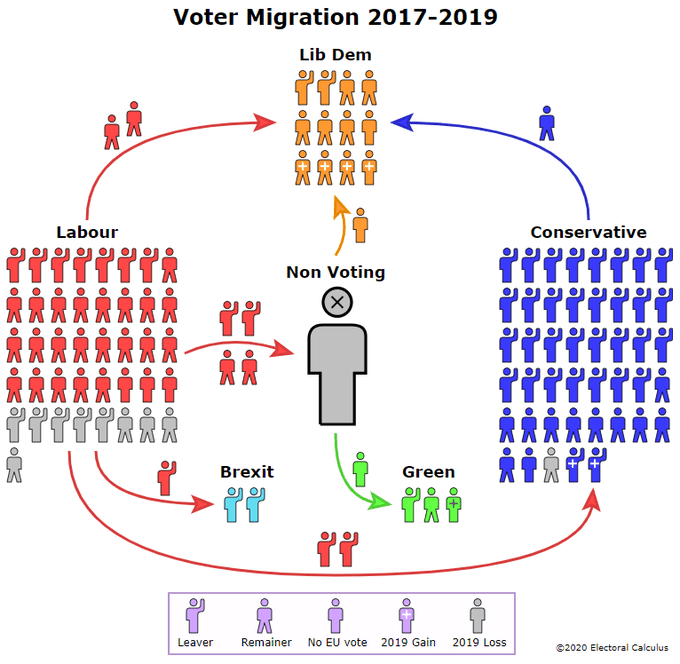
There was another factor underpinning the Conservative Party win of 2019— the fact that so many Labour Party voters “voted with their feet”, a few defecting to vote Conservative, but most simply not voting:

The Conservative vote-share increased only marginally across the country (more in a few seats), but the Labour share fell by 8 points. Had the Jewish lobby not trashed Corbyn-Labour on a daily basis for several years, and had Nigel Farage really fought for Brexit Party, the 2019 result would have been very different.

As for social nationalism, still no credible party anywhere to be seen./

Stoke Central and Copeland: the aftermath for Labour and UKIP

The by-elections in Stoke Central and Copeland have been held. The public relations people for Labour (UKIP seems to have no public relations section) are still trying to spin positives out of the Stoke result and even the Copeland defeat. The time has come to look to the future based on what can be taken from these by-elections.

The Result in Stoke Central

https://en.wikipedia.org/wiki/Stoke-on-Trent_Central_(UK_Parliament_constituency)#Elections_in_the_2010s

The Result in Copeland

https://en.wikipedia.org/wiki/Copeland_(UK_Parliament_constituency)#Elections_in_the_2010s

First Thoughts

I blogged before the poll that, if UKIP failed to win Stoke Central, that that would surely be the end or at least beginning of the end for it as a serious contender. I have also blogged and tweeted for 18 months my view that UKIP peaked in 2014. I have no reason to change those views now.

As a candidate, Paul Nuttall was fairly poor, not resilient, not intelligent, not really passionate enough politically. The UKIP organization or administration of the campaign also seemed poor. Overall, as in the past, UKIP seemed to be afraid to really set the campaign alight. The law being what it now is, UKIP could hardly have copied the successful 1960s Smethwick Conservative by-election candidate whose posters said “if you want a n****r for a neighbour, vote Labour”, but UKIP seemed to want to bypass the race/culture question entirely. There was no bite to the UKIP campaign.

The Labour candidate at Stoke Central, Gareth Snell, might fairly be described as “a poorly-educated and spotty Twitter troll, living mainly if not entirely off his allowances and expenses as a local council leader, who seems never to have had a non-political job (except a trade union one of some kind)”. In some respects he was a worse candidate than Paul Nuttall.

One has to bear in mind the heavily-industrial, heavily-Labour-voting history of Stoke-on-Trent. Labour has always had a built-in advantage there. The Conservative candidate, Jack Brereton, though looking like a schoolboy, did well to come a close third to Labour and UKIP, though in fact the Conservative vote increased by only a modest 1.8 points over the 2015 result.

Apathy or hostile apathy was the real winner in Stoke Central. 62% of the electorate did not vote. No party energized them to come out to vote for it.

As to Copeland, the main point that leaps out, apart from the obvious Labour car crash, is the poor performance of UKIP.

Future View

UKIP

UKIP surely must be finished now. It started in 1993 and in the nearly 24 years since then has failed to win a single Westminster seat, save for that of former Conservative MP Douglas Carswell, who is really just a Brexit Conservative and “free market” globalist.

UKIP would have been in a far better position had it won even a couple of seats at the 2015 General Election, but, in the irritating phrase, “we are where we are”. Theresa May’s Brexit policy has “shot UKIP’s fox” on the EU.

That leaves immigration, race and culture. UKIP now seems to have many spokesmen who are not of European race, so UKIP is not even offering the UK a white persona, a white country, if you like.

The conclusion is clear: UKIP is pointless, hopeless and must go.

Labour

Labour has been declining for years. Corbyn is both symptom and cause. The disappearance of the industrial proletariat has swept away the bedrock underneath Labour, replacing it by the sand of the “precariat”. Labour imported millions of immigrants, who are now breeding. The social landscape becomes volatile. The political landscape too.

The elimination of “socialism” from Labour led to focus-group rudderlessness, surely personified by Tony Blair, who has no principles, no real ideology, just careerism, self-seeking and politically-correct non-thinking. Labour became a party made in Blair’s image. It has no real ideology any more, not even social-democracy.

By 2020, the House of Commons will consist of 600 MPs, reduced from the current 650. Labour is currently at about 25% in the opinion polls and it is likely that, in 2020, Labour will have between 100 and 200 MPs in the House. Labour cannot now form even a coalition or minority government. It will slowly crumble.

The Future Beyond 2020

A new social nationalist party must be formed. It must be ideologically clear, administratively disciplined, capable of gaining trust and credibility. When a crisis comes, that small party may be able to seize control, as has happened before in history.

Update, 23 April 2019

I am updating because there has been much water under the bridge in the past 2 years and 2 months. Labour did fail to become the largest party in the Commons at the 2017 General Election, held a few months after the above was written. However, the Conservatives lost ground. Labour has trailed in the opinion polls since I wrote the above blog post, but just recently has managed to come back, not really on its own merit but because the Conservatives under Theresa May have had a complete car crash in several respects, especially Brexit. Labour has been sitting on the fence, not exactly a “cunning plan” but effective enough…

Update, 20 November 2020

The world turns…the 2019 General Election finished off the “15 minutes of fame” political career of Gareth Snell. He lost out to the Conservative Party candidate: https://en.wikipedia.org/wiki/Gareth_Snell; https://en.wikipedia.org/wiki/Stoke-on-Trent_Central_(UK_Parliament_constituency)#Elections_in_the_2010s.

As for the planned reduction of MP numbers to 600 (from 650), that will not now occur.

Update, 6 December 2020

I just noticed that my prediction of Labour MP-strength in the House of Commons (100-200 by 2020) was right: the Labour Party now has 200 MPs (201, if presently-suspended Jeremy Corbyn is included).

At date of writing, and despite the appalling incompetence of the Boris Johnson government, Labour under Jewish lobby puppet Keir Starmer is still trailing a few points behind the Conservative Party.

Update, 26 January 2026

The Copeland constituency no longer exists.

As for Stoke Central, Gareth Snell managed to regain it at the 2024 General Election with 42.4% of the vote: https://en.wikipedia.org/wiki/Stoke-on-Trent_Central#Elections_in_the_2020s.

The Reform candidate came second, with 24.2%. The Conservative vote slumped to 17.6%.

It is not unlikely that Reform will triumph next time, looking at the present opinion polling nationwide.

Incidentally, Snell is now married to half-Jewish former MP Ruth Smeeth, the Labour Friends of Israel member and alleged agent for both Israel and USA, who now sits in the degraded House of Lords as “Baroness Anderson”, having been “ennobled” by Conservative Friends of Israel former PM, “Boris”-idiot. What price “democracy”?

Stoke-on-Trent Central By-Election

Last week, I wrote a preview of the upcoming (23 February 2017) Stoke-on-Trent Central by-election, one of two taking place on that day

https://ianrmillard.wordpress.com/2017/01/18/stoke-on-trent-central-preview/.

Now that the main candidates are declared, I am ready to expand on that and to predict the result as best one can a month before polling.

The Stoke Central constituency has existed since 1950 and the Labour Party has won every election since then. Until Tristram Hunt appeared in 2010, the Labour vote varied between 48% and 68%. Hunt’s votes have been 38.8% (2010) and 39.3% (2015). Stoke Central has moved from being a Labour safe seat to one which can be regarded as marginal:

https://en.wikipedia.org/wiki/Stoke-on-Trent_Central_(UK_Parliament_constituency)#Elections

The Labour vote in 2015 was about 12,000, that of both UKIP and Conservatives about 7,000. The Liberal Democrats, until 2015 the second party, crashed to fifth place (behind an Independent) with 1,296 votes. In fact, the LibDem vote in 2010 was 7,000, the same as the UKIP vote in 2015, perhaps a sign that the “protest vote” bloc at Stoke Central is around 7,000 or so. Arguende. The LibDem candidate for the by-election is Zulfiqar Ali, a consultant cardiologist, who lost his deposit (vote share 4.2%) in the 2015 General Election.

Tristram Hunt, the outgoing-going-gone Labour Party MP, was never very popular in his own constituency, though London TV studios loved him. He made no bones about despising the leader of his own party, tried and failed to formulate policy of his own and was surprisingly bad (for someone of his background and education) at arguing his points when (as so often) being interviewed.

Hunt stepped down as MP in order to take a job as Director of the Victoria and Albert Museum. MP pay is about £74,000 (plus generous expenses); the V&A Director presently gets a package worth £230,000. Hunt may be getting more. No wonder that he said that “the V&A offer was too good to refuse.” So much for political conviction, vocation and, indeed, loyalty (whether to party or constituents). Stoke Central is well rid of him.

The Labour candidate in the by-election is Gareth Snell, a still fairly young former leader of the Borough Council of Newcastle-under-Lyme (3-4 miles from Stoke-on-Trent). His selection indicates that Labour are going to play on local roots and try to pretend that God is in His Heaven and Jeremy Corbyn far away, Corbyn being (arguably?) an electoral liability (seen as a credible future Prime Minister by only 16% in a recent poll).

The Conservatives have not been even the second party at Stoke Central since 2001. This by-election is one which will be decided between Labour and UKIP. The recent Theresa May Brexit speech may well have shot UKIP’s fox overall, but at Stoke Central no-one is expecting a Conservative win or even a Conservative second. The Conservative candidate is Jack Brereton, 25, who was elected at age 19 to Stoke-on-Trent City Council.

Since the 2001 General Election, the second and third-placed candidates at Stoke-on-Trent Central have received very similar numbers of votes (behind victorious Labour).

UKIP, joker in the pack. Paul Nuttall, a Northerner who was recently elected leader of UKIP, is the candidate. He must have a chance despite his partly-“libertarian” views (of which Labour is making the most, of course, claiming that Nuttall believes in NHS privatization). UKIP has a steep climb in the by-election, but it is possible. This is a by-election. The result will not affect who governs the UK. People can protest with their votes. Labour is now seen as the pro-mass immigration party and the pro-EU party. Stoke Central voted nearly 70% for Leave in the EU Referendum.

If turnout is low, if the 2015 Labour vote halves to about 6,000, if the 2015 UKIP vote mostly holds up at 7,000 or not much less, then UKIP can win. If.

It is not credible to imagine a win for the Conservatives or LibDems and they will vie for most votes not going to Labour or UKIP, but this is very much a Labour/UKIP contest. If enough people (eg 2015 Conservative voters) vote tactically for UKIP, UKIP has a good chance. On the other hand, many 2015 LibDem or Green voters may also vote tactically for Labour.

In 2015, an Independent got over 2,000 votes. Will those votes go to UKIP, now that that candidate has not renewed his candidature? Open question.

Unemployment is high, immigration is high and having had Labour MPs for 66 years has not prevented either in recent times. There is strong cultural resistance in the seat to the Conservative Party. UKIP is the insurgent here.

Prediction

The bookmakers still have Labour as odds-on to win the by-election and it would be tempting to call it as a Labour-UKIP-Conservative 1-2-3, but I am going to be bold and say that Paul Nuttall and UKIP can crack this. The seat must be one of the best chances UKIP has had or will have: anti-EU, pro-Leave, anti-mass immigration, disenchanted with the System parties and very much a “left-behind” area. Also, Tristram Hunt abandoning the seat for a quarter-of-a-million-pound job must sit badly in an area which is one of the poorest in England. In addition, Nuttall has the cachet, such as it is, of being his party’s leader.

In sum, I see the 1234 as: 1.UKIP; 2.Labour; 3.Conservative; 4.LibDem.

Effect

If the result is as I have predicted, it will push even more anti-Corbyn Labour MPs to jump ship and it will weaken Labour even further in the North (it being of little importance now in Scotland or most of the South of England). If Labour hangs on to win, then everything depends on the majority obtained but it might well be just a slower car crash.

Update, 30 May 2019

I blogged twice more about that Stoke on Trent by-election:

https://ianrmillard.wordpress.com/2017/02/21/stoke-central-by-election-final-word-before-polling/

and

https://ianrmillard.wordpress.com/2017/02/24/stoke-central-and-copeland-the-aftermath-for-labour-and-ukip/

Copeland By-Election: Watershed?

Three weeks ago, I wrote a preliminary blog post about the upcoming Copeland by-election

https://ianrmillard.wordpress.com/2017/01/02/the-copeland-by-election-the-blog-before-the-blog/

in which I examined the history of the constituency. I also took a look at the factors influencing the present by-election. The time has now come to attempt a prediction with reference to wider political trends.

The Copeland constituency has been in existence on its current boundaries since 1983. The previous constituency, Whitehaven (created during the electoral reform of 1832), was rock-solid Labour (often over 60%) from 1935 until the boundaries were changed in 1983

https://en.wikipedia.org/wiki/Whitehaven_(UK_Parliament_constituency)

The Copeland constituency has continued Labour since its creation: the Labour vote reached its high-water mark in 1997, in the Tony Blair landslide. In that year, the Labour candidate achieved a vote of over 58%:

https://en.wikipedia.org/wiki/Copeland_(UK_Parliament_constituency)#Elections_in_the_1990s.

His successor, Jamie Reed, started off in 2005 with a Labour vote of 50.5%. However, the Labour vote share has steadily declined since then, most recently to 42% in 2015

https://en.wikipedia.org/wiki/Copeland_(UK_Parliament_constituency)#Elections_in_the_2010s

The Conservative vote has been more volatile, ranging in various elections from 29% to 43%. The Conservatives achieved nearly 36% in 2015, only one point down on their 2010 showing.

The UKIP vote in Copeland has mirrored in a modest way that of much of the country: 2.2% in 2005, 2.3% (beaten by the BNP, which got 3.4%) in 2010, jumping to 15.5% in 2015.

The Liberal Democrats have never done very well in Copeland, their vote share flickering around the 10% mark, not exceeding that in 2010 (one point down from their 2005 showing in fact), then crashing to 3.5% in the 2015 debacle.

In 2010, the Green Party stood for the first time since 1987 but received a vote of less than 1%. That improved to 3% in 2015.

There are several factors which do not bode well for Labour:

  • Jamie Reed may be seen as a “rat leaving the sinking ship”, having taken a potentially lucrative position with the company which operates the constituency’s largest employing entity (by far), the Sellafield nuclear plant. That may seep into perceptions of Labour MPs as a whole;
  • recent polling shows Labour nationally as having the support of only 25% of voters;
  • the same polling shows that Jeremy Corbyn is seen as a potential Prime Minister by only 16% of voters;
  • Copeland voted heavily for Leave in the EU Referendum;
  • Copeland is believed to be hostile to the mass immigration which Labour and its embattled leader seem unwilling to criticize, let alone promise to halt.

Labour has now selected as candidate a local councillor, Gillian Troughton, a former medical doctor and supporter of the nuclear industry, in which her husband works. That may help Labour’s campaign, as will her support for the NHS and the local hospital, but Labour’s problems locally stem from its general decline nationally and its generally pro-EU, pro-mass immigration positions.

Traditionally, the Conservative vote in Copeland comes from particular communities along the coast and inland and that vote seems to be rather solid. There is no reason to suppose that the Conservative vote will not hold up fairly well, bearing in mind Theresa May’s recent stance on Brexit and also the immigration question.

Recently-stagnating UKIP can probably expect a surge in its vote, though it seems that the party will probably not be able to do well enough to win, which would require its 2015 vote to increase by at least 50% and probably more. However, UKIP will probably be able to garner votes from disaffected 2010 and 2015 Labour voters.

Turnout is key. In 2015, the Labour vote was 16,750, the Conservatives received 14,186, but UKIP’s vote was only 6,148. It is quite likely that former Labour voters will not so much vote Conservative or even UKIP, but simply stay at home and refuse to support Labour. If turnout slumps, particularly among those former Labour voters, then the Conservatives might well pull ahead of Labour , especially if the UKIP vote increases .

Prediction

Conservatives to win Copeland, with UKIP second and Labour third.

Effect

Only once in 35 years and twice in 60 years has a by-election seat been lost by the official Opposition party. If that happens in Copeland (even leaving aside the result of the simultaneous by-election at Stoke-on-Trent Central), Labour will go into a tailspin.  If Labour is pushed into third place, that effect will be magnified immeasurably.

Corbyn has made it clear that he will not resign whatever happens. Failure at Copeland would lead either to a second attempt to depose Corbyn via leadership challenge or (more likely) to a mass exodus of anti-Corbyn careerists, Blairites, Brownites and Zionists following Jamie Reed and Tristram Hunt out of the House of Commons and possibly out of the Labour Party. If that exodus, in turn, leads to the loss of further Labour seats, then it is hard to see Labour recovering. Ever.

We may be seeing the death of one of the two major (i.e. long-established, sometimes governing) political parties, something that has not occurred since the collapse of the Liberal Party in the 1920s.

Update, 3 March 2019

Well, two years on, looking at the article and its predicted result, I can feel content that I did OK. The Conservative Party candidate, Trudy Harrison, did win, as I thought at the time she would, getting a 43.3% vote. Labour’s candidate, Gillian Troughton, came second on 37.3%. A major factor was the collapse in the UKIP vote, from 15.5% to 6.5%. The vast majority of those votes probably went to the Conservatives.

The Green Party got a 1.7% vote at the by-election, the two Independent candidates 2.6% and 0.4%; none stood at the 2017 General Election.

The contest was reprised only 4 months later, at that 2017 General Election. The “main” (LibLabCon) or System parties ran the same candidates with a similar result: the Con vote increased to 49.1%; the Lab vote however also increased considerably, to 45.1%. The LibDem vote slumped, from 7.2% at the by-election to 3.3% at the General Election. UKIP’s vote slumped too, from 6.5% to 2.5%.

Copeland is now a fairly tight Con-Lab marginal. It could go either way next time.

Update, 5 June 2020

Well, since the last update, there has been another general election, the General Election of December 2019. In that election, the sitting Conservative Party MP, Trudy Harrison, retained her seat, and increased her vote-share to 53.7% (from 49.1% in the 2017 General Election). The Labour Party vote fell back by over 5 points. The other two candidates (LibDem and Green) both scored under 5% of the total vote; both lost their deposits. https://en.wikipedia.org/wiki/Copeland_(UK_Parliament_constituency)#Elections_in_the_2010s

Notes

https://en.wikipedia.org/wiki/Copeland_(UK_Parliament_constituency)

https://en.wikipedia.org/wiki/Copeland_(UK_Parliament_constituency)#Elections_in_the_2010s

https://en.wikipedia.org/wiki/Trudy_Harrison

Update, 26 January 2025

Trudy Harrison stepped down ahead of the 2024 General Election, the Copeland constituency then being abolished and replaced by a different constituency on different boundaries.

The UK Housing Crisis

The housing crisis in the UK is perhaps the most pressing problem the UK, certainly England has, apart from mass immigration. The two are connected, of course. It is idle to imagine that the housing crisis can be solved without stopping mass immigration, yet the System political parties all maintain that the two problems (or facts) are unconnected. In any TV discussion on housing, mass immigration is the elephant in the room, rarely if ever mentioned by the participants. This is remarkable.

The latest statistics [https://www.migrationwatchuk.org/statistics-net-migration-statistics] for immigration show that (official, “legal”) “net immigration” into the UK was 327,000 in a single year (about 700,000 came in, some left, some British people also emigrated). Even if two or three immigrants live in one house, that means that somewhere around 100,000-200,000 houses or flats would be required to house these incomers. In one year. Another 100,000-200,000 houses next year…and so on. In fact, the situation is worse than that, because the immigrants (certainly the non-Europeans) have a far higher birth rate than the British. In parts of London and elsewhere, there are already far more births to immigrant mothers than to British ones.

About 150,000 new houses are being built each year in the UK now, but the House of Lords has said that the UK “needs” (largely because of immigration and births to immigrant mothers) 300,000 more houses each year:

http://www.telegraph.co.uk/business/2016/07/14/england-needs-to-build-50pc-more-homes-than-governments-target-s/, while even more conservative estimates say 250,000.

In other words, there is a shortfall each year of at least 100,000 dwellings, yet the System political parties will not address the main reason why British people either cannot get a house (whether to buy or rent, as prices and rents spiral) or pay through the nose to do so. The Labour Party is particularly culpable, because it both promotes mass immigration and yet cries about the “housing crisis”! No wonder its former voters are deserting it in droves.

British people are divided by the crisis: a minority are living as rentier parasites and/or are profiting (on paper) via inflated property values. The majority are paying huge amounts in mortgage payments or excessive rents, simply so as to have a roof overhead. This cannot continue.

The solution to the housing crisis in, particularly, England, is to

  • stop mass immigration;
  • repatriate as many immigrants (and offspring) as possible;
  • prioritize British people for all forms of housing;
  • build decent State housing for rental;
  • change planning rules in large parts of Victorian and interwar London;
  • found beautiful new garden cities and towns without destroying the countryside;
  • decentralize the UK, to prevent the South and South East being ruined.