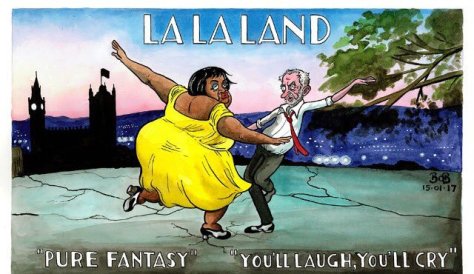
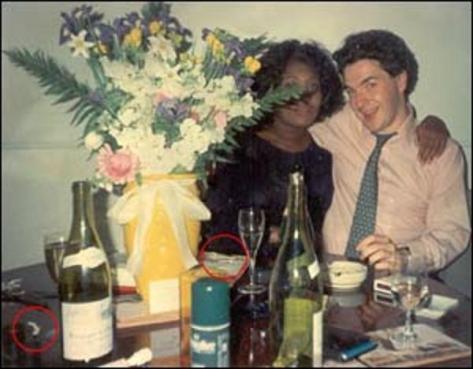
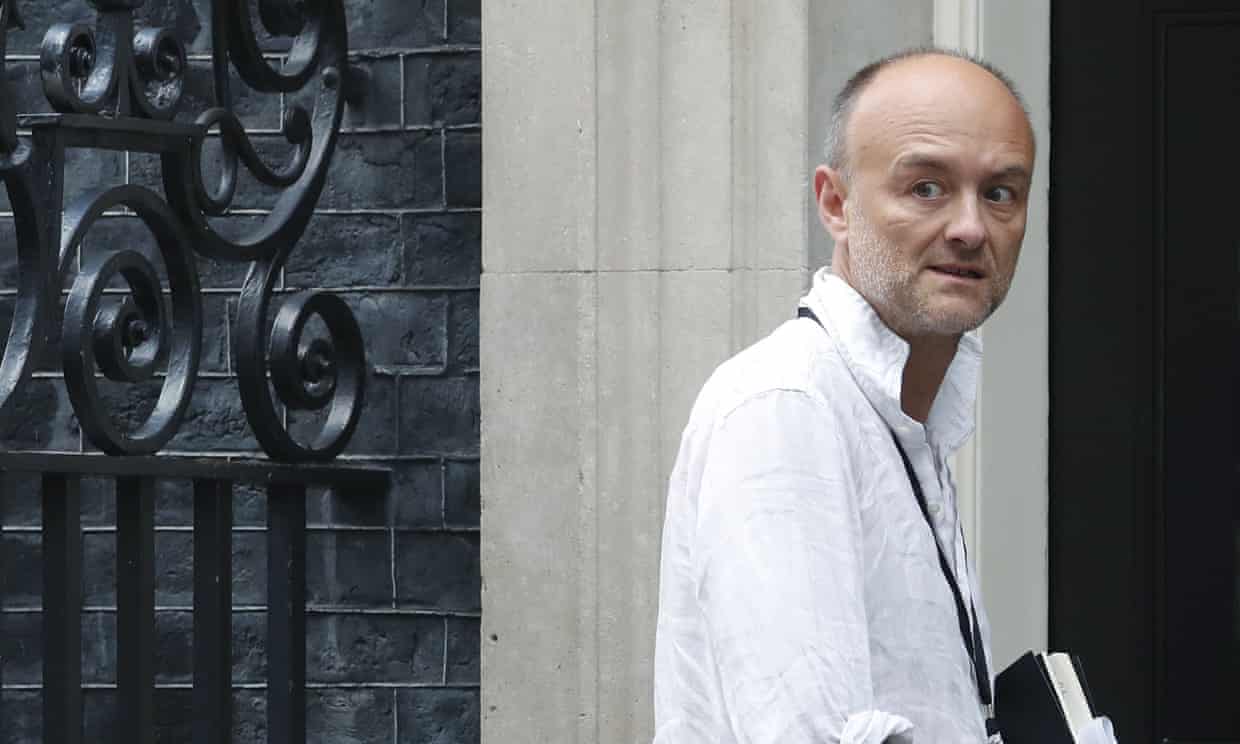
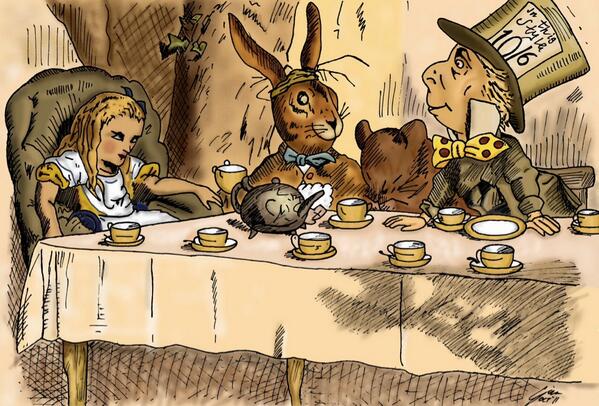
[meant to be Diane Abbott and Jeremy Corbyn, but if the cap fits…]
Harry and the Royal Mulatta: A Continuing Bad Joke
On Twitter, there are many idiots who blame “racists” and “misogynists” for “hounding” out the Royal Mulatta and her henpecked little boy. Their huge privilege goes with certain approved and customary behaviours. They want the lifestyle (minus the duties) but can’t seem to behave. This was always going to be a disaster. Some of us predicted it. Cultural differences…
Let’s just leave it at that.
I have an idea for a sitcom or comedy drama: A British royal prince marries a black woman (darker than MM, in my screenplay) and gives up his position to live with her in Hollywood, Beverly Hills or maybe Bel-Air. The marriage goes sour, she chucks him out, he is unable to return to his old life so he becomes a mixture of “bum” and private eye (a la Rockford Files)…Working title? What about “The Private Eye Prince“? Only joking…though I suppose that the Queen or Charles will have to chuck the “prince” some money to prevent him selling used Cadillacs or making money opening stores on Rodeo Drive…
To be fair to MM, at least she has some idea of what it is like to live without everyone fawning simply because you are the holder of an inherited title (come to think of it, Harry never did have that DNA test done…).
One has to ask, where would Harry be without his princely title? A junior Army officer unlikely to be promoted beyond the rank of major? An estate agent? A car salesman?
That thought (where would Harry be were he not a prince?) brings me to another thought. Were he an average Joe in title as well as every other way, would MM ever have agreed to meet him, as we are told she did, on a blind date?
Meanwhile, the tweets just keep coming!
Just had chat w/ Harry and Meghan & told them I'd set up a Go-Fund Me page for them and have an old-fashioned Southern "pounding" for them so they could get set up as "commoners." https://t.co/CvTK6ZIFNC
Meghan Markle & Prince Harry’s wax figures have been removed from the Madame Tussauds royal family display following their announcement to step back as senior Royals. pic.twitter.com/Pn1Cu3tnqv
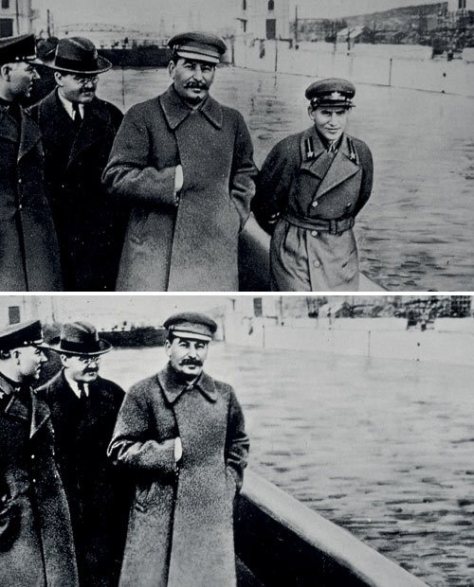
[for the historically illiterate, the above photos show Stalin with Molotov, Voroshilov and —brushed out of the second photo, having become an unperson— Yezhov, on the Moscow River embankment c.1937].
I am not a royalist, though not exactly an anti-royalist either. It all depends on circumstances and on the type of society.
“The welfare of the people is the highest law” [Cicero]. Harry has probably never heard that one.
For those who are dyed-in-the-wool royalists, and for those concerned about the —literally— millions of pounds of public funds spent only recently on renovating the “cottage” occupied by Harry and MM, I offer this consolation: Harry and the Royal Mulatta are still going to spend some time in the UK, their very presence providing balm and comfort to the repressed and suffering British people. Yes, indeed, they will fly in on private jets and helicopters to lecture the grateful British masses on “climate change” and, of course, “how to be multicultural”…So the £3M those taxed masses have had taken off them for the refurbishment etc (oh, and of course the £1M p.a. security costs, and the costs of world travel etc) have not been wasted. Oh, no, wait…
What is really funny is that all the “left wing” Twitterati, those who (you would imagine) oppose royal privilege, are actually on the side of Harry and MM. Ha ha! Those idiots.
“Ali G” said it!
Dominic Cummings
Not much in recent days from No. 10’s lunatic-in-residence. I blogged (again) about him last week:
Only in Private Eye: the People's Prime Minister answers questions from the public (but not ones from his wife's divorce lawyers like "how can you afford to go to Mustique?"). Plus an exclusive diary from Dominic Cummings, as told to Craig Brown. Buy your copy now! pic.twitter.com/10ffe7titk
I do not think very highly of loudmouth msm talking head James O’Brien, but I agree with this!
I am naturally very scruffy. Clean but incredibly messy. Even when I’m suited & booted for telly etc I will look creased & dishevelled within two hours max. And I don’t see how anyone can routinely look as absurd as Dominic Cummings without consciously trying to.
Trump has appeared at a White House press conference slurring his words and even odder than usual. I have previously wondered whether Trump has suffered some physical brain abnormality, something causing organic change. So far no proof of that beyond his behaviour and his peculiar and puerile-looking tweets etc. Now he has had killed an Iranian general, has threatened to obliterate Iran (Hillary Clinton did that too; they’re both in the Jew-Zionist/Israeli pocket) but has not retaliated after Iran sent missiles into Iraq.
What’s going on? Has Trump been drugged to stop him launching a world war? Are we in “Seven Days in May“?
In the next 5 years, almost anything could happen.
Alison Chabloz
Alison Chabloz is in court tomorrow, at Derby. She appeals her conviction and sentence (8 weeks’ imprisonment, notionally) for breach of a condition of her original 2018 sentence. Good luck to her! May justice and mercy prevail!
“Treason is a matter of timing”, Talleyrand is supposed to have said. A remark which perhaps goes down better in some countries than others, though really it has universal application. I suppose that it has two basic elements: treason; timing.
We all think that we know what “treason” means, but in fact there have been various definitions throughout the world and throughout history. We hear, in Robin Hood films and the comments columns of newspapers, the term “high treason”, for example, but outside the ranks of (some) lawyers, linguists and historians, the “high” seems just hyperbole to most people. The meaning, to most, can be said to be “caviar to the general”, above their heads.
In Germany and other Germanophone countries, there were traditionally two types of treason, Landesverrat [“Country Treason”] and the more serious Hochverrat [“High Treason”].
In fact, in the past, the main difference between the two, from the point of view of the captured perpetrator, was that he would be put to death in a somewhat less unpleasant manner for “Landesverrat“! Cold comfort, perhaps.
High Treason was doing such acts as to take over the State, or place the State under the rulership of another state; the lesser kind of treason would be to do acts such as helping the enemies of the State, giving secret information to those enemies, fighting on their side etc.
I suppose that one could, cynically, add the word “attempt” before the above “to take over the State”, inasmuch as a successful attempt to take over a state is not regarded as “treason” by the successful new rulers, and so the State itself, but as merely an incident of history. Only unsuccessful (“high”) traitors are punished; the successful ones punish others…
Other countries have other definitions of treason.
“The British law of treason is entirely statutory and has been so since the Treason Act 1351 (25 Edw. 3 St. 5 c. 2). The Act is written in Norman French, but is more commonly cited in its English translation.
The Treason Act 1351 has since been amended several times, and currently provides for four categories of treasonable offences, namely:
“when a man doth compass or imagine the death of our lord the King, or of our lady his Queen or of their eldest son and heir”;
“if a man do violate the King’s companion, or the King’s eldest daughter unmarried, or the wife of the King’s eldest son and heir”;[28][29]
“if a man do levy war against our lord the King in his realm, or be adherent to the King’s enemies in his realm, giving to them aid and comfort in the realm, or elsewhere”; and
“if a man slea the chancellor, treasurer, or the King’s justices of the one bench or the other, justices in eyre, or justices of assise, and all other justices assigned to hear and determine, being in their places, doing their offices”.
Another Act, the Treason Act 1702 (1 Anne stat. 2 c. 21), provides for a fifth category of treason, namely:
“if any person or persons … shall endeavour to deprive or hinder any person who shall be the next in succession to the crown … from succeeding after the decease of her Majesty (whom God long preserve) to the imperial crown of this realm and the dominions and territories thereunto belonging”.
[Wikipedia]
These “heads of treason” are now largely of historical interest, and the acts commonly charged via other laws, but it will be recalled that, after the 1994 book, Princess in Love, by the Jewess Anna Pasternak, about the affair between Princess Diana and the (by then, ex-) Guards officer James Hewitt, was published, an enterprising reporter from the Sun “newspaper” tried to make a citizen’s arrest of Hewitt for treason, for “violating the wife of the King’s eldest son and heir”! That would have made for an interesting incident, but Hewitt kept his front door firmly shut.
Treason. Were the officers involved in the 20 July 1944 plot to kill Hitler “traitors”? Hitler thought so! German law (as it was in 1944) also said yes. In fact, I am not convinced that German law as it now is would acquit the plotters (though I concede that my knowledge of German law is at best fragmentary). I blogged once or twice about those events:
These matters have been discussed more in Germany and France than they have in the UK. Nuances of loyalty have been tested more on the European mainland. The events around the Reich and the Second World War led to shades of meaning not always understood in the UK. In France during WW2, there was a spectrum of loyalties ranging from monarchist (!) and extreme conservative, through Gaullist and moderate conservative, to social democrat, to socialist, to Communist (pro-Stalin) and Trotskyist. Not all were hostile to Vichy and/or Germany. To give just one example, Francois Mitterand was supposedly both a “resistant” and part of the Vichy government, peripherally.
Some Frenchmen were not only pro-Vichy but pro-National Socialist. A relative few, perhaps 11,000, volunteered for SS Charlemagne:
Honourable pro-German Frenchmen such as Christian de la Maziere were not, in their own eyes, “traitors”, any more than were, in their own eyes, German officers such as von Stauffenberg.
Of course, the masses like simplicity. In the UK, they were told that Mosley was a traitor (though of course never tried as such), and I suppose that a number of simple people still believe what they have heard based on that wartime propaganda.
Take another case: “George Blake” (born Behar, a half-Jew). Traitor? Many would say so, on the basis that he was in British service and even had a British passport:
These nuances seem rather un-British, but they would not perplex the spymasters of the 16th Century, such as Walsingham, used as he and his opponents were to ideological allegiance crossing national or state lines; in that era, allegiance based, usually, on religion.
What about timing? Well, of course, sometimes timing, as Talleyrand expresses, is what makes treason, treason. The officers who plotted against Hitler and survived became acceptable in postwar West Germany.
Timing is important in so many things. I was rereading a book I had not seen for about 25 years, In the Gunsight of the KGB. A quite compelling story of how a professor of Marxism-Leninism, Ushakov, was arrested for anti-Soviet agitation (being a dissident), released by administrative error, then fled to avoid re-arrest and certain long imprisonment. The half of the book that deals with his flight and then escape across the heavily-guarded Soviet-Turkish border is a good read; the rest, which deals with his views about Sovietism and upcoming events, is rather poor.
Timing is especially instructive here: Ushakov fled in 1984, if memory serves. Now, today, we know that had he avoided arrest in some lawful way, he would have been able to travel freely in about 7 years. Had he been imprisoned, he would have been released by the late 1980s if not before. He, however, did not know that!
How could he have guessed that the whole Soviet system (which he still fears in his book, regarding it as almost all-powerful and able to hoodwink the West easily: the Golitsyn syndrome) would crash to nothing after 1989, the State itself being dissolved by 1991?
In fact, Ushakov was unlucky also in that his book came out in August 1989, only a couple of months before the collapse of the Berlin Wall, followed by that of socialism across Eastern and Central Europe and then in the Soviet Union itself. Ushakov’s book was therefore obsolescent by the time it hit the bookshelves (though the adventurous first half is still, even today, of interest). Ushakov therefore fell into obscurity, whereas he might well otherwise have followed, in a minor way, in the footsteps of more famous dissidents, escapees and defectors, such as Bukovsky.
We all stand within the bounds of time and space. At present, our world seems almost immutable, but beware the hubris of thinking that our Western society will continue forever (“The End of History” fallacy). In fact, I should say that there is every chance that the world we know will not be around in its present form for much longer.
What makes me laugh, if bitterly, is that so many msm characters still sort-of believe that we in the UK live in a “democracy”, even if flawed. If we are in a “democracy” at all (and it is of course a question of definition: see my brief historical analysis in Notes, below), then it is one where the democracy is little and mostly on the surface:
Christopher Steele, ex-head of MI6 Russia desk & author of so-called ‘Steele dossier’, has made very few public pronouncements. If he talks – as he does below – we really should listen. Lack of action against election interference = ‘scary’ https://t.co/JN1mjuwklk
“The release of documents began on New Year’s Day on an anonymous Twitter account, @HindsightFiles, with links to material on elections in Malaysia, Kenya and Brazil. The documents were revealed to have come from Brittany Kaiser, an ex-Cambridge Analytica employee turned whistleblower, and to be the same ones subpoenaed by Robert Mueller’s investigation into Russian interference in the 2016 presidential election.
Kaiser, who starred in the Oscar-shortlisted Netflix documentary The Great Hack, decided to go public after last month’s election in Britain. “It’s so abundantly clear our electoral systems are wide open to abuse,” she said. “I’m very fearful about what is going to happen in the US election later this year, and I think one of the few ways of protecting ourselves is to get as much information out there as possible.”
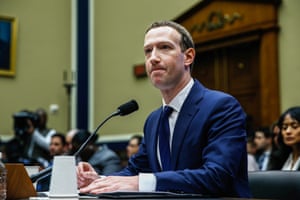
[Facebook’s Mark Zuckerberg testifies to Congress after it was reported 87 million Facebook users had information harvested by Cambridge Analytica. Photograph: Yasin Öztürk/Anadolu Agency/Getty Images]
The documents were retrieved from her email accounts and hard drives, and though she handed over some material to parliament in April 2018, she said there were thousands and thousands more pages which showed a “breadth and depth of the work” that went “way beyond what people think they know about ‘the Cambridge Analytica scandal’”.”
UK General Election 2019
The recent General Election was a prime example of the depths into which British “democracy” has fallen. The main three System parties were all headed and fronted by idiots:
Boris-idiot, who shows off his rote-learned ancient Greek and Latin, together with his collection of obscure words from the OED, when he wants to impress the plebs. A part-Jew public entertainer, useless at all previous jobs, sacked from most, whose previous bosses and colleagues concur in saying how useless, dishonest and unpleasant he is. Someone with no real ideas politically or ideologically;
Jeremy Corbyn: a long-term political self-caricature. At least he is anti-Zionist, but spoils even that by parrotting “holocaust” and “anti-fascist” nonsense, marking Jewish holidays etc. A personification of ideological cognitive dissonance, who was backed up by another idiot exhibiting similar traits, John McDonnell (who after the election result was interviewed in his garden, looking bemused and indeed like nothing more than a “grandad” who had been tipped out of his wheelchair and mugged). Corbyn’s political idea for the UK seemed to be a mixture of Labour policies 1945-1992, 1960s Cuba, 1980s Nicaragua, or the crazy Venezuela of more recent times, with a bit of (cartoon version) 1930s politics thrown in— “No Pasaran!” Spanish anti-Franco-ism, the Front Populaire, “the battle of Cable Street” etc. A joke;
Jo Swinson: doormat for the Jew-Zionists, who thought that she could be a Prime Minister when she was already hugely over-promoted as leader of the pathetic LibDem party, which seems to have no reason to exist anyway.
Ecce, your “democratic” choice!
Then we see that a fake pop-up “party” (Brexit Party), promoted by a con-man (Farage) siphoned off any radical nationalist votes, then unexpectedly withdrew all candidates facing Conservative Party candidates. A deliberate manipulation, probably a conspiracy. Possibly even procured by secret bribes, paid to Farage offshore. That is my honest belief, anyway.
And that is before we even consider the role played by the (basically, mainly) Jew-Zionist dominated Press, TV, radio etc. It has already been established by objective academic studies that Boris-idiot and his party were given a completely one-sided easy treatment as compared to Labour. (((They))) wanted Boris-idiot to win. He did.
This is what our “democracy” has come to. You get someone who, like Jess Phillips, is basically uneducated, uncultured, a careerist and/or freeloader (see her MP expenses: eg she employs her husband as “Constituency Support Manager”, meaning house-husband, for which she claims £50,000 a year for his pay, plus this and that).
The selection procedures of the System parties are pathetic. Most people with any real background are filtered out if they have their own views. The ones who get in are those who, like Jess Phillips, cobble together a CV from bits and pieces, and know people. Again, look at Iain Dunce Duncan Smith and his fraudulent CV. Or women like Liz Tr[redacted] and Lucia[redacted], who can be said to have become MPs “on their backs” (if that is the accurate phrase). Then once installed, those MPs are exceptionally hard to remove, particularly if they know the right people in their local party organization.
Boris-Who? Boris-How? Boris-Where?
People are asking “where is Boris, at this time of huge tension in the Middle East?” Well, the straight answer is that he is in a £20,000 a week villa on Mustique, but the answer to the implied question is another question: who cares where the idiot is?
The people who think that Boris should be in Whitehall, leading Britain’s response to the US and Iran, are those who think that Britain is still some kind of huge international player militarily. In reality, not so. We hear a lot about how Britain “punches above its weight” because of its commercial and financial hub position, because of its (supposed) intelligence and security expertise, because of its proficient armed services, even because of the English language!
There is some truth, of course, in all of those, but to say that Britain is a huge player militarily or geopolitically is mainly wishful thinking. It is the same or similar self-delusion that leads people (often misled by scribblers making money out of it) to think that National Socialist Germany was defeated mainly by clever little people in Whitehall back-rooms thinking up terribly clever “deception” operations, running “resistance” networks in occupied Europe etc.
Well, these activities did have some peripheral effect or effects (the ones that worked at all; a notable amateur duffer was the later James Bond scribbler, Ian Fleming), but of course those operations (The Man Who Never Was, the Double-Cross System, and virtually anything attempted by the ludicrous Special Operations Executive) were, or were supposed to be, subordinated to actual military operations.
The Reich was defeated, of course, not by terribly precious people in Whitehall, White’s Club, or the Ritz bar, thinking up deception operations and directing small numbers of sociopaths (in the Maquis, the “Resistance” etc), stabbing lone Germans in the back, or blowing up cafes, but by the millions of Red Army soldiers on the Eastern Front, gradually advancing with their tanks, horses, field guns and terror, by the huge American armies, navy, air force and, though hidden, atom bombs, and by the similar millions of British and Empire soldiers, sailors and airmen, fighting on all fronts.
Britain today is not really very powerful. I regret that, but it does not help to pretend that Britain is almost a superpower. One is reminded of the speech given to the assembled Con Party Conference at 25 years ago by Michael Portillo (he is better as a TV train buff; I enjoy his shows). In fact, part of that speech was good, but he made a fool of himself by pressing into service the name of the Special Air Service:
The thing is that, yes, elite units like the SAS are superb tools of the State, but —as General Schwarzkopf said in the 1990s Gulf War— “special forces do not win wars”. They are strategic tools, to be used in “special” strategic situations, and are not much good —and indeed wasted— in ordinary battles or large scale advances.
The fact is that Boris-idiot, as notional chief of the UK, is not really a player, unless the USA wants Britain to be seen to be there as “ally”, rather than USA seen to be acting unilaterally, which of course is the reality (with Israel hiding behind the curtain).
The events of the world, whether in Iran, Iraq or elsewhere, are happening regardless of what Boris-idiot says or does. Anyway, Britain only has about 70,000 in its Army, and of those only about 50,000 are even deployable. Many are simply not fit for duty, let alone action.
The fact is that Britain is a spectator for the most part. I suppose that the British nuclear forces (on submarines) are the exception to that. It would be an extraordinary misuse of them to utilize them to attack Iran, though, in support of Trump’s adventurism and Israel’s hidden agenda.
Trump and Iran
Trump has managed to do what generations of peacemakers failed to do— unite the Iranians and Iraqis! I suppose, to be fair, Teheran’s influence over Baghdad has been growing for many years anyway.
Looking at the wider picture, in the 1970s, 1980s, Israel was menaced by anti-Israel states all around. Iran, Syria, Iraq, Jordan, UAE, Saudi Arabia, Lebanon, Egypt and other North African states, Libya in particular. Now look! Syria, Iraq both devastated, Egypt under “control”, Libya on its knees and engaged in internecine conflict, Lebanon flooded with refugees from Syria, and the Gulf Arabs almost lining up to say nice things to Israel.
These changes did not come about by accident. Now Iran is in the gunsights of the Israelis and, more importantly, their “tail wags dog” “ally”, the United States, which subsidizes Israel, gives or sells it weapons, supports everything that Israel does or wants, yet tells its own people that the USA needs Israel, when the reality is of course the reverse!
Today the President of the United States said he is willing to target civilians, cultural sites, and places dear to a society in order to inflict TERROR.
It seems that Iran has offered USD $80M for the head of Donald Trump. About $79,999,099 more than it is worth! Tempting though…Sadly, it is about 42 years since I last fired a long-distance rifle (and if one were to enter the lists, it would be nice to have the chance to spend the bounty…).
Alison Chabloz, the persecuted singer-songwriter, is in court on Friday 10 January 2020, her appeal hearing against a relatively brief prison sentence imposed for “breach of condition” within another sentence. Good luck to her!
Easy to laugh at, but withal quite serious. Maybe very serious.
Trump and Iran
The attack at Baghdad Airport will have one of three possible results:
Nothing
Out and out war between Iran and the USA
An oblique response from Iran.
No prize for guessing that I think that the third option is most likely. Outright war is impossible, a regional power without deliverable nuclear weapons against the world’s (still) only functioning superpower. So what would an “oblique response” be? Maybe something that hits the USA economically, maybe something such as the assassination of a head of state or government (keep your head down, Donald!), maybe the same but aimed not at the USA directly but at its allies.
Speculating in an admittedly not very original fashion, one might wonder whether Iran might not at some point launch an all-out missile and other attack on Israel. It might be said that Israel’s nuclear capability would render such an attack suicidal. True, but still, it could happen. A similar attack but on, eg, the United Arab Emirates. More likely. Or on Saudi.
As to Trump himself, I find myself wondering whether he has some physical problem with his brain. I was reading a few of his tweets. They seem abnormal yet not in the slightest intelligent. I suppose that the US President gets brain scans etc as part of the silly annual ritual of the President getting a clear bill of health. I suppose…
A Woman Who Knows Secrets
The UK is now being run by a bunch of inept Politicians who in the real World wouldn’t even be able to get a job has an Estate Agent. Trust me I know Plenty of Etonians that are working as Estate agents because even with their fully paid up Education, they’re thick as Wood
[above, same person, many years ago, with the young part-Jew who later became Chancellor of the Exchequer, George Osborne; on the table, a bottle of wine and —circled in red— evidence of cocaine abuse]
Below: Ignorant loudmouth MP Jess Phillips put in her place by one of the State’s former (and unofficial) “chief whips”…
You are more deluded if it was ever possible than Jo Swinson. If you ever became leader of the Labour Party I’d be more disappointed than I am that Racist Lying Coker Boris Johnson is now leader of the Cons, that’s his much of a fraud I know you are. https://t.co/r5NiD6t3ql
Below, she makes an equally good point (the second tweet)…
Take note! You can join the Army all you like, but before you do, ask those that have left the Army and are homeless living on the Streets, suffering from PTS and worse, how their life is going?,while the Politicians who promised you The Land of Hope and Glory, turn their backs.
I WENT into a public ‘ouse to get a pint o’ beer,
The publican ‘e up an’ sez, ” We serve no red-coats here.”
The girls be’ind the bar they laughed an’ giggled fit to die,
I outs into the street again an’ to myself sez I:
O it’s Tommy this, an’ Tommy that, an’ ” Tommy, go away ” ;
But it’s ” Thank you, Mister Atkins,” when the band begins to play
The band begins to play, my boys, the band begins to play,
O it’s ” Thank you, Mister Atkins,” when the band begins to play.
I went into a theatre as sober as could be,
They gave a drunk civilian room, but ‘adn’t none for me;
They sent me to the gallery or round the music-‘alls,
But when it comes to fightin’, Lord! they’ll shove me in the stalls!
For it’s Tommy this, an’ Tommy that, an’ ” Tommy, wait outside “;
But it’s ” Special train for Atkins ” when the trooper’s on the tide
The troopship’s on the tide, my boys, the troopship’s on the tide,
O it’s ” Special train for Atkins ” when the trooper’s on the tide.
Yes, makin’ mock o’ uniforms that guard you while you sleep
Is cheaper than them uniforms, an’ they’re starvation cheap.
An’ hustlin’ drunken soldiers when they’re goin’ large a bit
Is five times better business than paradin’ in full kit.
Then it’s Tommy this, an’ Tommy that, an` Tommy, ‘ow’s yer soul? ”
But it’s ” Thin red line of ‘eroes ” when the drums begin to roll
The drums begin to roll, my boys, the drums begin to roll,
O it’s ” Thin red line of ‘eroes, ” when the drums begin to roll.
We aren’t no thin red ‘eroes, nor we aren’t no blackguards too,
But single men in barricks, most remarkable like you;
An’ if sometimes our conduck isn’t all your fancy paints,
Why, single men in barricks don’t grow into plaster saints;
While it’s Tommy this, an’ Tommy that, an` Tommy, fall be’ind,”
But it’s ” Please to walk in front, sir,” when there’s trouble in the wind
There’s trouble in the wind, my boys, there’s trouble in the wind,
O it’s ” Please to walk in front, sir,” when there’s trouble in the wind.
You talk o’ better food for us, an’ schools, an’ fires, an’ all:
We’ll wait for extry rations if you treat us rational.
Don’t mess about the cook-room slops, but prove it to our face
The Widow’s Uniform is not the soldier-man’s disgrace.
For it’s Tommy this, an’ Tommy that, an` Chuck him out, the brute! ”
But it’s ” Saviour of ‘is country ” when the guns begin to shoot;
An’ it’s Tommy this, an’ Tommy that, an’ anything you please;
An ‘Tommy ain’t a bloomin’ fool – you bet that Tommy sees!
Good grief! If this [see below] really is a snapshot of the mind of Dominic Cummings, then the government really is in the hands not only of idiots (eg Boris-idiot, Priti Patel etc) but of lunatics.
It also reminds us that lunacy is not really so hard to distinguish from genius, in most cases.
Say what you like about Dominic Cummings but this part of the blog is *spot-on* about the sort of people the civil service needs to start attracting. pic.twitter.com/0cfCatmSLr
[Update, 23 January 2020: the full lunacy of Cummings’ blog post, some of which was in the deleted tweet above, seems to have been expunged from the Internet, though maybe one of his “weirdos and misfits” would be able to find it]
[Update, 12 May 2024: the tweet appears to have been reinstated on Twitter/X and so is now visible here too]
The above (apparently from a blog penned by Cummings) is an inward-gazing stream of consciousness (though purporting to be to the point) worthy of someone whose residential address ends with the word “Hospital”, or similar.
What makes it alarming is that Cummings is not just a stray “Conservative” (and the word seems ever-less useful as a descriptor) who is on the periphery of power (in the way that the Monday Club or the Bow Group used to be), but someone right at the centre of what could be (perhaps inaccurately) called the Johnson Project. Indeed, “Cummings Project” might be more accurate. Boris Johnson himself has few ideas beyond schoolboy fantasies such as building bridges from Scotland to Ireland, creating artificial islands with Metropolis airports on them etc.
There was talk before the recent General Election that in Cabinet (effectively in Cabinet; I suppose technically, Cabinet committee), Cummings actually overruled the Prime Minister several times. Not just spoke over him, but overruled him on decisions! Now, OK, the person posing as Prime Minister is Boris-idiot, a bad joke PM who is a proven serial —indeed constant— liar, incompetent and fantasist, but there is still such a thing as respect for the office itself…
Dominic Cummings seems to me (admittedly only from what I have read…I have never met him or anyone who has met him) to be like a person who is somewhere between a guest and a gatecrasher at a dinner party, someone who has no idea how to behave and who has no respect for the hosts, the guests, the staff or the event.
Is there anything correct about his views re. government and civil service? Yes, the gene pool is shallow or narrow; in politics now even more so than in the administration proper (Civil Service), but the answer to that is to carefully reform recruitment and training, as well as overall structure, not to let off hand grenades all over Westminster.
I think that we have to remind ourselves that governing the UK is not some kind of pathetic country house weekend game in the drawing room or Hall. This impacts on real people, in their millions, all over this country. It is not a matter of scribbling some clever little half-baked idea that can be run up the flagpole at the Oxford Union or (taking on board the Cummings dislike of Oxbridge) a Spectator drinks party.
It may seem lazy to say “it is easier to destroy than create”, but the thing about truisms is that they contain truth. The machinery of administration and government in the UK was created over centuries, and particularly in the century or so since the mid-Victorian era. Once you tear it to pieces, you may find that groups of supposedly terribly clever little people, weirdos and misfits, sitting in groups around Whitehall, cannot in fact replace what presently exists.
Britain today has already suffered a number of shocks to its postwar (post-1945) stability: Thatcherism, mass immigration (accelerated since 1997), Blair-Brown “reforms”, the financial crisis of 2008, the fake “austerity” of the evil 2010-2019 “Conservative” governments (particularly the half-baked idiocies of Dunce Duncan Smith and his underlings). Now this.
Dominic Cummings is a History graduate, for what that is now worth. He will know, I presume, what happens to societies when everything that underpins their stability is knocked away. I presume that he also knows that revolutions usually consume their own children…
Update, 6 January 2020
Can't believe we got outmaneuvered twice by a man who's barely mastered keeping his anus on the inside of his trousershttps://t.co/E9hciVrV8j
More news about the half-Jewish “ho” madam, Ghislaine Maxwell:
Well, give that man a cee-gar! Turns out that I guessed right (I usually do, if I myself say so):
“Jeffrey Epstein’s socialite ‘madam’ Ghislaine Maxwell ‘is being hidden from the FBI in a series of safe houses because of the information she has on powerful people’”
Maxwell has remained incognito since Epstein’s arrest and death behind bars
New report claims both she and Epstein were ‘assets’ for a foreign government
Source says they funneled dirt on the rich and powerful to foreign spies
Now Maxwell may be hiding in a safehouse in Israel, the new report claims
She is a British and US citizen, and daughter of an alleged Mossad operative.“
“An explosive new report has asserted that deceased sex criminal Jeffery Epstein and his alleged ‘madame’ Ghislaine Maxwell were foreign intelligence ‘assets’, and that she is currently hiding in a safehouse in Israel.”
“She is not in the US, she moves around. She is sometimes in the UK, but most often in other countries, such as Israel, where her powerful contacts have provided her with safe houses and protection,’ the source said.”
“Born in France, Maxwell is both a U.S. citizen and British subject. Her family’s alleged ties to Israel’s national intelligence service, Mossad, have been well documented.
Maxwell’s father, Robert Maxwell, was a Czech-born ‘British’ [Jewish] media mogul whose financial fraud in raiding the Mirror Group pension fund was discovered after his death in 1991.
Also a ‘British’ member of parliament, Robert Maxwell reportedly had ties to British intelligence, the Soviet KGB, and Mossad — and was suspected of being a double or even triple agent by British Foreign Office officials.“
The shake-up of the Civil Service seems to be in the hands of Dominic Cummings but is being written about by a “Conservative” insider with a new name —new to me at least— called Rachel Wolf. Presumably Jewish.
[Further addendum: The author noted above is a partner at a firm of lobbyists called Public First. Another partner there is one Gabriel Milland, who was previously “Head of Media” at the Britain Israel Communications and Research Centre [BICOM], effectively an arm of Israel though funded, at least notionally, privately. See https://en.wikipedia.org/wiki/Britain_Israel_Communications_and_Research_Centre
It will be recalled that, prior to her becoming a Labour Party MP, Ruth Smeeth, who lost her seat at the 2019 General Election, was exposed as having been a “confidential contact” of officials at the US Embassy in London, as well as having been deeply enmeshed in the activities of the Israeli Embassy. Ruth Smeeth was also, before that (2005-?2009), Director of Public Affairs and Campaigns at BICOM: https://en.wikipedia.org/wiki/Ruth_Smeeth#Early_life
It appears that, of the four partners at Public First, one, Natascha Engel, is a former Labour MP, acquainted with Maurice Glasman, now Lord Glasman (whose brother is a very active member of the malicious Jewish-Zionist “charity” known as the “Campaign Against Antisemitism” or “CAA”. If the connection is not fraternal, perhaps a reader can tell me).
The UK has been shaken to the core already, though it may look much the same on the surface. The Thatcher years, then later the Blair-Brown regime, followed by the evil policies of 2010-2019. Now this.
We could be looking at the collapse of society before very long. What will then be society’s judgment upon those who precipitated such collapse?
Migration-invasion
Always amusing, though predictable, to read the tweets of those determined to believe that the influx of the backward peoples into Europe, including the UK, is somehow “beneficial”, something to be (in the usual bastard language) “celebrated”. Here we see tweeters “Femi”/”@Femi_Sorry” (the African talking head the System now has on Sky News The Pledge) and “ArnieSpanner”/”@unexpectedgoalz”, both struggling with the facts ( click to read the thread)…
The degeneracy of those who support migration-invasion
Here we see Zoe Gardner aka “@ZoeJardiniere”, who was so upset to read my tweets about mass immigration that she blocked my account after she had indulged in some truly pathetic bleating. That was a few years ago. She’s still at it, though (I suppose that she cannot get a better job):
"Hungarian family policy" is about women getting back into the home to breed more nice white kids "instead of" a permissive, liberal immigration system.
Watch out women, when they come for the foreigners they are never, ever far from coming for you. https://t.co/9yYQz8h7DC
Well of course it would be terrible if women in the UK, France, Germany, Netherlands etc actually had “nice white kids” instead of agitating for the invasion of their countries by backward migrant-invaders…Oh, no, wait…
Carlos Ghosn
I know little of the rights and wrongs of the Carlos Ghosn case, but his escape from Japan was brilliant, bearing in mind the resources the Japanese brought to bear on him.
Well, here we are…not on Merry Christmas but (maybe) near Happy New Year. Time for a few stray thoughts about the year passing away, the year(s) ahead, and about where UK society and the world may be going.
I am going to be adding to this throughout the day, in a stream of consciousness way, not in any particular order or with any fixed structure.
Bush fires in Australia
As a child of 10-13, I lived in Sydney, on the North Shore (Mosman/Cremorne), in the late 1960s (2-3 years). I recall seeing bushfire damage in the Ku-ring-gai Chase area (many miles to the North) once or twice (may have been a controlled burn fire gap), but only once saw an actual bushfire, and that was when my family drove up to Queensland in 1968. Somewhere in the Northern coastal part of New South Wales. We drove through an area with fire on both sides of the highway (Australia had no motorways then outside Sydney). That cannot of course be compared to the almost apocalyptic pictures we now see on TV from NSW and Victoria.
Temperatures? Well, I do recall that, one day, in Sydney, the news was full of how the next day would be the hottest ever recorded in Sydney. I think it got to 112F (44C). One day only, as far as I can remember. I think that that was in December 1967 or January 1968. I see from Wikipedia that Sydney’s record high, more recently, is recorded as having been 45C. So not very different.
Where it is now different is that such extreme heat now seems to go on for weeks or even months. I have heard so from members of my family who have visited Sydney a number of times in the past 20 years or so (a few even live there). They have no doubt that Australia is far hotter now than it was in the late 1960s. As I say, it is now not a question of isolated very hot days but of relentless heat every year for months at a time.
No-one had aircon in their home then!
For me, the question of “climate change” or “global warming” resolves into:
Is the climate worldwide getting hotter?
Is human behaviour part (or even all) of the causation?
What if anything can be done to ameliorate the effects, or even halt the process?
For me (obviously not a scientist and/or “expert”), again, the answers (provisionally) seem to be:
There is evidence that there is a warming trend worldwide, but the evidence is far from conclusive;
Human behaviour may be part of the causative trigger, but is unlikely to be the whole or only reason why the Earth’s atmosphere etc is warming (assuming that it is);
Human behaviour might make a difference but only if the really large-scale industrial powers, with overwhelmingly huge populations, cease to exist or to exist in the way that they now do. I am talking about, mainly, China and India.
What I can be certain about is that ridiculous rants by the likes of Greta Thunberg, and the kind of pathetic sub-terrorism indulged in by Extinction Rebellion will achieve nothing at all. I have blogged about these already:
For me, it is clear that the problem is, at root, the huge human population on the Earth now, which is twice as large as it was even in 1970 and about twenty times what it was at the start of our present age (the Fifth Post-Atlantean) in or about 1400 AD.
I feel that a huge “correction” in coming. In fact, I am rather glad that I shall probably be discarnate when it happens, though I do feel a responsibility, not to do anything to prevent it (I have no power to do so anyway), but to plant a seed which may one day burst into life as a new super-race and super-culture.
The collapse of the recent “climate change” summit was inevitable. The large polluting countries, chief among them China and India, cannot do enough (on the premise that cutting back on “emissions” actually helps), the USA will not do much, so the international System and the System msm concentrate on the peripheral issues, such as “emissions” of carbon from countries such as the UK, Australia etc. The UK only produces about 1% of global carbon “emissions” anyway, so it scarcely matters, in reality, what the UK does. That is even more true in respect of Australia.
Russia and “the West”
Russia today is not the Soviet Union. It is merely a large nation-state which sits somewhere between being a regional power and being a superpower.
The Soviet Union wanted to take over the world and certainly Europe in the 1920s, 1930s and even 1940s. By the 1950s, its leaders knew that that would probably never happen. Just as the Schlieffen Plan solidified into the trench warfare of the First World War after 1914, the revolutionary and later at least expansionist aspirations of the Soviet Union had solidified by the late 1940s into the Cold War rivalry with the US-led “West”. After 1989, that had all but stopped but was then replaced by a Russian-nationalist ideology.
As it now is, Russia is not going to invade Europe, but NATO is encircling (has encircled) Russia, and is pushing. Don’t push Russia too far. It now has hypersonic missiles and is years in advance of the Americans. The new missiles can hit American targets within 15 minutes.
“The general who oversees U.S. nuclear forces, Air Force Gen. John Hyten, said in February that hypersonic missiles can strike America within 15 minutes, half the time of ballistic weapons” [Bloomberg]
The lesson is obvious: stop poking Russia with a sharp stick.
In terms of conventional arms too, if need be, Russia can place 4 million men in the field, and even its active forces dwarf those of Europe and are more effective as well. As for the Americans, they have technology and numbers, but do they have real will?
The New World Order tried to swallow Russia in the decade after 1989. It failed, thanks to the upsurge in Russian nationalism under Putin and also thanks to the Islamist upsurge.
Russia is unlikely to be the aggressor (in Europe) but do not underestimate its power.
Some people make the mistake of saying “Russia’s economy has fundamental weaknesses, therefore it is militarily weak”. A mistake made throughout history. The Medes and the Persians. The Spartans and the Persian Empire etc. Stalin said of the atom bomb, “we must have it even if we have to eat grass”…(cf. North Korea).
China
One of the jokes of recent years was the spectacle of the then UK Defence Secretary, Gavin Williamson, a former fireplace salesman, interrupting playing with his pet spider (yes, really…) to threaten both Russia and China with his meagre forces! What a total idiot! He even threatened to send one of Britain’s few (about 20) capital ships to the South China Sea! That would really frighten China, which has about 700 naval ships and submarines, and over 700 naval aircraft! Not to mention 255,000 sailors:
I have blogged a great deal about the recent General Election. No point in regurgitating all that. Still, worth recalling that the 2019 Conservative vote only increased by 1.2 points over 2017. The Labour vote fell by 8 points. All the same, Corbyn did as well or better than Miliband or Brown, in national vote percentage terms, and not far short of Blair. Unfortunately for Corbyn, the national vote percentage is not the only factor.
The General Election of 2019 reinforced my view that Labour is now a niche party for the “blacks and browns” as well as public service people. It has no broad appeal. That however may change. Had only 18-24 y o voters voted, Labour would have captured almost all seats in England and Wales, and at least half of those in Scotland. The Conservatives would, by contrast, have no seats at all, not one. Is that a straw in the wind? Was 2019 the “last hurrah” for Labour, for the Conservatives, or for both?
The roots of the Conservatives in their new Northern seats are very shallow. Look at Hartlepool, a Labour seat even now. Labour received over a third of the vote, but both Con and Brexit Party over a quarter. Volatile, like all of the North and Midlands now.
It is not beyond the bounds of possibility that Labour, if radical, could bounce back and, with new voters coming up and retired elderly ones dying, seize back the field, all but wiping out a Conservative Party which in some respect is as weak as Labour.
In the last couple of years, we have seen Jez Turner (Jeremy Bedford-Turner) convicted and (incredibly) imprisoned merely for making a humorous reference to Jews in a public speech, and the satirical singer-songwriter Alison Chabloz convicted and briefly imprisoned (the matter is still in part under appeal as I write) for singing humorous songs!
What we face in the UK is an intensification of the assault on free speech, which is actually now being placed in the hands of police supposedly investigating “terrorism”! One man was convicted in 2019 of putting up “neo-Nazi” stickers on lamp-posts. Sentence? 2.5 years! Another was imprisoned for 2 years merely for posting remarks o Twitter and Facebook. The judge in that case was unwise enough to say that the harsh punishment was “to deter others”. A poundland Judge Jeffreys…
Etc
There is a huge amount still to say, but no more time today.
Discrimination against English people is OK; but discrimination against blacks, browns, Jews etc is not OK….in this sick degenerate society
“Race row after leading private schools turn down donor’s £1m offer to help poor white boys”
“Sir Bryan said: “If Cambridge University can accept a much larger donation in support of black students, why cannot I do the same for underprivileged white British?”
Listening to Farming Today on BBC Radio 4. Lawless bands engaging in illegal hare coursing. All or almost all is done by Irish tinker “traveller” riff raff, aka “gypsies”, but the BBC will not, of course, permit those words to be used. The BBC interviews farmers in the Fen country about this criminal nuisance, but either the farmers do not dare to designate the criminals or the BBC does not permit them to do so. This gives a false picture.
It is as if these hare coursing criminals have come from outer space, as far as the BBC is concerned. No question is put on air as to who or what these “people” are; just “hare coursers”… who arrive in 4WD cars, do illegal hare coursing, bet on it, film it. But they are not “travellers”, “gypsies”, “tinkers”…oh no…BBC, police, even the victims say “No Sir, we’re not “racist”…” As Americans say, “what a crock”!
Meanwhile…
“Fewer than one in 100 alleged hate crimes investigated by the UK’s first dedicated police unit have resulted in a charge, as experts say £1.7 million would have been better spent fighting violent crime.
Just 17 cases, or 0.92 per cent of the 1,851 incidents logged by the UK’s first online hate crime hub have led to charges.
Only seven of those charges resulted in a prosecution, meaning that under one in 200 proceeded to court. Three cases were pending a Crown Prosecution (CPS) charging decision, according to the figures obtained under Freedom of Information laws by the Press Association.” [Daily Telegraph]
Ha ha!…and of those remaining 7-10 cases, most probably ended in acquittal.
Greta Thunberg (again)
Incredibly, BBC Radio 4 Today Programme, the ultimate System radio mouthpiece in the UK, has Greta Thunberg as “Guest Editor”.
I have already blogged about both Greta Nut and the connected Extinction Rebellion nonsense:
One has to ask why the Today Programme has asked this mentally-disturbed, autistic creature, 17 years old this week (on 3 January 2020), and who has no educational qualifications of any kind (not even school ones), let alone any scientific ones, to edit their show? It’s pure System propaganda.
Greta Thunberg is no more authentic than a ventriloquist’s dummy:
If I am honest, Greta Nut’s “impassioned” rants just make me laugh out loud. Ridiculous, irrelevant little nut.
Sick politics
Kay Burley was apparently offered not only a safe Westminster seat by both Lab and Con (in 2015), but even an immediate Cabinet place! The present system is just mad. It is neither democratic nor rational.
In itself, a fairly standard story about an aged “veteran” from WW2, but look at the last paragraph:
“The Dambusters raid – officially known as Operation Chastise – has gone down in history as one of the war’s most famous stories.
Purpose-built ‘bouncing bombs’ were used to target dams in Germany in May 1943 – which then burst and caused catastrophic flooding in some parts.
A post-war film cemented the raid in the nation’s popular consciousness – although it claimed more than 1,600 lives.” [Daily Mirror]
There is gradually seeping into these wartime stories the consciousness of the human cost, not only to one side in war, but also to the “enemy” (especially civilians), of such military operations.
So-called “refugees” invade Southern England, as traitors sneer (at those standing against the invasion). Note the lifejackets and the demeanour of the young men (and they are apparently all young men):
Sounds like an interesting hour. On 26 January, in Vauxhall.
“FIRESIDE READINGS – THE DOCTRINE OF FASCISM AND ADDITIONAL WRITINGS”
Location
Tea House Theatre
139, Vauxhall Walk
London
SE11 5HL
“Holdfast Theatre Company returns in 2020 with Fireside Readings.
Fireside Readings – The Doctrine of Fascism and Additional Writings by Benito Mussolini, Alfredo Rocco and Giovanni Gentile.
A controversial work, pivotal to understanding a doctrine which sought to change the world and which many say led to the Second World War. Hear from the work of Benito Mussolini and others like him who together created the philosophical underpinnings of the fascist ideology.
This is not a work for the faint hearted, nor is it an endorsement of the doctrine. It is a topic for mature minds and will, we hope, spark a healthy debate.
Contents:
The Doctrine of Fascism by B. Mussolini,
The Political Doctrine of Fascism by A. Rocco,
The Philosophic Basis of Fascism by G. Gentile.
In the Fascist conception of history, man is man only by virtue of the spiritual process to which he contributes as a member of the family, the social group, the nation, and in function of history to which all nations bring their contribution. Hence the great value of tradition in records, in language, in customs, in the rules of social life.
Outside history man is a nonentity.
Join us by the fire for this spine tingling masterpiece.
“In 2015, the Conservative Secretary of State for Work and Pensions criticised the WCA, which was introduced when Gordon Brown was Prime Minister. He called the test “unbelievably harsh”, said it contained “perverse incentives” for claimants and lamented the fact that doctors were offered only a “binary choice” when asked for their opinion on fitness for work.[21] Litchfield’s professional opinion, as expressed to Parliament, was that the test was “by no means perfect” but nevertheless adequate.” [Wikipedia]
A former naval medic whose motives seem questionable to me (see the Wikipedia entry).
Note that point about the Work Capability Assessment. Those cruel and dishonest tests were introduced under a “Labour” government, under psychotic idiot Gordon Brown.
[I wrote this for my Diary Blog, but it deserves its own article]
New Year “Honours”
This has of course been a farce for a very long time. At least in the mediaeval period, there was no hypocrisy involved. You were a crony of the King, or helped him out in battle or otherwise, you got a title, and maybe the lands (and so, income) with which to support your new-found estate (status).
Later, absurdities such as the creation of the “baronet” class, the earliest example of the “sale of honours”, went alongside honours sometimes given for real achievement in the arts, sciences and commerce.
There were scandals along the way. The sale of honours under Lloyd George was egregious not in quality (it happened before, it still happens in 2019) but in quantity. Few “average citizens” realize that hardly any of the still extant hereditary titles predate 1900. And that is before we even consider the “life peers”, which rival the baronetage in risibility.
A woman starts a bra company. Turns out that it is a house of cards that eventually collapses, but not before Michelle Mone is “elevated” to the House of Lords as a “baroness”, having convinced idiotic David Cameron-Levita that she is a great “role-model”. A West Indian woman’s son is killed by some white ruffians in a scuffle at a South-East London bus stop. What?! Oh my God! Make her a “baroness” too! And bung her family a hundred grand at the same time.
The “House of Lords” was badly “reformed” by Blair; a poorly-thought-out reform, like so much of his legislation. It is time to get rid of it.
As to the new honours list: I have not read it in detail but, for one thing, is it not incredible that Iain Dunce Duncan Smith, a proven liar and fraudster, should be “knighted”? His record:
A part-Japanese, who attended a “secondary modern” State school near Birmingham and then went on to a substandard merchant navy school on Anglesey, later fraudulently inventing a university background (was found out, but sadly too late);
Poses as a kind of “upper class” Englishman by reason of having been a Scots Guards officer (never got beyond Lieutenant in 6 years, and was considered a deadhead even in Guards circles);
Married a wealthy wife but still, for a while, fraudulently claimed State benefits;
Has always sponged off his father-in-law, even —and to this day— living for free in a house on the latter’s estate in Swanbourne, Buckinghamshire;
Has wasted literally billions of State funds in trying to make his misconceived “welfare” “reforms” work, while subjecting the sick, disabled, unemployed etc to a regime characterized by an Oriental cruelty and vindictiveness;
Has, in effect, via his policies, killed tens of thousands of people;
Fraudulently claimed hundreds of thousands of pounds on his MP expenses for “employing” his wife; in fact she never did any work at all; Dunce was, however, never tried for what was a plain fraud on public monies;
Claimed that he could easily live on a few pounds a day if he had to; meanwhile, he claimed on his MP expenses for underwear and also for a £39 breakfast at the Waldorf in London (among a huge number of other doubtful claims);
Has shown himself incapable of properly holding high office;
Time and again proven to be a liar;
Conservative Friends of Israel member…
Dunce is the most obviously unmeritorious recipient of an honour this time, but what about the degenerate singer-songwriter, Elton John? I should like to have him removed from the airwaves and from sight. There again, a black woman has apparently been given a minor honour for baking cakes. Also, there is the now-usual plethora of sports people etc. Win a cricket match or rugby game on the other side of the world? Knighthood. Bloody joke.
At the other end, there are the people who get honours for years of “service” (work). OK, and many may be meritorious; many may not be. I was slightly acquainted once with a woman who, 20+ years later (2006 or 2007), got an honour (MBE, I think) “for fostering relations with Russia”. From what I heard on good authority, mainly carnal ones…
I think that this whole business needs a reboot, especially the higher honours, the “peerages”, “knighthoods” etc.