Tag Archives: triple lock

Diary Blog, 9 October 2022, with thoughts around Liz Truss possibly freezing the UK State Pension

Morning music

[The Palace of Westminster]

On this day a year ago

5 years ago on the blog

The “grey vote”: Liz Truss adviser advised “freeze State Pension“

https://www.theguardian.com/politics/2022/oct/08/freeze-pensions-slash-nhs-schools-matthew-sinclair-liz-truss-adviser

Well, there it is. Anyone not wealthy, and over the age of 65, as well as quite a few people of lesser age, who votes for the Conservative Party, is now a turkey voting for Christmas.

During the currency of the 2010-2017 governments, David Cameron-Levita realized that the only reliable demographic voting Conservative was that of “older people” generally— the older the voter, the more likely was he (or she) to vote Con, and also the more likely that that voter was to actually vote at all.

UKIP and, also, Farage’s other and later vehicle, Brexit Party, were mainly made up of fairly grey-haired and mostly ex-Conservative members and voters, people who at least vaguely realized that the Conservative Party was actually helping to destroy Britain, as the young Disraeli once wrote [“the great Conservative Party, that destroys everything“] and wanted a party that reflected their views better.

The trend is more or less the same now, except that UKIP and Brexit Party do not exist in any real sense, though Reform Party has taken up some of that slack.

Cameron-Levita and his cronies knew that fewer and fewer “younger” people, especially voters under the age of 30, were voting Con. That underlined the need to consolidate the Con vote in older age-groups, and especially the group that not only mostly voted Con, but could be relied upon to cast a vote, those in receipt of a State Pension, meaning those over 65 and some over about 62 (the eligibility age being slowly raised over time).

There were other factors: the older sections of the population were also those more likely to own a house or other dwelling outright, having either never had a mortgage or having paid it off while in their fifties, typically. The rise in nominal money-value of residential property therefore benefited that same group of older people.

The older sections of the population, especially the pensioners, were also those who favoured Brexit the most.

It is widely accepted that the general elections of 2015 and 2017 were won by the Conservative Party entirely by reason of the pensioner vote.

“In the 2017 general election age became a clear dividing line in British politics: older voters overwhelmingly voted Conservative and younger voters backed Labour.

The data shows that there are still some clear patterns along these lines, although the waters are somewhat muddied by a move away from two-party politics.”

[YouGov: https://yougov.co.uk/topics/politics/articles-reports/2019/10/31/2019-general-election-demographics-dividing-britai].

“The average age of the Conservative voter is such that the steepness of its “age curve” (the increasing probability of a person at 2017 voting Conservative given their age) is now almost certainly steeper than the natural degree to which people “get” more Conservative as they age. This is important as it suggests that new cohorts of voters cannot replace and replenish the ranks of the Conservatives, even if they do naturally get more Conservative over time.”

[https://wpieconomics.com/insights-archive/newsletter_blogs_polling-and-the-conservative-loss-of-political-ascendancy/]

See also: https://www.varsity.co.uk/opinion/22276.

The Conservative Party induced that reliable pro-Con voting bloc to carry on voting Con by introducing the “Triple Lock”, by which State Pensions would rise by the rate of inflation, or average pay, or 2.5% a year, whichever of the three was the greatest.

That obviously suited most pensioners very well, and secured those two election victories.

Poorer pensioners who received both State Pension and Pension Guarantee Credit were also served not badly, because the State Pension was covered by the Triple Lock, while Pension Guarantee Credit would still increase in amount, though only in line with inflation.

Rishi Sunak suspended the inflation part of the Triple Lock in 2021 (for financial year 2022-2023) [https://www.bbc.co.uk/news/business-53082530], thus —if you like— cheating pensioners; he also thereby broke the election pledge the Conservative Party made during the 2019 General Election.

Sunak, best known for his “panicdemic” “free money” giveaways, probably has that Triple Lock default, or sleight-of-hand, to thank for his not being ushered in as Conservative Party leader in 2022.

The vast majority of actual Conservative Party members are either pensioners or not far from becoming so. The, so-to-speak, “Indian giver” was basically given a slap by the Conservative Party pensioner membership. Had he not cheated the pensioners, Sunak would almost certainly be Prime Minister by now.

I’m laughing…

Now, it seems that the Liz Truss government may or may not continue with —that is, reinstate— the Triple Lock after 2023 (she still says yes…), but State benefits including Pension Guarantee Credit may or may not be uprated in accord with inflation— they may even be frozen.

“Under the triple lock, pensions increase by the highest of earnings growth, price inflation or 2.5 per cent a year.

The government temporarily suspended the wages element of the pensions triple lock for 2022-23 to avoid a disproportionate rise of the state pension following the pandemic.

…former chancellor Rishi Sunak confirmed the return of the triple lock in May, and prime minister Liz Truss has since said she is “fully committed” to the lock.

…“With inflation into double-digits, average earnings (total pay) of 5.5 per cent isn’t expected to be the deciding factor in next April’s state pension increase. The state pension is likely to increase by around double this at over 10 per cent, confirmed in September’s inflation figure published next month.”

…“While prime minister Truss committed to reinstating the triple lock in the immediate term during her leadership campaign, questions will remain over its affordability and whether the triple lock will survive in its existing form in the manifestos of all parties ahead of the next general election.”

[FT Adviser]

Can Liz Truss be trusted or relied upon? I think not (and her husband knows not!).

One thing is for sure— if Liz Truss or woolly-head Kwarteng short-change the “grey vote” any time between now and the next general election, that “grey vote” will either vote elsewhere or even just abstain, though it is ingrained in most of those of pensionable age that they should at least vote, as a civic duty.

There is also the point that house prices are forecast to fall, perhaps significantly, in 2023.

The Conservative Party is now around 20% in the opinion polls. Most of that hard-core 20% is composed of the “grey vote”. “Mess them about” by interfering with the State Pension and/or Pension Guarantee Credit, and the Con vote nationally, at a general election, might fall to as low as 10%. Then it would be “Goodnight Vienna” for the Conservative Party.

Tweets seen

Quite. Meaningless “exam passes”, “degrees” etc. Is James Cleverly any better or worse a Foreign Secretary for having a “degree” in Hospitality Management? It might even be “worse”…

Subhumans.

More music

More tweets

Britain needs social nationalism. It alone can give the people what they need now and what they need for the future of their children.

Late tweets seen

I agree with both.

Social nationalism’s chance to rise up, and destroy the enemies of Europe’s future, will soon arrive.

Late music

Diary Blog, 13 August 2022

Morning music

On this day a year ago

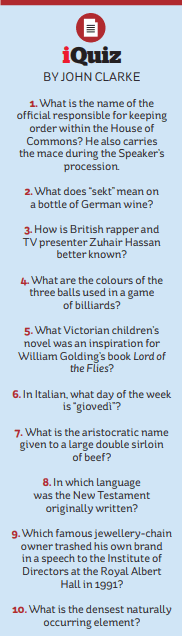
Saturday quiz

Well, I again beat political journalist John Rentoul this week— 5/10 as against his slightly shocking 2/10.

I would have scored 7/10 had I been able to recall the answer to question 7 (which I basically knew) and had I been more observant in the many billiard rooms I have seen, and so been able to answer question 4.

Apart from those questions 4 and 7, I did not know the answers to questions 3, 5, and 10.

NHS

https://www.dailymail.co.uk/news/article-11107205/Father-two-waited-20-hours-E-told-GP-suffering-leukaemia.html

“A father-of-two who waited 20 hours in A&E only to be told to see his GP ‘refused to leave’ the hospital without vital blood tests – which revealed he was suffering from terminal cancer.“

“Following the diagnosis he says the treatment and care he has received has been ‘amazing’.“

[Daily Mail]

The NHS is a fine idea, which in practice is often also very good, but which is also often terrible.

The “free at point of use” foundation I support completely, but not for blacks and browns who come to the UK to get free healthcare off the back of the British people.

Increasingly, it seems that NHS healthcare is very hit-and-miss, and for many years there has been both terrible mismanagement and/or maladministration. There has also been a widespread (and from what I have seen) justified perception that basic matters, such as hospital cleanliness, have been left undone, or not properly done.

Further, not all NHS staff exhibit the compassion that they should, and that others do.

“Covid”, even now, has become and remains the go-to excuse for poor service, whether seeing a GP or using a bank branch (my own bank has now reduced its hours to those last seen c.1980).

American “pay or die” healthcare (a simplification, of course) is unsuitable, but so is an NHS which is now little more than a skeleton service.

What matters is what works for the people, “for the welfare of the people is the highest law” [Cicero].

Tweets seen

As I blogged when Starmer became Labour leader, even if you leave aside the fact that he is a puppet for the Jew lobby, the bastard is as dull as ditchwater, and has no vision, only pettifogging detail work to offer.

Wait until you see the lazy reporting from Ukraine…

More music

[Dutch people welcome the Waffen SS, Amsterdam, 1940].

More tweets seen

An effusion, though, which took its force from Brooke’s class origins (without wishing to seem “Marxist”). The poorer classes were considerably repressed at that time, arguably more so than in some other countries, even European countries (e.g. France).

Brooke, though not an aristocrat or very wealthy, was from the reasonably-comfortable middle classes, arguably the most loudly-“patriotic” strata of English society in that era.

Incidentally, while looking up a few things about Brooke, I happened to see this Wikipedia entry about a young lady with whom it seems that Brooke had an affair: https://en.wikipedia.org/wiki/Katherine_Laird_Cox. Interesting character.

More music

A brief observation about the intolerable weather

As blogged previously, I have not only visited, but lived and/or worked in hot countries, albeit at a younger age, but there is something exceptionally oppressive about the heat this time.

I had to go out yesterday afternoon. Walking to the car, I felt the sun to be as fierce as I remembered it to have been once or twice in places such as Qatar. The sun felt, on the head and back, like some active and hostile force.

Disturbing to have such a feeling in England.

Late tweets

I blogged as much a few days ago.

How can Ukraine “win”? What would a Kiev-regime victory look like? All Russian troops pushed back into Russia proper? All Russian people deported? Crimea (and its 90%+ Russian population) placed under Ukrainian martial law (or rule, without law)?

If Crimea is attacked seriously and heavily, or if Russian forces in the Donbass region are pushed back and out, Russia will probably resort to “battlefield” or “tactical” nuclear weapons.

What would be worse for Russia, Ukrainian cities —including Kiev— flattened, or Crimea occupied by Kiev-regime forces, or Russian troops and civilians pushed out of Ukraine? I think, that for Putin at least, defeat is unimaginable, and he will do anything to prevent it.

Ha ha! A trifle crude, but true all the same.

Late music

Can The Conservatives Win A General Election? (or are they doomed?)

We are where we are, in the now-ubiquitous phrase. The prime-ministerial chair once occupied by the likes of Pitt, the 1st Duke of Wellington, Gladstone, Lloyd George, Churchill, Attlee, Harold Wilson, Margaret Thatcher etc is now occupied by a public entertainer of mixed ethnic and cultural origins, born in New York City, brought up partly in the USA and Belgium, and until recently a dual passport-holder. A rootless cosmopolitan playing out a performance as an “upper-class” “Englishman” caricature. Am-dram Churchill. Poundland Churchill.

Boris Johnson, Boris-idiot, Boris the clown. More to the immediate point, Boris without a majority, soon. As a child of eight years, Boris Johnson wanted to be “world king” and has for decades schemed and cheated and lied in order to get to the nearest position (outside the monarch’s own ambit) that England allows: the rank of Prime Minister. However, he has not become “King of the World”, but “King for a Day”, the traditional role, in the Revels, of the Jester or Fool (“…for who but a Fool would be King for a Day?”).

The Conservative Party elected Boris Johnson its leader. Conservative MPs voted to reduce the field to two. Conservative Party members, some 140,000 of them, voted and 66% of them, about 92,000, preferred Boris Johnson. It is not my purpose of this article to rail more than en passant against the absurdity that allows a prime minister to resign and for her successor to be, in effect, elected by 92,000 (mostly very elderly, mostly rather well-off financially) Conservative Party members (out of about 50 million voters generally). This article is for the purpose of examining electoral chances.

First of all, we have the Brexit chaos. I favoured Leave. I still favour Brexit. However, the whole process was criminally mishandled by the Conservative government of Theresa May.

How will Brexit affect a general election? I assume that the House of Commons will not allow a WTO or “no deal” Brexit, and so any general election that is then called will see Boris Johnson parking his tanks on the lawn of Brexit Party and trying to go all out for, effectively, the Leave vote of 2016. There are dangers for the Conservative Party in that.

Brexit is not the only issue in a general election. Some more affluent voters may vote Conservative for tax or other reasons even if they oppose Brexit. Also, many in the population will never vote Conservative even if they favour Brexit. Many despise Boris Johnson and will never vote Conservative as long as he is the leader. This is, if chess, three-dimensional chess.

However, now that the Conservatives under Johnson present themselves as the “Leave”/Brexit party, it can be assumed that a sizeable number of former Conservative voters who favour staying in the EU will migrate, at least temporarily, to the only significant Remain-supporting party, the LibDems. Where else can they go? It might be argued that many Conservative MPs favour Remain, and that those MPs will receive a special vote based on that. Don’t count on it. The label is the primary motor, and if Conservative means Leave, many Remain voters will leave…the Conservative Party.

If the next general election is called without the UK having left the EU, or having left on terms dictated by the EU (Brexit In Name Only), then Brexit Party will be waiting to snap up the hard-core Brexit vote.

Brexit Party intends, at present, to contest all 650 seats. Its mere presence ensures that dozens, maybe even beyond a hundred, Conservative MPs will lose their seats, in some cases to Brexit Party, but in more cases to the LibDems or Labour.

There has been talk of a Conservative/Brexit Party electoral pact, but that carries the danger of gifting the Brexit Party a bloc of seats. which might challenge the Conservative Party more strongly later.

Labour, though now called by msm commentators a Remain party, is more nuanced. Corbyn’s fence-sitting tactic, though much criticized, is all that he can do in a circumstance where Labour-held seats were more often (about 60%) Leave-voting, though most Labour voters voted Remain (because, as I blogged recently, Labour votes are increasingly concentrated in fewer and fewer seats).

It may be, anyway, that Labour voters have concerns other than, or as well as, Brexit: low pay, the Conservative attacks on the social welfare and benefits system, the burgeoning crime and disorder problem etc.

The composition of the Boris-idiot Cabinet and government will not attract many former Labour, LibDem or floating voters.

My conclusion is that the Boris Johnson government may struggle to attract the votes of more than 30% nationwide. Recent opinion polls have put the Conservatives at anywhere between 23% and 30%. Labour has been between 18% and 28%. LibDems around 16%-20% and Brexit Party 14%-20%.

If the Conservatives continue to lean towards Brexit strongly, they risk losing many of their pro-EU voters to the LibDems, but if they try to fence-sit or move more towards Remain, many of their previous voters will vote for Brexit Party or stay at home.

There is also the Boris Factor, but we see that, even though there has been a “Boris Bounce”, its effect has been slight. The Conservatives are still polling at or below 30% (as is Labour). Indeed, it could be argued that, for many former Conservative voters, especially in marginal seats, Boris-idiot is not an attraction but a turn-off. I concede that that is a guess, but it is at least an educated one.

I have fed various recent opinion poll results into the Electoral Calculus calculator [see Notes, below], and it is quite hard to come up with a Conservative majority in the Commons. Most results show a hung Parliament with either Lab or Con as largest party. Only one showed a Conservative majority (of one vote). In several cases, both main System parties were as many as 80 MPs short of a majority.

Now we all know that the “glorious uncertainty” of the Turf is carried over to the field of battle of British elections. It is hard to predict elections in Britain and “a week is a long time in British politics”, as Harold Wilson said. Also, Electoral Calculus is a fairly rough guide. Having said that, it seems clear that, at least in the short term, the Conservatives are on the back foot here. Any gamble to increase the Conservative majority in the Commons may well backfire, as in 2017. That would mean the end of The Clown as Prime Minister, but would also mean something of a political and even Constitutional crisis.

These should be fertile days for social nationalism, but we are as yet not even in the game…

Notes

https://www.electoralcalculus.co.uk/userpoll.html

Afterthought, 29 July 2019

David Cameron-Levita as Prime Minister always made sure that the interests of pensioners were prioritized, in particular by introducing the “Triple Lock” on State pensions. Pensions have been one of several issues taking greater prominence over the years by reason of the increasing average age of the population of the UK.

https://en.wikipedia.org/wiki/State_Pension_(United_Kingdom)#Pensions_Act_2007

There were clear practical political reasons for this policy. Support for the Labour Party at elections is fairly even across the half-dozen usual age groups, whereas support for the Conservative Party is concentrated among the old and middle-aged: just under 50% of all Conservative votes are those of persons aged over 65 years. Hardly any young people intend to vote Conservative (in the 18-24 age group, below 4%).

The loyalty of the over 65s has been reinforced by pensioner-friendly policies. There are signs now that the Conservatives intend to, in the oft-seen phrase, “throw the pensioners under a bus”. In 2017 Phillip Hammond wanted to remove part of the Triple Lock, but the DUP insisted on its retention in part-payment for DUP “confidence and supply” support in the Commons.

The Conservative Party is already getting some flak from the elderly for the BBC’s announcement that free TV licences will be withdrawn for those of 75+ years. There are rumblings about bus passes for pensioners. Overall, it is clear that the free market crazies now in the ascendant under Boris-idiot want to target the elderly as they have already done the disabled, sick, unemployed etc.

The Labour Party is now the party of the blacks and browns, those dependent on State benefits, and of the public service workers. The Conservative Party is now the party of the rich, the affluent, the buy-to-let parasites and the like, and (many of) the elderly. If the elderly who are not particularly well-off desert the Conservatives, the Conservative Party is in big trouble, because only about 10%-15% of UK voters can really be described as rich or even affluent, certainly no more than 20%. In 2017, the Conservative vote amounted to 42.4% of votes cast. If half or more of those votes suddenly disappear, the Conservative Party is quite likely to disappear with them.

Further Notes

https://www.ipe.com/countries/uk/peers-call-for-removal-of-triple-lock-on-uk-state-pension/www.ipe.com/countries/uk/peers-call-for-removal-of-triple-lock-on-uk-state-pension/10030786.fullarticle

https://www.theguardian.com/money/2017/apr/27/pensions-triple-lock-questions-answered

https://www.conservativehome.com/platform/2019/04/james-kanagasooriam-the-left-right-age-gap-is-even-worse-for-the-conservatives-than-you-think.html

https://www.mirror.co.uk/news/politics/bbc-over-75s-licence-fee-18335538

Update, 3 February 2023

Well, we all now know that, in December 2019, Boris Johnson and the Conservative Party won a supposed “landslide” at the General Election. In fact, the Conservative Party vote was only 43.6% of votes cast, but Labour’s vote fell to 32.1%, and that decided the matter.

Key was the decision of Nigel Farage to stab in the back his own candidates and supporters by withdrawing Brexit Party from serious contention. That was the key act that ensured a Johnson/Conservative win.

Brexit Party ended up with 2% of the vote nationwide. Had Farage and Brexit Party gone all out to win from the start, Brexit Party might have got 15%, which though giving Brexit Party few if any seats, would have tipped the balance back to hung Parliament territory.

Other factors were the elderly and late middle-age voters sticking with the Conservative Party, and the relentless and mainly Jewish anti-Corbyn campaign in the msm, which helped to crush Labour’s chances.