Category Archives: Reminiscences and Musings

Castro and Cuba

I had no intention of writing about Cuba or Castro following the recent death of “Fidel”. However, the public and mass media reaction, much of it an outpouring of adulation and “me-too” faux-liberal compromise, has impelled me to write.

There is no doubt that Cuba before Castro was corrupt and, for many, poor. Before Castro there was Batista and before Batista, Prio (Carlos Prio Socarras), of whom the British historian Hugh Thomas wrote, memorably, in his mammoth history of the country, that he “fell like a rotten fruit, full of its own corruption.” Prío himself later said of his presidency: “They say that I was a terrible president of Cuba. That may be true. But I was the best president Cuba ever had.”[see Arthur M. Schlesinger, A Thousand Days: John F. Kennedy in the White House. New York: Houghton Mifflin (2002) p 216].

Prio was in fact someone who tried to keep to constitutional proprieties and it was his decision not to act extra-judicially which allowed the harsher figure of Batista to seize power in 1952, Prio himself having been elected (by free and contested election) in 1948.

Cuba in the 1950s was sometimes described as somewhere between a Latin American country and a detached, poorer, part of the United States, the latter for long its effective suzerain.

It would be easier to make a quick judgment of Castro’s rule had the United States not (and typically) engaged in ham-fisted great-power and quasi-colonialist geopolitics over the island. Those American interventions continue to muddy the waters: attempts to assassinate Castro, the Bay of Pigs “invasion” of 1961; above all, the partial embargo (which Cuba called a “blockade”) imposed initially in 1960.

No-one can say for sure whether Cuba would be much different had it had the chance to trade freely with the USA, its neighbour and natural main trading partner. Probably not much. Venezuela is another and more recent example of the inability of a Latin American socialist economy to perform adequately for long.

The  bien-pensant “usual suspects” in the UK (the absurd Tariq Ali, Ken Livingstone, Jeremy Corbyn etc) are now saying that the Castro dictatorship was sort-of acceptable because Cuba had good education and good medical services. On that basis, they should be very kind indeed to German National Socialism, which provided the same and in fact far more (and with far less repression, in reality).

In fact, long before the Soviet subsidy disappeared, Havana was falling to pieces, as were the Cuban roads and railways. I myself had fleeting and peripheral contact with Cuba, otherwise seen by me only from the sea (between Cuba and the Bahamas) and the air (flying over Cuba between Tampa, Florida and Grand Cayman).

I was asked, when a practising barrister in London circa 1995, to help a scientific start-up based at Porton Down, Wiltshire, the high-security  biological warfare facility, then recently partly-privatized. A small company of scientists had a bacterium which turned biomass into fuel (unscientific me calling it the turning of straw into gold). I thought of Cuba with its sugar-cane detritus, lack of fuel and high technical-education levels. Unfortunately, the Cuban Embassy in London did not respond, unlike the Ukrainian: I visited Porton Down with the then Ukrainian Ambassador, Mr. Komisarenko [https://en.wikipedia.org/wiki/Serhiy_Komisarenko]. Nothing came of that in the end, but it seems that, in more recent years, a company called Havana Energy, headed by ex-Labour Party MP Brian Wilson, has been producing energy that way in Cuba. The Cuban Embassy’s unresponsiveness told me all I needed to know about the Cuban bureaucracy: unalert, lethargic, useless, bearing in mind the country’s crying need for fuel.

Since the early 1990s, Cuba has gradually been moving towards a capitalist economy. No doubt that process will continue. Eventually, some kind of greater rapprochement with the USA will happen.

In this blog post, I am more interested in the puerile reaction of the kind of people in the UK who are letting off Castro on human rights and economic efficiency because Cubans have a health service and a school system. Jeremy Corbyn has excelled himself in ignorant misunderstanding. He just digs himself deeper with every statement.

The mass media and in particular the BBC is, as one might expect, doing its bit to eulogize about Castro, saying that he “turned a small island into a major force in world affairs.” Where does one start in unpacking such nonsense?

The reaction to Castro’s death tells me something else: those in the UK who think themselves “socialist” are willing to turn a blind eye to historical, political and economic realities so long as the label is right.

Update, 5 January 2019

https://www.dailymail.co.uk/news/article-6558991/Rich-kids-COMMUNISM-Fidel-Castros-model-grandson-flashes-wealth-European-vacations.html

Robotics Might Save the Railways

The rail system in the UK is a mess. Start from basics: rail travel, when it started (in England, in the world) in the 19th century, was a fast expanding private enterprise system of competing lines. These lines (companies) solidified into an efficient cartel by the time of the First World War. During the war itself, the railways were under State control (and until 1921). The Railways Act 1923 put the de facto private cartel on a statutory basis, with four large railway companies running virtually all passenger and freight services. Profitability waned with the coming of cars and road freight so that, by the time of nationalization in 1948, losses threatened. This became reality in 1955, when British Rail recorded its first operating loss.

The “modernization” plans adopted from 1955 culminated in the Beeching Report of 1963 and the subsequent and consequent closures of lines, services and stations. More than a third of passenger services were closed down. The closures of railway stations were even more dramatic: out of 7,000 stations, more than 4,000 were shut.

The 1990s privatization was carried out in a manner so poorly-conceived that only free-market ideologues who knew little of the realities of how to run a railroad could ever have decided upon it. I do not propose to delve into the detail here (and I myself am no expert anyway), except to say that there seems to be a good case for re-nationalization, possibly on a low-compensation or even an expropriation basis.

What of the future? We see that, all over the world, even in the UK, that driverless train transport, indeed driverless transport generally, is becoming common. Many British people will have travelled on limited forms of automated transport such as the Docklands Light Railway or the monorail at Gatwick Airport which connects the main terminal with another. It would be possible to run many more light rail and ultralight rail services on new branch lines, connecting with existing mainline stations and lines. Indeed, computerized and robotized ultralight narrow-gauge trains could run from towns, villages and suburbs not presently connected to rail, such lines terminating at an existing railway station. A whole huge new web of public transport could come into operation in this manner, eventually becoming more dense even than the railway system that existed before the 1960s. At the extremities, such lines could be narrow-gauge and the trains very small, perhaps single carriage. The expense, though considerable, would be worthwhile, knitting together a country which has become dislocated.

Road transport will be the dominant mode for the foreseeable future, but if an enhanced branch line network can take even 10% of passenger journeys off the roads, the cost of the new system will perhaps have been justified on that basis alone.

The Organization of Community

When new social-national communities emerge, as they will in the coming years, the question is posed as to their organization.

It is important to note that, in the UK, a social-national community will not, in general, be anything akin to a commune, paramilitary encampment or religious settlement such as a monastery or convent. It will be a community which interpenetrates the existing or pre-existing ordinary village, suburb, town or city. The template can best be explained in relation to what might happen when social nationalism arrives in a large village or small town.

Scene

A social nationalist with capital buys a country house or estate, somewhere near a small English or Welsh town. He or she needs workers or retainers to help with the house, grounds, park, perhaps farmland too. Those people are sourced from the wider social-national community in the UK. At the same time, these people gradually infiltrate the local community, not in any sinister way, but by doing the things that they would have done wherever they lived: sending their children to local schools, joining local non-political groups (am-dram, allotments, churches, residents’, neighbourhood watch etc).

Other social nationalists arrive, buying houses locally, renting property, getting jobs or living off pensions or even State benefits. Some buy or rent farms, cafes, pubs, shops. Some start to work in the local offices of larger enterprises, in the local Jobcentre (if any), or in the local council offices. Others are able to work from home, thanks to the Internet.

Nothing alarming or noisy happens. There are no marches, demonstrations, or other disruptions. People get on with normal life. Underneath the surface, however, there is purposeful movement, a current beginning to flow. There are meetings, discussions, social events; nothing too large or noisy. In time, the social nationalists number in the hundreds and are a significant proportion of the local population, with more gravitating to the area every week. The time has then come for overt political action.

A by-election for a council ward is held. Few of the original local inhabitants even bother to vote. A social nationalist is elected, either under Party banner, as “Resident”, or “Independent”; even perhaps under System party aegis.

The local council is taken over before very long. Social nationalists are then in the driving-seat locally. The area and the wider region becomes a magnet for social-national people from across the UK as it becomes known as a place where censorship and hostile opposition is unknown or swiftly checkmated. The local librarian is a social nationalist, the Mayor, the schoolteachers, the council officials, the friendly innkeeper and his wife, the sub-post office people.

The election for Westminster is held and the social nationalist candidate is elected, perhaps under social nationalist party banner. By this time, the national press, radio and TV is trying to spread lies about the people in the movement, but can do nothing against a solid phalanx of believers, living, working and acting in a situation where the Zionists and others can do nothing substantial to harm or impede them. Locally, social nationalists run an Internet radio station, even local transmitted radio, as well as the local free newspaper. It is not long before the movement spreads throughout the whole region. People of like mind are fleeing London, Manchester, Birmingham etc so that they can live in such a region. A mini-ethnostate has been created.

The story does not end there, but on a wider stage.

Social Nationalism and Green Politics

There has always been a strong connection between the current now known as social nationalism and what is now called the “green” movement.

The famous author Henry Williamson [https://en.wikipedia.org/wiki/Henry_Williamson#Politics], who lived in North Devon and wrote the story Tarka the Otter, was a member of the British Union of Fascists, visited Germany during the 1930s and was, by any other name, a National Socialist.

It is well known that Walther Darre [https://en.wikipedia.org/wiki/Richard_Walther_Darr%C3%A9] was “green” and that he represented a definite current within German National Socialism.

The only state, to date, to have banned cruel experiments on animals outright was National Socialist Germany. The anti-vivisection law was the first law or one of the first few laws passed by Hitler’s government. Cartoons showed Goering (another National Socialist and leading conservationist) and animals saluting, with captions such as “Heil Goering!”, “Even the animals vote for the Fuhrer!” and “Vivisection verboten!”goeringanimals

A leading, though at the same time once-obscure thinker, who espoused both National Socialism and animal welfare (etc), was Savitri Devi [https://en.wikipedia.org/wiki/Savitri_Devi], whose work is now again coming to attention. Her ideas and books even have websites devoted to them: https://www.savitridevi.org/last_man_french.html and https://www.savitridevi.org/.

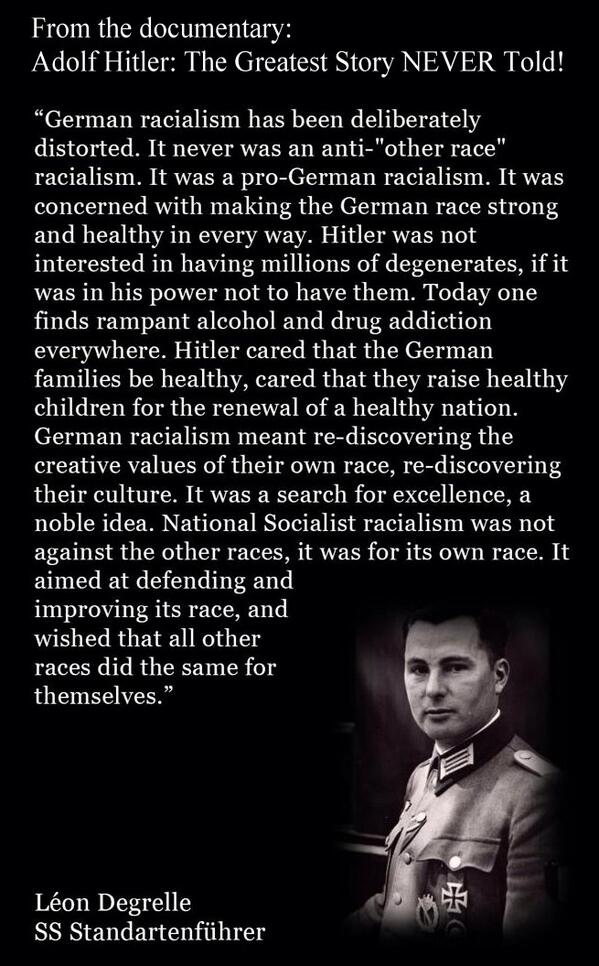
The connection is not surprising. What is now termed social nationalism is organic, built on the natural order and having respect for the creatures of the land, water and air as well as (contrary to Zionist propaganda) the relatively backward racial groups and peoples of our Earth. The hero Leon Degrelle [https://en.wikipedia.org/wiki/L%C3%A9on_Degrelle] put the latter point very well after the Second World War:becwoaeccaazenq

It is striking to see that there is very often an overlap, for example on Twitter, between those who are protective of animals and those who are strongly social-nationalist. Brigitte Bardot is a name which comes to mind: https://en.wikipedia.org/wiki/Brigitte_Bardot.

The new society in Europe will be nationalist; it will also be for Europe’s European future (though anti-EU); it will be green and it will be socially-just.

Notes:

https://www.kn-online.de/Nachrichten/Hamburg/Voelkische-Siedler-Die-Bio-Nazis-von-nebenan

Update, 28 June 2020

https://www.theguardian.com/world/2020/jun/28/german-far-right-infiltrates-green-groups-with-call-to-protect-the-land?CMP=share_btn_tw

Update, 26 May 2021

Note: https://en.wikipedia.org/wiki/Gerard_Wallop,_9th_Earl_of_Portsmouth#Organic_movement; https://en.wikipedia.org/wiki/Gerard_Wallop,_9th_Earl_of_Portsmouth

THE CASE FOR BASIC INCOME

Jesus Christ said that the poor are always with us (part of society). Whether that be accepted or not in absolute terms, the fact remains that, in practice, there is always the necessity to deal with “the submerged tenth”. In Soviet Russia, the solution was make-work jobs and, if that failed, part of the GULAG system. In finance-capitalist “Western” societies, there is the illusion of “aspiration” and “opportunity”: people need not be without (sufficient) income if they work. This theory or ideology leaves aside those who cannot work, whether because sick, disabled, or unable to find remunerative or sufficiently remunerative employment.

Robotics and computerization are advancing. Some studies say that a third of present jobs in countries such as the UK will disappear by about 2030 (some say “only” 25%). It may well be that other jobs will not appear to take up the slack. Millions may be left unemployed. At present, lack of income means that unemployed people (as well as the sick and disabled) have to jump through hoops in a degrading and largely pointless bureaucratic exercise in order to receive often very modest State-provided benefit payments. The system is not only expensive because of those payments, but because of the huge bureaucratic machinery that is built in to the process. There is a better way. Basic Income.

The Basic Income idea is that all citizens receive a regular payment, regardless of circumstances. In short, the payment is unconditional, meaning not withheld if the recipient does not have a job, look for a job, can do a job. Basic Income replaces all (or, in some versions, some) existing social welfare payments.

Basic Income is being trialled in some areas of Europe: in parts of Switzerland, Finland, the Netherlands. In Alaska, all permanent residents receive a small Basic Income payment annually (at present, about $2,500), monies routed from oil revenues.

Basic Income could be tweaked, so that persons on incomes above a certain level have an equivalent amount taken via the tax system; another idea would be to give a higher-tier Basic Income to the disabled (though that would mean some form of assessment and judgment). Alternatively, Basic Income could be paid only to those without income or capital, topping up income to a certain or decided level. That is, in fact, more or less what happens now in the UK, but without the present system’s bureaucracy, unpleasantness, snooping, harassing etc (made far worse since the Iain Duncan Smith regime of 2010-present).

It is objected that Basic Income would mean that people would just be unwilling to work. Is that so? First of all it might depend on the level of Basic Income. Economic realities would probably limit Basic Income to no more than about £15,000 p.a. It might be as little as £10,000 (either per person or per household). Many will, at that level, find plenty of incentive to work if they can. Also, it is rarely heard that people should not receive inheritances or trust incomes because they might be made lazy thereby. Lottery winners in the UK usually start businesses, carry on working for pay or do charity work.

In fact, in the UK, there are already payments somewhat analogous to Basic Income. State Pensions are already paid to all persons over a decided age, with extra “State Pension Guarantee Credit” money paid to those whose income and capital is below a certain level. Child Benefit was formerly paid to all persons who have children (regardless of income) and still is paid, though now there is an income cutoff point (at a fairly high level).

The cost of Basic Income is lessened by the removal of large numbers of pointless jobs in the (UK) Department of Work and Pensions etc and by the elimination of the need for large numbers of “Jobcentres” and other buildings and their upkeep. Housing Benefit will not exist, so greedy buy-to-let parasites will not be subsidized by taxpayers via taxation revenues). That alone will save billions of pounds.

A person receiving Basic Income who wishes to work will be able to look for work honestly (rather than in order to tick a Jobcentre box) and with confidence, and in the meantime will have money for transport, clothing, food. The disabled will not have to undergo degrading tests in order to receive at least the “basic level” of Basic Income (medical report from GP should be sufficient anyway). The more fortunate, who have income or capital, will (if receiving Basic Income), will be able to spend more (thus stimulating the economy) and/or start their own businesses.

In short, it will become clear in time that Basic Income is the way forward in the UK.

Fortress-Centres of Culture and Science

In the Dark Ages, the flame of civilization and culture was kept burning in fortified centres: walled cities, monasteries etc. It may be that the time has come to think in terms of “back-up” for the knowledge and human expertise that we take for granted today.

What does that mean in practical terms? There can be little doubt that, were a breakdown of law and order to occur (whether as a result of war or natural calamity), the British cities would probably become chaotically lawless in a short space of time, especially if fuel, food, water or utilities were unavailable.

It seems to me that those inclined to social-nationalism should think in terms of relocating to areas some distance from major cities, to small towns and villages where like-minded people can become either the majority or a strong minority. Such clusters of people can take over the local councils, local businesses and farms, as well as doing the usual run of employed work which they might do in the cities where they, perhaps, now live.

The idea has the following merits:

a. Political (electoral or other) bases can be created, with voting weight;

b. The clustering effect would enable concerted action;

c. In the event of catastrophes in the wider world, these centres would become the places looked to by the wider masses for leadership.

Clausewitz said that, in order to extend power, one must first have a secure base. It is that that social-nationalism lacks at present in the UK. The above proposal aims to address that lack.