
Introduction and background
I have blogged within the past day about the result of the UK local elections:
https://ianrmillard.wordpress.com/2019/05/04/the-uk-local-elections-have-been-held-my-view/
We have seen what happened in those elections:
- the Conservative Party humiliated and suffering a defeat worse than many (but not I) anticipated;
- the Labour Party, though losing few seats (82), also humiliated, in that, at this point in the conventional electoral cycle, the norm is for the governing party to lose and possibly lose heavily, but for the official Opposition party to make gains, perhaps considerable gains;
- the Liberal Democrats, who have not, in general, recovered since their rout at the 2015 General Election (and who in fact did worse at the 2017 General Election in terms of popular vote share —7.4% in 2017 as against 7.9% in 2015— though better in terms of House of Commons seats —12, up from 8), had a “good” result in these local elections, more than doubling the number of LibDem councillors.
Local councillors elected (only about a third of the over 20,000 total were in contest this time) were 3,561 (Con), 2,023 (Lab) and 704 (LibDem); others (mainly Independents) elected numbered 1,310, a large increase.
The totals of local government seats now held (mostly council seats) by the three main System parties: Con 7,615, Lab 6,327, LibDems 2,576.
The 2019 local elections gave the System parties the following vote shares: Con 28%, Lab 28%, LibDems 19%, Others (and spoiled votes) 25%.
The electoral swing percentages: 7% down for Con, 1% down for Lab, and 8% up for the LibDems.
It can be seen from the above that these elections were disastrous for the Conservatives, not successful for Labour. As to the LibDems, their upsurge was mainly a protest vote by pro-Remain former Conservative voters. Not very important. I do not want to waste more time than I have already on washed-up UKIP or on the Green protest vote.
Had the Nigel Farage vehicle, the Brexit Party, been contesting the local elections, the Conservative and Labour parties would have done very much worse, the LibDems about the same (their votes coming exclusively from Remainers and from those who think that mass immigration actually somehow benefits the people of the UK).
The 2019 EU election
It is now too late for the EU election not to be held in the UK. The pathetic “deal” cobbled together (as I write this, not quite agreed between Theresa May and Corbyn) will not be able to prevent the EU election happening. Thus Brexit Party comes into play.
Look at the film clip below. Nigel Farage arriving at a rally in Newport, Wales, on 30 April 2019. His reception is not just warm or supportive; it is ecstatic, an ovation by followers who seem almost to worship him.
Reminiscent of the entry of Adolf Hitler into the speech hall at Nuremberg in 1934, as shown in Triumph of the Will [dir. Leni Riefenstahl, 1935]. None of the substance and depth, of course, but superficially rather similar.
Opinion polls: Brexit Party was recently running at about 30% (2 May) and may by now be higher, maybe even 35%. That figure, though, relates purely to the upcoming EU elections
As regards Westminster elections, Brexit Party was running at 14% a few days ago, but it might well rise, perhaps considerably, from there. Labour is on about 30% and Conservatives around 25%.
Brexit Party is pretty much the only game in town as regards the EU election in the UK. Indeed, if Conservative/Labour do agree some unsatisfactory last-minute and cobbled-together “deal” to put to the EU, i.e. “Brexit In Name Only”, Brexit Party might well do even better on 23 May.
Possible General Election 2019
The System parties are assuming that, if some kind of limited faux-Brexit is presented to the British people, with or without a fake “Second Referendum” or “People’s Vote”, that that will shoot the Brexit Party’s fox. I’m not so sure.
There is huge dissatisfaction around, not only around Brexit (from both main directions), but also around the continuing other issues that bedevil the UK: the continuing low levels of pay and “welfare” (social security), overcrowded rail, poorly maintained roads, the spending cuts of a decade now impacting services such as NHS and police; immigration is continuing on a very large scale, too.
The msm and Westminster Bubble crowd have not fully caught up with what is happening. Look again at the Con, Lab and LibDem local results. Labour did not do well in terms of pressing ahead, but did not much slip back. The Conservatives suffered a really big hit. The LibDems did well mainly at the expense of the Conservatives.
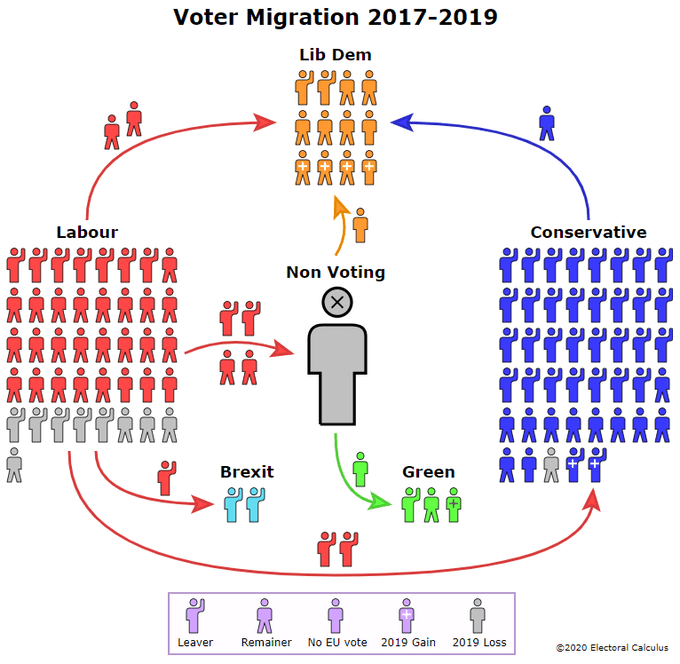
In any 2019 General Election, the Conservatives, under whoever is their new leader, would face a three-front war: against Labour, LibDems and Brexit Party. It has been assumed up to now that Brexit Party would take the role and have the effect of being a spoiler alone. Maybe now it might be more than a mere spoiler. Half the Conservative voters of 2017 are saying that they will not vote Conservative next time. I have already blogged about how that could mean a loss of 100 or even 200 Commons seats for the Conservatives. Most ex-Con voters will vote Brexit Party.
It may well be that Brexit Party can do well enough to create its own bloc of seats. Maybe 50. Maybe even 100. Labour will also benefit from the Conservatives losing votes to both Brexit Party and the LibDems.
I cannot see the LibDems doing better than staying at about the same level that they are on now (12 MPs), but votes for them from former Conservative voters may easily let in either Labour or the Brexit Party, depending on the seat in question. Having said that, it is not impossible that a small number of LibDem candidates might slip past the Con, Lab and Brexit party candidates in closely-fought 3-way or 4-way splits.
So the Conservatives will be losing Remain votes to the LibDems, Leave votes to Brexit Party. It may be, also, that those floating voters whose priorities lie elsewhere than with the EU/Brexit situation will go with Labour.
The Conservatives may be left as a niche party for the wealthy, the smug affluent, the buy to let parasites, the Zionist Jews etc. In a sense that was always so, but other categories of voter made up the weight in elections.
The Conservative Party may be permanently reduced to a hard core of 25% of the electorate, and perhaps to an even lower level than that. The ethnic minorities (except the Jews) are estranged from the Conservatives and are fast-increasing in number. The “blacks and browns” etc vote Labour. Many of the English/British (i.e. white) middleaged and elderly are either disappearing by effluxion of time or are defecting to Brexit Party; only 16% of voters under 35 favour the Conservatives; only 4% of those under 25. Very many of the young or quite young vote Labour or Green.
The msm seems to be saying now that the most likely outcome is a hung Parliament, with the Conservatives as biggest party in the Commons. I tend to stick with my prediction of 2+ years standing, that Labour will be the biggest party, though without a majority, if an election really is called this year. There is an outside chance that Labour might get a majority, but if its remaining Northern English base continues to erode, a Commons majority is not going to happen.
Notes
https://en.wikipedia.org/wiki/2019_United_Kingdom_local_elections
Some tweets
In the clip immediately below (from Sky newspaper review), journalist Brendan O’Neill, with loudmouth “Fleet Street Fox” (Susie Boniface), addresses the Labour lack of success in the local elections:
In fact, there were no less than 39,000 spoiled papers in all! Many had “BREXIT”, “Brexit Party” or Swastikas drawn on them…
https://twitter.com/EddieDempsey/status/1124075048984350727
and here below we see Lisa Nandy MP trying to avoid mentioning that the Labour vote is now at least partly (in some areas, almost entirely) an ethnic non-white vote. Seems that the Conservatives of Smethwick, at the famous 1960s by-election, were right: “if you want a n****r for a neighbour, vote Labour”! Lisa Nandy is trying to say that “graduates” (meaning “the educated”?…hardy ha ha in the era of “everyone gets a First” degrees) prefer Labour. Everyone and his dog is now a nominal “graduate”, who has gone to “uni” and got a crap (in many cases) “degree” leading to (also in many cases) a low-wage job, thus (ditto) leading to socio-political dissatisfaction…
Afterthought
My main article, above, says nothing about Change UK, the new party for Remainers and pro-Zionists. The article does not cover Change UK because Change UK is doomed and (as I said in another blog post) all but pointless. It is running at about 4% in the opinion polls re the EU elections, but better (some polls even had it recently at 10%!) re. any general election.
Readers will recall that UKIP had support, at the 2015 General Election, of 12.6%, yet gained no MPs (except for the ex-Con MP, Carswell). UKIP’s support was evenly spread throughout England and Wales; it had no Schwerpunkt or concentration of support in a few constituencies (which is how the LibDems and Greens, both with lower levels of support nationally, score). It follows from that that Change UK, even with 10% of votes (5% is more likely) has no chance of getting anywhere in any general election in 2019.
The significant thing about Change UK is that it will pull even more votes from the Conservatives, already losing votes to Brexit Party and LibDems.
Update, 7 May 2019
In the past days, while “Change UK” has apparently already sunk without trace (and almost nothing is heard about it), Brexit Party is really developing into something. Today, it was announced that there will be EU elections in the UK on 23 May, only 16 days from today. Brexit Party looks odds-on to be largest UK party and perhaps to take most of the seats allocated to the UK.
and nearly 2,000 people (see link below) turning out for Farage and his Brexit Party in Peterborough, where a by-election will be held in early June.
https://www.cambridge-news.co.uk/news/cambridge-news/nigel-farage-brexit-rally-peterborough-16240485
Update, 11 May 2019
“A ComRes poll for the Sunday Telegraph showed that if a Westminster general election were called, Labour would reap the largest share of the vote with 27%; the Brexit party would garner 20% ahead of the Conservatives on 19%. The Liberal Democrats would win 14%, followed by ChangeUK (7%) and the Greens (5%) with Ukip trailing on 2%.” [The Guardian]
Update, 18 May 2019
 Ian Robert Millard