
I am just putting down stray thoughts. I shall update this during the day and thereafter.
I have already blogged about the General Election result:
https://ianrmillard.wordpress.com/2019/12/13/reflections-on-the-2019-general-election/
It may be that the most significant fact about the General Election result is that the Conservative Party vote increased by only 1.2 points vis a vis 2017, from 42.4% to 43.6%.
The Labour vote decreased from about 40% to 32.2%. So about 8 points.
It follows that this was not some kind of “Conservative” surge, but a function of the relative collapse of the Labour vote. It also means that Boris-idiot in 2019 is scarcely more popular than was Theresa May in 2017.
Logically, it is unlikely that the economic and social situation in the UK will improve much, if at all, between now and 2022, let alone December 2024, the maximum term of this Boris-idiot government.
We know that, as far as members go, the Con Party has, or had earlier this year, 140,000 members, a quarter of the size of Labour; of which 90,000+ voted for Boris Johnson to lead them. Members, though, are less important than voters.
The membership of the Conservative Party increased greatly in late-2018 to early-2019. 36,000 new members. There were speculations about “entryism”, maybe by former UKIP members:
It is a fair inference that those new 36,000+ members were almost all Boris partisans. Without them, he might even not have been elected leader.
The Conservative Party is now in charge of a government built on shifting sands.
The average Conservative member is over 60 now (though all major System parties now have averages over 50). About half are over 70 years of age.
The typical Conservative voter is at least middleaged, and in fact usually an elderly person. Only in those over about 60 years of age is there a majority in favour of the Conservative Party.
The above-cited Guardian article now adds this rider:
“• This article was amended on 24 June 2019 because an earlier version referred to a supposed “geriatric membership”. Geriatric refers to a branch of medicine; octogenarian was meant. This has been corrected.”
An “octogenarian” membership?!
The obvious if ghoulish corollary to the above is that very many Conservative Party members and many Con voters will not see the next general election (assuming that there is one…).
Shifting sands
The new Conservative MPs from the North and Midlands represent areas traditionally not Conservative. The roots are shallow.
One sees that the constituencies where the Labour Party was not so much affected by the mainly white voter-defection to the Conservative Party were those areas largely inhabited by non-whites. See, for example, Liz Kendall’s seat at Leicester West:
https://en.wikipedia.org/wiki/Leicester_West_(UK_Parliament_constituency)#Elections_in_the_2010s
- Liz Kendall got just under 50% of the vote, compared to about 60% in 2017 and about 47% in 2015.
- David Lammy’s seat at Tottenham: 76% in 2019, as against 82% in 2017 and 67% in 2015
https://en.wikipedia.org/wiki/Leicester_West_(UK_Parliament_constituency)#Elections_in_the_2010s
- Diane Abbott at Hackney North and Stoke Newington: about 70% this year, 75% in 2017 and 63% in 2015 https://en.wikipedia.org/wiki/Hackney_North_and_Stoke_Newington_(UK_Parliament_constituency)#Elections_in_the_2010s
The msm-applauded “surge” to the Conservatives (in fact only 1.2 points) nationally, which was really an 8-point withdrawal from Labour, has scarcely touched those and similar seats. That supports my view that Labour, in terms of votes, is now largely (not entirely) the party of the “blacks and browns”.
It also supports my view that what the people really want, subconsciously, is a less militarized, less German, more “British” form of National Socialism, but brought into the contemporary arena as social-nationalism or the like.
If the economy tanks for whatever reason (mishandled Brexit, a continuation of the “austerity” nonsense of Osborne and Cameron-Levita, world events), then the brief “popularity” of Boris-idiot and the misnamed “Conservatives” (which in any case is not so: Con Party up only 1.2 points; though Labour is unpopular) will soak away into the desert sand. Will the people then look to “Labour”? Or elsewhere?
One thing is sure: the people cannot vote for a party that does not exist.
So far, since the demise of the BNP, the only alternatives —indeed one alternative under two successive names— to System parties have been UKIP and Brexit Party, effectively the same or under the same control when significant. Controlled opposition. Fakes. Parties posing as conservative “nationalist” while having candidates who were black, brown, Jew, you name it. Even a couple of ex-Marxist “revolutionary” lesbians. And the rabbits all accepted it. Even the “antifa” idiot-mob made those parties a major target of their bile, taking them as they assumed that those parties were, not as they really were.
A few quite random tweets I saw today, which seem to be symptomatic of the craziness of the general election farce that the UK’s degenerate political milieu has just held:
https://twitter.com/rodjgrimmer/status/1205563367714365440?s=20
People in Scunthorpe (!) so desperate for a better life and a better UK that they will vote Conservative! My take? “Labour is mostly trash, the Conservative Party is 99% trash, and so people clutch at straws as they drown.”
And what about this one (below)? Jew ex-Labour Party types happy that (of all “people”…I call the bastard “devil”) Iain Duncan Smith kept his seat! For the Jews, it really is always “all about them”, whether it be the 2019 General Election, the evil Con regimes of 2010-2019, or the Second World War.
Below: Jews crying with happiness that a finance-capitalist government has been “elected” by lies and big money advertising…
https://twitter.com/GnasherJew/status/1205891069856104448?s=20
Who is “gnasher jew”? Appropriately enough, they are not one Jew but legion, but here is one, anyway:
“Gnasher Jew” (one of that cabal of several Jews…) tweeted a semi-literate tweet a few months ago to the effect that I am “a convicted anti-Semite”. No, not convicted of “antisemitism” (which would in fact be impossible anyway, because “antisemitism” is not a criminal offence in the UK) or anything else.
Labour news
I see that Laura Pidcock, now 32, lost her seat at North West Durham. She is all too typical of young Labour MPs (many of whom are now ex-MPs): sole non-political job a few weeks or months as a “mental health support worker” (in her case): https://en.wikipedia.org/wiki/Laura_Pidcock
Laura Pidcock is so very typical: “anti-racist” “activist”, a kind of post-Marxist; probably solid on grass-roots problems such as poverty, but I doubt that I am guessing too wildly if I say that she probably thinks that mass immigration is great for the people of the UK. And so on. Well, that’s her binned politically.
Now we move on to a Labour MP who, unfortunately, is still in place: Jess Phillips. This ignorant horrible woman was the subject of one of my “Deadhead MPs” blog articles:
There is now a push from the Jewish lobby and msm to make this ignorant creature Labour leader! Labour, the party of Attlee, Wilson, Blair (whatever their flaws and whatever my own criticism of their policies and direction)…
Jess Phillips is pushing herself forward, despite her lack of culture and education:
Her article, in that stronghold of “working-class” life, The Observer, says that “disappointed” ex-Labour voters voted Conservative; but we have seen that the Conservative vote only went up, nationally, by 1.2 points, so not many former Labour voters did vote Con. Probably more in the North. Generally, they may well have stayed home and not voted, though.
There is also the point that only two-thirds (67.3%) of those eligible turned out to vote.
As one might expect, Jess Phillips’s article does not identify what Labour might do to regain its position, just says that the swing would have to be on the scale of 1997. I am scarcely a fan of Blair, Brown etc, but we have descended into farce if their positions or roles will be taken by Jess Phillips and…who? Yvette Cooper? (shudders…)
The accompanying photograph certainly makes my point about Labour being now largely the party of the “blacks and browns”! Hardly a white face…
Here (below) we see someone who is evidently not one of the world’s great thinkers:
Ever heard of mass immigration? Also known as “migration-invasion”. 13 million since 1997, plus births, plus illegals. Those eligible to vote and who do vote, all vote Labour.
…and look at this arrogance!
Oh, right….”serious current affairs shows” (there are few, if any, anyway) should not give time to “extremists“….Of course, giving time to Indian “Scottish” women who apparently do stand-up comedy and a bit of msm talking-head droning about politics (mainly about how there is supposedly too much “antisemitism”) is OK… of course….oh, no, wait…
Update, 15 December 2019
As expected, the msm are going mad about the “crushing victory” of Boris-idiot and the Con Party, despite the fact that the Conservative vote-share only increased by 1.2 points over what it was in 2017.
I missed this:
In Hartlepool, where Labour has always won, usually with over 50% of the vote and sometimes with over 60%, Labour won again, but on its lowest vote-share ever, only 37.7%. The stunning fact is that the Conservative candidate, in second place, got 28.9% and the Brexit Party candidate (Tice, Farage’s 2-i-c), got 25.8%. In other words, had either the Conservative Party or Brexit Party not stood, Labour would have lost that once very safe Labour seat, and by some margin.
Back on the Jewish front…
The Jewish actress and anti-Corbyn tweeter, Frances Barber (who was rather rude about me a few times when I had a Twitter account), now suggests (see below) that some Corbyn supporters be shot! Will the police be interested? No. However, were anyone to suggest that Con-supporting or Jewish-lobby-supporting persons should be shot, M. le Commissaire Plod would be on the case immediately.
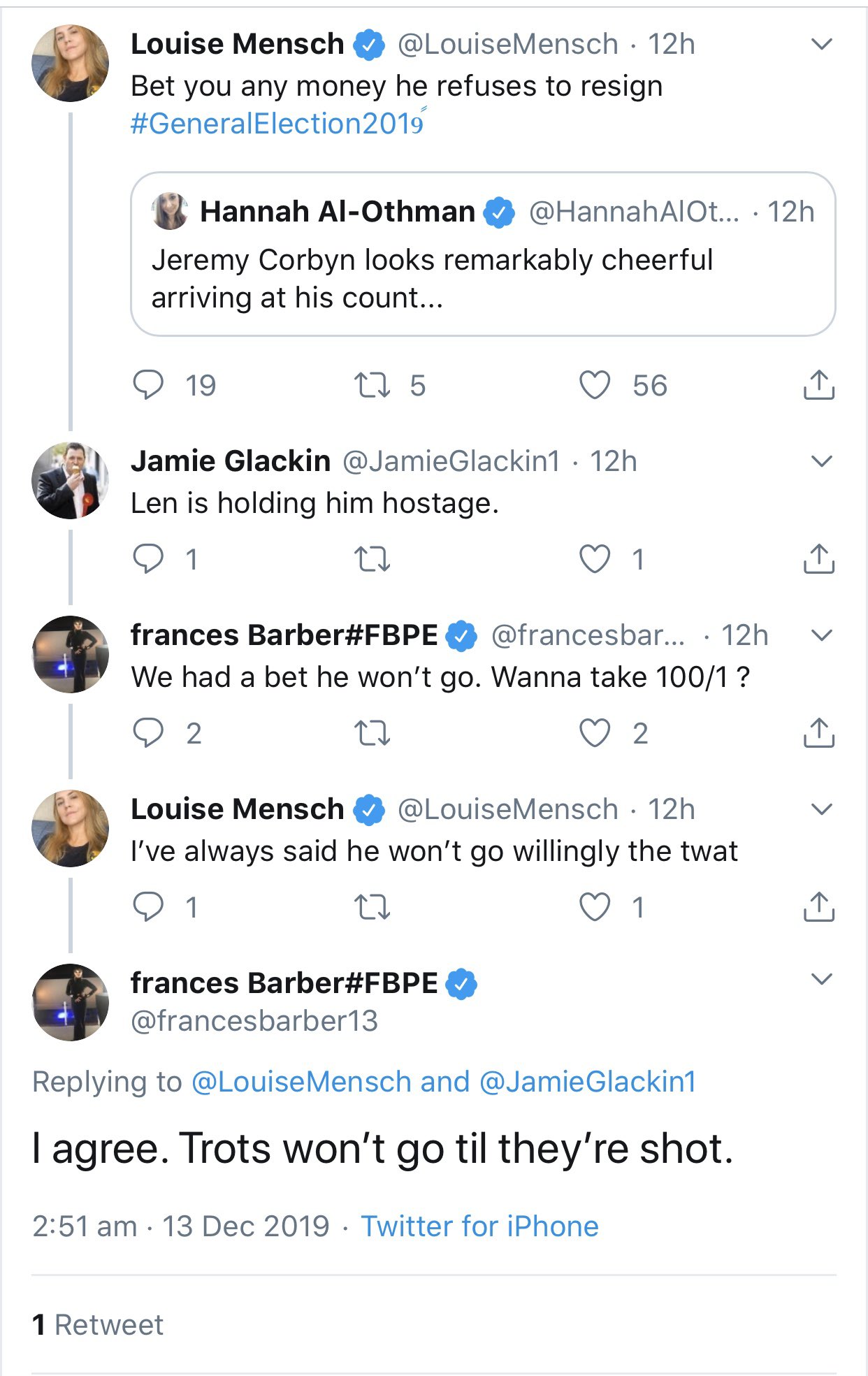
and note how totally irrelevant New York-based loonie and former/one-time/briefly/disgraced ex-MP Louse —I mean Louise— Mensch, tries to seem relevant to British political life, even now!

[above, Louise Mensch, who admitted that hard drugs “messed with” her brain…]
The febrile atmosphere today
Perhaps some people take some things too seriously; others just laugh:
Speaking for myself, I’m laughing, or at least smiling, already!
Labour’s slow decline
I usually make fun of Ash Sarkar e.g.https://ianrmillard.wordpress.com/2019/01/01/disordered-and-infantile-people/ , but she makes good (if to me obvious) points here:
The Jews are crowing
Partly because they now have a low-tax government packed with Jews, pro-Jews, pro-Israel Zionists, even Israeli agents. Mainly, though, because they have got rid of Corbyn. He and his people may still be there, but they are there in the manner of El Cid in the film with Charlton Heston. The Cid is dead, but is put back on his horse and rides out. In the case of the Cid, to victory, but in the case of Corbyn, over the field of defeat. The Jews have “won”, but only over Corbyn-Labour. “Their” victory may prove to be Pyrrhic and/or short-lived.
Of course, I should have preferred to see a weak, minority government headed by Corbyn, but for me the General Election result also has its good aspects (already blogged about), such as the “Labour Friends of Israel” MPs getting the order of the boot: Ruth Smeeth, Anna Turley, Mary Creagh, Emma Reynolds etc. Luciana Berger also failed. Others too. Parliament has been purged, albeit in limited fashion. John Woodcock, John Mann, Ian Austin— all gone. Jo Swinson too, who was almost creepily pro-Zionist.

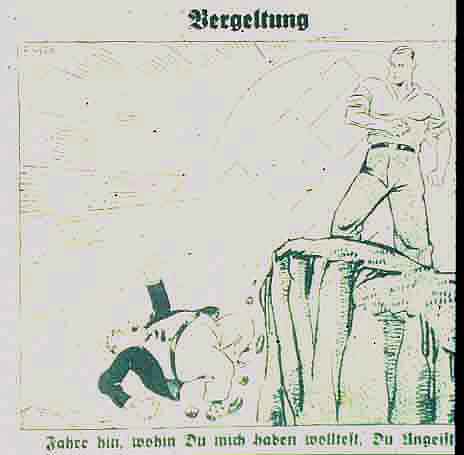
[Get down there, you devil, where you wanted me to go!]
Now?
Despite the election result being very much not to my taste, I scent prey here. Now that Labour has been badly wounded, the present evil ZOG regime does not have any real Opposition in Parliament or outside Parliament. The few hundred protesters in Whitehall were easily contained and were little more than an almost-peaceful sideshow.
This should be the moment when a social-national party or movement should arise, with the horns of a lamb and the words of a dragon.
More from Labour
Interesting:
“We are witnessing the beginnings of a fundamental realignment in British politics. The old tribalisms are crashing down around us. How Labour responds to this will determine whether it remains a serious political force or is instead destined to become a party of permanent protest.” [Unherd/Blue Labour]
Also:
We’re back! (see below). “Economically-radical” —and national— “socialism”…
Quite a lot of sense in there, but you cannot put new wine in old bottles. Both Labour and Conservative parties are dying. The election hullabaloo should not disguise that. Labour is going straight down now.
“Centrism”, i.e. returning to Blair-Brown times, the Zionist-Labour controllers monitoring the British people and destroying their race and culture (as well as their rights) will not wash now.
Likewise, multikulti Corbyn-Labourism, with its “anti-racism” and “antifascism”, and its tired, hackneyed references to “No Pasaran!”, “Cable Street”, “kick racism out of…blah blah blah”, and the lip-service paid to (dear God…) WW2 “holocaust” fakery and hoaxes, not to mention support for Cuban “socialism”, 1980s Nicaragua or the disastrous Venezuelan regime, is a very dead duck.
McDonnell, the worst thug “antifascist” (and IRA acolyte) of the lot at senior level in Labour (and who played a double game, sucking up to the Jews at every opportunity), was pictured on TV, in his garden, looking like a bemused “grandad” who has just been tipped out of his wheelchair and mugged. He’s gone, finished.
The “parties” of con-man Farage (UKIP, Brexit Party, any new one he may start) are dead too, as are the LibDems.
Only a new social-national party and movement can save the people of Britain.
Even elements of Labour, as seen above, are starting to recognize the correct direction of travel. What matters are the fundamentals:
- the elements of a “threefold social order” https://en.wikipedia.org/wiki/Social_threefolding
- the foundation for a better society and a better world can only now be that of European race, nation and culture;
- there must be a cultural revolution to “drain” (or drown) the swamp(s): msm, politics, law, academia.

Britain’s mass media 2019:
Unsuccessful Parliamentary candidate Fazia Shaheen (Labour), who came fairly close to beating evil Iain Dunce Duncan Smith at Chingford, questioned by presenter Emma Barnett (who describes herself as “a Jew in disguise“) and part-Jew ex-MP Jack Straw.
I was sent interesting information this evening, a map showing what the Parliamentary map of the UK would look like had only those aged 18-24 voted last Thursday (ignore the comment appended by the named “alt-Right/alt-Lite” British-resident ex-Muslim. That comment is absurdly simplistic, ignoring the real reasons why the young favour Labour, i.e. student debt, degrees that are often worthless in all ways, high rent, impossibility of buying a house or even getting a mortgage, low pay, exploitation etc). The map itself is stunning.

You see the result, above. All seats Labour, except for about (?) 20 SNP, about 20 LibDem, and 1 Plaid Cymru. No Conservative Party seats at all, not even in the most affluent parts of the South of England.
That is the train the Conservative Party has coming down the track at it. It may well be that the 18-24 y o voters of today may be less “anti-Conservative”, less pro-Labour in say 2024, when they are 23-29, but even if that map only shows a 75% picture, indeed if it displays even a 50% picture, the future for the Conservative Party is bleak. That bleakness can be intensified by looking at the present Conservative voters aged 65+. That is the hard core of the Conservative vote, and much of it will not exist in 2024.
So, demographically, the Conservative Party vote will have (literally) died by 2024. Not entirely, but to a great extent. The non-Conservative vote will have greatly increased. The only question is, will that new vote be for Labour, or something else, something completely new?
Update, 16 December 2019
Interesting fact. Had Labour received a total of only 2,227 more votes over 7 constituencies in 2017, i.e. about 320 votes extra, averaged, in each of those 7 constituencies, it could then have formed a minority/coalition government with smaller parties:
Corbyn would then have been Prime Minister and Boris-idiot would probably never even have become Conservative leader; at any rate, Labour might have ruled until 2022. Another example of the madness of Britain’s electoral system, whichever way you look at it.
LibDems
Seems that Jo Swinson is likely to get a fake “peerage” soon. A reward for failure? A reward for doormatting for the Jewish lobby, for sure.
Meanwhile, the 11 remaining LibDem MPs will be voting for a leader. Seems that a woman just elected as MP may get the job.
Boundary changes soon to be implemented will probably reduce the LibDem MP cadre to about 3, assuming that any survive the next general election anyway. Is there really any purpose to the LibDems now? The Con Coalition of 2010-2019 destroyed LibDem credibility, then since 2017 Jo Swinson’s behaviour killed any remaining respect that the voters may have retained for this joke party.
The House of Lords is a bad joke too. There are “peers” such as (soon) Jo Swinson, i.e. failed, old or mediocre ex-MPs. There are peers who were “ennobled” because they were cronies of Prime Ministers or other party leaders.
One woman (Michelle Mone) is there because she posed for a while as a successful “entrepreneuse” flogging lingerie. What a farce! [https://en.wikipedia.org/wiki/Michelle_Mone,_Baroness_Mone#Politics][https://en.wikipedia.org/wiki/Ultimo_(brand)#History].
That particular one picked up a very wealthy boyfriend later, and is actually at the Lords rarely if at all. At least that saves the State and people the taxfree £310+ per day “peers” are paid if they sign in for 10 minutes! Her company ceased trading in 2018.
Then we have the odds and sods in the Lords, elevated to make a good headline, such as the instant West Indian “baroness” who is in the Lords because her son was killed by white youths in a bus shelter in the 1990s. You really could not make it up!
Jew wants Labour to die
He also wants his pound of flesh…
[by the way, that photo is not him but an actor; the Jew looks very different and not at all “heroic”!][Update, 23 August 2020: the “avatar” photo has gone, replaced by that cartoon. I believe that I once saw “Nuddering”, then on Twitter as “The Nuddering Nudnik” (it means something in Yiddish), on TV: a thin bearded Jew, and possibly with mental problems, in my opinion].
Labour leadership contest (not yet —officially— going)
The System is pushing for Lisa Nandy to replace Corbyn. Below, Kay Burley, Sky News talking head:
Kay Burley is very much of the System msm. Paid hundreds of thousands a year, and her ex-husband (and father of her child) is a Jew:
https://en.wikipedia.org/wiki/Kay_Burley#Personal_life
I sympathize with Labour members and supporters if the choice is going to be between Lisa Nandy and Jess Phillips. Good grief!
Lisa Nandy is the kind of person the System would love to have as “Labour” leader: half-Indian, grandfather a Liberal Party MP and, in later life, a Liberal peer, and (despite her rhetoric about getting close to “our communities”) has never worked outside politics, unless you include some politicized charity work (researcher etc). Pro-migration-invasion. Anti-Corbyn so probably pro-Jew. Has a child but is not married to the father, who is a “public relations consultant”. She even has a link to one of the renamed and all-but-toothless (and politically-correct) trade unions:
https://en.wikipedia.org/wiki/Lisa_Nandy
http://acolliscommunications.com/
As to Jess Phillips, I blogged about her a while ago:
While Lisa Nandy is not my idea of a politician for Britain, and for several reasons, she is a serious figure, whereas Jess Phillips is just a vulgar bad joke.
Jews try to repress free speech in the UK even more now
The “Campaign Against Antisemitism” [CAA] is raising money in order to wage “lawfare” against anyone they label “antisemitic”. In a day or so, the “CAA” has already raised nearly £70,000 from about 30 Jews. About £2,500 average apiece. Of course, to suggest that Jews are more affluent than native/real British people would be “antisemitic”, so they would say…
Meanwhile, the Boris-idiot ZOG (Zionist Occupation Government) and the Zionists “behind the arras” are quickening plans to destroy free speech and dissent:
The Boris Johnson/”Conservative” Party ZOG victory in the general election was procured via Jewish money and mass media influence. “It was the Jews wot won it”, to adapt the famous Sun headline of 1992. See below:
Note the “fellow British citizens” weaselling.
The Golan Heights Chardonnay must have flowed like water.
Now the Zionists are, as noted already, preparing to attack free speech in even more ambitious and evil ways, by using large amounts of Jewish money to misuse the British legal system:
Emily Thornberry threatens to sue ex-MP Caroline Flint! “I’m lovin’ it…”!
Caroline Flint says that Emily Thornberry (aka Lady Nugee— her husband is a half-Jewish High Court judge; see photograph below) said that those in the North etc who voted Conservative instead of voting Labour in their “ancestral”/traditional habit, are or were “stupid”. Well, motivations for voting are complex sometimes, but if Emily Thornberry said that, I can see her point!
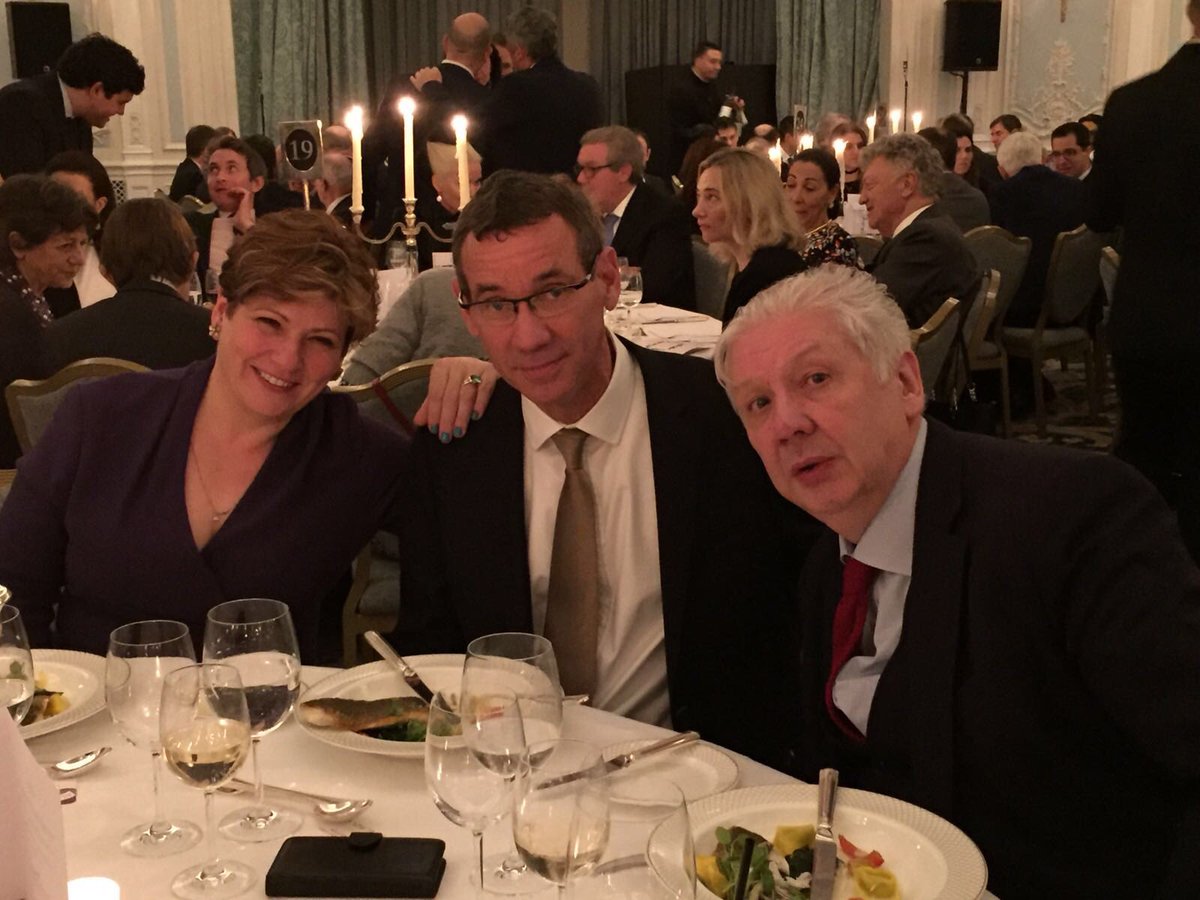
[above, Emily Thornberry, her husband (on right of picture) and the Israeli Ambassador, Mark Regev, at a Zionist banquet in London]
Boris Johnson could ditch promise to guarantee workers’ rights and environmental protections after Brexit, No10 suggests
[headline, The Independent]
Well, that did not take long. 3-4 days into the Boris-idiot ZOG regime and the lying “promises” are already being broken…
Anything is now justifiable to remove “Boris”, his ZOG Cabinet and this whole (misnamed) “Conservative” regime procured by lies and huge amounts of money.
Remember the poll tax?
BBC and other msm bias?
Which is why non-msm news and comment websites have become so popular. Popular with the public, though not with the System.
Now I read that The Canary [https://en.wikipedia.org/wiki/The_Canary_(website)] is going to be “investigated” by ex-Labour ex-MP and doormat for Zionist Jewry, John Mann. The political and social milieu in the UK is now almost Stalinist, albeit well-disguised. People, whole parties (Labour now) and news outlets placed “under investigation” by pro-Jew, pro-Israel apostates like Mann and John Woodcock. Ironically, the editor of The Canary is herself a Jewish lesbian.
I suppose that “lord” Mann would approve of the incitement to violence by an ersatz “Jewess” called Charlotte Nichols, who (just) managed to get elected at Warrington North:
https://en.wikipedia.org/wiki/Warrington_North_(UK_Parliament_constituency)#Elections_in_the_2010s
https://jewishnews.timesofisrael.com/charlotte-nichols-nazis/
In fact this woman, about whom there is not a great deal of information in the public domain, is a convert to Judaism, apparently. The traditional Jews do not even allow that. She made an amusingly bullshit statement to the TV to the effect that “as a Jewish woman” (which she is not, really) “whose grandfather fought in WW2” (so what? So did mine— BEF France, Dunkirk, later Burma— it’s usually Jews who make a big thing of that now, 75-80 years later, to try to sound somehow “credible” on such topics…she has learned from them, it seems…).
Is Charlotte Nichols aware of the terrorism that Jew-Zionist extremists unleashed against British soldiers (soldiers just like her grandfather) in Palestine after (and indeed before) 1945 (and against civilians too)? Bombs, bullets, the Jews even hanged some British soldiers.
“What goes around comes around”… [an American saying]
In fact, I feel that the country is turning away from civilities. The Zionist Jews are intensifying their well-funded abuse of the legal system for political purposes, and here is a “Jewish” woman (ersatz or “self-identifying”, so be it) saying that “Nazis” “should get their heads kicked in“.
In fact this Charlotte Nichols is not a known political quantity. “Brought up in the North West” but “living in London”, according to Wikipedia, which contains little else about her, not even her age or parentage. She has apparently been a trade union office-bod for several years.
This is what she says about herself:
https://www.thejc.com/comment/comment/jewish-convert-kaddish-gaza-charlotte-nichols-1.464705
Here is what the Daily Mail had to say about her prior to her election:
and the Telegraph:
In her TV interview, she mentioned that her opponents “made use of” her “medical history” or some such. Are we talking mental health “issues”? I wonder…
She says that she was born in Romford, East London, but brought up in Reading:
https://tribunemag.co.uk/2019/11/why-im-standing-for-warrington-north
She sounds like a loonie, in fact.
Update, 17 December 2019
Having woken up unwillingly, thanks to a gardener using a very noisy leafblower, my thoughts about what is left of the Labour Party are not very kind, especially having yesterday also noticed the comments of that Warrington North loonie (see above).
The prevailing wind at present comes from the wishful thinking direction. Labour is not the only example. However, it is a good example.
I saw it during the internal election that brought Corbyn to power. One instance was a Labour rally/meeting in York, which was in all the newspapers. Labour sources were ecstatic. Corbyn attracted about 2,000 or more listeners, maybe it was even 5,000. Yet the York area, as I tweeted at the time (the Jews, those benefactors of humanity, had not yet managed to have me expelled from Twitter), has about 210,000 people. You see my point. The crowd may have looked huge but was only 1%-2% of the population.
Nigel Farage was getting crowds of 2,000 recently, but in the end, the net result was almost zero.
Wishful thinking…Yes, Boris-idiot has plenty too, and his supporters more, but I am talking about Labour now.
When I used to hear Corbyn talking about politics, it was often like wandering into the Collet’s London Bookshop in Charing Cross Road c.1976. Militant, Tribune, the Morning Star, posters about anti-apartheid rallies, the socialist struggle in Latin America, Fascism, “No Pasaran!“, Cable Street etc.
Many many years ago, maybe 35-40 years ago, when I was learning Russian, I was always struck by the masthead of the newspaper Izvestia, which showed, inter alia, a picture of the cruiser Aurora, whose single (and blank) shot was a key event in the Bolshevik takeover of late 1917. https://en.wikipedia.org/wiki/Russian_cruiser_Aurora#October_Revolution_mutiny. It always seemed to me a symptom of a state political system preserved in jelly, or ossified. A state stuck in the battles of 60 years before.
The self-described “Left” in Britain is also like that (though I myself always avoid the use of “Right”, “Left” etc as unhelpful and undescriptive). So we get Labour MPs still, in 2019, talking about “Cable Street” (which they evidently do not know much about anyway), and which took place 83 years ago, as if it means something today. No. It does not. https://www.oswaldmosley.com/battle-of-cable-street/
Another myth is that trade unions still mean something. They don’t. Anyone listening to the last few Secretaries-General of the TUC could understand easily that the old powerful (sometimes too powerful) British trade unions of the 1970s and 1980s, destroyed by the outcome of a few large strikes (notably the Miners’ Strike) and by other factors (Conservative government legislation, but more importantly the gradual closure of heavy industry and then almost all manufacturing and extractive industry, and above all by immigration on a vast scale), have become toothless, politically-correct bodies not even much good as “workers’ advice” centres.
Mass immigration has destroyed much in the UK. One victim has been effective trade unions. Big business loves mass immigration: more consumers, lower unit wage costs etc.
For the typical Labour MP, member, supporter, what I have just written is unacceptable. For those people, “Cable Street” still means something, trade unions are still a major fact, mass immigration is something not only not bad but very good, something to be (in their sickening bastard language) “celebrated”.
House of “Lords”
The tweet below does not say everything that could and should be said about the House of Lords, but it does say a lot.
https://twitter.com/nickfthilton/status/1206883862535704576?s=20
The tweeter was kind enough not to overload his tweet with “inherited £300 million, or £500 million, pounds“.
In a way, though, that tweet, by that tweeter, is symptomatic of the whole of the self-describing “Left” or “socialist” side of UK politics generally (and indeed of most of what the System and “antifascists” call “the far Right”, too). The response to manifest injustice and to political chicanery is not the “aux armes, citoyens!” of French history, not the Germanenorden of German history, neither the disciplined ranks of SS and SA nor even the barricades of 1968 Paris. It is the bleat of the tweet, the bleat of people whose idea of being radical, and even edgily so, is to post a comment (being careful not to infringe the ever-more-repressive laws around what is lawful to say or not, as free speech is eroded).
This made me laugh:
https://twitter.com/criptheirvote/status/1206504772804730880?s=20
The subject itself is not funny, of course:
https://www.dailymail.co.uk/news/article-7803721/One-200-Britons-homeless-figure-jumps-9-2016.html
Proportional Representation
Interesting to see that three-quarters of Labour supporters now back PR. The “Conservatives” see no need now that they have a large majority in the Commons, but their spell as top dogs may be both short and lead to a different outcome. Still, I detect seismic movement at last, deep under the surface. This may happen, at last, but not for the life of this Parliament.
Valete
Time to say goodbye (from this blog post). I think that I shall start a daily comments blog soon.

Update, 23 August 2020
Since I wrote the blog post above, a very good explanatory graphic was created to show where 2017 voters went in 2019:
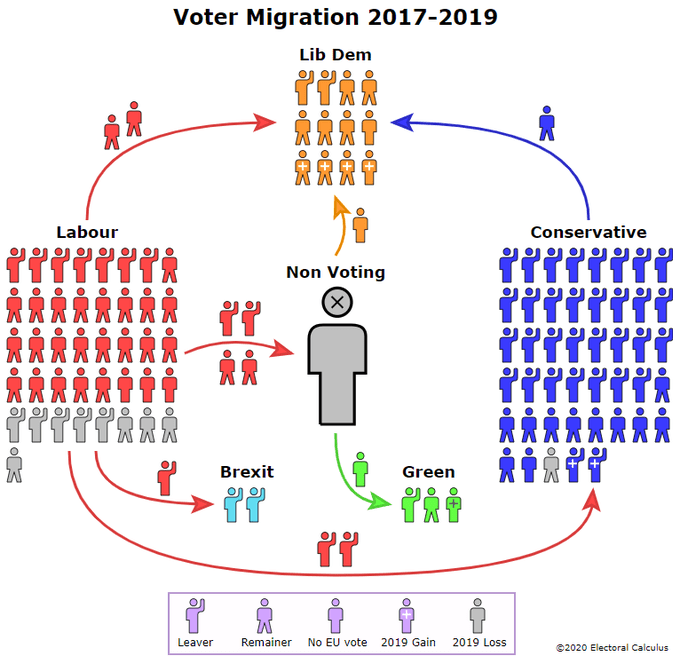
Note that almost as many previous Labour voters failed to vote (at all) as went to all other parties combined.
Update, 12 March 2023
Noticing today that the article has had a few recent hits, a few updates:
Jo Swinson never did get a peerage, though the System did chuck the silly cow a CBE.
At various times since 2019, the Jew-lobby MPs John Mann, John Woodcock and Ruth Smeeth all got “peerages”.
Corbyn has been deselected and chucked out of Labour, so may fight his seat as Independent.
Keir Starmer, of course, backed by the Jew lobby, became Labour leader and now has every chance of becoming Prime Minister by late 2024, now that, after the chaos and nonsense of the “Covid” “panicdemic” and “scamdemic”, and the disastrous governments of Johnson, Liz Truss (now that could never have been predicted in 2019, not even by me!), and now Indian money-juggler Rishi Sunak, Labour is running at over 50% in the polls, with Conservative Party at 25%, a level of support which (with Reform UK at over 5%) might mean a Commons coterie of only 20-30 Con Party MPs.



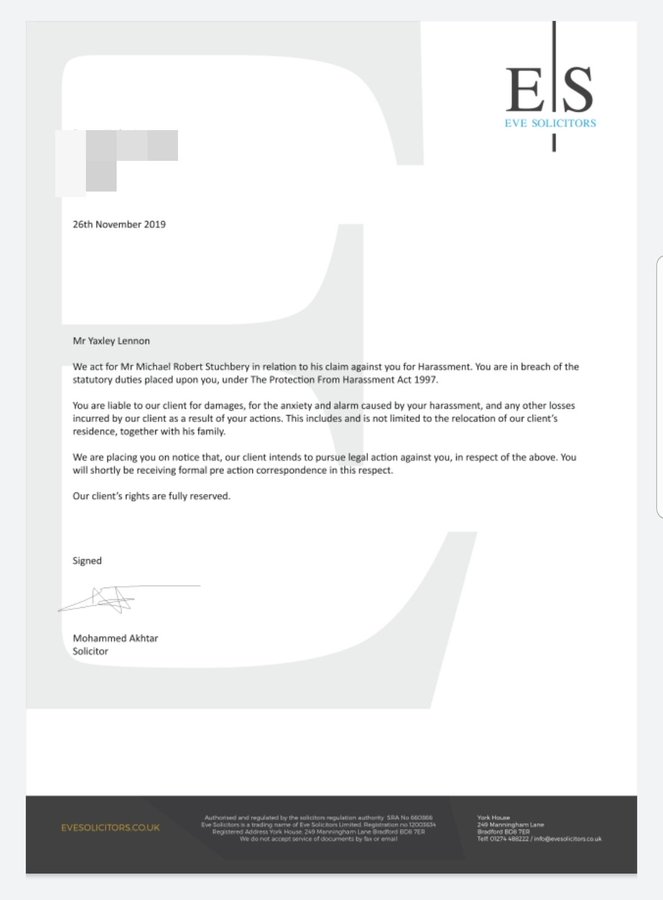

 [Brave antifa inciter Stuchbery, crying his eyes out when one of his chickens came home to roost]







 Ian Robert Millard