I have repeatedly blogged in the past year or two about how the Conservative Party, as a party of government at least, faces an existential challenge. MSM scribblers and talking heads have caught up now and discuss the situation frequently.
The opinion polls must make sobering reading for Conservative MPs. For the upcoming EU elections, the Conservatives are rated as between 11%-15%; for the next general election, the figures are 24%-25%.
That might translate into a loss of Westminster seats numbering somewhere between 50 and 200 out of the 312 that the Conservatives currently hold [the Con Party also has 247 out of 782 peers of the House of Lords, 18 out of 73 UK seats in the European Parliament, 31 out of 129 Scottish Parliament seats, 12 out of 60 Welsh Assembly seats, and 8 out of 25 London Assembly seats].
As my previous blogs explored, the Conservatives are menaced by several trends and facts:
an ageing membership (largely of pensionable age) and voter profile (only 16% of those under 35 intend to vote Conservative, and only 4% of those under 25);
a burgeoning ethnic minority population in the UK; most ethnic minority voters who vote, vote Labour (with the exception of Jews);
increasing numbers of urban and other renters, as opposed to property-owners; many renters are paying very substantial sums for their rent, and are subject to perceivedly unjust rental situations;
very many former Conservative voters defecting to Brexit Party by reason of the events around the EU Brexit situation;
dissatisfaction with Theresa May and, to a lesser extent, with the mediocre or poor level and performance of Conservative ministers and backbenchers;
Conservative voters tactical-voting for the LibDems in Lab/LibDem marginals and in former Conservative safe seats where Brexit Party has undermined the Conservative vote;
financial problems (recent msm reports that the Conservative Party cannot easily pay the rent on its head office), meaning, eg, that publicity cannot be bought;
reports that as many as 60% of 2017 Conservative voters will not vote Conservative next time.
The upshot is that the Conservative Party is in deep trouble. The UK, especially England and Wales, that the Cons have created since 2010, is just not working for most people. This is perhaps not the place in which to detail that statement, but I have done so in earlier blog posts.
What can the Conservatives do to recover their situation? Obviously, as a social national thinker, I hope that the Conservatives do not recover, but these matters must be examined. Conservative plans may include
ditching Theresa May: this is mooted daily in the msm, but she seems to be hanging on for the Summer, until August/September and possibly even until the Conservative Party Conference which starts on 29 September 2019, though no doubt her MPs would much rather have anointed a new leader by then;
once Theresa May is gone, election of a new leader. This presents another problem, in that the existing candidates are mostly of very poor quality. Even the most popular (allegedly) in the country, Boris Johnson, in fact (as opinion polls have revealed) is not very much supported by voters: only 20% think that he would be the right candidate (though he still scored higher than all others);
What else might the Conservative Party do to improve its position? Well, there is one thing, though it would be an extremely risky stratagem: not to call a general election until 2022.
The law brought in by David Cameron-Levita’s government in 2010 mandates a general election in 2022. It can happen before 2022, but that date is the backstop.
At present, the Conservatives have no chance of getting a Commons majority or even being the largest party in the Commons without a majority, if a general election were to be held this year. I have long held the view that a general election could be held in 2019, and it might well be held. The msm (again) lag behind and now the most likely date is indeed thought by the msm to be 2019, once the Conservatives elect Theresa May’s successor. It seems to be the msm/System wisdom-of-the-moment that the new Conservative leader will want to have his or her election approved by the votes of the people. I wonder. Now, however, we have to factor-in Brexit Party.
I begin to think that the general election will be delayed until 2020, 2021 or even 2022.
It has been a convention not amounting to a Constitutional convention that, when a Prime Minister of the UK stands down, the successor holds a general election to “sanctify” the new order via public approval expressed in votes. Those Prime Ministers afraid to do that (rapidly) usually lose out. Look at Gordon Brown. However, the situation now may impel a different decision.
When Theresa May goes, her successor will have to face the fact that Brexit Party is taking somewhere between a third and a half of Conservative votes. If the new Conservative leader calls a 2019 General Election, it will be akin to a turkey voting for Christmas. The chance of a Conservative win (meaning a Commons majority) would be unlikely. There is every chance that the Conservatives would lose seats. There is every chance that the Conservatives would lose many seats. There is a good chance that Labour would be the largest party in the Commons and so able to form a minority government (or possibly a Lab-SNP-LibDem coalition). There is even a chance that Labour might get a Commons majority, something all but impossible prior to the emergence of Brexit Party.
Faced with the above, the new Conservative leader might simply refuse to call a General Election (in effect, leaving aside the details) until (as would be hoped, no doubt) the enthusiasm for Brexit Party wanes. Who knows what might happen in a year, or three years?
There is another point here. The boundary changes decided upon a few years ago take effect in 2022. Reduction of MP numbers from 650 to 600. The seats lost will mostly be Labour and LibDem seats. If a General Election is deferred until 2022, the Conservatives will be about 30 seats better off.
A risky stratagem, and one that could backfire, but it might be the only chance for the Conservative Party.
Tweets
The tweet below displays typical twitterati wishfulness: says “must” when he means “can” or, indeed, “need not”…
Whether it's #BorisJohnson or any of the other vile tory leadership contenders, as soon as one is chosen their first act must be to dissolve Parliament and call a #generalelection the country must decide, not just 70 odd year old tory members #skynews#bbcnews
A comet has appeared in the UK’s political skies. Its name is Brexit Party. It is running at about 30% in the opinion polls re. the EU elections to be held on 23 May 2019, while in respect of Westminster elections, it is on about 15%. The EU elections may not be of much importance except as a popularity contest, but for a new party without any policies at all (except to get out from under the EU) to be at 15% indicates a groundswell of public disquiet which may have huge consequences one way or another in domestic UK politics.
[note: even as I write, the polling figures above are out of date! One very recent poll now has Brexit Party at 34% for the EU elections and 20% re Westminster voting intention, with Conservatives only on 19% for Westminster and 13% for the EU elections; has the Conservative vote ever been that low? I think not; even in the Blair-Labour landslide of 1997, the Conservatives polled in the actual election at 30.7%].
It now looks as though some of my early blogging was prescient indeed, if I myself may say so. “Give that man a cee-gar”!
Exclusive Telegraph poll: for the first time Brexit Party is in second place in general election polling – BP on 20%, Tories on 19% – on course to win 49MPS – Tories lose over 130 seats including Johnson and Rudd – Labour in minority governmenthttps://t.co/YGVFr3Y6bL
The Brexit Party gets more popular by the day, with 34% now intending to back them in the European elections – more than the Labour and Conservative Parties COMBINED. The 17.4m have been betrayed by our political class for years, and now we're going to MAKE them listen!
There are signs of panic in the main System parties:
“A ComRes poll for the Sunday Telegraph showed that if a Westminster general election were called, Labour would reap the largest share of the vote with 27%; the Brexit party would garner 20% ahead of the Conservatives on 19%. The Liberal Democrats would win 14%, followed by ChangeUK (7%) and the Greens (5%) with Ukip trailing on 2%.” [The Guardian]
I come from a certain direction: I recall the limited but real popularity of the National Front [NF] in the mid-1970s, and saw at first hand how outside forces made use of internal dissensions in order to destroy the NF as an effective party and movement. I believe (though without having any direct or personal knowledge) that similar events may have happened to explode the British National Party [BNP].
The National Front and BNP were both broadly social-nationalist, whereas UKIP is broadly nationalist but lacking the para-socialist element ideologically. Brexit Party has taken on UKIP’s “nationalist” or “patriotic” mantle despite having no published policies at all beyond leaving the EU.
It is easy to speculate about why the course of events happens, harder to pin down the exact or even approximate facts. Many casually blame, or designate as important, the operations of Zionists, Israel, MI5, SIS, MOSSAD, unnamed State agencies, freemasons, occult spiritual groups etc.
Every party or movement has internal tensions. As a John le Carre character remarked, “Jesus Christ only had 12 agents, and one of those was a double” [meaning “double-agent”].
The art of influencing events from the shadows is not to be identified or identifiable as a moving force.
Coming back to Brexit Party, there are known facts. The extraordinary political showman (as some would have it, “snake-oil salesman”), Nigel Farage, was leader of UKIP for decades. He in fact was in UKIP almost at the start, and is often termed one of the founders, though he was not the actual founder, who was an academic called Allan Sked.
“Sked is a member of the British-American Project, which exists to promote Britain’s political ties to the U.S.” [Wikipedia].
“During the administration of President Bill Clinton in the US, the Australian journalist John Pilger attacked the BAP as an example of “Atlanticist freemasonry.” He asserted in November 1998 that “many members are journalists, the essential foot soldiers in any network devoted to power and propaganda.” [Wikipedia].
Here is one msm drone who belongs to that British-American Project:
Yes, that’s right. Yasmin-Alibhai-Brown, the supposedly “radical”, “anti-imperialist” “journalist” (in fact, totally unqualified and inexperienced in true journalism, just a ranting loudmouth).
Another member of the very same organization is BBC journalist James Naughtie, most of whose views are, at least superficially, totally different from those of Yasmin Alibhai-Brown…
The British-American Project contains a large number of UK-based (and other) journalists (and others), of supposedly diverse views. I wonder if their views and motives are as “diverse” as they seem to be at first blush.
Only today, on the Andrew Marr Show [BBC 1 TV], Marr tried to trash Nigel Farage and Brexit Party, but Farage was able to crush Marr easily in the end.
System drones like Marr do not seem to understand that populist movements such as UKIP (a few years ago) or Brexit Party (now) are the last chance for the System to listen to the British people and so avert an explosion of justified political hatred which will, otherwise, roll over them like a tank over a cockroach.
Marr’s own (rarely admitted) views:
A typical pro-NWO, pro-ZOG, pro-EUmsm drone, paid until recently a million pounds a year by the BBC out of your “licence fee” (enforced tax) monies (apparently somewhat less now, after public uproar about the absurd salaries paid by the BBC to key propagandists).
Was the secret aim of UKIP to draw off nationalist sentiment from parties such as the BNP, i.e. to neutralize effective political opposition to NWO [New World Order] and ZOG [Zionist Occupation Government] in the UK by containing it, controlling it, monitoring it? Or was UKIP just a typically English amateur effort which mushroomed into something bigger. Or both of those?
Already, in looking at UKIP, we see the difficulty of unravelling the skein of motives: secret forces, public faces, ambitions, ideals, various personalities etc.
As recently as last year, Alan Sked said that “I founded UKIP. It’s a national joke now and should disappear.” [The Guardian]. Is that just sour grapes from a founder left behind? Is there anything else there? Had UKIP “done its job”, and so could be binned?
Until 2010, the BNP did better in all or almost all elections than did UKIP. It is hard to recall that, now that the UKIP star has risen and fallen and now that the BNP is just a tiny handful of back-room zealots. In its heyday, the BNP was more successful by far than UKIP. The BNP even had two MEPs (Nick Griffin and Andrew Brons).
Brexit Party is UKIP, but a UKIP which, like a snake, has shed its “skin” of various unwanted people, unwanted history etc and, unlike the snake, miraculously become far far more powerful, far more slick, far more able to capitalize on its “unique selling point”, the sheer hatred which many many people now feel for UK society as it now is (and also for the EU dictatorship).
Farage is the star of Brexit Party, as he was when in UKIP. Look at the clip below. Farage enters a hall packed with supporters. It echoes in a minor key the entrance of Adolf Hitler into the hall at the end of the 1935 Leni Riefenstahl film Triumph of the Will.
The Brexit party turned up in Newport, south Wales last night. A true Labour heartland. Usually. https://t.co/NoBovPxNCv
Farage can draw large crowds, as in this recent rally at Peterborough, where 2,000 supporters are said to have paid£10 each just to hear Farage speak. Few other politicians in the UK could get 200 (or even 20, in many cases) to turn up to hear them, even for free!
Peterborough rally for the Brexit Party. When was the last time British politics saw something like this?? Astonishing. They’re doing three rallies a week! pic.twitter.com/YVUlQnhTdw
Farage is the key to this. No Farage in UKIP means, effectively, no UKIP. Were there no Farage in Brexit Party, that party would also rapidly cease to exist.
Despite his public profile, Farage is to some degree an enigma. A metals trader, he was in employment as recently as 2003 and possibly even after that. He was elected as an MEP in 1999. He seems to have been a “Eurosceptic” (anti-EU) for a long time, voting Green Party in 1989: the Green Party was, at that time, Eurosceptic and not pro-mass-immigration. One wonders whether, had it not become a kind of middle class virtue-signallers’ party, Green Party might have had greater political success.
Farage created UKIP (not founded perhaps, but created) in his own image: anti-EU, free marketist (softened for tactical purposes), English more than British, not social-national, not “racist” (racialist), despite Farage making a few innocuous comments that only echoed what most white British people believe or feel. Brexit Party may or may not follow those lines, but we cannot say for sure, because Brexit Party, almost uniquely, has published literally no policies at all, save for Brexit itself.
I say “almost uniquely” because the surely-doomed Change UK, which can be taken to be the opposite pole to Brexit Party, also has no published policies (beyond staying in the EU). This is in fact consonant with earlier blogs and, until I was expelled from Twitter, tweets, i.e. that people in the UK, at least in England and Wales, are now voting against rather than for parties; voting tactically to block parties they dislike, rather than supporting the party they like. I have blogged before about this and how it is an outcome of the ludicrous UK electoral system.
I take Farage to be sincerely anti-EU, anti-socialist, possibly anti-immigration, but not to have any sophisticated socio-political or economic ideas. I have said before that Farage does not understand politics well, a surprising statement in view of his stellar public political performance. What I meant is that he has not developed any ideology, as such; neither has he a political programme; also, he has not much developed a party machine (with UKIP; we shall see what happens with Brexit Party).
I take Farage at face value, more or less; the same with his mass following. As to others, I am looking and seeing a strong Jewish element. Brexit Party already has a “Brexit Party Friends of Israel” group. There are other indications; the Brexit Party Treasurer is indirectly connected by marriage to the Rothschilds:
Brexit Party not only has Jewish influence but is open in general to persons of other and various ethnicities. Many candidates are not really British, certainly not of British origin.
Good afternoon Mr. Umunna. I am a candidate for the Brexit party. I am partly of Pakistani origin. There are many candidates of mixed ethnicity in our terrific party. You have the wrong end of the stick. May we pls meet to discuss your prejudices? Anytime that suits you. Pls say https://t.co/W6IdKODVMQ
Despite its paucity of policy and its multi-ethnic candidate list, many of those who support Brexit Party and also many of those who oppose it seem to think that it is somehow “nationalist”. It may be, but only in the very broadest sense.
In respect of candidates, one aspect I find very odd is that, out of about 60 or so Brexit Party EU election candidates, Brexit Party has no less than 3 who are former members of the (1978-1997) Revolutionary Communist Party. Remarkable from a tiny party which had so few members. If I were to suggest State involvement here, it would be without any real evidence, but it does give me pause all the same.
The Great Replacement, otherwise known as “migration-invasion” of Europe, is no mere “conspiracy theory”. United Nations and EU documents have laid out the conspiratorial globalist plan time and again. Only recently, EU and other political heads met in Marrakesh, Morocco, to pledge to assist African and Asian invasion of Europe, to replace European populations with alien black and brown populations.
This anti-white, anti-European campaign was built into the EU right from the start and conflated with the idea of a European “superstate”:
Jean Monnet was one of the principal freemasonic architects of the EU:
“Jean Omer Marie Gabriel Monnet (French: [ʒɑ̃ mɔnɛ]; 9 November 1888 – 16 March 1979) was a Frenchpolitical economist and diplomat.[1] An influential supporter of European unity, he is considered as one of the founding fathers of the European Union. Jean Monnet has been called “The Father of Europe” by those who see his innovative and pioneering efforts in the 1950s as the key to establishing the European Coal and Steel Community, the predecessor of today’s European Union.[2] Never elected to public office, Monnet worked behind the scenes of American and European governments as a well-connected pragmatic internationalist.” [Wikipedia]
“He was the first to be bestowed Honorary Citizen of Europe by the European Council of the European Union, for extraordinary work to promote European cooperation on 2 April 1976. Following this he became the first person alive to be pictured on a German stamp who was not also a German head of state.” [Wikipedia]
“In his book Praktischer Idealismus (Practical Idealism), written in 1925, he describes the future of Jews in Europe and of European racial composition with the following words:
The man of the future will be of mixed race. Today’s races and classes will gradually disappear owing to the vanishing of space, time, and prejudice. The Eurasian-Negroidrace of the future, similar in its appearance to the Ancient Egyptians, will replace the diversity of peoples with a diversity of individuals. […]
Instead of destroying European Jewry, Europe, against its own will, refined and educated this people into a future leader-nation through this artificial selection process.”
“Nazis considered the Pan-European Union to be under the control of Freemasonry.[27] In 1938, a Nazi propaganda book Die Freimaurerei: Weltanschauung, Organisation und Politik was released in German.[28] It revealed Coudenhove-Kalergi’s membership of Freemasonry, the organization suppressed by Nazis.” [Wikipedia]
“Hitler did not share the ideas of his Austrian compatriot. He argued in his 1928 Secret Book that they are unfit for the future defense of Europe against America. As America fills its North American lebensraum, “the natural activist urge that is peculiar to young nations will turn outward.” But then “a pacifist-democratic Pan-European hodgepodge state” would not be able to oppose the United States, as it is “according to the conception of that commonplace bastard, Coudenhove-Kalergi…”” [Wikipedia]
There are secret occult forces behind the founding and expansion of both USA and EU. They are not exclusively Jewish or Zionist, but there is a strong link, as there is to Freemasonry, and also to other groupings not publicly named. Forces of Evil.
Look at the tweet below, from the World Economic Forum at Davos, and retweeted by a pro-EU public relations drone, and which purports to show a wonderful “economic plan” to create a “trade route” (corridor) from Malta and the Mediterranean to Scandinavia. What is the real purpose here? To create a funnel from Africa to Northern Europe, through which migrant-invaders will be funnelled through the heart of Europe to destroy it racially and culturally.
The EU was never meant to be just a mutual-benefit trade bloc. It was always meant to be a monolithic superstate in which the white European populations could be mixed, eventually, with blacks and browns. Of course, that was never conveyed to the peoples of Europe, only to the self-appointed “elite”. In fact, some naive people supported the EU (and still do) because they imagined that it was European in race and culture and not only in geography. Thus we see the deliberate conflation by Remain drones, in the msm or on social media, of “EU” and “Europe“, as in “if Brexit happens, we shall be leaving Europe“, rather than “…leaving the EU.” The UK is part of Europe and always will be; it need not be part of the already-dictatorial EU superstate, which is deliberately importing the culturally inferior by the million.
How is it possible, though, for bothEU and Brexit Party to be heavily influenced by the same forces (ZOG, NWO etc)? Think of a bet whereby you could, in a two-horse race, win whichever horse puts its nose in front. Likewise, in the UK there are or were two or three main parties. The fix was/is into all of those parties. It does not matter (or did not, until Corbyn took over Labour) which party wins, because ZOG/NWO is embedded in all three “main parties” (things are changing now, though).
Brexit Party may have been partly set up with secret aims in mind, but these plans do not always go as planned. Brexit Party has mushroomed, almost exploded, in a way which was perhaps unforeseen even by Farage himself. These things happen in history. The events of the Russian Revolution spiralled out of control, or to use a different metaphor, spread like a wildfire from its modest beginnings in one city in the corner of a huge empire.
Why are voters flocking to Brexit Party? It cannot be because of Brexit Party’s policies, because it has none, or at least only one. I identify these factors:
the wish to have the Referendum of 2016 properly respected and complied with; but beyond that
the wish to hit out at the System parties and especially the mis-named “Conservative” Party, which under the influence of Jewish Zionism and globalism has trashed the UK (especially England and Wales) to the point where nothing works properly, where most people have neither security nor freedom, where the population is only about half really British now, and where standards in all areas are dropping like a stone (NHS, transport, education, real pay, State welfare benefits, animal welfare, environment etc). There is also the repression on thought and socio-political expression. “Free speech” scarcely exists now in the UK.
The wish to lash out is very strong now. The people can see that Brexit Party has the popular support to make it a credible vote at both EU and (so far) Westminster elections. People know (whether intellectually or instinctively) that a vote for Brexit Party is one that hits the Conservatives hard, much harder than voting, say, Labour. In any case, Labour itself is not supported by most people (not so much for policy reasons as because white English people especially do not like what they see around Corbyn: the blacks and browns, the semi-literate Angela Rayner types who would be in Cabinet, the creaking 1970s comic-book “Marxism” etc).
A vote for Brexit Party hits the Conservative Party hard not only in areas where Labour is strong but in areas where the Conservatives have prevailed for decades. As I blogged previously, if (as polls suggest) the Conservatives lose 60% or even 50% of their votes, they will lose 50-200 seats, to Labour, to Brexit Party itself, and, here and there, to the Liberal Democrats. That means (as I also blogged previously and to which the msm is now catching up) that
Brexit Party may actually win some —possibly 50, even 100— seats at Westminster;
The Conservative Party, which has outlived its usefulness, will fade and go the way of the Liberal Party after the First World War; and
Labour will (as I have predicted for 2 years) probably be largest party in the Commons, but will be unable to do whatever it wants, because it will be a minority government (almost certainly). People may well prefer that to a majority Labour government.
It can probably be said that, in Westminster constituencies where Labour is not now the first or second party in elections, even former Labour voters would be better to vote Brexit Party than to vote Labour, because in “Conservative” Westminster constituencies, a vote for Labour is going to be a wasted vote, whereas a vote for Brexit Party will quite possibly help to unseat the Conservative MP in question.
Speaking now from a social-national viewpoint, why do I welcome Brexit Party?
That is a simple question to answer. No matter what forces may be behind Brexit Party, no matter what forces influence it, its importance to me lies in its ability to smash the “three main parties” scam-system in the UK. A weak government, esp. Labour, would open the way to real social nationalism in a way never seen before.
The unreality of the “Remain” crowd can be gauged by the tweet below. Like so many of the twitterati, this fellow over-values Twitter. He actually thinks that he is achieving something by having a few hundred or a few thousand other Remain whiners in his echo-chamber retweet or “like” his pointless tweet. Result? Nothing, but he feels warm and justified. In fact, he is a public relations man whose Twitter output is largely a one-sided and pro-EU song of praise. I predict that 24 May 2019 will not be a pleasant day for him!
Looks as if Boris Idiot and Amber Rudd might both lose their seats at the next General Election. Conservative MPs will not be voting for either of them to be leader if there is every chance that they might lose their seats…Happy day!
Curtice: "The [Conservative] party faces the prospect of nothing less than a mass defection that could leave it with by far its worst ever result in a UK-wide ballot"https://t.co/PW0KpRPHiv#EP2019#brexit
Someone called Casper Hughes, writing in The Independent [see below], says that Brexit Party will have no effect on Westminster elections. That statement, I think, is probably wrong. For the following reasons:
first of all, like most unthinking scribblers and talking heads of the present time, he has not managed to free himself from the idea that there is a spectrum going from “far left” through “hard left”, “soft left”, “centre-left”, “centrist”, then to “centre-right”, “rightwing”, “hard right” and finally the —demonized— “far right”;
Casper Hughes labels, simplistically, a huge group as “rightwing voters”. It’s a meaningless phrase; it shows lack of real understanding;
politics is more nuanced now. People from all parts of the outdated “right”/”left” spectrum can, for example, be allied on animal rights, environment, economic outcomes (and even policies: rail and utility renationalization for example). It was Jack London who said “I am a socialist, but a white man first”;
it is a mistake to imagine that Brexit Party support is all about Brexit. The System betrayal of the EU Referendum result is one example of how the System has, in vulgar terms, shat on the white British people over and over, especially in the past 30 years or so. The Brexit Party is a chance (like the 2016 EU Referendum itself) to kick the System “parties” (which form, to a large extent, one party with 2-3 faces).
people are currently (since at least 2015) voting against, not for. The article does to some extent acknowledge that. That means that people are voting not for Brexit Party and its sole policy, but to stamp on Con and Lab (and LibDem) as well as voting —yes— for Brexit, i.e. to leave the EU properly, without strings;
people generally now realize that a conspiracy is stealing Brexit, against the “democracy” we are supposed to have in the UK; they want to fight against that; the traditional voters for the “main parties” are not as dominant as they were. In 1950, 97% voted LibLabCon. Now? Maybe 50%;
also, many traditional voters feel betrayed: Labour betrayed its core vote by turning into the Blair finance-capitalist, mass immigration, “ignore-Pakistani-child-rapists” “New Labour” or fake-Labour party. The Conservatives betrayed their core vote by continuing with mass immigration, by increasing taxes to an extent not seen under Blair —or even Callaghan in the 1970s—, by destroying much of the mental landscape that made England England, by conspiring to dishonour the 2016 Referendum result, and in other ways;
the article says in terms that the present situation is a re-run of UKIP in 2014-2015. It is not. People saw that UKIP was cheated in 2015 (1 in 8 people voted UKIP in 2015 and were cheated by a rigged electoral system) and are angry at that, but even more angry at the corruption, freeloading and dishonesty of the main 2 parties, as well as at their incompetence and arrogance;
the article supposes that the so-called “right-wing” voters will “coalesce” around the misnamed “Conservatives” as a “stop Corbyn” tactic. Don’t count on it. After 3 years of Jewish propaganda contra Corbyn, Labour is riding higher than ever; and many former Con voters actually like many Corbyn-Labour policies;
the article says that Brexit Party is unlikely to win many if any Westminster seats. Let’s see. The SNP was founded in 1934, and did not get many MPs until 2015, before which it often had 0, 1, 2 or a few MPs most of the time (81 years!); then it reached that FPTP tipping point and had 59. Brexit Party may or may not get to the tipping point, but the idea is no longer ludicrous, if it opposes, say, Labour under Corbyn and Conservative Party under whoever (possibly Boris-Idiot);
the very fact that Boris Johnson is spoken of as possibly Prime Minister is proof enough that the System is sick and the Conservative Party terminally so;
the article seems to imagine that if Brexit Party gets only the same vote as UKIP in 2015, then its effect is meaningless. No, because even if Brexit Party gets the 12% UKIP got in 2015, and if the others stack up as Lab 35%, Con 35%, LibDem 10%, that leaves the Conservatives, though largest party, 32 seats off a majority: https://www.electoralcalculus.co.uk/userpoll.html (only a couple of points more for Labour and Labour are largest party, though 18 off a majority);
the article’s conclusion is predicated on traditional tribal Conservative loyalty, but that is breaking down fast and very many older voters are dying. A recent poll said that less than half of 2017 Conservative voters intend (at present…) to vote Con next time. That would cull anything up to 200 Conservative MPs if it were to become reality;
the EU elections will be a guide, the Peterborough by-election even more important.
I noticed that the article ends on an uncertain note.
If actual voting reflected that, the Conservatives would lose about 172 seats and be left with about 145; Labour would be the largest party in the Commons, with 297 MPs (up 35), and Brexit Party would have a bloc of 105 MPs. LibDems might have 18. That would mean Corbyn as Prime Minister of a minority (or coalition) government, 29 seats short of a Commons majority.
Brexit Party is now holding two rallies daily! Not pathetic little meetings like those of Change UK (a Change UK meeting yesterday had 9 people on the podium and 5 —yes, 5— people in the audience!) Here is the Thursday May 16 2019 Brexit Party meeting in Willenhall, West Midlands, a town with a population of about 29,000; the meeting had about 1,000 attending, obviously mostly locals:
and here (same day!), another Brexit Party meeting in the same region, in Wolverhampton, this time with 1,200 attending! So at least 2,200 people had turned out to support Brexit Party in the same region and on the same day! This seems unstoppable, whatever some msm twitterati and chatterati are saying!
Nigel Farage about to go on stage in Wolverhampton. Hall managers tell me around 1200 are here. Every seat is taken. Supporters are having to stand around the walls. pic.twitter.com/xZshL2LgNW
— Christopher Hope📝 (@christopherhope) May 16, 2019
Meanwhile, at a Change UK “rally” (8 members of the public and 2 reporters? Or was it 5 members of the public and 5 reporters?…)
Now we’ve seen the enthusiasm of the people for Chuka and Soubry’s great party I assume we’ll be seeing less of them on #marr, #bbcqt and #BBCR4today… but I won’t hold my breath pic.twitter.com/TlZ9uVgCAT
Here we are. Election day. Every indication shows Brexit Party powering ahead, leaving Con, Lab, LibDems, let alone Greens and Chukup, in its wake and floundering. I saw an interesting Twitter thread analysis about it all (see below):
THREAD: On the rise of the Brexit Party and what it means for Brexit and British politics.
That’s it, there are no more Brexit Party rallies planned before polling day. I’ve been to half a dozen of them across the country, from the very first week to the end.
The Peston show on ITV got a psephologist to work out what would happen in the (unlikely but possible) contingency that the next general election saw the same voting as the recent EU elections. The result? Brexit Party 441 seats, Conservatives 1 seat!
Well, much water under the bridge! Brexit Party was polling around 12% when Farage decided to pull 317 Brexit Party candidates only 4 weeks before the election. That was followed by another 38. That, in return for a worthless promise from Boris Johnson, a man of no credibility, no integrity, a useless beneficiary of the UK’s sick political system.
Farage‘s ridiculous decision (taken unilaterally and without consultation with the candidates themselves, who had all paid to be considered as candidates) collapsed Brexit Party overnight. Farage killed his party as surely as if he had shot it in the neck.
Now, at time of writing, Brexit Party is in the polls at around 4% and, with 3 weeks to go, is not a serious contender in the General Election. Brexit Party might have won a number of seats while depriving the Conservatives (mainly) of a number of others, but now will be lucky to win even in those constituencies where it had a chance (e.g. Hartlepool).
Why did Farage destroy his own party? I am not the conspiracy theorist some imagine but I do speculate whether this is some kind of Russian operation.
Russia, we are told, wants the UK out of the EU (and, in Putin’s wildest dreams, NATO). Taking that as correct, it may be that Russian strategists were (are?) hoping for “hard Brexit” or “no deal Brexit” (real Brexit), because it weakens the EU (as part of the New World Order or “NWO”) and because a real Brexit might both cause economic/political discontent in the UK down the line and also stimulate Scottish nationalism, with the possibility that Scotland might break off from the UK, and then possibly (probably) decommission the nuclear missile submarine bases there. A break-up of the UK would be a stunning coup for the Russian state in terms of Atlantic geopolitics.
Still speculating, if an immediate “hard Brexit” seemed likely to be blocked by Parliament’s Remain majority in the event of another hung Parliament, then Russian strategists might have decided to strengthen Conservative Party chances by taking out Brexit Party.
Brexit Party is a dictatorship of one man, Farage. To take Brexit Party out of the General Election, Farage alone had to make that decision. He did. So the question is why did Farage take that decision? To my mind, there is no logical reason based on ordinary politics why Farage should take the word of a proven and continual liar such as Boris Johnson. On the other hand, if Farage is or has become an agent under control, then it makes perfect sense.
How do we know that Farage has not been promised (or even paid already) a large sum (£20M is good, £50M is even better) offshore? It makes sense in baldly venal terms but it also makes sense for Farage politically, if Farage has become convinced that a Boris prime ministership with a large majority would result, in a year or two, in a “hard” or even “no deal” Brexit. That way, Farage gets a secret fortune and the political result he has wanted to see since the early 1990s.
True, Farage is wealthy anyway (is supposed to be), but so what? As to whether the Russians would pay really large sums for such purposes…well, the wife of an “oligarch” paid the Conservative Party £160,000 just to have a tennis game with Boris Johnson and David Cameron-Levita. On that basis, £50M to change the whole course of British policy and strategy seems cheap at the price.
There is no direct evidence that Farage is an agent of the Russian state, but he has been shown to have close links with some leading “oligarchs” etc. The Russia of Putin is not the Soviet Union. It operates partly via the uber-wealthy who are beholden to Putin; the Soviet Union operated in this sense in a different way, bureaucratically, via the KGB and its predecessor agencies (NKVD etc), GRU and, pre-WW2, the Comintern.
As we have seen (google, or see my earlier blogs), Boris Johnson, like Farage, is or has been close to some Russian or Russian-Jew “oligarchs”. Then there is the role of Dominic Cummings, Johnson’s “adviser” (who however has been reported as having actually overruled Johnson on some occasions!). I blogged about Cummings a few months ago: https://ianrmillard.wordpress.com/2019/08/10/les-eminences-grises-of-dystopia/
There have been those who have implied that Cummings is a kind of Russian agent. My previous assumption was that he might have been an agent of SIS (British agent rather than salaried officer, perhaps, but who knows?) for a while (when he was in Russia for about 3 years after having graduated from university) but again that was just my speculative thought. Still, one would not necessarily preclude the other, especially over time.
I have no evidence that Farage has been paid a huge bribe by Russia; I have no evidence that Cummings has, either. Still, I do wonder. “Thoughts are duty free”, even in the EU…
There is, of course, also the fact that the British Intelligence assessment of some connected matters is not going to be released until after the General Election. It has been held up by Johnson and Cummings. Why?
So here we are again, in the “deadhead MPs” zone. The problem I have is that so very many MPs are now deadheads, meaning MPs who fall below the bar even for mediocrity. Mediocrity alone does not qualify an MP to be immortalized here. The MP must be outstandingly poor. How to say where that line is set, when so many now qualify? Anyway, having already chosen a number of MPs to participate in this series, here is a well-deserving example: Jess Phillips MP [Lab, Birmingham Yardley].
Jess Phillips
Background
Jess Phillips is the daughter of two “socialist”-oriented persons, who apparently walked around naked all the time at home, in front of their children. Very odd. Even the East Germans (some of them) only did that on specified Baltic beaches. The online magazine, Conservative Woman, commented thus:
“‘Teach girls at school about orgasms, says Labour MP’. That startling newspaper headline, alone, would have been sufficient for most readers to guess that the source was an interview given by that shameless self-publicist Jess Phillips.“
“Her interview also revealed that not only was Phillips brought up in a ‘naked household . . . an environment where nothing was embarrassing’, today in her own home she often goes around nude. Jess further boasts of being ‘open about sex’ with her two sons, currently aged 10 and 14, which must be delightful for them, though it is unclear whether or not she is clothed during their intimate chats.”
“If Phillips’s tale of home nudity is actually true and not a wind-up, far from being charmingly eccentric, it is revolting. Were a father revealed to be exposing himself to school-age daughters, with whom he frankly discusses sex, it would likely be career-ending, certainly for an MP, and might also interest both social services and police.”
“But don’t expect Jess Phillips to have her collar felt – she won’t be wearing one.”
Readers of the profile were not complimentary to Jess Phillips:
“Phillips is as mad as a barrel of polecats anyway. The fact that people actually vote for her is astonishing.”
and
“I’d like to like Jess Phillips, because at least she seems to have an infectious laugh. The trouble is, I remember her laughing also at male suicide statistics. Seemed to think it funny that suicide is the leading cause of death in British men aged 20-49. Not so funny really.”
It seems that her parents, though “socialist”, set up a private company in order to make money out of the NHS, her mother having been Deputy Chief Executive of the NHS Confederation and Chair of South Birmingham Mental Health Trust. That private company was active from 2003 until at least 2010, but is now defunct. Jess Phillips’ mother died in 2011.
Jess Phillips attended a local grammar school for girls, then the University of Leeds (Economic and Social History and Social Policy, a “soft” degree); she then took a post-graduate diploma in Public Sector Management at the University of Birmingham.
“At 16 I was a raver, a party animal to say the least. Weekends would start early on a Friday night, round at my friend’s house where we’d get ready. Then we’d be out, maybe to a local party at someone’s house. Then on Saturday it was an all-night rave until the wee small hours of Sunday.”
The only known jobs done by Jess Phillips are working for her parents until 2010 (when she was 29), and (from 2010) working as a business development manager at Women’s Aid domestic abuse charity. It is unclear for how long this position lasted. In the 2010-2015 period, Jess Phillips was also engaged in paid political activity as a councillor and as a member of at least two local quango panels. On occasion, Jess Phillips has made reference to having done waitressing and other work, but I think that we can be sure that we are talking days or weeks rather than months or years, assuming that she ever did those jobs at all.
Jess Phillips is married to one Tom Phillips. They have two children. I have been unable, as yet, to discover whether her husband is of Jewish or part-Jewish origin or indeed whether she herself is.
Controversies as MP
Jess Phillips
was selected as candidate not by open competition but via an approved “all-women shortlist”;
is a member of Labour Friends of Israel and has made a number of pro-Jewish interventions; Jews on Twitter etc often seem to give her support (may be part-Jew);
invented an altercation with Diane Abbott MP in which, Phillips claimed, “‘I roundly told her to fuck off.’ When asked what Ms Abbott did after that suggestion, Ms Phillips replied: ‘She fucked off.'” According to Diane Abbott in a January 2018 Guardian interview: “Jess Phillips never told me to fuck off. What was extraordinary is that she made a big deal of telling people she had”. Phillips later apologised.” [Huffington Post]
“Phillips told Owen Jones in December 2015 that she had told Corbyn and his staff “to their faces: ‘The day that … you are hurting us more than you are helping us, I won’t knife you in the back, I’ll knife you in the front‘”, if it looked as though he was damaging Labour’s chances of winning the next general election. Responding to criticism about her use of language, Phillips said on Twitter: “I am no more going to actually knife Jeremy Corbyn than I am actually a breath of fresh air, or a pain in the arse” [Wikipedia]
walks around in the nude at home, despite having two sons living with her;
has quarrelled with UKIP MEP candidate Carl Benjamin aka “Sargon of Akkad”, who said, in 2015, that “he would not even rape her”. Jess Phillips has now dredged that up, four years later, and has been making her usual and no doubt well-paid round of the TV and radio studios in order to make more publicity for herself out of it; she has even made complaint to the police about it, four years on (and, no doubt coincidentally, during the EU election campaign)!
has threatened several times to resign from the Labour Party but somehow never quite manages to do it (see below for details of how much money she drags down solely by being an MP);
“In July 2018 it was reported that Phillips served as deputy editor of The House, the in-house Parliamentary magazine published by the Dods Group, which had been purchased by Conservative Party donor and former Tory vice-chairman Michael Ashcroft, earning an annual salary of £8,000 for two hours’ work per month.” [Wikipedia]. So she does maybe 2 hours work each month for that obscure magazine, which pays her about £700 per month, i.e. about £350 an hour. Not bad compared to most of her poverty-stricken constituents, who are probably lucky to get £10 a hour!
draws a salary of £80,000 and also claims a quarter of a million pounds each year in expenses, most of which consists of “staff pay”, which includes £50,000 a year paid to her husband as “Constituency Support Manager” (house husband?); she also claims about £30,000 a year for accommodation (about 50% more than average);
constantly makes the rounds of TV studios, radio studios, Press interviews (all or mostly paid…)
Ambition
“In March 2019, she said: “I think I’d be a good prime minister” and that “I feel like I can’t leave the Labour Party without rolling the dice one more time. I owe it that. But it doesn’t own me. It’s nothing more than a logo if it doesn’t stand for something that I actually care about – it’s just a f***ing rose.” [Wikipedia]
Conclusion
The mystery is (or would be, were it not so common in the House of Commons now) why this ignorant, uncultured, foul-mouthed creature was ever thought suitable to be an MP. Birmingham Yardley is a safe Labour seat, and it seems that no way exists for her to be removed, unless her local Labour Party deselects her. Incredibly, despite her saying time and again that Labour means nothing to her, she has been reselected. She makes a very good living out of being a caricature loudmouth MP, and I see no possibility that she will leave Labour unless another party offers her a continued sinecure. Unfortunately.
Jess Phillips is the Left's equivalent of Boris Johnson – using irreverence and edginess as a substitute for ability, more interested in being a media celeb than in the hard graft of political ideas and debate, courting publicity at every opportunity. Why do people fall for it?
In case people think that I select only tweets hostile to Jess Phillips, here is one from (another) “Labour” and pro-Zionist doormat, Stella Creasy MP (Labour Friends of Israel etc), who wants to make “misogyny” [meaning trenchant criticism of any female, female MP that is] a “hate crime”! Note: Stella Creasy and Jess Phillips are both personal friends and members of Labour Friends of Israel.
It makes me want to tear stuff up and go all boudicca that this is happening to @jessphillips – I'll settle for now for making misogyny a hate crime so these idiots can be tackled and ensuring there's jacobs crackers and edam on tap whenever she needs next door x https://t.co/17XM6SJf6x
and here is another tweet supporting Jess Phillips, this time from vastly privileged System mouthpiece Dan Snow https://en.wikipedia.org/wiki/Dan_Snow , the son of BBC talking head Peter Snow. Dan Snow: St. Paul’s School, Balliol College, Oxford, married to the second daughter of the 6th Duke of Westminster (who was one of the richest men in Britain). “Snow presented his first programme in October 2002 just after graduating from university, co-presenting the BBC’s 60th anniversary special on the Battles of El Alamein with his father” [Wikipedia]. “With his father”?…Oh, that’s handy… Nepotism Central…Also a Remain drone (of course), Dan Snow thinks that making a silly remark should “instantly” disqualify a political candidate! He’s a well-educated, er, idiot…(correction, a well-educated and above all well-connected idiot).
Feeling so sad and helpless about the @jessphillips assault discourse. It should obviously be instantly disqualifying. That it isn't shows there is evil in our politics. I would never have believed it of my country.
and here’s another, but this time obscure, idiot who also believes that only “approved” and uncontroversial candidates should be allowed. Oh, right, like in Asian fake “democracies” such as China…
of course you are in an 'obvious box' – your politics are those of a careerist politician. You could be any number of Parties. I would suggest that your eye is on the main chance for Jess Phillips, not the people of Britain who you say you serve…? #RevolvingDoor
I have to admit that I found the following tweet rather funny!
Just leaving Westminster and and man ran down the street along side me asking me about why Carl Benjamin shouldn't be able to joke about my rape. Shouting "I pay your wages".
First The Times gave us Phillips as glamorous & seductive, now we have her looking like a prison warden. No matter how the media portray Phillips they'll never persuade us she's anything other than a publicity seeking opportunist. pic.twitter.com/7RlPDPNz7r
I expect that the judge and police/CPS will turn a blind eye. I myself think that she should suffer some penalty. What an incredibly stupid woman she is.
Update, 15 November 2023
🚨🚨 BREAKING: Jess Phillips has RESIGNED from Keir Starmer's front bench after voting for a Gaza ceasefire pic.twitter.com/x1zRT2v2Vr
Maybe liberalism’s children are starting to realise that multiculturalism has been a disastrous social experiment that no one wanted and that will destroy every society it’s forced upon. https://t.co/9qRLKK25TC
It just occurred to me that, with Jess Phillips, the apple did not fall far from the tree. She, like her parents, combines pseudo-socialism with grabbing as much money as possible, and with using Labour Party networking in order to do that.
I saw tweets about her today:
This is exactly the same kind of whataboutery and denialism that enabled the rape gangs to begin with https://t.co/Ol7CYZmIhy
Just a straight-out enemy of the future of white Europe.
Update, 25 October 2025
The second is from all 6 survivors switalskis represent both on the panel and 2 that have resigned, outlining the concern both from on the panel and that led to people leaving the panel. pic.twitter.com/7hgIXsCGEj
the Conservative Party humiliated and suffering a defeat worse than many (but not I) anticipated;
the Labour Party, though losing few seats (82), also humiliated, in that, at this point in the conventional electoral cycle, the norm is for the governing party to lose and possibly lose heavily, but for the official Opposition party to make gains, perhaps considerable gains;
the Liberal Democrats, who have not, in general, recovered since their rout at the 2015 General Election (and who in fact did worse at the 2017 General Election in terms of popular vote share —7.4% in 2017 as against 7.9% in 2015— though better in terms of House of Commons seats —12, up from 8), had a “good” result in these local elections, more than doubling the number of LibDem councillors.
Local councillors elected (only about a third of the over 20,000 total were in contest this time) were 3,561 (Con), 2,023 (Lab) and 704 (LibDem); others (mainly Independents) elected numbered 1,310, a large increase.
The totals of local government seats now held (mostly council seats) by the three main System parties: Con 7,615, Lab 6,327, LibDems 2,576.
The 2019 local elections gave the System parties the following vote shares: Con 28%, Lab 28%, LibDems 19%, Others (and spoiled votes) 25%.
The electoral swing percentages: 7% down for Con, 1% down for Lab, and 8% up for the LibDems.
It can be seen from the above that these elections were disastrous for the Conservatives, not successful for Labour. As to the LibDems, their upsurge was mainly a protest vote by pro-Remain former Conservative voters. Not very important. I do not want to waste more time than I have already on washed-up UKIP or on the Green protest vote.
Had the Nigel Farage vehicle, the Brexit Party, been contesting the local elections, the Conservative and Labour parties would have done very much worse, the LibDems about the same (their votes coming exclusively from Remainers and from those who think that mass immigration actually somehow benefits the people of the UK).
The 2019 EU election
It is now too late for the EU election not to be held in the UK. The pathetic “deal” cobbled together (as I write this, not quite agreed between Theresa May and Corbyn) will not be able to prevent the EU election happening. Thus Brexit Party comes into play.
Look at the film clip below. Nigel Farage arriving at a rally in Newport, Wales, on 30 April 2019. His reception is not just warm or supportive; it is ecstatic, an ovation by followers who seem almost to worship him.
The Brexit party turned up in Newport, south Wales last night. A true Labour heartland. Usually. https://t.co/NoBovPxNCv
Reminiscent of the entry of Adolf Hitler into the speech hall at Nuremberg in 1934, as shown in Triumph of the Will [dir. Leni Riefenstahl, 1935]. None of the substance and depth, of course, but superficially rather similar.
Opinion polls: Brexit Party was recently running at about 30% (2 May) and may by now be higher, maybe even 35%. That figure, though, relates purely to the upcoming EU elections
As regards Westminster elections, Brexit Party was running at 14% a few days ago, but it might well rise, perhaps considerably, from there. Labour is on about 30% and Conservatives around 25%.
Brexit Party is pretty much the only game in town as regards the EU election in the UK. Indeed, if Conservative/Labour do agree some unsatisfactory last-minute and cobbled-together “deal” to put to the EU, i.e. “Brexit In Name Only”, Brexit Party might well do even better on 23 May.
Possible General Election 2019
The System parties are assuming that, if some kind of limited faux-Brexit is presented to the British people, with or without a fake “Second Referendum” or “People’s Vote”, that that will shoot the Brexit Party’s fox. I’m not so sure.
There is huge dissatisfaction around, not only around Brexit (from both main directions), but also around the continuing other issues that bedevil the UK: the continuing low levels of pay and “welfare” (social security), overcrowded rail, poorly maintained roads, the spending cuts of a decade now impacting services such as NHS and police; immigration is continuing on a very large scale, too.
The msm and Westminster Bubble crowd have not fully caught up with what is happening. Look again at the Con, Lab and LibDem local results. Labour did not do well in terms of pressing ahead, but did not much slip back. The Conservatives suffered a really big hit. The LibDems did well mainly at the expense of the Conservatives.
In any 2019 General Election, the Conservatives, under whoever is their new leader, would face a three-front war: against Labour, LibDems and Brexit Party. It has been assumed up to now that Brexit Party would take the role and have the effect of being a spoiler alone. Maybe now it might be more than a mere spoiler. Half the Conservative voters of 2017 are saying that they will not vote Conservative next time. I have already blogged about how that could mean a loss of 100 or even 200 Commons seats for the Conservatives. Most ex-Con voters will vote Brexit Party.
It may well be that Brexit Party can do well enough to create its own bloc of seats. Maybe 50. Maybe even 100. Labour will also benefit from the Conservatives losing votes to both Brexit Party and the LibDems.
I cannot see the LibDems doing better than staying at about the same level that they are on now (12 MPs), but votes for them from former Conservative voters may easily let in either Labour or the Brexit Party, depending on the seat in question. Having said that, it is not impossible that a small number of LibDem candidates might slip past the Con, Lab and Brexit party candidates in closely-fought 3-way or 4-way splits.
So the Conservatives will be losing Remain votes to the LibDems, Leave votes to Brexit Party. It may be, also, that those floating voters whose priorities lie elsewhere than with the EU/Brexit situation will go with Labour.
The Conservatives may be left as a niche party for the wealthy, the smug affluent, the buy to let parasites, the Zionist Jews etc. In a sense that was always so, but other categories of voter made up the weight in elections.
The Conservative Party may be permanently reduced to a hard core of 25% of the electorate, and perhaps to an even lower level than that. The ethnic minorities (except the Jews) are estranged from the Conservatives and are fast-increasing in number. The “blacks and browns” etc vote Labour. Many of the English/British (i.e. white) middleaged and elderly are either disappearing by effluxion of time or are defecting to Brexit Party; only 16% of voters under 35 favour the Conservatives; only 4% of those under 25. Very many of the young or quite young vote Labour or Green.
The msm seems to be saying now that the most likely outcome is a hung Parliament, with the Conservatives as biggest party in the Commons. I tend to stick with my prediction of 2+ years standing, that Labour will be the biggest party, though without a majority, if an election really is called this year. There is an outside chance that Labour might get a majority, but if its remaining Northern English base continues to erode, a Commons majority is not going to happen.
In the clip immediately below (from Sky newspaper review), journalist Brendan O’Neill, with loudmouth “Fleet Street Fox” (Susie Boniface), addresses the Labour lack of success in the local elections:
The local elections were devastating for the Labour Party. It lost control in some of its old heartlands, including Bolsover and Hartlepool. It is paying the price for its betrayal of Brexit and its cosying up to the woke pro-Remain middle classes.
In fact, there were no less than 39,000 spoiled papers in all! Many had “BREXIT”, “Brexit Party” or Swastikas drawn on them…
Spoilt ballot papers on an industrial scale; support for the two main parties collapsing; explosion in the number of independent councillors; a new single-issue party surging in the polls…Was there a time when our political establishment was held in such contempt by the people?
Gilet Jaunes marching for the 25th consecutive week. A movement of workers fighting for greater democracy, economic justice and national sovereignty. Totally ignored by the 'internationalist' British Left. (They're just a bit *too* working-class, you see.) pic.twitter.com/6LrneaSlu1
"We need an English socialism that resists relentless commodification, values the land, believes in family life, takes pride in the country and its traditions: a conservative socialism." https://t.co/6bhSg7aisk
and here below we see Lisa Nandy MP trying to avoid mentioning that the Labour vote is now at least partly (in some areas, almost entirely) an ethnic non-white vote. Seems that the Conservatives of Smethwick, at the famous 1960s by-election, were right: “if you want a n****r for a neighbour, vote Labour”! Lisa Nandy is trying to say that “graduates” (meaning “the educated”?…hardy ha ha in the era of “everyone gets a First” degrees) prefer Labour. Everyone and his dog is now a nominal “graduate”, who has gone to “uni” and got a crap (in many cases) “degree” leading to (also in many cases) a low-wage job, thus (ditto) leading to socio-political dissatisfaction…
What does Labour losing control of Bolton, but gaining control of Trafford tell us? That the same trends we saw in 2017 and 2018 are holding – we’re gaining amongst graduates, often in cities, and losing our core vote elsewhere
The Labour leader of Sunderland city council sums it up:
We lost 10 seats because this city voted to leave but our MPs have been campaigning for a second referendum, and local people said, 'We're just not having that.' pic.twitter.com/wOmFFxB6PF
My main article, above, says nothing about Change UK, the new party for Remainers and pro-Zionists. The article does not cover Change UK because Change UK is doomed and (as I said in another blog post) all but pointless. It is running at about 4% in the opinion polls re the EU elections, but better (some polls even had it recently at 10%!) re. any general election.
Readers will recall that UKIP had support, at the 2015 General Election, of 12.6%, yet gained no MPs (except for the ex-Con MP, Carswell). UKIP’s support was evenly spread throughout England and Wales; it had no Schwerpunkt or concentration of support in a few constituencies (which is how the LibDems and Greens, both with lower levels of support nationally, score). It follows from that that Change UK, even with 10% of votes (5% is more likely) has no chance of getting anywhere in any general election in 2019.
The significant thing about Change UK is that it will pull even more votes from the Conservatives, already losing votes to Brexit Party and LibDems.
Update, 7 May 2019
In the past days, while “Change UK” has apparently already sunk without trace (and almost nothing is heard about it), Brexit Party is really developing into something. Today, it was announced that there will be EU elections in the UK on 23 May, only 16 days from today. Brexit Party looks odds-on to be largest UK party and perhaps to take most of the seats allocated to the UK.
Huge crowds coming out all over the country for the @brexitparty_uk.
Peterborough rally for the Brexit Party. When was the last time British politics saw something like this?? Astonishing. They’re doing three rallies a week! pic.twitter.com/YVUlQnhTdw
Sorry if I'm being dense. But given Change UK and the Brexit Party weren't even standing, isn't this "the Lib Dems are back!" narrative a touch premature.
The Brexit Party gets more popular by the day, with 34% now intending to back them in the European elections – more than the Labour and Conservative Parties COMBINED. The 17.4m have been betrayed by our political class for years, and now we're going to MAKE them listen!
“A ComRes poll for the Sunday Telegraph showed that if a Westminster general election were called, Labour would reap the largest share of the vote with 27%; the Brexit party would garner 20% ahead of the Conservatives on 19%. The Liberal Democrats would win 14%, followed by ChangeUK (7%) and the Greens (5%) with Ukip trailing on 2%.” [The Guardian]
The 2019 local elections are at an end and the results collated and endlessly analyzed in the msm. I had predicted a seat loss for the Conservatives of well beyond 1,000 seats, somewhere between there and 1,500. In that, my prediction was correct. Where I went wrong was in thinking that Labour would do well.
What I got right was the disgust and despair voters generally now feel in respect of the Conservative Party. What I got wrong, mainly, was in assuming that voters in the North and Midlands would vote Labour to spite the Conservatives, even if only as a choice between evils and not much supporting Labour as such.
The facts
The system of voting for local councillors etc in the UK is as antiquated and convoluted as one might resignedly expect: not all councils are elected in the same year, and some councils only elect a third of their councillors in any one election. Absurd.
The actual result of the election nationwide, where 8,798 seats (between a third and a half of all the 20,712 local government seats in the UK) were being contested was:
Con 3,562 (loss of 1,334) seats;
Lab 2,023 (loss of 82) seats;
LibDems 1,350 (gain of 703) seats;
Others 1,310 (mostly Independents). The Greens did well and now have 265 councillors (a gain of 194). UKIP did badly, and now have only 31 councillors (a loss of 145).
Analysis
The two major System parties are now widely despised. More than that, the political/electoral system is now despised; people have little or no trust in it or in those who are making their living from it. Those facts are reflected not only in the votes cast, but in those not cast. Turnout varies depending on the type of body being elected, but seems overall to have been only about 30%, if that. In addition, unprecedentedly huge numbers of ballot papers were spoiled, some being endorsed with the words “Brexit” or “Brexit Party” or a drawn Swastika. Unsurprising, when one considers that, in many local council seats, there was no real choice.
In many areas of Southern England, the Conservatives were not opposed by even System party opponents from Labour or the LibDems. That explains the way in which disgusted voters voted for anyone not tainted by System connections: Independents (despite most being completely unknown to most of those who voted for them; complete wild cards); Residents’ Association candidates, Greens. How though to explain the relative success of the LibDems (a System party)? How to explain the collapse of UKIP (a non-System party)? In fact, there is no difficulty in understanding those apparent anomalies.
The LibDems were obviously voted for by voters who liked the LibDems’ focus on local affairs, those who are Remain supporters voting for the LibDems as an anti-Brexit protest vote, and by those former Conservative voters who wanted to punish the Conservatives generally, but who were unwilling to vote for Labour, Greens or for complete wild cards. For those people, I suspect mainly in the South of England, the LibDems were an acceptable compromise “dustbin” vote.
The Greens were probably mostly voted for as a pure protest vote, as well as an environmentally-oriented protest vote.
UKIP lost out badly and now, out of a possible nearly 21,000 councillors, has only 31. I think that one can see why that has happened. I have been tweeting/blogging for years that UKIP peaked in 2014. Since then, UKIP has been sliding. The good, but not good enough, 2015 General Election result led to a precipitous plunge in UKIP’s fortunes. Its new leader, Batten, has slowed the plunge, but not stopped it.
UKIP had insufficient troops and funds to fight these local elections hard. It did not contest the vast majority of seats anyway. Apart from that, it is clear that the connection with the “alt-Right” wastes of space (“Sargon of Akkad” Benjamin, “Prison Planet” Watson, “Count Dankula” Meechan) has damaged UKIP badly. Benjamin’s spat with ghastly “Labour” (Labour label) MP Jess Phillips was probably a huge turn-off for many voters. This is the end of the road for UKIP, even re. the EU elections (if any are held in the UK), because defections to Brexit Party have already left UKIP with only 3 MEPs, and BP is running at 30% or more in the opinion polls, while UKIP is now down to about 3%.
Conclusion
These were elections in which voters clutched at straws, weakly trying to damage the main parties of the System. In most seats, there was no non-System candidate standing. The aftermath has been that Con and Lab are now trying to cobble together a faked-up “deal” (“Brexit In Name Only”) so that both parties can avoid having to hold EU elections at all on the 23rd of this month..
We are coming to the end of even the pretence of representative democracy in the UK. Any means will soon be entirely justified in replacing the present corrupt, decadent and totally incompetent system with a better one. The present political system is just not working.
There were almost no candidates ostensibly “nationalist”, still less social-national. A few did well where they stood, here and there. The standouts were Karen King and Julian Leppert, both of whom were For Britain Movement candidates..
Julian Leppert was elected for the “For Britain” party in Waltham Abbey, Paternoster ward, in Epping Forest, Essex. The one-time BNP councillor received 40.7% of the vote, 321 votes; the Con in second place got 227. Turnout was only 23%. About 808 votes were cast in toto.
Karen King, in Hartlepool, de Bruce ward, won with an even more striking 49.5% vote. “The turnout for the elections was 27.18% with 19,284 verified votes from an electorate of 70,943” [Northern Echo]. That of course relates to all Hartlepool and not simply the ward picked out, where Karen King/For Britain Movement got 694 votes, Labour 527, Con 180.
Hartlepool Borough Council councillors now consist of 13 Labour, 8 Independent Union, 5 Independent, 3 Conservatives, 1 UKIP, 1 Veterans’ and People’s Party, 1 For Britain Movement and 1 Socialist Labour Party. Such fragmentation is interesting. The old “three party” or “two party” System stitch-up is just not working any more.
Of course, readers of this blog will know that I have little time for “For Britain Movement”, and 2 councillors is a very small contingent out of the nearly 21,000 in the UK, but looking at those results in isolation, one can only congratulate the candidates.
I shall blog separately about the prospects for the main System parties.
A recent ComRes poll indicated that only about half of those who voted Conservative in the General Election of 2017 are intending to vote that way in the next general election, which might come any time between Summer 2019 and early June 2022. I have been thinking and blogging etc for a year or so that 2019 might be the year. Mainstream commentators have recently been gravitating to the same view.
The Brexit chaos has highlighted the incompetence of the Theresa May and other Conservative Party governments stretching back to 2010: roads, rail, social security/”welfare”, the migration-invasion (mass immigration), crime etc.
As I have more than once blogged and (before I was banned in our “free” country, tweeted), the choice for many may be between a Labour Party government which may well prove to be incompetent, and a Conservative Party government which has already, time and again, proven its incompetence.
Labour, Conservative, UKIP, Brexit Party
Labour is now slightly ahead of the Conservatives in the opinion polls, probably because
UKIP, though effectively washed-up as an electoral force, has managed, under its latest leader, Batten, to halt its downward slide;
Brexit Party now exists and is taking votes mainly from the Conservatives;
also, Theresa May is now finally seen almost universally as the disaster she is.
No-one expects UKIP to win seats in any general election this year; after all, 1 in 8 voters voted UKIP in 2015, but the rigged/unfair UK electoral system deprived it of its merited success. On strict PR voting, UKIP’s 12.6% popular vote would have given UKIP about 80 MPs. Indeed, had many not seen a vote for UKIP as a wasted vote, that number could have been doubled or even trebled. In Mrs. May’s now-famous screech, “nothing has changed!” as far as that is concerned.
UKIP will probably get a few percentage points of the vote in English and Welsh constituencies, maybe even 5%, but that will not win any seats. What it will do, though, is deprive the Conservatives (mainly) of those votes (nearly 600,000 in 2017). Many constituency seats are won and lost by less than a thousand votes.
Now we have Brexit Party, which I had thought would fight only the EU elections, but which, it seems (see Nigel Farage’s comments in Notes, below), now intends to fight the next UK general election.
My initial skepticism about Brexit Party has been proven wrong, at least in the opinion polls. Brexit Party is now running at anything up to 30% re. the EU elections, and, in initial polling, 14% in respect of Westminster elections. That latter polling may already have been superseded by events, but even 14%, at a general election, is huge, inasmuch as it means that Brexit Party and UKIP in aggregate may take away from (mainly) the Conservatives as much as 20% of the votes in any given English or Welsh constituency. In an average constituency with average GE turnout that works out at about 8,000 votes!
As usual, most of the Twitterati get it wrong. Look at the tweets below by one Tom Clarke, who seems to be a fairly typical Remain and anti-nationalist tweeter. He says, probably correctly, that 27% is not enough to “take power” but fails to see the side-effects in terms of depriving others of power…He also bleats about “mandate”. What about the 52% who voted Leave in 2016?
And there’s the problem for the Brexit Party in a nutshell. Set up for something that won’t happen, for which there has consistently been no appetite and no desire to compromise on anything. That is why they’ll never get above 30-odd %
In fact, Twitter is a poor guide to elections and popular votes. The twitterati voted Remain in 2016 (losing side), thought that Trump had no chance of becoming US President (wrong again), and are (or often seem to be) almost all pro-immigration, virtue-signalling idiots etc…
Core votes
The Labour core vote, though no more than 25% of eligible voters, is solid because it is composed of those unlikely to be enticed by other parties presently around, and particularly by the Conservative Party: almost all “blacks and browns” (and other ethnic minorities, except for Jews); almost all of the poorly-paid, unemployed, and disabled. Others, while not “core vote”, add up to possibly another 10% of the eligible electorate: those 18-24 (only 4% favour Conservative), voters under 35 (only 16% favour Conservative). Increasing numbers of persons in their 30s, 40s and older are victims of buy-to-let parasites and bully landlords, or are not getting much personal or social benefit from their work. Labour’s policies speak to them. The Conservatives have nothing to say to such people except “pay up or get out! And don’t complain about repairs!” and “poor pay? Get a different job!”
When one thinks “who today would vote Conservative?” the answer, in broad brush terms must be
the wealthy
the affluent
buy to let parasites
those who own their homes outright and are financially stable
those elderly who are stick-in-the-mud creatures of frozen voting habits
That is the 25% or so core vote, to which must be added
those who hate Labour or Corbyn enough to vote Conservative simply in order to keep Labour and/or a Labour candidate out.
Here is an important point: the Labour core vote may be and probably is growing; the Conservative core vote is shrinking.
The Brexit Party and UKIP strike both at the Conservative core vote and the potentially-Conservative non-core vote.
Would Boris Johnson make a difference?
Doubtful. I concede that I am as anti-Boris as almost anyone could be, but my antipathy is matched by many voters: Boris is apparently the choice for Con leader (and so, unless there is a general election, Prime Minister by default) of about 70% of Conservative Party members (if one can believe sources such as the Daily Express), but even if correct, that is 70% of (at most) 120,000 Con Party members, i.e. 84,000 voters out of at least 40 million (in 2017, about 32 million voted).
In polls of the wider public, Boris Johnson is only a few percentage points ahead of other possible Con leaders.
Conclusion
Since 2017, I have thought that the most likely result of the next UK general election is Labour to win most seats, but not enough to have an overall majority. Now, for the first time, I am questioning that and wondering whether a strong general election campaign by both Brexit Party and UKIP might weaken the Conservative vote to the point where, nationally, the Conservatives might get as little as 30% (could it drop even to 25%?) as compared to 42.4% in 2017 and 36.9% in 2015.
I am of course no psephologist, but using online tools etc, it seems not unlikely that, if the Conservative vote falls to 30% and Labour is five points ahead, Labour might end up with about 300 seats and the Conservatives about 250. Others, about 100. No overall majority.
If, though, the Con vote were 25% and the Lab vote five points ahead, the Conservatives would end up with perhaps 225 or fewer seats, while Labour might get about 320. Yet again no overall majority for Corbyn, but closer.
However, we are uncharted territory, and in the “glorious uncertainly” of the British electoral system, it is not impossible that, in dozens and perhaps hundreds of constituencies, the Conservatives might come in second rather than first, their vote sapped by voters voting for UKIP, Brexit Party and others.
The ComRes poll cited at the start of this article said that only just over half of 2017 Con voters were planning to vote Con next time. In 2017, about 13,600,000 or so voted Con. If that is reduced to about 7 million, then the Conservative Party is toast.
In that event, the parliamentary Conservative Party would be reduced to a half, even a quarter of its present strength, and Labour under Jeremy Corbyn might actually be elected with a considerable majority. After that, anything might happen.
In my concluding sentences, above, I explored what might happen if Brexit Party (and/or UKIP, but Brexit Party is plainly taking off in a way that UKIP now is not) were to take away a large number of votes from the Conservatives. I examined what would happen if, nationally, the Conservatives went from 35%-45% down to 30% or 25% (or even lower).
Nigel Farage has made comments indicating that Brexit Party might make inroads into the Labour vote too, especially in the North where Labour was once monolithic in its supremacy in most constituencies.
The polling percentages and national vote percentages can only take you so far. In 2017, Theresa May led the Conservatives to inconclusive victory-defeat and 317 MPs, despite getting 42.4% of the national vote, a level not achieved by any political leader since Mrs Thatcher in 1983. In 2015, David Cameron-Levita’s Conservatives only got 36.9% of the national vote, yet 330 MPs. Only in an electoral system as Alice in Wonderland as that of the UK could that make any sense.
In other words, predictions are tricky when it comes to exact or even inexact numbers.
However, in my view, Brexit Party (and what is left of UKIP support) will hit the Conservatives harder than Labour. Indeed, some voters in seats where Labour never wins may vote tactically to unseat Conservatives, even if the result is that a LibDem or other may get in as a result. One can easily imagine seats fought until now as effectively a two-way split which may now be fought as a three-way or even four-way split.
If Brexit Party can go up from its 14% polling (Westminster voting intention; in EU elections the figure may be as high as 30%) to 25%+, that raises the serious possibility of Brexit Party MPs being elected. If about half the 2017 Conservative voters are not going to vote Conservative (as ComRes reports), are they going to abstain or vote elsewhere? The fact that they bothered to vote before seems to suggest that they will vote again. That means that even in the handful of seats where the Conservatives won in 2017 with over 60% of the vote, the Conservative share of the vote might go from 60% or so to 40%. (the safest Conservative seat is North East Hampshire: 65.5% in 2017).
In the circumstances above, defending a 60% vote share and ending up with perhaps 40%, the Conservatives would still win in most cases, but that would not be the case in more typical constituencies, where the Conservative MP won in 2017 with 50%, 40% or an even lower percentage of the votes cast. A Con MP who got 40% in 2017 might end up getting 30% or even 20% next time.
If Brexit Party can maintain momentum, it (with UKIP’s effect added) will cripple the Conservatives, who will lose swathes of seats. For example, in Uxbridge and South Ruislip, Boris Johnson received about 50% of the vote in 2017. Most of the rest (40%) went to Labour. Were half or even a quarter of the Conservative votes to be cast elsewhere, Labour would win (even if the votes “cast elsewhere” were not cast for Labour). In that example, Boris would end up with less than 40% and (if Labour’s 2017 40% vote were to hold up), the Labour candidate would win. That could be replicated in hundreds of seats, in theory. Most would fall to Labour, a few might go to or revert to LibDem, but it is also possible that some would fall to the Brexit Party. At present, unreal though it feels, it is not totally impossible to foresee Nigel Farage’s Frankenstein coming to life (energized by the Brexit hullabaloo itself) and actually ending up as a bloc of anywhere between a few MPs and as many as 50.
Times columnist Iain Martin tweeted on 27 April 2019 that “Disintegrating Tories need a leader who can get the Brexit Party to shut up shop.” It is clear to him, quite evidently, that Brexit Party, even if only as a “super-protest”, has the ability to smash the Conservative Party forever by reducing a typical Conservative vote in a marginal or even hitherto “safe” constituency by anything up to 8,000 votes…
The corollary is —almost— equally true: if Brexit Party (and UKIP) either did not exist or were not popular, the Conservatives would be well ahead of Labour for the next general election.
27 April 2019
Interesting analysis from 2017: had Labour won 7 more seats (requiring only 2,227 votes!), Corbyn might now be Prime Minister!
and here is John Rentoul, writing in The Independent, saying outright part of what I have been saying (I think that he is the first msm commentator of importance to have done so), that is that the Conservative Party is a dead duck (he says “smoking ruin”!) and likely to run only third after Labour and Brexit Party at the next UK general election:
If that polling is right, the combined Brexit Party and UKIP vote at the possible/probable 2019 General Election is now running above 20%. Today 21%, tomorrow 25%, even 30%? Anything above 10% (as in 2015—UKIP got over 12% that year) is pretty bad for the Conservatives; anything above 20% will kill them stone dead. They would lose not even 100, but 200 MPs.
Update, 1 May 2019
With only 1 day to go before the UK local elections, I saw this tweet:
This is incredible! I am not a “supporter” of Farage or “Brexit Party”, but this is the sort of reception that few get! Reminiscent of the Fuhrer (though without the depth or substance, of course). Brexit Party is on a roll! Only three weeks to go before the moment of truth (EU elections).
The Brexit party turned up in Newport, south Wales last night. A true Labour heartland. Usually. https://t.co/NoBovPxNCv
There has been a see-sawing between the two main System parties for several years. At first, say in 2014-2015, it looked as though Labour was about to go into possibly terminal decline. I have no doubt that, had any of the pro-Israel, pro-EU candidates in the first post-GE 2015 Labour leadership contest (Liz Kendall, Chuka Umunna, Yvette Cooper) won, that would have come to pass. As we know, Corbyn won that contest, and Labour, though it came in second at the 2017 General Election, reduced the Conservative government to minority status. Since then the parties have generally been close together in the opinion polls, with the Conservatives usually slightly higher.
Since the 2017 election, the only difference between the two is that Corbyn has been favoured by fewer as a potential prime minister. Theresa May had the edge but no ringing endorsement (a typical result was Corbyn 25%, Theresa May 35%, Don’t Know 40%). I have not seen a recent poll about the System party leaders, but there have been recent polls vis a vis the upcoming EU election and re. Westminster voting intentions (the next general election might in theory only be in 2022, but there seems to be an acceptance that it might in fact be this year, as I predicted was not unlikely).
Here are recent poll results (questions asked about 3-8 days ago), collated by Britain Elects. The position of Nigel Farage’s pop-up Brexit Party is volatile, but it is plainly one of the two most favoured; UKIP is evidently some way behind all of Brexit Party, Labour and Conservative Party, but the important point is that both Brexit Party and UKIP will take votes mainly from the Conservatives in the EU elections (always assuming that the UK participates) and (if Brexit Party and UKIP put up candidates) in the general election of 2019 (if it happens). There are also local elections coming (2 May 2019) but the beneficiary there will be Labour, UKIP not being able to fight most seats and Brexit Party not standing at all.
It can be seen that YouGov is more bullish on Brexit Party’s chances than is ComRes, and that BP’s ratings vary daily or so even from a single pollster. However, there is some reason to believe that Farage’s new vehicle is riding even higher now (some estimates put its reach at over 30%).
An amateur or perhaps semi-professional psephologist has come up with this seat prediction for the EU election in the UK (based on a YouGov opinion poll):
Well, that’s for the EU Parliament. What about Westminster? The msm consensus now is what I have been predicting for a couple of years, Labour probably the largest party, but without overall majority. Where does that leave the Conservative Party? Quite possibly up a certain well-known creek without a paddle.
As I said here above, only a few years ago Labour looked like collapsing into becoming a niche party with maybe a 25% popular vote. Now things look very different: Corbyn has bent like the bamboo before the wind as the Jews (and the heavily Jew-influenced msm) have accused him of “anti-Semitism” (the Circuit judge in the Alison Chabloz appeal hearing recently confirmed that “anti-Semitism” is not a crime in England anyway…pass it on…).
The Zionist storm has been ferocious around Corbyn since 2015, but he simply sways with the wind. If I had not read that Corbyn scarcely reads books (one of his ex-wives said that he read not one book during their 4 years together!), I would take Corbyn for an acolyte of Sun-Tzu.
Well, much has happened since Corbyn took over. A membership/support base of about 200,000 has become one of 500,000+, Labour no longer has financial problems, its members and supporters are often young, and its poll ratings are finally improving.
Now it is the Conservative Party that may be facing an existential crisis. We read that only about 5% of Conservative rank and file members want Theresa May to stay as Leader, that donations have completely dried up, that the median age of Conservative Party members is 51 (with many over 80 or even 90), and that the supposed 120,000+ membership number is either only a paper figure or shows huge numbers of completely inactive members who take no part in the party even locally or socially, but are signed up to bank direct debits.
Only 16% of voters under 35 intend to vote Conservative, while the figure for under-25-years is a mere 4%. True, Conservative voters have always been mainly middle-aged and elderly, but not to this extent.
The Conservatives have usually trumped Labour on competence (in public perception, but God knows why…), but that is now faltering. The Conservatives can say that a Corbyn government would be incompetent, but the voters have seen that (as with David Cameron-Levita) the Theresa May Conservative government has been proven so: the NHS deteriorating, the police incapable of stopping the rise in violent crime, the increase in Internet snooping and monitoring of ordinary white British citizens by police, MI5 etc, the numbers being made homeless or literally starved to death thanks to the incompetent “welfare” “reforms” of Iain Dunce Duncan Smith and the jew “lord” Freud etc; then there are the potholed roads, the bursting and inefficient railways, not to mention the millions of unwanted immigrants, often from backward, violent and useless ethnic groups, flooding in almost without restraint. Police stations have been closed and sold, prisons are in a appalling state, people are imprisoned for saying anything against the Jews, but given small fines for bad crimes of violence. Then there are the squeezes, over a decade, on incomes.
The appalling muddle over Brexit has crystallized such feelings about this government’s sheer incompetence.
About half the chairmen of local Conservative parties have said that they will be voting Brexit Party in the EU elections. The Conservative Party is a party which is folding. The leader has no credibility, Cabinet members have neither loyalty nor discipline, its MPs are also without discipline, and it seems that donations have dried up.
“A damning Survation poll of 781 Tory councillors today found 76% want the Prime Minister to resign – with 43% saying she must go immediately” and “One councillor questioned in the study said: “The Conservative Party is dead. It will take a strong leader to dredge it out of the mud.””
“I am embarrassed to be a member at the moment. This will be a case study of (predictable) incompetence which has made our country and party a laughing stock around the world.” and “I will not vote Conservative nationally again. I have been a lifetime supporter and a Conservative councillor for 33 years.”
[Daily Mail]
It was the early symptom of the membership demographic problem (aka “an ancient membership…”), from 2010, that led to the Conservative Party trying to plug the door-knocking gap by bussing in hordes of young Con activists and/or employees via the disastrous Mark Clarke tour, because many constituency associations had almost literally no-one willing to canvass voters, mostly because, while some constituency associations had 200 or even 300 members, all of them were either infirm or far beyond retirement age.
More generally, it can be seen that there is a move to radical and even revolutionary politics. MSM scribblers are starting to take notice:
To listen to strong “Brexiteers”, one would imagine that Brexit is the only issue. Poorly-educated and perhaps not very intelligent msm scribblers, such as Susie Boniface, the so-called “Fleet Street Fox” (a Remain partisan), make the same mistake in reverse. Susie Boniface writes that the voters of Newport West, in the recent by-election, voted for a Remain-supporting (Labour) MP despite the fact that the area (not the exact area) voted Leave in 2016. She infers from that that voters have changed their mind on EU membership. No, they simply wanted a MP who (supposedly) believes in public services, decent pay and fair benefits for those that need them. Is it so hard to understand such things? Maybe if you are a London-based scribbler making a few hundred thousand a year and writing to an agenda…
We can see, looking ahead, that people are turning away from the System parties because the needs of the British people are simply not being met on any of the issues raised above. For the moment, those for whom Brexit is all-important have the safety-valves of UKIP and Brexit Party; on other issues, for many, Corbyn-Labour will fill the gap, for a while. In the end, though, only real social nationalism can offer a future for the real British people. 2022 may be the decisive year.
Note on Voting Percentages
The “glorious uncertainty” of British politics (oddly-drawn constituencies, FPTP voting etc) makes popular vote percentages of less importance than would be the case in a system of even passing fairness.
As can be seen from the linked charts, below, the Conservatives under Theresa May got a higher popular vote percentage (42.3%) in 2017 than the party had managed since Margaret Thatcher in 1983 (42,4%), yet only 317 MPs (currently 312) as against Mrs. Thatcher’s 376! In 2015, under David Cameron-Levita, the Conservatives got a popular vote of 36.9%, yet ended with 330 MPs! That’s the British system of voting— ridiculous.
My column: With nothing to say on Brexit or the economy, the Tories now face annihilation. Will they oust May on time, or be responsible for a Corbyn catastrophe? https://t.co/JejCzSuaBs via @Telegraph
Labour has problems as well…; but it is a measure of how angry and frustrated voters are that not even the prospect of Diane Abbott (here seen drinking a canned alcoholic mojito on the Underground/Overground) as Home Secretary is (much) denting Labour’s poll rating now!
Voters of Britain. Do you really want this woman to be your new Home Secretary? pic.twitter.com/85i4vkW68j
The racially and culturally inferior are allowed to flood into the UK and the rest of Europe, and in the UK are tolerated, given housing, given food money and more if they start breeding. Meanwhile, for the British, life becomes harsher daily:
The Brexit mess, so spectacularly mishandled by Theresa May and the idiotic careerists around her, may save UKIP from immediate collapse as a party, inasmuch as many British voters will want to punish the Conservative Party one way or the other. There may be in general a “perfect storm” for the Conservative Party, pressured on two fronts by both the Leave and Remain sides.
There will soon be elections for the European Parliament, on 23 May 2019. Recent opinion polling seems to be saying that Labour will have a landslide: initial voting intentions show Labour on 37.8% (up from 24.4% in 2016); Conservatives at 23.1% (unchanged), Brexit Party (Nigel Farage’s new party) 10%, LibDem 8%, UKIP 7.5%, Change UK (the recent Lab/Con defector MPs’ vehicle) around 4%, among others.
One has to be cautious in assuming that the above opinion poll reflects the likely outcome. The same poll seems to indicate that, after discussion, many pro-EU voters prefer Change UK (which would hit Labour and LibDem levels), while anti-EU voters may prefer either UKIP or Brexit Party.
Before the EU elections (in which the UK may not participate at all if the UK leaves the UK before 23 May), there will be local elections, on 2 May 2019. The indications are that, in those elections, Labour may also sweep the poll, with Labour benefiting not only from the “pendulum” or “see-saw” effect of elections in a system using FPTP voting, but also from abstentions by usual Con voters (or by their voting for Brexit Party or UKIP).
As far as the local elections are concerned, Labour starts the campaign with several advantages. The decade of spending cuts has finally impacted even the most true-blue Conservative areas. Labour has a army of local activists, thanks to its membership surge under Corbyn. It also has funds from the same source.
The Conservatives have few local activists now and most are beyond retirement age. The party looks tired. The Brexit mess can only be laid at the door of Theresa May and her Cabinet. The Cons will be lucky to avoid a wipeout in the areas voting for local councillors on 2 May.
There are also strategic factors. The Conservative Party claims 124,000 members, which seems high (average 200 members per constituency). Most are elderly. Few are active. The median age for Conservative voters has also risen, to 52. Recent polling has shown that only 16% of voters under 35 support the Cons, and only 4% of those under 25 do so.
In respect of the local elections, I see them as a straight fight between Labour and Conservative, overall. Labour is obviously in a good position in every respect.
In respect of the EU elections (in England and Wales), Labour may start in pole position, but there is a long way to go. Pro-EU voters may vote Labour, LibDem, Change UK or even Conservative. Anti-EU voters may vote Brexit Party, UKIP, or possibly either Lab or Con. Hard to say. Many voters may just try to hit out at the Conservatives any way they can. The obvious way to hit at the Conservative Party government is to vote Labour, assuming that hitting out trumps Brexit issues.
I can see that, while the Jewish/Zionist attack on Corbyn-Labour has made a dent in Lab’s popularity over 3-4 years, the voters are now tired of the whole Labour “anti-Semitism” whining, not least because Labour is now suspending members who speak out against the Zionist prominence in the UK. People have real issues with which to contend. It is a mistake to think that Twitter is the same as the UK public, especially now that Twitter has purged so many dissident voices (including mine). Jews and their “useful idiots” have colonized Twitter, to an extent.
The Leave/Brexit vote will be split between UKIP and Brexit Party, weakening both. All the same, these EU elections are all about (in the UK) protest voting.
Whichever way one looks at it, Labour looks like doing very well at the local elections and fairly well at the EU elections.
Update, 14 April 2019
Some msm outlets are now predicting a solid Labour win in the expected General Election too
Despite having no policies beyond the UK leaving (really leaving) the EU, Brexit Party is already running at anywhere up to 15% in opinion polling for the EU elections of 23 May 2019.
It is reported that up to 56% of those who voted Leave in the 2016 EU Referendum will vote either Brexit Party or UKIP in any General Election held this year. It is unclear whether Brexit Party would contest a general election, but if not, its votes would presumably go to UKIP. So about 50% of about 52% = about 26% of votes. That might not be enough to win any seats (certainly not, if split two ways), but it would cripple the Conservatives.
#BrexitParty fighting the Brexit betrayal of a Remain Majority parliament and its enables in bureaucracy, the EU and the media European Parliament voting intention:
Brexit Party, thanks to star turn Farage, is now at almost 30% in polling re. the EU elections. UKIP cannot seem to get much beyond 8%-9%. Still, that does mean that the Cons, in particular, will crash. They are polling now below 15% re. EU elections.
As far as the UK local elections are concerned, Brexit Party is taken out of the equation (contesting no seats) and UKIP is not contesting very many seats. That must favour Labour.
Update 21 April 2019
From the Daily Mail:
“If there is any overall winner from the meltdown in British politics, it will be Jeremy Corbyn – leader of what has become by any normal standards an extremist party.
As a historian of political ideas and movements, I have studied the rise and fall of parties and ideologies in Britain and Europe.
Today we are witnessing a meltdown in British politics with no historical precedent. Both main parties are shedding their traditional supporters at an astonishing rate.
According to a ComRes poll published last week, not much more than half (53 per cent) of 2017 Conservative voters intend to vote Conservative at the next General Election.”
The mad jamboree which passes for UK democracy in 2019 continues apace. Ann Widdecombe, one of the worst Home Secretaries ever, is going to be a Brexit Party candidate (for the EU Parliament seat of South West England). She says that she will still vote Conservative in the local elections. Having just looked up her details, it seems that she is 71. I thought that she was at least 80.
The tweet below captures the mood:
the lucky voters of the South West now have the choice between Andrew Adonis, Sargon of Akkad, Rachel Johnson, the Green one who tried to shut down Brussels airport, and Ann Widdecombe. https://t.co/mZmwVaultL
At least Ann Widdecombe is an animal-lover, especially cat-lover…
Ann Widdecombe's standing for the Brexit Party now. It's like when Channel 5 reveal who's in their latest reality show. Next will be Timmy Mallet, Jimmy Greaves and the woman who put a cat in a wheelie-bin.
As can be seen, and with less than 28 days to go before polling (assuming that the UK takes part in the EU elections), Brexit Party is neck and neck with Labour and has the momentum. The Conservatives are rapidly becoming also-rans as far as the EU elections are concerned. It looks as though those voters who want to cast an anti-EU/Leave/Brexit vote are going with Brexit Party, leaving UKIP to flounder around near the bottom of the poll. All or almost all UKIP votes are going to Brexit Party. Most Eurosceptic former Conservative voters are also going to Brexit Party. This is going to be interesting.
Meanwhile, in less than 5 days, there are the local elections. There, the results may also be dramatic, but not to the same extent: Brexit Party not standing, UKIP not standing for most council seats (and at present has only 101 councillors out of a possible 20,712); only about a third of council seats being contested this year. Also, in many parts of the South of England, there is little “democratic choice”, with most candidates posted being Conservative, the Labour and LibDem parties not contesting all seats.
Update, 1 May 2019
8,804 local council and other seats are in contest tomorrow, 2 May 2019. The Conservatives are contesting 96% of those seats. Labour will be contesting the majority of them. The LibDems are contesting some. UKIP have 18 candidates standing. Brexit Party is not contesting these elections:
As far as the EU elections of 23 May are concerned, the latest polls show an irresistible rise for Brexit Party, which is running somewhere around 33% now; the corollary is UKIP on only about 4%, not helped by the bizarre behaviour of UKIP’s MEP candidate “Sargon of Akkad” (Carl Benjamin), the “alt-Right” vlogger standing for the South West England constituency.
Meanwhile…
This is incredible! I am not a “supporter” of Farage or “Brexit Party”, but this is the sort of reception that few get! Reminiscent of the Fuhrer (though without the depth or substance, of course). Brexit Party is on a roll! Only three weeks to go before the moment of truth (EU elections).
The Brexit party turned up in Newport, south Wales last night. A true Labour heartland. Usually. https://t.co/NoBovPxNCv
I am writing this on 21 March 2019, so only 8 days before the supposed exit of the UK from the European Union (which, as I write, has now apparently been deferred for 2 months; the EU would not even give Theresa May the 3 months for which she begged).
The completely unexpected (by the System) EU Referendum result of 2016 has had the System scrabbling over how to keep the UK in practice signed up to the NWO/ZOG [New World Order/Zionist Occupation Government] agenda, in which the EU is key. All of the “solutions” and “alternatives” EXCEPT real Brexit (aka “No Deal Brexit”) are part of this scrabble. The preferred NWO/ZOG idea will be to “choose” between two or three non-alternatives, probably sanctified by a pseudo-“democratic” plebiscite or “People’s Referendum”, thus presenting the coup as a popular “choice”.
Already today, the msm noise is about “a million people sign petition to stay in EU!”, without pointing out that (even assuming that the names on that petition are genuine), that is only 1 million out of about 65 million in the UK! Over 17 million bothered to get out to vote to Leave the EU, and that was enough to win the Referendum, which was supposed to decide the issue on a simple majority vote.
Britain should have left the EU on time (and still can) without this vulgarly-called “deal” nonsense. Once out, Britain could (still can) come to mutually-convenient customs arrangements with the EU bloc. Something would sooner or later, probably sooner, be agreed. Maybe something not too different from now, but we would control our borders and our laws.
The general public have been subjected to Remain “Project Fear” propaganda for about 3 years now, since before the Referendum even happened. Much has been proven to have been false, but some has been (looked at superficially) vindicated, in that a few business investment decisions have been deferred or UK plans halted. Not a shock. Business hates uncertainty. The cause for much of the drop-off in investment can be blamed not on Brexit itself, but on the uncertainty which an inept government has caused.
Now it seems that there is every chance that Brexit will be deferred for months, possibly for years, or that Theresa May’s pathetic “deal” will lead to a “Brexit in Name Only” (“Brino”), which would leave the UK actually worse off than it is at present!
At the same time, it is now said that, even if immigration from the EU is slowed, the UK must expect an increase in immigration from places such as India! As I have blogged in the past couple of years, Brexit is and means more than Brexit. The Leave vote was a protest against, yes, the EU and its control over Britain, and, yes, also against EU low-wage immigration, but very much also against globalization, against non-European immigration etc, and in favour of heritage, identity, our culture and history. In fact, the EU immigration most people opposed was not so much Polish tradesmen and French bankers, but Roma Gypsy thieves and scavengers from Central and Eastern Europe, as well as drunken thugs from parts of the Baltic and elsewhere. That, and the sheer numbers involved, which stretch UK infrastructure to breaking-point.
The complete ineptitude of the Theresa May government has led to Britain losing face very badly. May and her ministers (idiots like Boris Johnson, at first pro-EU Remain and now pretending for reasons of personal careerism to be pro-Leave) have been comprehensively outplayed by the EU Commission and the main EU political figureheads. Theresa May has lost all credibility, but with her loss of face has gone the government’s credibility (what little it had) and that of Britain as a whole.
In any event, it can be seen that, particularly focussing on Brexit, very few people think that this government has been anything other than incompetent; few seem to think highly of Labour either. That casts the politics and party politics of the next couple of years into the hazard.
As far as the basically Leave-supporting ~50% of the population is concerned, that bloc knows that it has (as I predicted) been betrayed one way or the other. In terms of what they might do to protest, probably nine-tenths of those people can be written off as pub blowhards, leaving about 5% of the UK population as seriously disenchanted with the System (though only a tiny proportion even of that group will be awake enough to see “ZOG” as the enemy). That 5% of the UK population, perhaps three million, are the important ones. They are the potential core of any new social-national movement, they are the ones who could, if the stars are in favour, overcome the System and create a national wave which can sweep away the rubbish. We must look to those few million, and perhaps at first to only 1% or 2% of them, 30,000-60,000 people, to be the vanguard of a new society.
The period between now and 2022 will be the best time that has existed since the 1930s for social nationalism, not only in the UK but across Europe.
So now Leave supporting MPs are routinely referred to as far right extremists, who ‘should be in the National Front!’ Most of us are just trying to represent our Leave supporting constituents. https://t.co/0oszUh3wzw
Expenses cheat, Jewish lobby doormat and pro-Israel manipulator Margaret Beckett MP speaks in the Commons in favour of a “confirmatory” referendum to prove that the stitched-up non-Brexit has been “approved” by the “people” (the fear-stampeded, tired-out, brainwashed people…). She is a thief and a fraud and a total traitor. Put her on trial.
So let’s see: Oliver Letwin MP, a Jew, used to work for Rothschilds; he is now pushing the government agenda around Brexit or fake Brexit. Macron, posing as President of France, pro-Jew, pro-Israel, and surrounded by Jew businessmen, used to work for Rothschilds. John Bercow MP, Speaker of the House of Commons, anti-Brexit, is a Jew too. What does all this mean? How hard can it be??
My attention is caught by a Daily Mail report, which claims that “allies of” Tom Watson MP are confident that Corbyn will “be forced to” step down as Labour leader, after which Watson would face John McDonnell in a leadership contest which Watson would win. Watson would then take Labour back to its “Centrist” Blair-Brown supposed heyday (Watson preferring Brown to Blair, perhaps), after which the voters of Britain would cast their votes for the reborn “moderate” Labour Party and sweep Watson into Downing Street.
Where does one start, in unravelling such nonsense? I suppose, with the fact that Corbyn, having become leader of the Labour Party by some kind of miracle (speaking objectively and meaning a series of events not easily explicable in terms of materialistically-influenced logic), then was challenged and again won very convincingly.
It is necessary at this point to understand that the opposition to Corbyn has come, from the start, almost entirely from the Jewish or Jewish-Zionist element both within and outside Labour, from Jews and from persons who, while not all Jewish or part-Jewish, are completely under the control of that Jewish-Zionist lobby. A few examples? Sex-pest depressive John Woodcock MP (who left Labour once an inquiry was announced into his personal behaviour; ethnic status not entirely certain), Wes Streeting MP, Ruth Smeeth MP (Jewish, former employee of the Israeli lobby and propaganda organization called BICOM; “confidential contact” of the US Embassy in London —“source” according to Wikileaks), Rachel Reeves MP (ethnic status not completely certain), Angela Smith MP (now not in Labour), Joan Ryan MP (not now in Labour), Margaret Hodge MP (Jewish), Luciana Berger MP (Jewish, a poisonous Zionist; not now in Labour), fathead Chuka Umunna MP (half-Nigerian; not now in Labour), Jess Phillips (ethnic status not entirely certain), Liz Kendall MP (ethnic status not entirely certain) etc.
There are many others in the anti-Corbyn cabal. Most if not all of the MPs in that group belong (or did while members of the Labour Party) to Labour Friends of Israel.
The Labour “anti-Semitism” storm is entirely the creation of a “claque”, an organized body of cheerers and booers, mostly of Jewish and/or Zionist origins and connections. It is being pushed constantly by the Zionist-permeated “British” mass media. The aim is to get Corbyn to resign. That is the only way in which Corbyn can now be unseated.
This weekend, Watson was on the “controlled” mass media, eg the Andrew Marr Show, pushing the Zionist line:
Marr himself is of course completely signed-up to the “System” and to the “multikulti” society. Ecce the great “liberal”…
The Zionists used to control both main System parties. They have, since 2015, lost full control of one. They wish to get that control back. However, their fallback position would be to make Labour seem (or be) “unelectable”. In that event, the misnamed Conservatives would succeed electorally and so continue to form the government (which would be fine in the view of the Zionists: only about 5% of Jews now vote Labour).
Moving to the Daily Mail hypothesis: why should Corbyn step down? No-one can force that. The aim seems to be what is now termed “gaslighting” of Corbyn, to destroy his confidence and increase a sense of powerlessness. I think, though, that Corbyn’s enemies are underestimating his resilience.
Corbyn may be no intellectual, nor a particularly good speaker (though there are plenty of worse ones in the Commons), but he has resilience in spades, and the hide of a rhinoceros (he has had to have had that, over the past 4 years). He probably does feel like Julius Caesar in the Ides of March, with so many Labour MPs who hate him and plot against him surrounding him (including his own Deputy, Watson, whom Corbyn has no power to remove). I doubt, however, that Corbyn will step down while there is a chance that he might become Prime Minister. Don’t forget that Corbyn put himself up for Labour leader when no-one in the msm, no-one in the Westminster bubble, no TV or radio talking head “expert” thought that he had a chance.
Let us see what would happen if Corbyn were to step down: surely McDonnell would beat Watson? After all, Corbyn has so far beaten all “moderate” opponents easily:
In 2015, Corbyn won with a vote of 59.5%, beating Andy Burnham (19%), Yvette Cooper (17%) and Liz Kendall (4.5%);
In 2016, Corbyn beat Owen Smith MP 61.8%-38.2%, others having dropped out in ignominy (Smith is now so obscure that I have seen nothing of him in the msm since he was sacked from the Shadow Cabinet two years ago);
Were the contest to be a straight McDonnell/Watson one, I have little doubt that McDonnell would win. The Corbyn loyalists who are now the bulk of the membership would see to that. The Daily Mail suggests, surely risibly, that thick-as-two-short-planks Angela Rayner might contest and win such election. If she did, that would finish Labour almost as effectively as would the anointing of Diane Abbott! (Married name “Rayner”; unsure what her position is re. Jewish-Zionist lobby).
I myself come to this as an uninvolved though (as some would say) not entirely disinterested observer. I have never been a Labour member, supporter or voter. My main interest in Corbyn and Corbyn-Labour is in its having become a fairly strong anti-Zionist caucus, though terribly weakened by the cognitive dissonance of having to believe that those suffering under Jews/Zionists in the Middle East are right to fight them but, at the same time, (brainwashed into) believing that those exploited by Zionists in Europe (or who refuse to allow Zionists to control them or to destroy the European ethno-cultural stock) must not fight them (certainly not literally) because that would be “antisemitic“!
I also see Corbyn-Labour as one stepping-stone to a social-national movement not far down the line.
McDonnell and Corbyn both give lip-service to the “holocaust” narrative, play along with all that farrago of fakery and contrived emotionalism etc. They do not seem to see (may be too stupid to see) that such lip-service opens the door to Zionism. Witness the way in which Corbyn has been forced to start expelling loyal Labour members and supporters because they are judged (initially by the online Jewish-Zionist claque/cabal) to have tweeted or said something “anti-Semitic”! Labour also adopted the Zionist-drafted “international definition” of “anti-Semitism” (only in fact “adopted” by about 35 states out of 200). Why? Weakmindedness? Laziness? Was it the work of Zionist agents in Labour?
At any rate, the damage has been done and the “claque” (led by the malicious “CAA” cabal) is already crowing online. Corbyn should have felt his own power and just told the Zionists (“international definition”, “holocaust” nonsense and all) to get lost. He did not do that and now the evil pack is again baying for his blood…
The situation is not beyond repair. If Corbyn wins out, then good, the political situation will develop and the so-called “Overton Window” will have moved. If Corbyn loses and especially if Watson or someone under his sway becomes Labour leader, then that could be good in another way, by disgusting Corbyn’s most committed supporters and by rendering Labour even less “electable” than it now is (perhaps so opening up the political waterfront generally).
After all, “moderate” (hardy ha ha) ZOG/NWO tool Gordon Brown lost a general election, as did Ed Miliband. Corbyn so far may have “lost” one general election, but that 2017 “loss” has weakened the Conservatives greatly.
Do Watson’s supporters really think that he could lead the Labour Party to victory? I suspect that that is not the priority for “those behind the curtain”. “They” want rid of Corbyn and a pro-Israel leader installed. Whether Labour does well electorally is of little or no interest to them.
below: Chris Williamson MP doing exactly the wrong thing! Giving in to the Jew-Zionist lobby instead of speaking out clearly against it! Thick dork! Does he really think that he buys any credit from the Jews? They will still hate him whatever he says! If only Labour MPs had the guts to “just say no” to “them”!
A personal message and sincere apology from me regarding my recent remarks on anti-Semitism in the Labour Party. pic.twitter.com/2qaNCOVqGk
and here, below, we have the result of not coming out clearly and decisively against the Jew-Zionists! Labour is now far behind the misnamed “Conservatives”…and all because Corbyn, McDonnell and (eg) Chris Williamson are incapable of really hitting the Jew-Zionist lobby hard! You have to be clear and decisive! Also, Corbyn should bin the blacks and browns in the Shadow Cabinet and start again (he will not do that, though, and seems oblivious to the fact that most voters do not want Diane Abbott, Dawn Butler and other deadheads ruling them)
Plenty of water has passed under the bridge. The General Election of December 2019 was lost. The Conservative vote (percentage) scarcely increased, but the Labour percentage vote collapsed (though still at a higher level than it was in both 2010 and 2015: see https://en.wikipedia.org/wiki/Jeremy_Corbyn#2019_general_election_and_resignation.
At time of writing, the ineptitude of the Rishi Sunak “Conservative”-label government has led to Labour being high in the opinion polls, about 50% to 25%.


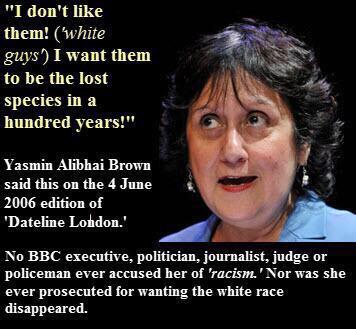
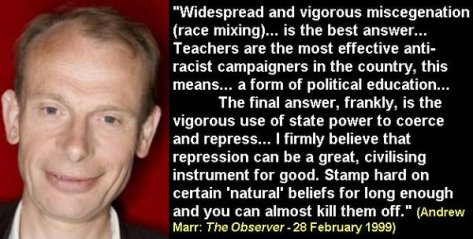
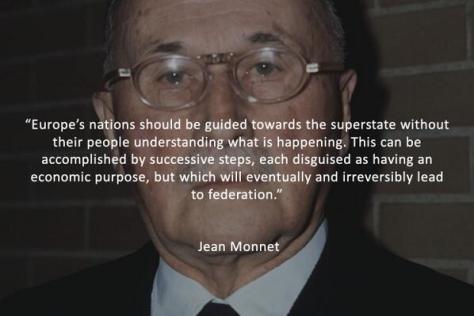
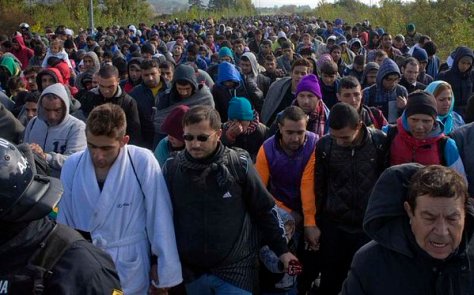



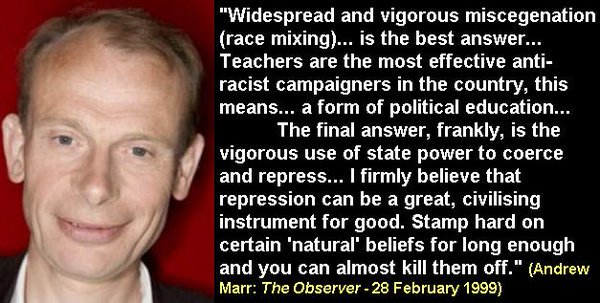
 Ian Robert Millard