Tag Archives: Reform UK

Deadhead MPs, An Occasional Series: The Karen Bradley Story

Karen Bradley is the Conservative Party MP for Staffordshire Moorlands, and has been since the constituency boundaries were changed for the 2010 General Election, making the seat a safe seat for the Conservatives. Her share of the vote increased from 45.2% in 2010 to 58.1% in 2017.

Unlike most MPs, Karen Bradley represents an area not far from where she was born. She went to a comprehensive school and then to Imperial College, where she graduated in Mathematics (B.Sc.).

There is little information about Karen Bradley’s family or parents. Her origins seem modest, at any rate.

Karen Bradley worked in tax for Deloitte and KPMG, for a total of 16 years; she also worked for 3 years as a consultant in the same field, but gave up and rejoined KPMG. I think that we can be sure that Karen Bradley does know about how to calculate tax.

Karen Bradley is married (husband’s occupation unknown to me); they have two children.

Upon election as MP in 2010, Karen Bradley joined the House of Commons Work and Pensions Select Committee (MPs on such committees get more pay). At least she would understand the tax questions.

There is no record that I have seen of her criticizing or even questioning the cruel system of “welfare” (social security) put in place by Iain Dunce Duncan Smith, the Jew “lord” Freud etc after 2010. On the contrary, she has always voted to make the poor (if unemployed, sick or disabled, at least) poorer.

https://www.theyworkforyou.com/mp/24725/karen_bradley/staffordshire_moorlands/votes#welfare

What a bitch.

The Germans have a saying: “put a beggar on a horse and he rides it to death”.

Karen Bradley became a Government Whip in 2012, a traditional home for mediocre MPs.

Karen Bradley was appointed junior minister at the Home Office in 2014 and then, in the turmoil following the 2015 General Election and the subsequent election of Theresa May as Conservative Party leader, she was appointed Secretary of State for Culture, Media and Sport.

It may be that Theresa May wanted to appoint women to senior posts.

MPs, like generals, need luck in their careers. I doubt that many, in 2010, would have predicted that Karen Bradley would go from not even being an MP in early 2010 to being a member of the Cabinet only six years later. She certainly had luck; however, the luck ran out:

During the cabinet reshuffle in 2018, Bradley was appointed Secretary of State for Northern Ireland after the resignation of James Brokenshire due to ill health. Matt Hancock replaced her as Culture Secretary. In July 2018 she came under criticism in the Northern Ireland Affairs Committee for failing to take action on British government discrimination against former soldiers and police. Andrew Murrison challenged her on her account of what she had done, and she said she would write to him. Sylvia Hermon commented: “I wait and wait for letters.”[12]

[Wikipedia]

In September 2018 she was criticised for admitting in an interview for House magazine, a weekly publication for the Houses of Parliament, that she had not understood Northern Irish politics before being appointed Secretary of State for Northern Ireland. “I didn’t understand things like when elections are fought, for example, in Northern Ireland – people who are nationalists don’t vote for unionist parties and vice versa,” she said.

[Wikipedia]

The newspapers were soon full of views about Karen Bradley, the vast majority very critical, using words such as “shamefully ignorant,”, “a slow learner”, “should resign”, “should not be in job” etc.

https://www.theguardian.com/uk-news/2019/mar/12/karen-bradleys-shameful-ignorance-about-northern-ireland

Karen Bradley did not even understand that Northern Irish voters mostly vote on sectarian lines! Hopeless…

Attracting widespread and sustained criticism, Karen Bradley united the political classes in their belief that she was inept, ineffectual, gaffe-prone and completely out of her depth,” said Deirdre Heenan, professor of Social Policy at Ulster University.” [BBC]

Media appearances by Mrs Bradley became infrequent and brief.” [BBC]

https://www.bbc.co.uk/news/uk-northern-ireland-49085076

In the end, though, Karen Bradley’s loyalty to Theresa May and the Conservative Party (she has almost always voted with her party) saved her until Theresa May was replaced by Boris Johnson, who sacked her at once:

https://www.bbc.co.uk/news/uk-northern-ireland-49103711

https://www.belfasttelegraph.co.uk/news/northern-ireland/karen-bradley-sacked-as-northern-ireland-secretary-by-boris-johnson-38343488.html

It is not hard to be Secretary of State for Culture, Media and Sport. Lazy half-Jew chancer Ed Vaizey blagged it for years. Karen Bradley did the same. It became clear, though, when she was appointed to Northern Ireland, that she had received at least one promotion too many. She was out of her depth in Cabinet. She had to go.

What now for Karen Bradley?

I was unsure as to whether Karen Bradley was enough of a deadhead to make it into the hallowed halls of my Deadhead MPs series. She might have been assessed as merely mediocre. However, her performance at the Northern Ireland Office has sealed her fate and provided her entry ticket to this blog series.

I imagine that we have seen the end of Karen Bradley as a member of the Government, whether under Boris Johnson or anyone else. However, she has a safe seat in the Staffordshire Moorlands, seems to be popular there and so will no doubt continue to be, as a constituency MP, merely mediocre most of the time, rather than a deadhead.

Notes

https://en.wikipedia.org/wiki/Karen_Bradley

https://www.karenbradley.co.uk/

Update, 10 January 2025

Karen Bradley became almost invisible after she was sacked from Cabinet in 2019. A wise tactic, because it saved her from having her evident unsuitability for office being again underlined.

Having said that, Karen Bradley actually increased her vote share in 2019, to 64.5% (Labour 26.9%).

At the 2024 General Election, Karen Bradley’s vote share fell to 35.4% (Labour 32.6%, Reform 23.2%).

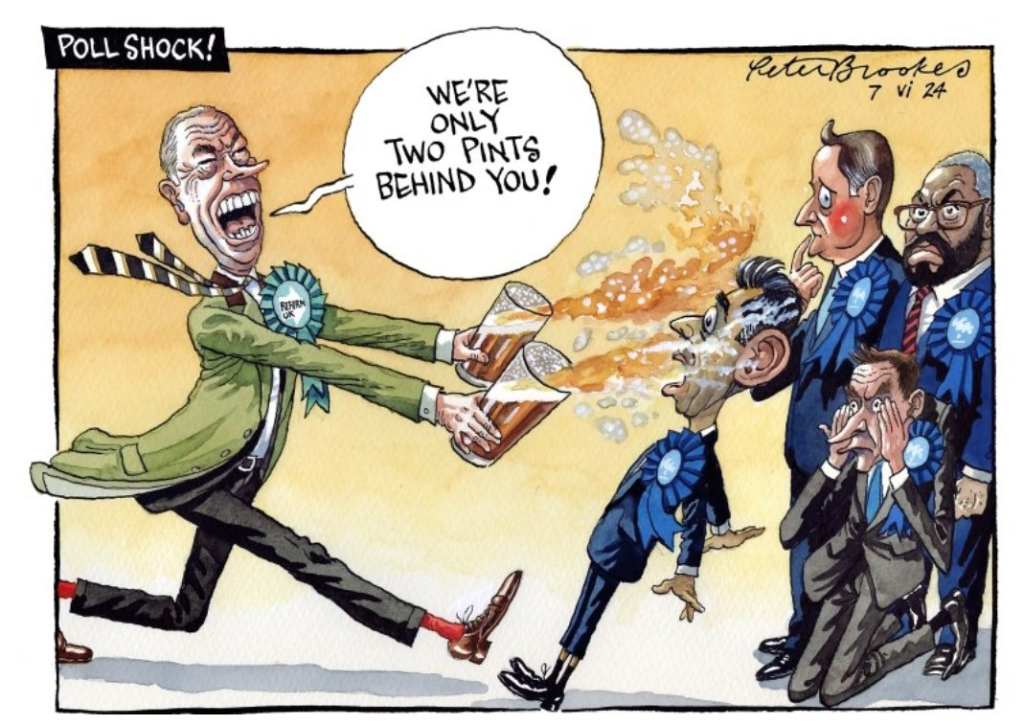
Next time? Hard to say. The Conservative Party is now in the trough of despair, but so is the Labour Party. Reform, though, is booming, and it may well be that, next time around, Reform will take votes from both Lab and Con, and thus put Mrs. Bradley out of a job. Open question.

After a 2019 General Election, What?

I just read a typically unsatisfying yet not completely uninteresting article in the New Statesman [below].

https://www.newstatesman.com/politics/uk/2019/07/boris-johnson-all-roads-likely-lead-general-election

The conclusion of that article is that Boris Johnson will be forced to a general election before very long. Unlike msm talking heads, we have no need to say “whoever is the next Prime Minister”: the system is broken, the 100,000 elderly people actually given a vote love “Boris”, and so we, the other 65 million, are having imposed upon us the least honest, least competent, least loyal, least decent, least worthy, least genuinely British Prime Minister in living memory, perhaps ever.

The crunch is coming, but Boris Johnson has never kept to any “pledge” or promise, whether political or personal, so will not be bound by his “Leave EU by 31 October 2019” one either, in my view.

As I have blogged previously, Boris Johnson likes to be presented as a strong maverick character, whereas in fact he is actually rather weak: weak in logic, weak in general knowledge, weak in resolve, weak in ethical standards, weak politically.

Philip Hammond puts it more diplomatically: ” “He is actually a more complex personality than it sometimes seems,” Hammond said of Johnson in his interview. “He is a mainstream conservative on all topics except Brexit. I very much regret his attitude to Brexit. His own story, which is multicultural, multinational and liberal, speaks for itself.” [The Guardian].

Hammond’s words of course are two-edged and allude to Johnson’s part-Jew, part-Muslim, born-in-USA (and brought up largely in USA and Belgium) background, as well as his loose and indeed louche morality.

I may be overthinking this, because I do not see Boris Johnson as a determined —or indeed any sort of— planner (except in terms of trying to become Prime Minister for the past 20+ years), but I wonder whether Johnson foresaw that the Commons would block fulfilment of his “Brexit on WTO terms by 31 October” so-called “pledge”? After all, it would hardly require clairvoyance. The House of Commons has a large Remain majority.

If Boris Johnson “pledges” to leave on WTO terms on 31 October 2019 and if that is then blocked by the Remain majority in the Commons, Johnson can then sigh loudly in public and say “I did my best, but have been stabbed in the back by all those pro-EU MPs…”, thus absolving him from blame for not “delivering Brexit” (the EU will very likely grant further “extensons” etc…). Johnson can then present himself as the Tribune of the People, fighting the corrupt Remain MPs. A hero to fools…
From Johnson’s point of view, perfect. No need to actually negotiate with people who are more intelligent, more knowledgeable, better prepared than Johnson himself ever is, no need to put in much effort and, finally, also parking tanks on the lawn of Farage and Brexit Party (that less certain, though).

What if it goes wrong for Boris-Idiot and there is a no-confidence vote? I am wondering whether the prospect of this stupid clown as Prime Minister, even leaving aside Brexit, might not be enough to make some Conservative Party MPs abstain in a no-confidence vote. I would not bet against it.

If Labour put forward a no-confidence vote, and if that succeeds, it might not mean an immediate general election. The Conservatives can put forward another, less obviously clownish MP as their prime ministerial choice. If all the Conservatives and all the DUP support that person, then that freezes out Corbyn and Labour for a while.

What if there is a general election? If Brexit Party put up a fairly full slate of candidates in England, and if at least some form of Brexit has not happened by then, there might well be an explosion of rage from the half of the country (more than half) that voted Leave in 2016. That explosion might well not spare the Conservatives who have so badly handled the Brexit negotiations for the past 3 years. After all, that inept performance calls to mind the other stupidities of the past decade.

Scotland seems likely to vote at least 40% SNP in a general election, creating (maintaining) a bloc of about 40-50 Westminster MPs. As for England and Wales, if you take out the blacks and browns (etc), and you take out London (and Gibraltar, which has no votes in Westminster elections), the Leave vote was around 70%. What does this mean?
First of all, Brexit is not the only issue. The socio-economic problems of the country play more to Labour’s advantage. What is letting down Labour electorally now is that it is seen to be largely the party of the blacks and browns, the immigrants and their offspring, as well as public service workers, and those reliant on State benefits. I speak in broad-brush terms of course.

The people who are voting Labour now and might vote Labour in any 2019 general election are concentrated in quite few seats, about 200-250, but some polls are saying that only 40% of 2017 Labour voters will vote Labour if there is a general election this year. Translating that into seats is not easy, but it could mean a substantial reduction from the position now.

The above is however affected by the effect Brexit Party might have on the Conservative vote, bearing in mind that, as with Labour, as high as 60% of 2017 Conservative voters say that they will not be voting Con next time.

If Brexit Party puts up candidates all over England and Wales, and scores at least 15% nationwide, the present 312 Conservative seats will reduce to about 250 and possibly fewer. Most will fall to the LibDems or Labour, but no doubt Brexit Party could win a few too. If Brexit Party can score 20%+ nationwide, then there might be only 150 Conservative MPs left.

We are in minority, possibly coalition, territory. Either

  • Labour + SNP or
  • Labour + LibDems; or
  • Conservative + Brexit Party or
  • Conservative + LibDems

One intriguing fact is that Boris Johnson is apparently marginally more popular with Brexit Party members than he is with Conservative Party members.

My guess today (in this volatile climate, one alters perceptions almost daily) is that it is a race between Labour’s vote (especially in the North) collapsing and the Conservative vote collapsing in much of the country, and weakened further by the existence of Brexit Party (even if Brexit Party itself scarcely wins a seat).

I cannot see Boris-Idiot lasting for long as Prime Minister— he is completely unsuited for such a position; but having said that, the country has already gone half-mad…

Postscript

I had scarcely published the above when, about an hour after that, the Guardian published the report below:

https://www.theguardian.com/politics/2019/jul/19/brussels-to-offer-boris-johnson-extension-on-no-deal-brexit

“Brussels to offer Boris Johnson extension”… Quelle surprise…

There is also this now:


Update, 10 April 2021

Nearly two years later from when I wrote the above blog post, we look back at the December 2019 General Election and see that most of the analysis was correct. What made the prediction of Conservative Party electoral collapse misfire was the event few —if any— predicted, meaning that Nigel Farage, snake oil salesman, stabbed his own party in the back, and withdrawing from active participation the majority of Brexit Party candidates, all of whom had actually paid for their own deposits (and more)!

All or almost all Conservative Party candidates were given a clear run by Brexit Party. Brexit Party candidates in some formerly Labour seats where the Conservative Party was always unlikely to win, were allowed to stand, as in Hartlepool, where the Brexit Party 2-i-c, Richard Tice, came a very close third and, had the party not been killed by its own leader, might have pulled off an historic coup in a seat Labour-held since it was created. Farage’s actions destroyed Brexit Party credibility during the campaign.

The net result was that, with most intended Brexit Party votes going to Conservative candidates, the Con Party achieved a huge 80-seat overall majority. Many Conservative candidates, especially in the North, won by fewer than 2,000 votes. Had Brexit Party put up more than a token fight, the Conservative Party might well not have achieved a majority at all.

As for Nigel Farage, after his treachery in 2019, he had the gall to wind up Brexit Party (literally, since it was set up as a private company) and start yet another party, Reform Party or Reform UK, which he then abandoned when offered a great deal of money in business. An out and out, controlled-opposition, con-man.

The Sliding Labour Party– What Next?

Some months ago I blogged about what I saw as the emerging political vacuum in England and Wales. My overall view now is the same but more so.

The 2015 General Election would have broken the mould of British politics had it been carried out under conditions other than the absurd First Past The Post system, more suited to the UK of the 1920s than that of the early 21st Century. The distribution of votes in Southern England illustrates this well enough, where the Conservative Party got about half the votes but won about 95% of the Westminster seats (a similar ration to that of the SNP in Scotland).

The UKIP insurgents famously won nearly 4 million votes UK-wide (mostly in England), some 12% of the vote, yet won no seat except that of Douglas Carswell, who is really a Conservative and was previously elected as one.

It can be asserted as simple fact that, in almost any given English seat, most of the voters do not get the MP or party that they want and for which they voted. Moreover, even the typical 30%-50% received by the winning candidate often reflects more the candidates that most voters did not want: voters vote tactically in the absence of a true choice being available.

FPTP has distorted British politics, giving the incumbent party in any given seat a great advantage and –far more– giving the main System parties as a whole a like electoral advantage and an anchor against sliding into ruination. All the same, when the forces become unstoppable, that slide does happen. It happened to the Liberal Party during and after the 1920s (replaced by Labour) and it happened to Scottish Labour after 2010. This illustrates it well:

https://en.wikipedia.org/wiki/Scottish_National_Party#UK_General_Elections

Founded in 1934, the SNP often scored less than 1% of the vote in Scotland and had to wait until 1970 to get a single MP elected. Even in 2010, the SNP only got 19.9% of the Scottish vote and 6 MPs (out of 59). Then the tipping-point was reached and in 2015, its vote swelled to 50% and suddenly the SNP had (a typically-disproportionate FPTP result) 56 MPs (out of 59). Labour in Scotland was ruined and now (2017) is only the third party in the polls there (after the Conservatives!) and has only about 15% voter support.

Moving to Labour overall, we see that this is a party that has been living “off its hump” for a long time. It even managed to jettison almost every remnant of “socialism” in its policies and yet win elections under Tony Blair (via appealing to otherwise Conservative or Liberal Democrat voters in the South and Midlands). Labour, in effect, “sold its patrimony for a mess of pottage”. When one asks oneself “what does Labour stand for?”, nothing coherent comes to mind: a confusion of old history, trade unions, strike banners, post-1945 nationalization, 1960s-1970s managerial technocracy, that old humbug Michael Foot in his donkey jacket at the Cenotaph, then, from the mid-1990s, the mirage of Blairism (New World Order pro-Americanism meets the Israel Lobby meets managerial “socialism” meets Common Purpose careerism).

It is often said that Labour is now split into Corbynists and Blairites. Another fault line (closely following the first) might be said to be the pro-Israel lobby bloc and the generally anti-Zionist bloc (though most in both still feel the need to pay lip-service to the “holocaust” narrative and its faked history, non-existent “gas chambers”, the now-derided “six million” etc).

In fact, Labour is now not even two parties but three:

  • the remnant of the old trade union-oriented Labour Party, based around traditional and unthinkingly Labour communities, mostly in the North;
  • the Blairite-Brownite pro-Israel bloc, consisting largely of MPs and their staffs, together with careerists in other parts of the country. These are those who want “to win elections” by promising pie in the sky: socialism to socialists, aspiration to the voters of the suburbs, “diversity” to the ethnic minorities and the rainbow loonies, profits and low taxes to the Jewish Zionist potential donors;
  • the Corbyn  camp, which relates to a partly-imaginary Labour history from the 1930s through to the 1980s: “no pasaran!” Communist (and some syndicalist) propaganda from the Spanish Civil War; an airbrushed “anti-Nazi” and “anti-fascist” Second World War narrative; the conflicts of the 1970s such as that in Chile or those in parts of Central America; the Miners’ Strike of the 1980s (seen mainly through a London lens though). This is largely a bloc based around London, around the half-mad pseudo-socialist local council enclaves that became notorious in the 1980s: Islington, Camden, Haringey, Lambeth. It is the dominant bloc now and is supported by at least half of the ordinary Labour Party members and supporters.

Naturally, there is overlap here and there within that tripartite split. However, what has fallen away is not only consensus among the Labour members and activists, but more, the voters. Most Labour voters now are in that first group and are only voting Labour out of traditional allegiance. When you look at, say, Stoke Central, where the by-election is about to take place, you see that voting Labour, not in 1945 but in 1997, 2001, 2005, 2010, 2015 has not given the people anything. Unemployment high, immigration high, large numbers of ethnic minority voters (Labour’s most reliable pawns now); little hope. Why would people in Stoke Central vote Labour? The answer seems to be that they see little choice (those that will actually vote, being probably a minority of those eligible).

In Stoke Central, the only alternative to Labour is UKIP, which is not the sort of social-national party likely to rise to power. In fact, UKIP is not social-nationalist at all, though some of its supporters are. The fact that UKIP is even being entertained (and may yet win the Stoke Central seat) is mainly a sign of Labour’s decline and not UKIP’s strength.

The industrial proletariat has gone, almost entirely. The trade unions are just a feeble bureaucratic, rainbow-coalition, “anti-racist”, Common Purpose-contaminated joke. The people who are suffering under fake “austerity” (the effect of #NWO/#ZOG globalism) and who belong to the burgeoning “precariat” (unemployed, underemployed, disabled, 50+, zero-hours-exploited, minimum-wage-exploited) are not now Labour voters but non-voters, sometime UKIP voters, potential social-nationalist voters. The Labour MPs are now mainly careerists, pro-Israel drones and “what’s-in-it-for-me?” bastards. Stoke Central MP Tristram Hunt abandoned his seat and constituents because, as he said, “the offer [from the Victoria and Albert Museum] was too good to refuse.” £250,000 a year. That was his price.

When a social nationalist movement of the new type emerges, as it must, it will start to scoop up the poor, or poor and angry and frustrated, masses. Labour will then disappear. Already it seems likely that Labour will only get between 100-200 seats in the 2020 Parliament, whether numbers are reduced from 650 to 600 or not. Labour policies– pro mass immigration, “welcoming” “refugees” (not of course to the MPs’ homes and neighbourhoods but to those of the former Labour voters), pro the EU octopus etc, simply have no appeal to those left behind by a conspiratorial globalism and multiculturalism.

As yet, a suitable party does not exist. When it does exist, Labour, already weakened, will fall to dust.

Update, 24 August 2025

Well, scroll on 8.5 years and here we are. The 2017 Stoke Central by-election was won by Labour (from UKIP and Con), and the seat retained by Labour at the 2017 General Election, but lost to the Conservatives in 2019, only for Labour to win the seat back in 2024: https://en.wikipedia.org/wiki/Stoke-on-Trent_Central_(UK_Parliament_constituency)#Elections_in_the_2020s.

In the bigger picture, of course, the Cons under Boris-idiot won in 2017, and won bigger in 2019, only to lose to Starmer-Labour in 2024, since which time Reform UK has arisen to prominence and, indeed, dominance. We now await events.