How many times have I in the past tweeted and (my Twitter account having been taken from me by a Jewish conspiracy in 2018) blogged, that “Boris” is no good in a crisis? Many times. Listening now?…
“A lot of people are trying to escape before midnight so that they can see their families.”
As Christmas approaches, Londoners were busy catching trains to elsewhere Saturday evening in a race against newly announced Tier 4 travel restrictions pic.twitter.com/vqr9M0UGQg
Can’t wait to experience the new strain of the virus when you guys get here. Yay @BorisJohnson and his FANTASTIC leadership throughout this. https://t.co/Srm8wRzQkR
She appeared to furnish Police Scotland's Chief Constable with the autonomy to block the border any way he saw fit? This appears appears to go beyond the role of the FM and the CC especially in the context of the superior law of the land. This requires to be scrutinised.
So we have Sturgeon purporting to act like the head of government of an independent state, ordering its borders closed, Police Scotland refusing (quite rightly, imo) to institute a hard border (while increasing patrols), police in London threatening to arrest anyone trying to escape from the zoo, and Boris-idiot trying again to play the poundland Churchill…
I have travelled more than most, and have seen some pretty screwed countries, so I do not say that the UK is the worst, by any means, but it is sliding rather fast now…
We have come to see the SNP as sort-of “normal” now, part of the political landscape, but it was a very minor party until 2015, only 5 years ago. Sturgeon is a strange woman, a fanatic, someone who seems to prefer Pakistani and other migrant-invaders to the English (and even some Scottish).
Inside story on the #grooming cover up. No point blaming the Common Purpose civil servants though – it's the politicians who accept their lies. And the people who keep voting for them.
DAN HODGES reveals the story of cover-up over the abuse of young girls https://t.co/GsbcKoG3G4
Those girls and others are, of course, now constantly brainwashed, both at school and on TV, to accept mixed-race “relationships”, and even offspring, as normal and “OK”… No wonder they were easily enough seduced, suborned, or bought.
Yes, @bradygwilson Lawrence was very sharp on the issue of liberty versus the strong state. I quote from him in my 'Abolition of Britain' https://t.co/4rbgGv5rHZ
Its example of the government needing to be seen to be acting, doesn’t matter if it’s useful, effective or anything. Just be seen doing something. So we get “let’s build emergency hospitals, we don’t have the staff for them, but that doesn’t matter, we’re being seen doing stuff”
I have no idea @silentmadge. I am buffeted this way and that by contradictory claims, and am unqualified to judge between them. . It seems quite possible. I'm much more interested in the fact that this supposedly terrifying plague often *has* no symptoms. That is beyond dispute. https://t.co/IfZOPswbMU
Yes, even the sainted English courts will not usually stand up for either liberty or free speech. On a smaller stage, look at my 2016 disbarment. A retired Circuit Judge chaired the 5-person panel. The others were two fellows who looked reasonable and behaved well and with appropriate humour if I made a joke; and two purse-lipped disapproving women who were cookie-cutter humourless types incapable (in my opinion) of thinking independently, though in fact they said little. Bookends.
You can see Tribunal panels and benches of lay magistrates like that (but with 3 members) all over the country.
That retired judge was impeccably (well, almost impeccably) fair in his manner and gave me an impeccably fair-seeming “trial” which, however, was always going to lead to my being found “guilty”. The only question was whether I would be disbarred, merely suspended, and/or fined.
For me, as good as penniless, the main thing was to avoid any financial penalty. I had ceased Bar practice in 2008 anyway, and would never return to either the practising Bar or to salaried employment. I could have successfully opposed actual disbarment, but chose not to do so.
In an exchange before the panel retired to consider their verdict, I could tell what the Chairman-judge was thinking, and in my view he knew what I was thinking. He did not overdo the matter, or express any faked disapproval of me, so I give him credit for that.
Still, the point is that the Tribunal knew what the System expected of it and so found against me. That then enabled the malicious pack of Jews behind the attack on me (“UK Lawyers for Israel”, effectively the same “people” as in the “Campaign Against Antisemitism”) to crow, and to dance ritually in their joyous “triumph”. Oh, and the self-described “Left” Twitter-twits all applauded the Zionists…the idiots.
Looks like various factors are beginning to come together: “the virus”, Brexit and possible shortages, economic slide leading possibly to near-collapse and to massive youth and other unemployment, and to continuing migration-invasion. This may be the time when social nationalism can truly rise up in the UK.
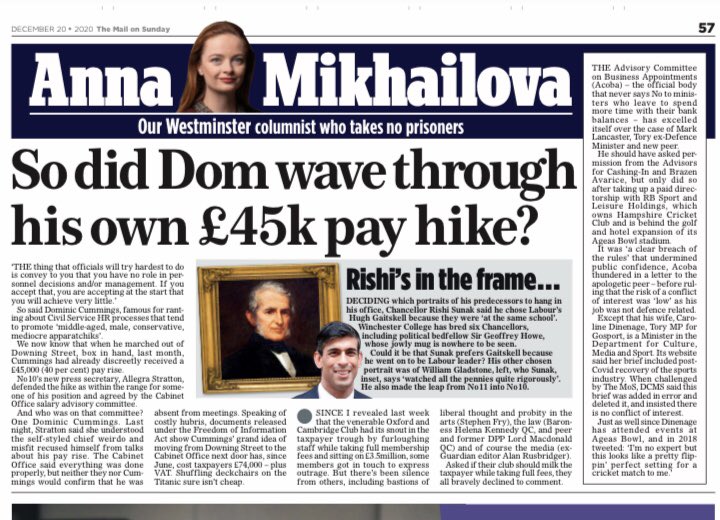
💥Column:
EXC: That £45,000 Cummings pay rise? It was approved by the Cabinet Office salary advisory committee
As one of several who wrote about Rotherham at @LabourUncut during 2012-2015, must admit I found the Home Office's conclusion surprising, that grooming gangs were "most commonly white". That's because it wasn't the case, as @DPJHodges reveals: https://t.co/axLUlHspOz
The Conservatives now clearly the party of the working class – why because the left no longer preaches solidarity just sectionalism and autonomy – time for Conservatives to do solidarity at scale https://t.co/o6UsXsraY1
An interesting tweet, confirming as it does my long-tweeted and blogged view that Labour is now mainly the party of the blacks and browns. It also confirms (by implication) that I have been right in saying that the “Conservatives” are winning over “Labour” by default, not on their own merit. A real social-national party could rise up and defeat both, if credible, properly led, with clear and properly radical aims.
As for “Labour” being supported by a majority of “graduates”, when almost everyone (well, 50%) under, say, 30, has a “degree”, what is such a “degree” really worth?
More pertinently, that means that persons under 30 (who are far more likely than older voters to have gone to some degree mill “McUniversity” rather than no university) support Labour. More likely to be renters, also likely to be getting poor pay (despite the “McDegree”).
Not every holder of a Mickey Mouse “degree” can emulate the ludicrous James Cleverly and become a Government minister on the strength of a “degree” in Hospitality Management… https://en.wikipedia.org/wiki/James_Cleverly.
My fundamental point was that it won’t be coming from Scotland. That still stands. Even when it’s Sunday you’ll have to do better than that to justify your patronising tone.
If the UK and particularly England stopped the migration invasion (and consequent births to the invaders) there would be no “water shortage”, though obviously both leaks and the lack of an overall strategy are very important.
Google Hampton Water Treatment Works and prepare to be educated.
Just watched about an hour of The Death of Stalin [https://en.wikipedia.org/wiki/The_Death_of_Stalin] which I realized, as I watched it, was not meant to be historically accurate. I see now from Wikipedia that it was meant to be “black comedy satire”.
Ahistorical, not so much black comedy as slapstick, very poorly realized and acted (contrary to what Wikipedia reports of the critical reaction to the film). Overall, very poor. I would not give it, even as “black comedy”, more than 2 out of 5. The locations were good, some possibly the originals or very close copies (e.g. the “Nearby Dacha” of Stalin, and what I thought was the park of the Economic Achievements Exhibition, but might not have been: https://en.wikipedia.org/wiki/Exhibition_of_Achievements_of_National_Economy).
I wondered whether someone such as Mel Brooks had directed the film, but apparently it was one Armando Iannucci.
For me, not worth watching right through to the end. Cheap slapstick.
As blogged before, this situation is not quite the Book of Revelation “mark of the Beast” scenario, but possibly an early attempt at something similar.
Yet much of the rabbit public has become almost obsessional about the facemask nonsense…
Well, @bbcjonsopel, your tweet was pretty clearly a call for more masking here. If you want to give ‘anything’ a go consider rational scepticism towards govt policy which is destroying the NHS, obliterating jobs and bankrupting the economy. And not working. https://t.co/Aqw9J0iIyE
It is rather unlikely that Jon Sopel, a Jewish journalist who is paid hundreds of thousands of pounds a year by the BBC (which is little more now than a Government/System mouthpiece), is going to rock the boat very much…[https://en.wikipedia.org/wiki/Jon_Sopel].
1/3 OK, I'll try again, @bbcjonsopel. You should have learned by now that US public opinion is much more subject to hysterical swings and crowd pressure than that in the UK. https://t.co/Bio48AU9Fc
2/2 @dillingersghost Your question is like a man who has burned down his house to get rid of a wasps' nest, responding to the gawping crowds as they gaze at the embers of his home(and the unharmed wasps buzzing round it) by saying 'Well, what would you have done?' . Not that. https://t.co/iY60wHDmQx
2/3 @bbcjonsopel. Next, as a BBC journalist, it's a breach of impartiality to take sides( as I think you do here) on matters of public controversy. Finally, you write as if there has hard evidence for the effectiveness of masks. https://t.co/Bio48AU9Fc
The great majority are still completely hypnotised by the propaganda, @checkout123. It is amazing and dispiriting to discover how many don't even know there is a controversy. BBC's behaviour has been so shameless that the only solution now would be to dissolve it and start again. https://t.co/jzudKNs0Tz
And we will be there forever if we don't all wake up and start thinking. This is like one of those old-style Deep South prison farms where they re-arrest you, just as you finish your sentence. @mcsteabilly. https://t.co/Vw2eoFr8iY
Direction of travel of the social-national movement
The first thing to recognize is that there is no “social-national movement” in the UK. The modest successes of, mainly, the BNP, 1997-2010, could be described as interesting rather than enthralling; the BNP’s complete collapse in 2010, though ongoing to 2015, was neither enthralling nor even interesting.
I do not include the “controlled opposition” of Farage, his UKIP and Brexit Party vehicles etc (which are scarcely “national”, let alone “social national”); neither do I include the “alt-Right” wastes of space: “Prison Planet” Watson, “Sargon of Akkad” (Carl Benjamin), “Count Dankula” and others. Not worth bothering about. Most of them are vocally pro-Jew and pro-Israel too (either to buy credit from them and so avoid damage to their apparently lucrative online activities, or out of actual adherence).
Apart from the above, what we have now amounts to little more than various individuals posting tweets, youtube vlogs etc online.
Thus the “antifascist” (mostly Jew or Jew-controlled) element can easily “take down” the aforesaid wastes of space, and (connected) types such as Katie Hopkins, and even Tommy Robinson (the only one of them with anything like a real offline following), simply by “taking down” their Internet service. These people (except, arguably, Tommy Robinson) are dependent entirely on their websites, blogs, vlogs and including online sales, for income.
Offline? Patriotic Alternative are slightly interesting, and I think that they are at least somewhat on the right track. The other little “movements” and “parties” are a waste of time and space. I have blogged about them previously here and there. If you use the search bar on this blog, you will find my comments about them made from time to time.
Anything or anyone else? Well, ex-BNP leader Nick Griffin is or seems to be partly on the right sort of track too, though I was forced to write critically recently about his support for Jayda Fransen and her “British Freedom Party”. His support for that frankly puzzles me.
There is space and indeed a necessity for a credible movement, which would include a political party, but one does not as yet exist. That movement would also include a gradual relocation by many to a few parts of the UK where forces can be concentrated. My views on this have frequently been blogged, and can be found below.
I have listened to the views of those who say that concentrating forces in such a way is a strategy of “running away”, and that we should “stand and fight”. Well, I would answer that by saying that
There is a difference between strategic withdrawal and “running away”;
One cannot “stand and fight” with no weapons and, even more importantly, no army!;
The English cities are becoming majority non-white; yes only gradually, but surely all the same; by 2040, maybe even 2030, the UK cities and large towns will be basically non-white, and already show clear signs of that;
Such a concentration of forces does not preclude activity in the main urban areas.
The next step must be to establish a tightly-controlled political movement, even if small. However, it must be credible and solid right from the start.
#Labour A reliable source confirms Keir Starmer is lining up Tony Blair for a sensational return to front line politics as Labour candidate to contest Islington North which is currently held by independent MP Jeremy Corbyn.
Can that be true?! Could be a game-changer if it is. Imagine if Blair actually took over Labour again…he is completely controlled NWO/ZOG. Just in time for the next crucial year in the 33-year cycle— 2022.
Mass Immigration Lays the Foundations for Jihadism in Europe.
Britain is riddled with enemies and traitors; they have to be rooted out.
Behold these vast discs of doom looming over Paddington Station. Now HMG has gone wholly Maoist, will they now be replaced with portraits of Johnson, Hancock, Whitty and Vallance looking stern, noble and 20 years younger? pic.twitter.com/SP1mZmlk1j
https://t.co/FV20okTiye Interesting government admission. 'Around I in 3 people with Covid have no symptoms'. How many more are affected mildly? In which case, why this frantic propaganda?
I think it is deeper than that. The opposition are complaining that the draconian loss of liberty doesn't go far enough, and other hitherto democratic, libertarian govts around the world are following the same steps.
— @Baldwhinger – unacceptable views (@JMC_Starbug) December 19, 2020
Hello?! Is anyone in? Has anyone out there heard of “The Great Reset”? Has anyone heard of “The Great Replacement”? What about the Coudenhove-Kalergi Plan? Or NWO? or ZOG?
This is not confined to the UK. It is a global “consensus” or conspiracy…
Matthew Parris. Dead right. In ‘The Times’ ‘Being bossed around has infantilised us all’ ( All? Well, not entirely! One small group stillholds out,,,,) pic.twitter.com/5ECBZM8pLZ
So far uncensored by Youtube and now with more than 200,000 views , my most recent conversation with @Iromg Mike Graham of @TalkRadio: 'The govt's attempt to stop covid is like sending the army out to glue the leaves back on the trees, to prevent autumn.' https://t.co/mPvsjvZtOx
Early 20th century Russians had far more beautiful tram stations built for pennies than what any European country can create today despite throwing millions on each glass cube they put up. This one in Moscow was even mass produced and factory made. https://t.co/gLS0HH1jfc
Just listening to the clown presently posing as Prime Minister. Describing the latest illegitimate restrictions on the population. So some people, in some areas, are now to be actually prohibited from travelling overseas “except for work”. So that gives the wealthy business or parasite element a good get-out (as in “I have a business meeting in Marbella or Eilat, and will be using a private charter aircraft…).
In addition, Christmas and the New Year are now cancelled. “The Great Reset”…
From where does the (alleged) “new variant” of “the virus” come? China? Some secret laboratory? Was the existing virus strain designed that way, i.e. to mutate? Or is it a purely natural mutation, like strains of influenza? We do not know.
The bottom line is that the UK economy is going to tank. Still, “always look on the bright side of life”, and this could be the impetus, in 2021, for the formation of a real, and credible, social-national party.
“For the welfare of the people is the highest law” [Cicero]
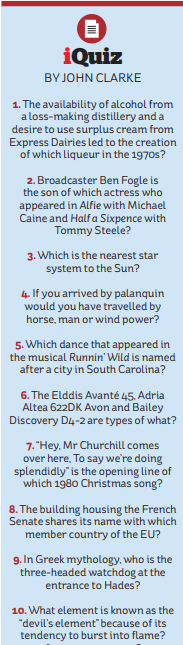
Damn. For the first time since I started looking at these quiz questions on Saturday, John Rentoul beat me, having apparently scored 5/10, whereas I scored only 3/10 this week (though had I thought for a moment I would have scored a few extra…); my worst-ever score…I had no idea at all about questions 2, 6, and 7.
In the end, the only response to the #greatreplacement is to have a large family of your own.
That alone will certainly not be enough, though it is good an sich.
Metro: “BREAKING: Londoners face being arrested if they try and leave city after midnight”. Have to say, I preferred it when those in Government were telling me to get out of London…
As I predicted some time ago, Sturgeon is using “the virus” to do “pretend-Independence” things. Closing borders unilaterally is the prerogative of a state, not a mere part of a state.
Do those people claiming this is all part of a grand conspiracy dreamt up by Boris have any understanding of the damage this is going to do to him politically. This is potentially an extinction level event for his premiership.
So? If the “Conservative” label fails and is voted out, the “Labour” label, equally (((controlled))) gets voted in, and very little changes…
Be as critical of Boris as you like. But anyone who thinks he wanted to do this as part of some grand plan to enslave Britain is off their head. It’s blindingly obvious this is the last thing he wanted to do.
Are we supposed to believe that that clown, “Boris”, is actually “in charge”? He is merely the puppet of powerful hidden forces.
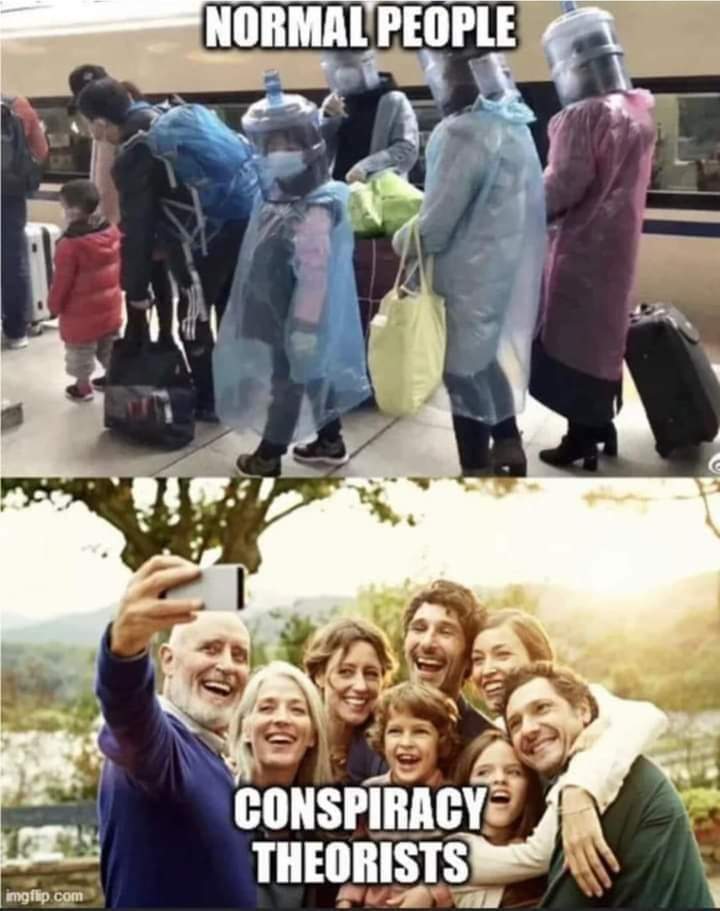
Conspiracy theory
The very latest conspiracy theory— just made up…by me. The mutating virus was planned in advance (and/or new mutations are deliberately released) with aim of reducing world population drastically. Maybe newer and newer mutations will “emerge”, each succeeding one more lethal than those before it (the first one was/is not so lethal, having —supposedly— killed 1 in 1,400 people in the UK).
Well, the above is just a speculation and may not be so…
For me, this is not someone who should have any power or influence at all. Sick in body and soul. The same or similar applies to his puppet, Boris-idiot.
Having said that, I have no interest in whether he drove North 250 miles in breach of the “lockdown” nonsense. There should never have been implemented such wide-ranging restrictions.
Now, while the msm obsess about Cummings, attention is on him, and not on the fact that the UK economy is actually collapsing behind the smokescreen put up by “lockdown” and its”furlough” payments (which buy off most popular protest, and will do so until furlough payments end).
So far, with (the surviving) pubs possibly re-opening in July and people able to walk on beaches, in parks, in National Parks etc, there is a semi-holiday feeling. Most people who would otherwise be scrabbling for fairly pitiful Universal Credit money are being paid 80%, in some cases 100% of their previous pay (some are actually better off by reason of not having to pay out for much transport, clothing etc).
However, the iceman cometh. The Autumn and Winter will see a tsunami of company failures (my description, some time ago, but now being echoed, using the same term, by leading businessmen). Unemployment will skyrocket. Then will be the time when social nationalism can get off the ground for the first time since 1939.
Boris-idiot
This must be the first and possibly last time I have agreed with something tweeted by “antifa” cheerleader Mike Stuchbery:
Can't see why all these right-wing lads fervently back Boris. He's got all the traits of what they'd call a beta. At the beck and call of others, no real convictions, all hot air and nothing behind the talk.
— Mike Stuchbery 💀🍷 (@MikeStuchbery_) May 25, 2020
Of course, Stuchbery is talking, I presume, mainly abot the “alt-Right” wastes of space, the like of “Prison Planet” Watson etc.
Some tweets seen
EXCLUSIVE: 'I look for Jeffrey's type and I bring 'em home.' Prince Andrew's cousin tells how Ghislaine Maxwell bragged she recruited girls for Epstein from trailer parks and was intent on eventually marrying him https://t.co/xm9Jaj9cI9pic.twitter.com/Pybfil1gxP
There is nothing to 'deny' @cd208. There is not a scrap of evidence that mass house arrest and the strangling of the economy saved a single life, that I know of. You have some? Please provide. https://t.co/vMskDKhdSQ
Time for today’s “dim SNP tweet of the day”, this time courtesy of tweeter “@amaginnit”
In a normal country, free people are not 'locked down' in the first place, @amaginnit, you serf. 'Lockdown' is a punishment for convicted prisoners who riot in penitentiaries. https://t.co/sGr8fnHNhN
I agree with Hitchens. What until relatively recently were “normal humans” in England have all but disappeared. The numbers taper off as the age drops below about 50.
Anyone younger than 40, so born around 1980, has been brought up and “educated” in a milieu of Jew finance-capitalism, “holocaust” propaganda disguised as school “history”, “multiculturalism” (as something supposedly good), the idea that the State should probably not help people (except fake “refugees”) very much (via social security, social housing etc), but that citizens should or even must obey, not only the exact letter of the law, not even its spirit (however thought of) but even the mere wishes or demands of (increasingly mediocre or even clownish) politicians.
One only has to look at what now is considered “comedy”…or the willingness (indeed eagerness) of many to denounce and/or “report” others (to police, to those running Twitter or other online fora, to employers) for unwillingness to censor themselves and/or comply with every politically-correct demand of the State or the Jew lobby. In fact, the police are among the most contaminated in this regard.
There are exceptions, a relative few of the under-40s, indeed under-25s, who are not, or not so much, brainwashed. It is a minority though, a small minority from what I can gather.
1/2 Is it? If you are so worried about accountability, surely a better target would be our supine plastic Parliament, which has made no attempt to scrutinise this policy, and our supine plastic 'opposition' which has not opposed. @chrisdonnelly12https://t.co/pMecBksXzz
Can't see why @timwilde16. It is essential for our national future that the whole episode is viewed as a mistake rather than a success. If not we will never escape from the facemask fanatics, and we will be in constant danger of a repeat of house arrest & economic strangulation. https://t.co/Q0kCDMzFgj
In fact, at this point I am more interested in what happens next, and particularly what will be happening in 3, 6, or 9 months in society, re. the economy, and in politics, than in arguing about or hearing debate about what Coronavirus is, what causes it to spread, and whether the peak happened before “lockdown” (which seems very likely) or later.
Prepare for the coming recession. Relief from government and the private sector will have its limits.#COVID19
— Marvic Leonen — maroon check (@marvicleonen) May 19, 2020
Let him warn himself. Chancellor Rishi Sunak 'warns' of the pointless economic devastation he and his fellow Cabinet members have themselves caused because they are unfit for their posts, and panicked: https://t.co/ZK17Z6L4dV
The tweeter above is referring to Rishi Sunak https://en.wikipedia.org/wiki/Rishi_Sunak , the Indian whom Boris-idiot made Chancellor, and who the shallow msm and Twitter mob lauded as a financial (and political) genius a couple of months ago for having introduced the “furlough” scheme, via which the obligations of companies to pay their employees were in effect transferred to the State which then shut down much of the economy.
A few (including me, Hitchens etc) saw through this scheme as a disastrous and ultimately pointless waste of resources which, combined with the shutdown (“lockdown”) would destroy the UK economy.
The msm and Twitter mob thought otherwise. “Rishi Sunak for PM!” was the cry. What a brilliant man, to throw away £8 billion (maybe £11 billion) a month “supporting [workers, families] etc”… Surely such a man must eventually become Prime Minister?
Well, I doubt it (even leaving aside his origins). The “furlough” plan in fact did not simply keep employees financially warm until “lockdown” ends, at which time, in Sunak’s own mis-chosen words, the economy will “bounce back” in a V-shaped “recovery”.
At the time, I blogged that, because this virus “crisis” (made much worse by governmental panic in the UK, EU and elsewhere) has led to economic slowdown, crucially to collapse in demand internationally, the result will be, certainly in the UK, not a “V-shaped recovery” but an “L-shaped non-recovery”.
Sunak may have ridden high in public opinion for a couple of months, but I do not see him prospering politically after at least many wake up to what is really happening. Any fool can throw golden sesterces to the plebs from his imperial chariot. For a while…
Sunak alone is not to blame for the “lockdown” and so not to blame for the coming recession (which may even become a depression), but he is to blame for being part of a Cabinet of fools that shut down the economy for months unnecessarily, and for both introducing and now extending a misconceived “pay workers £2,500 a month not to work and not to complain or protest” scheme.
Also, for going along with his foolish and incompetent Government’s strategy of scaring the British people (and other UK inhabitants) out of their collective skin, so that many are now too frightened (or anyway simply unwilling) to return to what was normal life.
The reason behind the extension to October (without even any reduction) in the “furlough” payments, is plainly political, to prevent or make far less likely any protest or worse from the “furloughed” employees.
However, the real state of the pre-Coronavirus UK economy, now that the froth of low-paid McJobs (“gig economy,” fake “self-employment”, zero hours contracts, and other poorly-paid exploitation disguised by, formerly, Working Tax Credits etc, and now by Universal Credit payments) has been swept into the bin, is becoming plain to see. Desolate.
As for that sacred cow of British people, house prices, the values are dropping like a stone, as I predicted. Already we see that buyers are demanding discounts of up to 20%. Before long, that will be 50% or more. Lending is unlikely to be easily-available from now on, and there will be fewer people buying. and with lower capital available, whether their own or via mortgage monies. People will still want or have to move house, but will have less money with which to do so. Result— lower house prices at all levels.
Time for the “dim SNP tweet of the day”, this time from a tweeter who refers to the Union between Scotland and England (1707):
EH. HOLD ON.
England's worst recession since over 300 years?
Are you thinking what I'm thinking?
— David Taylor 🏴 (@taylordauthor) May 20, 2020
I am more inclined to go back about 375 years, to the age of Cromwell, and England’s only real revolutionary situation.
Collapsing economy
Already, 4.2 million people are on Universal Credit, with millions more forecast as 2020 continues:
Companies are shedding workers by the hundred, by the thousand, now. Some companies are giving up the ghost entirely, such as the once-famous Antler suitcases (est. 1914), which went yesterday, with the closure of 18 stores and the sacking of the entire workforce of 200 staff. Other companies laid off thousands on the same day.
Today, we see that Rolls-Royce in Derby will lay off 9,000 workers across the world, and most of the losses will be in Derby itself.
When the “lockdown” nonsense —and with it the “furlough” scheme— ends, in the Autumn, supposedly, there will be company collapses on a scale not seen since the 1930s, very likely.
Northern Ireland
Boris Johnson may be Boris-idiot, but he can certainly pull the wool over the eyes of many. A con-man.
Theresa May, zooming in from Sonning, asks Michael Gove whether the PM's Brexit deal will force Northern Ireland to follow EU law until at least 2024. He answers: um, yes. pic.twitter.com/8fNBBSnldt
This hysterical Gov't must never be allowed to get away with the damage it has caused. They have broken the country in 2 months.https://t.co/1nYln33qDH
So children aged 1-14 years old have a 1 in 5.3 million chance of dying from Coronavirus in the UK. Puts the hysterical teachers’ unions in their place…Having said that, it seems pointless to open up the schools for the few weeks left until the start of Summer holidays.
There is much in what you say. But as 9,000 jobs and livelihoods, hopes and homes, are destroyed at Rolls-Royce – real people raising real families through real work – who really gives a dam about the reputations of a few over-promoted Tory MPs? https://t.co/u9LVKqYfGYhttps://t.co/h04cn86IwF
Depends how you look at it. We've got Priti Patel on LBC being interviewed by Ferrari using language of Nick Griffin/NF re refugees. I can see him listening on radio & thinking 'my job is done'
On other hand we've got Patel allowing in 100s++ child refugees in as per Dubbs prog
— WokeAndSnigglingAlot🥤 (@Nikhedonia11) May 20, 2020
That tweeter, “@CabinetOfClowns” also tweeted this (below):
Pretty shocking interview on LBC. Priti Patel is now using same language as Nick Griffin re refugees
She's got a lot to say about Islamic extremism, but totally silent on right wing extremism, which has now overtaken Islamic extremism. Maybe doesn't want to upset Tory voters!
— WokeAndSnigglingAlot🥤 (@Nikhedonia11) May 20, 2020
What “right wing terrorism” can she mean? The odd disturbed individual who wants to drive his car at a mosque? Young people who own Swastika cookie-cutters and cushions? Someone who got 2.5 years in prison for putting up a few stickers on lamp-posts? A few people in a pub talking about bumping off a MP?
In reality, there is no “right wing” (I am supposing that that tweeter means “social nationalist”, or just “nationalist”) “terrorism” in the UK. Am I wrong? So where is it? Where?
Just a few of the hundreds of police – NONE wearing masks or social distancing – in central London today for the trial of #PaulGolding.
Clearly, the cops know the 'virus threat' is social control hype. Unlike the economic, social & health catastrophe of their #lockdown farce. pic.twitter.com/DBoMXazbko
#NigelFarage tries to cover his unspeakable cowardice in refusing to speak out against the Covid1984 lockdown crime by messing around in boats. THIS crisis outweighs all others.
"If my eye don't deceive me, there's something going wrong around here". Just how comfortable are all the "revolutionary" left with being on the same ethnocidal page as the global corporations? pic.twitter.com/hw8Q9hsuZD
The coming few years could finally see social nationalism emerge victorious in the UK, but that can only happen if there is a co-ordinated movement led by a “vanguard” party. One does not now exist. The small groups which do exist have little or no credibility.
Looking down the road, we can now see that economic collapse in a decadent society opens the way for us. It is only two years now until 2022, the most significant year since 1989 (on the 33-year cycle). 2022-1989-1956 (the year of my own birth)-1923.
For me personally, 2022 will probably be the last marker-year in the 33-year cycle that I see in my present incarnation, because in 2022 I shall reach the age of 66.
I have been wary of Chris Tarrant ever since I saw some “holocaust” rubbish he was pushing on TV. Naturally, as a “media person”, he wants to keep in with the Jew element that infests the mass media. Still, it is a pity that his type has little or no principle. Now I see that he is being exposed on Twitter:
“Michael Jonathan Wright failed to attend appointments on June 14 and June 21 last year as part of his community order made by the court on May 15 after he assaulted a police officer in Southampton on 30 August, 2018.
The court heard how the 38-year-old failed to provide a reasonable excuse for missing his appointments.
Appearing at Southampton Magistrates’ Court on April 7, he admitted the breach of his community order.
Wright, of Wills Road, Southampton, was handed a community order.”
Well, the fellow only assaulted a policeman, after all (then failed to comply with the terms of his initial sentence); it’s not as if he sang songs satirizing Jewish “holocaust” fakes and hoaxes, in the manner of Alison Chabloz! Be fair!…
Meanwhile, on the Coronavirus front
“The Government has denied claims Whitehall officials have calculated up to 150,000 lives could be lost as a result of the lockdown.” [Daily Mail]
Note that: not “because of Coronavirus” but “because of the ‘lockdown'”.
“It is worse than all but the bleakest projection if social distancing measures had not been introduced.” [Daily Mail]
So even the pro-Government newspaper people are waking up to the fact that the “lockdown” is causing, and/or will cause, directly and indirectly, more deaths than the Coronavirus itself.
Prince William
Ha ha! That thick princeling has exposed his mediocrity (again)…
Prince William is a privileged, tax payer funded knob! Of course it’s easy for for him to say that Britain “is at its best in a crisis”(thousands of people died this weekend) from his palace. He or any member of his family have done nothing of significance during this crisis! pic.twitter.com/c2UuaSjWZb
Oh dear. Actually, I have nothing much against “William”, except the absurdity of such a person eventually becoming a head of state (and, in the meantime, living a life of unbelievable privilege while pretending to be a human charity-bot). The bottom line, though, is “do we need him and his family?” Answer: no.
Ian Austin
The ex-MP, Ian Austin, is still pushing the Jew-Zionist-Israel cause on Twitter and elsewhere. The bastard certainly set the bar low when he was an MP:
pro-Israel, pro-Jewish lobby;
against freedom of speech (eg. re. “holocaust” fakery);
one or the worst expenses cheats and embezzlers of the 2005-2010 Parliament, and one who, in any other occupation, would have been prosecuted and probably imprisoned for fraud;
seems to have an interest in bestiality, of all things, or at very least thinks that pornography about it should be decriminalized!
I would not be surprised were I to discover that Jewish or Israeli sources paid out Tom Watson in cold hard cash, maybe offshore. Only my own genuine and reasonable opinion, of course. I have no direct evidence that such is the case…
Labour is finished. It need not have been. In 2017, Labour still had a run in it, had Corbyn had the courage (and actually the intellect) to challenge the Jews head-on. Now (((they))) have basically taken back what is left of Labour. The new leader, Keir Starmer, is married to a Jewish woman (a lawyer) and their children are being brought up as Jewish. Starmer has appointed Friends of Israel members as Shadow Cabinet members: Rachel Reeves, Lisa Nandy, Nia Griffith etc.
At present, Labour is around 25% in the all-UK opinion polls, for what that is worth.
In Scotland, those of generally social-democratic or even socialist views vote SNP for the most part. The lesbian bigmouth who once “led” Scottish Labour has long ago departed for the shekels of life as a Press columnist and North-of-Hadrian’s-Wall TV talking head, leaving her successors as “who he?” nobodies.
Scottish Labour now runs at about 12% in the polls, and has only about 20,000 members (and falling), out of about 5.5 million inhabitants of Scotland. About 1 Scottish Labour member for every 275 people in Scotland. The party now has only 1 Westminster seat (out of 59 in Scotland), 23 MSPs (out of 129), and only 241 out of 1,227 local government seats in Scotland. The message is clear: this is a declining, terminally-declining, rump of a formerly-powerful party.
The same is true to a lesser extent in England. Membership is high at nearly 600,000 and has increased since the 2019 defeat. In fact, Labour has the most members of any party in the whole of Europe. However, the figures for seats give a truer picture:
202 MPs out of 650, less than a third (all-UK);
179 MPs out of 533 (English seats);
176 out of 785 members of the House of Lords;
and so on. Wales is going the same way: 22 Westminster seats still, out of 40, but at one time, and not long ago, almost all Welsh seats were Labour.
Membership numbers matter, up to a point, but are not the only factor of importance. In any case, 600,000 Labour Party members out of maybe 50 to 60 million persons eligible to vote is as little as 1 Labour Party member for every 90 or 100 potential voters.
In the scam binary Con-Lab electoral system that now exists, the Labour Party will attract votes from those opposed to the Conservative Party first and foremost, but as the polls show, that may be at or below 25% of voters.
Starmer and his pro-Israel creatures may recover some votes which Corbyn lost (and Starmer will have a fair wind from the infested pro-Zionist msm), but it may be that Starmer will also lose votes, the votes of the “socialist” voters (and also the anti-Jewish lobby voters).
My present view is that Labour is likely to stay where it is in the polls for some time. If a credible social-national party emerges, it might even go lower, as it has since 2015 in Scotland (despite the SNP being only faux-“nationalist”).
Look [below] at the idiot supporters (and MPs) Labour now has!
Solidarity with @HackneyAbbott. You paved the way for women of colour in politics, you handled yourself with courage and poise, and you’ve been a beacon for the left.
I think many in Cabinet already realise this @funnygir5 . But having thoroughly terrified an astonishingly credulous public with claims that half a million will die unless we wreck the economy, they have created a monster they cannot control. Slow backtrack is coming. https://t.co/RAQdBFsFlk
“Credulous public” indeed. After all, if they can be persuaded that Germany killed six million Jews in “gas chambers” (of which latter there is no credible proof at all) and elsehow, in about 3 years or so (mainly 1941-44), then people can be persuaded of anything, I suppose. Not that the whole public does believe the fakery around the so-called “holocaust”, but many do. Some even still believe the WW2 propaganda (which originated in similar WW1 stories) that Jews were melted down to create soap, or their skins tanned to make lampshades or armchairs…I suppose that if you can believe that sort of thing, then the Coronavirus “millions will die” nonsense will not be so hard to swallow.
Thank you @d_mos77. Those worrying sounds you hear in the dead of night, and which keep you awake, are the sigh of a dying economy, and the last gasp of personal freedom. https://t.co/EqxA4EqgOu
This must be typical of so many business built on sweat, savings and risk, now gurgling down the plumbing, thanks to government policy. And for what? there is no evidence these measures have saved a single life. https://t.co/J9x4rsR0ye
Now multiply that economic and social damage by about 5 million…
No wonder that the nodded-through Coronavirus Act 2020 provides for 2+ years of police-state powers…
I think, given the vast economic and social damage done by these shutdowns, one needs evidence that they work. There isn't any. You just presume there is because you have credulously accepted a consensus. https://t.co/O9xXEfxw1m
@mrvik599 You are presuming a connection between the number of deaths and the application or non-application of a shutdown. There is none. Unshut Japan's death rate (now I think less than 150 in a population of 127 million) is far less than that of countries which have shutdowns. https://t.co/jcQlR7Y9Rn
Japan: a country famous for its cleanliness. Admittedly, I have never been there and the very few Japanese I have met have been such as the young Japanese woman (a trainee diplomat) I once met at a special dinner in Cambridge, and she was squeakily clean (and incredibly charming), but I have no idea how typical she was. I should guess quite (typical), in that Japan is a country where they wash or shower before getting into the bath!
Now, I have noted before in my blog articles of the past days and weeks that the European countries exposed in a study of 2015 as the least clean in terms of washing hands after using the bathroom (Italy, Spain, France and the Netherlands) are also the ones which have been hardest-hit by Coronavirus.
The cleaner countries in terms of washing hands seem to be those where Coronavirus has not run out of control.
That sounds almost too simple, but one of the few facts about Coronavirus that we know beyond dispute is that the best way to fight it as a society is by frequent and thorough washing of hands, preferably using soap and water.
As I wrote a while ago, it really could be as simple as that. Other factors have secondary effect, of course. There is obviously less chance of getting infected if you live on an island without other inhabitants, but most of us cannot do that, and such conditions are hard to replicate in crowded UK urban areas.
Reminiscent of The Day of the Triffids, where the scientists cannot find a way to fight the Triffids, but at the end discover that simple seawater kills them. Sometimes the simple and/or final solution is right in front of us.
(sorry about the spoiler, but most British people have seen the film anyway, sometime in the past 58 years).
Odd indeed…
This is interesting. What does it actually mean?https://t.co/4B8t6xjRvt How full is the new Nightingale Hospital in London now?
Does that mean that patients who cannot take care of themselves are just being dumped “in the community”? Or that huge numbers of surgical operations are being postponed or cancelled?
More tweets
I'm aware @davidjo18187087 of the incessant, disapproving conformist coverage of Sweden, treating it as a crazy pariah. I'd like to see a report from a non-UK reporter, wondering if *we* were right to smash up our economy and sacrifice our personal liberty for no known reason. https://t.co/QsNzksV5w9
The daughter of Prince Andrew (the flunkey of “offed” Jew parasite, Israeli Intelligence source and paedophile, Jeffrey Epstein), is trending on Twitter because…well… look at a few tweets:
Princess Beatrice declaring she'll put on a lavish wedding after the pandemic is over in an attempts to raise spirits, just shows how woefully out of touch a vast majority* of the Royal family are. Get to fuck with your flaunting, while we struggle to find bog roll and pay bills.
It will not lift my spirits at all if Princess Beatrice has a bigger wedding next year. In fact it will piss me off something rotten. Go away, have a private wedding which you pay for yourselves and stop deluding yourself you are relevant to me or the British public in general
Well, that’s enough, I think. What I find alarming is that this thick ugly parasite is 9th in succession to the throne! Can you imagine what would happen if, by “a series of unfortunate events”, those ahead of her in line failed to make it to the finishing post? It does not bear thinking about…
Shopping foray
Despite thinking that the “lockdown” is largely nonsensical (and likely to result in far more deaths and miseries in the end than Coronavirus itself), I had not been out for 4 days when I went shopping for food and drink, mainly, today. Arriving at Waitrose an hour before early close (by reason of the religious holiday, Easter Monday), I found few cars in the car park. The black-clad Handmaid’s Tale-style Waitrose marshals were still around the entrance. I only had to wait a minute before being waved inside.
Shortages? Only bleach (every single brand, type and container gone) and dried pasta. Oh, and one of my regular purchases, kefir. At least all the plain/unsweetened flavour type was gone, leaving only Morello cherry (which I quite like) and various even sweeter fruit and other flavours (which I rarely buy).
Everything else, the other panic-buy and bulk-buy stuff (loo paper, water, bread, tinned fish, chicken, eggs) was there in quantity. Waitrose have really stepped up and met the challenge of stampeded consumers with several freezers and fridges and no shortage of funds.
As I predicted a while ago, the initial week or two of complete panic-buying has gone, but I do detect an undercurrent of “prudent bulk-buying”, people maybe buying a pack (or three, the maximum allowed now) of pasta (or whatever) every time they go in, which might well be every day or two. Why? I think, at a guess, that people are uncertain, do not know what might happen in 3, 6, 12 months, and want at least to know that they have months of pasta, if nothing else, in stock. Maybe they are not so wrong, in fact.
I overheard a conversation about selfish people holding large parties in someplace or other (maybe up North) and the speaker was angry because he had a relative in a bad way in hospital with, I presumed, Coronavirus. I am with him as far as such large excited gatherings are concerned (I don’t like or approve of them anyway), but to jump from that to the absurd “lockdown” we suffer under is not logical. That though is the point: the pathetic mantra of the government and its employees, “Stay at home, Protect the NHS, Save lives”, while in fact borderline meaningless, works as propaganda because it taps into emotion, not thought, primarily.
On the drive home, I noticed a white car with lights on behind me, some distance back. In fact, as if hanging back. My instinct said “police”, so I made sure that I was just within the speed limit. Sure enough, as it slowly gained on me, I could see that it was a marked police car (which had not been obvious at a distance). I thought that the lone driver might pull me over because of these absurd and inconvenient “lockdown” measures. No other car was on the highway (a rural A-road). I decided to turn off and see if he followed. In fact he did not follow and just drove on.
Just as well. I hate having boring conversations with traffic cops, though to be fair to them, they have not been too difficult on the few occasions over the years when I have been stopped. Anyway, I tend to think, like the character in the Vysotsky song, 07 [long-distance telephone code in the old Soviet Union], “It is night!…for me there is no law!” (and that despite the fact that my car is taxed and insured, has MOT up to date, and I myself have a valid licence with no points— I must just be paranoid!).
I notice that Twitter catches up with me. Today, #WhenCoronavirusIsOver is “trending” in the Twitterati’s echo-chamber. I have been thinking for several days, and in fact longer, about blogging on that very topic.
The public health emergency itself
We all know that, certainly as a public health emergency, Coronavirus or “COVID-19” will end. When, we do not know. At first, the “experts” thought as late as next year, then it was “later in 2020”, now they seem to be saying sometime in the Summer. I myself do not know —just like the “experts”— but I am suspecting that this will not last beyond June at latest. Why?
First of all, we have seen the experience of Wuhan itself, where cases seem to have been around 3% of the population (3% of 11 million = about 330,000) but confirmed cases were only about 81,000 (which may seem enormous, but Wuhan is a city with more people than London, 19 million in the metro area around, compared to about 15 million in and around London, and has several times the population of the Paris area). Of the fewer than 82,000 confirmed cases in Wuhan, 3,300 have died. The outbreak has now either been contained or simply ceased (played itself out). The authorities are now easing the “lockdown” restrictions.
That link, above, is worth perusing. It shows that, in Europe, the UK is actually far down the list of countries with Coronavirus (per million population). We see that some countries have had far more cases, adjusted by population, than the UK, but a lower death toll. Why? They have better healthcare.
Germany has had three times the number of Coronavirus cases as has had the UK, but only a third of the deaths. Why? Better healthcare.
The NHS is a very fine thing in principle, but in practice it is lagging behind many countries in terms of outcomes. It is a kind of religion in the UK, a sacred cow. It has also been both maladministered and starved of funds for many years.
In Germany, the healthcare system just dealt with the Coronavirus situation. Its political leaders did not overdose on the “we can do it” rhetoric, there was none of the fake “wartime spirit” that we have seen in the UK, with its “recruit a million volunteers” and “mass clap-in for the NHS” (which the Twitterati loved…oh, didn’t they love it! Virtue-signalling central…).
There is panic around. Example: special flights are today taking British tourists from Peru (which has virtually no Coronavirus) to the UK (which has). I am sure that the tourists are grateful. Or misinformed.
“Cokehead” Gove, the expenses-cheating little doormat for Israel, has now announced that the UK will possibly “have to have” even more strict “lockdown” measures. How will we even get food? This is madness.
The predictions for deaths in the UK were 250,000, even 800,000! Now one study says 5,700; another says about 20,000. Still bad, but nowhere near the apocalyptic numbers previously mooted. Already we see the alarming death toll stabilizing. The last day (28 March) was not quite so bad as that of the day before.
It is difficult to argue, as have such as the scribbler Peter Hitchens, that the very severe measures, “advised” and then mandated by the Boris-idiot government, were wrong or too strict. Having said that, that may indeed have been the case.
“The simplest way to judge whether we have an exceptionally lethal disease is to look at the death rates. Are more people dying than we would expect to die anyway in a given week or month? Statistically, we would expect about 51,000 to die in Britain this month. At the time of writing, 422 deaths are linked to Covid-19 — so 0.8 per cent of that expected total. On a global basis, we’d expect 14 million to die over the first three months of the year. The world’s 18,944 coronavirus deaths represent 0.14 per cent of that total. These figures might shoot up but they are, right now, lower than other infectious diseases that we live with (such as flu). Not figures that would, in and of themselves, cause drastic global reactions.“
“We may very well be comparing apples with oranges. Recording cases where there was a positive test for the virus is a very different thing to recording the virus as the main cause of death.“
“Early evidence from Iceland, a country with a very strong organisation for wide testing within the population, suggests that as many as 50 per cent of infections are almost completely asymptomatic. Most of the rest are relatively minor. In fact, Iceland’s figures, 648 cases and two attributed deaths, give a death rate of 0.3 per cent. As population testing becomes more widespread elsewhere in the world, we will find a greater and greater proportion of cases where infections have already occurred and caused only mild effects. In fact, as time goes on, this will become generally truer too, because most infections tend to decrease in virulence as an epidemic progresses.“
[Dr. John Lee, NHS consultant pathologist, in The Spectator]
He makes another very important point:
“The moral debate is not lives vs money. It is lives vs lives. It will take months, perhaps years, if ever, before we can assess the wider implications of what we are doing. The damage to children’s education, the excess suicides, the increase in mental health problems, the taking away of resources from other health problems that we were dealing with effectively. Those who need medical help now but won’t seek it, or might not be offered it.”
I dare say that the above, despite having been written by a NHS consultant pathologist, and indeed professor of pathology, will not be welcome to many engaged in groupthink on Twitter, in government, in the organs of the State such as the police, and NHS. Dissent from the “accepted” view is treated as a kind of social treason at present.
Simply washing hands is probably 90% of the answer. As for “social distancing”, “social isolation” etc, they help but are secondary or tertiary.
There has been a study from Oxford University suggesting that a high proportion, maybe 50% of the UK population, has been, since the beginning of 2020, infected with Coronavirus. Most people either show no symptoms or relatively mild symptoms. We have seen this at the heart of government. A number of MPs and ministers have been confirmed cases. So far not one has been seriously unwell, despite their ages (in their 40s, 50s, 60s).
The virus cannot live for long on a human being. A few weeks at maximum. After that, the carrier, if infected, is either
asymptomatic and clear;
diagnosed and then recovered and clear; or
(a tiny minority, probably a small fraction of 1%) dead.
The virus likewise does not live long on surfaces. Hours, a few days (or even weeks, but only in exceptional cases).
Incidentally, the first confirmed case of Coronavirus in China was on 10 January 2020, the first in Italy 29 January, and the first in the UK 30 January. Fewer than three weeks after China. China is now easing restrictions, but the UK government is talking about keeping them until as long as September! Even tightening them (how?)…
We are now right at the end of March 2020. “April is the cruellest month”, as T.S. Eliot wrote. It will probably see the peak of the Coronavirus epidemic in the UK, if that has not already been reached. By May, the situation will probably look very different, and by June, very different again. I shall be surprised if we are not “back to normal” by July at the latest. But what is “normal”, now?
After Coronavirus
I suppose that the Government and the whole System will say that Coronavirus ruined the economy. In fact, it was “tanking” already. The retail sector in particular. Now, we have seen huge numbers of lay-offs, some partly subsidized by the new government “furlough” plan. Already there have been half a million registrations-as-unemployed and there will be millions more.
Vast numbers of small businesses have been hit, and many will close down, never to re-appear. I don’t mean the fake “businesses” that consist of one person doing the job of an employee but not, technically, being employed. I mean real very small businesses, which may employ only the principal, and maybe a handful of others. Small, but multiply those few people by a million and you see the problem.
The UK Government cannot pay a significant proportion of the population fairly substantial amounts indefinitely unless there is an economy still functioning. At present, the only parts of the enterprise economy still functioning are the retail banks, the supermarkets, the smaller food shops, the medical-pharmaceutical sector, some construction and engineering projects, some agriculture and horticulture.
The pound will eventually fall through the floor in a situation where other economies are or will resume functioning while the UK economy is still prevented by its own government from functioning. That will make imported goods very expensive. Britain imports most of its food.
We could be looking here at Britain’s final eclipse as a major economy.
House prices
British people are famously obsessed with the supposed value of their houses. A house where I spent many years on and off in Little Venice, London, was bought at a valuation of £100,000 in or about 1980. The lady owner sold it in 2005 for £1.4M, I believe. Its valuation in 2018 was around £3.5M and may even be £4M now. A 35x or even 40x increase in value in 40 years! Pay in the UK has increased (face value) by only about 2x or 4x in that period.
Even in the past two decades, and even outside London, property has leapt in value. I recall seeing little bungalows for sale in Seaton, Devon in 1998, while idly walking around. One was only £23,000! Others were £25,000 and £28,000. I should imagine that even those little places would be priced at something like £200,000. In fact, I have just now looked on a property website: cheapest similar house— £195,000. A nearly tenfold increase in 22 years.
The UK property market is a house of cards ready to collapse. The buy to let sector will be first. People who do not have jobs cannot rent houses, usually, because the housing benefit does not cover the full cost (even if the owner is willing to rent to the jobless— most are not).
Once the buy to let sector has collapsed, the rest of the market will suffer a catastrophic (for property-owners) fall. A 50% fall is by no means impossible.
As to commercial property, even before Coronavirus the sector was tanking. Jews control much of it, so to that extent I rub my hands. With businesses collapsing, the economy on the floor, there will be little or no demand for offices and shops. The Internet is in any case killing the retail sector inasmuch as it is in the High Streets and even malls.
Pick-up in the economy
After Coronavirus, some businesses will pick up quickly: barbers, hairdressers, people who fix computers etc. Others may never emerge from the depths. One thing is for sure: money will be in short supply for most people.
Unemployment
Unemployment will be huge. The misconceived and cruel “welfare” (social security) “reforms” started by the Labour Party (particularly the “Blairites” Alistair Darling and James Purnell) from about 2007 and made inestimably more harsh under the part-Japanese sadist Iain Dunce Duncan Smith have ruined the DWP both attitudinally and in terms of efficiency. The recent huge upsurge in demand has found the DWP (under deadhead minister Therese Coffey) unable to cope.
Politics
I predict that, in 2021-2022, and as the economy tanks, the pound collapses, house prices fall and unemployment surges, there will be a demand from the whole people for radical change. The tired “Conservative” Party cannot offer that, still less can the —all but irrelevant— Labour Party. This will be the moment for social nationalism to strike!
“You see, my son, here time turns into space!”
Update, 24 December 2020
Most of what I predicted in the above article has come to pass.
Superficially, I was wrong in saying that both “the virus” and the various measures supposedly to reduce its occurrence would finish long before the end of 2020. Well, here we are, and, on paper, the virus is still here. However, flu has all but disappeared as a cause of death, replaced by “Coronavirus” or “Covid-19”.
Vast numbers are being tested and so, ipso facto, numbers “infected” are also high, but few require any treatment. As I predicted, deaths peaked in April. I myself still know no-one who knows anyone who has or has had the virus.
The overall death toll in numbers in the UK is below that of some recent years. “The virus” is a serious public health situation but scarcely the Black Death. About 1 out of every 1,400 living in the UK has died from or with “the virus” (in the world generally, 1 in 8,000).
Meanwhile, the absurd over-reaction of “the authorities” has trashed civil rights, ruined much of the economy, and made life near-intolerable. Unnecessarily.
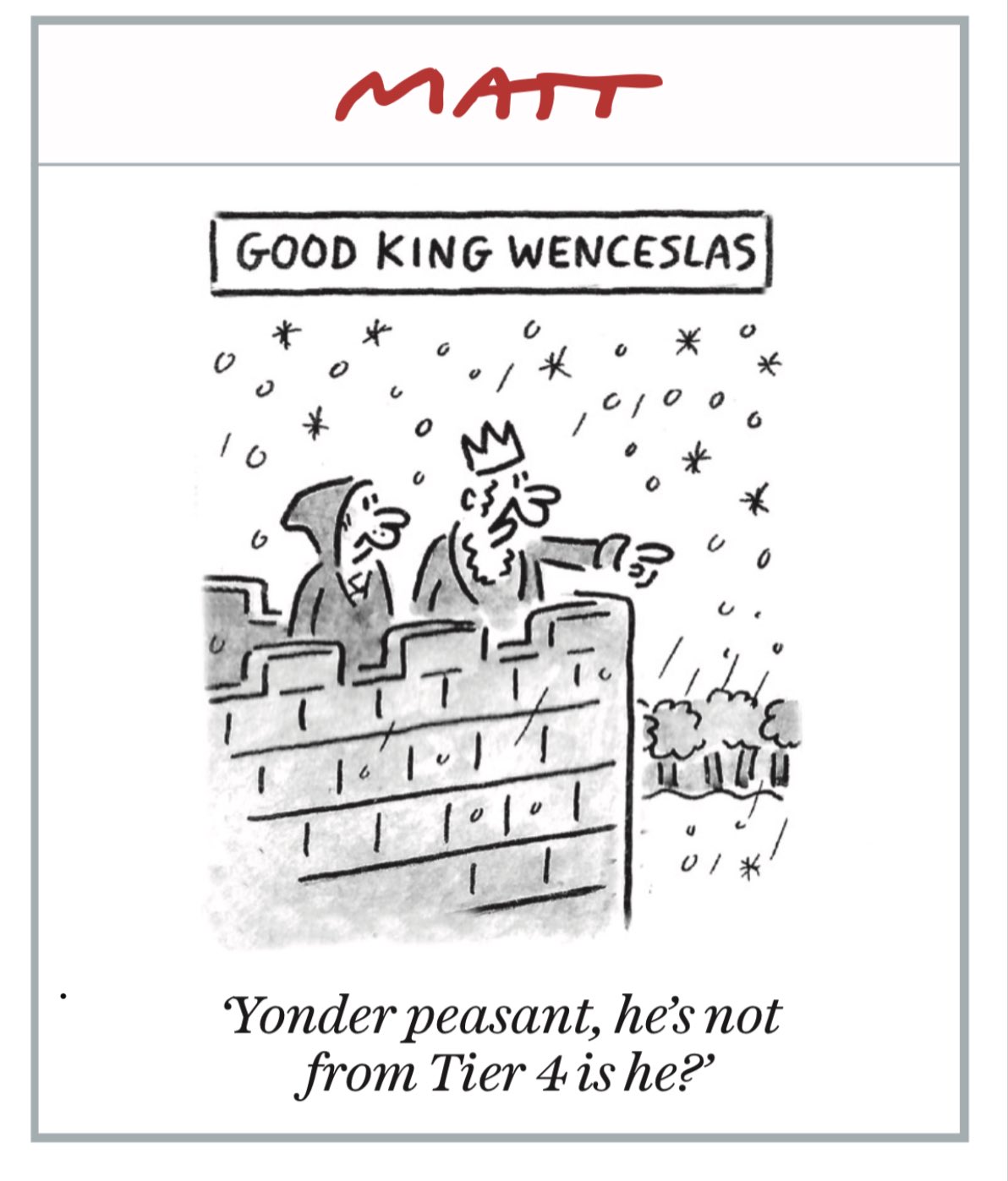
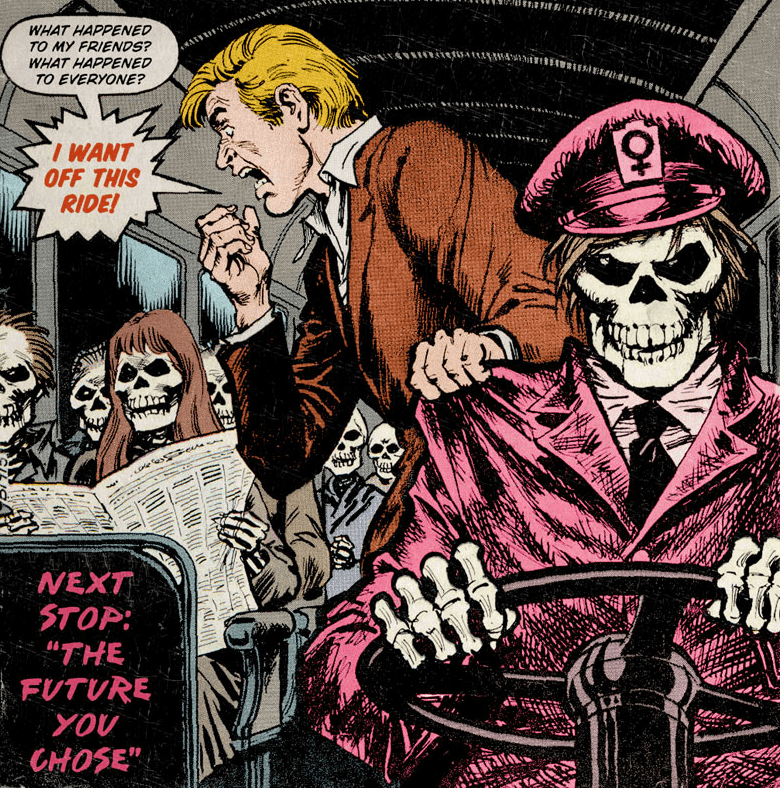
Illusion is something that many prefer to reality, as this cartoon indicates:
“They want not only their daily bread but also their daily illusion.” [Adolf Hitler, talking about many Germans during the decadent Weimar Republic of 1918-1933]
The Green Party
This blog article was prompted by a tweet that I happened to see, tweeted by one Jonathan Bartley, the “co-leader” of the Green Party.
David Davis is wrong on @BBCr4today that all parties are in a worse state than they have been for years. @TheGreenParty membership is growing, we are polling higher than our best ever general election result and have a record number of councillors on a record number of councils.
The Green Party is so large and important now that it has to have not one but two “co-leaders”. Well, jesting aside, there must be some other reason (almost certainly something very very silly) that necessitates two leaders, the other “co-leader” being one Sian Berry.
Bartley seems to have come from an affluent background. He graduated from the LSE aged 23, thereafter floating around Westminster as researcher etc until he founded the think-tank, Ekklesia. He does not seem to have done (or have needed to do) any other work of much substance between the founding of Ekklesia in 2002 and being elected as Green Party co-leader in 2016.
Deputy Leader is 34-year-old Amelia Womack, who was elected to her party position aged 29, having never been elected to any public position (not even as local councillor); neither has she ever had a paid job of any kind, it seems. She is a candidate in the upcoming Newport West by-election:
Now the facts are (i.e. the reality is) that the Green Party of England and Wales, founded 1990, has 1 MP (out of 650), 1 member of the House of Lords (out of 781), 3 MEPs (out of 64 English/Welsh seats), 2 London Assembly members (out of 25), and 178 local councillors (out of 19,023).
The Green Party is polling at somewhere around 5% nationally (it has been as low as 2% in recent years), and only has its one MP by reason of the unusual demographics and the (in 2010, when Caroline Lucas was first elected) 4-way voting split in the constituency of Brighton Pavilion:
In other words, the Green Party is like a tame rat on a wheel. Lots of activity and noise, but nothing really achieved. It’s not that I am opposed to all Green Party policies. I like some of its environmental policies, its support for Basic Income, its concern for animal welfare etc. There has, after all, always been connection between what are now called “green” ideals and social-nationalism. I have even blogged about it:
Where I cannot accompany the Green Party is in its apparent belief that open borders are good, mass immigration of inferior peoples into Europe is good, or that the EU is mostly very good for the UK.
I agree with the Greens when they say that FPTP voting is unfair on them (as on, in the past, UKIP, the BNP and the National Front, among others). Even 5% of votes should give the Greens around 30 MPs, whereas they may soon struggle to retain their one (though Caroline Lucas is a known TV face and probably will stay for a while). However, to say that UK political life is unfair is really just a pathetic bleat even if true (which it is).
At some point, reality will have to dawn on the Green Party members (surprisingly, nearly 40,000 of them). Or maybe not. I think that many Green Party members probably like their nursery politics game, which they must know in their hearts can never lead to serious results; but it makes them feel good and virtuous.
The Green Party is not about to get MPs elected or sweep the country in any way. The Green Party will simply continue as it is, a virtue-signalling pressure group pretending to be a political party. However, relatively few British people will vote for a party that supports both mass immigration and UK membership of the EU; neither will voters give credence to a party which has no one clear leader and which seems to be a refuge (even in its top-most ranks) for perpetual students and/or virtue-signalling and hugely self-deluded persons.
The Nationalist Milieu
It is often said that the plethora of food programmes on TV are a kind of “food porn” for people who rarely if ever cook. Well, the so-called “far right” (I myself never use terms such as “Left”, “Right” etc) or nationalist political tendency is rather like that: the Zionists, their “useful idiot” “antifa” offshoots, the msm too, and of course the System apparatchiki such as police, all like to say that there is a huge “danger” from “far right extremism” etc. If only! In reality, what exists at present is a mixture of hobby politics, “I’m the leader!” (of 2.5 people) parties, and politically-tinged 1970s football hooligan groups, together with System politics under nationalist camouflage (as with UKIP).
People of my vintage (b.1956), will recall (the now notorious) Gary Glitter singing “I’m the leader!” in 1973, a psychology characteristic of both “I’m the Leader!” parties and, usually, “hobby parties” (though every successful political party has to have a credible leader).
The English Democrats
I am starting with the English Democrats because they seem to me to epitomize the “hobby politics” sort of party. They claim(ed) to have over 2,000 members (2015), though I daresay that even that was a gross overestimation. I personally only ever heard of one member by name (my mother-in-law’s former neighbour), and he was a very strange man, a retired pilot aged about 70 (c.80, now). I would not be surprised if that man were fairly typical of the English Democrats’ members.
The English Democrats were founded in 2002. Their best electoral result was in the Mayoral race at Doncaster in 2009, which they won. They would also have won in 2013, had the Mayor not resigned from the English Democrats not long before the election. He still stood but as Independent and lost to Labour by only 590 votes, the EDs having put up their own candidate, who received 4,615 votes.
Police and Crime Commissioner elections have been their second best (highest vote-share just over 15%). In local elections, they have reached over 10% here and there, with their leader, Robin Tilbrook, receiving 18.2% of the vote in an election for the Epping Forest District Council. In Westminster elections, all results have been below —far below— 1% (in 2017, about a tenth of 1% in each of the seven seats contested).
The English Democrats have few policies, and those so bland that they could be espoused by several other parties, including System ones. Even the “English Parliament” idea has been mooted by System MPs occasionally.
“[Robin Tilbrook’s] party agitates for anyone living in England. His notion of Englishness is akin to American notions of “Americanness” – that you can be from any ethnic background and still wrap yourself in the flag.” [from an American newspaper interview]. So someone straight off the boat from God knows where is “English”, so long as living in England, according to that idiot! Even his professed “Euroscepticism” is very muted (and is based on the disproportionate amount of EU funding going to non-English parts of the UK).
The English Democrats are the “hobby politics” party par excellence. Mr. Tilbrook will never be blacklisted by the msm, nor targeted seriously by “antifa” or the Jewish lobby. He will never be interrogated by the police. He has in fact been invited onto TV occasionally and given a polite hearing, e.g. on BBC Daily Politics. He is even a Freeman of the City of London (awarded 2011)! Members of the EDs can write letters to the Daily Telegraph and talk at the bar of their golf clubs without let or hindrance. A waste of time worthy of P.G. Wodehouse.
For Britain Movement
I have blogged about “For Britain” previously. This party, though partly on the right track in terms of policy, is basically a one-trick pony. “You can have any colour so long as it is black!” [Henry Ford, re. the Model T car]; with “For Britain”, you can have any policy so long as it is anti-Islamism. Not that I oppose that view, but it is not enough.
For Britain is not exactly a “hobby politics” party, but it is really just a one-man or one-woman band, closely aligned with the policy-free beer-bottle throwers of the English Defence League and their one-time leader, the person usually known as Tommy Robinson.
The leader of For Britain, Irish lesbian former secretary Anne-Marie Waters (“Maria” originally), certainly has some followers, and For Britain has some members, as witness the local election campaign poster linked below, but how many is unclear. Probably fewer than 100. Quite possibly only about 50.
“The party fielded fifteen candidates in the 2018 local elections, none being elected.[11] The party came last in almost all the seats it contested.[12] In June 2018, the party expelled one of its local election candidates after Hope Not Hate linked him to the proscribed neo-Nazi group National Action and the white nationalist group Generation Identity“
[Wikipedia]
So “For Britain” (which says, pathetically, to the Jew-Zionist lobby, “look, we’re pro-Israel!” in the forlorn hope that the Jews will not hate it), sacked someone at least active enough to get up from his chair and stand as a candidate, simply because the unpleasant “Hope Not Hate” crowd fingered him!
As for Anne-Marie Waters, she herself stood in the Lewisham East by-election of 2018, receiving 266 votes (1.2% of votes cast; 7th place, behind Labour, LibDem, Con, Green, Women’s Equality and UKIP, but just ahead of Christian People, Monster Raving Loony, and 5 other minor candidates). “For Britain” is no good even as a protest vote in a by-election!
Sometimes, I wonder whether this or that group, party or movement or “leader” is not a put-up-job by the enemy, but in reality the likelihood is that these people are just deluded, indulging in near-pointless political activity. Having said that, it suits “Hope Not Hate” and the other manipulators of “antifa” idiots to have something to point at and say, “Look! Nazis/neo-Nazis/Fascists!” (etc).
Who, who would join something as one-dimensional, as limited, as “For Britain”? God knows. Not many have joined, anyway.
UKIP
Well, here we are at last out of the “hobby politics” and “I’m the Leader” areas, though plenty of UKIP members are hobby politicos. UKIP, though, is the real thing: a functioning political party, conservative-nationalist, and which at one time had two or three MPs (albeit temporary cast-offs), still has 7 MEPs (out of a possible 73), as well as 1 member of the House of Lords, 3 Welsh Assembly members (out of a possible 60) and 101 local councillors (out of a possible 20,712).
UKIP might have broken through to a measure of power in 2015 but did not, and now never will. It peaked in 2014. A succession of poor leaders (the present one is slightly better than those that followed Farage) crippled already-failing UKIP, whose membership, at one time reaching 50,000, is now somewhere below 23,000. UKIP has always been semi-tolerated by the System (inc. the Jew-Zionist lobby) and has now gone over to a basically one-trick-pony policy position which is not far from the offerings of Tommy Robinson, Anne-Marie Waters and the whole effectively pro-Jew and pro-Israel “alt-Right”/”alt-Lite” crowd (the British ones of prominence have in fact recently joined UKIP: “Prison Planet” Watson, “Count Dankula” Meechan, “Sargon of Akkad” Benjamin. All wastes of space).
To join or support UKIP now, except perhaps as a way of protesting pointlessly in an election, is just silly. It could not get one MP in 27 years (leaving aside the Conservative few who defected briefly), not even in 2015 when it was voted for by 1 out of every 8 voters! The voting system is rigged and flawed, and that suits the System parties very well.
UKIP’s vote in 2015 (nearly 4 million votes) fell to less than a seventh of that in 2017.
UKIP too is in the realm of political unreality, at least as far as elections are concerned.
How to go toward a realistic political viewpoint
The short to medium term future is uncertain and likely to bring revolutionary change to the world. I recently blogged about this:
As far as UK politics is concerned, it is clear that the major urban areas are no-go zones for nationalist parties, at least in respect of getting MPs elected. They can only be viewed as recruitment pools at present.
To pretend that a movement or party can be founded, then play the game of System politics, is otiose. UKIP tried that —and was semi-System anyway— yet failed utterly in any attempt to gain power (though I concede that UKIP did obliquely achieve the holding of and result of the 2016 EU Referendum, which result however is now being cynically betrayed by cosmopolitan conspirators such as the Jew Letwin and the virtue-signalling hypocrite Yvette Cooper… even as I write).
The fast-breeding ethnic minorities, including mixed-race elements, are collectively only a few decades away from becoming the majority in the UK. In some cities and towns, they are already the majority. That fact alone makes ordinary democratic politics a no-win situation for social-nationalism.
A social-national movement must be built from the ground up, and on a basis of reality, even if that reality looks, at present, like the sheerest fantasy.
In fact, UKIP came third, exactly where it was in the previous two general election contests at Newport West, and while its 8.6% of votes looks good vis-a-vis 2017 (2.5%), UKIP got 15.2% in 2015:
This was just a by-election protest vote and a pretty muted one.
The Greens came 6th, with 924 votes (3.9%).
As for “For Britain Movement”, its candidate came last out of the 11 candidates, getting 159 votes (0.7%). This party is wasting the time of its few members.
Update, 9 April 2019
Judicial Review cases are never dealt with in days. We will hear next week what the government has to say in Reply but only then will the High Court list the first hearing. We are applying for the hearing to be "Expedited". We have a strong case that the UK is Out of the EU!
— English Voice 🏴 (@EnglishVoice) April 7, 2019
The EDs are claiming that the UK is already out of the EU and have launched a judicial review application to “prove” the same. Rarely has wish so directly confronted political reality.
Update, 12 April 2019; a few thoughts about the near-future EU and local elections
The Brexit mess, so spectacularly mishandled by Theresa May and the idiotic careerists around her, may save UKIP from immediate collapse as a party, inasmuch as many British voters will want to punish the Conservative Party one way or the other. There may be a “perfect storm” for the Conservative Party, pressured on two fronts by both the Leave and Remain sides.
There will soon be elections for the European Parliament, on 23 May 2019. Recent opinion polling seems to be saying that Labour will have a landslide: initial voting intentions show Labour on 37.8% (up from 24.4% in 2016); Conservatives at 23.1% (unchanged), Brexit Party (Nigel Farage’s new party) 10%, LibDem 8%, UKIP 7.5%, Change UK (the recent Lab/Con defector MPs’ vehicle) around 4%, among others.
One has to be cautious in assuming that the above opinion poll reflects the likely outcome. The same poll seems to indicate that, after discussion, many pro-EU voters prefer Change UK (which would hit Labour and LibDem levels), while anti-EU voters may prefer either UKIP or Brexit Party.
Before the EU elections (in which the UK may not participate at all if the UK leaves the UK before 23 May), there will be local elections, on 2 May 2019. The indications are that, in those elections, Labour may also sweep the poll, with Labour benefiting not only from the “pendulum” or “see-saw” effect of elections in a system using FPTP voting, but also from abstentions by usual Con voters (or by their voting for Brexit Party or UKIP).
As far as the local elections are concerned, Labour starts the campaign with several advantages. The decade of spending cuts has finally impacted even the most true-blue Conservative areas. Labour has a army of local activists, thanks to its membership surge under Corbyn. It also has funds from the same source.
The Conservatives have few local activists now and most are beyond retirement age. The party looks tired. The Brexit mess can only be laid at the door of Theresa May and her Cabinet. The Cons will be lucky to avoid a wipeout in the areas voting on 2 May.
There are also strategic factors. The Conservative Party claims 124,000 members, which seems high (average 200 members per constituency). Most are elderly. Few are active. The median age for Conservative voters has also risen, to 52. Recent polling has shown that only 16% of voters under 35 support the Cons, and only 4% of those under 25 do so.
Returning to UKIP etc, the Brexit Party will obviously have the effect of splitting the Leave/Brexit hard core.
Update, 17 April 2019
The “For Britain” “Movement” (can 50 people be a “movement”?) has posted on GAB that they are not “far right” (whatever that means) and in some ways are no more “extreme” than Margaret Thatcher and not even really “socially conservative”. Oh dear…pretty pathetic.
I don’t know why I am even wasting 10 minutes of my ever-shorter lifespan examining this fake “movement” with its 50 members, especially after its recent (latest) electoral debacle at the Newport West by-election (last-placed out of 11 candidates; 159 votes, which represented 0.7% of votes cast).
Still, it confirms what I wrote in the original blog post, I suppose…
Update, 10 May 2019
Harold Wilson was right: “a week is a long time in British politics”. In the five weeks since the above article was written, at least two matters of importance have occurred
the local elections trashed the Conservatives (who lost over 1,300 seats), but Labour more or less stood still (losing 82 councillors), which was interpreted as failure by many;
Brexit Party burst into life and now has 100,000 members (by any other name).
Once again, I am deflected from my slow and peaceful writing of a piece about my several years in Cornwall and Devon, and particularly those spent at Polapit Tamar [below, pictured in the 1940s], and which has an interesting history of its own,
by the need to write about contemporary political events. Still, duty calls…
Social Nationalism is stalled in the UK, but waking from a dormant state…
In other blog posts, I have criticized Corbyn-Labour-supporting Aaron Bastani, Ash Sarkar etc, but Bastani is surely right in tweeting that “The space for a successful far-right party in the UK is massive.” The label “far-right” I disparage, of course, but in essence I agree with him. The difference is that he opposes the birth of such a movement, whereas I support it!
The space for a successful far-right party in the UK is massive. We are fortunate that both the BNP & UKIP failed to fill it.
The fact that much of the establishment still thinks a 'centrist' politics is even remotely possible shows they either don't know this or don't care >
I have recently blogged about the “Independent Group” non-party, about how it will struggle even to get to a 2015-UKIP level of support (see Notes, below), both for “technical” reasons (FPTP voting, a likely even level of support nationwide, so insufficient to create a winning concentration of votes, a Schwerpunkt, in any one constituency etc) and because the voters are moving to the falsely so-called “extreme”. I examined also the Social Democrat Party of the early 1980s.
There is however also the point that Bastani raises in the tweet shown above (does he read my blog?): the fact that people generally are getting frustrated, and many angry, very angry, with smug, “centrist” MPs and MEPs complacently making hay for themselves as people struggle and, in not a few cases, literally starve to death in the UK (thanks to policies such as the “welfare” “reforms” which were imposed by political rats such as Iain Dunce Duncan Smith, Esther McVey, the Jew “lord” Freud and many others).
The roads are potholed, the trains are expensive and don’t even run much of the time, mass immigration has, taking the effect overall, trashed our European society, legal services, local services etc have been cut or destroyed, housing has not only become completely inadequate (mass immigration, millions of births to backward aliens, private profiteering) but threatens to become even less adequate.
The British people want and increasingly will want concrete results. The Westminster game of using the corrupt electoral system to win over the “moderate” voters in the 50-100 most marginal constituencies to a “same-old” pseudo-democratic con-game is seen as the rigged system that it is.
A few years down the line, the choice will be stark: European civilization and social nationalism against “multikulti” neo or pseudo-Marxism and also against Zionist-controlled private profiteering and fake “conservatism”.
When the right time comes, our society will be changed in the right way, keeping what should be preserved, creating what is new and worthwhile, but destroying the inferior with the flame of justice.
I was just reading a few appreciations of Paddy Ashdown, the one-time LibDem leader, who recently died. I tend to adhere to the saying de mortuis nihil nisi bonum, but when it comes to political people, kindness must sometimes give way to clarity.
In fact, I rather liked Paddy Ashdown, at least in parts (not that I ever actually met him). I certainly feel more respect for him than I ever could feel for the idiots who preceded and followed him (Thorpe, Steel, Kennedy, Campbell, Clegg etc, though I do have time for Jo Grimond, whose interesting and erudite memoirs I reviewed on Amazon years ago; Grimond was by far the best of the Liberal/LibDem leaders, to my mind).
I feel that Ashdown was a great deal more honest than most System politicians, for one thing. Also, he was an idealist, and someone willing to put a mission above his (and his family’s) comfort: not many men in their mid-thirties would leave a comfortable and perhaps promising SIS/FCO career to get involved in the hurly-burly of UK politics, particularly for something as marginal as the then Liberal Party (at the time it had only 13 Commons seats, despite having garnered nearly 20% of the popular vote in both of the two 1974 General Elections). Ashdown gave up a pleasant diplomatic/intelligence near-sinecure based in Switzerland to take ordinary jobs in the Yeovil (Somerset) area while pursuing his political mission. When his employer folded, nearly a decade later, Ashdown applied unsuccessfully for 150 jobs. When elected MP for Yeovil in 1983, he had been unemployed for 2 years and was doing unpaid volunteer work as part of a programme for the long-term unemployed.
Not that I agreed with much of Ashdown’s policy-set: Ashdown was a politician for an England which was disappearing even in the 1970s. He seems to have been sanguine about mass immigration, for one thing. I doubt that he was ever anti-Zionist in any sense (certainly not my sense). Ashdown was no intellectual and not (to my mind) a policy person. Neither was Ashdown intellectually honest in a way that might match what I still perceive to be his personal integrity (leaving aside the “Paddy Pantsdown” episode). Certainly, amid the pathetic rabble called the LibDems, Ashdown could hardly fail to be seen as a star, just as the young Bill Clinton, with his Georgetown, Oxford and Yale academic background, could not fail to shine in the intellectual backwater that is Arkansas.
Yes, much can be laughed at in Ashdown, not least his absurd sense of his own importance and weight, as when he was or tried to be (using my own parody-title for him) “the Lord High Panjandrum of the Balkans and Afghanistan”, but without at least some elevated sense of self-worth, Ashdown would never have tried to be a political leader in the first place, I suppose.
So why am I talking about Ashdown, when this blog piece is supposed to be about the creation of a social-national movement?
What caught my attention about Ashdown as politician was that he only got elected as MP in 1983, after about 8-9 years of trying; also, once he was an MP, it only took him 5 years to become the leader of his party (admittedly tiny in terms of MP numbers).
One of the precepts of the American “self-help” guru Anthony Robbins is that “most people overestimate what they can accomplish in a year and underestimate what they can achieve in ten years.” That is very true. Examples are all around in history.
Famously, Hitler joined the NSDAP as “Member no.7” in 1919. A year later, it was still of little importance even in its home city, Munich. By 1923 Hitler had attempted the Beer Hall Putsch, which went down in shambolic ignominy; by 1928, 9 years after its foundation, the NSDAP could still only raise a national vote of 2.6%. However, Hitler had built a party and beyond that, a whole volkisch movement. It only needed the right conditions in which to flourish. The Depression provided that, together with the widespread feeling against the Jewish exploitation of the German people: by 1930, the NSDAP had a vote of 18%, by 1932 of 33%, and by 1933 of nearly 44%.
Lenin’s serious revolutionary political activity could be said to have begun with the establishment of Iskra [The Spark] in 1900. Though by 1910, Lenin was still politically marginal, he was considered to be one of the leaders of the Marxist tendency, at least. However, both Bolsheviki and Mensheviki together numbered only 8,400 by 1910 (perhaps 75% of whom were under 30 years of age). Once again, though, the important point is that a party, albeit split, existed and, once the disastrous Russian participation in the European war of 1914 onward had destroyed the strength of the Tsarist government and society, that party could take over the existing uprising in 1917 and perform a coup d’etat later the same year.
Other examples? How about “Solidarity” in Poland? Founded by a small number of workers in Gdansk (former Danzig) in 1980, by 1989 it was the governing party in Poland.
UKIP was formed in 1993 and had become an organized though marginal party by 2003. UKIP never did break through. It peaked in 2014 and deflated from 2015. What stopped UKIP from taking power was not only the UK’s totally unfair First Past the Post electoral system (though that did not help). What stopped UKIP was, first, that it was and (to the extent that it still exists) is not a revolutionary, nor even radical, party/movement; also, there has been no truly “triggering” event comparable to the First World War, the Great Depression etc in the UK of the late 20th/early 21st centuries.
Even if the future for the UK and Europe is a kind of multifaceted civil war, a political party or movement must exist. It is the sine qua non. In a year, it would achieve nothing, but in ten years it could achieve everything.
We are now hearing speculation about part of the UK Labour Party splitting off and forming a new so-called “centrist” party: pro-Israel, pro-Jewish lobby, Blairite. Washed-up ex-Labour MP (still clinging on as “independent” MP for the salary, expenses, pension and gratuity rights, and freebies) John Woodcock made a doomed-to-fail plea for such a party recently.
The fact is that only those expelled from Labour or about to be will join Woodcock. Electoral reality is that Corbyn and his supporters retain and will retain the name “Labour” and all its worldly goods, including name-recognition. True, Labour has in recent decades done some very bad things, such as importing millions of blacks and browns with the deliberate aim of destroying white British (there is no other British) society. However, Labour is still living, electorally, off the hump of the creation of the NHS, and other more positive policies of the increasingly remote past.
In other words, Corbyn and his people will stand at the next general election as “Labour” and will be elected or otherwise on that basis. Even if the rebels can organize themselves into “Labour Centre” or some such in the years or, probably, months before that next general election, few if any will be elected in a contest where huge numbers of voters just look at the label: “Labour”, “Conservative” etc, even though the real or original Labour and Conservative parties disappeared decades ago.
What about some other and completely new party? In France, Macron started “his” own party, En Marche, but Macron is merely a figurehead for ZOG and the New World Order [NWO]. Rothschilds bankrolled Macron. His “pop-up” party was not a grassroots upsurge but as manufactured and marketed as sliced bread. Still, the success of En Marche in getting elected was a pointer to the fading popularity of the old System parties.
In the UK, the same frustration and anger fuelled, first, the BNP in the decade up to 2010 and then, up to 2015, the “nationalism-lite” UKIP. Only the semi-rigged British FPTP electoral system saved Labour and Conservative from a devastating UKIP upsurge. On a proportional voting basis, UKIP would not have had 1 MP in 2015 but, at minimum, 70 MPs. In fact, because voters would know that their UKIP votes were not wasted under a pr voting system, UKIP might well have received twice the number of votes that it actually did (nearly 4 million) and so would have ended up with as many as 150 MPs.
All that is water under the bridge now, but there was a recent opinion poll which indicated (though in other words) that about 38% of UK voters would be willing to vote for a generally nationalist pro-Brexit new party and that 24% would, right now, be willing to vote for an “anti-immigration” and “far right” party. I have always fought the use of the misleading “far right”, “right”, “centre”, “left”, “far left” spectrum terminology, but there it is.
It is clear to me that there is a possibility for a truly social-national party to succeed in the UK and particularly in England (and Wales too, probably). It would have to be set up on a very strict and disciplined basis, with power centralized, though an organizational structure of regions might also work. Anything too “democratic” just lets in the forces of opposition: well-funded Jewish Zionist attacks etc, leading to splits. We have seen that in the National Front, British National Party and UKIP.
The party I envisage must be financially secure through its own members, simply and clearly organized, and ideologically clear. Such a party would, in the chaotic conditions ahead, be able to position itself for a bid at national leadership.