Category Archives: historical

People are Worth More than Their Opinions

Someone, possibly Auden, remarked once that “people are worth more than their opinions” (in relation to the Comintern/NKVD agents of the 1930s active in the British universities). There is something in that. On Twitter, for example, I have noticed that people bitterly divided politically will often still support, separately, such causes as animal welfare or environmental improvement. Wider than that, I am willing to see that some of those who attack my views (and, often, me personally) are, in some cases –and like me– interested in the welfare of the more downtrodden parts of the population. Sadly, most of those who attack me –and this particularly applies to the Jewish Zionists– are unwilling to see the slightest good in me or my views. I can only assume that to do so would weaken their assertion that anything connected with social nationalism (and, a fortiori, National Socialism) is irredeemably evil and without any good in it at all.

Adolf Hitler was of different mind. He accepted into the ranks of the NSDAP and SA, even into the SS, many who had been his enemies. People, in other words, who wanted a better society but who at first did not accept that National Socialism would create one.

In the Soviet Union, from 1917 onward, many who fought Bolshevism or were at least opposed to it were later shot, imprisoned or exiled as so-called “former people”, others however were allowed to stay as free as anyone could be under Sovietism. Some even became members of the CPSU and/or the officer corps of the Red Army, at least until the purges of the late 1930s. Beria’s own past was full of ambiguities. During the 1941-1945 war, the vast majority of Russians fought and struggled together (whatever one may think of that).

In the UK at present, I can see that many want positive social change and that many (sometimes the same people) want to preserve the better aspects of the existing society. These people belong to Labour (especially the Corbyn wing), the Green Party, the LibDems, UKIP, even the Conservative Party. I trust that, when a real social national movement comes into existence, these people or many of them will feel able to join with me in the rebirth of this country.

Post-Collapse Survival; Preservation of Civilization and Culture

Recent months have seen devastation from hurricanes. The Caribbean area has been the worst-hit. Most of those islands are now, with help from major states as well as from charities and individuals, bouncing back. Puerto Rico is still suffering from the effects, partly because it is the largest of the worst-affected islands, partly because the US Federal Government response has been sluggish.

In Europe, it is unlikely that we shall suffer in any major way from hurricanes, but there is a quite-high chance that our societies will suffer from the dislocations caused by war and/or socio-economic collapse. Many will say that this cannot happen or would not affect at least the more civilized parts of Europe. Are they sure? It is still just within living memory that parts of Europe were devastated twice by the very major conflicts of 1914-18 and 1939-1945. Apart from those wars, there have been others: the war between the Bolsheviks and others from 1918-1922 (Russia, Ukraine, Poland, East Prussia); the Spanish Civil War (1936-1939); the Balkan War(s) of the 1990s. That is not even taking into account smaller armed conflicts such as the Hungarian Uprising and subsequent Soviet invasion (1956) or disruptions of an economic or other nature. The recent and continuing “migration-invasion” of Europe by non-Europeans comes to mind.

An individual or small group within a society, not holding political power, cannot do much to steer such events; neither can an individual or small group easily defend itself either directly or in terms of subsistence. However, there are possibilities, if prepared for in advance. In Puerto Rico, while most of the population suffered (at time of writing many continue to suffer) from shortages of water, food, from lack of electricity, vehicle fuel and medical help, others have been able to weather the storm, both literally and metaphorically, far better.

In Puerto Rico and elsewhere, those who survived without suffering more than they had to were those whose homes were solid, who had stocks of food, fuel and medical supplies and who were as far as possible “off-grid”. Twitter carried innumerable stories of despair and triumph, such as the farmer who powers his farm using solar power from his own solar array. For him, the fact that the electricity distribution network was not working (for weeks) was not directly relevant.

In the UK and across Northern Europe, the same applies. I have blogged previously about how people on farms, country estates and elsewhere might be able, not only to survive social collapse, but also to help to preserve culture and civilization during what could be an extended period without central control, help, law, order. As during WW2 rationing, those best off might be people living in rural areas, especially those already “prepped”:

  • electrical power and hot water from solar panels, heat exchanges, small wind turbines, small hydropower plants; there are also ways of producing limited amounts of electricity via pedal-powered and hand-operated wind-up systems; temporary back-up might involve small petrol or diesel generators.
  • water purification systems; solar stills; temporary back-up via stocks of bottled water: bottled water lasts, at a minimum, 2 years and in many cases is still drinkable without treatment after 4 –or more– years and even after that can still be used after simple treatment such as addition of drops of potassium permanganate or by running it through a filter and purification system, or by boiling it as required. In fact, most rural farms and estates have access to springwater supplies etc.
  • food home-grown or produced. This of course depends on having land on which to grow it and will be much easier if the preppers already do it on their own estates and farms (or the land around ordinary houses). How much land is required is not fixed and depends on the required diet, the land type and quality etc, but can be as little as half an acre per person and quite likely even a smaller area– https://www.smallfootprintfamily.com/how-much-land-is-needed-to-be-self-sufficient . In addition, there will be food backup via stocks of tinned food, dried foods and, for those whose diet encompasses them, foods from fishing and shooting: fish, shellfish, venison etc. A further source would be from permaculture sources: nut-bearing trees, wild berries and so on.
  • Internet. This may be interrupted or even cease to exist for a time, though it is likely that service will continue in some form or be rebuilt eventually; a major resource in terms of useful techniques, as well as in holding together spread-out communities and the rebuilding –if necessary– of the wider society. Also, a way of offering or asking for help.
  • medical help: as on expeditions etc, you can never have too many doctors or nurses. A further advantage to having doctors on board before disaster strikes the general society is that doctors can order supplies of drugs unavailable without prescription and, should they so decide, stockpile them. While few individuals will be able to afford their own operating theatre, a social-national community might be able to fund doctors to set up one before it is required.
  • transport: vehicle fuel can be stored, but may not last very long. Electric cars and other vehicles are still novel; when they are available, anyone with an electrical supply and a charger will be able to charge them and so continue to have the use of cars, trucks, tractors etc.

I have left out the question of arms. As the law now is in the UK, most people are not permitted arms beyond shotguns and in some cases rifles. Obviously, farmers and landowners will usually have such weapons. In a situation of collapse, arms will probably become available. In any event, any larger or more complex weapons (eg mortars, tanks) require persons with the requisite military training. In short, it is unnecessary for the germinal ethnostate to have arms beyond those customarily available to all rural communities in the UK (other European countries are far less strict).

We in the germinal ethnostate will be in a good position not only to survive but to found a new society if we prepare in the right way and in good time.

Notes

https://www.smallfootprintfamily.com/

https://www.theorganicprepper.com/

http://prepared-housewives.com/about-me/preppers/

https://sustainablefoodtrust.org/articles/making-compost-at-blaencamel-farm/


The Right Attitude to Race and Culture

Race and culture are among the hottest topics of the moment. From the migration-invasion of Europe to the American wave of the alt-right, to the elections in European states, there is a ferment which will not calm. As social-nationalists, standing first and foremost on the racial-cultural front line, we must be clear where we stand in terms of attitude.

It disturbs me when I see unpleasant and too-general remarks made even about the basest of race-types. We must never forget that, as Adolf Hitler himself said in another context, “there is the individual, but beyond the individual is the race.” The individual comes out of a race; he is made by it, formed by it, is in most cases brought up and educated by it and by the nation which is part of the race. However, the individual can transcend the race-group (equally, can descend from it). German National Socialism itself recognized this reality when it granted a relatively small number of persons, who were not Aryan, the status of “honorary Aryan” or Ehrenarier: https://en.wikipedia.org/wiki/Honorary_Aryan

We today, even those of us who are social-national in political orientation, are yet not  National Socialists in the same sense as those who fought for European humanity in the 1920s, 1930s and 1940s. We today have our own path forward. At the same time, to put it in Biblical language, we “honour our father and our mother” and that means that we honour National Socialism as the ground from which we sprang.

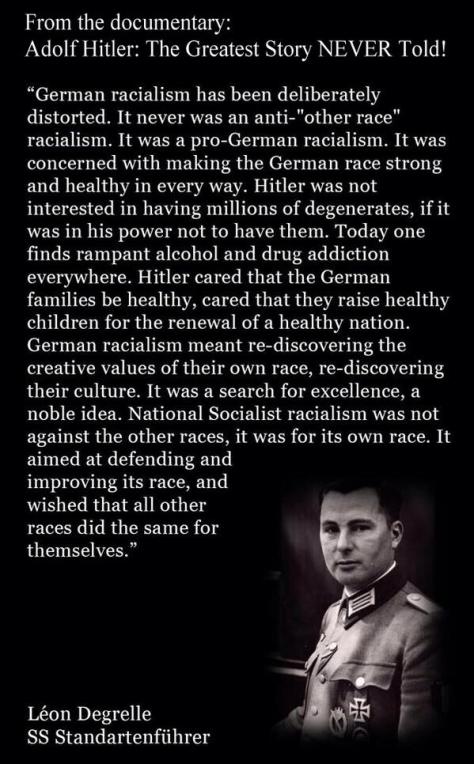
Leon Degrelle, the political leader, front-line fighter and thinker, had this to say on the subject after National Socialism in its original phase had passed into history:

becwoaeccaazenq

There is no need for social nationalists to utter insults at blacks, Jews or members of other groups, except where that is justified and/or where it makes a political or social point. I do not want to concentrate on the American socio-political situation. I am not American, have not lived or worked there for many years and am focussed on Europe and Russia. However, we have to recognize that American society is very different from our European society. American society has had a relatively recent history of slavery, of genocide (the American Indians, aka Native Americans), of a civil war in which 3% of the population died, of the resistance to the social consequences of that war in the South, that resistance being, in part, the Ku Klux Klan, and so on.

American politics has become far more bitter, far more polarized, particularly in language, than is generally the case in Europe. There is also the point that there is a far wider spectrum of education and culture in the USA than pertains in most parts of Europe, or even Russia.

For me, it is natural to regard the non-European races as distinct and as having their own paths to the future, while equally recognizing the necessity (for all races) for the leading role of European humanity. For some Americans, this is perhaps less obvious and those other races seen as purely enemy contingents.

Social nationalists must take every opportunity to refute the lie (often though not always made by Jewish Zionists) that we base our political philosophy on “hate”. We ourselves know that that is not so, but often the public is bamboozled by the Jewish Zionists into believing the lie. For example, we wish not to be ruled or owned or influenced by the Jewish Zionist element, but that is, if you like, “defensive” in nature.

Our attitude to race and culture is one of recognition of evolution and involution. Our European race is generally still evolving, as is the “Russian”, “Slavonic” or “Slavic” race which (important point) will not come into its plenitude for another 1,500 years. Other races in this world are stagnant or are degenerating. The prime motive force behind social nationalism is to evolve the race and nation to higher levels and to destroy any threats to that evolution. This is a positive, not a negative, political world-view.

In the future, European and Euro-Slavic humanity will have powers of soul, of mind, which today would be regarded as magical. This is the point to which we as a people have been striving.

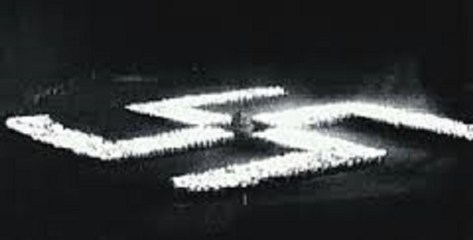
When we see the sacred Swastika, we must understand it to be a symbol of evolution, of our evolution.

TorchSwastika

“Thank You For Your Service!…Have A Nice Day!”

One of the many minor but telling irritations of the present day is the extent to which American phrases and linguistic usage has infiltrated everyday English English. I say that despite having lived and worked in the United States (work sourced both in the USA and elsewhere) alongside American people. In fact, I am (despite the best efforts of parts of the Jewish Zionist lobby, including the crazed scribbler Louise Mensch) still a member of the New York Bar, at least on paper (I never practised there).

It was back in the early 1990s when I first heard someone (a West Indian woman) use the term “train station” to designate what everyone I knew until then had called a “railway station” or sometimes “rail station”. When I questioned the term, she replied that she had never heard such places called anything but “train stations”. My theory was that that was the influence of latter-day American films, particularly those shown on Sky. Maybe. Since then, “train station” has become ubiquitous, even on the BBC.

One might say, “what does it matter?” whether railway stations are called “railway stations” or “train stations”. However, language does matter. Whole treatises have been written on the power of transformative vocabulary. The American military machine and its political masters used to be expert at that (far more so than the British). “Operation Desert Shield” conveyed a message; “Operation Desert Storm” a different one, a changed one. Sometimes it became awkward if pushed too far, as in the phrases used in the Vietnam War: “bodycount”, “free fire zone”, “friendly fire” and many others became notorious; some are still in use today.

Such manipulative use of language is common elsewhere. The linked worlds of special operations and espionage have given us “plausible deniability” etc, and that is before we even look at the sleazy swamp of the political milieu. I do not want to go off-track too far and lose my point in the morass of “hard Brexit”, “soft Brexit”, “helping people back to work” (indeed the ghastly “world of work” itself) etc.

Words create a mental landscape, they shape a society as surely as the architecture of our cities and, to be rather topical, public statuary.

It matters whether the influx of millions of non-Europeans into Europe and other European-inhabited lands is described as a “desperate” “movement” of “refugees” or as a “flood” of “migrant-invaders”, indeed as a “migration-invasion” (my favourite) or simply as an “invasion”.

It matters if “social security” (in the British use of the term), meaning a “safety net” or system available to those who need it (and, importantly, into which most if not all of those using it have paid, one way or another) is then changed to “welfare”, a term which gives the impression of money or food thrown at (probably undeserving and probably useless) eaters, who are, again, “probably” taking money from “the taxpayer” (not even “the State”).

It matters if “free speech” is in many cases re-designated as “hate speech” and/or “hate crime”.

So we return to “thank you for your service”…one of the least meaningful phrases around. An American affectation, which seems to say, “this person served in ‘the military’ in some capacity and so we regard him –or her– as heroic.” It of course bears little relationship to reality. Most service personnel, even in a war, are not anywhere near the “front-line” or active fighting areas. Indeed, many American service personnel never even leave the shores of the USA. In Britain, that idea crept in during the Falklands campaign, when anyone who had been to the Falklands in uniform became, ipso facto, a “Falklands hero”, courtesy of the Sun “newspaper”.

No-one disputes that a modern military system requires large numbers of accountants, lawyers, dentists, administrative people, pension experts etc, as well as cooks, drivers and the more obviously martial occupations of fighter pilot, tank commander, infantry soldier and commando. They all “do their bit”, in the English phrase of yesteryear. However, it seems strained to say “thank you for your service” to people who spent their entire service researching legal cases in Washington D.C., or fixing the plumbing on an Air Force base in Texas.

One notices that some scribblers who are very adherent to the Atlanticist or “New World Order” viewpoint are among the worst offenders (people such as Louise Mensch). In fact, it could be said that “thank you for your service” goes beyond affectation and constitutes an attempt to further Americanize the mentality of the British.

So it is that I plead for people to avoid the use of “thank you for your service”, even when addressing those who should be in that sense respected.

When Public Order Collapses

I suppose that few British people have ever seen the collapse of public order. The United Kingdom has at least been fortunate in that regard. The tumultuous events of the past century have left largely intact the Victorian legacy of “law and order” bequeathed by the 19th Century.

Britain has endured two world wars (1914-1918 and 1939-1945), other and smaller wars overseas, a General Strike (1926), other periods of industrial strife (1930s, 1970s), acts of terrorism, periods of political violence (1930s, 1970s) and even a limited and slow-burn civil war in pockets (Northern Ireland, particularly 1970s to late 1990s), yet overall order (and the rule of law) has persisted. Even in Northern Ireland that has been so, though a barrister friend of mine visited a “Diplock court”–https://en.wikipedia.org/wiki/Diplock_courts— in the 1980s and told me of how surrealistic it was to see a criminal trial with all the panoply of the English law (bewigged and gowned barristers, a “red judge” in his wig and robes etc) but without a jury and, instead of court security or police officers, several soldiers carrying submachineguns and on guard.

This is of course in stark contrast to the experience of other Europeans. Russia of course is, as always, sui generis, with its 20thC revolutions (1917), civil war (1918-1922), political purges (1917-1948), invasion and vast wartime destruction (1941-1945), as well as the collapse of the Soviet system in the 1980s and early 1990s and the waves of gangsterism and Jewish-Zionist oligarchy that followed from 1991 onward until a degree of stability was attained under the Putin regime.

The older generation of mainland Europeans were almost all affected, at least at second-hand, by disorders: the Second World War swept across the continent leaving few countries untouched (and even some of those–Finland, Spain, Eire– had seen their own wars, civil wars etc). In fact, the only European countries of any size unaffected directly (though certainly indirectly) by the Second World War or civil upheavals were Sweden and Switzerland. Even Portugal, neutral during 1939-1945, later had a military coup and revolution (in the 1970s).

France, for example, was in the 20th Century invaded twice, had several all-France republics established, as well as the Vichy Government of 1940-1944; it also had considerable political and industrial conflict, huge destruction from air, land and sea (in 1940, from German attack, but more seriously from the Anglo-American invasion, bombing, shelling etc of 1941-1944). France also had the underground war of the OAS in the early 1960s, which very nearly brought down de Gaulle and the Fifth Republic.

Again, Poland has seen, from 1914 through to the 1980s, invasions, purges, wars, civil disorder, very great changes in the Western and Eastern borders of the country itself, near-starvation at times, economic collapse several times, destruction of much of its infrastructure, ruination of its currency.

The effects upon civic life and rule of law of all these events has been greater on mainland Europe than has been the case in the UK. On mainland Europe, the ways of life of the various countries has had to be re-established, sometimes several times over, usually with very significant changes. In the UK, the way of life has evolved quite slowly and –even as a result of WW2– without dramatic alteration overnight.

Why then, do I see civil disorder as a serious possibility in the UK?

First of all, Britain has taken in a vast horde of mainly non-European immigrants, most of whom have no racial, cultural or religious connection with anything that British history has produced. Even those non-Europeans born in the UK do not feel the same connection with the country that is felt by the real British (including those with other white Northern European ancestry and who were born here).

Secondly, the reaction of the Caribbeans and other non-Europeans to serious difficulty is to engage in street protest which can become riotous, as has happened several times even in the past decade.

Thirdly, the indigenous British have lost at least some of the resilience which sustained public order in previous times. By way of personal anecdote, I recall the “petrol crisis” of 2000, when I had not long returned from overseas: https://en.wikipedia.org/wiki/Fuel_protests_in_the_United_Kingdom. Having little choice but to travel across country, I saw at one motorway filling station scenes not far from the chaotic. This left a deep impression on me. Speaking personally, I have little faith in the ability of the System to maintain order, should a more serious or prolonged crisis hit the nation, if “nation” it still is.

I do not see the British now as a unified people, because of both cultural and directly racial/religious factors. A large and growing minority are really not British at all and have only tenuous connection with and loyalty to the State.

A fourth aspect is that the arms of the State are not now well-staffed. Police, Army etc. Could they handle large-scale disruption? I wonder.

It may be that the UK will have to undergo some of the vicissitudes endured in the past century by many of the mainland European peoples before a new system is established.

They Go Like Sleepwalkers, whence Providence Dictates

Adolf Hitler once remarked that he went like a sleepwalker to wherever Providence or Fate dictated. A cynic might ask why, in that case, did Germany lose the Second World War. I have thought about this over the years, coming to the conclusion (decades ago now) that Germany’s bitter defeat saved not only Germany itself but all Central Europe and even all Europe from terminal disaster.

As is well-known, the atom bomb scientists working on the Manhattan Project (the British end being known as “Tube Alloys”), were almost all Jews who had fled from or anyway left Europe to live in the USA. Their motivation was to create a weapon which would obliterate National Socialist Germany. Japan was but an afterthought.

So focussed were the Jew atom bomb scientists on Germany’s destruction, that when it seemed possible in mathematical theory that detonation of the first bomb in the desert of the South Western USA would cause the world’s atmosphere to catch fire, destroying all life on Earth, those Jews decided to proceed. A sombre fact indeed.

Had Germany not been forced to surrender by complete military defeat, it would have seen its main cities destroyed by atom bombs. The air, water, soil of much of Central Europe would have been contaminated for decades, in fact for centuries. Seen like that, the bitter defeat and humiliating  surrender was a saving grace in the end.

Why do I bring up these facts? Because I want to make the point that agencies above the human level act on what might be seen as “purely” earthly concerns: war, politics etc.

Move now to the present UK political scene. Less than 2 years ago, Jeremy Corbyn, an eccentric and –his critics said– extremist radical, was persuaded to stand in the Labour Party leadership contest and agreed purely because he wanted to have his kind of politics at least represented. It was uncertain as to whether Corbyn would even be allowed to become a candidate, because to stand, a candidate required nomination by 15% (35) of Labour MPs. Corbyn did not have even that much support. In the end, he was nominated, not only by the few who supported him, but by a number of MPs who did not support him and who had no intention of voting for him. Reflect on that. A number of MPs who were anti-Corbyn still nominated him and without those nominations Corbyn would not even have been on the ballot. As it was, Corbyn only managed to scrape onto the list with 36 nominations (inc. his own), the last a few minutes before nominations closed.

Once on the ballot, Corbyn’s support mushroomed and he won easily, overwhelmingly. The same happened when there was a challenge to his leadership the following year. Events happened by which his opponents were wrongfooted. There seemed to be an aura of invincibility around Corbyn and his campaign. Indeed, in 2015, Conservatives were urged by Toby Young and others to join Labour under the £3 offer scheme and then vote for Corbyn, on the premise that a Corbyn leadership would sink Labour!

Mainstream media commentators seemed unable to fathom Corbyn’s appeal. Journalist Janan Ganesh, for example,  wrote that Corbyn’s election “spelled disaster” for Labour. I wonder if he wishes now that he had spiked that opinion!

Coming up to the 2017 General Election, the polls predicted Labour’s worst-ever disaster, with its MP bloc being reduced from 230 to as few as 150. Some predicted an even lower number. That general perception of Labour’s defeat persisted until about two weeks before Election Day, when the Prime Minister, Theresa May, suddenly destroyed both her own carefully-crafted public persona and her party’s chances. The bursting of the Conservative Party balloon was palpable. The polls immediately narrowed and by Election Day were showing the parties almost neck and neck. We should, again, reflect on this: Theresa May, for no reason, destroyed her own party’s campaign. For me, “the Hand of God” is shown here.

The eventual result of the General Election was a Labour MP bloc of 262, up from 230 and something few had seen coming. As for the Conservatives, though some loyalists said that “Labour lost”, that was and is not how it feels. The Conservatives lost 13 seats (317 won, down from 330) and their House of Commons majority. Corbyn’s stock rose and he is now said to be higher in public esteem than Theresa  May, while Labour is higher in the polls than the Conservatives.

Taking it as a fact, for the purposes of argument, that higher forces are protecting Corbyn, why would that be so? After all, he is some kind of agnostic, it seems, is not overtly religious or spiritual and does not on the surface seem to have anything to commend him to what Schwerin von Krosigk termed “the Angel of History”. All one can say to that is the admittedly-platitudinous comment that “God moves in mysterious ways”. There are a few ideas that come to mind: the Conservative Party may now be prevented from imposing a Jewish-Zionist repression on freedom of expression on the Internet, for one thing. It is also far less likely that the UK can get involved in Israel-instigated wars or attacks in other parts of the world.

It may be, also, that it is necessary that the UK has to have a weak System government, so as to gradually open the door to social nationalism and a completely different society down the line. I cannot say. All I can say is that it seems as if Corbyn does enjoy a degree of “divine protection” and it will be fascinating to see how that plays out in the coming months and years.

Yevgeny Yevtushenko, Darcus Howe and the MSM: Cultural Musings

Introduction

The deaths of two people came to notice particularly in the past week. One person had been a significant cultural influence in the Soviet Union, was world-famous, is still oft-quoted. The other was a West Indian immigrant to the UK, best known for his support for black rioters, gangster criminals and others, as well as his assault on British cultural norms.

The first was Yevgeny Yevtushenko [https://en.wikipedia.org/wiki/Yevgeny_Yevtushenko] about whom The Guardian newspaper published this by way of obituary: https://www.theguardian.com/books/2017/apr/02/yevgeny-yevtushenko-obituary.

The second was one Darcus Howe: [https://en.wikipedia.org/wiki/Darcus_Howe], about whom the Guardian said this: https://www.theguardian.com/world/2017/apr/02/darcus-howe-writer-broadcaster-and-civil-rights-campaigner-dies-aged-74.

It can surely be seen that even the Guardian was unable to make out Darcus Howe as being a greater cultural figure or a more positive one than Yevtushenko.

Comment and Personal Musing

I knew neither of the two recently deceased. I had heard of Yevtushenko vaguely, en passant, as a child and teenager, about the poet who was able to fill stadia in Russia with fans listening to his declamations. Black and white pictures from Life magazine and books. Later, in my twenties, I knew a few people who had been well-acquainted with Yevtushenko in Moscow. I even met his third wife on a couple of occasions during that time and once swam with her and her children (Yevtushenko’s) in a semi-private wooded beach area in some expensive part of Bournemouth, on England’s southern coast.

I never met Yevtushenko himself, though I heard plenty about him. His private life was messy, not always commendable, but that is hardly unusual in the biographies of poets and artistic people generally. One cannot judge a poet primarily by his private life (think of Byron etc). At a distance, he seemed to me to be a Soviet cultural windvane, able to change direction not so much with the prevailing wind but at the moment before it changed. Thus Yevtushenko was seen by some , e.g. Irina Ratushinskaya [https://en.wikipedia.org/wiki/Irina_Ratushinskaya] as an “official poet”, with all the moral compromise and material benefits which that term implied; by others, as a brave and anti-official –even a little bit anti-Soviet– quasi-dissident.

Certainly Yevtushenko was willing to argue even with such as Khrushchev on occasion. He was lucky, perhaps, to have been born in 1932 and not 1922 or 1912. He escaped Stalinism to a large extent. Also, he was born and mainly brought up in Siberia, where (ironically) the Stalinist pressure was slightly less. Having said that, he lived in Moscow from age 18, studied there, was never in political trouble. I once heard privately that his mother had been an informant (“secret co-worker”) for the KGB and went weekly to an address not far from the Lubyanka to receive her stipend, signing for it on a list which had all the other names blanked out via a kind of stencil. Perhaps. That would not imply, however, that Yevtushenko himself was implicated with such work (and as I heard it, his mother only went through the motions anyway, giving little but avoiding conflict).

Certainly, Yevtushenko lived rather well by Soviet and indeed Western material standards. Robert Conquest [https://en.wikipedia.org/wiki/Robert_Conquest] described that as “well-rewarded collaboration”. By the 1970s, if not before, he had a house or “dacha” at Peredelkino [https://en.wikipedia.org/wiki/Peredelkino] with (I believe I was told), 4 or maybe 5 bedrooms –unheard of luxury in the Soviet Union for all but the highest-regarded citizens. He also had an apartment near the Kremlin with no less than (from memory) 14 rooms (a friend of mine was offered the chance to stay there for a week while it was unoccupied; she returned to London gushing about how wonderful it was and how she had not realized that people in the Soviet Union lived like that!); the apartment had been occupied at one time, I was told, by Beria [https://en.wikipedia.org/wiki/Lavrentiy_Beria] though Beria did have a mansion in Moscow, perhaps in addition. Yevtushenko also had a house on the Black Sea, situated, I believe, at Yalta.

Yevtushenko is now known for several “soundbites”, in today’s terminology, as much as for his poems: “in Russia, a poet is more than a poet”; and the 1962 lines usually slightly changed to (and improved?) “double and triple the guard on Stalin’s tomb, lest he return….and with him, the past” [http://osaarchivum.org/files/holdings/300/8/3/text/60-4-47.shtml].

Whatever one’s view of Yevtushenko, there is no doubt that he was a significant cultural figure, who personified the changes in the Soviet Union from Stalin’s rule, through the Thaw of the 1950s and early 1960s and on to the retrenchment which led up to Gorbachev, corrupt laxity and then complete collapse. Yevtushenko himself spent his later years living partly in the USA, paid generously by the University of Tulsa (Oklahoma) and the City University of New York (CUNY). A weathervane to the last.

As to Darcus Howe, I know little of him beyond a few items recently read, though I do recall that rather menacing figure on “British” TV from time to time, always promoting the idea that the blacks in the UK had been and were oppressed by white British people and culture.

I cannot imagine that Howe ever contributed much to the UK, though others, in the mainstream media especially, seem to think otherwise. On Twitter, the death of Yevtushenko was like an express train at night, flashing quickly through a country station (Zima Junction?) without stopping. Darcus Howe’s death was trending for far longer. The mainstream TV and radio almost ignored Yevtushenko’s death (and life), while eulogizing about the life of the West Indian rioter and troublemaker. Channel 4, the tax-subsidized “independent” channel, was especially loud in its praises.

Where the msm did notice Yevtushenko’s death, the reports concentrated mainly on his poem “Babi Yar”, about the death of Jews in the Ukraine during the war with Germany. Typical.

The cultural sickness of the West can be seen in the juxtaposition of the two recent deaths and how they have been treated. The time must come when real merit is respected, when people are able to properly discriminate between what is worthwhile and what is not. Most of the existing cultural organizations and faces must be removed.

The Way Forward for Social Nationalism in the UK

“The talent of the strategist is to identify the decisive point and to concentrate everything on it, removing forces from secondary fronts and ignoring lesser objectives.”

Those words of Clausewitz are often taken to encapsulate the essence of strategy. How are they applied to the socio-political question in the UK (England, primarily) from the social-national point of view?

“The Decisive Point”

The “decisive point” or objective, ultimately, is the formation of a British ethnostate as an autonomous part of a Eurasian ethnostate based on the Northern European and Russian peoples. However, within the UK itself and before that, the objective must first be drawn less widely, as political power within the UK’s own borders.

The Gaining of Political Power in the UK

The sine qua non of gaining the sort of political power required is the existence of a political party. More than that, a party which is uncompromizing in its wish to entirely reform both State and society.

History is replete with examples of states which have seemed not even just powerful but actually eternal, yet which have collapsed. Ancient Rome, though perhaps not a “state” in our modern sense, is perhaps the one most embedded in the Western consciousness. More recently, the Soviet Union and its satellite states. In between those two examples (but among many others) we might cite the pre-1914 European “settlement” based on the empires and kingdoms which collapsed during and after the First World War: Germany, Austria-Hungary, Russia, the Ottoman Empire.

The main point to understand is that, in situations of crisis on the large scale, it is not the political party with the most money, erudition, developed policy or even membership that comes out on top, but the party with the most will or determination. That means the most disciplined party under the leadership of the most determined leader.

It is better to have a party consisting of only 1,000 which is tightly-disciplined and self-disciplined than one of 100,000 which is a floundering mass of contradictions. When a national crisis occurs, such as 1917-1921 in Russia or 1929-1933 in Germany (to take two obvious examples), the people instinctively turn to the party perceived to be strongest, not strongest in numbers, money, intellectuality or number of members, but strongest in the will, the will to power.

The Party

A party requires leadership, members, ideology, policy and money. Everything comes from the leadership and the membership, in symbiosis. In practical terms, this means that policy is open to free discussion, up to the point where a decision is made as to what is party policy as such. Also, it has to be understood that a party requires money as a tank or armoured car requires fuel. To have endless fundraising drives, hunts for wealthy donors etc demeans and dispirits the membership. Having a “tithing” system renders such other methods unnecessary. The members sacrifice an agreed amount of their post-tax income, such as 10%. The party organizes itself and its message to the general population using that money.

As a rule of thumb in contemporary Britain, it might be said that, on average, each member will provide something like £2,000 per year to the party. A party of even 1,000 members will therefore have an annual income of £2 million, enough to buy not only propaganda and administration but real property as a base. By way of comparison, the Conservative Party in 2017 has an income of about £3.5 million.

Elections

It must be understood that elections are only one way to power, but they are indispensable in England, for historical-cultural reasons. A party which cannot win elections loses credibility rapidly once that party is large. In the initial phase, no-one expects the party to win Westminster or even local council seats, but after that, it has to win and so grow, or deflate as the BNP did and as UKIP is doing now. The problem small parties have under the English electoral system is that a Westminster seat can be won only with, at a minimum, about 30% (and usually 40% or more) of votes. The insurgent party is in danger of spreading itself too thinly, in every way. UKIP’s history illustrates the point: in 2015, about 12% of votes cast (nearly 4 million), but only the one MP with which they, in effect, started. The answer is to concentrate the vote. That is done by concentrating the members and supporters of the party geographically.

Safe Zones

I have blogged previously about the creation of safe zones and especially one primary safe zone (possibly in the South West of England). If the members and supporters of the party gradually relocate into that zone or zones, many things become easier, from protection of buildings, meetings, exhibitions etc to the election of councillors and MPs. I have also blogged about the magnetic attraction such a safe zone might exercise over people in the UK as a whole.

The Decisive Time

The “decisive time” cannot be predicted. In Russia, Lenin (at the time in foreign exile) thought that the 1905 uprising was “the revolution”. He was wrong. He also thought that the first (February, old-style) 1917 uprising was not “the” revolution. He was wrong again. It was.

https://en.wikipedia.org/wiki/February_Revolution

Lenin had to hurry back to Russia (arriving belatedly in April 1917, old-style) not only to try to take control (he failed in that and had to foment his own coup d’etat in October 1917) but to avoid being sidelined and so becoming an almost irrelevant footnote to history.

In Germany after 1929, Hitler likewise was not in control of events. In the end, economic near-collapse and political turmoil gave him the chance to win enough votes (33% in 1932) to form a coalition government which led on to full power in 1933, after the NSDAP achieved a higher –though still minority– popular vote (44%).

In other words, both Lenin and Hitler were the pawns of Fate while striving to be the masters of events. They had something in common though: highly-disciplined and ideologically-motivated parties behind them.

Practical Matters

At the age of 60, the last thing which is convenient for me is to form a political party. I have no need of such an activity as a hobby or absorbing interest. I am coming to the idea out of duty, out of a realization that something has to be done and out of an understanding that something can be done, if Fate concurs. I am not willing to compromize on overall ideology or on the way things are organized within such a party. I shall only establish a political party (which may become a movement) if it can be done on a serious basis. However, there is a need for a party to speak for the British people and there is a widening political vacuum in which such a party can thrive and grow.

Update 15 April 2019

In the two years since I wrote the above blog post, my view has not changed, that is

  • a political party and movement is needed;
  • there is at present no such party;
  • such a party can only be established if done on a serious basis;
  • I myself still do not have the means with which to found such a party; but
  • a political party and movement is —still— needed…

Update, 8 March 2023

All factors mentioned in the previous update remain the same.

The Internet: Privatization of Public Spaces

I have been concerned for some years about how “public space” on the Internet is really just privately-owned space. Offline, there are sometimes concerns raised about how parks and other spaces, which are usually open to the public, are made less than fully open to the public by the imposition of charges, fees or conditions. In fact, there have in the past often been fees and conditions imposed on entry to parks etc, but in those cases those unable or unwilling to comply could go elsewhere. That is not always so online.

In the offline world, there are public markets and competition between marketplaces in various ways. Online, though the same may be true superficially, the reality is that a few key players operate in a quasi-monopolistic manner. Facebook, Twitter, ebay, Amazon have little real competition. The private individual is granted access to these spaces essentially at the will or whim of the proprietor. If expelled, the individual has no redress save appeal (and not by right) to the website itself. There are no means to go to law to enforce re-admittance, because the relationship between the website and the individual is one based on contract and the contractual power lies with the website.

Taking Amazon and intruding a personal note to make the argument more concrete, for 2 or 3 years (up to 2011 or 2012) I reviewed books on Amazon (at one time I owned over 2,000 books and bought one every few days). I was on the Amazon UK “Top 100 reviewers” list and the vast majority of those who voted or commented liked my reviews and found them helpful. Very few hated what I wrote but one of that tiny handful (literally about 3 or 4 people) was a Jew who objected to some of my reviews because they examined events 1933-45 from a revisionist (truth-seeking) perspective. This person trolled virtually every review I wrote, “commenting” sarcastically on each, insulting me as well as my reviews, trying to bait me to argue with him (with the obvious idea of then screaming “antisemitism!” and “hate speech” and getting me chucked off Amazon, of course. “They” do the same on Twitter etc).

After about 2 years, the aforesaid Jew (who, by the way, operated under a pseudonym, as the same sort of trolls often do on Twitter) managed to interest the Jewish Chronicle in his complaint. The Jewish Chronicle wrote about my reviews, the attention resulting in my being barred from reviewing books on Amazon. About a third of my reviews were removed. Oddly enough, those reviews were removed en bloc. Most had nothing to do with the 1933-1945 era, National Socialism, Jews, Israel etc. There was no possibility of appeal, not even to the site itself.

I then started to review books on the American Amazon site. The same occurred before long, except that this time the same Jew must have contacted Amazon directly after complaining about me under my reviews (all of them…), because all of those reviews on the US site disappeared overnight and I was barred without warning. No appeal, no explanation. So much for American “free speech”!

The above illustrates the problem. While there are other online booksellers, some of which allow reviews, in the end the reviewer, the citizen, is there as guest of the website and can be chucked off at any time. Amazon’s position is quasi-monopolistic, yet it is not merely a retailer but a provider of what amounts to a public intellectual forum.

Twitter is the same: if someone is barred from Twitter, he is effectively muzzled, his right of freedom of expression taken away. He has no redress (though Twitter itself does give a possibility of appeal). It is not good enough to say that “other sites exist”. Twitter is in a global quasi-monopolistic position.

Tellingly, the Zionists and others (but mostly Zionists) often make the point that barring someone from Facebook, Twitter etc is not an attack on free speech because those sites are “private platforms” and can get rid of unwanted authors at will.

The privatization of public online space is wrong. The solution is to give the citizen a legal right to appeal against removal from any website which has more than x number of users or subscribers. The present situation is an unwarranted extension of the economic sphere into the sphere of law and rights.

Free Speech: Individuality and Collectivity

Rudolf Steiner often spoke of the ever-increasing individualism in our age (that period which he named the “Fifth Post-Atlantean Age”, which started around 1400 AD and is due to run until about 3500 AD). This is an inevitable continuing process and will bring many benefits if people are guided by conscience. However, if people are not guided by individual conscience, the forces of the individual will tear apart society.

Against the forces of individualism stands “society”, which encompasses law, unwritten “laws” of convention and expectation and also the powers of the State (which holds itself out as the concrete expression of the people as a whole).

Society is, of course, a good thing. In proper measure, it makes possible and supports such aspects of life as law, public order, organized help for the sick, disabled, elderly, poor etc. It is a structure which supports the family, too. It also provides, via the State,  the structure for defence against outside forces (hostile states, natural calamities etc). However, if taken too far, society and/or the State becomes oppression, involving the repression of individual liberty in various ways (most obviously, perhaps, suppression of free speech or other freedom of expression).

Society restricts freedom of speech. It is hard to imagine a society beyond the most primitive or germinal in which complete freedom of speech exists (eg spoken or written threats against the person). On the other hand, when society (the State, or perhaps a religious or political cult) prevents individual expression, reasonable restriction becomes unreasonable repression. One thinks, perhaps, of the more extreme socialist states of the 20th Century, such as the Soviet Union under Lenin and Stalin, China under Mao Tse-Tung, Albania under Enver Hoxha, Cuba under Fidel Castro. The same was true of anti-socialist tyrannies such as Nicaragua under Somoza.

Particular emergency conditions may lead to a temporary tightening of what is regarded as acceptable free speech. In the Second World War, the various combatants restricted free speech considerably. In the UK, those who spoke out against the war or government policy faced both prosecution (State) and persecution (society generally). Even the USA, with its famous Constitutional safeguards, clamped down on freedom of expression.

As in other fields of life, we can see that the tension between the demands of the individual qua individual and those of the collective results in what amounts to a compromise. It is a question of either where society (in practice, usually the State, but possibly a smaller community such as a town or even a family) decides where the line is drawn, or where the individual draws the line, based on conscience or preference and regardless of where the State and/or society has drawn it.

Most people, most of the time, obey the dictates of the collective. Were that not so, law could not exist except as a facade with nothing behind it (cf. Stalin’s Russia etc); neither could the State or its power, in the end. On the other hand, the individual must always obey conscience and it therefore becomes vital to distinguish between individual conscience and individual wilfulness or egoism. No outside force can decide what is conscience and what is wilfulness or egoism. The individual, the individual human soul, is the only judge or arbiter here. Where the individual and the collective collide, the results can range from martyrdom of the individual to reform or even revolution affecting the collective.

Where do I myself, as both individual and citizen (i.e. part of the collective) draw the line? For me, freedom of expression about social, political and historical matters should be absolute. Other forms of expression (eg threats, libels, fraudulent misrepresentations) can be (and commonly are) restricted to a greater or lesser extent.

It follows from the above that I prefer the approach taken in the United States to that of most EU states (including the UK). Restrictions on freedom of expression are often imposed for or from outwardly “good” motives, but rapidly become a slippery slope with evil results. The road to Hell is paved with good intentions.

Notes

  1.  http://www.cps.gov.uk/legal/a_to_c/communications_sent_via_social_media/
  2. https://en.wikipedia.org/wiki/English_defamation_law
  3. https://en.wikipedia.org/wiki/First_Amendment_to_the_United_States_Constitution