Category Archives: Stray memories of life at the English Bar

Diary Blog, 17 April 2020

First thoughts

Turned on the TV, to see that The World at War is again being shown. Interesting to the extent that many people who were in quite high positions in WW2 were still alive and able to be interviewed in 1973 when the series started. Not the top leaders, of course, but (mainly on the British and German sides) the secondary or lower commanders and other personalities: Speer, General Warlimont, Stalin’s interpreter etc.

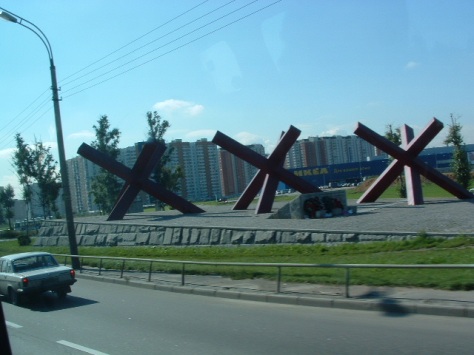
As before, I was struck by how close the Wehrmacht came to capturing Moscow. As I have blogged before, in 1993 my driver made it from the Khimki memorial (the point of furthest advance in 1941) to close to the Kremlin in 15-20 minutes!

tanktrapmemorial

A 1941 German tank would take longer, but even so… (yes, since both 1941 and my first visit in 1993, an IKEA store has appeared there!).

Annoying that, in World at War, Laurence Olivier, doing the voiceover, attempts a kind of faux-Russian pronunciation which is in fact wrong in both Russian and Western usage, eg “Shtalin” for “Stalin”.

Ash Sarkar

Ash Sarkar, who taught briefly at a new university (and now at some institute in the Netherlands, founded by a Dutch Jew), is now seen quite often on TV in the UK as a kind of “licensed Bolshevik”, following her rather silly “I’m literally a communist” outburst on a daytime TV show a couple of years ago. She is 28 today. That fact is “trending” on Twitter.

Ash Sarkar is part of the Novara Media set-up, along with Aaron Bastani.

https://en.wikipedia.org/wiki/Aaron_Bastani

https://en.wikipedia.org/wiki/Ash_Sarkar

https://en.wikipedia.org/wiki/Novara_Media

Here is not the time or place convenient to examine the inanity of being both “communist” and “libertarian” (which is what both of the above claim to be; they also both claim to be “feminist”). To go into the full depths of their political childishness would take too long today. I have blogged about them, en passant, in relation to wider issues:

https://ianrmillard.wordpress.com/2019/01/01/disordered-and-infantile-people/

https://ianrmillard.wordpress.com/2019/01/18/some-thoughts-about-venezuela-socialism-and-developing-a-more-advanced-society/

https://ianrmillard.wordpress.com/2019/01/04/a-brief-word-about-owen-jones/

DwKVd5wX4AIEVJF

[above: Aaron Bastani and Ash Sarkar]

Neither is here and now the time and place to examine how it is that Anglia Ruskin University had someone whose degree and MA were both in English Literature teaching “Global Politics” for a year. We are talking about someone who defined Communism as “the desire to see the coercive structures of state dismantled, while also having fun“… I wonder what Marx (let alone Lenin, Stalin and Trotsky) would have thought of that!

dfbzlnnwaaal3ei

As said, Ash Sarkar has taken over from Owen Jones the mantle of the “licensed Bolshevik” or “System-approved faux-revolutionary” on the msm in the UK. She appears, despite her “I’m a communist” outburst, on BBC, Sky etc. I wonder whether the System msm would have been so accommodating had someone said “I’m literally a National Socialist”? Or even “social-nationalist”? Of course not. Blackballed at once. So Ash Sarkar fulfils the role of pseudo-revolutionary or radical. The BBC or Sky can then say “look, we’re an open and free mass media outlet. We even have revolutionaries on our shows.” Yes, of course…

The Ash Sarkar trend on Twitter provides yet more evidence of how little Twitter reflects the real political world. I read that Novara Media has grown from having only a few thousand readers in 2015 to hundreds of thousands, on occasion 1 million or more, now.

However, there are 70 million inhabitants of the UK. If you looked only at Twitter, you might imagine that most support a “Novara Media” political position, when in fact Labour as a whole (and there is little organized “socialism” outside Labour) only has the support at present of about 25% of the population, and an Ash Sarkar position some very small proportion of that.

Twitter has expelled most truly dissident personalities (including me, in 2018), mostly at the behest of the organized Jewish lobby. Increasingly, one can almost judge the public mood by seeing what is favoured on Twitter, then reversing it.

Westminster Bridge clapathon for idiots

I blogged about this yesterday. I have to agree with this fellow:

https://twitter.com/Mister_Woodo/status/1250918479626108930?s=20

and this one

(though I wish that some people would stop referring to the British police as “the feds”! Did that come from American TV via the blacks in the UK, somehow? How silly it is…)

Katie Hopkins [below] is right:

https://twitter.com/KTHopkins/status/1251043599439007754?s=20

The UK as North Korea-lite, complete with emotional blackmail (if you don’t clap, and more importantly if you don’t support “lockdown”, or if you doubt the official narrative, you must be a bad person, almost a murderer…)

The Government of fools

It seems that little Matt Hancock and his fellow-clowns may “instruct” anyone over 70 and also anyone under 70 with health problems as common as high blood pressure to stay “indefinitely” in “lockdown”, i.e. under house arrest! For years, or for the rest of their lives!

https://www.dailymail.co.uk/news/article-8225021/Pressure-cafes-shops-reopen-government-expert-warns-mass-testing-come-first.html

I suggest that little Matt Hancock and this government shut up before they really do cause a (typically British, quiet?) revolution in this compliant nation of serfs.

The only reason that I am not going out wherever I please on a daily basis at present is because I have nowhere much to go anyway! If the proposed restrictions (beyond May) are mandated, however, I may have to go out with the specific intention of “flouting” the UK’s toytown police state “laws”.

Meanwhile…

and…https://www.thesun.co.uk/news/11423742/nhs-volunteers-idle-thanks-shambles-app/

Below, UK North Korea-lite riot squad goons (“Territorial Support Group” in the Metropolitan Police) getting very agitato at a (Jew) journalist who tried to film an arrest (probably a pointless one):

https://twitter.com/simonchilds13/status/1250718305889013760?s=20

This is always the problem, in any country, when you give the police too much power. They tend to abuse it and/or treat government preferences as “law”. What the government wants is not law. Look at the sergeant in charge there, in the clip. Shouts out that the journalist “is killing people” by standing outside a park, filming. How bloody stupid can you get?! When will the sergeant call in an air strike?…

This, below, is how the UK Government of Fools runs its toytown “war effort”:

Strange tweet and article, reproduced without comment or endorsement:

https://twitter.com/ForFreeSpeech1/status/1251083393476984833?s=20

https://virily.com/business/sacrifice-rituals-for-moloch-on-13-days-of-preparation/

another unusual tweet:

https://twitter.com/ForFreeSpeech1/status/1251079209423966210?s=20

and what of this?

Other tweets seen today

Hubris is A Bad Thing, so I shall not claim that Peter Hitchens is [see below] copying my blog remark of yesterday, which compared the government of fools’ “lockdown” with the actions of The Sorcerer’s Apprentice. After all, the parallel is rather obvious.

A thought out of season

A few years ago, a pack of Jews, including some public entertainers, got together and, via the Jew-Zionist fake “charity”, the “Campaign Against Antisemitism”, had the satirical singer-songwriter Alison Chabloz barred from the Edinburgh Fringe, part of the Edinburgh Festival. How they laughed! Well, guess what? Most of those singers, monologuers, comedians etc were hoping to appear and make money, or advance their careers, at the Fringe this year. Oh, no, wait. Coronavirus…

Festival cancelled. Fringe cancelled. As Windsor Davies used to say, “oh dear, what a pity, never mind”.

L’homme qui rire

The same is true of all those barristers who either applauded my getting disbarred (via an allied pack of Jews) in 2016, or who failed to defend me publicly (not one did defend me, in fact). Coronavirus has now shut all of the courts, or almost all (I believe that some magistrates’ courts are still ploughing their way through their pathetic daily lists of minor crimes). Much of the Bar (despite “virtual hearings” here and there) has had its court work frozen. Not all have paperwork to do.

I sincerely hope that those who attacked me or failed to speak up, not so much for me personally, but for freedom of socio-political expression, suffer stinging blows; and well-deserved.

Unfortunately, many barristers have plenty of capital on which to draw, but many do not. I hope that those who opposed me and especially those who tried to kick me when I was down (via Twitter etc) will take a hit. They will anyway, eventually, one way or another, but now (in the pocket) would be a good start.

A tiny glimmer of commonsense (but not much)

Driving to the countryside and walking – where more time is spent doing the latter than the former – is among a list of reasonable excuses for Britons leaving their home during the coronavirus lockdown, according to advice issued to police.” [The Guardian]

https://www.theguardian.com/world/2020/apr/16/driving-for-exercise-allowed-under-lockdown-rules-police-advised-coronavirus

…yet still no sign that the “authorities” or the police or public understand that, in terms of commonsense, there is nothing wrong in driving around just to get some change of air (with window down, for example). It neither exposes anyone to the virus, nor spreads it (because the virus is only able to move in air, briefly, in droplets of water, as when someone sneezes).

Prison Island UK

So the Government of this country, unlike all others in Europe, at least so far, is suggesting that 10% or 20% of the population is going to have to remain under house arrest for months, maybe years, until a vaccine is found or…when? Until the next Chinese virus is upon us? First thought: tell the Chinese to stop eating bats, rats, pangolins, birds’ nests and all the other disgraceful stuff they eat.

It is not acceptable for a British government to place a substantial minority or indeed majority of the population under house arrest. The only reason that the UK is in a bad position vis a vis this virus is because the Conservative Party governments have been for years cutting to the bone the NHS, care homes, social care in the community, and other relevant areas.

Do we see in Germany, France, Scandinavia etc this panic about shortages of equipment, of staff, of beds, of hospitals? No. Do we see in those other countries officially-approved “clapothons” to “celebrate” the health service? No. Do we see individuals having to (or deciding to) collect funds for the health service via crowdfunding, because that service is underfunded? No.

Well, I drove out on a couple of connected errands, both (I regret) within the new toytown police-state “rules”; two errands, one drive, as the Chinese might put it. My first afternoon drive for weeks.

My impressions: more cars than when the “lockdown” was first imposed, though fewer than when the UK lived what was then called “normal” life. No obvious police presence, though I hear through local sources that the police have been quite active in the wider local area in the (presumably) late evenings, i.e. after the supermarkets and convenience stores shut (mostly 2000 hrs). They have apparently been stopping cars, checking people out etc.

The little village shop a couple of miles away is now operating a “1 out 1 in” system, with only 2-3 people in toto allowed in at any time. I was able to buy some artisan trout pate and trout pate with horseradish, and a couple of bunches of local asparagus, as well as a few Lotto tickets.

It strikes me that “social distancing” is having a quite powerful psychological effect on people, a mental or emotional distancing too. Fewer smiles, a feeling around of wariness. What is really behind all this? As with the mass sacrifice of cattle during the Foot and Mouth emergency, there seems to be at least one hidden agenda.

China

I am coming to the provisonal view that the world as a whole is going to have to treat China as a deadly enemy. I am not happy about that tentative judgment, but I cannot see an alternative, the way things are. We must see things as they are, not as they might be in a more perfect world…

Diary Blog, 3 February 2020

Good morning.


Streatham incident

A part of London I know slightly but not well. A couple of times, c.1980, I had a beer in the pub just about where the incident occurred. A few times, round about the same year, I had a milkshake or whatever in the local McDonalds (the first one I had ever patronized, I believe, and quite possibly the last, except for the odd visit to the ones in Victoria Street and at Marble Arch, and one in Maryland). I also had a (dishonest and generally non-paying) Sri Lankan instructing solicitor in Streatham in the early 1990s; I attended her office for a reception once. She killed herself a few weeks later. I think that the last time I was in Streatham was probably about 25 years ago.

Leaving aside reminiscence, it seems that the Government response to the latest terrorist incident is to say that —ill-defined— “terror” convicts will in future have to serve more or less their full sentence, rather than be released on licence earlier (most prisoners get out at half-time).

Tweets about the incident, many misinformed or simply laughable, now rain down…as do comments by the sort of idiot-MPs we now have in Parliament. For example, here isΒ  Bell Ribeiro-Addy, the MP for Streatham, who went to the scene of the attack. She said: β€œThe perpetrator didn’t serve his full sentence, which is questionable – what is more questionable is why he needed to be under surveillance. If someone needs to be under surveillance it brings the question on why they were released in the first place.” [Guardian]

This is what Wikipedia says about her:

Ribeiro-Addy was born and raised in Streatham, growing up on a council estate onΒ Brixton Hill. She is Christian and of Ghanaian descent.[3][4] Privately educated at the independent Streatham & Clapham High School, Ribeiro-Addy graduated as aΒ Bachelor of ScienceΒ in Biomedical Science with Ethics & Philosophy of Science from theΒ University of BradfordΒ later gaining aΒ Master of ArtsΒ in Medical Law & Ethics atΒ Queen Mary University of London, awarded in 2007, and aΒ Graduate Diploma in LawΒ atΒ BPP Law School, awarded in 2015.[5]Β She was the National Black Students’ Officer for theΒ National Union of Students (NUS) from 2008 to 2010, national co-ordinator of the Student Assembly Against Racism, and the national convenor of the NUS’ Anti-Racism/Anti-Fascism campaign.

So…Bell Ribeiro-Addy has, as well as her grand-sounding but probably rather easy first degree and (ditto or double…) Masters’ degree, a “graduate diploma in law”, yet she seemingly cannot understand the simple concept that people are released from prison according to strict rules and regulations under law. They cannot be kept in prison for arbitrary reasons. This is the UK, not a banana republic like Ghana, from where Ms. Ribeiro-Addy’s parents came. The UK may be becoming a banana state, and MPs such as Ms. Ribeiro-Addy are accelerating that process, but we are, thankfully, not quite there yet. I feel a blog article in my “Deadhead MPs” series coming on…

The “Secret Barrister” on Twitter, often worth reading, has this to say about the governmental response:

It will be recalled that I have previously blogged about Dominic Cummings, Boris-idiot’s lunatic-in-chief:

https://ianrmillard.wordpress.com/2020/01/03/dominic-cummings-a-government-of-dystopia-and-lunacy-posing-as-genius/

https://ianrmillard.wordpress.com/2019/08/10/les-eminences-grises-of-dystopia/

Boris-idiot, Dominic Cummings and Priti Patel at the head of domestic policy; what could possibly go wrong?…

“Secret Barrister” adds:

The tweeter below attacks the “Secret Barrister”, but he himself has little (in fact nothing) intelligent to say, which means that he has a good chance of becoming a “Conservative” MP at some point in the future, so long as the Jew lobby does not dislike him.

Another tweeter seems to imagine that the terror attack might have been stopped, had the local police station still been open and full of police, though she adds a rider:

https://twitter.com/Nadine_Writes/status/1224022338842300417?s=20

Thus speaks a would-be “journalist” who writes for the Huffington Post joke “newspaper”. Her assignment for today? To look up the meaning of the word “uncanny”…Her usage reminds me of how (until someone told him he sounded stupid) Barack Obama would, in almost every second or third sentence, use the word “extraordinary”, and with great sonority…

As to the police, I do not see how their response can be faulted. They took out the terrorist only minutes (perhaps less than one minute) after he started his rampage.

It may be that the terrorist knew or assumed that he was under close surveillance, and that that was why he stole a knife rather than simply buying one with cash: had he bought one, the watchers would have assumed that he was about to attack; he probably underestimated the skill of the surveillance people, thinking that he could steal a knife without anyone seeing that he had done so. Having said that, some witnesses are saying that the terrorist took the knife openly. If that is right, my theory falls and I do not know what to think except that maybe the terrorist was seeking some spurious Islamist “martyrdom”, i.e. “suicide by cop”.

The governmental response is pathetic. The terroristΒ  had served a relatively short sentence. Had he had to serve the remaining months, would that have changed anything? No.

Now, while it is true that most (the vast majority of) Muslims in the UK would not commit such acts, or (arguably) even support them if done by others, a certain percentage of that Muslim population would either do them or support them. Active would-be terrorists are few.

There are, officially, about 2,660,000 Muslims in the UK, so the real figure may be about 3 million. Let us say that 1 in 10,000 is a terrorist or a would-be terrorist. That’s still 300. Not huge, but the State does not have the resources to keep 300 possible terrorists under 24/7 surveillance. What if the ratio is 1:1,000? That would be 3,000 terrorists. You see the problem. It takes dozens of operators, or at least 20 as a minimum, to keep close surveillance on even one person 24 hours a day, 7 days a week. 300 x 20 = 6,000 officers. 3,000 x 20 = 60,000 officers. No can do. Even if the number of police/MI5 etc needed is only 3,000, the burden is still too heavy. It’s not possible.

The only long-term solution is for the UK to become a relatively-homogenous ethnostate.

Brexit

Me like…

brexit

Global cooling?

https://www.mirror.co.uk/news/uk-news/warnings-weather-mini-ice-age-21418120

If that were to happen, Greta Nut would “top” herself…


Mike Hoare

The legendary contract soldier, Mike Hoare, has died at the age of 100. Long ago, I knew a couple of people who had known him in Africa.

https://www.mirror.co.uk/news/world-news/worlds-best-known-mercenary-who-21421033

https://en.wikipedia.org/wiki/Mad_Mike_Hoare

Of course, kneejerk “antifascists”, bien-pensant scribblers etc will denigrate someone of this sort, but Hoare was a hero who saved many people from torture and death during the Simba rebellion in the Congo (1964-65). Not only Europeans, but Africans too. Nuns etc. Read Congo Mercenary before you judge him harshly:

https://www.amazon.co.uk/Congo-mercenary-Michael-Hoare/dp/B0000CNJRT/ref=tmm_hrd_swatch_0?_encoding=UTF8&qid=&sr=

https://en.wikipedia.org/wiki/Mad_Mike_Hoare#Simba_rebellion

The sort of adventurer and hero “Not Wanted On Voyage” in contemporary Britain, sadly.

Scotland and England

For myself, I am content to let the Scots leave the UK should they wish it, though in my view it is an unconvincing “independence” that would see Scotland dominated by the EU and international finance, by (presumably) NATO too, and with a population likely to be swamped by mass non-European immigration over time (though Scotland is at present over 95% white, which is probably why few Scots sympathize with English people who despair at their country becoming black/brown— “I’m All Right, Jack”…).

Any pull-out by Scotland would of course have considerable repercussions in terms of rump-UK politics. The 650 Westminster MPs would become 591 and, with boundary changes, perhaps only about 560. The Conservative Party would be dominant in the short-term, with the Scottish SNP and LibDem contingent no longer there.

Another day shuts down

When I Had Lunch at an Italian Restaurant, Visited the EU Commission, but Never Saw Tashkent

Explanation

I am now writing about a personal experience, because I feel that some people might find it interesting anyway, and because I also feel that, inter alia, it says something about the EU and the way it operates.

The facts

In 1998, some months after my return from a several-months sojourn in Egypt, I was telephoned by someone whom I did not know, Leasor by name, who told me that my name had been suggested as someone who might be a suitable candidate for a project funded by the EU, and would I meet the next day to discuss it? I was interested, not least because I needed a job.

At the time, I was staying temporarily with my parents, at the yachting haven of Hamble, in Hampshire. As I say, I had been in Egypt for quite a while, had then spent three months penniless and effectively homeless in London (a dystopian nightmare), and since that time another lucrative work possibility, in Odessa (Ukraine), had just recently fallen through. The small financial settlement I had been paid (after having had to issue court proceedings against a Jew fraud —will blog about that another time—) was running out rapidly. So I was happy to investigate this new idea, whatever it might be.

A day or two later I was in London, lunching in a smallish and pleasant Italian restaurant in Pimlico, a stone’s throw from the Vauxhall Bridge Road. My host, Leasor (I forget his Christian name), was easy to talk to and explained that there was an EU TACIS project coming up for tender. TACIS was “Technical Aid to the Commonwealth of Independent States”, a foreign aid umbrella supposedly helping out the former Soviet republics by providing “expertise”. I regarded it as largely a boondoggle, a major aim of which was to help out not the former Soviet Union but large Western law firms, accountancy firms, “consultancy” firms and industrial concerns.

I believe that, since our telephone conversation, I had faxed my CV to Leasor, so he knew my work background, qualifications etc. He also knew that I had been, during 1995-1996, on the Committee of the Central Asia and Transcaucasia Law Association [CATLA], also connected with TACIS; the CATLA committee met every few weeks at one or another plush office of law firms in the City of London or West End. I remember that they included Clifford Chance, Norton Rose and other large firms. CATLA had been set up by UK law firms with interests in the new states recently carved out of the Soviet Union.

As for Leasor himself, I do not think that he said much about himself, save for the fact that he had been involved in a few similar deals in recent years. I am not someone who questions people closely (leaving aside my years at the practising Bar); I always think it rather rude. Neither did I enquire how he got my temporary home telephone number.

I had spent a year in Kazakhstan (1996-97), and had, a few years earlier, visited post-Soviet Moscow. This was of interest to the consortium which was bidding for the contract in Uzbekistan; also useful was my far-from-perfect but serviceable Russian language (both reading and speaking).

After lunch, Leasor took me to see his brother (in fact he had or has at least one other, but I did not know that then). His brother had been Adjutant of the 17th/21st Lancers, a smart cavalry unit now (at time of writing) not in independent existence; that brother was running what was basically a public relations outfit in a small office in Westminster. The brother or his firm would also be part of the bid consortium. I found both brothers pleasant and polite, though the ex-officer one did carry light traces of his former profession of arms in his speech and manner.

The next meeting was at the offices of yet another part of the consortium, the large law firm Simmons & Simmons, in the City of London. The meeting was chaired by its then “emerging markets” partner, a small Jew with a name so Scottish that the possessor of it should have had bagpipes and a tartan Tam O’Shanter. I had met him before. Also present was a City of London bod with a good line in convoluted financial jargon.

The project in Uzbekistan was to be based in the capital, Tashkent, the largest city in Central Asia. The title of the project was something like “Secondary Markets in Uzbekistan”. What I knew about secondary markets could be written, if not on a postcard, then certainly on a single side of paper, but no matter: the financial bod and the law firm would jointly take up that slack. My role would be to be second-in-command, so to speak, based as sole resident representative in Tashkent. All that was really required of me was legal and resident experience in the region (Uzbekistan borders Kazakhstan) and serviceable Russian. The others would be based in London.

It turned out that this was the EU’s second attempt to get a secondary market going in Uzbekistan. The first had sunk without trace, taking about Β£2 million in EU funding with it. I discovered that the team who had won the previous bid (I think French) had blown almost all the budget on salaries and on staying in the most expensive hotels in Tashkent, Moscow and European capitals, leaving nothing for publishing useful (educative) information or for effective liaison with the government of Uzbekistan.

20 years have now elapsed. I realized only years after the events now chronicled that, in overall charge of TACIS projects for that part of the world from 1994-1996, i.e. not so very long before I got directly involved in the region, was one Nick Clegg, since then of course MP (2005-2017), UK Liberal Democrat Party leader (2007-2015) and (2010-2015) Deputy PM, but then just a wealthy “trustafarian” whose parents had got him a job in Brussels:

He took up a post at the European Commission in April 1994, working in the TACIS aid programme to the former Soviet Union. For two years, Clegg was responsible for developing direct aid programmes in Central Asia and the Caucasus worth €50 million. He was involved in negotiations with Russia on airline overflight rights, and launched a conference in Tashkent in 1993 that founded TRACECAβ€”an international transport programme for the development of a transport corridor for Europe, the Caucasus and Asia.” [Wikipedia].

No wonder the project for which I was recruited had failed at its first attempt! Clegg! I note also that only now, a quarter of a century later, is the “new Silk Road” coming into being. I wonder how much EU money Clegg wasted overall…

Coming back to a micro level of economics, my own proposed salary was, if I remember rightly, going to be somewhere around Β£100,000 (I think more) taxfree (and paid offshore), equivalent to maybe Β£150,000 or so taxfree today (educated guess). I think that accommodation and flights were also on offer. This was more than attractive to someone who had, that very same year, been for months all but destitute in London (where some of my adventures would make amusing reading, were I able to write them down).

So to Brussels…

The two Leasor brothers and I flew on a small business airline to Brussels. The jet was almost empty and arrived just as darkness was falling, around 1800 hrs. A confusing taxi ride through endless tunnels and we were there, in the middle of Brussels, a city to which I had never been (though I had visited Belgium itself on a number of occasions, starting in (I think) 1963, aged maybe just 7, when my family flew Sabena from Heathrow to Ostend, a service long-since discontinued).

In the morning, after an excellent dinner (Brussels is noted for cuisine) and a night in some hotel which appeared to be exclusively occupied by delegates and supplicants to the EU Commission or Parliament, we set off on foot to our own appointment with the Commission.

At the Commission (not the famous main building but a quite neglected smaller one nearby), we were ushered in eventually to a room set up like a tribunal, with EU flags on vertical poles and tables for us, the Uzbek delegation and the Eurocrats judging our bid.

The Uzbeks were a government minister (I forget now, 20+ years later, whether it was the Foreign Minister or Minister for Foreign Trade, I think the former) and his English-speaking assistant, a clever-looking young man who had “KGB” or the equivalent written all over him.

The “tribunal” consisted of a troika: the chairwoman was a French or Belgian woman, maybe 50, very much conscious of her importance (whatever that was) and looking somehow lacquered, as if her hair or face might crack if she were to fall over. There was also a besuited person of, I think, Belgian nationality and an English or maybe Scottish civil servant, looking scruffy and wearing a roll-neck jumper, making him look like the once-famous 1956 publicity shot of the young Colin Wilson, writer of The Outsider, pictured as enfant terrible of popular philosophy.

After one of the others gave an overview of our bid, it was my turn to be grilled. The main thing was to ask about my legal background and then to test my facility in Russian conversation. That was done by the minister, with help from “KGB” assistant. After a while, the KGB assistant carried on, until one of the troika interjected and said “I think that we have established that Mr. Millard has a good command of Russian…we are running short of time.” The KGB assistant wanted to carry on interrogating me but had to shut up. Not before time. The bastard had pretty much reached the outer limits of my fluency. As he subsided, he flashed me a smile and a sharp glance as if to say “I’ve got your number…”

We went back separately to London. I thought that we had done enough to win the bid, as had the brothers, but in the end it turned out that, for purely political reasons, a consortium from, if I recall, Spain had to be awarded the contract, because Spain had not had enough of a bite at the TACIS cherry…

Aftermath

My visit to Brussels over, I only heard once more from Leasor (the one who contacted me initially). I ended up, not long afterward, going to live for a while in the Caribbean and elsewhere. To this day, I have never visited Tashkent.

It was only much later that I started to wonder whether there had been something else behind that —superficially— purely commercial bid. Uzbekistan, like Kazakhstan, was just then, in 1998, becoming pivotal in geopolitical terms, as “Western”/NATO/NWO power rubbed up against an upsurging China, a Russia starting to be resurgent, and Islamism from the South. Maybe Professor Haushofer was at least partly correct…

Uzbekistan was under strict dictatorial control and at that time had not yet committed itself to cooperation with NATO. It might be that our bid was really an opening gambit to insert an intelligence post into Tashkent, with me as “clean” figurehead, at least at first. The project would have provided access to Uzbek ministers and advisors at or near the top level of their government.

Evidence? Not much. Was it relevant that I was called out of the blue? Not necessarily (headhunters had done that before and would do so again). Was it relevant that the Italian restaurant was near Vauxhall Bridge Road? Not necessarily. Was it in any way relevant that —as I only discovered a few years ago— the brothers were the sons of the writer James Leasor, who was a WW2 officer, later a foreign correspondent and writer of famous books on war and espionage, some of which were filmed: The One That Got Away and (filmed sub nom The Sea Wolves) Boarding Party? I suppose not. Straws in the wind, as we are in life…

Notes

https://en.wikipedia.org/wiki/Technical_Aid_to_the_Commonwealth_of_Independent_States

https://en.wikipedia.org/wiki/Nick_Clegg#Careers_before_politics

https://en.wikipedia.org/wiki/James_Leasor

https://www.smashwords.com/profile/view/jamesleasor

https://www.jamesleasor.com/about/

https://woodstockleasor.com/#leadership

https://en.wikipedia.org/wiki/17th/21st_Lancers

https://www.countrylife.co.uk/property/country-houses-for-sale-and-property-news/the-house-we-bought-for-20000-18459

https://en.wikipedia.org/wiki/Tashkent

https://en.wikipedia.org/wiki/Secondary_market

https://en.wikipedia.org/wiki/The_Outsider_(Colin_Wilson)

https://en.wikipedia.org/wiki/Karl_Haushofer

https://en.wikipedia.org/wiki/The_Sea_Wolves

Letting Off Steam About Libel

My attention was caught by this news report:

https://twitter.com/jimwaterson/status/1118518659830505472

Now many who read my blog will know that I was, in the 1991-2008 period, at various times a practising barrister (in England) and an employed barrister (mostly overseas). Defamation was not one of my specialisms. I would have liked it to have been. It is an interesting and lucrative field, often involving interesting and/or famous people, though certainly not demanding the highest legal skills or intellectual gifts (contrary to the general public belief).

I did a few cases of libel while at the Bar, though all were advisory; none reached a substantive court hearing. I did advise, pro bono (unpaid), and when only a student, on a libel matter the result of which made the front pages of the more serious newspapers: Flegon v. Solzhenitsyn [1987].

Unable (as a mere student) to appear before the judge and civil jury (all defamation cases then had a jury), I nonetheless attended court most days, sometimes all day, wrote (mostly ignored) instructions and good advice for the plaintiff (now dumbed-down to “claimant”), and advised generally on tactics etc (also mostly ignored). I was told by another attendee that once, I having told Flegon’s assistant to give Flegon a note while he, Flegon, was (speaking very loosely) “cross-examining” a witness, I bowed myself out of [High] Court, only for the judge to demand of Flegon, as soon as I had gone, “to see that note that you have just been given”. Apparently, the judge read the note and told Flegon (who was proving a massive pain to the judge in various ways) to “listen to the good advice that you have been given, Mr. Flegon”! My first commendation by the Bench!

The Daily Telegraph said, when Flegon died (16 years later, in 2003):

His remarkable success at repeatedly getting manuscripts out of the Soviet Union led to the widespread view that he must have had contacts in the KGB; but in 1987 he won Β£10,000 libel damages in the High Court from Solzhenitsyn over an allegation to that effect in the Russian version ofΒ The Oak and Calf. Unable to afford a barrister’s fees, Flegon conducted his case himself, in faltering English.

Well, returning from the past to the present, we often see people, usually on Twitter, either talking about suing this or that person (often another “tweeter”) or expressing an opinion on defamation cases before the courts.

The average Joe has no idea about legal matters, and yet many opine about the law and practice of defamation, perhaps because it tends to attract msm publicity.Β For example, the tweet below betrays no hint that the tweeter knows that people have never been allowed to get legal aid for matters of defamation.

Despite having been expelled from Twitter, I read the tweets of others, particularly those whom I consider “persons of interest”. Often, en passant, I see tweets by various idiots either threatening others with legal action or recommending that others sue —often named— other parties in defamation. Few seem to understand either the relevant law (which has changed somewhat in recent years) or the practical aspects.

In the Kezia Dugdale case reported today, the Scottish judge decided that the words written were defamatory, but that the defendant, Ms. Dugdale, had a defence (that of fair comment). By the way, note that that defence has now been replaced, in England and Wales, by a defence of “honest opinion”, but this case was heard in Scotland under Scottish law.

Now the claimant in that Kezia Dugdale case, a Mr. Campbell, obviously does not understand the law, having tweeted only today that the law or legal system is, in effect, asinine because the judge decided that the words were defamatory and yet had decided against him! Like many many others on Twitter etc, the said Mr. Campbell does not seem to understand that even if words are defamatory on their face or by implication, the defendant might yet have one or more of the available defences.

Time and again on Twitter (I am not on Facebook) I see people, innocent of any useful legal knowledge, claiming that words which are not defamatory anyway are defamatory, or (where the words might be defamatory) ignoring the available defences.

Prominent among the above are Jews on Twitter, who often invoke the name of “Mark Lewis Lawyer” (the Jew-Zionist lawyer who recently fled to Israel after being found guilty of professional misconduct: see Notes, below). In fact, his publicized defamation cases were all (the ones I saw anyway) very simple and straightforward, requiring little real legal expertise. My honest opinion is that he is a copper-bottomed self-publicizing poseur.

Take a look at the above paragraph. It might or might not be considered in part “defamatory” (or it might be considered as a whole or in part a “mere vulgar insult”, which would not be actionable in any event). Also, even if the statements above, or some or one,Β were to be considered defamatory, I have defences open to me should the supposed “top defamation specialist” reach out from his mobility scooter or wheelchair in Israel to sue me (he has so far not done so in respect of any of the rather many blog posts which I have written about him in the past months). I have the defences of, inter alia, “Truth”, “Honest Opinion”, and “Publication on a matter of public interest” available to me.

There again, the armchair lawyers of Twitter rarely consider other factors, chief amongst which is whether the defendant has any funds. If not, large sums (in some cases, hundreds of thousands of pounds) might be expended in pursuit of a defendant who (like me) would simply declare bankruptcy if faced with a money judgment. Bankruptcy in England is now little more than an inconvenience lasting for a year (in most cases) for someone without capital (whether in cash or real or other property) or income. There are few advantages to being broke (as I now am and, incidentally, as “Mark Lewis Lawyer” now is); one of them, though, is the useful one of being effectively “unsueable”.

There are other factors, but this is a blog post, not a legal treatise.

It is usually the case that the best advice that can be given to a potential litigant in defamation is “don’t”! Three examples:

  • Oscar Wilde. Wilde need not have brought the libel action which eventually led to his disgrace, imprisonment, exile and early death;
  • David Irving. A fine and persecuted (by the Jew lobby) historian, but not a lawyer. Need not have brought the case against Deborah Lipstadt, an American Jew-Zionist academic supported and funded by the worldwide Jewish/Zionist lobby. Insisted on appearing for himself. Said to have lost Β£2M in costs to the other side, at least on paper. He also, more importantly, had his books removed from large bookshop chains; some were even pulped. Large publishers dropped him;
  • Count Nikolai Tolstoy. The only one of the three whom I have ever met (once). The only one of these three who was the defendant (there was also a co-defendant in his case). He lost, but eventually paid only Β£57,000 of the Β£1.5M awarded against him initially; he paid the Β£57,000 years later and only after the death of the plaintiff, Lord Aldington.

So, Twitter armchair lawyers and the perpetually outraged: don’t put your daughter on the stage, never wear brown in town and stop threatening libel suits against people, even if you can get lawyers you can rely upon…

Notes

https://ru.wikipedia.org/wiki/%D0%A4%D0%BB%D0%B5%D0%B3%D0%BE%D0%BD,_%D0%90%D0%BB%D0%B5%D0%BA

https://www.dworskibooks.com/index.php?route=information/news&news_id=3

https://www.telegraph.co.uk/news/obituaries/1430648/Alec-Flegon.html

https://www.scotsman.com/news/kezia-dugdale-this-case-was-never-about-the-definition-of-homophobia-1-4909617

https://www.heraldscotland.com/news/17580304.kezia-dugdale-releases-statement-after-winning-defamation-case/

https://en.wikipedia.org/wiki/Oscar_Wilde#Wilde_v._Queensberry

https://en.wikipedia.org/wiki/David_Irving#Libel_suit

https://en.wikipedia.org/wiki/Nikolai_Tolstoy#Controversy

https://www.amazon.co.uk/Books-David-Irving/s?rh=n%3A266239%2Cp_27%3ADavid+Irving

http://www.legislation.gov.uk/ukpga/2013/26/section/3/enacted

http://www.legislation.gov.uk/ukpga/2013/26/crossheading/defences/enacted

Blog Posts About “Mark Lewis Lawyer”

https://ianrmillard.wordpress.com/2019/01/11/update-re-mark-lewis-lawyer-questions-are-raised/

https://ianrmillard.wordpress.com/2018/12/22/mark-lewis-lawyer-latest-update/

https://ianrmillard.wordpress.com/2018/12/20/self-publicizing-supposed-top-lawyer-mark-lewis-full-transcript-of-disciplinary-hearing-judgment-now-released-by-tribunal/

https://ianrmillard.wordpress.com/2018/12/19/the-latest-revelations-about-zionist-supposed-top-lawyer-mark-lewis/

https://ianrmillard.wordpress.com/2018/12/13/more-details-about-mark-lewis-lawyer-and-his-abusive-social-media-presence/

https://ianrmillard.wordpress.com/2018/12/11/mark-lewis-lawyer-disciplinary-case-now-updated-to-11-december-2018/

https://ianrmillard.wordpress.com/2018/11/23/mark-lewis-lawyer-tries-to-have-part-of-the-case-against-him-thrown-out/


When I Was Not Arrested in Egypt

Why Was I in Egypt Anyway?

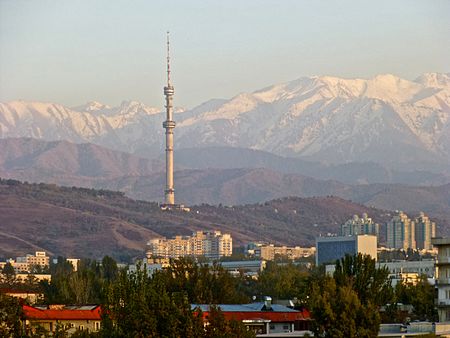
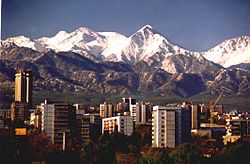
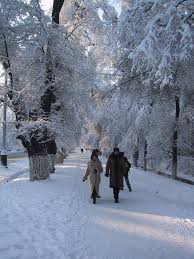
In 1997, I moved back to London after having spent an interesting year in Almaty, Kazakhstan. Almaty was, even then, a quite large city, was at the time the capital of Kazakhstan, and boasted green spaces, tree-lined streets, pavement cafes, pretty girls in short skirts (or furs, depending on the season), a city as hot as 40C in high Summer, sub-zero and snowy in Winter.

450px-TV-Turm_Almaty_-_3

250px-Almaty-mountains

275731-Trolleybuses_are_best_in_Kazakhstan

275876-ianrmillards_new_Alma_Ata_Page_Almaty

ALA_Pushkin_street

[immediately above, Pushkin Street, not very far from where I lived at one time]

Almatysnow

[above, Almaty in Winter]

On returning to London after 12 months, in late September 1997, I found that it was easier to be “offered” another overseas position than to actually get one. In the world of the headhunters, words are cheap. I found myself rapidly running out of funds in a London where the weather became wet and then cold and wet; in fact, my very first day back in London, it became necessary to visit Knightsbridge to buy a raincoat (unnecessary in Almaty, where it rains heavily for only a few days in the year). I went on holiday to Minorca and then, after a number of fruitless meetings re. possible contracts (everywhere Russophone from Moscow to Moldova to Baku and back to Almaty) sat down to decide where to winter, in the hope that a new contract might be offered in the upcoming new year; it was by now already early December.

It had to be somewhere both reasonably warm and reasonably (if not very) cheap. I considered the Canaries, Asmara (Eritrea) and a few other locations, before settling on Egypt, partly because I had been there before (only briefly though, a short break at the Luxor Hilton a few years before), partly because I knew that it could be cheap if one did not stay at a luxury-grade hotel, partly because it would be pleasantly warm even in December. There had also just been a terrible massacre at the Temple of Hatshepsut in the Valley of the Kings (across the river from Luxor), which led me to consider that there might be cheap flights and hotel rooms on offer.

What spoiled the flight part of the plan was that after the news media reported the massacre, the package tour and cheap flights people immediately cancelled all flights to Egypt. However, I had already decided by then to go, my resolve hardened by a pointless breakfast meeting at 0730 (!) with a couple of American “emerging markets” hucksters at the Mount Royal Hotel near Marble Arch, after which I got an overpriced taxi back to Little Venice in the pouring rain and chill.

Olympic and Egyptair were still flying, so I bought a ticket to Aswan via Athens and Cairo.

Egypt

Cutting through the detail of my first weeks in Egypt, I stayed in subtropical Aswan (it’s 1 degree North of the Tropic of Cancer) for 2 weeks before spending a couple of dull weeks at an almost deserted, beautiful and undeveloped beach (living in a large tent) near the then almost uninhabited and tiny settlement of Marsa Alam on the Red Sea. Served by one bus every day or two, it was hard to get to and harder to escape from… (now, over 20 years later, that almost derelict area is very different, has luxury hotels and even its own international airport!). From there I went, not without difficulty, to Alexandria, a journey of at least 12 hours by both what in Tunisia is called voiture de louage (a 6-seat car shared by 5 customers and driver) and long-distance bus via Port Safaga, al-Quseir and Hurghada.

I had already selected a small 3-star hotel on the Corniche in Alexandria, thanks to my Lonely Planet guidebook. Walking distance from Ramla, the central place in Alex. However, unknown to Lonely Planet,Β the buses no longer terminated at Ramla for reasons of traffic control, so I ended up pulling my heavy (thankfully, wheeled) suitcases (inc. portable typewriter) miles along the Corniche (seafront).

After a day or so, I decided to stay in the supposedly good semi-gated beach suburb of Mamoura Beach, at the Eastern extremity of Alex. If possible, I would then rent a flat there via a local agency.

As anyone who has spent more than a brief holiday in Egypt will tell you, organization is not to be expected, chaos is the norm…

At the railway station, which was not busy, I got a local train. It terminated at Abu Qir, which was the place where, in the bay of which, Nelson defeated a French fleet at the Battle of the Nile in 1798 (the westernmost mouth of the Nile itself is now a few miles to the East of that bay).

I had bought a ticket to Mamoura. The train would then continue only for two or three stops until it finished its journey. The seats were polished wooden benches and the train’s journey passed at a snail’s pace. Eventually the train reached Mamoura. I disembarked. It was still mid-morning.

I was not entirely expecting the typically Egyptian scene outside the small station. Crowded streets, traffic, donkey-carts carryingΒ ayshΒ (flat and usually very tasty Egyptian bread), schoolchildren in uniform (this was the first day of Ramadan, so they had probably been sent home early). I had been expecting a quieter sort of place.

What I did not understand at the time was that I had got off at the wrong stop. I had assumed that the nearest station to Mamoura Beach would be Mamoura, whereas in fact the latter was a suburb to the East of Mamoura Beach. I should have disembarked at Montazah.

I had a map, but not a good one. I walked through a couple of crowded residential streets going North, in the direction of the sea. I came upon an Islamic cemetery, the wall of which had a gap on the other side. A small boy was climbing through it. I assumed (wrongly, again…) that he must have been going to the beach, so I followed. When I arrived on the other side, the boy had gone and I found myself in a large open area with some buildings in the middle distance. I saw some soldiers doing road repair on an unused roadway. Their sergeant, when approached, directed me (thanks to my Arabic phrasebook) to where there was the hotel (the only one) on Mamoura Beach, and where I had thought that I might stay. He helpfully wrote the name of that hotel (as I thought) on a scrap of paper, in case I needed to ask anyone else.

I carried on but was surprised to see that the beach, cut off by barbed wire, appeared to be mined. The skull and crossbones motif and a warning in Arabic and English made that plain. As for what I thought was some kind of disused military camp, it appeared now to be, well, an in-use military base. Oh dear…

I walked on and found myself next to a large ground-to-air missile battery, with 4 missiles in place, pointing upward at about 45 degrees.

Realizing that I had to get out, I moved across cut grass towards a distant wall, only to find that a small pack of what seemed to be wild dogs, sunning themselves near the wall, had noticed me. I slowly moved away, tracked parallel to my course by one of those dogs. This was not a military base as known in the UK, USA or even (where I had been in 1977) Rhodesia.

It was at that moment that an officer spotted me and sent over a young sergeant to me to see who was this European wearing chinos, climbing boots and a tweed-style jacket. After I had dropped the half-brick I was carrying (in case the dog attacked), the sergeant escorted me to the officer. A short conversation later (in which I tried to thank them for their help and to walk out of what I could now see was the nearby guarded exit from the base), ended with me taken a few steps to a nearby low building, which turned out to be the Officers’ Mess. Half a dozen curious officers came out, one with a wooden chair, which was placed in front of me. I was gestured to sit. The officers were not unfriendly (several shook hands with me), but just very curious. It felt like being treated as were the shot-down fliers of the First World War. The only thing missing was the bottle of champagne.

Minutes later, a car rolled up, which turned out to contain a major and a captain, who turned out to be the security officer (major) and intelligence officer (captain) of the base. The major searched me, including my boots (while still on my feet), then I was placed in the car and driven away. Thus began a boring but not uneventful day.

The major and captain (the latter more pleasant and I thought probably from a more cultured background, though that was just an impression) questioned me over some Arab coffee (which I like). The captain spoke English, the major none or almost none. There was no rough stuff, no violence or obvious threat. However, they went over my reasons for being in Egypt, in Alex, in Abu Qir and, most of all, on their base.

It turned out that the address in Arabic scrawled by the sergeant I had encountered was not the Mamoura Beach Hotel but a special Soviet-style hotel for officers only, just by the base. Why did I have this in my pocket? Why did I have a Swiss Army knife? Why did I have a map, a small torch, a phrase-book? And so on. One officer casually remarked that, the year before, they had caught an agent of MOSSAD. I have no idea whether that was true, or if so what happened to him, and I decided not to ask, or to appear too interested in what happened to spies in Egypt. I just evinced what I hoped sounded like polite slight interest.

Several times, I asked for the British Consul. The responses were almost amusing, but it was hard to see the joke: “the Consul? Oh, no, the Consul is only for the most serious cases. You don’t want to be treated as a serious case, do you?” or “the Consul will be busy. We just need to ask a few questions more.” When I said that I needed access to the Consul because I was under arrest, the answer was “No, no! You are not under arrest. You are very welcome in Egypt!” (“Ah, so I am free to leave?” “Once we have asked a few more questions…”).

After a couple of hours of such light diversions, including my asking about whether the base had been once a British one, which was me trying to lighten the atmosphere as well as genuine curiosity (they said no), I was informed that I would be leaving, but only because some civilian colleagues needed to speak to me. This was not good news. The Mukhabarat (security police, secret police) is a ubiquitous and feared organization in Egypt. I had entertained a slight hope that the Army might just release me as innocent tourist with a warning not to stray in future. Vain hope.

I was escorted out of the office into a larger reception-style office crowded with ordinary Egyptian soldiers, many of whom were plainly there to catch a glimpse of me, though none said anything. There was also a very sinister body, a civilian, in a light brown leather jacket, with dark glasses and heavy stubble, who absurdly —in that situation— pretended not to have noticed that a foreigner was in the reception area. One of “them”, of course.

I was taken by car out of the base in a car driven by the young sergeant, my fellow passengers the captain and the major. Alexandria is about 20 miles long but only a mile or so deep. It runs along the coast. We were driving now from the edge of the city, past vegetable allotments and near the sea towards central Alex. It was not long before we were in one of the suburbs of Alex not far from the centre of the city (as I thought; I did not then know the city, of course). I thought that we were possibly in the Chatby neighbourhood. The car stopped by a quite high wall. A door was there. We were admitted. On the other side, there seemed to be a fine looking white house, like a small palace, amid luxuriant gardens. There was a little white painted waiting building by the entrance. We waited. The captain left. I lightened the atmosphere by asking the young conscript how come he was a sergeant at such a young age. He blushed as the major asked what I had said! When the sergeant translated it, the major laughed.

A civilian with a long scar down his cheek came to take me into the house. The soldiers left, the major shaking my hand. In a way, that seemed ominous.

Inside, the house was all marble, white and gold. I was shown into a glitz-palatial room, with white and gold chairs around a long low coffee table. It was the very image of the rooms in which Saddam Hussein used to receive his visitors.

Already gathered there were my new interrogators, several Mukhabarat officers. The only one who said nothing was Scarface, presumably there to provide the muscle in case the dangerous spy tried to escape or to kill those present with his bare hands.

A boy came in to take orders for coffee. Displaying all the confidence of my dozen words of phrase-book Arabic, I requested “aqwa mazboot, min fadlak” (loosely meaning Arab coffee with a little sugar please) and one of the Mukhabarat people jumped on it: “oh, so you speak Arabic?!” “I have a phrasebook, that’s all”. “But you ask for coffee with a good Egyptian accent…” and so I nearly became the first man hanged (well, not really, but halfway there) because I owned a good phrasebook. Thanks, Berlitz!

I tried the ask-for-British-Consul thing again, with the by-now-expected response: “The Consul will be busy…You are not under arrest…You are welcome in Egypt…We just have to ask a few questions” etc.

Then the polite but persistent questioning resumed: why was I in Egypt? Why was I on the military base? “What do you think of Israel?”; “I have always opposed Zionism”; “Oh, why would you answer thus to an Egyptian intelligence officer?” Smiles all round, mine by far the most nervous.

Another strange question: “what do you think of Princess Diana?” [who, as mentioned above, had died about 3 months previously]; “I have no particular view of her”; “Really?” [incredulously]…”all Egyptian people love Princess Diana”. Now it was my turn to respond “really?”. “Yes…I myself met Princess Diana here in Alexandria.” I supposed that that was plausible, Mohammed Fayed (father of her lover, Dodi Fayed) having originated in Alex.

Yet another strange question: “why do British government not clear the mines that they put on the beaches of Egypt?”, this a reference to the thousands, maybe millions, of landmines placed under the sands of Egypt (beaches and inland) by the British, Germans and Italians during the Second World War. There are even some on Red Sea beaches. The barbed wire with the warning symbol and English/Arabic “Beware Mines” is everywhere in some regions. I could only nod sympathetically and indicate that I had no influence or power over the British Government or its actions… All in all, this was a very odd little tea party or, rather, Arab coffee party.

In the end, after a couple of hours, it was decided that I had to return to my hotel on the Corniche to get my passport (I carried around only a photocopy). Scarface, a younger officer and a driver accompanied me.

The expressions on the faces of the staff at the hotel were telling: they were petrified. They knew at once who my “guests” were. The officers examined my baggage, my passport etc. They were most interested in the typewriter, my snorkelling equipment (especially the very large “professional”-size fins) and my sole reading matter: Barbarossa, by Alan Clark.

I was surprised that we did not return to the villa, but went to another, possibly more central neighbourhood (not knowing the city, I was trying to see clues to where we were). The driver was a professional, the only one I ever encountered in Egypt who did not use the horn incessantly. It was now drizzling as darkness fell, and as we drove slowly down a street of tall pre-WW2 houses, rather reminiscent of Paris (Alex having been effectively under joint Anglo-French control in the decades up to the late 1940s), the streetlights showed a steel barrier ahead, guarded by a phalanx of uniformed security police with submachineguns, the rain glistening on their short capes, again reminiscent of old Paris. They were ready for trouble, wearing not caps but steel helmets. As our car approached at a snail’s pace, the driver signalled twice using his headlights. The barriers were parted for us.

The car stopped. I was asked to disembark. The air was fresh and cool, as it often is at night in the Alexandrian winter. I was not restrained in any way. After all, to where would I run (even if I were not shot in the back)?

We were outside what had obviously been the townhouse of some wealthy merchant of the late 19thC. Depressingly, the windows were all barred. At first, I thought that I was going to be actually imprisoned in that place.

Above the door, the coat of arms of the Mukhabarat, incorporating the Egyptian all-seeing eye and a hawk or eagle (I think hawk: Horus was “the Hawk of Light” in ancient Egypt; that eye was his eye, “the Eye of Horus”). Also, the words, in Arabic and English, “State Security Headquarters, Alexandria”.

I was led in. At one time in the mists of history (well, pre-1945 anyway) the entrance hall must have been quite grand. A very high ceiling, a wide curved staircase leading up to the next floor, a crystal chandelier, a generally white and gold ambience. An entrance hall for a Hollywood film, perhaps one starring Fred Astaire and Ginger Rogers. Or some version of Anna Karenina. The effect was spoiled, however, by the general lack of maintenance and cleanliness, the long sofa with its dirty fabric badly torn, and the battered old wooden table, at which sat a scruffy middleaged fellow in a warm jacket, his revolver casually in front of him on the table, together with a clipboard and a landline telephone.

Once I was left there, this individual struck up a conversation as I sat on the sofa that the Mukhabarat might have taken from a skip, so old and used was it. There was no-one else around. Kafka-esque. The “receptionist” told me that I was waiting to see the general in charge of all state security in Alexandria. He would then order my release. I had little confidence in that, having been given the run-around all day and knowing that Egyptians can have an odd sense of humour (and a certain streak of sadism, somehow, too). Still, I had no choice but to wait.

At one point, around 1900 hrs, some people arrived and ascended the staircase. The night shift? Or do secret police personnel find the night more congenial for their work? One fellow, dressed in what looked like an expensive suit, was obviously important, because the scruffy receptionist actually got off his rear to greet him. The new arrival looked rather comical to my mind, in that he seemed almost as broad as he was tall, like the British advertising cartoon seen on posters and TV in my childhood, “Mr. Cube”, who was the face of Tate & Lyle sugar. There was something slightly sinister about this man, though. He stopped part-way up the grand staircase and turned round to look at me briefly. His gaze was or seemed quizzical.

I was later escorted by the scruffy fellow upstairs and through quite bright, well-appointed corridors to a small but comfortable office occupied by, as the reader may have guessed, “Mr. Cube” and a colleague, the largest person I ever saw in Egypt. They were friendly enough, and Mr. Cube (aka General Cube, who introduced himself only as the head of state security in Alexandria) explained that before I could be released, he would have to be satisfied that I was not a spy. So we ran through all the same stuff all over again. Mr. Cube was not unfriendly and had some Turkish or Arab coffee brought in, the best I have ever had, served in exquisite tiny china cups. Very welcome after a foodless day (I had not even had breakfast).

At the end of our talk, Mr. Cube did a strange thing (but one I later read about in relation to both the Soviet and British intelligence services). He just looked at me, straight in the eye, and his friendly demeanour turned into something so chilling and indeed evil that it has stayed with me to this day. His gaze seemed to be penetrating deep into my consciousness. The word which came to mind later was “pitiless”. This was a man who might be capable of anything and quite probably had tortured and killed people. Then Cube turned off the terror as easily as he had turned it on, and pronounced that he thought that I was not a spy, but that he had to get clearance from Cairo before releasing me. He busied out of the office and his large assistant clapped me on the back in a friendly way (which felt like the blow from a large bear must feel).

Half an hour later and Cube was himself driving me back to my hotel in his own (very modest) little car (I think that it was a Fiat). It was almost midnight, about 2300 hours. He wished me a pleasant stay in Egypt (in fact I did stay, for another 2 months) and I entered the hotel again. Again the faces of the staff said it all. They obviously had not expected to see me again. The waiter even raised his arms in the air and quietly cheered, as if a goal had been scored.

Well, I did many other things in Egypt but that’s enough for now. If anyone ever asks me about my longest trip to Egypt and what happened, I just say that I was “not” arrested…

932347-The_Corniche_at_Alexandria_Alexandria

Alexandria, San Stefano (now redeveloped)

932352-Early_morning_along_the_Corniche_Alexandria

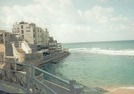
Early morning sea view from the Corniche at Alexandria

mamoura beach

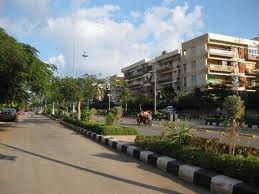
above:Β the main residential road in Mamoura Beach, Alexandria, where I rented a flat a few days after the events described above; I lived there for a month

Mamoura

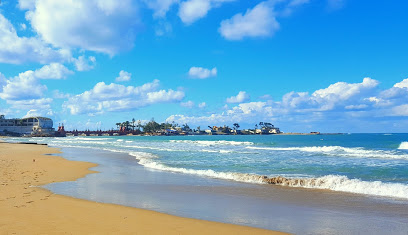
above: Mamoura Beach. When I was there it was off-season, January, but quite warm in daytime, though cool and often wet at night.

MontazahSta

above: OldΒ Montazah Station, near both the Montazah Palace and Mamoura Beach where I lived for a month.

Notes

https://en.wikipedia.org/wiki/Almaty

https://en.wikipedia.org/wiki/Luxor_massacre

https://en.wikipedia.org/wiki/Marsa_Alam

https://en.wikipedia.org/wiki/Safaga

https://en.wikipedia.org/wiki/El_Qoseir

https://en.wikipedia.org/wiki/Alexandria

https://en.wikipedia.org/wiki/History_of_Alexandria

https://en.wikipedia.org/wiki/El_Maamora_Beach

https://en.wikipedia.org/wiki/Battle_of_the_Nile

https://en.wikipedia.org/wiki/Abu_Qir_Bay

https://en.wikipedia.org/wiki/Abu_Qir

https://en.wikipedia.org/wiki/Montaza

https://en.wikipedia.org/wiki/Lavon_Affair

https://en.wikipedia.org/wiki/General_Intelligence_Directorate_(Egypt)

https://www.historytoday.com/archive/goodbye-mr-cube

https://en.wikipedia.org/wiki/Eye_of_Horus

The short 1946 film below shows mainly the grounds of the Montazah Palace in Alex, not far from where I lived for a while; it also shows the Corniche.

Alexandria was much better under European rule and/or influence!

[above: scenes from pre-Nasser Egypt: Cairo, Alexandria and elsewhere]

[below: old Alexandria]

[below: amateur film from, at a guess, a few years ago. It shows some places I occasionally frequented, such as the Brazilian Coffee Stores in central Alex, mentioned in Lawrence Durrell’s books known as The Alexandria Quartet: https://en.wikipedia.org/wiki/The_Alexandria_Quartet]

[below, a critical look at Alexandria as it is now]

Below, another view of Alex as it is now:

Another (less impliedly critical) film, below:

above: scenes of Alex, the one immediately shown above being the Montazah Gardens, surrounding the Montazah Palace. Easy walking distance from my one-time temporary refuge at nearby Mamoura Beach. I was there a couple of times. An oasis of tranquility.

below: amateur video from the cityΒ 

A few further thoughts…

When I was first in Alex (as every foreigner calls it before long), my impression was of a kind of Miami Beach, or as such a place might be after large-scale devastation and/or long-term neglect. Ironically, one seafront part of Alex is actually called Miami! Maybe that’s where the more famous one got its name, but [see Note, below] apparently not.

Despite the acreage of decaying concrete there, despite the nuisance of a goodly part of the population, despite the traffic (and noise thereof), despite despite despite, there isΒ something compelling about Alexandria, at least to me. The sea is a large part of that. The sea at Alex is so beautiful that not even the decaying concrete and the often-ghastly people can ruin it. I was there in winter, and it may be that winter, or perhaps slightly earlier or later, is the best time there. In any case, the 5+ million population swells even more in summer, and Alex must be unbearable then. When I was there, in 1998, the settled population was “only” 3.5 million, so has grown by about 50% in just 20 or so years! Before the Second World War, the population was below 1 million.

There is, or was, something indefinably romantic about Alexandria, despite everything (concrete near-ruins, street nuisances, general chaos, tasteless redevelopment —the most egregious example since I was there being the huge excrescence now at San Stefano). I am not sure that I have any wish to return to Alex, but I cannot say that I never shall.

Notes

“[Miami, Florida] was named for the nearbyΒ Miami River, derived fromΒ Mayaimi, the historic name ofΒ Lake OkeechobeeΒ “: https://en.wikipedia.org/wiki/Miami#History

http://worldpopulationreview.com/world-cities/alexandria-population/


An Unexpected Discovery

My blog, as regular readers will know, concentrates on ideas or matters of general import to society or the world. I do occasionally blog about other things, such as the less strictly legal aspects of my life at the English Bar, particularly if the story or anecdote has a humorous element or one which, to me, seems to say something about society as a whole.

When I blog about people I have known or had connection with, I usually keep them anonymous, or use initials only as identifiers. However, there are cases where the individual is either very well-known or, in my view, does not deserve the protection of anonymity.

Let us go back to December 2007, when I was beginning to have serious problems with the Revenue, problems which were not resolved until 2012. I made my last appearance in court (a truly ridiculous 3-day construction case at Central London County Court…long story, deserving a blog piece of its own some day) and left for my home in North Finistere, France (though I remained, purely nominally, a barrister in chambers, and at the practising Bar, until mid-2008).

Not long before I left for France for the last time (I had been bi-weekly commuting for 3 years via car ferry and air), a nuisance joined chambers. I had twice (successfully) opposed this barrister, one Brent McDonald, in fairly minor County Court negligence cases in the South West of England and had been frankly unimpressed by him. Though he seemed not unintelligent, he also seemed devoid of common sense: for example, insisting to a judge that a motor accident must have happened in a certain way because of the laws of kinetic energy! He was originally in the construction trade, I believe, and had a technical background. I disliked his attitude, which was very and unnecessarily confrontational. He was also a sore loser. If I am being completely honest, I thought that there was something wrong with him mentally.

That individual, I believe of Scottish origins, was, according to the senior clerk to chambers, married to an Indian (I think) woman, and they apparently had a child (in fact, if memory serves, two children). The Clerk said that he had plenty of good work, mostly legally-aided.

I was, at the time, a member of Rougemont Chambers, Exeter, which had burgeoned from a handful of people and not much work when I joined in 2002 to being a busy provincial set with a couple of dozen barristers and three clerks in 2007 (it is now merged with another set under a new name and is the largest set in Exeter and the largest in the South West outside Bristol).

The other members of chambers (it was always a surprise to me what poor judges of character many barristers are) were apparently impressed by McDonald at a reception chambers held for him, and the senior clerk was impressed by the list of solicitors supposedly willing to instruct him (and thus bring work and revenue to chambers). I abstained on accepting him into chambers, rather than voting against him, because both the Head of Chambers (who is now a Circuit Judge) and the Senior Clerk had persuaded all other members to approve him and I did not have the power to veto his acceptance.

In the first day or so, McDonald was not offensive and even remarked on how impressed he was that I was mentioned in the main legal directories (that “review” barristers and solicitors) as someone to brief on matters such as Caribbean and other offshore laws, and oil and gas questions, the latter particularly involving the Russophone jurisdictions where I had had very direct experience (including a year living in Kazakhstan).

It was not long, however, before McDonald started to buttonhole me on my political views, though only on the race question (including the Jewish Question). This was odd, because members of chambers rarely discussed anything political. McDonald was insolent and inquisitorial. To me, his attitude was unbelievable, not least because he had only just joined chambers and was in every way junior to me! Protocol is important to me. His demeanour was would-be intimidating, would-be bossy. I was fuming but courtesy also is very important to me. In fact, the bastard even remarked, half-sneeringly,  on how polite I was and how it was obvious that politeness was important to me!

McDonald effectively admitted that his antipathy toward me was based on (his kneejerk assumption about) my political views, combined with the fact that his wife and offspring (I think that he had two children) were non-European; as noted above, I believe that his wife was Indian. In the end, he grudgingly accepted that I had different views from his and we effectively agreed to avoid each other in chambers. Until he arrived, chambers had been a pleasant place. It was an object lesson in how one person can poison a whole environment very quickly.

So I left the practising Bar and my Exeter chambers and England, though not primarily (in fact, scarcely at all) because of McDonald (though his being there was certainly a disincentive to me, like the taste of a bitter piece of peel when eating a fruit).

I do not think that McDonald stayed long in those chambers before joining a larger set in Bristol, an offshoot of a London set. I noticed that he was himself now mentioned in the legal directories which he seemed to revere. They said that he “had come up through the ranks” and was well-regarded or some such.

I myself have always viewed such legal directories with skepticism, not so much because they recommended me at one time (!) but more because I had read glowing reports about people and organizations which did not chime with my direct experience of them, such as the “Emerging Markets” mini-department at Cameron McKenna (a large City of London law firm) for which I worked for 6 months in 1996-97, based for most of which time in Almaty, Kazakhstan (I later stayed on there, working with a very large American law firm).

That Cameron McKenna department was largely a Potemkin village created by an Australian woman of Russian-speaking (note speaking) origins, who would have been incapable of organizing the proverbial “piss-up in a brewery”, but who was very good at putting on an impressive front: when her department was about to be closed (when the **** hit the fan in various ways), about a year after I myself had moved on, that person not only managed to move just in time (and with a few toadies) to another large City of London law firm dealing with Russia, Kazakhstan etc, but the Times legal section and the main legal directories all (briefed by her and/or cronies, no doubt) lauded her new firm as having been “strengthened” by having this useless and devious woman and said toadies on board! (the last I heard of her, a few years ago, she had returned to the Antipodes and was an Australian trade delegate at a fairly high level, no doubt flourishing like the green bay tree…).

Anyway, returning to this McDonald character, I pretty much forgot about him for a decade, but then I started my blog and included a few reminiscences etc. So it was that I decided, recently, to see whether he was still at the Bar. To my surprise, I could not find him in the Bar Directory, or anywhere else, even by Googling. I did find some noted (i.e. appeal) cases, dating from 2008 or so. I wondered whether he had died, emigrated, even been disbarred! I drew a blank everywhere. Then I noticed that there was someone with the same surname at his last-known chambers. Not his wife at the time I knew him, because hers was a foreign, I think Indian, first name and this one was called Fran. Anyway, the Indian woman had not been at the Bar. So I thought that the surname must be co-incidence (McDonald being a fairly common name). Then, however, I noticed a few more facts.

It turned out that appeal cases from 2008 and later, proudly noted on that chambers’ website as having been done by Fran McDonald, had in fact been noted, in the law reports themselves, as having been done by Brent McDonald. I took a closer look.

The Bar Directory now has no public record for a Brent McDonald, but does now have an entry for one Lola Francesca McDonald…

Now a stranger move yet! It turns out that the barrister formerly known as Brent McDonald and now known as Fran McDonald has relocated to, of all places, the small New Zealand town of Nelson, at the top of NZ’s South Island.

What makes this move even stranger, on the face of it (and notwithstanding that Nelson seems a pleasant small town, reputedly the sunniest in New Zealand), is that McDonald (whether as Brent or Fran) was a personal injury specialist (though in Exeter he did other negligence-related and yet other work in the brief time when we were both members of Rougemont Chambers in 2007). There is, as far as I know, no personal injury legal work in New Zealand (see below for the reason for this).

The legal directories said:

“‘…rising star [Fran] McDonald continues to act on severe injury and fatal accident cases in the UK and abroad. She is very popular.’ (2012)”; and

“‘[Fran] McDonald is solely focused on personal injury and clinical negligence.’ (2014)”

(note the square brackets: looks as if Fran was still Brent in 2012 and 2014, despite the “she”; as for the Legal 500, that organization does not note McDonald’s New Zealand departure in its latest online offering: see below)

 “WORK DEPARTMENT

Personal injury; public inquiry; clinical negligence; product liability; inquests.

POSITION

Fran is a specialist barrister acting in the field of personal Injury who is recommended in both β€˜Chambers & Partners’ and β€˜The Legal 500’. Fran’s practice is focused on personal injury, including fatal accidents, inquests and inquiries.

The favourable references cease after 2016. The reason is a little vague (to me at least). I have no idea how long “gender reassignment” takes (or whether Brent/Fran underwent it), though, apropos of nothing much, I did once own a copy of the memoirs of April Ashley, my copy sadly abandoned in France in 2009, along with 99% of my library of 2,000 books. The April Ashley book was rare, too, the print run having been pulped.

I presume that the apparent hiatus after 2016 may have had something to do with what must be a very trying metamorphosis for anyone.

What makes the emigration to New Zealand odd is that it is clear, on the face of it, that McDonald built up a solid reputation in England in personal injury and the related clinical negligence area, but has now relocated to a country where there is effectively no personal injury or clinical negligence work, because New Zealand has a “no-fault” system, based on universal insurance, assessment of injury etc (see Notes, below).

I notice that McDonald, despite and perhaps justly boosting his/her personal injury repertoire on the London chambers’ website (to the exclusion of almost everything else), now lists as specialisms “employment law” and, even more weirdly (to my eye), nautical matters!

Fran’s main specialism in Nelson is issues relating to employment law. After completion of his exams in the new year he will resume practice over his full range of contentious interests including tort law (negligence, trespass etc), insurance, commercial/contractual disputes, professional liability, property disputes, medico-legal matters, engineering and construction and health and safety legislation.”

and

Many of his cases over the years have had a nautical theme such as claims involving distraint of containerised goods, allisions or breach of contract especially where jurisdictional/conflict of laws questions arose. Fran is equally happy to bring or defend claims. For example, he acted for UK Marines injured on the battlefield at the same time as being counsel for over 1,200 Iraqis alleging they were imprisoned, tortured or had family members murdered by UK forces.

The Nelson law firm names McDonald as Fran, as do the chambers in London (of which he/she is still, it seems, a member), but the London website refers to “she/her” whereas the New Zealand one has it as “he/his”. All very confusing… In addition, the New Zealand law firm shows McDonald as male, in a suit, shirt, tie, with short hair. The London website shows Fran as, or as if, female, with matching hair. Even more confusing…

The New Zealand law firm, Hamish Fletcher, which McDonald has joined in Nelson, has —actually not too unpleasing aesthetically, from the architectural point of view— offices on the floors above some retail outlets: Specsavers, a clothing shop and a “vape shop”, as can be seen via Google Earth.

Well, there it is. I am no psychiatrist, but it appears that the underlying motive force here is a wish for reinvention: the young man in construction or engineering becomes a barrister, marries, has children, changes sets, changes locations, changes sex, emigrates to the far side of the world and to very different circumstances, even (as it appears) metamorphosing in appearance again.

In the Russian proverb, “the soul of another is a dark wood” [чуТая Π΄ΡƒΡˆΠ° Ρ‚Π΅ΠΌΠ½Ρ‹ΠΉ лСс].

Does the above story tell us anything beyond the egregious McDonald’s personal odyssey? Someone seemingly rootless… is that typical of the age, typical now of UK people? I myself was once called, in jest, “the wandering Aryan”! It does reinforce my view of “legal directories”, not to mention chambers’ and law firms’ websites!

What about the “gender bender” aspect? A lady barrister I knew in London once was convinced that pollution of the water and air was leading to feminization in the males of both fish and humans (she was looking at her boyfriend at the time!). Was she wrong? I merely pose the question. When both April Ashley and (btw) a later friend of mine, Della Aleksander, had “sex change surgery” in Casablanca (April Ashley in 1960, Della Aleksander sometime in the early 1970s, I believe), such things were outrageous enough to draw down huge tabloid press interest. Now, it sometimes seems as though everyone and his dog is having a “sex change”! I do not think we can simply shrug our shoulders at all this. It may be that we are coming to the point where our whole civilization is about to experience a crisis.

Notes

https://www.barstandardsboard.org.uk/regulatory-requirements/the-barristers’-register/?ProfileID=43962

http://www.oldsquare.co.uk/our-people/profile/fran-mcdonald

http://www.legal500.com/firms/9535/offices/9534/lawyers/90812

http://www.hflaw.co.nz/our-team/fran-mcdonald/

https://www.newzealandnow.govt.nz/resources/acc%E2%80%93helping-to-meet-the-costs-of-personal-injury

https://en.wikipedia.org/wiki/Accident_Compensation_Corporation

https://en.wikipedia.org/wiki/Nelson,_New_Zealand

https://en.wikipedia.org/wiki/April_Ashley#Biographies

https://en.wikipedia.org/wiki/April_Ashley

https://ianrmillard.wordpress.com/2018/11/15/when-reality-becomes-subjective/

https://ianrmillard.wordpress.com/2019/01/26/the-tide-is-coming-in-reflections-on-the-possible-end-of-our-present-civilization-and-what-might-follow/

Extra Note

Many readers of my blog will be aware that I ceased to be even nominally a barrister in late 2016. For those who are not, and are curious as to why, please see:

https://ianrmillard.wordpress.com/2017/07/09/the-slide-of-the-english-bar-and-uk-society-continues-and-accelerates/

Update, 6 May 2019

I happened to notice that the name of the subject of the blog post no longer appears in the online list of barristers belonging to his former chambers in England.

Update, 28 May 2022

Having seen that the original blog post has had a number of hits overnight, I checked out the website of that law firm in Nelson, New Zealand. It seems that the individual in question has now reverted to “Brent”.

What an unexpected and odd world we live in.

Update, 14 June 2023

Upon looking up the individual in question (on the website of the New Zealand law firm) for the first time in over a year, it appears that the individual no longer says anything about specializing either in personal injury or “wet” shipping matters, but now gives priority to business mediation etc, and even claims to have always done that kind of work. Really?

I cannot recall him ever doing that kind of work when I had the misfortune of being acquainted with him, whatever he may now claim. I should know. I did a bit myself when in the same chambers as him, and even sat as a business mediator now and then.

Oh, well, there it is…

Update, 15 July 2024

The blog post having had quite a few recent hits, I decided to see whether there was any further or better information that I should add. Turns out that the individual in question is still “Brent”, and now sports a beard. He moved on, apparently, from his former law firm a year ago and over the past year has been associated with two other law firms in turn, both on the South Island of New Zealand. He is not, however, and as of today’s date, on the websites of either.

Barristers, Solicitors and Fees (and a few other things that irritate me)

Background

As some of my readers will know, I was from 1991 to 2008 a working barrister (sometimes in practice in England, sometimes employed by international law firms); I was also nominally a barrister, but neither practising nor employed, from 2008-2016. In 2016, I was disbarred by reason of a malicious Jew-Zionist complaint against me by a pro-Israel lobby group known as “UK Lawyers for Israel” (see the Notes at the foot of this blog post).

232323232fp93232)uqcshlukaxroqdfv975(=ot)3;8 =73(=33(=XROQDF)26 (8;953824;ot1lsi

[photo: me as newly-minted pupil-barrister in or about 1992, aged however about 35]

As matters now stand, I have no personal interest in the Bar or the legal professions (the Bar, the solicitors’ profession etc); I do have a general socio-political interest, however, as well as a liking –perhaps excessive– for walking down Memory Lane (my natal chart has Saturn in Scorpio, for those with interest in such things).

I was impelled to write today having seen the Twitter output of someone calling himself “Abused Lawyer”:

https://twitter.com/AbusedLawyer

Thoughts

I start from the premise that a society of any complexity requires law, a legal system, legal rights and duties etc. By way of example, as long ago as the Babylonian Empire (c.600 BC), there existed laws dealing with the ongoing liability of builders to purchasers of houses (English law only caught up with this in, I think, the 1970s). At any rate, any complex society requires correspondingly-detailed laws.

Legal complexity is a sign of a complex society, just as the existence of “celebrity chefs” and “celebrity” sportsmen (etc) is a sign of a decadent society (as in the latter days of the Roman Empire: discuss).

Laws alone, however, are only the start. In order to have effect, laws need pillars of support: (equitable) enforcement, at the very least. Stalin’s Russia had laws on paper, but was very arbitrary and unjust in enforcement. English law has always said that “where there is a right, there is a remedy” and that that remedy will consist in, at root, enforcement of criminal law by a criminal penalty, or in civil law a civil ruling providing for compensation or a mandatory compulsion or prohibition.

There is a further point. In order to get from right to remedy, you need a mechanism with which to do that. In an ideal society, every citizen would be educated enough, have sufficient will or resolve (and the means necessary) to be his/her own lawyer. In reality, there is a need, in every society beyond the smallest and most primitive, for a group of lawyers, so that citizens can be advised, protected, fought for, defended, and also so that society functions with relative smoothness.

As societies progress, they go from having no lawyers, to having a few who are supposedly unpaid amateurs or monied gentlemen who receive only gifts (honorarii) from the grateful, then on to having lawyers who are paid freelancers (or, in some countries, salaried employees of the State).

The question arises as to howΒ to remunerate lawyers. In England, there were at one time several kinds of lawyer: barristers, “attorneys”, “sergeants”, “notaries” etc. These categories were whittled down (for most purposes) to only two by the late 19th Century: barristers (in four “Inns of Court” in London) and solicitors. The barristers, when paid, were paid by the solicitors, who in turn were paid by their lay clients (the term “lay” coming, like much else, from the ecclesiastical vocabulary of the late Middle Ages).

The first State-paid legal aid scheme (criminal) in England dated from the 1890s and covered only the most serious offences (particularly murder, then a capital offence). After WW2, it became gradually clear that both justice and convenience required State funding for at least the more serious criminal offences dealt with at the Assizes and Quarter Sessions (from 1971, the Crown Courts). Civil legal aid dates from 1949 and expanded greatly until 2010, when it started to be drastically cut back, along with criminal legal aid.

When I started at the Bar in 1993 as a real working barrister and not a mere “first six” pupil (spectator and dogsbody), I did quite a lot of publicly-funded work: criminal “rubbish” (in the charming Bar term) in the magistrates’ courts and (far less commonly) the Crown Courts; Legal Aid-funded and also privately-funded civil work in the County Courts (housing, landlord and tenant, contract, various tortious disputes) and in the High Court: judicial reviews (mostly housing or immigration-related), which were via Legal Aid; also contractual problems, libels etc, which were privately-paid.

Even in 1993, criminal legal aid was not too generous (I was in the wrong sort of chambers to get lucrative frauds or other really serious criminal cases), though I still recall the unexpected pleasure at getting a Β£5,000 fee for 5 days at City of London Magistrates’ Court, an “old-style” committal in a cheque fraud case which later went to the Old Bailey for trial. A Nigerian solicitor and another Nigerian, a recently-Called barrister, cheated me out of that trial, but that’s another story….

I do recall that I did go to court from time to time for “Mentions”, a nuisance involving going somewhere, dressing up, then appearing for (usually) 5 minutes before a judge, all for Β£45, if memory serves (I was told about 10 years ago that the fee for that was still below Β£50, 15+ years later!).

On the other hand, I knew several people who, having gone to the Bar in 1988 or 1989 with relatively modest academic qualifications, had started to get lucrative and legally-aided criminal work by 1993. One was making around Β£100,000 p.a. by being led (i.e. by a Q.C.) in large-scale frauds. The average salary in the UK at the time would have been around Β£15,000 to Β£20,000, I suppose.

It is a question of where the line is drawn. The general public read of the few barristers making millions (some from legal aid) and are unaware of the fact that many barristers (solicitors too) make almost joke money, such as (in 2018) Β£20,000 a year, Β£30,000 a year etc. That applies especially to criminal barristers (and solicitors). The barrister has many expenses to pay, too, from Chambers fees and rent (which work out at as much as 20% of gross fees received) to parking, fuel etc (in the 2002-2008 period I myself travelled all over the UK, and also to mainland Europe and beyond by car, ferry and plane).

Lawyers must be paid, but how well? Unfortunately, this cannot be left to public sentiment. Just as, perΒ Bill Clinton, “you can’t go too far on welfare” (because the public love to see the non-working poor screwed down on), it seems that the public have, understandably but ignorantly, no sympathy for lawyers! The newspapers make sure of it. On the other hand, read what “Abused Lawyer” has to say…

Further Thoughts

My first thoughts are that the governments since 2010 and perhaps before have had no real interest in the law as a major pillar of society. The court buildings themselves are often not much to look at. Many of the newer (post 1945) Crown Courts are in the “monstrous carbuncle” region, though there are a few modern courts that are better, such as Truro and Exeter, both of which I visited often when practising at the Bar out of Exeter in the years 2002-2007.

Some County Courts are appalling to look at: I once had to appear at Brighton County Court, which is or was like a public loo in almost every respect. Again, I was once only at Walsall County Court: I saw a magnificent 18thC building in the neoclassic style (pillared frontage etc) with the legend “Walsall County Court” on it. However, it turned out that that building had been sold and that the real County Court was now situated nearby in what had obviously been a shop, possibly a furniture emporium. Now, about 14 years later, I have just read that the original building is a Wetherspoon’s pub! Britain 2018…

If you visit courts in the United States, you often find that they embody “the majesty of the law”: pillars, atria, broad stone steps etc. Not all, but most. Even the modern courts make an effort to seem imposing. Not so in the UK! You might ask “so what?”, but image and impression are important. The same is true of the Bar. It is infuriating to see some barristers hugely overpaid, particularly at public expense, but at the same time law and society are diminished if the Bar is reduced to penury.

The question is not simple: the Bar has become overcrowded. Even now, we see that every other (or so it sometimes seems) black or brown young person wants to become a barrister (quite a few English people –so-called “whites”– too).

When I was at school and vaguely thinking about the idea (in 1973, the year in which I in fact dropped out of school!), the Bar had about 4,000-5,000 members (in practice in chambers), whereas now, in 2018, there are 16,000 (but the official definition now includes some —perhaps 3,000— employed barristers). In very broad terms, you could say that the number of practising barristers has tripled in 40 years. However, it seems that in 2017 and 2016, the number exceeded 30,000! Has there been a cull in the past year or so? I do not have the information with which I might answer my own question.

Looking at the situation from my present eyrie of objectivity, it seems to me clear that the Bar (and also the solicitor profession) as a career for many is going to disappear. Britain is getting poorer and the plan of the international conspiracy is to manage that. How? By importing millions of unwanted immigrants (who breed); by getting the masses used to the idea that Britain is getting poorer and/or “cannot afford” [fill in whatever: the Bar, the law, the police, the Welfare State, defence, decency…]. Also, by labelling the few non-sheep standing up against it all as “extremists”, “neo-Nazis”, “racists” etc.

The fees for the criminal Bar and the lower end of the civil Bar will only become more modest. Large numbers of often rubbish barristers will compete for the badly-paid cases going (and some more affluent young barristers, with family money supporting them, will willingly work for peanuts anyway). There is also the point that, when I was at the Inns of Court School of Law in 1987-88, you had to go there for a year in order to take, eventually, the (then) three days of the Bar Examination. Now, all sorts of poor places offer a “Bar Finals course” (now, I believe, called the Bar Vocational Course or BVC, or some even newer name). Thus the supply of (often poor) barristers has increased.

A final word on fees. Traditionally, barristers were not supposed to care about fees. They could not sue for their fees. These attitudes still exist, though in very modified form, today. At the same time, some solicitors take advantage. I suppose that my critics will call me biased etc, but I found that the non-paying solicitors were mostly the smaller, often Jewish or other “ethnic”, firms who, almost invariably, were also very lax on ethics (i.e. were crooks, in blunt language). I suppose that some will ask why I accepted instructions from such firms. Well, there are ways to get out of things, but the “cab rank” rule limits what you can say and do, and the joke “Code of Conduct” would make it impossible to say “no Jews, no blacks, no browns” (etc)…

Looking further ahead, the legal profession is likely to be hard-hit by AI (artificial intelligence).

Notes

https://ianrmillard.wordpress.com/2017/07/09/the-slide-of-the-english-bar-and-uk-society-continues-and-accelerates/

Update, 1 December 2018

A tweet about a Crown Court trial by the author of a recent high-selling book on the broken justice system of the UK continues the theme:

As to why (criminal) barristers are now working for peanuts in many cases, see above blog post, and also:

  • most criminal barristers cannot do anything else and are by no means always of much interest to those who might pay more, i.e. employers of whatever type;
  • Β most criminal barristers are “me too” pseudo-liberals with the backbone of a jellyfish, as witness their lack of (public) support for me when a Jew-Zionist cabal (“UK Lawyers for Israel”) made malicious and politically-motivated complaint against me to the Bar Standards Board in 2014 (hearing 2016);
  • following above theme, most barristers (not only criminal ones) are scared of the (absurd) BSB, the Bar Council, their instructing solicitors, their own shadows (etc);
  • some have family money and/or are trustafarians.

Update, 13 December 2018

Another relevant contribution, from a barrister calling himself Cayman Taff…

Update, 16 December 2018

Solicitors: civil legal aid firm numbers reduced by well over 1,000 (from about 3,600 to 2,500), so a reduction of over a quarter. The BBC says “decimated”, but I have ceased to expect much literacy from BBC (or other msm journalistic) staff…

https://www.bbc.co.uk/news/uk-46357169

and I just noticed this tweet (see my mention of “Mentions” in the body of my blog post, above)…

Fragments of Memory…#From Pupillage: Neil’s Party

Foreword

Some reading this may also have read my previous blog posts [see Notes, below]Β about my rather untraditional Bar pupillage in 1992-93, and also about my early post-pupillage days in Bar practice. I thought to write about a few other stray incidents from those times. Humour was rarely entirely absent, though sometimes in the context of events which were, especially for the people advised or represented, taxing and upsetting. I was, of course, in the first six months of my pupillage not allowed to advise or represent, and so was basically a spectator and supernumerary.

Anyway, here is one event that has stuck in my recollection. It is not directly “legal”, but connected to some lawyers I knew.

Neil’s Party

At the time, in 1992, I was very friendly with a young barrister called Neil M. and his charming wife, Helen. Both had been in the same small “Practical Exercises” group at “Bar School” (the Inns of Court School of Law in Gray’s Inn, at the time the only place where aspiring barristers could study and be examined) in 1987-88. Our surnames all started with “M” (Neil and Helen had different surnames at that time, being unmarried; in fact they first met in that little group of 7 or 8 people).

I had gone to the USA (initially in 1989, but somewhat commuted UK/USA in the following few years) and had married a US citizen; I also qualified by exam (and pretty tough it was) at the New York Bar. Neil M. had started pupillage in London and, by 1992, was already a rising barrister at the criminal Bar. Helen, his wife by that time, had left the Bar for the solicitors’ profession. In 1992, when I returned to the UK after one of my sojourns in New Jersey, the country was just going to hold the General Election of that year.

I was not actively political at the time, though I of course despised the System parties. Neil M., on the other hand, was a Labour Party stalwart, a political position which originated from his upbringing in the North West of England: he was the son of an amiable “tankie” Communist (literally so, a member of the C.P.G.B.), whom I met a couple of times in later years.

Neil M. was, I suppose, somewhere in the middle of the Labour Party, ideologically, close to the outlook of John Smith, the Scottish advocate who led Labour for about 20 months until his death in 1994. I should characterize Neil’s outlook as “tribal Labour”; to me that had no greater weight than that of someone who supports this or that football team, or Oxford/Cambridge in the Boat Race. In fact, Neil M. concurred with my view up to a point, saying that I could not understand why people like him were so partisan in favour of a System party; for him it indeed was like “…supporting a football or rugby team; you don’t understand that either!”

I was invited to attend the special election night dinner at the beautifully-refurbished National Liberal Club, once the haunt of Gladstone, Lloyd George and Asquith, later (in the 1970s) the decayed and dilapidated place where the likes of Cyril Smith and Jeremy Thorpe had stayed and behaved badly. By 1992, most members were “non-political” (meaning not Liberal Democrats). Much later yet, in 2001-2002, I was myself a member.

Large TV screens had been set up in the Club dining room, in order to relay the election results from the BBC as they came in.

Older readers will recall that the opinion polls made Labour favourite to win the 1992 General Election. Neil Kinnock was widely expected to become Prime Minister, though later his triumphalist and arguably too-“Labourite” speech at Sheffield was blamed for putting off floating voters:

At any rate, Labour went into the final day and evening confident, a position echoed by many of those at the dinner I attended. In fact, I noted that many were not pro-Labour, but were quieter than the Labour partisans. At my table, I sat near Neil M. and his wife, as well as another barrister, a markedly iconoclastic (and amusing) Jew commercial barrister called Robert L. and his extremely engaging, attractive and articulate wife, a City of London banker, with whom I had an interesting and slightly barbed conversation.

All went well at the dinnerΒ until, after midnight, it started to become very obvious that Labour was not going to win the election. The scene in parts of the large Club dining room reminded me of a smarter and English (and far less sexualized) version of Don’s Party, the Australian film about a party which unravels when the expected victory of the Australian Labor Party (in 1969) fails to occur. I left the Club very late but still before most of the diners. I was told later that, after I left, scuffles and the like broke out between mocking “Conservatives” and angry, frustrated and drunken “Labour” partisans.

I myself was highly amused by the outcome of the election, mainly because, to me, it was obvious that most of the Labour MPs in the Shadow Cabinet were a bunch of fakes and/or hypocrites, led by Kinnock himself, a creeping crawling doormat for Zionists, and an apologist for mass immigration and finance-capitalism ameliorated slightly by a Welfare State already beginning to show signs of disappearance.

Neil M. was angry at me (and years later admitted to me that he had come close to hitting me! In the sacred precincts of the Club, at that!). He himself later became a local councillor in Islington and was informally offered the chance to become a Labour MP, but turned down the opportunity on the ground that as a barrister doing very good criminal work, he was making about twice an MP’s salary and needed the money. Years later he ruefully explained that he had thought that MPs lived off their salaries! He had no idea back then that not only did they have very generous expenses (and in many cases cheated badly on those!) as well as the really quite good salary (compared to most people), but also often had offers of lucrative “work” from all sorts of “consultancies” etc. Disguised near (or actual) corruption. Pity that Neil M. did not become a politician in the Westminster monkeyhouse. He would have been a good and conscientious constituency MP.

Final Word

In fact, Labour improved their position in the election, with an extra 42 MPs, though that still left the Conservatives under John Major with an overall majority of 21. It took 5 years before Labour under Tony Blair could sweep away the Conservatives and many of their MPs. Neil Kinnock ceded control of Labour to John Smith and then (after Smith died in office) to Tony Blair.

As for my friends Neil M. and Helen M. (I shall not say too much, to save them from embarrassment, now that the Zionist Jews label me in the msm and on social media as a “far right” “extremist”, “anti-Semite” and “neo-Nazi”), I maintained friendship for another 15 years, and in fact still regard them as quite close friends today, though I have not seen them now for a decade. I always send them a Christmas card (I’m like that, a bit like Jacob and the Angel: I will not let you go until you bless me…).

https://ianrmillard.wordpress.com/2018/08/05/an-embarrassing-morning-in-court/

https://ianrmillard.wordpress.com/2018/08/03/first-steal-a-chicken/

https://en.wikipedia.org/wiki/National_Liberal_Club

http://www.nlc.org.uk/

https://en.wikipedia.org/wiki/United_Kingdom_general_election,_1992

https://en.wikipedia.org/wiki/Don%27s_Party

https://www.youtube.com/watch?v=YMundQIwku8


“Mark Lewis Lawyer” Tries to Have Part of the Case Against Him Thrown Out

  • The Jew-Zionist lawyer (solicitor) Mark Lewis, best known for the UK phonehacking cases of some years ago, is facing a disciplinary tribunal under the auspices of the Solicitors’ Regulation Authority, and is trying to have part of the case against him thrown out on the specious basis that he was “merely responding” to rude comments about him by “a Who’s Who of neo-Nazis” (as if that were a defence? Oh well, let’s leave that aside…he’s not my solicitor, thank God!). I post the link to the Law Society Gazette report below.

I should add that I am neither party nor witness in those disciplinary proceedings.

I shall be blogging further about this unpleasant individual, probably in considerable detail, at a later time. For the moment, I shall confine myself to saying that

  • Mark Lewis started to send me a small number of abusive tweets (unprompted by any tweets from me to him) in 2012 or 2013. I did not reply in kind and blocked him on Twitter;
  • Lewis’s then wife (a short-lived marriage), one Caroline Feraday (a “Z List” would-be “celebrity” about 20 years ago) was in fact the first to abuse me on Twitter, having seen a tweet by me about the “WW2 Jewish looted art” “restitution” scam, reported on by the Radio 4 Today Programme. Lewis joined in her hysterical abuse against me. (The marriage failed after less than a year and after a few years —in 2018— she had a child by another man in Southern California, to where she —and Lewis, for a while, in 2013— had relocated);
  • I had to block both Caroline Feraday and Mark Lewis on Twitter because of their unpleasant abuse; I should add that, until they started to abuse me online, I had never heard of either of them;
  • Some time after I blocked Mark Lewis on Twitter, I was informed (and saw evidence from his own online output) that he had tried to make complaint against me to the Metropolitan Police in or around 2013. I know the name of the police officer who was (in Lewis’s words) “dealing with the case”, a woman who had previously served in the Royal Military Police. The complaint failed (in fact, I was not even contacted by the Metropolitan Police);
  • Mark Lewis is or was a leading member of, and office-holder in, two Jew-Zionist organizations, UK Lawyers for Israel [UKLFI] and the so-called Campaign Against Anti-Semitism [CAA]. The first cabal (UKLFI) made complaint against me to the Bar in 2014 (6-7 years after I ceased practice, a purely political and malicious complaint based on a small number of tweets, none of which were addressed to any individual but were general comments on society). I was disbarred in 2016 as a result of that complaint. The second cabal (the CAA) has tried on several occasions to have me prosecuted, via malicious complaint to Essex Police [see link below] and elsewhere (but now is itself under investigation by the police in relation to several matters);
  • Mark Lewis has from time to time posted other rude or abusive comments about me online, the last being about a year or two ago;
  • Mark Lewis is supposedly now relocating to Israel, and the London law firm which employed him for a couple of years, Seddons, parted company with him a while ago.

Unfortunately, I was unaware until recently that Lewis was being “tried” for abuse online against others, and was only aware today that Lewis had made preliminary application to throw out the case in part on the basis that he was merely “replying” to abuse by “neo-Nazis” (in which category he apparently places me). In my case, I was tweeted by Lewis; I was neither rude nor insulting, still less abusive to Lewis, yet he was –unprompted– horribly rude and abusive to me, as was his short-term and hysterical then wife, though she soon moved on and concentrated on (risibly) trying to convince her Twitter followers —mostly bought– that she was still, really, a “celebrity” (apparently a few people still remember her reporting on London traffic congestion etc);

  • It is important to underline that I was never even rude, still less abusive, to Lewis. His abuse was unprompted, unexpected both in itself and in its ferocity, and not the result of anything I tweeted to him (he addressed me “out of the blue”).

I await the results of the disciplinary proceedings with interest.

Notes

https://www.lawgazette.co.uk/news/lewis-prosecution-is-disgraceful-considering-hate-campaign-against-me/5068417.article

https://www.lawgazette.co.uk/practice/fee-dispute-i-wasnt-sure-what-work-mark-lewis-was-doing-law-firm-chief-tells-court/5063455.article

https://ianrmillard.wordpress.com/2017/07/13/when-i-was-a-victim-of-a-malicious-zionist-complaint/

https://ianrmillard.wordpress.com/2017/07/09/the-slide-of-the-english-bar-and-uk-society-continues-and-accelerates/

https://www.dailymail.co.uk/news/article-2184723/RICHARD-KAY-DJ-Caroline-Feradays-brief-encounter.html

https://www.pressreader.com/uk/scottish-daily-mail/20140519/282273843396961

https://www.lobster-magazine.co.uk/free/lobster63/lob63-mark-lewis.pdf

https://www.standard.co.uk/lifestyle/mark-lewis-my-ms-consultant-told-me-not-to-do-anything-stressful-so-i-went-after-murdochs-phone-6370688.html

Β 

Debate about this on Twitter…

https://twitter.com/IKWiltshire186/status/1065911406162309121

Update, 23 November 2018

It appears that the hearing has in fact now started and that Lewis failed to get part of the evidence (and so the case) thrown out:

https://www.lawgazette.co.uk/news/lewis-regulatory-action-inevitable-after-death-threat-tweets-tribunal-hears/5068449.article?utm_source=dlvr.it&utm_medium=twitter

Lewis apparently has given evidence that, at times, he “had no idea what he was doing” because of the drugs he was prescribed! Glad that he is not my solicitor!

download

170217-lewis-die-e1533384703639

Psychotic (or maybe the MS he has afflicts mind as well as body); he himself, at trial, blamed drugs for some nasty tweets, but he stands by those shown above!

Update 26 November 2018

Lewis was given a fairly lenient penalty by the Solicitors’ Regulation Authority for his sins: Β£2,500 fine plus Β£10,000 costs. Pity he was not struck off the solicitors’ roll. He admitted that he sometimes has no idea what he is doing because of prescription drugs. He’s on the way out.

On Twitter, the whole UK Twitter Jew Zionist cabal (many of them lawyers, several of them Jews with not obviously-Jewish names) is out in force, defending Lewis’s behaviour. Take a look on Twitter under “Mark Lewis” or “@mlewislawyer”.

Also, compare the lenient treatment given to Lewis (whose ferocious abuse was aimed at named individuals and addressed directly to them) to that meted out to me, disbarred for tweeting 7 (reduced to 5) tweets critical of or mocking Jew Zionism!

https://ianrmillard.wordpress.com/2017/07/09/the-slide-of-the-english-bar-and-uk-society-continues-and-accelerates/

Update, 27 November 2018

Jews immediately set up crowdfunding pages for Lewis. Already, about Β£8,000 has been given (by Jews, presumably and judging from names of donors) and it seems likely that the SRA financial penalty and costs will all be paid that way. Lewis may even make a profit on it all! I cannot imagine that Lewis and his “carer”/”partner” Mandy Blumenthal (a property “investor”) are exactly short of money anyway.

Meanwhile, on Twitter, the debate continues:

https://twitter.com/arryTuttle/status/1067334995449126912

https://twitter.com/Tir_Tairngire/status/1067329329749737472

The division is sharp: Jews and a few “useful idiot” non-Jews supporting Lewis (I dare say that most are unaware of the true facts of Lewis’s persistent and long-term abuse of people or have been misled by the story his Counsel put forward on his behalf); non-Jews mostly not supporting his position.

Here for example, we see Aisha Ali-Khan, an oddly pro-Lewis Muslim woman (and married to a one-time policeman, himself given a suspended sentence for a criminal offence as well as dismissed from the police), supporting him. She often calls on Twitter for the prosecution of supposed “anti-Semites” etc. Strange hypocrisy: she herself has been imprisoned two or three times for contempt of court, harassment and so on. Maybe she considers Lewis, as another abuser, to be a kindred spirit! I forgot to mention that, at one time, she was assistant to ex-Labour and Respect former MP George Galloway. I wonder what she was up to…

https://www.thetelegraphandargus.co.uk/news/16171212.george-galloways-former-parliamentary-assistant-jailed-for-contempt/

https://www.bbc.co.uk/news/uk-england-26873650

https://www.mirror.co.uk/news/uk-news/jealous-copper-spied-george-galloways-3943177

Pathetic minor academic Ben Gidley (another Jew-Zionist), here posing as one of his other Twitter faces, “Bob From Brockley” (yet another of his aliases is “@antinazisunited”; he was also “@TheSoupyOne” but was expelled from Twitter for –again!– harassment! Those Zionist Jews never seem to learn…), and here supports Lewis in reply to Katie Hopkins, dragging me into it all! Note that my featured tweet is not addressed to Lewis…In fact Gidley/BobFromBrockley is once again wrong: I have not been on Twitter for about 7 months now; I no longer have an account. Ben/Bob also falsely implies that I was part of “a concerted campaign” to harass Lewis. No…in fact I never tweeted to him except perhaps (and politely) once, when Lewis started hisΒ campaign against me (mostly from the shadows).

and it seems that Mandy Gargoyle is not very well thought of, either.

Here is some pseudonymous Jewess, “Anna”, attacking Katie Hopkins, and also persecuted singer-songwriter Alison Chabloz. I have seen tweets identifying “Anna” (and other accounts) as… Mandy Gargoyle, but I have no idea whether she is or not. Maybe not: probably straight from Tel Aviv, judging by the poor English (eg Alison Chabloz as someone’s “son“!). No matter.Β [note, 29 November 2018: the Twitter account “Anna” has now disclaimed being Mandy Blumenthal, though claiming that she is “honoured” that “one antisemite” “keeps on” making the association. No idea who that might be….I’m looking but not finding, today].

Here’s an amusing one. Jew (odds-on) who thinks that Lewis should not have been prosecuted by the SRA because tweeting in a personal and not professional capacity.

Well, I pleaded that (inter alia) when Jew-Zionists had the Bar Standards Board “prosecute” me (2014-2016). The tribunal decided (quite wrongly on the facts) against me. I never held myself out as barrister on my Twitter profile or in any of the 5 supposedly offending tweets (none of which was addressed to a named individual). Lewis has always (typical…) self-promoted as a “lawyer” (solicitor) on his Twitter profile. I shall be blogging about the so-called “top lawyer” in greater detail at a later date.

Anti-Zionist Jew, Gilad Atzmon, mentions Lewis and his behaviour here:

https://www.gilad.co.uk/writings/2018/11/26/gilad-needs-additional-support

This is an amusing one, from Simon Myerson QC, who is part of the Jewish Zionist troll group called “@gnasherjew” on Twitter. My impression over the years is that he constantly tweets “as a Jew”, but here he claims not! In fact, his Twitter profile used to self-describe as “ocean-going Zionist QC”, a neat way of wearing his Jewishness on his sleeve while also bragging (about being both a QC and an ocean yachtie).

Update, 3 December 2018

The Jews continue to pile in for Lewis. Twitter is still full of Jews wishing Lewis well in his move to Israel (supposedly the day after tomorrow), andΒ Legal Business magazine here quotes a lawyer saying things helpful to Lewis. Was the lawyer a Jew, one wonders?

https://www.legalbusiness.co.uk/blogs/media-lawyer-mark-lewis-fined-2500-in-controversial-sra-antisemitism-row/

and Legal Business continues:

“The partner added: β€˜Is it the role of the SRA to intervene in Twitter rows? This is a case about boundaries, and it suggests that the SRA’s boundaries are in a different place to that of the public.’”

Well, how very supportive. Where were all these supporters of free speech when the Jew-Zionists had me disbarred for 5 tweets about society generally?

In fact not every tweeter has supported Lewis and his appalling behaviour:

Update, 4 December 2018

Another Jew lawyer weighs in on Lewis’s side, at the same time wishing him bon voyage to Israel…

A day or two premature, nicht wahr?

Update, 6 December 2018

Yes, the dog has indeed left!

Landing in Israel, Lewis said to TV reporters that Jews should clear out of Europe:

“In my opinion, Europe has ceased to be a place for Jews, we are a wandering people and it is time to wander again,” Lewis concludes”

https://www.10.tv/news/177728

https://www.timesofisrael.com/europe-is-finished-leading-lawyer-says-as-he-leaves-uk-for-israel/?fbclid=IwAR0zICcsod6xz3RfW92qUvwO_0ZgX3o4ovK-32XjGK9b2u6WVe8AGcCRwjs

Lewis says that “Europe is finished”, when what he means is “finished” in the sense of “no longer so easily exploited by Jew-Zionists”!

As for “finished”, he looks pretty finished himself, a shambling wreck in fact, as shown in this clip from RT News:

In fact, Lewis’s remarks seem to be almost incoherent. It is not clear whether that is because of disjointed RT News editing, the long flight to Israel, the effects of his medication on his brain (as mentioned in his recent “trial” before the Solicitors’ Regulation Authority) or some other cause (such as any degenerative effects on the brain caused by progressive MS). It has occurred to me several times over the past 6 years that Lewis’s brain might have been affected by some side-effect of his MS condition itself, but I do not know enough about MS or medicine generally to say whether that is possible (I read that it is, though) or likely. He often seems to me to leave rationality behind.

WhatΒ would “Golda Meir” have said?

Dt6s0pEWwAEylHO

Anyway, here’s someone calling himself “Golden Anglo”, a tweeter who seems to be yet another critic of Lewis and his attitude etc…

https://twitter.com/GoldenEagle_BBC/status/1070710098660638720

Reminds me of this amusing ten-minute cartoon:

https://www.youtube.com/watch?v=lKDeyuM0-Og

Update, 7 December 2018

Some (a random selection of) very recent tweets about Lewis and Blumenthal (funny though how RT News seems to have swallowed the same bs as the “British” msm about how Lewis is or was a “top lawyer”…)

https://twitter.com/DundeeBloke/status/1071088207360679936

https://twitter.com/AuldgitzFarts/status/1071116522452647937

https://twitter.com/MomentumCV/status/1071119262142607362

https://twitter.com/D_HairyLemon/status/1071140634055114753

https://twitter.com/bigfatgit/status/1071144086558658560

https://twitter.com/xMATTxLAWx/status/1071144408282775552

Β 

Lewis denying that he has property in Israel:

Lewis may or may not have a house in Israel (yet), but he certainly has or had (I suspect still has) an apartment, as he admitted in this 2011 interview with the [London] Evening Standard:

“I was devastated,” he says. “I’d been turned down for so many jobs, I’m thinking to myself, I can’t go on any more, you can only get so many knockbacks. I’m giving in and going to my flat in Israel and retire in Eilat.”

https://www.standard.co.uk/lifestyle/mark-lewis-my-ms-consultant-told-me-not-to-do-anything-stressful-so-i-went-after-murdochs-phone-6370688.html

Lewis, like Israel, prefers to get his “defence” in first…

In other words, Lewis (and Blumenthal) now exhibit their primary (in fact, really, only) loyalty, i.e. to the state of Israel and to their fellow-Jews. Yet Jews always say that it is “anti-Semitic” to say that Jews have (even) dual loyalty, let alone that they put Jewry and Israel first, before the host country (in this case, the UK). Here we have a typical case: while in the UK, Lewis and Blumenthal were “British” “patriots”, even putting themselves above real British people in that regard, but as soon as they have emigrated to Israel, Europe (not just the UK) is “finished”, “anti-Semitic”, “unsafe” and Britain is not a home for the Jews but just a “Hotel California” where they spent a few years, or a few generations…

The people I despise are the British ones who, out of naivety, or bribery, or fear of career repercussions etc, doormat for the Zionists. Most barristers, for example, are either such doormats or are silent through fear of being blackballed by the Jewish-Zionist lobby in the legal professions, and particularly by Jewish solicitors who might withhold work. The same applies in the world of entertainment and the msm in general.

Update, 8 December 2018

Tweeters are still commenting…

https://twitter.com/The_JPR/status/1071281996268093440

https://twitter.com/BLOG7O7LOL/status/1071307229545025541

She made money out of a contrived Zionist stunt? It might not be on the “Ann Frank” scale but still, “not a bad little earner”…

…and Lewis’s ex-wife Caroline Feraday cannot stop herself from commenting! Well, why not? After all, he cannot slap her from Israel!

Dt6s0pEWwAEylHO

Meanwhile, Lewis answers one of hundreds of critical tweeters. Note that he —a Jew born and brought up in Manchester, UK— describes the Jews as “my people”: he’s left behind the fiction that he is “British” except in terms of one of his passports (he now proudly holds up his new (?) Israeli one). He’s an Israeli now even officially. I hope, though without much confidence, that he now shuts up about UK matters.

…and Mandy Gargoyle has now joined in, trying to intimidate a tweeter who is tweeting under a pseudonym. She is not very intelligent. Just as well. Malice and intelligence would be harder to laugh off.

Update, 10 December 2018, P.M.

Meanwhile, dirty little pro-Zionist propagandist Douglas Murray blogs in favour of Lewis. His brief piece made me laugh out loud, so credit where due! Lewis, says he, never sought limelight for himself! Hardy ha ha! “Modest” (ha ha!), “self-effacing” (ha ha ha!), “cerebral” (what on Earth is Murray on?!), “upholding…the principles of a free and fair society” (!). Ah, so that was what Lewis and his fellow Jew Zionists (of “UK Lawyers for Israel” and “Campaign Against Anti-Semitism”) were doing when they had me disbarred for daring to tweet the truth, when they had Alison Chabloz prosecuted for singing songs, when they had Jez Turner imprisoned for speaking the truth in a public speech…

“Though he was near to limelight, he never sought it for himself. A modest, self-effacing and cerebral figure, his career was not about seeking personal notoriety, but of practising the law, representing his clients and upholding what he saw to be the principles of a free and fair society.”

https://unherd.com/2018/12/why-are-jewish-people-wandering-again/

Update, 16 December 2018

Here below, at the foot of this section, is one of Lewis’s tweets about me, from over 2 years ago. As you, the reader, will see, he refers to me as β€œfailure as a barrister and as a human being”, among other things.

I suppose that most people who read that tweet were unaware of the irony: until Lewis got onto the β€œphonehacking” wagon, he himself was at rock-bottom. He had parted company with a firm of solicitors in Manchester under unclear circumstances (rather a theme…see below), had been divorced (ditto), and in or about 2009 was only making about Β£9,000 a year (as he admitted to a newspaper interviewer a few years later).

The phonehacking stuff paid off, and soon Lewis was busily “creating” a legend as β€œtop lawyer”. The phonehacking stuff did not last long of course. Technology moved on and phonehacking is now just a footnote in legal history (it’s a purely UK story anyway: hardly anyone in the USA has heard of it). Lewis left his next firm, in London (where he was a β€œconsultant”), under acrimonious circumstances (he much later sued that firm and they countersued, but it is not publicly known how that ended, the matter presumably having been settled and sealed).

Lewis married, in 2013, one-time local radio presenter Caroline Feraday. β€œTop lawyer marries celebrity”, or at least that is how the narrative went. Stories were seen in the Press about how Lewis β€œhad clients in the USA” to where he and la Feraday would be relocating (to her new apartment in West Hollywood, no less). She, in her turn, seemingly had various Hollywood opportunities lined up, the newsreading public was told.Β  She already had a part in a TV sitcom arranged β€”had β€œbeen cast” in itβ€”, the gullible (?) readers were told. More than that! She was busy β€œwriting a book”, which was to be turned into a film and β€œseveral studios are interested…”

Lewis, the Daily Mail’s tame showbiz reporter was told by Feraday, had clients in the U.S. and would β€œcommute” between LA and London. As 1950s people were wont to say, β€œget you!”…

Lewis and Feraday moved to West Hollywood, flying Virgin Upper Class (well, after all, they were, er, β€œcelebrities”, weren’t they?) to LA. They joined the West Hollywood branch of the Soho House club, on Sunset Boulevard. β€œCelebrities” have more than a few thousand Twitter followers, of course, so they both β€œacquired” tens of thousands of new β€œfollowers”, Lewis ending up after a week or so with about 80,000!

Sadly, all that hype seemed to disappear like a mirage in Death Valley.Β La Feraday never did get into an American sitcom (or if she did, it must have bombed, or been pulled immediately…there never was one, I am guessing). I have no idea whether she ever got any part in American film or TV. Her breathless β€œlook at me, peopleβ€”a celebrity in sunny Hollywood!” Twitter account said nothing (that I saw, anyway) about her getting a acting part, but that is unsurprising. After all, why should an acting part on American TV, or in a film, go to someone without any acting experience, and who was nearly 40? The supposed book deals and film options also vanished without trace.

As for Lewis, his brave new Californian world crumbled into ashes. American lawyers soon realized that Lewis (unlike, er, me) had never qualified at the Bar of any American state and so was not qualified to practise in California (or any other state). Those lawyers made sure that the California Bar was aware of the foregoing. The upshot (whatever the causes…and I have heard a few stories) was that the marriage foundered after only a year (including a few months in LA) and Lewis returned to the UK in 2014 with his tail between his legs.

By the following year, Lewis had joined the well-known London law firm, Seddons, as a partner (salaried “partner”, not equity partner). At the time, I was surprised that Seddons had taken him on, but there it is. He left in 2018, just as it became known that he was coming up for β€œtrial” in the Solicitors’ Disciplinary Tribunal (where he was found guilty on all charges). Seddons’ statement was that Lewis had resigned as a partner because of his upcoming β€œaliyah” (emigration) to Israel (he is now an Israeli citizen).

Lewis’s second ex-wife, Caroline Feraday, stayed on in LA, did some amateur comedy appearances there and a few 2-minute reports about the Oscars etc for the British local TV news show, BBC South-East Today (cheaper than actually sending someone, I suppose), and eventually had a child in 2017 by another man.

Lewis is now an Israeli citizen and resident (he has or had a flat there). He is not now a partner or employee of any law firm in the UK and has stated that he will not seek admission to whatever Bar may exist in Israel. He has a degenerative progressive medical condition and is, apparently, on medication.

[note: much material about Lewis, including some newspaper coverage, has mysteriously disappeared from the Internet, or at least from Google searches]

Update, 12 January 2021

For further information, please see: https://ianrobertmillard.org/2018/12/20/self-publicizing-supposed-top-lawyer-mark-lewis-full-transcript-of-disciplinary-hearing-judgment-now-released-by-tribunal/; and https://ianrobertmillard.org/2019/01/11/update-re-mark-lewis-lawyer-questions-are-raised/; and https://ianrobertmillard.org/2018/12/22/mark-lewis-lawyer-latest-update/; and https://ianrobertmillard.org/2018/12/19/the-latest-revelations-about-zionist-supposed-top-lawyer-mark-lewis/; and https://ianrobertmillard.org/2018/12/11/mark-lewis-lawyer-disciplinary-case-now-updated-to-11-december-2018/.

Lewis is pretty much washed up in every way now.

An Embarrassing Morning in Court

Another in the series of vignettes about my perhaps slightly unusual life at the English Bar. The disaster recounted below occurred in early 1994.

A children’s author called Lemony Snicket wrote a book called A Series of Unfortunate Events. I once represented someone who had suffered a series of such events.

A Nigerian, X, had been born in the UK where his affluent parents had been on holiday. A few weeks after the birth, the family returned to Nigeria, where X went to school. It was then decided to send X to university overseas. An American university, I think in the Midwest, was chosen and X attended that institution for a few years. During that time, X also engaged, like many Nigerians, in business activities of some sort. Unfortunately, as a result of these, he was charged and convicted of a Federal offence of fraud, subsequently serving a one-year sentence in Federal prison.

X had entered the USA on a visa which was invalidated once X was convicted of a Federal offence. Thus, when the year in prison had finished, X was incarcerated in another Federal detention facility as a person facing deportation. X wanted to appeal his conviction and so resisted deportation by filing an appeal against that too. He was moved to a Federal facility in Louisiana. According to his own account, the place was a “concentration camp” amid heat and mosquitos in which place, every day, he was offered the chance to be released if only he would agree to drop his immigration appeal and return to Nigeria. He resisted these invitations for some time, but eventually, worn down by the conditions, conceded.

It was at this point that it was discovered that X had been born in London. The US authorities thenceforth refused to deal with the Nigerian Consulate on his behalf and took him under guard to the UK ConsulateΒ in Houston, Texas, apparently the nearest one with authority to deal with the matter. He was issued with a British passport and was then sent to the UK, a country he had only seen as a newborn baby.

X said that he had never been violent, but only argued with the US officials accompanying him, to the effect that he wished to go to Nigeria, not the UK. As a result, X travelled from Houston to Gatwick handcuffed throughout the flight, also forced to wear a weighted leather device attached to one leg, and with two guards guarding him.

X’s travails continued after landing. All other passengers were disembarked, then a police car was driven up to the aircraft and steps brought. X was told to get up but could not, by reason of his leg having gone to sleep. The handcuffs and leg weight were removed. He was then manhandled by the guards and the British police off the aircraft, then literally dragged down the aircraft steps and into the waiting police car. It got worse from there.

Having (according to his own evidence) not wanted to be sent to the UK, X was now held at Gatwick police station and then an immigration detention centre near Portsmouth on the basis that he had no right to be in the UKΒ  and was, notwithstanding the recently-issued British passport, an illegal immigrant! After two weeks in British immigration detention, X was driven back to Gatwick police station, told “OK, you have been checked out and you do have the right to be in the UK”, whereupon he was given the bus fare to Crawley, the nearest town, and released. Thus X found himself in the UK with only pennies in his pocket, nowhere to stay, knowing no-one and nothing.

X eventually managed to get some kind of emergency help with housing from the local council but wanted to move to London. He left Crawley for various reasons and went to London. He applied for housing to seven London boroughs, most of which refused even to consider his request (he claimed). This was the basis for his wish, over a year later, to seek judicial review of the decisions to refuse him and/or the refusal to consider his request(s) at all. I have no idea why his Nigerian family did not help him out with money or air tickets. Maybe the American events had estranged them.

X in person was irritating: an obsessive, fast-talking West African who had obviously decided to stay in the UK and to extract as much benefit as possible. Having said that, I thought that he had been treated very badly both in the US and UK. His case seemed at least arguable. His solicitor was a small Nigerian, almost a pygmy in size, who did not inspire confidence.

On the morning of the “application to apply” of the 2-stage process, I was at the Royal Courts of Justice, my by-then-usual stamping ground, in order to appear before Mr. Justice Laws (later a Lord Justice of Appeal). I had invited an old friend, an elegant European aristocratic lady, to see me in action and then, after my hoped-for initial triumph, to join me at lunch in Hall at nearby Lincoln’s Inn.

Greek tragedy placed hubris as inviting Nemesis. The courtroom was quite crowded with other barristers coming on after me. At first, things went well, despite the fact that, instead of neatly-organized files, the pygmy solicitor’s filing system appeared to be a large black bin-bag. The judge was listening, even perhaps slightly nodding at times (or was that wishful thinking on my part?). Then I struck the reef:

“Mr. Millard, where is the document from each council refusing Mr X?”

“My Lord, there are no such documents. Part of the case of the Applicant is that he requested a written decision in each case and was refused even that.”

“Mr. Millard, I think that I have to see something in writing.”

It was at this point that I felt a tug on my barrister’s black gown. Turning slightly, I saw the pygmy waving a piece of paper excitedly, smiling manically and nodding like a mechanized Victorian toy. Rashly, very rashly, I replied to the judge,

“I in fact appear to be in a position to assist your Lordship”

and only then looked at the paper. Big mistake. It was blank. I turned it over. Blank. I turned it over again, not quite believing this. I must have looked like a character out of a Laurel and Hardy film. I caught, peripherally, the incredulous looks of a couple of the waiting barristers. Sadly, no flying saucer appeared to beam me up and away from it all. I had to say something.

“I regret, my Lord, that in fact I am not in a position to assist your Lordship.”

Thus it was that Mr Justice Laws, later Lord Justice Laws, turned that colour, a mixture of pink, red and purple, that I now call Judicial Livid. His final remarks, in refusing our application, were curt (though not insulting; they did not have to be…).

On the way out of the courtroom and into the corridor, my guest, swathed in furs and jewels, and whom I had hoped would see me achieve a successful result, sympathetically said, “poor Ian”…

Update, 6 April 2020

https://www.dailymail.co.uk/news/article-8190231/Dominic-Cummings-uncle-retired-judge-Sir-John-Laws-dies-coronavirus-diagnosis.html

All the world’s a stage, And all the men and women merelyΒ players. … They have their exits and their entrances, and in his lifetime aΒ man will play many parts, his life separated into seven acts.

[Shakespeare, As You Like It, Act 2, Scene 7]

Update, 30 August 2023

I see that, since my last update of this blog post, it has received more hits, including a single hit today.

I also saw Laws’ Wikipedia entry: https://en.wikipedia.org/wiki/John_Laws_(judge).

Life is famously short, even when not “nasty” and/or “brutish” [etc], as Hobbes put it in Leviathan. A mere (?) 28 or 29 years ago, there I was, highly embarrassed before the (seemingly) all-powerful and very irritated High Court judge. Now, I am where I am, and that judge is no longer even on the Earth. All things pass…

Incidentally, I only now notice that that judge, Laws, was a mere 11 years older than me, having been born in 1945. I had thought much older. On the sole occasion when I appeared before him, I thought (or would have assumed) that he was at least 20 years older, with his almost circular red (indeed, livid) face surmounted by judicial short wig.

Life is a puzzle, really…