Today I reflect on the General Election and its aftermath.
I am not, nor have I ever been, a member of any of the System parties, and I did not, as such, support any of the System parties in this election.
In my Polling Day blog, I made the point that the opinion polls, with their variations and taking into account error margins, might have meant either a Conservative majority of over 100 or a hung Parliament with the misnamed “Conservatives” as short of a majority as -40.
I felt that the election was impossible to call, but at the same time felt a responsibility to the readers of this blog (not a huge number, but today I have had, so far, about 250 hits from about 100 different people, apparently situate in the UK and US, Germany, Hong Kong, various other states, even Burkina Faso) to make a judgment call.
I was wide of the mark. I thought that either the “Conservatives” would get a majority of perhaps 10 MPs, or that the election would produce a hung Parliament.
In respect of the other parties, I was closer: I said that the SNP would return with over 50 MPs (48), that the LibDems would get fewer than 10 (11) and that Brexit Party, stabbed in the back by its own leader and founder, would just implode and get no MPs (exactly correct).
Labour
I have blogged repeatedly that all the main (System) parties in the UK have run beyond their properly-allotted time.
The tweet below is from a mentally-disturbed “antifa” person who used to troll me, or about me, endlessly when I was on Twitter, but I agree with him on this point:
Seeing so many Northern working class seats being lost to Tories. Conned into voting for a man and a party who couldn't care less about them. It's tragic.
Like the North did after a decade of Thatcher, they'll realise, soon.
There had been, for 4 years prior to the election, a campaign on radio, TV, in the Press, on social media by —mainly— Jew-Zionists against Corbyn and Labour.
The Jewish campaign against Corbyn intensified after Boris Johnson (himself, inter alia, part-Jew) called this election.
The Jewish campaign included a rant by Chief Rabbi (I prefer Chief Pharisee) Ephraim Mirvis, who talked about “our nation losing its soul”. What nation? Mirvis was born in South Africa, spent most of his life in Israel, moved to Ireland in the 1980s or 1990s and only washed up on UK shore in the mid/late 1990s.
All the (as Rupert Murdoch said several years ago, Jewish owned or run) “British” Press was part of the campaign against Corbyn to a greater or lesser extent.
Labour policies were scarcely put to the voters in the mainstream media.
In addition:
Labour has for some many years been becoming, not entirely but to a large extent, the party of the “blacks and browns”.
Labour favours something close to “open borders”; disastrously wrongheaded
Diane Abbott: Labour minders put her in near-Purdah during the campaign but she must have been worth a million or more votes…to the Conservatives…
The tweet below, by “Champion Puffa”, made me laugh! He’s right, too!
[2020 note: the tweet was later deleted, it seems, and referred to pathetic African talking head puppet “Femi Sorry”]
She seems to imagine that the Grenfell matter, unpleasant as it was, remains some kind of major concern for the British people, who mostly felt sorry for the victims but understood that many of them were not even supposed to be in the UK (were not lawfully resident here). Emma Dent Coad is now an ex-MP, because she did not understand that.
There is a kind of echo chamber on Twitter, Facebook etc, which makes the Labour partisans blind to realities, not least because former tweeters such as myself are expelled from Twitter (since mid-2018 in my case, after having been conspired against by an unholy alliance of Zionist Jews and “socialist” Labour supporters).
Look at the tweet below, posted by “Dr.” Louise Raw (apparent main activity: tweeting all day, like so many “antifa” types). She correctly points out the exploitative finance-capitalist regime which will now intensify under Boris-idiot, but thinks that the answer is “unions”, which after the 1980s became useless. Mass immigration killed them as effective organizations, just as mass immigration is killing the NHS, congesting rail and road, making schools burst at the seams etc. Yes, doctors and nurses are imported in large numbers (why are we not training our own?) but immigrants are also huge users of NHS services. Huge users…
Be warned-the Tories will be coming for the unions. Join one if you can, and get active. We will need them. pic.twitter.com/nix9cUi5vE
Labour lost out in the North and Midlands partly because there is no industrial proletariat left. Also, why would the present Northern and Midlands masses vote for the party of blacks such as David Lammy, Diane Abbott, Kate Osamor, Dawn Butler? Why? There is no reason…
Labour activists and leaders (Corbyn, McDonnell) seem to be “anti-Israel”, but still willing to parrot Israeli/Jewish “holocaust” nonsense etc. Cognitive dissonance.
Labour’s Jewish and Zionist MPs were still attacking Corbyn even during the campaign. Sex pest depressive and ex-MP John Woodcock joined up with expenses cheat fraud and ex-MP Ian Austin to trash Labour.
Why would people vote for nasty “antifascist” thugs like John McDonnell? No reason…
Brexit: this was in fact not a reason not to vote Labour and the post-Election polling supports that, except that Brexit was to some extent a code, which meant STOP IMMIGRATION! Is Labour listening? No.
As a matter of fact, despite all of the above (and more), 32.2% of the voters that voted still voted Labour.
A third of the British people that bothered to vote, and so more than a third of the voting England-resident population (though including blacks and browns) voted for Labour despite the tsunami of Jewish or Jewish-directed propaganda fed to them in the Press, and on BBC, Sky News etc.
The future
54% of 18-24 year olds voted Labour. Labour may have a chance of rebirth there, but unless it hits much harder against embedded Zionism in the UK, rotting away our msm, our institutions, law, politics etc, Labour will be wasting its time.
Labour would have done much better in this election, maybe even won, had there not been this constant Jewish-Zionist attack day after day after day.
Conservatives
Former Conservative MPs, ministers, even a Prime Minister (John Major) etc begged the public to think before voting and to vote Labour or at least not Conservative! That failed. Why?
the appeal was to thought; the “moronic masses” operate mainly on emotion or just unconscious willing.
Brexit was a code word with a varied content (I write as someone in favour of Brexit) but those behind “Boris” were using it as an emotional trigger to bypass thought.
Voters in many —mainly white— parts of England and Wales understood that Labour has ceased to much represent them, their race, culture, identity. Not true everywhere, not so of every Labour MP, but true enough in many areas.
This was not a vote for the Conservatives (whose vote only went up by about 1 point) but against Labour (whose vote collapsed by 8 points).
What else? Well…
There is the point that voters did not have a social-national party for which to vote. They had Labour, certainly “social” but only partly national. They had the LibDems, a party of the suburban middle classes. They had the Conservatives, posing as “nationalist” slightly, or they had Brexit Party, the founder and leader of which killed it by turning it (in Chinese Red Guard language) into a “running-dog” of the Conservatives. Faced with that choice, many chose Con over Lab.
Labour ignored the mass rape of white English girls by various kinds of black-brown riff-raff over a period of 20+ years. That has damaged Labour, in some parts of the country, as badly as the child abuse scandals have damaged the Roman Catholic church.
LibDems and Brexit Party
As I forecast, the LibDems have been much diminished (again) and Brexit Party effectively killed off.
Jo Swinson thought that, by doormatting for the Jew-Zionists, she would find favour. She did— with the Jews. However, the British voters had no interest in that, and just saw a Con-lite woman and a party without a real identity.
Brexit Party? Farage is just a con-man with a good speaking style. He killed his own party, cheated its members out of money and hope, and has no future in the UK, politically. A con man pure and simple. By standing down Brexit Party candidates facing Conservative opponents, he dishonoured himself and left ALL his candidates high and dry. A silly little man with a big voice, and a big hat to sit on his big head.
What now?
The present Cabinet is a Zionist Occupation Government [ZOG], and there is every chance of this government becoming an elected dictatorship. The electoral system is a bad joke. This government is not really legitimate. It cannot be fought with ordinary means such as an election in 5 years’ time. In that time, this government may have imposed a dystopia even worse than that of the past 9+ years.
Are there any good aspects to the election results?
A few.
Israeli and American “confidential contact” Ruth Smeeth lost her seat. It was good to hear her anger, but the stupid creature apparently was unwilling to consider that her own behaviour over the past 4 years was a major reason why Labour just lost and so why she herself has now been binned, probably for good.
A couple of other “Labour Friends of Israel” women ex-MPs had to be led away from the count crying (for themselves), having lost their salaries, expenses, political careers etc. Ha ha! That really made me laugh!
Several other Labour ex-MPs tied up with the Jewish lobby lost their seats: Angela Smith, Anna Turley, Caroline Flint etc. Ha ha! Great news!
Luciana Berger failed to get a new seat in Golders Green, London. Good. She will not suffer, though (she comes from a wealthy Jewish family and has a wealthy Jewish husband).
Anything else?
Pity that Jess Phillips and Stella Creasy are still in place.
In the end, the “Conservatives” only got about (fewer than) 14 million votes; Labour received well over 10 million. The result was an outcome caused largely by msm bias, Jewish lobby interference and a broken electoral system.
Final word
I see people from both Lab and Con sides and from elsewhere waking up to the necessity of protecting race and culture. Beginning to wake up. Who knows what will happen in that very significant year 2022? Hitler only got 2.6% of the national vote in Germany in 1928.
We can yet win the future.
Not “conservative”, not “socialist”, but a social-national future.
So here we are. 12 December 2019. Polling Day in the most significant general election since 1997. I shall be updating this throughout the day.
Weather
Cold, windy, wet. Popular wisdom has it that weather affects voting turnout. Perhaps. Seems commonsense, but about a fifth of people (notably the elderly, though also those with medical conditions) have already voted. The elderly voters are mostly going to vote “Conservative”. How many “Conservative” voters really understand that the Conservative Party, the party of Baldwin, Chamberlain, Churchill, Macmillan, Heath and even Thatcher and John Major, inter alia, has in fact been replaced by a doppelganger, is doubtful. I imagine that many assume that the label is the same, so the contents are the same. Not so, in fact.
We have seen such Conservatives (and small-c conservatives) as John Major and Peter Oborne even telling voters to vote Labour this time. Not because John Major has suddenly become a “socialist”, but because he can see the alien nature of the present Cabinet led by Boris-idiot.
Returning to the effect of the weather, Professor Sir John Curtice, the well-known psephologist, recently dismissed the idea, saying that the weather today, already forecast then, was “just normal horrible December weather”. He lives in Glasgow, though! Well, to me it seems that the weather might have some limited effect, but the people most affected have already voted by post, so Curtice may be right.
The “British” Press, especially the popular Press (Sun, Express, Mail etc) have in their Polling Day editions gone for anti-Corbyn “Project Fear”, with Corbyn cast as a Leninist-Trotskyist cartoon, and his party as something akin to 1970s East Germany, or Chavez-Maduro Venezuela. You would not guess that many Labour policies are actually the norm in many countries of mainland Europe, including those run by “conservative”-oriented parties.
The Jewish-Zionist attacks on Corbyn and Labour are highlighted. The Daily Mail even has horrible actress Maureen Lipman on the front page, under the title “national treasure”. Oh, yes, the “national treasure” who said that if Corbyn became Labour leader, she would leave the UK and go to live in Israel or the USA. Never happened. In fact, she said something similar even in 2014. She’s still here.
The attacks are an alien interference in this election.
On the other hand, only a minority of people now read a newspaper, even online.
Back to the postal voting. It probably is mostly Conservative. The typical Conservative Party voter is a fairly comfortably-off or at least not very poor pensioner. The typical Labour voter is probably under-35, probably/maybe not white.
Should I guess at the outcome?
It is probably a fool’s errand to guess the result of the election. Still, as blogger, one has some kind of responsibility not to sit on the fence.
The polls show Conservatives leading Labour by 5-10 points. Bearing in mind the 2-3 point errors inherent in opinion polling, that might result in anything between a Conservative majority of 100 or even 150 to a hung Parliament with the Conservatives only just the largest party and 40 short of a majority. That might lead to a Labour minority government supported by the SNP.
My prediction is: either a hung Parliament or a very small Conservative majority (under 10).
Admittedly, there is subjective bias, inasmuch as my favoured result would be a hung Parliament, possibly with Labour as largest party, but the latter is unlikely. If there is a hung Parliament, it must be heavily odds-on that the Cons will win the most seats.
My impressions of the last week of the campaign:
As I had expected from the start, a tightening in the polling.
Boris Johnson looking less and less “prime ministerial”. The incidents such as the refusal to look at the picture of the little boy on the hospital floor, the hiding in a fridge to avoid questions, the losing control generally…; for me, those incidents play back to other times (eg the 2011 London riots) when Boris found that there was a crisis or unexpected event happening, and Boris was at a loss as to what to do or even how to react. Boris is no good in a crisis.
A gradual dawning on many people (but will it be enough?) that to give the “Conservatives” a majority is to throw away the UK, its remaining rights and decencies —and whatever freedoms still exist— and to become complete slaves of a ZOG [Zionist Occupation Government] regime.
"No one can really say anything with confidence, other than that the Conservatives are on course to get more votes than Labour and that we have a terrible, unreliable electoral system."
Photos of a few polling stations only (see the report), but an interesting straw in the wind. Young people, so probably mostly voting Labour. If enough young people voting Labour get out in the marginal seats and actually vote, they can swing this whole election.
BBC batting again for Boris-idiot. The Zionist lobby must be behind it. “They” infest the BBC, Sky, ITN, all the msm outlets, whether TV, radio, or Press; book publishing too…
— Dorset Eye (Independent Citizen Community Media) (@dorset_eye) December 11, 2019
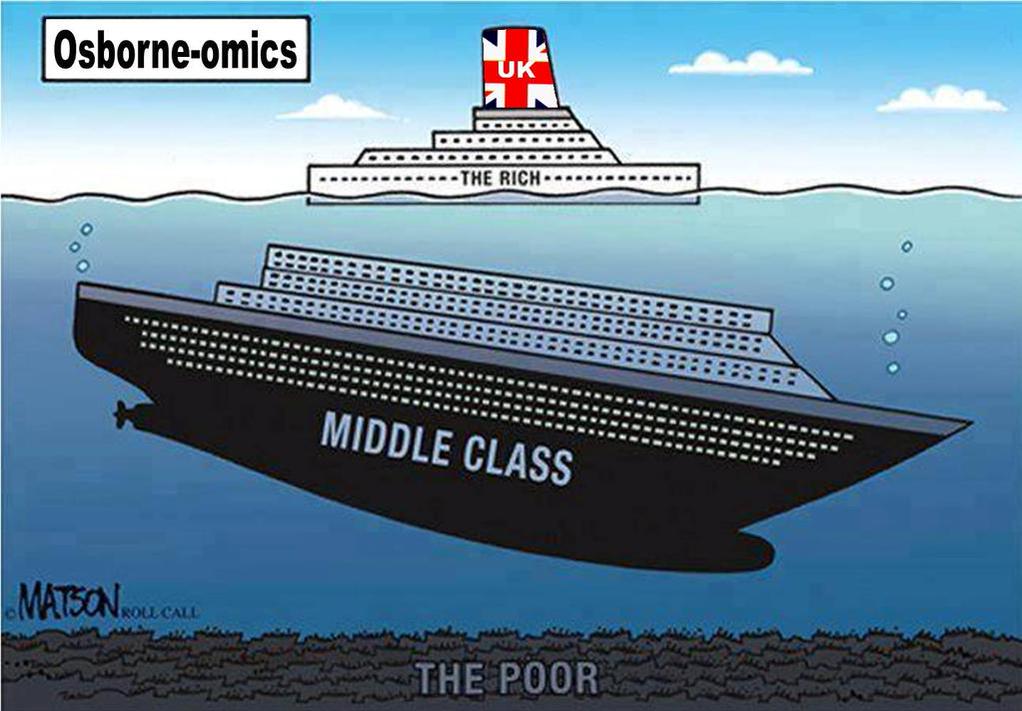
Below, an amusingly-put and very true piece about the stupidity of the post-2010 “Austerity” policies of David Cameron-Levita, George Osborne and Theresa May (all part-Jew):
Only Greece followed the same policy as the UK. The more successful European and other countries and economies did not, and were better rewarded.
In the future, there must be Basic Income for all citizens (but not for any untermenschen just off the boat)
1225: Polling day continues.
BBC drone Laura Kuenssberg (yet another part-Jew, btw) is under severe criticism for her breach of electoral law in commenting on the outcome of postal ballotting a whole day before the close of polling. In fact, her obvious bias against Labour and Corbyn (well, hardly surprising: BBC, a part-Jew and on £250,000 a year plus expenses!) might actually have helped Labour, in that if Labour-leaning voters think that the postal vote heavily favours the Cons (as it no doubt does) then it might just stimulate others to go and vote despite the cold, despite the wet, despite the wind.
I’m not being funny , or taking proclaiming party bias , but when any potential prime minister is ‘hiding in a fridge’ & ‘pocketing phones’ and parties are generating a vast output of fake news and prominent journalists fail to take them to task there is no democracy to vote for
Talking about the extreme Jewish element, I took a look for the first time in months at the Twitter page of “Hope not Hate”, the misnamed and mainly Jewish “antifascist” group. Well, they do not seem to know what to do about this election. Most of their tweets today and for several days past have hit out at, of all contending parties, the Brexit Party! Which is on 2% in the polling and has no chance of getting even 1 MP (a longshot chance might be Hartlepool but I doubt it). I suppose that well-funded HnH, as a basically Jewish-run outfit, wants to depose Corbyn and any “antisemitic” Labour people in office, but does not favour Boris-idiot either. “Result— misery”, as Mr. Pickwick said (“result— irrelevance” too, in the case of HnH).
Corbyn and el gato awaiting events. His ex-wives claim that he rarely reads a book, but if he really is reading The Grapes of Wrath, how appropriate for someone with his 1930s mindset (“No Pasaran!” Franco, the Spanish Republicans, the Comintern, Cable Street etc).
I now start to think beyond Polling Day, to the future for the main System parties. Will the Con Party collapse by 2024 merely because by then it will have virtually no members? Its membership is almost all very elderly. They may not be alive by 2024. On the other hand, the younger part of the population is used to “virtual reality” and spends much of its time in “cyberspace”, so a “political party” which is just a facade (MPs, advertising, TV/radio slots) propped up by huge amounts of money from finance-capitalist sources, but with few real members, may not seem so strange. Perhaps.
…and I just saw this (below). Looks as though someone else woke up.
At the same time, Boris-idiot could, constitutionally, still be Prime Minister even if neither an MP nor a peer! Fact. I suppose that, were he to be dumped at Uxbridge, a Con MP drone in a safe seat would resign anyway, a by-election would be held in January and Boris-idiot would be back as MP. Hey presto! Long live “democracy”!
On the other hand, if Boris-idiot lost his seat, I should imagine that he would face an immediate leadership challenge.
Why would a Con MP in a safe Con seat resign to make way for Johnson? Let’s say…a peerage, and maybe some back-pocket offshore monies in the BVI or Panama, paid by Johnson’s (((secret backers))). Most Con MPs could be bought for a million (or less).
1930.
Two and a half hours to go.
Saw this:
Long queue's like this at polling stations can only mean one thing: a #YouthQuake – 8.8 on the Richter Scale – payback for the 88% of Tory election ads found to contain LIES.
BBC election broadcast, Huw Somebody with (as good as, perhaps actual) Israeli agent Priti Patel. Disgusting.
Exit poll of 22,000 voters showing possible Con majority of about 80. Disaster for Labour, if so. The Jew-Zionists have been pulling out all the stops to procure such a result. The “Conservatives” have spent millions more than Labour—acquired from finance-capitalist speculators— to fool the electorate.
John McDonnell on now, with Andrew Neil. He has the chance to put the Zionist lobby in the dock (its influence in and over the mass media etc) but looks like he will —again— fail to really hit hard, or at all, against the Jewish Zionist lobby.
If there is a big majority for the Conservatives, it just reinforces the obvious fact that the supposed “democratic” system is merely a fraud. A Zionist-contaminated fraud.
The Zionist Jews will be celebrating. They think that they have defeated both Labour and “anti-Semitism”. “They think it’s all over”. Au contraire. It has just begun in the wider sense.
2255: Now Farage is on BBC, talking with Andrew Neil. Neil grilling Farage. Farage weaselling. He comes over ever more as a total idiot. Had Farage kept on trucking in this election, had he not stabbed his own party in the back, Brexit Party would probably have won a couple of seats, and, in the circumstances of a hung Parliament, Brexit Party might have morphed into the “Reform Party” Farage has been talking about and from there, who knows? As it is, Brexit Party is finished, Farage is finished. A conman.
2203: Now a Pakistani “Scotsman” from the SNP is on the BBC. Talking about SNP (likely) successes. I predicted 50+ SNP seats. It may happen.
2330: Blyth Valley, Labour since the year dot, has gone Con by about 700 votes. This is the beginning of the end for Labour in the Northern part of England.
2355: Nicholas Soames on BBC. Trying to pretend that he supports Boris-idiot. Trying to project that he is still relevant. He may be little more honest than Boris-idiot, hard to say, but clothes his nonsense in old-school-tie, the-old-regiment camouflage…
The “co-leader” of the Green Party on TV. Silly fellow, though I agree with him that the voting system is both unfair and broken.
0030:
Laura Kuenssberg claiming that voters “cared” about the “antisemitism” allegations re. Corbyn. At the BBC, the (((propaganda))) never stops.
First collected thoughts:
First thought is how easy it is for lying centres of media and political power to fool a basically uneducated, or only superficially educated mass. In view of the amount the UK spends on education, the result is pathetic.
I am going to call it a day for now and resume with a new blog post tomorrow.
The above poll is the second in the past day or so to show an upward movement in the Labour vote: this poll would leave the Conservatives 6 short of a majority. Only two opinion polls, so far, but together with the poll about preference for Prime Minister (Johnson on 39%, Corbyn on 32%, the latter very good compared to previous ratings), it may just be that we are seeing a swing to Labour, albeit modest.
Update, 10 December 2019
Only ONE clear day now before Polling Day
Well, as I thought would happen, and have recently blogged about, there is at last—at least some— movement toward Labour, or rather away from the Conservatives. The disgraceful and all-too-typical treatment of the little boy sleeping on a hospital floor may be Boris-idiot’s “Mrs Duffy” moment:
[Gordon Brown and Mrs Duffy in the 2010 General Election campaign]
I hated most of Gordon Brown’s policies and views (System ZOG/Bilderberg) and did not think much of him personally (judging admittedly mainly from what I saw in msm sources), but fair’s fair: Gordon Brown, as Prime Minister, was still head and shoulders above Cameron-Levita, May and now this total idiot, “Boris”. We have gone rather rapidly into politics as farce, or maybe tragi-comedy.
I was watching a few minutes of All Out Politics on Sky News. LibDems. People in woollen bobble hats in some fairly leafy area. Whenever you see the LibDems, you just know that those people have no serious financial or other problems, and that they (or their husbands, wives, parents) either have private incomes or (and/or) professional occupations. You may say that there is nothing wrong with that, but it does tend to lead to a rather unfocussed bien-pensant attitude or mindset.
I have met many many English people like that. They are those whose counterparts, in the Germany of the 1920s and early 1930s, could not imagine Hitler and the National Socialists coming to power on the back of popular need, and anger and disgust with the System; they are those who, in the Russia of early 1917, supported the Cadet Party and the liberals around Prince Lvov, and laughed at Lenin and his angry Bolsheviki who were, the well-meaning, comfortably-off folk thought, never going to get into power.
When I look at Liberal Democrats (I mean the rank and file, not the Con-lite careerists at the top of the party), I see people who basically are not angry enough. Not angry enough about little boys having to sleep and be treated on hospital floors, not angry enough about the UK swamped and flooded by immigrants and their (pop! pop! pop!) offspring, THIRTEEN MILLION since 1997! Not angry enough that British young people are not being trained in sufficient numbers as doctors and nurses. Not angry enough at Jew-Zionist speculators in the City of London (or the USA, or in Tel Aviv), refusing to be taxed for the benefit of the British people. Not angry enough at cultural degeneracy. And so on.
The LibDems have no bite.
Had Jo Swinson and her stupid little group of MPs not supported the Con attempt to force this election (thus shaming Labour into backing it), we would not be where we are, within sight of a possible alien ZOG regime holding real power. The only justification for voting LibDem is where the only likely alternative winner is Con.
Boris-idiot is getting worried
Boris-idiot and his cabal are getting worried that the Cons might not get a majority. I pray not. That little bastard, with his rote-learned bits of Greek and Latin, and his “look at me, I’m terribly clever and want to be World King” long and unusual words trawled from the Oxford English Dictionary, must not have power. At present, he has only the semblance of power.
Boris-idiot has for 20+ years acted out the part of someone hugely intelligent who almost “must” become Prime Minister. He has sold that persona to gullible people in the msm and public. Look at his record of both dishonesty and incompetence. He has never done a job properly, whether it be journalist, editor, MP, junior minister, Mayor of London , Cabinet minister and now Prime Minister.
We have been told for many years, in effect, “Boris has the ability to be PM, but does he have the integrity and character?” to which I have always replied, “Boris does not have the integrity and character, but he also does not have the ability”. In fact, where is his supposed intelligence proven? By getting a fairly mediocre Oxford degree? By failing at every job he has ever had? By scribbling a couple of derivative and all-but-plagiarized books about Churchill etc? By scribbling a brainless newspaper column?
People may wake up to the inadequacy of Boris-idiot as PM only when a real crisis happens and he is unable to deal with it. Look at the 2011 (mainly) black riots in London. Boris had no idea what to do. He made a gesture by turning up with a few people and brooms (and Press photographers) at Clapham; later buying (unusable) water cannon, weeks after the riots had stopped. He tried the old broom nonsense again in the recent floods. As (briefly, disastrously) Foreign Secretary, he mishandled the Iranian hostage matter so badly that the unfortunate lady in question was put in a yet worse position and even now remains in prison there.
Once again, the likely result is a hung Parliament, with Cons the largest party in the Commons but 6 MPs short of a majority. Good news.
I wonder whether the LibDems would prop up a Con regime? Maybe they would, maybe only if Brexit were either not implemented or the transition “extended” yet again, maybe for years. I am in any event expecting the LibDems to end up with only 5-10 seats.
The DUP have seen what a liar and horrible bastard Boris-idiot is. They will never support him again and may even vote his non-Brexit measures down. Happy day…
Ah! I nearly forgot to blog about the egregious Farage and his imploding “Brexit Party…
I heard Farage on Radio 4 Today Programme this morning. As ever, talking a good game. He either does not realize —or does realize but cannot redo it now— that standing down his candidates in Con-held seats only has simply destroyed Brexit Party as a credible party. Farage seems to look on his move as simple a clever manoeuvre to facilitate Brexit by supporting Boris-idiot and the Cons, despite the fact that
Boris Johnson’s Brexit is really BRINO, Brexit In Name Only;
Many Con MPs were (and as 2019 candidates are) Remainers or at best BRINO-ers.
The apparent fact (from listening to the radio interview) that Farage cannot understand why his candidates think that he has betrayed them says everything about this little man talking big (albeit that he is a good public speaker).
In fact, Farage and his top cabal not only let down the stood-down candidates but also all the other Brexit Party candidates, who now have no credibility whatever. Brexit Party is now on 2%-3% in all polls, but Farage still talks about how he hopes to get “a few…half a dozen” MPs! Cloud-cuckoo land.
Oh no…! It gets worse! Farage has now expelled two Brexit Party councillors, in Hartlepool, for being “racist”…
and Richard Tice, the business bod who is Farage’s 2-i-c and candidate for the Hartlepool constituency, has joined in, insulting those councillors. Bye-eee, Tice! Not much chance now!
So the sacked councillor (sacked from failed and fake “Brexit Party”, but Farage has not the power to sack the man as a councillor) apparently said that “Muslims” “are outbreeding us”. Well, that is no more than the plain truth. In fact, it is true of not only the (99.9% non-white) Muslims in the UK, but really all of the blacks and browns. They usually have 3+, even 5+ children, whereas white British people often have no children, or merely 1 or 2. We are being outbred. It’s a fact.
Google “the Great Replacement”, or “the Coudenhove-Kalergi Plan”.
Migration invasion is not merely a matter of rubber boats landing on the pebble beaches of Kent and Sussex, not merely the hordes arriving on ferries or at the major airports. It includes the offspring of those non-Brits already here.
Political imbeciles like Farage have had their day. His candidates only have one use now as far as I am concerned: to take away votes from the misnamed Conservatives. They will not take away many, unfortunately. Brexit Party is on only about 2% or so in the polls. In the average constituency, that means about 1,200 votes. Enough, hopefully, to block a few Conservative wins, anyway.
A reader of my blog (not someone I know personally) just sent me this, which I think is the sort of account of NHS care etc that the System politicians ignore:
“Just got home after 4 hours at Hosp’ amazing that our treatment is free on the NHS and thank God.
[medical and identifying details blanked out]
Impossible not to notice that the various nurses, doctors and radiographers with the exception of one (from New Zealand) were either Indian, Iranian, Chinese, or one from Zaire and they seemed to all have accents, so not educated here. The Tory’s were stupid to stop the bursary for nurses and to make it a degree course, now we have to import fully trained NHS staff from elsewhere because Brit girls can’t afford to do the degree. On the other hand, apart from myself, the only other white lady in the waiting room was an Irish lady.
The question is if we didn’t have so many immigrants as patients, we wouldn’t need so many staff, so how would [name and location of hospital blanked out] hospital have looked this a.m. if we had no immigrants on either side? I am always told that we HAVE TO bring in immigrants to pay the taxes needed to cover the cost/care of our elderly, which makes it sound like some dodgy pyramid scheme. Surely every immigrant also becomes a user of health care, of our education system for their children, policing etc. Does the average tax and National Insurance contribution cover what we take out? Someone must know. I remember one (Arab) family who came here as refugees a long time ago. They had 10 children and the father was a Doctor. So far so good. Then the Mum bolted, eventually the younger children got taken into care, the older children were given council flats, then eventually the younger ones grew up, left care and got into council flats too. Before the children were ultimately taken into care the Dad had to give up working to care for them, so how much did that one family cost us so far? As far as I hear, none of the children have gone on to be high earners.
Why is Britain so stupid as to give refugees Nationality? We can shelter people until whatever disaster made them flee, then send them home with a few thousand pounds to help them on their way. We can offer fixed term contracts for those whom we need to work here.”
Why indeed?…
I thought that worth posting. The account of someone who is, according to the viewpoint of System drones, far less ideological and far less “extreme” than I am supposed to be…
“Against stupidity, the Gods themselves struggle in vain” [Schiller, Die Jungfrau von Orleans]
An example of the application of that quotation:
Could tactical voting really decide the election result?
New polling says most Labour and Liberal Democrat voters will still vote for their preferred candidate, even if they’re sure they can’t win.
Well, no-one should ever underestimate the stupidity of the mob: they know that their candidate has no chance, but instead of voting tactically, or just staying at home, they will go out and proudly exercise their pseudo-democratic right! Idiots.
Vote for animal welfare
As the party of animal welfare, we’ll ban fur, end the use of cruel snares and halt the badger cull. pic.twitter.com/QZ82nWaY1P
One clear day to go before Polling Day and most opinion polls still have the Conservatives between 5 and 15 points ahead of Labour. LibDems are not going to do well and Brexit Party is “a dead man walking”.
Yet it need not be that the Cons get a majority. If, in the 50-100 most marginal constituencies, the under-45 voters turn out, the voters who do not usually vote turn out, the renters and students and poorly paid and unemployed etc turn out, and vote Labour or (tactically) for LibDem, SNP etc, it need not happen.
You are not voting for a Labour government, you are voting to stop an “elected” tyranny being imposed on the British people.
As things stand, Labour cannot get a majority, so all the scare stories about how East Germany circa 1970 is about to take over the UK are nonsense.
More polling news
YouGov predicting Con majority of 28 but “cannot rule out a hung Parliament”. In other words, there is still all to play for in those marginal seats.
The msm are now desperate to raise non-issues to damage Labour. The latest has been a series of comments (possibly in jest) by dimwit Jonathan Ashworth:
Anyone who votes Conservative, knowing what has been done since 2010, knowing what a nasty, squalid little liar and pipsqueak would-be tyrant Boris-idiot is, is an enemy of the British people.
A vote for the Conservatives is also not a “vote for Brexit”, because Boris-idiot wants a “Brexit In Name Only” and only pretends to want that much because he thinks that it will boost his MP numbers in this election. Wake up— he’s just a pathological liar.
Meanwhile, treacherous pro-Israel Jew and pro-Zionist ex-Labour MPs have stabbed Labour in the back at the crucial moment, taking out large Press advertisements (must have cost plenty…):
If Boris Johnson and his alien ZOG Cabinet end Polling Day with a Commons majority, a majority procured entirely by lies and by dark manipulation of the corrupted msm, it could objectively be said that “normal” politics has been suspended and that a low-intensity civil war has begun.
Oh, before the witching hour, I must not forget to (as people say today) “shout out” to the voters of Lincoln: don’t be silly enough to vote for Israel doormat Karl McCartney, the “Conservative” expenses-blodger, who was cast out in 2017. Read my piece about him:
Normally, I would never “endorse” a non-English candidate, but in this case I hope that she wins, beating that evil cheating bastard Dunce (who is part-Jap anyway…).
Update, 11 December 2019
Polling Day is tomorrow!
MRP: Tories could still fall short of majority. 2nd ref still possible.
Lab keep climbing, from 25% to now 34%. Green vote looks soft – still 1.5% higher than '17 – and Lib Dem vote just keeps falling. Lab cld be 37%+ by Thurs.
So it has come down to the wire. Four years of (mainly) Jew-Zionist propaganda in the msm has obviously damaged Corbyn and so Labour. Having said that, when people forget Corbyn and think of parties and policies and general outlook, in my opinion Labour is probably doing better than many expected, at least.
The “Conservatives” are appalling and Boris-idiot is arguably the most appalling of the lot. I myself find it hard to imagine any reason why a voter would vote Conservative in this election, unless he or she is in the top 5% for income and/or capital and is voting purely on the basis of personal self-interest re. taxation .
“Boris” will not “deliver Brexit”; he will deliver a BRINO that is similar to those offered by Mrs May. He has an appalling record of incompetence and dishonesty (as have many Con ministers). What else is there? Empty promises from a man whose every word is a lie.
Still, the polls all show a national lead for Con over Lab, albeit far less of a lead with every day. How that translates into marginal seats, no-one really knows for sure. The election came two or three weeks late for the Cons, but it may have come several weeks too early for Labour to do really well.
On a wider view…
I hope so! Please God YES! (see conclusion of tweet by pro-Israel faux-proletarian scribbler Dan Hodges, below)
I think Corbyn will lose tomorrow. But I also think it's too late. Looking at some of the people advocating – with increasing ferocity – a vote for a party they know in their hearts is virulently antisemitic, I don't see how we recover. A line is about to be crossed. For ever.
Labour, of course, is good only for stopping Boris Johnson and his alien ZOG Cabinet, stopping them from having a majority and then imposing a New World Order tyranny on the UK. Down the line, a new movement must arise, a social national party and movement to create a new and better society in the UK and across Europe.
“They also don’t ask how Boris Johnson meets his notoriously expensive private financial commitments on his meagre prime ministerial salary, now that he no longer enjoys his reported £250,000 a year from The Daily Telegraph. His hero Winston Churchill was helped out by lavish private subventions from business tycoons. Is history repeating itself?” [Peter Oborne]
Peter Oborne, sometimes eccentric, sometimes mistaken, but never without courage, has got this absolutely right.
Look at the “Cabinet” of Boris-idiot:
Boris Johnson, part-Jew, part-Turk, part-whatever, born in New York City, brought up largely in USA and Belgium; held US passport until recently. Went to Eton and Oxford, where he was a member of the young thug and vandal club, the Bullingdon. In order to join, he had to burn a £50 note in front of a homeless person…A former (earlier) member of the Bullingdon, David Dimbleby, has said that, until David Cameron-Levita and Boris Johnson joined, the Bullingdon was a club for young gentlemen.
Dominic Raab, part-Jew. Wants a completely soulless free market system. Very unpleasant. May be facing “certain allegations” from his staff…
Grant Shapps, Jew, best known for dodgy business dealings, such as masquerading, even in the Palace of Westminster, under other names, and trying to sell get-rich-quick scams to mugs; was head of the youth wing of the Jew-Zionist Bnai Brith organization;
Liz Truss, only became an MP on her back. Incredibly dim.
Sajid Javid, Pakistani born in UK. Ex-Muslim. Devotee of the crazed Jewish writer Ayn Rand. Fanatically pro-Jew and pro-Israel.
Rishi Sunak, wealthy Indian. Ex-Goldman Sachs. Another rootless cosmopolitan.
Priti Patel, Indian whose parents arrived from East Africa in the 1970s. Effectively an Israeli agent. Was sacked by Mrs May after having been exposed, but later taken on by Boris-idiot. Calls British workers “lazy”. Pro-Jew slavedriver.
Robert Buckland, thick Welsh barrister.
Brandon Lewis, thick barrow-boy barrister.
Andrea Leadsom, complete nonentity in the Theresa May mould.
Matt Hancock, once little more than a teaboy (with a degree) at Bank of England. Suited thug.
Therese Coffey, unpleasant moneygrubber. Tank-like, Guinness-drinking, cigar-smoking, but supposedly not a lesbian…
Gavin Williamson, former fireplace salesman. Deadhead. Idiot. Has pet spider and thinks that the UK can challenge China (which can put 850 large naval ships on the sea, as against UK’s 20) in the Far East, or Russia (which can if necessary field 4 million troops, as against UK’s 50,000-150,000) in the Baltic region. Idiot.
Amusingly misnamed James Cleverly, a “half-caste” (mother West African) who has a “degree” in “Hospitality Management” from a “McUniversity”. Thick. Atheist. Tried to get out of responsibility after having caused a car crash recently.
Michael Gove, cocaine-abusing pro-Jew, pro-Israel expenses cheat.
Robert Jenrick, entitled little pissant.
And there are more where they came from. As far as I know, all the Cabinet members around Boris-idiot are Friends of Israel members.
Latest opinion polling
The final polls for the main polling organizations have come out. The Cons are scoring in the range 41% to 45%, Lab from 32% to 36%.
On those strict figures, the 2019 General Election result could be anything from a Conservative majority of 100+ to a Conservative majority of about 10.
Bearing in mind that the polls can be out by several points either way, that means that the election result could be anything from an almost off-the-scale Con majority of somewhere between 100-150 and a hung Parliament with the Cons as many as 40 short of a Commons majority.
If the Cons really were hugely short of a majority, they would find it hard even to form a minority government, because the LibDems will probably get fewer than 20 seats (I am predicting maybe 10), and the SNP and others will not support the Cons. In that event, Labour, perhaps 50 short, will have the unexpected possibility to form a minority government with the SNP and others. If SNP get 50 seats, they alone could partner Labour. If not, others will have to come aboard. The LibDems are craven, so they might, whatever they now say.
For God’s sake, don’t vote in that freeloading chancer and pro-Israel Freemason, Karl McCartney, Lincoln voters!
It is now 2340. There is still all to play for. In the most marginal constituencies, voters can stop this slide into ZOG tyranny by denying Boris-idiot and his evil alien Cabinet a majority. Vote tactically contra the Cons.
I shall be starting a separate blog article for Polling Day.
As Neil says, Boris-idiot may soon be confronting Putin. Not only David and Goliath, but David who is running scared and without a sling.
“The Prime Minister has imposed a blanket ban on discussing his private life and has been forced to swat away questions about his past relationships – even flatly refusing to answer how many children he has.” [Daily Mail]
That is or is partly because there is a persistent rumour that Boris-idiot is the father of Jennifer Arcuri’s 3-y-o child. It will be recalled that Boris gave her £126,000 of taxpayer monies as well as taking her on official trips, when he was briefly and disastrously Foreign Secretary.
There is only one objective now for anyone who is not a “Conservative” supporter (and even for real Conservatives)— stop Boris any way you can.
The election is about marginal constituencies. Most seats will not change hands. It is vital that, in the ~100 most marginal seats, every voter stands against the planned elected dictatorship (ZOG tyranny) by assessing how to stop the Conservative candidate. Tactical voting. Whatever.
If the young get out and vote, if those who do not usually vote get out and vote, this nonsense and evil can be stopped. It is not a matter of voting for a Labour majority government but of stopping Boris Johnson, and his alien “Conservatives” (few of whom are even really British) from getting a majority. You do not have to be a Labour supporter to vote Labour, in this just cause.
Meanwhile, an example of “the unacceptable face of capitalism”:
Eddie Stobart group about to fall. Some idiot, one Andrew Tinkler, somehow wormed his way into the family business, bought himself a private jet, racehorses etc, sold off the original business to a Jew-operated “private equity” vulture operation (making said Jew and his business partner £150 million) etc…Now the whole bloody lot may collapse, and the “private equity” vultures are willing to give the corporate equivalent of a “payday loan”, for only 25% interest!
and 6,500 workers may lose their jobs, pension monies etc. This is Boris Johnson “Conservative” finance-capitalism.
Daily Telegraph and other msm outlets continue to drone on about Labour and “anti-Semitism”. I wish that Corbyn would stop meeting this Zionist propaganda halfway and just say something like:
“we are addressing the real issues: homelessness, buy to let parasitism, stresses on schools, NHS, transport, pay, benefits. We are not going to prioritize Jew-Zionist whining about potential loss of some of their customary tribal privileges.”
If Corbyn and his people did that, Labour would not face any more criticism from the Zionist Jew lobby than is already the case, but it would wake up the millions of sleepyheads in the UK and take the fight to the enemy.
Sadly, I doubt that Corbyn or most of his top people have the guts or the gumption…they want to say “we oppose Israel” while at the same time saying that “we do not oppose Israel-by-any-other-name in the UK”. Cognitive dissonance.
The Daily Mail incites readers to email Brexit Party candidates to get them to withdraw their candidatures. I am surprised that this is lawful (if indeed it is). Direct interference (and intimidation?)…
I have to admit that I wonder who would bother to run a Brexit Party candidate off the road? The Brexit Party is on 2% in some polls, and has no chance of anything except abject failure.
I have still not worked out whether Nigel Farage thought that he was being a Poundland Macchiavelli in standing down his Brexit Party candidates in (and I think only in) Conservative-held seats, or whether he just reached the outer limits of his (imo) limited real political ability. Either way, as I blogged on the day, Farage has committed political suicide, or rather murder and suicide: he has killed Brexit Party and also killed his own political career.
look at the (now ex-) Brexit Party MEPs who have defected to (or soon to) the Conservatives: among them, the smoked salmon Jew, Forman, and the sister of living Lord Charles dummy, Jacob Rees-Mogg.
“General election news – live: Labour cut Tory poll lead, as Boris Johnson dodges BBC and ITV interviewers amid ‘cold, hard evidence’ he lied about Brexit deal”
The Jews (no, not the 250,000 Jews in the UK, but the few hundred, maybe few thousand most hardened Zionists and their non-Jew doormats) are going to protest by the Palace of Westminster on Sunday. They thus insist on making this General Election all about them, their obsessions, their own selfish, self-centred tribal interests. As I have blogged before, an old saying says “be careful what you wish for”.
Johnson has banned the @DailyMirror from his campaign bus. Reporters from other papers should have boycotted the bus until the Mirror was allowed back on. Some things are more important than access. These are dark times for British political journalism:https://t.co/eqbWLbI8T0
“If the polls are right, and I guess they are, Johnson is set to move back into Downing Street with the most commanding Conservative victory since Maggie Thatcher secured a majority of 102 in 1987.
As a lifelong Conservative, I should be delighted. Instead, I feel despair. To secure his victory, Johnson has sunk lower than any prime minister in modern times. Far lower.”
[Peter Oborne]
Just saw this!
The depiction of the role of the BBC in this distasteful Dutch cartoon is telling: "Nothing to see here." https://t.co/y7ImLB3d1s
“It would appear Johnson is looking for a mandate to put himself above the law. Fairness and decency have been abandoned by people who ought to know better.
Johnson and his Tories may well win next week. But they will have won through deceit and bullying. In the long term, they will pay a price. So – sadly – will the rest of us.”
[Peter Oborne]
John Major and Tony Blair both saying that voters should vote tactically against Boris-idiot and the Conservative Party. Neither, however, is saying that what needs to happen is for the UK to bin the outdated FPTP electoral system and bring in a proportional system. It has to come, sooner or later.
I like this tweet:
I thought the British were bulldogs. Are we really going to have this weak little Narcissus run the country? Vote tactically. https://t.co/mnlZ7W6GlR
The Corbyn/Johnson debate seems to have been a draw (I did not see it). Boris-idiot is said to have done better on security, on Brexit and (oddly, to my mind) on looking “prime ministerial”; Corbyn scored on “being more in touch” with the average Joe, on the NHS, on being more trustworthy. On government spending, Boris just beat Corbyn but not by much, a few points only. Boris is still seen as “more likeable”, which I find puzzling, possibly because I would like to stamp on, and jump up and down on, his head, but “that’s just me”…
Update, 7 December 2019
“Conservative” rule for a decade. Trashing of the social fabric:
Boris Johnson prays to God that this video never makes it into the public domain. Because in his own words it shows what he REALLY thinks of our NHS. If voters saw this it would leave them in zero doubt. Of course BBC will never show voters it. pic.twitter.com/JvtY9keIlf
The next opinion polls may not emerge until tonight (for the Sunday msm). It will be interesting to see whether Labour has gained ground (or slipped, but I think more likely to have improved its position). Not that polls are always right: think 2016 Referendum, the Trump/Hillary election in the USA, the 2017 General Election, the Peterborough by-election. To name only a few polling disasters.
This election is still open, at least in the sense that Boris-idiot and his pack of alien, non-Brit, ZOG conspirators can be prevented from getting a Commons majority and so real power.
Why a black? (they are, after all, still a minority in the UK: 3% only according to Wikipedia; in fact all non-whites in UK total “only” about 13%, it is claimed; at any rate, well under 20%);
Why a black man with a white woman? “Rassenschande“…
Those errors, no doubt the result of all-too-typical Labour multikulti obsession, weaken the ad. They make it less of an appeal to the (still) white English mainstream and vast majority. The ad tends to show or put people with concerns about privatized industries into a minority box. It tends to say that “Labour is the party for the blacks, browns and mixed-race elements of society”, which weakens Labour’s appeal to the majority.
Royal Family
Apropos of nothing much, I just saw a news story from a few days ago, with film (and still) showing Princess Anne aside from the greeting line for President Trump, and then gesturing at the Queen (in apparent but —we are told— not in fact in breach of protocol). The still photo was striking: like a scene from a Marx Brothers film, with Princess Anne as Harpo. Good grief. The Jewish element in that family is strong and very obvious in several of its members. Now there is, of course, “the Royal Mulatta” as well…
Little Miss Gracious! Great balls of fire! The misnamed “Conservatives” will be ******** themselves about this! If that were the result next Thursday, the Conservatives would have a majority, but only one of about 6. Bearing in mind error margins, this might give the Cons a larger majority than 6 or might leave them where they were a month or two ago, or worse yet.
There is still all to play for in this election (except a Labour majority, which I would not want anyway).
Interesting piece by my friend Richard Heller, former adviser to Denis Healey, arguing that in the likely event Johnson wins the election he will soon be the most unpopular leader in British history.https://t.co/mVjc3jNg3V
Apparently, someone sent Smith (his real surname) a dead rat in the post. If that is all that happens to the bastard, after every evil thing that he has done, frankly I think that he is winning…
Apparently he declared it fit for work and it starts it's jobsearch on Monday. https://t.co/v8NuS5CRz1
It seems that the poll yesterday which gave the Cons only a 6-point lead over Labour may have been an outlier, in that other polls released today show a wider gap, 10+ points (Opinium even has 15 points). That does not mean that the outlier was wrong, the consensus right.
In the very important 2019 Peterborough by-election, Brexit Party looked like romping home. The bookmakers also thought so, as did the betting exchanges, which had Brexit Party heavily odds-on. In the end, Labour, aided by the local Muslim vote, won by a few hundred votes. I blogged about the result:
We all know that the opinion polls got other important elections etc wrong in recent years, not least the 2016 EU Referendum.
I watched the first 10 minutes of theAndrew Marr Show, until barrow-boy barrister and now Security Minister Brandon Lewis came on. There are some things too greasy for a Sunday morning after an evening of blini, caviar and vodka!
One thing that surprised me is that Sarah Vine, Daily Mail columnist, was allowed on Marr during the last phase of the election campaign, bearing in mind that she is married to Michael Gove, the pro-Jew expenses cheat and Cabinet minister. She was neutral, or at least seeming to be, in her comments, however. The “Labour” commentator was anti-Corbyn ex-MP Gloria del Piero.
This election is not yet over.
It may be that the consensus is right, the “smart money” right, the talking heads right, and that Boris-idiot and his ZOG Cabinet of Israeli agents, Jewish-lobby drones and careerists will have the victory they have cheated and lied to get. It may be…but it need not be!
I saw the tweet below. A cri de coeur, but one which, though I sympathize with it, fails to note that Labour is not doing what it can to win, because
Corbyn insists on “defending” the indefensible, meaning, inter alia, Gypsy and “traveller” thieves and scavengers, and the migration-invasion of Britain generally;
Labour is not hitting out hard enough at the Jew-Zionist element which has been undermining Corbyn and Labour for 4 years now!
The brutality of Tory austerity to me is not just in the devastating impact its had on the poor, the vulnerable or those who have the least, but in how many others just accept it now as part of 'everyday life'.
Also, many voters look at, most obviously, Diane Abbott, and think… “that, as Home Secretary?…” and either stay at home or vote anywhere but Labour!
The fact is that those of any age who do not normally vote, as well as the under-35s and especially under-25s who notoriously fail to vote, and especially those in the 100 most marginal constituencies, could change everything if they got out and voted any way but Conservative.
Seems that the Marr interview with Boris-idiot (last week) left many tweeters unenamoured with Boris…
Johnson is a total wanker: a loathsome, bullshitting, blame-mongering, lying prick. If you think he should be our PM, you’re a disgrace too.#Marr
“Wolfie” is a good tweeter, after all he used to retweet me occasionally! (before the Jew-Zionists had me expelled from Twitter).
Aha! Welcome to the light Andrew ! #marr Opens the programme by commenting on how the majority of the print media are pro Tory – and whose Tory leaning commentary is quite different to "on -line" commentary" That's WHY so many of us now search our *news* and info on-line !
The fact is, that if you vote Conservative, in this election particularly, you are “enabling” the sort of wickedness that has gone on since 2010 (yes, Labour started it all, in the Blair-Brown years, but it has become just evil since then); see below:
I was interested to see the dry-as-dust-mannered (but always worth listening to) Professor Sir John Curtice on Marr. When asked as to whether the (forecast) awful weather might impact the Labour vote, he replied in the negative, but added that the forecast weather was anyway just normal horrible December weather! He might have added that he lives in Glasgow!
Polling guru John Curtice tells #Marr that Labour "is now a party of young people, not a party of the working-class". Sadly, he is right.
On the same programme, @GloriaDePiero warns that Labour's 'Red Wall' of traditional heartlands is in danger of collapse. She too is right.
Gloria del Piero has spent much of the past 4 years undermining Corbyn (and so Labour)! An Italian by origin, proud possessor of a sociology degree from “the University of Central England”, and someone whom even her own party turned down for SpAd and other positions, she somehow managed to become, in time, “Political Editor” of breakfast TV bore GMTV. GMTV staff seem to be or have been pretty poor: I once (at least 20 years ago) met a fat blonde young woman (twenty-something) in a 1st Class compartment of a train from Southampton to Waterloo. She informed me that she was a producer for GMTV, but was miffed when I said that I had never seen it, never getting up that early! She then spoke on her mobile telephone all the way to Waterloo. Very rude. What can one do? I could hardly smash her face in, after all (I suppose).
Gloria del Piero on Marrtalked about how the “Red Wall” of solid Labour seats was ceasing to be solid, or even Labour. I wonder why? Could it be because, under Blair and Brown, MPs with little knowledge of the world or of real work or a profession were drafted in as lobby-fodder MPs? Could it be because many of those MPs were not even really British in terms of origins? Could it be because many of those MPs turned out to be “beggars on horseback”, who despite (in del Piero’s case) having only survived as a child because of State benefits paid to her family, yet turned against the British people and supported cuts to benefits and the Welfare State when in Parliament (as did del Piero in TV interviews around 2010)? Could it be that the voters are angry at MPs who are “Friends of Israel” members?
Del Piero was hated by many of her former constituents. Her majority in 2017 was only 441 (Ashfield in 2005 had a Labour majority of over 10,000 and, several times previously, of over 20,000). She saw the writing on the wall and is not standing for re-election.
On the wider point, I have blogged many times previously about how politics is changing, becoming more nuanced.
I am generally pro-environment (though not pro those idiots in Extinction Rebellion, or that horrible little creature Greta Thunberg), pro-animal welfare etc. Many who oppose me on other matters also care for animals, birds. environment generally. There are new bonds and fissures in the body politic. Many are waking up to the disproportionate money, power and influence of the Jew-Zionist lobby in the UK, which politically is particularly powerful in the “Conservative” Party. Not all are social nationalists, or even in favour of European race and culture. There is a whole range of British and other European people standing contra this malicious tribe.
UK politics has already changed in some ways from what it was even a quarter of a century ago. Look at Scotland and Wales. The heavy industry that characterized those countries or regions has gone, pretty much. The industrial proletariat has gone with it. Labour was set up to represent the “workers”, mostly in industry. That role expanded to include shop workers and others. The trade unions likewise. Now, while post-Marxists [Owen Jones etc] can try to find a “proletariat” in what is either the “lumpenproletariat” or the new (?) “precariat”, these seething masses of scarcely-politically-aware persons are not loyal to any party or ideology.
Communism or radical socialism never caught on in the UK, least of all in England. Social-democracy did. Labour espoused it, but so did the Conservative Party of the 1950s to 1980s, so did the Liberal Party that became the LibDems. The first two at least were mass organizations, with members in the millions. The Conservative Party, at peak in the 1950s, had maybe 5 million members! Now?
The recent “Conservative” Party leadership election showed that the Cons have about 140,000 members. Most are well over retirement age. The Conservative Party is dying just as it looks about to deliver its final sting by winning the 2019 General Election.
When I say “winning”, I mean by getting the largest bloc in the Commons, with or without an actual majority. Further down the line, in perhaps 2022 or 2025, the Conservative moment will have gone. Most of its present members will be deceased, for one thing, and there is no chance that they can be replaced. This is the last hurrah for the Con Party, a fact emphasised also by other indications: former Conservative Party prime ministers urging a vote for Labour or LibDems! Then look at the Cabinet! A ragbag of Jews, Pakistanis, Indians, Israeli agents, all headed by the least plausible Prime Minister for, arguably, a hundred and fifty years, perhaps ever.
Jews
The Jew-Zionists are holding a protest against Labour right now in Parliament Square. Their last one attracted only about 100 (but they now claim thousands even for that pathetic little rabble! cf. “holocaust” etc!).
I expect that, however many turn up, they will be photographed as if a sea of angry squawking birds.
Looks like dozens, not hundreds, not thousands. Lots of placards (professionally printed) and flags, but not so many Israeli ones (their true allegiance). Mostly Union Jacks, Saltires etc, to seem more “British”.
[addendum, inserted on 9 December: turns out that the Jews that turned up had been asked specifically not to wave Israeli flags; a few who did had arguments with Zionist security operatives; so I was right…]
7/8 If Labour is elected this week, the antisemitism we have seen thus far will be dwarfed by what follows. Large numbers of Jews will leave the UK, those that remain will be permanently fearful and attacks on Jews and Jewish communal buildings will increase.
The idea that 40% of Jews will leave the UK if Labour is “elected” (as majority government, which is not going to happen anyway) is ludicrous, even if a pleasant idea an sich;
Who is supposed to want to attack “Jewish communal buildings”? Not me or anyone I know politically. Stray “Islamists”? Stray debtors? God knows. I suspect that there are few, if any, “attackers” around.
Another notorious Zionist, David Collier, is there, claiming a crowd of “thousands”…but credit where due: at least Collier does not claim that many if any non-Jews are there, “supporting” this nuisance, but just “British Jews”…
I am at Parliament Square, where 1000s of British Jews have gathered #TogetherAgainstAntisemitism. 1000s. Still streaming into the square. It isn't impressive, nor warming, nor hopeful. It is utterly and totally tragic that this is happening in the UK.
Here’s the funny thing: the Zionist Jews claim that Labour MPs, members, supporters and voters are willing to “throw the Jews under a bus” in order to get a Labour government or at least deny the Conservatives a Commons majority.
In reality, it is the other way around: the Jews are willing to throw the British people under a bus, in order to spite Corbyn. “They” are putting their tribal interests ahead of those of the British people, who would suffer terribly under a Boris-idiot majority government.
What do most Jews care? Only 5% of them vote Labour anyway, and if a Boris-idiot “Conservative” government is terrible (it would/will be), well… most Jews are fairly affluent; not a few are rich or even uber-rich. Even if Corbyn were to take power (he cannot) and is another Lenin, Trotsky, or Hitler (and two of that troika were Jew/part-Jew anyway), and even if Corbyn does all that they (claim to) fear, well… most Jews could emigrate to Israel or the USA. They have the means. They have “community” systems in place to facilitate that.
Here’s another one. He does not claim “thousands”. His video shows, imo, about 300 or maybe 400:
British Jews pack Parliament Square to protest against anti-Semitism ahead of the General Election. Hard to imagine scenes like this prior to 2015. pic.twitter.com/8rtoy48YaL
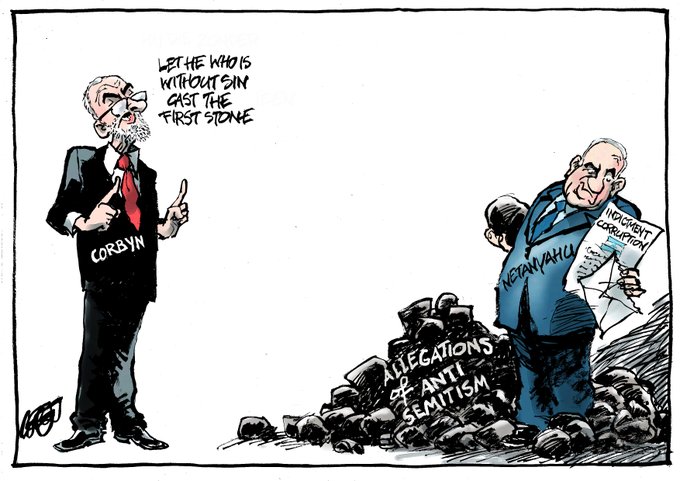
Still, no doubt the infested BBC and Sky News etc will present it as huge on the evening broadcasts, and the “British” Press likewise, tomorrow. Another stone cast at Labour’s election campaign by those “without sin”…
Final thought on the Jewish (Zionist) protest in Parliament Square: it is obviously hundreds not thousands, but to be extra fair, let us pretend that 1,000 Jews are there. The Jewish population in the UK is supposedly 250,000-300,000. Even if only those over 18 are included, that means that only 1 out of every 200-250 attended. In reality, only 1 out of about every 700 bothered to attend. Seems that most Jews, even in the London area, are not so desperately fearful —or even angry…
Back to bigger or wider issues…
Polls
It is worth remembering that not only do the main opinion polls have a poor record in spotting political winners (ditto, bookmakers etc) but that several important elections, referenda etc were called wrongly by the polls even on the very day! The Con Party started off as much as 20 points ahead in this election, but as predicted (by me, by some others, by electoral history, by far the better option) narrowed.The Cons may be and indeed are ahead, but by what margin is in fact uncertain.Maybe 10 points, maybe 5. A couple of percent makes the difference between a Con Party Zionist Occupation Government tyranny [ZOG] and a hung Parliament, a better result.
All that matters is that voters in marginal seats especially vote against the Conservative Party. Tactical voting. This is one election where the marginalized, the usual non-voters, the tactical voters, the under 25s, can decide a general election.
So the “Conservative” Party thinks that it is OK to put up candidates who are black, called “Darren”, and who tell (real) British people that, if they and their children are poor and hungry, that they are “unable to budget”, should not even be able to use a foodbank (because they cannot “budget” apparently; the scheiss state of the UK’s economy is all their fault!) and should rely on payday loans? —AKA payday (((loans)))—
The “Conservative” Party is just doomed after this election, whatever happens.
As for Broxtowe, the former seat of “the Member for Plymouth and Angostura”, Anna Soubry, I fully expect it to go Labour on 12 December. Fortunately, the Con vote is weakened (despite also being helped by Farage’s stupid withdrawal of the Brexit Party candidate) by Anna Soubry fighting as “TIG–Change UK”, she helped by withdrawal of the LibDems. Labour came close to winning last time and should be able to get over the line this time: https://en.wikipedia.org/wiki/Broxtowe_(UK_Parliament_constituency)#Elections_in_the_2010s
Jews are squabbling
The Jews are squabbling about the Parliament Square protest. I still think, looking at the photos on Twitter, that about 500 were there, but liars like Silverman are claiming that 3,000 were there! Nonsense. The photographs show that there were hundreds, not thousands. However, even on their own figures, the “Campaign Against Antisemitism” Jews are only claiming that 1 out of every 100 Jews in the UK attended.
The more established Jewish lobby, such as the Board of Deputies, did not support that pathetic CAA gathering. The different cabals are evidently disunited.
The fundamental immediate issues in this election are mass immigration, Brexit, NHS, transport, pay, benefits, housing, law and order (in no particular order).
I have no confidence in Boris-idiot and his alien ZOG Cabinet. They cannot rule properly or effectively.
The reality of the NHS under the Tories: a 4-year old with suspected preumonia forced to sleep on the floor.
Brexit Party still pretending to be part of the election. I have already blogged at length about how Farage’s poor strategy, and in particular his senseless decision to stand down all 317 Brexit Party candidates in Con-held seats, has killed his party and probably his own political career. Seems that the Guardian agrees with me:
Turn that around. If Jo Swinson were no longer LibDem leader, the LibDems might be free to enter a pact with Labour. Jo Swinson is unlikely to survive (politically) the election. She will almost certainly be replaced. Corbyn? I think that he is there unless Labour goes down far worse than I, anyway, think will happen.
A Jew tweets
The tweet below from the Zionist liar Silverman made me laugh.
When has a government riddled with antisemtism ever produced a fairer society?
[immediately above, Ursula Haverbeck, when a beautiful girl in the early 1940s; now an old lady of 91, she has been imprisoned for speaking the truth in Merkel’s Germany, a state taken over and ruled by ZOG (Zionist Occupation Government)]
Ah, well, back to the mediocrity (and worse) of today…
LibDems: Jo Swinson says that she will not resign as LibDem leader even if the LibDems lose seats. Well, I am expecting the LibDems to end up with fewer than 10 MPs. I may be out by a few; we shall see. In any event, it does highlight Jo Swinson’s careerism. She will do anything for a ministerial portolio, even a junior one (like the one she accepted from the Conservative 2010-2015 regime, the “Con Coalition”).
This, from Corbyn/Labour activist Louise Raw (who is in fact not so friendly to me), made me laugh:
There you have it: Jo Swinson “puts no limits on her ambitions”. From the horse’s mouth (or the horsey mouth, if you prefer). Jo Swinson will do anything to “get ahead”, including doormatting for the Conservatives. She says that she will not cooperate with Corbyn, though. I suppose that she wants to keep in with the Jewish lobby.
As for “Chukup”, he and Swinson battling for “leadership” of the pathetic LibDem rabble might be called “the clash of the careerists”, but it is farcical: they will probably both lose their seats anyway, Chukup having had to abandon his Streatham seat and now trying to get elected for the Cities of Westminster and London constituency. Unlikely. The Con candidate last time (Mark Field, not standing this time) won with about 46% of the vote, four times and more that of the LibDem.
Labour: a journalist assesses Corbyn’s persona and personal appeal
A reminder that this General Election is not a game, to be played for and points scored before the players return to Eton for tea and cake (or, if Guards officers, to the Mess for port and plum cake); this election affects real people, enduring, suffering, wanting a better life:
Many voters vote according to their perception of the leaders of the main parties. Corbyn‘s rating has, until now, been far below that of Boris Johnson, at one point Johnson 45% and Corbyn about 15%. Now there is little to choose between them, if this poll is accurate. It could be the breakthrough that Labour has been trying to find. A straw in the wind, to be sure, but it could be very significant, though Labour as a party was still (as of yesterday or Saturday) still several/many points behind the Conservatives.
Surely, even in a country as politically-illiterate as the UK, the people do not want to be ruled by this pipsqueak little would-be tyrant?
Boris Johnson doesn’t care. He isn’t pretending not to care. He isn’t being hilarious. THE PM DOESN’T GIVE A FLYING ONE ABOUT THIS KID, OR MY KID, OR YOURS. He barely cares about his own https://t.co/L6hi7OHwOb
Time for a new blog thread covering the upcoming General Election set down for 12 December 2019. As with the previous six, it will be updated many times daily.
Only 9 clear days left before Polling Day.
Boris-idiot must be stopped. It is not a matter of being “pro-Corbyn” or “pro-Labour” (which I am not, as such) but of stopping a superficially constitutional coup d’etat.
Johnson’s Cabinet is a pack of pro-Israel, pro-Zionist, pro-Jew traitors. Few are even British except in terms of their passports. In fact, Boris-idiot himself actually had a U.S. passport until 2017! He is part-Jew, part-Turk, part-God-knows-what, born in New York City, brought up in the USA and Belgium. His fake “English upper class” persona is a theatrical act on which he has worked all his miserable life.
Cartoons often explain political and social realities very clearly. Here is Boris-idiot misusing the recent terror attack for immediate political purposes:
Below, David Davis making a fool of himself:
The article that follows this tweet is legally illiterate from start to finish. @DavidDavisMP does not even try to understand the law before blithely decreeing that “Parliament must limit the discretion of judges” in terrorism cases and blaming “the European Court”. #FakeLawhttps://t.co/UssHIT2D4l
Pity. In some respects David Davis would have made a far better PM than Boris (well, almost anyone would, of course) but, at the same time, Davis is as thick as two short planks.
This morning, I heard some thick-sounding Welshman on Radio 4. Turned out that the weaselling idiot was the Secretary of State for Justice, Robert Buckland, no less!…
One of the most notorious Jewish Zionist fanatics takes yet again to Twitter to rail at a Corbyn supporter, in this case the singer Ed Sheeran.
Nice virtue-signalling, @edsheeran.
Any thoughts about caring @jeremycorbyn having terrified an entire minority to the point that almost fifty percent of it is planning to leave the country if he becomes PM?https://t.co/H94bnvDDJ4
So “50%” of Jews are “planning” to leave the UK if Labour “win” the election? Ha ha! I doubt it. Most of them, adopting the famous phrase of Macmillan, have never had it so good! We recall only too well Maureen Lipman‘s whining along the same or similar lines, starting in 2014. She’s still here, unfortunately.
Another example: former supposed “top defamation lawyer” Mark Lewis, the “top lawyer” whose only assets, according to the Solicitors’ Disciplinary Tribunal [SDT] under the auspices of the Solicitors’ Regulation Authority [SRA] at his 2018 “trial” —at which he was found guilty and fined—, were his own clothes, a mobility scooter and a pension worth £70 a week! “They” can certainly talk a good game! Lewis and his girlfriend/carer, Mandy Blumenthal, did go to Israel, i.e. emigrated, after Lewis was found guilty, but both have since returned on several occasions, and their emigration had nothing to do with Labour or Corbyn.
Mark Lewis was thoroughly exposed at his “trial” (disciplinary tribunal) as an offensively-ranting, medically slowly degenerating troll and fake, whose prescription drugs meant that (as he himself testified) he “did not know what he was doing” at times. He was also being jettisoned by his employers (in fact already had been, at time of trial) and had debts. He jumped ship, in effect.
[anyone wishing to read about Mark Lewis and his behaviour can do so here
“Israel, despite being a liberal democratic country, is not an immigration country. Therefore, Israel does not have laws and regulations enabling foreigners who wish to come and settle Israel the opportunity to do so.”
“Both Zimmermann and Amar-Dahl describe a country that has historically welcomed, indeed, continued to actively seek Jewish immigrants from other countries. Yet, Israel shuns other refugees and immigrants. “They set a clear limit: admission for Jews only,”
As I have blogged in the past, I am very glad that “Mark Lewis Lawyer” is not my lawyer!
I had never heard of Ed Sheeran until about a year ago, and I would certainly not recognise any of his music, but I understand that he is quite popular. As to Silverman, whose sinister title at the Israel-lobby “Campaign Against Antisemitism” or CAA is “Head of Investigations and Enforcement”, you can read about him readily enough on the Internet. I myself wrote this in 2017:
The Jews (at least the Zionist, pro-Israel ones) seem to want to make this election, and British politics generally, all about them. An old saw says “be careful what you wish for”.
Leaving aside these nuisances, what about the real election news?
The news that struck me this morning is that the rail union, RMT, is planning to hold strikes, starting very soon. Well, recalling idiotic thickhead Bob Crow, the one-time (now deceased) leader of the RMT, I do not expect great intelligence from them, but it is hard to imagine anything more damaging to Corbyn and Labour than a strike on the railways just before a General Election!
It conjures up images of “the winter of discontent” in 1978-79. That actually affected relatively few people and did not last all winter either, but people who were not around then —and incredibly a few who were!— often tend to think of it as much more than it was; some think that the whole of the 1970s were either like that or “3 day weeks” because of power cuts (that was just a few weeks, and affected people only peripherally, as I recall, in 1974!). The RMT leadership are idiots. They want a Labour government, or at least for Labour not to be trashed, but then they do this!
And now for something completely different…
Politics should be an outcome of our adherence to our European race and culture, with roots going back into prehistory, but reaching out to a higher future evolution of society:
Just an antidote to the пошлость (“poshlost”) [Russian: tawdriness etc] of the present time…
I also wanted to honour that great conductor, Mariss Jansons (a half-Jew, in fact, as well as half-Latvian), who has died. His interpretations of Shostakovitch and some of the Scandinavian composers were very good.
This is not the place in which I should blog at length about the connection between race, culture and society, but let us at least keep that in mind during the hullabaloo of the election noise.
UKIP
It is a matter of mild amusement but no great surprise to me that UKIP is still around, though only as a shell. It failed to go social-national in 2014, and so failed to break through the FPTP voting scam-barrier in 2015. It slid lower and lower, until Farage found an excuse to desert. He then founded another waste-of-space party, which he has again stabbed in the back and deserted.
Meanwhile, the shell of UKIP is, incredibly, trying to pretend that it can win a seat or seats at this election! Here below is the “interim leader”, some silly old bag called Pat Mountain. I have searched online for information about Ms. Mountain but without much result.
I have blogged before about people who indulge in “hobby politics”, and this lady seems to be a prime example. While I do not disagree with her opposition to migration-invasion, she really should be knitting shawls, volunteering at the local cat rescue or just enjoying coffee with friends (all worthy pursuits, btw; I do not denigrate them) rather than pretending to lead a political party. Also, who are the other UKIP people, who are not ashamed to be led by someone like this?! Words fail…Take a look at the Sky News All Out Politics interview! (below)
In an election campaign rife with calamitous interviews, here’s UKIP’s 5,239th leader Pat Mountain failing to make a coherent point as she blindly stumbles through an inescapable maze crafted by her own stupefying ignorance.pic.twitter.com/gxydrryZZt
She really thought that her time was too precious to waste finding out basic statistics like how many asylum applications were granted in the last year on record.
The problem is always “where do political parties go to die?”. When a party collapses, there is always a rump of it left for a while, like a piece of ocean flotsam. BNP, NF, UKIP, Communists (of various kinds) are still around. In this election, UKIP is actually fielding either 43 or 44 candidates (another fact of which its “interim leader” seems unsure). I do not know why UKIP is fielding candidates or why the individual candidates are bothering to stand. I am not a psychiatrist or religious counsellor.
As to the UKIP manifesto, released today, there is little wrong with the actual policies, in fact I agree with most of them, but UKIP people should stop hobby politicking and join a real social-national party— when one exists!
As I was was blogging weeks ago, the polls are now narrowing. People who oppose Boris-idiot and his ZOG Cabinet are realizing that, to stop Boris-idiot, they need to vote Labour where Labour has a real chance and, where Labour has no chance, vote tactically for, in most cases, the LibDems (despite the flaws of the LibDems and Jo Swinson).
The ICM poll above indicates Conservatives as largest party but 16 MPs short of a Commons majority. That would be OK.
Update, 3 December 2019
So much for “the Conservative Party is the party of law and order”! I was just reading about a small, wealthy town in the South of England, which has one of the highest concentrations of millionaires etc outside parts of London and only small pockets of social housing and/or deprivation. Many houses are in the million-pound-plus bracket and few are worth less than half a million.
Apparently, 4 “yoots” in “hoodies” went around that wealthy quiet town for four hours on one recent night, attacking cars (18 cars in 13 quiet roads). They used crowbars, hammers and a rock so large that it had to be carried by two of the vandals together.
Residents of the town saw some of the vandalism but the vandals ran off when challenged, then carried on nearby. Some residents confronted the criminals but were threatened with a knife. The criminals were obviously unafraid. A number of residents not only saw or heard the crimes taking place but also called 999, only to be told to call 101, at which they were given a crime number and told that the crimes had been “registered”. Others were told that the police were “too busy” to attend.
The crimes noted above affected at least 18 people directly, possibly a hundred indirectly. According to the local newspaper, no-one has been arrested for the tens of thousands of pounds worth of damage: cars with windshields and windows put out, dents, holes etc.
The crime spree apparently went on for over 4 hours, until after 0200.
That town had its police station all but closed a few years ago (it is open for enquiries 9-5 but has few if any police, not even PCSO play police, stationed there). The town has a Conservative MP whom even local Conservatives agree is completely lazy and useless. The constituency is the 5th safest Con seat in the UK. The local council is all or almost all Conservative.
One has to ask: if the Conservatives cannot even keep safe an area like that, what chance London, Birmingham, Manchester? The citizens, unlike those of the USA, are forbidden from keeping, let alone using, firearms. Lawlessness triumphs. Would it have been so bad if the “youths” had been just shot? I don’t think so…
Voting Labour, at least where Labour have a reasonable chance of winning, will not bring about a Corbyn-Labour “Marxist” dictatorship, as his detractors (and even some of his supporters!) believe or pretend to believe. Labour, in this election, has little chance of getting even a small Commons majority. A minority Labour government (propped up by SNP etc) would never have the votes to push through some latter-day policy of, so to speak, “all power to the soviets!” or the like.
No. What you are doing, if you vote Labour (or, where Labour has no real chance, at least LibDem, SNP, or even Brexit Party), is preventing Boris-idiot from imposing a Jewish-lobby ZOG tyranny on the UK, a situation which could lead, eventually, to actual civil war.
#TacticalVoting could oust John Redwood in #Wokingham! A report from Datapraxis suggests that tactical voting for the Lib Dems could yield 8,700 more votes against Redwood, enough to topple his 7,684 majority.
LET’S DO THIShttps://t.co/Pt4qCEqAjN
— Berkshire for Europe #StopBrexit (@BerkshireforEU) November 29, 2019
Meanwhile, Philip Schofield, who has been “doing very well” financially out of “Conservative” tax policies etc, nakedly partisan on TV (despite the General Election). He must have earned some brownie points with the Jewish lobby for this! Piers Morgan also bats for the Jew lobby… The msm is just infested…
You have to vote for the candidate most likely to defeat a Tory.
This is not a drill.
It’s a one-time teeth-gritting exercise to quite literally save your country from the Tory locusts. If you vote tribally you will be enabling Johnson & the Tories & that will be unforgivable.
— A C Grayling #FBPE🕷 #PeoplesVote &/or #Revoke50 (@acgrayling) December 1, 2019
According to my calculations (using Electoral Calculus, including its Scotland prediction and tactical voting prediction), that would give the Con Party a Commons majority of 8. It is an open question whether the polls will continue to narrow. Maybe so, but the election is still very open either way.
8 clear days left until Polling Day.
This is the sort of evil which the Conservative Party has facilitated:
Not sure about exactly what “monthly tickets” are referred to, but the underlying meaning is sound: it costs far more in the UK to travel by train vis a vis most countries.
Here’s a tweet about the NHS, which the Boris-idiot Jewish-lobby ZOG Cabinet is planning to “sell off”, i.e. make into a market where (((American))) interests can make more money:
I’ve been in rooms with Conservative senior advisors and policymakers. I’ve heard first-hand the conversations these politicos and journalists have had about the NHS in the most powerful halls of this country. They intend to end the NHS. Anyone that tells you otherwise is lying.
Johnny Mercer, former Army officer and Con candidate for Plymouth Moor View (MP 2015-2019) is getting into more trouble.
I had thought (initially, when Mercer became an MP) that he was better than the Conservative MP average. Wrong. Turned out to be a moneygrubber as well as being an incompetent. Credit where due, though: he did, with reason, call Theresa May’s government “a shitshow”. Rough tough soldier language.
Rancid self serving Tory MP Johnny Mercer earns £85k from an armed forces charity yet voted to cut support for soldiers’ bereaved families
Just a reminder while Johny Mercer is trending that he set up a charity that deliberately committed fraud against British war veterans. He also wrote a book about his ”heroic” time in the army. His colleagues who were there too called bullshit on it.https://t.co/vEdPyi3q8K
I cannot comment on his military record, but I have to admit that in other ways Johnny Mercer is starting to annoy me. His outside “earnings”, for one thing; also, the fact that he “employs” his wife part-time (on MP expenses). Such family members can make anything up to £50,000, all paid out of Parliamentary expenses. The family income must have flourished since Mercer (who left the Army in 2013 with the modest rank of Captain) became an MP. I wonder what, if anything, his wife does for that money. A “nice little (extra) earner”, anyway.
Mercer is also pro-Jew, pro-Israel. Well, if he were not, I suppose making those extra pennies might be more difficult. He would probably be blacklisted.
In the tweet below, Mercer bats once again for the Jewish lobby, this time against a Jewish woman who opposes the established Jewish-Zionist lobby. Seems that, for Mercer, she is “the wrong kind of Jew”…
“Zionists have certainly controlled the discourse about Holocaust remembrance” “Israel can go f*** itself” Quite a virulent strain of unpleasantness in Labour under Corbyn in Plymouth. https://t.co/yVlpSf27NR
I missed this (below) yesterday, probably because Newsnight became so bloody boring as to be almost unwatchable years ago (I never see it now):
We took a closer look at p48 of the Tory manifesto…@maitlis: Is this a shifting away from a legal framework, to a political framework?@LordCFalconer: It is… so if Mr Johnson becomes PM again, he won’t be restrained by the courts from acting unlawfully#Newsnight | #GE19pic.twitter.com/1eBajuc3Pq
Trump protests too much when he says he wouldn’t want NHS to be included in trade talks if it were offered “on a silver platter” https://t.co/UmUiaF7rSY
I do not agree with the writer of that Independent piece that the election is cut and dried. True, the Conservatives are still ahead. True, Boris-idiot is still, incredibly, preferred as PM by 40% of voters (Corbyn is on 22%). True, bad weather is forecast for 12 December, which helps the Cons (because many of their habitual voters are elderly and vote by post).
As against that, the level of the “youth vote” (meaning the under-35s) is hard to quantify but, in marginal constituencies, could change everything….if they vote…
Likewise, it may be that, as the LibDems slide to near-irrelevance in most constituencies, Labour will benefit from the LibDem failure (or will those LibDem voters just stay home?).
At any rate, for me the election is not cut and dried. The writer in the Independent thinks that it is, that Boris-idiot will get a majority and will then impose an elected dictatorship. I do not rule that out and, if it happens, there may only be one way to remove Boris and his MPs (and I think that my readers will be able to guess my meaning), but he has to get a majority first, and that may not happen.
As for Jo Swinson, I agree there with the Independent. There was no need to agree to this election. Jo Swinson did that, and so “shamed” Labour into joining in (but where was their steel?). Boris-idiot and his “advisers” (controllers?) got what they wanted.
Jo Swinson has spent much of the election campaign doormatting for the Jewish lobby. What a total waste of space she is! Most of her main policies are identical to “Conservative” ones anyway.
There is a rumour that she might resign even before the election! I doubt that, but it would be a boost for Labour, mainly, if she did. It seems that there is a 50-50 chance that she will lose her own Scottish seat. She’s washed up now, whatever. Stupid woman.
Hard to say what that poll means. According to Electoral Calculus, depending on Scottish and tactical factors, it could mean a Commons majority for the Cons of between 16 and 32.
The polls have narrowed, but still not enough, so far, to deny the Cons a majority. A couple of points more or less, and the Cons might be left 16 short of a majority. This election cannot be easily forecast.
BBC bias
I used to defend Laura Kuenssberg against accusations of bias and accusations of being part-Jew. I was wrong. She is part-Jew and she is biased. Re. the latter, have a look at Peter Oborne in The Guardian:
— VOTE TACTICALLY ON THE 12TH DECEMBER (@TheProgAlliance) December 4, 2019
I was talking with a lady a while ago about the Conservative Party MP in her area. The MP, an unmeritorious beneficiary of one of the safest Conservative seats in the country, this slug, a former schoolmaster, is so lazy that when said lady wrote to him on a matter of great personal importance to her, the letter actually went unanswered. Not even fobbed-off, but unanswered. The slug has been photographed sleeping in the Chamber of the House of Commons and is despised both in his own constituency and the Commons itself. The said lady now lives in a neighbouring constituency.
I asked “Will you vote?” “Oh, yes!” (people of that age, about 90, feel that it is a civic duty). “Which party?” “Oh, Conservative! I would not want Corbyn getting in!” (there followed a few minutes of the result of Daily Mail and Daily Telegraph brainwashing…).
The absurd fact underpinning the above exchange is that, in both constituencies mentioned, a vote is a waste of time, because in both seats, the Conservative candidate has been elected easily since both seats were formed. In one seat with 40%-65% of the vote; in the other with 50%-60%. So whichever way someone votes it is a waste of time. If Conservative, 1 vote added to 40,000+ others, the majorities in recent elections being over 20,000. On the other hand, a vote even for the LibDem second-placed is also wasted, because so far behind, and one for Labour even more so (in 2015, Labour came 4th in one seat!).
Thus many, in a very rigged and unfair voting system, are now thinking of voting tactically in order to at least exclude the candidate least wanted.
NHS
Brave young doctor makes her points on a London Underground train. Striking. Equally striking, though, is the blase attitude of the other passengers, engrossed in their bloody telephones, apparently.
I was thinking about what a disappointment Johnny Mercer has been as an MP, overall. In fact, that is true of most officers who become MPs. Usually nbg (no bloody good), often moneygrubbers too. Dan Somebody or Other, paratroop officer, who was a Labour MP in recent years, and even talked of as leadership material. Turned out to be just another pro-Jew, pro-Israel nonentity. Then there’s Colonel Bob Stewart. And others.
Page 48 of the Tory manifesto is a reaction to the Supreme Court prorogation case. It promises to remove the power of the courts to stop the government acting unlawfully.
If the courts can’t protect our rights, nobody can. We are powerless. The Tories are offering dictatorship.
I’d bought into the myth that @BorisJohnson is an intelligent man. The more I’ve seen of him this GE the more I see he’s not. His parents paid an awful lot of money trying to disguise it by buying him knowledge of Latin & a few long words. Plus he has zero emotional intelligence!
By my calculation, that could still give a Con majority of 14 MPs. This election is getting close-run. It’s going to the wire.
Jews
The Jews, at least the supposed leading ones, have come out against Labour, and for ZOG elected tyranny. They have chosen their side. No mistakes. They have put tribal interests before the welfare of the British people. Fact.
I have decided now to blog separately about the legal dispute which he has with the political activist known as Tommy Robinson.
This blog post will be updated as required.
I start by posting about the legal dispute itself, which was at the end of the other posted article.
Update, 23 November 2019
The latest news is that some odd woman tied up with both “antifa” nonsense and Jew-Zionists has created a GoFundMe appeal on behalf of Stuchbery, supposedly so that he can sue the political activist known as Tommy Robinson.
I prefer not to comment on the proposed legal claim until I read more about the foundations for such claim. I presume that Stuchbery is doing this (the woman mentioned above may be raising funds for him but only Stuchbery himself can actually sue) because:
he knows or believes that Tommy Robinson has assets sufficient to satisfy any successful claim;
he has seen that others are already suing Tommy Robinson;
he thinks, perhaps, that a civil legal action will damage Tommy Robinson by starving him of funds;
if successful, Stuchbery will make a great deal more money than he gets at present via online begging or his part-time work in Stuttgart, where he now resides.
Were I the defendant, and leaving aside the potential substantive issues that might be in issue in the proposed case, I suppose that I should focus firstly on the fact that Stuchbery is
resident outside the strict jurisdiction (albeit still in the EU);
is a foreign national (as I understand, an Australian citizen);
has no real or other property in England and Wales;
has no means with which to satisfy any judgment on costs or in respect of any counterclaim or setoff that might be claimed by Tommy Robinson, should the Court decide against Stuchbery on one or more issues or otherwise.
I doubt that this claim will get off the ground. I certainly doubt that it will clear the probable first hurdle, as explained above, but we shall see. It appears, however, that plenty of mugs are donating to the said GoFundMe appeal at present.
Update, 25 November 2019
Stuchbery’s solicitors, Eve Solicitors (the firm is a limited company in fact, possibly in effect a one-man operation), are operating out of a rundown Victorian terrace in Bradford; several other small legal and other firms are operating nearby. The operation has only been in operation since 20 May 2019, at earliest:
The “firm” has only been at its present address since 28 September 2019, before which, i.e. from its incorporation in May until September 2019, it operated out of a tiny Victorian terraced house in a “Coronation Street” lookalike, Hudswell Street, Wakefield (Yorkshire).
The principal (and only named) solicitor is one Waseem Ahmed.
Where the name “Eve” came from, God knows. My only guess is “Adam and Eve”, as in the Cockney rhyming slang, “you wouldn’t Adam and Eve it!”
Only joking.
Having said that, when I was a practising barrister in London in the early-mid 1990s, I knew of Pakistani and other ethnic-minority solicitors (in London, in Luton and elsewhere) who used “English”-sounding names for their small firms. Some of them still owe me money! (Unpaid fees). I am sure that Stuchbery’s solicitor is not like that.
I looked earlier at the GoFundMe appeal set up to collect money for Stuchbery’s proposed legal claim against Tommy Robinson. So far, 262 mugs have donated a total (as of time and date of writing) of £5,209 to start the claim. I wonder whether they or others will donate the rest of the £15,000 asked for? Frankly, I doubt it, though the amount so far raised has been raised in only three days.
I doubt that the proposed lawsuit will either launch or get anywhere.
Further thoughts
The woman who is fundraising for Stuchbery, and who seems to have all day to tweet etc, has tweeted that “As many of you know, Mike Stuchbery is about to sue #TommyRobinson for harassment. He is backed by #ResistingHate and a full legal team.“
A “full legal team”? So that would be someone called Waseem Ahmed and…?
I do not say that “Eve Solicitors” (i.e. Mr. Ahmed) is a one-man-band (though it certainly seems to be), and I cannot say that there are no legal people offering advice etc from the sidelines (what used to be known at the Bar as “cocktail party advice”), but I do know, having been at one time a practising barrister who (in the 1990s) regularly appeared (weekly, at least) in the High Court, as well as in County Courts, and more occasionally other types of court and tribunal (both then and in the 2002-2008 period), that GoFundMe £20,000 will only serve to kick off such a case and claim, if I have understood its likely nature properly. Costs rapidly escalate.
Solicitors vary in their fees, barristers likewise. Simply to issue proceedings in a High Court action (which I suppose the proposed case would probably be) would be several hundred pounds as a minimum, and many thousands of pounds in some cases:
As a rule of thumb, a barrister will get anywhere from (as minimum) £500 a day on a small civil matter in the County Court, up to many thousands of pounds per day for almost any High Court matter, though there is no “limit” as such, and some barristers, eg the top commercial silks (QCs) will be on £10,000 a day or more. The spectrum is very wide.
As those who enjoyed Rumpole of the Bailey will know, a barrister usually gets a “brief fee” (to cover all preparation and the first day, if any, in court), then daily “refreshers”. How much are they? How long is a piece of string?
One of my own last few cases was a County Court commercial matter involving a large amount of cattle feed. Now that it is long ago since I last appeared in court (December 2007; this case was not long before that), I think that I can reveal, by way of illustration, that I was paid, that time, £5,000 as a brief fee and £1,000 a day for refreshers (in fact there were no refreshers, because the matter settled on the first day in court).
I have no real idea how much the case of Stuchbery v. Robinson might cost Stuchbery in legal fees if it is ever pursued to court, but my semi-educated guess (“semi” because I have not been involved with the Bar for over a decade) is that whoever presents it in court (unless doing it for free or on the cheap) will probably want a brief fee of perhaps £5,000 (at least) and (at minimum) £500 per day refreshers. Maybe £10,000 and £1,000 per day. It can be seen that, even at the lower estimate, a 2-week hearing (10 days in court, which this well might be) is going to cost £9,500 for Counsel’s fees alone.
Solicitors’ fees also vary widely. When I myself worked (overseas) for law firms (as an employed lawyer), the firms charged for my work at anything up to USD $500 (or about £400) an hour (I myself didn’t get that, sadly, the firms did); and that was over 20 years ago. I suppose that Stuchbery’s solicitors will not be very expensive, but will probably still charge maybe £50 an hour at absolute minimum. Solicitor case preparation might take hundreds of hours. 100 hours @ £50 p.h. = £5,000.
Then there are what solicitors term “disbursements”, i.e. the expenses of the case such as issue fees, witness expenses, whatever.
You can see how £20,000 can be quickly exhausted…
However, even if Stuchbery’s solicitors (solicitor?) can launch the proposed matter and fund a couple of weeks in court (and don’t forget that the solicitor, if in attendance, will also be charging for his time there), there is the matter of what happens if Stuchbery loses. No, that is not left to chance. The lawyers for the proposed defendant, Robinson, will in that event have to have their costs covered too. Even if they only come to the same level as Stuchbery’s (which I doubt), that puts Stuchbery (and possibly others who have funded the claim) £20,000+ in the hole. It could be a great deal more. Maybe even hundreds of thousands.
Stuchbery is an Australian citizen, maybe also a German one now (I do not know). He has no real property in the UK or, as far as I know, even in Germany, where he now lives. He has no, or no substantial, monies in the UK (or anywhere?). He does not have a substantial income or a full-time job.
On the above facts, and if Robinson applies in court for that, Stuchbery is almost certain to have to provide “security for costs”, i.e. [see above] monies “paid into court” (into a court-controlled account) to cover Robinson’s costs should Stuchbery lose his case. Likewise, on the above facts, that would almost certainly have to be the whole of Robinson’s likely outlay in defending the case. Certainly tens of thousands of pounds. Possibly over £100,000.
If Robinson applies for security for costs, and if the court agrees with the application, but if Stuchbery cannot then come up with whatever sum is demanded (I cannot think that it would be lower than £20,000; probably far far more), then the claim (the case) will be struck out, certainly “stayed” (put on ice), possibly with costs awarded to Robinson.
Stuchbery will probably have to raise £40,000+ even to start his case.
I think that my readers will understand better now why I think that Stuchbery has no chance of success regardless of the merits of his case (if any).
Presumably, Stuchbery does understand that, in a case like this, witnesses (he himself, Robinson, others) will have to give evidence, be cross-examined on that, all the while with Stuchbery staying in the UK, perhaps for weeks or even a month or more. Expensive.
Update, 26 November 2019
Stuchbery again applauding censorship, and elimination of free speech and accurate reporting (but then, Stuchbery not being a real journalist but a tendentious pro-“antifa” fanatic, what else would one expect of him?):
BREAKING: Twitter suspends journalist Andy Ngo – The Post Millennial https://www.thepostmillennial.com/breaking-twitter-suspends-journalist-andy-ngo/ …
Almost everyone and everything in my life has let me down this year. I’ve been as understanding as I can, but I’m pushed beyond my limit. I’ll be okay, but I need to disappear.
It wasn’t the Far Right trolls who got me to this point. I’d never give them the satisfaction.
Meanwhile, the “Sue Tommy Robinson” GoFundMe set up by Stuchbery’s supporter(s) is running into the sand. The fund is still attracting donations at a daytime rate of about £100 an hour (almost nothing overnight); about £1,000 a day. The rate is slowing and I myself doubt that it will reach its £20,000 target (as I write, the total stands at over £6,600), let alone the £40,000+ really required to seriously launch proceedings in a matter of this sort. Still, time will tell.
I have to concede that it is impressive to see so many donations flood in, mostly at £5 or £10 a time. One every 5-10 minutes as I look this evening. A lot of people don’t like Tommy Robinson. I’m not very favourable to him myself! (I oppose Stuchbery and his type more, though).
I doubt that Stuchbery’s mental health will stand up to what could be an extended civil trial, if it ever gets going. I have blogged previously about the odd fact that so many “antifa” types are on medication for mental problems.
Anyway, looks like he’s gone, at least for now.
Update, 27 November 2019
The plot thickens!
Mike Stuchbery
✔@MikeStuchbery_
Pre-action letter has gone out to ‘Tommy Robinson’ alerting him of my intention to take legal action against him.
I notice that Stuchbery has already deleted his “everybody hates me; I’m going into the garden to eat worms” tweet of last night. He must have forgotten to take his medication. Lucky that I copied the tweet to this blog…
As to the “Letter before Action”, such letters were at one time often the only correspondence inter partes before proceedings were issued. Since the advent of the new Civil Procedure Rules [“CPR”] about 20 years ago, there are laid down pre-action protocols for various types of case: https://www.justice.gov.uk/courts/procedure-rules
I notice that the letter refers only to “harassment” as a head of action (at this stage at least). I notice also that the letter is signed by a solicitor called Mohammed Akhtar. So Eve Solicitors would seem to have at least two lawyers on board.
Speaking personally, this is not an area of law I myself ever dealt with, even after I returned to the practising Bar in 2002 (after 6 years spent away, mostly overseas). It will be noted that the Act itself dates from 1997. The Act covers both criminal and civil proceedings.
As a purely civil matter, which this proposed legal action is, it will be heard in the County Court, in all probability; there seems to be no obvious reason to trouble the High Court, if harassment is to be the only head of action.
The judge can in principle grant an injunction (e.g. restraining the defendant from approaching the claimant or his home, or from doing various acts). The judge is also empowered to award damages.
In this proposed case, the court will not (IMO) order any injunction because the proposed claimant, Stuchbery, lives overseas (and in fact it may well be that the proposed defendant, Robinson, has no idea where exactly Stuchbery lives in Germany, meaning his actual address). The Court will not in any event purport to grant an injunction in another jurisdiction. An injunction only affecting England and Wales is possible, but might be considered otiose in a circumstance where Stuchbery is overseas and may never be again in the English jurisdiction.
That leaves damages.
In this case, it may be that Robinson would be able to lay a counterclaim. That will depend on the facts (which I know only in outline, i.e. from what I have read).
This case may well require a “window” of several weeks and may be set down for more than 1 week. Perhaps 2 weeks. Perhaps longer (e.g. if there is to be a counterclaim). There may be and probably will be a need to call numerous witnesses.
Despite the Letter before Action, and despite the likelihood that this will be County Court and not High Court, my feeling is that this action will either not proceed, or perhaps may be launched only to founder on the jagged reef of “Security for Costs”. I cannot see that any judge would deny Robinson security for his likely costs, on these facts.
I still think that Stuchbery and his backers are going to have to come up with something nearer to £40,000 to get this matter launched and over the Security for Costs hurdle.
Update, 28 November 2019
A few thoughts…
A “Letter before Action”, of course, does not constitute anything more than the legal equivalent of the naval “shot across the bows”. The “Pre-Action Protocols” contained in or annexed to the Civil Procedure Rules have to be sent to the defendant or his solicitors before any action is commenced (failure to comply with the Protocols —the CPR ones, that is, not the Protocols of Zion!— will usually have costs consequences).
When Stuchbery’s solicitors supply Robinson or his solicitors with initial or formal particulars of the claim, there will be material for the latter to work on.
I know of this matter only what I have read, mainly via Twitter. Even so, I can see that this case might require a number of witnesses (initial guess would be at least half a dozen and maybe quite a few more). Each extra witness means more expense for the parties, not least because the witness has to be examined, cross-examined, possibly re-examined, which all take time. Then there is the pre-hearing paperwork, witness statements etc. It all takes money.
As of 1024 this morning, Stuchbery’s GoFundMe amounted to £8,496. Not bad, considering that almost all has been made up from small donations of £5 or £10 apiece. All gathered in in less than a week. However, this morning, so far, only two lots of £5 have been donated. I think that there is a definite slowing of giving. The first few thousand pounds were donated in the first day. Stuchbery still has a steep hill to climb to get to the set target (£20,000) and a steeper one yet to reach the point (imo, at least £40,000) where the action will be allowed to proceed if Robinson applies successfully for Security for Costs.
Later..
In the morning, Stuchbery’s GoFundMe stood at a few pounds under £8,500. I am now writing just before 1830 and the total now shows at £8,635. An increase of only £135. In fact the past 24 hours shows an increase of only (just under) £300.
At this rate, it will take until mid-January to reach the target sum (which, as I have blogged, is probably a half or less of what might be required if Stuchbery’s legal claim against Tommy Robinson is going to proceed to trial).
I may be wrong, but sense that the donations are drying up and may soon reduce to £100 a day or even £50…
Later yet (2300 hrs)..
The Stuchbery GoFundMe is at £8,765. About £300 today. As I said before, it is impressive, in a way, that so many people have donated. Seems that many dislike Tommy Robinson so much that they are willing to give £5 or £10 (a few give £20+, and I saw one donation of £250) to have him sued. I doubt that many are donating to help Stuchbery, as such; this is more a “hit Tommy Robinson” thing (imo).
At a rate of 300 a day, nothing will happen until mid/late January. In fact, I expect donations to continue to decline, to £200 a day, then £100, then…you get the idea. This may go on, without a case starting, for months (if one gets going at all).
Update, 29 November 2019
The Stuchbery GoFundMe appeal now stands (at nearly 1130 today) at £8,905. In the 11 hours since midnight, £150 has been donated. It is clear that the appeal is running into the sand now. Most of those who wanted to donate to hit Tommy Robinson have probably now donated.
It becomes fairly obvious that this appeal will probably not be able to hit its target figure, unless some heavy-duty backers can be found. That almost certainly means that the legal action against Tommy Robinson will not proceed, even in the unlikely event that solicitors and Counsel offer their services for free (it sticks in the craw to refer to that being “pro bono”, in this case…). Robinson will no doubt apply for Security for Costs if proceedings are issued (I doubt that they will be), and Stuchbery has no way of finding that level of funding, as far as I can see anyway.
Eve Solicitors
As I suspected, Stuchbery’s solicitors, Eve Solicitors, is only one solicitor. It’s a one man band, according to the Law Society website:
Perhaps the other solicitor, one Mohammed Akhtar, who signed the Letter before Action to Tommy Robinson, has not been notified to the Law Society (or put on its website) for some reason.
Update, 1 December 2019
I am writing just after midday on Sunday, 1 December 2019. As of time and date of writing, the Stuchbery fund totals £9,587. Not bad, and in only 10 days. However, in the past 24 hours only £157 has been donated.
Whether you say that the Stuchbery appeal has “run into the sand” or “has run out of steam” is immaterial. Whatever metaphor is employed, the reality is the same: this legal action is unlikely to be launched, to be able to be sustained, or to have success.
Nearly 2300 hrs: the fund stands at £9,757. In the past 23 hours, £285 has been donated. A reasonable sum, but only a fraction of what came in over previous days. Stuchbery and his backers are still not, after 10 days or so, even halfway to their own set target amount. At this rate, it will take them until some time in mid-January 2020 to get to £20,000 (and that is assuming that donations continue to come in).
Update, 2 December 2019
1300 hrs: Stuchbery’s fund is still a couple of hundred pounds under the £10,000 halfway mark. £9,802. Only £20 has been donated since last night. At this rate it will take him and his backers until this time next year to get to their target. Stuchbery’s manic tweets about how Robinson must be begging to “be taken to the cleaners” is indicative both of his disordered mental state and his ignorance of English law and legal procedure (as well as his obvious wish to make money out of the whole thing).
I saw this tweet thread, ending in a comment by Stuchbery which made me laugh out loud! Talk about lack of self-awareness! Stuchbery should look in the mirror!
Apart from Stuchbery’s own tweet, an earlier one by “BikerGuy/Andy King” was amusing; it seemed to say that Stuchbery is suing Tommy Robinson in defamation. No. So far, only for harassment, looking at Stuchbery’s solicitors’ Letter before Action. If extra heads of claim are added, they will be covered, presumably, in the documentation pursuant to the CPR Pre-Action Protocols. In that event, it may be that the action will be High Court and not County Court. We bystanders must just wait with interest to see.
Perhaps I should repeat my statement of earlier date and in another blog: I am not a “supporter” of Tommy Robinson. He is one of a whole crowd of pro-Jew, pro-Israel persons and organizations who are simply anti-mass immigration and Islamization. I go along with them on that, but only on that. Tommy Robinson, EDL, Britain First, For Britain, “Prison Planet” Watson, the various other “alt-Right” wastes of space, Breitbart, UKIP, Brexit Party, Katie Hopkins etc. All wastes of space and all trying to make money out of fake nationalism.
However, Stuchbery and his laughable “antifa” comrades (mainly, like those named above, just catspaws for the Jewish lobby, and mostly too thick even to realize it) want to destroy European race and culture. I oppose that even more…
1800 hrs: Just checked Stuchbery’s fund. £9,812. £10 was donated in the afternoon, and in the past 24 hours, a total of £75.
I was right: this “donate to sue Tommy Robinson” appeal is running out of steam quite rapidly now.
2235: The organization or group, “Resisting Hate”, connecting Stuchbery and his fundraising woman, one Roanna Carleton-Taylor, has put out a statement on Twitter:
My own take on this, from a detached distance, is that the fundraiser (which was supposed to be for £20,000 to fund Stuchbery’s case alone against Tommy Robinson) has not achieved full success, having raised not even the £10,000 mentioned in the tweets above, but rather less— £9,822). Donations have flagged and in the past 24 hours have amounted to only £65.
My speculation is that Stuchbery’s backers have seen that their fundraiser is not going to succeed on its original basis and so have decided to put a nice spin on it by claiming that they only “really” wanted to raise £10,000 (not £20,000), which they have almost done, and then will be tapping the aforesaid mugs for another £10K in the New Year.
Now, the mugs who have donated are being told that Stuchbery’s “legal team” (Eve Solicitors of Bradford, comprising only one or maybe two solicitors, who both appear from their names to be Pakistani Muslims), have agreed to represent both Stuchbery and his German wife for £20,000! £10,000 apiece, we are told.
Obviously, I am commenting as an uninvolved observer, not knowing any more about all of this than is publicly available or in the public domain, but readers of my blog, and in particular this article, will be aware that I think that Tommy Robinson will be sure to ask the Court for “Security for Costs”, which will run (imo) into tens of thousands of pounds. Even assuming that the claim is run as a joint claim, it will still cost at least £20,000 to launch and run, and another £20,000+ for Security for Costs.
Stuchbery’s backers are claiming, as shown in the tweets above, that they are now going to wait until January 2020 before they even start to fundraise for Frau Stuchbery. Assuming that they can raise another £10,000+, that means that any case against Tommy Robinson will not start, if it ever does, until maybe March or April 2020…
Who will actually speak for Stuchbery and/or his wife in Court? For what kind of brief fee? We do not know. Most solicitors have only limited rights of audience. What kind of barrister will appear for very little? If I say what I am thinking, I shall probably be called “racist” or something…
What will happen to any unspent portion of the nearly £10,000 already raised if a case is never fully launched? Will Stuchbery take it, will “Resisting Hate” and/or “Roanna, Witch of Peace” take it, will the solicitors mentioned take it? I doubt that any of the donors (mugs) will get their money back.
I am not really a popcorn lover, but all the same will await events with interest…
ps. at 1530 hrs, the fund total is unchanged, and I notice that only one mug has donated in the past 24 hours (£10). Nonetheless, Stuchbery has left the fund up, or anyway kept it pinned to his Twitter timeline. Old habits die hard…
Update, 4 December 2019
Well, while “Roanna, Witch of Peace” has unpinned the Stuchbery GoFundMe appeal from her Twitter timeline, Stuchbery himself has just left it up as Pinned Tweet on his timeline. I suppose that he thinks “well, so what if mugs only donate a few pounds a day, it’s still worth having“…
…and in fact the appeal is still open for donations. In the past 24 hours to 1800 hrs today, another £20 was donated.
Update, 5 December 2019
Stuchbery’s GoFundMe is still up, still receiving donations. A couple of mugs have given a total of £15 in the past 24 hours.
Update, 6 December 2019
Just looked at Stuchbery’s GoFundMe. In the last 24 hours, more than I expected: £122, but that consists of one donation of £5, one of £17, and one of…£100.
The odd thing is that the £100 donation is from one “Mo Akhtar”. Surely that would not be the same Mohammed Akhtar who, as “Mohammed Akhtar, Solicitor” signed off on the Letter before Action sent by “Eve Solicitors” to Tommy Robinson? If so, it suggests a strange circularity!
Is the idea to “prime the pump”, in the hope that a few gullible mugs will donate a few more small amounts to get over the line? Only £16 to go. Then Stuchbery, “Roanna, Witch of Peace” and “Resisting Hate” can claim that “£10,000 was raised” as they claim “in a week” (er, no, it was started on 21 November, so already over two weeks).
Very odd.
Update, 7 December 2019
For the first day or so since the GoFundMe started on 21 November, not even one mug has donated. In fact, there have been no donations in the past 24 hours. Indeed, if you take away the (suspicious?) donation from one “Mo Akhtar” [see the update from 6 December, above] there have been no donations for nearly three days.
I do wonder what exactly is going to happen to the £9,984 raised. The monies will, after GoFundMe takes its cut, be paid to the Organizer, said to be “Roanna Carleton-Taylor”, aka “Roanna, Witch of Peace”, who tweets under the label “@witchofpeace”.
As I have blogged before, will there really be a legal claim against Tommy Robinson? The “Witch of Peace” and her organization, “Resisting Hate”, claim that the “£10,000” raised will now be supplemented by the proceeds of yet another GoFundMe appeal in January 2020, at which time (or sometime thereafter), Stuchbery’s wife (apparently a German citizen and living with him in Germany) will become a second legal claimant against Tommy Robinson. Perhaps.
I have said what I have said [see above blog]. I cannot see this proposed legal claim either proceeding or succeeding. The GoFundMe ran out of steam before even half of the £20,000 asked for was raised. The idea that a second GoFundMe will raise another £9,000 or £10,000 is very doubtful. I may be wrong, but I think not. How many mugs can there be? Beyond that, as my full blog, above, says, the chance of a legal claim against Tommy Robinson continuing past the stage of his (likely) request for Security for Costs is a very long shot.
I notice that “Resisting Hate” has 1,976 Twitter followers (and follows 1,282!). The “Witch of Peace” has 3,596 (following 2,951!). When the Jews procured my expulsion from Twitter, I had c.3,000 and I was only following about 50 people and organizations, if I recall aright.
In the meantime, looking at Stuchbery’s recent tweets, he has joined what sounds like a good gym, where they have a sauna etc. I once belonged to a similar place in London (the then Barbican Health Club, now owned by one of the Branson companies), very plush and not inexpensive (even in 1994, several hundred pounds to join, then about £50 a month). And that was 25 years ago.
In fact, I just looked and, though it is maybe cheaper now relative to general inflation since 1996, most memberships are all the same nearly £100 a month (but they have binned the joining fee).
Seems that Stuchbery manages to belong to his gym, travel around visiting other cities etc, despite not having a f/t job (he claims to have three p/t ones; I wonder). He should write a self-improvement book about how to do it!
I don’t suppose that Stuchbery has been told to get fitter so that he can take part in sub-terroristic German “antifa” activities (the sort about which he used to tweet approvingly), but who knows?
Well…Stuchbery has now taken down his GoFundMe appeal, which with the help of the £100 from “Mo Akhtar” (who —oddly— has the same name as the solicitor in that “Letter before Action”) reached £9,984.
Whether any of the monies thus raised from about 580 mugs will ever be used to sue Tommy Robinson, who knows? As my previous comments on the blog make clear, I very much doubt it. In fact the whole thing may have been either an outright scam to extract money from mug donors, or maybe it started as a genuine but naive crowdfunding effort that just failed to reach its £20,000 target.
Not quite sure what to make of the YouTube video (below) that I happened to see (and which, towards the end, mentions “Roanna, Witch of Peace”, Stuchbery’s collaborator), but here it is anyway:
Update, 18 December 2019
Stuchbery has learned nothing; still inciting “antifa” violence in a pathetic, would-be clever, weaselling way, while sitting in a cafe in Germany. There’s something just…unclean…about Stuchbery.
“Years of experience”? Strange, when “Eve Solicitors” have only existed since May 2019, i.e. about 6-7 months! I suppose, being charitable (probably too charitable), it could refer to the (one or two) solicitors that the firm seems to have, as individuals, who may have practised elsewhere previously. “Team”? Can one solicitor (or maybe two solicitors) constitute a “team”?
I also saw this tweet from “Eve Solicitors”:
Arbitration Dispute resolution Contracts Commercial Defamation Civil harassment Personal injury
Who are they trying to kid?! Ha ha! “Our specialist solicitors”? What, two solicitors “specialize” in 7 mostly rather divergent areas of law? Is that social media ad honest? Is it within the SRA rules?
The Twitter account of “Eve Solicitors”, opened in November 2019, has all of 25 followers; that’s as of today, New Year’s Day, 2020.
I hesitate to suggest that the whole Roanna/Stuchbery/Eve Solicitors thing is some kind of scam, but, well, we shall see. According to “Roanna Carleton-Taylor” (apparently her real name), the ludicrously-named “witch of peace” on Twitter, there will be further fundraising in January to try to get enough money for “antifa” blot Stuchbery to sue Tommy Robinson for civil harassment. The nearly £10,000 already raised will, supposedly, be transferred from the “witch of peace” to Eve Solicitors in January and for that purpose.
As I have previously blogged, I cannot see that Stuchbery will be able even to launch an action against Tommy Robinson for less than about £40,000, for the reasons I blogged about in some detail. Will the 500 or 600 mugs who have donated so far reach into their pockets for another £10,000, £20,000, £30,000? I doubt it. Will the nearly £10,000 donated so far be refunded if no action is launched? I doubt it.
I have little time for Tommy Robinson either, as I have also already blogged. One-dimensional fake nationalism; pro-Israel, pro-Jewish lobby, and now he (like that idiot Paul Golding, and Katie Hopkins too) is supporting the illegitimate ZOG regime of the biggest con-man in British politics, Boris Johnson.
Update, 10 January 2020
Here we are almost at mid-January 2020, yet so far no sign of either the harassment action threatened against Tommy Robinson by Stuchbery and his cohorts or even the second fundraising drive for that (disguised as a drive so that Frau Stuchbery can also sue, so claimed the little “Resisting Hate” cabal last month). It will be interesting to see whether either will happen. If not, what happens to the nearly £10,000, already donated to Roanna “witch of peace”, for Stuchbery’s legal action?
I begin to wonder whether the police and/or Solicitors’ Regulation Authority may not eventually be taking an interest in this crowdfunding activity.
I see on Twitter that “Dr.” Louise Raw, another prolific “antifa” tweeter, seems to think that there will be a defamation action against Tommy Robinson. Not by Stuchbery, I hazard (I suppose that she may be referring to a different potential claimant).
In the meantime, despite claiming on Twitter to have no less than three jobs, Stuchbery, on this Friday morning, seems (what a surprise) not to be working but strolling into town (I presume Stuttgart) to have a leisurely coffee:
Think I've gone a new level of native here. Sun's out, so I've gone into town, despite the stiff breeze, to pick up some Vitamin D and drink coffee.
“Despite the stiff breeze“? Ha ha! Hardly Front Line Stalingrad…
In the meantime, Stuchbery, while drinking his —as it may be— melange or mocha, is still inciting violence online against those who question the “holocaust” farrago:
The report also mentions the “witch of peace” and her GoFundMe for Stuchbery. The HuffPost even obligingly links to it, with the result that several hundred pounds have been donated, bringing the total at time of writing to about £10,500. I have to say that I still doubt that the lawsuit will be launched, get off the ground, or fly far, but we shall have to wait and see.
Update, 15 January 2020
Well, in the past few days, a further £800 has been donated to Stuchbery’s sue-Tommy-Robinson GoFundMe. At time of writing, the appeal is on £11,384. Rather short of its £20,000 target and far far short of the £40,000+ which I have said, in my blog, would probably be required for Stuchbery to launch, effectively, a legal action against Tommy Robinson.
In the past 24 hours only £40 has been donated.
At the present rate, the £20,000 target will not be reached until the Summer of this year, if at all. What happens then if the action is not launched or has to stop? Will the £20,000 (minus GoFundMe fees) be returned to the mugs who donated? No. Will it be shared out among Eve Solicitors (for their “fees and expenses”?), Mike Stuchbery and Roanna Carleton-Taylor, the so-called “Witch of Peace”? I don’t know, but it will go somewhere. The mugs (those who are donating) will certainly not be refunded.
As with the first attempt to fund this legal action, there has been an initial rush of enthusiasm by those hostile to Tommy Robinson (and, as I have said, I am not very sympathetic to him myself), but then the wall was reached. Put alternatively, the funding appeal has again run into the sand. I still cannot see this action ever being launched, let alone succeeding.
Update, 16 January 2020
In the past 24 hours, a further £10 has been donated by some anonymous mug, bringing the total to £11,394. I suspect that previous donors are loath to be bitten twice. It does become rather obvious that Stuchbery and his UK fundraiser Roanna Carleton-Taylor (aka the “Witch of Peace”) are not going to be able to launch the proposed action against Tommy Robinson unless some eccentric stumps up a large sum to get the fund at least to its £20,000 target. I have already blogged about how I doubt that anything can be pursued unless Stuchbery gets at least £40,000 from mugs…I mean donors.
Update, 18 January 2020
Well, since the last update, two days ago, £95 has been donated (only £20 of that was in the past 24 hours). The appeal is now somewhat short of £11,500.
I wonder at what point they (Stuchbery and “the Witch of Peace”) will decide to give it all up as a bad job? Or will they launch the action regardless, wait until Tommy Robinson applies for Security for Costs, then abandon the action, blaming the legal system or something of that sort? Probably the latter, I am guessing. Then they can keep the rest of the money, whatever is left after GoFundMe, Court and solicitors’ fees.
I am sure that Stuchbery, who seems to have time to wander around his part of Germany, to tweet, to sit in cafes drinking coffee and eating strudel (while pretending to have three jobs), would be glad of even a few thousand pounds in cash, tax free.
Update, 19 January 2020
In the past 24 hours, only £5 has been donated to Stuchbery’s GoFundMe appeal. Looks like it is more “Gone” than “Go”…
Update, 22 January 2020
Nothing at all has been donated to Stuchbery’s GoFundMe appeal in the past 2 days, and only £5 in the past 3 days. Looks like Stuchbery and the “Witch of Peace” reached what might be termed “peak mug” before Christmas. Naive donors seem thin on the ground now.
There is obviously little or no chance of Stuchbery’s legal action against “Tommy Robinson” being launched (as promised or threatened) this month. At the risk of boring my readers through repetition, I do not think that there is much prospect of it being launched at all.
Update, 23 January 2020
I notice that some poor sap donated £10 to Stuchbery’s GoFundMe appeal today, the first donation for 3-4 days. The fund now stands at £11,524.
Update, 26 January 2020
No-one donated to Stuchbery’s GoFundMe today. In fact, no-one has donated for three days, and in the past week only about £25 has been given. Stuchbery and the “Witch of Peace” may have to accept that their attempt to make money from mugs has been only partly-successful, and that their attempt to use “lawfare” to attack (and profit from) “Tommy Robinson” has not worked. Even notorious Jew lawyers such as “Mark Lewis Lawyer” (late of London, now a resident of Eilat, Israel) are finding it rather harder than they supposed to take down their chosen enemies and make money out of them.
Update, 28 January 2020
An anonymous mug donated £10 to Stuchbery’s GoFundMe appeal yesterday. That makes a grand total of £20 donated in the past week. Sooner or later, Stuchbery and “Roanna, Witch of Peace” and their tame Pakistani solicitor will have to accept that they are not going to (successfully? at all?) sue “Tommy Robinson”.
In the meantime, Stuchbery has been threatening Danish publications with libel actions! He is an idiot. Does he know Danish law? I doubt it (I too know none, admittedly). The Danes must have been exposing him for the mentally-violent grifter that he is!
Oddly, it seems that Stuchbery might find the Danish legal system more welcoming than the English! (See below)
“Defamation remains a criminal offence in Denmark.
The relevant offence in the Danish Criminal Code is Art. 267 on defamation, defined as “violat[ing] the personal honour of another by offensive words or conduct or by making or spreading allegations of an act likely to disparage him in the esteem of his fellow citizens”. The scope of this article includes both factual allegations as well as “terms of abuse”. The penalty for acts under this article is a fine or imprisonment for up to for months .
Art. 268 stipulates that defamation committed in bad faith (maliciously), or in cases in which the offender at least had good reason to think the information was false, the possible penalty increases to a prison term of up to two years. Art. 269 provides an exemption from criminal liability if the act under Art. 267 involves a fact-based allegation that is true of “if the issuer of the allegation in good faith has been under an obligation to speak or has acted in lawful protection of obvious public interest or of the personal interest of himself or of others”.
Under Art. 270, even true statements may be liable under Art. 267 if they are considered gratuitously insulting.”
Touching to see how Stuchbery seems to have a naive belief in the altruism of lawyers! He seems to think that lawyers in Denmark, England, wherever…have nothing better to do but to advise, and appear for, odd foreign persons who have no money!
Speaking of which, the grand total for Stuchbery’s GoFundMe is still £11,534, only £20 having been donated in the past week.
Update, 31 January 2020
Well, Stuchbery’s GoFundMe is stuck on £11,534. The last donation was £10, and that was nearly four days ago. The previous one (also £10) was nearly eight days ago. Only those two £10 donations have been donated in over a week.
Unsurprisingly, there is no sign of the “legal action against Tommy Robinson” promised by Stuchbery and “Roanna, Witch of Peace”, his associate in the UK. It was supposed to be launched in January 2020. So far, nothing has been done (as far as I know) by the tiny Pakistani law firm selected by “Roanna, Witch of Peace” except to send a vague “Letter before Action” to Tommy Robinson a couple of months ago.
Meanwhile, Roanna “Witch of Peace” has been tweeting:
Ah, so she opposes “tweets that advocate violence”? She should give grifter Stuchbery a few well-chosen words of advice, then, because he has been advocating violence for years on Twitter, right up to 2020. He has advocated “punching”, “cracking skulls”, using other methods of attack. In fact, even today his first tweet of the day was this! [below]
Stuchbery is a puzzle for economists as well as lawyers (in my case, ex-lawyer): says that he has “three jobs”, but they seem to be a few hours per week (if that). Meanwhile, Stuchbery sits in Stuttgart cafes, drinking coffee and tweeting a good class war while staying well away from the front lines (if any).
He also threatens libel and other legal process in England, Denmark etc, despite having no steady job, and no money to speak of. He ought to write a book about how to do it. Why not? After all, Twitter and society in general is awash with those who, despite never having done anything to speak of in their whole lives, feel able to put themselves out as “life coaches”, “success coaches” and so on. “How to be an entrepreneur…by someone who has never been one”. “How to make millions…by someone who is hoping to get a modest income via being a ‘business coach’…”. Are there mugs enough to keep them all in coffee-money? I have no idea. Maybe…
Update, 2 February 2020
The GoFundMe set up by Stuchbery and “Roanna, Witch of Peace” is still stuck at £11,534. The last donation was £10, given 5 (nearly 6) days ago. I wonder whether the “Witch of Peace” will find a plausible explanation —for the mugs who gave their £5 and £10 notes— as to why there is no legal case issued against Tommy Robinson? The only way out I can envisage is the one I postulated a while ago: legal proceedings will be issued, Robinson will apply for Security for Costs, that will be granted, and then Stuchbery will be unable to pay into court enough money; the suit will then be stayed indefinitely or for some time. The blame can then be fastened on a reactionary legal procedure or court system.
Eventually, on those premises, the suit will either be dismissed with costs ordered against Stuchbery, or Stuchbery’s lawyer(s) will have to withdraw, in either case paying the costs of Robinson out of the GoFundMe monies. Whatever is left of those monies will not be capable of being returned to the donors even pro rata (some were anonymous) and so the cash left over will (after the solicitor takes his no doubt generous fees) be Stuchbery’s to keep, in practice. Viva la grift!
Amusing on several levels. Seems that, as in Parsifal, time is elastic in Stuchbery’s Germany. He seems to spend an inordinate time drinking coffee in cafes for someone who says that he has no less than three jobs.
Be that as it may, Stuchbery’s GoFundMe has increased by £20 in the past day, bringing the total donated by mugs in the past week or so to £30, and to £11,554 altogether.
In a way, I wish that Stuchbery and the “Witch of Peace” would raise enough to reach their £20,000 target (or the £40,000 I think that they will need) and issue the proceedings against Tommy Robinson, so that I can watch. I am not much of a popcorn-lover, but it would be amusing to see what happens. I doubt that much, if anything, will happen, though.
Update, 5 February 2020
Well, a few developments. “Roanna, Witch of Peace”, i.e. Roanna Carleton-Taylor, Stuchbery’s GoFundMe organizer, who is also the founder and one of the (few) members of the idiot-“antifa” group called “Resisting Hate”, changed her Twitter label from @witchofpeace to some other stupid label, something like @antifashwitch.
As to “Resisting Hate”, its Twitter account, @ResistingHate, has been suspended, probably permanently. I wonder what is going on. I saw these tweets, though I cannot vouch for their veracity:
Roanna Carleton Taylor (@witchofpeace) claims to be 'Anti Fascist' but encourages people to doxx people she doesn't agree with.
You support Roanna Carleton Taylor, who is married to Sean Carleton Taylor, a man who spanked a young girl in uniform, and were forced to move home because of their proximity to a primary school – this is all documented with the Police! https://t.co/iYFiPlUFGX
Strangely enough, a rather silly abusive message (“your turn will come” etc…) was sent to my blog a week or two ago. Only about the third or fourth in three years. I did not approve it for publication, obviously, but know exactly from where it came (despite apparent attempts having been made to conceal the true location). “What goes around comes around”, as they say…
Well, back in the real world, the GoFundMe set up by Stuchbery and his, er, broomstick-riding associate has reached £11,589, thanks to a couple of naive mugs who donated £20. In the past 24 hours, £35 has been donated; in the past week or so, a total of £55. That means that in only 4 years, Stuchbery, Roanna and their Pakistani solicitor will be able to sue Tommy Robinson! Or not (if, as I think, £20,000 will prove inadequate). In the meantime, Stuchbery can carry on drinking coffee in German cafes and pretending that he has three jobs…
Update, 10 February 2020
Well, Stuchbery is still drinking coffee in the cafes of Stuttgart, talking a good pseudo-revolutionary war while (as always) staying well away from any action:
Take all the MAGA hats. All of them. Put them in a big pile. Pour kerosene on them. Burn them. Scatter the ashes.
It still won't be 'fascist', and anyone who tells you so is curiously silent when some angry white kid hunts down Hispanic folks in a Walmart with an assault rifle.
He’s just an unbalanced nut, really. Meanwhile, the GoFundMe set up for his proposed or supposed legal action against Tommy Robinson has had only £35 donated in the past week (the last donation was £10, 5 days ago).
I am beginning to wonder whether the whole “sue Tommy Robinson” scheme was not at least partly a scam dreamed up by “@antifashwitch” Roanna, Stuchbery himself, and the Pakistani solicitor. Maybe that is a bit “conspiracy theory”, but so far —and we are in mid-February now— there is no sign of any legal action being launched (one was promised in or after January…) and the money the hundreds of mugs have donated sits there…
I want Stuchbery to try to sue “Robinson”, because I am looking forward to some remote-viewing legal fun as the lawsuit crashes and burns. However, I now think that I shall be disappointed; there will be no Stuchbery v. Yaxley-Lennon.
Update, 14 February 2020
Stuchbery’s Letter before Action, sent by “Eve Solicitors” to Tommy Robinson, was dated 26 November 2019. It seems that nothing more has happened since then. Nearly three months. No sign that Stuchbery has started proceedings. The GoFundMe total is now £11,594, one mug having donated £5 in the past week or so.
My speculative thought that this GoFundMe is (or would become) a scam is firming. I have seen no tweet by Roanna “@antifashwitch” or Stuchbery saying that the funds from the appeal have been transferred to Eve Solicitors “by Jan 2020” (as promised on 21 November 2020 when the fund was set up online).
In the meantime, Roanna “antifashwitch” has no job (as far as can be seen) and while Stuchbery pretends to have three jobs, he seems to spend most of his time drinking coffee in German cafes, visiting historical sites and then copying stuff he reads onto his history-oriented tweets, or tweeting ridiculous “Wolfie Smith” stuff about “Death to Fascism” and defeating “neo-Nazi-ism” etc.
Update, 15 February 2020
Well, it seems that having (as he claims) three jobs does not prevent Stuchbery from travelling for pleasure. Here he is today, off to Krakov!
I wonder whether Krakov (my preferred spelling) is different from how it was on my own last visit, in 1989. The ancient main square looks the same. The Cloth Hall and the Basilica, where I was once best man at a big wedding. Doesn’t seem over 30 years ago…
Back to Stuchbery, though. He seems to spend most of his time tweeting, as well as drinking coffee in the cafes of Stuttgart, as well as visiting nearby cities. His GoFundMe, supposedly to sue Tommy Robinson, is still stuck (only £5 has been donated in the past ten days). All the same, the money, over £11,000 of it, will not be refunded to the mug donors even though it becomes embarrassingly obvious that Stuchbery and “Roanna, @antifashwitch” are not going to issue court proceedings against Tommy Robinson via their Pakistani solicitor.
I yet again find myself wondering whether Stuchbery, Roanna and the Pakistani have just divided up the money, or whether (after GoFundMe and legal fees) Stuchbery has just been remitted the bulk of the money to use for his “lifestyle” and leisure travels.
If I am wrong, no doubt a lawsuit against Tommy Robinson will be publicized on Twitter or in the msm. So far nothing. This all started back in August and a Letter before Action was sent to Tommy Robinson (sub nom “Mr. Yaxley Lennon”) in November 2019. I doubt that that letter much taxed the solicitor’s legal skills.
I do not feel sorry for the mugs who donated. Stuchbery is a violent and fanatical extremist who, however, is too cowardly to get personally and directly mixed up in political violence. He prefers to incite and instigate via tweet from a German cafe, Bierstube or Konditorei. Anyone stupid enough to give that grifter money deserves to lose it! Still, if it turns out that there was never a serious intention to use the monies donated for the purpose expressed, then I daresay that the UK police fraud squad(s) might be interested.
All aboard for the Krakov Express!
Update, 22 February 2020
Not much change in the situation. Stuchbery’s GoFundMe has now reached £11,614, a total of £20 (from three separate mugs) having been donated in the past 9 days.
Still no sign of any legal action by Stuchbery and/or his “German” wife. I doubt that “Tommy Robinson” is quaking in his boots.
Meanwhile, many tweets are critical of Stuchbery. One (below, from a “Clarice Edwards”) makes points similar to those I made some time ago:
Wow. Go fund me started 3 months ago for a grifter with 90,000 followers to raise £20,000 from his supporters and to date has raised £11,614. Shows what his loyal followers think of him.
Yes, it shows the essential pointlessness of Twitter. If a mere quarter of Stuchbery’s supposed Twitter followers were to donate as little as £1 each, he would easily over-subscribe the amount he wants to raise. Yet here we are. Only £20 donated in the past nearly 10 days…
There is going to be no legal action against Tommy Robinson by Mike Stuchbery. Fact. If I am wrong, it will only be because an action is launched cynically, without hope of success, for political motives and so that whatever is left over from initial moves can be shared out by the two or three “antifa” idiots involved.
Meanwhile, Stuchbery, sitting drinking coffee in a cafe, urges —again— the broad masses to revolt. He never stops fighting the culture war… from his favourite cafe.
Loud, angry protests outside many AfD branch offices across Germany.
Well, here we are pretty much at the end of February. Stuchbery and “AntiFashWitch” Roanna Carleton-Taylor (and their “full legal team”, meaning a Pakistani in a back room in a North of England rustbelt town) have still not launched the threatened legal action (or even served the preliminary paperwork) against Tommy Robinson/Stephen Yaxley-Lennon.
It looks as though, as I blogged weeks and even months ago, Stuchbery, Roanna and the Pakistani have reached “peak mug”. No-one now wants to donate to their doomed lawsuit. Only £5 has been donated to the GoFundMe appeal in over a week, and over the past month or so, only £80 has come in.
Meanwhile, Stuchbery continues to travel around Germany, sending out feelers for any hospitality that might be on offer:
I'm in Munich this weekend. Do I know anybody there?
Though now based in Stuttgart with his “German” wife, Stuchbery is going to Munich and has been around the Bodensee (Lake Constance) this week:
Guys, for various reasons I've been down near the Bodensee a bit and I don't think I've ever come across a landscape that made me feel so… happy? pic.twitter.com/LBfEmtQVQd
Quite a feat for someone who claims to “work three jobs”…
Still, I am sure that the 689 mugs who —incredibly— have donated to his GoFundMe appeal (currently totalling £11,614) will be glad that Stuchbery can enjoy life at their expense, despite the fact that there is obviously never going to be a lawsuit by him against Tommy Robinson.
Update, 7 March 2020
Well, Stuchbery’s GoFundMe appeal, set up by “@antifashwitch” (formerly “@witchofpeace” on Twitter) and supposedly to fund his lawsuit in either defamation or harassment against Tommy Robinson, continues to stall.
Stuchbery’s GoFundMe has had precisely nothing donated in the past week (in fact in the past 8 days) and only £35 in the past month. Despite that, “witch” Roanna Carleton-Taylor insists, to the few that ask on Twitter, that the lawsuit will happen, sometime or aother… Hardy ha ha! The appeal was set up about 5 months ago now, in November or October last year, and has only raised about £11,600 of the £20,000 asked for. Occasional misguided mugs give £5 or so.
Meanwhile, Stuchbery threatens more lawsuits for which he cannot pay (or succeed in). I myself am also now apparently in his gunsights!
Does anybody know who this Ian Millard bloke is? It's just been brought to my attention he's been consistently defaming me. https://t.co/1Kv5xYACVx
The problem (well, one problem) that Stuchbery has is that he knows little or no law (just as he understands little of history or journalism, despite his self-identifying as “historian” and “journalist”). Like many on Twitter (often but not always Jews) he thinks that he or others can “sue” at the drop of a hat, and with inevitable success. No…
Update, 12 March 2020
Stuchbery’s GoFundMe appeal is still on only £11,624. The last mug donor to give money was a lady who gave £10, two weeks ago. In the past month, a total of £30 has been given. I suppose that, in the end, Stuchbery and “Roanna, AntiFashWitch” will have to give up the pretence that they are going to sue Tommy Robinson. Perhaps they hope that the monies raised can be “redistributed”. The donors will of course not be reimbursed.
Update, 20 March 2020
In the past month, £25 has been donated to the “sue Tommy Robinson” GoFundMe; nothing at all in the past week. The total now stands at £11,634. Still no sign that Stuchbery is really going to sue Tommy Robinson, very nearly 6 months after Stuchbery’s associate, Roanna Carleton-Taylor (aka “@WitchOfPeace” and “@AntiFashWitch”), launched the funding appeal. Likewise, Stuchbery has not attempted to sue me for what he claimed is my “defaming” of him; neither have any Danes been sued by him.
Stuchbery is full of…coffee and cakes bought with monies kindly provided by his mug donors! Ha ha!
Update, 1 April 2020
In the past weeks there has been no change. Stuchbery’s “sue Tommy Robinson” fund set up by Roanna Carleton Taylor of Derbyshire (aka @WitchOfPeace and @AntiFashWitch) in November 2019, still stands at £11,634. Nothing at all has been donated in the past 18 days and only £10 in the past month.
The above does not mean that proceedings cannot be issued. In Stuchbery’s case, I very much doubt that they will be, not now and not in the Summer or Autumn of 2020 when the courts resume activity.
It is “only” my opinion, of course, but I believe that not only will Tommy Robinson not be sued by Mike Stuchbery, but that Stuchbery and/or “AntiFashWitch” will, eventually, just keep the monies donated by about 650 mugs, once GoFundMe have taken off their fees and once the one-man-band Pakistani solicitor has taken his cut via “professional fees”…
Update, 25 May 2020
The GoFundMe appeal set up last November by “@AntiFashWitch” Roanna Carleton-Taylor, so that Stuchbery could sue Tommy Robinson, has now crawled forward to £11,644. No money has been donated in the past month, and only £10 in the past 2 months.
Stuchbery will not be suing “Tommy Robinson” or anyone else. So what happens to the fund? A modest amount, but still worth having. As written previously, I suppose that Stuchbery and “AntiFashWitch” will split it, once GoFundMe and the one-man-band Pakistani solicitor have taken off money for their fees.
Meanwhile, Stuchbery jogs around Stuttgart for his health, and tweets. Once the cafes re-open (assuming that that is not already the case), he can drink coffee and eat cake, funded by the nearly 700 mugs who donated to him.
Still grifting…
If you like the history tales, you can support them by buying me a coffee – with Corona wiping out the walking tours at present I've got time on my hands! https://t.co/g5kavoFnG8pic.twitter.com/5RdseM1Abw
— Mike Stuchbery 💀🍷 (@MikeStuchbery_) May 23, 2020
Update, 11 June 2020
Stuchbery again talking a good game and trying to incite political violence:
Hey Paul. Yes. I wouldn't touch the fella – I'm not that kind of guy. Also, yes, having your address announced to thousands of racists is a big problem.
I'm just saying, if anyone tried to pull down a statue of Mandela, there are plenty of folks who would hospitalise them. https://t.co/E4gOnI0U8P
[above: Stuchbery about a year ago, when Tommy Robinson turned up at his then home in the UK; not so hard…]
Stuchbery always tries to threaten or incite in that weasel-like way. He himself never gets directly involved but sits in cafes inciting violence from a safe distance.
As to the threatened legal action against Tommy Robinson, it will never happen (as I predicted from the start). The GoFundMe is stuck at £11,644, and no-one has donated even a fiver for about 2 months. I don’t really feel sorry for the 700 mugs who donated to that appeal (set up by Roanna Carleton-Taylor, aka “@antifashwitch”). I dare say that at least some of it will keep Stuchbery in cream cakes and coffee as he sits in his favoured Stuttgart cafes, inciting violence by computer or smartphone….
Update, 19 July 2020
Stuchbery again threatening to bring defamation actions across the world, actions that he would be unable to sustain substantively or financially. He’s not exactly a loony, but not far off. Mentally and politically “disturbed”.
If they did, it'd be libel and they'd want a bloody great lawyer, and so would the groups associated with them, because I'd clean them out otherwise. https://t.co/aKGkmjqRbA
That must be about the 10th time at least that I have seen Stuchbery threaten to bring against all sorts of people (a while ago, he was claiming that I myself “defame” him; I never received his summons to a defamation action, and never will…).
Oh, and his “planned libel action” (planned by him and the “antifa” troll Roanna Carleton-Taylor of Derbyshire) has raised £11,644 via GoFundMe, but the last donation (£5) was nearly 3 months ago, and it is clear that I was right: Stuchbery never will sue Tommy Robinson. I have no idea whether Stuchbery, “Roanna” and the Paki-stani one-man solicitor firm will simply divide up the money mugs donated. Perhaps we shall find out, one day.
Update, 12 June 2022
I update partly because the post continues to get hits quite often.
As I predicted from the start, there never was launched any action against “Tommy Robinson” (Stephen Yaxley-Lennon) by those behind that GoFundMe appeal, meaning the “antifa” grifter Mike Stuchbery, and Roanna Carleton-Taylor (now “@oilpaintwitch” on Twitter, and formerly “@antifashwitch” and “@witchofpeace”).
No public word from the Pakistani solicitor, “Roanna”, or Mike Stuchbery as to what happened to the over £11,000 donated. The 700+ mugs who donated have been taken not only for a ride but for a pointless ride…
In fact, “Tommy Robinson” has been taken to court several times since the launch of the appeal, but by others, nothing to do with the above GoFundMe.
Update, 10 February 2026
Well, here we are, 7 years after the blog post was first written, and 4 years since it was last updated. I decided to update again mainly because the post still gets hits quite often.
In the past 4 years, “Tommy Robinson” was never sued by Stuchbery. Stuchbery himself is still resident in Germany and apparently has a girlfriend and even (he claimed, a year or so ago) a job. Maybe. He has left Twitter/X, and now (very rarely) posts on the pathetic “Blue Sky Social” echo chamber.
“Roanna”, aka”@witchofpeace” or “@antifashwitch”, has given up her pathetic “antifascist” tweeting, “doxing”, and incitement, and has “retired” to a life of semi-amateur painting and trying to extract the maximum benefit from the social security system. Her “Resisting Hate” cabal no longer exists, it seems (I think the police gave her “words of advice”).
Needless to say, the ~£13,000 donated by hundreds of mugs has disappeared, probably into the pockets of Stuchbery, Roanna, and their Paki-stani one-man-band solicitor (as I predicted, all those years ago).
Incidentally, the old Jewess from North London who often used to insult me in online talks with “Roanna” (and also make completely false allegations to the police about me) seems to have fallen out with “Roanna” (probably over the appalling Jewish slaughter of women and children in Gaza), and anyway looks like “snuffing it” soon (and rarely posts her online bile against me and others these days).
Anyone who wants to read my reaction to the interference in the General Election by the Chief Rabbi (I prefer “Chief Pharisee”) can see it on my previous General Election 2019 blog (no.5). I made the point that, with (((typical))) damned cheek, the Chief Pharisee talked about “our country” and “the soul of our nation“!
What country or nation would that be? Ephraim Mirvis was born in South Africa, lived most of his life in Israel, finally moved to Ireland, and only in the 1990s washed up on British shores.
What interests me more is that virtually every newspaper has made this its front-page splash. Every radio and TV show leads with it too. I think that we can see where the influence and power (whether political, or the money-power) resides in the UK when it comes to the mass media…
Just saw this. Made me laugh, but it shows what fakery goes on in System politics (that’s right, fakery is not confined to so-called “holocaust” “survivors”! Neither is it confined to Jews, if truth be told…)
One of the most recent opinion polls, below, would seem to suggest that my assessment(s) in my General Election blogs, to the effect that Hung Parliament is as likely as a Con majority, might be right after all:
By my use of Electoral Calculus, that poll works out as suggesting Cons as largest party, but 14 MPs short of a Commons majority. So in other words, the Conservative Party would be worse off than it was before the prorogation. That would probably result in Boris-idiot being dismissed, stabbed in the back and the front by his own surviving MPs. Happy day!
If only Corbyn and Labour would just tell the Zionist Jews to shut up, instead of which Labour weasels, wrings hands, says how terrible “anti-Semitism” is (even when basically defensive in nature), and whines that Labour wants to stamp it out etc. “Stamp out” the freedom of expression of British people? Goodbye Labour…
Chief Rabbi says Corbyn not fit for office eh? Yawn. There is no such thing as antisemitism. It's a myth. The UK's Jews are nobody's victims. No minority identity group has ever had it so good. But Corbyn is the architect of his own downfall. He hasn't the balls to deal with it.
The usual lack of self-awareness from Dunce Duncan Smith. I am against graffiti of every kind, mainly for aesthetic reasons, but if this is all that happens to Dunce and his cohorts, after what he has inflicted on so many, and over so many years, I think that he should offer up a prayer of thanks to the heavens.
While we are on the subject of the unintelligent kind of “Conservative”, take a look at Twitter account @TheaDickinson. “The stupid party” to the very marrow! Example:
Someone on £80,000 is already paying £25,000 a year in tax.
Twitter account @AlexGPorter explains the reality: Labour’s tax plans mean that persons earning £81,000 p.a. or so will pay maybe £10 per month extra in income tax, but of course there are those who earn, or at least receive, pre-tax, literally millions p.a. They might well end up paying hundreds or even thousands of pounds per month extra tax (but they will still be receiving huge amounts; violins not required):
But it’s totally disingenuous to look at the “average” member of the top 5%. Every person earning above £80k won’t be taxed an extra £53,000. Those earning £81k will be taxed a very small amount more, those earning several million a year will be taxed *a lot* more.
Of the £80bn additional revenue, less than £6bn of that is coming from increased income tax. Here is a handy graphic to help … it shows where the rest of it is coming from.
Not that I agree with all of the above plan. Independent schools do not pay tax on fees and donations because most are not profit-making. They are non-profit and for purposes of education and so are treated as charitable in the legal sense. Why do I oppose taxing their fees and donations?
Firstly because education has always been treated as one of the “heads of charity” under the (16thC) Statute of Elizabeth. That merely secularized the ancient privileges of previously-religious institutions which, before Henry VIII, provided almost all education. Of course, even today many schools are run by religious bodies.
Secondly, I favour schools having tax breaks because the UK must improve its educational level generally. You cannot do that by degrading the resources available to the best schools.
Thirdly, independent schools offer numerous scholarships and bursaries, which would be far less common were schools to lose significant funding by reason of having to pay tax or extra tax.
“The polls are tightening” (as I thought that they would):
The opinion polls have narrowed, but not by much: a 14-pt Tory lead last week is 12 pts this week – Corbyn needs to move voters (or hope the polls are as wrong as last time) https://t.co/7OJzEF9OGS
The battle lines are set, barring late events. 15 clear days before Polling Day.
Update, 27 November 2019
Switching on a radio, I hear that Corbyn has had a “car crash” interview with Andrew Neil. A brief extract was played on BBC radio news. A few thoughts on that:
Andrew Neil is the best political interviewer around at present, but
Andrew Neil is almost absurdly pro-Jew, and has repeatedly ranted against those who think that the Jews have disproportionate power, influence and money in the UK. Why Neil is so seemingly philo-Semitic in that sense, I do not know. There may be several reasons.
The BBC seemed to have a biased presentation (on the radio news), in that
In the extract I heard, Neil asked about taxing those earning under £81,000 p.a., and Corbyn tried to answer to the effect that, yes, in strict terms, those earning lower amounts might pay [obviously a small amount] of extra income tax but would get more back in other ways. In relation to that quite reasonable answer,
Andrew Neil wanted to focus only on income tax and
the BBC radio news cut off Corbyn’s reasoned response after seconds.
the BBC is acting like a biased State broadcaster. It has to go.
I am enough of a “democrat”, or at least sufficiently fair, to be at least somewhat shocked (though hardly “surprised”) by the BBC bias, despite my not being “pro-Labour” as such.
My other thought about the supposedly “disastrous” interview is that most people will not have seen or heard it anyway. Of course, the msm will push it on the news.
Labour should have said from the start, “yes, a relative few earning under £81,000 will pay a little more, about £20 a month, by losing one specific tax break, but will receive far more in other ways, so will be better off”. How hard is that?
In other news, low-profile (and thick as two short planks) Labour MP Nia Griffithhttps://en.wikipedia.org/wiki/Nia_Griffith has said that Labour should “apologize” yet again to the Jews for daring to mildly criticize some of them. My thoughts:
Nia Griffith should be sacked at once, both as Shadow Secretary of State and as MP;
Nia Griffith is a member of Labour Friends of Israel;
Nia Griffith was a proven expenses cheat;
Nia Griffith is a lesbian;
Nia Griffith (previously a schoolteacher) has “done very well” out of being an MP since she was elected in 2005, owning a London flat, a house in Llanelli, Wales, and also a subsidized 10-acre smallholding in Wales (Carmarthenshire) in addition to the Llanelli house.
Why was Nia Griffith ever appointed as Shadow Sec. of State for Defence? She has no military, naval or other defence background, has never shown any knowledge about the issues, in fact has been all but invisible (she was a teacher before latching on to the old MP racket).
Another pro-Israel doormat.
Her outburst about Jews was obviously planned to cause as much damage to Labour’s General Election chances as possible; it’s treachery.
Was she ordered to make this outburst? If so, by whom? Labour Friends of Israel? The Israeli Embassy? Other treacherous “Labour” MPs or persons?
Here’s a strange thing: Ian Austin, ex-Labour MP and one of the worst doormats for the Jewish and Israeli lobby in the UK, as well as one of the most shameless expenses cheats of the 2005-2010 Parliament (he was basically a fraudster) seems to believe that bestiality is not so bad that pornography involving bestiality cannot be decriminalized!
Austin is now a main figurehead for “Mainstream“, a Jewish-funded anti-Corbyn pop-up “organization”, together with another ex-MP, John Woodcock, the sex pest and depressive case (and another doormat for Israel and the Jewish lobby), who has now been appointed by Boris-idiot as a kind of Government snoop and monitor of so called “far right” people (social nationalists). Nice people…(not, obviously). Both of these blots used to block me on Twitter (in Woodcock’s case because faux-“revolutionary” and “licensed Bolshevik” “intellectual” (?) Owen Jones told him to!).
So Ian Austin thinks that bestiality-pornography, and some other types of pornography, should be decriminalized, but that “holocaust” “denial” (historical examination and revision) and anything “anti-Semitic” or critical of Jews should be criminalized?! Strange priorities. Makes one wonder about Austin, who is unmarried.
Breaking news, about a Conservative secret plan to sell off the NHS!
The above news is more confirmation of the basically alien nature of the upper ranks of the Conservative Party: multikulti cosmopolitans, rootless Zionist Jews and pro-Zionists from India, Pakistan, Uganda, New York City etc. Are any of the bastards BRITISH except in terms of their passports?
The NHS has its faults (not all money-related) but overall it is one of Britain’s best aspects, and must not be sold off to alien financial interests.
On the other hand, it may be that the NHS needs radical reform. A reader of my blog asked me today about South Korea’s health service. I knew nothing of it. I do now:
The Labour claim (and documentation) about the NHS “up for sale” to American health finance interests could be a game-changer in this election. The NHS is central to UK society. Its flaws. Its great strengths. Any suggestion that it might be sold off in bits to American finance will be greeted with horror by a huge majority of the voters, even by most Conservative Party voters.
Corbyn reveals 450 pages of uncensored US-UK trade talks over opening the NHS to private healthcare, together with reduced food standards and corporate courts (replacing ECJ with American judges). Bombshell dropped into the campaign. Will be across this as details emerge 💥💥💥
This would produce a result of Conservatives as largest party, but (blessedly) 14 short of a Commons majority. Excellent.
Update, 28 November 2019
I expect that some who read my blog imagine that I am pro-Labour Party because I am 100% anti-Conservative Party. Not so. For me, it is essential that the Boris-idiot Zionist Occupation Cabinet is defeated, but a Labour majority government would also be very bad, though perhaps not quite as bad. The best result in the General Election would be a hung Parliament, leading to a weak minority government, preferably a Corbyn-Labour one. That would be the best seedbed for real social nationalism (rather than the fake Zionist-lobby “nationalism” of UKIP, Brexit Party, the “alt-Right”, Tommy Robinson, Katie Hopkins etc).
Boris-idiot is still avoiding an interview with Andrew Neil. He is afraid:
Joking aside, can you imagine if Corbyn had ducked Andrew Neil? He’d have rightly been slaughtered for it. Boris Johnson is Prime Minister. He has an obligation to subject himself to scrutiny. If he bottles it people will wonder what he’s trying to hide.
Below, a Jewish woman takes what must surely be a commonsense view of the contrived “Corbyn is ‘anti-Semitic‘” noise put out by the Jew-Zionist “claque”:
Things I think more important than low level anti-semitism, in no particular order: the NHS; foodbanks; hungry children; people sleeping on the streets; zero hours contracts; the widening wealth gap; rising infant mortality; essential-drug shortages;
Isn’t it incredible? This storm in a teacup, meaning whipped up fakery of Labour “anti-Semitism”, has had more msm play in the past days and weeks than, eg, those dying after having peanuts benefits removed, millions trying to survive either on low benefits or low pay or both, the continuing invasion of the UK by blacks, browns and others, the NHS being slowly sold out and sold off to American (((financial))) interests, etc etc.
The difference is, if Labour wins, a few people will get a bit annoyed. If the Tories win, a lot of people will get a lot dead.
I wonder why the Zionist Jews and their self-interested whining have all the publicity? Could it be because, as Rupert Murdoch said some years ago, “they” own most of the Press in the UK? You can add to that, that (((they))) also staff most of the newspapers, TV and radio stations and so on. Any journalist not going along with what “they” want is immediately hounded and probably removed from his or her job. “They” have destroyed the independence of the UK msm, and are working on also censoring and “monitoring” social media and the Internet generally.
Freedom of socio-political (and historical) expression is one of the most important battlefields of our time. Perhaps the most important.
From where I am standing, Labour and Corbyn do not seem to be “anti-Semitic” anyway, even in a defensive way. After all, I —of all people— ought to know! (Google “Ian Millard barrister” and you will see what I mean!).
When one thinks of everything the people of England have undergone even in the past 10 years, and that applies especially to the poorer people in this society, and yet the Jews (many of them anyway) do nothing but whine, complain, denounce people (i.e. non-Jews) to police, Twitter, Facebook etc, and make demands regarding their own selfish, self-interested tribal interests.
I should not be surprised if this contrived anti-Labour Party “anti-Semitism” whining and demanding results in an awakening of many formerly asleep people in this country —an awakening for the first time— to the disproportionate power and influence wielded by Jews in the UK, especially by Zionist Jews, and above all by those embedded in the mass media and politics.
Thinking about the General Election in a wider sense, I still think, despite the Conservative lead, that there is all to play for. Yes, the misnamed “Conservatives” are ahead in all the opinion polls, but there are margins of error of as much as 3 points, for a start. I have already blogged about how, a few days ago, two recent polls had almost —but not quite— identical figures, but one had Labour 2 points higher. That alone changed the likely result from Con majority of 48 to Cons being short of a majority by 4 MPs.
If the polls put Cons on 41% and Lab on 30%, it could be that the real figures are as different as Con 38% and Lab 33%. There again, every constituency is different, and national voting intentions do not predict every seat accurately.
The Greens are on 3% nationally and have been around that level for many years, but in 2010 Caroline Lucas was elected at Brighton Pavilion on a vote of about 31%, which became 41% in 2015 and 52% in 2017. Likewise, the LibDems are and have been able to apply a Schwerpunkt (concentration of forces) in particular constituencies, so despite getting under 8% nationally in both 2015 and 2017, were able to get 8, then 12, MPs elected (and the LibDem national vote declined in 2017 vis a vis 2015…).
UKIP scored higher than both the Greens and LibDems in 2015 (12.6% nationally) but nowhere had a constituency vote share big enough to get an MP elected, excepting a previously-elected Conservative defector in one seat.
It is quite possible for Labour to win this election even if it is 5 or maybe even 10 points behind the Conservative Party nationally. The seats that matter are the marginal seats, whether defined as the 50 most marginal, or the 100.
Labour has failed to really hit back at the Jews (meaning the organized pro-Israel msm Jewish/Zionist lobby). Next time, maybe, if Labour loses badly enough this time…
Apart from that, Labour should be hitting harder on NHS, private rent parasites, buy to let parasites, low pay, poor conditions at work, low standards generally. Labour should also try to reach out to the pensioner vote, as well as getting the generally pro-Labour under-35s to actually go out to vote on 12 December.
I like this:
“General election 2019: Labour promises to plant two billion trees by 2040”
Boris Johnson's views of the Working class: "Working class men are likely to be useless, drunk, criminal, aimless, feckless & hopeless" "Cuts in Social security that leave women in destitution on a Victorian scale might act as deterrent to unmarried women having children"
Those quotations from the diseased mind of Boris-idiot are at one with the Oxford University student and Bullingdon Club member (the young Boris Johnson) who burned a £50 note while taunting a homeless man living in the street. He is evil.
I noticed a clip showing Boris-idiot’s motorcade leaving the town of Telford the other day. Four large Range Rovers or similar, with about 6 motorbike cops escorting and all normal traffic blocked off. They must be afraid that someone will do something to him.
[apologies for intruding this all but irrelevant clip from one of my favourite films]
Lewis Goodall of Sky News visits Hampshire:
In all seriousness, in various different ways, Molly speaks for so many I’ve met on my travels. Deeply dissatisfied with the choice in front of her. Unable to vote for her traditional party. Uncertain what to do next. It’s why I think this election is still so unpredictable.
Those responsible for the kind of wickedness shown in that newspaper report have never been punished. Iain Dunce Duncan Smith, the Jew “lord” Freud, David Gauke, Therese Coffey, Esther McVey, David Cameron-Levita, George Osborne etc. Many others, some at the head of affairs, others not so much, right down to the robots at the bottom.
Another reason not to vote Conservative, despite Labour’s partial guilt and the LibDems’ very considerable “enabling” guilt.
Update, 29 November 2019
A couple of tweets I saw, to start today’s update:
As I blogged previously, the LibDems are rapidly becoming an irrelevance in this election, because
though the LibDems have the unique aspect of being the sole Remain party of any importance in England (the SNP in Scotland and Plaid in Wales are also Remain, as are minor parties such as the Green Party), there is enough doubt or wriggle room in Labour for Remain voters to go with Labour;
though the Brexit mess overshadows everything, the agenda of the election has moved on: people need health services, decent pay, decent State help such as benefit payments etc; mass immigration continues; there is a housing crisis. People cannot live (and vote) by Brexit alone;
in the final analysis, there is going to be a harsh, Jewish-Zionist infiltrated Boris-idiot government (ZOG) in the UK unless Labour win enough seats to prevent a “Conservative” (ZOG) Commons majority. Only Labour has the ability to stop Boris; the LibDems do not have the means to win many seats, and if they did, they would just agree to another Con Coalition, as in 2010. They would “enable” the Boris ZOG Cabinet to trample on the British people;
Jo Swinson, it has become clear, has been elevated to a position (LibDem leader) which exceeds the level of her ability. I predicted it. She has been disastrous for the LibDems and has spent much of her time in the election campaign echoing “Conservative” cries about Labour “anti-Semitism”. A doormat for the Jewish lobby and Israel.
Assuming, as I do, that the LibDems will sink below even the 15% national polling they currently enjoy, what then? If the LibDems go down to 10% (which is certainly possible), then 5% of the national vote is going to go elsewhere, probably all or almost all to Labour. In 2017, 32 million votes were cast. That might be exceeded in 2019, but even on the 2017 figures 5% adds up to about 1.5 million votes. Per constituency, maybe 3,000 votes. Enough to upset many an applecart.
The Jews seem to want the UK 2019 General Election to be all about them. Others might say “be careful what you wish for”…
“So spake Israel’s true king, and to the Fiend Made answer meet, that made void all his wiles. So fares it, when with truth falsehood contends.” [Milton, Paradise Regained]
I was pleased to see this latest poll, for two reasons:
it confirms that I was right to say that the earlier polls predicting a huge Boris-idiot/Conservative Commons majority would narrow approaching 12 December (admittedly trite, as such narrowing is commonly the case; and
those percentages suggest that the misnamed “Conservative” Party (aka and more accurately, the Con Party), would be left 11 MPs short of a Commons majority. Excellent. Boris-idiot will then be (politically) assassinated by his own MPs. The Ides of December…
[I should add that the polling company see their poll as suggesting a Con majority of 1].
NHS
Having been a serial hospital visitor (not patient) for the past decade, I agree with the tweets below:
NHS maladministration goes right to the top, and right down to the “trivial” (which is not so trivial when people suffer as a result) such as being unable to park a car at a hospital or only being able to park at considerable expense. It’s just wrong. Another example: Imagine hospitals so badly managed that patients and their families cannot easily find wheelchairs! (used to get immobile or semi-mobile patients around inside hospital buildings). You don’t have to imagine it. Just visit many NHS hospitals.
The same applies to basic cleanliness in hospitals.
The maladministration within the NHS dishonours the often excellent (not always but more often than not) work put in by the clinical staff.
Behind a paywall, but it is clear from the bit I read that LibDem expectations have collapsed and that there is the prospect, not even of the LibDems ending the election campaign with fewer than the 12 MPs the 2017 General Election brought them, not even the below-10 predicted by me a while ago, but possibly of them being reduced to one or two MPs in total. However:
“The election guru John Curtice said national polling might not be the only factor: “We might discover that the Lib Dem vote becomes somewhat more geographically concentrated than it was in 2017, and therefore their ability to convert votes into seats is rather better than you might expect.” [The Guardian]
The all-important Schwerpunkt again. I myself still think that the LibDems are going to end this election in the 5-10 MPs range. The LibDems’ wider, more national appeal is looking very weak. The old Liberal Party had a distinctive, if “Marmite”, appeal. The LibDems carried that on, but it started to lose that after 2010. The LibDems’ biggest problem is irrelevance and their biggest presentational problem is the lack of a distinctive image.
The “British” Press…
John Rentoul, one of the best-informed commentators, yet sees no problem with the Press being in such few hands. He denigrates Corbyn for identifying it as an issue:
The joke “Prime Minister” states that his answer is to make terrorist prisoners serve their full sentences rather than be released early…which would mean in this case that the individual would have had to wait another 2 years or so before launching his knife attack. Such a policy would just delay, not prevent. Boris is an idiot.
Meanwhile, Jennifer Arcuri, one of Johnson’s discarded “hoes”, and to whom Boris-idiot bunged £126,000 of British public money, has given an unintentionally funny interview:
“Jennifer Arcuri claims Boris Johnson was angry when he became foreign secretary because he could no longer visit her home
In a frank interview, the model-turned-entrepreneur says their relationship continued after he stepped down as mayor of London and became a cabinet minister – and that they were in touch as recently as July.
Ms Arcuri also comes closer than before to confirming a sexual relationship, saying it is always the woman who is criticised “when you have an affair with an older man”.
Referring to Mr Johnson’s promotion, in July 2016, she said: “He was pissed [off] when he became foreign secretary.
During their first encounter alone, in a hotel bar, he asked her: “Were you a model? You are absolutely beautiful. I can see you being a model and actress.”
She said: “He had complimented me but it was not sleazy in any way,” adding: “I knew where he was going with wanting to pursue me. I am not stupid.
“People had mentioned he wants to sleep with you and I said, ‘No, he doesn’t. He is just so enthralled with my mind.’
[addendum: Arcuri’s former husband says that, while “Jennifer” —not her real name, apparently— had been a pole dancer, she had never been a working model; the “entrepreneur” or “entrepreneuse” is now being sued for about £70,000 in respect of non-repayment of student loan debt…]
The Conservative Party is losing any semblance of decent behaviour now:
We’re aware of Conservative Party Facebook adverts using edited BBC content. This is a completely unacceptable use of BBC content which distorts our output and which could damage perceptions of our impartiality. We are asking the Conservatives to remove these adverts.
The Ides of December have neither come nor gone. We are (as of tomorrow) in only the Kalends of December, and there remain 11 full days before Polling Day.
Voters in Ashford should remember that Conservative Party candidate Damian Green accesses, or at least accessed until he was caught, horrible porn, including bestiality:
— Tofu-eating Wokerati 🕎🌹#BLM #PeaceAndJustice (@candybrazao) September 10, 2019
Latest poll shows gap Con/Lab narrowing even more:
“The Conservative lead in the general election campaign has been more than halved in just one week, putting the UK in “hung parliament territory”, an exclusive poll for The Independent shows.
Boris Johnson’s party is now only six points ahead of Labour, it has found – matching other surveys suggesting the race is tightening dramatically, amid growing Tory nervousness.
Jeremy Corbyn is successfully winning back the support of voters threatening to defect to other parties, the poll by BMG Research shows, taking his party’s rating up five points to 33 per cent.
The Conservatives, meanwhile, have dipped two points to 39 per cent, six points ahead instead of the 13 points in BMG’s survey a week ago.” [The Independent]
This is the danger which the msm drones are largely ignoring:
Agree. Terrifying. The UK on the edge of an abyss. The responsible, moderate and kind have been purged from the Tory party. What’s left are the careerists, the fanatics and the dimbos. And they could win. https://t.co/J5mkXHRjXa
— Simon Gosden. Esq. #fbpe 3.5% 🇪🇺🐟🇬🇧🏴☠️🦠💙 (@g_gosden) November 30, 2019
Update, 1 December 2019
Boris-idiot was too afraid to be properly interrogated by Andrew Neil, and the BBC was not going to allow the buffoon onto the softer couch of the Andrew Marr Showuntil he did agree to be interviewed by Neil.
Now, however, the craven BBC has caved, so Johnson will be on Marr shortly. The BBC has become, like the EU, unworkable. It has become, over the past 10 years, almost a government mouthpiece. There always were elements of that, starting (arguably) in WW2, but the BBC is now, to use the current phrase, “not fit for purpose”.
Marr show: all three newspaper reviewers women. Co-incidence or policy?
Issues covered in newspaper review: mainly General Election. Is Labour in trouble in its traditional Northern heartlands? According to Helen Pidd, Northern Editor of the Guardian, affirmative. For many voters, the question will be whether they break the local or regional taboo against voting Con, or simply abstain. My guess is abstain, but obviously that is a guess, albeit an educated one. If “abstain” is right, then it will affect only the most marginal seats.
The terror attack. Cons trying to use it politically, but after all there have been Con governments, in effect, in government for nearly 10 years now.
Another issue is rail and especially that of rail fares. Shareholders have just received over a billion pounds in dividends! Now fares are to rise again! This must help Labour, which wants to renationalize most rail.
Chuka Umunna on Marr. Ex-Labour (and ex-Change UK) MP Chukup, now a LibDem, saying that the LibDems were first or second in 134 seats in 2017, if I heard aright. He urges voters to vote LibDem tactically in seats where Labour has no real chance but LibDems do, in order to prevent the Cons from winning and getting a majority. That would be a good argument, had the LibDems any real integrity. Sadly, not. People remember the craven LibDem ministers and MPs in the 2010-2015 Con Coalition. The LibDems would prop up the Conservatives anyway.
Now Labour “baroness” Shami Chakrabarti comes onto Marr. Makes a few sensible points on terrorism, cuts to police and probation etc. She sometimes seems so far up her own **** that she might suddenly go into orbit or, perhaps, turn to stone and become a statue of herself. Her actual points are better than her initial presentation of herself.
My feeling is that Labour would do better not to engage too much with the terror issue. The Conservatives would love to link Corbyn with terrorism. After all, the recent attack was the act of one semi-lunatic, albeit politicized. It was not “terrorism” in the political sense, as was, say, the IRA bombing campaign of 1970-1999.
Boris-idiot now on Marr. Trying to say that Labour’s parole law of 2008 somehow caused the London Bridge attack of last week. Cons retained the “release at half-way” law. Boris tries to say “Not me, guv! I dindu nuttin” (tries to blame May and Cameron, too!).
Of course, even had the attacker been released 2 years or 3 years later, he still would have attacked. Boris is an idiot and his “idea” about amending the parole aspect would simply delay, not prevent.
Boris-idiot floundering under Marr’s not difficult questions. It must have stung Andrew Marr that he is thought less heavyweight than Andrew Neil. He is being a little more assertive than usual.
Boris-idiot is now blustering and talking nonsense (as usual). His metier is as a part-Jew public entertainer. I suppose that being a newspaper columnist, scribbling fact-free rubbish, is also his metier. Same thing, really. Or he could travel around the UK by train, meeting odd or unusual people etc, in the manner of a latter-day Michael Portillo.
Boris-idiot calls the Pakistani terrorist “this gentleman”! Ha ha! Corrects himself and next time calls him “that individual”. Come to think of it, Boris-idiot was not asked (and did not raise) the question of why this Pakistani terrorist, his family, his community, are even in the UK!
Marr’s interview with Boris-idiot is becoming a rout, unexpectedly. Boris-dork is gabbling, trying to soundbite every superficially-popular Con policy in the few minutes left, but Marr making the point that a plan for hospitals is not “36 new hospitals”. Marr also noted that the Conservatives have closed 300 magistrates’ and Crown courts over the past years. The County Courts were not mentioned. I myself used to appear as Counsel not only in the High Court and in the larger county courts, but also (2002-2008) at the small County Courts in, inter alia, Barnstaple, Penzance etc, now closed.
Marr also noted that the Conservatives have closed 500 public libraries.
Marr asks Boris-idiot about EU regulations which will affect Northern Ireland after Boris’s “BRINO” (Brexit In Name Only). Boris showing both ignorance and rudeness as his lying is prodded.
Marr asks Boris-idiot about his spending plans and how they might well be pie in the sky. He then prods Boris about Islamophobia and his own statements in the past.
Marr asks Boris why he has been avoiding Andrew Neil. Idiot refuses to say that he will be interviewed by Andrew Neil. Fact is, he’s scared…
Marr finishes by thanking “…you, Prime Minister”…
What a “car crash” for Boris-idiot! No wonder that he is running scared of Andrew Neil!
Is Boris-idiot really so stupid that he thinks that he can just lift a thread of 16 tweets from a well-known Twitter account, and somehow no-one will notice?! He may be misplaced as “Prime Minister”, but fact he is in that role. He is also in the midst of a bitter election campaign. People will notice; they have noticed.
Boris Johnson has posted a thread. The entire content has been lifted, without attribution from The Secret Barrister, @BarristerSecret. Pretending to sound well informed, stealing the work of others, passing it off as his own. @BorisJohnson, you're a plagiarist. https://t.co/n0gJdSPGNE
Well, after all, Boris-idiot was sacked for dishonesty at least four times...as trainee journalist, as journalist, as junior minister, and the only reason he avoided it when failing to do his job properly as Foreign Secretary was because Mrs May was weak and allowed him to hang on and then resign.
“Secret Barrister”, yesterday:
🛑Usman Khan was released under a sentencing regime which no longer exists
🛑Johnson’s manifesto says not a single word about current Extended Sentences.
🛑The minor changes he has proposed to automatic release would not have applied to Khan.
I think that, for Boris Johnson, the General Election is coming two or three weeks too late. People are waking up on a larger scale now to Boris-idiot’s muddled stupidity, nastiness, dishonesty, incompetence, but most importantly lack of any real idea of how to get Britain from where it is to where it should be and still could be.
Even a week ago, the opinion polls, for what they are worth, were all showing the Conservative Party riding high and likely to get a stonking majority. Now, they begin to show a possible hung Parliament. The election is still very open, in reality, though I doubt that Labour could get a majority in any event.
It had to happen: at last Nicola Sturgeon has expressed a view akin to my own:
How anyone watching this interview can conclude that Johnson has the seriousness, dignity, judgment or sensitivity to be Prime Minister is beyond me. #Marr
10 clear days until Polling Day. There is all to play for as far as the Conservatives and Labour are concerned. For Brexit Party, it’s already all over.
LibDems? Pretty much all over, though tactical voting may help them up to a point. No-one (very few anyway) will vote for Jo Swinson or LibDem policies generally. Even Remain partisans have mostly defected to Lab or even Con (on the basis that Boris-idiot’s “deal” is BRINO and not a full Brexit).
I have to say that, if Jo Swinson loses her own seat, I shall be laughing. Jo Swinson has proven herself not only a bad joke as LibDem leader (I don’t care at all about that, of course) but also a complete doormat for the Jewish lobby. Out with her! Raus!
Looking at the figures for East Dumbartonshire elections, what strikes me most forcibly is the decline of Labour, from nearly 56% in 1964 to just over 12% in 2015 (14.6% in 2017):
In honour of Dumbartonshire, an area which I have never visited:
(in fact the work by Stravinsky is not connected to the original Dumbarton in Scotland, but to the famous estate, in the Georgetown area of Washington D.C., where the world-historic Dumbarton Oaks conference was held in 1944)
The “Leaders’ Debate” has just been held. I only saw extracts on the TV news, but based on that, I should say that Corbyn came over better; my subjective view, of course. Twitter reaction (for what it is worth) seems mixed, as does instant polling: Corbyn “more trustworthy” and “in touch with ordinary people”, Boris-idiot more “Prime Ministerial” (that Old Etonian gloss again?) and (it surprises me that the punters think so, though) more “likeable”
YouGov / Sky News
Post debate scores
Trustworthy Corbyn 45 Johnson 40
Prime ministerial Corbyn 29 Johnson 54
Likeable Corbyn 37 Johnson 54
In touch with ordinary people Corbyn 59 Johnson 25
The Conservative Party leadership cadre is now infused with the deep dishonesty typical and characteristic of Boris Johnson, Dominic Cummings and the present Cabinet (eg the Jew Shapps, who sold members of the public dodgy business schemes and get-rich-quick plans, while posing under other names and even entering the Palace of Westminster using faked ID):
Conservative party press office criticised after rebranding Twitter account 'factcheckUK' during election debatehttps://t.co/U0WW3ThJYK
Journalist Isabel Oakeshott seems to be, reading between the lines, doing damage control for Boris-idiot, in effect.
I don't think these TV debates will ever be particularly informative or revelatory when they are so tightly controlled. Need to be quite a bit longer and more free flowing.
Isabel Oakeshott, now the girlfriend of Brexit Party second in command Richard Tice, and like so many Brexit “Party” supporters (I am presuming, perhaps, that she is a supporter), seems to have one foot in Brexit Party and another in the Conservative Party. There is now little difference between the two, which is why Brexit Party is being washed down the plughole.
Retired fire chief and pro-Labour tweeter John Edwards blocked me on Twitter (before the Jews had me expelled in 2018). He said that I am “a dreadful fascist”! Yet here I am, reposting his tweet of this evening…
A key question in tonight's #ITVDebate was about trust and integrity. This act of deceit by Johnson and the Tories makes it clear that they don't have a shred of either.
and from Alastair Campbell, one-time Blair spinmeister:
I’m back as me!!! Final thoughts re debate. Format poor. Audience role unclear. Main statements too formulaic. @BorisJohnson constant sloganeering re Brexit and talking over Julie E irritating. @jeremycorbyn good in parts. Overall I thought he won it. But not an edifying event
I was reading some of what I wrote about Brexit Party earlier in the year. Well, much water under the bridge since then!
Brexit Party was polling around 12% when Farage decided to pull 317 Brexit Party candidates only 4 weeks before the election. That was followed by another 38. That, in return for a worthless promise from Boris Johnson, a man of no credibility, no integrity, a useless beneficiary of the UK’s sick political system.
Farage‘s ridiculous decision (taken unilaterally and without consultation with the candidates themselves, who had all paid to be considered as candidates) collapsed Brexit Party overnight. Farage killed his party as surely as if he had shot it in the neck.
Now, at time of writing, Brexit Party is in the polls at around 4% and, with 3 weeks to go, is not a serious contender in the General Election. Brexit Party might have won a number of seats while depriving the Conservatives (mainly) of a number of others, but now will be lucky to win even in those constituencies where it had a chance (e.g. Hartlepool).
Why did Farage destroy his own party? I am not the conspiracy theorist some imagine but I do speculate whether this is some kind of Russian operation.
Russia, we are told, wants the UK out of the EU (and, in Putin’s wildest dreams, NATO). Taking that as correct, it may be that Russian strategists were (are?) hoping for “hard Brexit” or “no deal Brexit” (real Brexit), because it weakens the EU (as part of the New World Order or “NWO”) and because a real Brexit might both cause economic/political discontent in the UK down the line and also stimulate Scottish nationalism, with the possibility that Scotland might break off from the UK, and then possibly (probably) decommission the nuclear missile submarine and air bases there. A break-up of the UK would be a stunning coup for the Russian state in terms of Atlantic geopolitics.
Still speculating, if an immediate “hard Brexit” seemed likely to be blocked by Parliament’s Remain majority in the event of another hung Parliament, then Russian strategists might have decided to strengthen Conservative Party chances by taking out Brexit Party.
Brexit Party is a dictatorship of one man, Farage. To take Brexit Party out of the General Election, Farage alone had to make that decision. He did. So the question is why did Farage take that decision? To my mind, there is no logical reason based on ordinary politics why Farage should take the word of a proven and continual liar such as Boris Johnson. On the other hand, if Farage is or has become an agent under control, then it makes perfect sense.
How do we know that Farage has not been promised (or even paid already) a large sum (£20M is good, £50M is even better) offshore? It makes sense in baldly venal terms but it also makes sense for Farage politically, if Farage has become convinced that a Boris prime ministership with a large majority would result, in a year or two, in a “hard” or even “no deal” Brexit. That way, Farage gets a secret fortune and the political result he has wanted to see since the early 1990s.
True, Farage is wealthy anyway (is supposed to be), but so what? As to whether the Russians would pay really large sums for such purposes…well, the wife of an “oligarch” paid the Conservative Party £160,000 just to have a tennis game with Boris Johnson and David Cameron-Levita. On that basis, £50M to change the whole course of British policy and strategy seems cheap at the price.
There is no direct evidence that Farage is an agent of the Russian state, but he has been shown to have close links with some leading “oligarchs” etc. The Russia of Putin is not the Soviet Union. It operates partly via the uber-wealthy who are beholden to Putin; the Soviet Union operated in this sense in a different way, bureaucratically, via the KGB and its predecessor agencies (NKVD etc), GRU and, pre-WW2, the Comintern.
As we have seen (google, or see my earlier blogs), Boris Johnson, like Farage, is or has been close to some Russian or Russian-Jew “oligarchs”. Then there is the role of Dominic Cummings, Johnson’s “adviser” (who however has been reported as having actually overruled Johnson on some occasions!). I blogged about Cummings a few months ago: https://ianrmillard.wordpress.com/2019/08/10/les-eminences-grises-of-dystopia/
There have been those who have implied that Cummings is a kind of Russian agent. My previous assumption was that he might have been an agent of SIS (British agent rather than salaried officer, perhaps, but who knows?) for a while (when he was in Russia for about 3 years after having graduated from university) but again that was just my speculative thought. Still, one would not necessarily preclude the other, especially over time. Allegiances change, people change, or are suborned, or bought, or get angry and turn coat. These things happen.
I have no evidence that Farage has been paid a huge bribe by Russia; I have no evidence that Cummings has, either. Still, I do wonder. “Thoughts are duty free”, even in the EU…
There is, of course, also the fact that the British Intelligence assessment of some connected matters is not going to be released until after the General Election. It has been held up by Johnson and Cummings. Why?
To say that I was appalled by the quality of the three students called upon to discuss the election etc would be an understatement. All were studying Journalism, apparently. They had all been asked to listen to the Corbyn/Johnson debate.
The least impressive of the three was a young woman whose every fourth or fifth word was “like”. She had previously favoured “Jeremy” but thought that Johnson was clearer on what he wanted. I think that she may have just meant “more emphatic”. The others at least used “like” more sparingly. The sole young man was even able to string a sentence together, though not to much effect. All three were concerned about what the first young woman called “climate” [change] but one got the impression that all three knew as much about the issues as my cat’s left ear. The young man referred to the need to do something so that “we don’t have to wade through three feet of water”, though that would be unlikely except in a flood of Biblical proportions, Sheffield itself being situated at a height above sea level of between 95 feet and 1,798 feet:
Overall, I found the three students disturbing not because they seemed in any way rebellious or radical, but because they seemed to be such bland creatures. That, and the (apparent) palpable ignorance and inability to comprehend, think, or express themselves cogently. I was interested to hear that all three wanted to leave Sheffield (one said it is “boring”), though the “like…like…like” girl wanted to move to “London, Manchester or Salford”, a strange mixture. “How will you keep them down on the farm, once they’ve seen…Salford?”…Unlikely.
Politically, all were registered to vote, but none mentioned any issues that concerned them except “climate” and none had any ideas, it seemed, about that, just that it was of concern. All thought that life and career was and would be harder for them than it had been for their parents (in that I am inclined to agree, in general) but again none had any ideas about how to change that. Not one seemed to espouse any political ideology or philosophy. These were potential journalists, we were asked to believe. Depressing.
A further thought comes to mind, not for the first time. We are always being told by polling organizations and Remain whiners themselves that Remain partisans tend to be “better educated”, by which is meant “have degrees” etc. The trouble with that contention is that about half of all 18+ y o persons now go to some kind of college or “uni”. These degree mills pump out “graduates”, many of whom are in reality completely uneducated and uncultured, and in not a few cases plainly as thick as two short planks. In other words, this whole “Remain voters/supporters are better educated than people who want out of the EU” is a conclusion based on false premises.
For once I agree with faux-proletarian scribbler Dan Hodges (re. Corbyn in that debate; see below):
Terrible debate. Terrible format. Boris won the first half narrowly. Corbyn won the second half comfortably. Not by a big enough margin to dramatically transform the campaign. But possibly by enough to stem the bleeding in the polls and stabilise Labour’s campaign.
For my money (having seen only extracts, admittedly), Corbyn “won” because he did seem fairly ordinary, which must have been a shock to many who half-believed the fantasies of the popular Press and Boris Johnson to the effect that Corbyn is akin to Stalin, Trotsky, Lenin etc. I daresay that some viewers were surprised that Corbyn had only one head, and that it was not that of a demonic goat, complete with horns.
The laughter when Boris-idiot talked about trust and honesty said it all: Boris is not trusted, and actually not respected. He is not really treated by the public as a real Prime Minister. That means that he gets away with more, though. It works both ways.
Conservative Party lead is more apparent than real:
Worth adding that the increase in Con lead since 11 Nov, when Farage announced Brexit Party pullout, has not increased average Con seats estimate, because Con share up in seats they already hold https://t.co/MJcE4PpyBO
The LibDems released their manifesto to some msm publicity a day or so ago, but the interest was rather muted. It seems to me that the LibDems are becoming almost an irrelevance in this election. The retreat of Brexit Party has closed off quite a few LibDem possibilities in Con-held seats in the South of England (mainly), because the Conservative vote in those seats will have been shored up.
At the same time, the stance of the Liberal Democrats is “socially liberal, fiscally conservative”, following the lead of Jo Swinson herself, who after all held junior office during the 2010-2015 Con Coalition. That is not only the reverse of my own position, but also will not play in much of England, Wales or Scotland. I doubt that the LibDems will take many —if any— seats presently held by Labour.
In fact, under the pressure of the big-spend pledges of Lab and Con, the LibDems have loosened the reins of spending too, in their manifesto.
The LibDems have “bet the farm” on being the only significant party in the General Election to be clearly and firmly Remain (in England, that is; in Scotland, the SNP position is effectively the same).
Only about half of the voters favour Remain. Only about a third of those consider Brexit to be the most important issue in the election. So 15%-20% both favour Remain and think it the most important issue. It is noteworthy that the LibDems are currently running at between 12% and 18% in the various opinion polls. Admittedly, that is well above their polling of past months (and years).
There are seats in London and the South East where the LibDems may take a few seats, but in the big picture the LibDems are an irrelevance. I think that Leave supporters might vote either Con or Lab, whereas there are, no doubt, Remain supporters who think that Labour is sufficiently Remain to be supported, or alternatively that while the Conservatives are not Remain, they all the same are effectively so, via Boris Johnson’s BRINO (“Brexit In Name Only”) “deal”.
I wrote off the LibDems after 2011, but was only (?) 90% right. The LibDems survived like political cockroaches. I am tempted to write them off again, but they do have that ability to hang on somehow. FPTP voting is both their bane and their lifeline (as the “third choice” party).
An interesting psephological analysis about potential Conservative Party majorities, published 2 days ago:
The Jews on Twitter have been going mad for the past day, merely because Jeremy Corbyn, at the TV debate, pronounced the name of the Jew paedophile, rapist etc, Jeffrey Epstein, correctly. He pronounced it as “Epshtine” (“tine” like River Tyne), which is correct in normal German (and so Yiddish) usage. The Jews of Twitter are claiming that the name should be pronounced in the incorrect American manner, i.e. “Epsteen”. The Beatles had a manager called Brian Epstein, and I only ever heard of him referred to as “Epshtine” or “Epstine”, never “Epsteen”. The funny thing is that broadcast msm drones in the UK, at least on the BBC, are running so scared of the Jews that today every last one of them, e.g. on the Radio 4 Today Programme, was using “steen” and not “shtine” or even “stine”.
Labour’s manifesto has been released, promising a building programme: 100,000 council houses per year for years. Well, there is a housing shortage of very serious proportions, and there is also a serious problem of abuse of the lives of tenants by landlords. However, much of the problem in this sector is caused by the migration-invasion, i.e. mass immigration, combined with births to immigrants.
Labour wants more immigration, even though immigration is running at something like 500,000 a year. Net? Officially 258,000 in 2018, but that leaves out illegals, and even the government estimates that there are 1.5 MILLION of those pests alone in the UK now! Also, “net immigration” conceals the fact that virtually all “permanent” immigrants are non-white, whereas many leaving the UK are white English, Scottish, Welsh people fleeing to Australia and elsewhere, as well as EU nationals returning home.
There is almost no point in building hundreds of thousands of houses if most will go to migrant-invaders (and so encourage even more to try to move here). Britain cannot absorb (net) a quarter of a million or more new “inhabitants” every single year, meaning a population the size of a city such as Southampton, and remain a decent or even half-decent country.
Film has emerged of aggressive “security” staff attacking a Brexit Party leafletter at a Morrison’s supermarket:
Britain 2019. I suppose that the thing that surprises me most, looking at the report, is that there are still people prepared to waste their time (let alone get assaulted) canvassing or leafletting for Brexit Party.
Now that I have seen more of the Labour manifesto,
I am thinking (leaving substance aside and considering it from the electoral point of view) “why not”? Labour is in a bit of a hole in the opinion polls; it cannot do much worse (because around 25% would vote Labour even if it proposed copying the policies of Pol Pot or of Trotsky’s War Communism). Labour’s struggle is to persuade another 10% to 15% to put their crosses by Labour on the ballot paper.
On the above premise, Labour may as well be radical and own it. It just might work.
Meanwhile, “Mainstream”, the new Jewish-funded anti-Corbyn organization, has come out with a spoof ad featuring the Jewish actress Maureen Lipman. She “threatened” to leave the UK and go to Israel or the USA if Corbyn became Labour leader. Oddly enough, she is still here…still “threatening” to emigrate.
📞 Beattie asks: “Why would anybody vote for this Labour Party?”
John Woodcock, the disgraced sex pest former MP, who has mental problems, is going to be, or already is, the Con-appointed “special envoy” on “countering violent extremism”, despite his completely partisan, biased ideological position. In other words, someone who is as good as an agent of influence for Israel is going to be snooping on and working against those British people struggling in the front ranks of the socio-political battle of our time. Woodcock is a leading member or supporter of “Mainstream”, which in this election is trying to weaken Labour’s chances.
Update, 22 November 2019
The Daily Mail examines the effect of Brexit Party on Labour-held seats in the North of England:
I have to say that, after the Brexit Party shambles during this election campaign, I struggle to see why anyone would still vote Brexit Party, but there it is. I suppose that the same mugs voted LibLabCon all their lives, so why not?
A second “Leaders’ Debate” will not now be held, because Boris Johnson has cried off. He failed to win the last one and has now blinked.
As I have repeatedly blogged, Labour is now the party of the non-Europeans (meaning mainly the “blacks and browns”), public service workers and those dependent on State benefits:
So many hot takes on Labour's manifesto. I've not got one; just a figure that might be relevant. Proportion of people who currently work in the public sector in the UK: c.17%. (Figure for Labour members, including retirees from the public sector, is c.42%). May explain something.
Naturally, it is trite to say “Mrs May and the Conservatives were ahead at this point during the 2017 General Election campaign [and therefore the Boris Johnson Con lead in this election campaign will have gone by Polling Day].” Why? Because Mrs May had built up or rather puffed up a brittle bubble around the “strong and stable” mantra. When she made a U-turn on elderly social care and seemed unable to do more than shriek “Nothing has changed! Nothing has changed!”, the whole Theresa May, Conservative Party “strong and stable” bubble just burst. Not even overnight. At once.
This time round? So far, no one defining moment of that sort. One may happen between now and Polling Day (3 weeks minus 1 day from today; 20 days), but part of Boris Johnson’s strength is that no-one actually expects Boris-idiot to be consistent, or honest, or even particularly —or at all— competent. Everyone knows that he is a liar, an incompetent, a philanderer, a money-grasper etc. It is therefore hard to see what event or behaviour would be so calamitous as to actually surprise the public. Johnson has actually weaponized his own inability to be a proper Prime Minister.
Having said the above, the Conservatives (like Labour) are piling up extra votes in seats which they were going to hold anyway. It is not impossible to see floating voters in marginal English and Welsh constituencies being interested by Labour’s policy offer. Add that to likely Con losses in Scotland and London and it is possible to think that a hung Parliament is as possible as a Con majority.
Labour cannot get a majority, in my view, but it can still prevent Boris-idiot from getting one.
Seems that Labour’s tax plans etc mean that people in the top 5% of earners will have to pay a small amount more in tax (supposedly £10 per month, which seems very modest). There has been argument over whether people earning £80,000 pa really are in the top 5%, following a Question Time spat. There has also been confusion over whether the tranche of taxpayers affected will be those only in the top 5% or in the top 50%.
Both men live/lived in Britain under this Tory Govt Stephen Smith deemed fit to work despite weighing just six stone died still fighting the decision of the DWP The aggressive man earns over £80,000 a yr and is incandescent with rage that he would pay about £10 extra tax monthly pic.twitter.com/Ykdk1O7ZPy
— sue#NHSLove💙💙💙#FBNHS #GeneralElectionNow (@SueSuezep) November 22, 2019
The member of the audience on @bbcquestiontime also said earning £80,000 a year didn't even put him in the top 50% of earners. Anything over about £25,500 would put you in the top 50%.
This is just bizarre. Of course if you earn over £80,000 a year you are in the top 5% of earners nationally and should pay more income tax above that threshold. Nearly half of all the workers in this country earn less than £13,000 a year. Where do they find these people?! #bbcqthttps://t.co/nux5c1BQV1
If ever there is an area where the devil is in the detail it is that of taxation.
Of course, it is all too easy to feel that “I make x-amount per year and I’m certainly not rich/wealthy/affluent.” As long as ago as 2001, I myself made well over £80,000 gross (but that was that year; my income was always either “feast or famine”, the latter almost literally at times), so in today’s 2019-money-value maybe £140,000 gross (educated guess) yet I did not feel wealthy, though certainly not poor either. Today? I am genuinely near-broke! The point is that whether you feel “well-off” is very subjective (in my own case, a fairly large chunk of my earnings in late 2001-early 2002 went on just renting a quite modest detached house in the London area).
I may have been in the top couple of percent in terms of income, but did not feel wealthy or particularly privileged (and my assets were few, another important point: I had little beyond a 2,000-book library, a Rolex watch and a —rather modest— car).
“But leading lawyer Jolyon Maugham tweeted: “Fact. Earning £80,000 a year puts you well into the top *3%* of adult earners.”
He added: “£80,000 – what an MP earns – puts you into the top 3% but it doesn’t give you the lifestyle the English middle class once had.
“No private school, no comfortable house (certainly not in London), and so on. What we used to call a middle class existence is increasingly unobtainable.
“I’m not playing a violin for him – about 97% have it worse – but it does tell a story about how all the gains are going to an infinitesimally small number of people and how (in a way) everyone else can be cross with justification.” [from the Daily Mirror report]
How true. What matters is the lifestyle that comes out at the other end. The (?) relatively modest school which I (and my brothers) attended in the early 1970s now costs about £18,000 per pupil per year! (they do have bursaries etc)
Likewise, the semi-detached Victorian villa in the Little Venice section of Maida Vale, West London, where I spent many years (on and off) from age 19 to age 40, and which was valued at £100,000 in 1980, is now “worth” about £4 million! A 40x increase in “value” in 40 years! Hugely more than general inflation, let alone average pay, over those 40 years.
The fact is that in the UK, a tiny tiny number of incredibly rich people own almost everything and have incomes (and capital gains) in the millions and tens of millions, as well as assets in the tens of millions, hundreds of millions and thousands of millions (billions). They are a legitimate target for taxation and for at least partial expropriation.
However, it is clear that, in order to achieve social goals, any radical government will have to tax the ordinary Joe too. Ideas such as raising tax and NI thresholds are crude and help the “better-off” as much or more than the low earners. A far better way is to have no thresholds at all, and to give necessary help to the poor via other means (benefits such as child benefit, Basic Income etc). It is better to get £1 a head from a million people than £1,000 a head from a relative few. Why not both?
It may be that indirect taxation is better, but that has to be carefully handled if it is not to be retrogressive.
The present General Election exposes the rot in our society and political system. Few real ideas (that are any good) about how to deal with what must be dealt with: health, social care, alienation, funding for government, social problems generally, mass immigration. Labour’s ideas are the best of those on offer, but still either inadequate or half-baked.
The latest opinion poll (via Panelbase) gives intentions as Con 42%, Lab 32%, LibDem 14%, Brexit Party 3%, Greens 3%. Electoral Calculus makes that a Con gain of 4 seats overall, but still resulting in the Cons being 4 short of a majority.
The previous poll I saw, from another organization, and a day ahead of the above poll, gave the Cons a majority of 36! Yet the figures for that one were not far different: Cons 42%, Lab 30%, LibDems 15%, Brexit Party 4%. A few percent higher or lower, especially for Labour vis a vis Conservative, makes a very big difference.
The huge recent Con lead in the polls has narrowed (in both of those above polls) but the Cons are still well ahead in percentage terms, obviously. They do seem to be feeling the pace now, though: Boris refusing to debate on TV again. The previous debate might have destroyed Corbyn and so Labour. It did not do that.
It is very clear that Brexit Party is finished. I think that we have seen the end, not only of Brexit Party, but also of Nigel Farage. I am now expecting the effect of Brexit Party on the overall General Election results to be minimal. Opinion polling in a few Northern English seats seems to indicate that Brexit Party may take enough votes from Labour to let the Conservatives in here and there (eg Great Grimsby). Maybe, maybe not.
As to the LibDems, I think that they will end up on 12-13 December with fewer than 20 seats and possibly fewer than 10. Some commentators are predicting 30+ and one bold fellow has said 100! My own sense is that the LibDems will win a few seats but lose more, including those contested by most of the ex-Change UK defectors.
In the absence of a truly social-national party, the choice offered to the voters is dire, and the only parties really contesting the election in England and Wales are Lab and Con (I fully expect the SNP to win the vast majority of seats north of the Border).
BREAKING: First big election model seat projection predicts Tory majority of 48
Con 349 Lab 213 LD 14 SNP 49 Plaid 5 Green 1 Speaker 1
Datapraxis ran 270,000 YouGov interviews through their own predictive MRP model (like the ones that predicted the last election)
Nigel Farage has said the Labour election campaign is "bombing" after Jeremy Corbyn announced his "neutral" position on Brexit.@Nigel_Farage | #GE19https://t.co/pQVGNkstrb
Ha ha! Farage says that “Labour is bombing all over the country” and that Corbyn is a poor leader. Well, there is some truth in both statements, but what strikes me forcefully is how lacking in self-awareness Farage is!
Labour may be (to some extent) “bombing”, but Brexit Party (or should that be “Farage Party”) has already bombed all over the country. It started off at 15% in some opinion polls, but is now at either 4% or 3% in all the ones I have seen. It does not have far to go to reach the 1%-vote depths of the joke “parties” such as the Monster Raving Loonies and the Christian-This-Or-Thats (not to mention the fake “nationalist” joke-parties such as “For Britain”, “Britain First” etc, though they struggle to get even 1% of any vote).
[I should add that, the last I saw, “Britain First” had been deregistered as a party by the Electoral Commission anyway, so would be unable to stand candidates under a party name]
As for “leadership”, Corbyn may be no Adolf Hitler, but Farage has just betrayed his most loyal followers by standing down about 360 of them so that Conservative Party candidates (including Remainers!) have a better chance of winning the seats that they are contesting! Is that “leadership”?
Now Farage is talking about forming yet another “party”! He says that it will be a reform party to “drain the Westminster swamp” and may be called Reform Party. Now, if only he had done that 6 months ago and joined it with Brexit Party…Had he done that then, he might have been in a different and better place now.
One can never easily write off Farage, and he sees the way the wind is blowing, but who would trust him now?
“First-time voters hold key in 56 marginals, analysis shows”
“Intergenerational Foundation report comes as 670,000 young people registered to vote in seven days” [The Guardian]
An interesting report. Hundreds of thousands of young people (defined as the under-35s) have registered to vote (670,000 in the past week alone) under the new stricter criteria. About half are under-25. Virtually none support the Conservative Party: fairly recent polling indicated that as few as 4% of the under-25s support the Conservative Party, and only about 15% of under-35s.
As I blogged recently, if those of all ages who do not vote, about a third of all those eligible, found a reason to vote, that might well change politics in the UK in a radical and even revolutionary way.
“Under Britain’s first-past-the-post electoral system some votes really are much more important than others; in any given election only a small minority of the most marginal constituencies actually change hands,” said Angus Hanton, the co-founder of the IF. “Winning British elections is about winning marginals.” [The Guardian]
Of course, only the marginal constituencies really count, but if all the unregistered people (often discontented, or malcontents) were involved, many more seats would be marginal, though I understand perfectly well why many do not bother to vote.
“First-time voters could unseat their MP in 56 marginal seats across the country, according to an exclusive analysis of the 1.2m new electors who have come of age in England and Wales since the 2017 general election. Thirty of these seats are held by the Conservative party, 20 are held by Labour, four by the Liberal Democrats (almost a quarter of their seats) and two by Plaid Cymru.” [The Guardian]
As stated, 670,000 new voters have recently registered, many in the past few days alone. The deadline for registration is at midday on Tuesday 26 November:
Anyone 16+ can register, but only those 18+ can vote. There is therefore an uncertainty over the effect of those recent registrations, though it seems sensible to assume that most recent registrations are from intending 12 December voters.
There will be a scramble to register (which can take only 5 minutes if done online). Labour will be desperate to get as many as possible under-35s registered. The Conservatives must be hoping that few will bother. Conservative Party support is mainly from those over 65 and almost entirely from those over 45. I notice that Boris-idiot is now promising to keep the “Triple Lock” on pensions, something Philip Hammond wanted to scrap.
The 2016 Referendum had a large age division. This has now been imported into politics generally.
Those (so far) 670,000 new voters are split, very roughly, into a thousand voters per constituency. The fact that they registered recently suggests that they are intending to vote. Most (in England and Wales) will vote Labour. Few will vote Conservative.
As far as persons are concerned who have turned 18 since the last general election in 2017, they number about 1.2M people. There must be a few, perhaps several, hundred thousand still unregistered. There is a lot to play for here, in the next day and a half.
It can be seen that the effect of 1,000 or 1,500 new voters per constituency may be very significant, especially if most are going to vote Labour. It could change everything.
Not that I favour further reduction of the voting age. Switzerland began to decline once it
allowed women the vote; but more importantly
allowed people younger than 28 (the age is now 18) to vote.
I believe that the age rubric (maybe the sex bar too) was changed in the 1990s, maybe late 1980s.
I see tweets from (mainly Labour) ladies saying such things as “my son of 12 (this was a real tweet, btw) is very political and loves Jeremy Corbyn; the age threshold should be 16.” What can one say? I was quite political and also quite intelligent at 12, but people are generally immature until they are 28. I myself was. It is not so much a question of intellect or knowledge as of commonsense and a greater or higher level of wisdom than the vast majority have at 16, 18, or 21.
However, it is interesting, though disturbing, from the sociological point of view, that there is a growing infantilization of politics. Even more disturbing is that it affects the old as well as the young.
On the “Conservative” side, one sees responses on Twitter and in newspaper comments columns to the effect that, for example, if there is poverty, “they should get a job“, when in fact much UK poverty is in-work poverty (and not everyone can get work, let alone reasonably well-paid work).
On the more “Labour” side, we see remarks, for example, to the effect that mass immigration makes no difference to pay, benefits, services etc (except to improve them!), rail, road congestion etc. There is a wilful refusal to see the truth and a wish to believe that, with one wave of his wand, Magic Grandfather and/or the State can just “magic” high pay and benefits for all. “Luxury Communism”…
The pollsters couldn't understand the GE2017 results – Look at how far they were out! pic.twitter.com/sKnhti5saV
And the police can't find him? Breach of peace, racism, harassment, all is there. But I am pretty sure he has friends at the nearest council, Labour friends who will ask the police to do nothing.
The “brown” (presumably a Pakistani of some type) knows more than many (typically) weak and brainwashed pro-multikulti white British people: he obviously feels that the UK belongs to the migrant-invaders like him (whether arriving in rubber boats in Kent and Sussex, arriving as “family members” at airports, as “asylum seekers”, or just born to black/brown mothers here in the UK). The w** assumes that the white man is the unwanted minority person. Soon he will be. Wake up, British people! It is nearly too late.
That charming scene from a “British” street also tends to make my point about Labour being now largely the party of the “blacks and browns”…
Fed into Electoral Calculus (with SNP assumed to get 50% in Scotland), that most recent poll would give a Conservative majority in the Commons of 28 (with 21 more Con MPs, 45 fewer Labour MPs). Boris-idiot would be well pleased with a majority of 28. Having said that, most polls until now have forecast larger majorities. The forecast majorities are ever-smaller (with a few exceptions).
There is one day left (exactly 24 hours at time of writing) in which Labour might encourage students and others to register to vote; the cutoff point is 1200 hrs tomorrow (Tuesday).
As for Polling Day, 12 December, there are now 16 clear days left before the polls open. Does Labour still have a chance of heading off a Conservative majority?
The minor parties (apart from the SNP) are now where they will be. Brexit “Party” is washed up completely and is very likely either to win any seats or even to be very important either way to whether the Conservatives or Labour win here or there. The best chance is probably in Hartlepool, being contested by Richard Tice, Farage’s 2-i-c. Even there, Labour probably has a better chance.
The LibDems are stuck on or below 15%. In their case, what matters is whether they can create a Schwerpunkt (concentration of forces) in any one constituency. They have a few good chances, but I still think that they will end up with fewer than 20 seats, quite possibly fewer than 10.
Labour’s chances rely on appealing to floating or new voters in marginal seats. I would not write Labour off just yet despite the dawning realization of its supporters and the public that the traditional raisons d’etre of Labour are fast disappearing, indeed have disappeared, and with them the traditional dyed-in-the-wool loyalty of the previously monolithic Labour vote in the North and elsewhere.
Labour’s policy offers are in essence attractive to many, but Labour is held back, first by its recent (past 20 years) black/brown emphasis (personified of course by Diane Abbott), secondly by uncertainty over whether Labour can deliver. Part of that is the surely correct assumption of most voters that Labour is not going to win a Commons majority (as a bet, it now stands at 40/1 on Betfair betting exchange).
It remains possible for Labour to deny the Conservatives a majority if it can get its vote out, and if the “young” (under-35s) vote in greater percentages than heretofore. If, if, if. Even here, in terms of “getting the vote out”, the Conservatives have a built-in advantage, in that a high proportion of their vote will be postal, Conservative voters tending to be elderly or at least in late middle age.
Despite everything saying “the Conservatives will get a solid majority”, I am still not sure. The “glorious uncertainty” of Britain’s electoral system, the fact that a small number of voters in a relatively small number of constituencies will decide the matter, make this still an open contest in terms of whether Boris-idiot, surely the most egregiously ill-suited Prime Minister in modern times (since the 19thC at least), will get the real power he so richly fails to merit.
Boris Johnson yesterday repeated the claim that Labour’s plans would mean £2,400 extra in taxes for everybody.
This assumes the whole cost of Labour's plans will be met by income tax payers which isn't the case, so the figure is meaningless.https://t.co/iCtqxRKRvB
It is now after 2200 hrs, so Labour has only 14 hours in which to persuade those who support Labour, but are not yet registered to vote, to register. The election result may hang on that alone.
Update, 26 November 2019
Correction: the deadline for voter registration is midnight tonight, not midday as previously thought. This could be crucial in stopping the Conservatives from getting a majority. A million new voters have registered recently.https://www.bbc.co.uk/news/election-2019-50544602
The main news on Zionist-controlled msm (BBC, Sky etc) is that the Chief Rabbi has (not for the first time) declared not only himself and his immediate cabal but the “Jewish community” as a whole to be hostile to Labour. All news outlets are carrying this as the main news item.
The Chief Pharisee had the damned cheek to refer to “our country“, and even “the soul of our nation” (“our”?!), meaning the UK, despite the fact that he was born in South Africa and lived only in Israel and Ireland before coming to the UK in the 1990s: https://en.wikipedia.org/wiki/Ephraim_Mirvis#Early_life_and_education
Hopefully, this nasty individual’s intervention will merely increase the Labour vote and will in any case awaken many naive people to the important issue of Zionist interference in our political and social life.
Not that my opinion of Labour is very high, au contraire, but in this election, looking at the possibility of a Conservative majority and an elected Con dictatorship under Jewish and Israeli control (Boris-idiot, Sajid Javid, Priti Patel, the Jew Shapps and all other Cabinet members are Zionists; some are actual agents of Israel), Labour’s vote in this General Election must be maximized.
In essence, the “Conservatives” did not increase their vote much; hardly at all, in fact, across the board, but the Labour vote fell by ~8 points. That was decisive. The mainly Jewish or Zionist anti-Corbyn attack campaign (bought at huge expense) worked, in the end. “Boris” ended up with a Commons majority of 80.
As for the LibDems, their popular vote increased, but they lost, overall, 1 seat, and ended up with 11. The leader, Jo Swinson, lost her own seat and has left frontline politics.
Only a few of those 38 constituencies are likely to elect a Conservative MP by reason of Brexit Party‘s withdrawal, but every seat counts at present. The total of seats withdrawn from Brexit “Party” contestation is now 355.
Apart from that, and despite the fact that I do not and never have supported Brexit Party (or its previous incarnation, UKIP), I feel almost infuriated myself that Farage has let down his thousands of troops in this way. God knows how they themselves feel! At least there was some logic, however mistaken, in the decision of Field Marshal Paulus to surrender at Stalingrad. In the case of Farage, his “army” was intact and fairly up for the fight, with at least some prospect of isolated successes here and there.
I discussed these matters in greater detail in my last blog thread about the election.
The polling experts seem agreed that Labour has “close to zero” chance of a Commons majority, a fact obvious to most people, surely, and for months if not years. The well-known Professor Curtice says that any narrowing of the Conservative lead below 8 points will place the result in hung Parliament territory; Kellner of YouGov, however, thinks that the present strong Conservative lead predicts a Con majority.
I always go with the famous remark of Harold Wilson about a week being a long time in British politics. Only 25 clear days (plus Polling Day) now remain, but that is enough, dependent on events, to change the overall picture.
Police now examine whether the Conservative Party has rigged the election:
The “Labour Party offers free broadband” story is interesting. The msm have been unsure whether to laugh at it, regard it as a serious policy and/or attack it as almost Leninist.
It seems to me that there is an age differential here. A high proportion of those of pensionable age (and I should add, for those unaware, that I myself am now 63, incredibly) probably regard this Labour policy offering as mad or as irrelevant. Many of that demographic either do not use the Internet (quite a few have never used it) or use it only for reading emails and/or for reading the Daily Mail online. Most people of that age, say 65+, can easily afford a broadband service if they want one. Most people over 65 vote, the vast majority in fact, and most of those who do vote, vote Conservative.
When we move to the under-35s and especially the under-25s, we see that, in the 18-24 age group, only about 4% (acc. to some polls) support the Conservatives, and most do not vote. These are they who have never known a world without the Internet. Many are not affluent. A proportion are downright poor.
You can see from the above that those who disparage the Labour “free broadband” idea are those who have no problem getting good Internet provision anyway, who may or may not use the Internet at all, and for whom the Internet is a add-on to their world, not a sine qua non. Also, they are those who probably vote Conservative.
As to those young or younger people who mostly do not vote Conservative, and who probably like the concept of free Internet service, the big question is whether they like it enough both to register to vote and then actually to vote (Labour).
Will this make any difference? A question which may only be answered on 12 December. Britain Elects has this:
"To what extent would you support or oppose a policy providing free broadband internet to all UK homes and businesses by 2030?"
In fact, this is one of Labour’s better ideas and I do not say so only because I was tweeting about free universal Internet access years ago (before the Jews had me expelled from the Twitter timewasting echo-chamber in 2018). I was putting the idea out there from about 2012.
If Britain is going to become a high-quality tech state, it needs fast and universal broadband, inter alia. It would enable areas more remote, less wealthy, more rural (in some cases. all three) to foster new service and retail enterprises and industries. It also helps to educate the population, educate in the wide sense.
There are other reasons to support the idea of universally-available free broadband. In the Britain of 2019, Internet access is not available freely to all, yet most freelance or other jobs and even most applications for jobs require Internet access. Many State benefit applications now require Internet access. Also, of course, even things which do not require Internet access (e.g. taxing a road vehicle) are done cheaper and easier online.
Some people say “Internet access is available from libraries”, but
not always free of charge;
only if there is a local library (many have been closed by reason of “Conservative” cuts since 2010);
only during (often very limited) opening hours;
often using outdated computers bought or donated years ago to the libraries.
Such limited access cannot be compared to 24/7 access free at home.
Now to the immigration question. Here is a typical tweet from a System/msm journalistic source:
This is a semi-regular reminder for everyone who loves the idea of an "Australian-style" points-based immigration system that Australia has THREE TIMES the net migration per capita that the UK does. Their system is about getting more immigration, not less. And good for them.
The idea that (recent non-white) “immigration has been good for Australia” is news to anyone who knows the country. I was there as a child for nearly three years (1967 to late 1969), attended school there (Middle Harbour PS and North Sydney Boys’ High School), had and have relatives there etc. The non-white immigration (since the 1980s) has been disastrous, though the “business community” love it (as in the UK). Of course they do! Lower unit labour costs, more consumers, higher rents etc. For most people though, higher costs for everything (food, property prices and rents etc), lower pay, more stress on roads and all services. When I lived in Australia, the population was 12 million, Sydney about 2.5M of that. Now, 5M or more in the Sydney area, and 25 million in the whole of Australia.
Mass immigration is often not at all positive:
I have not revisited Australia since 1969, but relatives are always going backwards and forwards (four were here recently, one is still here), so I do hear impressions of the situation. About the non-economic consequences too…
The truth is that virtually all System msm outlets in the UK push the “immigration is great for the UK” line. The poor British people, who know that that is nonsense (and that knowledge applies even more to those aged over 60) are ignored, laughed at, ranted at and lied to (etc).
“Law and order”. Saw the piece below (first pub. a year ago), which puts “Shadow Home Secretary” and serial ignoramus Diane Abbott in her place.
According to my use of Electoral Calculus, the superficially-similar Deltapoll and YouGov polling would lead, in an election, to divergent results (Con majorities of 110 and 152 respectively), though both showing huge Con majorities all the same.
However, the not dissimilar SavantaComRes polling would leave the Conservative Party 14 MPs short of a Commons majority, worse than the 2017 result. In British general elections, the devil really is in the detail.
We see Labour support slowly growing now. In my opinion, this is mainly a “Stop Boris” surge rather than an “Oh, Jeremy Corbyn!” uplift. Those who hate the Conservative Party as it now is are beginning to see that a vote for Labour is their only option in most cases, except in Con/LibDem marginals.
The narrative has moved on from a purely Brexit analysis. Immigration has moved up the agenda. While in theory this plays better for Con than Lab, voters can see that huge numbers have invaded the UK unimpeded even since 2010. Labour cannot be blamed for that.
As cold weather advances, the deficiencies of the NHS come to the fore. That plays better for Labour, overall. The same is true for problems with rail, roads, utility bills etc.
I could hardly believe that, in the past week, Corbyn spoke in support of Gypsies and Irish tinker “travellers”, and against the British Army of the 1950s that fought the evil murderers and torturers of the Mau Mau and its support base, in Kenya. I think that part of Corbyn is not a Labour Party leader trying to speak for the British people (and get elected) but is still a campaigning Islington-residing backbench MP best described as cartoon semi-Marxist. As election speeches, those were a disaster. Fortunately for Corbyn, few voters likely to be swayed even heard or read of them.
Labour’s policy offers of free broadband, more regulation and possible part-nationalization of rail and utilities are meeting with at least some interest from voters, in the teeth of a completely one-sided msm barrage. I think that the days when some semi-literate “newspaper” like the Sun could make or break a campaign are gone. The newspapers are scarcely read anyway, these days, and the outdated “leader” pages and editorials are as out of date and irrelevant as the sermons of John Wesley.
It may be that, except in Con/LibDem marginals, the LibDem vote will mainly migrate to Labour as a way of stopping the Conservatives from winning.
As I see it, there is still a good chance for Labour to hold on to the extent that the Conservatives are denied a majority. If that happens, then the Conservative MPs will have no incentive at all to hang on to this idiotic clown, Boris Johnson, as leader. They only wanted him in the first place because he was supposed to be able to reach out to voters normally resistant to the Conservative Party. If he cannot do that, he is toast.
More from Professor Curtice:
CURTICE IS RIGHT The news isn’t Lab has 0% chance of a majority. It’s that unless Tories get 326 seats, the others will club together and push Boris/Brexit out. So basically it’s Tories v everyone else. https://t.co/ewB6W8y5Bk
Aforesaid “ho” gets free foreign trips and £126,000 taxfree from the British taxpayer (thanks to Boris-idiot) and she’s a “victim”, it seems!
“Arcuri says: “It’s caused nothing but utter chaos, destruction and sheer disappointment on many fronts … and as a result I am the collateral damage that’s left behind. I mean the prime minister hasn’t been affected. He puts his head in the sand and looks the other way.” [Guardian]
Boris-idiot leaves chaos and confusion behind him, always. Well, does one expect anything else? After all…(((you know)))…
Recent tweets of note:
Don't vote Tory, says someone who was Tory cabinet minister 4 months ago https://t.co/dPVn7oMYK0
I know there is other stuff but large parts of Labour manifesto has leaked to Mail on Sunday… FoM fudged – if UK leaves then its on the table, if UK stays it stays. Inelegant… but here come the polices… pic.twitter.com/eCBmyEm0xZ
The problem (either way) in talking about Labour policies is that it is all but impossible for Labour to get a self-standing Commons majority, so the best it can hope for is a minority government propped up by SNP, odds and sods and maybe (Jo Swinson notwithstanding) the LibDems. It is very unlikely that Labour’s most controversial policies will ever become law and/or be put into effect.
It's possible this election is going in the opposite direction
The range of projections is Tory majority 0 (325 seats, effective majority of 7 if Sinn Fein win 7) with Savanta ComRes to Tory majority 156 with YouGov
My feeling is that the main two parties are at last starting to converge in the polls, though at time of writing the Conservative Party is clearly still ahead both in headline poll terms and on the majority of issues. However, with 24 clear days (plus polling day itself) to go, there is yet time for the voters to be less sure that they want Boris Johnson to get a real electoral mandate.
The election is clearly the Conservative Party’s to lose, but it may be that, despite Labour support collapsing all over the country, that is what will happen, resulting in another hung Parliament. If LibDems, whose preferred candidate in a given constituency has no realistic chance, switch tactically to Labour, if Labour supporters whose candidate has no chance switch to LibDem candidates (in Con/LibDem marginals), and if former Brexit Party supporters prefer a Lab vote to a Con one (as may be the case now in the North and elsewhere), then a hung Parliament is once again a not-unlikely outcome.
So, although some of this weekend's Tory poll leads seem dramatic, this is partly (1) higher Tory vote share in seats they already hold because Brexit Party has pulled out…
New health secretary Matt Hancock received £32,000 in donations from chair of think tank that wants NHS 'abolished' | The Independent https://t.co/nU6HqpmbAp
Once again, the msm tries to make out that Corbyn is not far from being a Russian agent (ironic, in view of the storm around Russian money and Boris-idiot…). In fact, getting rid of Trident is a perfectly respectable policy position. Michael Portillo, a former Defence Secretary in the John Major Conservative Party government of the 1990s, has said that Trident is not useful. That is right. Trident is hugely expensive and, equally important, cannot be used independently of the USA. It is not an independent deterrent. It does not do what it says on the tin. Were Trident ever used, it would guarantee the complete or almost-complete destruction of the UK, a geographically-small state (unlike the USA, Russia and China).
As to mass immigration, yes, there Corbyn is vulnerable (and seems unable to dissemble about it). He actually thinks that mass immigration is good for the UK. In his world, his milieu, people probably agree. His problem is that most British people do not agree.
Corbyn’s only defence on immigration is that he himself has been so far responsible for none of it. Au contraire, it was the msm-approved, Jewish lobby-approved, “Centrist”, Blair and Brown governments that deliberately imported millions of immigrants (migrant-invaders) with the express though secret intention of destroying the UK’s race and culture. Whistleblowers have since revealed the truth, and that the ones really pushing for mass immigration were Jewish, including Barbara Roche and Phil Woolas (both now disgraced and removed from Parliament): https://www.migrationwatchuk.org/press-article/83/was-mass-immigration-a-conspiracy
In fact, the “Conservatives” have always secretly been pro-immigration too, in government. Look at the years 2010-2019…Big business loves mass immigration: lower unit labour costs, more consumers etc.
Labour tries now to move the news agenda on, away from Brexit and away from Corbyn’s personality and controversial connections:
Britain is being invaded, by (inter alia) boats crossing the channel. Hundreds daily; and all Priti Patel (posing as Home Secretary) does is to make “tough” statements meaning precisely nothing. She also wants to bring in more Indians “legally”.
More “ho” news:
Below: in the Age of Wokeness, the well-used mis-quotation now reads “Hell hath no fury like a ‘ho’ scorned”…
“When I reached out to him… I was completely sidelined. Why treat me like the enemy?”
The report is interesting both in itself and in its implications.
Bolsover is or was one of the rock-solid Labour safe seats.
I have never thought much of Dennis Skinner. For me, he personifies a kind of old Labour wilful ignorance that is best buried: in favour of the disastrous 1939-45 war against Germany, wilfully ignorant about Stalin’s Soviet Union etc. A cartoon view of history, especially 20th Century history. No real ideas about how to improve Britain (if Skinner ever had any original or interesting ideas, I never heard them). Just a grouchy surliness and defeatism posing as “socialist” “resistance”. I dislike many of his stances on social policy too:
“Skinner has voted for equalisation of the age of consent, civil partnerships, adoption rights for same-sex couples, to outlaw discrimination on the grounds of sexual orientation, and for same sex couples to marry,[15] and has a strongly pro-choice stance on abortion. On 20 January 1989, he talked out a move to reduce the number of weeks at which termination of a pregnancy can be legally performed in Britain by moving a writ for the Richmond by-election.[16]”
[Wikipedia]
Skinner is of course rather old now [b.1932] and is not really au fait with much of contemporary life:
“In 2014, he was voted off Labour’s National Executive Committee (NEC).[7] In the same year, he stated that he has never sent an email and does not have a Twitter account.[27]” [Wikipedia]
Having said that, Skinner is said to be a very good constituency MP. He is a rarity in the Commons in coming from a genuine old proletarian background: mother a cleaner, father a coal miner, and he himself a coal miner for 15 years (though he claims 20) before he became the President of the NUM in Derbyshire aged only 32 (he later became a councillor at Clay Cross, Derbyshire and attended Ruskin College, Oxford for a while). He has been MP for Bolsover since 1970.
Despite being a bit of a self-caricature, Skinner is —at least mainly— authentic. He is not a careerist, not corrupt, not an expenses cheat, fraud or freeloader, though his personal partner for the past 22 years has been his long term researcher/assistant, an American Jewish woman now 70 called Lois Blasenheim, said in 2012 to be then paid ~£35,000 a year (considerably more now —up to £50,000— if still en poste) via Skinner’s expenses. Crucially though, she was his assistant prior to the personal relationship; i.e, no scandal. In any case, Ms. Blasenheim is said to be wealthy in her own right and, when she met Skinner, had a house in Carlyle Square, London, where houses (now, at time of writing) average £8M in value. I have no idea whether she and Skinner now live there. Probably.
Skinner’s views are genuinely held. On the negative side, he is in a mental-ideological straitjacket, and has no really developed ideas about how to evolve UK society (let alone Europe or the world) to higher levels. He is obviously unable even to comprehend the many bad things that mass immigration has brought to the UK over past decades, and I have never heard anything of his against the Jewish lobby in the UK, though he did vote against the Iraq war.
The importance of Bolsover is, of course, as symbol. Labour has, in the past, scored vote-shares as high as 80% (1950; 1966) and was still getting well over 50% and usually over 60% (even over 70%) until 2010, since when the Labour vote has stuck around 50%.
50% is still very high, but the Conservative vote, before 2017 always below 30% and often below 20%, rose to over 40% that year.
“It wasn’t the Conservatives who shut the pits,” he adds. “It was Arthur Scargill who let us down by not having a national ballot. They were tough times for us. We had to come out and couldn’t go back.
“We were Labour people then, but now we are leaning to the Conservatives to get Brexit done and because of immigration.” [inews]
“Drive up the hill out of town today and you can see why the site of the old colliery is once again a source of tension.
After the pit closed in 1993, the 930-acre site was turned into a business park and half of it was given over to billionaire Mike Ashley’s Sports Direct. By 2016, figures suggest the firm’s warehouses were employing 3,500 agency workers – mainly from eastern Europe.
Anti-social elements
Hundreds of protesters marched on the site saying it was attracting “anti-social elements” from abroad. There were also claims of a clash of cultures in the town – with a local newspaper reporting that gangs of men were drinking on the streets and leaving women and pensioners feeling intimidated.
“People are annoyed because there has been an influx of people from Europe because of Sports Direct,” says Yvonne Chapman, 74, who is shopping in the market square. “We’ve seen the effects of immigration here. That’s why people want Brexit.”
“I come from a mining family,” she adds. “My dad and my granddad were miners. It goes back centuries. But I think we’re all voting Conservative now. I don’t even know the name of their candidate. I’ve never needed to know until now.”” [inews]
“Back in the market square, 76-year-old Douglas Steel has just stepped out of a cafe with his wife Connie. The pair met at a fairground in this square back in 1962. He is hobbling on crutches – a reminder of the back injury that finished his mining career at Shirebrook pit in 1987.
“I was born right there above the bank in 1944,” he says. “We had no electricity and I was born by gaslight. I joined the union when I was 15.
“During the miners’ strike, I had no choice but to go back to work. I needed to for the sake of my family. It was the bully boys from Doncaster who kept us out. They came down here and smashed people’s gates to make bonfires.“Itmakes you cry what’s happened to this town. It used to be together. But the town is shattered now.” [inews]
You can see the dilemma the voters of Bolsover have: they want both nation and society. Social nationalism. Labour have ignored them, their MP is a dinosaur living in the 1970s if not 1940s, so they blindly thresh around, even thinking of going against a century of inward-looking Labourite socialism and voting “Conservative”, despite the evidence before them that globalist capitalism is no answer to their problems.
2/9 Here’s where Leave and Remain voters are clustered, per BES data. There’s a lot of common ground on economics, but they’re split culturally.
Remainers skew very liberal, Leavers authoritarian.
NB those Leavers in the upper-left: socially conservative, economically left-wing pic.twitter.com/49nnKojyZ3
It might still come good for Labour in this election (to the extent of at least not being half wiped out) but Labour remains in deep trouble, with only 22 clear days left. When 40% and maybe even 50% of the voters of Bolsover are thinking of voting Conservative (not even LibDem, Brexit Party, UKIP or whatever), there has been a sea change.
It can be seen that the Bolsover voters are not voting for Conservative Party policies or people but against immigration and stagnation. Dennis Skinner, 87 years old Labour Party machine dinosaur who has never sent a email and who is like a living relic from some bygone era, is a symbol himself, of a Labour Party which ceased to exist at least 22 and probably 27 years ago.
Labour, as I have often said, is no longer the party of the proletariat, because the “proletariat” no longer exists (in significant numbers) even in the once-industrial North of England. Labour’s strength lies now in the blacks, browns, the public services (somewhat), the 20% dependent on State benefits. That strength is concentrated in large cities only, or at least mainly.
The UK is ripe for social nationalism. There needs to be a party. People cannot support or vote for or fight for a party that does not exist.
Good points from Peter Oborne about how Boris-idiot has been given a fair wind and an unfair advantage by the msm for the past 20 years; I have been saying that for years:
Brexit Party is still about 5% in the polls. It is an irrelevance and is now becoming an embarrassment. My blogging, for several months at least, about how Nigel Farage —despite his crowdpleasing and oratorical gifts— is a poor politician and strategist, has been proven accurate. As with UKIP, Farage has not set up a decent party administration, has had no Westminster success and has failed to break the “3 main parties” System scam. He could have done it but, as with UKIP, was unwilling to put forward radical social-national policies, and so remained “national-conservative” and far too close to the Conservative Party.
Farage also did something else that he did at UKIP— betrayed his followers.
Brexit Party is a dead duck. Farage’s own actions have killed it stone dead. Idiot.
Brexit is not the only fruit
Meet Danny. Danny gets up and goes to work. He works hard all day and then returns "home". To his tent. Where he sleeps because his pay is so low he cannot afford to rent. In Britain, a job is no longer a route out of homelessness pic.twitter.com/RjHpllUE6x
I was born in a tenement slum with no heating and an outside toilet. This fuckwit has never experienced anything other than privilege. How dare he comment on food banks besides maybe claiming to be partly responsible for their creation! https://t.co/87GWBxIx69
Pity that the “Conservative” candidate in Aberdeen North does not have the steel to tell the Zionists to get lost…he needs more fibre in his diet, or in his character.
Labour is –possibly, maybe…I think— slowly catching up, and Boris-idiot’s lead as “best candidate to be PM” is diminishing fast:
Well, as I predicted, Dennis Skinner lost his seat at Bolsover. A remarkable result all the same: Labour and Skinner ended up with just under 36% of the votes cast, the Conservative Party candidate getting well over 47%.
It is a open question as to the result had a Brexit Party candidate not stood. It may be that the Conservative Party candidate would have attained as much as 56% of the vote.
Even so, this result represented a sea-change. The Conservative was a gay, and also an employee of a private health company! The new MP for Bolsover!
Dennis Skinner’s binning at Bolsover shows that the old Labour type (even where assisted by the Corbyn/Momentum-style “counter-Reformation” “socialists”) will never be popular again. That old-style 1930s-meets-1960s “socialist” type, with its focus on “anti-fascism”, “No Pasaran!”, “the Battle of Cable Street” and “Jarrow Hunger March” banners, is dead and buried in the Britain of 2019 and 2020.
Once again I restart my General Election blog because the previous two are now both long and inconvenient to read. Starting in the evening of 11 November 2019.
This translates (using Electoral Calculus) to a Conservative Party majority somewhere around 14. Is this just an outlier, or the first poll showing a break in the wave of opinion poll predictions of massive Conservative majorities (some of 150 or more)? We shall see.
The latest round fired in the Brexit Party war was this, in The Independent, from Labour MP Phil Wilson:
A hard-hitting polemic. Gritty Northern lad turned MP, Phil, against effete Southern carpetbagger Nigel. Except, as so often in UK politics, the details get in the way.
True, Phil Wilson was born the son of a miner in Co. Durham. He has lived in the constituency he represents for much of his life. However, “Wilson later worked as a gambling lobbyist for the Gala Coral Group in the lead up to the passing of the 2005 Gambling Act, and as a director at London based public affairs consultancy Fellows’ Associates.” [Wikipedia].
A lobbyist for a giant bookmaker? A director of a public relations firm based in London? That’s not very gritty and Northern…Almost like working for “the man, the very fat man, that waters the workers’ beer”…
“Wilson is known for being one of the “Famous Five”, a group of local Labour
Party members who helped a young Tony Blair get selected as the Labour candidate for Sedgefield for the 1983 election.[3] He subsequently worked for Tony Blair in his constituency office, the Labour Party and a PR company.” [Wikipedia]
Phil Wilson supports remaining in the EU, wants to ignore the 2016 Referendum by holding another one, and is (quelle surprise) a member of Labour Friends of Israel…
I have heard nothing from Phil Wilson against either the Jewish lobby or the migration-invasion of Britain by blacks, browns and others.
Of course, he is right about Farage, but Wilson and his MP cronies (and those in his public relations/Blairite circles) should muse on why it is that people in places like Sedgefield turn to snake-oil salesmen like Farage? Might it be that they are sick of “Labour” MPs who are all tied up with Jewish and/or London public relations and gambling interests yet pretend to be hardy Northern proletarians at election time? “Labour” MPs who turned a blind eye to the invasion of the UK by racially and culturally inferior peoples? Who turned a deaf ear to the many girl victims of Pakistani Muslim “grooming” etc?
Voters in places like Sedgefield (and the rest of the country) have no social-national party to support, so some of them turn to obvious fakes like Farage and Brexit Party, because those voters are sick of fakes like Blair, his (((enablers))) and fake “Labour”.
From the Sky News politics juju man, Lewis Goodall:
It’s unimaginable to think Farage would have ever backed the Conservatives under Cameron or May. It says something about his relationship with Johnson and how far the Conservative Party has moved, that he has effectively done so now.
A good example of reasoning which may or may not be correct, but which is not logically inevitably so. There may be other motivators. All the same, it is remarkable that Farage is willing to take the word of the biggest fraud seen in UK politics for decades, Boris-Idiot. A con-man conned?
Interesting shot across the bows by Remain partisan and ex-Con and ex-Cabinet minister, Nick Boles
and Katie Hopkins, who was at first ecstatic at the Brexit Party “pact” (unilateral surrender), now rows back a bit, while still loving it. I don’t rate her political nous very highly but she is cunning.
it doesn't matter what i think of the Lib Dems; all that matters is i put my cross next to them on the 2017 election ballot and unseated a Tory MP.
putting a cross on a ballot paper to keep out a Tory means that you don't want Boris Johnson & Nigel Farage in power. that's all.
— Sarah 🚩 #WearAMaskYouStupidBastards (@sazmeister88) November 11, 2019
Other tweets:
How can anyone believe @Nigel_Farage “we fight every seat”, “but not me personally”. Now it’s “we won’t contest 317 seats” The man is Bullshit and Bluster MkII. He and @BorisJohnson are two cheeks of the same arse
It seems not all of the Brexit Party is very happy with Farage’s decision. Here is their parliamentary candidate for Arundel and South Downs, saying Farage has behaved duplicitously and is a “disgrace.” ⬇️ https://t.co/Kvys7hjTUq
As I blogged earlier today, when I heard about Farage’s extraordinary U-turn, this finishes Brexit Party. Right here and now. Finished. Killed stone dead.
and continuing with the real Britain outside the Brexit bubble(s):
"Landlords have the right to let you freeze to death, you ungrateful paupers. " Say daughter of a Baron, who comes from a banker's family… Why am I not surprised?? https://t.co/xe7U64zIaT
Will this, below, be in the Sun “newspaper”? I doubt it.
Boris Johnson claimed £16.50 for Remembrance Sunday wreath out of his expenses. Shows what he really thinks of veterans. Jeremy Corbyn paid for his himself.
For me, there are two main stories today, both of which can be seen via the latest opinion polls. The most recent (but still taken before the latest Farage/Brexit Party shambles):
Labour starting to catch up with the Conservative Party;
In fact, those figures would still give the “Conservatives” (they really should get a more honest label) a Commons majority of about 56, because 39% is high anyway, and because the LibDems and Brexit Party look like taking fewer Con votes. However, the direction of travel of Labour is clearly upward.
I really think that Farage’s latest slippery tactic, standing down 317 candidates to help the “Conservatives”, has mortally wounded Brexit Party. In fact, I think that it has killed it stone dead. The same may be true of the reputation of Nigel Farage.
Brexit Party was at 8% in the latest poll, taken before the latest Farage action. I doubt whether, across the board, Brexit Party will get a vote share of more than 5% on 12 December, polling day, and very much doubt that it can get even 1 MP, though Tice might have a chance as a protest candidate in Hartlepool.
I think that most Brexit Party candidates are going to lose their deposits. It now appears that all potential Brexit Party candidates, 3,000 of them, had to stump up £100 each to apply. After Farage’s unilateral surrender to the “Conservatives”, this money will not be refunded! As far as I know, the electoral deposits payable to the electoral authorities by Brexit Party candidates have not been paid yet, so Farage (who is the major shareholder in the private company that owns Brexit Party) has just decided to keep those monies, amounting to £300,000 (minus the £150,000 in deposits —£500 each— which will be paid to allow the remaining 300+ candidates to stand). Unless I have missed something, that means that Farage and Brexit Party have in effect just “stolen” £150,000 from their own most fervent supporters!
As to Labour, its policies may now be working through to public consciousness. Some are popular in principle, such as those to do with rail, water, other utilities. The “Conservatives” may say that they are “unaffordable”, but many of their own policies, such as the “welfare” “reforms” of Dunce Duncan Smith have cost unbelievable amounts of money (instead of saving money), all so that the poor can be terrorized.
Corbyn is never going to be flavour of the month with the public, but the screams of the msm (the Jewish press, really) are becoming so shrill and absurd that few take them seriously. Corbyn as Stalin (per Boris-Idiot)? No-one believes that. Corbyn as Trotsky or Lenin? Just ridiculous. I think that that card has now been played and has little more traction in it.
We may be looking at a narrowing of the gap between Conservative and Labour, with Brexit Party all but dropping out and the LibDems either losing support or concentrating it in a relatively small number of seats in the South where they have a good chance against the Conservatives.
I may be wrong, but at present feel that the “Conservatives” are about to be squeezed on two fronts. As we know, a two-front war is hard to win! Who said that?…
YouGov has now come out with a poll taken since Farage threw his party under a bus:
It rather proves my blog point of, originally, some months ago, to the effect that Farage is not a very good politician despite his gifts of oratory etc. That does not preclude the possibility that Farage is doing what I call a Mikhail Tal.
Tal was a Soviet chess grandmaster and World Champion. One of his famous games showed him sacrifice almost all his pieces in order to place the few remaining ones in a winning position, having of course plotted it all out in advance. The question then would be: what, for Farage, *is* a winning position? Not for “Brexit Party”, which, like all pawns, “exists to be sacrificed” (in the words of Wilhelm Steinitz), but for Farage?
Those figures would give the “Conservatives” a Commons majority of perhaps 156…which would be an “elected” dictatorship. We might be in “V for Vengeance” territory. If the General Election itself mirrored that opinion poll, Labour would be left with only 155 MPs, a loss of 107.
“[Farage] told ITV’s Good Morning Britain: “I made a big, generous offer to the Conservative Party yesterday [Monday]. I gifted them a couple of dozen seats.”
Mr Farage later criticised the Tories for not reciprocating his move by standing aside in some Labour areas where the Brexit Party could challenge the incumbent.
He told the BBC: “I would have expected, having put country before party, to perhaps have got something back from the Conservatives.
“But no, nothing is good enough for them.”
He added: “It is clear to me it is not a Leave majority they want in Parliament, it is just a Tory one.””
Is Farage really that naive? Why should the Cons stand down anywhere, now that Brexit Party has unilaterally stood down 317 candidates?!
Has Boris just driven his steamroller through Farage’s croquet game?
In fact, under electoral law, Farage/Brexit Party still have about 50 hours (until 1600 hrs, 14 November 2019) in which to officially declare or withdraw candidates. Why does Farage not belay his last order and allow the 317 stood-down candidates to stand anyway, to spite Boris-Idiot? Farage now knows that Boris has no intention of playing the game. Boris is carrying a machine-gun onto the grouse moor.
Perhaps not directly an election story, but not irrelevant either: Jew business leech presently polluting the air of the UK tells struggling nurse that she should get a second job or start an online business!
Nurses and all NHS staff must be paid reasonably well. While we are on the subject of the NHS, we must change this absurd system that has been allowed to grow up, whereby parking has to be paid for. When you visit a hospital in most countries, you do not pay to park! Hospitals should be funded out of taxation (if public, as most are in the UK). That should be even more the case when the hospital staff park! Plan hospitals properly, with adequate and free parking!
Out of sync with most other recent polls. An outlier, if you like. However, this is the second poll (from 2 polling companies) which goes against the orthodoxy of the past weeks (that the Conservatives are about to win hugely). On this Survation polling, the Conservative Party would actually be 1 MP short of a majority, so better off than a month or two ago, but far from trampling over all other parties.
My sense is that this General Election is not yet cut and dried.
The George Monbiot article, below, is a good example of how out of touch so many Guardian-reading chattering-class twitterati are. Everyone with any sense knows that there is a serious problem in the UK, especially in England, with both Roma-type Gypsies and the faux-Gypsies also referred to as Irish “tinkers” or, in today’s politically-correct nonsense-term, “travellers”. To ignore that fact, or, worse, to actually support these anti-social elements, plays into the hands of would-be dictators like Priti Patel.
When politicians such as Corbyn (living in Islington) “support” thieves, scavengers and despoilers of the green and pleasant land (what little is left of it), they place themselves against the British people. The British people notice, and vote accordingly.
George Monbiot himself lives rather comfortably, mostly in Oxford…
Boris-Idiot went to the flood-affected areas with a mop, in a typically ham-fisted attempt to entertain the people. Now he orders 100 soldiers to go (to be filmed for TV news). Someone who merely poses as PM.
Talking of floods, the Mayor of Venice seems to be another political idiot, saying that the bad flooding there is “obviously a result of climate change”. Poor sap obviously cannot think. The flooding is the worst for 50+ years, i.e. there was flooding as bad or worse back in 1966…In fact, St, Mark’s Basilica has been flooded, as it now is again, 6 times in 1,200 years, so there was such flooding as bad in Venice hundreds of years ago, even 1,000 years ago!
There is a danger that we as a society retreat to a “belief”-society which ignores facts, eschews logic as well as intellectual freedom, and prefers “belief”, officially-approved “belief”, officially-enforced “belief”:
“Climate change” caused by human “emissions”, “holocaust” a-history involving “gas chambers” gassing millions of Jews from 1942-1944, and so on. The Aral Sea, in a film by Al Gore, gone by reason of “global warming” (in reality, because Soviet authorities diverted its feeder streams and rivers to cotton production) etc. There are innumerable other examples. Fake history, fake news, fake science. Our times…
Farage now says that he might vote “Conservative”!
Boris Johnson offers Farage a pact that the Cons will put up paper candidates only in 40 Labour-held seats, if Brexit Party stand down their remaining candidates (about 250). So far refused, with (as I write) only 17 hours to go before the deadline (1600 hrs, 14 November 2019).
Farage has pretty much killed Brexit Party by standing down 317 candidates for no reciprocation by the Conservative Party. It’s pathetic.
Update, 14 November 2019
Farage seems (on the face of it) to have only now woken up to what I have been blogging about for months: that Boris Johnson and his cronies are not really interested in Brexit but want a Commons majority for other and very sinister ends. They weaponized Brexit in the attempt to maximize a Commons majority, but Brexit is not the end for them, merely the means to get a higher number of votes in the General Election, and so a greater number of MPs.
It comes after Mr Farage was warned that votes for his party would hand the keys of Number 10 to Labour leader Jeremy Corbyn, with Boris Johnson claiming that a Conservative government is the only way to “get Brexit done”.
Farage still has time, in theory, to re-stand the 317 candidates he stood down recently. As I write, there remain just under 4 hours before the deadline. However, many of his betrayed candidates now despise him and his pop-up “party” and would probably not agree anyway.
It may be that Brexit Party standing in Labour-held seats will now redound to Labour’s benefit, in that even if Brexit Party only gets a few percent, the votes will be from voters who would otherwise vote Conservative. It might save Labour’s bacon in many Northern seats.
Labour’s election messages so far are mixed, ineffective and not grabbing the voters (is my sense, anyway), and the wall-to-wall anti-Corbyn bias of the Jewish-influenced UK msm just intensifies that.
Labour’s immigration policy is turning voters off, but it may be that most people already were turned off by it, and so cannot be turned off “double”, so to speak. In any case, people know that the Conservatives themselves have been pathetic on the migration-invasion question.
Having said the above, I sense that Brexit is perhaps just beginning to take a back seat as domestic policy issues come to the fore: the floods in Northern England, the emergency services, the NHS etc. Labour’s strong suits.
Meanwhile, Jo Swinson, doormatting (as usual) for the Jewish-Zionist lobby:
I am today signing the International Holocaust Remembrance Alliance definition on antisemitism, which all candidates are being asked to sign this Election. pic.twitter.com/KsdFHrdT7p
The “IHRA” is basically a Jewish-Zionist front; Blair was one of its early supporters;
The “International Holocaust Remembrance Alliance” only has 31 states (out of about 200) as members;
only 6 out of those 31 states have formally endorsed or adopted the “definition” referred to by Jo Swinson;
“On 1 January 2015, Professor David Feldman stated in a Sub-Report for the Parliamentary Committee Against Antisemitism that the definition had “largely has fallen out of favour” due to criticisms received.[45][46]” [Wikipedia]
In the UK, only extremist Zionist organizations, and doormats such as Jo Swinson, Eric Pickles and that little pissant Robert Jenrick, have promoted the so-called “definition”;
“In October 2019, University College London required speakers at a book launch to agree to additional guidelines relating to discussing antisemitism, even though that was not the subject of the book“…in other words, the “definition” is merely a tool via which Jewish-Zionist extremists attempt to close down the freedom of expression of host peoples.
Jo Swinson is no more than semi-literate. A “definition” is “of” something, not “on” something; and “which all candidates are being asked to sign this Election“? Ha ha!
Here’s another: Jo Swinson is longing to get into another Con-LibDem coalition. She loved the 2010-2015 Con Coalition, in which she was a PUS (junior Government appointee) and voted for all of the terrible measures against the poorer people of the UK.
“Jo Swinson, the Liberal Democrat leader, has said she would sooner push the UK into another general election than put Labour leader Jeremy Corbyn into Downing Street in the event of a hung parliament. Ms Swinson, who could hold the balance of power if no party wins a House of Commons majority in the December 12 election, rejected the possibility of the anti-Brexit Lib Dems entering a parliamentary pact with Mr Corbyn.” [Financial Times]
And, quelle surprise…Robert Largan, the “Conservative” candidate at High Peak, Derbyshire (who lives, it seems, in Fulham, London, and works as an accountant for Marks & Spencer), has signed that same fake “definition”! Wouldn’t you know it?!
Largan seems to specialize in negative attacks on the present Labour MP for High Peak, Ruth George, as well as on anyone who tweets support for her. See below.
David, I know you’re interested in my movements but a couple of quick points: 1) I have lots of local volunteers who knock on doors with me, which is how we’re knocked on so many doors. 2) I haven’t knocked on your door because you’re a massive racist & friend of @RuthGeorgeMP pic.twitter.com/7AuDoDlxus
—and notice Largan’s supporter there, “Happy”/”@lcfcsingh”, presumably an Indian and Conservative Party member, from Leicester (Largan seems to have to bus-in supporters, he seems to have very few locally), who plays the (more usually) Jew-Zionist card, trying to intimidate the anti-Conservative tweeter, “David”, by threatening him with the UK police acting as a Poundland KGB : “just reported your tweet. Expect a knock at the door.” Ha ha! Yeah, right…A sign of the times, though.
(though “David” is misinformed if he imagines that “denying” a so-called “holocaust” “is a crime”. It is not, not in the UK).
Some locals appear to despise Largan, who would no doubt be more at home in some chi-chi Fulham (or Soho?…) bar.
Seriously fed up with you playing this card! Focus on local issues! I really hope you don’t win as you certainly do not deserve to win with your constant mudslinging and lack of responding to local people’s questions!
Taking a step back, and looking at the big picture, where is Labour, meaning in general, beyond this General Election? Where is the Conservative Party? Where are the LibDems? I leave out “Brexit Party”, which has just been sacrificed by its progenitor.
I have often blogged about how Labour is now the party, almost exclusively, of the ethnic minorities (except Jews and now perhaps the wealthier Indians) and/or those who directly benefit from public funds (public service workers, NHS employees, State benefit recipients). There are of course other groups and individuals, but those are the core voters, added to which may be the minority of younger voters (under 35s) who actually bother to vote.
The Labour core vote is no more than 30% of the whole, nationally. That, with Labour’s connected propensity to stack up votes in a relatively small number of safe seats, makes it hard for Labour to get a Commons majority. Ever.
The “Centrists” (non-socialist, pro-Israel) in Labour look back wistfully at the 1997-2010 Blair “appeal to all demographics” years of huge Labour majorities in the Commons (crazed Gordon Brown being a tacked-on afterthought). That was then. Times have changed. The Labour Party’s deliberate encouragement of mass immigration (migration-invasion), blind eye turned to the mass rape of young English, Welsh and Scottish girls by (mainly) Pakistani Muslims, not to mention Labour’s sycophancy towards the ultra-wealthy and its toleration of zero-hours contracts, PFI scams etc, have over years alienated the voters.
It is worth remembering that the voters rejected “Centrist” Brown and then Ed Miliband, after which the (Jewish-controlled/influenced) newspapers and TV kept saying, in effect “Labour elected the wrong Jew brother” (i.e. not David Miliband). The UK msm is pathetic.
Corbyn is not Labour’s only problem, though his image is one problem. Labour’s main problem (with apologies to those who have read my words time and again) is one of identity. The industrial proletariat no longer exists, replaced (alongside much of the “middle class”) by the “precariat“, volatile and angry but also disorganized and unfocussed.
Those scribblers like Owen Jones who try to label that “precariat” as “working class” are just wilfully missing the point. The “working class” of Owen Jones is a conflation of (a relatively small) “new proletariat”, a “lumpenproletariat wearing sports gear” and the “precariat”. That is why most people just laugh when post-Marxists like Jones try to call these surging, uncontrolled, msm-brainwashed masses, with their adulation of 15-minutes-of-fame “celebrity” (and that covers the waterfront from The Only Way Is Essex, Premier League footballers, pop music, even Harry and the Royal Mulatta) , “working class”.
…and Labour (whose MPs are very different from their voters) not only has little to say to those masses but in many instances has proven to have been their enemy, certainly since 1997, arguably since the 1980s and the days of that old humbug Michael Foot.
Below: I thought that Labour activists were all young now? Not in Edinburgh, it seems. It looks like a convention for Age UK!
At the McEwen Hall in Edinburgh eagerly awaiting Jeremy Corbyn's arrival on stage in about 15 minutes or so. 😁😁😁 pic.twitter.com/UWyfdqHdgK
— Steven Hemmings – What are we all waiting for? (@StevieHemmings) November 14, 2019
One has to ask where Labour support is going to come from. The “blacks and browns”?Labour is not “national”(ist), and until Corbyn took over had also thrown away its “socialist” credentials. Its time may be running out. Which brings us to the Conservative Party.
The problem that the now-misnamed Conservative Party has is one of demographics. The average Conservative Party voter is a person of about 60-80 years of age, with many well beyond that. There are few young or even 35/50 y-o voters. The core Conservative vote consists of fairly affluent or wealthy persons of middle age or old age. Racial questions are not key, though most Conservative voters are white. The wealthy of non-white populations are believed to favour the Conservative Party, and 90%+ of Jews vote Conservative now, but the numbers are small in absolute terms.
The core Conservative vote is no more, as with Labour, than 25%-30% nationally. The battleground is for the remaining voters and particularly the extra 10%-15% and in swing or marginal seats, which are the only ones that usually matter.
The best argument that the Conservative Party now has is the exact reverse of Labour’s best argument: Con is not Lab; Lab is not Con. We are talking negatives. Voters are really voting negatively, against the party they hate the most.
Other Conservative Party policies are not likely to inspire: the Cons have been in charge for nearly 10 years, have talked a semi-good game on immigration but have failed miserably. As for Brexit, the pathetic lack of real progress has not changed. We are still in the throes of trying to leave (but not really leave).
When it comes to the economy, too, while the Cons sold their pathetic “austerity” nonsense to the masses via the msm from 2010, somehow persuading them that the unemployed, disabled and others on State benefits were responsible for the UK’s poor performance, the reality is —slowly— dawning: “austerity” (suffered only by the poor and fairly poor) actually held back the UK economy. Other countries (except semi-banana states like Greece) have done better by boosting their economies, not paring back everywhere. Well, if you will trust a stupid part-Jew trustafarian cokehead like George Osborne with the economy, what do you expect?
The Conservatives are doomed, but not quite yet. It is hard to see them forming the government in, say, 2025 or 2030. As far as this general election is concerned, though, they are riding high because of the near-collapse of Labour. All the same, as we enter the last 4 weeks of this short election campaign, there is still all to play for. I do not yet regard the predicted massive Conservative victory (predicted by most, still) as inevitable, though it is clear that Labour is in serious trouble.
The LibDems have what the marketers call a “unique selling point” in that they are the sole hard-Remain party. Will that be enough? The withdrawal of Brexit Party from contesting Con-held seats will deprive the LibDems of a number of potential wins. The LibDems are languishing on around 15% nationally.
Since the start of the campaign, amongst working class voters: Cons – up 10 Lab – up 4 Lib Dem – down 3 Brexit party – down 11 https://t.co/vdc0xLCtuR
I begin to wonder whether the LibDems are going to slump. They may take a certain number, a small number, of seats, but I see no large breakthrough. At present, thanks to defections, they have (or had until the campaign started) 21 MPs; 12 from 2017, 9 defectors. I cannot see them having more than 20 after 12 December. They may even drop back to below a dozen. I may be wrong, but that is my feeling.
So with Con, Lab and LibDem all losing traction, what next? No country can be without a future, unless it is destroyed totally. It may have an unpleasant future, though, if the right choices are not made. Importation of inferior peoples— wrong choice. Maladministration to save money or kow-tow to special interest groups— wrong choice. Prioritization of quantity over quality in education— wrong choice. And so on.
Britain needs a social-national party and movement.
Update, 15 November 2019
The System parties now vie with each other in offering the voters “goodies”. For my money, the eyecatching offer today was that from Labour: free broadband for everyone. The other parties may say that it is “unaffordable” but that is just negative white noise. This is a potential gamechanger. In fact, I myself suggested this years ago. My idea was Basic Income, free local transport, free internet and utilities (all to a predetermined set maximum amount). Labour is catching up with me now; 5-10 years late, but better late than never.
The Conservatives are offering to reinstitute a few of the rail lines closed in the 1960s. Not a bad idea, but some mentioned (eg the Varsity Line
Returning to the parties that are really playing in this election, my sense, this cold morning, is that a new phase of the election campaign has started, a new front has opened up. Perhaps several new fronts.
The election campaign has so far been almost entirely about Brexit. I speculated, weeks ago, that there were other issues important to people. Now the narrative has (again) caught up with me. Whether it was the flooding in the North, the news about stresses on the NHS, or just that all three System parties are now talking about those other issues in society, there is a palpable change of atmosphere. Brexit is taking a back seat. That has to play more to Labour’s advantage.
The Conservatives and the Jewish-influenced msm are talking much about Labour’s supposed “anti-Semitism”, but I feel that that is “caviar to the general” and will not resonate much with most voters.
I shall be interested to see whether Labour makes up any ground in the next few opinion polls. My guess is that it will. If it does not, Labour really is facing a crisis bigger than any in recent history.
LibDems. Brexit.
The assumption has been made by many msm commentators and also by me to some extent, that the LibDems will get a boost by being the only unalloyed Remain party of any significance in this election. I still think that that is so, but the effect may well be limited.
As we know, less than 50% of UK voters voted Remain in 2016. If you leave out Northern Ireland and Scotland, the proportion was smaller in England and Wales. The figure now seems not much changed. Recent polls said that about 40% of the voters say that Brexit is the most important issue in this election. So, it is arguable that those
favouring Remain,
who also think that Brexit is the most important issue
might add up to around a fifth to a quarter of the electorate. Probably no more than a fifth. That might give the LibDems 20% of votes, as a maximum. Not enough for a breakthrough, but respectable, especially looking at the 4.9% the LibDems scored in 2015 and the 3.9% they received in 2017.
However, that 40%, the”most important issue” figure, comes from a poll taken some weeks ago. If that is now 30%, the LibDems may have a ceiling of 15%. For the LibDems everything now depends on getting in a large hard-core Remain vote. Failing that, the LibDems will slip below 10%, possibly below 5%, and the 2015-2017 decline will continue to LibDem oblivion.
Blind spot?
System scribbler Dan Hodges waxes indignant about supposed Russian interference in UK elections. Should he not cast his eyes toward the proven interference in UK elections and politics by Israeland its agents?
It doesn't matter whether you're pro-Brexit or anti-Brexit. Or pro-Boris or pro-Corbyn. If there is evidence a foreign state has been interfering with UK democracy we need to be informed about it. This is the classical definition of an issue that transcends party politics.