At time of writing, it appears that Theresa May has seen off an attempt by the “Brexiteers” under Jacob Rees-Mogg to unseat her as Leader of the Conservative Party. The 48 letters necessary (15% of Conservative MPs) have as yet not been received by the Chairman of the 1922 Committee. The present number received is unknown but thought to be somewhere around 30. To my mind, that establishes that
most Conservative MPs have the backbone of a jellyfish;
some Conservative MPs are afraid of doing anything that might precipitate a general election in which many would or might lose their seats;
some Conservative MPs are afraid that, in the absence of any credible challenger to Mrs. May, she would get over 50% of votes straight off and so not only beat off the challenge but (under applicable rules) be safe from challenge until late 2019 or early 2020 (depending on when the MPs were polled).
So we now look at the likely continuation of the Theresa May government at least into mid-2019; but will such a government be able to govern except in the formal sense?
Already (as I predicted), the Democratic Unionists [DUP] have fired warning shots by abstaining from votes and even voting against the Government. They, unsurprisingly, think that Theresa May is going to break —indeed, has already broken— the limited support agreement between the two parties. It seems clear that that inter-party agreement is running out of road. If the DUP does not support the Government, no matter that the DUP commands only 10 MPs, the Government’s legislative programme will be crippled (I am glad to note…). If, in addition to that, Conservative Brexiteers also fail to support the Government, then the Government is helpless.
Now we read that Amber Rudd, a dangerous and stupid woman just brought back into Cabinet by her friend Mrs. May, has said that, if the “deal” agreed between the EU and Mrs. May is not confirmed by the Commons, there might “have to be” a so-called “Final Referendum” on whether the UK remains in or leaves the EU.
So there we have it. It has happened before in other EU states: the people vote unexpectedly against the wishes of the EU, so the EU makes sure that there is another vote which changes the popular vote result. In the UK, there has been nonstop fear propaganda for two and a half years. Of course there may now be a popular majority for Remain! Vast sums have been spent frightening the life out of the British people and thousands of Remain whiners have spent their lives on social media backing that fear campaign.
What I take away from the above is that, for social nationalists, we are pretty close to having to say goodbye to the politics of constitutional democracy. Even when a limited measure of national sovereignty is clawed back, “they” make sure, by money, by msm and social media propaganda and by manipulation of the news agenda etc, that the popular will is over-ridden. Combine that with the high birth rate of the non-whites in the cities and you can see that traditional politics is largely a waste of time for us.
As for the present government, the chances are that, in the absence of a majority, it will soon cease to function as a legislating entity and will live out its remaining time as a purely executive one. That makes a Labour government even more likely at some point in the next few years. Apres? Le deluge…
Update, 15 December 2018
“It’s over. If Brexit happens at all – and for the first time I’m beginning to think it won’t – it will be on terms that keep the worst aspects of EU membership. Britain will be humbled in the eyes of the world, having tried to recover its independence and been faced down. The largest popular vote in our history will be disregarded, and the nation that exported representative government exposed as an oligarchy. Plus – and I know this sounds almost trivial next to those calamities, but it matters to me – the Conservative Party might never recover.” [Daniel Hannan MEP, writing in the Daily Telegraph]
Update, 22 December 2018
On 12 December 2018, the requisite number of letters having been received by the Secretary of the 1922 Committee, a No-Confidence vote was held. Theresa May was backed by 200 Conservative Party MPs; 117 voted against her. This equates to a split of 63%-37%. Theresa May is now safe from challenge until December 2019 (but may resign before that date).
Increasingly, it becomes hard to believe the news, not only because of the various kinds of “fake news” around, but because so much news now, though perhaps completely true, reflects the galloping madness of our society. Take the report I just saw from the [UK] Daily Express (see link in Notes, below), admittedly not the most accurate of newspapers, but there seems to be little doubt that the basics of the report are true. Extracts:
“University lecturers told DON’T USE CAPS as it frightens students”
“UNIVERSITY lecturers have been told not to use words in capital letters when setting assignments because it might frighten students into failure.”
“Generally, avoid using capital letters for emphasis and “the overuse of ‘do’, and, especially, ‘DON’T’.””
Reading the Express report led me to consider related ideas. We already see that almost every school student who is not actually retarded or absent now gets high marks and that the majority now get “A” grades (often in everything, usually triggering the Americanized phrase “straight-A-student”). The same is true at degree level. Only the drop-outs and mentally-disordered now fail or get Thirds. Even a lower Second (the norm of, say, 30 years ago, awarded to such as Tony Blair) is rare. Sweeties for all and Firsts for over half. No-one must be upset, or offended.
Then there is the calibre of recruits to the armed forces. It will be said that many recruits are fit, healthy, brave, resourceful etc; people will point to exceptional cases such as successful SAS candidates, individual heroic actions etc. The reality, though, is that the armed forces have been forced to lower their physical entry requirements, and not only because women now comprise a quite high proportion of the intake (about 9% across the armed forces).
It will be recalled that, when Iranian forces captured a dozen or so British naval and Marine personnel in 2007, one or two not only told the Iranians everything they knew, but in one case did so because the Iranians threatened to confiscate his iPod! Several of those held later sold their stories to the UK tabloid press (one, Faye Turney, a married naval rating aged 25, is said to have made £80,000-£100,000).
In case anyone thinks that I am criticizing without ever having been in such a situation, all that I can say is that in fact I have myself been in a few difficult situations overseas, albeit not exactly similar.
The point is that wars are not won by the few elite or heroic exceptions, but by the rank and file generality, by what Germans used to term the Feldgrau. That brings us onto numbers. The British Army now consists of 81,000 regular troops and 27,000 in The Reserves (formerly, Territorial Army). A number lower than at any time since the late 18th Century. The same is true, mutatis mutandis, of the other armed services.
Now I hope that we shall never war against Russia, and I certainly do not regard the Russians as “barbarians”, but to some extent Russia does stand in the same relation to the “West” as the barbarians stood to Rome 1,500-2,000 years ago, as Amaury de Riencourt pointed out in his 1950s book, The Coming Caesars.
Russia can field, across all arms, over a million men (and women) in regular service and a further nearly three million in reserves. Four million…
Then we have the other and more obvious “barbarians at the gate”, ranging from China (about 2.5 million service personnel), through Islamist forces and terrorists, to the migrant-invaders from Africa and elsewhere. We must also not ignore the fact that the barbarians are, in many cases today, already inside Fortress Europe.
In order to defend a society, one must have strength. Strength comes from both numbers and moral force (and, today, advanced weaponry, but that is, in reality, not quite the gamechanger many imagine). As Hitler said, “it’s not the weapon, it’s the man behind it.” History is replete with tales of how small forces have defeated larger ones, but those smaller ones were always in possession of superior spirit and tactical sense and, usually, superior (or at least more capable of further evolution) race and culture. Is that what we see when we look at the UK, France, Italy, Spain, Germany, Scandinavia today? Hardly!
Look at the seething urban masses of the UK, for example: a very high proportion of non-whites, for a start. Not that every “black or brown” is a “bad person” by any means, but few really share our culture; most (even those born in the UK) are in fact entirely ignorant of our culture and history, and few are ready to fight for it, and us.
Look too at the mass of white British. Can one really say that they are ready to fight for race and culture? I think not. In fact, they have proven the reverse over the past decades. Indeed, since 2010, they have proven themselves incapable even of fighting against their own reduction to near-serfs: pay reductions (in real terms), benefit cuts and oppressions, migration-invasion on a scale that not even Enoch Powell can have foreseen.
Brexit. The EU Referendum brought out the generational differences: about 70% of 16-24-y-o persons favoured Remain (if only out of ignorance, so be it), whereas over-70s were about 80% (maybe more) for Leave. There were many reasons why people favoured either Leave or Remain, but part of the Remain vote was certainly younger persons —and especially younger under-24s— who were scared of not having Big Brother EU to tell them what to do and what to think. The same applies to social media, where so many younger people just want to ban anything or anyone (they think) “offensive” (anything that challenges their spoonfed view of the world).
A good proportion of the white UK population is covered adequately by the pejorative term “plebs”. Culturally-weak, racially-insecure, with quite a number further weakened by drink and drugs. As for the “upper classes”, they are mainly socially and culturally decadent, interested only in selfish concerns and quite as mired in such vices as drug abuse as are those characterized as “plebs”.
I see no sign that the British population as it is can stand up to any of the threats to the present British state, population or way of life. The only solution or possible way out is for a very radical social nationalist movement to take power and impose its will on the unresponsive masses.
The Asia Bibi case surely shows “lack of moral fibre” in the UK “establishment”. I am not, of course, in favour of allowing in “refugee” hordes, but if ever there was a genuine individual “refugee” case, this was it. Refused asylum in advance because few UK politicians and civil servants want to take the risk of agitating the millions of Pakistani Muslims in the UK, many of whom want to turn the UK into a facsimile of their own native (hole of a) country.
Again, I do not much like Katie Hopkins, but is she wrong here?
…and if you think that my blog post title (about the decadent wealthy and their equally drug-soaked and useless pleb contemporaries) is a harsh judgment, take a look at this:
Trawling through some of the “me too” idiots who joined the Jew-Zionists in attacking me at least once on Twitter in the past few years, I noticed a typical waste of space today (for the first time): one Peter, Twitter name “@_binbag”; 23+, gay, with a “degree” from somewhere or other, and “working for” an equally-worthless MA. Semi-literate, probably (judging from his tweets) deeply ignorant, and totally signed-up to the “rainbow” nonsense multikulti society of the doomed. Does someone like this add anything even to the present decadent society? Would such a person be “wanted on voyage” to a better society? I think not.
What is written here should be taken in the context of my own belief about historical cycles and in particular that of 33 years. For me, the 33-year cycle is now of great importance. 1923, 1956, 1989, 2022. The last great change in the world took place not so much in as pivoting around the year 1989, and was, in its major effect, the fall of socialism (of all kinds) and its replacement by what might be characterized as globalized finance capitalism. By “socialism”, I mean every kind of socialized socio-political ideology and its practical application.
Soviet socialism and its historical offshoots (whether in China, Albania, Cuba, South-East Asia etc) fell to pieces, replaced by a basically capitalist ethos (sometimes ruled by the same or similar people and even keeping some of the same symbols and slogans, as in China and Cuba).
Soviet-style (Marxist-Leninist) socialism fell, in and after 1989, but it did not fall alone. Social-democratic “socialism” also fell, or just fell apart. Across Western Europe (the same is generally true in Central and Eastern Europe), social-democratic parties have been in decline since 1989.
Socialism, Social-Democracy and Globalist Finance-Capitalism in the UK from 1989
In the UK, the Labour Party erased Clause IV of its Constitution (the clause providing for a socialized society) in 1995. For the next 20 years, the UK Labour Party was not only “socialist” only in implied name, but increasingly also only “social-democratic” in implied name. By 2010, there was virtually no clear water between the Labour and Conservative parties. Both espoused similar globalist finance-capitalist principles, even openly. Indeed, though this blog post is not the place in which to detail it, both Labour and Conservative competed to shout the loudest about how much they loved transnational business and wanted to attract the wealthy and uber-wealthy to the UK, while making a sport of demonizing the poor, the unemployed and disabled, many of whom are reliant on State benefits and services etc.
It may be that the Corbyn phenomenon, resisting going further down the globalist finance-capitalist path, is a sign that that the 1989-2022 era has now run out of steam in the UK, as elsewhere. Much of Corbynism is a nostalgic attempt to go back to the 1970s, but its importance lies not in what it is but in what it is not.
Transnational Enterprises Profiting from Europe
Europe (EU and otherwise) has failed to properly address the profiteering of huge transnational enterprises, whether traditional or Internet-age. They have not been taxed properly or effectively, have played the various European legal and taxing jurisdictions off against each other, and have often treated their employees shabbily.
It should not be forgotten that large-scale capitalist enterprises profit from mass immigration, which provides millions of new consumers, i.e. potential customers, lowers rates of pay, and helps to create, in the American phrase, a “hardscrabble” society which favours finance-capitalism.
It will be recalled that Adolf Hitler referred to “the Aryan ideal of creative work”. As against that, there stand the two pillars of non-Aryan time-employment— on the one hand, various forms of coerced work, ranging from outright slavery to “wage slavery” doing mechanistic labour or running after numbers and/or money; on the other hand, idleness (either unemployment with no cultural or other opportunities and little money, or the luxurious idleness of the decadent wealthy).
Transnational and Other Large Enterprises Promoting the Multiracial Society
There has been a long-term conspiracy to destroy the racial basis of Europe. This goes back at least as far as Coudenhove-Kalergi and his notorious Plan. The international conspiracy is heavily embedded in the so-called “European Union”. One only has to look at the last few years’ “migration-invasion” of Europe. It has been encouraged by all the usual System suspects, from Yvette Cooper and other MPs of the UK, to Angela Merkel, to Jewish groups who have actually organized “aid” to bring “refugees” to the EU and UK! One active example has been the Labour Party “peer” and Jew “lord” Alfred Dubs (an expenses cheat, apart from anything else), who himself came to the UK in 1938 as a child of 6 (his father having bravely fled from Prague and abandoned his family).
There again, when the flow of migrant-invaders was not fast enough for the purposes of the conspiracy, Angela Merkel made her (in fact illegal under EU law) invitation to “refugees” to invade Europe, triggering an even greater and sudden influx from Africa and Asia.
Equally egregiously, we have seen so-called “humanitarian” organizations and actual navies (such as the British) ferrying migrant-invaders to Europe across the Mediterranean. This was presented to the UK/EU public as “rescue at sea” when the reality is that many of the migrant-invaders were picked up by EU naval vessels or those of NGOs only a few miles from the coast of Libya and ferried to Italy, France etc.
There has been a massive campaign in mainland Europe to make the migrant-invaders (mostly young or young-ish men) acceptable, particularly to girls in Germany, Scandinavia etc. Government agencies in Germany, Sweden etc have even put out sex instruction booklets showing cartoon Africans having sex with blonde European girls in various positions! We must be clear about this: this is treason to Europe’s future. The harshest penalties are appropriate. Those who put out such propaganda are evil and must face justice.
Turning to the UK (I do not know whether it applies elsewhere; it probably does), we see that every or every second or third TV ad now shows a mixed-race couple (usually black man with white woman) and/or family, as if that is the norm in the real world. Of course it is not, but it is that kind of demography that is the aim of the thought-manipulators in the msm, ad agencies etc. How many of those are, shall we say, “members of a certain tribe”? Many, to say the least. Such television advertisements do notreflect society as it now is, but attempt to create such a mixed-race society by normalizing the production of mixed-race children, and normalizing the mixed-race family in the collective mindset.
This admixture to the European DNA is justified to fools by the idea that Europeans are not having enough children, so that the “Great Replacement” of Europeans by non-Europeans (via migration-invasion and high birth rate) in Europe is somehow justified. That kind of dummy reasoning leaves out the fact that Europeans are specifically discouraged from having children (especially with each other): promotion of birth-control, abortion, the LGBT-whatever narrative, all of which making it impossible economically — and even socially— for women to be stay-at-home mothers, and making it impossible economically for most European-race men to afford to support a family through paid work.
Resistance
The present situation has to be reversed. Safe zones throughout Europe, leading to the creation of germinal ethnostates, must be part of the solution. After 2022, a New Order will start to arise in Europe. We shall be the masters then.
It has always been accepted that, while subjective views of the world mean that reality may differ for different people, there exists, beyond the subjective reality, an objective reality, most of the time at least. Certain things were to be accepted, by all but the insane, as objectively true or real, and other things were regarded as untrue or unreal. Real included measurement of time, age, race, sex, and a million other things. Unreal did not have to be defined but would include direct “untruths” such as two men dressed up as a pantomime horse. These were “two men dressed up as a pantomime horse” (i.e. true), but were not “a horse” (i.e. false, or untrue).
It was never suggested that two men should not dress up as a pantomime horse and pretend to play the part of a horse on stage —or, indeed, in the street—, simply that two men dressed up as a horse are not a horse! That remains true even were the two men to sincerely believe (e.g. if insane) that they really were a horse.
Now it is true that there might be grey areas, particularly as to the future: it was true, in 1902, to say that people could not fly in heavier-than-air machines; by 1904, the same statement was untrue. There are other obvious examples. “Britain has a huge empire.” True in 1914, 1918, 1939 and even in 1945, but today (2018) not true.
Have we now moved (in the “West”, mainly) to a situation where objective reality is taking a back seat? Wishful thinking (eg the middle-aged woman who thinks that she still looks young) has always existed, but now it is sufficient merely to assert your wish for it to be superficially taken as representing fact: the male person or (far more rare) unfortunate freak of birth who “identifies” or “self-identifies” as female. Not only is such a wish-turned-“fact” to be taken seriously today (in, say, the UK) but anyone saying that a man who has had “gender re-assignment” surgery is still not, inreality, a woman, is accused of being “a bigot” uttering “hate speech”.
So it is that feministic women (with whose outlook I myself generally have little in common) and indeed many other women, and who object to women having to share exclusive facilities such as sport changing rooms, bathrooms etc with so-called “trans-women” (which might mean, eg, young girls having to undress and shower alongside middleaged –and even surgically unchanged– men posing as women, in effect), have been labelled “TERFS“, meaning “Trans Exclusionary Radical Feminists”; and all because the said “TERFS” are unwilling to accept as true an evident untruth.
In the Netherlands, a man of 69 wants to have his age “reclassified” officially as 49, apparently for reasons of vanity, though it has been suggested (see notes below) that in fact he is making a satirical “propaganda of the deed” attempt. All the same, how telling it is that some dimwits commenting actually support the idea that a citizen should be able simply to choose an age at whim. A moment’s thought can surely show that such an idea must lead to chaos in a developed society! Examples (scarcely necessary, surely? Perhaps they are, in an increasingly mad society…): someone of 50 wants to get the benefits available to pensioners, so “self-identifies” as a 70-y-o. Or someone aged 50 wants to be allowed to join an age-restricted-on-entry organization such as the Army, or the Boy Scouts. It’s all just so ridiculous.
Then we have the whole race question. Sometimes I can do nothing but shake my head at the mentality of those who believe or want to believe that, say, a Chinese born in London is “English” or at least “British” rather than Chinese, or that a Jew born in Paris is “French”. Even the hardcore multikulti dimwits and maniacs find it hard to go along with the corollary, i.e. that an ethnically English person born in Peking or Calcutta is thereby a “Chinese” or “Indian”! But of course now the individual can “self-identify” anyway, so that we have cases such as the mentally-disturbed (?) and certainly very odd woman who, in the swamps of American politically-correct academia, simply cosmetically changed her appearance to look a little like a light-skinned “African-American”, then built a whole minor academic career on how bad whites are and how oppressed blacks are in the USA; not that there is not at least some truth in that, but that is a big and complex question, not something black and white (no pun intended). She was exposed in the end, mainly because she had claimed to be partly-black and was not. That was a few years ago. Today, I wonder whether her plea that she was simply “self-identifying” would save her from disgrace.
Another case. Barack Obama. Obama’s mother was white (mainly British –English, Welsh, Scottish– and Irish, with some German and Swiss aspects), his father black African. In his days of political prominence, no-one in the msm wanted to think or speak of him other than as “black”, because his superficial articulacy meant that it “proved” that a “black” man could be suitable (as it at first appeared) to be President of the United States. I do not recall one instance of Obama described accurately as “America’s first mixed-race President”, but only as “America’s first black President”…
There is a whole academic milieu in which it is regarded as axiomatic that “race is a social construct”. Such people have effectively lost touch with reality, as have those who have apparently almost convinced themselves that the Romans were black!
It brings to mind the “Russian” Revolution, which was partly-Russian in its first upsurge in Spring 1917, but simply a Jewish Bolshevik coup d’etat in October 1917 (old calendar).
Updated to 2018, we still see in the UK and elsewhere the fiction that the Jew “oligarchs” who “stole Russia” in the early 1990s (Berezovsky, Abramovitch etc) are “Russians”!
In fact, there are numerous other examples of where people, including the highly –superficially– educated prefer implausible unreality to reality. One, widespread in the UK, is that the country (and Europe as a whole) can accept unlimited millions of immigrants without any diminution in employment, pay, State benefits, pensions, road and rail services, school accessibility, NHS service etc etc.
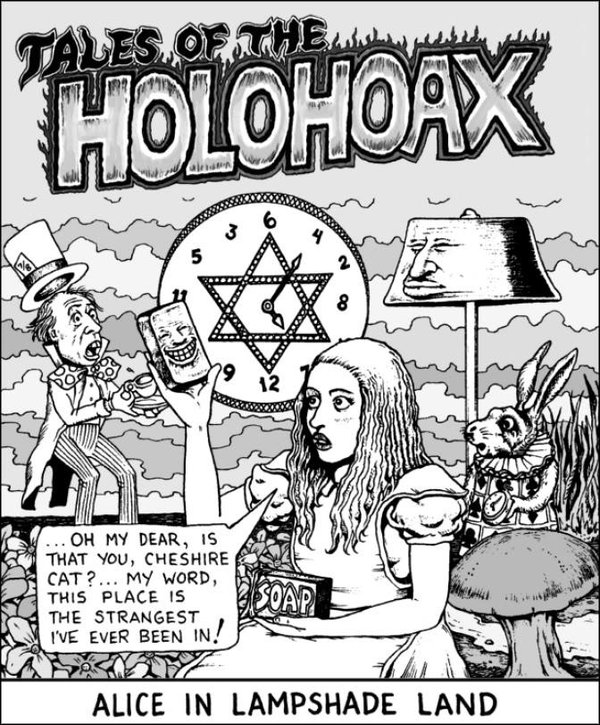
I have thought a little about where this strange and widespread distortion of reality might have originated. There is the shifting of the ground of reality caused by theoretical physics over the past century. Then there is, more concretely, the “black propaganda” of the two world wars: in WW1, the British atrocity stories (Belgian nuns raped, babies stuck on German bayonets, bodies rendered down to make soap etc). Most of those stories were “recycled” more cleverly in WW2, so that, even today, many of the simpler people in the UK still believe that Jews were made into soap, their hair used to stuff Wehrmacht greatcoats (oh, yes, the German Army loved to stuff its cold-weather clothing with unwashed and lice-ridden hair from Jews!), their skin made into lampshades or tanned into leather upholstery for armchairs… and that is before we even get to the fabled “gas chambers” or the Munchausen-like tales of Elie Wiesel, Irene Zisblatt and hundreds of other proven fakes. The cartoon below illustrates well the situation.
The story about the Emperor’s new clothes has become everyday reality in the UK and across the “West”: fail to at least pretend to believe that the “holocaust” narrative is true in all its details and numbers etc, fail to offer lip service to racial “equality” (eg IQ averages etc), fail to agree that a surgically-altered man is a woman, fail to praise the migration-invasion of Europe, fail to believe that Jews are a wonderful benefit to every nation, and you may well be in serious trouble, especially if you have or need a job or profession. You may even (like Alison Chabloz) find yourself convicted and sentenced accordingly.
Another example is the way in which the basically undemocratic and indeed tyrannical EU matrix is supported by and beloved of millions of deluded people (who often think themselves some kind of intellectual elite) and who regard the EU as a liberal bastion, despite its refusal to honour popular voting, despite its mediaeval-style “holocaust” “denial” laws and its other repressions.
No wonder that the msm is not believed, politicians are not believed, “fake news” becomes a major factor.
In any event, there is no doubt that unreality and the worship of falsity is in the ascendant. Lies are exalted and that means that Evil is exalted. This can have but one outcome.
This bloke seems deadly serious to me. Why are people refusing to respect his inner beliefs about himself? Only he can determine his own age, it's not for anyone else to say https://t.co/EvopLcrdEZ
The above does not purport to be a comprehensive listing of all the instances or situations where people prefer comforting lies (unreality) to the more bracing truth (reality). One might cite, though, to provide two connected examples, academic award inflation and UK university degrees. These are important topics.
Originally, England had but one University (Oxford, founded, in origo, 1096). Later, Cambridge (1209) and others were founded: St. Andrew’s (in Scotland, founded 1413) and (in Ireland), Trinity College, Dublin (1592). Further university expansion occurred in later centuries, particularly in the 19thC.
These expansions of university education were all driven by reality, the need to provide better-educated leaders and specialists in government, industry, science etc.
The next great university-education expansion occurred after WW2. The so-called “red brick” universities. Snobs or people concerned about standards (usually the former), such as Kingsley Amis, proclaimed that “more will mean worse”. There is still debate about that, but the old phrase “six of one and half a dozen of another” probably covers it.
Even at that stage, meaning the 1960s, university expansion in the UK was still partly driven by reality, the more complex post-WW2 society needing more people with high or higher levels of education. In fact, standards were still fairly high. Anyone who looks at the old “O” and “A” Level papers (and “S” Levels, a fortiori) from the 1950s and 1960s, even 1970s, then compares them to today’s equivalent papers can see that most UK school exams have, indisputably, become easier over the past 60 years.
The cracks in the university system which started to show in the 1960s widened thereafter. Tony Blair, the fount of so much badness in the UK, finally cracked the whole system open by allowing virtually any institution to call itself a “university” and to issue (mediaeval concept in any case) “degrees”. Now, pretty much any Tom, Dick or Sharon can get a “degree” at “uni” in some such subject as Hotels and Hospitality, Travel and Tourism, Gender Studies, Third World Studies etc. The more traditional subjects have also been dumbed-down hugely, so that about half the students now (since about 1997) “achieve” a “First”, and hardly anyone gets less than an Upper Second. As for getting a Third or a Pass degree, or even failing the exams, well, short of absenteeism or mental breakdown— impossible. Result? Degrees are now almost worthless and you only have to look at some Oxbridge graduates to see that the problem is not confined to those attending the less-prestigious institutions.
Still, most people like the unreality better than reality: students have an easier life and almost all “achieve” high marks, their teachers like the fact that they “achieve” such high numbers of high-achieving students, the institutions like the same, as does government. The statistics look great! Only thing is, this is largely unreality, a mirage.
Update, 23 November 2018
Below, a thread from Twitter which exposes the contemporary madness richly. For some of these lunatics (and I have seen nonsense of this sort on Twitter etc even from an NHS psychiatrist, one who espouses the “race is a social construct” garbage), reality does not exist except as a subjective wish-list. For them, if an African man of 70 wants to be a European woman of 30, then fine, that’s what he —sorry, “she”— is, and anyone dissenting is “guilty” of “hate speech” or “hate thought” (?) and must be punished. Even George Orwell could never have foreseen this!
Another aspect (again, see the thread…and read the whole thread by clicking on one of the tweets below) is that truth alone is not enough for many, but has to appeal to people via a kind of “support the self-styled victims” argument, as in “don’t discuss whether men can just decide that they are women, but discuss whether their doing that makes [real] women victims” (etc).
The depths of the socio-political madness can be gauged by a look at some of the tweets above, such as the one directly above by tweeter [at time of writing called] “AnarchoCatgirl”. In the old joke, if she is interested, I believe that I can offer her London Bridge at a very reasonable price!
In fact, it is interesting that it is mostly the firmest feminists who have bridled at this whole “transpeople” nonsense and reality-distortion. Feminists may not know much (in some cases) but they do know what is a woman and what is not a woman:
Looks as though others are in agreement with me: see this, written in typically-convoluted Jewish-academic style, and from a different ideological direction than my own, but attacking the same sort of madness:
The madness continues. Sometimes I feel that the only way to deal with these and other issues in the UK will be “non-peaceful” somewhere not far down the line. It may or may not be so, but I myself feel it strongly. Does that mean that it is true?
More Twitter reaction. I shall add to this as I notice relevant bits of news and comment.
Many women are wondering how and why the trans lobby has been so successful this last decade. Here's why – money – and lots of it. Seems odd that we, as taxpayers and contributors, are funding organisations actively working against our interests. https://t.co/omg88ld1bc
Trans women are in fact women. That's why "trans" is an adjective modifying "woman" to mean that a "trans woman" is one way to be a woman, much like a white woman, a straight woman, a disabled woman, etc.
— Maddie, Eschatological Nightmare (@lisaquestions) March 7, 2019
Below: someone called Marc, on Twitter, tries to stand up for truth and logic but is criticized by trans-“woman” Tara Hewitt, a half-crazed creature from the UK North West who, years ago, trolled me on Twitter, and who, supporting Scameron and Osborne’s “austerity” nonsense-economics, wanted to become a “Conservative” MP, despite “her” risibly poor educational level…
More evidence that the UK police see their role not as traditional police (keeping the public safe, investigating real crime etc) but as being a kind of poundland KGB, “investigating” peoples’s opinions and then going on to repress freedom of expression, even travelling long distances to harass or intimidate people suspected of holding or expressing the “wrong” views about society…
Below: the prophet speaks: great classic writer G.K. Chesterton foresaw today’s social madness…
We shall soon be in a world in which a man may be howled down for saying that two and two make four, in which people will persecute the heresy of calling a triangle a three-sided figure, and hang a man for maddening a mob with the news that grass is green.
A Dr Who writer @OldRoberts953 is expunged from a book by the BBC because he won’t conform to the latest transgender ideology. His views on transgenderism are probably shared by 90%+ of Brits but he’s now a Non-Person for the BBC. The net tightens around free speech. Please share https://t.co/G9fM2BK1e4
2016: Craig Telfer is ranked 200th 2017: Craig Telfer is ranked 390th 2018: Craig Telfer 'transitions to female' 2019: CeCe Telfer is national championhttps://t.co/KHXaIjhYvopic.twitter.com/Uoy72PCqkR
"She says the transgender woman, who is serving a sentence for rape of a female, groped her breasts in the prison toilets… The victim was moved to a different prison only to find her assailant had also moved there and would be sharing accommodation."https://t.co/cU0L3maVWf
The madness spreads to organizations such the the Girl Guides. Guides, Scouts, other charities (real or fake), you name it, they are all full, at higher levels, of termites who are traitors to society, evil killers of our future, Common Purpose conspirators etc:
This is not “a victimless crime”, not merely a debate in an ivory tower. Think about the 6-y-o girl who has been abused and traumatized by some teenage nut because he, said nut, wants to identify as “she”. In the future, the Third Reich will have to be revisited.
"This is an act of national cowardice by our would–be leaders, dressed up as high-minded moral superiority. Will any of them think again? While they absent themselves, women are being betrayed."
Even the academic standing against some of the madness, one Kathleen Stock, is compelled or impelled to defend truth not by saying simply “A is TRUE, B is UNTRUE”, but by entering into long philosophical and sociological exegesis. Telling…
Some of the “trans” people and extreme responses to those tweets are so off the wall that you wonder whether what is required is a psychiatrist or a machine-gun.
Time to recall the old saying “those whom the Gods wish to destroy, they first make mad”. This society is running on empty.
The writer of the piece below was rude to me on Twitter, and applauded my getting expelled from in 2018, so it would be natural to put “the finger” up to him, but the topic is important, even if he himself is a flawed messenger (and I do not recall the exact details— he is not important enough for that):
“The panel said only views akin to Nazism or totalitarianism were unworthy of protections for rights of freedom of expression and thought..” Seems that the Indian in charge thinks that National Socialism is just too true!
…but even now the Daily Mail calls the rapist “she”, and “her”…
Update, 2 February 2025
The madness carries over into other socio-political areas, such as the immigration “debate”, aka migration-invasion:
My blog post (another one that has had to be added to via updates over the years) about the links connecting Jew-Zionism, “antifa” nonsense, and mental illness, has proven popular:
I’m very happy about this, but the fact that people need a Supreme Court to tell us that women are in fact women is beyond stupid. This crazy nonsense is where the liberals have dragged society. A playpen for lunatics. Stomp out every liberal policy and stop the insanity!
I am often to be found ranting about the lack of education (in the real sense), culture or plain commonsense in the connected worlds of politics, journalism and law, as well as at the steep decline in quality in those areas and generally. Thus it was with a cynical sneer that I read the statements made by Cabinet ministers (!) this past week and in other recent weeks. Take a look at this piece from The Guardian (a pro-Remain article, but leave that aside).
“I hadn’t quite understood the full extent of this, but if you look at the UK and if you look at how we trade in goods, we are particularly reliant on the Dover-Calais crossing.” [Brexit Secretary, Dominic Raab];
“My wife would say [my Lego collection is] far too large, but I find Lego therapeutic … Everybody who does any difficult or stressful job needs a way to switch off. We all have different ways. Mine is Lego.” [Culture Secretary (!), Jeremy Wright];
“I freely admit that when I started this job, I didn’t understand some of the deep-seated and deep-rooted issues that there are in Northern Ireland. I didn’t understand things like when elections are fought, for example, in Northern Ireland, people who are nationalists don’t vote for unionist parties and vice versa.” (!)[Karen Bradley, Northern Ireland Secretary].
There are hundreds of other examples from the last 8 years of total incompetence. Iain Dunce Duncan Smith alone contributed dozens, though his metier is more in complete executive incompetence mixed with graft and outright fraud. He may never have been promoted beyond Lieutenant in the Guards, but he did manage to learn the Guards officers’ knack of sounding authoritative despite complete ignorance and despite being as thick as two short planks.
One of the more honest (perhaps— some disagree) of recent Conservative Party MPs, Johnny Mercer, not long ago called the Theresa May government-of-fools “a shitshow”! Blunt Army language, but can anyone now disagree?…
Things are really coming to a head now with this sorry excuse for a government. Either Brexit is going to be in name only, or it will happen but under conditions of chaotic incompetence, thanks to this government’s inability to do its job.
It really does say something about the Theresa May government that until his self-interested resignation recently, the “great intellectual” in it was supposed to be Boris Johnson, who has not once been able to do competently any one of the jobs given to him by reason of his privileged background. This is a man whose idea of appearing intelligent and cultured is (or was, until people generally started to laugh openly at it) quoting bits of rote-learned Latin and Greek and dog-whistling classical-history soundbites. The amazing thing is that, until very recently, Johnson’s self-publicized image as “Prime Minister in Waiting” was actually taken seriously by the msm and so the masses. Indeed, few were willing to point out that Johnson was a walking self-parody, with his classical crammer-college allusions and his pathetic am-dram reprise of Winston Churchill, right down to the gruff comments and slight stoop. He even copied Churchill’s gait sometimes!
Well, thank God for small mercies: it now seems that even Boris Johnson himself has now accepted that he will never be Conservative Party leader and so will never be PM either. Only about 20 or 30 MPs would back him and so he would not be in the top two places. About 5th-ranked, probably.
Most MPs can scarcely be called mediocre, let alone competent. That applies equally to Labour, but this Government stands or falls on its own record. Labour has every chance of being largest party in the Commons quite soon, perhaps by some date in 2019.
The situation now seems to be that the Brexit-in-name-only scenario may not pass the Commons. The Democratic Unionists [DUP] will not accept Northern Ireland being treated differently from the rest of the UK, and if forced to that will simply oppose the Government (or abstain) on all other legislation. Collapse of Government not long after.
Alternatively, if a real no-deal Brexit happens, unprepared for and resulting, in the words of Johnny Mercer MP, in “a shitshow” economically, then a situation of both economic and social turmoil might be brought about within months.
Social nationalism can only prosper from now on.
Update, 20 June 2019
Well, on rereading this for the first time since writing it, and because I noticed that it had had a few hits recently, I have to admit that I underestimated the level of stupidity of the Conservative Party MPs and membership. The exceptional (crazy) Westminster politics of the hour have brought about a crazy result (probably): Boris Johnson now looks quite likely to become Conservative leader and so, by default, Prime Minister next month.
Update, 3 December 2023
In the words of Macmillan, “Events, dear boy”… Events and “Conservative” MPs conspired to get “Boris” Johnson elected (by Con Party members) as Con Party leader, and so Prime Minister. As we now know, he then won the 2019 General Election and, on resignation in 2022, was replaced by absurd and vacant “ho”, Liz Truss, who in turn was replaced after about 6-7 weeks by Indian money-juggler Rishi Sunak.
Despite having underestimated Johnson’s chances of becoming Prime Minister, I think that the original blog post stands up quite well.
As to the others mentioned in that original post, half-Jew bully Dominic Raab is standing down as MP in 2024, after being found guilty of bullying civil servants, and after 13-14 years as MP: https://en.wikipedia.org/wiki/Dominic_Raab.
Jeremy Wright was sacked (by Johnson) after only a year in post as Culture Secretary, but is still an MP and fairly likely to remain one unless the swing to Labour in 2024 is huge: https://en.wikipedia.org/wiki/Jeremy_Wright.
Karen Bradley was dismissed from Cabinet in 2019 but remains an MP and, like Wright, has a notionally very safe seat.
Today I happened to see the Daily Mirror report (link below, at foot of post) about a 9-year-old girl who telephoned a charity begging for help, even offering to work, in order to save her family. This was not in some ragged part of the former Soviet Union, not in Latin America, not (to be rhetorical) in the Britain of the workhouse and Ebenezer Scrooge, but that of Britain in 2018.
The Conservative Party seems to be relying on effluxion of time to disguise what it (and to a lesser extent, Blair-Brown Labour) has done in the past 20 years and especially since 2010 when the Con Coalition took power. However, the fact is that millions of people have been degraded, insulted, even killed or forced to suicide by the hugely expensive and ill-conceived “welfare” “reforms” of Iain Dunce Duncan Smith. He and those guilty with him, have not as yet faced popular justice. Perhaps some form of justice will in the end catch up with him, and Esther McVey and Danny Alexander, and David Gauke, and the Jew “lord” Freud etc.
Then we have Brexit, which I (for social national revolutionary reasons) favour. The present government has proven itself incompetent in respect of that, too.
Armed forces: scarcely functioning, thousands of experienced officers and other ranks made redundant, so that, now that few want to join what was the TA (now, The Reserves), the government is forced to open Army recruitment widely to those from Commonwealth countries who may never even have visited the UK.
NHS: plainly in managed decline.
Immigration: scarcely slowing.
Housing: far too expensive and, in the private rented sector, the hunting ground of buy-to-let parasites.
A future for the young: where is it?
Wherever one looks, the present government has failed miserably, along with its predecessors of the past 8 years. Labour looks scarcely better, true, and has even decided to keep the pathetic Universal Credit scheme if elected, but in a general election, an incompetent government is still at a disadvantage vis a vis an incompetent Opposition.
Labour is no longer unelectable
It was said for years that “Labour is unelectable” under Corbyn, a strange statement in view of the fact that Brown and Miliband also both failed to make it electable. The idea seems to be that Labour has to appeal to the middle of the road floating voters to be electable, and that Corbyn does not appeal to that voter. I do not think that the misnamed “Conservatives” can rely on that. Many of the Corbyn-Labour policies do have Middle England appeal: strict rail regulation or even renationalization, strict controls on utility company bills, making large transnational enterprises pay decent tax. These and other policies speak to those forgotten Middle England voters. Labour has not quite thrown the poor under a bus, but its focus is certainly now on winning over the vital marginal seats. It has recently supported Phillip Hammond’s tax plans on the basis that Labour plans to hit the wealthiest 5% (in income terms) and not, say, the most affluent 10%, 20% or 50%.
The Conservatives have demonized the poor, especially but not only the non-working poor. The Con Party is now more than ever the party only of the wealthy few, the buy to let parasites, the Jews too (95% of whom have deserted Labour since Corbyn took over), the wealthy London foreign cosmopolitans of various types etc.
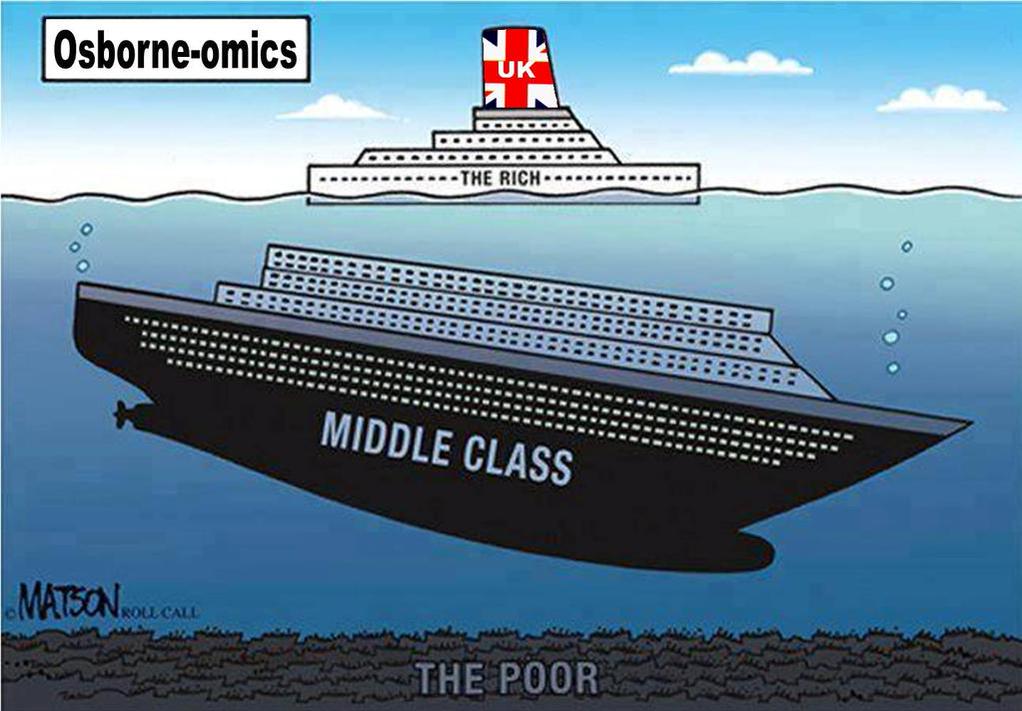
As to the traditional Conservative Party Middle England vote, that is ebbing away. The reasons are clear: the “middle classes”, at least at the lower end, are sinking, and the Government is letting them drown. A cartoon from a few years ago made the point.
On the above facts, it is more than likely that the Conservatives will not be the largest party after the next General Election. The Conservative vote shrinks with every passing month. There is a sense that, as with the 1990s Conservatives, the present Theresa May government has outstayed its welcome so that almost everyone is saying “GO!”.
The poorest 10% will mostly vote Labour anyway. The wealthiest 5% (and probably 15%) will mostly vote Conservative whatever. The bulk of workers in the middle are the battlefield, and one which Labour looks increasingly likely to win.
It is reported in the System “newspapers” that some people made an “effigy” of Grenfell Tower and then burned it as a Guy Fawkes Night stunt. In fact, this first of all shows how standards in journalism have fallen through the floor, because “effigy” means a model of a person, strictly speaking. Leaving that aside, this is another example of how the UK continues to sink into madness.
The alleged act may have been in poor taste, but only in a country gone mad could it be called crime! The UK police waste their resources on this? While serious real crime skyrockets! The UK is becoming like Stalin’s Russia, complete with me-too idiots.
In fact, if you read the reports, you see that neighbours and even family members of those arrested (and, yes –incredibly–, five people have actually been arrested over this nonsense) all feel obliged to distance themselves from the terrible crime (thought-crime?) committed; they all virtue-signal like mad. “Oh, no, guv’nor, I’m not like that!” or “I never had any idea that enemies of the people were living next door to me!” or “I’m afraid now that I know that bad people live near me” (etc…).
The msm reports show detectives at the house of these ordinary folk (who have now been exposed as “enemies of the people”), the detectives solemnly bagging-up evidence as if at the scene of murder or terrorism!
Meanwhile, in the real world outside the “fake news” newspaper offices, outside the Twittersphere and the milieu of the virtue-signallers, London has an epidemic of murder and knife crime, with hundreds stabbed or shot each year. In fact, the real situation is worse, because many killings which are really murder are reclassified as “manslaughter”. Large areas of the UK are becoming lawless zones, the police are not responding to emergency calls and many crimes not only go unpunished but uninvestigated and indeed all but unreported. Pakistani “grooming” and rape gangs are found everywhere in the UK, preying on white British children, Islamist terrorism is likewise widespread now.
The UK police nonetheless have the resources, it seems (and despite their constant whine about lacking such resources), to investigate comments made on Twitter (especially about Jews), to track down those posting cartoons mocking Jews, Muslims and others, and now to arrest persons who make the wrong sort of “effigy” on Guy Fawkes Night. Mad or what?
The ancients said that “those whom the Gods wish to destroy, they first make mad.” Be afraid, be very afraid, Britain…
The Daily Telegraph report, in which it is revealed that this petty incident of “offence” is being investigated “fully” by “a team” of detectives headed by a Chief Superintendent, no less! If only Lewis Carroll were still alive!
(“Free speech” in the Britain of 2019! Note the robotic refusal of Humberside Police to apologize or even engage with the free speech argument, even now. Sinister is the right word for this.)
The trial of Paul Busetti in relation to the events described above has been set down for 29 July 2019 (estimated duration unknown, possibly longer than 1 day, at an educated guess).
Well, the farcical process of investigation, arrest, charge, prosecution and trial is over. I was right about the duration of trial: 2 days. The result? Acquittal before the Chief Metropolitan Magistrate, Emma Arbuthnot.
The prosecution was a politically-motivated farce, but the laugh is at least partly on the taxpayers, because tens of thousands of pounds have been laid out by police, CPS and the MoJ in taking to trial someone who just made a joke (tasteless, yes, so be it).
Meanwhile, in similar news, the South Wales Police have reinforced their longstanding and well-deserved reputation for thick-as-two-short-planks woodentop-ery by actually arresting and locking up a man who simply flew a flag from his own house!
55 year old man arrested “on suspicion of a racially aggravated public order offence" after flying a swastika flag on the back of his house in Wales https://t.co/bPueK4tnGR
“A spokesperson for South Wales police stated, “we are aware of images circulating on social media of a flag with a swastika on it being displayed in Neath.”
“We would like to reassure you this flag has been removed and a 55-year-old local man has been arrested on suspicion of a racially aggravated public order offence.”
Well, “long live freedom”…(but not in South Wales, it seems…)
I hope that the accused fights this latest attempt to repress civil rights, an attempt made on behalf of the Jew-Zionist lobby. The police are now becoming actively hostile to the British people.
Update, 5 February 2020
“A man who displayed a large red flag with a swastika on the side of a house in Wales will not face charges, it has emerged. People living in Neath were said to be ‘absolutely disgusted’ by the flag on a property near the A474 flyover. One shocked passer-by had taken a picture of the flag and posted it on social media. A 55-year-old man was arrested on suspicion of a racially aggravated public order offence. South Wales Police said a file of evidence was submitted to the Crown Prosecution Service who decided no further action should be taken against the man.” [Metro newspaper]
So the (London) Metro newspaper sees fit to insert nonsense about how locals were “absolutely disgusted” by the flying of the Swastika banner. I doubt that that is true. However, the nub of the report is at the end: no further action. So just more police time and money (and that of the innocent man arrested) wasted because the Jewish lobby will not shut up…
I recently re-read Special Tasks: The Memoirs of an Unwanted Witness– A Soviet Spymaster, the autobiography of General Pavel Sudoplatov, who was, inter alia, the brains behind such complex secret operations as the acquisition, in the 1940s, of atomic and nuclear technology from the USA and UK; he also oversaw such sanguinary plots as –and most notoriously– the assassination of Trotsky in Mexico in 1940.
I last read Sudoplatov’s book in 1994, the year of its first hardback publication. On first reading, I did not, perhaps, pay enough attention to the part of the book near the end, dealing with Beria and the Politburo in general after the death of Stalin in 1953.
It might be said that to examine the beliefs and intent of Beria is otiose now that 65 years have passed since his death by summary execution. Also, unsurprisingly, few tears have been shed for him since his death. He was in many ways monstrous: this article is of course limited in scope by reason of, inter alia, lack of space. Beria’s crimes of a political nature were on a vast scale. His more personal crimes were also many and included the regular abduction and rape of women and girls, including some young schoolgirls. Having said that, his swift “trial” (in secret and without defence representation) and the immediately-following execution was a purely political action ordered by those with political records in many ways as bad (Khrushchev, for one).
I start from the following premises:
that Western and/or Westernizing conspirators funded and oversaw the Bolshevik coup d’etat in October 1917 (old calendar);
that the same cabals set up the Soviet system in the 1920s as a quasi-religious movement (in style) which was atheist (in content);
that the quasi-religious character of Bolshevism slowly started to dissipate after the death of Lenin in January 1924, replaced at first by a pseudo-intellectual Marxism-Leninism (incorporating a personality-cult), then by a revival of “Holy Russia” and nationalistic propaganda (mixed with the foregoing) during the war of 1941-45. Finally, there came a late efflorescence of the Stalin personality cult mixed with pan-Slavism between 1945 and Stalin’s death in 1953;
that in the (significant number) 33 years from 1956 (the year of Khrushchev’s Secret Speech denouncing Stalinism as a personality cult etc) to 1989, Sovietism continued to decay ideologically, until it finally collapsed into a pile of dust.
Beria, ideologically
Beria was born in Merkheuli, near Sukhumi, which latter was a prosperous resort in late-Tsarist times. His family was not poor. It may be important that (in contradistinction to Russia), the Black Sea littoral was part of the Alexandrine Greek polity and, later, the Eastern Roman Empire. A more cosmopolitan milieu than that of Russia and one which existed for more than a thousand years prior to the first foundation of Kievan Rus.
That area, Abkhazia (geographically a part of Georgia, though historically distinct), was the location of the legendary Golden Fleece and is said to have been the birthplace of wine.
In the Soviet era, peasants were able to (in effect) own their own agricultural or horticultural plots of up to 0.5 hectare (about an acre or so). This was put into law in the mid-1930s. “Special districts” (particularly in Georgia) could have plots as large as 1 hectare (2.2 acres) officially and slightly more unofficially. By 1939, these small plots (only a few percent of the land area of the Soviet Union) produced at least 21% of all Soviet agricultural produce (and a far greater percentage of fruits etc). Some estimates from later times (the 1970s) put the real figure as high as 40%.
The “garden plots” or “household plots” had become important in Georgia/Abkhazia since the end of serfdom in 1865 (serfdom in some parts of the Russian Empire lasted for some years after the formal abolition of 1861).
Beria (b.1899) thus grew up in a milieu quite different from his later Russian and Ukrainian colleagues.
Beria was, as a youth, involved, when a student in Baku (again, a very “capitalist” and cosmopolitan city which, after a long history, had boomed pre-1914 by reason of the oil finds), with both the Bolsheviks and the Azeri anti-Bolshevik Musavat movement, which had Muslim, Turkic and general reformist roots and ideology.
It has been alleged against Beria that he had been involved with British Intelligence in Baku in or around 1919. Not impossible. Baku was of huge strategic importance during the First World War.
Likewise, at his drumhead trial in 1953, it was alleged that Beria favoured soft relations with National Socialist Germany or was even a “traitor” who helped Germany militarily and diplomatically (see the Wikipedia article, below).
Anthroposophy and other Germanic cultural connections
Beria was friendly toward the writer Konstantine Gamsakhurdia, who was educated partly at Berlin University (graduating in 1918) and spent the war years 1914-1918 in Germany and Switzerland as well as France. Gamsakhurdia may well have met Rudolf Steiner (d.1925) at that time, when Steiner was constructing the First Goetheanum (at Dornach, near Basel, Switzerland).
In the 1920s, Konstantine Gamsakhurdia was for 3-4 years a political prisoner in the Solovki concentration camp on the Solovetsky Islands. He would almost certainly not have survived the purges of the 1930s without Beria’s protection.
The son of Konstantine Gamsakhurdia, Zviad Gamsakhurdia, became President of Georgia in the first democratic elections following Soviet rule. He is generally considered to have been an Anthroposophist, and wrote, among other works, Goethe’s Weltanschauung from the Anthroposophic Point of View [pub. Tbilisi 1985].
Beria’s Preferred Policies
Beria was not an idealist, but a practitioner of Realpolitik, par excellence. This enabled him not only to implement Stalin’s repressions without conscience, but also to see the aspects of Soviet life that were not working.
Had Beria succeeded Stalin,
he would have brought back a large measure of private ownership, or at least operational ownership, into agriculture. That would have hugely improved Soviet agriculture, whereas Khrushchev’s Virgin Lands scheme was mainly an expensive and ecologically-negative failure;
because Beria was not an ideologue, he would have had no qualms in ending the Cold War early. He would have been, to cite Mrs Thatcher’s view of Gorbachev, someone “with whom the West could do business.” That might have meant no Vietnam War, no Soviet support for so-called “Liberation” movements in Africa, no Cuban Missile Crisis, no Berlin Wall;
while Beria would certainly have ruthlessly stamped down on domestic political opposition, he would not have repeated Stalin’s mistaken policy (implemented partly by Beria himself) of arresting millions of people for effectively no reason;
Beria would have (as Sudoplatov notes) allowed the non-Russian republics a greater degree of independence, thus creating an earlier and more feasible “Commonwealth of Independent States” [CIS], albeit that they would not be “states” but autonomous or semi-autonomous republics.
Beria would have concentrated the KGB (its later name) and GRU on useful intelligence gathering and not on playing spy games and fomenting pseudo-Marxist revolts in Africa, Latin America etc.
Conclusion
While it might stick in the craw of many to conclude that Beria would have made a far better ruler of Russia than uneducated Khrushchev with his half-baked huge projects and his bang-shoe-on-table style of diplomacy, the facts speak for themselves.
A British scribbler, one Alex Marshall (formerly of The Guardian, now at time of writing apparently “Europe Culture Editor” for The New York Times) wrote a book called The Caucasus Under Soviet Rule, in which he wrote that “Personally propagating a bizarre Rudolph Steiner-inspired cult of anthroposophy, [Zviad] Gamsakhurdia…[etc]”.
Poorly written, for a start: “Anthroposophy” requires upper-case “A”, just like, say, “Roman Catholicism”. Marshall spells Rudolf Steiner, “Rudolph”, just as those who make fun of Hitler often write his name “Adolph” in petty denigration; also, “a bizarre” should be (if written at all) “the bizarre”.
Marshall’s words sound like a polemic against Anthroposophy, that movement which has achieved so much (though that fact is still not well-known to the masses in the Anglophone countries). To write off Anthroposophy as “a bizarre cult” is itself bizarre: think biodynamic agriculture, Waldorf [Rudolf Steiner] education etc.
I note that Marshall’s book, at least according to some reviewers, contains a number of other factual errors.
In fact, Shevardnadze, who overthrew Zviad Gamsakhurdia, was a ruthless “ex”-Soviet apparatchik who reintroduced large-scale repression into already-chaotic Georgian political life. He was the preferred candidate of the New World Order, completely under the “Western” thumb. I myself was slightly acquainted at one time (c.1995) with one of Shevardnadze’s advisers, who –like me– was on the Committee of the Central Asia and Transcaucasia Law Association [CATLA], a body active in the 1990s and which was supported by the British Government and large London-based law firms with interests in those regions.
I am not, nor have I ever been, a member, supporter or voter for the Labour Party;
No feelings (of any importance) were hurt in the creation of this blog post
Background
The latest opinion polls have Labour at around 40%, with the Conservative Party at a couple of points ahead, perhaps only one point. This is remarkable, after a year (in fact three years) in which Labour has been pretty much demonized. The Jewish-Zionist element in the Press, on TV and radio, on social media too, has attacked Jeremy Corbyn and Labour nonstop, with a constant whine about “anti-Semitism” and other aspects of Corbyn’s and others’ supposed beliefs or behaviours.
At the same time, many Labour MPs, perhaps the majority, have tried on several occasions to unseat Corbyn and to install a Labour leader who is more acceptable to the Jewish-Zionist lobby. So active have been some “Labour”-label MPs in plotting against Corbyn that newspapers discovered that they rented a regular “safe house” in the countryside where they could conspire in secret.
I have previously blogged about how it seemed “destined” for Corbyn and the anti-Zionists to take over Labour: how Corbyn was only able to be on the ballot paper the first time because several MPs who had no intention of voting for him yet nominated him! Even so, Corbyn only got the exact number of nominations he required (plus his own vote). That exactitude speaks to me of supernatural intervention (see my own similar experience of 1978 below this blog post).
Why is it necessary for Corbyn to lead Labour? Why would a Corbyn premiership be a good thing?
Until Corbyn took over as Labour leader, the Jewish-Zionist element controlled both main System parties in the UK. Now, “they” control only one, whereas Labour is fitfully breaking free (though its leaders still feel the need to offer lip-service to the “holocaust” narrative etc).
The best aspect of Corbyn leading Labour is that hundreds of thousands of recent Labour members and supporters now exist, many of whom have been radicalized, not so much by Corbyn or Labour as such, but by the fact that they now see through the Zionist influence and power working against and inside Labour (ex-Israel propaganda employee Ruth Smeeth MP, Jess Phillips MP, disgraced alleged sex pest John Woodcock MP, John Mann MP, Chuka Umunna MP etc). Those Labour supporters have in many cases been radicalized, ironically, by the sheer hate-filled dishonesty of the Zionist fanatics themselves. Those hundreds of thousands are not, and are not yet ready to go, overtly social-nationalist, but they have cast off most of the shackles of Zionist mind-control and that is very significant for the future.
A Corbyn-Labour government would take the whole UK politico-social matrix to the brink. Power would be cast into the hazard, and that can only be good for those of us sacrificing, thinking and fighting for the future in the as yet shadowy ranks of social nationalism.
Labour’s Chances
In 2022, boundary changes will reduce presently Labour seats by about 30. Only a few Conservative MPs will be affected (and the LibDems will be all but wiped out). Labour may struggle if 2022 is the date of the next General Election. However, there is every chance of a General Election in 2019, just as the possibly chaotic Brexit events are occurring. The economy is about to tank. Big investors are pulling out of the UK. London properties in the highest priced categories are not selling. Huge numbers of families are going to be hit even harder shortly by reason of the implementation of the botched Iain Dunce Duncan Smith “Universal Credit” “reform”. All of that plays to Labour’s advantage.
Against the above, all that the Conservative Party has in its quiver is yet more lip-service about controlling mass immigration (which the “Conservatives” have failed to do in 8 years; words are cheap…) and negative public relations about Corbyn, Labour etc. My assessment is that even the existence of Diane Abbott and other ethnic minority deadheads as potential Cabinet ministers (!) may not be enough to win over for the Conservative Party the floating voters in marginal seats, and they are the ones that count.
My conclusion is that, albeit probably on a minority-government basis, Labour will be in power and Corbyn in Downing Street before 2022 and quite likely by mid-2019.
Final Word
In the blog post above, I promised to give an example of when I myself was the subject of what might be called “Divine intervention”. I could give a number of examples, but here is one: after returning from Rhodesia in 1977, and doing some part-time or short-term jobs in the UK for a year or so, I conceived the idea in January 1979 of visiting a mountain in the far West of Ireland, on the Dingle Peninsula (then not the tourist destination that I believe it now is). I had no money at all, really, and the First Class rail and ship ticket would be £126 in the money of the time. At that moment, I received a tax refund, from work done at least 2 years previously, of exactly £126! I had not applied for any refund. Makes you think…
Update, 19 January 2022
Well, I was right about a general election in 2019, but wrong about the result of the General Election of 2019. I had, perhaps, underestimated the influence of Britain’s basically Jewish-controlled msm on the mass of the voters. Also, the msm was constantly puffing stupid “Boris” Johnson as a dynamic and charismatic “prime minister in waiting”.
We know that happened from there. “Boris” won that election, and has been pretty disastrous. Meanwhile, Labour was retaken by the Israel lobby under puppet Labour leader Keir Starmer.
Final note: those proposed boundary changes have been scrapped.
Max Hill Q.C. is on the brink of taking up his role as D.P.P., in succession to Alison Saunders. It is too early to say what his official attitude will be in relation to political “crime”, “thought crime” and freedom of expression. While he has made some quite liberal remarks in the past in connection with Muslims, Islamists etc, he has also referred to “far right fanatics”, a meaningless phrase which is often used by Zionists and their msm doormats to label social nationalists and others.
Already, the unpleasant Zionist fanatics of the so-called “Campaign Against AntiSemitism” or “CAA” (themselves under police investigation for stalking, harassment and abuse of charitable status) have taken to Twitter etc in an attempt to put pressure on the new DPP. They want him to prosecute anyone criticizing Zionist individuals and groups under the UK’s draconian laws against so-called “hate speech” etc. Indeed, one of their doormats in the msm (himself apparently a Jew) has already publicized on Twitter and on the LBC (radio station) website a file relating to various “cases” where the police and/or CPS have not prosecuted mostly rather innocuous tweets and other online postings.
The Zionists of the CAA are using the entirely unrelated shooting event in Pittsburgh, USA to try to shut down legitimate freedom of expression in the UK…and are being aided and abetted by other Zionists in the decadent UK mass media milieu.
The new DPP, before he listens to any of the CAA’s nonsense, should bear in mind that, quite apart from the various alleged illegalities perpetrated by CAA persons (and which are currently under police investigation), the CAA has made a number of frivolous and indeed malicious complaints (to the police, to the CPS, to Twitter etc) against quite a large number of people, including David Icke, Al Jazeera TV, the Jewish anti-Zionist Gilad Atzmon, and even against me. In fact, in its 4+ years of operation, the CAA has only scored two “victories” of any significance, to wit against Jez Turner (Jeremy Bedford-Turner) and against the singer-songwriter Alison Chabloz (who is in any case presently appealing both conviction and sentence).
The CAA’s membership numbers are secret, but thought by many to number only a few hundred, certainly not many more if its Parliament Square and other demonstrations are anything to go by. Crowds numbering between 50 and 200 individuals.
In order to assist Max Hill Q.C. and his staff in any deliberations, I commend my own experience of victimization by these Jewish-Zionist and pro-Israel fanatics. The events described took place in January 2017, so nearly two years ago now, and the blog post dates from about 18 months ago.
The Jew Stephen Silverman of South Essex, the so-called “Head of Enforcement” at the “CAA” (“Campaign Against Antisemitism”) fake charity, and who was exposed in open court (Westminster Magistrates’ Court) as a pseudonymous troll and stalker of women, has recently been complaining that the DPP will not meet with Silverman or his colleagues (who include Joe Glasman, an evil snooper, and Stephen Applebaum of Edgware, North London, soi-disant “film critic” and house husband; Applebaum was also a very malicious and pseudonymous troller and stalker of women before he was exposed).
If it is true that the DPP will not agree to have his ear bent by the CAA trolls, it must be because, at long last, the CPS (and police?) are waking up to the maliciousness of these Jews, and to their politically-motivated “lawfare” against those with whom they disagree (“those whom they hate” would be more accurate).






 Ian Robert Millard