I have been a voice crying in the wilderness, but I sense now that the people will soon be ready to listen, in the UK and across Europe.
Born in the English county of Berkshire and brought up both there and in Sydney, Australia, I have had a varied and sometimes challenging life. I could not list all the jobs I have done, from the most basic labouring and menial work through to advising international enterprises and appearing as a barrister in the courts of England, including the High Court.
I have lived and/or worked in numerous countries, including the USA (where I qualified as attorney at the Bar of the State of New York), France, Russia, Kazakhstan, Egypt (and other parts of the Middle East), Turkey and the Caribbean.
Many reading this will be aware that in October 2016 I was disbarred (in England), after a Jewish Zionist pressure group made official complaint about me (in 2014) to the Bar Standards Board. The complaint related to 7 tweets (out of, at the time, about 155,000) which I tweeted from my Twitter account (@ianrmillard). I shall write about the Kafkaesque process which led eventually to my disbarment in more detail on the blog, though only to clear the air and to lay out the full facts omitted from the accounts given by the Daily Mail, Daily Express, Independent, Huffington Post, Metro etc.
My aim in blogging is to comment on current events and trends; also, even more important, to put forward ideas and policies for a new or better society.
I disparage the terms "left" or "left wing", "right", "far right" etc. These are outdated and, in an era in which politics is becoming more nuanced in the UK, Europe and elsewhere, misleading. The same applies to terms such as "Nazi", "neo-Nazi" etc. Speaking for myself, while there was much that was valuable and good in the work of Adolf Hitler and the NSDAP and in German "volkisch" politics generally, there is no need to defend everything that every National Socialist did from 1933-1945. The National Socialists were fighting the horrifying Stalinist version of socialism and, also, the debt-oriented finance-capitalism of the "West". That fight was both necessary and honourable. The fight now moves to the needs of the 21st Century.
For me, the template for the new society is contained, in outline, in the Threefold Social Order first explained after the First World War by that great genius Rudolf Steiner.
I urge all British people to join the struggle for national freedom. There are dark forces, often posing as "good", which must be vanquished.
There now seems to be a serious chance that there will be a general election in the first few months of 2019, something I predicted (though not with great confidence) in previous blogs over the past year.
In previous blog posts, even recently, my prediction was that any general election in 2018 or 2019 would result in a hung Parliament but with Labour as largest party. The end result would then probably be a Labour minority government.
The Daily Mail seems to think that an early 2019 General Election, possibly as early as March, would result in a crashing defeat for the Conservative Party.
What has caused this situation is not so much Brexit, or the fear of Brexit, as the sheer incompetence of the present Government. Look at one of the least competent Cabinet Ministers (even in a poor Cabinet), Chris Grayling, who has been a member of this Cabinet and the two previous ones! A typically-psychopathic type, if I may play the armchair psychologist, who has messed-up in every job that he has ever had. Here he is explaining or rather not explaining what the Government will do if (when) Theresa May’s pathetic “deal” is rejected by the Commons:
"You don't have to tell me what plan B is, but you do have one right?" – Transport Secretary Chris Grayling says Theresa May's brexit deal is not perfect but doesn't go into detail about the Government's plan B if it is voted down, or whether plan B even exists #Ridgepic.twitter.com/jr3W3JlAHI
Incompetence is a killer vote-loser for any government. Taking the years 2010-2019 as effectively one government and not three, we can see incredible incompetence across the board, from social security/”welfare” issues, pensions, HS2, transport (especially rail) generally, nuclear power, the Brexit mess (failure to prepare for a WTO Brexit from the beginning), continuing mass immigration, NHS issues…you name it.
True, many (including me) have little confidence in the competence of any Corbyn-led Labour government, but will the voters prefer to vote for Corbyn-Labour, which might be incompetent, or for a “Conservative” Party which has been proven, in spades, to be incompetent and incapable?
What about Brexit itself? It may be that Brexit, though certainly a major issue for the voters, will not play to the decisive advantage of either party. About half the country favour Remain, about half prefer Leave, with divisions in both main camps. It should be recalled, though, that “Brexit” and “Leave” are to some extent manifestations of dissatisfaction with the general way in which Britain is working, or rather not working for many many people.
My money at this stage is still on a hung Parliament with Labour as largest party, because there are huge numbers of people who will not vote Labour (ever, anyway, whatever), others who will not vote for a Labour Party led by Corbyn, yet others who will not vote for a Labour Party in which deadheads such as Diane Abbott and Dawn Butler might well become Cabinet ministers.
Even psephologists struggle with election predictions. It is the “Glorious Uncertainty” of both the English racecourse and the (mainly) English electoral system. Raw percentages count for only so much, because of First Past The Post voting and the way that boundaries are sliced up.
In the end, the “True Blue” and “Deepest Red” constituencies are not the deciders. The marginal constituencies decide. How many marginals depends. Some put true marginals at 50 (out of 650), others at 100 or even 150.
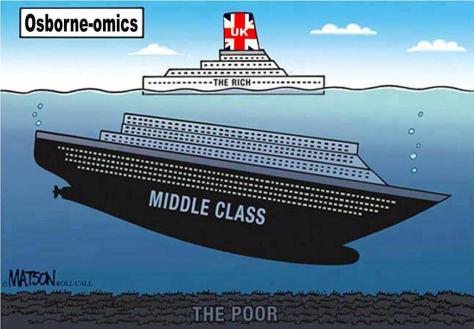
One has to make an educated guess. My guess is based on the fact that life has become progressively tougher (financially and in other ways) for most people over the past 8 years; in fact the past 10 years, 2 of which were Labour, but mostly the past 8, which have been years of “Conservative” rule. In those years, only the most wealthy or affluent 10%, maybe even 5%, have really prospered, as seen in the cartoon below from the days of the Con Coalition
The roads are potholed, the railways expensive and chaotic, the social welfare system has become both cruel and shambolic, mass immigration continues all but unabated, education has become a joke, pay in real terms is greatly less than it was in 2010, let alone 2005, crime is often not even investigated by the police, and most local authorities are both cash-starved and incompetent. The Army has shrunk to 78,000 men (and women, now), and the same is true, mutatis mutandis, of Navy and RAF.
Does any of the above encourage people to vote Conservative? I think not. They might not all vote Labour, and there are no other options with much credibility, but it may be that enough people will either vote Labour or stay home to give Corbyn-Labour a majority. I am tempted to predict that. On balance, though, I think that I stick with hung Parliament as my present prediction, always recalling, as Harold Wilson famously said, that “a week is a long time in British politics”.
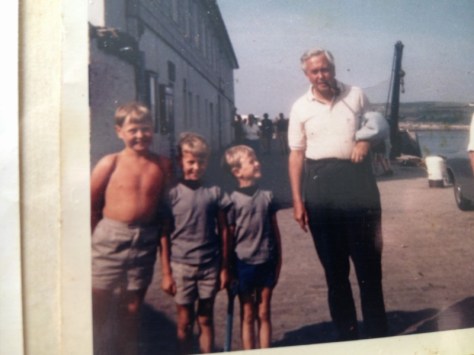
Below, an amusement: me aged 9 or maybe just turned 10, with then PM Harold Wilson. St. Mary’s, Scilly Isles, September 1966. I am the eldest boy in the photo.
Many readers of this blog will have read of my experiences with the malicious and extreme Jew-Zionist organizations, “UK Lawyers for Israel” (UKLFI) and “Campaign Against AntiSemitism” (CAA), the memberships of which overlap in part. For example, the abusive Jew-Zionist solicitor Mark Lewis, who has now fled to Israel, is a leading member of both.
I dare say that many ordinary people on, for example, Twitter, have no idea that sometimes, when they see a veritable tweetstorm or at least tweetsquall —such as that backing Lewis during his recent Disciplinary Tribunal hearing (he was found guilty anyway)—, they are actually reading tweets which are part of a barrage put out and/or at least loosely coordinated by those two groupings. Below, two blog articles which reported on my experience of these organizations:
The CAA Pressured the DPP/CPS to Prosecute Jez Turner and Alison Chabloz
1. Jez Turner
In 2015, Jez Turner (Jeremy Bedford-Turner) of the London Forum made a speech in the street, in Whitehall, London. One sentence mentioned the Jews, in such manner as that they should be removed from the UK. The CAA, which had agents at the scene, reported Jez Turner to the police there and thereafter. Eventually, the Crown Prosecution Service [CPS] considered whether any offence of incitement might have been both committed and as to whether any prosecution was a. likely to result in conviction, and b. in the public interest. The CPS decided not to prosecute. Note that a prosecution under [the relevant part of the] Public Order Act 1986 requires the assent of the Attorney-General. In other words, Jez Turner could not have been prosecuted privately by the CAA for the alleged offence.
The CAA made application to the High Court for a judicial review of the no-prosecution decision made by the CPS. The Director of Public Prosecutions (DPP), as head of the CPS, was the Respondent. On the eve of the relevant hearing in 2017, the DPP/CPS agreed to look again at their decision, thus avoiding a defeat but at the same time giving in to the demand of the CAA. After some time, the CPS announced that Jez Turner would now be prosecuted. He was, in 2018, in the Crown Court, no less than three years after he made his speech. He was, arguably, unlucky in his jury and possibly (I was not personally present) in his judge. He was given a full year in prison, of which half would actually be spent incarcerated (he was recently released). All for making a humorous speech in which one sentence said that the Jews should be (again) expelled from England.
2. Alison Chabloz
In the case of Alison Chabloz, who sang satirical songs, some of which mocked the Jew-Zionists, she was accused of having breached the (“bad law”) Communications Act 2003, s.127, in having, allegedly, posted online the said songs. The CPS refused to prosecute her or, rather, did not; with the time-limit of 6 months looming, the CAA took a private prosecution. Leaving aside the legal and technical argument on the merits, the CPS had the right to take over the case and, if it did, to drop it or to continue it. The CPS decided to take over the prosecution and continue with it (though it in fact substituted other charges for the original ones…). The offence is summary only. Alison Chabloz was convicted at trial in 2018 and given a sentence of (depending on how it is read) a total of 12-20 weeks’ imprisonment, suspended for 2 years, plus community service “serf labour”, a financial penalty of £700, and a 1 year ban on use of “social media”. Note, however, that Alison Chabloz is appealing both conviction and sentence.
3. Nazim Hussain Ali
Mr. Ali led and spoke at an anti-Israel rally in London. The CAA individuals hung around, in their usual fashion, tried to catch Mr. Ali saying something or other, then (as in the other cases mentioned here) reported him to the police. The CPS refused to prosecute and so the CAA took a private prosecution. The CPS took over that prosecution and discontinued it. The CAA then wanted to have that decision judicially reviewed. It was. They lost.
The judgment is worth reading in full, but the most relevant parts are:
“The DPP took the view that, in all the circumstances, the words used were not “abusive” within the meaning of that provision, so that a prosecution was more likely than not to fail.”
and
“As the [legal precedent] authorities stress, article 10 [of the European Convention on Human Rights] does not permit the proscription or other restriction of words and behaviour simply because they distress some people, or because they are provocative, distasteful, insulting or offensive.”
and
“this is a public law challenge, and this court can only intervene if the decision to take over the CAA’s private prosecution and discontinue it made by the Decision-Maker was irrational, i.e. a decision to which no properly directed and informed CPS decision-maker could have come. In my judgment, it cannot be said that it was irrational.”
My Thoughts
This was a big hit against the CAA. The CAA is an organization which for years has been making inflated claims, both in its own name and via sometimes pseudonymous and abusive Twitter (and other) accounts run by its leading members, notably Stephen Silverman (who styles himself “Head of Investigations and Enforcement”!).
Under its own name and under the real names of its leading members, but also under other account names, the CAA has for 4-5 years been threatening not only “anti-Semites” and “holocaust” “deniers” (historical revisionists), but anti-Zionist dissidents in general with unspecified police and other action, also sending, from pseudonymous Twitter accounts (etc) threatening and harassing tweets (etc) to and/or about individuals. Some people were constantly taunted online and even offline with threats about knocks on the doors of houses, arrests, prosecutions, trials, terms of imprisonment. Almost all figments of the sick imaginations of the CAA members in question.
Women in particular were targeted by a number of online social media accounts controlled by various CAA persons, and in particular by Stephen Silverman of Essex and his associate, one-time/sometime “film critic” Stephen Applebaum, of North London. The pair have been somewhat muzzled of late —having been exposed and had their real names etc exposed— and now mainly tweet (slightly less overtly venomously) as @ssilvuk and @rattus2384).
Another leading Jew-Zionist (at least in his own estimation) is one Gideon Falter, who apparently graduated from Warwick University in law, though if so did not carry through to becoming a solicitor or barrister. Falter, Chairman of the CAA, seems to have family money (his parents are said to own a house in a well-known street in St. John’s Wood, London where houses sell for anything up to £40 Million). He seems to spend most of his time on CAA or other Zionist activities. I suppose that that is one way in which, he may imagine, he validates his existence.
Falter has given evidence in several cases, but his evidence has not always been accepted as veracious. In the case of Rowan Laxton, in 2009, which therefore preceded the establishment of the CAA by 5 years, Falter gave evidence which, while accepted by the magistrates, was (at least impliedly) not accepted by the Crown Court judge at the appeal (rehearing), at which hearing Laxton was successful. He was fully reinstated at the Foreign and Commonwealth Office and is now H.M. High Commissioner in Cameroon: https://www.gov.uk/government/people/rowan-james-laxton–2
Laxton’s career success must be bitter for Falter, who has also had his testimony in other “anti-Semitism” cases strongly challenged…
Over the 4+ years since its foundation, the CAA has not been very successful. It has attempted to bring to trial (either by privately prosecuting people, or by making malicious allegations about them to the police and/or professional bodies) quite a large number of potential defendants. Most have either not been prosecuted or have been acquitted, or have been successful on appeal. A few people have been prosecuted for saying or writing rude things (quite likely justified anyway) about individual Jews (I noticed a few cases about landlords and property developers etc…). Most of those cases resulted in fines being handed down, by local magistrates, in the order of £50 or £100. Rather petty.
The larger scalps taken by the CAA are few, even if one includes the handful of successes by the UKLFI group: Jez Turner (now released after having spent 6 months in prison), Alison Chabloz (who is appealing now), a few minor harassment cases. The CAA failed to get the CPS to prosecute me for tweeting truth, and was too frightened to try to prosecute me privately, though UKLFI did get me disbarred in 2016 (8-9 years after I had anyway ceased Bar practice!).
The CAA has been —and I believe still is— under investigation both by the police and by the responsible officers of the Charity Commission. It has been criticized extensively by the more “Establishment” part of the Jewish power structure in England, including the Board of Deputies of British Jews and the Jewish Chronicle. It recently suffered a considerable blow when one of its most active members, Mark Lewis, the venomous Jew-Zionist solicitor, fled to Israel after the conclusion of the Disciplinary Tribunal case brought against him by the Solicitors’ Regulation Authority.
The finances of the CAA “charity” are opaque. I suspect (educated guess) that two particular Jew millionaires, indeed billionaires, have contributed to the CAA, and for them a few tens of thousands of pounds a year is a bagatelle. However, even the ultra-wealthy are probably unwilling to give much to an organization which consistently manifests failure.
I should love to know how many Jews are members of the CAA (are any of its members non-Jews? Maybe there are a few doormats here or there). My guess would be hundreds rather than thousands. It has appealed for donations, run pledge drives etc, and recently tweeted to recruit a half-time-working “communications” person at a salary of £12,500-£15,000 a year. Hardly sumptuous. The CAA Twitter account was inactive from 20 December 2018 until 11 January 2019.
I have no idea what, if any, costs will be payable by the CAA in relation to the latest defeat in court, but I hope that they will be substantial.
The latest defeat by the CAA, and Mark Lewis’s flight to Israel (where he has said, repeatedly, on radio and TV, that Jews should all leave Europe), must mark the beginning of the end for the abusive and fake CAA “charity”.
Objectively speaking, it may be that the CAA has done much to stimulate “anti-Semitism” in the UK…
Good luck to Alison Chabloz in her upcoming appeal!
Below, a very recent tweet thread in which Stephen Applebaum of the CAA, under his most recent pseudonym, @rattus2384, and with other Jews, attacks the father of a 16 year old girl allegedly targeted by yet another Zionist. [click for full thread]
The CAA’s sting seems to have been largely drawn. The CAA Twitter account has tweeted only once (on 11 January 2019) since 20 December 2018. Gideon Falter has not tweeted since 5 September 2018 (except for two retweets, on 6 November 2018 and 7 December 2018). Both Silverman and Applebaum/Rattus have been somewhat muzzled of late. Now that they have been fully unmasked and exposed, they have evidently decided that they have to be more circumspect online. The CAA star is fast-waning.
Update, 18 July 2019
Well, like the cockroach, the CAA is still embedded…Having failed to have a Palestinian activist resident in the UK prosecuted [see above], the CAA Jew-Zionists try to get him another way, by having his professional regulator (he is a pharmacist) “investigate” his political life and then perhaps haul him before a disciplinary tribunal. This is what “they”, meaning (((they))) do…(for my own experiences, see below the CAA tweet…)
“Al Quds Day” leader Nazim Ali, who blamed “Zionists” for Grenfell Tower tragedy to face regulatory investigation following complaint by CAAhttps://t.co/vJRAm5s8xz
— Campaign Against Antisemitism (@antisemitism) July 18, 2019
The UK professions now all have new, or fairly new, “Codes of Conduct” for the members of whatever profession is being “regulated”. These have been drafted by “Zionist” lawyers in almost all cases. Should the individual member of a profession be anti-Zionist, lo and behold, (((they))) make “complaint” about the “hate speech” or whatever that the individual is said to have uttered. A covert Zionist takeover, and an attempt to control the private and political life of the people affected.
Where “they” are, there can be no real freedom.
Update, 5 November 2020
The “Campaign Against Antisemitism” prevailed on the General Pharmaceutical Council to “prosecute” Nazim Ali. “Lawfare” misusing the professional regulations. Nazim Ali might have lost his shop, business, profession, decades of work, all because a pack of Jew extremists pretended to be “offended”.
As it was, the disciplinary case against Nazim Ali was heard mostly in the first week of November 2020. The result, given on 5 November 2020, was that the tribunal held that what Nazim Ali said in 2017 was not “antisemitic” but that it had been “offensive”. He was given an official (quasi-judicial) warning.
Ha ha! The CAA Jews thought that they were going to at least ruin and bankrupt Nazim Ali now that the police and CPS were not going to charge him with anything criminal. Instead, he was just given a warning.
The CAA cabal took Nazim Ali’s matter to judicial review, and the High Court decided to remit it back to the Tribunal, which found the case proved against him on two charges, but simply repeated the warning to Ali.
In other words, the CAA put out huge effort for effectively nothing. They are, however, claiming it as some kind of major Jewish victory…
The Jew-Zionist solicitor, Mark Lewis, was recently found guilty at a Disciplinary Tribunal on several charges brought by the Solicitors’ Regulation Authority. My blog has carried the following articles about him and about some of his egregious behaviour, which behaviour has been manifested for a number of years, certainly since 2013:
Lewis and his partner/carer Mandy Blumenthal (Lewis has also referred to her, in a British TV interview, as his “wife”), “made aliyah”, i.e. emigrated from the UK to Israel, in late 2018, after he had been found guilty by the Disciplinary Tribunal. At that hearing, Lewis’s Counsel told the Tribunal that Lewis “had no assets” except for his clothes, a mobility scooter and a private pension [said to be worth £70 a week]. Lewis had an income (salary, payable only until March 2019 when his notice period expires) of £10,000 (pre-tax, per month), and was also in receipt of Disability Living Allowance benefit, which he was exchanging (with Motability) for a car.
According to the published judgment of the Tribunal, the financial penalty imposed upon Lewis, the relevant part of which was a fine of only £2,500, was reduced from £7,500 precisely because of his impecuniosity. He was said to have no real property and to be living in rented property in London.
In this very recent podcast, Lewis was interviewed from his location in Eilat, the Israeli resort on the Gulf of Aqaba. Why is this relevant? Well, in an interview of 2011 with the London Evening Standard, Lewis said this:
“I was devastated,” he says. “I’d been turned down for so many jobs, I’m thinking to myself, I can’t go on any more, you can only get so many knockbacks. I’m giving in and going to my flat in Israel and retire in Eilat.”
In the recent podcast, Lewis goes on to say that, while he has no intention of applying for the Bar of Israel (because of his poor Hebrew), he may be servicing “clients” which he claims he still has in the UK; he even implies that he may be making (as solicitor-advocate, presumably) court appearances in English courts! Well, that would not at present be possible, unless he has been approved by the Solicitors’ Regulation Authority as a sole practitioner (which he did not say he has been), or unless Lewis acts as a member of a law firm in England (which I doubt that he is or will be). Otherwise, Lewis would only be able to deal with legal matters the substance of which is outside the UK. He certainly could not appear in English courts.
In the podcast, Lewis talks about how he can work from Israel on UK work, using computers etc, and about how “there are planes to get you to court appearances”! Once again playing the “big shot”, this time once more the “top lawyer” who flies in to London or wherever else in order to appear in court on some important case. Hardy ha ha…big talk from someone whose own Counsel said at the Disciplinary Tribunal hearing that Lewis should not be fined much because “he has no assets” (except for his clothes and a mobility scooter!)…and whose recent flight to Israel was gratis, courtesy of the Israeli emigration authorities.
Incidentally, the podcast interviewer introduced Lewis as “one of England’s most distinguished lawyers”! Is there any limit to “their” lies and gall?!
Implications
So in 2011, Lewis owned a flat in Eilat, Israel…Does he still own one there? If so, he may have deliberately misled the Disciplinary Tribunal. Of course, it may be that he does not now own property in Israel and therefore did not mislead the Tribunal. He may simply have been in Eilat on holiday, staying in rented property or in hotel accommodation. It does raise questions, though…
See tweet below: are Lewis and Mandy Blumenthal already on the way back??
So basically you are saying that you feel disabled passengers that need an ambilift are only suitable for the back row seats even when paying for the most expensive fare bracket? Funny how no other airline does that.
Well, it appears that the egregious Lewis has now joined what appears to be a firm of Jewish or mostly Jewish lawyers based in London. I thought that he and his “partner”/”carer”, Mandy Blumenthal, were fleeing British “antisemitism”? Lewis made a big fuss about going to live in Israel, only a month or so ago!
So…the UK is OK as a place to make money for him while he lives in Israel? Or is he actually back in UK? If so, full-time or part-time (or, er, not at all…)?
The firm in question seems to operate from 2A, Norland Place, London W.11. Norland Place is a small cobbled mews side-street in Notting Hill, as seen in the estate agency photos below (and on Google Earth).
According to Companies House, Mark Lewis was appointed a director of Patron Law Ltd on 23 January 2019. According to the 2-page pdf document attached to the filing document, Lewis gave his “Country/State where usually resident” as “United Kingdom”.
So did Lewis lie to the public and Solicitors’ Disciplinary Tribunal in giving his (then upcoming) residence and/or domicile as “Israel”? Or has he made a false declaration to Companies House in stating that his “Country/State where usually resident” is the UK? Surely they cannot both be true?
Update, 30 January 2019
I will be based in Israel. Technology and flights mean I can live here and work there.
Lewis has apparently been retained by two minor UK Jewish “celebrities” and is threatening to sue on their behalf somewhere around 70 people, all or almost all Corbyn-Labour supporters on Twitter. As in the notorious McAlpine case (with which Lewis was not involved), Lewis is demanding that those tweeted by him supply their real names and contact details as a preliminary to “settlement” (surrender) or legal action.
“@Rattus2384” (aka @grubstreetsteve) is in fact Stephen Applebaum, a prolific Twitter user (troll) from North London, who is a member or supporter of the “Campaign Against AntiSemitism” (CAA), as is Lewis. Applebaum’s tweet puffs Lewis to absurdity. He fails to mention that Lewis’s own Counsel at the Solicitors’ Disciplinary Tribunal a few months ago asked for Lewis to be let off lightly because Lewis “has no assets except for his clothes and a mobility scooter”!
“The UK’s most successful defamation lawyer”? Ha ha!
Update, 3 March 2019
Lewis pretending that his (honorary) “Doctorate in Law” was not given to him by his old poly just for being briefly sort-of “famous”…
You aren’t familiar with the Data Protection Act and GDPR are you. So simply revert to ad hominem attacks. I guess my doctorate in law was an award for stupidity.
Some of Lewis’s Tweets, Part of the Recent Case Against Him
Update, 4 March 2019
Meanwhile, some people [see the Jewish Chronicle link, below] find it hard to let go of the laughable illusion that Lewis is a “top lawyer” (in this case, “high profile lawyer”), despite the fact that “his employment was terminated” by his last three (if not four) employers (in acrimonious circumstances in at least two of the cases), despite the fact that Lewis was described by his own Counsel at the Solicitors’ Disciplinary Tribunal (which found him guilty of professional misconduct) as someone who “has no assets” except “his clothes and a mobility scooter“! Lewis also has effectively no income now, since his £7,000 net monthly salary from his last employers, Seddon’s, is cut off this month (the last month of his notice period).
Lewis, now resident in Israel but connected with a small law firm in London, has however been instructed to pursue tweeters on behalf of two unpleasant Jewesses also prominent on Twitter. I shall watch the progress of the actions (if proceedings are ever actually issued) with interest.
Below, another testimonial for the “top defamation lawyer”, Mark Lewis! Oh, no, wait…
PLUS @MLewisLawyer don’t forget that I have a LONG memory… I no longer recognise the Mark that acted for me anymore, what happened to your integrity? ???
Seems that some Twitter Zionists and others have not quite got the news, and think that “Mark Lewis Lawyer” is something more than a poisonous and near-insolvent bully impotently tweeting and threatening from his wheelchair or mobility scooter in Israel! Others, however, seem to be better informed…
But you're always one step ahead. Karma will get@MLewisLawyer.
I think that Karma is already having its effects on Lewis…
Update, 12 March 2019
The Jewish Chronicle hedges its bets now, referring to Lewis merely as “high profile lawyer”, no longer “top defamation lawyer” etc. The bastard’s £7,000 (net) a month from his former employer, Seddons, expires this month, so he may soon be feeling the pinch.
As I have said in the past, “Mark Lewis Lawyer” is a fraud, not worth his salt as a lawyer, but just someone who (and it is typical of “them”…) publicizes himself, talks a good game, but then only performs in simple open-and-shut cases (such as the Katie Hopkins/Jack Monroe case), which a child could litigate.
Ooooops I mustn’t forget to mention that my Phone Hacking litigation Case, is in full Swing …NO THANKS TO YOU YOU @MLewisLawyer. Just Saying ☺️ Looking so Forward #RupertMurdoch#NewsOfTheWorld#TheSun and OTHERS 😁💪🏿
Lewis is (quelle surprise) well-known to horrible “Blairite” MP (Common Purpose drone, expenses cheat, gay online dating site user, Labour Friends of Israel member, Remain and anti-Corbyn conspirator etc) Chris Bryant https://en.wikipedia.org/wiki/Chris_Bryant
who won £30,000 from the News of the World in 2012. You cannot say that Bryant does not maximize his opportunities as an MP…
One of the amusing and ongoing aspects to the “Mark Lewis Lawyer” situation is the number of those on Twitter (mainly Jews, but not solely) who still seem to think that Lewis is “top lawyer”, “top defamation specialist” etc. They also tend to be those who imagine that libel actions can be brought at the drop of a hat, and without consequences if lost. They rarely know the law at all. Here’s one, inciting Lewis to sue an unnamed person (who seems to be in South Africa, at that!)
Sue him for libel Mark!
— (((LucilleGrantWriter)))🇮🇱 🇺🇦🔯 🟢⚪🟣 ♀️ (@L_D_Grant) June 23, 2019
People like tweeter (((LucilleGrantWriter))), obviously Jewish (again…), never seem to think how Lewis (whose Counsel told his Disciplinary Tribunal that “he essentially has no means“, and that “his only assets are his clothes and a mobility scooter“) might sue anyone in England or elsewhere on his own account!
Come to think of it, I have heard nothing, and seen nothing in the msm or legal websites about the proposed defamation actions being threatened by Lewis of behalf of UK-based Jew-Zionist “celebrities” Tracy-Ann Oberman and Rachel Riley (“Riley”? The only Jew I ever heard of with such a name was Sidney Reilly! In his case, he just invented his nom de guerre. Still, there it is.).
Under the law as it now is, libel actions in England have to be brought within a year of the date of publication. I seem to recall that the alleged libels (by Labour Party members and supporters, nothing to do with me, in case the reader is unaware!) were tweeted around November or even October of 2018, so time will run out within a few months. My guess? More Jewish Zionist bullying tactics, and there never will be any such libel action by those Jewish women.
Update, 10 July 2019
I never miss being in the UK, but I wish I was there tonight to watch #Panorama “is Labour Antisemitic?” and the rest of the series “Is the Pope Catholic?” and “Do bears defacate in the woods?” BBC 9pm @BBCPanorama@UKLabour
Lewis was born and brought up in the UK, educated here, lived and worked here, scarcely been anywhere else for most of his life, yet has no more real connection with this country than if he had just got off the boat from wherever his clan originated. There we have it. In a nutshell.
Seems that Lewis’s ex-wife, Caroline Feraday, has also fallen on hard times, living in a “Nowheresville” in California with her young daughter (Caroline Feraday is now a single mother). She says that she is unable to raise a mere $10,000 [£7,700], despite having some kind of (“office bod”?) job, and so has turned to GoFundMe. Strange. She was featured, in the past (in newspapers), a decade ago though, as having property of considerable value both in the UK and Brazil (in Copacabana, Rio de Janeiro) as well as (since 2013) in California.
Surprisingly, she has, and within only one day (at time of writing), managed to raise nearly $2,000 of the $10,000 for which she asks.
[above: the latest picture of Lewis, looking a little peaky; taken in London, February 2020]
Update, 10 July 2020
The reader will have noted that one-time wannabee “celebrity”, Caroline Feraday, who now lives in a obscure tract development in California, was, not so long ago, begging for money via GoFundMe, because her neighbour was, allegedly, harassing her [see above].
In fact, some mugs were still donating money to Caroline Feraday, via GoFundMe, only a month ago: https://uk.gofundme.com/f/legal-fees-dealing-with-stalkerharassment, yet the tweets below show clearly that she has recently spent out USD $10,000 on a sunroom or windows for her house (the sunroom or windows apparently not delivered or constructed):
Before lockdown I paid @SunroomsWindows for a job which should have been done in March. They’ve repeatedly lied and clearly don’t intend to fulfil, yet have taken 10k of my money, they’re are out of contract, told me they’d start today and just didn’t show. I’ve been too patient
.@SunroomsWindows are literally the MOST dishonest company I’ve ever dealt with. I don’t cry about much, but to have given them so much trust over and again and then no show broke me today. The world just seems too full of liars and tw*ts right now.
“Dishonest“? “Liars“? “Tw*ts“? Look in the mirror, if you can bear it! Ha ha! To my mind, this comes close to fraud: taking money from kindhearted mugs because she claims to be in desperate need, yet paying out the very sum she originally sought ($10,000) for her legal fees in order to buy special windows!
Update, 24 July 2020
Now Lewis is again retained by other Jews and/or Labour Party or ex-Labour Party members and/or employees to sue the Labour Party (which —under doormat for the Jewish lobby, Starmer— has rolled over) and, I believe that I read, Jeremy Corbyn personally.
We are back in “pound of flesh” territory…
Meanwhile, there has been a backlash, not only from Corbyn supporters, but from those who do not like or trust Lewis:
Donations to 'Jeremy's Legal Fund', to support his possible libel battle against John Ware, continue to surge.https://t.co/hLFOnoZcg5
— The London Economic (@LondonEconomic) July 24, 2020
Legal fighting fund started for Corbyn reaches £120,000 in first 24 hours https://t.co/j3jp28TM6I
I just checked: as of date and time of writing, that legal fund, which at first was aiming at a target of £20,000, has reached over £163,000, with about £30 coming in every minute! https://uk.gofundme.com/f/47gyy-jeremy039s-legal-fund
What about Lewis?
The same maniac #MarkLewis who represented me back in the day re my phone hacking claim and litterally did fuck all but court the media, and YET my NEW Lawyers took under 3 Months to settle the same claim this Year. Lewis needs to be disbarred, he’s no Lawyer he’s a warmonger
Well, of course Lewis cannot be “disbarred”, because he is not and never has been a barrister! He is a solicitor, though one whose behaviour has been more than merely questionable over the years.
Update, 28 July 2020
People continue to tweet about Lewis and his behaviour. Jews tend, generally, to corrupt the legal system of any country that “hosts” them. Lewis is a prime example. An abuser…
Other Zionist Jews have always supported Lewis on Twitter. There’s a whole cabal of them.
Mark Lewis told a court he was living on £75 a week – he doesn’t sound very successful to me. pic.twitter.com/VxL4dTjwmO
What sort of person gets disciplined and fined by their own Professional body the SRA for 'truly awful, nasty and dreadful' messages sent to Jewish people ?
Lawyer Mark Lewis
What sort of person hires such a lawyer to take action against 'antisemitism' ?
I still remember a few years back when #MarkLewis was caught out on Twitter for buying up 1,000’s of Twitter accounts to give the impression he had a larger following. Pathetic Man
UK people are very naive about Jews. They often fail to see how Jews are totally different from English people. A Jew will put up a “big” front, no matter what, at all costs; they regard it as a speculative investment. The more honest ones admit it. Look at the book about the Korda brothers, Charmed Lives, by Michael Korda https://en.wikipedia.org/wiki/Michael_Korda
This is what Lewis has always done, “created a legend” (in the old KGB sense); meaning a not entirely true and/or inflated CV.
Lewis of course is a small operator in that respect. Certainly compared to major Jew frauds such as the late and unlamented “Robert Maxwell”. The very verb “to big up” is of Jew origin.
So we have Jew solicitor Lewis, whose own Counsel at his 2018 “trial” asked for mercy on the basis that he owned only a mobility scooter, his own clothes, and £70 a week from a private pension, yet Lewis is now again posing as the big international lawyer!
When Lewis sued a former firm (where he was a “consultant”, doing “phonehacking” cases) he claimed to the tame (Jew-infested) UK Press that he was expecting to receive a “six figure sum”. Result? The case failed, in effect. Settled without Lewis receiving anything. Typical of him.
Lewis did have a good position for a couple of years at Seddons, a well-known firm of London solicitors. That ended in late 2018, the year when Lewis was found guilty at the Solicitors’ Disciplinary Tribunal.
Much of the circa £10,000 a month (c.£7,000 net) which Lewis was paid (Seddons continued to pay him to the end of his notice period in March 2019) seems to have gone on presenting a wealthy front to the world and especially the Press. Renting an expensive apartment etc. He also had expensive cars at one point years ago (though later blagging a free car via Motability, once he realized that he could get Disability Living Allowance). Yet poor people, without much income, have had Motability cars taken away, in many cases…
Lewis is very (((typical))), let’s leave it there…
Update, 29 July 2020
TV stars Tracy-Ann Oberman and Rachel Riley drop libel claim over Twitter post https://t.co/pDEjIFdj4c
People may not be aware that Mark Lewis has settled an anti-Semitism case before this, without it reaching court. I am sure @CraigMurrayOrg will be delighted for Jane Heybroek. Jake Wallis Simons accepted that Mr Murray is not an anti-Semite, on the steps of the court 1/2
— leftworks #WeAreCorbyn (@leftworks1) July 29, 2020
Rachael Riley and Tracey-ann Oberman's legal team forced to settle with Jane Heybroek in embarrassing libel defeat. Legal TEAM? You mean the 1 Lawyer #MarkLewis a WarMonger. They were NEVER going to win. I Hope that Lewis. #Riley and #Oberman get Bankrupt https://t.co/NWtN5V05hv
And the Guardian of course manages to leave out the interesting information that Jane Heybroek, who had promptly deleted her retweet, was the only one targeted for a libel case, despite previous hints from the two celebrities that legal action could be taken against 70 people.
Ah, that was what I wondered about previously: out of the “70 potential defendants” targeted by the Jewish women Rachel Riley and Tracy Ann Oberman, it seems that only one claim got to court— and that that one has now failed.
I do not know whether the two unpleasant Jewish women are planning to sue others. I doubt it.
Lewis even now tries to talk a big game to the newspapers, as always, but where are the “bigger fish to fry” of which he spoke today? Is he back on those drugs that he testified (at his 2018 Solicitors’ Disciplinary Tribunal —which he lost) caused him not to know what he was doing or writing? That is what he himself testified, i.e. that he was incapable and incoherent.
Why on Earth would anyone retain Lewis? On the other hand, he is cheap, in the sense that he operates on the no-win, no-fee basis, backed by speculative finance (litigation insurance). They hope to take assets from defendants who lose at trial, or monies from intimidated defendants who might decide to settle at an earlier stage.
People are so easily conned, nicht wahr? I still see tweets from people who imagine that Lewis is some kind of defamation superstar. His successes have been in simple cases where the defendant was unwise and self-willed, like the “Jack Monroe” (“Bootstrap Cook”) action against columnist, now ex-columnist, Katie Hopkins. Well, now we see what happens when Lewis is up against real libel specialists…
Update, 20 March 2023
Yes very much an ex-husband, this wasn't even the worst thing he did. Twice he was spotted very much with other women, once coming out of a hotel in the morning with one, and another at an airport going away for the weekend together when he very much told me he was home.
If that was Lewis (and I think that Caroline Feraday has only been married once), then of course he would not be able to “storm off” now, unless he put his wheelchair into overdrive.
Time heals all wounds, one way or another…
Update, 16 September 2023
Here's Mark Lewis formerly of UK Lawyers for Israel, attendee at launch of extremist Herut UK, getting into bother for retailing untrue evidence.
Well worth reading, the following tweets describe part of a recent case catastrophically badly-handled by “Mark Lewis Lawyer”. Quite apart from his evident professional negligence, it is clear to me, reading it all, that Lewis was also flagrantly dishonest. He really should be struck off the solicitors’ roll.
I might add that the heroic and ultimately victorious Claimant, James Wilson, is in my opinion far too kind to the Jews and/or part-Jews who defamed and hounded him, but that is another question.
Since one of the Defendants’ solicitors, Mark Lewis (@MLewisLawyer) of Patron Law (@LawPatron), is mentioned in the statement, I am tagging him here. If he wishes to reply, I’ll post his reply below my statement.
This is the email where Mark Lewis (@MLewisLawyer) of Patron Law (@LawPatron) refuses in principle my offer to settle for nominal damages and zero costs with Mr Cantor
Wow! Mark Lewis acted for Daniel Miller and Nina Power against Luke Turner. Lewis’ clients lost in spectacular fashion. Mr Miller is now bankrupt. I am not sure about Ms Power.
It is awful the same will happen to Mr Mendelsohn and Mr Cantor!
Mr Justice Nicklin said this about Mark Lewis (@mlewislawyer) misleading the court: “It is likely that this error occurred because he [Mr Lewis] had simply failed to carry out sufficient (or any) research or to take adequate instructions from his clients.”https://t.co/ECvQB8yqpnhttps://t.co/T7SlclxAjl
Here’s another example of an unhinged letter from Mark Lewis (@mlewislawyer).
Big question: did Mr Cantor insist I had to give Lewis a pile of cash before Mr Cantor would settle? Or was it Lewis himself insisting on that? What do you think? Cui bono? pic.twitter.com/vOeBqyznpD
When Mr Mendelsohn gave evidence at trial, it became clear he was unaware of some of the conduct of, or positions adopted by, his solicitor Daniel Berke.
He honestly thought Berke had complied with the pre-action protocol. In reality, there was almost no compliance!…
In my case, Mark Lewis’ completely bananas position was that mediation had to follow meaning and strike out hearings. I assume he’s never bothered to read the pre-action protocol! @MLewisLawyer
Because Mark Lewis is a self-publicizing Jewish/Zionist bully who is also not a very good lawyer, as many of his clients over the years have discovered; neither is he an honest one.
Also @supergutman, I am doing my absolute level best to avoid forcing the sale of Mr Cantor’s house to pay my costs.
Mark Lewis seems to have washed his hands of Mr Cantor in terms of helping him meet my costs.
What’s desperately sad about the position is that Lewis has talked openly about being belligerent, ruthless, hitting people, and taking homes off people.
Something has gone terribly wrong here in that it is Lewis’ own client who is set to lose his home. pic.twitter.com/DrsPF1FV2P
It is weird that the anonymous pro-Israel trolls have started having a go at me again after judgment in my case.
If the trolls actually cared about defending Jewish people, there is a vulnerable man called Eddy Cantor who is set to lose the home he and his family live in. I need… pic.twitter.com/Iaxc3zmeAg
“It is weird that the anonymous pro-Israel trolls have started having a go at me again after judgment in my case. If the trolls actually cared about defending Jewish people, there is a vulnerable man called Eddy Cantor who is set to lose the home he and his family live in.
I need help to stop that happening. He is set to lose it because Mark Lewis did not work out that Mr Cantor had equity in his home. Mr Lewis therefore thought Mr Cantor had financial immunity in the litigation.
I worked out Mr Cantor had equity in his home by looking it up on the Land Registry and asking him. Rather than having a go at me, the trolls could have go at Mr Lewis to encourage him to step in to stop Mr Cantor losing his home.“
“Famous” (self-publicizing) “libel specialist” Mark Lewis Lawyer: both dishonest and incompetent, as I have blogged for several years. He has never sued. Admittedly, partly because my present —and for several years past— impecuniosity makes me effectively “unsueable”, but he has never even tried to apply for an injunction/restraining order against me. He knew that he would lose. He prefers to sneak around helping the “Campaign Against Antisemitism” (he was a founder member) to make malicious lying complaints to police (etc) about me.
Mark Lewis and his partners at Patron Law are refusing to say whether they will pay my costs.
It is causing terrible stress to their former client Eddy Cantor who is set to lose his home.
I’m going to give some information about Patron’s partners.
“This is Patron’s partner Alexander Zivancevic. He was fined £15k by a Tribunal because he lacked integrity. He paid money from a client into his own personal bank account.“
Another one of them, of course…
Mr. Wilson has discovered that, when the usual Jew-Zionist pack scores a hit against a non-Jew, the (((usual))) Press pack (inc. LBC radio and Talk TV etc) go overboard on it, but when the Zionists (eg “Campaign Against Antisemitism”) fall down, the mass media is silent. I have seen it time abd again.
Of course, one must not say that the Jewish influence over the mass media is stifling truth in the UK; that would be, apparently, not only “antisemitic” but “grossly offensive”…
Not for nothing is (or was) France called La Belle France. If I had to name a country which, for me, challenges the better parts of England for its countryside, it would be France, where I myself lived for 4 years (in North Finistere, Brittany), commuting by car ferry to the UK every week or so. My first holiday away from my parents was a 3-week stay in Paris in 1971, aged 14/15. I stayed in the –at the time, not very smart– Rue de l’Arbalete, in the 5th Arrondisement on the Left Bank, near the Sorbonne, the Ecole Normale Superieur and the Jardin des Plantes, in which park I spent quite a lot of time looking at chess games, wandering about, sometimes drinking a strange green carbonated mint-drink. In other words, I like France (and often its people) very much, despite French bureaucracy and, at times, hugely irritating inflexibility.
The Present Situation
Now we see that many of the French cities are intermittently burning, that there are violent clashes between protesters and riot police in the streets, including the Champs-Elysees and the Boulevard St. Germain. There have been mobs running through the Tuileries, a ministry stormed, at one point the Jeu de Paume (museum/gallery) on fire. The number of protesters on the streets before Christmas 2018 was around 30,000. Now, in early January 2019, we are are seeing 50,000 and more. What is going on?
Macron and His Regime
We must understand that the current President of France, Macron, is the evil “genius” whose “reforms” have caused the uprising (for such it is becoming). However, the present situation is one which has roots going back to 1989 (when socialism in various forms died across the world), to the establishment of the Fifth Republic in 1958, to that of the Fourth Republic in 1946, and indeed to the fall of the Third Republic in 1940, with the consequent establishment of the Vichy government (in power from 1940 to 1944 and governing about half of the territory of France itself, as well as overseas possessions).
The “democratic” basis of the Fifth Republic has always been shaky, but it is arguable that France is more “democratic” now than it has ever been, at least since 1940: the President is now elected every 5 years (changed from 7 in 2000), and is elected directly by the voters, whereas from 1958-1962, the President, at that time de Gaulle, was elected by an “electoral college”. This “democratic” accolade is perhaps an omen, however: the last very “democratic” France, the Third Republic, collapsed from its own weakness and division, first amid an undeclared civil war between the Popular Front and its many and various opponents, then from external invasion, as the German forces swept across Northern France in 1940.
Macron and his pop-up “movement”, En Marche, did not come out of nowhere. Like other fake “movements” across Europe and the former Soviet Union (eg the “Orange Revolution” in Ukraine), Macron’s was funded by Jewish cosmopolitan financial circles. Macron himself worked for Rothschild et Compagnie Banque from 2008-2012. In those four years, and another after he left Rothschilds, Macron is said to have made about (possibly more than) 3 million Euros.
Let’s retrack and look at Macron more personally. He went to a Jesuit school, where, aged 15, he met a woman teacher, married with children and aged 39. This woman became romantically and sexually involved with him (sexually —supposedly— only after he turned 18, by which time she was 42 —and if you believe that, you will believe anything…), and left her husband and three children, later marrying Macron (in 2007, when he was 30 and she 54).
Macron only stopped being a student when aged 27, in 2004. He became an “inspector of finances”, a post at a high level in the civil service. He formed a strong connection with a Jewish businessman called Alain Minc, who lent Macron 550,000 Euros in order to buy an apartment in Paris. When Macron left the ministry, he had to buy himself out of his contract. That cost 50,000 Euros. Did that sum also come from Minc?
Here is what puzzles me about Macron: he reminds me of the young Faust, whom Mephistopheles calls “an intelligent youth whom it is easy to instruct”, if I recall the quotation aright. Thus we have the still-young Macron, only 29 and from, though not a poor background, not one of wealth either. He graduates, from the last of several institutions, aged 27, and within 2 years is lent over a half million Euros by a Jewish businessman, not even for a business idea but to buy personal real property. Not just any Jewish businessman, though. Minc has been on the supervizory board of Le Monde and has also been an advisor to several leading politicians in France, including Nicolas Sarkozy.
The oddness does not end there. In the same year, 2006, one of the wealthiest women in France, Laurence Parisot, who was head of MEDEF, the French equivalent of the CBI in the UK, offered the young Macron, who at 29 was still only 2 years from having been a student, the job of managing director of MEDEF (he declined). Laurence Parisot was also head of the bank BNP Paribas.
What else of note do we know about Macron? Well, in 2018 he was awarded the annual Charlemagne Prize, the first recipient of which (in 1950) was none other than Richard von Coudenhove-Kalergi, the evil mind behind the Coudenhove-Kalergi Plan! Other recipients of the Prize have included Jean Monnet, the godfather of the EU, who received it in 1953, Konrad Adenauer (1954), Winston Churchill (1955), Edward Heath (1963; he brought the UK into the EEC, predecessor of the EU, in 1973), Henry Kissinger (1987), Tony Blair (1999), Bill Clinton (2000), Jean-Claude Juncker (2006), Angela Merkel (2008), Donald Tusk (2010), Martin Schulz (2015), Pope Francis (2016) and the very influential globalist and supporter of finance-capitalism (and alleged to have been an agent of the British SIS), Timothy Garton Ash (2017).
Macron’s En Marche “movement” was, it is alleged, initially bankrolled by the Rothschilds. 5-6 months before the foundation of En Marche in April 2016, Macron visited Israel.
Macron came to power because the French were tired and disaffected, estranged from the System parties. Marine le Pen of the Front National was thought to have a good chance of victory in the 2017 Presidential Election, so perhaps En Marche was formed by the System and Zionists partly in order to head her off.
Macron and those behind him intended to destroy much of what remains in France of “socialist”/social democratic policy as well as the relaxed lifestyle (including restricted business hours, hours of work etc) which is so much part of France’s appeal for those who live there.
Macron conceals his harshness behind a superficially-pleasant manner, but his mask has dropped, repeatedly. He said, for instance, that there are only two types of people, the “important” and the “nothings”. Such words have not been spoken openly in France for many many years. They call to mind 1789 without the cake!
Macron seems to despise the French people and to be sanguine about their replacement by blacks and browns, another thing that links him to Coudenhove-Kalergi, Tony Blair, Angela Merkel (etc) and to the Jewish-Zionist lobby.
There has been a migration-invasion of France and it continues. It was foretold in fiction decades ago, in the book The Camp of the Saints, by Jean Raspail.
The French people have woken up to Macron and to the cosmopolitan finance-capitalist globalists behind him. His approval rating was said to be 25% in late 2018, and may now be as low as 15%. 80% of French approve the Gilets Jaunes or Yellow Vests.
What Now?
What happens now is an open question. The Yellow Vests appear to have wide popular support, far beyond the 50,000 who are fighting on the streets, demonstrating, or standing vigil by roads etc. The government is about to take severe and even harsh measures. It remains to be seen whether such measures contain dissent or whether they will ignite an uprising of the poor and middle classes against the wealthy (relatively) few, against the powerful Jewish-Zionist lobby, and against the EU and other manifestations of the NWO (New World Order) and ZOG (Zionist Occupation Government).
[Addendum, 10 January 2019:I should add that what may prevent the Yellow Vests from developing beyond a mere protest movement is that they appear, as a group, to have no real ideology and little organized direction (not sure about the latter), but something more organized (in both senses) may develop.
Since the original blog post was published, the Yellow Vests have faded away, and Macron has been re-elected (2022), with 58.55% against Marine le Pen on 41.45%. A good result for Ms. le Pen, but nowhere near good enough.
Who, politically and intellectually, is Owen Jones?
Owen Jones is one type of creature that I cannot bear. It is not because he claims to be a “socialist” idealist (yet seems very interested in money and careerism); not because he likes to give out the impression that he comes from humble origins (though his mother is a university professor); not because he talks constantly about the (mostly) Northern working class and industrial culture of the past (when he himself is a narcissistic gay who lives in a gentrified part of East London and makes a rather comfortable living by scribbling and being a TV talking head); and so on. It is because, overall, he strikes me as being a £3 note, and I cannot tolerate fakery.
Owen Jones comes from a background of Marxist politics: a grandfather who was apparently a fellow-traveller of the CPGB (the Communist Party) and parents who were Trotskyists and members of Militant, the extreme socialist group founded by, inter alia, a Jew called Isaac Blank, who took on the protective colouration of a British-sounding name (“Ted Grant”) .
Owen Jones graduated from Oxford University in 2005, and was awarded a Master’s degree (M.St: one requiring time in class and a thesis but no exam) in 2007. After that he worked as a researcher for John McDonnell MP and started to write for a number of paper and online publications. He also wrote a book called Chavs: the demonization of the working class.
I am at a disadvantage here, not having read Jones’s book, but it seems to me that he is probably making a cardinal error in confusing the proletariat with the lumpenproletariat (if such terms any longer have meaning).
At any rate, it seems to me strange that Owen Jones did not move on from being a Parliamentary researcher to active politics as a Labour MP. It may be that, at that time (pre-2010), he would not have found favour in what was still very much a Blair-Brown Labour Party.
Jones used his profile as a radical Labourist to try to oppose the Con Coalition of Conservative and LibDems, and their “austerity” policies. He founded, with other high-profile Labour persons (and a few others, such as Caroline Lucas, the Green Party MP), The People’s Assembly Against Austerity. That failed, inevitably. Marches rarely achieve anything. About 50,000 (its supporters said 150,000) marched, on a date in 2015, a smaller number having gathered in 2014 outside BBC HQ. Result? Nothing.
Speaking for myself, I can agree with some of what Owen Jones says and writes, such as his words contra the appalling policies of the Con Coalition. However, he really has nothing much to say in a positive way. Jones seems obsessed by the kind of issues which permeated institutions such as Collet’s London Bookshop in the 1970s: the rights of ethnic minorities, gays etc.
As for Jews etc, I was rather surprised, in 2015, to see Jones tell the Blairite MP John Woodcock (now not a Labour MP, following sex pest scandals) to block me on Twitter. Woodcock and Jones were at opposite ends of the Labour Party, so that was unexpected.
(FYI, “That guy” was me! Oh…and, yes, sex pest mental case and paid Israel tool Woodcock did block me!)
However, I now see the connection: Woodcock is very pro-Israel and has received funding from Israeli sources. Jones, it now turns out, is himself part-Jew! See the tweets and photograph below…
Oh shut up Rachel – Baddiel attack dog(just kidding). On a serious note if this was alan sugar was black and u said owen jones was racist for what he said, i wud personally take that as u beong a condescending liberal.
Jones was rather hostile to Corbyn as Labour leader, writing that no-one would vote for him, but changed his tune once he saw that Corbyn was firmly seated as Labour leader and, moreover, that Labour had done better than expected in the 2017 General Election. However, he has at the same time now begun to tweet and write against “anti-Semitism”, though characterizing it as a function of the “hard Right” rather than Corbyn-Labour “Left”. Like most contemporary scribblers, Jones finds it impossible to ditch the outdated “Left/Right” dichotomy.
I've been getting increasing numbers of these anti-Semitic dogwhistles (sometimes attached with the ever pleasant standard threats of violence and death). Jews, of course, were often traditionally targeted as the sinister puppetmasters behind socialism. pic.twitter.com/SGI1SdIzfV
Owen Jones is a bit of a political butterfly. He speaks and writes eloquently against the trashing of the welfare state and UK society generally, yet seems sanguine about mass immigration by backward peoples, does not like it when people notice that not a few of the worst finance-capitalist exploiters are Jews, and he seems to have poor political judgment generally.
There was a time, about 8 years ago, when Owen Jones was widely tipped to become a Labour MP and even a future Labour Party leader. One does not hear that now (well, I do not, anyway). There was once a cynical saying about Brazil, to the effect that “Brazil is the country of the future…and always will be!”. There is something like that in Owen Jones: the Boy Wonder or “Wunderkind” of UK socialist politics, always taking on the tired old System. The key word being “always”…Not many can maintain the Peter Pan effect perpetually. The gloss has become a little tarnished.
Owen Jones at 26 seemed to many Labour rank and file supporters or members to have a far greater future than he now appears to have at 34. That at least is my impression. It may be telling that his Wikipedia entry is quite packed in the years up to and including 2014; after that, nothing much. His star has definitely waned. He is on TV far less often now (at least to my mind) and only The Guardian seems to continue to await his words with bated breath. He may have missed the bus in terms of becoming an MP, though I would not rule that out if he applies for a seat fairly soon.
Not that Owen Jones is struggling. His (2015) Guardian salary may only have been around £40,000 a year (and maybe not hugely more now), but his second book, The Establishment, published in 2014, is said to have earned Jones nearly half a million pounds, which even after tax must have been worth about £300,000 or so. Chavs (2011) also sold well.
Politicians can and do write about politics. Writers can and sometimes do become active political players, but only if they chime with the times. I wonder whether Owen Jones still does.
Update, 5 January 2019
In case anyone is in any doubt about my view on Owen Jones, I can add that I view him as a “licensed Bolshie”, completely harmless to the System, which is why he is (or was, until he became a bloody bore) invited so often onto TV politics shows. Having someone like Jones (or Ash Sarkar, or various others) on a TV discussion show makes the point that “we believe in free speech! Look, we even have revolutionaries on sometimes!”, when in fact only the harmless are allowed on, especially if they make fools of themselves. That is also why educated social nationalists are not welcome…
Below, a few tweets about the “People’s Assembly”, which I thought had died off, but seems to be, notionally, still going. Here (see tweets below) we see Owen Jones speaking to what seems to be about 10 people in Trafalgar Square on 12 January 2019. His opponents should have just let him get on with it (but filmed the farcical sight). I have seen more people queuing to get into a cinema matinee on a wet Wednesday!
The online-only “newspaper”, The Independent, claimed that “several thousand anti-fascists marched”. Well, they must have…er…marched on! Jones got a little applause and a few hoots at the end. Maybe, being kind, 50 people rather than 10. I notice that his supporters on Twitter do not dare to show how few people were in the crowd, if crowd is the bon mot… “Knot” of supporters, perhaps.
Objective observers and journalists attending the “People’s Assembly” tweeted that only a few hundred were there— that is, until Jones started to speak! (then there were about 10, ha ha!)
As a speaker, self-important Jones reminds me not so much of Lenin, Hitler or Mosley, but more of Sir Roderick Spode, leader of the Black Shorts in the Jeeves and Wooster stories, as filmed by British TV in the early 1990s! The funniest thing is that he takes himself so very seriously.
Perhaps the most hilarious aspect of all is that Owen Jones, and those few or few hundred or (if anyone believes The Independent these days) few thousand “marchers”, seem to believe that a pathetic demo/march of this sort accomplishes something. In fact, in a real civil war, Jones and his motley crew would be defeated in about five minutes.
Update, 24 May 2019
Fair’s fair. I can agree with Owen Jones here [see clip below], with the exception of the bit about the Windrush people (who should all be repatriated):
and here (see video report linked below) is Owen Jones at the recent Olympia rally of the Brexit Party. Very amusing. What would he not give to have a tenth of that audience at one of his speeches?!
“I’m obviously very concerned and worried – not simply about my own personal safety, but of others, and the fact that the far right feels increasingly emboldened and far right-types are feeling increasingly prepared to resort to thuggery and violence.”
A few points come to mind:
Jones may have been attacked for some other, some non-political (or even personal), reason (it seems that the attackers made no remarks during the attack);
Jones talks about “far-right” violence, which in fact scarcely exists in the UK, but fails to mention the extreme violence perpetrated by the anti-British groups such as “antifa” idiots and Jewish extremists (see the links about the “43 Group” and the “62 Group”, below);
Jones has always supported “no-platforming”, i.e. the sometimes violent refusal to let so-called “far right” people speak, write, or even comment on social media. Jones might like to reflect on proverbs or sayings such as “what goes around comes around” and the Biblical comment that “he who lives by the sword dies by the sword” (an old saw that has certainly stood the test of time);
Jones certainly stays up drinking late (by my standards, anyway!); 2am/3am?
[note that the above two links only tell part of the story, because Wikipedia has been well and truly infiltrated by Jew-Zionists in terms of those exercizing monitoring and editorial functions: for example, the latter article, about the “62 Group” does not mention Jew-Zionist criminal Gerry Gable’s conviction for having broken into the apartment of historian David Irving in the 1960s; Irving of course was never engaged in “violence” against Jews or anyone else].
…and freeloading grifter Mike Stuchbery, a sacked temporary teacher who now poses as both journalist and historian, tweets, below, about the reported attack on Jones:
With such a high-profile journalist as @OwenJones84 being subject to a premeditated attack, it's worth remembering that journalists were among the very first targets of fascists – some murdered in direct retribution for their criticism. /1 pic.twitter.com/8OCWBBWtB2
Here’s Stuchbery again, tweeting from his armchair or dining chair and supporting “justified” use of violence by “antifa” thugs (idiots):
Yes, Antifa may seem uncouth. Yes, they sometimes use violence. Sure, sometimes they drown out other voices. They're not here to bring balance to the Force though, dickheads – they're here to get rid of modern-day fascists! pic.twitter.com/IGULUBnfG6
Owen Jones has a few things in common with grifter Mike Stuchbery. “They don’t like it up them, Captain Mainwaring!”. When Stuchbery planned a stunt involving the invasion of the home of Tommy Robinson’s family (and I myself am no “supporter” of Robinson) and that stunt backfired, the brave “antifa” keyboard warrior, Stuchbery, who incited German “antifa” to “crack skulls”, break bones and “punch them, keep on punching, never stop” etc quickly became a “victim”. He has learned much from the Zionists, it seems…
I dare say that Owen Jones will monetize his bruises from the recent attack for years ahead, talking in print and on TV and radio about that terrible time when the “far right” attacked him etc…
I am moved to write this by a couple of stimuli. First of all by a UK Labour Party National Executive Committee delegate (I think on the NEC as “youth” representative) to some recent conference in Cuba, and who said something like how wonderful it was to be in a country which showed how real socialism worked.
The second impetus came from an interview I heard on BBC World Service radio: an interview with an “artist” of whom I had never heard, called Tania Bruguera. Apparently, her father had been a Cuban diplomat and politician, and had actually handed her over aged 7 (or maybe I misheard and it was 17) to the security police with the statement that she had said anti-“Fidel” things and that the security police should do with her what they liked. She now says that that was a result of the Cuban system of selfish save-your-own-neck denunciation (rather than her own father being a complete shit, which is what she probably really thinks).
I looked up her “art” (“installations”, “performance art” etc). Unimpressed. To me, it looks like talentless rubbish. Having said that, she has the right to do it, which right is not accepted in Cuba. She is allowed to travel fairly freely. These days, she gets hassled and threatened, at times arrested, though not simply shot or chucked into a concentration camp or prison, which is what might have happened in the 1960s or 1970s.
There is the nagging feeling that Corbyn and many around him actually view states such as Cuba, 1980s Nicaragua, or even the Venezuela of recent years as success stories. I have previously blogged about Corbyn’s almost fossilized politics and policies, as well as his friendly or supportive attitude towards Cuba:
As regular readers of this blog will know, I am not totally hostile to Corbyn and at least some of his supporters (vis a vis the misnamed “Conservatives”), inasmuch as the Corbynists want to create a more equitable society in the UK, want to control or remove the Jewish-Zionist influence which has been so pervasive since about 1989, want people to have decent health, housing, social security etc. The devil, however, is in the detail.
The intellectual inconsistency of many of the Corbynists is shown by the fact that while they oppose Jewish exploitation of and behaviour toward the Palestinian Arabs, they ignore the same pattern when Jews exploit British, German or French (or Russian!) people; they also often still unthinkingly parrot “holocaust” propaganda. Corbyn and John McDonnell are themselves prime examples.
Another example: Most people accept that, in any market economy, more labour available means lower unit labour cost. Many of the Corbyn-Labour people disagree. They say that mass immigration makes no real difference to pay, even at the lower levels. Employers are to blame for exploiting employees and government is to blame for not simply setting a high minimum pay level. Faced with that kind of economic illiteracy, one tends to shake head and refuse to argue. Those people, though, genuinely think that all that has to be done for paradise to descend is for the State to lay down and enforce pay levels and, indeed, price levels.
Nobel Prize-winning economist Milton Friedman said, many years ago, that one can have a welfare state, and one can have open borders (and consequent mass immigration), but one cannot have both. When will Labour MPs and members wake up to this?
While there is room for relatively minor tinkering with pay and prices (minimum pay, enforced cheap prices in targeted areas such as public transport etc, even Basic Income —which I favour—), for the State to overwhelm the economic sphere is to invite the economic paralysis that caused even Cuba (and, famously, 1980s China) to introduce quasi-free market reforms, as indeed did Lenin himself in the Soviet Union, via his New Economic Policy of the 1920s. Complete State control of the economy leads to shortages or even economic collapse, as we see in Venezuela. I do not see much understanding of these truths in Corbyn or McDonnell.
It is in relation to mass immigration that we see the madness most obviously. In a sense, this is unsurprising. Polls have shown for some years that Labour is mainly voted for by the “blacks and browns”, in the sense that the one demographic which is very pro-Labour is that of the ethnic minorities (except the Jews, who hate Corbyn’s anti-Zionist tendencies).
I should not let anyone reading this go away under the misapprehension that I “prefer” the Conservatives to Labour. I oppose both main System parties, and Labour is at least (in parts, in some senses) anti-Zionist now. I also despise what the Conservatives have done since 2010 to trash society. However, anyone who thinks that Labour is a real alternative need only look at the total deadheads around Corbyn. Look at Diane Abbott, Dawn Butler (both of whom might well be Cabinet ministers under a Corbyn prime ministership!), or the recently disgraced MPs Kate Osamor and Fiona Onasanya (the latter will almost certainly be in prison soon). Not only blacks, by the way: Angela Rayner, for example, would probably be a Cabinet minister under a Corbyn government. Words start to fail…
I favour Labour over Conservative not because I imagine that Labour’s idiots are actually able to operate a government, but because
Corbyn and many of his supporters are now fighting directly against Zionism here in the UK, not merely in the Middle East; and
a weak government under Corbyn can lay the ground for social nationalism.
Notes
The title of this blog post of course refers back to the 1920 Leninist pamphlet usually referred to as Left-Wing Communism, An Infantile Disorder [Детская болезнь “левизны” в коммунизме], perhaps more accurately translated as The Children’s Illness, “Leftism”, in Communism. However, in using the words “infantile” and “disordered” to refer to some aspects of “Corbynism”, or some people in Corbyn-Labour, I do so advisedly…
I thought to include a few examples. Here’s one. Stupid enough to state on UK TV that she is “literally a Communist”! Hardy ha ha…but note that her absurd statement did not make her a pariah, despite the hugely bloodstained history of Communism/Socialism. Now what if she had said that she was “literally a National Socialist”? Hm…Ash Sarkar’s statement did not prevent her from continuing to write for major newspapers occasionally, and also to appear on TV from time to time. The Jewish influence over the mass media is right in front of us, and in the case of TV, “literally”!
Senior Editor @novaramedia. Literature bore. Anarcho-fabulous. Muslim. THFC. Walks like a supermodel. Fucks like a champion. Luxury communism now!“
Here is her Wikipedia entry: https://en.wikipedia.org/wiki/Ash_Sarkar which, unbelievably, states that she “lectures in global politics at Anglia Ruskin University” [former Anglia Polytechnic].
Wikipedia adds that “Sarkar’s great-great-aunt, Pritilata Waddedar, was a Bengali nationalist and an active participant in armed struggle against the British Empire in 1930s Bengal. Her grandmother is a hospital carer…Her mother is a social worker who was an anti-racist and trade union activist in the 1970s and 1980s. Sarkar’s mother helped “organise marches…“
“The Times has described her as “Britain’s loudest Corbynista“…and Dazed magazine said she is one of “the voices resetting the political agenda in the UK”.” [Wikipedia]
Basically, an enemy of the British people.
and take a look, or rather listen, to one “Liz from Leeds”, whose incredibly naive and just plain wrong (inaccurate, ahistorical) idea of, inter alia, “why Soviet socialism failed” is actually unintentionally funny. “Novara Media” (the collective of Corbyn supporters Ash Sarkar, Aaron Bastani etc) tweeting that “Liz from Leeds” was correct! [the black woman shown is the TV show presenter]
and here is another idiot, Hevreziya-Something, attempting to sound like a real “Communist” (who thinks that he –sounds more like she, but apparently not– can be “Anarchist” and –a male–“Feminist”, and a “Populist” etc all at the same time!…oh, and an economist…once he has finished school, that is, though he claims to have been commenting for years; age does not preclude political infantilism, I suppose)
he offers political advice in the tweet below, which made me laugh out loud (the bit about a General Strike in UK and USA, but the first tweet is also amusingly naive):
Well, I think that I shall draw a veil over that particular “Communist/Anarchist/Populist” now! He/she probably has to go and wash its hair or something…
The trouble is that there are literally thousands of people, maybe hundreds of thousands, quite as stupid. Most support Labour. Many, such as Ash Sarkar and the Hevreziya-someone tweeter, above, are of non-European origin, but there are many others, such as the Englishwoman tweeting below, calling herself “Countess Helen Nonny Nay” [since this blog post was written, altered to Cringing Peasant Helen NonnyNay], who thinks that white British families who want a better life should just “fuck off” as the UK welcomes the dregs of Africa and Asia to our shores…
I don't care if a whinging family decide to move to Australia or not. Go on, fuck off! Or stay here – it makes no difference to me.
Caught out by background TV while doing my dusting. 💃
— Dr Nonny (indistinct chatter) (@nayright12) January 3, 2019
Actually, the sad thing is that some of these people have their hearts sort-of in the right place in some respects— animal welfare, a better society, anti-Jew-Zionism (though most are still brainwashed by the “holocaust” scam/myth). The white Northern European ones would support social-nationalism were they not so indoctrinated and silly.
Update, 6 January 2019
Another idiot, Laurie Penny, who was at one time on TV occasionally (like Owen Jones), until even msm people realized that (like Owen Jones) she is pretty much a one-trick pony…
Do these people, the Owen Jones’s, the Laurie Penny’s etc, realize that their intolerance (yes, their intolerance) might one day not only bring society (the Social Contract) crashing down, but bring down the skies on their own little worlds? I doubt it.
but then, the resistance…
Marxism-Leninism as a political force was destroyed or ebbed away to nothing by 1989 and a host of (other) devils have rushed in to fill the vacuum…
In the end, a complete cleansing of UK (and world) society will have to take place.
Further Update, 6 January 2019
I happened to see the photo below, a kind of “family portrait”: Ash Sarkar and Aaron Bastani in what is perhaps a room designed with reference to either “luxury Communism” or tasteless tat. You decide…
Below, Andrew Neil nails Ken Livingstone on Venezuela…
"If all that's true, it would be appalling, but I have watched America impose sanctions… an appalling impact on their country" @ken4london on how Alan Johnson & Esther McVey reacted to his #bbctw film
Not that everything said by Ash Sarkar (or Aaron Bastani) is wrong. This, below, is right (because grounded in reality, not incorrect theory):
It just really brought home to me that so many people in this country are in similar positions: trapped in low-paid and precarious work, up to their eyeballs in debt, with children and families to care for, but no avenue into quality employment.
What Ash Sarkar and her ilk cannot accept, if only because it might imply that they themselves should clear out of the UK, is that mass immigration is, ultimately, “white genocide” by replacement of real British (i.e. white) people by blacks, browns and others.
He's no different to you: another foreign invader with a massive chip on their shoulder and an even greater inferiority complex. You hate this nation and its people, but are happy to reap its benefits.
— DeAndre DeShawn DeWilliams (@PaddyThePinko) March 1, 2019
Here we see some reaction to Ash Sarkar’s and Owen Jones’s doormatting for the Jewish lobby…
Seems that “someone” sees a vacancy in the msm-approved “licensed Bolshevik” slot previously occupied by Owen Jones (usually by Owen Jones; sometimes Laurie Penny or others). That way, the msm can say, “look! We are open to all shades of opinion, even radical and revolutionary ones!”, while in fact only inviting the kind of people who are in reality completely harmless to the ZOG/NWO System. Non-white or Jewish faux-rebels. White social-nationalists are, of course, banned…
Update, 20 July 2019
A late entrant, a comedienne (for the brainwashed, that’s “comedian”, apparently…), of whom I have never heard but who I am sure is very proud to have 130K Twitter followers (and I am sure at least a few dozen regularly read her tweets…). She believes in “anti-fascist action” and intimidating anyone standing up for free speech.
and, quelle surprise, she has been contracted at various times for those present gravediggers of culture, Channel 4 (usually a gravedigger) and the BBC (sometimes a gravedigger).
…from the Independent, reporting on beach patrols at Dover; all too typical of the sort of persons now prominent in “Labour” and what is left of the trade unions:
“Riccardo La Torre, firefighter and Eastern Region Secretary of the Fire Brigade Union, branded the coast patrol “despicable” and said: “These have-a-go, racist vigilantes have no place in any kind of enforcement or emergency activities and will only serve to make conditions and tensions worse.”
So “Riccardo La Torre” (que?), a regional secretary of the Fire Brigade Union, thinks that migrant invaders from Africa and the Middle East are “working class people”, who are “trying to get to safety”?!
Safety from, er, France? There you have in a nutshell, the craziness that is much of “Labour” now. Alien migrant-invaders are “working class people”, who should be allowed to occupy the UK at will (and be subsidized too)!
Note particularly the fag-end “Marxism”, trying to shoehorn the facts into some 1980s polytechnic back-of-postcard Marxism-Leninism.
I have blogged previously about Corbyn, Labour etc. About Corbyn, I have not much changed my view, which is that
Corbyn is someone with an almost pathetic level of formal (and also, judging from his pronouncements, informal) education, someone with what at least appears to be a poor knowledge-base even in respect of those areas where he seems to think himself knowledgeable (eg the 1930s, Fascism, National Socialism, Marxism, Mosley, the Second World War and so on);
Corbyn was never expected to be more than a back-bench Labour MP and (in the view of many) an infantile crypto-Communist nuisance (perhaps more “anarcho-Communist”), and who was more likely to appear in the now-all-but-defunct pages of Militant (now, The Socialist), Tribune, Lobster or Private Eye than in the commentary columns of the more serious newspapers;
Corbyn’s election as Labour leader had something supernatural about it, in that he was only able to get the necessary 35 nominations to stand in the contest because he was nominated by a number of MPs who had no intention of voting for him!
Corbyn’s nomination was (to use the Leninist metaphor) the spark that created a raging conflagration in Labour;
Corbyn has, on the one hand, energized Labour’s activist base and “created” a party of between 500,000-600,000 members (though pre-2015 Labour did have a total of about 550,000 full members, affiliated members and registered supporters, of which 147,000 were full members); on the other hand, there is no evidence that Corbyn-Labour has solid support in the country as a whole;
The Jewish-Zionist element has tried to unseat Corbyn several times, by holding a second leadership election, as well as by a relentless msm and social media campaign;
As I predicted throughout would happen, Corbyn saw off all challenges despite his being a poor leader (indeed, scarcely a leader at all) and despite the relentless Jew-Zionist assault on his leadership; this again indicates the supernatural nature of, not Corbyn himself, but his placement as Labour leader. Corbyn is there for a reason;
Despite his strange fuzzy “sort-of-Marxist” or almost anarcho-syndicalist ideology (as it seems to me), Corbyn is actually not as alien a figure to many voters as are or were the “entitled” trustafarians David Cameron-Levita, George Osborne (both part-Jew, in fact) and Nick Clegg, with their cosmopolitan sheen of wealth, easy road to fame, inherited money and foreign origins. Corbyn is in fact, as I have said before, a recognizable English/British type, with his Lenin-meets-engine-driver caps, his vegetable-growing allotment, his non-Oxbridge bicycling etc. At any point from the 1920s or even the Edwardian age to the present day, such a figure might be encountered on, indeed, local allotments, in local Labour constituency parties, at the Tolpuddle Martyrs’ commemoration, the Durham Miners’ Gala, at steam fairs or on heritage railway lines, not forgetting marches and demonstrations in solidarity with this or that obscure foreign cause.
I have thought for some time, certainly since 2015, that voters in England (and maybe Wales, and even Scotland) today are voting (if at all) against and not for this or that party. I now see more mainstream commentators taking up that baton. Someone on the BBC World Service radio made the same point in the past week.
The Jew-Zionist lobby has thrown everything at Corbyn from “antisemitism” (which may even have rebounded to his advantage!) to his silly pro-IRA linkage in the 1970s and 1980s. Nothing has worked. Labour has not overtaken the Conservative Party by much (if at all) but has not collapsed in the opinion polls either. Likewise, the shambolic performance of the Conservative Party in government has not collapsed the Conservatives in the polls. To my mind, that is because there are huge numbers who are going to vote against parties rather than for them. That means tactical voting to exclude the most disliked party in any given constituency.
To me, it is telling that, when asked to give a thumbs-up or down re Corbyn as PM, he scores only about 25%; Theresa May scores slightly better, maybe 35%, but “Don’t Know” beats both of them at about 40%.
The odds must favour a hung Parliament. Neither main System party is now in a position to deliver a killer blow, though much depends on whether the SNP vote continues to decline or whether it holds up enough to maintain a serious voting bloc. It looks as if the SNP will hold on to at least 30 MPs, maybe more.
What is holding Labour back more than anything is the corona of “deadhead” MPs (many, though by no means all, black or brown) around Corbyn. The “Diane Abbott effect” has been seen in spades recently, with the Fiona Onasanya and Kate Osamor scandals.
In the end, I think that Corbyn has a good chance of being the next Prime Minister, though at the head of a minority government, so long as the next general election occurs before boundary changes kick in in 2022.
“Man proposes, God disposes”…as someone (Mark Twain?) once wrote. My blog post was right in almost everything but its main prediction! In fairness, it was written over a year before the disastrous General Election of 2019, which propelled Boris-idiot into real power as Prime Minister, a role which, at time of writing, he has been unable to fulfil with any credibility.
I was just reading a few appreciations of Paddy Ashdown, the one-time LibDem leader, who recently died. I tend to adhere to the saying de mortuis nihil nisi bonum, but when it comes to political people, kindness must sometimes give way to clarity.
In fact, I rather liked Paddy Ashdown, at least in parts (not that I ever actually met him). I certainly feel more respect for him than I ever could feel for the idiots who preceded and followed him (Thorpe, Steel, Kennedy, Campbell, Clegg etc, though I do have time for Jo Grimond, whose interesting and erudite memoirs I reviewed on Amazon years ago; Grimond was by far the best of the Liberal/LibDem leaders, to my mind).
I feel that Ashdown was a great deal more honest than most System politicians, for one thing. Also, he was an idealist, and someone willing to put a mission above his (and his family’s) comfort: not many men in their mid-thirties would leave a comfortable and perhaps promising SIS/FCO career to get involved in the hurly-burly of UK politics, particularly for something as marginal as the then Liberal Party (at the time it had only 13 Commons seats, despite having garnered nearly 20% of the popular vote in both of the two 1974 General Elections). Ashdown gave up a pleasant diplomatic/intelligence near-sinecure based in Switzerland to take ordinary jobs in the Yeovil (Somerset) area while pursuing his political mission. When his employer folded, nearly a decade later, Ashdown applied unsuccessfully for 150 jobs. When elected MP for Yeovil in 1983, he had been unemployed for 2 years and was doing unpaid volunteer work as part of a programme for the long-term unemployed.
Not that I agreed with much of Ashdown’s policy-set: Ashdown was a politician for an England which was disappearing even in the 1970s. He seems to have been sanguine about mass immigration, for one thing. I doubt that he was ever anti-Zionist in any sense (certainly not my sense). Ashdown was no intellectual and not (to my mind) a policy person. Neither was Ashdown intellectually honest in a way that might match what I still perceive to be his personal integrity (leaving aside the “Paddy Pantsdown” episode). Certainly, amid the pathetic rabble called the LibDems, Ashdown could hardly fail to be seen as a star, just as the young Bill Clinton, with his Georgetown, Oxford and Yale academic background, could not fail to shine in the intellectual backwater that is Arkansas.
Yes, much can be laughed at in Ashdown, not least his absurd sense of his own importance and weight, as when he was or tried to be (using my own parody-title for him) “the Lord High Panjandrum of the Balkans and Afghanistan”, but without at least some elevated sense of self-worth, Ashdown would never have tried to be a political leader in the first place, I suppose.
So why am I talking about Ashdown, when this blog piece is supposed to be about the creation of a social-national movement?
What caught my attention about Ashdown as politician was that he only got elected as MP in 1983, after about 8-9 years of trying; also, once he was an MP, it only took him 5 years to become the leader of his party (admittedly tiny in terms of MP numbers).
One of the precepts of the American “self-help” guru Anthony Robbins is that “most people overestimate what they can accomplish in a year and underestimate what they can achieve in ten years.” That is very true. Examples are all around in history.
Famously, Hitler joined the NSDAP as “Member no.7” in 1919. A year later, it was still of little importance even in its home city, Munich. By 1923 Hitler had attempted the Beer Hall Putsch, which went down in shambolic ignominy; by 1928, 9 years after its foundation, the NSDAP could still only raise a national vote of 2.6%. However, Hitler had built a party and beyond that, a whole volkisch movement. It only needed the right conditions in which to flourish. The Depression provided that, together with the widespread feeling against the Jewish exploitation of the German people: by 1930, the NSDAP had a vote of 18%, by 1932 of 33%, and by 1933 of nearly 44%.
Lenin’s serious revolutionary political activity could be said to have begun with the establishment of Iskra [The Spark] in 1900. Though by 1910, Lenin was still politically marginal, he was considered to be one of the leaders of the Marxist tendency, at least. However, both Bolsheviki and Mensheviki together numbered only 8,400 by 1910 (perhaps 75% of whom were under 30 years of age). Once again, though, the important point is that a party, albeit split, existed and, once the disastrous Russian participation in the European war of 1914 onward had destroyed the strength of the Tsarist government and society, that party could take over the existing uprising in 1917 and perform a coup d’etat later the same year.
Other examples? How about “Solidarity” in Poland? Founded by a small number of workers in Gdansk (former Danzig) in 1980, by 1989 it was the governing party in Poland.
UKIP was formed in 1993 and had become an organized though marginal party by 2003. UKIP never did break through. It peaked in 2014 and deflated from 2015. What stopped UKIP from taking power was not only the UK’s totally unfair First Past the Post electoral system (though that did not help). What stopped UKIP was, first, that it was and (to the extent that it still exists) is not a revolutionary, nor even radical, party/movement; also, there has been no truly “triggering” event comparable to the First World War, the Great Depression etc in the UK of the late 20th/early 21st centuries.
Even if the future for the UK and Europe is a kind of multifaceted civil war, a political party or movement must exist. It is the sine qua non. In a year, it would achieve nothing, but in ten years it could achieve everything.
Jewish Zionist extremist Jonathan Hoffman (of “Sussex Friends of Israel”) has now set up a petition to the effect that the verdict and sentence in the Mark Lewis case should be declared “null and void”.
So far (at time of writing), only 224 persons have signed the petition supporting Lewis. That’s about 1 out of every 300,000 people in the UK, or to put it another way, 1 out of about every 1,200 Jews in the UK.
Hoffman seems to imagine that all that is required to void the proceedings and result of them is for the Solicitors’ Disciplinary Tribunal to make a declaration! The couple of dozen other Jew-Zionists (several of them lawyers!) who have tweeted similarly appear to be under the same delusion.
In reality, the Tribunal panel member objected to was only one of three, and was not even the Chairman of the panel. If Lewis thinks that the verdict or sentence should be set aside, he need only lodge notice of appeal by 3 January 2019. No doubt the Administrative Court will do exactly as he and/or his extremist “claque” and clique of supporters would wish (ha ha!— I am of course being heavily ironic or satirical, and quite possibly sarcastic…).
Again, I fail to see what even Lewis himself would gain from either any successful appeal (highly unlikely though such success would be) or from some unilateral act of hara-kiri by the Tribunal.
Lewis was not struck off the solicitors’ roll by the SDT; he was not even suspended. His £10,000 costs penalty (which the Tribunal implied would almost certainly not even be collected by the SRA by reason of his impecuniosity) has been crowdfunded, as has his fine of £2,500. The SDT finding and sentence does not stop Lewis from working as a solicitor, if (a big if!) he can get any law firm to employ him, or alternatively if he complies with the necessary regulations to practise as a sole practitioner.
In reality, Lewis was leaving the UK for Israel anyway. One can see why (and it is not because he and his ghastly partner/carer are in the slightest afraid of British “anti-Semitism”): Lewis has a progressive/degenerative medical condition, MS, which has worsened in the past few years. He is unable to walk properly and has either to use a mobility scooter, or to be pushed in a wheelchair, or (until he left for Israel) to drive himself in the car supplied to him (thanks to the “antisemitic” British taxpayer…) by Motability in lieu of Disability Living Allowance.
Lewis had not attended his place of work (at Seddons, the London law firm) since March 2018, by reason of his medical condition, which was made worse by some kind of traffic accident. He became unable to write. When Seddons heard of the complaints against Lewis to the SRA (or when the upcoming Tribunal hearing was publicized), Seddons terminated Lewis’s employment, in September 2018, on 6 months’ notice, though presenting it at the time as if the reason, or sole reason, for the termination was that Lewis was emigrating permanently to Israel.
While of course I do not know the details of Lewis’s billing performance etc at Seddons, he was on a pay package of £10,000 a month (gross), presumably (educated guess) with the possibility of a bonus or percentage if he exceeded that amount of billed work over a period. In Tribunal, it was said by Lewis’s Counsel that his assets as of November 2018 were just his clothes, his mobility scooter and a pension which was worth £70 a week or less. That, and his £10,000 a month pay, payable only until March 2019.
Reading between the lines, one can see that, while Lewis’s assiduous courting of the “occupied” UK mass media brought Seddons publicity (a mixed blessing, I should have thought!), Lewis obviously was not bringing in or doing much billed work. In short, he was not worth his salt even before he stopped actual work (or even attending his office) in March 2018. Seddons seem to have treated Lewis rather well, inasmuch as they carried him totally for six months before terminating his contract, and then carried him for another 6 months (until March 2019), despite his being just a dead weight to Seddons, a useless person and in fact a liability to his employers. To be frank, I was astonished to read, in 2015, that a well-known firm such as Seddons had taken Lewis on. I expect that they lived to regret it.
To return to the main point, Lewis had already decided to leave the UK for Israel. He knew (probably years in advance, as I did when Jew-Zionists made malicious complaint against me to the Bar Standards Board, an analogous situation) that he was going to be “put on trial” at Tribunal and that Seddons would probably not keep him on, so he (again, educated guess and I may be mistaken) kept it quiet from Seddons as long as he could, to keep getting the £10,000 a month (before tax, assuming that he paid it, so about £7,000 a month net).
Lewis now has little future as a lawyer, but that has really nothing to do with the verdict of the Tribunal. Lewis never denied posting the violent and crazed messages wherewith he was charged. Indeed, he justified himself in respect of the non-Jew victims, though he was willing to crawl a bit to the father of the 18-y-o Jew victim.
In other words, Lewis’s behaviour was exposed at Tribunal, and even were he to appeal and to win any appeal (unlikely anyway), any potential employers or clients will be aware of what he wrote; also aware that Lewis has been and presumably still is sometimes non compos mentis by reason of either his medical condition, or its effects on the brain, or the medication used in respect of that. I would not want a lawyer like that; few would.
Lewis has also stated that he will not be making application to join the Bar of Israel.
I can only assume that Lewis will be living off a number of income sources while living in Israel:
his partner/carer is apparently a buy-to-let parasite in the UK and/or has other business interests; she has stated that she will be buying property in Israel;
Lewis will still be able to get some UK Disability Living Allowance (paid for by all those “antisemitic” British taxpayers…) in Israel, indefinitely. Yes, only up to maybe £100 a week or so, but hey!…;
I have no idea what disability benefits Israel offers, but I suppose that there are some;
Lewis has a £70 a week private pension, apparently;
Israel offers considerable “Aliyah” (emigration/immigration) benefits (see Notes, below), which, by the way, include a one-wayfree flight to Israel, financial help, housing benefit etc;
I would not be surprised to discover that his Jewish Zionist supporters in the UK will be covertly remitting him some charity monies informally; indeed, it is not beyond the possible that some wealthy Jews will remit him larger sums, who knows?
This individual, Lewis, is the Jew Zionist who, having conspired behind the scenes against me for years (certainly since 2013, possibly since 2011),
was one of the Jews covertly behind the malicious complaint about me to the Bar Standards Board by “UK Lawyers for Israel” (where he is or was a leading member);
was involved in the malicious complaint against me to Essex Police by the “Campaign Against Antisemitism” (where he is still an “Honorary Patron”, oddly described as Dr. Mark Lewis, maybe because he was given an honorary degree by his alma mater, Middlesex Poly/Uni, a few years ago); and
repeatedly tweeted about me that I was or am “a sad unemployable git” and “failure as barrister, failure as human being”!
Now look who’s talking! An incoherent, medicated, washed-up, foul-mouthed, disgraced and twice-divorced Jew Zionist, living in Israel on benefits, on charity and off his “partner/carer”, and incapable of doing anything except tweeting and being pushed around in a wheelchair.
When the cabal called “UK Lawyers for Israel” made their malicious complaint against me (in 2014) to the Bar Standards Board, one of their leading lights was Mark Lewis. One of the “Patrons” of UKLFI was one Baroness Deech, a Jewish Zionist and life peer, whose parents were from Poland, though she was born in the UK. The “baroness” was also, at the time of complaint against me in 2014, the head of… the Bar Standards Board!
When the BSB decided to “prosecute” me at a Bar Disciplinary Tribunal (for a small number of tweets about society), the “baroness” was still in post.
When the Deech person ceased to be head of the BSB, and before my Tribunal hearing was held in late 2016, another person took over as Chairman of the BSB, but he was a former British diplomat who just happened to be a former ambassador to Israel, and whose interests and other work included “restitution” of property seized in the 1930s and 1940s (and now claimed by Jews wanting “restitution” —or huge compensation— from European states and companies)!
When I made the point, both before my Tribunal hearing and at the hearing itself, that “justice must not only be done but be seen to be done” and that the whole decision-making process in my case was fatally-flawed, both a High Court judge (on preliminary application) and the Tribunal chairman (a retired Circuit Judge) turned me down, on the basis that the fact that “baroness” Deech was both a Patron of the organization which complained against me and the most important official of the organization deciding on whether I should be “put on trial” or not, was not relevant!
Needless to say, no Jews ever tweeted to say how unjust this all was. Typical…
In other words, my Bar Disciplinary Tribunal case and hearing (though conducted relatively fairly on the day by the retired judge chairing it) was a “stitch-up” from the very start. The result was, in reality, never in doubt because of the Jewish Zionist influence and the perceived “need” to kow-tow to “them”. Yet the Zionists on Twitter etc now say that Mark Lewis was judged unfairly at his similar Tribunal because one of three SDT panel members once made a few anti-Israel remarks!
Lewis shown on Israeli TV, saying that “they [British people] wanted us out of England, and we are glad to be out of England.”
Hopefully he will not come back, but I bet that he is still getting part of the Disability Living Allowance that he was being paid in the UK, though he has had to give up the free Motobility car that the “antisemitic” British taxpayers provided for him even when he was dragging down £10,000 a month as a partner in Seddons, the London law firm!
Allegations that Mandy Gargoyle made implied threats to people and even tweeted photos of their houses…
You are completely lying.. Her account was suspended after she reacted to an ex member of the BNP and Mandy Blumenthal (convenor of the CAA) posting her old home online and threatening to pay a visit.. WHO is telling you this?? pic.twitter.com/sKoYalr1Ve
— Team Phoenix 🔥 #followthephoenix (@LeftPhoenix) January 2, 2019
4 January 2019
Seems that Mandy Gargoyle should have been investigated by the UK police…
Dear Mark Hopkins/Mandy Blumenthal. Sally has never sent his mooring address to anyone because she doesn't know where it is you silly twits. Whereas it was in fact YOU who doxxed Sally's old home in broad daylight and threatened violence. You are truly a bunch of loons. pic.twitter.com/d9H5eMZz4B
— Team Phoenix 🔥 #followthephoenix (@LeftPhoenix) January 4, 2019
Update, 13 January 2019
Hoffman’s absurd online petition to the SRA demanding (ignorantly) that the SDT or SRA “overturn” the verdict in the Lewis case has now effectively come to its end, with 411 signatories. 411 out of about 250,000+ Jews in the UK (and about 65,000,000 non-Jews).
Some of the tweets Lewis sent to Alison Chabloz. He must be psychotic, or maybe the MS not only afflicts his body but affects his mind…or was it the drugs?
Update, 23 October 2019
Seems that Lewis’s ex-wife, Caroline Feraday, has also fallen on hard times, living in a “Nowheresville” in California with her young daughter (Caroline Feraday is now a single mother). She says that she is unable to raise a mere $10,000 [£7,700], despite having some kind of (“office bod”?) job, and so has turned to GoFundMe. Strange. She was featured, in the past (in newspapers), a decade ago though, as having property of considerable value both in the UK and Brazil (in Copacabana, Rio de Janeiro) as well as (since 2013) in California.
Surprisingly, she has, and within only one day (at time of writing), managed to raise nearly $2,000 of the $10,000 for which she asks.
I have, in the recent and fairly recent past, blogged about various MPs in a House of Commons where, increasingly, to be mediocre is a standard few can reach. See Notes, below. I have now decided to blog from time to time about a few more deadhead MPs, starting with recently-convicted Fiona Onasanya.
Now let us be clear: people in the UK, especially in the mainstream media [msm] tend to bend over backwards to be fair to ethnic minorities and especially blacks. You see it on quiz shows and in TV interviews and elsewhere. You see it even more in that echo-chamber of the pathetic “me too” “socially-liberal” multikultis, Twitter.
Some of the deadhead MPs (indeed, most) are white; however, the black ones can rely on getting a fairly easy ride from the msm until they really push the boat out in terms of stupidity, aggression or general uselessness. See, for example, Diane Abbott, Dawn Butler, Kate Osamor and now Fiona Onasanya.
Fiona Onasanya
Fiona Onasanya, a black African (Nigerian origin) but born in Cambridgeshire, and now 35 years old, is usually described as having been “a commercial property solicitor” prior to having been selected as a Labour PPC (prospective Parliamentary candidate) then elected as MP. I suppose that most people merely accept that bland potted bio, but in fact it is only superficially true.
Fiona Onasanya was Admitted to the ranks of solicitors in November 2015, at the age of 32. Prior to that (but exactly when, I do not know) she attended the University of Hertfordshire on an LL.B course, and then the University of Law (former College of Law) in order to qualify as a solicitor.
So what did Fiona Onasanya do between the ages of 18 and 32? A first degree and then Solicitors’ course together add up to about 4 years. That leaves 10 years outstanding. Her constituency website is not at all illuminating. Her Wikipedia entry states that she was a County Councillor in Cambridgeshire from 2013. That of course pays an allowance these days, as well as expenses (such as fuel for a car). Fiona Onasanya was also Deputy Leader of the Labour Group on that council, which pays extra (exactly how much, I do not know, but there are councillors with “extra responsibilities” that make a modestly good living out of it). At any rate, there seem to be 8-10 “missing years”, for which there may or may not be a good explanation.
Fiona Onasanya’s (self-drafted?) Wikipedia entry states that “She worked as a solicitor at Eversheds, Howes Percival, Nockolds and DC Law, specialising in commercial property law”, but she can have been little more than an office gopher. She worked for 4 different law firms in only 18 months! Probably no good and did little more than make coffee and read up on “diversity” regulations etc…
As for her selection as Parliamentary candidate, it seems to me that to have selected Fiona Onasanya, especially for somewhere like Peterborough, was almost an insult to the people of that city, 82.5% of whom are white, while only 2.3% are black (and little more than half of those are black African).
It now appears that there was no proper selection process. Here are tweets from the Political Correspondent of Channel Four News, Michael Crick, on the subject:
Fiona Onasanya, found guilty today, is one of the 36 new Labour MPs in 2017 – like Jared O’Mara In Sheffield Hallam – whom Labour picked without a proper selection process in 2017 – no interview, no speech, no selection by local members. Just picked by a small NEC panel.
I have confirmed it was left-winger Pete Willsman who effectively chose Fiona Onasanya on the small Labour NEC panel which met to pick candidates at the 2017 general election for the eastern region. https://t.co/nkloN6umN3
The meeting lasted a gruelling six hours, in which the NEC panel simply read people's CVs. The panel didn't meet or interview any of the people they picked. https://t.co/wad8pZHrvw
Fiona Onasanya was prosecuted for perversion of the course of justice, a charge which has brought a number of MPs to a prison cell, among them Jonathan Aitken and Chris Huhne (the latter on very similar facts to the present case).
Fiona Onasanya was lucky in her first jury, when the jury could not agree, even on the required 10-1 majority basis (one juror became unwell during trial). There must have been blacks and/or Labour Party partisans on that jury! Its prolonged deliberations and weekend adjournment brought hundreds of mocking tweets (heedless of “contempt of Court”), such as one which suggested that the jury would be sequestered for the weekend “in the local mental hospital”, so open-and-shut was Onasanya’s case. In fact, the second jury did not take long to find her guilty.
Since then, Fiona Onasanya has compared herself to Biblical figures who faced courts, such as Jesus Christ and Daniel, and to others who (apparently unknown to avid Nigerian church-goer Fiona) never faced courts at all (Moses, Joseph etc).
Fiona Onasanya faces a prison sentence. Though perversion of the course of justice carries a maximum sentence of life imprisonment, the relevant judicial guidelines indicate between 4 months and 36 months, with 12 months not uncommon in cases where the defendant lied about the identity of a car driver. Chris Huhne got 8 months, and that was on a guilty plea and far simpler facts (a simpler conspiracy). Jonathan Aitken got 18 months, also on guilty pleas, but his offence, in fact 2 offences, were intrinsically more serious, arguende.
If Fiona Onasanya is sentenced to a year or more in prison, she will be forced to vacate her seat (though in theory an MP so forced out can re-enter if again elected). The judge’s sentence will therefore either trigger a by-election, or keep Fiona Onasanya in her seat (at least until the next General Election). Jeremy Corbyn has given a broad hint that she faces deselection before that election anyway. Without the Labour label, she would probably get only a handful of votes.
My guess, albeit an educated guess, is that Fiona Onasanya will get a year or more of imprisonment. Why? Apart from the bare offence, she not only pleaded Not Guilty in both trials but also made up a complicated story with her brother (guilty of several similar offences), part of which was to blame an entirely innocent young Russian of whom they knew. He was saved from possible (indeed probable, arguably) prosecution only because he was visiting his family in Russia at the material time. The failure of the first jury to agree was plainly perverse and flew in the face of a plethora of convincing circumstantial and other evidence.
As to Fiona Onasanya’s future outside politics, it looks bleak: if imprisoned, she will undoubtedly be struck off the solicitors’ roll (that is a likelihood in any case). She is now 35. If imprisoned, she could be 37 when released. It looks as if the dole queue beckons. Either that or digging up potato from the heavy soil of Cambridgeshire.
On today’s date, Fiona Onasanya MP was sentenced to 3 months’ imprisonment, which means that she will actually be in prison for about 6 weeks minus days in court and in police custody, so probably about a month in the end, if that. Her brother got 10 months.
I am surprised at the leniency of the sentence, in that she deliberately set out on a course of deception, tried to blame someone else for the offence and pleaded Not Guilty despite overwhelming circumstantial evidence, thus necessitating two expensive trials (the first jury being unable to agree on a verdict).
In his very similar trial a few years ago, Chris Huhne got 8 months on a Guilty plea! As a former practising barrister who has (long ago, in the early/mid 1990s) conducted Crown Court criminal trials (though I was always more civil and commercial), I am aware that every sentencing is different because every defendant is different, but the anomaly here is stark. Fiona Onasanya gets about a third of Huhne’s sentence despite her crime being worse on the facts, despite having pleaded Not Guilty (twice). Is it because she is black? Or because she is a black woman? Vicky Pryce (see below) was a woman, after all, and she got 8 months, not 3, and for less. I read much about “white privilege”. Hardy ha ha.
Vicky Pryce got 8 months for having done less than either her husband or Fiona Onasanya. Vicky Pryce and Chris Huhne both actually served 9 weeks in prison before being released early, not the strict 4 months as might have been expected.
Reading the judge’s remarks in the Onasanya case (see tweet below), it is clear that he was floundering in trying to find a reason to suspend the sentence, but in the end could not, so made the sentence as lenient as he felt was possible.
Judge to Fiona Onasanya's barrister on suggestion of suspended sentence: "I'm in difficulty."
"If she wasn't an MP or wasn't in a position of responsibility, she would go inside. It's not one law for those in a position of power, and another for those who are not,"
The lenient sentence means that, until removed by the electors of Peterborough, Fiona Onasanya will continue to collect about £1,000 a week after tax, whether in prison or not. She will also continue to get her flat rent, utilities etc paid for via Parliamentary expenses!
The only way to remove her early would be for 10% of Peterborough electors to demand that via a Petition of Recall, which would trigger a by-election. She has been expelled by Labour, which supports such a petition. However, it will take months both to organize the petition and then for a by-election to be held.
In fact, latest news is that the Recall Petition cannot even be started until Fiona Onasanya has finished her appeal process, which might be months or even (potentially) years. For all that time she will be dragging down £1,000 a week after tax, despite the fact that her assistant has said (to a newspaper) that she did no work as an MP whatsoever, and had 5,000 emails unanswered until she employed said assistant (via expenses, of course).
I suppose that there will be a General Election soon anyway and that, if this waste of space stands, she will get only about 10 votes, or at least only a few hundred (depending on how many Africans in Peterborough are totally stupid).
The Onasanya case proves yet again what a load of useless trash many MPs are now. In this case, her only known jobs are 18 months working as trainee (making the tea?) at a few law firms. At the age of 35. We should find some island somewhere and start deporting. Tristan da Cunha? Target number? In the millions.
Well, I had no idea that the Attorney-General reads and takes account of my blogging! Only joking…but it seems that the A-G is considering whether to refer Fiona Onasanya’s sentence to the Court of Appeal as “unduly lenient”.
Fiona Onasanya, still an MP and likely to remain one until the next general election, was released after only 28 days in prison. I guessed right on that.
Update, 5 March 2019
Fiona Onasanya lost her appeal, in the Court of Appeal (Criminal Division) against conviction. In theory, she might appeal to the Supreme Court, but it is unlikely that that would be allowed, there not being (as it seems) grounds for such appeal. It is doubtful too whether legal aid would be forthcoming for it, and Fiona Onasanya has no means with which to pursue a privately-paid appeal, though it occurs to me that it is in her financial interest, possibly, at least to make application to appeal, in that, as noted here above, she is getting (net of tax) about £1,000 (in pay) and a similar amount for her London rent, utilities etc paid to her (on Parliamentary expenses) for every week in which she still sits as MP, despite disgrace, despite conviction, despite imprisonment, despite the fact that “her assistant has said (to a newspaper) that she did no work as an MP whatsoever, and had 5,000 emails unanswered until she employed said assistant (via expenses, of course)“. Typical. Most of Africa is in near-chaos for the same reasons, because most blacks are incapable of organization…
So far, there have been no active moves made to start the procedure of recall, because the criminal appeal process is still active, even if only notionally. I expect that Fiona Onasanya will be able to hang on as MP until the Summer, if not until the end of the year. To stop her clinging on until the next general election, there has to be the political equivalent of stamping on her fingers, meaning
an end to the appeals process;
a Recall Petition in proper form;
a petition signed by at least 7,000 people in Peterborough;
The deadhead has now made a video appealing to Peterborough voters to keep her as MP. She really must think that the people of Peterborough are as thick as she is! My guess? If there is a recall petition before a General Election, then I think that it will be voted for overwhelmingly, and that, in the subsequent by-election, she will get a vote of somewhere around 2%. Of course, in the meantime, because she is appealing her conviction, she is still receiving her over £77,000 p.a. salary, plus expenses such as a paid-for London flat (with all utilities, Council Tax etc also paid for).
The creature (Fiona Onasanya) could not pronounce “eligible” or “ineligible”, saying “illegible” (i.e. did not know the difference!).
She is still on Twitter, and still tweeting as if the axe will not soon fall on her whole life and lifestyle!
Update, 30 April 2019
It seems all but inevitable that tomorrow a recall petition will approve the sacking of Fiona Onasanya and the calling of a by-election which might result in Brexit Party scoring a hit:
BREAKING: Constituents in Peterborough opt to remove their MP Fiona Onasanya- 19,261 signed the petition which will trigger a by-election. pic.twitter.com/xeZUJSm0xF
It would be incredible if Farage stood for the seat and captured it (despite the fact that “Brexit Party” is obviously rather far from my position ideologically).
Update, 7 May 2019
The by-election will be held on 6 June 2019 (the anniversary of the Normandy Landings of 1944! You couldn’t make it up!) and, while Nigel Farage will not be standing, the Brexit Party will be putting up a candidate. Nominations close on 9 May. Look at the rally below. According to local newspapers, nearly 2,000 people. In a provincial city. In England.
Peterborough rally for the Brexit Party. When was the last time British politics saw something like this?? Astonishing. They’re doing three rallies a week! pic.twitter.com/YVUlQnhTdw
Change UK London Rally vs Brexit Party Peterborough Rally. One made lead story on BBC News, the other didn’t even feature. That’s right. The tiny one made the front page, the massive one didn’t. Why’s that I wonder? pic.twitter.com/0MVGwgUoly
— The Other Nigel. My truth. (@TheOtherNigel) May 7, 2019
(In fact, the photo there may not be of Brexit Party’s meeting)
As for Fiona Onasanya, she has now been removed as MP, and will almost certainly be expelled (struck off) from the solicitors’ profession (in which she only practised for about a year anyway). She is already effectively forgotten and will soon be back on the dole.
Update, 8 August 2019
Fiona Onasanya has, as expected, now been struck off the solicitors’ roll.
The fact that creatures like Fiona Onasanya were and still are selected as Labour candidates was one major reason why Labour started to slide from being a major party to becoming a niche party appealing to blacks, browns, public service workers and a few other groups.
Update, 5 October 2022
At the by-election necessitated by the removal of Fiona Onasanya as MP, Labour’s new candidate, Lisa Forbes, won narrowly from Brexit Party. pushing the Conservative Party candidate into third place. However, at the General Election of 2019, some 6 months later, Lisa Forbes was unseated by the same Conservative candidate (and Brexit Party relegated to a poor fourth place): see https://en.wikipedia.org/wiki/Peterborough_(UK_Parliament_constituency)#Elections_in_the_2010s
“I have now authored and published a book about my journey into politics, Parliament and prison entitled ‘Snakes & Adders’ (see http://www.fionasanyaa.co.uk), currently release monthly newsletters to subscribers, host workshops and am seeking to establish trauma informed care support for women in prison.
Outside of the political arena, I am an active member of my church, an avid reader and seek to encourage, inspire and assist others utilising the experience I am privileged to have.”