Tag Archives: Hitler

What’s in a Name?

Religious and occult literature is replete with learned disquisitions about the sacred power of the Name. We see that, in Genesis, the Bible itself starts with the words “In the beginning was the Word, and the Word was with God, and the Word was God.” In the New Testament, this theme is continued. Jesus Christ renamed some people who had “come over to him”, such as Peter. Others, later, renamed themselves, to mark their “ideological” or spiritual transformation, as when Saul became Paul after his experience on the road to Damascus.

In Rome, Octavius becomes the Emperor Augustus or Caesar Augustus eventually (the style Augustus Princeps was bestowed upon him by the Senate of Rome in 27 B.C., when he was 35).

In early mediaeval Spain, Rodrigo Díaz de Vivar is given the name El Cid (from the Arabic for “lord”, sidi) to crown his mission. Likewise, in the Christian monastic tradition, the postulant chooses or is given a new name, often one referencing a deceased saint. The same is true of religious leaders such as bishops, metropolitans, popes etc. Gandhi is called Mahatma Gandhi, same surname but elevated by the new forename.
In literature, we see that the hero who fights perceived evil, particularly if doing so covertly, takes a new name, a nom de guerre: the Scarlet Pimpernel was an early example, followed by many another, right up to the “superheroes” of the 20th and 21st centuries: Superman, Batman, Spiderman etc.

In the field of espionage too, we see that sometimes a secret agent who becomes a known character is given or takes a name: the White Rabbit, the Welshman etc. Mata Hari…

Politically, the same applies: the anarchist Bruno Traven (itself a pseudonym) was known in early 1920s Germany as der Ziegelbrenner (“the Brickburner”). Better known were the noms de guerre of the Bolshevik leadership: Lenin (V.I Ulyanov), from the river Lena; Stalin (I.V. –or JV– Djugashvili), from “steel”, Trotsky (L.D. Bronstein), a Russification or Polonization of the original Jewish (Yiddish/German-style) name. In fact, most Bolshevik leaders took on longlasting pseudonyms, in a macabre aping of those old religious orders: Scriabin became Molotov (from molot, “hammer”), though he was a rare real ethnic Russian. Most of the Bolsheviks who changed name did so partly to disguise their otherwise all-too-obvious Jewish identity. Having said that, the new names of the leaders also often spelled out the new strong self-image: “Steel”, “Hammer” etc. [Stalin and Molotov were among the few non-Jews].

Though German National Socialists were not generally given to changing name and in fact disapproved on principle, some did so temporarily, while on the run or on special missions. Hitler himself used the nom de guerre “Wolf”, Herr Wolf”, and “Herr Doktor Wolf” while evading State agents in Munich after the failure of the Beer Hall Putsch of 1923. Hitler himself did often say that it was fortuitous that his name was Hitler and not, as it perhaps might have been, Schicklgruber

[https://en.wikipedia.org/wiki/Adolf_Hitler#Ancestry].

“Heil Sch…!” you get my meaning. Names are important. Many a showbusiness personality has achieved fame and fortune only after changing name. Beyond even that, the use of “transformational vocabulary” can change, with the name, the sense, the sense of mission or purpose. Thus, the U.S. combined operation “Desert Shield” of 1990 became “Desert Storm” of 1991, as defence turned to attack.

The use of a particular name for a political party or group can energize it and make it stand out: En Marche!, le Front National, the Angry Brigade, Leave and so on.

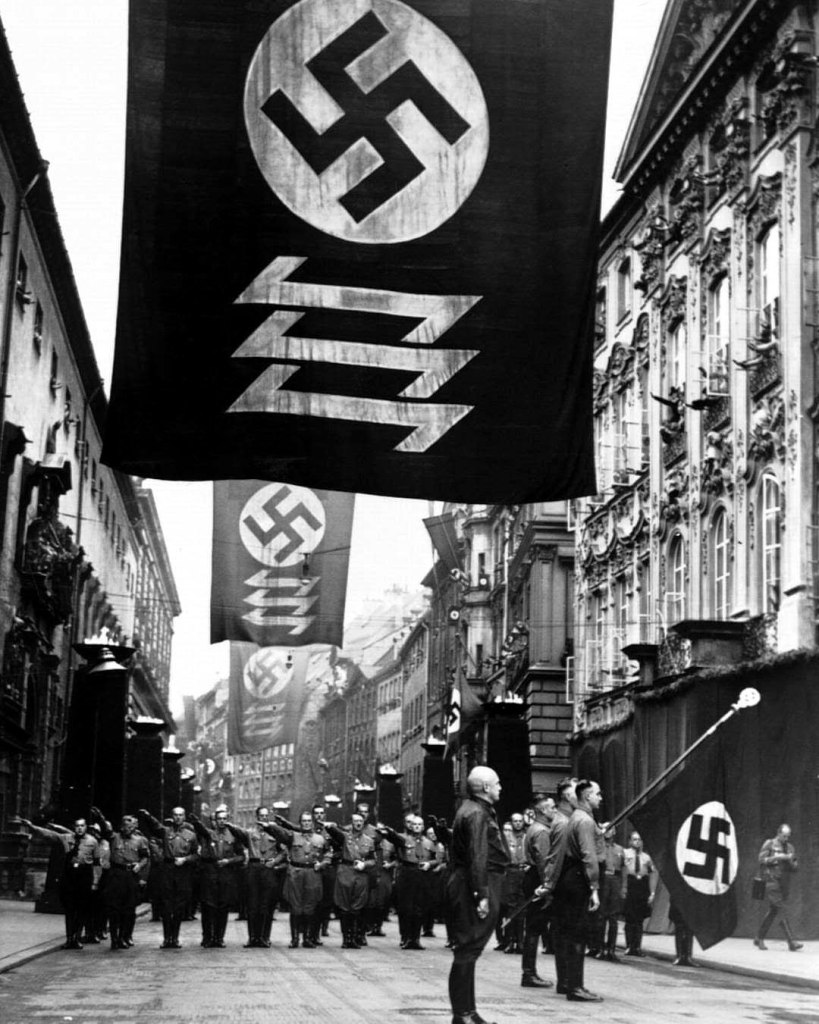
An allied aspect is that of the Invocation, a word or form of words designed to link the material with the spiritual, to send up prayer or supplication, and to bring down power to the Earth. “Heil!” is an obvious example. “Heil Hitler!” which eventually (in just a few years) replaced the likes of “Good day” and “goodbye” in, at least official, Germany. Hitler’s speeches are often very well-written, erudite, informed, but the power of Hitler’s oratory was not founded on its content, but on something above and beyond content. Yet that still required words as a basis.

When we consider how to pull the UK and Europe out of the mess into which it is sliding, we must consider the sacred power of the Word and use it.

Notes

https://en.wikipedia.org/wiki/Trotsky_(surname)

The Way Forward for Social Nationalism in the UK

The talent of the strategist is to identify the decisive point and to concentrate everything on it, removing forces from secondary fronts and ignoring lesser objectives.”

Those words of Clausewitz are often taken to encapsulate the essence of strategy. How are they applied to the socio-political question in the UK (England, primarily) from the social-national point of view?

“The Decisive Point”

The “decisive point” or objective, ultimately, is the formation of a British ethnostate as an autonomous part of a Eurasian ethnostate based on the Northern European and Russian peoples. However, within the UK itself and before that, the objective must first be drawn less widely, as political power within the UK’s own borders.

The Gaining of Political Power in the UK

The sine qua non of gaining the sort of political power required is the existence of a political party. More than that, a party which is uncompromizing in its wish to entirely reform both State and society.

History is replete with examples of states which have seemed not even just powerful but actually eternal, yet which have collapsed. Ancient Rome, though perhaps not a “state” in our modern sense, is perhaps the one most embedded in the Western consciousness. More recently, the Soviet Union and its satellite states. In between those two examples (but among many others) we might cite the pre-1914 European “settlement” based on the empires and kingdoms which collapsed during and after the First World War: Germany, Austria-Hungary, Russia, the Ottoman Empire.

The main point to understand is that, in situations of crisis on the large scale, it is not the political party with the most money, erudition, developed policy or even membership that comes out on top, but the party with the most will or determination. That means the most disciplined party under the leadership of the most determined leader.

It is better to have a party consisting of only 1,000 which is tightly-disciplined and self-disciplined than one of 100,000 which is a floundering mass of contradictions. When a national crisis occurs, such as 1917-1921 in Russia or 1929-1933 in Germany (to take two obvious examples), the people instinctively turn to the party perceived to be strongest, not strongest in numbers, money, intellectuality or number of members, but strongest in the will, the will to power.

The Party

A party requires leadership, members, ideology, policy and money. Everything comes from the leadership and the membership, in symbiosis. In practical terms, this means that policy is open to free discussion, up to the point where a decision is made as to what is party policy as such. Also, it has to be understood that a party requires money as a tank or armoured car requires fuel. To have endless fundraising drives, hunts for wealthy donors etc demeans and dispirits the membership. Having a “tithing” system renders such other methods unnecessary. The members sacrifice an agreed amount of their post-tax income, such as 10%. The party organizes itself and its message to the general population using that money.

As a rule of thumb in contemporary Britain, it might be said that, on average, each member will provide something like £2,000 per year to the party. A party of even 1,000 members will therefore have an annual income of £2 million, enough to buy not only propaganda and administration but real property as a base. By way of comparison, the Conservative Party in 2017 has an income of about £3.5 million.

Elections

It must be understood that elections are only one way to power, but they are indispensable in England, for historical-cultural reasons. A party which cannot win elections loses credibility rapidly once that party is large. In the initial phase, no-one expects the party to win Westminster or even local council seats, but after that, it has to win and so grow, or deflate as the BNP did and as UKIP is doing now. The problem small parties have under the English electoral system is that a Westminster seat can be won only with, at a minimum, about 30% (and usually 40% or more) of votes. The insurgent party is in danger of spreading itself too thinly, in every way. UKIP’s history illustrates the point: in 2015, about 12% of votes cast (nearly 4 million), but only the one MP with which they, in effect, started. The answer is to concentrate the vote. That is done by concentrating the members and supporters of the party geographically.

Safe Zones

I have blogged previously about the creation of safe zones and especially one primary safe zone (possibly in the South West of England). If the members and supporters of the party gradually relocate into that zone or zones, many things become easier, from protection of buildings, meetings, exhibitions etc to the election of councillors and MPs. I have also blogged about the magnetic attraction such a safe zone might exercise over people in the UK as a whole.

The Decisive Time

The “decisive time” cannot be predicted. In Russia, Lenin (at the time in foreign exile) thought that the 1905 uprising was “the revolution”. He was wrong. He also thought that the first (February, old-style) 1917 uprising was not “the” revolution. He was wrong again. It was.

https://en.wikipedia.org/wiki/February_Revolution

Lenin had to hurry back to Russia (arriving belatedly in April 1917, old-style) not only to try to take control (he failed in that and had to foment his own coup d’etat in October 1917) but to avoid being sidelined and so becoming an almost irrelevant footnote to history.

In Germany after 1929, Hitler likewise was not in control of events. In the end, economic near-collapse and political turmoil gave him the chance to win enough votes (33% in 1932) to form a coalition government which led on to full power in 1933, after the NSDAP achieved a higher –though still minority– popular vote (44%).

In other words, both Lenin and Hitler were the pawns of Fate while striving to be the masters of events. They had something in common though: highly-disciplined and ideologically-motivated parties behind them.

Practical Matters

At the age of 60, the last thing which is convenient for me is to form a political party. I have no need of such an activity as a hobby or absorbing interest. I am coming to the idea out of duty, out of a realization that something has to be done and out of an understanding that something can be done, if Fate concurs. I am not willing to compromize on overall ideology or on the way things are organized within such a party. I shall only establish a political party (which may become a movement) if it can be done on a serious basis. However, there is a need for a party to speak for the British people and there is a widening political vacuum in which such a party can thrive and grow.

Update 15 April 2019

In the two years since I wrote the above blog post, my view has not changed, that is

  • a political party and movement is needed;
  • there is at present no such party;
  • such a party can only be established if done on a serious basis;
  • I myself still do not have the means with which to found such a party; but
  • a political party and movement is —still— needed…

Update, 8 March 2023

All factors mentioned in the previous update remain the same.

Reports and Lies

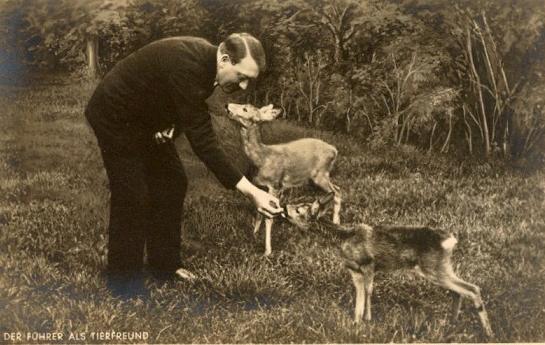
We are accustomed to reading the most arrant nonsense about Adolf Hitler. According to this stream of black propaganda (which started as long ago as the 1920s), Hitler was savage, unforgiving, tyrannical, vituperative, uneducated, a down-and-out from the gutter, a house-painter, sexually perverse, an erotomaniac, impotent, excessively interested in women, a gay, mad, sometimes mad, occasionally mad, only interested in his own material benefit, a tax dodger, even harsh toward his beloved dog, Blondie!

In Hitler’s own lifetime, a pack of lies was spewed out by his enemies: Jewish elements and interests; the Communists and Socialists who, many of them, supported or condoned Stalinism; also journalists working, in effect, for those same groups. During the Second World War, both the Soviet Union and the Western Allies maintained huge ministries and agencies dedicated to “black propaganda”. After 1945 the baton was passed to the increasingly prevalent Jewish or Zionist lobby and its major offshoot, the “holocaust” industry, aided by historians who knew that their careers depended on not challenging the approved narrative.

The “Hitler was a house-painter” story seems to have come from a Jesuit priest who was taken to hear Hitler in Munich in or about 1920. He asked what Hitler was (at that time Hitler had few followers and was unknown outside the city); the answer came, “I think that he is a painter of houses” (no doubt a garbled version, heard somewhere, of Hitler’s pre-WW1 life as a struggling art student and painter). In the 1930s, Churchill took up that false version of Hitler’s life as a young man, no doubt calculating that English snobbery would be inherently biased against a political leader with a past involving painting houses or the like. Even today, one occasionally sees reference to Hitler “painting houses”.

The idea that Hitler was “mad” came from an anti-Hitler newspaper editor (probably the half-Jewish scribbler Konrad Heiden), who, in the 1930s, told the American correspondent and anti-Hitler propagandist William Shirer (who posed as an historian after 1945) that Hitler was a “Teppichfresser” (“carpet-chewer”), meaning prone to bouts of insanity when he would supposedly curl up in rage on the carpet and chew the edge of the same. A complete invention, which has coloured the popular view of Hitler ever since, though even the Jewish historians no longer make the exact allegation.

As to the stories and speculations about Hitler’s  sex life, I should imagine that every possibility has now been explored by journalists and historians eager to reduce Adolf Hitler to a sort of freak show. Needless to say, the most likely possibility (that Hitler was “normal” but unenthusiastic) is of little interest, being unlikely to sell books or newspapers.

A more recent allegation has been that Hitler was a drug addict. Again untrue, though there is at least a kernel of fact underpinning this one, in that Hitler’s doctor, Morell, was a medical innovator who did tend to experiment on his patients. Hitler demanded results; Morell tried to provide them:

https://en.wikipedia.org/wiki/Theodor_Morell#Substances_administered_to_Hitler

(actually, though many have quailed at Morell’s preparations, such as the ones that included “intestinal bacteria”, these were the basis for the now-popular “active” yoghurt health drinks for the stomach now found next to the milkshakes in every UK supermarket).

What about Hitler as a vengeful tyrant? This seems to rest mainly on his reaction to the 1944 plotters, who, in the midst of Germany’s fight for survival, saw fit to blow up Hitler and the German High Command at Rastenburg in East Prussia (now in Poland). Yes, they were executed, some cruelly, it seems, but would it have been much different in, say, England, had Churchill been blown up by “traitors” at Ditchley Park (in, perhaps, 1940), alongside his military and naval chiefs?

In reality, Hitler was not a vengeful type. Anton Drexler, the locksmith who founded the then DAP which Hitler joined in 1919, had a serious quarrel with Hitler in 1921. He wrote a letter accusing Hitler of “acting like a Jew, twisting every fact” (!), was removed as head of the party (replaced by Hitler) and was given a purely figurehead position until he resigned in 1924, after which he was elected to the Bavarian Parliament for another party, serving as elected member until 1928. Despite that, Drexler was readmitted to the NSDAP in 1933, honoured (though not given any political position) and died peacefully in 1942. One cannot imagine Stalin treating a similar case the same way!

Another example. The first reports about an attempted putsch in Munich in 1923 (the Beer Hall Putsch, also known as the Hitler-Ludendorff-Putsch), reached the ears of a police commander called Sigmund von Imhoff, who contacted the Reichswehr commander of the city and seized the telephone and telegraph exchange. He was probably the most important reason that the putsch failed (amid bloodshed, Hitler himself being injured as the main march was brought to a halt).

One can well imagine what Stalin, on attaining power, would have done with an officer such as von Imhoff, but under Hitler he was not punished. On the contrary, he was promoted to Police General in 1933 and, in WW2, seconded to the Luftwaffe with the rank of Major General (he died in Bavaria in 1967).

This article could be ten times or a hundred longer, so many lies about Hitler and the Reich have been told and continue to be told. However, the few examples above perhaps will give pause to those who imagine that they have been told the truth about those world-historic events of the 1920s, 1930s and 1940s.