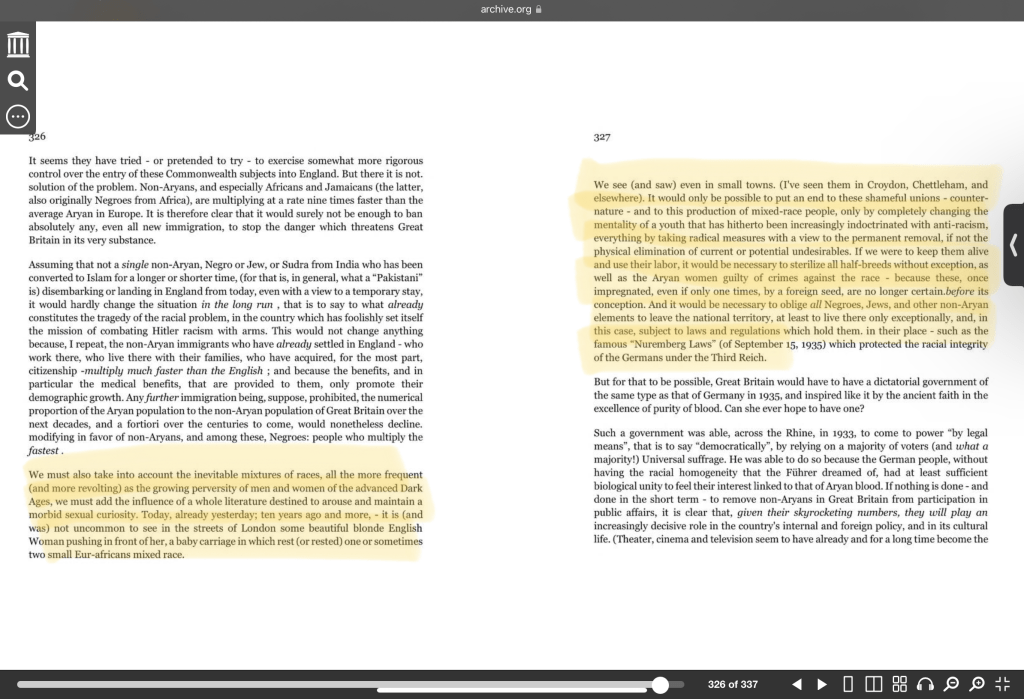
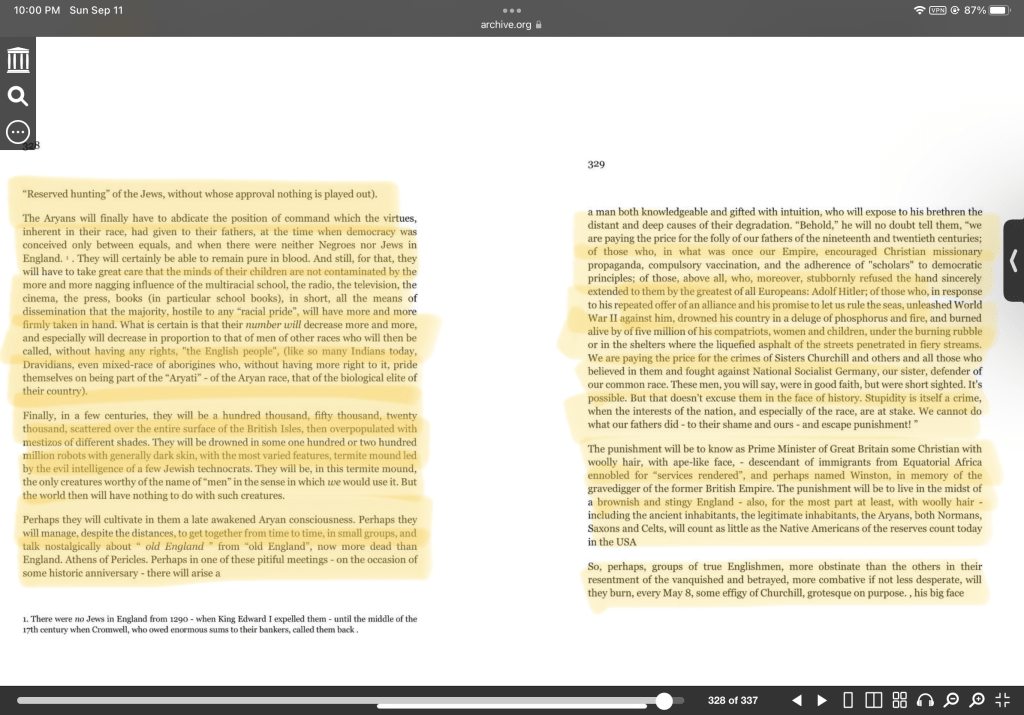
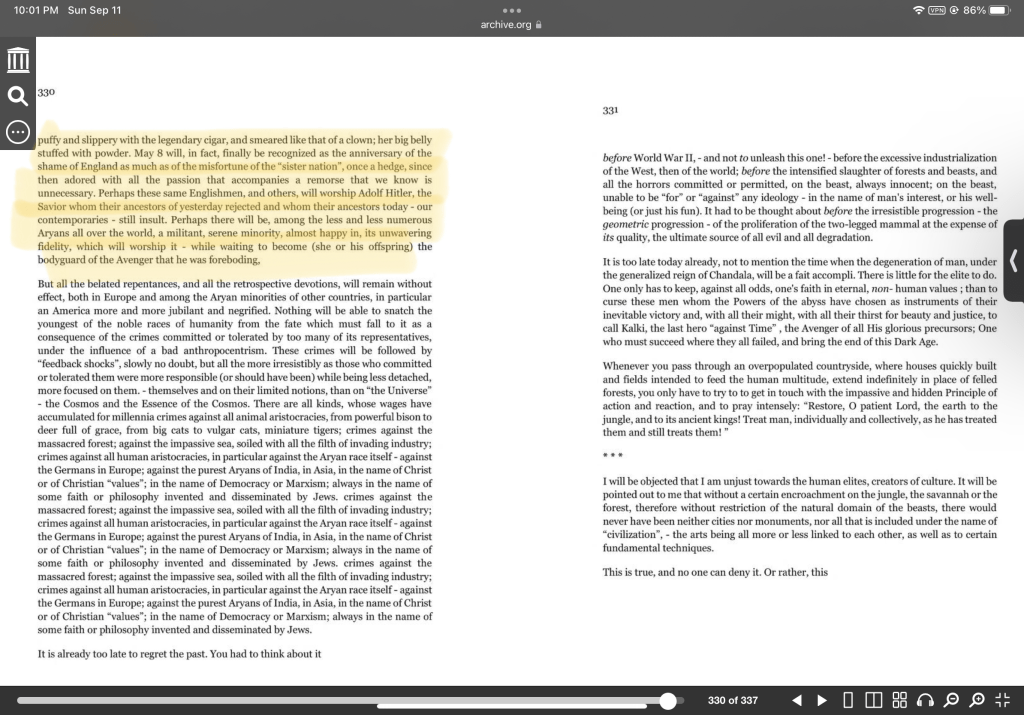
I happened to see a few pages written by Savitri Devi in the 1950s:
[note: pre-existing highlighting]
Prophetic.
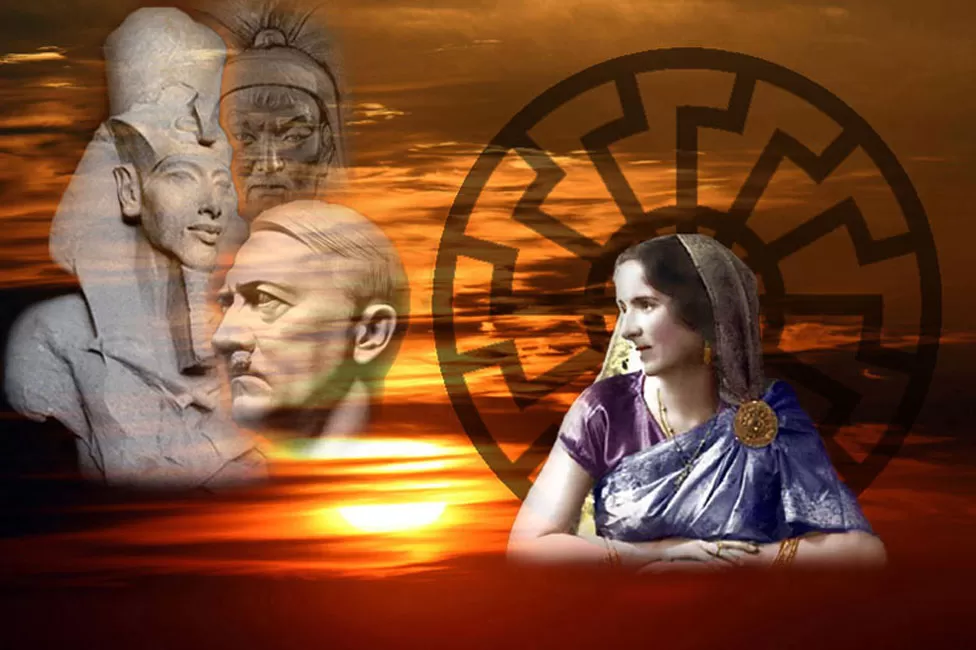
Interesting to note that Savitri Devi [Maximiani Devi Portas] was born 2.5 months prematurely. Premature birth is known to result, in some cases, in the person who has [re]incarnated having psychic powers (cf. St. Paul); https://en.wikipedia.org/wiki/Savitri_Devi#Early_years.
Ukraine
Though the “British” and other msm cannot be taken, without more, to be reliable, there have been numerous reports in the past 24 hours of a collapse of the Russian lines in parts of Ukraine east of the Dnieper; perhaps even betokening a general collapse.
‘Russia's northern front line in Ukraine appears to have collapsed, with military chiefs in Kyiv saying the army has recaptured at least 3,000sq km’ pic.twitter.com/opp81ry4m1
'Without Izyum and Kupyansk, Russia cannot effectively supply its forces in the north-east or the east of the country, and so further collapses, withdrawals and surrenders of Russian forces are to be expected’ pic.twitter.com/mWnP34DGKL
‘They may be able to stabilise their lines temporarily, but we have crossed a point of no return. Russia's forces were previously poorly equipped, supplied and of low morale. To that list you can now add terrified of encirclement' pic.twitter.com/vKzIBsYL1X
If Russia is not to be utterly defeated in this war (which would quite likely then see something akin to at least a palace revolution in Moscow), it needs to escalate both numbers and force generally, and to think outside the box, as the leaders of the Reich often did, particularly from 1936 (recovery of the Rhineland) to 1944 (Battle of the Bulge).
If Russia fails to crush the Kiev regime, NATO forces, or NATO-equipped and NWO-controlled Ukrainian forces, will be within 280 miles range of Moscow.
This could be an existential danger not only for Putin but also for the Russian Federation.
More tweets seen
Ukraine suffering from blackouts as troops press counteroffensive against Russia https://t.co/nXU3zldbo2
My maternal great-grandparents were Ukrainian Jews who emigrated to the United States a century ago — fleeing violence and death inflicted by Russians. It’s awesome to see Putin’s ass being whipped now by President Zelenskyy, another Ukrainian Jew. 🇺🇦✡️
🧵🚨#RUSSIA: TVs in #SaintPetersburg have been hacked – all digital channels show a montage starting from 9/11 terror attacks in New York then subtly shift to footage of Putin's terror attacks all over #Ukraine. Very impactful. Key excerpts translated to English below ⬇️ pic.twitter.com/NexGnSSkQC
Who do you think might be behind that? I doubt whether the Kiev regime would be able to do it.
Im not even anti-Ukraine. Im anti-Western influenced Ukraine that leads us to endless war. I can’t control Russia or their politics so there’s no sense in saying anything to them, but I like to think I may be able to sway my reps in DC.
Are they winning suddenly? They make one small gain and you War Shills act as of that haven’t lost thousands of lives and thousands of acres. I stand firm. Ukraine should have negotiated from the beginning rather than fight back. And btw, no one else is fighting back for them.
BREAKING: The Biden administration has announced a $3 billion package to Jackson, Mississippi to fund massive repairs and updates to water infrastructure.
Just kidding. That money is going to weapons for Ukraine.
After all these years of the same msm and governmental bs, we still see tweets or newspaper columns implying that impoverishing the British people supposedly to help backward countries is somehow a “mistake” or “wrong policy”, when it is a quite deliberate part of a plan, the Coudenhove-Kalergi Plan.
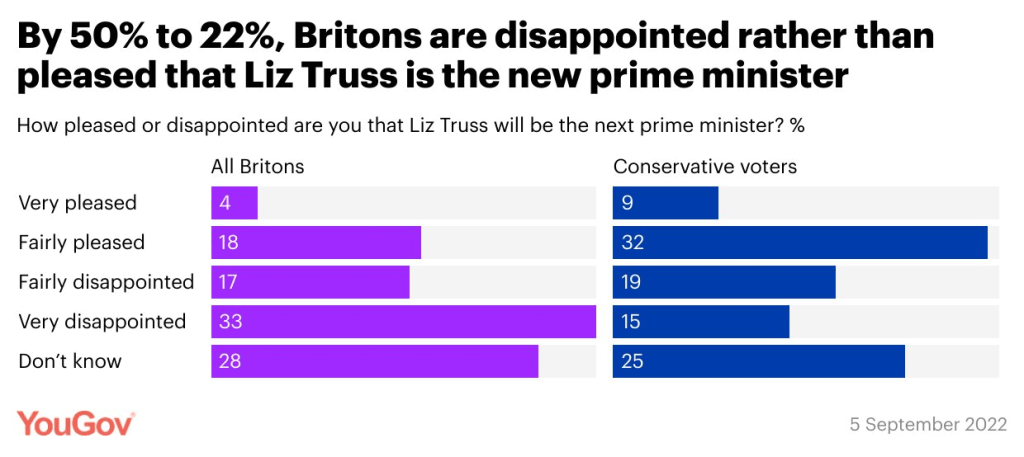
So only 22% of people are at all pleased that Liz Truss is or is about to be Prime Minister (once rubberstamped by the Queen). Not such a surprise, in view of the fact that the voters have not been asked to vote on this. At least, only those voters who are Conservative Party members, i.e. about 1 in every 500 people, of which only just over half voted for Liz Truss.
Liz Truss has therefore been voted for by about one person out of every 900 people. Not much of a mandate.
Even most of those who normally vote for Conservative Party candidates are not pleased about this— a mere 41% of those voters.
Coudenhove-Kalergi Plan in operation
“For the first time in Britain’s history, there will not be a white man in one of the four great offices of state.” [The Guardian]
LEAST WE FORGET what the Tories have done, this being amongst the worse – & after public outcry they gave water companies until 2050 to reduce sewage dumping thro infrastructure & the right to increase our bills to pay for the work.https://t.co/yUJIju123v via @MetroUK
Tory false populism and failed energy policies: shelved the nuclear strategy of the last Labour govt, sold off gas storage facilities, failed to push renewables adequately, abandoned the home insulation programme.#newsnightpic.twitter.com/S8R5xdEGqL
— Alan M – Square One is underrated💙 🇬🇧 🇩🇪 🇪🇺 (@am1874northwich) September 5, 2022
More on Ukrainian “refugees” in the UK—
“Why I’m glad to see the back of my Ukrainian refugee“
“As Olena’s luggage once again filled half of my downstairs corridor, ready to be loaded into the car that would ferry her to her new accommodation, I could hardly wait to see the back of her.”
I suggest that all well-meaning and/or virtue-signalling mugs thinking of hosting such guests read that Daily Mail article before buying into a pack of trouble.
Another point is that most of Ukraine is not a war zone in reality, not yet anyway. With the exception of part of the Black Sea coastal belt, and the odd military base, almost anywhere west of the Dnieper is not under attack, and that is well over half of the country. The same is true (so far) of the majority of territory east of the Dnieper.
In all, about three quarters of Ukraine is pretty safe and life is continuing in a relatively normal fashion, bearing in mind the overall situation of conflict, and the fact that Ukraine is not a real state at all but a failed, shambolic, corrupt, crime-ridden kleptocracy, run by a Jew cabal.
Tweets seen
Yes @jonboyjon1976 I am supporting his freedom of speech and opposing the government’s lawless use of arbitrary punishment against him. I regard this as my civic duty. Do you * oppose* freedom of speech or support arbitrary punishment? https://t.co/iPbTPYyhb0
@robertchallis. As I’ve written in The Mail on Sunday, I regard it as wrong. I don’t know which law might make it illegal,but in that case punishment should follow arrest, charge, trial and conviction.We call this due process. What I am protesting against is arbitrary punishment. https://t.co/ulFkvyydGz
Tweeter “Gerard” must be a complete idiot. Look at a. the population numbers for Russia and Ukraine, then b. at the full military and/or destructive power available to both; then c. at the economic strength of both.
I certainly do not advocate this, but what does tweeter “Gerard” think would happen if Putin landed a nuclear bomb on Kiev?
Political ambition is a dangerous thing. Those in its grip are often deluded by beliefs which bear little relation to reality. Nobody should go into politics until they have raised children to adulthood, or fought in a war, or run their own business. Or something of that sort. https://t.co/59Zdf6s2x0
The free market is a liberal obsession, and has been ripping through Communist China fur decades . There is nothing conservative about such crude money-worship. Conservatism values the family, the little platoons, tradition and permanence, not unending waves of greed. https://t.co/d5qvwrLbwE
The obese Therese Coffey, the new Health Secretary.
This is how u know NOTHING is going to change.
The NHS is a repair & accident service, it is not a healthy lifestyle service. A Health secretary shd have a handle on what a constitutes a healthy life.https://t.co/DSMilJORP8
I have not listened to LBC joke radio since about 1976, but I see that irascible radio loudmouth Nick Ferrari (pro-Jewish lobby drone) has today referred to “Boris”-idiot as “a supremely successful leader“. Just one example of the unreality that pervades the UK’s msm.
More music
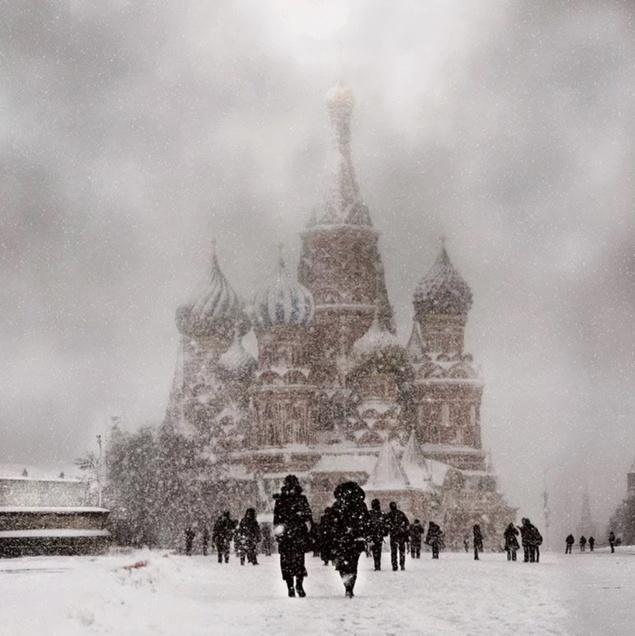
[Panoramic view of Moskva river and Kremlin at sunrise]
Eddie Izzard
Intentionally or not, Eddie Izzard shows how supposedly intelligent people will go along with anything if they think that’s the approved opinion. pic.twitter.com/FMcqVImrvR
A not-very-funny (because it could just happen) piece of political satire.
In the circumstances mooted, only a [self-censored…] of the evil in society would cleanse this country.
Eddie Izzard is a man who enjoys wearing make up & feminine clothes. That’s entirely his choice. However it doesn’t mean he is a woman, any more than my cropped hair, jeans & lack of lipstick make me a man. Please don’t reinforce regressive stereotypes with incorrect pronoun use
I applaud Eddie Izzard's courage in becoming the Screaming Lord Sutch of our generation. We've long needed a hilarious spoof candidate to remind us our politics is broken. pic.twitter.com/bSRn2TMEzs
Proof that this society, at least in large parts (which means overall, really) is broken. Many people are so confused about reality that they cannot distinguish male from female, good from bad, decent behaviour from mere virtue-signalling, and social cohesion from fake communitarian nonsense (such as the brainwashed plebs of 2020, “clapping for the NHS” on order, or under social pressure, outside their dwellings).
The Labour Party is especially infected with socio-political disease.
More music
More tweets
Therese Coffey who hid 9 reports that apparently detailed wrong doings and cruelty in her last department is Health Secretary, Deputy PM – She is also best friends with Truss. https://t.co/XOoGOZRljv
There is no real democracy in the UK, just a rigged electoral system designed expressly to maintain a mere facade of democracy while, in reality, providing the voters with a fake and basically binary Con/Lab “choice” leading to an ultimately-similar result no matter which party “wins”.
Ken Clarke on BBCr4today said that the UK is heading into a deep long lasting recession even worse than the one Ted Heath's govt created. National Debt is 100% the equivalent of GDP – only ever happens when the Tories are the govt. Some party of FISCAL RESPONSIBILTY.
Free money for “Covid” “panicdemic” nonsense, free money for the regime of the Jew dictator Zelensky, free money for migrant-invaders and hoteliers, free money for MPs, free money and tax cuts for speculators, but poverty and suffering for most of the British people.
PAHAHAHAHAHAHAHAHAHAHAHAHAHAHAHA
She voted for 70 million people to be placed under potentially fatal house arrest, for no reason, multiple times.
What the fucking hell do you think she's going to do to defend the 'principles of liberty'? https://t.co/pR4sBvl8qF
…and the “BLM” “useful idiots” talk about “cultural appropriation” by white Europeans! Of course, the blacks are just being used by the “you know whos” (((you know whos))). “They” are those who infest the world of TV, film and radio (and the Press), not the blacks.
Late thought
I saw a minute or so of the public valete of “Boris”-idiot in Downing Street. Pathetic. Entirely expected. Pitiful, really.
There was the usual back-of-postcard “classical” reference (to Cincinnatus— https://en.wikipedia.org/wiki/Lucius_Quinctius_Cincinnatus), in order to remind the public that Johnson was at Eton and Oxford, and the usual pathetic jokes, this time mainly about how Johnson saw himself as a “booster” (rocket) to get Liz Truss into orbit. To my mind, more like a “booster” (injection) that poisons and kills the recipient. Anyway, as far as I know, only former MP Mark Field has been able to get Liz Truss into orbit, and she very quickly fell to Earth in the muddy fields of South West Norfolk.
“The boss of RAF recruitment has said she is ‘unashamed’ of the force’s diversity targets, amid claims that it has effectively paused its recruitment of white men.”
[Daily Mail]
The RAF has become largely a pathetic joke. Incidentally, this is the “RAF senior officer” in question: https://en.wikipedia.org/wiki/Maria_Byford. A dentist by training…
One starts to wonder why the RAF (and Royal Navy, and even the Army) even exist.
“A lot of people in the more depressed parts of my constituency often sadly smoke and cigarettes are £12 a packet.
‘And people find it difficult to stop smoking.
‘So there are other ways we can help people – through smoking cessation, helping people budget and also… giving people the skills to make simple, nutritious meals from basic ingredients.
‘Because if you are going to live on takeaways that is a very expensive way of feeding your family.‘”
[Robert Goodwill MP, quoted in the Daily Mail].
This is Robert Goodwill: https://en.wikipedia.org/wiki/Robert_Goodwill. A proven expenses overclaimer, who also “employs” his wife via his MP expenses (she gets £30,000 a year for a part-time job, assuming that she does anything at all), he is a farmer of some kind, meaning that he inherited land and has been getting farming subsidies for that (for decades)..
The sort of nonsense that the ironically misnamed Goodwill is spouting (i.e. that the poor are only unable to live decently because they smoke, drink, buy takeaway food or the wrong kind of food, or otherwise waste money) has been around for a long time. It predates even Victorian ideology, and Orwell examined it in one or two of his 1930s essays.
Having said that, there is a grain of truth in that narrative about smoking, drinking, being unskilled in cooking etc, but —as Orwell noted— people living in poor circumstances want a little of what we might call comfort purchases .
The fact is that the cost of living has started to get out of control, a result of years of inflationary policies, some of which stem from the giveaways of Sunak during the “panicdemic”. Pay has not kept pace, State benefits even less so.
“Conservative” political drones and the corrupt msm are now starting to blame the poor (again) for their poverty, and suggesting everything from fasting to never heating homes to cooking classes, in fact everything except paying more to both workers and benefit recipients (and many people are both).
In fact, Goodwill is so dim that, despite having made it to junior minister several times, he has always been sacked before very long.
The fact is that the MPs we have now are mostly a very poor lot, a very decadent lot, a very stupid lot, and they have no interest in being better informed. They only understand one thing, but in our “free country” (as it used to be called) I am “not allowed” to mention it, or if I do, the poundland KGB (toytown police) will probably be at my door (again).
“YOUTH SUPPORT FOR A REACTIONARY RIGHT PARTY In order to test young people’s support for a new radical or reactionary right political party, we polled the same question in a specific poll of 1,010 18-24-year-olds living in Britain between 15 and 19 April 2022 via Focaldata, weighted to be representative of the national 18-24 year old population. Consistent with our findings of 18-24s from the full nationally representative poll (37% supported), 35% of 18-24 year olds said they would be likely to support a new party that says it wants to push back against ‘woke’ culture, reduce Government spending, reduce taxation, rule out any future Covid lockdowns, privatise the BBC and Channel 4, challenge the ‘islamisation of the UK’ and support unrestricted freedom of speech. Support was much higher among young men (43%) than young women (28%), and out of step with national trends, graduates were more likely to voice support for such a party (39%) than those without a degree (32%). We also asked those who said they would support such a party (n=358) whether they would continue to support such a party if critics accused this new party of being far right, a characterisation the new party strongly denied. Worryingly, an association with the far right did not have an impact among the majority of young supporters – as 46% said they would continue to support this party, 31% said they would not now support the party, and 23% remained undecided. Unlike among the general population, where violence and extreme views of populist and radical right parties can be disrupted by exposing associations with violence and extremism, support for reactionary politics among young people is unlikely to be easily unsettled by allegations of being far-right.”
From a report (in my view, very biased in its premises anyway) by or for the mainly Jewish “Hope not Hate” crowd.
Who says that a new party would do all of these? “Push back against ‘woke’ culture, reduce Government spending, reduce taxation, rule out any future Covid lockdowns, privatise the BBC and Channel 4, challenge the ‘islamisation of the UK’ and support unrestricted freedom of speech.“
Social nationalism would not “reduce Government spending“, nor necessarily reduce taxation. As for “unrestricted freedom of speech“, that is a naive and stupidly uninformed way of putting it. Direct personal threats should be and always have been unlawful in the UK, certainly in modern history.
The issue is free speech on social, political, religious and historical topics. One should be able to speak freely about Jews, blacks etc, and about Judaism, Islam, Christianity etc, inter alia, including the now-ludicrous “holocaust” farrago.
In any case, a real social national party would do a great dealmore than the above quotation says. As was said nearly a century ago, “neither Revolution nor Reaction“.
As to this so-called “Hope not Hate” crowd, I wonder where the money comes from to fund this self-describing “anti-hate” yet entirely hateful organization with its full-time paid staff? A Swedish billionaire heiress and her Jewish husband were apparently donating huge amounts, and may still be. I do not know. How much, if any, comes from Israeli sources? I do not know.
The “EternalEnglish” Twitter account is now being heavily censored by Twitter itself. See the account on Twitter. Not all of his tweets can now be copied and pasted. The (((you know who))) element has been trying to get him closed down.
The Conservative Party is engaged in demographic attrition warfare against the British population. Tens of thousands more low-wage Asians are to be imported. pic.twitter.com/7cebSMo2hR
In Moscow, the defence ministry said that three MiG fighters with nuclear-capable Kinzhal missiles were delivered to the Chkalovsk airbase in Russia’s Kaliningrad exclave — Russia’s westernmost outpost, bordering Poland and Lithuania — as part of “measures of deterrence”
— The Times and The Sunday Times (@thetimes) August 18, 2022
Air-launched Kinzhal missiles with an estimated range of 1,200 miles were rumoured to have been sent with MiG fighters to Kaliningrad in February, but this was the first public acknowledgement of a deployment
— The Times and The Sunday Times (@thetimes) August 18, 2022
Stop pushing Russia. Ukraine is not any kind of security interest for the peoples of Western Europe (or the Americas).
What we are seeing is a “New World Order” [NWO] attempt to paint Russia into a corner. It has already resulted in the Russian invasion of Ukraine, and may result in far worse. Don’t do it. Don’t go there.
A huge #megalithic complex of more than 500 standing stones across 1,500 acres has been discovered in S. Spain, perhaps one of the largest in Europe. Dating to c.5500- 4000 BC, many faced east, aligned on sunrise at the solstices and equinoxes. #prehistoryhttps://t.co/OOifxT9eSO
The vessels were among hundreds scuttled along the Danube by Nazi Germany's Black Sea fleet in 1944 as they retreated from advancing Soviet forces, and still hamper river traffic during low water levels 2/5 pic.twitter.com/PBsmgA53VZ
We need a new law that say the British government can't spend £billions 'defending democracy' abroad if it can't even stop our beaches and sea having raw sewage pumped into them https://t.co/MmoGYYJtRF
…and now we are all going to pay the price for the majority who went along with the “panicdemic” without thinking— with the shutdown lockdowns, the facemask nonsense, the “social distancing” rubbish, the “furlough” payments, the business “loans” to fraudsters and others, the £38 BILLION thrown away on useless “test and trace”, the vast amounts wasted on “PPE” in hospitals, the never-used “Nightingale” fake “hospitals” etc etc etc…
Is this how Western civilization will end, not with heroic or bloody battles, but with hordes of non-whites and riff-raff looting convenience stores, as everything runs out?
Whites are a tiny minority on earth and it's only our countries being flooded by genocidal levels of mass migration, yet we're the only ones not allowed to have racial/ethnic identity.
If they want to convince most people that lockdowns were a 'mistake' and therefore not a viable future solution, it's because they can then say that mass mandatory vaccination is the only option.
Locking 70 million people in their homes and stopping almost all access to healthcare will OF COURSE cause massive problems. But it doesn't result in young people, who've been out of lockdown for months and feeling perfectly healthy, suddenly having strokes and heart attacks.
After the “gas chambers” part of the WW2 “holocaust” narrative, the bulk of the “Covid” narrative, and within that the “vaccination” scam, must be the biggest hoax ever.
I grow increasingly pessimistic about the international situation.
The only chance that the Kiev regime of the Jew Zelensky has to survive in power there is to continue to get more (and better) arms from the NATO bloc. That, and to provoke a wider conflict.
We see that, in the past 24 hours, a series of Ukrainian (?) attacks on Crimea (where 90%+ of the population is Russian) and on Russian territory itself.
The Russian advance has slowed to a crawl.
Putin is not going to withdraw from either Crimea or the Donbass, yet he is not in a position to deal the Kiev a knockout blow conventionally, as things stand.
Tactical nuclear weapons offer the Russian side a potential edge. The Ukrainians have none. A very horrific possibility, because it might mean large urban areas being destroyed, with all the pain and hurt that would entail. In such a scenario, NATO might take the opportunity to assist the Kiev side directly.
Who was “to blame” for WW2? To say “Germany”, is trite and simplistic. What about WW1?
If WW3 starts out of this Ukraine situation, it might be that Russia’s finger will be on the trigger first, but that, again, is a simplistic way of looking at a complex situation.
Can it really be that we are looking at the possibility that much of civilized Europe will be destroyed for really nothing, that “nothing” being because the NWO cabals want both to encroach upon Russia, and also to support the corrupt, shambolic, failed “state” of Ukraine? Horrifying.
I was sent some interesting quotations from Hitler. I do not at present have the citations (probably from Mein Kampf, possibly from the WW2 transcripts published in the 1950s as, in English editions, Hitler’s Table Talk), but will add them as and when. The quotations certainly read as if authentic. I believe them to be authentic.
“The ignorance of the broad masses about the inner nature of the Jew, the lack of instinct and narrow-mindedness of our upper classes, make the people an easy victim for this Jewish campaign of lies.”
“While from innate cowardice the upper classes turn away from a man whom the Jew attacks with lies and slander, the broad masses from stupidity or simplicity believe everything. The state authorities either cloak themselves in silence or, what usually happens, in order to put an end to the Jewish press campaign, they persecute the unjustly attacked.”
That sounds just like that which happened to me when I was wrongfully and unlawfully disbarred in October 2016.
“Culturally, the Jew contaminates art, literature, the theatre, makes a mockery of natural feeling, overthrows all concepts of beauty and sublimity, of the noble and the good, and instead drags men down into the sphere of his own base nature. Religion is ridiculed, ethics and morality represented as outmoded until the last props of a nation in its struggle for existence in this world have fallen.“
Exactly what has gone on for decades in “British” television and publishing (etc).
I despised Blair I despised Brown. I despised Cameron. I despised Clegg. I despised May. I despised Johnson. I despise Sunak. I despise Truss.#Democracypic.twitter.com/utHX7BkTEa
🔴The drop in living standards is bigger than during the financial crisis, the slump of the early 1990s or the stagflationary turmoil of the 1970s, even taking into account government help with energy bills
Were there a social-national party and/or movement worth anything, this would be, probably, the moment of lift-off (once the majority of the public start to suffer). As it is, as social-national people we look upon what is happening as mere observers, not active players.
Twitter is rotten. I myself was expelled (“suspended“, in Twitter’s weasel vocabulary) in 2018, after a pack of Jews finally managed, after years of trying, to get Twitter to remove my “account” (“@ianrmillard“).
As I predicted many months ago, Elon Musk turned out to be too intelligent to buy Twitter, once the results of his due diligence enquiries came in. It’s simply a dishonest organization (and one which is basically unprofitable, as most of its history shows).
How about not letting 1000s of foreigners in to GB every week? Nah! Let's just cover our (not his) beautiful country in concrete.
The “Conservative” Party leadership contest (“leadership“? Those cretins?) amounts to “which do you want, the Indian puppet on a stick, or the white woman puppet on a stick?“.
Just some salty rhetoric to grab the headlines during the leadership contest. In reality they're ALL singing from the same globalist hymn-sheet. https://t.co/Ns8UFO51gb
Did Russia impose sanctions resulting in driving up the price of energy? Did Russia lockdown our economy for two years destroying supply lines in the process? Did Russia print 4 Trillion dollars globally and hand it to their friends in the banking system??
I really dislike tattoos, especially —though not exclusively— on women.
Perhaps the only thing the SS and orthodox Jews had in common was a prohibition on tattoos, though some (not all) SS officers and men, mainly Waffen-SS, had their blood group tattooed under the arm in case of requiring a transfusion in or immediately after battle. As for Jews, if detained, they were tattooed compulsorily, with a prisoner number.
…”in your nothing I hope to find my everything” [Goethe, Faust; Faust’s reply to Mephistopheles].
The white Northern Europeans of today are an embattled minority, with many flaws but who, nonetheless, are the only community capable of forming, together with the Russians, the foundation for a quantum leap in evolution which can in turn trigger the formation of a germinal super-race on this planet.
“You carry in your blood the holy inheritance of your fathers and forefathers. You do not know those who have vanished in endless ranks into the darkness of the past. But they all live in you and walk in your blood upon the earth that consumed them in battle and toil and in which their bodies have long decayed.
Your blood is therefore something holy. In it your parents gave you not only a body, but your nature. To deny your blood is to deny yourself. No one can change it. But each decides to grow the good that one has inherited and suppress the bad. Each is also given will and courage.
You do not have only the right, but also the duty to pass your blood on to your children, for you are a member of the chain of generations that reaches from the past into eternity, and this link of the chain that you represent must do its part so that the chain is never broken.
But if your blood has traits that will make your children unhappy and burdens to the state, then you have the heroic duty to be the last. The blood is the carrier of life. You carry in it the secret of creation itself. Your blood is holy, for in it God’s will lives.”
[SS Verlag: material for instruction of the Hitlerjugend]
I have blogged on previous occasions about Zeppelins and other airships. I remain convinced that, with advances in technology, they have a great future. Anyone wanting to read my earlier blog posts and comments can search for them using the search box on the blog.
“We believe we have a responsibility and must take a lead,” the Green mayor of Hanover, Belit Onay, said.https://t.co/gNQDzW6wzk
— The Times and The Sunday Times (@thetimes) July 28, 2022
In Berlin the lights were turned off at 200 public buildings, including the Brandenburg Gate and Berlin Cathedral, while Cologne is considering shutting off the illumination of its cathedral
— The Times and The Sunday Times (@thetimes) July 28, 2022
“We can’t say yet how much gas will cost in November, but the bitter news is it’s definitely a few hundred euros per household,”
Robert Habeck, the economy minister, said. Some reports have said the levy could cost families an extra €500 a year
— The Times and The Sunday Times (@thetimes) July 28, 2022
It will take three to four weeks for all the illuminations to be switched off.
Habeck accused Russia of waging “an economic war” to break Europe’s resolve to support Ukraine. “We’re in a serious situation. It is time that everybody understood that” https://t.co/9de20gkfL9
— The Times and The Sunday Times (@thetimes) July 28, 2022
What was that about “sanctions hurting Russia“?…
All so unnecessary, but of course “Ukraine”, just like “Covid”, “monkeypox” and “climate change”, has just been weaponized by transnational conspirators in order to implement a global agenda for the “New World Order” [NWO] conspiracy/consensus.
Poke the Russian bear and see what happens…
“Prepping” may not be easy in Europe, compared to other parts of the world, but is worth looking at all the same. Our whole civilization is now in danger, not from Russia, “Covid”, or even “climate change”, but from parasites within the body politic of the West itself.
Just remind me: who is having to turn off heating and hot water? Russians? No, Germans. Who are facing heating bills 4x the level of a year ago? Russians? No, British people.
Who is to blame? Russians? No— the leaders of the Western NWO/ZOG “international community”.
I certainly do not agree with “Bootstrap Cook” that the solution to those problems is to “nationalize everything” (though I would not say no to railways, some energy supply, water supply, effluent disposal etc), her tweets here have some force.
I agree particularly with her that topping-up inadequate pay via Universal Credit is conceptually misconceived; I have always said that. It rewards economic enterprises which are poor-paying employers. It subsidizes economic enterprises via taxpayer monies, in effect. Basic Income is a better way to go, for all its defects or problems.
“The devastating impact of Covid-19 litter on Earth’s wildlife: Shocking photos snapped in 23 countries show animals tangled in face masks, disposable gloves and other personal protective equipment”
You still see cranks, though not many now, wearing facemasks. I notice that almost all are of pensionable age. Probably thoroughly brainwashed to do what “authority” says, even though in this case “authority” (in 2020-2021) consisted of idiots such as “Boris”, Little Matt Hancock, “Professor Lockdown” (Ferguson) and similar total cretins.
Late tweets
Indeed – going so far as to deny that life ever used to be like this or could ever be like that again.
Interesting, a specialist in chemical and biological warfare. Sounds furious. I wonder why…
…and Jews are not even mentioned in the cartoon. What was that quotation from Stendhal?
Huge thanks to @bobscartoons. for sharing his story and thoughts was a huge privilege. ‘Masks of Benevolence: the art and times of Bob Moran’ https://t.co/RGqNAWN92Y
These blue tick attacks are a strange phenomenon though. It's as if some message is sent out across the blue tick community to have a go at a particular Tweet. It's the same weird flocking behaviour that led to me losing my job. And it's largely people nobody's ever heard of.
“They” are behind most of it. “The usual suspects”. The “you-know-who” (((element))).
The amazing Kathy Gyngell, who edits @TheConWom has been banned from Twitter for expressing sympathy with victims of the you-know-what. These are confirmed victims – they have the compensation or death certificate to prove it. It's disgusting.
If you have not yet worked out that the NWO/ZOG matrix pretty much controls Twitter, you have not been paying attention. Twitter is a massive scam, a con operation that has had untold billions pumped into it, and has scarcely ever, in all its years of operation, come close to turning a profit.
I blogged some time ago about how I was sure that Elon Musk was too intelligent to buy Twitter. Guess what? He has withdrawn. He obviously found out what a con the whole thing is.
Why was it set up? In order to monopolize free speech on important subjects, then to destroy that free speech.
Yes, there are innumerable other platforms, but they are either small and basically of little account (eg GAB), or are repositories (like Tik-Tok) not for significant discussion or exposition, but for blacks, Koreans… whoever…to dance to silly tunes, or for amusing clips of animal life.
Most of the interesting alternative voices on Twitter have been removed from Twitter in recent years, from David Icke and Patriotic Alternative to Katie Hopkins and Tommy Robinson (and others, including me, eventually removed in 2018, after a pack of Jews had plotted to get me out for years).
— Russian Embassy, UK (@RussianEmbassy) July 29, 2022
I favour clemency where possible, so do not necessarily agree with the above, but for 8 years, the forces of the Kiev regime have been targeting civilians in the Donbass region. Terrorism by any other name. Apart from which, this is almost a civil war; it is certainly not a declared war in the international law sense. All the same, surely it is better to keep prisoners for exchange or ransom?
Twenty-two of the Tories’ biggest donors – who have donated a combined £54m to the Conservative Party – have been made lords since 2010.
What the voters of Britain, certainly of England and Wales want, but completely unconsciously, is a contemporary, and less military-oriented, form of National Socialism. Call it social-nationalism, “national rebirth”, even “National Socialism with a human face” if you like. A country that is evolving higher in all ways, not degenerating. A European-race country. A country that takes care of its citizens, rather than virtue-signalling and inviting the dregs of the Earth to infest our land.
This (read that report) is a trend that has been going on for 2-3 decades now. I could recount numerous examples from my own experience. One of the least egregious would be that involving a pupil in my own chambers in Exeter (in the early/mid 1990s, I was practising in London, but after working and living in various places overseas from 1996-2002, returned to the practising Bar in SW England in mid-2002).
The pupil to whom I refer (and who shall be nameless, partly out of courtesy but equally because I have actually forgotten her name), was from Northern Ireland.
Now I have to say that I find the Northern Irish accent one of the most difficult in the UK to understand easily but, in addition to that, the girl in question had a pretty bad speech impediment.
You might ask why on Earth someone with a bad speech impediment wanted to go to the Bar in the first place, or was not sidetracked into other career options at an earlier stage, but there it is. Of course, not all barristers spend much of their time in court.
Now, said girl pupil was, like many Bar pupils, far more obliging and pleasant when a pupil (and no doubt trying to get along pleasantly with members of chambers) than she was once taken on as a tenant or —as I think she was, cannot now recall exactly— squatter (a quasi-tenant but with no rights of tenure). I myself only saw her in passing, really, but did note that, once she was actually working as barrister, she seemed rather abrasive, judging admittedly by the very few times I saw her at (though not in) court. I never had any trouble with her myself, and in fact saw little of her.
Now the interesting thing was that not only did chambers (notably in the person of the main Clerk to Chambers) champion that young woman, but claimed that instructing solicitors loved her. Well, maybe. Seems strange to me that someone with both a speech impediment and an accent that was more like a gargle could be at the English Bar doing court work, but there we are.
I harbour a suspicion that people tend to bend over backwards to be nice, so to speak, to the physically-disabled, as many do also to some of the ethnic minorities. That is fine as far as it goes, but not when it amounts to a kind of lie.
Incidentally, I seem to remember that the person noted above returned, in the end, to her native Ulster, and maybe left the practising Bar.
Digressing further, I happened, out of curiosity today, to look at the website of the successor chambers to the one to which I belonged in Exeter from 2002-2008 (and which, an amalgam of two or three sets, is now the largest in the South West outside Bristol). I saw that several people that I liked are still there, and I saw that not only (as I knew already) is my old head of chambers now “His Honour” (a Circuit Judge) but that someone else I knew in chambers, a former magistrates’ clerk, with an encylopaedic knowledge of some aspects of (in particular) criminal law, is now also “His Honour”. Unless it is just someone with an identical name, but I think not.
That last was a nice little man, very polite and pleasant, who wore his considerable knowledge lightly. I seem to recall that he had written a well-received book on sentencing. Glad to see that his knowledge and diligence has been rewarded.
I was amused to see that two people who had rather more than a spat in chambers are now both members of that set. I liked both of them. One was a then-young man who was very eager to progress chambers (my wife called him a “Young Turk” for his enthusiastic diligence, but in these dumbed-down times, I suppose I shall have to explain that he was not a real Turk!). He was married to a pretty young woman whom I believe I met once at some chambers reception or other.
The other barrister, also young, was an ex-solicitor whose grandfather had founded one of the largest firms of solicitors in the South West. A very pleasant person.
Those people, with others in chambers, used to go shooting together, an activity of which I thoroughly disapproved. I disapprove of all hurt done to animals, particularly for sport or “fun”. I even disapprove of shooting humans, under most circumstances. Ironically, most of those I liked best in chambers were the shooters.
Anyway, one day, those two members of chambers were out shooting when a pheasant fell onto the head of the wife of the “Young Turk” and knocked her out in the field. Whether that preceded or not the affair that she apparently had with the other young barrister, I know not. It later transpired that, after much bad blood, I was the only member of chambers to be unaware of the feud that ensued, my mind being occupied by other matters (or as my wife would say, “in the clouds”) and, also, the fact that I was, by then, only spending half the month in the UK, the rest in France and some other countries.
I suppose that the two former antagonists have either buried the hatchet or (and/or) come to the realistic conclusion that that set is more or less “the only game in town” (in Exeter) now. Time heals all wounds, they say (though I remain doubtful of that, speaking generally). The events in question were after all some 15 or 16 years ago now.
Really heartened by solidarity in response to this. I was one of the women he harassed when I was very young and my DMs were full of male journalists who could tell I didn’t have a support network/ was vulnerable.
— TheEndOfEverything (@EternalEnglish) June 9, 2022
A ‘reset’ is meant to be a return to something that existed previously. The general idea being that doing so makes things better – fixes some problems. The ‘Great Reset’ is not that. It’s a total transformation to something entirely new. It is wholly destructive, not corrective.
The Independent witnessed losses being inflicted on the Ukrainian military and the lack of long-range firepower to fight back; one soldier interviewed has since been killed and another three injured
At last, a reality check in the otherwise useless and in fact often deliberately untruthful UK msm.
I was blogging months ago that the forces of the Kiev regime would soon be running short of military resources, particularly fuel and ammunition.
J.H. Brennan
I discovered today that J.H. Brennan, whose early 1970s books Astral Doorways and Experimental Magic I owned from 1978 (when I was 21-22 y-o), is still alive, now aged 81: https://en.wikipedia.org/wiki/James_Herbert_Brennan.
A pretty good writer, in my opinion, with an easy-reading style (judging by the few books of his that I have read).
More tweets seen
Since 2008, politicians and bankers have kept recession at bay by pretending it wasn’t happening. That strategy is beginning to unravel.@willydunn explains why the ostrich economy is heading for a reckoning.https://t.co/TiNChSZPHr
The explanation was that someone (us) would have to pay for the deficit incurred by the banks, but the reality was that by removing the single biggest spender (the government) from the economy, they hampered recovery.
With monetary policy keeping financial markets on steroids, speculative investment led money towards whatever seemed to carry the most risk: companies with a failed business model, or ones that had actually gone bankrupt.https://t.co/r1noQATezn
Worse still, the high energy prices and inflation of commodity prices caused by the pandemic would provide the Russian kleptocracy with the money to conduct a brutal invasion of Ukraine.
The war in Ukraine was the first item on a list of factors that the World Bank’s Global Economic Prospects predicted were likely to lead the world into a new global recession. pic.twitter.com/Xa9uIH8ypN
No one wants to accept that the world faces a “decade of despair”. While the World Bank and financial institutions are reluctantly beginning to agree, central bankers are still holding out hope for a “soft landing”.
And politicians are happy to let them do so, because the longer the ostrich keeps its head in the sand the more it can be made a scapegoat when the hurricane arrives.
Interesting analysis, and I can agree with much of it, though I do not accept that neurotic bighead, Gordon Brown’s, bailout of the bank swine was right at all— better to have let them go bust, imprison the wealthy bankers, then step in to help those with say £200,000 or less on deposit; and let the affluent and wealthy go smoke.
I agree that the “austerity” nonsense of the part-Jews David Cameron-Levita and George Osborne was disastrous, causing misery to millions without in any way dealing with the real problems of the financial sector and “national debt”.
Trudeau's Justice Minister David Lametti has just announced that people don’t have an “absolute right to own private property” in Canada‼️☝🧐🙏👇👇👇 pic.twitter.com/YPuSD31UGL
Seems that the vindictive Jew-Zionist propagandist, Simon Wiesenthal, owned a watch now valued (partly, no doubt, by reason of his having owned it) at £400,000.
Ironic. Wiesenthal presented himself as living in modest circumstances in Vienna, reliant on various minor (it seems now maybe not so minor) income streams (including a stipend from the Israeli external intelligence org, MOSSAD).
Indeed, the thriller writer Frederick Forsyth portrayed Wiesenthal as rather down-at-heel in his, Forsyth’s, book, The Odessa File.
I suppose that it is unlikely that Alison Chabloz will be inclined to write a new song about it all, now that she has been imprisoned —again— for lampooning Jewish behaviour. Pity.
The “Wiesenthal watch” is a Patek Philippe, the so-called “Rolls-Royce of watches”. They do keep their value well. I knew of a couple of such watches sold by the writer and diplomat Miguel Serrano [https://en.wikipedia.org/wiki/Miguel_Serrano], who was very friendly with a London-based friend of mine.
Serrano wanted to sell a couple of Patek Philippe watches at (if I remember aright) Sotheby’s. I cannot now recall exactly when that was, either late 1980s or early 1990s. I think late 80s.
One of the watches had been given to Serrano by Indira Gandhi [https://en.wikipedia.org/wiki/Indira_Gandhi]. Serrano had been Indira Gandhi’s lover (while he was in India as Ambassador, from 1957), though that fact is absent from Wikipedia etc. Serrano himself made no great secret of the liaison, at least to trusted friends, and was apparently invited to Indira Gandhi’s funeral after her assassination.
I cannot recall now how much the watches fetched at auction; many thousands, and perhaps over £20,000. A lot, bearing in mind that this was over 30 years ago.
The watches were left in the keeping of my friend, who showed them to me; she put them up for auction for Serrano, who was still in Chile.
Serrano later came to London, collected the proceeds of sale, and spent £5,000 on a painting by Hitler, one of several also up for auction at that time. I might have been introduced to Serrano, but either I was out of the country, or other matters got in the way. At any rate, I never did meet him.
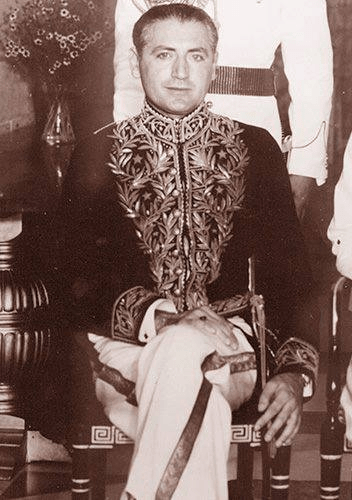
[Miguel Serrano, dressed in the uniform of the Corps Diplomatique, when Chilean Ambassador to India, 1957]
“Bank of England’s new doom-laden warning for the economy: Unemployment will rise, inflation will hit TEN PERCENT and post-Covid growth will stagnate – as interest rates rise AGAIN to a 13-year high of 1%.”
I am sure that most readers of this blog will not need to be told that the above has not been caused by Putin or his invasion of Ukraine, but by the nearly two years of ridiculous “Covid” restrictions, and the “free money” (supposed) giveaways (“furlough” payments, massive fraud, cash for cronies, “eat out to help out”, business “loans” etc).
The situation is made far worse now by the UK’s (and others’) sanctions regime aimed at Russia.
Britain should have loosely joined with Russia years ago, in return for cost-price gas and the defusing of the arms race.
Still, this might be the time for which social-nationalists have been waiting, if a credible and effective social-national movement emerges. So far, not; just ineffective and almost ludicrous little organizations, without weight, numbers, money, or credibility.
I have made just criticism in the past few years of, inter alia, Aaron Bastani and Ash Sarkar, and their idea called “Fully Automated Luxury Communism” [https://en.wikipedia.org/wiki/Fully_Automated_Luxury_Communism], but (despite not having read the book), I apprehend thatone of its basic premises is that the benefits of modern technology and productive techniques have been arrogated by a tiny minority of finance-capitalists. If my understanding of the book is correct in that regard, then I certainly agree with that view; indeed, it can hardly be denied.
Books such as The Spirit Level [https://en.wikipedia.org/wiki/The_Spirit_Level_(book)] have shown how inequality in the “Western” world has grown since the 1950s and particularly in recent decades. Numerous studies have shown how the remuneration and wealth (capital) of corporate owners and the highest strata of executives has become grotesque.
In the 1950s, in the USA the typical disparity between the pay of highest-paid and lowest-paid in a company was about 15:1. Now it is hundreds to one and, in not a few cases, thousands to one. That is without even getting into share options, capital gains etc
The same is true of the UK. There are many large companies where the top executives are getting a million or more a year (many millions in some cases) in salary alone, while the bottom-level employees are on something like £15,000. A ratio of at least 70:1, and in many cases hundreds to one.
It is not a question, for me, of inequality alone (some inequality is inevitable and indeed good) but of inequality so great and so unfair that it amounts to inequity.
We see how some of the wealthiest capitalists on Earth (Jeff Bezos, Richard Branson, Elon Musk etc) vie with each other to build their own space rockets, not to do anything truly worthwhile with them but to take what amount to joy-rides into space, accompanied by other hugely-wealthy individuals. Meanwhile, their own employees live on pennies, in many cases unable to pay their rent, feed their families properly, or achieve even a modestly-comfortable standard of living.
The fruits of scientific and technological innovation must be shared more equitably.
“Hopper“, not “Hooper” (and “they’re“, not “their“) (etc)…but never mind. It’s Christmas.
The Archbishop of Canterbury, the Most Reverend Justin Welby, has called for compassion for migrants crossing the Channel in his Christmas sermon and praised the "extraordinary" RNLI and Border Force crews.https://t.co/eFvqEid5Kbpic.twitter.com/2rVwAVCttu
“Give not that which is holy unto the dogs, neither cast ye your pearls before swine, lest they trample them under their feet, and turn again and rend you.” [Matthew 7:6]
…or, more likely, has decided to turn a Nelsonian eye…
It is entirely misplaced and wrongheaded “compassion” to invite into the UK (or to tolerate an unwanted invasion by) those who, most of them, despise British people and/or hate us, and who will be, at best, a heavy millstone round the British neck, forever.
Justin Welby will have to suffer no detriment by tolerating the migration invasion. No, that burden will be borne by the British poor, mostly.
I was going to keep the blog short today, and concentrated on purely Christmas topics (and one does after all have other things to do on Christmas Day), but the world has impinged on my retreat…
Free speech. Catalyst was the sentencing of Alison Chabloz for Holocaust denial which I thought did more harm than good. A lot of other things to do with censorship and forms of hate speech being criminalised. In the long run I don't see a benefit to it, more the opposite.
Naturally, Christmas, as we know it in the UK and/or “Anglosphere”, is largely what people today often call “a construct” or “social construct”. You see in magazines or online quite a lot of historical detail about that.
In the UK, perhaps especially England, we have a fairly closely-defined idea of what Christmas should be: the Christmas tree, the angel or star atop the tree, carols, Santa Claus in his red suit, sitting in a sleigh in the sky, itself pulled by flying reindeer.
As many will know, the Christmas tree tradition, in England, dates back only to 1834, when one was installed at Windsor Castle; the tradition dates back longer in Germany, to the late Middle Ages.
As for the fairy atop the tree, that may be connected with the late Roman cult of Mithras, though that seems to me to be contrived, in view of the fact that the Christmas tree tradition itself is of recent historical origin. I would not say, though, that I am really qualified to pronounce on that aspect.
As to red-suited Santa with his sled or sleigh, reindeer etc, that is a conflation of ancient traditions, 19thC traditions, and “traditions” which come from as recent a source as 1930s American ads for Coca-Cola: see https://en.wikipedia.org/wiki/Santa_Claus.
In Russia, the 19thC saw “Grandfather Frost” emerge, a tradition at least half-heartedly kept up in 20thC Soviet times as an alternative to the usually disapproved-of and sometimes suppressed Russian Orthodox Christmas religious holiday (which takes place a couple of weeks after the Western one by reason of the fact that the Russian Orthodox church still uses the Julian Calendar).
I believe that some Christian occultists aver that the “Santa in a sleigh” picture has an underlying reality in that the Cosmic Christ travels spiritually around the world for the “12 days of Christmas”, assessing the overall spiritual condition of the world. Perhaps.
My own view is that it does not really matter that our 20thC/21stC idea of Christmas would seem slightly odd to Victorian England, and downright alien to the English of Tudor times. It is our mental picture, our idea of what is sacred, our idea of what is worthwhile. It encapsulates what has gone before, and is of social and personal value.
Whatever the origins of Christmas as we know it, and however “inauthentic” some may claim it to be, the fact remains that we regard it as sort-of-sacred, even if in a sense it is not, and that includes the “Father Christmas” or “Santa Claus” figure in his red robes, even if he does only date back, in that form, to 1930s Disney and Coca-Cola. We do not like it being changed for obviously socio-political reasons.
Ghastly
Saw a few minutes on TV of some ghastly Christmas thing in Westminster Abbey yesterday. Some weird fellow looking like a Scottish down and out strumming on a guitar and, er, singing, while queen-to-be Kate accompanied on a piano. Not quite sure what the whole thing was, because I only saw a minute or two of it.
The Mezzotint
Saw a BBC adaptation of the M.R. James story, The Mezzotint. My expectations were not, if truth be told, high, but in fact this was an excellent short film. The original story was written in 1904, but the adaptation was, seemingly, set in the 1920s (judging by the props, clothes, and some music heard).
Even the fact that, typically for today, they shoehorned a non-European into the story (an anglicized Indian, or Anglo-Indian), did not jar, the way it was done. Pretty good.
As a matter of fact, I expected better from Neil. Despite his pro-Jewish Lobby rants on TV in the past few years, I thought that he believed at least in a reasonable level of personal and social liberty. Apparently not.
I suppose that one man’s “reasonable restrictions” are another’s “Covid police state”…
At the end of the day, Neil is part of the System, speaking broadly.
Incidentally, Neil has (though on another issue) become rather litigious of late; I therefore give fair warning (in re the —admittedly highly unlikely— contingency of his taking any legal action against me), that I have effectively no assets any more, and so am as good as “unsueable”. I also know how to make bullying litigation very expensive for those launching it.
So the mainstream narrative was natural mutation, while the secondary narrative (as retailed by Sir Richard Dearlove and others) is that Covid-19 was produced in a Chinese laboratory, and that it then escaped somehow.
What about a third idea (and that is the one I tend to favour): the virus was produced in a Chinese laboratory, but did not escape accidentally. It was released deliberately, but that outbreak was, as planned, brought under control quite quickly in Wuhan and other parts of China.
Meanwhile, though, the same virus somehow made its way to the very places, meaning the Alpine ski resorts, best situated a. to incubate new cases and, b. as launch pads from where the virus might be spread quickly throughout the western and central parts of Europe.
Now how was it that that virus jumped from provincial China to the ski resorts of the Alps? We could be looking here at a scenario not far removed from the background of films such as The Cassandra Crossing [https://en.wikipedia.org/wiki/The_Cassandra_Crossing]. Incidentally, “This film was very famous in China with Chinese dub in 1980s” [Wikipedia].
As to why such a “conspiracy theory” might have a basis in reality, there are several possibilities.
Tweets seen
It’s been almost SIX MONTHS since I queried why my elderly aunt was hospitalised after a fall with ‘all obs fine’ – no human contact for 13 days – then put in a Covid ward and had Midazolam & morphine put in her PRN (list of anticipatory meds).
Don’t make it seem as if inept “Boris” actually has a “plan”; the only plans are in the minds of those who control the “Boris” show from behind the scenes. Look at the organ-grinders, not the monkeys.
…and already the international or transnational conspiracy is thinking about how to introduce mandatory subcutaneous microchips as a form of “Covid passport” (but really as a means of tracking the individual 24/7).
I have not watched a full Question Time since I returned to live full-time in the UK, well over a decade ago, and saw the televised lynching of Nick Griffin. The mask of the BBC and other msm fell off there and then, and the influences behind most of the msm were exposed to the light.
Incidentally, I see that the System’s oft-seen “Auntie Tomasina”, Bonnie Greer, who was seated (obviously deliberately) next to Griffin on that TV show trial, is still tweeting her stuff, now supporting both the “Covid” police state and the “black lives matter” nonsense-propaganda…
The entire system has to collapse and go into the dustbin of history. There's nothing worth saving. Without genuine leadership, we cannot play a meaningful part in that process.
He is right. The UK needs a social-national government. That means that a real social-national movement must exist. That movement can only exist if there exists both a leader and a support-base.
…and when Tom Watson was finally pressured to give up being an MP (he had been a huge expenses cheat, and was also involved with several other forms of questionable behaviour), he was appointed, in 2020, head of UK Music, the umbrella organization for commercial interests involved in music. A body permeated with Jewish interests and influence. The outgoing head of UK Music had been Michael Dugher, also a former “Labour” MP, also a member of Labour Friends of Israel…
Indeed, the same Michael Dugher became, in 2020, the Chief Executive of the Betting and Gaming Council, the main lobby group for the gambling industry, another commercial area riddled with Jewish money and influence.
Further, in September 2020, Tom Watson was also appointed “senior advisor” to Flutter Entertainment, which controls the huge gaming businesses Paddy Power, Betfair, and Sky Bet. Before Flutter Entertainment opened its wallet, Watson had been very critical of the gaming industry. For bastards like Watson, money really talks…
Watson was blackballed, in effect, from becoming a member of the House of Lords, by reason of his activities and behaviour, but it seems that he may yet reach the Lords at some point, the present “Labour” leader, Jewish-lobby puppet Keir Starmer, having re-nominated him.
Look at the key thread running through the above four paragraphs: Jewish money, power, and influence, suborning corrupt and venal MPs and others.
Oh, many would…the kind of Twitter twits often seen calling for almost permanent “lockdown”, facemask nonsense, weekly “boosters” of the supposed “vaccines” etc…in other words, the System’s willing slaves.
Eventually, the USA will either break down, or break apart, if it does not impose dictatorial order; not because all blacks are evil, or murderous, or because there are no intelligent blacks at all, but because a society with a majority black population (which is the direction of travel) simply cannot sustain an advanced culture and civilization. We in the UK are seeing the emergence of similar problems and manifestations, though arguably at a less-serious stage.
In other words, that black woman is saying “buy only from blacks” or “boycott non-black businesses“…Imagine if she were saying the reverse. The skies would have fallen in!
[SA-men in 1930s Germany, supporting boycott of Jew-owned businesses: the placard says “German! Defend yourself! Don’t buy from Jews!“]
More tweets
Hitchens is entirely right here, Britain – along with Australia – is an appendage of not only US military force but increasingly subject to its sovereignty too. Exit from the EU will massively intensify this, as does confrontation with China. https://t.co/dRkjzlL4X2
I’ve often thought that, for any of its downsides, social media would make it much harder to perpetrate illegal wars based on lies like in the early 21stC. The public response would be different, and successful.
Now I think @Twitter would simply close down dissenting accounts.
What does Bastani mean Twitter “would” close down dissenting accounts?! A pack of Jew-Zionists conspired together to get Twitter to “suspend” (expel) me in 2018. David Icke, Katie Hopkins, Mark Collett, Laura Towler, Alison Chabloz, and legions of others have gone the same way.
Incidentally, I see that the recently-replaced head of Twitter, one Dorsey, supposedly has a fortune of about USD $9 BILLION! Yet Twitter, since it started has, overall, made a massive loss…
“US-based microblogging and social networking service Twitter reported a net loss of $536.7 million in the third quarter of 2021, according to its financial results released Tuesday. The results showed a steep decline from net income of $28.6 million in the same period of last year.” [US financial Press]; and
“American micro-blogging site Twitter on Wednesday announced that it had suffered a net loss of $1.14 billion in 2020 representing a net margin of -31 percent. On the other hand, Twitter’s costs and expenses saw an increase of 19 percent year over year totaling $3.69 billion while revenue amounted to $3.72 billion.” [US financial Press].
What is really going on here?
The problem with the Bastani type is that —in his case— not being really or fully British (half-Iranian), and with a head full of fake post-1989 pseudo-“Marxism”, he just struggles to connect with the real British psyche. See, for example, the tweet below:
Why does the British elite get so excited about killing small, cuddly mammals? Genuinely weird idiosyncrasy. https://t.co/ibbhiramvE
He does not understand that it is not “the British elite” who are animal-lovers, but virtually the whole British people. Indeed, it might well be argued that the wealthier Brits are more selective in their love for animals than the poorer ones (who do not, most of them, hunt, shoot or even fish).
Looking at Bastani’s tweet, it is more ambiguous in meaning (not so good for a journalist…) than it seemed when I first saw it. Does he mean that “the British elite” like to kill animals (as when foxhunting), or that they get worked up or agitato in opposition when others do it? In the idiom of today, “whatever”…
In fact, Bastani’s organization, Novara Media, seems (from what I have seen on Twitter etc) to be mainly composed of non-Brits, and indeed anti-Brits, people such as Ash Sarkar.
“Communism” (which those people claim to support or espouse), has certainly gone the way Marx predicted: “first time tragedy, second time farce“…
Says it all…those idiots love to “deplatform”, then one fine day it happens to them. Same is true of the Jew-Zionists on Twitter. Oh, what a (typically-Jewish) fake-victim scream goes up when one of their pack is expelled or suspended from Twitter!
Having said the above, Bastani is right at times, as in this tweet:
Great video from @PoliticsJOE_UK. ‘Anti politics’ of sleaze only goes so far. The sado-populism of the Tories is taking a distinctly S & M feel for some here. pic.twitter.com/HSqqOfMNDq
Never underestimate the political stupidity of the British people: those Con voters would vote Con under any conceivable circumstance, just as, until recently, there were swathes of the UK where voting “Labour” was a community tradition, rarely dissented from.
The problem people have is that there is no credible alternative to even Boris Johnson’s ludicrously-poor government. The Israel-first Starmer Labour Party would be a worse elected dictatorship even than the “Boris” one.
“Boris” is not credible, his government is not credible, but then neither is the shadow government of Jewish-lobby puppet Starmer. Imagine Starmer as PM, Angela Rayner as a Cabinet minister, dictatorial Yvette Cooper as Home Secretary etc. I’m angry just thinking about it, even though I truly despise “Boris” and all his Cabinet.
Bastani and his lot are correct, though, in my view, in saying that the Corbyn-style Labour Party was no less “electable” than that of Starmer. Maybe more electable.
Late tweets
Just as Israel held their 'Omega Virus War Game' 13 days before 'Omicron' hit the scene, Israel is now leading a 10 country “simulation” war game of a major cyberattack on world financial markets.https://t.co/B2agSbuHSk
This whole thing, the “panicdemic”, has become a test of how stupid and how easily duped the British people really are…and it is not going well, frankly.
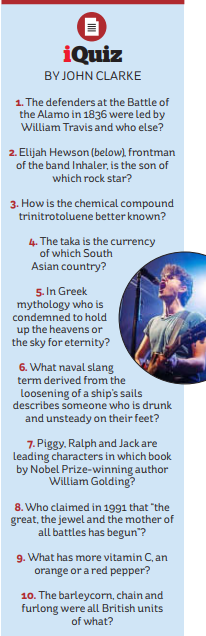
Once again, political journalist John Rentoul loses out to me, his quite creditable score of 6/10 having been pipped by my 7/10. I did not know the answers to questions 1, 2, and 4.
Almost all liars try to build their structure of lies on a foundation of truth. Thus the “holocaust” farrago (“gas chambers” and all) has been built up on the foundation of the fact that a large number of Jews and others in the German Reich and some surrounding countries were interned and then deported to the East after 1939 (though in fact there were still 900 Jews living in Berlin itself by early 1945).
If someone says “someone woke up, had breakfast, took a bus into a nearby town, then returned the same way, until the bus took to the air and went into outer space”, is that sentence “true” or “untrue”? It is (perhaps) true in part, but the most spectacular part of the sentence is patently untrue.
If you then say “well, the basic narrative happened, but not the bit about the bus going into the air and then into space”, then you are telling the more exact truth, but someone who is trying to sell books based on the “flying bus” might be harsh enough to say that you are “telling lies” or, to put it another way, being a “flying bus denier”, and engaging in “flying bus denial”.
My “progressive alliance” calculator applied to average of most recent polls https://t.co/LeE4FlIWUg Con 40% + LibDem/Green 4% = 44% Lab 34% + LibDem/Green 7% + SNP 4% = 45%
Security panic, 1939 style. London street maps removed from my vintage atlas. The Germans would obviously have had no other means of finding their way round the capital, had they got here. pic.twitter.com/w9o6mQD4yW
One of the silliest aspects of the UK public’s perception of 1939-1945 is that “the war was won” not by the vast hordes of the Red Army advancing west (fuelled and supplied largely by American industry), and not by the equally-huge American forces committed to the fight after 1941 and actually fighting on the western flank after 1942 (not to mention the secret atom bomb project), but by terribly clever little wheezes dreamed up by terribly clever little people in Whitehall back rooms. Country signposts turned round, or removed, maps of London not published (because the Germans will not have had even one streetmap of London in their possession) etc.
Thus the constant (80 years later) wave of books, TV shows etc about such as the actually shambolic and (overall) pointless activities of the Special Operations Executive [SOE], stabbing the odd German sentry, or vandalizing bits of rail track; or about the (tiny) “Secret Army” of gamekeepers and farmers etc, who were supposed to be ready to set the UK ablaze should German forces invade. Such plans owed more to John Buchan’s books, or those of other authors, than to reality.
@bananas1968 Whatever she needs, I wish more people would believe in Frizelda. If they did (she's the opposite of Tinkerbell here) she might go away. But lots want to believe all's OK, there's no shadow-banning, no rigged algorithms, the internet is free and fair. Sweet, really. https://t.co/BPbmfFrNve
Still, just as every lock has a key, so every internet company has a boss, and a cadre of those with the power to ban, unban, restrict etc. At present, it could be said that if they have a Luger at their heads, it is that of the State, or perhaps of the Zionist lobby.
Tweeter “@kieronf2” does not seem to me to merit the label “freethinker”, or even “thinker”…though I am sure that he is generally well-meaning; a retired Metropolitan Police detective, now resident in Minorca.
I would not oppose such a programme if it were voluntary. The population is largely overweight and largely sedentary. I myself am now a prime example, if truth be known. The days when I trekked miles, sometimes dozens of miles in a day, through landscapes such as the African bush, Welsh and English countryside, and the Tien Shan mountains, have long long gone! Ditto the almost daily 1-2 mile swims that I once undertook.
The NHS and society generally is paying out huge sums for treatment for “lifestyle” diseases, and the most widespread of those are caused at least partly, if not mainly, by dietary and exercise deficiencies.
The devil here is in the detail. The spending cuts of 2008-2019 have closed large numbers of, not only libraries, but also swimming pools, lidos etc. There should be a programme of constructing swimming pools, as well as other health-leisure facilities, such as athletics tracks. Many parks have been closed or built upon. Britain needs new parks, both for aesthetic reasons and for the gentle exercise of strolling in the park.
Boris: The New Blair 'What Mr. Johnson has done, in my view, is portray himself as the new Blair, a friendly, smiling figurehead, accessible and charming, who appears unthreatening while concealing a vast agenda of change.' https://t.co/wUg5ZmlUYK
I have blogged repeatedly about the 33-year cycle. It brings in huge changes for the succeeding few decades. The last key year was 1989. That ended old-style socialism as a serious force in world affairs. Yes, some actions preceded 1989, and a few remnants of the old world order persisted after 1989; a few still do, here and there: tiny or backward states such as North Korea, Cuba, Venezuela. Yes, China still (ludicrously) labels itself as a socialist country ruled by a Communist party, but the reality is quite other.
Look at the UK. Before 1989, Britain had an avowedly “socialist” (basically social-democratic) party, the Labour Party. After 1989, the “socialist” MPs took a back seat, Clause 4/ Clause IV [https://en.wikipedia.org/wiki/Clause_IV] was dropped, and “Labour” just became a label, with a policy overview not very different from that of the mainstream of the Conservative Party.
Indeed, after Labour’s 1997 “landslide” (not really a landslide in terms of popular vote), Labour prime ministers and other ministers started to look not unlike “Conservative” ministers. Indeed, Cameron (Cameron-Levita) and Blair are often called similar in terms of policy.
Now, we see another change about to happen, as the New World Order [NWO] and ZOG seek to tighten their grip on the world, and especially on the West.
Thousands of people are campaigning against vaccine passports, face masks and further lockdowns in Trafalgar Square today as part of The Worldwide Rally For Freedom.#talkRADIO | #londonprotestpic.twitter.com/wd5waFDEr2






















 Ian Robert Millard